
Search

Becs (244 KP) rated How NOT to Summon a Demon Lord in TV
Jul 22, 2019


Catching and Action-Packed!
TRIGGER WARNINGS: memory loss, anger issues, agoraphobia, graphic injuries, fat-shaming, body-shaming, forced marriage, incest, manipulation, toxic relationship, mind control, misogynistic language, slavery, torture, violence, executions
I was generally worried at whether this show was going to be good or if it was going to be one of those trashy anime's that are just 'alright'. I randomly put it on as I had just finished my hundredth re-watch of Vampire Knight and was shocked. This was crafted into a rather enjoyable story that had an amazing cast of main characters. There was silliness, softcore (ecchi) content, action, and adventure.
Throughout the show, there are scenes that are deemed inappropriate and the first episode contains one of those "whoa there" scenes. I wouldn't recommend watching if you don't want somewhat sexual scenes littered throughout the show. Besides those moments, How NOT to Summon a Demon Lord is pretty fun and an enjoyable series that fits with the genre of the show.
How NOT to Summon a Demon Lord captures the whole overpowered main character but balances it with a main character that has limits to his power. There is also the whole sense of danger to those that are close to the main character. The story is told really well and wraps up nicely, leaving the ending open so that if more seasons do end up getting made it would work perfectly with continuing the story on. But if this was the end, then it ended on a good note.
You won't see much of the modern world in the show except for the very beginning. The setting is set in a parallel fantasy world (isekai) where the main character is instantly sucked into a world similar to the game that he was playing. There isn't much connection between the game world and the modern world, but it really isn't an issue as it happened early on in the show.
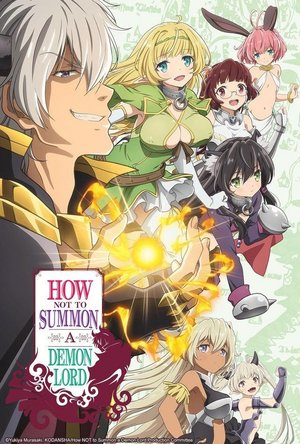
The show itself is about the main character, who plays an all-mighty powerful Demon Lord in a game in the modern world, but then gets physically summoned into this parallel fantasy world. The twist: the main character is actually stuck in the body of his character Diablo. The story follows a pretty typical plotline where the main character adapts to being in a new body, a new world, how he deals with his surroundings, and how he tackles the issues that arise.
The biggest plot point revolves around the two summoners: Rem and Shera. Each had their own reason for summoning Diablo and he even gets involved with those same issues, seeking to help them. It's insinuated incredibly well that these two young women are main characters alongside Diablo, but some issues arise. Like the slave collars that are around the women's necks should have been around Diablo's neck. The issues that these young women have are as weighty as the salve collars. Slavery is apparently legal in this world, but Diablo doesn't abuse his power and actually allows the women to do as they please, even going as far as forming a bond with both of them.
Overall, I enjoyed watching the story unfold and seeing the producers establish the difference between the modern world and the game that Diablo was experiencing. And even seeing Diablo overpower so many of the opponents he encountered throughout the world. I was entertained throughout every episode and ended up binging this in an entire night!
Generally, when you have a show like this, the characters have to carry a ton to really make the show good. In How NOT to Summon a Demon Lord, they do an exceptional job at portraying that. Diablo is a pretty solid main character, even being likable! The problem with action-packed shows like this with an overly powerful main character is that the character isn't likable and that makes the show rather boring. With this show, you do not get that vibe one bit. Diablo actually works because he's a generally nice guy at heart, never resorting to using his powers right away or even stop caring about whether or not he kills someone. His strength is evenly matched with his lack of communication and his heavy social anxiety. I mean, you get inside his head quite often and he uses both his brains and brawn to help in a rough spot, instead of just randomly firing about as most power main characters do. This really adds to the appeal of Diablo.
The other two main characters, Rem and Shera are two girls with their own reasons for summoning a powerful demon to aid them. Both are entertaining and even have their own backstories that really add to the story. Rem's backstory is a bit more emotional compared to Shera's but the watcher is able to emphasize with both excruciatingly well. Especially when all three main characters develop a sturdy friendship and gain the trust of the others. Shera is the glue that holds both Rem and Diablo together when they start doubting themselves.
There are a wide variety of antagonists and side characters that don't get a ton of focus, but they do help push the main cast and story along. These antagonists have their own goals and that causes serious conflict with the goals Diablo, Rem, and Shera have/want to do. But then there are also the side characters that are actually on the side of the three mains and do play important roles in various points of the story.
The art and visual effects were well down and it wasn't the same graphic scenes and spells as most anime's do. For instance, Diablo doesn't just spam the same spell over and over (like I do when I'm playing a game because I'm a button smasher haha) instead, he uses different attacks and spells for each occasion. The show doesn't shower blood around like it's rain *cough cough Game of Thrones cough cough*, but it does a good enough job letting the watcher know when someone gets hurt/ dies.
My final thoughts:
Overall, this was a well-done show that held the action and made the characters very likable, without rushing the story. There is comedy, action, magic, and a bit of a push on the boundary with softcore (ecchi) content but you get a good sense from the main characters and story that it's defiantly worth checking out.
I was generally worried at whether this show was going to be good or if it was going to be one of those trashy anime's that are just 'alright'. I randomly put it on as I had just finished my hundredth re-watch of Vampire Knight and was shocked. This was crafted into a rather enjoyable story that had an amazing cast of main characters. There was silliness, softcore (ecchi) content, action, and adventure.
Throughout the show, there are scenes that are deemed inappropriate and the first episode contains one of those "whoa there" scenes. I wouldn't recommend watching if you don't want somewhat sexual scenes littered throughout the show. Besides those moments, How NOT to Summon a Demon Lord is pretty fun and an enjoyable series that fits with the genre of the show.
How NOT to Summon a Demon Lord captures the whole overpowered main character but balances it with a main character that has limits to his power. There is also the whole sense of danger to those that are close to the main character. The story is told really well and wraps up nicely, leaving the ending open so that if more seasons do end up getting made it would work perfectly with continuing the story on. But if this was the end, then it ended on a good note.
You won't see much of the modern world in the show except for the very beginning. The setting is set in a parallel fantasy world (isekai) where the main character is instantly sucked into a world similar to the game that he was playing. There isn't much connection between the game world and the modern world, but it really isn't an issue as it happened early on in the show.
The show itself is about the main character, who plays an all-mighty powerful Demon Lord in a game in the modern world, but then gets physically summoned into this parallel fantasy world. The twist: the main character is actually stuck in the body of his character Diablo. The story follows a pretty typical plotline where the main character adapts to being in a new body, a new world, how he deals with his surroundings, and how he tackles the issues that arise.
The biggest plot point revolves around the two summoners: Rem and Shera. Each had their own reason for summoning Diablo and he even gets involved with those same issues, seeking to help them. It's insinuated incredibly well that these two young women are main characters alongside Diablo, but some issues arise. Like the slave collars that are around the women's necks should have been around Diablo's neck. The issues that these young women have are as weighty as the salve collars. Slavery is apparently legal in this world, but Diablo doesn't abuse his power and actually allows the women to do as they please, even going as far as forming a bond with both of them.
Overall, I enjoyed watching the story unfold and seeing the producers establish the difference between the modern world and the game that Diablo was experiencing. And even seeing Diablo overpower so many of the opponents he encountered throughout the world. I was entertained throughout every episode and ended up binging this in an entire night!
Generally, when you have a show like this, the characters have to carry a ton to really make the show good. In How NOT to Summon a Demon Lord, they do an exceptional job at portraying that. Diablo is a pretty solid main character, even being likable! The problem with action-packed shows like this with an overly powerful main character is that the character isn't likable and that makes the show rather boring. With this show, you do not get that vibe one bit. Diablo actually works because he's a generally nice guy at heart, never resorting to using his powers right away or even stop caring about whether or not he kills someone. His strength is evenly matched with his lack of communication and his heavy social anxiety. I mean, you get inside his head quite often and he uses both his brains and brawn to help in a rough spot, instead of just randomly firing about as most power main characters do. This really adds to the appeal of Diablo.
The other two main characters, Rem and Shera are two girls with their own reasons for summoning a powerful demon to aid them. Both are entertaining and even have their own backstories that really add to the story. Rem's backstory is a bit more emotional compared to Shera's but the watcher is able to emphasize with both excruciatingly well. Especially when all three main characters develop a sturdy friendship and gain the trust of the others. Shera is the glue that holds both Rem and Diablo together when they start doubting themselves.
There are a wide variety of antagonists and side characters that don't get a ton of focus, but they do help push the main cast and story along. These antagonists have their own goals and that causes serious conflict with the goals Diablo, Rem, and Shera have/want to do. But then there are also the side characters that are actually on the side of the three mains and do play important roles in various points of the story.
The art and visual effects were well down and it wasn't the same graphic scenes and spells as most anime's do. For instance, Diablo doesn't just spam the same spell over and over (like I do when I'm playing a game because I'm a button smasher haha) instead, he uses different attacks and spells for each occasion. The show doesn't shower blood around like it's rain *cough cough Game of Thrones cough cough*, but it does a good enough job letting the watcher know when someone gets hurt/ dies.
My final thoughts:
Overall, this was a well-done show that held the action and made the characters very likable, without rushing the story. There is comedy, action, magic, and a bit of a push on the boundary with softcore (ecchi) content but you get a good sense from the main characters and story that it's defiantly worth checking out.
Purple Phoenix Games (2266 KP) rated Hit the Silk! in Tabletop Games
Mar 9, 2021

Ok here’s the deal. You and your buddies have gone in deep with the casino and they are out to ice you if you don’t pay up. You have secured the funds to repay your debts and have hijacked the plane needed to get back to settle up. There’s just one problem: there are 3-6 of you and only 2-5 parachutes on board this plummeting aircraft. With whom to ally and can you make it off the plane with enough parachutes and money to make this run worth it?
Hit the Silk! is a semi-cooperative game about hidden information, strong and weak alliances, bluffing, and negotiation in the skies where the plane WILL go down. Players will be trading information with others in order to figure out which players they will unite with and which they will deceive to win the game. Not all players can win, and some players may not even survive the flight. WHO DO YOU TRUST?
DISCLAIMER: We were provided a prototype copy of this game for the purposes of this review. These are preview copy components, and I do not know for sure if the final components will be any different from these shown. Also, it is not my intention to detail every rule in the game, as there are just too many. For this preview I will be describing the Standard game mode. You are invited to download the rulebook, back the game through the Kickstarter campaign, or through any retailers stocking it after fulfillment. -T
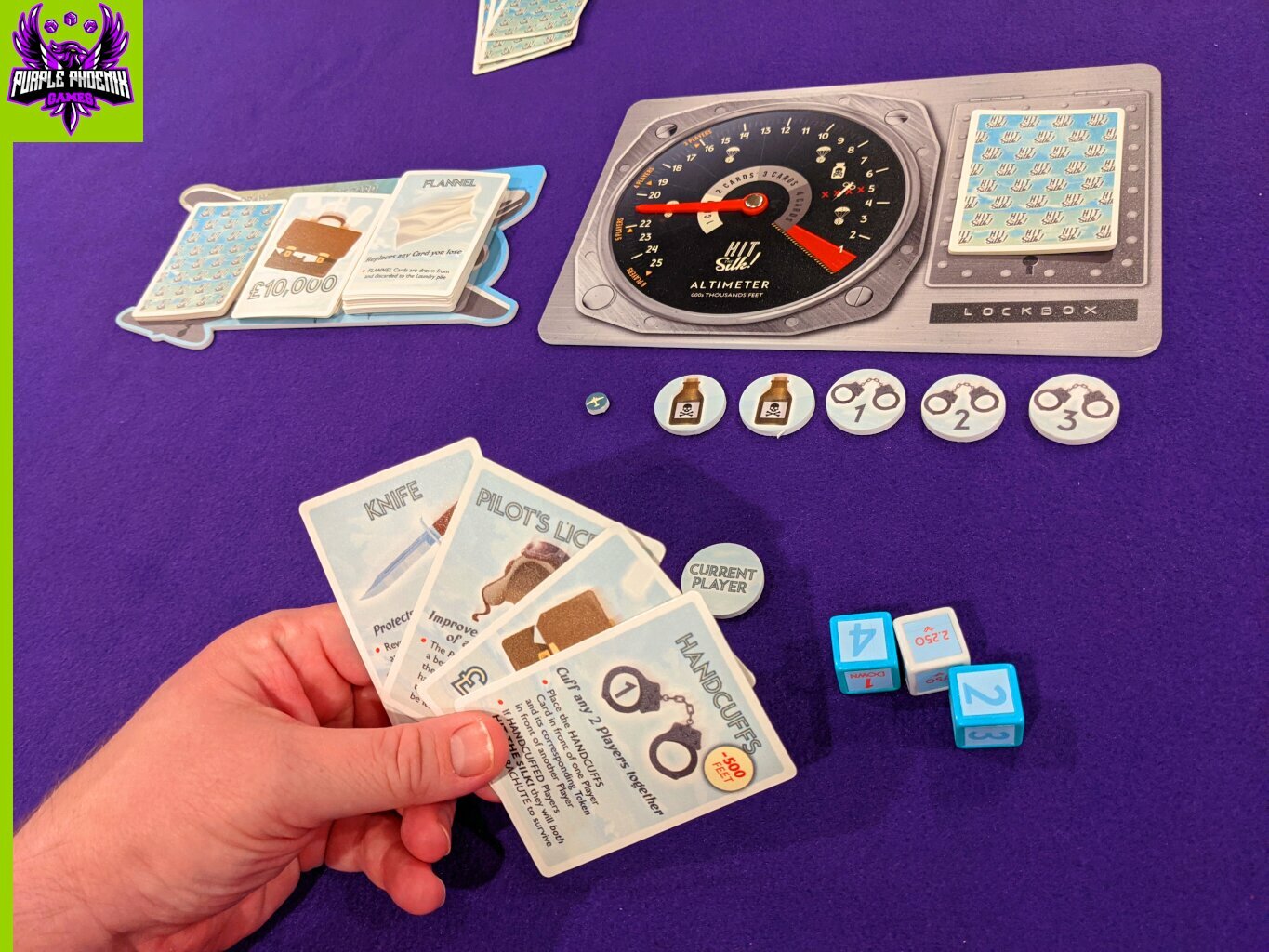
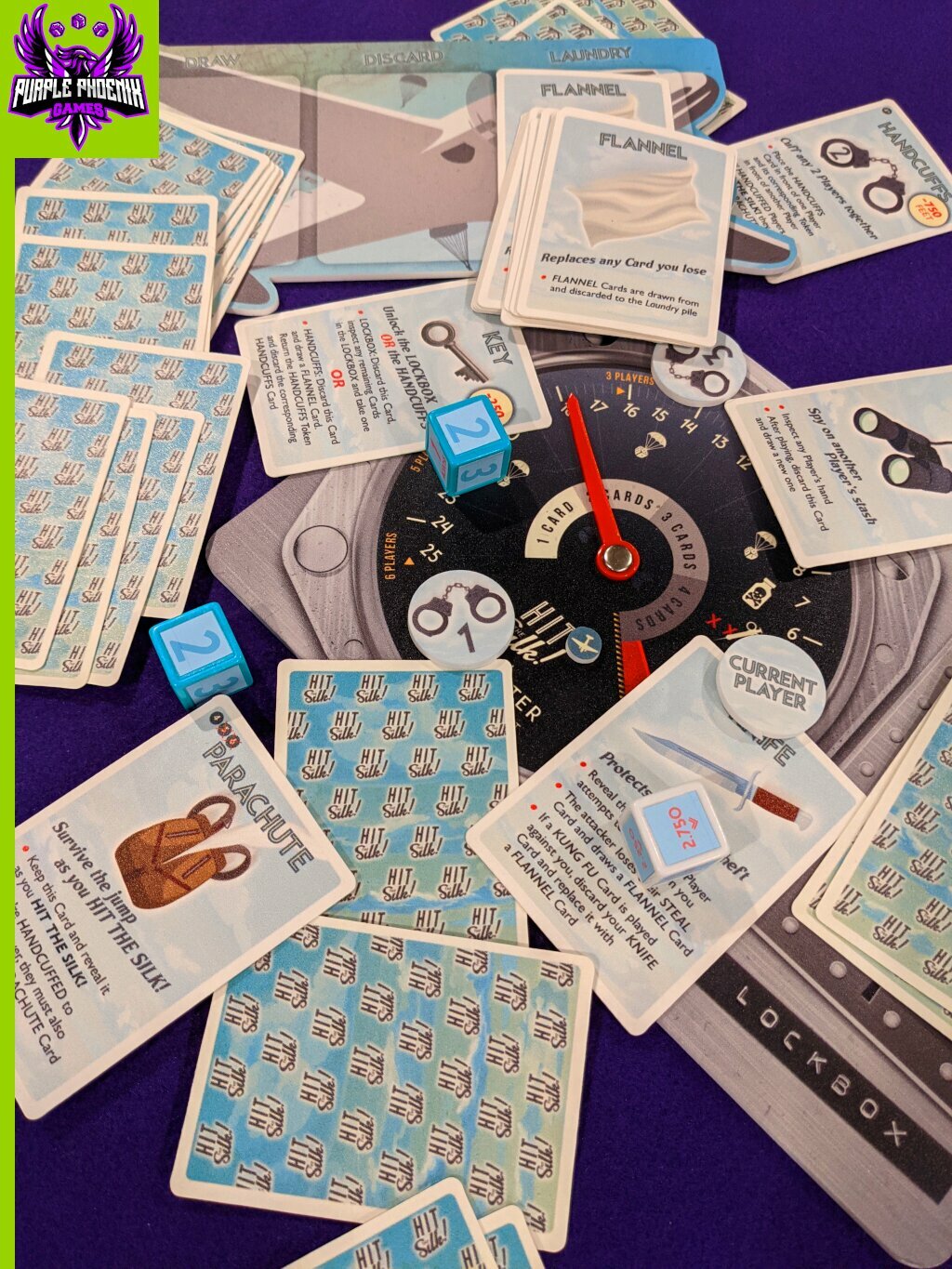
To setup, place the Altimeter board on the table and set the needle to the correct altitude per number of players. The card organizer board is setup near the Altimeter with the Flannel cards on the Laundry space, the draw deck on the left space, and the discard pile between the two. Four cards are randomly placed face-down onto the Lockbox space on the Altimeter board, and six cards are dealt to the players. They will choose four to keep and discard the other two. Place all remaining components on the table. A first player is chosen and the game is setup to begin!
On a turn a player may do any or all of the following: Change a card, Take actions, Trade with another player. To change a card the current player will choose one card from their hand, either discarding face-up to the discard pile or to the Laundry if it is a Flannel card, and then drawing a number of cards pertaining to the altitude level on the Altimeter board (the higher the plane the less cards can be drawn). The player chooses one card to keep and discards the others.
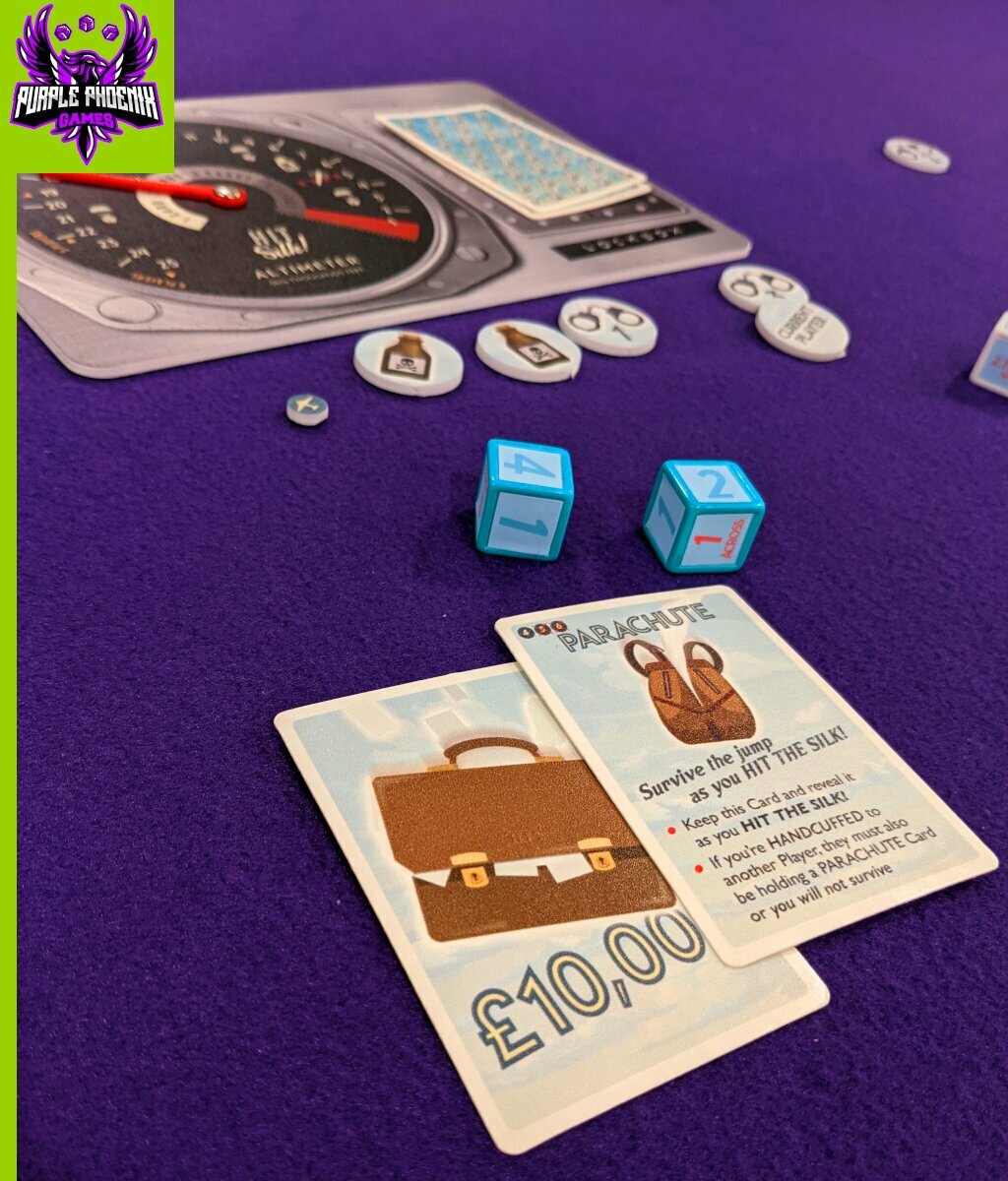
Many cards will be action cards, so during a turn the active player can use as many action cards as they wish. To take an action the player simply notes any altitude adjustments printed on the card, adjusts the Altimeter needle by that much, then plays the card for its action. Some action cards allow players to Steal cards from another player (blocked by a Knife card), Spy another player’s hand, Handcuff two players together (or a player to a briefcase of money), use Key cards to unlock Handcuffs or to pilfer one card from the Lockbox on the Altimeter board, Poison another player (cured with the Antidote card), kick a weapon out of a player’s hand by using a Kung Fu card, or blatantly attacking a player by using both a Pistol and a Bullet card. Players will take one wound from the first bullet and will be permanently slain by taking another bullet wound.
The final action that can be taken on a turn is trading with another player. This is a risky action to take as players are not bound by their verbal agreements. Therefore, a player may offer to trade a Bullet and a Knife in exchange for a $10,000 and a Key card. However, neither player is REQUIRED to trade these exact items during the trade, and alliances weaken over trade disputes.
Intermittently throughout the game, as altitude drops, players are given the task to vote whether to keep flying or to hit the silk (which means to jump out of the plane with a parachute in hand)! Should players vote by majority to continue playing the game keeps going as before. If the players vote by majority to hit the silk!, then all players with parachutes reach the ground safely and pool together their money in hopes of reaching the goal amount determined at the start of the game. Those who jump without a parachute sadly perish, but those who are able to stay on the plane without being handcuffed to a jumping player may attempt the very difficult task of landing the plane (which involves the dice shown, but I will let you discover the method on your own).
Should the landing party have gathered enough money to pay the debt, those players win! If the player lands the plane correctly they win! If a player dies, well, they lose.
Components. Again, this is a prototype copy of the game, so components shown are probably going to look differently as the result of a successful Kickstarter campaign. That said, I want to first applaud Escape Plan Board Games for their usage of “eco-conscious production.” The component materials we received are certainly unlike any I have felt or played with in the past. They feel different, and I assume it is due to this new eco-friendly material they are using. I also want to point out the art style of Hit the Silk! It is fabulous and definitely gives off that jetset vibe. I love it! I do hope the dice will be getting an upgrade in the final version, as stickered dice are rarely in style. I have not seen or heard of any plans for upgrades or final components, but I hope a nice eco-friendly upgrade option exists for this game.
So here’s the rub. I truly like this game quite a bit. I do have issues with player elimination games, personally, because for whatever reason I am always the first to be targeted for elimination. While it’s funny at first, I despise having to be left out of the rest of the game. That said, I still very much enjoy this game. Yes, I don’t like being targeted, but I am able to take one for the team, and then ask players to try a different strategy the next playthrough. Being able to make loose alliances and just break trades by giving the other player two Flannels instead of the Parachute and Key is just fun times. I enjoy the ever-decreasing altitude of the plane that stresses players to get things done quickly without having the needle dip too far for comfort. I like that a lot.
I wish the dice were used more in the game (at least in Standard mode), as I love nice chunky dice, but I can look past this because the rest of the gameplay is so solid. I still have yet to figure out the best way to use the Handcuffs, but the weapons and Kung Fu are just so ridiculous and amazing simultaneously that I like using them as soon as I get them in hand. So if you, like me, have a hole in your collection for a game taking place in the skies featuring a gang of casino-chased hoodlums, then I urge you to take a look at Hit the Silk! Just know that if you handcuff yourself to me, you can bet on me making some very inappropriate comments.
Hit the Silk! is a semi-cooperative game about hidden information, strong and weak alliances, bluffing, and negotiation in the skies where the plane WILL go down. Players will be trading information with others in order to figure out which players they will unite with and which they will deceive to win the game. Not all players can win, and some players may not even survive the flight. WHO DO YOU TRUST?
DISCLAIMER: We were provided a prototype copy of this game for the purposes of this review. These are preview copy components, and I do not know for sure if the final components will be any different from these shown. Also, it is not my intention to detail every rule in the game, as there are just too many. For this preview I will be describing the Standard game mode. You are invited to download the rulebook, back the game through the Kickstarter campaign, or through any retailers stocking it after fulfillment. -T
To setup, place the Altimeter board on the table and set the needle to the correct altitude per number of players. The card organizer board is setup near the Altimeter with the Flannel cards on the Laundry space, the draw deck on the left space, and the discard pile between the two. Four cards are randomly placed face-down onto the Lockbox space on the Altimeter board, and six cards are dealt to the players. They will choose four to keep and discard the other two. Place all remaining components on the table. A first player is chosen and the game is setup to begin!
On a turn a player may do any or all of the following: Change a card, Take actions, Trade with another player. To change a card the current player will choose one card from their hand, either discarding face-up to the discard pile or to the Laundry if it is a Flannel card, and then drawing a number of cards pertaining to the altitude level on the Altimeter board (the higher the plane the less cards can be drawn). The player chooses one card to keep and discards the others.
Many cards will be action cards, so during a turn the active player can use as many action cards as they wish. To take an action the player simply notes any altitude adjustments printed on the card, adjusts the Altimeter needle by that much, then plays the card for its action. Some action cards allow players to Steal cards from another player (blocked by a Knife card), Spy another player’s hand, Handcuff two players together (or a player to a briefcase of money), use Key cards to unlock Handcuffs or to pilfer one card from the Lockbox on the Altimeter board, Poison another player (cured with the Antidote card), kick a weapon out of a player’s hand by using a Kung Fu card, or blatantly attacking a player by using both a Pistol and a Bullet card. Players will take one wound from the first bullet and will be permanently slain by taking another bullet wound.
The final action that can be taken on a turn is trading with another player. This is a risky action to take as players are not bound by their verbal agreements. Therefore, a player may offer to trade a Bullet and a Knife in exchange for a $10,000 and a Key card. However, neither player is REQUIRED to trade these exact items during the trade, and alliances weaken over trade disputes.
Intermittently throughout the game, as altitude drops, players are given the task to vote whether to keep flying or to hit the silk (which means to jump out of the plane with a parachute in hand)! Should players vote by majority to continue playing the game keeps going as before. If the players vote by majority to hit the silk!, then all players with parachutes reach the ground safely and pool together their money in hopes of reaching the goal amount determined at the start of the game. Those who jump without a parachute sadly perish, but those who are able to stay on the plane without being handcuffed to a jumping player may attempt the very difficult task of landing the plane (which involves the dice shown, but I will let you discover the method on your own).
Should the landing party have gathered enough money to pay the debt, those players win! If the player lands the plane correctly they win! If a player dies, well, they lose.
Components. Again, this is a prototype copy of the game, so components shown are probably going to look differently as the result of a successful Kickstarter campaign. That said, I want to first applaud Escape Plan Board Games for their usage of “eco-conscious production.” The component materials we received are certainly unlike any I have felt or played with in the past. They feel different, and I assume it is due to this new eco-friendly material they are using. I also want to point out the art style of Hit the Silk! It is fabulous and definitely gives off that jetset vibe. I love it! I do hope the dice will be getting an upgrade in the final version, as stickered dice are rarely in style. I have not seen or heard of any plans for upgrades or final components, but I hope a nice eco-friendly upgrade option exists for this game.
So here’s the rub. I truly like this game quite a bit. I do have issues with player elimination games, personally, because for whatever reason I am always the first to be targeted for elimination. While it’s funny at first, I despise having to be left out of the rest of the game. That said, I still very much enjoy this game. Yes, I don’t like being targeted, but I am able to take one for the team, and then ask players to try a different strategy the next playthrough. Being able to make loose alliances and just break trades by giving the other player two Flannels instead of the Parachute and Key is just fun times. I enjoy the ever-decreasing altitude of the plane that stresses players to get things done quickly without having the needle dip too far for comfort. I like that a lot.
I wish the dice were used more in the game (at least in Standard mode), as I love nice chunky dice, but I can look past this because the rest of the gameplay is so solid. I still have yet to figure out the best way to use the Handcuffs, but the weapons and Kung Fu are just so ridiculous and amazing simultaneously that I like using them as soon as I get them in hand. So if you, like me, have a hole in your collection for a game taking place in the skies featuring a gang of casino-chased hoodlums, then I urge you to take a look at Hit the Silk! Just know that if you handcuff yourself to me, you can bet on me making some very inappropriate comments.

Annie Chanse (15 KP) rated Shadows & Dreams in Books
Dec 19, 2017


Review** spoiler alert ** *Warning: contains spoilers, bad words, and quite a long rant*
To be honest, I was very disappointed in this book. It had a great premise, which meant it had the potential to be a really good story, but the writing style of the author just completely ruined this book for me.
The basic idea behind the story is that Kate Kane, a paranormal PI, sets off on a case to find the brother of a woman she slept with once, and during this investigation, she runs into ALL MANNER OF TROUBLE. There are vampires and werewolves and ex-girlfriends around every corner, just lurking and waiting to pounce on Miss Kane. It's a very busy and involved story, and if it had been better written, I would have easily given it four stars at least, but there was just TOO much about this book -- style-wise -- that drove me insane.
For instance:
1. The plot, itself, is actually fairly well thought out and developed and is nowhere NEAR as cheesy as it sounds when you hear, "Vampires fighting werewolves," -- which, let's be honest, these days is so trite and overdone that it is scoffed at on a regular basis. However, there IS a good story in this novel. But the way Hall writes the not-cheesy story is so cheesy that it makes you THINK the story is cheesy. A lot of cheese, huh? A little confusing? Well then, let me give you an example.
Page 7-8: "Truth be told it was a little bit awkward, but my social weirdness threshold has gone way up since my girlfriend tried to murder my ex-girlfriend because her ex-girlfriend tried to murder her."
Okay... a bit ridiculous, especially seven/eight pages in, but I can roll with it. However, at the bottom of page eight:
Kane asks, "Who saw him last?"
Her assistant -- who is actually a statue brought to life and gifted to Kate by a group of rats who are apparently all seeing and all knowing God-types -- says, "I don't know. [...] Probably somebody at the hospital."
Kane asks, "Which one?"
And the assistant replies with this fantastic line: "The Whittington. He broke his leg changing a light bulb. Because he was standing on a swivel chair because he's an idiot."
Okay, I concede that maybe this line is supposed to sound ridiculous and funny, so I can even let that one slide. But then, three pages later, Hall completely turns me off to the book with this:
"Well, fuck. I was about to be hired by a woman I'd very nearly slept with to find her missing brother who was working for the woman who'd left me for a tech startup at the tech startup she left me for."
Wh-wh-what?! Are you kidding me? Could that sentence BE anymore convoluted or that plot-point any more ridiculously stereotypical?
And what is truly awful is that the story itself REALLY WASN'T THAT BAD. I mean, the writing was awful, which, overall, meant that the novel was -- in my opinion, of course -- bad, but the way the story progressed WAS interesting. It was nowhere near as bad as these 'recaps' by the main character make it sound, but the problem is that Hall throws in these inner-monologues for Kane ALL throughout the book, and they are terrible! Which, in turn, decreases the value of the entire story.
Another example falls right on the heels of the page 11 jewel.
Page 14: "I really really hoped this wasn't going to be another zombie plague. There'd been an outbreak when I'd taken Eve up to Lake Windermere for our third anniversary, and we'd spent the whole weekend under siege in the hotel, making molotovs from the minibar and clubbing re-animated tourists to death with souvenir walking sticks."
Really? Zombies now? On top of the vampires, witches, and werewolves? Can we POSSIBLY fit anymore para into this normal?
Enough with that.
Now on to point number 2. The girl on girl sex scenes in this book between sexy, snarky PI and her vampire girlfriend, the Prince (yes, Prince) of Cups, should be hot, right? No. They are forced, fake, and ridiculous. Halfway through the first one, I thought, "Jesus. This isn't lesbian sex. This is lesbian sex if it was written by a man who WISHES he could see some lesbian sex." That was the point at which I decided to look up more info on Alexis Hall, and I found out that he is, in fact, a man, which at least explains the sex scenes.
#3. Speaking of sex scenes, Hall also has this really irritating -- and distracting -- habit of throwing in random, explicitly sexual thoughts at TOTALLY inappropriate times. Right in the middle of the most stressful situations -- being locked up, about to be killed, thrown in prison/on trial -- Kate Kane begins inner-monologuing with herself about how much she'd like to fuck whatever female happens to be standing in front of her. RIDICULOUS! And annoying. Hated it.
4. One of the MOST annoying things about this book, however, was that it was in DESPERATE need of a SERIOUS case of editing. All throughout the book there were glaring errors that any first year college student should have caught while reading. I'm willing to discount SOME of these "errors" as simply being lost in translation, as the book is written with a British tone, and I am very much American. However, SOME of these errors simply CANNOT be due to anything other than careless editing.
For instance, page 113: "It's main distinguishing feature, right, was that was it was blue."
WAS that WAS it WAS blue? What does that even mean? Oh, yes, it means that no one bothered editing this beast before printing.
Page 141: "Piercing the heart will paralyse, but it won't kill, and anything will do, it doesn't have to wood."
Okay, so maybe the "paralyse" is simply British, but surely the "doesn't have to wood" bit needs a "be" in there somewhere, right?
Page 157: "Have we have achieved case closed, Miss Kane?"
Yes, yes have we have.
There are several -- SEVERAL -- more examples of these type errors, but I'm not about to point them all out. If you read the book, I'm sure you'll easily catch them on your own.
5. Another thing that drove me NUTS was the repetition. The awful thing is I'm fairly certain that Hall used these repetitious lines PURPOSELY to create some kind of effect -- humor, maybe? Whatever the desired result, it failed to do anything other than annoy me.
For instance, page 163: "'Hi. So. Look.' I tried to find a way to express the fact I had some good news and some bad news that wasn't I've got some good news and some bad news. 'I've got some good news and some bad news.'"
...blink... ...falls over...
Page 177: "All the more reason to tell them. [...] If they know that we know that she has returned, then they will not be tempted to conspire against us out of the false belief that we do not know. Of course, they may already know, but at present, we have no way to know what they know. If we tell them, we will know what they know, and all we will not know is how long they have known it."
Oh. Jumping. Jesus. On. A. Pogo. Stick. Please tell me you aren't serious.
And there was this one thing that repeated over and over again throughout the book. The first time, it was actually pretty clever. The second time, even, was okay. But by the time I'd read it nine times -- yes, NINE TIMES, no exaggeration whatsoever -- I was ready to never EVER read anything like it ever again.
This particular phrase was something Kate Kane internalized or muttered aloud to herself each time she decided to do something stupid OR she felt her life was in danger. The basic format went something like this:
"Here lies Kate Kane, died peacefully in her sleep aged 94. Beloved daughter."
The "Here lies Kate Kane" part remained constant, as did the "Beloved daughter." It was only the middle part that changed, for instance, "Here lies Kate Kate. Should have minded her own business. Beloved daughter." Or perhaps, "Here lies Kate Kane. She made a difference to dozens. Beloved daughter."
This continued NINE TIMES. It is not cute, funny, or clever after about the second time, definitely after the third. BUT NINE TIMES?! Come on!
And finally, my last complaint.
6. Several of the items, scenes, quotes, etc. in this book seemed waaaaaaaaaay too close to things from other books for my taste. Perhaps it is simply a coincidence and the author did not intentionally siphon plot points and details from other authors -- except, of course, when he obviously did in his quotations, such as his use of "Not all those who wander are lost" and "As old as my tongue, a little bit older than my teeth" which are DIRECTLY taken from other books, but I'm hoping those were intentional and not attempted-to-get-away-with-it plagiarism.
But there are several things in this novel that could have been taken from Jim Butcher's "Dresden Files", Lewis' "Narnia" chronicles, and Tolkien's "Lord of the Rings" series. I'm hoping, however, that they weren't, but they were very, very similar.
All in all, I'm disappointed to say that I was not a fan of this book at all, and I will most likely not be reading anymore Kate Kane books.
To be honest, I was very disappointed in this book. It had a great premise, which meant it had the potential to be a really good story, but the writing style of the author just completely ruined this book for me.
The basic idea behind the story is that Kate Kane, a paranormal PI, sets off on a case to find the brother of a woman she slept with once, and during this investigation, she runs into ALL MANNER OF TROUBLE. There are vampires and werewolves and ex-girlfriends around every corner, just lurking and waiting to pounce on Miss Kane. It's a very busy and involved story, and if it had been better written, I would have easily given it four stars at least, but there was just TOO much about this book -- style-wise -- that drove me insane.
For instance:
1. The plot, itself, is actually fairly well thought out and developed and is nowhere NEAR as cheesy as it sounds when you hear, "Vampires fighting werewolves," -- which, let's be honest, these days is so trite and overdone that it is scoffed at on a regular basis. However, there IS a good story in this novel. But the way Hall writes the not-cheesy story is so cheesy that it makes you THINK the story is cheesy. A lot of cheese, huh? A little confusing? Well then, let me give you an example.
Page 7-8: "Truth be told it was a little bit awkward, but my social weirdness threshold has gone way up since my girlfriend tried to murder my ex-girlfriend because her ex-girlfriend tried to murder her."
Okay... a bit ridiculous, especially seven/eight pages in, but I can roll with it. However, at the bottom of page eight:
Kane asks, "Who saw him last?"
Her assistant -- who is actually a statue brought to life and gifted to Kate by a group of rats who are apparently all seeing and all knowing God-types -- says, "I don't know. [...] Probably somebody at the hospital."
Kane asks, "Which one?"
And the assistant replies with this fantastic line: "The Whittington. He broke his leg changing a light bulb. Because he was standing on a swivel chair because he's an idiot."
Okay, I concede that maybe this line is supposed to sound ridiculous and funny, so I can even let that one slide. But then, three pages later, Hall completely turns me off to the book with this:
"Well, fuck. I was about to be hired by a woman I'd very nearly slept with to find her missing brother who was working for the woman who'd left me for a tech startup at the tech startup she left me for."
Wh-wh-what?! Are you kidding me? Could that sentence BE anymore convoluted or that plot-point any more ridiculously stereotypical?
And what is truly awful is that the story itself REALLY WASN'T THAT BAD. I mean, the writing was awful, which, overall, meant that the novel was -- in my opinion, of course -- bad, but the way the story progressed WAS interesting. It was nowhere near as bad as these 'recaps' by the main character make it sound, but the problem is that Hall throws in these inner-monologues for Kane ALL throughout the book, and they are terrible! Which, in turn, decreases the value of the entire story.
Another example falls right on the heels of the page 11 jewel.
Page 14: "I really really hoped this wasn't going to be another zombie plague. There'd been an outbreak when I'd taken Eve up to Lake Windermere for our third anniversary, and we'd spent the whole weekend under siege in the hotel, making molotovs from the minibar and clubbing re-animated tourists to death with souvenir walking sticks."
Really? Zombies now? On top of the vampires, witches, and werewolves? Can we POSSIBLY fit anymore para into this normal?
Enough with that.
Now on to point number 2. The girl on girl sex scenes in this book between sexy, snarky PI and her vampire girlfriend, the Prince (yes, Prince) of Cups, should be hot, right? No. They are forced, fake, and ridiculous. Halfway through the first one, I thought, "Jesus. This isn't lesbian sex. This is lesbian sex if it was written by a man who WISHES he could see some lesbian sex." That was the point at which I decided to look up more info on Alexis Hall, and I found out that he is, in fact, a man, which at least explains the sex scenes.
#3. Speaking of sex scenes, Hall also has this really irritating -- and distracting -- habit of throwing in random, explicitly sexual thoughts at TOTALLY inappropriate times. Right in the middle of the most stressful situations -- being locked up, about to be killed, thrown in prison/on trial -- Kate Kane begins inner-monologuing with herself about how much she'd like to fuck whatever female happens to be standing in front of her. RIDICULOUS! And annoying. Hated it.
4. One of the MOST annoying things about this book, however, was that it was in DESPERATE need of a SERIOUS case of editing. All throughout the book there were glaring errors that any first year college student should have caught while reading. I'm willing to discount SOME of these "errors" as simply being lost in translation, as the book is written with a British tone, and I am very much American. However, SOME of these errors simply CANNOT be due to anything other than careless editing.
For instance, page 113: "It's main distinguishing feature, right, was that was it was blue."
WAS that WAS it WAS blue? What does that even mean? Oh, yes, it means that no one bothered editing this beast before printing.
Page 141: "Piercing the heart will paralyse, but it won't kill, and anything will do, it doesn't have to wood."
Okay, so maybe the "paralyse" is simply British, but surely the "doesn't have to wood" bit needs a "be" in there somewhere, right?
Page 157: "Have we have achieved case closed, Miss Kane?"
Yes, yes have we have.
There are several -- SEVERAL -- more examples of these type errors, but I'm not about to point them all out. If you read the book, I'm sure you'll easily catch them on your own.
5. Another thing that drove me NUTS was the repetition. The awful thing is I'm fairly certain that Hall used these repetitious lines PURPOSELY to create some kind of effect -- humor, maybe? Whatever the desired result, it failed to do anything other than annoy me.
For instance, page 163: "'Hi. So. Look.' I tried to find a way to express the fact I had some good news and some bad news that wasn't I've got some good news and some bad news. 'I've got some good news and some bad news.'"
...blink... ...falls over...
Page 177: "All the more reason to tell them. [...] If they know that we know that she has returned, then they will not be tempted to conspire against us out of the false belief that we do not know. Of course, they may already know, but at present, we have no way to know what they know. If we tell them, we will know what they know, and all we will not know is how long they have known it."
Oh. Jumping. Jesus. On. A. Pogo. Stick. Please tell me you aren't serious.
And there was this one thing that repeated over and over again throughout the book. The first time, it was actually pretty clever. The second time, even, was okay. But by the time I'd read it nine times -- yes, NINE TIMES, no exaggeration whatsoever -- I was ready to never EVER read anything like it ever again.
This particular phrase was something Kate Kane internalized or muttered aloud to herself each time she decided to do something stupid OR she felt her life was in danger. The basic format went something like this:
"Here lies Kate Kane, died peacefully in her sleep aged 94. Beloved daughter."
The "Here lies Kate Kane" part remained constant, as did the "Beloved daughter." It was only the middle part that changed, for instance, "Here lies Kate Kate. Should have minded her own business. Beloved daughter." Or perhaps, "Here lies Kate Kane. She made a difference to dozens. Beloved daughter."
This continued NINE TIMES. It is not cute, funny, or clever after about the second time, definitely after the third. BUT NINE TIMES?! Come on!
And finally, my last complaint.
6. Several of the items, scenes, quotes, etc. in this book seemed waaaaaaaaaay too close to things from other books for my taste. Perhaps it is simply a coincidence and the author did not intentionally siphon plot points and details from other authors -- except, of course, when he obviously did in his quotations, such as his use of "Not all those who wander are lost" and "As old as my tongue, a little bit older than my teeth" which are DIRECTLY taken from other books, but I'm hoping those were intentional and not attempted-to-get-away-with-it plagiarism.
But there are several things in this novel that could have been taken from Jim Butcher's "Dresden Files", Lewis' "Narnia" chronicles, and Tolkien's "Lord of the Rings" series. I'm hoping, however, that they weren't, but they were very, very similar.
All in all, I'm disappointed to say that I was not a fan of this book at all, and I will most likely not be reading anymore Kate Kane books.
Mandy and G.D. Burkhead (26 KP) rated The Grey Bastards in Books
May 20, 2018


Shelf Life – The Grey Bastards Exemplifies Grimdark Fantasy at Its Damn Finest
Contains spoilers, click to show
The Grey Bastards is a fun, foul-mouthed read. If you’re turned off by bad language, steamy sex, or a good plot with plenty of action and twists, then this book isn’t for you. The Grey Bastards falls into the fantasy sub-genre known as grimdark. Where high fantasy has your Tolkien beautiful and noble elves, dwarves, humans, and wizards with epic battles between good and evil, grimdark takes all of that and covers it in shit, pus, and blood. Notice how in high fantasy nobody ever takes a piss or fucks? In grimdark, everyone does.
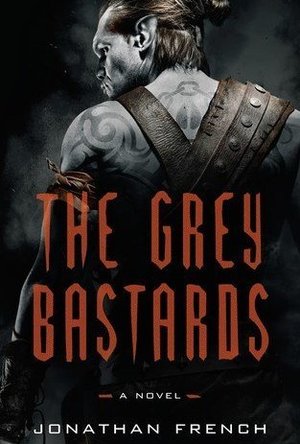
But don’t be fooled into thinking this book will be any less intelligent, epic, or heartfelt for it. The Grey Bastards is all of that and more. The novel follows Jackal, a half-breed orc living in the Lot Lands, the barren desert wasteland of Hispartha. He is a Grey Bastard, one of many half-orc hoofs, each protecting its own small town in the Lots. Members of a hoof are elite warriors that ride out on their Barbarians—giant warthogs—and slaughter invading bands of orcs.
Hispartha is a vibrant world, with a mix of fantastical species (orcs, half-orcs, elves, humans, halflings, and centaurs) with unique cultures and religions. Hispartha itself takes influences from Reconquista Spain, which is especially noticeable in the nomenclature, geography, and architecture.
The primarily atheistic half-orcs recently won their freedom from slavery at the hands of humans. Humans treat the half-orcs like second-class citizens, but tolerate them because of their strength, using them as a shield from the orcs. The elves are beautiful, reclusive, and probably the most cliché; there is one important elf character, but for the most part, we don’t get a good look into their culture in the first book. The centaurs worship Romanesque deities and go on crazed, Bacchanalian killing sprees during the blood moon.
Besides the half-orcs, the halflings are perhaps the most interesting. I still have a hard time visualizing them, trying to figure out if they are thin, pixie-like creatures or more stocky like dwarves. Their small stature and black skin makes me think of pygmies. They worship a god they expect will reincarnate someday, (view spoiler)
One thing that has always annoyed me about fantasy is that many authors feel that the characters of their world, being pre-industrial and thus “medieval,” must all be white, straight, Christian (or proto-Christian), cisgender males. If a woman appears at all is to act as the damsel, prize, or, if she’s lucky, a mystical enchantress to guide the heroes or provide a maguffin. It has come to the point in which this has become a tired and accepted baseline for fantasy. I don’t necessarily think that these fantasy authors are intentionally trying to be uninclusive, so much as they just seem to forget that other groups of people can exist in fantasy thanks to its fathers, Tolkien and Lewis.
But enough with my rant, the purpose of which is to highlight why I am often drawn to grimdark fantasy: at the very least I know that women, people of color, lgbt people, and other religions will be present, even if they are often victimized. This is because grimdark fantasy honestly depicts the horrors of rape, war, murder, slavery, and racism (or rather, speciesism in most cases) and has heroes and villains that are morally grey.
However, many authors describe these atrocities and then leave it at that, assuming that simply depicting them is enough to make a book mature and meaningful. They often fail to make any sort of statement on evil, and thus can seem to be, at best, blindly accepting it and, at worst, glorifying it (this often happens in the cases of magnificent bastard characters, who are absolute monsters but are so charming you almost respect or like them).
Jonathan French, however, does not fall short of the mark as many authors do, and for two main reasons: humor and humanity.
Let’s start with the humor. This book is hilarious. I mean in the I literally laughed out loud while reading it way. Sure, the jokes are often crass, but I have a dirty mind, so inappropriate humor is my favorite kind. The dialogue is especially top-notch, and the interactions between Jackal and his friends Fetching and Oats feel genuine, full of in-jokes, insults, and sexually-charged humor, all of which are exactly how I interact with my own close friends. And every major character in this book is so damn witty that I’m honestly jealous of them. If I could be quick enough to make even one of their zingers at the right time in a conversation, I would feel proud of myself for the rest of the day.
Humor is necessary to prevent any grimdark fantasy from becoming too over-the-top or depressing. And honestly, humor is needed most when the world is a dark and frightening place. But too much humor could accidentally downplay the point of grimdark: the brutally honest depiction of the atrocities that people are capable of.
And this is where it is important to have an element of humanity. By this I mean that the “good guys” must make some action or statement on those atrocities. Too often I read or watch hardened badass characters with no emotion who can watch a person get tortured and killed without flinching (maybe even do it themselves) and who never stop to question the nature of their society (even as part of their character growth), and I have difficulty finding them at all relatable or even the least bit interesting.
Now, often for this type of character, he or she is dead inside as a coping mechanism and part of their character arc is learning to allow themselves to feel their repressed emotions: heartbreak, anger, fear, etc. This can be done very well (see The Hunger Games for a great example—dystopian scifi and grimdark fantasy have very similar undertones). But most times it just ends up falling flat.
But Jackal already starts out with more personality than most grimdark protagonists. He is a humorous and light-hearted person. Sure, he lives in a desert wasteland, his race is entirely created by rape, he’s treated as a second-class citizen, and his life and the lives of those around him are in constant danger of rape and/or murder by invading orcs or blood-crazed centaurs. But despite all of that, he still has a sense of humor, people he loves, a community, ambitions, moral code, and all of the other things that these protagonists are often lacking.
Don’t get me wrong, he can be an asshole, and he’s often acts rashly before he thinks. But the scene that really stuck with me the most was [when Jackal and the wizard Crafty come across an unconscious elf sex-slave. I was expecting him to say something along the lines of “There’s nothing we can do for her, we have to save ourselves” or “This isn’t any of our business” or “It would be best to just put her out of her mercy.” These are the typical lines that a grimdark protagonist might utter while their companion—accused of being a bleeding heart—frees the slave. But this was not the case. Jackal and Crafty both immediately set out to free the girl and steal her away from her owner, despite the danger to themselves. And when he comes across an entire castle-full of these women, Jackal again sets about freeing them without a moment’s hesitation. (hide spoiler)]
And it’s no surprise that Jackal has a serious problem with rape. As I’ve mentioned before, half-orcs are entirely the product of roving bands of orcs raping human, elven, or even half-orc women. [When Jackal learns that Starling, the elf slave he rescued, is pregnant with a half-orc baby, he is not only furious with the orcs that gang-raped her, but also disturbed by the fact that elven society shuns any of their women who have been raped, and that these victims often end up taking their own lives rather than give birth to an impure half-elf. (hide spoiler)]
Furthermore, Jackal, unlike many people in Hispartha, does not buy into misogyny or sexism. His best friend Fetching is the first female half-orc to have joined a group of riders. Not only does Jackal respect Fetching, he understands the emotional turmoil that she is dealing with being the first female rider and how she overcompensates as a result to earn the respect of the other men.
While there is quite a bit of speciesism (pretty much none of the species get along with one another), the inhabitants of Hispartha come in every skin color and nobody gives a damn. Furthermore, sexuality is primarily treated as each person’s individual preference and nobody else’s business. While characters may make jokes about acting “backy” (gay), these are made in good humor between friends, and nobody gets particularly offended by them. Fetching is herself openly bisexual (though she seems to suppress her heterosexual desires more than her homosexual ones out of that same need to be “one of the boys”), and Oats and Jackal are one of my favorite bromantic pairings.
Grimdark fantasy can often be depressing to read. But Jonathan French does an excellent job of infusing hope into his narrative. The story actually has a happier ending than I was expecting. [I was especially pleased when Jackal chooses Fetching to be the new leader of the hoof (she is voted in unanimously by the other riders). I find it incredibly annoying in books and movies when revolutionaries/usurpers decide to appoint themselves leaders, as the former does not qualify you for the latter. Part of Jackal’s arc is realizing that he is not meant to lead the hoof like he’d once desired. (hide spoiler)]
For the sequel, The True Bastards, I’m hoping to see [if a cure can be found for the thrice-blood child now infected with plague, how Fetching is doing leading the hoof, and what the mysterious Starling is up to (I don’t buy for a second that she’s killed herself). And of course, I fully expect that Jackal is going to have to fulfill his empty promise to the halfling’s resurrected god, Belico.
But don’t be fooled into thinking this book will be any less intelligent, epic, or heartfelt for it. The Grey Bastards is all of that and more. The novel follows Jackal, a half-breed orc living in the Lot Lands, the barren desert wasteland of Hispartha. He is a Grey Bastard, one of many half-orc hoofs, each protecting its own small town in the Lots. Members of a hoof are elite warriors that ride out on their Barbarians—giant warthogs—and slaughter invading bands of orcs.
Hispartha is a vibrant world, with a mix of fantastical species (orcs, half-orcs, elves, humans, halflings, and centaurs) with unique cultures and religions. Hispartha itself takes influences from Reconquista Spain, which is especially noticeable in the nomenclature, geography, and architecture.
The primarily atheistic half-orcs recently won their freedom from slavery at the hands of humans. Humans treat the half-orcs like second-class citizens, but tolerate them because of their strength, using them as a shield from the orcs. The elves are beautiful, reclusive, and probably the most cliché; there is one important elf character, but for the most part, we don’t get a good look into their culture in the first book. The centaurs worship Romanesque deities and go on crazed, Bacchanalian killing sprees during the blood moon.
Besides the half-orcs, the halflings are perhaps the most interesting. I still have a hard time visualizing them, trying to figure out if they are thin, pixie-like creatures or more stocky like dwarves. Their small stature and black skin makes me think of pygmies. They worship a god they expect will reincarnate someday, (view spoiler)
One thing that has always annoyed me about fantasy is that many authors feel that the characters of their world, being pre-industrial and thus “medieval,” must all be white, straight, Christian (or proto-Christian), cisgender males. If a woman appears at all is to act as the damsel, prize, or, if she’s lucky, a mystical enchantress to guide the heroes or provide a maguffin. It has come to the point in which this has become a tired and accepted baseline for fantasy. I don’t necessarily think that these fantasy authors are intentionally trying to be uninclusive, so much as they just seem to forget that other groups of people can exist in fantasy thanks to its fathers, Tolkien and Lewis.
But enough with my rant, the purpose of which is to highlight why I am often drawn to grimdark fantasy: at the very least I know that women, people of color, lgbt people, and other religions will be present, even if they are often victimized. This is because grimdark fantasy honestly depicts the horrors of rape, war, murder, slavery, and racism (or rather, speciesism in most cases) and has heroes and villains that are morally grey.
However, many authors describe these atrocities and then leave it at that, assuming that simply depicting them is enough to make a book mature and meaningful. They often fail to make any sort of statement on evil, and thus can seem to be, at best, blindly accepting it and, at worst, glorifying it (this often happens in the cases of magnificent bastard characters, who are absolute monsters but are so charming you almost respect or like them).
Jonathan French, however, does not fall short of the mark as many authors do, and for two main reasons: humor and humanity.
Let’s start with the humor. This book is hilarious. I mean in the I literally laughed out loud while reading it way. Sure, the jokes are often crass, but I have a dirty mind, so inappropriate humor is my favorite kind. The dialogue is especially top-notch, and the interactions between Jackal and his friends Fetching and Oats feel genuine, full of in-jokes, insults, and sexually-charged humor, all of which are exactly how I interact with my own close friends. And every major character in this book is so damn witty that I’m honestly jealous of them. If I could be quick enough to make even one of their zingers at the right time in a conversation, I would feel proud of myself for the rest of the day.
Humor is necessary to prevent any grimdark fantasy from becoming too over-the-top or depressing. And honestly, humor is needed most when the world is a dark and frightening place. But too much humor could accidentally downplay the point of grimdark: the brutally honest depiction of the atrocities that people are capable of.
And this is where it is important to have an element of humanity. By this I mean that the “good guys” must make some action or statement on those atrocities. Too often I read or watch hardened badass characters with no emotion who can watch a person get tortured and killed without flinching (maybe even do it themselves) and who never stop to question the nature of their society (even as part of their character growth), and I have difficulty finding them at all relatable or even the least bit interesting.
Now, often for this type of character, he or she is dead inside as a coping mechanism and part of their character arc is learning to allow themselves to feel their repressed emotions: heartbreak, anger, fear, etc. This can be done very well (see The Hunger Games for a great example—dystopian scifi and grimdark fantasy have very similar undertones). But most times it just ends up falling flat.
But Jackal already starts out with more personality than most grimdark protagonists. He is a humorous and light-hearted person. Sure, he lives in a desert wasteland, his race is entirely created by rape, he’s treated as a second-class citizen, and his life and the lives of those around him are in constant danger of rape and/or murder by invading orcs or blood-crazed centaurs. But despite all of that, he still has a sense of humor, people he loves, a community, ambitions, moral code, and all of the other things that these protagonists are often lacking.
Don’t get me wrong, he can be an asshole, and he’s often acts rashly before he thinks. But the scene that really stuck with me the most was [when Jackal and the wizard Crafty come across an unconscious elf sex-slave. I was expecting him to say something along the lines of “There’s nothing we can do for her, we have to save ourselves” or “This isn’t any of our business” or “It would be best to just put her out of her mercy.” These are the typical lines that a grimdark protagonist might utter while their companion—accused of being a bleeding heart—frees the slave. But this was not the case. Jackal and Crafty both immediately set out to free the girl and steal her away from her owner, despite the danger to themselves. And when he comes across an entire castle-full of these women, Jackal again sets about freeing them without a moment’s hesitation. (hide spoiler)]
And it’s no surprise that Jackal has a serious problem with rape. As I’ve mentioned before, half-orcs are entirely the product of roving bands of orcs raping human, elven, or even half-orc women. [When Jackal learns that Starling, the elf slave he rescued, is pregnant with a half-orc baby, he is not only furious with the orcs that gang-raped her, but also disturbed by the fact that elven society shuns any of their women who have been raped, and that these victims often end up taking their own lives rather than give birth to an impure half-elf. (hide spoiler)]
Furthermore, Jackal, unlike many people in Hispartha, does not buy into misogyny or sexism. His best friend Fetching is the first female half-orc to have joined a group of riders. Not only does Jackal respect Fetching, he understands the emotional turmoil that she is dealing with being the first female rider and how she overcompensates as a result to earn the respect of the other men.
While there is quite a bit of speciesism (pretty much none of the species get along with one another), the inhabitants of Hispartha come in every skin color and nobody gives a damn. Furthermore, sexuality is primarily treated as each person’s individual preference and nobody else’s business. While characters may make jokes about acting “backy” (gay), these are made in good humor between friends, and nobody gets particularly offended by them. Fetching is herself openly bisexual (though she seems to suppress her heterosexual desires more than her homosexual ones out of that same need to be “one of the boys”), and Oats and Jackal are one of my favorite bromantic pairings.
Grimdark fantasy can often be depressing to read. But Jonathan French does an excellent job of infusing hope into his narrative. The story actually has a happier ending than I was expecting. [I was especially pleased when Jackal chooses Fetching to be the new leader of the hoof (she is voted in unanimously by the other riders). I find it incredibly annoying in books and movies when revolutionaries/usurpers decide to appoint themselves leaders, as the former does not qualify you for the latter. Part of Jackal’s arc is realizing that he is not meant to lead the hoof like he’d once desired. (hide spoiler)]
For the sequel, The True Bastards, I’m hoping to see [if a cure can be found for the thrice-blood child now infected with plague, how Fetching is doing leading the hoof, and what the mysterious Starling is up to (I don’t buy for a second that she’s killed herself). And of course, I fully expect that Jackal is going to have to fulfill his empty promise to the halfling’s resurrected god, Belico.