
Search
Search results

Purple Phoenix Games (2266 KP) rated Holi: Festival of Colors in Tabletop Games
Apr 16, 2022


I absolutely love a beautiful game. Being a gamer, I have seen and played many gorgeous games. However, the first time I set up Holi: Festival of Colors (just Holi from here), both my 5 year old son and my slightly older mother-in-law both commented on how awesome it looked setup on the table. It has been a while since I last was so impressed by the sheer glamour of a game – and I only have the base retail version! I HAVE to get my hands on an upgrade pack or something… Just checked. I’ll have to buy the Deluxe version. Okay, placing order.
Holi is an abstract, area control, card-driven action selection (akin to Onitama) game for two to four players. In it, players are attendees at the Holi Festival and the goal is spread their favorite color onto the plaza and other players in order to increase their joy (earn VP). The winner is the player who is best able to throw their color and score joy, all while enjoying the festival!
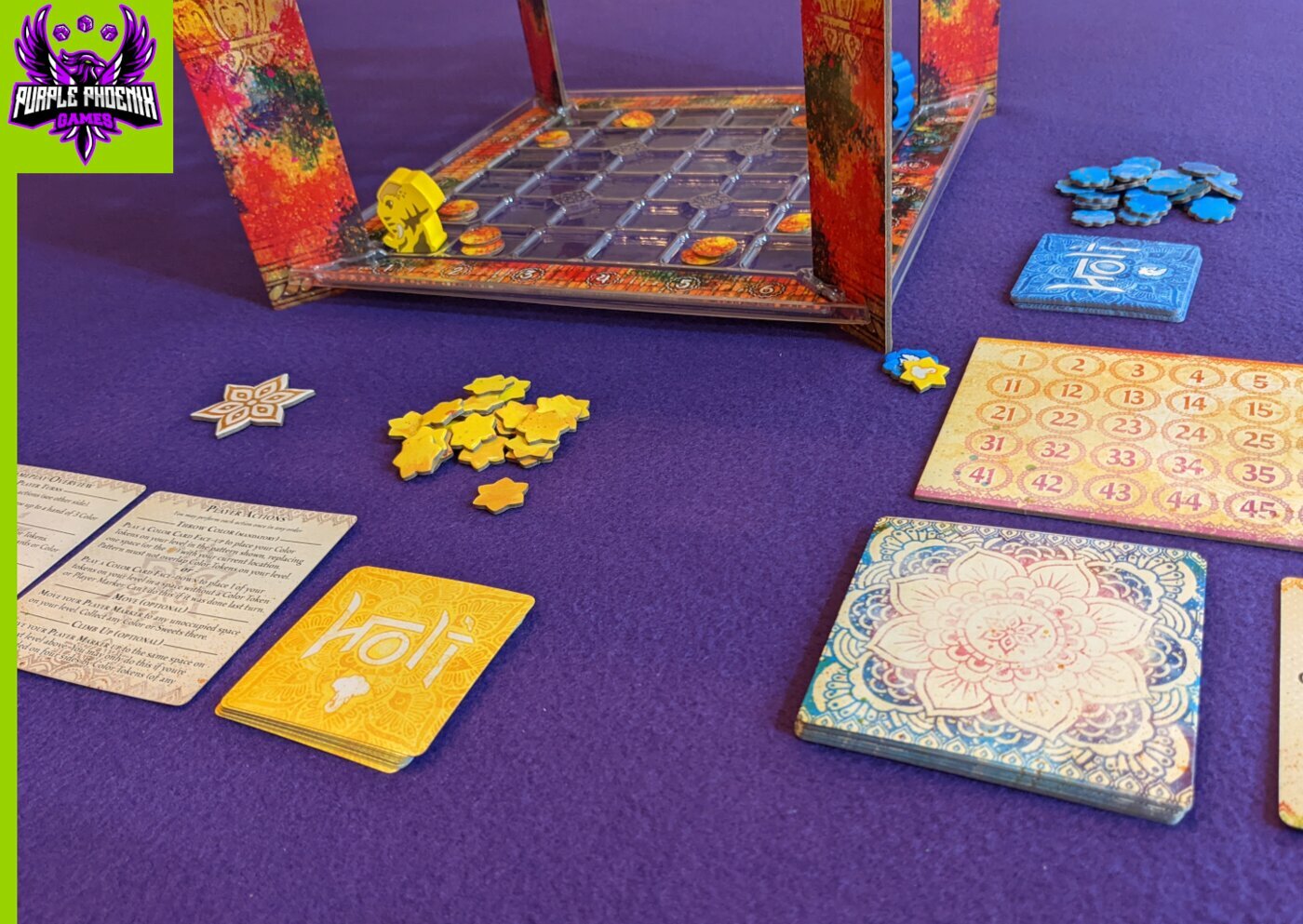
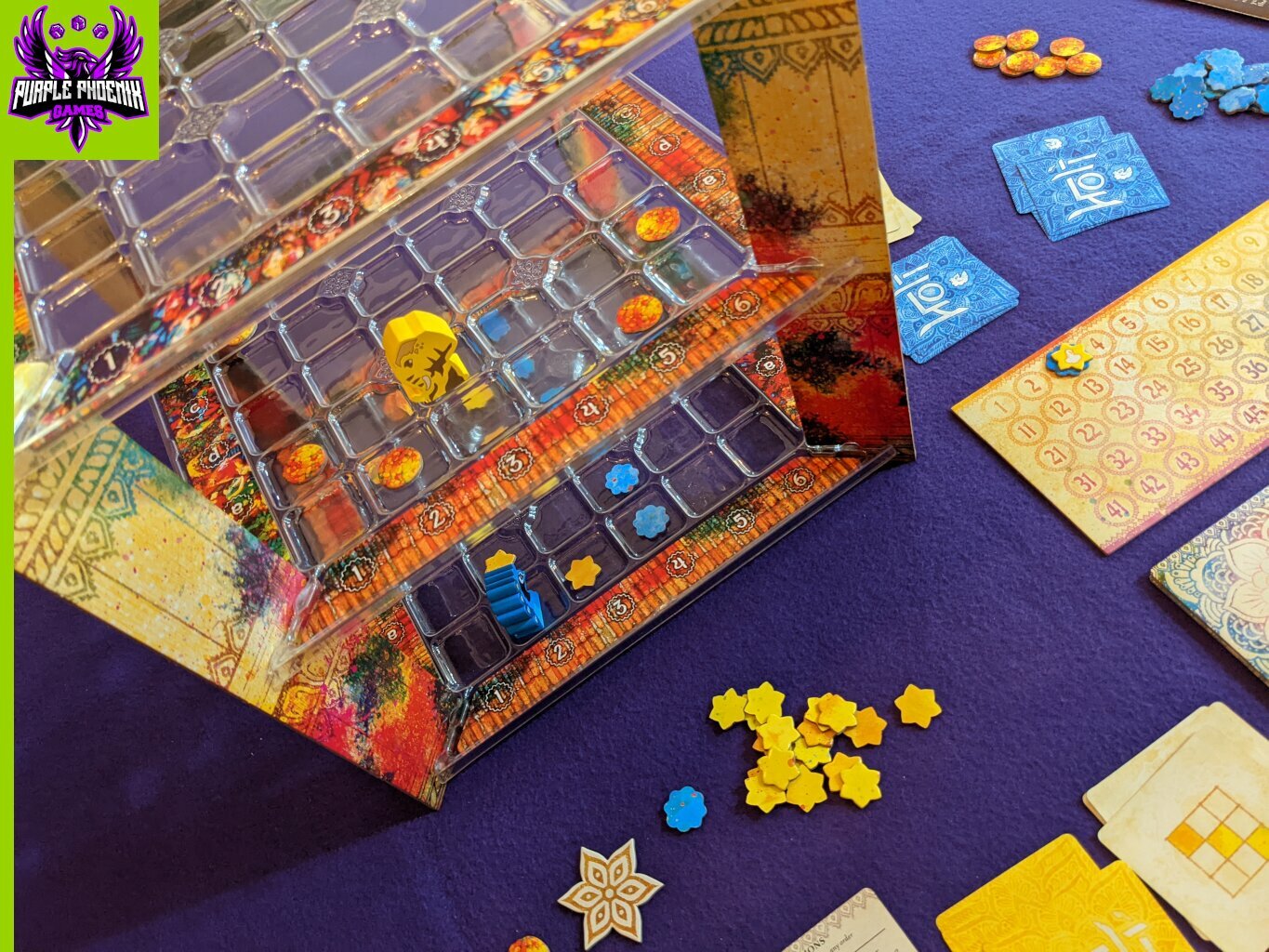
To setup, the game owner will assemble the three-tiered board and place the appropriate sweets tokens on their spaces. The score track and Rivalry cards are set nearby so all can see. Each player receives their color’s player markers (in four delightful animal shapes), color tokens, color cards, and a helper card. The first player receives the cool lotus flower (I think) marker and the game may begin!
Holi is played over a series of turns, and continues until every player has either run out of color tokens or color cards to play. Each turn, players will take one to three actions in any order, with only one action being absolutely mandatory. This is the Throw Color action. In order to Throw Color, the active player will choose a color card from their hand of three cards to play. On these cards are indications of where a player’s marker/piece/animeeple must be located and the spaces near it to throw color tokens on the board. These color cards are reminiscent of those found in Onitama, where players may only move to specific spaces based on card grid iconography. Players will be littering the squares of the play area with their color tokens as well as attempting to hit other players’ animeeples with their color.
Players may also optionally Move at any point during the turn. This is an easy one: players may Move to any space on the current level of the board they are on, except any space inhabited by an opponent’s animeeple. These spaces could already contain sweets tokens, which can be collected by the player, or even color tokens. When a player lands in a space with their own color token, they take it back to their supply to be used again. However, landing on an opponent’s color token causes the active player to also take it into their supply, thus scoring the opponent points at the end of the game.
Finally, a player, if in a space surrounded on four edges by color tokens, may Climb Up to the next higher level. Players on the middle level will score 2 joy (VP) at the end of the game for each color token placed, while tokens on the top level will score 3 joy. Care should be taken when throwing color on the upper levels, because should an empty space reside on the level below where the token has been placed, the token will fall through to the lower level! Therefore, only color tokens will only remain placed on higher levels when another token is blocking its fall below it.
Once all players have played their cards and thrown their color tokens, the game is over and the score is tallied. 1 point is earned for each color token on the bottom level, 2 points for the middle level, and 3 points for tokens on the upper level. Players score 2 more points for each of their color tokens that found their way into opponents’ supplies. Remember those sweets tokens that players were collecting? Players will score 5 points for every player that has less sweets tokens at the end of the game. If playing with the Rivalry cards, points are also scored for any of their special circumstances (ie color tokens scoring 4 instead of 3 on the top level, or hitting opponents with colors score 2 points immediately instead of the normal 1 point, or even 10 bonus points to the player with the most color tokens on the bottom level). The player with the most points at the end of this scoring phase wins the game!
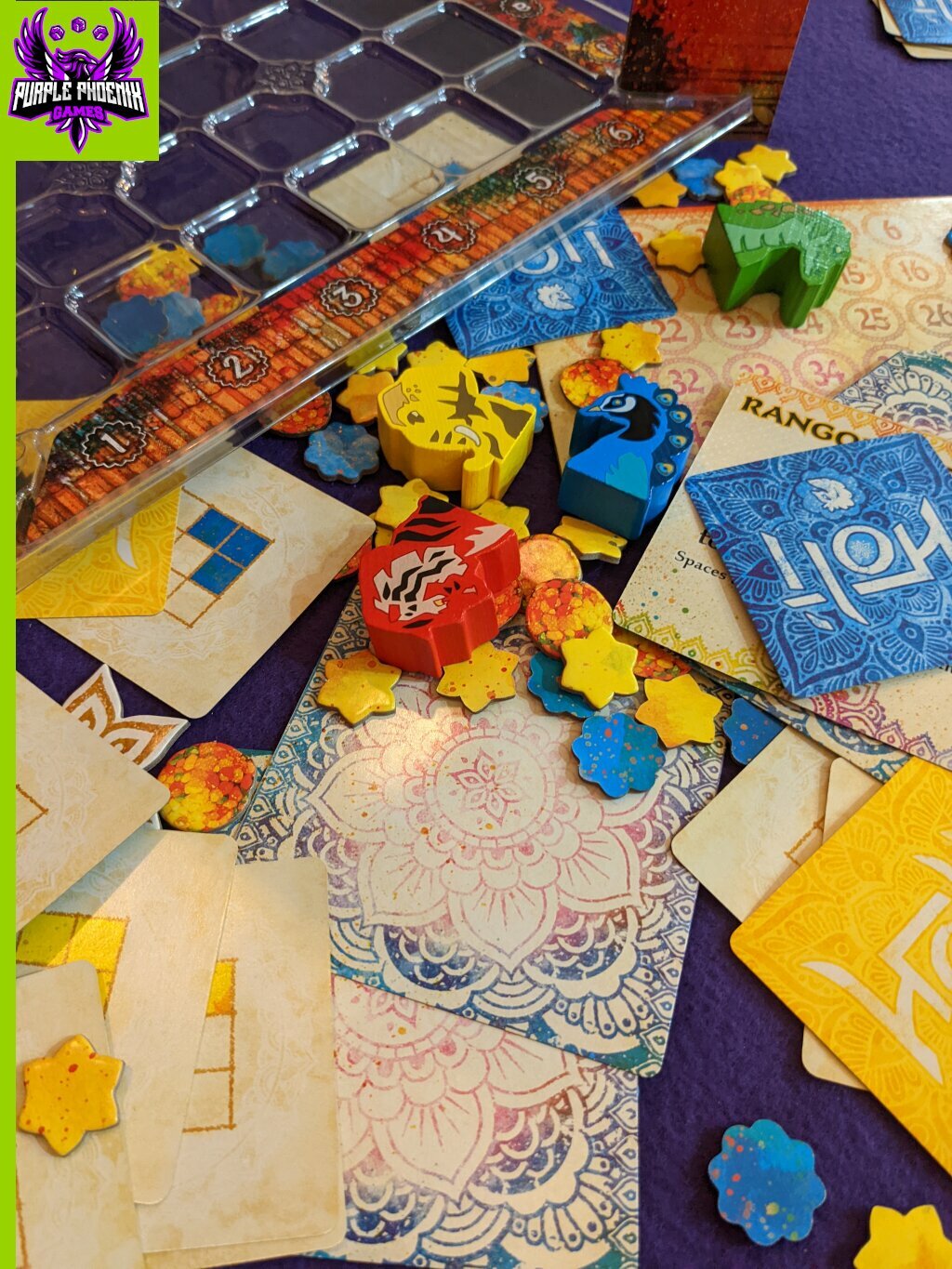
Components. I kind of already made my point about this game being a flat out stunner on the table. I will sing its praises from here to India and then back again. I normally acknowledge the artist(s) on a game once I open it for the first time, but seeing that this is a total Vincent Dutrait masterpiece, I just had to see which other games of his I own. I have made my claims in the past for my favorite board game artists and I had not included Dutrait. No more. This is brilliant and just a wonderful experience throughout. The components are all great, and that multi-layered board? I mean, come on! The intricacies found throughout and within this box are immeasurable, and I will surely be adding the Deluxe version to my collection.
Holi is a game I can pull out with almost any person or group of people and feel confident that it will give an extremely satisfying experience. The rules are relatively simple, and games are very quick. This is not a filler, but runs so smoothly and briskly that one may miscategorize it as such. The options of movement are so unrestricted, and having the ability to craft spatial situations with the cards in your hand to allow only your animeeple to climb up to the next level is just delicious. Speaking of, the sweets tokens, and really ALL of the components, are just so cute and well-illustrated. I really am finding it difficult to point out any flaws in this game. Every time I have played it I have simply had the best time with my opponents. Yeah, there’s some minor take that, but it’s all in good fun, and if you know anything about the actual celebration of Holi, participants relish coming home just covered head to toe in paint, colored water, and other colorful materials. It’s a great theme that shines through, and I look forward to each of my coming plays.
Currently, eight games we have published reviews for have earned the Golden Feather Award. At the time of this writing, I know one other will be joining that list soon, and now Holi will as well. So that is 10 total games over the 495 we have published and are sitting in queue to be published. That said, it is no surprise, I’m sure, that Holi has earned its spot among the best we have played, and I am incredibly relieved that I was able to grab a copy when I did. This will remain a favorite of mine for many years, I know it. If you are like me and appreciate an amazing production value with a comparably wonderful game underneath, then you owe it to yourself to pick up a copy of Holi as soon as you can. Or come play my copy with me. I will always be up for a play.
Holi is an abstract, area control, card-driven action selection (akin to Onitama) game for two to four players. In it, players are attendees at the Holi Festival and the goal is spread their favorite color onto the plaza and other players in order to increase their joy (earn VP). The winner is the player who is best able to throw their color and score joy, all while enjoying the festival!
To setup, the game owner will assemble the three-tiered board and place the appropriate sweets tokens on their spaces. The score track and Rivalry cards are set nearby so all can see. Each player receives their color’s player markers (in four delightful animal shapes), color tokens, color cards, and a helper card. The first player receives the cool lotus flower (I think) marker and the game may begin!
Holi is played over a series of turns, and continues until every player has either run out of color tokens or color cards to play. Each turn, players will take one to three actions in any order, with only one action being absolutely mandatory. This is the Throw Color action. In order to Throw Color, the active player will choose a color card from their hand of three cards to play. On these cards are indications of where a player’s marker/piece/animeeple must be located and the spaces near it to throw color tokens on the board. These color cards are reminiscent of those found in Onitama, where players may only move to specific spaces based on card grid iconography. Players will be littering the squares of the play area with their color tokens as well as attempting to hit other players’ animeeples with their color.
Players may also optionally Move at any point during the turn. This is an easy one: players may Move to any space on the current level of the board they are on, except any space inhabited by an opponent’s animeeple. These spaces could already contain sweets tokens, which can be collected by the player, or even color tokens. When a player lands in a space with their own color token, they take it back to their supply to be used again. However, landing on an opponent’s color token causes the active player to also take it into their supply, thus scoring the opponent points at the end of the game.
Finally, a player, if in a space surrounded on four edges by color tokens, may Climb Up to the next higher level. Players on the middle level will score 2 joy (VP) at the end of the game for each color token placed, while tokens on the top level will score 3 joy. Care should be taken when throwing color on the upper levels, because should an empty space reside on the level below where the token has been placed, the token will fall through to the lower level! Therefore, only color tokens will only remain placed on higher levels when another token is blocking its fall below it.
Once all players have played their cards and thrown their color tokens, the game is over and the score is tallied. 1 point is earned for each color token on the bottom level, 2 points for the middle level, and 3 points for tokens on the upper level. Players score 2 more points for each of their color tokens that found their way into opponents’ supplies. Remember those sweets tokens that players were collecting? Players will score 5 points for every player that has less sweets tokens at the end of the game. If playing with the Rivalry cards, points are also scored for any of their special circumstances (ie color tokens scoring 4 instead of 3 on the top level, or hitting opponents with colors score 2 points immediately instead of the normal 1 point, or even 10 bonus points to the player with the most color tokens on the bottom level). The player with the most points at the end of this scoring phase wins the game!
Components. I kind of already made my point about this game being a flat out stunner on the table. I will sing its praises from here to India and then back again. I normally acknowledge the artist(s) on a game once I open it for the first time, but seeing that this is a total Vincent Dutrait masterpiece, I just had to see which other games of his I own. I have made my claims in the past for my favorite board game artists and I had not included Dutrait. No more. This is brilliant and just a wonderful experience throughout. The components are all great, and that multi-layered board? I mean, come on! The intricacies found throughout and within this box are immeasurable, and I will surely be adding the Deluxe version to my collection.
Holi is a game I can pull out with almost any person or group of people and feel confident that it will give an extremely satisfying experience. The rules are relatively simple, and games are very quick. This is not a filler, but runs so smoothly and briskly that one may miscategorize it as such. The options of movement are so unrestricted, and having the ability to craft spatial situations with the cards in your hand to allow only your animeeple to climb up to the next level is just delicious. Speaking of, the sweets tokens, and really ALL of the components, are just so cute and well-illustrated. I really am finding it difficult to point out any flaws in this game. Every time I have played it I have simply had the best time with my opponents. Yeah, there’s some minor take that, but it’s all in good fun, and if you know anything about the actual celebration of Holi, participants relish coming home just covered head to toe in paint, colored water, and other colorful materials. It’s a great theme that shines through, and I look forward to each of my coming plays.
Currently, eight games we have published reviews for have earned the Golden Feather Award. At the time of this writing, I know one other will be joining that list soon, and now Holi will as well. So that is 10 total games over the 495 we have published and are sitting in queue to be published. That said, it is no surprise, I’m sure, that Holi has earned its spot among the best we have played, and I am incredibly relieved that I was able to grab a copy when I did. This will remain a favorite of mine for many years, I know it. If you are like me and appreciate an amazing production value with a comparably wonderful game underneath, then you owe it to yourself to pick up a copy of Holi as soon as you can. Or come play my copy with me. I will always be up for a play.


Heather Cranmer (2721 KP) rated The Exalted Gate in Books
Jun 7, 2018


(This review can be found on my blog <a href="http://themisadventuresofatwentysomething.blogspot.com/">The (Mis)Adventures of a Twenty-Something Year Old Girl</a>.
I absolutely love the cover of this book. It is gorgeous!! Anyway, this book has ten stories in it, so I will review and rate each one individually.
*
Boots
Judith (of an undisclosed age) is a girl that hates wearing shoes. However, she is in a play where she has to play a Polish tramp. She doesn't want to wear shoes, but the director says even tramps wear shoes. She finds some beat up looking boots in the prop room and puts them on. As soon as they are on her feet, it's like they have a mind of their own. They take Judith where they want to go. What ensues in an adventure that Judith won't soon forget.
I thought the story of Boots was a really cute and interesting read. I definitely think this will appeal to children of all ages. The only slight problem was with punctuation, but that's nothing that major. Judith is an interesting girl. I'd recommend this story.
I'd give Boots a 4.5 out of 5.
*
Five Gifts
Lonia is a thirteen year old girl whose parents are already nagging her to get married. (Yeah, it's a bit much, but it does say in the story that this was way back in the day). She'd rather spend her days in the children's glade talking to her elf friend, Pintak. One day, Pintak is kidnapped by a mean old wizard, and Lonia decides that she must go rescue him. She is given five gifts from different creatures of the forest to help her on her quest.
I was impressed with this story, and I found it quite interesting. There's also a lesson to be learned about experimenting on animals. Lonia was definitely a brave little girl and was willing to risk everything to save her friend. There are a few punctuation mistakes and a mispelt word, but other than that, this story was a good one.
I'd give Five Gifts a 5 out of 5.
*
Sintinko
Sintinko is a story set in Japan back when it was all emperors and generals. The emperor is jealous of Sintinko and wants to have him killed. It's only because of Ilyo, Sintinko's love interest, that the emperor spares his life. However, Sintinko is banished from Japan until he can find a maple tree that can sit in the hand of the emperor. Ilyo and Sintinko know that they will most likely never see each other. Unbeknownst to Sintinko and everyone else, Ilyo disguises herself as a geisha to help Sintinko on his journey. Love and loss are the themes of this story.
This was such a bittersweet love story. I felt sorry for both Sintinko and Ilyo. Sintinko thought he would never see his beloved again and swore off any type of relationship. Ilyo had her beloved right there in front of her, yet she couldn't do anything about it.
The names, being Japanese, were a bit hard to pronounce, but it's easy to get past that since the story is so strong. Speaking of names, this story even lets us know how the Bonsai tree got its name.
There's a few punctuation mistakes, but nothing that takes away from the story.
I think this story would be better suited for ages 11+. Personally, I found the story a bit slow, but not painfully slow.
I'd give Sintinko a 3.5 out of 5.
*
Tivurambhat
Tivurambhat is the story of a ghost by the same name of the title who helps people out in times of need in India. A mean man forces people to work for him by letting them borrow money, putting the interest up, and paying them such low wages they can never afford to pay him pack. One man decides to do something about it and goes to Tivurambhat for help.
I loved the message behind the story. Towards the ending, it even had me smiling. I couldn't pronounce the names since they were all Indian names, so I just shortened them so my American self could pronounce them. I loved the character of Tiv. He kind of reminded me of an American version of Casper for some reason. I really enjoyed the conversation between Pradesh and Tiv the most. This was such a happy story!
Again, there's some punctuation mistakes and a few grammar ones as well, but the story itself was excellent.
I'd give Tivurambhat a 5 out of 5.
*
St. Penalyn's Well
St Penalyn's Well tells the story of Rebecca (of an undisclosed age) who ventures into an overgrown garden with her dog. She stumbles across a well with an inscription. It is while reading this inscription that she becomes trapped in the well. Lucky for her, she meets an elf named Opickle who keeps her company and gives her the inspiration she needs to find her way out.
This was definitely an interesting story. I was hooked all the way through. It's a story about friendship amongst diversity and not giving up. I found Opickle to be just a tad bit of a snob but not enough to put me off the story.
A few punctuation mistakes throughout the story but not enough to be distracting.
St. Penalyn's Well gets a 5 out of 5 from me.
*
Quint and Trout's Mistake
Quint and Trout's Mistake is a story I didn't finish because of the name calling and making fun of someone who is overweight. It starts out innocently enough. A lake is being overrun by a white smelly substance. Two brothers, Quint and Trout, talk their friend Ned into investigating why this is happening. Ned swims down to the bottom of the lake and finds an overweight creature living in a cave who has been kicked out of his house. This is when the name calling starts, and I stopped reading.
I do not like stories aimed at children that condone name calling of any sort whether it be because of weight, disabilities, race, etc. Children do not need to read something like this and feel bad about themselves or view it as an excuse to tease others. I was very disappointed something like this was in a children's book.
Quint and Trout's Mistake gets a 0 out of 5 from me. What a vile story!
*
Densus
Densus is a boy who was born with blue fingernails and blue streaks in his hair. This is because he has a destiny to fulfill. When a crab named Arnold asks him if he'd go tell a giant that he has found a perfect wife for him, Densus agrees because it's his destiny even if there's a possibility the giant could kill him.
This is a story about destinies. It lets us know that we all have destinies if only we weren't too busy trying to find out what they are. This is a fun story which I think children would love! I loved Arnold the crab!! I think a majority of children would love him.
Again, there's a few punctuation and grammar mistakes but nothing major.
I'd give Densus a 5 out of 5.
*
Alice's Granddaughter
Alice's Granddaughter takes place years after Alice in Wonderland. Alice's granddaughter, Alicia, is recruited by a thief named Cheng to go down into a rabbit hole to get him a yellow dragon. Alicia discovers that things in Wonderland haven't changed much.
I thoroughly enjoyed this story! I'm a sucker for everything Alice in Wonderland-esque, and this was no exception! I loved how the author still managed to preserve the original Wonderland in his tale and how he even managed to keep the style of writing similar to that of Lewis Carroll. My favorite character was definitely the talking table. My only gripe is that I wish this story would've been longer!
As like with the previous story, there are some punctuation and grammar mistakes that can be overlooked.
Alice's Granddaughter gets a bit 5 out of 5.
*
The Dragon
The Dragon is a story about death. In this story, we follow a dragon in her very last moments as she dies of what I assume to be old age. We get to see her memories of when she was her prime and when she takes her last breath.
This is a sad story and probably one for the older children unless younger children can handle the topic of death. It's not written in a morbid way though. It's actually written quite beautifully especially when we get to see the memory of the dragon in her prime. I think this story can show that death is not always bad.
There are grammar and punctuation mistakes but nothing that deters from the story.
The Dragon gets a 3.75 out of 5.
*
The Wisdom of a Dog
The Wisdom of a Dog is about a man named Keith and his dog who go on an adventure and wind up in a crystal city. Keith must found out who is destroying the city and save it.
This story was a good read, and I think most children would enjoy it especially as it involves a talking dog. I enjoyed how the author even placed his own dialogue in the story. This is a good versus bad story that shows that bad people never win.
Again, there are grammar and punctuation mistakes, but it doesn't take away from the story.
The Wisdom of a Dog gets a 3.5 out of 5.
*
The Exalted Gate by Daniel Nanavati averages out to a 3.5 out of 5. I'd definitely recommend this book to old and young alike!
(I received a free physical copy of this title from the publisher in exchange for a fair and honest review).
I absolutely love the cover of this book. It is gorgeous!! Anyway, this book has ten stories in it, so I will review and rate each one individually.
*
Boots
Judith (of an undisclosed age) is a girl that hates wearing shoes. However, she is in a play where she has to play a Polish tramp. She doesn't want to wear shoes, but the director says even tramps wear shoes. She finds some beat up looking boots in the prop room and puts them on. As soon as they are on her feet, it's like they have a mind of their own. They take Judith where they want to go. What ensues in an adventure that Judith won't soon forget.
I thought the story of Boots was a really cute and interesting read. I definitely think this will appeal to children of all ages. The only slight problem was with punctuation, but that's nothing that major. Judith is an interesting girl. I'd recommend this story.
I'd give Boots a 4.5 out of 5.
*
Five Gifts
Lonia is a thirteen year old girl whose parents are already nagging her to get married. (Yeah, it's a bit much, but it does say in the story that this was way back in the day). She'd rather spend her days in the children's glade talking to her elf friend, Pintak. One day, Pintak is kidnapped by a mean old wizard, and Lonia decides that she must go rescue him. She is given five gifts from different creatures of the forest to help her on her quest.
I was impressed with this story, and I found it quite interesting. There's also a lesson to be learned about experimenting on animals. Lonia was definitely a brave little girl and was willing to risk everything to save her friend. There are a few punctuation mistakes and a mispelt word, but other than that, this story was a good one.
I'd give Five Gifts a 5 out of 5.
*
Sintinko
Sintinko is a story set in Japan back when it was all emperors and generals. The emperor is jealous of Sintinko and wants to have him killed. It's only because of Ilyo, Sintinko's love interest, that the emperor spares his life. However, Sintinko is banished from Japan until he can find a maple tree that can sit in the hand of the emperor. Ilyo and Sintinko know that they will most likely never see each other. Unbeknownst to Sintinko and everyone else, Ilyo disguises herself as a geisha to help Sintinko on his journey. Love and loss are the themes of this story.
This was such a bittersweet love story. I felt sorry for both Sintinko and Ilyo. Sintinko thought he would never see his beloved again and swore off any type of relationship. Ilyo had her beloved right there in front of her, yet she couldn't do anything about it.
The names, being Japanese, were a bit hard to pronounce, but it's easy to get past that since the story is so strong. Speaking of names, this story even lets us know how the Bonsai tree got its name.
There's a few punctuation mistakes, but nothing that takes away from the story.
I think this story would be better suited for ages 11+. Personally, I found the story a bit slow, but not painfully slow.
I'd give Sintinko a 3.5 out of 5.
*
Tivurambhat
Tivurambhat is the story of a ghost by the same name of the title who helps people out in times of need in India. A mean man forces people to work for him by letting them borrow money, putting the interest up, and paying them such low wages they can never afford to pay him pack. One man decides to do something about it and goes to Tivurambhat for help.
I loved the message behind the story. Towards the ending, it even had me smiling. I couldn't pronounce the names since they were all Indian names, so I just shortened them so my American self could pronounce them. I loved the character of Tiv. He kind of reminded me of an American version of Casper for some reason. I really enjoyed the conversation between Pradesh and Tiv the most. This was such a happy story!
Again, there's some punctuation mistakes and a few grammar ones as well, but the story itself was excellent.
I'd give Tivurambhat a 5 out of 5.
*
St. Penalyn's Well
St Penalyn's Well tells the story of Rebecca (of an undisclosed age) who ventures into an overgrown garden with her dog. She stumbles across a well with an inscription. It is while reading this inscription that she becomes trapped in the well. Lucky for her, she meets an elf named Opickle who keeps her company and gives her the inspiration she needs to find her way out.
This was definitely an interesting story. I was hooked all the way through. It's a story about friendship amongst diversity and not giving up. I found Opickle to be just a tad bit of a snob but not enough to put me off the story.
A few punctuation mistakes throughout the story but not enough to be distracting.
St. Penalyn's Well gets a 5 out of 5 from me.
*
Quint and Trout's Mistake
Quint and Trout's Mistake is a story I didn't finish because of the name calling and making fun of someone who is overweight. It starts out innocently enough. A lake is being overrun by a white smelly substance. Two brothers, Quint and Trout, talk their friend Ned into investigating why this is happening. Ned swims down to the bottom of the lake and finds an overweight creature living in a cave who has been kicked out of his house. This is when the name calling starts, and I stopped reading.
I do not like stories aimed at children that condone name calling of any sort whether it be because of weight, disabilities, race, etc. Children do not need to read something like this and feel bad about themselves or view it as an excuse to tease others. I was very disappointed something like this was in a children's book.
Quint and Trout's Mistake gets a 0 out of 5 from me. What a vile story!
*
Densus
Densus is a boy who was born with blue fingernails and blue streaks in his hair. This is because he has a destiny to fulfill. When a crab named Arnold asks him if he'd go tell a giant that he has found a perfect wife for him, Densus agrees because it's his destiny even if there's a possibility the giant could kill him.
This is a story about destinies. It lets us know that we all have destinies if only we weren't too busy trying to find out what they are. This is a fun story which I think children would love! I loved Arnold the crab!! I think a majority of children would love him.
Again, there's a few punctuation and grammar mistakes but nothing major.
I'd give Densus a 5 out of 5.
*
Alice's Granddaughter
Alice's Granddaughter takes place years after Alice in Wonderland. Alice's granddaughter, Alicia, is recruited by a thief named Cheng to go down into a rabbit hole to get him a yellow dragon. Alicia discovers that things in Wonderland haven't changed much.
I thoroughly enjoyed this story! I'm a sucker for everything Alice in Wonderland-esque, and this was no exception! I loved how the author still managed to preserve the original Wonderland in his tale and how he even managed to keep the style of writing similar to that of Lewis Carroll. My favorite character was definitely the talking table. My only gripe is that I wish this story would've been longer!
As like with the previous story, there are some punctuation and grammar mistakes that can be overlooked.
Alice's Granddaughter gets a bit 5 out of 5.
*
The Dragon
The Dragon is a story about death. In this story, we follow a dragon in her very last moments as she dies of what I assume to be old age. We get to see her memories of when she was her prime and when she takes her last breath.
This is a sad story and probably one for the older children unless younger children can handle the topic of death. It's not written in a morbid way though. It's actually written quite beautifully especially when we get to see the memory of the dragon in her prime. I think this story can show that death is not always bad.
There are grammar and punctuation mistakes but nothing that deters from the story.
The Dragon gets a 3.75 out of 5.
*
The Wisdom of a Dog
The Wisdom of a Dog is about a man named Keith and his dog who go on an adventure and wind up in a crystal city. Keith must found out who is destroying the city and save it.
This story was a good read, and I think most children would enjoy it especially as it involves a talking dog. I enjoyed how the author even placed his own dialogue in the story. This is a good versus bad story that shows that bad people never win.
Again, there are grammar and punctuation mistakes, but it doesn't take away from the story.
The Wisdom of a Dog gets a 3.5 out of 5.
*
The Exalted Gate by Daniel Nanavati averages out to a 3.5 out of 5. I'd definitely recommend this book to old and young alike!
(I received a free physical copy of this title from the publisher in exchange for a fair and honest review).