
Search

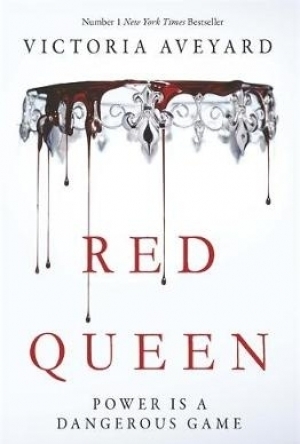


The world is ruled by Silvers, with their shining blood and abilities. The Red have no special powers are seen as lesser. They are relegated to perpetual poverty, while the Silbers live lives of luxury. But what happens when a Red manifests abilities in an arena filled with noble Silvers? They make her a future princess of course, but it's not the fairy tale it sounds like.
Mare is thrust into a world she never wished for and doesn't fit into. She is given no choice but to accept. There is much to learn about her abilities and how to control them. The one demand she made was to ensure the safety and well-being of her family. Her brothers are called home from the war, but not soon enough to save all of them. <spoiler> One was a member of a rebel/revolutionary group and was executed for it. </spoiler> This pushes Mare over the edge and she joins the rebel group, the Scarlet Guard.
It's intriguing to learn what each person has the ability to do. The control over water, manipulation of light, healing, mind-reading and more. But it's very off-putting and juvenile when the author refers to them as greenies or telkies. It sounds more like a two-year-old naming their stuffed bear Brownie or Fluffy than an author giving life to special abilities.
The world is not our own, so it would be nice to learn more about it. Unfortunately, Mare is not very learned and we must view the world through her lens. It would be fascinating to be given a history, geography and culture lesson from Julian in novella form. What does their domain look like? What about the surrounding kingdoms, their rulers, ruling abilities and geography? How did these new borders come to be? (It is mentioned that the borders were not always the way they are currently.) Overall, the world building is pretty good but could be improved (which it does later in the book.) The physical descriptions of the towns the royals pass on their way to the palace late in the story are good and allow the reader to immese themselves in the world more fully.
The princes are, unsurprisingly good people despite the harshness of the King and Queen. <spoiler> Or at least appear to be that way in the beginning, but it does not last. </spoiler> The future love interest(s) must be liked by the reader. Mare herself is harsh and quick-tempered by likable nonetheless. Though she has no choice in her future, she assures her family's well-being and that shows she has a good heart.
Of course, our protagonist catches the attention of not just one but two princes. The older and future King, Cal, wants to be a good ruler so he secretly ventures out in public to learn and experience his people outside the reports of advisors. He even decides to send a group of Silver soldiers to the front line and chooses to lead them. It may win the war, but it could also kill him. The younger, forever shadowed brother Maven believes that Reds and Silvers are equals. He even joins the Scarlet Guard to help propel change and spark a revolution.
Anyone can betray anyone.
The Scarlet Guard secrets Maven and Mare out of a play and transports them to another town just to have a conversation. Clearly the travel and discussion would take a significant amount of time and yet no one wonders where they are. The return trip and the play ending are just completely skipped. It was abrupt and didn't seem well-thought out.
The book ends with betrayal and bloodshed. But it also ends with a promise and the hope that not all is lost. It makes me want to begin the next book immeiate. Highly recommended book to fans of YA novels with good world building and character development that deal with monarchical rule and upheavals as well as people with special abilities.
Mare is thrust into a world she never wished for and doesn't fit into. She is given no choice but to accept. There is much to learn about her abilities and how to control them. The one demand she made was to ensure the safety and well-being of her family. Her brothers are called home from the war, but not soon enough to save all of them. <spoiler> One was a member of a rebel/revolutionary group and was executed for it. </spoiler> This pushes Mare over the edge and she joins the rebel group, the Scarlet Guard.
It's intriguing to learn what each person has the ability to do. The control over water, manipulation of light, healing, mind-reading and more. But it's very off-putting and juvenile when the author refers to them as greenies or telkies. It sounds more like a two-year-old naming their stuffed bear Brownie or Fluffy than an author giving life to special abilities.
The world is not our own, so it would be nice to learn more about it. Unfortunately, Mare is not very learned and we must view the world through her lens. It would be fascinating to be given a history, geography and culture lesson from Julian in novella form. What does their domain look like? What about the surrounding kingdoms, their rulers, ruling abilities and geography? How did these new borders come to be? (It is mentioned that the borders were not always the way they are currently.) Overall, the world building is pretty good but could be improved (which it does later in the book.) The physical descriptions of the towns the royals pass on their way to the palace late in the story are good and allow the reader to immese themselves in the world more fully.
The princes are, unsurprisingly good people despite the harshness of the King and Queen. <spoiler> Or at least appear to be that way in the beginning, but it does not last. </spoiler> The future love interest(s) must be liked by the reader. Mare herself is harsh and quick-tempered by likable nonetheless. Though she has no choice in her future, she assures her family's well-being and that shows she has a good heart.
Of course, our protagonist catches the attention of not just one but two princes. The older and future King, Cal, wants to be a good ruler so he secretly ventures out in public to learn and experience his people outside the reports of advisors. He even decides to send a group of Silver soldiers to the front line and chooses to lead them. It may win the war, but it could also kill him. The younger, forever shadowed brother Maven believes that Reds and Silvers are equals. He even joins the Scarlet Guard to help propel change and spark a revolution.
Anyone can betray anyone.
The Scarlet Guard secrets Maven and Mare out of a play and transports them to another town just to have a conversation. Clearly the travel and discussion would take a significant amount of time and yet no one wonders where they are. The return trip and the play ending are just completely skipped. It was abrupt and didn't seem well-thought out.
The book ends with betrayal and bloodshed. But it also ends with a promise and the hope that not all is lost. It makes me want to begin the next book immeiate. Highly recommended book to fans of YA novels with good world building and character development that deal with monarchical rule and upheavals as well as people with special abilities.

Purple Phoenix Games (2266 KP) rated Dingo's Dreams in Tabletop Games
Mar 25, 2020


If you’re like us, you are always on the lookout for great deals on board games. Our FLGS has a Used Game Sale every year, and it is a saving grace for me (and my wallet). If I’m lucky, I’ll find an OOP game that’s been on my wishlist forever, or I’ll find a game that may be new to me even if it isn’t new to the market. And 2 years ago at that Used Game Sale is where I stumbled upon Dingo’s Dreams.
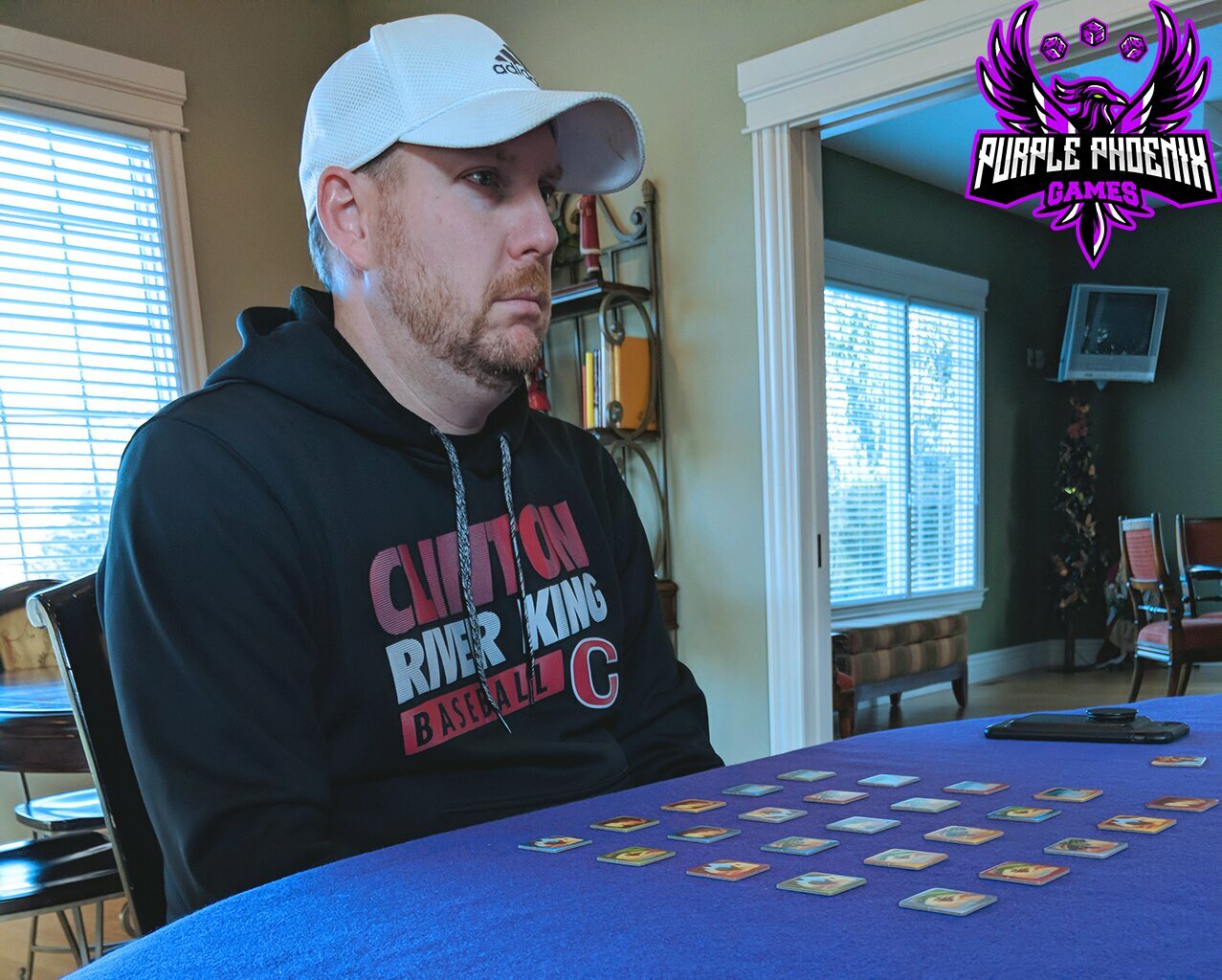
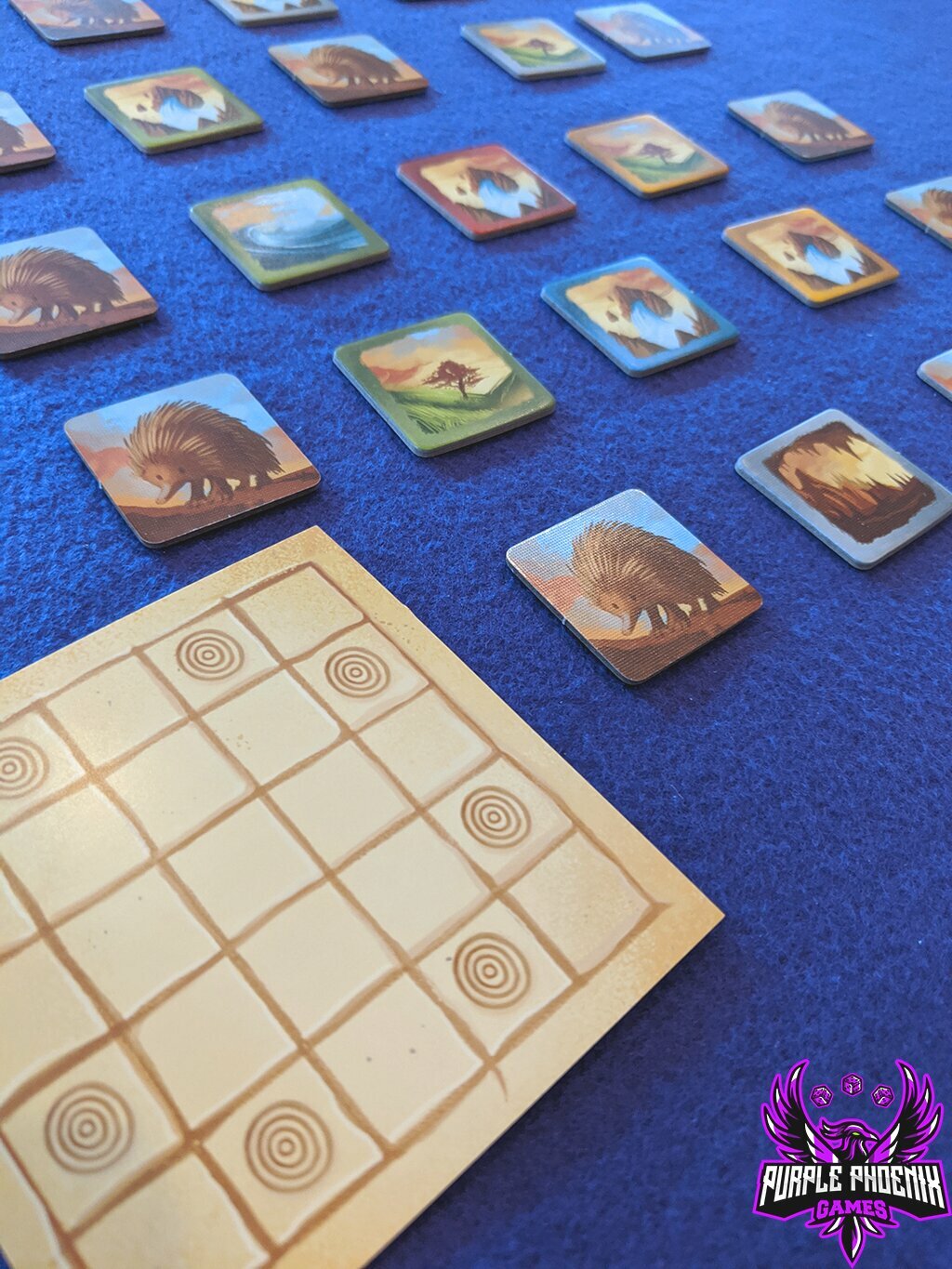
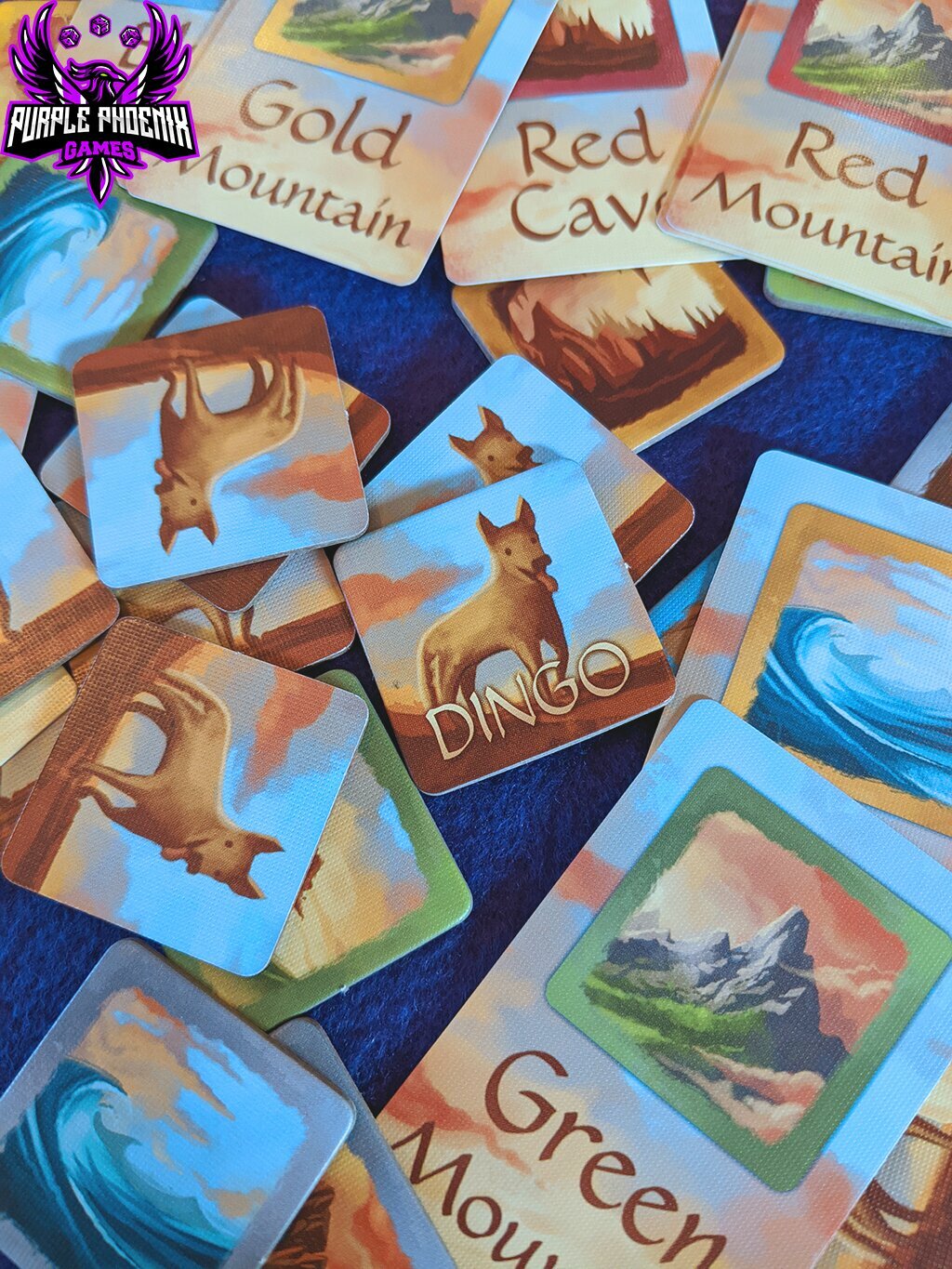
In Dingo’s Dreams, the goal is to guide your spirit animal through the dream world and back home before your opponents do. How do you do that? By being the first to get your dreamscape to match the dream card pattern. To setup the game, each player takes the 25 tiles of their chosen animal, and creates a 5×5 grid in front of them. The tiles are double-sided, and the side with the animal should be face-down. There will be 1 extra tile, with the animal on both sides, which should be kept to the side. The Walkabout cards are shuffled and placed in a face-down deck, and a single dream card is revealed. Each turn of the game has 2 phases: Walkabout and Dreamtime. In the Walkabout phase, a card is revealed from the Walkabout deck and all players find the corresponding tile in their grid and flip it over so the animal side is face-up. In the Dreamtime phase, all players will take their extra tile and place it at the end of any row/column, thus forcing that line of tiles to shift over and push out a different tile. Play continues until one player has manipulated their grid to match that of the dream card. Once you do that, call out the name of your animal (Dingo!) and you win!
The rules and gameplay of Dingo’s Dreams are relatively simple, but how does it perform overall? It’s a pretty light game, but it does require some strategy. It takes some creative manipulation to shift your grid to victory. You have to be thinking a turn or two in advance to see if you can setup your grid for maximum benefit. That being said, the randomness of the grid setups and the Walkabout cards sometimes makes the game feel too luck-based. Yes, you do have the power to manipulate your own grid, but ultimately you are at the mercy of the cards and they can really work against you, no matter how strong your strategy is. Another drawback of Dingo’s Dreams is the lack of player interaction. This game is pretty much multi-player solitaire. Everyone is working on their own grids at the same time, and the only thing that affects you are the cards. It’s kind of a quiet and low energy game, which is not necessarily a bad thing, but it can halt the momentum of game night.
On that same note, one of the things that I do really like about Dingo’s Dreams is that it is so relaxed and simple. It makes for a great filler game and palette cleanser between some beefier games. The overall playtime is relatively short, and it can quickly be played multiple times in a row. Another great thing about Dingo’s Dreams is the option to increase the difficulty by adding Hazards. Hazards are tokens placed on certain spaces of the dream cards, and they mean that you cannot have an animal tile in that spot of your grid in order to win. It just adds another level of strategy and can up the ante around the table.
Overall, Dingo’s Dreams is a light and relaxing game that is perfect for playing between heavier games when you need a little break. Was this a good find for me at the Used Game sale? I would say so. It’s not one that I pull out at every single game night, but it’s one that I will use to introduce newer gamers to the hobby, and one that I will pull out when I just want a quiet night in. Purple Phoenix Games gives Dingo’s Dreams a fantasy-filled 13 / 18.
In Dingo’s Dreams, the goal is to guide your spirit animal through the dream world and back home before your opponents do. How do you do that? By being the first to get your dreamscape to match the dream card pattern. To setup the game, each player takes the 25 tiles of their chosen animal, and creates a 5×5 grid in front of them. The tiles are double-sided, and the side with the animal should be face-down. There will be 1 extra tile, with the animal on both sides, which should be kept to the side. The Walkabout cards are shuffled and placed in a face-down deck, and a single dream card is revealed. Each turn of the game has 2 phases: Walkabout and Dreamtime. In the Walkabout phase, a card is revealed from the Walkabout deck and all players find the corresponding tile in their grid and flip it over so the animal side is face-up. In the Dreamtime phase, all players will take their extra tile and place it at the end of any row/column, thus forcing that line of tiles to shift over and push out a different tile. Play continues until one player has manipulated their grid to match that of the dream card. Once you do that, call out the name of your animal (Dingo!) and you win!
The rules and gameplay of Dingo’s Dreams are relatively simple, but how does it perform overall? It’s a pretty light game, but it does require some strategy. It takes some creative manipulation to shift your grid to victory. You have to be thinking a turn or two in advance to see if you can setup your grid for maximum benefit. That being said, the randomness of the grid setups and the Walkabout cards sometimes makes the game feel too luck-based. Yes, you do have the power to manipulate your own grid, but ultimately you are at the mercy of the cards and they can really work against you, no matter how strong your strategy is. Another drawback of Dingo’s Dreams is the lack of player interaction. This game is pretty much multi-player solitaire. Everyone is working on their own grids at the same time, and the only thing that affects you are the cards. It’s kind of a quiet and low energy game, which is not necessarily a bad thing, but it can halt the momentum of game night.
On that same note, one of the things that I do really like about Dingo’s Dreams is that it is so relaxed and simple. It makes for a great filler game and palette cleanser between some beefier games. The overall playtime is relatively short, and it can quickly be played multiple times in a row. Another great thing about Dingo’s Dreams is the option to increase the difficulty by adding Hazards. Hazards are tokens placed on certain spaces of the dream cards, and they mean that you cannot have an animal tile in that spot of your grid in order to win. It just adds another level of strategy and can up the ante around the table.
Overall, Dingo’s Dreams is a light and relaxing game that is perfect for playing between heavier games when you need a little break. Was this a good find for me at the Used Game sale? I would say so. It’s not one that I pull out at every single game night, but it’s one that I will use to introduce newer gamers to the hobby, and one that I will pull out when I just want a quiet night in. Purple Phoenix Games gives Dingo’s Dreams a fantasy-filled 13 / 18.

Animal Face Snap.pic: Funny Stickers Photo Booth
Lifestyle and Entertainment
App
▶▶▶Get *Animal Face SnapPic* and make the most of our photo manipulation special...

Kirk Bage (1775 KP) rated Okja (2017) in Movies
Mar 3, 2020 (Updated Mar 3, 2020)

Okja (pronounced ok-cha, as far as I can discern from hearing it said) was a film I had on my radar from its release, but it took the impetus of Parasite and director Bong Joon Ho winning the Oscar to kick me into settling down to watch it. It is the kind of film I would have seen as a matter of course when I worked at the beloved Cameo Cinema, Edinburgh, back in the day… but the kind of film it takes me a while to get around to these days.
What I had heard was that it was quirky, had a very black humour and involved a giant pig. Other than that I was going in blind. Which is always preferable, with almost any film! Hype and too much information can ruin your experience of a thing, simply by putting preconceptions and ideas in your head that may influence your thinking and true reaction to something. I was very grateful then to avoid too much information regarding this unique movie.
The cast is full of people I like, outside of the Korean cast that were strangers to me, in all honesty. Jake Gyllenhaal and Paul Dano, especially, are two actors that have been high on my list of consistent performers you can trust for some years; both making interesting and compelling career choices in terms of subject matter and working with strong directors. Tilda Swinton too is usually good value for a promising watch, almost guaranteeing something slightly leftfield and worth thinking about.
Dano gets away with being the one likeable, if morally ambiguous, character out of the three; with Swinton and Gyllenhaal giving bizarre, heightened comic performances that it is hard to reference to anything else! As the main story of eco-consciousness and a girl’s love for her giant pig progresses in charming fashion, it is these starkly bonkers performances that stick out like very sore thumbs – sometimes raising awkward chuckles, but mostly making you go “what the hell is going on!?”
Well, what is going on is an exploration of corporate evil, the lies, deviousness and manipulation used to make a profit that ignores life and nature as anything worth preserving, or even loving. It wants us to look at meat eating for what it is, and imagines how we might think more about it as a species if we truly accept that animals have rights, personalities, even souls. Of course many people watching wouldn’t need to be converted to this way of thinking at all, so I am very curious (as a non vegetarian / vegan) what reaction a person whose consciousness of these things has been awake for years might have…?
It is possible to watch this without involving yourself too much in that whole debate, however. At its heart, it is a film about innocent love, and a rescue movie that sets unlikely heroes against a gargantuan nemesis against all odds. Naturally, it is a very smart script, that doesn’t ignore the notion of making fun of itself and keeping it mostly fun. In many ways, it seems like a family friendly film, apart from the underlying seriousness of the subject of cruelty, torture and, essentially, murder for the private gain of unscrupulous suits who would watch the world burn in the name of profit.
At the time of watching it, I caught myself in the right mood and really enjoyed it for what it was. Seo-Hyun Ahn as Mija is utterly lovely, and you do find yourself falling for Okja (rendered with marvelous CGI work) and sympathising with the warmth of their relationship as friends. The moments of the film that show nature and the calm of a non-modern world are the most compelling. The parts of the film with cities and noise and guns are more jarring – which, perhaps, is the point and fully intentional. Clearly, this is a director with serious vision and talent that was almost, if not quite, getting it right. As we now know, with Parasite he nailed it…
This is a film I’d be a little cautious of recommending to some people. It is just too odd in parts. It is a good film, not a great one. And perhaps more likely to impress in the hands of viewers that are already converted to the cause and way of thinking it champions.
What I had heard was that it was quirky, had a very black humour and involved a giant pig. Other than that I was going in blind. Which is always preferable, with almost any film! Hype and too much information can ruin your experience of a thing, simply by putting preconceptions and ideas in your head that may influence your thinking and true reaction to something. I was very grateful then to avoid too much information regarding this unique movie.
The cast is full of people I like, outside of the Korean cast that were strangers to me, in all honesty. Jake Gyllenhaal and Paul Dano, especially, are two actors that have been high on my list of consistent performers you can trust for some years; both making interesting and compelling career choices in terms of subject matter and working with strong directors. Tilda Swinton too is usually good value for a promising watch, almost guaranteeing something slightly leftfield and worth thinking about.
Dano gets away with being the one likeable, if morally ambiguous, character out of the three; with Swinton and Gyllenhaal giving bizarre, heightened comic performances that it is hard to reference to anything else! As the main story of eco-consciousness and a girl’s love for her giant pig progresses in charming fashion, it is these starkly bonkers performances that stick out like very sore thumbs – sometimes raising awkward chuckles, but mostly making you go “what the hell is going on!?”
Well, what is going on is an exploration of corporate evil, the lies, deviousness and manipulation used to make a profit that ignores life and nature as anything worth preserving, or even loving. It wants us to look at meat eating for what it is, and imagines how we might think more about it as a species if we truly accept that animals have rights, personalities, even souls. Of course many people watching wouldn’t need to be converted to this way of thinking at all, so I am very curious (as a non vegetarian / vegan) what reaction a person whose consciousness of these things has been awake for years might have…?
It is possible to watch this without involving yourself too much in that whole debate, however. At its heart, it is a film about innocent love, and a rescue movie that sets unlikely heroes against a gargantuan nemesis against all odds. Naturally, it is a very smart script, that doesn’t ignore the notion of making fun of itself and keeping it mostly fun. In many ways, it seems like a family friendly film, apart from the underlying seriousness of the subject of cruelty, torture and, essentially, murder for the private gain of unscrupulous suits who would watch the world burn in the name of profit.
At the time of watching it, I caught myself in the right mood and really enjoyed it for what it was. Seo-Hyun Ahn as Mija is utterly lovely, and you do find yourself falling for Okja (rendered with marvelous CGI work) and sympathising with the warmth of their relationship as friends. The moments of the film that show nature and the calm of a non-modern world are the most compelling. The parts of the film with cities and noise and guns are more jarring – which, perhaps, is the point and fully intentional. Clearly, this is a director with serious vision and talent that was almost, if not quite, getting it right. As we now know, with Parasite he nailed it…
This is a film I’d be a little cautious of recommending to some people. It is just too odd in parts. It is a good film, not a great one. And perhaps more likely to impress in the hands of viewers that are already converted to the cause and way of thinking it champions.

BankofMarquis (1832 KP) rated Joker (2019) in Movies
Oct 10, 2019

Joaquin's Performance Elevates This Film
Give Joaquin Phoenix the Oscar right now. His bravura performance as the titular character in JOKER is one for the ages. He is on the screen in every scene of this film and captivates and repulses you at the same time. This performance raises this film to another level.
The question is - what level was this film at, and where does this performance raise it to?
Set in Gotham City right around the time of the murder of Bruce Wayne's parents, JOKER tells the origin story of...well...a character that calls himself JOKER. This sad sack, with the name of Arthur Fleck, is a part-time clown (standing outside of store closings with a spinning sign or going to Children's Hospital). We watch his origins as he rises (or perhaps...falls?) to the anarchic symbol that is JOKER. And that's the interesting thing about this film. You are watching the fall of a man and the rise of a symbol - does Fleck find comfort or madness in this journey - or, perhaps, maybe he finds comfort in madness?
Embodying this broken spirit that keeps getting up despite whatever beatings (sometimes physical, sometimes mental, always with the potential to finally break him) is the unique talent that is Joaquin Phoenix. You can tell from his portrayal of Arthur that there is something just "off" with him and you continually wait for the breaking point that will drive him down the road of JOKER. But it is not only his acting that is on display here, it the manipulation and movements of his body that is amazing and outstanding. Much like a professional dancer, Phoenix/Fleck waltzes through this film like there is a musical score that only he can hear - and that is both fascinating and disturbing at the same time. There is a fine line that needs to be trod here, for if you don't, this character and performance can easily be one of total madness (a.k.a. Jack Nicholson as Jack Torrance in the SHINING) but Phoenix balances sanity/insanity very well and you are waiting for the final blow that will send him, inevitably, over the edge. It's like watching a ticking time bomb that you cannot see the clock counting down to zero - but count down to zero you are sure it will do.
Exchanging blows with Phoenix for about 1/3 of this film is Robert DeNiro as talk show host Murray Franklin (think a meaner version of Johnny Carson). DeNiro is VERY good in this role and it is good to see that he still can "bring it" as a serious actor when he wants to. Unfortunately, DeNiro's character isn't really in the first 2/3 of this film and that's too bad. Phoenix' Arthur Fleck is a force to be reckoned with and he really could have used another character just as strong to play against.
Unfortunately, Writer/Director Todd Phillips (THE HANGOVER films) doesn't really give Phoenix anyone strong to play against for the first 2/3 of this film though Frances Conroy (overbearing mother), Zazie Beetz (potential love interest) and Brett Cullen (billionaire Thomas Wayne, father of Bruce) come and go in all too brief appearances that never really are on screen long enough to stand their ground (though Conroy comes close). This makes the first part of this film very on-sided, dreary, depressing and dark. I get that Director/Writer Phillips was going for the "Decaying of Gotham" theme as seen through the eyes of Fleck, but it became a slog after awhile. I wanted to yell at the screen at about the 1 hour mark "All right, I get it!"
Now...to give Phillips credit, he creates an interesting version of this world that we all know well (through the Dark Knight and various other DC Universe films), so I give him points for originality. And...he really NAILS the ending (the last 1/3 of the film - the part WITH DeNiro). I thought it was effective and potent and left it's mark.
Which brings me back to my opening thought. Phoenix raises this film up with his performance - the question is "from where to where". I'd have to say (because of the slowness of the first 2/3 of this film) that Phoenix fearless performance raises this dark and dreary film from a "C" to a "B". So with that in mind, I give JOKER...
Letter Grade: B
7 (out of 10) stars and you can take that to the Bank(ofMarquis)
The question is - what level was this film at, and where does this performance raise it to?
Set in Gotham City right around the time of the murder of Bruce Wayne's parents, JOKER tells the origin story of...well...a character that calls himself JOKER. This sad sack, with the name of Arthur Fleck, is a part-time clown (standing outside of store closings with a spinning sign or going to Children's Hospital). We watch his origins as he rises (or perhaps...falls?) to the anarchic symbol that is JOKER. And that's the interesting thing about this film. You are watching the fall of a man and the rise of a symbol - does Fleck find comfort or madness in this journey - or, perhaps, maybe he finds comfort in madness?
Embodying this broken spirit that keeps getting up despite whatever beatings (sometimes physical, sometimes mental, always with the potential to finally break him) is the unique talent that is Joaquin Phoenix. You can tell from his portrayal of Arthur that there is something just "off" with him and you continually wait for the breaking point that will drive him down the road of JOKER. But it is not only his acting that is on display here, it the manipulation and movements of his body that is amazing and outstanding. Much like a professional dancer, Phoenix/Fleck waltzes through this film like there is a musical score that only he can hear - and that is both fascinating and disturbing at the same time. There is a fine line that needs to be trod here, for if you don't, this character and performance can easily be one of total madness (a.k.a. Jack Nicholson as Jack Torrance in the SHINING) but Phoenix balances sanity/insanity very well and you are waiting for the final blow that will send him, inevitably, over the edge. It's like watching a ticking time bomb that you cannot see the clock counting down to zero - but count down to zero you are sure it will do.
Exchanging blows with Phoenix for about 1/3 of this film is Robert DeNiro as talk show host Murray Franklin (think a meaner version of Johnny Carson). DeNiro is VERY good in this role and it is good to see that he still can "bring it" as a serious actor when he wants to. Unfortunately, DeNiro's character isn't really in the first 2/3 of this film and that's too bad. Phoenix' Arthur Fleck is a force to be reckoned with and he really could have used another character just as strong to play against.
Unfortunately, Writer/Director Todd Phillips (THE HANGOVER films) doesn't really give Phoenix anyone strong to play against for the first 2/3 of this film though Frances Conroy (overbearing mother), Zazie Beetz (potential love interest) and Brett Cullen (billionaire Thomas Wayne, father of Bruce) come and go in all too brief appearances that never really are on screen long enough to stand their ground (though Conroy comes close). This makes the first part of this film very on-sided, dreary, depressing and dark. I get that Director/Writer Phillips was going for the "Decaying of Gotham" theme as seen through the eyes of Fleck, but it became a slog after awhile. I wanted to yell at the screen at about the 1 hour mark "All right, I get it!"
Now...to give Phillips credit, he creates an interesting version of this world that we all know well (through the Dark Knight and various other DC Universe films), so I give him points for originality. And...he really NAILS the ending (the last 1/3 of the film - the part WITH DeNiro). I thought it was effective and potent and left it's mark.
Which brings me back to my opening thought. Phoenix raises this film up with his performance - the question is "from where to where". I'd have to say (because of the slowness of the first 2/3 of this film) that Phoenix fearless performance raises this dark and dreary film from a "C" to a "B". So with that in mind, I give JOKER...
Letter Grade: B
7 (out of 10) stars and you can take that to the Bank(ofMarquis)

Bob Mann (459 KP) rated Dunkirk (2017) in Movies
Sep 29, 2021


A war vehicle running low on fuel.
The words “Christopher Nolan” and “disappointment” are not words I would naturally associate… but for me, they apply where “Dunkirk” is concerned.
It promised so much from the trailer: a historical event of epic proportions; Kenneth Branagh; Tom Hardy; Mark Rylance; Hans Zimmer on the keys; the director of such classics as “The Dark Knight”; “Inception” and “Interstellar” : what could go wrong?
But it just doesn’t work and I’ve spent the last 24 hours trying to unpick why.
A key problem for me was the depiction of the beach itself. The film eschews CGI effects – a move that I would normally approve of – in favour of the use of “practical effects” and the involvement of “thousands of extras” (as the rather glutinously positive Wiki entry declares). Unfortunately for the movie, there were some 400,000 troops marooned in this last patch of civilisation ahead of the Nazi hoard, and all of the shots refuse to acknowledge this scale of potential human tragedy. Yes, there are individual scenes of horror, such as the soldier walking into the sea against the impassive stares of the young heroes. But nothing of scale. At times I thought I’d seen more people on the beach on a winter’s day in Bournemouth! In the absence of a co-production with China, and the provision of the volume of extras as in “The Great Wall“, CGI becomes a necessary evil to make the whole exercise believable.
What it was really like…. one of the famous paintings by Charles Cundall (Crown copyright).
My disquiet at this deepened when we got to the sharp end of the rescue by the “small boats”. In my mind (and I’m NOT quite old enough to remember this!) I imagine a sea full of them. A sight to truly merit Branagh’s awed gaze. But no. They might have been “original” vessels…. but there was only about half a dozen of them. A mental vision dashed.
Did I feel a spot of rain? Looking to unfriendly skies on the River Mole.
The film attempts to tell the story from three perspectives: from the land; from the sea and from the air. The sea though gets the lion’s share of the film, and there is much drowning that occurs that (I am aware) was distressing for some in the audience.
Styles going in One Direction…. down.
Nolan also pushes his quirky “timeline” manipulation too far for an audience that largely expects a linear telling of a classic tale. It’s day; it’s night; the minesweeper’s sailing; then sunk; then sailing again; a Spitfire crashes, then crashes again from a different perspective. I know many in the audience just didn’t ‘get’ that: leaving them presumably very confused!
That being said, the film is not a write off, and has its moments of brilliance. Kenneth Branagh (“Jack Ryan: Shadow Recruit“, “Valkyrie”) – although having a range of Nolan’s clipped and cheesy lines to say – is impressive as the commanding officer. Mark Rylance (“Bridge of Spies“, “The BFG“) also shines as the captain of the “Moonstone”: one of the small boats out of Weymouth (although here there is a grievous lack of backstory for the civilian efforts). And Tom Hardy (“The Revenant“, “Legend“), although having limited opportunity to act with anything other than his eyes, is impressive as RAF pilot Farrier. His final scene of stoic heroism is memorable.
Fionn Whitehead is also impressive in his movie debut, and even Harry Styles (“This is Us“) equips himself well.
A surfeit of horror leads to a lack of compassion. Harry Styles, Aneurin Barnard and Fionn Whitehead look on as the death toll mounts.
The cinematography by Hoyte Van Hoytema (“Interstellar“) is stunning with some memorable shots: a burning plane on a beach being a highspot for me.
And Hans Zimmer’s score is Oscar-worthy, generating enormous tension with a reverberating score, albeit sometimes let down by unsuitable cutaways (for example, to scenes of boat loading). Elsewhere in the sound department though I had major issues, with a decent percentage of the dialogue being completely inaudible in the sound mix.
Kenneth Branagh, impressive as Commander Bolton RN.
I really wanted this to be a “Battle of Britain”. Or a “Bridge Too Far”. Or even a “Saving Private Ryan”. Unfortunately, for me it was none of these, and this goes down as one of my movie disappointments of the year so far.
It promised so much from the trailer: a historical event of epic proportions; Kenneth Branagh; Tom Hardy; Mark Rylance; Hans Zimmer on the keys; the director of such classics as “The Dark Knight”; “Inception” and “Interstellar” : what could go wrong?
But it just doesn’t work and I’ve spent the last 24 hours trying to unpick why.
A key problem for me was the depiction of the beach itself. The film eschews CGI effects – a move that I would normally approve of – in favour of the use of “practical effects” and the involvement of “thousands of extras” (as the rather glutinously positive Wiki entry declares). Unfortunately for the movie, there were some 400,000 troops marooned in this last patch of civilisation ahead of the Nazi hoard, and all of the shots refuse to acknowledge this scale of potential human tragedy. Yes, there are individual scenes of horror, such as the soldier walking into the sea against the impassive stares of the young heroes. But nothing of scale. At times I thought I’d seen more people on the beach on a winter’s day in Bournemouth! In the absence of a co-production with China, and the provision of the volume of extras as in “The Great Wall“, CGI becomes a necessary evil to make the whole exercise believable.
What it was really like…. one of the famous paintings by Charles Cundall (Crown copyright).
My disquiet at this deepened when we got to the sharp end of the rescue by the “small boats”. In my mind (and I’m NOT quite old enough to remember this!) I imagine a sea full of them. A sight to truly merit Branagh’s awed gaze. But no. They might have been “original” vessels…. but there was only about half a dozen of them. A mental vision dashed.
Did I feel a spot of rain? Looking to unfriendly skies on the River Mole.
The film attempts to tell the story from three perspectives: from the land; from the sea and from the air. The sea though gets the lion’s share of the film, and there is much drowning that occurs that (I am aware) was distressing for some in the audience.
Styles going in One Direction…. down.
Nolan also pushes his quirky “timeline” manipulation too far for an audience that largely expects a linear telling of a classic tale. It’s day; it’s night; the minesweeper’s sailing; then sunk; then sailing again; a Spitfire crashes, then crashes again from a different perspective. I know many in the audience just didn’t ‘get’ that: leaving them presumably very confused!
That being said, the film is not a write off, and has its moments of brilliance. Kenneth Branagh (“Jack Ryan: Shadow Recruit“, “Valkyrie”) – although having a range of Nolan’s clipped and cheesy lines to say – is impressive as the commanding officer. Mark Rylance (“Bridge of Spies“, “The BFG“) also shines as the captain of the “Moonstone”: one of the small boats out of Weymouth (although here there is a grievous lack of backstory for the civilian efforts). And Tom Hardy (“The Revenant“, “Legend“), although having limited opportunity to act with anything other than his eyes, is impressive as RAF pilot Farrier. His final scene of stoic heroism is memorable.
Fionn Whitehead is also impressive in his movie debut, and even Harry Styles (“This is Us“) equips himself well.
A surfeit of horror leads to a lack of compassion. Harry Styles, Aneurin Barnard and Fionn Whitehead look on as the death toll mounts.
The cinematography by Hoyte Van Hoytema (“Interstellar“) is stunning with some memorable shots: a burning plane on a beach being a highspot for me.
And Hans Zimmer’s score is Oscar-worthy, generating enormous tension with a reverberating score, albeit sometimes let down by unsuitable cutaways (for example, to scenes of boat loading). Elsewhere in the sound department though I had major issues, with a decent percentage of the dialogue being completely inaudible in the sound mix.
Kenneth Branagh, impressive as Commander Bolton RN.
I really wanted this to be a “Battle of Britain”. Or a “Bridge Too Far”. Or even a “Saving Private Ryan”. Unfortunately, for me it was none of these, and this goes down as one of my movie disappointments of the year so far.
Purple Phoenix Games (2266 KP) rated Potion Explosion in Tabletop Games
Jan 6, 2020
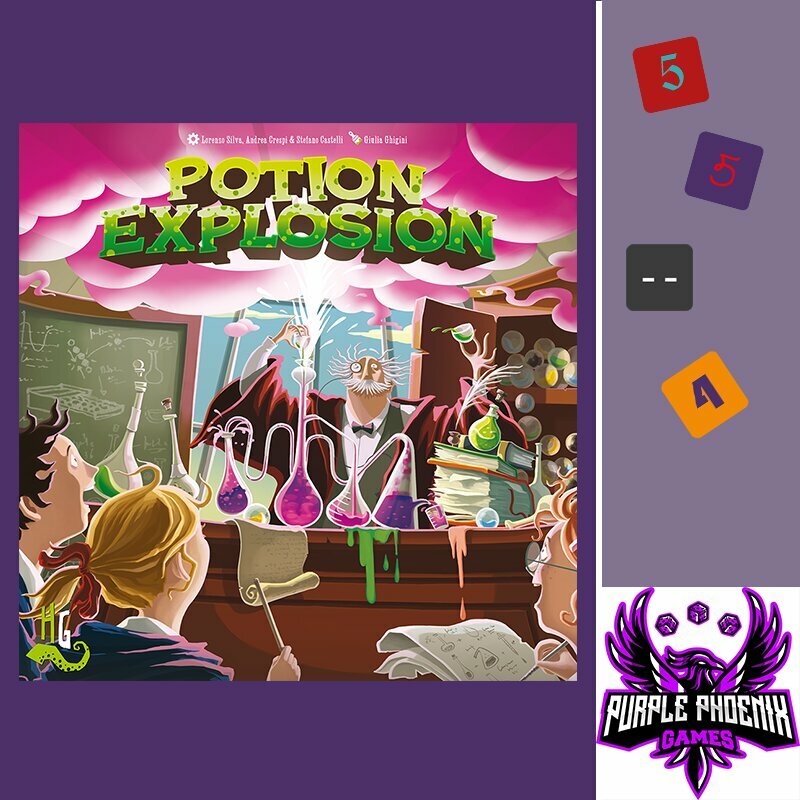
Your senior year at Horribilorum Sorcery Academy for Witty Witches and Wizards is almost at an end, but one thing stands between you and graduation – final exams! You’ve passed everything with flying colors, and now it’s time for your final exam in Potions class. Do you have what it takes to brew the most difficult and impressive potions? Or will amateur mistakes result in inaccurate recipes and ultimate failure? The time for studying is over, and the time for potion making is NOW!
Disclaimer: There are several expansions for this game. I do not have any of them, nor do I have any gameplay experience with any of them. If and when I do get them added into my base game, I will either amend this review or write a new one! – L
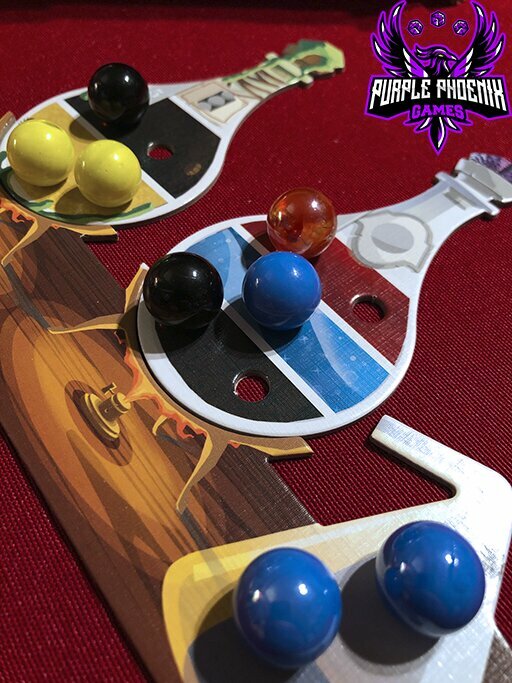
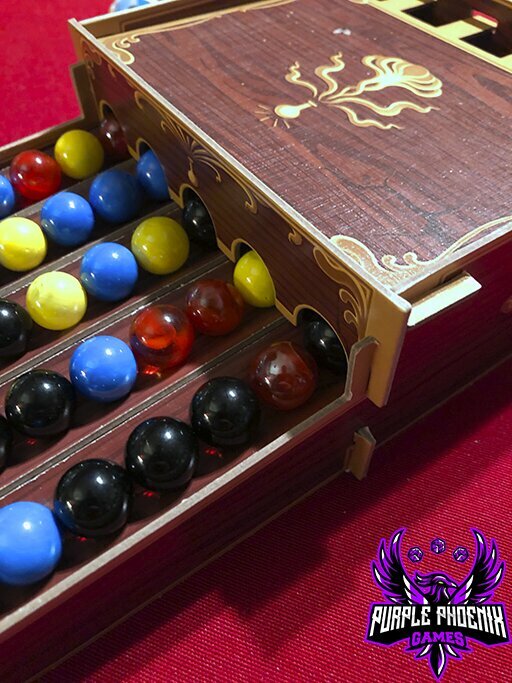
Potion Explosion is a game of set collection in which players are trying to complete potions for end-game VPs. To start the game, each player takes two beaker-shaped potion tiles to be kept in their desk (play area). On your turn, you will select one marble from the dispenser and play it to one of your potions. Easy enough. The marbles are housed in an angled dispenser, so when a marble is removed from one of the tracks, the rest roll down to fill in the gaps. Neat, right? But there’s a catch. If the marble you take causes two marbles of the same color to collide as they move down the dispenser, you have triggered an explosion! That means that you are allowed to take all marbles of the same color that were involved in the explosion on that same track. Sometimes, by removing all the marbles involved in an explosion, a second explosion may be triggered! In that case, you take all of those marbles as well!
Once you’ve taken a marble (or multiple, depending on any explosions), you immediately play those onto your active Potion Tiles. You have the option of keeping up to three marbles in the Ingredient Pool on your desk to be played in later turns. Extra marbles that cannot fit on your Potion Tiles or in your Ingredient Pool are returned to the dispenser. If you complete a potion on your turn, return its corresponding marbles to the dispenser and place the Potion Tile beneath your desk, to be scored at the end of the game. Then you select another Potion Tile from the available stacks to be added to your desk. You will always have two Potion Tiles on your desk. Your turn is now over, and play continues with the next player. The game ends when a certain number of Skill Tokens (earned for completing sets of 3 identical potions, or for completing sets of 5 different potions) have been awarded to players. Play continues until everyone has had the same amount of turns, and then VPs are counted. The player with the most VP is the winner!
I’ve got to lead this off by saying that one of the things I love most about Potion Explosion are the components. The Potion Tiles are nice and thick cardboard, and the marbles are just so much fun to fiddle with throughout the game. Yeah, I may accidentally roll some off the table every once in a while, but they’re a neat addition to the game. I’ve heard that the cardboard dispenser doesn’t hold up after many plays, but I have yet to see that issue, and know that lots of people are now 3D printing dispensers for themselves to circumvent this problem.
So how does it play? Potion Explosion is relatively fast to play, and requires more strategy than meets the eye. You’re selecting and playing marbles, but you’ve also got to keep an eye on any explosion possibilities. Maybe you need 4 blue marbles – are any of the dispenser tracks loaded with blues so that you could strategically trigger an explosion? Or is your neighbor really going for red marbles, so you trigger a red explosion just to keep those from them? The marble placement in the dispenser may be random, but your manipulation of the available marbles is not. Strategy is everything here, because one mistake in marble selection could end up handing your opponents the game.
I thoroughly enjoy Potion Explosion. It’s fast to teach, fast to learn, and fun to play with all ages! The mechanism of the marble dispenser is pretty neat, and it adds an extra element to the game. This game keeps me engaged the entire time because it is just so fun to watch the marbles moving down the tracks and potentially triggering multiple explosions. Although it requires good strategy, it’s a light enough game to give your a break in between some heavier brain-burners. If you haven’t had the opportunity to try Potion Explosion yet, I would highly recommend it. Purple Phoenix Games gives it a bubbling 14 / 18.
Disclaimer: There are several expansions for this game. I do not have any of them, nor do I have any gameplay experience with any of them. If and when I do get them added into my base game, I will either amend this review or write a new one! – L
Potion Explosion is a game of set collection in which players are trying to complete potions for end-game VPs. To start the game, each player takes two beaker-shaped potion tiles to be kept in their desk (play area). On your turn, you will select one marble from the dispenser and play it to one of your potions. Easy enough. The marbles are housed in an angled dispenser, so when a marble is removed from one of the tracks, the rest roll down to fill in the gaps. Neat, right? But there’s a catch. If the marble you take causes two marbles of the same color to collide as they move down the dispenser, you have triggered an explosion! That means that you are allowed to take all marbles of the same color that were involved in the explosion on that same track. Sometimes, by removing all the marbles involved in an explosion, a second explosion may be triggered! In that case, you take all of those marbles as well!
Once you’ve taken a marble (or multiple, depending on any explosions), you immediately play those onto your active Potion Tiles. You have the option of keeping up to three marbles in the Ingredient Pool on your desk to be played in later turns. Extra marbles that cannot fit on your Potion Tiles or in your Ingredient Pool are returned to the dispenser. If you complete a potion on your turn, return its corresponding marbles to the dispenser and place the Potion Tile beneath your desk, to be scored at the end of the game. Then you select another Potion Tile from the available stacks to be added to your desk. You will always have two Potion Tiles on your desk. Your turn is now over, and play continues with the next player. The game ends when a certain number of Skill Tokens (earned for completing sets of 3 identical potions, or for completing sets of 5 different potions) have been awarded to players. Play continues until everyone has had the same amount of turns, and then VPs are counted. The player with the most VP is the winner!
I’ve got to lead this off by saying that one of the things I love most about Potion Explosion are the components. The Potion Tiles are nice and thick cardboard, and the marbles are just so much fun to fiddle with throughout the game. Yeah, I may accidentally roll some off the table every once in a while, but they’re a neat addition to the game. I’ve heard that the cardboard dispenser doesn’t hold up after many plays, but I have yet to see that issue, and know that lots of people are now 3D printing dispensers for themselves to circumvent this problem.
So how does it play? Potion Explosion is relatively fast to play, and requires more strategy than meets the eye. You’re selecting and playing marbles, but you’ve also got to keep an eye on any explosion possibilities. Maybe you need 4 blue marbles – are any of the dispenser tracks loaded with blues so that you could strategically trigger an explosion? Or is your neighbor really going for red marbles, so you trigger a red explosion just to keep those from them? The marble placement in the dispenser may be random, but your manipulation of the available marbles is not. Strategy is everything here, because one mistake in marble selection could end up handing your opponents the game.
I thoroughly enjoy Potion Explosion. It’s fast to teach, fast to learn, and fun to play with all ages! The mechanism of the marble dispenser is pretty neat, and it adds an extra element to the game. This game keeps me engaged the entire time because it is just so fun to watch the marbles moving down the tracks and potentially triggering multiple explosions. Although it requires good strategy, it’s a light enough game to give your a break in between some heavier brain-burners. If you haven’t had the opportunity to try Potion Explosion yet, I would highly recommend it. Purple Phoenix Games gives it a bubbling 14 / 18.


CCNA Routing and Switching ICND2 200-105 Official Cert Guide
Book
Trust the best-selling Official Cert Guide series from Cisco Press to help you learn, prepare, and...
Purple Phoenix Games (2266 KP) rated Cooking Customers in Tabletop Games
Feb 4, 2020
Raise your hand if you have ever worked in the food industry. Okay, I see a few hands. Now raise your hand if you have ever been so torqued by a customer that you wanted to cook them in a pie. Oh, thanks for your hand Mrs. Lovett. Good to know. Well this game is an experience of getting your money and getting out. Fastest one to do so will win, and if you have to stew a few eyeballs in the process, more power to you.
DISCLAIMER: We were provided a copy of this game for the purposes of this review. This is a retail copy of the game, so what you see in these photos is exactly what would be received in your box. I do not intend to cover every single rule included in the rulebook, but will describe the overall game flow and major rule set so that our readers may get a sense of how the game plays. For more in depth rules, you may purchase a copy online or from your FLGS. -T
Cooking Customers is a card and dice game where the first player to amass $20 in “tips” will be crowned the winner. Players earn tips by serving enough meals to customers at each table. Players can receive meals by rolling them on dice, or by card manipulation. Let me explain.
To setup, place the meals (black discs) in the middle of the table for all to reach. Similarly, place all the dice nearby. These dice have three sides: FIRED, MEAL, and a blank side. Shuffle the mighty deck of cards and deal five to each player, placing the rest of the deck in the middle of the table. Finally, shuffle the Table cards and place somewhere near the other components. Players are now ready to begin!
On a player’s turn, they will first draw the topmost Table card to be placed in front of themselves. This card will show how many meals need to be served to it to be satisfied and earn tips. The Table cards will mostly just sit there in front of players collecting meal discs for the game’s duration. Once a Table card is drawn (and only one Table per player, please) the active player may then play cards from hand. A player may play one or two cards, but only one card may be played to the active player’s tableau, and only one card may be played on an opponent. Should a player not wish to play a card to anyone’s tableau, they must discard a card to the middle of the table. Then the active player will draw back to the hand size of five cards.
Cards played to other players are usually bad, Munchkin-esque cards that halt progression or just cause mayhem for their designs. I will not go into detail on these, as half the fun of this game is the Take-That of these cards. Cards played to a player’s own tableau can be a myriad choices: Cooks, Helpers, Kitchen Supplies, etc. The most important are the Cook cards. A player will need to have a Cook “hired” in front of them in order to participate in the next phase of the game: rolling dice. Players can have Helper cards (sous chefs) and Kitchen Supplies active without a Cook, but the player may not roll dice or serve meals without a Cook. Cooks and Helpers will dictate how many dice are rolled in the next phase of a turn, and rolling more dice is always better.
Once all cards have been played on a player’s turn, they may now roll the dice (though for a game with such a dark theme I say we use the “Roll Them Bones” colloquialism). When the dice are rolled, players are hoping for MEAL to show up on all dice. This is how a meal can be collected and served to the Table cards. However, if at any time all dice read FIRED then the player’s Cook is fired and they may not continue rolling dice. The Cook is discarded and play is forfeited to the next player. #cheflife amirite?
Once a Table card has all the meals it needs to be satisfied, the player may score it by flipping it over to reveal the amount in tips they have earned. Play continues in this fashion until one player has earned $20 in tips. They can then taunt the other players with their superiority.
Components. Cooking Customers is a BUNCH of cards, some painted wooden discs, and some embossed dice. The cards are good quality, the discs are good as well, and the dice are great. All the components are pretty darn good. The art, though gross at times, is really well-done (see what I did there) and kept us laughing throughout our plays.
I do have one qualm about this game: the rulebook. Though only six pages long and with lots of illustrations throughout, I found that reading it made me more confused than it should have. I did take the rulebook’s advice to go to the publisher’s website, goodenoughgames.com, and watch the rules explanation and playthrough. That helped immensely to clear up what the rulebook did to my brain.
All in all, we had a great time playing this one. We all like Munchkin, and though it is NOT Munchkin, Cooking Customers delivers a take-that dice and card game that really is worth checking out. If you are looking for something with a new theme that plays quickly and has some meat on its bones (and there), then we certainly recommend Cooking Customers. Purple Phoenix Games gives this one a hearty (food puns are too easy) 13 / 18. You can purchase a copy at goodenoughgames.com currently. While you’re there please watch the video.
DISCLAIMER: We were provided a copy of this game for the purposes of this review. This is a retail copy of the game, so what you see in these photos is exactly what would be received in your box. I do not intend to cover every single rule included in the rulebook, but will describe the overall game flow and major rule set so that our readers may get a sense of how the game plays. For more in depth rules, you may purchase a copy online or from your FLGS. -T
Cooking Customers is a card and dice game where the first player to amass $20 in “tips” will be crowned the winner. Players earn tips by serving enough meals to customers at each table. Players can receive meals by rolling them on dice, or by card manipulation. Let me explain.
To setup, place the meals (black discs) in the middle of the table for all to reach. Similarly, place all the dice nearby. These dice have three sides: FIRED, MEAL, and a blank side. Shuffle the mighty deck of cards and deal five to each player, placing the rest of the deck in the middle of the table. Finally, shuffle the Table cards and place somewhere near the other components. Players are now ready to begin!
On a player’s turn, they will first draw the topmost Table card to be placed in front of themselves. This card will show how many meals need to be served to it to be satisfied and earn tips. The Table cards will mostly just sit there in front of players collecting meal discs for the game’s duration. Once a Table card is drawn (and only one Table per player, please) the active player may then play cards from hand. A player may play one or two cards, but only one card may be played to the active player’s tableau, and only one card may be played on an opponent. Should a player not wish to play a card to anyone’s tableau, they must discard a card to the middle of the table. Then the active player will draw back to the hand size of five cards.
Cards played to other players are usually bad, Munchkin-esque cards that halt progression or just cause mayhem for their designs. I will not go into detail on these, as half the fun of this game is the Take-That of these cards. Cards played to a player’s own tableau can be a myriad choices: Cooks, Helpers, Kitchen Supplies, etc. The most important are the Cook cards. A player will need to have a Cook “hired” in front of them in order to participate in the next phase of the game: rolling dice. Players can have Helper cards (sous chefs) and Kitchen Supplies active without a Cook, but the player may not roll dice or serve meals without a Cook. Cooks and Helpers will dictate how many dice are rolled in the next phase of a turn, and rolling more dice is always better.
Once all cards have been played on a player’s turn, they may now roll the dice (though for a game with such a dark theme I say we use the “Roll Them Bones” colloquialism). When the dice are rolled, players are hoping for MEAL to show up on all dice. This is how a meal can be collected and served to the Table cards. However, if at any time all dice read FIRED then the player’s Cook is fired and they may not continue rolling dice. The Cook is discarded and play is forfeited to the next player. #cheflife amirite?
Once a Table card has all the meals it needs to be satisfied, the player may score it by flipping it over to reveal the amount in tips they have earned. Play continues in this fashion until one player has earned $20 in tips. They can then taunt the other players with their superiority.
Components. Cooking Customers is a BUNCH of cards, some painted wooden discs, and some embossed dice. The cards are good quality, the discs are good as well, and the dice are great. All the components are pretty darn good. The art, though gross at times, is really well-done (see what I did there) and kept us laughing throughout our plays.
I do have one qualm about this game: the rulebook. Though only six pages long and with lots of illustrations throughout, I found that reading it made me more confused than it should have. I did take the rulebook’s advice to go to the publisher’s website, goodenoughgames.com, and watch the rules explanation and playthrough. That helped immensely to clear up what the rulebook did to my brain.
All in all, we had a great time playing this one. We all like Munchkin, and though it is NOT Munchkin, Cooking Customers delivers a take-that dice and card game that really is worth checking out. If you are looking for something with a new theme that plays quickly and has some meat on its bones (and there), then we certainly recommend Cooking Customers. Purple Phoenix Games gives this one a hearty (food puns are too easy) 13 / 18. You can purchase a copy at goodenoughgames.com currently. While you’re there please watch the video.
Kirk Bage (1775 KP) rated Black Mirror - Season 3 in TV
Mar 3, 2020
Nosedive - 8
We had to wait almost another 2 years for the Netflix investment to show a product, and in time for Halloween 2016 we got the super-glossy re-boot of Nosedive, with a big name up front and lots of anticipation. The tone was instantly more playful; less British, more inclusive to a world audience. It tackled with a wry humour the universal phenomenon of popularity and everything being rated, most notably, people themselves. In a future world of sunshine and pastel shades it has become the norm to rate every interaction, from buying coffee to buying a house, in the hope of becoming one of the beautiful people rated above a 4.5. It cleverly questions the motivations for that desire, and the pitfalls of false behaviour and the manipulation from an elite standpoint. It isn’t necessary to imagine this future, as we are virtually there already, and all this episode does is heighten the idea to hyperbolic proportions. Rated down by many viewers because it is “annoying”, but that is entirely the point: the whole thing makes you want to scream!
Playtest - 6.5
Also available for Halloween (as was the whole season, in standard Netflix style) came a chance to explore what really scares us! And… they blew it. Sure, the idea that gaming and VR becomes so photo realistic it seems entirely real isn’t far away. But, making it personal to a very annoying character dissolves all tension quite early on. Some mild jump scares aside, this has to go down as a missed opportunity. Notable only for the re-occurance of the White Bear symbol.
Shut Up and Dance - 7
This is the one most likely to make you think, hmm, that is too far! An uncomfortable episode, not only because of the subject matter and ultimate revelation, but because of the intense nastiness that pervades it. No doubt that tension is intentional, and therefore effective to a degree, but for me it crosses the line of entertainment and becomes simply nasty. Being unafraid to tackle controversial subjects is to be applauded, but the execution has to be note perfect, or the risk is the backlash this episode received. A cautionary tale about surveillance, data theft, blackmail and our personal online responsibility. Not a bad piece, just a slight misjudgment on tone and delivery.
San Junipero - 9.5
Just when critics were sharpening their pens that Netflix had ruined the potential of Black Mirror in its first phase, comes an almost perfect piece of TV that is literally heavenly! Everything about San Junipero is a work of art! Another “blind” episode that takes a while to unravel; the pacing and realisation of which is so beautifully judged that, from a writing point of view, this has to be seen as the pinnacle of the show to date. Mackenzie Davis is extraordinary as the vulnerable, shy and naive Yorkie, looking for a connection in an 80s nightclub, filled with nostalgia and cultural memes galore. The music alone is not only sing aloud perfect, but chosen for storytelling reasons so clever it raises goosebumps! The relationship between Yorkie and Kelly, an equally great Gugu Mbatha-Raw, is filled with chemistry and nuance, drawing us in to a place so deep that when the penny drops on what is really going on it draws a gasp and then possibly tears – I know it did for me! The mechanics of the technology that would make this story possible does raise a lot of questions, but in the end it is better to accept it as an allegory for love, life and our ideas of “eternity”. Don’t look too deeply at the how, but marvel at the why, and this could be the best hour of TV you will ever see! So rewatchable, rich and rewarding; the only reason not to make this a feature length big budget film is that how could it possibly be improved?
Men Against Fire - 7
Revisiting yet again the technology of a brain implant that affects our vision of the world, literally and figuratively, this episode explores indoctrination and brainwashing, with the underlying themes of racism and basic human compassion. It is a fine analogy of how the media and governments would have us think of immigrants and the “dangers” of anything “not us”. A tad obvious, and doesn’t really go anywhere new once the twist is revealed. Visually quite stunning, but not as strong as other episodes that cover similar ground.
Hated in the Nation - 8.5
With a running time of 89 minutes, this is essentially what happens when Black Mirror pushes an idea to feature length. Allowing more time for character development does make a difference, and the tension build in this fine concept for a thriller also benefits from a few extra minutes. The ever reliable Kelly MacDonald is the cornerstone of a strong cast, on the hunt for the mind behind a series of killings by killer bee drones, targeted at a democratically elected “most hated” person every day, based on a public vote. An exploration of media vilification and how easy it can be to manipulate our idea of someone’s identity and judge their actions and even personalities based on one wrong thing they may have said or done. The episode is a who-dunnit? A why-doit? And, framed, with the backdrop of the inquest surrounding events, both a good cop movie and a courtroom drama. Charlie Brooker has hinted that some of these characters may return at some point. I’m all for it.
We had to wait almost another 2 years for the Netflix investment to show a product, and in time for Halloween 2016 we got the super-glossy re-boot of Nosedive, with a big name up front and lots of anticipation. The tone was instantly more playful; less British, more inclusive to a world audience. It tackled with a wry humour the universal phenomenon of popularity and everything being rated, most notably, people themselves. In a future world of sunshine and pastel shades it has become the norm to rate every interaction, from buying coffee to buying a house, in the hope of becoming one of the beautiful people rated above a 4.5. It cleverly questions the motivations for that desire, and the pitfalls of false behaviour and the manipulation from an elite standpoint. It isn’t necessary to imagine this future, as we are virtually there already, and all this episode does is heighten the idea to hyperbolic proportions. Rated down by many viewers because it is “annoying”, but that is entirely the point: the whole thing makes you want to scream!
Playtest - 6.5
Also available for Halloween (as was the whole season, in standard Netflix style) came a chance to explore what really scares us! And… they blew it. Sure, the idea that gaming and VR becomes so photo realistic it seems entirely real isn’t far away. But, making it personal to a very annoying character dissolves all tension quite early on. Some mild jump scares aside, this has to go down as a missed opportunity. Notable only for the re-occurance of the White Bear symbol.
Shut Up and Dance - 7
This is the one most likely to make you think, hmm, that is too far! An uncomfortable episode, not only because of the subject matter and ultimate revelation, but because of the intense nastiness that pervades it. No doubt that tension is intentional, and therefore effective to a degree, but for me it crosses the line of entertainment and becomes simply nasty. Being unafraid to tackle controversial subjects is to be applauded, but the execution has to be note perfect, or the risk is the backlash this episode received. A cautionary tale about surveillance, data theft, blackmail and our personal online responsibility. Not a bad piece, just a slight misjudgment on tone and delivery.
San Junipero - 9.5
Just when critics were sharpening their pens that Netflix had ruined the potential of Black Mirror in its first phase, comes an almost perfect piece of TV that is literally heavenly! Everything about San Junipero is a work of art! Another “blind” episode that takes a while to unravel; the pacing and realisation of which is so beautifully judged that, from a writing point of view, this has to be seen as the pinnacle of the show to date. Mackenzie Davis is extraordinary as the vulnerable, shy and naive Yorkie, looking for a connection in an 80s nightclub, filled with nostalgia and cultural memes galore. The music alone is not only sing aloud perfect, but chosen for storytelling reasons so clever it raises goosebumps! The relationship between Yorkie and Kelly, an equally great Gugu Mbatha-Raw, is filled with chemistry and nuance, drawing us in to a place so deep that when the penny drops on what is really going on it draws a gasp and then possibly tears – I know it did for me! The mechanics of the technology that would make this story possible does raise a lot of questions, but in the end it is better to accept it as an allegory for love, life and our ideas of “eternity”. Don’t look too deeply at the how, but marvel at the why, and this could be the best hour of TV you will ever see! So rewatchable, rich and rewarding; the only reason not to make this a feature length big budget film is that how could it possibly be improved?
Men Against Fire - 7
Revisiting yet again the technology of a brain implant that affects our vision of the world, literally and figuratively, this episode explores indoctrination and brainwashing, with the underlying themes of racism and basic human compassion. It is a fine analogy of how the media and governments would have us think of immigrants and the “dangers” of anything “not us”. A tad obvious, and doesn’t really go anywhere new once the twist is revealed. Visually quite stunning, but not as strong as other episodes that cover similar ground.
Hated in the Nation - 8.5
With a running time of 89 minutes, this is essentially what happens when Black Mirror pushes an idea to feature length. Allowing more time for character development does make a difference, and the tension build in this fine concept for a thriller also benefits from a few extra minutes. The ever reliable Kelly MacDonald is the cornerstone of a strong cast, on the hunt for the mind behind a series of killings by killer bee drones, targeted at a democratically elected “most hated” person every day, based on a public vote. An exploration of media vilification and how easy it can be to manipulate our idea of someone’s identity and judge their actions and even personalities based on one wrong thing they may have said or done. The episode is a who-dunnit? A why-doit? And, framed, with the backdrop of the inquest surrounding events, both a good cop movie and a courtroom drama. Charlie Brooker has hinted that some of these characters may return at some point. I’m all for it.