Search

Purple Phoenix Games (2266 KP) rated The Quest Kids in Tabletop Games
Mar 26, 2021

Have you heard of The Quest Kids? It’s a YouTube channel featuring six young adventurers as they use powerful “Tolk Gems” to help complete quests and protect the city of Treasure Falls. These kids are always striving for good and understanding, and are not afraid to do what is right in all scenarios. These Quest Kids are ideal role models for young children, and when I heard of board games based on the IP I knew my kids and I would love the games. Was my Faith Tolk Gem pointing me in the right direction, or has it gone dark for me? SPOILER: This game is great!
The Quest Kids is a dungeon crawler style board game for players as young as five years of age. Yes, FIVE! In it, players are acting as one of these Quest Kids, attempting to explore the cave of Tolk the Wise. The Quest Kids will find abilities to enhance their own, treasures to collect, and silly bad guys to scare away within, and the player with the most stars (VP) at the end will win the game!
DISCLAIMER: We were provided a copy of this game for the purposes of this review. This is a retail copy of the game, so what you see in these photos is exactly what would be received in your box. I do not intend to cover every single rule included in the rulebook, but will describe the overall game flow and major rule set so that our readers may get a sense of how the game plays. For more in depth rules, you may purchase a copy from the publisher online or from your FLGS. -T
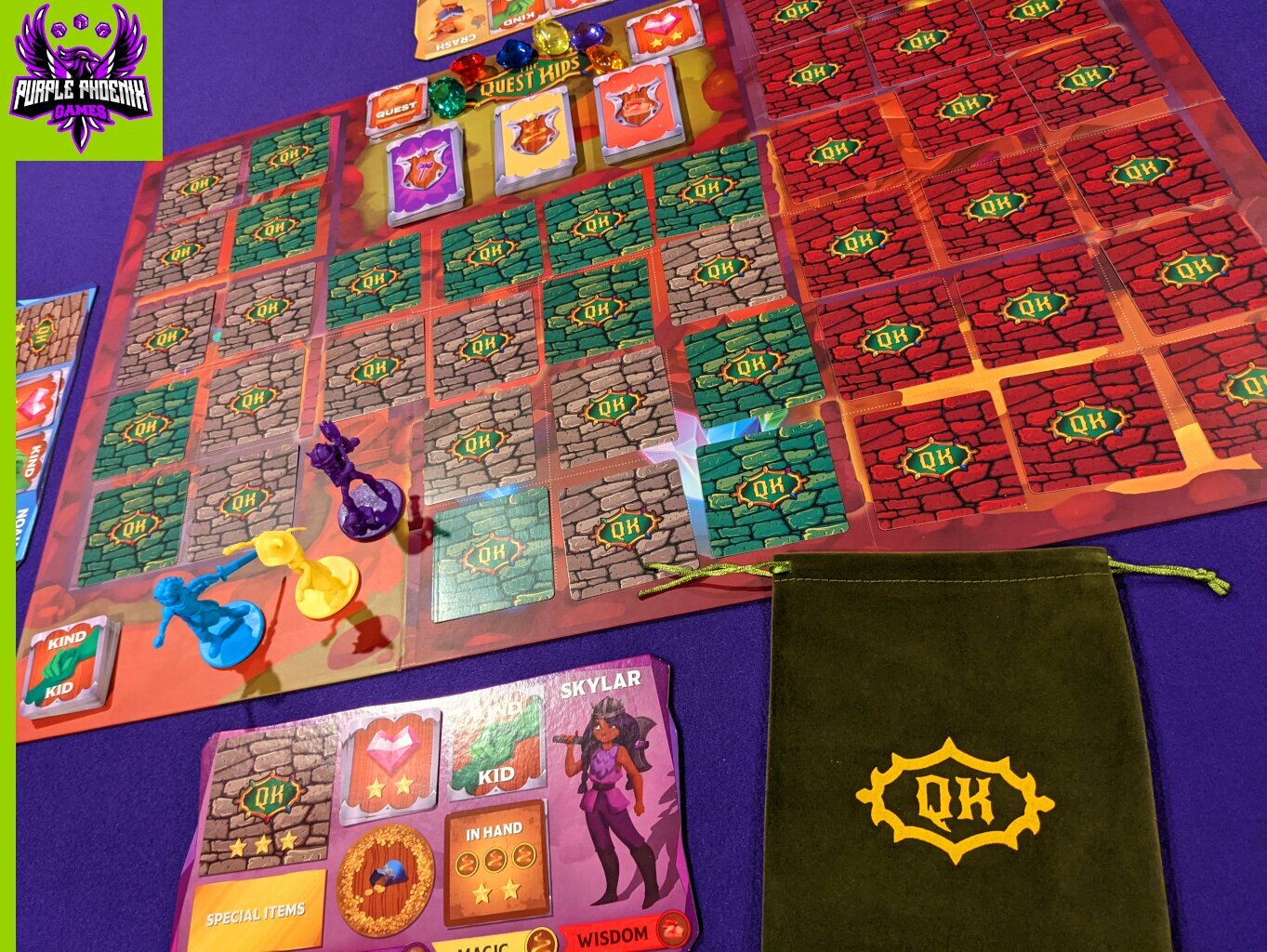
To setup, place the large game board on the table and populate it with the green, gray, and red Dungeon Tiles according to the rules. Also prepare the card decks and place them appropriately in their spaces on the board. The Treasure Tokens are placed in the Treasure Bag. Each player will receive one Quest Kid Player Mat and matching figurine. In addition each player will receive three starting Health Cards, one Quest Card, and one appropriate starting Ability Card. The game may now begin from the entrance to the cave!
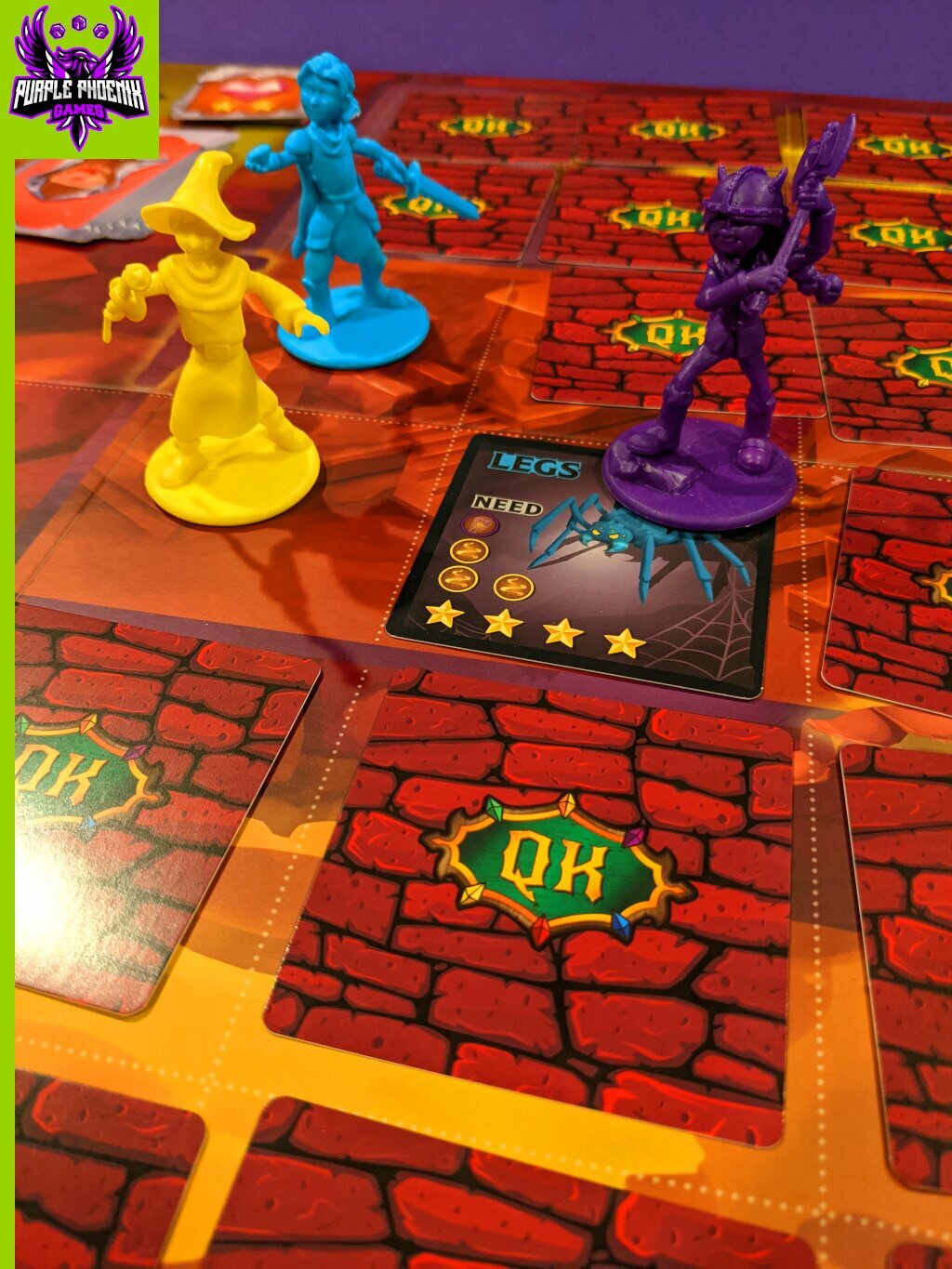
On a turn players will be able to have free movement around the board exploring tiles and resolving them in turns. Green tiles are always good for the players, Gray tiles may have some bad guys but are predominantly good, and Red tiles are littered with those silly bad guys that will need to be scared away. A player will travel to a board location and encounter a Dungeon Tile by flipping it over and collecting the resources shown or attempting to scare away the bad guys. Bad guys can be scared by discarding the printed Ability Cards on their tile. Once discarded, the player collects the tile to their Player Mat for stars at game end.
Sometimes players will encounter a bad guy they do not possess enough Ability Cards to scare away. In these scenarios the player may ask the other players for help. Nonactive players may then offer Ability Cards from their stash in order to help achieve the goal. For every Ability Card donated to the cause the donating Quest Kid will receive one Kind Kid Card. Kind Kid Cards are always great and can be resolved at ANY time during the game. Should a player encounter a bad guy they cannot scare away and other Quest Kids cannot help with Ability Cards, the active player will suffer a loss of one of their Health Cards (worth two stars).
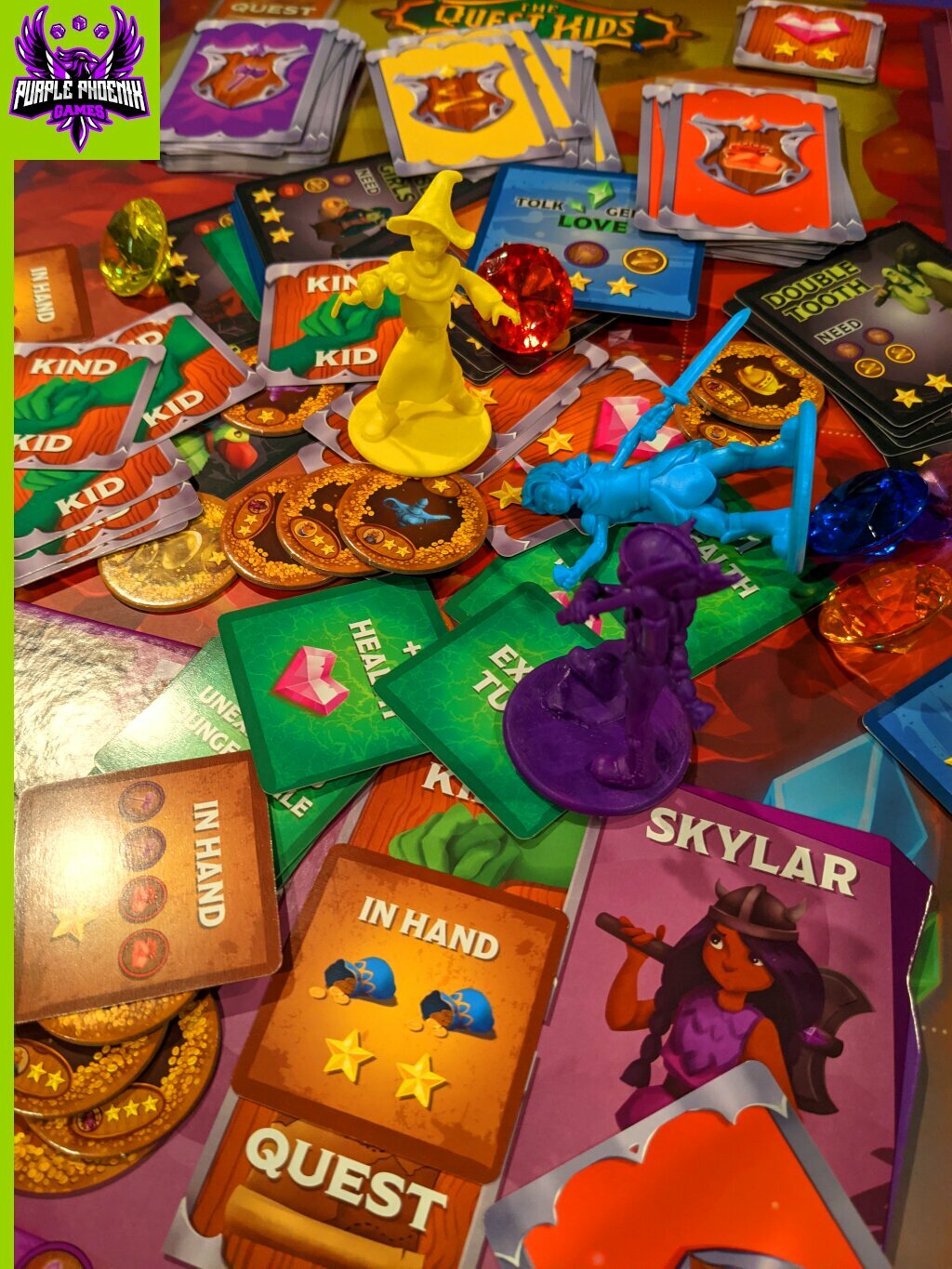
Some tiles or Quest cards will instruct the player to draw one or more treasures from the Treasure Bag. Most treasures are good and provide stars, but some are blobs that eat stars. Each Treasure Token also has two values. The top value is for the normal amount of stars. However, the bottom value is worth more stars if the controlling player matches the Quest Kid printed on the token. Some treasure may be worth just one star unless the Quest Kid is a match, in which case it is then worth three stars, for example.
Turns continue in this fashion until all Dungeon Tiles have been resolved or a stalemate reached. At this point all players count up their stars they have collected from various sources and the player with the most stars is the winner!
Components. This is a kids’ game, can we all agree? THIS kids’ game, however, boasts some of the most interesting and wonderful components I have seen. The board is huge and depicts a magical cave. Super cool. The tiles are easy to read and understand, as with all the iconography. The Quest Kids themselves all have the same abilities (unless the expansion is added – and the review for that is coming soon), so that smaller children are not burdened with having to remember their special abilities. There are these plastic Tolk Gems that can be collected during the game and children absolutely flip for these things. And did you see those colorful and very big minis? I mean, come on! It’s a kids’ game! They LOVE minis! The game also comes with cardboard standees in case your children cannot handle the minis carefully enough.
Here is the deal. I absolutely adore these Quest Kids games. They are absolutely the perfect difficulty for young gamers who are ready to step up from the Candy Lands and Chutes & Ladders. Now, the box suggests 5+ but my 4-year-old did just fine with it, so take that with a grain of salt. Having had him already familiarize himself with The Quest Kids characters in The Quest Kids: Matching Adventure, this was an easier process getting this game to the table for us.
The game gives an exciting dungeon crawl experience for younger children, and it’s honestly something I never really knew I needed in my life until I now have it. It is so simple to teach and play and definitely encourages helping other players, if even just because you receive those Kind Kid cards in return. Anything to create that helpful player atmosphere to prepare them for heavier cooperative games is much appreciated.
Please do not misunderstand me. The Quest Kids is targeting younger players, but I do believe that any aged gamer could appreciate and have a good time with this. It certainly will not fill the void of other dungeon crawlers, but if you need a fix and would like to spend 20-45 minutes playing something to scratch that itch, then pull out your copy of The Quest Kids. It is super-light, colorful, and is a perfect stepping stone to bigger cooperative games. Purple Phoenix Games (with special guest Finley) gives this one a Kind 11/12. Please visit the publisher’s website to pick up your copy, and have a great time introducing your children (or partners, in-laws, grannies, pets, whomever) to cooperative dungeon crawls that will have you leaving the table in a much better mood than when you sat down.
The Quest Kids is a dungeon crawler style board game for players as young as five years of age. Yes, FIVE! In it, players are acting as one of these Quest Kids, attempting to explore the cave of Tolk the Wise. The Quest Kids will find abilities to enhance their own, treasures to collect, and silly bad guys to scare away within, and the player with the most stars (VP) at the end will win the game!
DISCLAIMER: We were provided a copy of this game for the purposes of this review. This is a retail copy of the game, so what you see in these photos is exactly what would be received in your box. I do not intend to cover every single rule included in the rulebook, but will describe the overall game flow and major rule set so that our readers may get a sense of how the game plays. For more in depth rules, you may purchase a copy from the publisher online or from your FLGS. -T
To setup, place the large game board on the table and populate it with the green, gray, and red Dungeon Tiles according to the rules. Also prepare the card decks and place them appropriately in their spaces on the board. The Treasure Tokens are placed in the Treasure Bag. Each player will receive one Quest Kid Player Mat and matching figurine. In addition each player will receive three starting Health Cards, one Quest Card, and one appropriate starting Ability Card. The game may now begin from the entrance to the cave!
On a turn players will be able to have free movement around the board exploring tiles and resolving them in turns. Green tiles are always good for the players, Gray tiles may have some bad guys but are predominantly good, and Red tiles are littered with those silly bad guys that will need to be scared away. A player will travel to a board location and encounter a Dungeon Tile by flipping it over and collecting the resources shown or attempting to scare away the bad guys. Bad guys can be scared by discarding the printed Ability Cards on their tile. Once discarded, the player collects the tile to their Player Mat for stars at game end.
Sometimes players will encounter a bad guy they do not possess enough Ability Cards to scare away. In these scenarios the player may ask the other players for help. Nonactive players may then offer Ability Cards from their stash in order to help achieve the goal. For every Ability Card donated to the cause the donating Quest Kid will receive one Kind Kid Card. Kind Kid Cards are always great and can be resolved at ANY time during the game. Should a player encounter a bad guy they cannot scare away and other Quest Kids cannot help with Ability Cards, the active player will suffer a loss of one of their Health Cards (worth two stars).
Some tiles or Quest cards will instruct the player to draw one or more treasures from the Treasure Bag. Most treasures are good and provide stars, but some are blobs that eat stars. Each Treasure Token also has two values. The top value is for the normal amount of stars. However, the bottom value is worth more stars if the controlling player matches the Quest Kid printed on the token. Some treasure may be worth just one star unless the Quest Kid is a match, in which case it is then worth three stars, for example.
Turns continue in this fashion until all Dungeon Tiles have been resolved or a stalemate reached. At this point all players count up their stars they have collected from various sources and the player with the most stars is the winner!
Components. This is a kids’ game, can we all agree? THIS kids’ game, however, boasts some of the most interesting and wonderful components I have seen. The board is huge and depicts a magical cave. Super cool. The tiles are easy to read and understand, as with all the iconography. The Quest Kids themselves all have the same abilities (unless the expansion is added – and the review for that is coming soon), so that smaller children are not burdened with having to remember their special abilities. There are these plastic Tolk Gems that can be collected during the game and children absolutely flip for these things. And did you see those colorful and very big minis? I mean, come on! It’s a kids’ game! They LOVE minis! The game also comes with cardboard standees in case your children cannot handle the minis carefully enough.
Here is the deal. I absolutely adore these Quest Kids games. They are absolutely the perfect difficulty for young gamers who are ready to step up from the Candy Lands and Chutes & Ladders. Now, the box suggests 5+ but my 4-year-old did just fine with it, so take that with a grain of salt. Having had him already familiarize himself with The Quest Kids characters in The Quest Kids: Matching Adventure, this was an easier process getting this game to the table for us.
The game gives an exciting dungeon crawl experience for younger children, and it’s honestly something I never really knew I needed in my life until I now have it. It is so simple to teach and play and definitely encourages helping other players, if even just because you receive those Kind Kid cards in return. Anything to create that helpful player atmosphere to prepare them for heavier cooperative games is much appreciated.
Please do not misunderstand me. The Quest Kids is targeting younger players, but I do believe that any aged gamer could appreciate and have a good time with this. It certainly will not fill the void of other dungeon crawlers, but if you need a fix and would like to spend 20-45 minutes playing something to scratch that itch, then pull out your copy of The Quest Kids. It is super-light, colorful, and is a perfect stepping stone to bigger cooperative games. Purple Phoenix Games (with special guest Finley) gives this one a Kind 11/12. Please visit the publisher’s website to pick up your copy, and have a great time introducing your children (or partners, in-laws, grannies, pets, whomever) to cooperative dungeon crawls that will have you leaving the table in a much better mood than when you sat down.
Purple Phoenix Games (2266 KP) rated Spy Club in Tabletop Games
Aug 12, 2021
You guys have heard of “Where in the World is Carmen Sandiego?” The globetrotting super-spy who is hard to pin down? Well imagine what she may have been like as a young person. I bet she had her own spy club. And now we have a game to play to emulate what it may have been like in such a club. **This game has nothing to do with Carmen Sandiego.
Spy Club is a cooperative memory and deduction card game utilizing an action point system and sharing of resources. It is set in any neighborhood where kids can gather in groups and snuff out a mystery. The goal is to whittle the clues down to the correct Motive, Suspect, Location, Crime, and Object of the Crime. Are you intrepid youths up to the task?
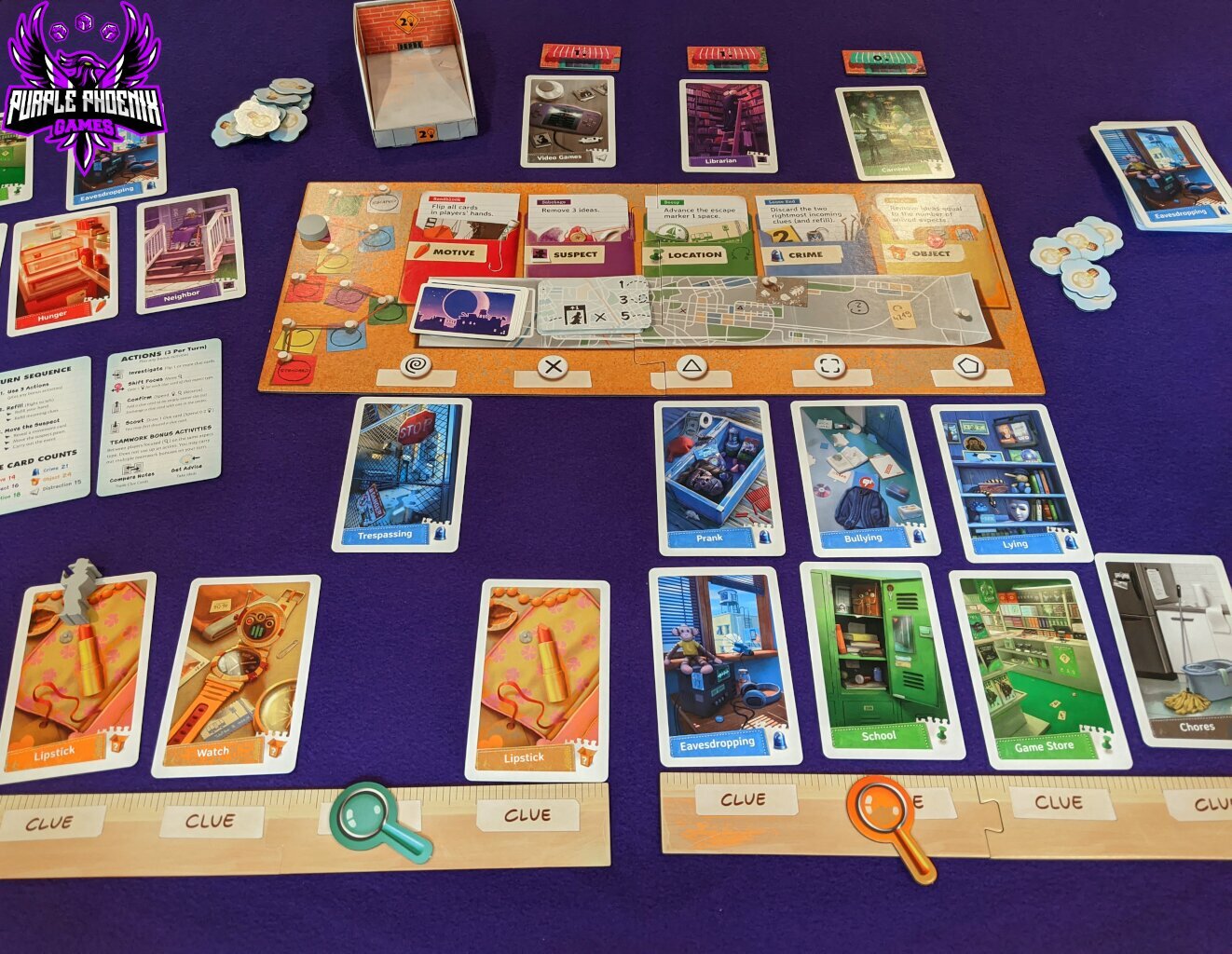
To setup, place the main board on the table, and the Escape Marker upon it at the bottom of the track. Shuffle the Movement Deck cards separately by backs, remove one from each differently-backed set, and place them in day – sunset – night order in its space. Each player receives a play board according to the number of players and a spyglass in their favorite color to go upon their play board. The Idea markers can be in a rough pile near everything else. The Clue Deck is to be shuffled and placed face-down (or face-up, whichever you prefer; they are double-sided) and each player is dealt a number of Clues equal to the number of spaces on their play boards. Clues will also be dealt to an “Incoming Clues” area (an offer row or “market”). DO NOT LOOK AT THE BACKS OF THE CARDS. Like, EVER. Unless you use an action to do so. The Suspecteeple will be placed on the right-most Clue Card of the starting player’s board. The game of sleuthing may now begin!
A player’s turn will consist of three main steps with different phases in those steps. Step 1 is Use Actions. Players will be able to use three Actions on their turn. These Actions are: Investigate, Shift Focus, Confirm, and Scout. To Investigate the active player will flip a Clue Card from their collection to its back. They may then continue flipping their cards or stop at any time. To Shift Focus a player will simply move their spyglass to a different Clue and collect Ideas equal to the number of Clues whose aspects match the newly-focused one (two Ideas if moving to a Location and a player has two Location Clues). Skipping Confirm, to Scout simply means purchasing a card from the Incoming Clues area to a player’s board, with a discard of an existing card already there.
Confirming is where the main action in Spy Club lies. Players will be attempting to Confirm five Clues of matching aspect (Location, Motive, etc) in order to hone in on the correct aspect. To Confirm, a player can submit a Clue from their collection (hand) to the main board. The cost, in Ideas, depends on where the spyglass lies. If the spyglass is directly under the Clue to be submitted the cost is nothing. However, if a player wishes to complete three Confirm actions and they have matching Clues on either side of their spyglass, they would need to spend two Ideas for each Clue resting one space away from the spyglass.
There are also rules for taking “Teamwork Bonus Actions,” but I will let you discover those on your own.
After these Actions are carried out, Step 2 is Refill. Firstly the active player’s hand will need to be refilled from the Incoming Clues row, and more Incoming Clues come out to fill that row.
Step 3 is Move the Suspect. Drawing from the Movement Deck the active player will match up the Movement cards from the previous round and the current round to find out how many spaces the Suspecteeple will be moving through players’ cards. Depending upon which aspect Clue the Suspecteeple lands a negative action will be levied against the players. In some ways the Suspect could land on cards that trigger no negative action, but I will leave that for you to discover as well. I am a bit… distracted.
Play continues in this fashion of players Using Actions, Refilling the Clue cards, and Moving the Suspect until players win by solving all five aspects of the crime, the Suspect escapes, the players run out of Idea markers, the Suspect escapes due to running out of Movement cards, or there are insufficient Incoming Clues to refill a player’s hand. So there are four ways to lose and one way to win.
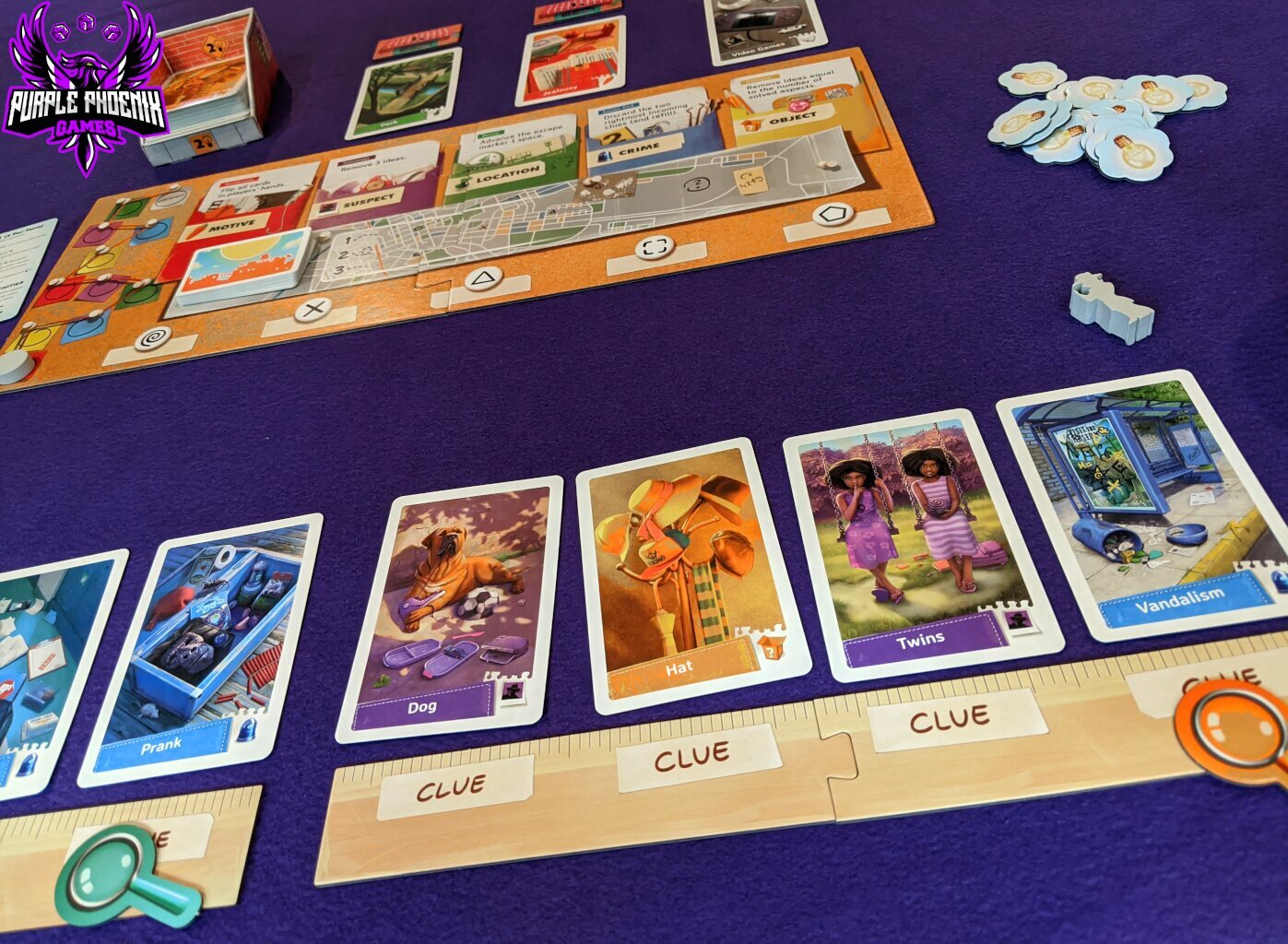
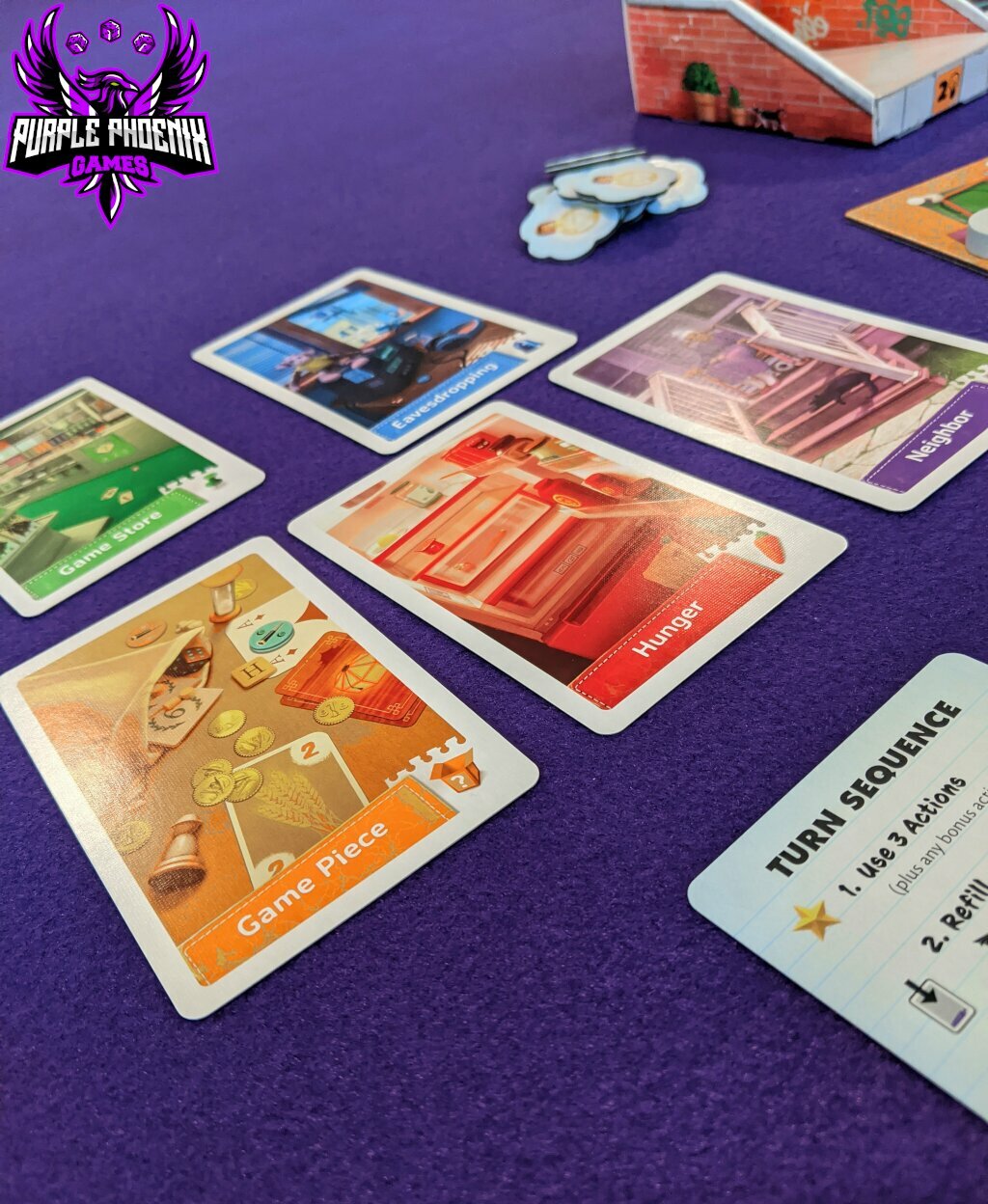
Components. I find the components in Spy Club to be good overall. Nothing really stands out as amazing, either in design or quality. The art is very good, though. One thing I will say about the components as a whole is that once the game is setup and in play it looks fascinating on the table. I love the way it looks and certainly assists with full immersion. Always a plus in my book.
There are so many things I love about this game. And there are so many things I didn’t even explain here! Ok I’ll tell you one. Spy Club can be played as a one-shot game night medium-length (60 minutes) game, or can be converted into a campaign game where players will play five connected scenarios using a giant stack of cards that are not in use for the one-shots. That is simply fabulous! I can play one game of this to get people hooked, then reel them in by offering to continue this as a campaign to see what the main story arc is really trying to tell us. Oh man, that’s just special and I love it!
I feel like I have been playing a lot of really great games lately, and Spy Club is certainly a GREAT game. In fact, I told the rest of the team that this one is a contender for my Top 10 Games of All Time list. It has everything I love in a game: it is difficult (my first game I would have lost had it lasted one more turn) without being too heavy, it is inviting me to play more games (especially with the campaign mode active), I just like looking at it on the table, and creates a stunning amount of tension as we race against the game clock to figure out the crime aspects.
I have had this in my collection for too long without it being played, and I am so sorry that it took me so long to get into it. I will certainly be playing this a LOT more, and introducing as many people to it as I can. I think in the gaming world it is flying under the radar, but I will be one of its champions and suggest it as much as possible. If you like certain aspects (hehe) of Clue, 13 Dead End Drive, Carmen Sandiego, and even Jaipur, then take a look at Spy Club. Purple Phoenix Games gives this a super-sleuth 11 / 12. I actually might go play it right now. Yes, at 11:07pm.
Spy Club is a cooperative memory and deduction card game utilizing an action point system and sharing of resources. It is set in any neighborhood where kids can gather in groups and snuff out a mystery. The goal is to whittle the clues down to the correct Motive, Suspect, Location, Crime, and Object of the Crime. Are you intrepid youths up to the task?
To setup, place the main board on the table, and the Escape Marker upon it at the bottom of the track. Shuffle the Movement Deck cards separately by backs, remove one from each differently-backed set, and place them in day – sunset – night order in its space. Each player receives a play board according to the number of players and a spyglass in their favorite color to go upon their play board. The Idea markers can be in a rough pile near everything else. The Clue Deck is to be shuffled and placed face-down (or face-up, whichever you prefer; they are double-sided) and each player is dealt a number of Clues equal to the number of spaces on their play boards. Clues will also be dealt to an “Incoming Clues” area (an offer row or “market”). DO NOT LOOK AT THE BACKS OF THE CARDS. Like, EVER. Unless you use an action to do so. The Suspecteeple will be placed on the right-most Clue Card of the starting player’s board. The game of sleuthing may now begin!
A player’s turn will consist of three main steps with different phases in those steps. Step 1 is Use Actions. Players will be able to use three Actions on their turn. These Actions are: Investigate, Shift Focus, Confirm, and Scout. To Investigate the active player will flip a Clue Card from their collection to its back. They may then continue flipping their cards or stop at any time. To Shift Focus a player will simply move their spyglass to a different Clue and collect Ideas equal to the number of Clues whose aspects match the newly-focused one (two Ideas if moving to a Location and a player has two Location Clues). Skipping Confirm, to Scout simply means purchasing a card from the Incoming Clues area to a player’s board, with a discard of an existing card already there.
Confirming is where the main action in Spy Club lies. Players will be attempting to Confirm five Clues of matching aspect (Location, Motive, etc) in order to hone in on the correct aspect. To Confirm, a player can submit a Clue from their collection (hand) to the main board. The cost, in Ideas, depends on where the spyglass lies. If the spyglass is directly under the Clue to be submitted the cost is nothing. However, if a player wishes to complete three Confirm actions and they have matching Clues on either side of their spyglass, they would need to spend two Ideas for each Clue resting one space away from the spyglass.
There are also rules for taking “Teamwork Bonus Actions,” but I will let you discover those on your own.
After these Actions are carried out, Step 2 is Refill. Firstly the active player’s hand will need to be refilled from the Incoming Clues row, and more Incoming Clues come out to fill that row.
Step 3 is Move the Suspect. Drawing from the Movement Deck the active player will match up the Movement cards from the previous round and the current round to find out how many spaces the Suspecteeple will be moving through players’ cards. Depending upon which aspect Clue the Suspecteeple lands a negative action will be levied against the players. In some ways the Suspect could land on cards that trigger no negative action, but I will leave that for you to discover as well. I am a bit… distracted.
Play continues in this fashion of players Using Actions, Refilling the Clue cards, and Moving the Suspect until players win by solving all five aspects of the crime, the Suspect escapes, the players run out of Idea markers, the Suspect escapes due to running out of Movement cards, or there are insufficient Incoming Clues to refill a player’s hand. So there are four ways to lose and one way to win.
Components. I find the components in Spy Club to be good overall. Nothing really stands out as amazing, either in design or quality. The art is very good, though. One thing I will say about the components as a whole is that once the game is setup and in play it looks fascinating on the table. I love the way it looks and certainly assists with full immersion. Always a plus in my book.
There are so many things I love about this game. And there are so many things I didn’t even explain here! Ok I’ll tell you one. Spy Club can be played as a one-shot game night medium-length (60 minutes) game, or can be converted into a campaign game where players will play five connected scenarios using a giant stack of cards that are not in use for the one-shots. That is simply fabulous! I can play one game of this to get people hooked, then reel them in by offering to continue this as a campaign to see what the main story arc is really trying to tell us. Oh man, that’s just special and I love it!
I feel like I have been playing a lot of really great games lately, and Spy Club is certainly a GREAT game. In fact, I told the rest of the team that this one is a contender for my Top 10 Games of All Time list. It has everything I love in a game: it is difficult (my first game I would have lost had it lasted one more turn) without being too heavy, it is inviting me to play more games (especially with the campaign mode active), I just like looking at it on the table, and creates a stunning amount of tension as we race against the game clock to figure out the crime aspects.
I have had this in my collection for too long without it being played, and I am so sorry that it took me so long to get into it. I will certainly be playing this a LOT more, and introducing as many people to it as I can. I think in the gaming world it is flying under the radar, but I will be one of its champions and suggest it as much as possible. If you like certain aspects (hehe) of Clue, 13 Dead End Drive, Carmen Sandiego, and even Jaipur, then take a look at Spy Club. Purple Phoenix Games gives this a super-sleuth 11 / 12. I actually might go play it right now. Yes, at 11:07pm.

Purple Phoenix Games (2266 KP) rated Tiger Stripes in Tabletop Games
Nov 25, 2021

So it was one of those days when I was checking my email and noticed something odd. I had a random tracking number sitting in my inbox for a game arriving soon. I didn’t recall requesting this game, so why was I having one shipped? A mystery still to this day. However, I recognized the designer’s last name, but could she be related to the designer in mind that I particularly enjoy? And would this game be any good? I was cautiously hopeful.
Tiger Stripes is a set collection, hand management, drafting game for two to four players. In it, players are young tiger cubs just earning their stripes (a fact I did not know prior to playing: that tiger cubs aren’t born with stripes). Each cub will earn their stripes by drafting the best available cards and utilizing them to the fullest in order to collect sets of prey.
Oh fact check: tigers are born with stripes already, so this game is not based fully on facts.
DISCLAIMER: We were provided a copy of this game for the purposes of this review. This is a retail copy of the game (I think), so what you see in these photos is probably what would be received in your box. I do not intend to cover every single rule included in the rulebook, but will describe the overall game flow and major rule set so that our readers may get a sense of how the game plays. For more in depth rules, you may purchase a copy online or from your FLGS. -T
To setup, each player will choose their tiger avatar cards and also receive seven Stripe tokens. The card deck is shuffled, and each player is dealt two cards for the starting hand. The remainder of the deck is placed on the table as a draw deck, but five cards are dealt to the table as an offer row. The youngest player goes first, and the stripes are ready to be earned, like Boy Scout badges… but for ferocious tiger cubs.
Turns are taken in three steps. The player must make a choice of one action for the first step of their turn: Draw a card, Take a tiger card, or Capture Prey. A player may choose to blindly draw a card from the top of the deck and add it to their hand as their action. Alternately, the player may instead choose to take a tiger card from the offer row and add it to their hand. Both of these are self-explanatory.
The third action that can be taken is to Capture Prey. A tiger may capture prey from the offer row by discarding cards from their hand with matching symbols to their target cards they wish to capture. Each card in Tiger Stripes has one or more symbols printed in the upper left hand corner. By discarding cards from hand to the discard pile, a player may use all the symbols provided by these cards to match with cards’ symbols from the offer row. For example, a player may discard two tiger cards and a snake card, noting the symbols now provided. By using the purchasing power of these symbols, the player may then draft cards from the offer row by paying their cost in symbols. It is entirely possible for a player to be able to draft cards from hand in order to purchase all available cards in the offer row to be added to their hand. An explanation of the significance of this is coming.
The second step of a turn is mandatory only if the prerequisites are met: every set of three like cards in hand are discarded in return for Stripe Tokens. So, for every set of three matching monkey, snake, deer, and boar, the player will receive one, two, three, or four Stripe Tokens to be added to their avatar card, respectively, with any tiger cards discarded to be treated as wild cards to complete a set. Therefore, a player may wish to purchase all cards from the offer row in an attempt to score multiple sets during this second step to earn as many stripes as possible.
Finally, the third step of the turn is to Replenish the Jungle (the offer row). For any cards drafted in the turn, the player will replace with cards from the draw deck to setup the next player’s turn.
Play continues in this fashion of grabbing cards, discarding cards, and scoring sets for stripes until one player has earned their seventh stripe and won the game!
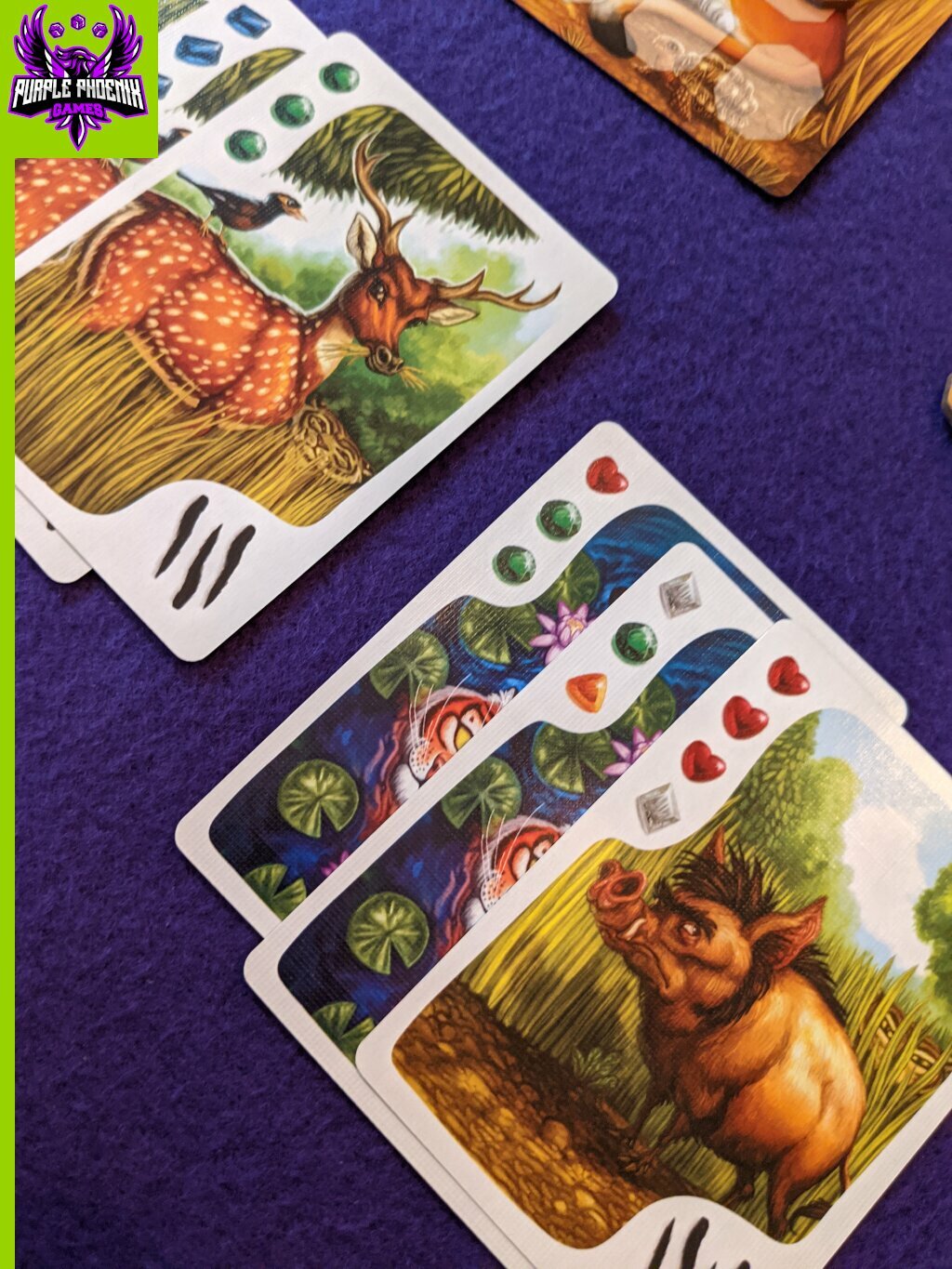
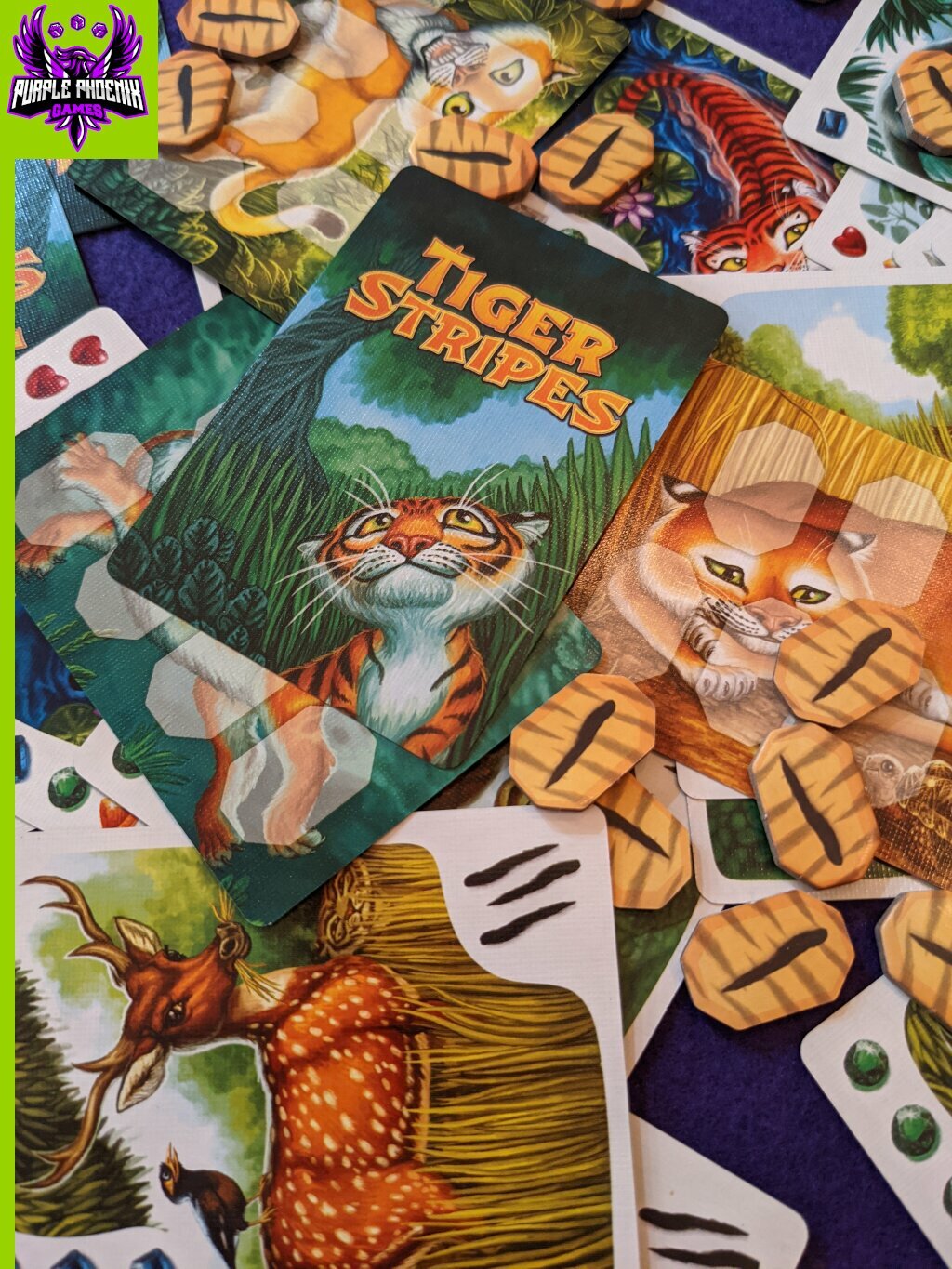
Components. This game is a deck of cards and a bunch of Stripe Tokens. The cards are all nice quality, with linen finish, but are a bit on the thinner side as far as flimsiness is concerned. I think if players are all somewhat careful this will not pose problems. If so, consider sleeving your copy. The Stripe Tokens are oblong octagons with stripey art. Speaking of the art, throughout the game the art is very cute and cuddly… except for the boar. He is crotchety. I do enjoy finding the stalking tiger somewhat hidden on each card’s art. A great nod to the noble tiger’s hunting ability.
Now, as I was typing the rules breakdown I felt like I was typing quite a lot for as light as the game actually is. In fact, though it says on the box that it is intended for ages 7+ I just couldn’t leave out my little 5-year-old gamer son. He grasped the rules really well, and though he hasn’t developed the best strategy-focused brain skills yet, he is still able to play and enjoy Tiger Stripes. In actuality, he and I had a blast playing through this several times. Yes, it is a resource optimization card drafting game, but to him, it was more like procuring a veritable zoo of cute animals that then offered his tiger the stripes needed to win. And win he did. Several times. This certainly isn’t a game of high strategy and multiple-minute turns, but rather a quick and easy card game with a great little theme.
Is the designer, Isabel duBarry, a relative of the great Philip duBarry? Perhaps. And that is a great thing, because one of our favorite games across the board is Revolution! Perchance game design just runs in the family. I am not sure, so maybe someone can chime in on this here.
When my son adds a game to his rotation, that is a sign of a great little game for us. He has added Tiger Stripes to this rotation and we will be playing the mess out of it here over the next several weeks/months. While this is by no means a gamer’s game, it is absolutely perfect for a game day with kids. My child loves it, and I quite enjoy playing as a tiny tiger out on the prowl for their stripes. If you have littles at home, parents who haven’t quite converted fully into game partners, or newbies you are inviting into the hobby, Tiger Stripes is a good little game to get the party started. It’s quick, easy, features great art and theme, and introduces simple mechanics to hook people on gaming. Go grab a copy and just keep it in your back pocket for those times you need something like this for that one special group in front of you.
Tiger Stripes is a set collection, hand management, drafting game for two to four players. In it, players are young tiger cubs just earning their stripes (a fact I did not know prior to playing: that tiger cubs aren’t born with stripes). Each cub will earn their stripes by drafting the best available cards and utilizing them to the fullest in order to collect sets of prey.
Oh fact check: tigers are born with stripes already, so this game is not based fully on facts.
DISCLAIMER: We were provided a copy of this game for the purposes of this review. This is a retail copy of the game (I think), so what you see in these photos is probably what would be received in your box. I do not intend to cover every single rule included in the rulebook, but will describe the overall game flow and major rule set so that our readers may get a sense of how the game plays. For more in depth rules, you may purchase a copy online or from your FLGS. -T
To setup, each player will choose their tiger avatar cards and also receive seven Stripe tokens. The card deck is shuffled, and each player is dealt two cards for the starting hand. The remainder of the deck is placed on the table as a draw deck, but five cards are dealt to the table as an offer row. The youngest player goes first, and the stripes are ready to be earned, like Boy Scout badges… but for ferocious tiger cubs.
Turns are taken in three steps. The player must make a choice of one action for the first step of their turn: Draw a card, Take a tiger card, or Capture Prey. A player may choose to blindly draw a card from the top of the deck and add it to their hand as their action. Alternately, the player may instead choose to take a tiger card from the offer row and add it to their hand. Both of these are self-explanatory.
The third action that can be taken is to Capture Prey. A tiger may capture prey from the offer row by discarding cards from their hand with matching symbols to their target cards they wish to capture. Each card in Tiger Stripes has one or more symbols printed in the upper left hand corner. By discarding cards from hand to the discard pile, a player may use all the symbols provided by these cards to match with cards’ symbols from the offer row. For example, a player may discard two tiger cards and a snake card, noting the symbols now provided. By using the purchasing power of these symbols, the player may then draft cards from the offer row by paying their cost in symbols. It is entirely possible for a player to be able to draft cards from hand in order to purchase all available cards in the offer row to be added to their hand. An explanation of the significance of this is coming.
The second step of a turn is mandatory only if the prerequisites are met: every set of three like cards in hand are discarded in return for Stripe Tokens. So, for every set of three matching monkey, snake, deer, and boar, the player will receive one, two, three, or four Stripe Tokens to be added to their avatar card, respectively, with any tiger cards discarded to be treated as wild cards to complete a set. Therefore, a player may wish to purchase all cards from the offer row in an attempt to score multiple sets during this second step to earn as many stripes as possible.
Finally, the third step of the turn is to Replenish the Jungle (the offer row). For any cards drafted in the turn, the player will replace with cards from the draw deck to setup the next player’s turn.
Play continues in this fashion of grabbing cards, discarding cards, and scoring sets for stripes until one player has earned their seventh stripe and won the game!
Components. This game is a deck of cards and a bunch of Stripe Tokens. The cards are all nice quality, with linen finish, but are a bit on the thinner side as far as flimsiness is concerned. I think if players are all somewhat careful this will not pose problems. If so, consider sleeving your copy. The Stripe Tokens are oblong octagons with stripey art. Speaking of the art, throughout the game the art is very cute and cuddly… except for the boar. He is crotchety. I do enjoy finding the stalking tiger somewhat hidden on each card’s art. A great nod to the noble tiger’s hunting ability.
Now, as I was typing the rules breakdown I felt like I was typing quite a lot for as light as the game actually is. In fact, though it says on the box that it is intended for ages 7+ I just couldn’t leave out my little 5-year-old gamer son. He grasped the rules really well, and though he hasn’t developed the best strategy-focused brain skills yet, he is still able to play and enjoy Tiger Stripes. In actuality, he and I had a blast playing through this several times. Yes, it is a resource optimization card drafting game, but to him, it was more like procuring a veritable zoo of cute animals that then offered his tiger the stripes needed to win. And win he did. Several times. This certainly isn’t a game of high strategy and multiple-minute turns, but rather a quick and easy card game with a great little theme.
Is the designer, Isabel duBarry, a relative of the great Philip duBarry? Perhaps. And that is a great thing, because one of our favorite games across the board is Revolution! Perchance game design just runs in the family. I am not sure, so maybe someone can chime in on this here.
When my son adds a game to his rotation, that is a sign of a great little game for us. He has added Tiger Stripes to this rotation and we will be playing the mess out of it here over the next several weeks/months. While this is by no means a gamer’s game, it is absolutely perfect for a game day with kids. My child loves it, and I quite enjoy playing as a tiny tiger out on the prowl for their stripes. If you have littles at home, parents who haven’t quite converted fully into game partners, or newbies you are inviting into the hobby, Tiger Stripes is a good little game to get the party started. It’s quick, easy, features great art and theme, and introduces simple mechanics to hook people on gaming. Go grab a copy and just keep it in your back pocket for those times you need something like this for that one special group in front of you.


Purple Phoenix Games (2266 KP) rated Kingdomino Origins in Tabletop Games
Dec 28, 2021


I try very hard not to allow hype to affect my views on a game. This is why I similarly rarely consume other reviewers’ work on a game prior to me playing it. I don’t want others influencing my experiences. However, I was ultimately tempted by the Game Boy Geek, Dan King, when a video he published was titled, “Why I’ll Never Play Kingdomino Again.” I mean, with a title like that, and already having reviewed and loved OG Kingdomino, I just HAD to see what was with this new version. I have to say, he makes some great points – many with which I tend to agree. But what are those points?
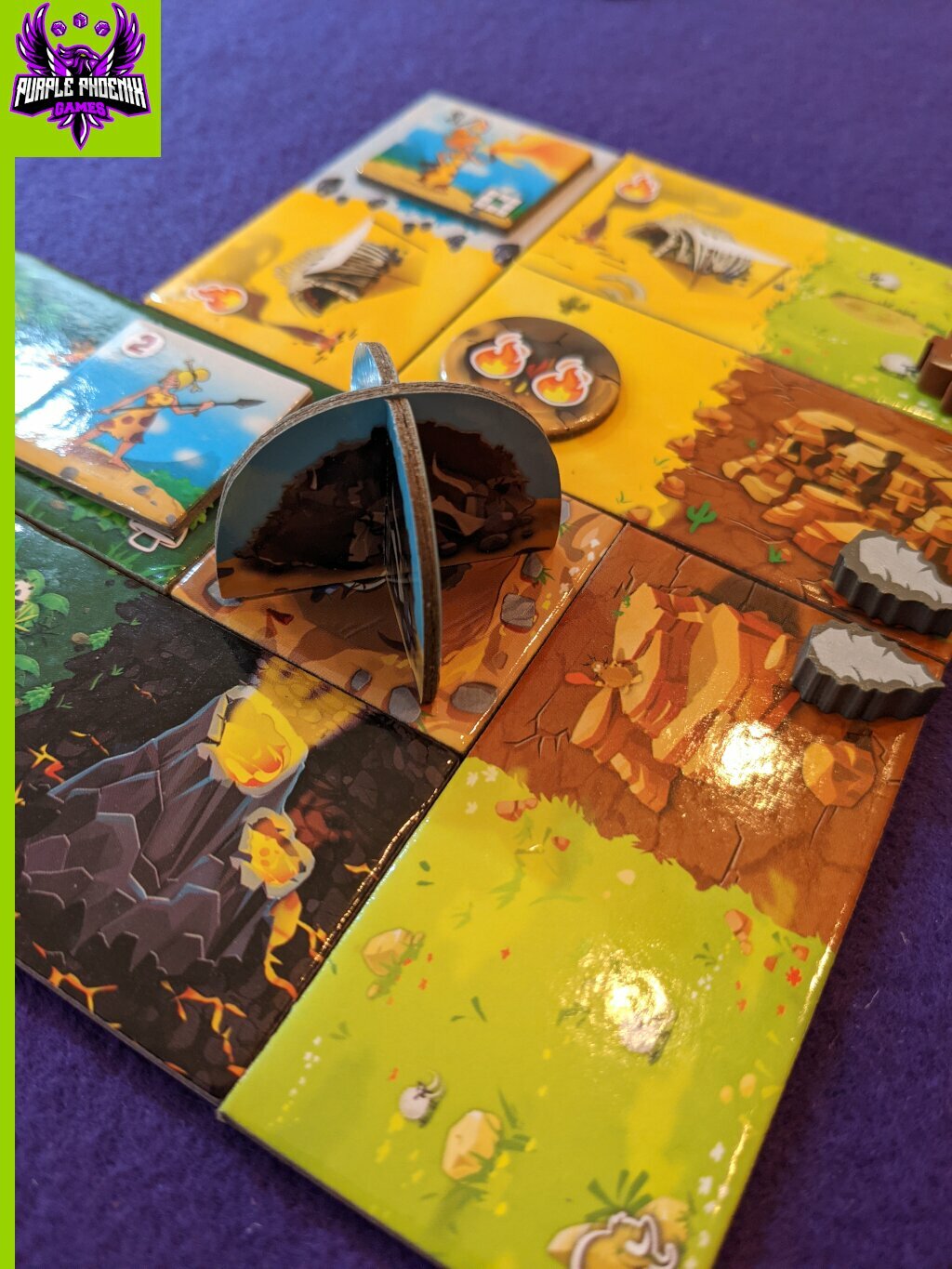
Kingdomino Origins is a tile drafting and placement game set in prehistoric times for two to four players. Just like the original Kingdomino (even though this is titled Origins, which makes me chuckle) players will be drafting tiles from the offer and adding them to their village, matching terrain types to those already built. Instead of crowns to count VP, Origins has players using fire icons and tokens to multiply VP for endgame scoring. New for Origins is the ability to play three different modes: Discovery, Totem, and Tribe Mode! The player with the most VP at the end of the game wins!
DISCLAIMER: We were provided a copy of this game for the purposes of this review. This is a retail copy of the game, so what you see in these photos is exactly what would be received in your box. I do not intend to cover every single rule included in the rulebook, but will describe the overall game flow and major rule set so that our readers may get a sense of how the game plays. For more in depth rules, you may purchase a copy online or from your FLGS. -T
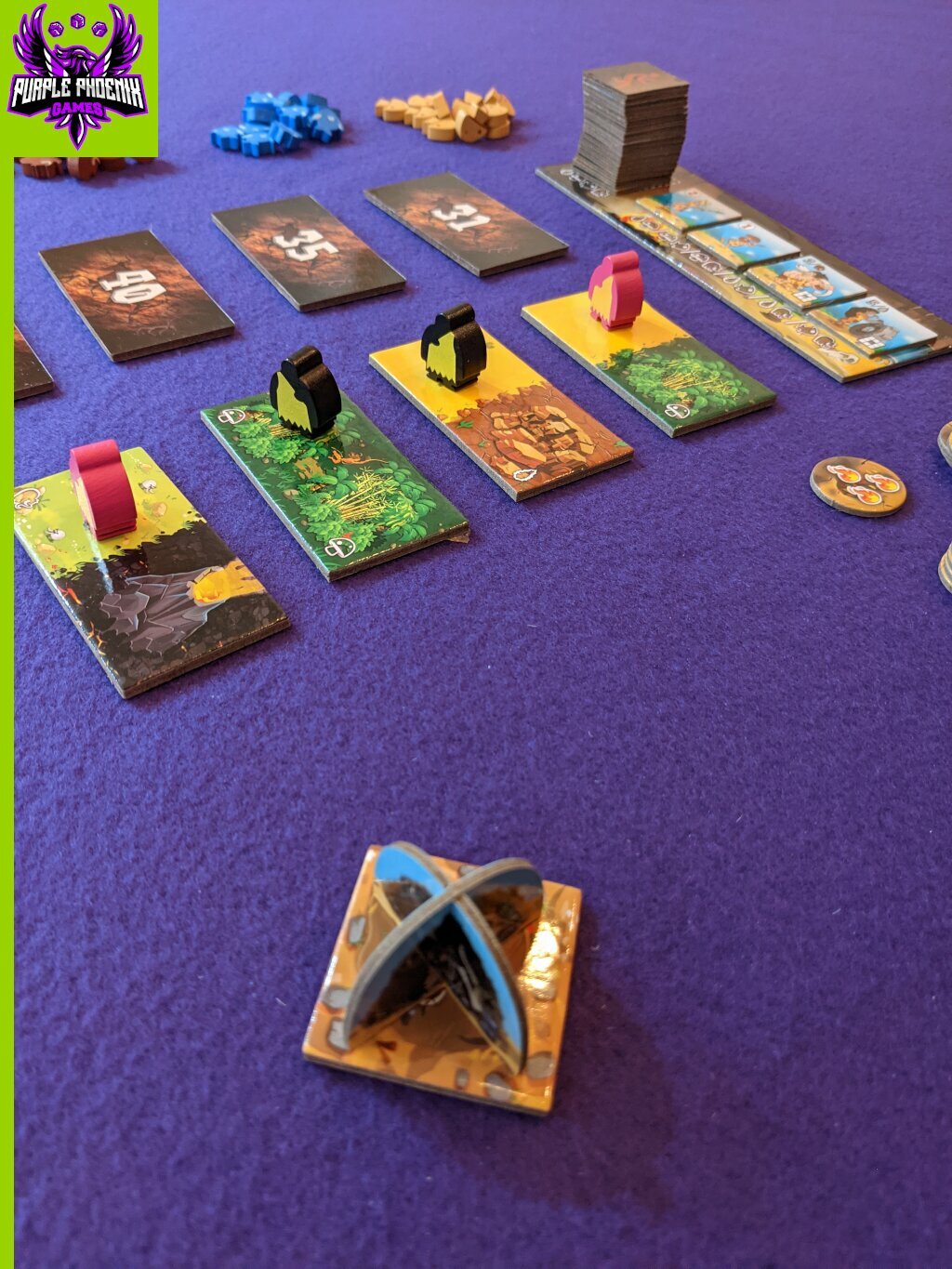
To setup (a two-player game playing the Tribe mode is used for this review), place the Cave Board on the table, shuffle the Caveman tiles, and deal four to the board. Separate the fire tokens and resourceeples into their piles on the table. Shuffle the main domino tiles and, as in the original, draw four, arrange them numerically, and reveal them to make the offer. Place another four domino tiles nearby, face-down, and arranged numerically. The players each choose a color, takes their starting tile with hut placed atop, and their two chiefeeples. The first player will choose to take tiles 1 and 4 or 2 and 3 from the offer by placing their chiefeeples upon them. The game is now setup for Tribe Mode and ready to begin!
On a normal turn, a player will have two steps to complete: Place a Domino, and Choose a New Domino. In a 3-4 player game, each player will have one domino to place, but in this 2 player game each player will have two dominoes to place within their 7×7 grid (a 5×5 grid with 3-4 player games). The player takes their chosen dominoes from beneath their chiefs and add them to their village grid. As in all domino-based games, the terrain (or side) of the domino must be placed adjacent to a matching terrain type in the village; the starting tile is wild and can match to any terrain type.
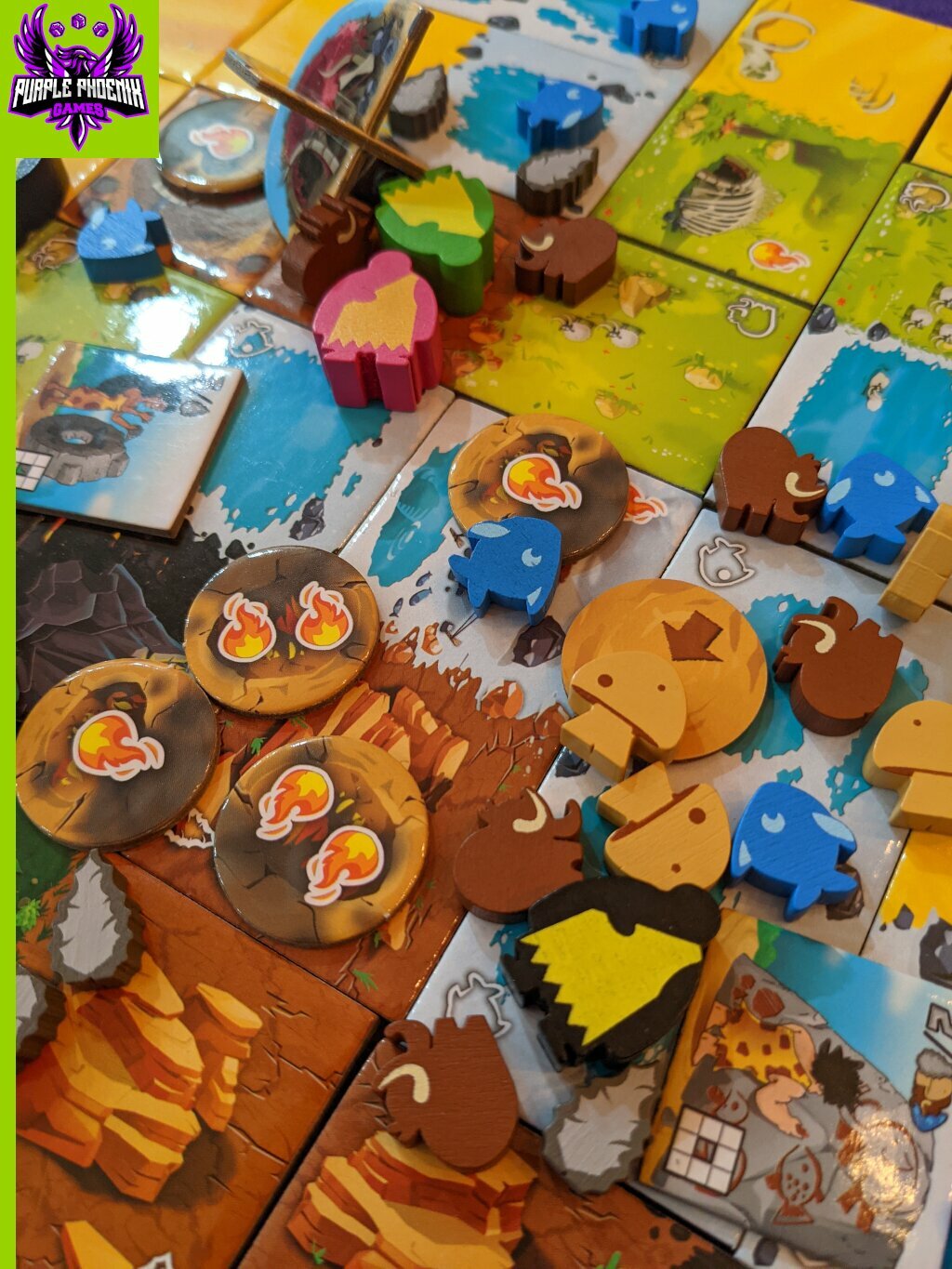
Once a domino is placed, if it shows icons or volcanoes, special rules are enacted. For icons showing resources, a wooden resourceeple is placed upon the icon. These come in mammoths, fish, mushrooms, and flints. In Tribe Mode, these will be used later. However, if a volcano is placed in the village, it will spew forth one to three flames, whose tokens will be placed on a domino square in the village. The volcano tile showing one active crater sends a flame soaring up to three squares away, and diagonal movement is acceptable. A volcano tile showing three active craters throws three flames (a fire token with three fire icons) one square away.
Once both tiles have been placed, the player will next Choose a New Domino (or dominoes when playing a two player game). From the now-revealed set of four new tiles in the offer, the players will choose their next tile(s) to be played during the next round, thus also creating the turn order for the next round.
After players have chosen their dominoes, and only in Tribe Mode, the final step to the turn is optional: Recruit a Caveman. Remember those resourceeples that were placed on tiles? By discarding two different resources, a player may recruit one of the face-up Caveman tiles from the board. By discarding one of each type of resource, the player may instead look through the stack of Caveman tiles and take one of their choosing. These Caveman tiles do many different things, but they primarily offer extra VP for being placed adjacent to specific resources, or by clumping together similar Cavemen in the village.
Once all the dominoes have been added to the villages, the game ends and VPs are counted for each player. The game comes with an excellent score pad to help keep track of the different ways to earn VP. The player with the most VP (“comfort points” in the game) is the winner and creates the most prosperous Caveman village!
Components. Just like previous versions of Kingdomino, these components are excellent. The domino tiles are again thick and glossy, the huts are again the 3D style, and the chiefeeples are similar in style to the kingeeples from the original. In this new version, however, new fire tokens have been added, and are fine, but they are double-sided to remind players how many squares they travel – an EXCELLENT idea. I have to also applaud these cute little resourceeples. They are so stinkin cute and look great on the villages. The art is again wonderful on everything in the box, and overall is just a great bunch of components.
What about the claim Dan King made about never playing Kingdomino again? Gosh darnit, I totally agree. By simply playing the included Discovery Mode you get all the same functionality of Kingdomino. But it doesn’t stop there. I didn’t really get into the second mode, Totem Mode, but it also uses the resourceeples to grant extra VP to the players who have collected the majority of each type. It is a great next step from Discovery, and a good setup for Tribe Mode, especially when playing with newer gamers.
So, the components are similar quality to the original version, but there are more components included, and provide three different play modes. The only thing I see that the original Kingdomino has on this version is the Age of Giants expansion. Perhaps something similar is in the works for Origins, where players can effectively negate opponents’ VPs. I’m sure giants existed in Caveman times, right?
All this said, I may be soon looking for a new home for my copy of Kingdomino and the Age of Giants expansion, as I am certainly agreeing with Dan here. I don’t think I have the interest in playing Kingdomino anymore, as long as I have Kingdomino Origins in my arsenal. Purple Phoenix Games gives this one a super-upgraded 5 / 6. The extra play modes, excellent components, and the cool volcano mechanics just elevate this superior version. If you are a fan of Kingdomino, then I highly recommend you check out Kingdomino Origins. Unless, of course, you don’t wish to be seduced away from your beloved copy of the original version. I understand, but you may be unnecessarily handicapping your collection.
Kingdomino Origins is a tile drafting and placement game set in prehistoric times for two to four players. Just like the original Kingdomino (even though this is titled Origins, which makes me chuckle) players will be drafting tiles from the offer and adding them to their village, matching terrain types to those already built. Instead of crowns to count VP, Origins has players using fire icons and tokens to multiply VP for endgame scoring. New for Origins is the ability to play three different modes: Discovery, Totem, and Tribe Mode! The player with the most VP at the end of the game wins!
DISCLAIMER: We were provided a copy of this game for the purposes of this review. This is a retail copy of the game, so what you see in these photos is exactly what would be received in your box. I do not intend to cover every single rule included in the rulebook, but will describe the overall game flow and major rule set so that our readers may get a sense of how the game plays. For more in depth rules, you may purchase a copy online or from your FLGS. -T
To setup (a two-player game playing the Tribe mode is used for this review), place the Cave Board on the table, shuffle the Caveman tiles, and deal four to the board. Separate the fire tokens and resourceeples into their piles on the table. Shuffle the main domino tiles and, as in the original, draw four, arrange them numerically, and reveal them to make the offer. Place another four domino tiles nearby, face-down, and arranged numerically. The players each choose a color, takes their starting tile with hut placed atop, and their two chiefeeples. The first player will choose to take tiles 1 and 4 or 2 and 3 from the offer by placing their chiefeeples upon them. The game is now setup for Tribe Mode and ready to begin!
On a normal turn, a player will have two steps to complete: Place a Domino, and Choose a New Domino. In a 3-4 player game, each player will have one domino to place, but in this 2 player game each player will have two dominoes to place within their 7×7 grid (a 5×5 grid with 3-4 player games). The player takes their chosen dominoes from beneath their chiefs and add them to their village grid. As in all domino-based games, the terrain (or side) of the domino must be placed adjacent to a matching terrain type in the village; the starting tile is wild and can match to any terrain type.
Once a domino is placed, if it shows icons or volcanoes, special rules are enacted. For icons showing resources, a wooden resourceeple is placed upon the icon. These come in mammoths, fish, mushrooms, and flints. In Tribe Mode, these will be used later. However, if a volcano is placed in the village, it will spew forth one to three flames, whose tokens will be placed on a domino square in the village. The volcano tile showing one active crater sends a flame soaring up to three squares away, and diagonal movement is acceptable. A volcano tile showing three active craters throws three flames (a fire token with three fire icons) one square away.
Once both tiles have been placed, the player will next Choose a New Domino (or dominoes when playing a two player game). From the now-revealed set of four new tiles in the offer, the players will choose their next tile(s) to be played during the next round, thus also creating the turn order for the next round.
After players have chosen their dominoes, and only in Tribe Mode, the final step to the turn is optional: Recruit a Caveman. Remember those resourceeples that were placed on tiles? By discarding two different resources, a player may recruit one of the face-up Caveman tiles from the board. By discarding one of each type of resource, the player may instead look through the stack of Caveman tiles and take one of their choosing. These Caveman tiles do many different things, but they primarily offer extra VP for being placed adjacent to specific resources, or by clumping together similar Cavemen in the village.
Once all the dominoes have been added to the villages, the game ends and VPs are counted for each player. The game comes with an excellent score pad to help keep track of the different ways to earn VP. The player with the most VP (“comfort points” in the game) is the winner and creates the most prosperous Caveman village!
Components. Just like previous versions of Kingdomino, these components are excellent. The domino tiles are again thick and glossy, the huts are again the 3D style, and the chiefeeples are similar in style to the kingeeples from the original. In this new version, however, new fire tokens have been added, and are fine, but they are double-sided to remind players how many squares they travel – an EXCELLENT idea. I have to also applaud these cute little resourceeples. They are so stinkin cute and look great on the villages. The art is again wonderful on everything in the box, and overall is just a great bunch of components.
What about the claim Dan King made about never playing Kingdomino again? Gosh darnit, I totally agree. By simply playing the included Discovery Mode you get all the same functionality of Kingdomino. But it doesn’t stop there. I didn’t really get into the second mode, Totem Mode, but it also uses the resourceeples to grant extra VP to the players who have collected the majority of each type. It is a great next step from Discovery, and a good setup for Tribe Mode, especially when playing with newer gamers.
So, the components are similar quality to the original version, but there are more components included, and provide three different play modes. The only thing I see that the original Kingdomino has on this version is the Age of Giants expansion. Perhaps something similar is in the works for Origins, where players can effectively negate opponents’ VPs. I’m sure giants existed in Caveman times, right?
All this said, I may be soon looking for a new home for my copy of Kingdomino and the Age of Giants expansion, as I am certainly agreeing with Dan here. I don’t think I have the interest in playing Kingdomino anymore, as long as I have Kingdomino Origins in my arsenal. Purple Phoenix Games gives this one a super-upgraded 5 / 6. The extra play modes, excellent components, and the cool volcano mechanics just elevate this superior version. If you are a fan of Kingdomino, then I highly recommend you check out Kingdomino Origins. Unless, of course, you don’t wish to be seduced away from your beloved copy of the original version. I understand, but you may be unnecessarily handicapping your collection.

BankofMarquis (1832 KP) rated The Apartment (1960) in Movies
May 11, 2018


A true classic in every sense of the word
My local cinema does "Secret Movie Night" once a month, you just show up and watch a "classic" of their choosing, you just don't know what it is until it starts.
One of the reasons that I enjoy this is that I end up viewing films that I might not, otherwise, choose to watch. Case in point is the selection for May - the 1960 Oscar winner for Best Picture, THE APARTMENT - a "love story" with some comedy and some dark dramatic moments and themes. A very tricky combination of items that are bundled together, brilliantly, by a master of the craft.
THE APARTMENT tells the story of nebbish office worker C.C. Baxter (Jack Lemmon in an Oscar nominated performance, more on that later) who is talked into lending his apartment to higher-ups in his company so they can carry out extra-marital affairs. When one of the affairs goes wrong, Baxter is forced to "clean up the mess".
Written and Directed by the GREAT Billy WIlder (SOME LIKE IT HOT, SUNSET BOULEVARD), The Apartment is more than a love story, more than a look into the vacuous lives of those anonymous office workers, it is a look into the lives of those who are victims of abuse of power. Wilder, rightfully so, won the Oscar for Best Director and Best Screenplay for this film. The Apartment is strongly written and directed not flinching at the deep subject matter while also balancing things out with moments of comedy and joy, turning what could have been a dour, dark subject into a more joyous exploration of true humanity and love rising through the corruption and abuse of power heaped upon them.
In the lead role of CC Baxter, Lemmon is perfectly cast. Starting as a pure comedic character who is set upon by a world too strong for him, his character slowly turns sharper, deeper, more serious and more real as the film progresses. Lemmon was nominated for the Oscar for his performance - and rightfully so. I had to look up who beat him out for the statue and found out it was Burt Lancaster's powerhouse performance in ELMER GANTRY, so I can't really argue about this (but I digress).
Matching Lemmon beat for beat is Shirley MacLaine, the wronged girl who's "issues" (I'm not going to spoil what happens, if you haven't seen this) are at the heart of this film - and at the heart of Lemmon's character. MacLaine is charming and tragic in this role and she, too, was nominated for an Oscar (for Best Actress losing to Elizabeth Taylor for Butterfield 8). Rounding out the cast was a pre-MY 3 SONS Fred MacMurray (as the Exec who abuses both Lemmon's and MacLaine's characters). He was terrific as this cad, and thought for sure that he would have been nominated for Best Supporting Actor, but that honor went to Jack Kruschen as Lemmon's neighbor in the apartment building where they both lived. I am fine with that but preferred MacMurray's performance. Also showing up are such great character actors as Ray Walston (MY FAVORITE MARTIAN), David Lewis (GENERAL HOSPITAL), Willard Waterman (THE GREAT GILDERSLEEVE) and David White (Larry Tate in BEWITCHED) as other Execs using The Apartment for their purposes.
This is a terrific motion picture and if you haven't seen it (or if you haven't seen it in quite sometime), I highly recommend you check it out (it is shown on the Turner Classic Movie channel on a fairly regular basis). It certainly shows a slice of life during the MAD MEN days that just doesn't exist anymore - and also presents a type of film, and a type of filmmaker, that just doesn't exist today.
Letter Grade: A+
10 (out of 10) stars and you can take that to the Bank (ofMarquis)
One of the reasons that I enjoy this is that I end up viewing films that I might not, otherwise, choose to watch. Case in point is the selection for May - the 1960 Oscar winner for Best Picture, THE APARTMENT - a "love story" with some comedy and some dark dramatic moments and themes. A very tricky combination of items that are bundled together, brilliantly, by a master of the craft.
THE APARTMENT tells the story of nebbish office worker C.C. Baxter (Jack Lemmon in an Oscar nominated performance, more on that later) who is talked into lending his apartment to higher-ups in his company so they can carry out extra-marital affairs. When one of the affairs goes wrong, Baxter is forced to "clean up the mess".
Written and Directed by the GREAT Billy WIlder (SOME LIKE IT HOT, SUNSET BOULEVARD), The Apartment is more than a love story, more than a look into the vacuous lives of those anonymous office workers, it is a look into the lives of those who are victims of abuse of power. Wilder, rightfully so, won the Oscar for Best Director and Best Screenplay for this film. The Apartment is strongly written and directed not flinching at the deep subject matter while also balancing things out with moments of comedy and joy, turning what could have been a dour, dark subject into a more joyous exploration of true humanity and love rising through the corruption and abuse of power heaped upon them.
In the lead role of CC Baxter, Lemmon is perfectly cast. Starting as a pure comedic character who is set upon by a world too strong for him, his character slowly turns sharper, deeper, more serious and more real as the film progresses. Lemmon was nominated for the Oscar for his performance - and rightfully so. I had to look up who beat him out for the statue and found out it was Burt Lancaster's powerhouse performance in ELMER GANTRY, so I can't really argue about this (but I digress).
Matching Lemmon beat for beat is Shirley MacLaine, the wronged girl who's "issues" (I'm not going to spoil what happens, if you haven't seen this) are at the heart of this film - and at the heart of Lemmon's character. MacLaine is charming and tragic in this role and she, too, was nominated for an Oscar (for Best Actress losing to Elizabeth Taylor for Butterfield 8). Rounding out the cast was a pre-MY 3 SONS Fred MacMurray (as the Exec who abuses both Lemmon's and MacLaine's characters). He was terrific as this cad, and thought for sure that he would have been nominated for Best Supporting Actor, but that honor went to Jack Kruschen as Lemmon's neighbor in the apartment building where they both lived. I am fine with that but preferred MacMurray's performance. Also showing up are such great character actors as Ray Walston (MY FAVORITE MARTIAN), David Lewis (GENERAL HOSPITAL), Willard Waterman (THE GREAT GILDERSLEEVE) and David White (Larry Tate in BEWITCHED) as other Execs using The Apartment for their purposes.
This is a terrific motion picture and if you haven't seen it (or if you haven't seen it in quite sometime), I highly recommend you check it out (it is shown on the Turner Classic Movie channel on a fairly regular basis). It certainly shows a slice of life during the MAD MEN days that just doesn't exist anymore - and also presents a type of film, and a type of filmmaker, that just doesn't exist today.
Letter Grade: A+
10 (out of 10) stars and you can take that to the Bank (ofMarquis)

Michael Mitcheson (16 KP) rated the PlayStation 4 version of Apex Legends in Video Games
Feb 27, 2019

Solid game but will it survive the long run.
Apex legends is another battle royal game that has taken the world by storm. Some would say its a watered down genre however apex legends redefines the format adding its own spin on the mode.
Graphically it is stunning. A good amount of fauna, desert, buildings and caverns to showcase different textures whilst not quite being as cartoon like as fortnite.
The player handling is fantastic with vaulting, sliding and using zip lines. It does not feel clunky but rather smooth and fluid.
Sound is fantastic. Weapons sound so good and you can distinguish weapons prior to a fight just from hearing them. Footsteps alter from the terrain that is being ran on and dulled by crouching.
Currently the game is 3 person squads and has a max player count at 60 lower than the 4 person squad and 100 player count. This works well for the pace of the game and map size. You are never too far away from getting in the action should you wish after surviving the initial 5 minute onslaught for areas and that sweet precious loot.
You'll notice I put squad / team work in both positive and negative. The positive is it semi forces you to land as a squad. This can be cancelled by those who aren't the jump master and want to go rogue. I have noticed this but not is often as other games of the genre. 3 players allows for a good amount of mutual support, mixing and matching legend abilities to secure a win and having a diverse amount of weapons to cover all ranges. I have also negatived it due to the rogues, item/weapon/ammo stealing, lack of pinging (more on this after) and absolute lack of microphone communication. That last one is not a fault of the game or dev but merely an observation for the ps4 platform.
The ping system is the single point that makes this game fantastic. If you have a child or a broken mic you can opt to ping. Let's travel here, I'm watching here, enemy sighted and so forth. If you're not talking use the feature it's fantastic and also ends the classic e emy over there, where? There group conversation.
Legends have unique abilities but in a nutshell play what you like. Pick a character that has perks that fit your style. You can pick up that elusive 'dub' in any combination of legends. I still haven't settled. On one but enjoy 3-4 that I switch around. Its also good to have that incase someone rudely steals your character.
Minor bugs so far that I've encountered are falling through the floor (now patched allegedly and in fairness it hasn't happened to me in a while), items fallingb, through building/ dropship floor, death boxes dissapearing and falling through floors. The devs are however extremely good currently at updating and listening to the community.
Weapon balance is pretty damn bad (personal opinion). Peacekeeper is a beast shotgun at close range and mid range. The range for me needs dropping and that's prior to finding the attachment hop ups to strengthen it. The Mozambique is just a dreadful shotgun that you will find left on the floor to rust by just about everyone.
Very quickly on microtransactions. They are cosmetic only. You can warn everything including new legends in time but prepare to grind. Real money does not need to be used.
Time will tell if this game will survive the test of time as the devs release the battle pass and future content. Currently I'd give it 7/10. Solid game and worth a try by anyone. It is free after all.
Graphically it is stunning. A good amount of fauna, desert, buildings and caverns to showcase different textures whilst not quite being as cartoon like as fortnite.
The player handling is fantastic with vaulting, sliding and using zip lines. It does not feel clunky but rather smooth and fluid.
Sound is fantastic. Weapons sound so good and you can distinguish weapons prior to a fight just from hearing them. Footsteps alter from the terrain that is being ran on and dulled by crouching.
Currently the game is 3 person squads and has a max player count at 60 lower than the 4 person squad and 100 player count. This works well for the pace of the game and map size. You are never too far away from getting in the action should you wish after surviving the initial 5 minute onslaught for areas and that sweet precious loot.
You'll notice I put squad / team work in both positive and negative. The positive is it semi forces you to land as a squad. This can be cancelled by those who aren't the jump master and want to go rogue. I have noticed this but not is often as other games of the genre. 3 players allows for a good amount of mutual support, mixing and matching legend abilities to secure a win and having a diverse amount of weapons to cover all ranges. I have also negatived it due to the rogues, item/weapon/ammo stealing, lack of pinging (more on this after) and absolute lack of microphone communication. That last one is not a fault of the game or dev but merely an observation for the ps4 platform.
The ping system is the single point that makes this game fantastic. If you have a child or a broken mic you can opt to ping. Let's travel here, I'm watching here, enemy sighted and so forth. If you're not talking use the feature it's fantastic and also ends the classic e emy over there, where? There group conversation.
Legends have unique abilities but in a nutshell play what you like. Pick a character that has perks that fit your style. You can pick up that elusive 'dub' in any combination of legends. I still haven't settled. On one but enjoy 3-4 that I switch around. Its also good to have that incase someone rudely steals your character.
Minor bugs so far that I've encountered are falling through the floor (now patched allegedly and in fairness it hasn't happened to me in a while), items fallingb, through building/ dropship floor, death boxes dissapearing and falling through floors. The devs are however extremely good currently at updating and listening to the community.
Weapon balance is pretty damn bad (personal opinion). Peacekeeper is a beast shotgun at close range and mid range. The range for me needs dropping and that's prior to finding the attachment hop ups to strengthen it. The Mozambique is just a dreadful shotgun that you will find left on the floor to rust by just about everyone.
Very quickly on microtransactions. They are cosmetic only. You can warn everything including new legends in time but prepare to grind. Real money does not need to be used.
Time will tell if this game will survive the test of time as the devs release the battle pass and future content. Currently I'd give it 7/10. Solid game and worth a try by anyone. It is free after all.
Purple Phoenix Games (2266 KP) rated Happy Salmon in Tabletop Games
Jun 12, 2019



Brain burners. We have all played them. They typically aren’t my cup of tea because usually when I get to play games it is later in the evening. By that time I have had a full day’s work, taken care of a toddler (or more depending on when you read this), and thus my brainpower tank is already close to empty. Throw a game or two on top and I’m all mushy upstairs. ENTER: HAPPY SALMON.
Disclaimer (if needed): We are only reviewing the green version of this game. We know you can buy the blue version and add the cards for more players, but we haven’t done that yet. So we are just sticking with green for now. -T
In the activity Happy Salmon (let’s be honest, this isn’t necessarily a “game” so much as an “activity”) each player has a color-coded personal deck of cards that must be shuffled and held face-down. The players then stand in a circle. Setup is complete. The object of the game is to be the first player to deplete your deck of cards. You do so by turning over the top card of your deck and hopefully matching its face with another player who has turned over their copy of that card. Sounds easy right?
The “activity” portion and/or meat of this game happens when you find your match – you must both DO the action listed on your card. It could be as easy as high-fiving each other. Or pounding knuckles. Or simply switching places in the circle (see photo below). But then you have the ol’ Happy Salmon card which requires each player to do this absurd salmon handshake action that could be entertainment enough for the group if you have players with less-than-stellar bodily coordination.
So this doesn’t really sound all that appealing, I know. And I also wouldn’t have given it another thought, except I heard the guys from Dukes of Dice podcast raving about how rejuvenated they felt after having played this in the middle of an intense game sesh. I trust the opinions of Sean and Alex, and the price was right for me, so I picked it up. Boy am I glad I did! Now, this isn’t a game that I will bring out to every game session, nor with every play group, but I WILL pull this out if anyone is getting a little sleepy, or if we just want to shake out our bodies and our brains to hit up another long game.
The components are easy to discuss. It’s a fish made out of mousepad material that zips open and holds all the cards. The fish is great, but I really don’t care for “boxes” that aren’t… well, boxes. It’s great quality though. The cards, on the other hand, are really flimsy and make your hand sweaty. I don’t think I will sleeve these cards ever, as a replacement set is VERY affordable, and I do not really have any other suggestions to alleviate this “problem,” but the cards are just okay-quality. I suppose you are just flipping them over and then chucking them on the floor anyway, but for an extra $5 on the price of the game I would have preferred more rugged cards.
What this game lacks in hardcore thinkyness, prestige, and strategy, it makes up for in fun, hilarious moments, and plays that become raucously entertaining bits of your life you may never forget. It will never be on my Top 10 list, but it’s currently on my Top 100 and I will never get rid of my copy. For those reasons Purple Phoenix Games gives Happy Salmon a very appreciative 12 / 18 (Laura claims to have never played it).
https://purplephoenixgames.wordpress.com/2019/03/08/happy-salmon-review/
Disclaimer (if needed): We are only reviewing the green version of this game. We know you can buy the blue version and add the cards for more players, but we haven’t done that yet. So we are just sticking with green for now. -T
In the activity Happy Salmon (let’s be honest, this isn’t necessarily a “game” so much as an “activity”) each player has a color-coded personal deck of cards that must be shuffled and held face-down. The players then stand in a circle. Setup is complete. The object of the game is to be the first player to deplete your deck of cards. You do so by turning over the top card of your deck and hopefully matching its face with another player who has turned over their copy of that card. Sounds easy right?
The “activity” portion and/or meat of this game happens when you find your match – you must both DO the action listed on your card. It could be as easy as high-fiving each other. Or pounding knuckles. Or simply switching places in the circle (see photo below). But then you have the ol’ Happy Salmon card which requires each player to do this absurd salmon handshake action that could be entertainment enough for the group if you have players with less-than-stellar bodily coordination.
So this doesn’t really sound all that appealing, I know. And I also wouldn’t have given it another thought, except I heard the guys from Dukes of Dice podcast raving about how rejuvenated they felt after having played this in the middle of an intense game sesh. I trust the opinions of Sean and Alex, and the price was right for me, so I picked it up. Boy am I glad I did! Now, this isn’t a game that I will bring out to every game session, nor with every play group, but I WILL pull this out if anyone is getting a little sleepy, or if we just want to shake out our bodies and our brains to hit up another long game.
The components are easy to discuss. It’s a fish made out of mousepad material that zips open and holds all the cards. The fish is great, but I really don’t care for “boxes” that aren’t… well, boxes. It’s great quality though. The cards, on the other hand, are really flimsy and make your hand sweaty. I don’t think I will sleeve these cards ever, as a replacement set is VERY affordable, and I do not really have any other suggestions to alleviate this “problem,” but the cards are just okay-quality. I suppose you are just flipping them over and then chucking them on the floor anyway, but for an extra $5 on the price of the game I would have preferred more rugged cards.
What this game lacks in hardcore thinkyness, prestige, and strategy, it makes up for in fun, hilarious moments, and plays that become raucously entertaining bits of your life you may never forget. It will never be on my Top 10 list, but it’s currently on my Top 100 and I will never get rid of my copy. For those reasons Purple Phoenix Games gives Happy Salmon a very appreciative 12 / 18 (Laura claims to have never played it).
https://purplephoenixgames.wordpress.com/2019/03/08/happy-salmon-review/

Heather Cranmer (2721 KP) rated The Statistical Probability of Love at First Sight in Books
Jun 6, 2018

This review also features on my blog <a href="http://themisadventuresofatwentysomething.blogspot.co.uk">The (Mis)Adventures of a Twenty-Something Year Old Girl</a>.
I had never heard about this book until I won it on a blog giveaway. I thought the synopsis sounded good, and I wanted a break from the paranormal genre I usually read. Unfortunately, I was left feeling disappointed by this book.
The Statistical Probability of Love at First Sight is a story that takes place over a twenty-four hour time frame. Hadley is an American seventeen year old girl who is being forced to go to her father's wedding in London to another woman. Hadley hasn't forgiven him for leaving her and her mother. Hadley misses her original flight by four minutes and is put on the next flight. It is while waiting for her flight that Hadley meets Oliver, a British teen who is on his way to London for a different reason. As luck would have it, Oliver and Hadley are on the same flight and are sitting in the same row. They talk and laugh all throughout their flight but are separated upon going through customs. Hadley is left feeling devastated. Will she ever see Oliver again or will she be doomed to be even more miserable at her dad's wedding?
At first, I didn't really think the title of the book made much sense. I was constantly wondering what the title had to do with the book? I mean, it does feature insta-love, but that's as far as the title went as to matching up with the book. However, the title is spoken by one of the characters in the book, so then it made sense.
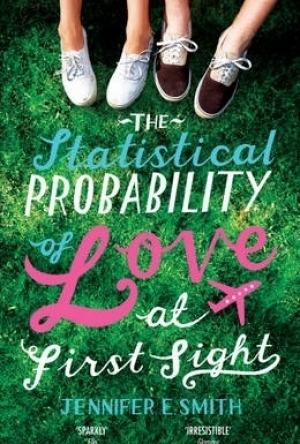
I love the cover!! I love the way how it seems as if time has slowed down for the couple on the front of it. It's such a cute cover. It's one of the first things that caught my attention on this book. I also love the basic colours of the book, white, grey and red. It works perfectly!
I thought the setting was fantastic! Jennifer E. Smith did a fantastic job at making London seem perfect. When I've been to a city, I'm a bit more critical when reading about it in a book. However, the author did me proud in this book. Miss Smith was 100 percent accurate when it came to writing about London.
However, the pacing was a bit too slow for my liking. Upon reading every chapter, I just felt bored. This book didn't really make me feel anything. I was really happy that this was a fairly short book for this reason.
The dialogue was great and easy to understand. It's perfect for a YA book. There's no swearing, so it's a great book even for younger teens. Plus, there's no hard words in it that had me running for a dictionary.
As for the characters, Hadley is an okay character. She seems a bit younger than seventeen though if I'm honest. I just could never really get into Hadley. She felt just a bit too one dimensional. There wasn't enough character building for me to really relate to her. I liked Oliver. I found him to be funny and charming. I just wish he was featured in the book more and that the author would've done a bit more character building for him as well.
All in all, I felt this book was lacking major character development. I would've liked to have had more insight into the main characters' lives. Plus, the pacing was just a bit off.
I had never heard about this book until I won it on a blog giveaway. I thought the synopsis sounded good, and I wanted a break from the paranormal genre I usually read. Unfortunately, I was left feeling disappointed by this book.
The Statistical Probability of Love at First Sight is a story that takes place over a twenty-four hour time frame. Hadley is an American seventeen year old girl who is being forced to go to her father's wedding in London to another woman. Hadley hasn't forgiven him for leaving her and her mother. Hadley misses her original flight by four minutes and is put on the next flight. It is while waiting for her flight that Hadley meets Oliver, a British teen who is on his way to London for a different reason. As luck would have it, Oliver and Hadley are on the same flight and are sitting in the same row. They talk and laugh all throughout their flight but are separated upon going through customs. Hadley is left feeling devastated. Will she ever see Oliver again or will she be doomed to be even more miserable at her dad's wedding?
At first, I didn't really think the title of the book made much sense. I was constantly wondering what the title had to do with the book? I mean, it does feature insta-love, but that's as far as the title went as to matching up with the book. However, the title is spoken by one of the characters in the book, so then it made sense.
I love the cover!! I love the way how it seems as if time has slowed down for the couple on the front of it. It's such a cute cover. It's one of the first things that caught my attention on this book. I also love the basic colours of the book, white, grey and red. It works perfectly!
I thought the setting was fantastic! Jennifer E. Smith did a fantastic job at making London seem perfect. When I've been to a city, I'm a bit more critical when reading about it in a book. However, the author did me proud in this book. Miss Smith was 100 percent accurate when it came to writing about London.
However, the pacing was a bit too slow for my liking. Upon reading every chapter, I just felt bored. This book didn't really make me feel anything. I was really happy that this was a fairly short book for this reason.
The dialogue was great and easy to understand. It's perfect for a YA book. There's no swearing, so it's a great book even for younger teens. Plus, there's no hard words in it that had me running for a dictionary.
As for the characters, Hadley is an okay character. She seems a bit younger than seventeen though if I'm honest. I just could never really get into Hadley. She felt just a bit too one dimensional. There wasn't enough character building for me to really relate to her. I liked Oliver. I found him to be funny and charming. I just wish he was featured in the book more and that the author would've done a bit more character building for him as well.
All in all, I felt this book was lacking major character development. I would've liked to have had more insight into the main characters' lives. Plus, the pacing was just a bit off.
BankofMarquis (1832 KP) rated Venom (2018) in Movies
Oct 13, 2018

Hardy, Williams elevate mediocre material
I had lowered my expectations when entering the new Sony film VENOM for I had heard that this non-MCU Marvel film wasn't really a Marvel - or a Spiderman - film, even though it features one of the more famous characters from the Spiderman Universe, which is, of course, a Marvel property.
Confused, yet?
Well, don't be. Because this knowledge is not needed, nor (quite frankly) is it wanted as the filmmakers of Venom made a film that centers on the titular anti-hero with no real regard to his place in the Marvel Universe.
And this works well...enough. True, the plot, dialogue, situations, special effects and gadgets of this film are middle-of-the-road at best, but with the two folks at the center of this film, I started to forgive this film it's many flaws and enjoyed two Oscar-caliber Actors having a good ol' time in a Supehero movie.
Venom, of course, tells the story of...Eddie Brock..who becomes - through a merging of his body with an Alien symbiotic creature (don't worry about it, just roll with it) - becomes the titular VENOM. A being that wants to eat live creatures (most notably human heads) while the good part of Eddie tries to keep him in check and help him fight bad guys.
In lesser performance hands, this character could become silly and stupid, but in the more than capable performance by the great Tom Hardy (Bane in THE DARK KNIGHT RISES), Eddie Brock/Venom is an intriguing figure to watch on-screen. His simultaneous ability to look unnerved and hunger for live flesh while looking for a nice cool bath caused me to smirk on more than one occasion and I ended up rooting for him throughout the film.
Matching him is the great Michelle Williams (she of the 4 Oscar nominations, most recently in MANCHESTER BY THE SEA) as Eddie Brock's ex-Fiance Anne Weying. Like Hardy, Williams is elevating mediocre material to something better than the mediocrity it was destined to be. The chemistry between Williams and Hardy is evident in their bi-play with each other and I couldn't help but think "get these two into an Oscar-caliber film together and watch the sparks - and the awards - fly."
Unfortunately, Riz Ahmed as bad guy Carlton Drake is not able to rise above the material and when he is playing opposite Hardy and/or Williams, he pales in comparison and I began to realize just how weak the script by the trio of Jeff Pinkner, Scott Rosenberg and Kelly Marcel is. Clearly, two of them were brought in to re-write the original (I have no idea who did what) but none of them were able to elevate the proceedings.
Nor could Director Ruben Fleischer (ZOMBIELAND) elevate things. His Direction is pedestrian at best. There is nothing really interesting going on and when the going got tough he just started to rely on the quick cut/edits that is so "en vogue" these days - and it grew tiresome.
But when I started to grow weary of the events on the screen, Hardy and Williams would show up and I began to forgive things again, even thinking during the credits scene (where they introduce the Villain for VENOM 2), I want to see Hardy and Williams play against (name deleted so as not to spoil) as the new Villain - that might be cool!
So, I'm "in" for Venom. It was "good enough" and I will come back for the next installment - and based on the Box Office of the opening weekend, there WILL BE a next installment.
Letter Grade: B
7 (out of 10) stars and you can take that to the Bank(ofMarquis)
Confused, yet?
Well, don't be. Because this knowledge is not needed, nor (quite frankly) is it wanted as the filmmakers of Venom made a film that centers on the titular anti-hero with no real regard to his place in the Marvel Universe.
And this works well...enough. True, the plot, dialogue, situations, special effects and gadgets of this film are middle-of-the-road at best, but with the two folks at the center of this film, I started to forgive this film it's many flaws and enjoyed two Oscar-caliber Actors having a good ol' time in a Supehero movie.
Venom, of course, tells the story of...Eddie Brock..who becomes - through a merging of his body with an Alien symbiotic creature (don't worry about it, just roll with it) - becomes the titular VENOM. A being that wants to eat live creatures (most notably human heads) while the good part of Eddie tries to keep him in check and help him fight bad guys.
In lesser performance hands, this character could become silly and stupid, but in the more than capable performance by the great Tom Hardy (Bane in THE DARK KNIGHT RISES), Eddie Brock/Venom is an intriguing figure to watch on-screen. His simultaneous ability to look unnerved and hunger for live flesh while looking for a nice cool bath caused me to smirk on more than one occasion and I ended up rooting for him throughout the film.
Matching him is the great Michelle Williams (she of the 4 Oscar nominations, most recently in MANCHESTER BY THE SEA) as Eddie Brock's ex-Fiance Anne Weying. Like Hardy, Williams is elevating mediocre material to something better than the mediocrity it was destined to be. The chemistry between Williams and Hardy is evident in their bi-play with each other and I couldn't help but think "get these two into an Oscar-caliber film together and watch the sparks - and the awards - fly."
Unfortunately, Riz Ahmed as bad guy Carlton Drake is not able to rise above the material and when he is playing opposite Hardy and/or Williams, he pales in comparison and I began to realize just how weak the script by the trio of Jeff Pinkner, Scott Rosenberg and Kelly Marcel is. Clearly, two of them were brought in to re-write the original (I have no idea who did what) but none of them were able to elevate the proceedings.
Nor could Director Ruben Fleischer (ZOMBIELAND) elevate things. His Direction is pedestrian at best. There is nothing really interesting going on and when the going got tough he just started to rely on the quick cut/edits that is so "en vogue" these days - and it grew tiresome.
But when I started to grow weary of the events on the screen, Hardy and Williams would show up and I began to forgive things again, even thinking during the credits scene (where they introduce the Villain for VENOM 2), I want to see Hardy and Williams play against (name deleted so as not to spoil) as the new Villain - that might be cool!
So, I'm "in" for Venom. It was "good enough" and I will come back for the next installment - and based on the Box Office of the opening weekend, there WILL BE a next installment.
Letter Grade: B
7 (out of 10) stars and you can take that to the Bank(ofMarquis)
Purple Phoenix Games (2266 KP) rated Camping with Sasquatch in Tabletop Games
Jun 18, 2019 (Updated Jun 25, 2019)
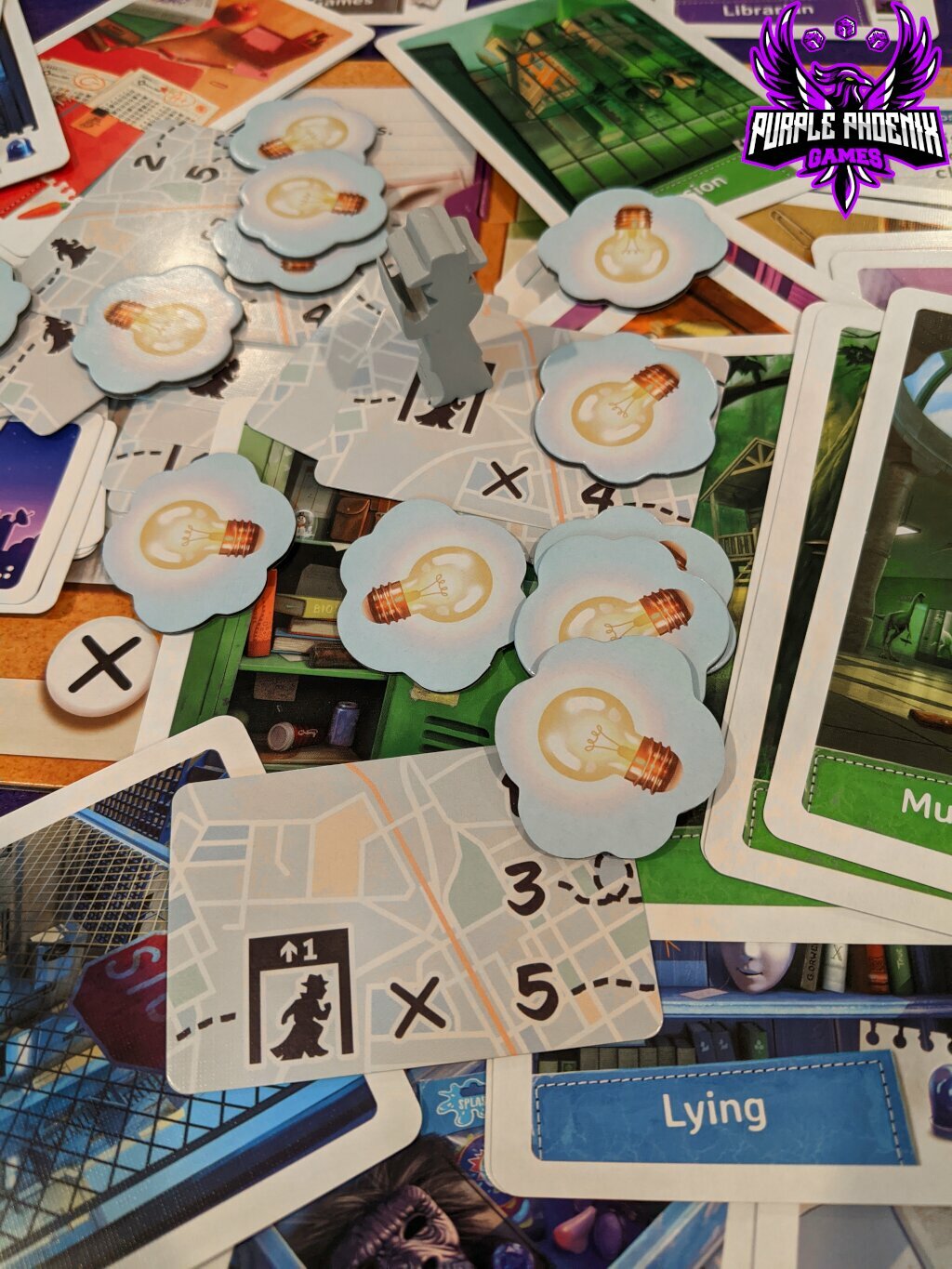
You campers like to have fun, right? Well let me warn you of the dangerous Sasquatch in these here woods. You don’t want to get tangled up with him. He will eat your fishy fishies, your s’mores, and your bathing suits. Don’t believe me? Keep reading.
Camping with Sasquatch is a super silly set collection, hand management, card shedding game in the party game genre featuring, well, Bigfoot. You are dealt a hand of cards of various suits (s’mores, hiking, fishy fishy, etc) and from the large draw pile of remaining cards are revealed three cards. On your turn you must draw a card from the draw pile, and play two cards from your hand. You score points by adding cards to the revealed cards on the table to make sets of suits Rummy style. So you can have a set of 3 like-cards, or a run(?) of 3 different cards, with Sasquatch cards in the same suit being wild. When you complete a set of cards on the table, you claim the set and put the cards in your scoring pile. Each card in your scoring pile is worth one victory point. The first player to shed his hand to zero triggers the end game, and the player with the most victory points is the winner. Duh.
Here’s what makes this game a little different and a little more interesting. The Sasquatch cards are wild. They can be used in a set or a run. Easy. However, you can play a Sasquatch card by itself to the table by slapping it down and calling out what suit it is: “Sasquatch Swimming!” When someone does that the other players must frantically slap the Sasquatch with an appropriate suit-matching card from their hand. If they cannot or if they are the last to do so they are awarded with all the cards that had just been played. In a shedding game, adding cards to your hand is always no bueno. This, however, leads to hilarity at the table, but also frustration if you play with bad sports, or uninterested opponents.
Components. This is a card game. The cards are of good quality, and the art is campy and cartoony. I quite like the art style, but some people I played with had mixed opinions on it. What I did appreciate was the one page folded rulesheet with full color Sasquatch poster on the back. I like light games with non-confusing rules. However, on that subject, I couldn’t find anywhere that it stated we could use more than the three slots to play our cards to next to the draw pile, even though there is a graphic that shows more slots in a dashed outline. We initially played the game with just the three slots available and it was a drag, man. Once we allowed some interpretation of the rules to open up more card slots, the game flowed quite a bit more easily and we enjoyed it much more.
Overall, this is just a silly game of shedding with a unique theme that we all liked. The Sasquatch slap aspect of the game gave it a nice little bump in interest for us, but ultimately we agreed that it was light and fun, but not one we will think to bring out very often. I would like to recommend this, but I will do so to a particular situational scenario. If you are ending your game night and just need a super light nightcap to help you tie one on, then pull out the ‘Squatch. He may eat your hot dogs, but he’s just trying to make a living too. Purple Phoenix Games gives this one a hairy 15 / 30.
Camping with Sasquatch is a super silly set collection, hand management, card shedding game in the party game genre featuring, well, Bigfoot. You are dealt a hand of cards of various suits (s’mores, hiking, fishy fishy, etc) and from the large draw pile of remaining cards are revealed three cards. On your turn you must draw a card from the draw pile, and play two cards from your hand. You score points by adding cards to the revealed cards on the table to make sets of suits Rummy style. So you can have a set of 3 like-cards, or a run(?) of 3 different cards, with Sasquatch cards in the same suit being wild. When you complete a set of cards on the table, you claim the set and put the cards in your scoring pile. Each card in your scoring pile is worth one victory point. The first player to shed his hand to zero triggers the end game, and the player with the most victory points is the winner. Duh.
Here’s what makes this game a little different and a little more interesting. The Sasquatch cards are wild. They can be used in a set or a run. Easy. However, you can play a Sasquatch card by itself to the table by slapping it down and calling out what suit it is: “Sasquatch Swimming!” When someone does that the other players must frantically slap the Sasquatch with an appropriate suit-matching card from their hand. If they cannot or if they are the last to do so they are awarded with all the cards that had just been played. In a shedding game, adding cards to your hand is always no bueno. This, however, leads to hilarity at the table, but also frustration if you play with bad sports, or uninterested opponents.
Components. This is a card game. The cards are of good quality, and the art is campy and cartoony. I quite like the art style, but some people I played with had mixed opinions on it. What I did appreciate was the one page folded rulesheet with full color Sasquatch poster on the back. I like light games with non-confusing rules. However, on that subject, I couldn’t find anywhere that it stated we could use more than the three slots to play our cards to next to the draw pile, even though there is a graphic that shows more slots in a dashed outline. We initially played the game with just the three slots available and it was a drag, man. Once we allowed some interpretation of the rules to open up more card slots, the game flowed quite a bit more easily and we enjoyed it much more.
Overall, this is just a silly game of shedding with a unique theme that we all liked. The Sasquatch slap aspect of the game gave it a nice little bump in interest for us, but ultimately we agreed that it was light and fun, but not one we will think to bring out very often. I would like to recommend this, but I will do so to a particular situational scenario. If you are ending your game night and just need a super light nightcap to help you tie one on, then pull out the ‘Squatch. He may eat your hot dogs, but he’s just trying to make a living too. Purple Phoenix Games gives this one a hairy 15 / 30.