Search

Search only in certain items:

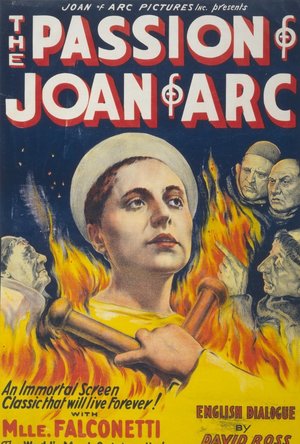
The Passion of Joan of Arc (1928)
1928 | Biography, Drama, History
8.4 (5 Ratings)
Movie Favorite

"It is the most vexing challenge because I just find that, depending… I’m not so psychotic that my mind changes constantly on that subject, but it really depends on where you are in your life. You sort of have a rolling list of a few dozen that you cherish for different reasons. All you try to do is avoid interviews like this so you don’t get pinned down. [laughs] No, I always have trouble pinning anything to a fixed list. Why is it hard? Is it easy for you? You start thinking about the directors you leave off the list and your heart starts breaking. In chronological order, The Passion of Joan of Arc. The last time I saw that film, it struck as me as if it was an artifact from the period itself that it’s depicting. It was like a medium unto itself, and [Maria] Falconetti’s performance, it really cannot be compared to anything else. It’s beyond naturalism, it’s beyond melodrama, it’s beyond everything. It’s just coming straight out of her soul. But mainly, the last time I saw it I just had this weird time slip kind of experience where I felt like I was really seeing a mad visionary from the time who somehow invented the movie camera. [laughs] Putting on this intense pageant on this subject of intense religious devotion. I find that film a knockout. You can’t watch it lightly, but that’s all right."

Source
  
La Dolce Vita  (1960)
La Dolce Vita (1960)
1960 | Comedy, Drama

"I’ve never been very fond of Fellini—too baroque for me. But La dolce vita is an amazing film, summing up an era, a culture, a city; in its own way it is of historical importance. Maybe it is the great Italian film of that period, in the same way that The Mother and the Whore, by Jean Eustache, is the ultimate nouvelle vague film made ten years later, by someone who had been a marginal figure of the movement, and embodying a city, a time, a culture now all gone. My admiration for Jean-Pierre Melville has only been growing through the years. He is a minimalist, like Bresson, but not so much in the sense of emptying the frame—it’s more about getting rid of a lot of the visible to replace it with the invisible. I haven’t been filming a lot of gangsters, but I can understand his fascination for both outlaws and cops, for their world haunted by betrayal and death. In Army of Shadows, he adapts a semi-autobiographical novel by Joseph Kessel and makes the ultimate film of the French Resistance. Both Kessel and Melville had been involved with the Free French, and here cinema meets history. A great artist carried by historical circumstances transcends not just his own inspiration but the medium. Army of Shadows is not only one of the most important French films, it is also a national treasure."

Source
  
Army of Shadows (L'Armée des ombres) (1969)
1969 | International, Drama
(0 Ratings)
Movie Favorite

"I’ve never been very fond of Fellini—too baroque for me. But La dolce vita is an amazing film, summing up an era, a culture, a city; in its own way it is of historical importance. Maybe it is the great Italian film of that period, in the same way that The Mother and the Whore, by Jean Eustache, is the ultimate nouvelle vague film made ten years later, by someone who had been a marginal figure of the movement, and embodying a city, a time, a culture now all gone. My admiration for Jean-Pierre Melville has only been growing through the years. He is a minimalist, like Bresson, but not so much in the sense of emptying the frame—it’s more about getting rid of a lot of the visible to replace it with the invisible. I haven’t been filming a lot of gangsters, but I can understand his fascination for both outlaws and cops, for their world haunted by betrayal and death. In Army of Shadows, he adapts a semi-autobiographical novel by Joseph Kessel and makes the ultimate film of the French Resistance. Both Kessel and Melville had been involved with the Free French, and here cinema meets history. A great artist carried by historical circumstances transcends not just his own inspiration but the medium. Army of Shadows is not only one of the most important French films, it is also a national treasure."

Source
  
Judgment Night by Faith No More
1993 | Hip-hop, Rock
(0 Ratings)
Album Favorite

"This was something of an anomaly in Faith No More’s catalogue, from a film made in the early ‘90s called Judgement Night. The soundtrack was a sort of experiment where they would get bands - white people, essentially - and they would couple them with hip-hop groups and see what happened. This was one of my first introductions to hip-hop to be honest and it wasn’t even ‘proper’ hip-hop, it was bands playing with rapping over the top. “I just thought it was absolutely amazing and I couldn’t get enough of it, this worn-out tape. ‘Another Body Murdered’ was one of the best tracks on it and it ended up introducing me to loads of bands and loads of rappers and this wasn’t like nu-metal, it was mostly edgy rappers. But then there was also a track ‘Fallin’ with Teenage Fanclub featuring De La Soul, things like that. It gave me a really broad introduction via a medium I already understood, which was bands. “But because it was a faceless tape, I didn’t really know who everyone was or who was doing what on each track. I didn’t realise then what cultural lines might have been crossed, because it was all just blurred into one: here’s the guitar, here’s somebody rapping. It didn’t matter to me at all and I think that was a healthy way to discover that sort of music."

Source