
Search

Kirk Bage (1775 KP) rated The Lighthouse (2019) in Movies
Jan 22, 2021

Robert Eggers made a striking introduction for himself in 2015 with the moody and disconcerting The Witch, bringing a future star to the world’s attention in Anya Taylor-Joy in the process. You could argue after seeing his sophomore effort, The Lighthouse, that in terms of creating deliberately nauseating landscapes his work is the third cog in the arthouse revival of intellectual “horror”, after Ari Aster (Hereditary / Midsommar) and Jordan Peele (Get Out / Us). The group actually sits quite well together, as there is an obvious social commentary by metaphor crossover going on here, as well as just a little bit of “crazy”.
The point of difference up front with Eggars seems to be an earthiness. He likes dirt, and straw and rain and holes in the ground, and a sense of temperature in a scene (usually very cold). He also loves to frame an image and hold it there simply for the bizarre beauty of it, much as David Lynch has done unapologetically and without explanation his whole career.
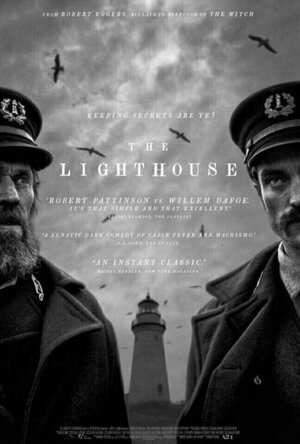
As perfect as Tayor-Joy was in The Witch for her innocent otherworldly qualities, so Willem Dafoe is also as a craggy, sweaty-toothed old man of the sea in this. Whatever else you take, or don’t take from The Lighthouse, it is hard to deny the absolute cinematic purity of Dafoe’s face! It alone will guarantee this film’s cult status (and his) forever. And I do mean forever; the very best images of this film are worthy to be frozen, framed and wondered at alongside the most enduring black and white iconography in the entire history of the art form. And most often the best images involve Dafoe.
He is just so damn interesting to look at, all the time, no matter what. His range as an actor over the years just gets more and more impressive the more you think about it. He is capable of being heartbreakingly vulnerable and tender, but can also be terrifying on demand. His streak of dark humour can not be underestimated either – consider the genius of his introduction here, where the simple touch of his pipe being upside down tells you everything you need to know about this man and where this film is going.
Except, we don’t know where it is going. Ever. It is a very odd experience in terms of a satisfying narrative. It never seems to settle or fit into a genre comfortably, which is fine if all elements sublimate magically, but I don’t think they quite do. Is it a horror, a comedy, a psychological thriller, a study of loneliness and isolation, a metaphor for… something? The closest I can get is to say it is as if Lynch remade Young Frankenstein with just Igor and Dr Frankenstein, at a lighthouse, but forgot to make it funny or cohere into a real story. Of course, the things that I am reaching for as shortcomings may be exactly what others see as strengths. There is something to be said for being taken on a journey you can’t define or easily explain.
Quite often on this journey we are teased and fed details that seem to go nowhere, and avenues that may have proved interesting to explore are closed with a bang, in favour of another drinking scene and another fight – which are great the first few times, but become repetitive to a baffling degree later on. Mythology and dreams of the sea are played with, but also not fully approached; we are only given brief flashes of Mermaids and Krakens, nightmares and visions only, before returning to the mundanity and drudgery of the job of a lighthouse keeper. You are often left wondering who is going more mad, the men in the film or you watching it. I definitely recommend the best way to watch this is a little or a lot drunk, very late at night… it demands it, somehow.
It is difficult for all these reasons to say with any true certainty then, after just one viewing, if I think it is any good… I don’t know yet, I will have to watch it again some time to find out, is my best answer. For sure the photography is 100% first rate and instantly unforgettable – Jarin Blaschke was deservedly Oscar nominated for the extremely fine work – and the design and feel of the whole thing is quite masterful. I really want to like it more than I do, and perhaps if I was still in my wide-eyed twenties I would be enthusing about it endlessly, but now… I can see a touch of the Emperor’s new clothes about it, so am cautious of praising it too much.
One other element that is impressive, however, that I have yet to touch on, is the continued rise of Mr Robert Pattinson as an actor of serious note. As I have already touched on recently in other reviews, I did not see this coming, that it would be him that I was naming as one of the most promising talents of his age group working in film today! But you just can’t deny his versatility and understanding of genre and character. He puts in another very solid effort here, full of interesting choices and nuance; he is certainly an exciting prospect for the decade ahead.
In summary. See it. Unless you absolutely hate things that don’t tie the strings up nice and neatly, and decide for yourself. Some people will hate it, and I get that. It is a film-lovers film, for sure. Mesmerising and Meticulous, as one critic put it. Admire it for the craft involved, and experience it with an open mind. Just don’t go in expecting traditional horror, or traditional drama, or traditional comedy, or even traditional surrealism… The Lighthouse, for all it’s debatable flaws is unique! I suggest you let it be that way by not over-reaching to define it.
The point of difference up front with Eggars seems to be an earthiness. He likes dirt, and straw and rain and holes in the ground, and a sense of temperature in a scene (usually very cold). He also loves to frame an image and hold it there simply for the bizarre beauty of it, much as David Lynch has done unapologetically and without explanation his whole career.
As perfect as Tayor-Joy was in The Witch for her innocent otherworldly qualities, so Willem Dafoe is also as a craggy, sweaty-toothed old man of the sea in this. Whatever else you take, or don’t take from The Lighthouse, it is hard to deny the absolute cinematic purity of Dafoe’s face! It alone will guarantee this film’s cult status (and his) forever. And I do mean forever; the very best images of this film are worthy to be frozen, framed and wondered at alongside the most enduring black and white iconography in the entire history of the art form. And most often the best images involve Dafoe.
He is just so damn interesting to look at, all the time, no matter what. His range as an actor over the years just gets more and more impressive the more you think about it. He is capable of being heartbreakingly vulnerable and tender, but can also be terrifying on demand. His streak of dark humour can not be underestimated either – consider the genius of his introduction here, where the simple touch of his pipe being upside down tells you everything you need to know about this man and where this film is going.
Except, we don’t know where it is going. Ever. It is a very odd experience in terms of a satisfying narrative. It never seems to settle or fit into a genre comfortably, which is fine if all elements sublimate magically, but I don’t think they quite do. Is it a horror, a comedy, a psychological thriller, a study of loneliness and isolation, a metaphor for… something? The closest I can get is to say it is as if Lynch remade Young Frankenstein with just Igor and Dr Frankenstein, at a lighthouse, but forgot to make it funny or cohere into a real story. Of course, the things that I am reaching for as shortcomings may be exactly what others see as strengths. There is something to be said for being taken on a journey you can’t define or easily explain.
Quite often on this journey we are teased and fed details that seem to go nowhere, and avenues that may have proved interesting to explore are closed with a bang, in favour of another drinking scene and another fight – which are great the first few times, but become repetitive to a baffling degree later on. Mythology and dreams of the sea are played with, but also not fully approached; we are only given brief flashes of Mermaids and Krakens, nightmares and visions only, before returning to the mundanity and drudgery of the job of a lighthouse keeper. You are often left wondering who is going more mad, the men in the film or you watching it. I definitely recommend the best way to watch this is a little or a lot drunk, very late at night… it demands it, somehow.
It is difficult for all these reasons to say with any true certainty then, after just one viewing, if I think it is any good… I don’t know yet, I will have to watch it again some time to find out, is my best answer. For sure the photography is 100% first rate and instantly unforgettable – Jarin Blaschke was deservedly Oscar nominated for the extremely fine work – and the design and feel of the whole thing is quite masterful. I really want to like it more than I do, and perhaps if I was still in my wide-eyed twenties I would be enthusing about it endlessly, but now… I can see a touch of the Emperor’s new clothes about it, so am cautious of praising it too much.
One other element that is impressive, however, that I have yet to touch on, is the continued rise of Mr Robert Pattinson as an actor of serious note. As I have already touched on recently in other reviews, I did not see this coming, that it would be him that I was naming as one of the most promising talents of his age group working in film today! But you just can’t deny his versatility and understanding of genre and character. He puts in another very solid effort here, full of interesting choices and nuance; he is certainly an exciting prospect for the decade ahead.
In summary. See it. Unless you absolutely hate things that don’t tie the strings up nice and neatly, and decide for yourself. Some people will hate it, and I get that. It is a film-lovers film, for sure. Mesmerising and Meticulous, as one critic put it. Admire it for the craft involved, and experience it with an open mind. Just don’t go in expecting traditional horror, or traditional drama, or traditional comedy, or even traditional surrealism… The Lighthouse, for all it’s debatable flaws is unique! I suggest you let it be that way by not over-reaching to define it.

Mandy and G.D. Burkhead (26 KP) rated Hottest Blood: The Ultimate in Erotic Horror in Books
May 20, 2018


Shelf Life – Hottest Blood: The Ultimate in Erotic Horror is Neither of Those Things
(I’m gonna go ahead and throw a disclaimer on up here: You are about to read something that deals with purportedly “erotic” subject matter. If you don’t like the sound of that word, you might wanna go elsewhere. If it’s actually-erotic things that offend you, though, you’ll be fine.)
I like short story compilations because you get a variety of content that’s just as easy to breeze through if you have the time as it is to get to a stopping point and put down if you don’t. I like horror fiction because it usually involves the super-natural, which interests me, and intense emotional responses, which are almost always a good thing in writing. And I like eroticism because I am a warm-blooded human being with a pulse. However, on the whole, I do not like Hottest Blood.
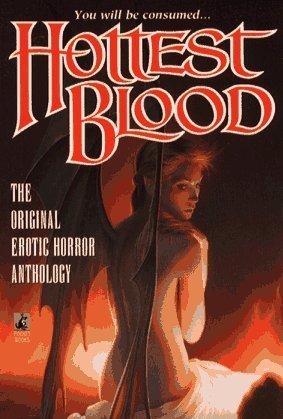
I wanted to, I did. Look at that cover. It’s equal amounts scary and sexy, both in completely safe, PG-13-at-most kind of ways. Unfortunately, Softcore Succubus here is both the scariest and the sexiest thing about this book
Bluntly analogized, you know that feeling you get when you come across something on the internet that disturbs and/or disgusts you, and then you learn that there’s a dedicated group of people that gets off on it? Most of the stories in this book are that feeling captured in words.
Case in point, the story “Damaged Goods” by Elizabeth Massie, which as far as I can tell is about a couple of physically abused, emotionally damaged, developmentally stunted kids somewhere around their early teens who live with a religious fringe cult being led out to a field to have sex with each other while a nameless U.S. President watches and masturbates before both kids are drowned in a river by their preacher/pimp caretaker.
Or there’s “Mr. Right” by Chris Lacher, which tells the story of a college student named Russ who has a secret fetish for the deformed women in the freak show at a nearby carnival – a fascination which leads to him getting held down and forcibly raped by a group of unwashed subhuman mutants, which the detailed descriptions make sure you understand are completely revolting to all five senses. The story ends with him being dumped out behind the fairgrounds while a small, legless girl happily informs him that this is how all carnival workers reproduce, and he can look forward to seeing his own mutant rape-spawn in the show next year.
Or there’s “Abuse” by Matthew Costello, which simply shows us how the arrest of a Peewee Herman surrogate goes down in an adult movie theater before ending with another man jerking off with the cold, dry, severed hand in his pocket as he contemplates getting a new one to replace it.
The tone of these three are pretty much par for the course for the rest of the book: thoroughly disturbing, and sex is involved, but the disturbing feeling stems from revulsion rather than fear, and the sex bits are so far on the other end of the spectrum from erotic that it feels like the authors are trying to punish their readers for even expecting to be aroused in any way.
Of course, I said myself earlier that intense emotional responses are “almost always a good thing in writing.” By that merit alone, this book technically succeeds; in fact, if it had billed itself as shock fiction instead of erotic horror, I’d begrudgingly give it a medal in its class. The “aw, what the hell?!” moments are not as artistically executed as, say, a Chuck Palahniuk read, and they tend not to have as much depth to them, but strictly in terms of making you wish that you could unread words, they get the job done.
But that isn’t the job that Hottest Blood was hired to do, and that’s not what it put on its resume. It said it was going to “heat the blood and chill the mind,” and promised that “terror never felt this sexy!” It would have been more appropriate to say that “sex never felt this terrible.”
All of that said, if you abandon any hope of seeing anything resembling erotica or horror (scary horror, anyway), there are a few stories in here that are decent reads – mostly because they try to say something with their subject matter rather than use it to see how thoroughly they can ruin the idea of sex for the reader. To give a few quick nods of approval:
Nancy Holder’s “I Hear the Mermaids Singing,” which opens the anthology, is a dark and modern re-imagining of “The Little Mermaid” that brutally points up the drawbacks to throwing away your whole life and family in order to pursue someone that you know nothing about outside of a few fleeting glimpses and lustful inner fantasies.
J.L. Comeau’s “Black Cars” is the narrative of a high-class chauffeur as he tells his passenger an increasingly mysterious story about a couple of his regular customers, culminating in a creepy twist payoff that, in retrospect, actually makes it count as a legitimate horror story, and a decently gripping one at that.
And “Safe at Home” by Steve and Melanie Tem, while decidedly and disturbingly unsexy, at least has good reason to be; it’s a short character study of a young woman who’d been molested as a child, and the lasting and complex psychological damage resulting thereof that prevents her from having any normal social life or relationships, even with someone whom she legitimately likes, someone who knows what’s happened and sincerely cares for her.
So for the handful of intriguing stories that don’t make you quit (or wish you had) mid-read out of revolted disappointment, I can’t completely condemn Hottest Blood. If you want to test your own threshold for repulsion but are understandably hesitant to use online image searches to this end, I heartily recommend it.
If you are legitimately turned on by the idea of a man eating a woman alive and then gestating her alien spawn inside his own bloated body until his head detaches and crawls away (“How Deep the Taste of Love,” John Shirley), I suppose I still heartily recommend it, though I do so from a safe distance.
If you want to read one of the few stories involved that aren’t horrible, I heartily recommend trying to find them on their own somewhere else first.
But if you want “the ultimate in erotic horror,” stay the hell away. Softcore Succubus is a trap.
I like short story compilations because you get a variety of content that’s just as easy to breeze through if you have the time as it is to get to a stopping point and put down if you don’t. I like horror fiction because it usually involves the super-natural, which interests me, and intense emotional responses, which are almost always a good thing in writing. And I like eroticism because I am a warm-blooded human being with a pulse. However, on the whole, I do not like Hottest Blood.
I wanted to, I did. Look at that cover. It’s equal amounts scary and sexy, both in completely safe, PG-13-at-most kind of ways. Unfortunately, Softcore Succubus here is both the scariest and the sexiest thing about this book
Bluntly analogized, you know that feeling you get when you come across something on the internet that disturbs and/or disgusts you, and then you learn that there’s a dedicated group of people that gets off on it? Most of the stories in this book are that feeling captured in words.
Case in point, the story “Damaged Goods” by Elizabeth Massie, which as far as I can tell is about a couple of physically abused, emotionally damaged, developmentally stunted kids somewhere around their early teens who live with a religious fringe cult being led out to a field to have sex with each other while a nameless U.S. President watches and masturbates before both kids are drowned in a river by their preacher/pimp caretaker.
Or there’s “Mr. Right” by Chris Lacher, which tells the story of a college student named Russ who has a secret fetish for the deformed women in the freak show at a nearby carnival – a fascination which leads to him getting held down and forcibly raped by a group of unwashed subhuman mutants, which the detailed descriptions make sure you understand are completely revolting to all five senses. The story ends with him being dumped out behind the fairgrounds while a small, legless girl happily informs him that this is how all carnival workers reproduce, and he can look forward to seeing his own mutant rape-spawn in the show next year.
Or there’s “Abuse” by Matthew Costello, which simply shows us how the arrest of a Peewee Herman surrogate goes down in an adult movie theater before ending with another man jerking off with the cold, dry, severed hand in his pocket as he contemplates getting a new one to replace it.
The tone of these three are pretty much par for the course for the rest of the book: thoroughly disturbing, and sex is involved, but the disturbing feeling stems from revulsion rather than fear, and the sex bits are so far on the other end of the spectrum from erotic that it feels like the authors are trying to punish their readers for even expecting to be aroused in any way.
Of course, I said myself earlier that intense emotional responses are “almost always a good thing in writing.” By that merit alone, this book technically succeeds; in fact, if it had billed itself as shock fiction instead of erotic horror, I’d begrudgingly give it a medal in its class. The “aw, what the hell?!” moments are not as artistically executed as, say, a Chuck Palahniuk read, and they tend not to have as much depth to them, but strictly in terms of making you wish that you could unread words, they get the job done.
But that isn’t the job that Hottest Blood was hired to do, and that’s not what it put on its resume. It said it was going to “heat the blood and chill the mind,” and promised that “terror never felt this sexy!” It would have been more appropriate to say that “sex never felt this terrible.”
All of that said, if you abandon any hope of seeing anything resembling erotica or horror (scary horror, anyway), there are a few stories in here that are decent reads – mostly because they try to say something with their subject matter rather than use it to see how thoroughly they can ruin the idea of sex for the reader. To give a few quick nods of approval:
Nancy Holder’s “I Hear the Mermaids Singing,” which opens the anthology, is a dark and modern re-imagining of “The Little Mermaid” that brutally points up the drawbacks to throwing away your whole life and family in order to pursue someone that you know nothing about outside of a few fleeting glimpses and lustful inner fantasies.
J.L. Comeau’s “Black Cars” is the narrative of a high-class chauffeur as he tells his passenger an increasingly mysterious story about a couple of his regular customers, culminating in a creepy twist payoff that, in retrospect, actually makes it count as a legitimate horror story, and a decently gripping one at that.
And “Safe at Home” by Steve and Melanie Tem, while decidedly and disturbingly unsexy, at least has good reason to be; it’s a short character study of a young woman who’d been molested as a child, and the lasting and complex psychological damage resulting thereof that prevents her from having any normal social life or relationships, even with someone whom she legitimately likes, someone who knows what’s happened and sincerely cares for her.
So for the handful of intriguing stories that don’t make you quit (or wish you had) mid-read out of revolted disappointment, I can’t completely condemn Hottest Blood. If you want to test your own threshold for repulsion but are understandably hesitant to use online image searches to this end, I heartily recommend it.
If you are legitimately turned on by the idea of a man eating a woman alive and then gestating her alien spawn inside his own bloated body until his head detaches and crawls away (“How Deep the Taste of Love,” John Shirley), I suppose I still heartily recommend it, though I do so from a safe distance.
If you want to read one of the few stories involved that aren’t horrible, I heartily recommend trying to find them on their own somewhere else first.
But if you want “the ultimate in erotic horror,” stay the hell away. Softcore Succubus is a trap.