
Search
Search results

Gareth von Kallenbach (980 KP) rated Watchmen (2009) in Movies
Aug 14, 2019


In an alternate 1985, where Nixon is president, The U.S. won the Vietnam War, and costumed heroes have been banned by an act of the Senate, a superhero is killed. The death of the mercurial entity known as The Comedian (Jeffrey Dean Morgan) sets a string of events into motion that will soon see the world poised on the edge of nuclear annihilation, and the few remaining heroes locked in a life or death race against time to save the world. In the gritty and compelling new movie “Watchmen” by Director Zack Snyder, a clever blend of film noir and gumshoe style films of old combined with action and adventure as well as a deep examination of human frailties to create a film like no other.
No sooner has the death of the Comedian hit the streets (literally), when the edgy vigilante Rorschach (Jackie Earle Haley), begins to suspect that there is a larger and far more sinister plot in effect, one that has targeted the few remaining costumed avengers of New York City. Rorschach’s theory is disbelieved by his former associate Dan (Patrick Wilson), who prowled the streets as Night Owl and is now content to keep to himself, with his days of costumed glory behind him. He keeps his social circle limited to the first Night Owl and visiting with Laurie Jupiter ( Malin Akerman), and her husband, Dr. Manhattan (Billy Crudup).
With his concerns being dismissed, Rorschach is left to do the legwork on the mystery which soon shifts into high gear when he is framed for a murder he actually did not commit and an attempt is made on the life of the other former Watchmen, Ozymandias (Matthew Goode). With Rorschach in prison and surrounded by enemies, Dr. Manhattan, the all powerful and blue skinned being, is forced to take refuge on Mars after Laurie leaves him and a series of accusations are levied against him at a press conference .
It soon becomes clear to all that the death of The Comedian was not a random act of violence or a simple act of revenge, but rather the first salvo in a war against costumed heroes. With the former team in chaos, Laurie to take up residence with Dan, who has long held a torch for her, to defy the government order and suit up again. After saving a group of people from a fire, Laurie and Dan find the passion and purpose that has been missing from their post-hero lives and passionately unite and set out to free Rorschach and get to the bottom of the conspiracy before it is to late.
The film is an amazing mix of comic book action and mystery that includes a suprising amount of mature material that examines everything from humanity’s ultimate destiny to the inner psyche of tortured and flawed individuals. The characters all have their flaws and traumas and compensate by donning masks and taking on new personas. The deeply troubled Rorschach is filled in by some horrific and disturbing flashbacks that show how he became the disturbed and deeply dangerous crusader for justice that he is, so extreme in his measures that he is wanted by the police for his actions. Dan and Laurie try to move on from their past, but find that they are more comfortable in their costumed personas than they are in their day-to-day lives. Dr. Manhattan is perhaps the most dysfunctional of all as he has shut himself off from his wife, humanity, and joy. He has evolved beyond caring for anything but his experiments.
Snyder keeps the nearly three hour film moving at a brisk pace and deftly captures the look and tone of the graphic novel on which the film is based. The opening segment that shows alternate versions of great moments in history is amazing, as is the well choreographed action sequences. Despite being a superhero film, “Watchmen” is a superb mystery and drama that is loaded with interesting characters and clever social commentary. The cast is very strong, and Haley is remarkable as Rorschach. He is utterly captivating whenever he is on the screen and has crafted a true modern anti-hero for the masses.
Some may find the graphic violence and sex in the film a bit extreme, but in order to fully capture the duality of the characters and the dark world that they dwell in, it was in many ways restrained from what is actually implied by the source material. “Watchmen”, is a true marvel and is one of the most entertaining, diverse, and original action films in memory.
No sooner has the death of the Comedian hit the streets (literally), when the edgy vigilante Rorschach (Jackie Earle Haley), begins to suspect that there is a larger and far more sinister plot in effect, one that has targeted the few remaining costumed avengers of New York City. Rorschach’s theory is disbelieved by his former associate Dan (Patrick Wilson), who prowled the streets as Night Owl and is now content to keep to himself, with his days of costumed glory behind him. He keeps his social circle limited to the first Night Owl and visiting with Laurie Jupiter ( Malin Akerman), and her husband, Dr. Manhattan (Billy Crudup).
With his concerns being dismissed, Rorschach is left to do the legwork on the mystery which soon shifts into high gear when he is framed for a murder he actually did not commit and an attempt is made on the life of the other former Watchmen, Ozymandias (Matthew Goode). With Rorschach in prison and surrounded by enemies, Dr. Manhattan, the all powerful and blue skinned being, is forced to take refuge on Mars after Laurie leaves him and a series of accusations are levied against him at a press conference .
It soon becomes clear to all that the death of The Comedian was not a random act of violence or a simple act of revenge, but rather the first salvo in a war against costumed heroes. With the former team in chaos, Laurie to take up residence with Dan, who has long held a torch for her, to defy the government order and suit up again. After saving a group of people from a fire, Laurie and Dan find the passion and purpose that has been missing from their post-hero lives and passionately unite and set out to free Rorschach and get to the bottom of the conspiracy before it is to late.
The film is an amazing mix of comic book action and mystery that includes a suprising amount of mature material that examines everything from humanity’s ultimate destiny to the inner psyche of tortured and flawed individuals. The characters all have their flaws and traumas and compensate by donning masks and taking on new personas. The deeply troubled Rorschach is filled in by some horrific and disturbing flashbacks that show how he became the disturbed and deeply dangerous crusader for justice that he is, so extreme in his measures that he is wanted by the police for his actions. Dan and Laurie try to move on from their past, but find that they are more comfortable in their costumed personas than they are in their day-to-day lives. Dr. Manhattan is perhaps the most dysfunctional of all as he has shut himself off from his wife, humanity, and joy. He has evolved beyond caring for anything but his experiments.
Snyder keeps the nearly three hour film moving at a brisk pace and deftly captures the look and tone of the graphic novel on which the film is based. The opening segment that shows alternate versions of great moments in history is amazing, as is the well choreographed action sequences. Despite being a superhero film, “Watchmen” is a superb mystery and drama that is loaded with interesting characters and clever social commentary. The cast is very strong, and Haley is remarkable as Rorschach. He is utterly captivating whenever he is on the screen and has crafted a true modern anti-hero for the masses.
Some may find the graphic violence and sex in the film a bit extreme, but in order to fully capture the duality of the characters and the dark world that they dwell in, it was in many ways restrained from what is actually implied by the source material. “Watchmen”, is a true marvel and is one of the most entertaining, diverse, and original action films in memory.

Emma @ The Movies (1786 KP) rated Hellboy (2019) in Movies
Jun 22, 2019 (Updated Sep 25, 2019)


Open, black and white apart from Nimue's red dress.
Production notes: Try and make it noir-esque, but we need it done quickly so don't be too bothered by any of the class that goes with it.
As openings go it summed up the backstory quite nicely and Ian McShane's voiceover was good, but despite all of that it wasn't saved from it being quite badly shot.
I didn't want to start this review by moaning, but it's nearly impossible as there's a lot to moan about. I think I'm going to get it all out of the way now and then move on.
That CGI... at one point I wrote down that it was Harry Potter bad, I'm talking Voldemort on the back of the head bad. I'm trying to think of an obvious effect where it was actually good but I'm drawing a blank. Gruagach, our pig-demon-thing, looked like he was wearing a Halloween mask, but had it been real life I suspect it would look better.
Generally the creature effects are terrible, I was briefly hopeful for the giants but then the fight started and things got progressively worse. The blood was a particularly bad offering. I was particularly annoyed with this scene because the bits where Hellboy is thrown around were actually quite good and with a little work it could have been amazing.
Major Ben Daimio, played by Daniel Dae Kim, also got some punishing CGI for his transformation, unfortunately the negativity doesn't stop there. I just couldn't understand what that accent was about... I just... what the... ugh.
He's not the only character that's treated badly. Alice has so much potential in her but it isn't until the end that she discovers what she's really capable of. I can't help but think that they could have used her more to boost the movie.
David Harbour as Hellboy doesn't have me convinced. he's got the laid back attitude and some of the banter that the part needs, but there was a spark missing for me. Perhaps he was slightly more horizontal than laid back.
Quite possibly the best scene in the movie is right at the end when we see the group back together briefly. This scene was so well done that I was a little irritated they didn't manage to replicate that earlier in the film.
Hellboy is probably too long, there are definitely pieces to cut out. As much as I love her, Big Mo has to go, I'd also cut out Baba Yaga. The effects were overly creepy and the scenes added hardly anything apart from what felt like an obvious set up for a sequel.
The story overall isn't that bad, I like the origin of Hellboy, although baby Hellboy felt a lot like they'd taken the Ally McBeal baby and painted it red. I also liked the fact that they didn't let him instantly take the easy route to victory, that really worked in his favour.
I've realised at this point that I haven't really mentioned Nimue. She's one of the main villains, I probably should have talked about her by now but apart from the assembly scene she's not overly memorable, much like most of the other bad guys.
As a last passing note I want to mention the music. I noticed it a lot and it was frequently very good, it certainly helped the transition scenes. I probably would have turned the volume down a bit, but it was a great selection so I don't think it's too much of a problem.
I should probably stop waffling at this point. Despite what has amounted to a lot of moaning and griping Hellboy wasn't a waste of my time. I know lots of you are going to disagree with me on that point. To be entertaining given all of those faults I nitpicked was a great achievement. It delivers on daft action and sometimes that's all I need to have an amusing time at the cinema. We probably just need to keep our fingers crossed for better effects if they come out with a sequel.
What you should do
I would go and see it at the cinema if I were you. If you can get past the fact it isn't Ron Perlman and there's a severe lack of kittens then you're bound to have some fun.
Movie thing you wish you could take home
Some spirit powers would be quite fun, minus the vomiting part.
Production notes: Try and make it noir-esque, but we need it done quickly so don't be too bothered by any of the class that goes with it.
As openings go it summed up the backstory quite nicely and Ian McShane's voiceover was good, but despite all of that it wasn't saved from it being quite badly shot.
I didn't want to start this review by moaning, but it's nearly impossible as there's a lot to moan about. I think I'm going to get it all out of the way now and then move on.
That CGI... at one point I wrote down that it was Harry Potter bad, I'm talking Voldemort on the back of the head bad. I'm trying to think of an obvious effect where it was actually good but I'm drawing a blank. Gruagach, our pig-demon-thing, looked like he was wearing a Halloween mask, but had it been real life I suspect it would look better.
Generally the creature effects are terrible, I was briefly hopeful for the giants but then the fight started and things got progressively worse. The blood was a particularly bad offering. I was particularly annoyed with this scene because the bits where Hellboy is thrown around were actually quite good and with a little work it could have been amazing.
Major Ben Daimio, played by Daniel Dae Kim, also got some punishing CGI for his transformation, unfortunately the negativity doesn't stop there. I just couldn't understand what that accent was about... I just... what the... ugh.
He's not the only character that's treated badly. Alice has so much potential in her but it isn't until the end that she discovers what she's really capable of. I can't help but think that they could have used her more to boost the movie.
David Harbour as Hellboy doesn't have me convinced. he's got the laid back attitude and some of the banter that the part needs, but there was a spark missing for me. Perhaps he was slightly more horizontal than laid back.
Quite possibly the best scene in the movie is right at the end when we see the group back together briefly. This scene was so well done that I was a little irritated they didn't manage to replicate that earlier in the film.
Hellboy is probably too long, there are definitely pieces to cut out. As much as I love her, Big Mo has to go, I'd also cut out Baba Yaga. The effects were overly creepy and the scenes added hardly anything apart from what felt like an obvious set up for a sequel.
The story overall isn't that bad, I like the origin of Hellboy, although baby Hellboy felt a lot like they'd taken the Ally McBeal baby and painted it red. I also liked the fact that they didn't let him instantly take the easy route to victory, that really worked in his favour.
I've realised at this point that I haven't really mentioned Nimue. She's one of the main villains, I probably should have talked about her by now but apart from the assembly scene she's not overly memorable, much like most of the other bad guys.
As a last passing note I want to mention the music. I noticed it a lot and it was frequently very good, it certainly helped the transition scenes. I probably would have turned the volume down a bit, but it was a great selection so I don't think it's too much of a problem.
I should probably stop waffling at this point. Despite what has amounted to a lot of moaning and griping Hellboy wasn't a waste of my time. I know lots of you are going to disagree with me on that point. To be entertaining given all of those faults I nitpicked was a great achievement. It delivers on daft action and sometimes that's all I need to have an amusing time at the cinema. We probably just need to keep our fingers crossed for better effects if they come out with a sequel.
What you should do
I would go and see it at the cinema if I were you. If you can get past the fact it isn't Ron Perlman and there's a severe lack of kittens then you're bound to have some fun.
Movie thing you wish you could take home
Some spirit powers would be quite fun, minus the vomiting part.

Chris Sawin (602 KP) rated Under the Silver Lake (2018) in Movies
Jul 6, 2019

In David Robert Mitchell’s (It Follows) Under the Silver Lake, Andrew Garfield portrays a jobless and lethargic young man named Sam. Apart from his obsession with conspiracy theories and finding obscure messages in common pop culture, Sam typically spies on his topless and bird-loving neighbor. He also blatantly ignores the fact that he’s facing eviction in five days for unpaid rent. His current infatuation is a zine entitled Under the Silver Lake, which seems to mirror what’s currently transpiring in Los Angeles. Sam develops a crush on his new neighbor named Sarah (Riley Keough), who seems to disappear without a trace overnight. What begins as an investigation into Sarah’s current whereabouts evolves into something deeply rooted in the peculiar.
There’s a lot to digest with Under the Silver Lake. Not only is the story constructed on finding clues and deciphering the bizarre, but the film itself is also loaded with homage to famous music, film, and people. Nirvana, The Legend of Zelda, Nintendo Power, and Spider-Man are just a few references in the film and that doesn’t cover the blatant influence of films such as Rear Window or 2001: A Space Odyssey. What you have to ask yourself, and this is probably what makes the film so polarizing, is if what lays between the admiration for popular culture a worthwhile experience?
What you can appreciate is Andrew Garfield’s performance. Sam is so bored with his uneventful existence that he tries to find hidden meaning in everyday items. He is basically a stalker fueled by paranoia and consistent lusting of whatever woman is closest to him. When sex isn’t an option for Sam, he masturbates and somehow this becomes a common theme of the film. The first thing you ever pleasured yourself to is suddenly a conversation piece. Garfield has an unusual demeanor as Sam, but never really comes off as creepy. The method in which the story keeps snowballing into something bigger with more and more connections helps Sam’s case. Sam beats the snot out of a kid who keyed a giant penis ejaculating onto the hood of his black GT Mustang and you only seem to like him more because of it.
The fact of the matter is you also become invested in Sam’s discoveries. Despite what you feel about Under the Silver Lake as a film, it’s still unpredictable and intriguing even with its 139-minute duration. With its abrupt camera movements, a kamikaze squirrel, a serial dog killer on the loose, pets named after soda, the discovery of saltines and orange juice being one of the most unique combinations ever, a gory dream sequence, animated zine stories, people barking like dogs, the map on the back of a cereal box being the answer to everything, a seething hatred for the homeless, a way too impressive piano medley, and an almost unrecognizable Topher Grace as a reliable friend, Under the Silver Lake feels like it is overloaded with these overwhelmingly precise details that don’t necessarily lead to anything substantial.
On first watch, it’s impossible to decipher if Under the Silver Lake is destined to be a cult classic or a misguided neo-noir mystery. David Robert Mitchell knows how to introduce elements of comedy, mystery, and drama, but that final product is what leaves you scratching your head. Maybe this gets better with multiple viewings and you find more Easter eggs with each watch or everything connects differently in your head after knowing what direction the story is headed in. In the meantime though, Under the Silver Lake mostly feels like a nearly two and a half hour session of stoner ramblings that can’t decide whether to be Brick, Inherent Vice, or Southland Tales; even The Homeless King feels like a side story lifted from Terry Gilliam’s The Fisher King.
What’s happening directly in Sam’s world isn’t what matters most in Under the Silver Lake. He’s more worried about Sarah and Los Angeles than he is about not having a job or possibly a place to live in a matter of days. The outside world is far more interesting to Sam because it’s that, “The grass is always greener,” kind of mentality. Sam is consumed by Sarah because she is the one woman in the film he doesn’t get to sleep with. Having everlasting discussions of what your topless neighbor’s parrot is saying is far more humorous than revealing anything remotely personal. Becoming entangled in this crazy spider’s web of a conspiracy is far more interesting than living a boring existence. Sam makes the most out of nothing, literally. Under the Silver Lake is this spellbinding enigma of a film that is equally stimulating as it is mystifying.
There’s a lot to digest with Under the Silver Lake. Not only is the story constructed on finding clues and deciphering the bizarre, but the film itself is also loaded with homage to famous music, film, and people. Nirvana, The Legend of Zelda, Nintendo Power, and Spider-Man are just a few references in the film and that doesn’t cover the blatant influence of films such as Rear Window or 2001: A Space Odyssey. What you have to ask yourself, and this is probably what makes the film so polarizing, is if what lays between the admiration for popular culture a worthwhile experience?
What you can appreciate is Andrew Garfield’s performance. Sam is so bored with his uneventful existence that he tries to find hidden meaning in everyday items. He is basically a stalker fueled by paranoia and consistent lusting of whatever woman is closest to him. When sex isn’t an option for Sam, he masturbates and somehow this becomes a common theme of the film. The first thing you ever pleasured yourself to is suddenly a conversation piece. Garfield has an unusual demeanor as Sam, but never really comes off as creepy. The method in which the story keeps snowballing into something bigger with more and more connections helps Sam’s case. Sam beats the snot out of a kid who keyed a giant penis ejaculating onto the hood of his black GT Mustang and you only seem to like him more because of it.
The fact of the matter is you also become invested in Sam’s discoveries. Despite what you feel about Under the Silver Lake as a film, it’s still unpredictable and intriguing even with its 139-minute duration. With its abrupt camera movements, a kamikaze squirrel, a serial dog killer on the loose, pets named after soda, the discovery of saltines and orange juice being one of the most unique combinations ever, a gory dream sequence, animated zine stories, people barking like dogs, the map on the back of a cereal box being the answer to everything, a seething hatred for the homeless, a way too impressive piano medley, and an almost unrecognizable Topher Grace as a reliable friend, Under the Silver Lake feels like it is overloaded with these overwhelmingly precise details that don’t necessarily lead to anything substantial.
On first watch, it’s impossible to decipher if Under the Silver Lake is destined to be a cult classic or a misguided neo-noir mystery. David Robert Mitchell knows how to introduce elements of comedy, mystery, and drama, but that final product is what leaves you scratching your head. Maybe this gets better with multiple viewings and you find more Easter eggs with each watch or everything connects differently in your head after knowing what direction the story is headed in. In the meantime though, Under the Silver Lake mostly feels like a nearly two and a half hour session of stoner ramblings that can’t decide whether to be Brick, Inherent Vice, or Southland Tales; even The Homeless King feels like a side story lifted from Terry Gilliam’s The Fisher King.
What’s happening directly in Sam’s world isn’t what matters most in Under the Silver Lake. He’s more worried about Sarah and Los Angeles than he is about not having a job or possibly a place to live in a matter of days. The outside world is far more interesting to Sam because it’s that, “The grass is always greener,” kind of mentality. Sam is consumed by Sarah because she is the one woman in the film he doesn’t get to sleep with. Having everlasting discussions of what your topless neighbor’s parrot is saying is far more humorous than revealing anything remotely personal. Becoming entangled in this crazy spider’s web of a conspiracy is far more interesting than living a boring existence. Sam makes the most out of nothing, literally. Under the Silver Lake is this spellbinding enigma of a film that is equally stimulating as it is mystifying.

graveyardgremlin (7194 KP) rated Nightmares: A New Decade of Modern Horror in Books
Feb 15, 2019
Shallaballah by [a:Mark Samuels|679023|Mark Samuels|https://images.gr-assets.com/authors/1485638875p2/679023.jpg]
Weird and I didn't completely understand it. I'm not big on surreal-like stories.
1.5 stars
Sob in the Silence by [a:Gene Wolfe|23069|Gene Wolfe|https://images.gr-assets.com/authors/1207670073p2/23069.jpg]
I liked it okay, but wasn't wowed. I feel like there was a missed opportunity and that the ending was too abrupt.
3 stars
Our Tun Too Will One Day Come by [a:Brian Hodge|167606|Brian Hodge|https://images.gr-assets.com/authors/1326937946p2/167606.jpg]
Folklore and horror equal an interesting tale. I'd read more from Brian Hodge.
4 stars
Dead Sea Fruit by [a:Kaaron Warren|1207458|Kaaron Warren|https://images.gr-assets.com/authors/1303270263p2/1207458.jpg]
So far the best in the book. Perfectly paced and pretty darned creepy.
4.5 stars
Closet Dreams by [a:Lisa Tuttle|38313|Lisa Tuttle|https://images.gr-assets.com/authors/1296860221p2/38313.jpg]
Haunting. That's the first word that popped into my head when I finished this story. Also, disturbing, sad, and devastating. Trigger warning: <spoiler>pedophilia and abduction, although not described in any kind of detail</spoiler>
5 stars
Spectral Evidence by [a:Gemma Files|765702|Gemma Files|https://images.gr-assets.com/authors/1266869494p2/765702.jpg]
I had a hard time with this, especially at the beginning since it's written as a case study with footnotes. Had this been written as a regular short story, I do believe the horror is there for a good tale, but as it stands it didn't feel at all scary or nightmarish.
2.5 stars
Hushabye by [a:Simon Bestwick|2830642|Simon Bestwick|https://s.gr-assets.com/assets/nophoto/user/u_50x66-632230dc9882b4352d753eedf9396530.png]
This was...okay. It sorta fit the book, but it also sorta didn't. The story almost felt noir, but not quite, plus everything was rather vague. Not bad, but fine.
3 stars
Very Low-Flying Aircraft by [a:Nicholas Royle|20435|Nicholas Royle|https://s.gr-assets.com/assets/nophoto/user/m_50x66-82093808bca726cb3249a493fbd3bd0f.png]
The only horror in this is the fact that it's included in a horror anthology. I'm not even sure what the point was.
1.5 stars
The Goosle by [a:Margo Lanagan|277536|Margo Lanagan|https://images.gr-assets.com/authors/1361153347p2/277536.jpg]
Meh. An even more twisted sequel of sorts to Hansel and Gretel sans Gretel. While it's gory, it didn't bother me but I didn't love it.
3 stars
The Clay Party by [a:Steve Duffy|376166|Steve Duffy|https://images.gr-assets.com/authors/1329037438p2/376166.jpg]
A take on the Donner Party told through diary entries and a letter at the end.
4 stars
Strappado by [a:Laird Barron|466494|Laird Barron|https://images.gr-assets.com/authors/1446325324p2/466494.jpg]
This didn't do anything for me; it was just too vague.
2 stars
Lonegan's Luck by [a:Stephen Graham Jones|96300|Stephen Graham Jones|https://images.gr-assets.com/authors/1458951688p2/96300.jpg]
Interesting, the writing and pace was good. The MC is a conman of the old(?) West. I didn't understand why he did what he did exactly, like were there circumstances of something that happened to the country as a whole, but it's not such a big thing. I only hoped he'd get a taste of his own medicine, so to speak.
3 stars
Mr. Pigsny by [a:Reggie Oliver|518983|Reggie Oliver|https://images.gr-assets.com/authors/1477924368p2/518983.jpg]
An odd, creepy little tale.
4 stars
At Night, When the Demons Come by [a:Ray Cluley|4446653|Ray Cluley|https://s.gr-assets.com/assets/nophoto/user/u_50x66-632230dc9882b4352d753eedf9396530.png]
Perfectly told, perfectly paced, with a horrible-ish ending. Definitely memorable.
4.5 stars
Was She Wicked? Was She Good by [a:Mary Rickert|7344680|Mary Rickert|https://s.gr-assets.com/assets/nophoto/user/u_50x66-632230dc9882b4352d753eedf9396530.png] (as M. Rickert)
Meh. Not bad, but not great either. I don't really have much to say about it.
3 stars
The Shallows by [a:John Langan|58413|John Langan|https://s.gr-assets.com/assets/nophoto/user/u_50x66-632230dc9882b4352d753eedf9396530.png]
I honestly don't even remember this one so it must not have been all that bad or good.
2 stars
Little Pig by [a:Anna Taborska|4343515|Anna Taborska|https://s.gr-assets.com/assets/nophoto/user/u_50x66-632230dc9882b4352d753eedf9396530.png]
Horrific only in the way of what you might do to for the survival of those you love. A quirky start with an powerful ending.
4 stars
Omphalos by [a:Livia Llewellyn|2966042|Livia Llewellyn|https://images.gr-assets.com/authors/1298571003p2/2966042.jpg]
Well-written but definitely not one for everybody. It's sick, a little too descriptive with the incest. I don't need an actual scene with explicitness. While I felt sorry for the MC and her brother, the story made me sad for actual victims. Possibly the point, but it's an upsetting story that some should probably skip. Also, what happened in the end? I get some of it, but it was so confusing and vague that I didn't fully comprehend the conclusion. It doesn't matter much, but I'm getting tired of vague endings or other scenes in these stories.
3.5 stars
How We Escaped Our Certain Fate by [a:Dan Chaon|16560|Dan Chaon|https://images.gr-assets.com/authors/1241719844p2/16560.jpg]
Interesting and thoughtful zombie tale. Slightly melancholy.
3.5 stars
That Tiny Flutter of The Heart I Used to Call Love by [a:Robert Shearman|128037|Robert Shearman|https://images.gr-assets.com/authors/1363523036p2/128037.jpg]
Strange. I'm not sure exactly what I thought of this tale, and I'm not sure I totally get what happened at the end, but that seems to be my lot with some of these stories.
3 stars
Interstate Love Song (Murder Ballad No. 8) by [a:Caitlín R. Kiernan|4798562|Caitlín R. Kiernan|https://images.gr-assets.com/authors/1491390729p2/4798562.jpg]
I liked this story. It was....interesting to say the least. Not my favorite but solid.
3.75 stars
Shay Corsham Worsted by [a:Garth Nix|8347|Garth Nix|https://images.gr-assets.com/authors/1207583754p2/8347.jpg]
3.5 stars
The Atlas of Hell by [a:Nathan Ballingrud|2957979|Nathan Ballingrud|https://images.gr-assets.com/authors/1354770124p2/2957979.jpg]
4.5 stars
Ambitious Boys Like You by [a:Richard Kadrey|37557|Richard Kadrey|https://images.gr-assets.com/authors/1252945001p2/37557.jpg]
4 - 4.5 stars
Okay, I kinda ran out of reviewing steam near the end, but the last two stories were excellent.
Weird and I didn't completely understand it. I'm not big on surreal-like stories.
1.5 stars
Sob in the Silence by [a:Gene Wolfe|23069|Gene Wolfe|https://images.gr-assets.com/authors/1207670073p2/23069.jpg]
I liked it okay, but wasn't wowed. I feel like there was a missed opportunity and that the ending was too abrupt.
3 stars
Our Tun Too Will One Day Come by [a:Brian Hodge|167606|Brian Hodge|https://images.gr-assets.com/authors/1326937946p2/167606.jpg]
Folklore and horror equal an interesting tale. I'd read more from Brian Hodge.
4 stars
Dead Sea Fruit by [a:Kaaron Warren|1207458|Kaaron Warren|https://images.gr-assets.com/authors/1303270263p2/1207458.jpg]
So far the best in the book. Perfectly paced and pretty darned creepy.
4.5 stars
Closet Dreams by [a:Lisa Tuttle|38313|Lisa Tuttle|https://images.gr-assets.com/authors/1296860221p2/38313.jpg]
Haunting. That's the first word that popped into my head when I finished this story. Also, disturbing, sad, and devastating. Trigger warning: <spoiler>pedophilia and abduction, although not described in any kind of detail</spoiler>
5 stars
Spectral Evidence by [a:Gemma Files|765702|Gemma Files|https://images.gr-assets.com/authors/1266869494p2/765702.jpg]
I had a hard time with this, especially at the beginning since it's written as a case study with footnotes. Had this been written as a regular short story, I do believe the horror is there for a good tale, but as it stands it didn't feel at all scary or nightmarish.
2.5 stars
Hushabye by [a:Simon Bestwick|2830642|Simon Bestwick|https://s.gr-assets.com/assets/nophoto/user/u_50x66-632230dc9882b4352d753eedf9396530.png]
This was...okay. It sorta fit the book, but it also sorta didn't. The story almost felt noir, but not quite, plus everything was rather vague. Not bad, but fine.
3 stars
Very Low-Flying Aircraft by [a:Nicholas Royle|20435|Nicholas Royle|https://s.gr-assets.com/assets/nophoto/user/m_50x66-82093808bca726cb3249a493fbd3bd0f.png]
The only horror in this is the fact that it's included in a horror anthology. I'm not even sure what the point was.
1.5 stars
The Goosle by [a:Margo Lanagan|277536|Margo Lanagan|https://images.gr-assets.com/authors/1361153347p2/277536.jpg]
Meh. An even more twisted sequel of sorts to Hansel and Gretel sans Gretel. While it's gory, it didn't bother me but I didn't love it.
3 stars
The Clay Party by [a:Steve Duffy|376166|Steve Duffy|https://images.gr-assets.com/authors/1329037438p2/376166.jpg]
A take on the Donner Party told through diary entries and a letter at the end.
4 stars
Strappado by [a:Laird Barron|466494|Laird Barron|https://images.gr-assets.com/authors/1446325324p2/466494.jpg]
This didn't do anything for me; it was just too vague.
2 stars
Lonegan's Luck by [a:Stephen Graham Jones|96300|Stephen Graham Jones|https://images.gr-assets.com/authors/1458951688p2/96300.jpg]
Interesting, the writing and pace was good. The MC is a conman of the old(?) West. I didn't understand why he did what he did exactly, like were there circumstances of something that happened to the country as a whole, but it's not such a big thing. I only hoped he'd get a taste of his own medicine, so to speak.
3 stars
Mr. Pigsny by [a:Reggie Oliver|518983|Reggie Oliver|https://images.gr-assets.com/authors/1477924368p2/518983.jpg]
An odd, creepy little tale.
4 stars
At Night, When the Demons Come by [a:Ray Cluley|4446653|Ray Cluley|https://s.gr-assets.com/assets/nophoto/user/u_50x66-632230dc9882b4352d753eedf9396530.png]
Perfectly told, perfectly paced, with a horrible-ish ending. Definitely memorable.
4.5 stars
Was She Wicked? Was She Good by [a:Mary Rickert|7344680|Mary Rickert|https://s.gr-assets.com/assets/nophoto/user/u_50x66-632230dc9882b4352d753eedf9396530.png] (as M. Rickert)
Meh. Not bad, but not great either. I don't really have much to say about it.
3 stars
The Shallows by [a:John Langan|58413|John Langan|https://s.gr-assets.com/assets/nophoto/user/u_50x66-632230dc9882b4352d753eedf9396530.png]
I honestly don't even remember this one so it must not have been all that bad or good.
2 stars
Little Pig by [a:Anna Taborska|4343515|Anna Taborska|https://s.gr-assets.com/assets/nophoto/user/u_50x66-632230dc9882b4352d753eedf9396530.png]
Horrific only in the way of what you might do to for the survival of those you love. A quirky start with an powerful ending.
4 stars
Omphalos by [a:Livia Llewellyn|2966042|Livia Llewellyn|https://images.gr-assets.com/authors/1298571003p2/2966042.jpg]
Well-written but definitely not one for everybody. It's sick, a little too descriptive with the incest. I don't need an actual scene with explicitness. While I felt sorry for the MC and her brother, the story made me sad for actual victims. Possibly the point, but it's an upsetting story that some should probably skip. Also, what happened in the end? I get some of it, but it was so confusing and vague that I didn't fully comprehend the conclusion. It doesn't matter much, but I'm getting tired of vague endings or other scenes in these stories.
3.5 stars
How We Escaped Our Certain Fate by [a:Dan Chaon|16560|Dan Chaon|https://images.gr-assets.com/authors/1241719844p2/16560.jpg]
Interesting and thoughtful zombie tale. Slightly melancholy.
3.5 stars
That Tiny Flutter of The Heart I Used to Call Love by [a:Robert Shearman|128037|Robert Shearman|https://images.gr-assets.com/authors/1363523036p2/128037.jpg]
Strange. I'm not sure exactly what I thought of this tale, and I'm not sure I totally get what happened at the end, but that seems to be my lot with some of these stories.
3 stars
Interstate Love Song (Murder Ballad No. 8) by [a:Caitlín R. Kiernan|4798562|Caitlín R. Kiernan|https://images.gr-assets.com/authors/1491390729p2/4798562.jpg]
I liked this story. It was....interesting to say the least. Not my favorite but solid.
3.75 stars
Shay Corsham Worsted by [a:Garth Nix|8347|Garth Nix|https://images.gr-assets.com/authors/1207583754p2/8347.jpg]
3.5 stars
The Atlas of Hell by [a:Nathan Ballingrud|2957979|Nathan Ballingrud|https://images.gr-assets.com/authors/1354770124p2/2957979.jpg]
4.5 stars
Ambitious Boys Like You by [a:Richard Kadrey|37557|Richard Kadrey|https://images.gr-assets.com/authors/1252945001p2/37557.jpg]
4 - 4.5 stars
Okay, I kinda ran out of reviewing steam near the end, but the last two stories were excellent.

Bob Mann (459 KP) rated The Girl in the Spider's Web (2018) in Movies
Sep 28, 2021
Would the last straight woman in Stockholm turn off the lights?
You’ve gotta love a Scandi-thriller. Well, that was until last year’s hopeless Michael Fassbender vehicle “The Snowman” which devalued the currency better than Brexit has done to the pound! The mother of them all though was the original “Girl with the Dragon Tattoo” trilogy (in Swedish) in 2009. Although subject to a wholly unnecessary English remake two year’s later by David Fincher (with Mara Rooney and Daniel Craig) it was Noomi Rapace who struck the perfect note as the original anarchic and damaged Lisbeth Salander: a punk wielding a baseball bat like an alien-thing possessed (pun well and truly intended!).
Now though we have “A New Dragon Tattoo Story” (as the film’s subtitle clumsily declares) based on the book by David Lagercrantz, who took over the literary franchise after the untimely death of Stieg Larsson. Picking up the reins as Salander is that most British of actresses Claire Foy…. which seems an odd choice, but one which – after you get past the rather odd accent – she just about pulls off.
The Plot
Lizbeth Salendar (Claire Foy) has an interesting hobby. She is a vigilante, like a lesbian Batman, stalking the streets of Stockholm putting wrongs right where abusive boyfriends/husbands are concerned.
She is also a hacking machine for rent. And Frans Balder (Stephen Merchant) has a problem. He has invented a software program that allows its user to control every nuclear warhead in the world from a single laptop (cue every other Bond/24/Austin Powers script ever written). But he has had second thoughts and wants it back from its resting place on the server of the NSA’s chief hacker, Ed Needham (Lakeith Stanfield). Balder recruits Salander to recover it, but when things go pear-shaped Salander finds herself on the wrong side of both the law and the encircling terrorist “spiders”.
The Review
Scandi-dramas work best when they exploit the snow; maintain a sexual tension; and go dark, gritty and violent. On the plus side, “The Girl in the Spider’s Web” ticks most of those boxes adequately. Foy’s Salandar is smart, sassy and sexy, outwitting the best of the best, and only once finding her intellectual match. (If you’re a lesbian, Stockholm is most definitely the place to be: there only seemed to be one hetero-female there, and she was an adulteress).
But Salander also has a Bond-like invincibility that unfortunately tests your incredulity at multiple points. Contributing to the excitement is the stunt team, who keep themselves busy with some great car and bike chases.
So, the movie has its moments and is great to look at. But the film ends up a sandwich or two short of a smorgasbord, thanks largely to some totally bonkers plot points and more than a few ridiculous coincidences. There are without doubt an array of well-constructed set pieces here, but they fail to fully connect with any great conviction. An example of a scene that infuriates is a dramatic bathroom fight in a red-lit gloom with identical protagonists that is cut together so furiously you would need a Blu-ray slo-mo to work out what the hell is going on… and then I fear you might fail.
So it’s an A- for the Production Design (Eve Stewart, “The Danish Girl“) and the Cinematography (Pedro Luque, “Don’t Breathe“), but a C- for the director Fede Alvarez (also “Don’t Breathe“).
Avoid the Trailer
I will save my biggest source of wrath though for that major bug-bear of mine: trailers that spoil the plot.
I’ve asked before, but for a film like this, WHO EXACTLY PUTS TOGETHER THE TRAILER? I’d like to think it’s some mindless committee of marketing execs somewhere. Because I HONESTLY CAN’T BELIEVE it would be the director! (If I’m wrong though, I would point my finger at Mr Alvarez and chant “shame, shame, shame”!)
For the trailer that I saw playing in UK cinemas does it’s level best to not only drop in the key spoilers of the plot (including the climactic scene), but also spoils just about every action money-shot in the movie. It’s all so pointless. If you’ve by any chance managed to get to this point without seeing the trailer, then SAVE YOURSELVES and AVOID IT!
(The one attached below by the way is slightly – slightly! – better, including some over-dubbing of a line that I don’t think was in the film. Perhaps they realised their huge mistake and reissued it?)
The Turns
As I mentioned earlier, Claire Foy again extends her range by playing Salander really well. She is the reason to go and see the film.
The Daniel Craig part of Blomkvist is played here by Sverrir Gudnason, who was in “The Circle” (which I saw) and was Borg in “Borg McEnroe” (which I didn’t). Blomkvist really is a lazy ****, since he works for the publication “Millenium” but writes absolutely nothing for years. It must be only because the boss (Vicky Krieps) fancies him that he keeps his job. Gudnason is good enough, but has very little to do in the movie: its the Salander/Foy show. Slightly, but only slightly, more involved is Lakeith Standfield as the US intelligence man.
Given little to do in the plot. Sverrir Gudnason as the incredibly unproductive ‘journalist’ Mikael Blomkvist. (Source: Sony Pictures Entertainment)
Stephen Merchant is an odd casting choice for Balder. Not withstanding that he was brilliant when almost unrecognisable in “Logan“, here he looks far too much like his “Ricky Gervais sidekick” persona to be taken seriously: and it’s not even remotely a comedy (there is only one humorous moment in the film, a nice “clicker” gag in a car park).
Final Thoughts
I had high hopes for this film from the trailer, but I was left disappointed. It’s not classic Scandi-noir like the original “Tattoo”; and it’s not going for the black comedy angle of “Headhunters” (which I saw again last week and loved… again!). It falls into a rather “meh” category. It’s not a bad evening’s watch, but perhaps worth leaving for a DVD/cable showing.
Now though we have “A New Dragon Tattoo Story” (as the film’s subtitle clumsily declares) based on the book by David Lagercrantz, who took over the literary franchise after the untimely death of Stieg Larsson. Picking up the reins as Salander is that most British of actresses Claire Foy…. which seems an odd choice, but one which – after you get past the rather odd accent – she just about pulls off.
The Plot
Lizbeth Salendar (Claire Foy) has an interesting hobby. She is a vigilante, like a lesbian Batman, stalking the streets of Stockholm putting wrongs right where abusive boyfriends/husbands are concerned.
She is also a hacking machine for rent. And Frans Balder (Stephen Merchant) has a problem. He has invented a software program that allows its user to control every nuclear warhead in the world from a single laptop (cue every other Bond/24/Austin Powers script ever written). But he has had second thoughts and wants it back from its resting place on the server of the NSA’s chief hacker, Ed Needham (Lakeith Stanfield). Balder recruits Salander to recover it, but when things go pear-shaped Salander finds herself on the wrong side of both the law and the encircling terrorist “spiders”.
The Review
Scandi-dramas work best when they exploit the snow; maintain a sexual tension; and go dark, gritty and violent. On the plus side, “The Girl in the Spider’s Web” ticks most of those boxes adequately. Foy’s Salandar is smart, sassy and sexy, outwitting the best of the best, and only once finding her intellectual match. (If you’re a lesbian, Stockholm is most definitely the place to be: there only seemed to be one hetero-female there, and she was an adulteress).
But Salander also has a Bond-like invincibility that unfortunately tests your incredulity at multiple points. Contributing to the excitement is the stunt team, who keep themselves busy with some great car and bike chases.
So, the movie has its moments and is great to look at. But the film ends up a sandwich or two short of a smorgasbord, thanks largely to some totally bonkers plot points and more than a few ridiculous coincidences. There are without doubt an array of well-constructed set pieces here, but they fail to fully connect with any great conviction. An example of a scene that infuriates is a dramatic bathroom fight in a red-lit gloom with identical protagonists that is cut together so furiously you would need a Blu-ray slo-mo to work out what the hell is going on… and then I fear you might fail.
So it’s an A- for the Production Design (Eve Stewart, “The Danish Girl“) and the Cinematography (Pedro Luque, “Don’t Breathe“), but a C- for the director Fede Alvarez (also “Don’t Breathe“).
Avoid the Trailer
I will save my biggest source of wrath though for that major bug-bear of mine: trailers that spoil the plot.
I’ve asked before, but for a film like this, WHO EXACTLY PUTS TOGETHER THE TRAILER? I’d like to think it’s some mindless committee of marketing execs somewhere. Because I HONESTLY CAN’T BELIEVE it would be the director! (If I’m wrong though, I would point my finger at Mr Alvarez and chant “shame, shame, shame”!)
For the trailer that I saw playing in UK cinemas does it’s level best to not only drop in the key spoilers of the plot (including the climactic scene), but also spoils just about every action money-shot in the movie. It’s all so pointless. If you’ve by any chance managed to get to this point without seeing the trailer, then SAVE YOURSELVES and AVOID IT!
(The one attached below by the way is slightly – slightly! – better, including some over-dubbing of a line that I don’t think was in the film. Perhaps they realised their huge mistake and reissued it?)
The Turns
As I mentioned earlier, Claire Foy again extends her range by playing Salander really well. She is the reason to go and see the film.
The Daniel Craig part of Blomkvist is played here by Sverrir Gudnason, who was in “The Circle” (which I saw) and was Borg in “Borg McEnroe” (which I didn’t). Blomkvist really is a lazy ****, since he works for the publication “Millenium” but writes absolutely nothing for years. It must be only because the boss (Vicky Krieps) fancies him that he keeps his job. Gudnason is good enough, but has very little to do in the movie: its the Salander/Foy show. Slightly, but only slightly, more involved is Lakeith Standfield as the US intelligence man.
Given little to do in the plot. Sverrir Gudnason as the incredibly unproductive ‘journalist’ Mikael Blomkvist. (Source: Sony Pictures Entertainment)
Stephen Merchant is an odd casting choice for Balder. Not withstanding that he was brilliant when almost unrecognisable in “Logan“, here he looks far too much like his “Ricky Gervais sidekick” persona to be taken seriously: and it’s not even remotely a comedy (there is only one humorous moment in the film, a nice “clicker” gag in a car park).
Final Thoughts
I had high hopes for this film from the trailer, but I was left disappointed. It’s not classic Scandi-noir like the original “Tattoo”; and it’s not going for the black comedy angle of “Headhunters” (which I saw again last week and loved… again!). It falls into a rather “meh” category. It’s not a bad evening’s watch, but perhaps worth leaving for a DVD/cable showing.

Purple Phoenix Games (2266 KP) rated Chronicles of Crime: 2400 in Tabletop Games
Nov 17, 2021

I have reviewed and previewed the base Chronicles of Crime, and each of the entries in the Millennium Series (1400, 1900, and now 2400). I have the Noir expansion coming in my next order from an online retailer once another title gets off the pre-order list, and will most likely be ordering Welcome to Redvale soon as well. To say I am a fan of the series is a massive understatement. The system is just so unique and I love exploring the games inside. Now, I definitely prefer 1400 to 1900, but where does this newest entry fall in the pecking order? I bet you’re… dying… to find out!
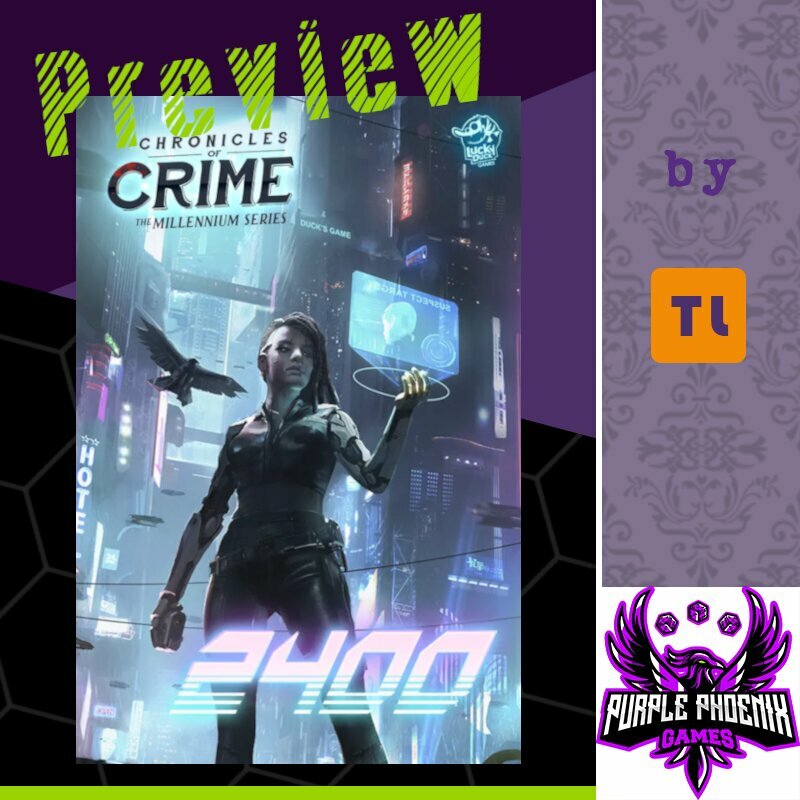
Chronicles of Crime: 2400 (which I shall shorten to 2400 for the duration of this preview) is an app-assisted campaign, murder-infested, cooperative storytelling game for one to four players. If you are familiar with the original Chronicles of Crime, you already mostly know how to play 2400 (there are a few new mechanics here). However, should ye be of the uninitiated, allow me to set the stage for this incredible gaming experience.
DISCLAIMER: We were provided an advance retail copy of this game for the purposes of this preview. These are retail copy components, so they should be exactly what you would receive in your copy. Also, it is not my intention to detail every rule in the game, as there are just too many. You are invited to download the rulebook, purchase directly from the publisher, or through any retailers stocking it after fulfillment. -T
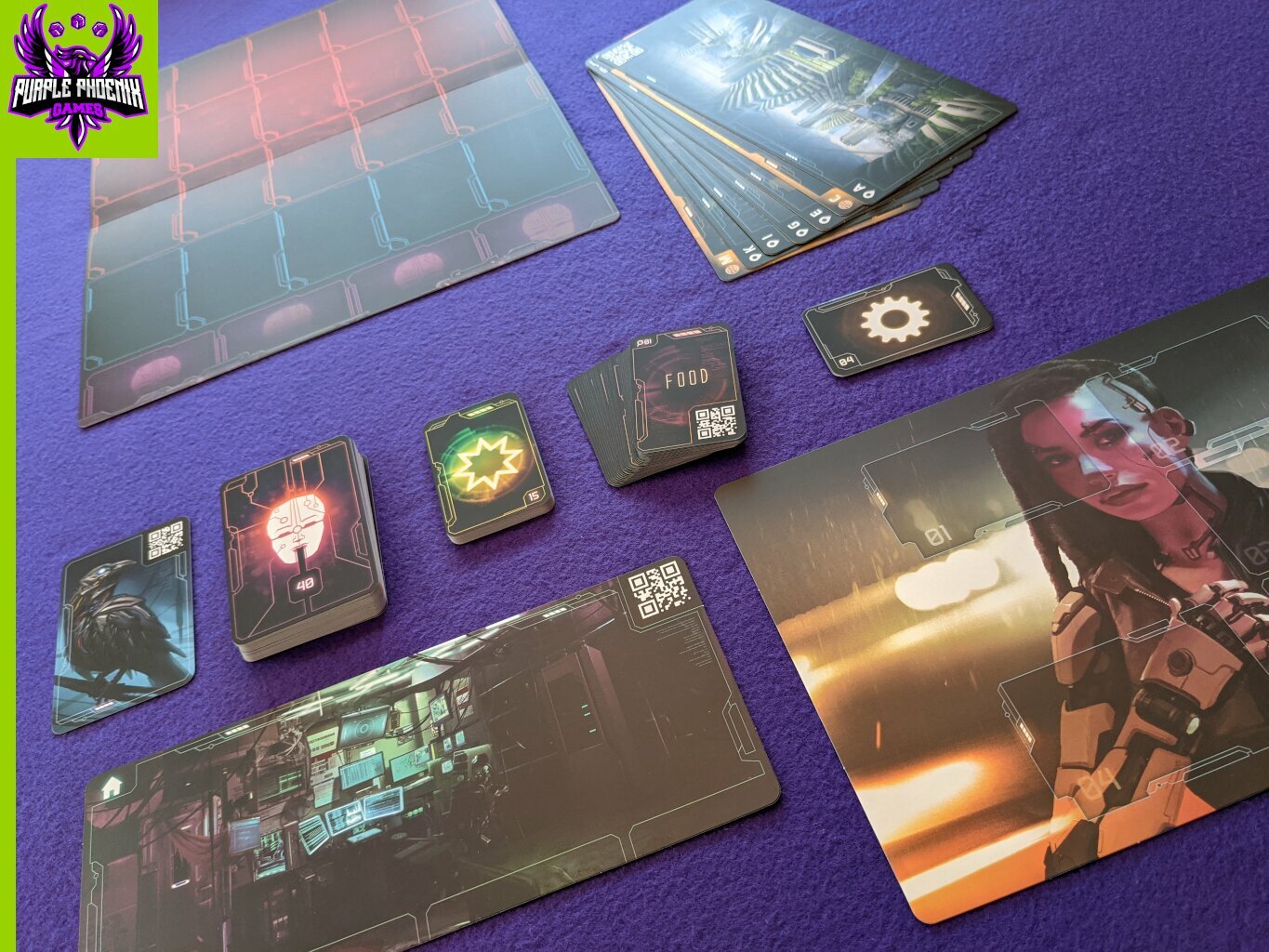
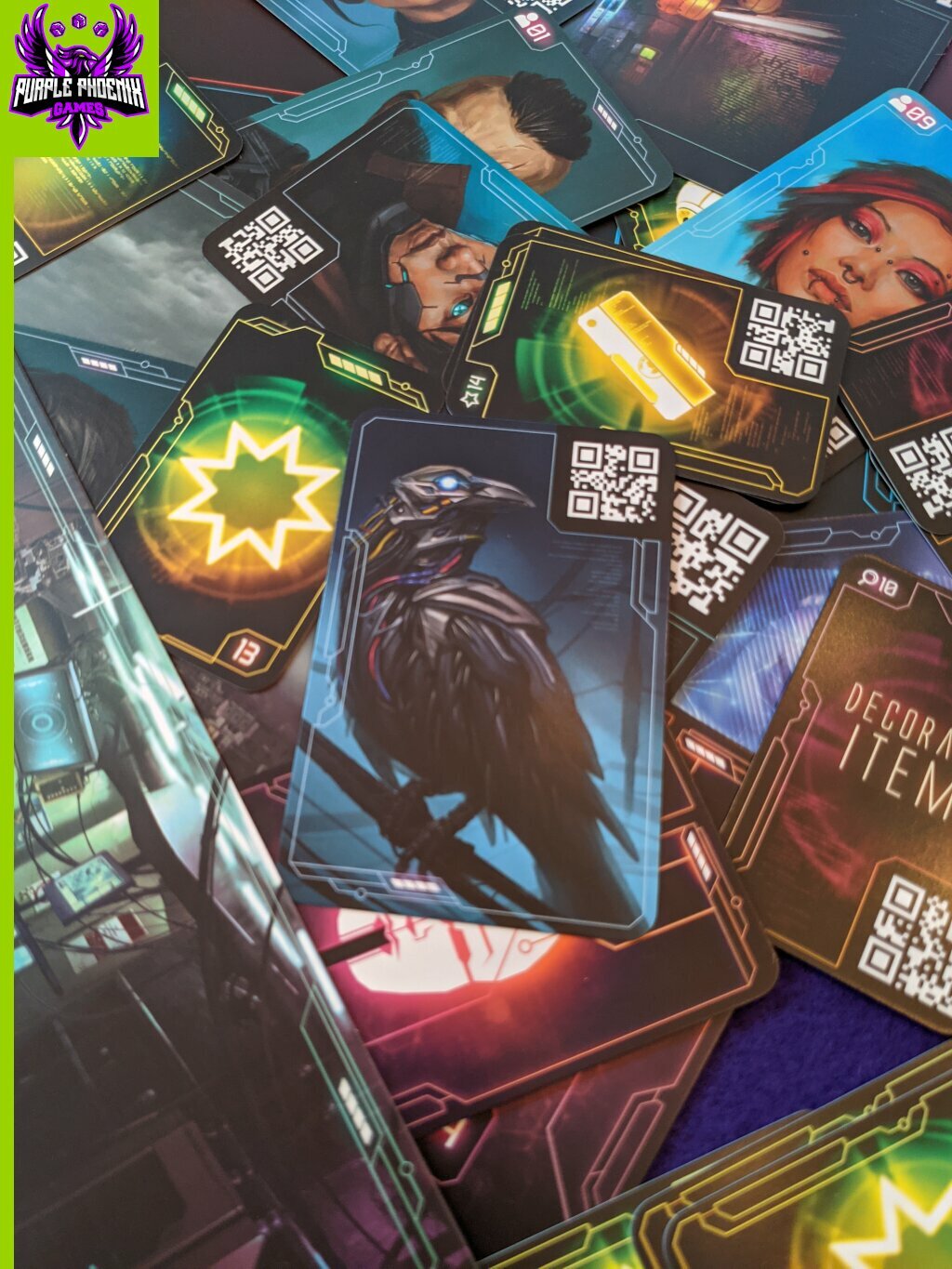
To setup, place the Evidence Board in the middle of the table and the Home Location Board near. Keep all the decks of cards nearby (shuffled or unshuffled, whatever is your liking) as well as the alphabetically-labeled, double-sided Location Boards. Place out the Implant Board and the Raven card within reach (new to 2400). Fire up the Chronicles of Crime app, choose “2400,” and then choose the case you would like to play. The app will walk players through the additional setup steps for the case being played. For this solo preview the photos represent happenings in the Tutorial scenario. Also, to be completely upfront I got a perfect 100/100 for a final score… for the introductory Tutorial. Autographs can be purchased at the end of the preview.
Each of the cases will involve players traveling to different Location Boards and meeting Characters at these locations. Many cases will be involving several Special Items and, new for the 2400 version, augments to the main character, Kalia Lavel, and her cybernetically-enhanced pet Raven. The Raven (unnamed in the game) acts as a portable computer, able to access information across the web and provide insight into certain aspects of the case being solved.
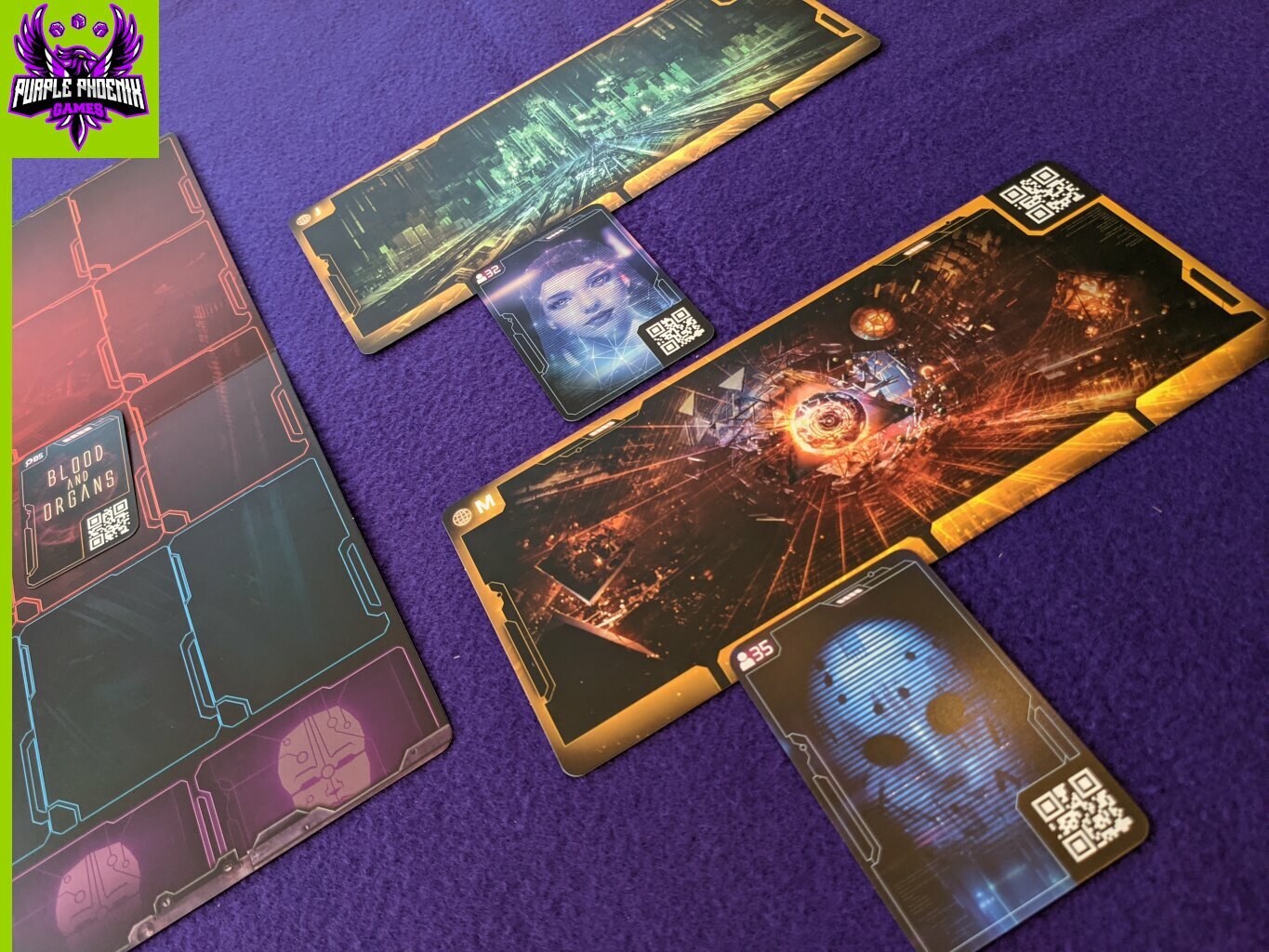
By using the app and scanning the QR codes on the boards and cards players will be learning about the case, viewing the scene of the crime(s), inspecting items, chatting up locals for information, and also new for 2400: visiting new Cyberspace Locations (a la The Oasis in Ready Player One)! With so many new additions to the CoC series here in the 2400 chapter, seasoned vets will find something for which they can be excited.
Play will continue not so much in “rounds” but until the players have enough evidence and a good handle on the situation enough to return Home to recharge, or visiting HQ to divulge case information by scanning answers to their questions about the case. The app then assesses the accuracy of the answers and outputs a score. For reference, though I did receive 100/100 on my first play of 2400 I did only receive a 70/100 on my first runthrough of the original Chronicles of Crime, so playing this style of game several times seems to improve how one plays.
Components. As most items in the box of the game are card or cardboard-based, and all really great quality, I will speak on other component items. Firstly, the art and art style throughout the game is simply stunning. I mean look at those Location cards and character art! This art really speaks to me and it says, “I’m gorgeous.” As a side note, I think I will be contacting Lucky Duck Games to get my hands on the font used on the Evidence Category cards. It’s just a perfect choice in this setting.
The app. I have only great things to say about the app. It’s the same app that you would use for all Chronicles of Crime games, and operates the exact same way. For me it has been flawless to use and just a joy to bring technology into the gaming world, especially for a game set in the year 2400. I am obviously no purist game enthusiast, as I enjoy these hybrid model games. Once you play with the app you will see how ingenious a system it really is. The app coupled with the nondescript cards and other components in the game make for infinite storytelling possibilities that can only be limited by creativity and time constraints. I love the components in the box AND the marvelous app.
Gameplay for me is also just glorious. I love being able to sit down, setup the game, and let the app tell me what’s going on. So what should I do first? Oh, let’s mosey on down here to this Location Board and drum up some information. Ooh I found an Item! I should have the Raven scan it for any historical information. Hmm, it registers as being hot? Okay, time to go back to that location and speak with the other person who was in there. OH CRAP, I wasted too much (in game) time and now that other person is gone?! Uh oh, I better stop messing around here…
It’s just amazing, and I love this family of games. I am so stoked to delve more into 2400 and discover more shenanigans happening in futuristic Paris. My implants (no jokes here please), Raven, and I are out to solve all the cases and beg for more. If you are looking for a game that uses a hybrid board game/app model, are a fan of this setting, or just want to have a really great experience playing a game, I urge you to consider Chronicles of Crime: 2400. It has everything I love in a unique game and I just can’t get enough! Oh, and for me, this is the best one of the bunch. I don’t know what it is exactly that I love so much, but it adds the right amount of extra stuff to CoC that I just feel like playing these scenarios endlessly. That is, until I have run out of scenarios and have to cry to LDG or fans to create more and more. If only I were more creative.
Chronicles of Crime: 2400 (which I shall shorten to 2400 for the duration of this preview) is an app-assisted campaign, murder-infested, cooperative storytelling game for one to four players. If you are familiar with the original Chronicles of Crime, you already mostly know how to play 2400 (there are a few new mechanics here). However, should ye be of the uninitiated, allow me to set the stage for this incredible gaming experience.
DISCLAIMER: We were provided an advance retail copy of this game for the purposes of this preview. These are retail copy components, so they should be exactly what you would receive in your copy. Also, it is not my intention to detail every rule in the game, as there are just too many. You are invited to download the rulebook, purchase directly from the publisher, or through any retailers stocking it after fulfillment. -T
To setup, place the Evidence Board in the middle of the table and the Home Location Board near. Keep all the decks of cards nearby (shuffled or unshuffled, whatever is your liking) as well as the alphabetically-labeled, double-sided Location Boards. Place out the Implant Board and the Raven card within reach (new to 2400). Fire up the Chronicles of Crime app, choose “2400,” and then choose the case you would like to play. The app will walk players through the additional setup steps for the case being played. For this solo preview the photos represent happenings in the Tutorial scenario. Also, to be completely upfront I got a perfect 100/100 for a final score… for the introductory Tutorial. Autographs can be purchased at the end of the preview.
Each of the cases will involve players traveling to different Location Boards and meeting Characters at these locations. Many cases will be involving several Special Items and, new for the 2400 version, augments to the main character, Kalia Lavel, and her cybernetically-enhanced pet Raven. The Raven (unnamed in the game) acts as a portable computer, able to access information across the web and provide insight into certain aspects of the case being solved.
By using the app and scanning the QR codes on the boards and cards players will be learning about the case, viewing the scene of the crime(s), inspecting items, chatting up locals for information, and also new for 2400: visiting new Cyberspace Locations (a la The Oasis in Ready Player One)! With so many new additions to the CoC series here in the 2400 chapter, seasoned vets will find something for which they can be excited.
Play will continue not so much in “rounds” but until the players have enough evidence and a good handle on the situation enough to return Home to recharge, or visiting HQ to divulge case information by scanning answers to their questions about the case. The app then assesses the accuracy of the answers and outputs a score. For reference, though I did receive 100/100 on my first play of 2400 I did only receive a 70/100 on my first runthrough of the original Chronicles of Crime, so playing this style of game several times seems to improve how one plays.
Components. As most items in the box of the game are card or cardboard-based, and all really great quality, I will speak on other component items. Firstly, the art and art style throughout the game is simply stunning. I mean look at those Location cards and character art! This art really speaks to me and it says, “I’m gorgeous.” As a side note, I think I will be contacting Lucky Duck Games to get my hands on the font used on the Evidence Category cards. It’s just a perfect choice in this setting.
The app. I have only great things to say about the app. It’s the same app that you would use for all Chronicles of Crime games, and operates the exact same way. For me it has been flawless to use and just a joy to bring technology into the gaming world, especially for a game set in the year 2400. I am obviously no purist game enthusiast, as I enjoy these hybrid model games. Once you play with the app you will see how ingenious a system it really is. The app coupled with the nondescript cards and other components in the game make for infinite storytelling possibilities that can only be limited by creativity and time constraints. I love the components in the box AND the marvelous app.
Gameplay for me is also just glorious. I love being able to sit down, setup the game, and let the app tell me what’s going on. So what should I do first? Oh, let’s mosey on down here to this Location Board and drum up some information. Ooh I found an Item! I should have the Raven scan it for any historical information. Hmm, it registers as being hot? Okay, time to go back to that location and speak with the other person who was in there. OH CRAP, I wasted too much (in game) time and now that other person is gone?! Uh oh, I better stop messing around here…
It’s just amazing, and I love this family of games. I am so stoked to delve more into 2400 and discover more shenanigans happening in futuristic Paris. My implants (no jokes here please), Raven, and I are out to solve all the cases and beg for more. If you are looking for a game that uses a hybrid board game/app model, are a fan of this setting, or just want to have a really great experience playing a game, I urge you to consider Chronicles of Crime: 2400. It has everything I love in a unique game and I just can’t get enough! Oh, and for me, this is the best one of the bunch. I don’t know what it is exactly that I love so much, but it adds the right amount of extra stuff to CoC that I just feel like playing these scenarios endlessly. That is, until I have run out of scenarios and have to cry to LDG or fans to create more and more. If only I were more creative.
graveyardgremlin (7194 KP) rated The Taken (Celestial Blues, #1) in Books
Feb 15, 2019


Even though I'm not especially fond of angels, I decided to try out this new series based on my previous experiences with Vicki Pettersson's work. Sadly, after an intriguing first chapter, any enjoyment I may have expected never came knocking (guess it was too busy knockin' on heaven's door).
Meet one of the two main characters, rockabilly girl Katherine "Kit" Craig. She's an eternally optimistic and peppy reporter whose best friend and co-worker, Nicole, was just murdered while following a lead. Our other MC is a haunted Centurion angel named Griffin Shaw who ushers the newly murdered into the afterlife, otherwise known as the Everlast, while bemoaning the murders of both himself and his wife Evie back in 1960. After making a mistake concerning Nicole, he's been sent back to earth as a human with some angelic senses still intact. Kit and Grif soon meet up and begin investigating the circumstances around Nicole's death, whilst Griffin seeks out any details involving his own.
Problem Number One:
The Cardboard Characters
Character development is supposed to unfold over the course of a book, in this case it actually appeared to deteriorate as the book went on. Kit never developed into anything but one of those annoyingly chipper people you just want to hit with a sledgehammer, while Grif started promisingly enough but then stagnated. They were both very shallow characterizations, and on top of that, I never understood Kit's actions or reactions to just about anything. I never felt her sadness about her best friend's death, whom she rarely gave a passing thought, believed she was smart (by the end, I thought her a dolt), or seem in any way human with nary a rational thought in her head. About mid-way through the book, Grif tells her he's an angel after they kiss, so what does she do? Does she a) run away screaming, b) think he's a few feathers short of a goose and tell him to get hell out of her house and life, or c) have a calm Q&A session followed by giving him a whatfor that consists of "I won't kiss you again" and "you're watching me walk out that door (in her own house) because you can't handle any emotion blah, blah, blah by pretending you're an angel" and then proceed to attend a charity event wherein she acts and converses normally, like nothing happened? If you picked "c" *ding ding ding*, you're a winner! Because as we all know, any sensible guy will pull out the "I'm an angel" trick and expect a woman to believe him. *rolls eyes* Never was it ever crystal clear if Kit thought Grif was either crazy or a liar. It was all a bit hazy, but what can you expect from someone we're never allowed to know? All we discern is she dresses and lives (somewhat) rockabilly, but it's all a veneer to her hollowness inside, which led me to dub her Rockabilly Barbie.
<img src="http://i272.photobucket.com/albums/jj183/piscesrain/reviews/RockabillyBarbie.jpg">;
Because that's all she is and nothing more. The only character that I found a little more well-rounded was the secondary character Bridget Moore and the two Centurions introduced close to the end. Everyone else was either forgettably two-dimensional or they were a caricature, a la Caleb Chambers and Paul Raggio.
Problem Number Two:
The Relationship(s)
I'm expected to believe in a possible relationship between Grif and Rockabilly Barbie, err I mean Kit, but there's not much there to believe in. Like the characters, it was shallow with the same descriptions reiterated over and over again. Basically it's a case of telling instead of showing. I felt no love, maybe some attraction, but that's all she wrote. Likewise I never bought that Kit and Paul could ever have gotten far enough to be married, they were just too different. Most people don't do a 180 after they get married, the seed of who Paul really was deep down inside would have already been there and if Kit was even a fraction astute, she should have caught that. All this served was to be a plot point in the book.
Problem Number Three:
The Plot(s)
The main plot involving Nicole's death and Chambers had a "been there, done that" quality to it. The plot didn't shock me or seem like anything new, I've come across the same before or at least plots that were very close, and it wasn't even told in a fresh way. So I wasn't as affected by anything in the book as I probably should have been, partially due to the indifference I felt and the fact that I figured out everything long before the author dropped, what I guess she thought, were informational bombshells.
The book had three major plotlines: Grif and Evie's deaths, Nicole's death/prostitution ring, and Grif and the Pure Anas' philosophical moments. They weren't juggled well at all. Ms. Pettersson should have picked only one and paid more attention to developing that specific plot and the characters. The scenes with Anas (or Anne) especially didn't mesh with the other stories and felt as if the author was overreaching the boundaries set up by the book. One scene in particular was extremely bizarre and pointless to the book as a whole.
Where was the noir? I've seen enough film noirs to know it ain't here.
Problem Number Four:
The Ending
What happened at the end is what I'd expect in a book that's exclusively romance and not in a mystery/urban fantasy hybrid, which made the rushed ending seem even more ridiculous and sappy. It was incredibly unbelievable to the story and didn't seem to set up the next book in any way. Also, one of the plotlines was all but left dangling with no foreshadowing or anything. Poor, poor, poor execution. Don't expound on a storyline if you're not going to finish it up or at least leave it dangling in a way that makes the reader want to come back. All that boring set-up for a completely stupid and cheesy ending. I expected rainbows and unicorns to pop out at any moment.
Overall the book felt more like a rough copy than a finished one and definitely could have used a few more goings over. Several descriptions were rushed and chaotic or simply poorly done so that I was scrambling to picture what was going on. The book is almost 400 pages and it is simply too long. With so many storylines, I'm not sure how they managed to both crawl and have very little action at the same time. I was going to give this two stars because I didn't hate the book, that would imply that it elicited any feelings what-so-ever, but the truth of the matter is that there isn't one thing I really liked about the book either. The only way I'd read a sequel to the bafflingly-named Celestial Blues series is if it featured different leads like the aforementioned Centurions, and even then I'd cautiously dip my toes into the book.
Originally reviewed: June 29
Received: Amazon Vine
Meet one of the two main characters, rockabilly girl Katherine "Kit" Craig. She's an eternally optimistic and peppy reporter whose best friend and co-worker, Nicole, was just murdered while following a lead. Our other MC is a haunted Centurion angel named Griffin Shaw who ushers the newly murdered into the afterlife, otherwise known as the Everlast, while bemoaning the murders of both himself and his wife Evie back in 1960. After making a mistake concerning Nicole, he's been sent back to earth as a human with some angelic senses still intact. Kit and Grif soon meet up and begin investigating the circumstances around Nicole's death, whilst Griffin seeks out any details involving his own.
Problem Number One:
The Cardboard Characters
Character development is supposed to unfold over the course of a book, in this case it actually appeared to deteriorate as the book went on. Kit never developed into anything but one of those annoyingly chipper people you just want to hit with a sledgehammer, while Grif started promisingly enough but then stagnated. They were both very shallow characterizations, and on top of that, I never understood Kit's actions or reactions to just about anything. I never felt her sadness about her best friend's death, whom she rarely gave a passing thought, believed she was smart (by the end, I thought her a dolt), or seem in any way human with nary a rational thought in her head. About mid-way through the book, Grif tells her he's an angel after they kiss, so what does she do? Does she a) run away screaming, b) think he's a few feathers short of a goose and tell him to get hell out of her house and life, or c) have a calm Q&A session followed by giving him a whatfor that consists of "I won't kiss you again" and "you're watching me walk out that door (in her own house) because you can't handle any emotion blah, blah, blah by pretending you're an angel" and then proceed to attend a charity event wherein she acts and converses normally, like nothing happened? If you picked "c" *ding ding ding*, you're a winner! Because as we all know, any sensible guy will pull out the "I'm an angel" trick and expect a woman to believe him. *rolls eyes* Never was it ever crystal clear if Kit thought Grif was either crazy or a liar. It was all a bit hazy, but what can you expect from someone we're never allowed to know? All we discern is she dresses and lives (somewhat) rockabilly, but it's all a veneer to her hollowness inside, which led me to dub her Rockabilly Barbie.
<img src="http://i272.photobucket.com/albums/jj183/piscesrain/reviews/RockabillyBarbie.jpg">;
Because that's all she is and nothing more. The only character that I found a little more well-rounded was the secondary character Bridget Moore and the two Centurions introduced close to the end. Everyone else was either forgettably two-dimensional or they were a caricature, a la Caleb Chambers and Paul Raggio.
Problem Number Two:
The Relationship(s)
I'm expected to believe in a possible relationship between Grif and Rockabilly Barbie, err I mean Kit, but there's not much there to believe in. Like the characters, it was shallow with the same descriptions reiterated over and over again. Basically it's a case of telling instead of showing. I felt no love, maybe some attraction, but that's all she wrote. Likewise I never bought that Kit and Paul could ever have gotten far enough to be married, they were just too different. Most people don't do a 180 after they get married, the seed of who Paul really was deep down inside would have already been there and if Kit was even a fraction astute, she should have caught that. All this served was to be a plot point in the book.
Problem Number Three:
The Plot(s)
The main plot involving Nicole's death and Chambers had a "been there, done that" quality to it. The plot didn't shock me or seem like anything new, I've come across the same before or at least plots that were very close, and it wasn't even told in a fresh way. So I wasn't as affected by anything in the book as I probably should have been, partially due to the indifference I felt and the fact that I figured out everything long before the author dropped, what I guess she thought, were informational bombshells.
The book had three major plotlines: Grif and Evie's deaths, Nicole's death/prostitution ring, and Grif and the Pure Anas' philosophical moments. They weren't juggled well at all. Ms. Pettersson should have picked only one and paid more attention to developing that specific plot and the characters. The scenes with Anas (or Anne) especially didn't mesh with the other stories and felt as if the author was overreaching the boundaries set up by the book. One scene in particular was extremely bizarre and pointless to the book as a whole.
Where was the noir? I've seen enough film noirs to know it ain't here.
Problem Number Four:
The Ending
What happened at the end is what I'd expect in a book that's exclusively romance and not in a mystery/urban fantasy hybrid, which made the rushed ending seem even more ridiculous and sappy. It was incredibly unbelievable to the story and didn't seem to set up the next book in any way. Also, one of the plotlines was all but left dangling with no foreshadowing or anything. Poor, poor, poor execution. Don't expound on a storyline if you're not going to finish it up or at least leave it dangling in a way that makes the reader want to come back. All that boring set-up for a completely stupid and cheesy ending. I expected rainbows and unicorns to pop out at any moment.
Overall the book felt more like a rough copy than a finished one and definitely could have used a few more goings over. Several descriptions were rushed and chaotic or simply poorly done so that I was scrambling to picture what was going on. The book is almost 400 pages and it is simply too long. With so many storylines, I'm not sure how they managed to both crawl and have very little action at the same time. I was going to give this two stars because I didn't hate the book, that would imply that it elicited any feelings what-so-ever, but the truth of the matter is that there isn't one thing I really liked about the book either. The only way I'd read a sequel to the bafflingly-named Celestial Blues series is if it featured different leads like the aforementioned Centurions, and even then I'd cautiously dip my toes into the book.
Originally reviewed: June 29
Received: Amazon Vine
Kirk Bage (1775 KP) rated Knives Out (2019) in Movies
Jan 22, 2021
Murder mystery films tend to be more fun in theory and anticipation than they are to watch. It’s a genre that I very much enjoy and have indulged in over the years. Yet, if I look back in detail at it, I find that it is the books, especially those of Agatha Christie, that I like much more than anything lasting a couple of hours on the screen. There’s something about the mystery being rushed and squeezed into the cinema artform that is usually anti-climactic or even a full on let down.
Perhaps my favourite of the entire genre is a film that refuses to take itself seriously and is at once a pastiche of the multiple cliches that have accumulated over the years. And that film is, of course, the wonderfully camp, funny and charming 1985 romp Clue, starring Tim Curry and a slough of 80s B stars having the time of their lives. It isn’t a “good” film, it is a cult film, it’s joy being in its absolute lack of pretension or moral judgement. Like the board game that inspired it, it isn’t overly complicated or long, but has just enough cleverness, mirth and ambiance about it to always be a winner.
Rian Johnson’s take on the genre, Knives Out, is aware of these elements at all times, being above all things colourful, playful, arch and glib, but never convoluted or cerebral in an alienating way. He is something of a master at subverting a genre and wringing new life into it; take the invention of the teen noir in Brick, or the blend of assassin time travel sci-fi in Looper. He even gave an entire franchise a new breath of life by re-examining the use of humour and self referencing in Star Wars: The Last Jedi.
All of those previous films have as many detractors as mega fans, proving his style is devisive, for its audacity and its irreverence towards any idea of purism within an established model. And Knives Out is no exception to that. However, it may be the film of his that most people can agree on that they enjoyed, for one reason or another. I think it’s as interesting to ask why that is as it is to talk about the film itself… so, I will. At least, I’ll try to do both without losing my train of thought.
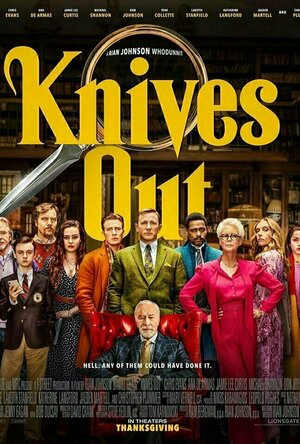
Firstly, it looks stunning; the palate of rich colours used in the poster and all marketing just make it look like something you want to immerse yourself in – every jacket, tie, dress, or piece of furniture is designed to precision, and it works like a dream of the genre you may have once had, as if it had been plucked directly from your subconscious. As in all good murder mysteries, the location, props and costumes should hold as much character as the actors, and the stately home of the Thrombey family certainly provides plenty of atmosphere in every texture and material on display.
Of course, the cast of characters is wonderfully put together with some inspired casting of familiar faces and actors you trust, such as Toni Collette and Michael Shannon, together with a few we don’t see enough of these days, such as Jamie Lee Curtis and Don Johnson, who both manage to create something as memorable as anything they did in their golden days. Add to the mix two bone fide action film superstars in Daniel Craig and Chris Evans, who leave the baggage of their most famous characters far behind and manage to convince you they are real actors again, the former with the aide of a jarring but hilarious Southern drawl, that grates at first but is a perfect choice on reflection.
Then there are the two lynchpins of this film’s ultimate success and joy: the exceptional legendary gravitas of 90 year old Christopher Plummer as the patriarch and victim at the centre of the intrigue, and the quite glorious revelation of Ana de Armas, whose charisma, beauty and skill in this delicately balanced role was the most impressive thing for me about the whole production. It may be Craig who is the ever present focus, as the detective tasked with solving the “crime”, but it is de Armas that you will remember most long after the credits roll.
As for the plot, well… I obviously can’t talk about it without ruining the whole thing. But, I can say that it isn’t far into the intricate web of motives, alibis and secrets before you start to sense this is going somewhere different, even unique. The examination of the relationships and personalities, and the extent to which they each demonstrate greed and selfishness is fascinating, superceding the crime that exists on the surface with a swamp of far seedier and unpleasant goings-on. Craig’s suave Benoit Blanc isn’t so much a detective here as a family therapist, or perhaps a supernatural presence in the style of the old classic, An Inspector Calls. Perhaps, it is suggested, no one completely escapes guilt and shame here… or do they? Are we looking for a murderer, or the only morally good person amidst a pack of dogs?
Another key element is how modern and unstuffy it feels, despite the country house and riches this is no play of manners, quite the opposite – no one here is on their best behaviour for the sake of decorum, and being upper class is an idea played with rather than enforced. The tea and cakes of the classic Christie, such as Murder on the Orient Express is replaced by smartphones and similar trappings, that identify it as definitely 2019 and no period piece. The concerns and themes are very much rooted in our present problems, and for that it engages and resonates in ways a costume drama just can’t do.
Upon finishing it for the first time, you may be thinking “sure, OK, I enjoyed that… but I’m not blown away here”. Then, as it sinks in over coming weeks, you find yourself recommending it to people, and thinking about how good it is in ways you didn’t initially think about. And that is surely why it was so embraced by the critics and paying public alike; it is a likeable, fun film, that can also stand some artistic scrutiny. It isn’t the smartest, or prettiest, or most meaningful film ever made, but it is enough of all three to make it an instant mini-classic, in my opinion.
I feel like there is maybe more to say about it, which is always a good sign, but that will do for now. I’d be happy to discuss it with anyone that feels the need. Or hear from anyone that didn’t like it! It would be interesting to hear that side of it, because I haven’t heard many negative comments on it at all. I don’t think I would defend it as a masterpiece to the end of the Earth, ‘cos it ain’t that good. I’m just hard pressed to find a serious fault. And it’s great when one of those sneaks up on you!
Perhaps my favourite of the entire genre is a film that refuses to take itself seriously and is at once a pastiche of the multiple cliches that have accumulated over the years. And that film is, of course, the wonderfully camp, funny and charming 1985 romp Clue, starring Tim Curry and a slough of 80s B stars having the time of their lives. It isn’t a “good” film, it is a cult film, it’s joy being in its absolute lack of pretension or moral judgement. Like the board game that inspired it, it isn’t overly complicated or long, but has just enough cleverness, mirth and ambiance about it to always be a winner.
Rian Johnson’s take on the genre, Knives Out, is aware of these elements at all times, being above all things colourful, playful, arch and glib, but never convoluted or cerebral in an alienating way. He is something of a master at subverting a genre and wringing new life into it; take the invention of the teen noir in Brick, or the blend of assassin time travel sci-fi in Looper. He even gave an entire franchise a new breath of life by re-examining the use of humour and self referencing in Star Wars: The Last Jedi.
All of those previous films have as many detractors as mega fans, proving his style is devisive, for its audacity and its irreverence towards any idea of purism within an established model. And Knives Out is no exception to that. However, it may be the film of his that most people can agree on that they enjoyed, for one reason or another. I think it’s as interesting to ask why that is as it is to talk about the film itself… so, I will. At least, I’ll try to do both without losing my train of thought.
Firstly, it looks stunning; the palate of rich colours used in the poster and all marketing just make it look like something you want to immerse yourself in – every jacket, tie, dress, or piece of furniture is designed to precision, and it works like a dream of the genre you may have once had, as if it had been plucked directly from your subconscious. As in all good murder mysteries, the location, props and costumes should hold as much character as the actors, and the stately home of the Thrombey family certainly provides plenty of atmosphere in every texture and material on display.
Of course, the cast of characters is wonderfully put together with some inspired casting of familiar faces and actors you trust, such as Toni Collette and Michael Shannon, together with a few we don’t see enough of these days, such as Jamie Lee Curtis and Don Johnson, who both manage to create something as memorable as anything they did in their golden days. Add to the mix two bone fide action film superstars in Daniel Craig and Chris Evans, who leave the baggage of their most famous characters far behind and manage to convince you they are real actors again, the former with the aide of a jarring but hilarious Southern drawl, that grates at first but is a perfect choice on reflection.
Then there are the two lynchpins of this film’s ultimate success and joy: the exceptional legendary gravitas of 90 year old Christopher Plummer as the patriarch and victim at the centre of the intrigue, and the quite glorious revelation of Ana de Armas, whose charisma, beauty and skill in this delicately balanced role was the most impressive thing for me about the whole production. It may be Craig who is the ever present focus, as the detective tasked with solving the “crime”, but it is de Armas that you will remember most long after the credits roll.
As for the plot, well… I obviously can’t talk about it without ruining the whole thing. But, I can say that it isn’t far into the intricate web of motives, alibis and secrets before you start to sense this is going somewhere different, even unique. The examination of the relationships and personalities, and the extent to which they each demonstrate greed and selfishness is fascinating, superceding the crime that exists on the surface with a swamp of far seedier and unpleasant goings-on. Craig’s suave Benoit Blanc isn’t so much a detective here as a family therapist, or perhaps a supernatural presence in the style of the old classic, An Inspector Calls. Perhaps, it is suggested, no one completely escapes guilt and shame here… or do they? Are we looking for a murderer, or the only morally good person amidst a pack of dogs?
Another key element is how modern and unstuffy it feels, despite the country house and riches this is no play of manners, quite the opposite – no one here is on their best behaviour for the sake of decorum, and being upper class is an idea played with rather than enforced. The tea and cakes of the classic Christie, such as Murder on the Orient Express is replaced by smartphones and similar trappings, that identify it as definitely 2019 and no period piece. The concerns and themes are very much rooted in our present problems, and for that it engages and resonates in ways a costume drama just can’t do.
Upon finishing it for the first time, you may be thinking “sure, OK, I enjoyed that… but I’m not blown away here”. Then, as it sinks in over coming weeks, you find yourself recommending it to people, and thinking about how good it is in ways you didn’t initially think about. And that is surely why it was so embraced by the critics and paying public alike; it is a likeable, fun film, that can also stand some artistic scrutiny. It isn’t the smartest, or prettiest, or most meaningful film ever made, but it is enough of all three to make it an instant mini-classic, in my opinion.
I feel like there is maybe more to say about it, which is always a good sign, but that will do for now. I’d be happy to discuss it with anyone that feels the need. Or hear from anyone that didn’t like it! It would be interesting to hear that side of it, because I haven’t heard many negative comments on it at all. I don’t think I would defend it as a masterpiece to the end of the Earth, ‘cos it ain’t that good. I’m just hard pressed to find a serious fault. And it’s great when one of those sneaks up on you!
Emma @ The Movies (1786 KP) rated Artemis Fowl (2020) in Movies
Jun 13, 2020


Disney: "We're making a film of Artemis Fowl!"
Me: *wildly switches from happiness to devastation about the possibilities*
Artemis Fowl's father, Artemis Fowl Snr., has gone missing, the media is portraying him as a criminal and calling for answers. Shocked and confused by what's happening Artemis Jnr. receives a phone call from his father's kidnapper and must hand over an item to secure his release. But he's no idea what the item is, or where, he's about to learn a great deal about fantastical things in a very short space of time and meet an odd selection of new friends.
So... I'm going to break this down into two parts, the first bit will be just about the film and the second will be me ranting about the film in conjunction with the book... *calm thoughts* Let us begin.
From the very beginning I was thrown, the opening in no way seems like a family film and I was wondering if by avoiding reading about it all beforehand that I'd got the wrong idea about what to expect.
With such a good cast backing up our newcomers I had medium hopes for what was going to hit our screens...
Ferdia Shaw takes on the part of Artemis Fowl Jnr., putting aside the comparison between the two versions until later, the performance isn't bad but it's quite forgettable. The same sadly goes for Lara McDonnell as Holly Short. Neither one has much of a presence on screen and I think that's mostly to do with the fact that Artemis and Holly are both rather bland in the whole story.
There's something oddly appealing about Josh Gad as Mulch but I'm not sure that giving him such a large role as narrator worked. It's never really clear why he's given that role and the scene's where we cut back to him talking are given a strange noir look that doesn't match with the rest of the film. Even so, I'm willing to concede that he's my favourite character as he has just enough humour to carry it.
Judi Dench as Commander Root was a little bit of a challenge to see. Root is a gruff but caring character, the trouble come in the fact that the change comes quite unnaturally at times.
One of the main failings is that there are times when the script feels poor, the dialogue is a little forced and doesn't fit with the characters, couple that with a variety of scenes that don't fit with the style of everything else and the fact that some pieces could be removed without really affecting anything around it and I'm left less than inspired by the film.
I did like the look of Haven City, the animation of the overhead view looked really promising. As we got into the city though I couldn't help but think it looked a little cheap and the aesthetic wasn't great. Effects, in general, were not good if I'm honest, particularly when you get to the siege on Fowl manor, when the siege is ending it comes with some chaos that is a perfect example of this coupled with another example of how the story glosses over an explanation of what's happening that could have offered some extra development for characters. (Specifically in this instance, Foley, who was woefully underused. He might not have been as majestic as a Brosnan centaur but he deserved better than the film gave him.)
By the end a lot of things get resolved seemingly by fairy magic because it's not clear how any of it happens. Potentially it's something that I wouldn't have noticed as there's a certain amount of this kind of wrapping up that you can forgive, but by this point I was so frustrated by everything that I was spotting everything.
I'm aware I'm waffling more than I intended so let me "briefly" mention things regarding the book...
The film is, in my opinion, only vaguely based on the book. It has kept ideas and pieces of story while removing and adding characters to varying degrees. Notably Artemis' mother is gone and his father is there instead. Removing mum makes Juliet's inclusion surplus to requirements, I can understand wanting to keep her for a young female character for viewers to identify with, but the role she ends up with is bland and in no way lives up to the book's version. The blandness also extends to her brother, Butler, and that's partly because of the major change they made...
Artemis. He is barely recognisable in comparison. He's a jeans-wearing, surfing, tween? He's much more casual than the original and this fluffier version doesn't have the same edge that book Artemis does. In their revamp they have changed his story and I very quickly felt like it could have been a sequel to the books, Artemis Snr. felt more like the Artemis from the books grown up and he was teaching his son about all the things he learnt. Part of the thing I enjoyed about the books is that Artemis was always an anti-hero of sorts, he was very difficult to like at times because of his actions, film Artemis is a little bit jumbled in this respect as they give him a very clear reason for the things he does so when he tries to show that tough side it doesn't have any impact.
There are a lot of differences, but I will leave that analysis for someone who is much more thorough at scouring the books and film than I am. I'll be keeping my eye out for other reviews with the comparisons in, if you spot any then please leave a link in the comments below.
When it came to scoring this I thought about it on two levels.
As a film from such a big company I was quite shocked by the quality of script and effects, there was a baddie that didn't really participate in anything and there were scenes and characters which weren't needed... and to finish it off in such an obvious set up for a sequel... I was done. I had marked it down for a generous score of 2 stars, that's normally my "I didn't like it but I can see why other people might" score, but I can't quite see what would appeal to people in it if I'm honest.
As an adaptation of the book I was too frustrated by the changes they made to Artemis, they essentially changed the fundamentals of the character and that had a knock-on effect to other characters as well. No one came out unscathed, but even though Mulch was heavily adapted I was glad that some of his humour was still there. Scoring on this basis I would have given it 1 star, but again, that felt generous to me.
In the end I will always score something on my enjoyment, in this instance it seems fair to even out the two scores. They've taken a great book and removed most of its personality, the final product was not exciting to watch and I don't think I could bring myself to watch a sequel.
Originally posted on: https://emmaatthemovies.blogspot.com/2020/06/artemis-fowl-movie-review.html
Me: *wildly switches from happiness to devastation about the possibilities*
Artemis Fowl's father, Artemis Fowl Snr., has gone missing, the media is portraying him as a criminal and calling for answers. Shocked and confused by what's happening Artemis Jnr. receives a phone call from his father's kidnapper and must hand over an item to secure his release. But he's no idea what the item is, or where, he's about to learn a great deal about fantastical things in a very short space of time and meet an odd selection of new friends.
So... I'm going to break this down into two parts, the first bit will be just about the film and the second will be me ranting about the film in conjunction with the book... *calm thoughts* Let us begin.
From the very beginning I was thrown, the opening in no way seems like a family film and I was wondering if by avoiding reading about it all beforehand that I'd got the wrong idea about what to expect.
With such a good cast backing up our newcomers I had medium hopes for what was going to hit our screens...
Ferdia Shaw takes on the part of Artemis Fowl Jnr., putting aside the comparison between the two versions until later, the performance isn't bad but it's quite forgettable. The same sadly goes for Lara McDonnell as Holly Short. Neither one has much of a presence on screen and I think that's mostly to do with the fact that Artemis and Holly are both rather bland in the whole story.
There's something oddly appealing about Josh Gad as Mulch but I'm not sure that giving him such a large role as narrator worked. It's never really clear why he's given that role and the scene's where we cut back to him talking are given a strange noir look that doesn't match with the rest of the film. Even so, I'm willing to concede that he's my favourite character as he has just enough humour to carry it.
Judi Dench as Commander Root was a little bit of a challenge to see. Root is a gruff but caring character, the trouble come in the fact that the change comes quite unnaturally at times.
One of the main failings is that there are times when the script feels poor, the dialogue is a little forced and doesn't fit with the characters, couple that with a variety of scenes that don't fit with the style of everything else and the fact that some pieces could be removed without really affecting anything around it and I'm left less than inspired by the film.
I did like the look of Haven City, the animation of the overhead view looked really promising. As we got into the city though I couldn't help but think it looked a little cheap and the aesthetic wasn't great. Effects, in general, were not good if I'm honest, particularly when you get to the siege on Fowl manor, when the siege is ending it comes with some chaos that is a perfect example of this coupled with another example of how the story glosses over an explanation of what's happening that could have offered some extra development for characters. (Specifically in this instance, Foley, who was woefully underused. He might not have been as majestic as a Brosnan centaur but he deserved better than the film gave him.)
By the end a lot of things get resolved seemingly by fairy magic because it's not clear how any of it happens. Potentially it's something that I wouldn't have noticed as there's a certain amount of this kind of wrapping up that you can forgive, but by this point I was so frustrated by everything that I was spotting everything.
I'm aware I'm waffling more than I intended so let me "briefly" mention things regarding the book...
The film is, in my opinion, only vaguely based on the book. It has kept ideas and pieces of story while removing and adding characters to varying degrees. Notably Artemis' mother is gone and his father is there instead. Removing mum makes Juliet's inclusion surplus to requirements, I can understand wanting to keep her for a young female character for viewers to identify with, but the role she ends up with is bland and in no way lives up to the book's version. The blandness also extends to her brother, Butler, and that's partly because of the major change they made...
Artemis. He is barely recognisable in comparison. He's a jeans-wearing, surfing, tween? He's much more casual than the original and this fluffier version doesn't have the same edge that book Artemis does. In their revamp they have changed his story and I very quickly felt like it could have been a sequel to the books, Artemis Snr. felt more like the Artemis from the books grown up and he was teaching his son about all the things he learnt. Part of the thing I enjoyed about the books is that Artemis was always an anti-hero of sorts, he was very difficult to like at times because of his actions, film Artemis is a little bit jumbled in this respect as they give him a very clear reason for the things he does so when he tries to show that tough side it doesn't have any impact.
There are a lot of differences, but I will leave that analysis for someone who is much more thorough at scouring the books and film than I am. I'll be keeping my eye out for other reviews with the comparisons in, if you spot any then please leave a link in the comments below.
When it came to scoring this I thought about it on two levels.
As a film from such a big company I was quite shocked by the quality of script and effects, there was a baddie that didn't really participate in anything and there were scenes and characters which weren't needed... and to finish it off in such an obvious set up for a sequel... I was done. I had marked it down for a generous score of 2 stars, that's normally my "I didn't like it but I can see why other people might" score, but I can't quite see what would appeal to people in it if I'm honest.
As an adaptation of the book I was too frustrated by the changes they made to Artemis, they essentially changed the fundamentals of the character and that had a knock-on effect to other characters as well. No one came out unscathed, but even though Mulch was heavily adapted I was glad that some of his humour was still there. Scoring on this basis I would have given it 1 star, but again, that felt generous to me.
In the end I will always score something on my enjoyment, in this instance it seems fair to even out the two scores. They've taken a great book and removed most of its personality, the final product was not exciting to watch and I don't think I could bring myself to watch a sequel.
Originally posted on: https://emmaatthemovies.blogspot.com/2020/06/artemis-fowl-movie-review.html

Cynthia Armistead (17 KP) rated Down These Strange Streets in Books
Mar 1, 2018
This anthology gathers stories from authors who normally write in various genres. The commonality is that each story is a mystery, and there's a fantastic twist to each. Martin's introduction calls such stories the "bastard stepchild" of mystery and horror.
[a:Charlaine Harris|17061|Charlaine Harris|http://photo.goodreads.com/authors/1307925926p2/17061.jpg]'; "Death by Dahlia," set in the Sookie Stackhouse universe, is one of a series of stories about the vampire Dahlia Lynley-Chivers. Each story stands alone, but my enjoyment grows greater with each addition to her tales. I'd much rather see Dahlia as the main character of a novel than Sookie, to be honest. This story, set at the party for the ascension of a new vampire sherrif, was a little gem, and a nice start to the collection.
"The Bleeding Shadow" by [a:Joe R. Lansdale|58971|Joe R. Lansdale|http://photo.goodreads.com/authors/1200406474p2/58971.jpg] is grittier from start to finish, set in the south of black folks in the 1950s. A beautiful woman sends her sometime-suitor to find her brother, a blues musician who has gotten into music that isn't of this world. I couldn't be done with this one soon enough, as it gave me the willies. I have a feeling Lansdale would be happy that it stuck with me for a while.
[a:Simon R. Green|41942|Simon R. Green|http://photo.goodreads.com/authors/1224555729p2/41942.jpg]'s "Hungry Heart" takes us to the Nightside, where John Taylor is hired by a young witch to retrieve her stolen heart. I haven't read any of the Nightside novels, but this is probably the third or fourth short story I've read, and for some reason they never leave me wanting more. I don't hunger for the darkness, I guess. I will give Green points for creativity in evil henchmen, though.
"Styx and Stones" by [a:Steven Saylor|42919|Steven Saylor|http://photo.goodreads.com/authors/1243268148p2/42919.jpg] takes a teenage version of his novel hero Gordianus on a world tour to see the Seven Wonders of the World, and this stop is Babylon. Gordianus and his companion, Antipater, find a murderous ghost in residence near their inn in addition to seeing the Ziggurat, the Gate of Ishtar, and what's left of the Hanging Gardens.
[a:S. M. Stirling|6448047|S. M. Stirling|http://www.goodreads.com/assets/nophoto/nophoto-U-50x66.jpg]'s "Pain and Suffering" was unsatisfying to me. It opened with an ex-soldier's combat flashback twisted into something Other, then we learn that the ex-soldier is a cop. He and his partner spend a lot of time investigating an apparent arson and possibly-connected kidnapping. The flashbacks repeat. There's more, but I don't want to spoil the story. I just felt that there was a lot of build-up for very little payoff, and that perhaps this story was meant as a teaser for a novel in which context it would all make far more sense.
"It's Still the Same Old Story' by [a:Carrie Vaughn|8988|Carrie Vaughn|http://photo.goodreads.com/authors/1231952277p2/8988.jpg] features vampire Rick, from the Kitty Norville books. An old friend calls him needing his help, but by the time he gets to her, she's dead. Most of the story is told in flashback, with him remembering when he originally met the now-old-woman, when they were lovers for a time. The murder is no great mystery for very long. The story felt more rote than anything else, as if perhaps Vaughn wanted to humanize Rick a bit by showing that he had cared for this woman at one time. I didn't feel much of anything from it.
One of the more creative pieces, "The Lady is a Screamer" by [a:Conn Iggulden|119121|Conn Iggulden|http://photo.goodreads.com/authors/1235073163p2/119121.jpg], is told in first person by a con man turned ghostbuster. I didn't like it, precisely, and i certainly didn't like the narrator. It stands alone, though, and doesn't feel derivative at all, so that says something all by itself.
"Hellbender" by [a:Laurie R. King|6760|Laurie R. King|http://photo.goodreads.com/authors/1314242901p2/6760.jpg] is probably the only story that left me determined to hunt down more of the author's work. I would classify it as near-future science fiction, but it certainly fits in the noir detective genre as well. I have no hesitation giving this one story five out of five stars.
"Shadow Thieves" is a Garrett, P.I. story by [a:Glen Cook|13026|Glen Cook|http://photo.goodreads.com/authors/1207159752p2/13026.jpg]. That's another series I haven't read, but I believe this is the first time I've read a short story set in that world. I wouldn't mind reading the series if the novels are all light-hearted like this story. There was some darkness, obviously, or the piece wouldn't be in this anthology - but overall, there was humor.
[a:Melinda M. Snodgrass|725899|Melinda M. Snodgrass|http://photo.goodreads.com/authors/1271184595p2/725899.jpg]'; "No Mystery, No Miracle" is probably the most controversial story in the book if anybody is really paying attention. I found it intriguing and well-written.
"The Difference Between a Puzzle and a Mystery" by [a:M.L.N. Hanover|1868743|M.L.N. Hanover|http://www.goodreads.com/assets/nophoto/nophoto-M-50x66.jpg] takes us a big city, where an overworked cop is trying to get a confession out of a supposedly demon-possessed killer. He gets help from an unusual minister (Unitarian, we're told - not something that will thrill any UUs out there). I found this one of the most chilling stories in the book. Telling you why, however, would be a spoiler.
I would love to see a novel featuring the main characters of [a:Lisa Tuttle|38313|Lisa Tuttle|http://photo.goodreads.com/authors/1296860221p2/38313.jpg]'s "The Curious Affair of the Deodand" - a young woman in the Watson role and a young man as a Sherlock Holmes-type consulting detective. The young lady is every bit as vital to resolving the case as the man is, which is one of the things I enjoyed about the story. The resolution isn't as satisfying as it could be, though, which is one of the reasons I'd like to see the same characters in other circumstances.
"Lord John and the Plague of Zombies" by [a:Diana Gabaldon|3617|Diana Gabaldon|http://photo.goodreads.com/authors/1213918339p2/3617.jpg] is a Lord John Grey story. This is, I believe, the first thing I've read by Gabaldon. It wasn't bad and it wasn't earth-shakingly good. It was decently-plotted with predictable characters and a nice little twist at the end, so enjoyable to read. I won't avoid her work but I'm not burning to read more, either.
"Beware the Snake" is an SPQR story by [a:John Maddox Roberts|19522|John Maddox Roberts|http://photo.goodreads.com/authors/1285244765p2/19522.jpg]. Once again, I'm unfamiliar with the author and the series, but the story gave enough context for me to understand the setting and the characters, so that was all right. It was enjoyable, although I probably would have twigged to a couple of things more quickly were I more familiar with Roman naming customs.
[a:Patricia Briggs|40563|Patricia Briggs|http://photo.goodreads.com/authors/1228867484p2/40563.jpg]'; "In Red, With Pearls" is set in Mercedes Thompson's world but featuring werewolf Warren Smith and his lover Kyle. Kyle is set upon by a zombie assassin who is thwarted by Warren, but of course Warren wants to know who sent the zombie, why, and who made the zombie. It's a very good story, as I've come to expect from Briggs. I had a bit of a hard time keeping up with some of the secondary characters in the story, but then I was distracted at the time.
"The Adakian Eagle" by [a:Bradley Denton|198305|Bradley Denton|http://photo.goodreads.com/authors/1320697919p2/198305.jpg] is a Dashiell Hammett story - as in, Hammett is a character. That was interesting alone, but the story in general was well-told. Spare and hard, as befits one of the main characters.
All in all this is a collection that I can definitely recommend. There are very few clunkers are several excellent stories. [a:George R.R. Martin|346732|George R.R. Martin|http://photo.goodreads.com/authors/1195658637p2/346732.jpg] and [a:Gardner R. Dozois|12052|Gardner R. Dozois|http://photo.goodreads.com/authors/1247758142p2/12052.jpg] did their jobs very well.
[a:Charlaine Harris|17061|Charlaine Harris|http://photo.goodreads.com/authors/1307925926p2/17061.jpg]'; "Death by Dahlia," set in the Sookie Stackhouse universe, is one of a series of stories about the vampire Dahlia Lynley-Chivers. Each story stands alone, but my enjoyment grows greater with each addition to her tales. I'd much rather see Dahlia as the main character of a novel than Sookie, to be honest. This story, set at the party for the ascension of a new vampire sherrif, was a little gem, and a nice start to the collection.
"The Bleeding Shadow" by [a:Joe R. Lansdale|58971|Joe R. Lansdale|http://photo.goodreads.com/authors/1200406474p2/58971.jpg] is grittier from start to finish, set in the south of black folks in the 1950s. A beautiful woman sends her sometime-suitor to find her brother, a blues musician who has gotten into music that isn't of this world. I couldn't be done with this one soon enough, as it gave me the willies. I have a feeling Lansdale would be happy that it stuck with me for a while.
[a:Simon R. Green|41942|Simon R. Green|http://photo.goodreads.com/authors/1224555729p2/41942.jpg]'s "Hungry Heart" takes us to the Nightside, where John Taylor is hired by a young witch to retrieve her stolen heart. I haven't read any of the Nightside novels, but this is probably the third or fourth short story I've read, and for some reason they never leave me wanting more. I don't hunger for the darkness, I guess. I will give Green points for creativity in evil henchmen, though.
"Styx and Stones" by [a:Steven Saylor|42919|Steven Saylor|http://photo.goodreads.com/authors/1243268148p2/42919.jpg] takes a teenage version of his novel hero Gordianus on a world tour to see the Seven Wonders of the World, and this stop is Babylon. Gordianus and his companion, Antipater, find a murderous ghost in residence near their inn in addition to seeing the Ziggurat, the Gate of Ishtar, and what's left of the Hanging Gardens.
[a:S. M. Stirling|6448047|S. M. Stirling|http://www.goodreads.com/assets/nophoto/nophoto-U-50x66.jpg]'s "Pain and Suffering" was unsatisfying to me. It opened with an ex-soldier's combat flashback twisted into something Other, then we learn that the ex-soldier is a cop. He and his partner spend a lot of time investigating an apparent arson and possibly-connected kidnapping. The flashbacks repeat. There's more, but I don't want to spoil the story. I just felt that there was a lot of build-up for very little payoff, and that perhaps this story was meant as a teaser for a novel in which context it would all make far more sense.
"It's Still the Same Old Story' by [a:Carrie Vaughn|8988|Carrie Vaughn|http://photo.goodreads.com/authors/1231952277p2/8988.jpg] features vampire Rick, from the Kitty Norville books. An old friend calls him needing his help, but by the time he gets to her, she's dead. Most of the story is told in flashback, with him remembering when he originally met the now-old-woman, when they were lovers for a time. The murder is no great mystery for very long. The story felt more rote than anything else, as if perhaps Vaughn wanted to humanize Rick a bit by showing that he had cared for this woman at one time. I didn't feel much of anything from it.
One of the more creative pieces, "The Lady is a Screamer" by [a:Conn Iggulden|119121|Conn Iggulden|http://photo.goodreads.com/authors/1235073163p2/119121.jpg], is told in first person by a con man turned ghostbuster. I didn't like it, precisely, and i certainly didn't like the narrator. It stands alone, though, and doesn't feel derivative at all, so that says something all by itself.
"Hellbender" by [a:Laurie R. King|6760|Laurie R. King|http://photo.goodreads.com/authors/1314242901p2/6760.jpg] is probably the only story that left me determined to hunt down more of the author's work. I would classify it as near-future science fiction, but it certainly fits in the noir detective genre as well. I have no hesitation giving this one story five out of five stars.
"Shadow Thieves" is a Garrett, P.I. story by [a:Glen Cook|13026|Glen Cook|http://photo.goodreads.com/authors/1207159752p2/13026.jpg]. That's another series I haven't read, but I believe this is the first time I've read a short story set in that world. I wouldn't mind reading the series if the novels are all light-hearted like this story. There was some darkness, obviously, or the piece wouldn't be in this anthology - but overall, there was humor.
[a:Melinda M. Snodgrass|725899|Melinda M. Snodgrass|http://photo.goodreads.com/authors/1271184595p2/725899.jpg]'; "No Mystery, No Miracle" is probably the most controversial story in the book if anybody is really paying attention. I found it intriguing and well-written.
"The Difference Between a Puzzle and a Mystery" by [a:M.L.N. Hanover|1868743|M.L.N. Hanover|http://www.goodreads.com/assets/nophoto/nophoto-M-50x66.jpg] takes us a big city, where an overworked cop is trying to get a confession out of a supposedly demon-possessed killer. He gets help from an unusual minister (Unitarian, we're told - not something that will thrill any UUs out there). I found this one of the most chilling stories in the book. Telling you why, however, would be a spoiler.
I would love to see a novel featuring the main characters of [a:Lisa Tuttle|38313|Lisa Tuttle|http://photo.goodreads.com/authors/1296860221p2/38313.jpg]'s "The Curious Affair of the Deodand" - a young woman in the Watson role and a young man as a Sherlock Holmes-type consulting detective. The young lady is every bit as vital to resolving the case as the man is, which is one of the things I enjoyed about the story. The resolution isn't as satisfying as it could be, though, which is one of the reasons I'd like to see the same characters in other circumstances.
"Lord John and the Plague of Zombies" by [a:Diana Gabaldon|3617|Diana Gabaldon|http://photo.goodreads.com/authors/1213918339p2/3617.jpg] is a Lord John Grey story. This is, I believe, the first thing I've read by Gabaldon. It wasn't bad and it wasn't earth-shakingly good. It was decently-plotted with predictable characters and a nice little twist at the end, so enjoyable to read. I won't avoid her work but I'm not burning to read more, either.
"Beware the Snake" is an SPQR story by [a:John Maddox Roberts|19522|John Maddox Roberts|http://photo.goodreads.com/authors/1285244765p2/19522.jpg]. Once again, I'm unfamiliar with the author and the series, but the story gave enough context for me to understand the setting and the characters, so that was all right. It was enjoyable, although I probably would have twigged to a couple of things more quickly were I more familiar with Roman naming customs.
[a:Patricia Briggs|40563|Patricia Briggs|http://photo.goodreads.com/authors/1228867484p2/40563.jpg]'; "In Red, With Pearls" is set in Mercedes Thompson's world but featuring werewolf Warren Smith and his lover Kyle. Kyle is set upon by a zombie assassin who is thwarted by Warren, but of course Warren wants to know who sent the zombie, why, and who made the zombie. It's a very good story, as I've come to expect from Briggs. I had a bit of a hard time keeping up with some of the secondary characters in the story, but then I was distracted at the time.
"The Adakian Eagle" by [a:Bradley Denton|198305|Bradley Denton|http://photo.goodreads.com/authors/1320697919p2/198305.jpg] is a Dashiell Hammett story - as in, Hammett is a character. That was interesting alone, but the story in general was well-told. Spare and hard, as befits one of the main characters.
All in all this is a collection that I can definitely recommend. There are very few clunkers are several excellent stories. [a:George R.R. Martin|346732|George R.R. Martin|http://photo.goodreads.com/authors/1195658637p2/346732.jpg] and [a:Gardner R. Dozois|12052|Gardner R. Dozois|http://photo.goodreads.com/authors/1247758142p2/12052.jpg] did their jobs very well.