

Purple Phoenix Games (2266 KP) rated Dinosaur Island in Tabletop Games
Jun 12, 2019
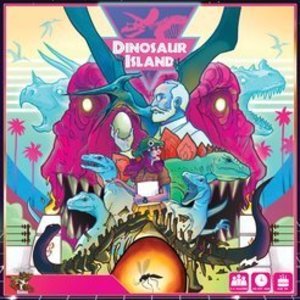


In Dinosaur Island, you have successfully created a theme park of the Jurassic variety (see what I did there?), and are now tasked with managing and supervising the day-to-day operations. Think “Zoo Tycoon” on steroids. You have to collect new DNA, upgrade your facilities, build new attractions, hire specialists, oversee your workers, and create new dinosaurs to populate your park! Make sure you manage your resources wisely for maximum benefit, and keep a close eye on the security of your park to ensure the safety of your guests! The goal is to create and maintain the most successful dinosaur park!
DISCLAIMER: An expansion exists for Dinosaur Island, and I do own it, but I have yet to incorporate it into my games. Once I get some experience with the expansion, I will either amend this review or address it in a separate post! -L
Let me first begin this review by saying that there is A LOT going on in this game. Seriously, a lot. And it can be pretty overwhelming at first. But one thing I cannot praise enough about Dinosaur Island is its rulebook. It’s kind of hefty, but it is so detailed and clear (with numerous examples) that I understood how to play the game on my first read-through. And sometimes with games that have so many moving elements, total understanding from the get-go can be rare, for me especially. The excellent rulebook makes a seemingly daunting game not so scary. I always keep the rulebook on hand when I play (just to be safe!), but once I got the hang of all of the steps, I don’t really need to refer back to it anymore!
As a solo game, Dinosaur Island plays very similarly as it does in group play with a few minor differences. For one, no regular Objective cards are used – instead you use a set of specified Solo Objective cards. Next, to simulate player interaction during the Research and Market Phases, the solo player draws a card from an AI deck and eliminates the options/discards the resources listed on the card – this mimics group play in the sense that turn order changes every round and you do not always get your first pick during these phases. The remaining 2 Phases (Worker and Park) occur simultaneously and involve no player interaction, so those are played as normal. One final difference between group and solo play is that the solo player can choose to play without Plot Twist cards. A solo game is played over the course of 7 total rounds, and the overall goal of the game remains the same – amass the most Victory Points.
The trickiest part of playing Dinosaur Island solo, for me, has to do with the Solo Objectives. You have 7 Solo Objectives to be completed throughout the game, and they reward Victory Points based on the round in which they were completed – finishing objectives in earlier rounds yields a higher number of points. If you are unable to complete any objective in a given round, you must discard one (of your choice) at the end of that round. The hard thing is that depending on which objectives are currently in play, it can be difficult to complete one each round to earn those points. Some things take time (and a couple of rounds) to be able to complete – like “Reach a threat level of 15.” If you have multiple long-term objectives in play, they can really limit the number of points you can earn from them. A nice mix of objectives (both short-term and long-term) can help balance out the game a little more, but it’s ultimately a luck of the draw.
One positive thing I can say about the objectives, though, is that they really force you to come up with a multi-faceted strategy. Depending on which objectives are in play, you have to decide on a logical strategy and order in which to complete them for maximum points. You can’t just focus on one objective – you also need to be setting yourself up to complete future objectives. I never feel like I’m just going through the motions because I always need to be thinking ahead to my future rounds.
The thing I really like about Dinosaur Island as a solo game is that it is still extremely engaging. I’m not a huge fan of “Beat your own personal best” solo games, but this one keeps me so involved that I don’t mind the fact that there’s no real ‘winner.’ Since a group game doesn’t involve that much player interaction anyway, Dinosaur Island doesn’t really even necessarily feel like a solo game. Every play requires a different strategy, and that makes it feel like a new game every time. If you enjoy Dinosaur Island in a group setting, give it a try as a solo game. There’s really not much of a gameplay difference, and I think you’ll enjoy it just as much!
https://purplephoenixgames.wordpress.com/2019/05/21/solo-chronicles-dinosaur-island/
Purple Phoenix Games (2266 KP) rated Bob Ross: Art of Chill Game in Tabletop Games
Jun 30, 2021


Bob Ross: Art of Chill is a set collection, hand management, card drafting game that has its players attempting to complete masterful paintings before the master does in order to collect bonus “chill points” to win the game. Whomever manages to reach ultimate chill status will be victorious and can return to feeding Peapod, their rascally pocket squirrel.
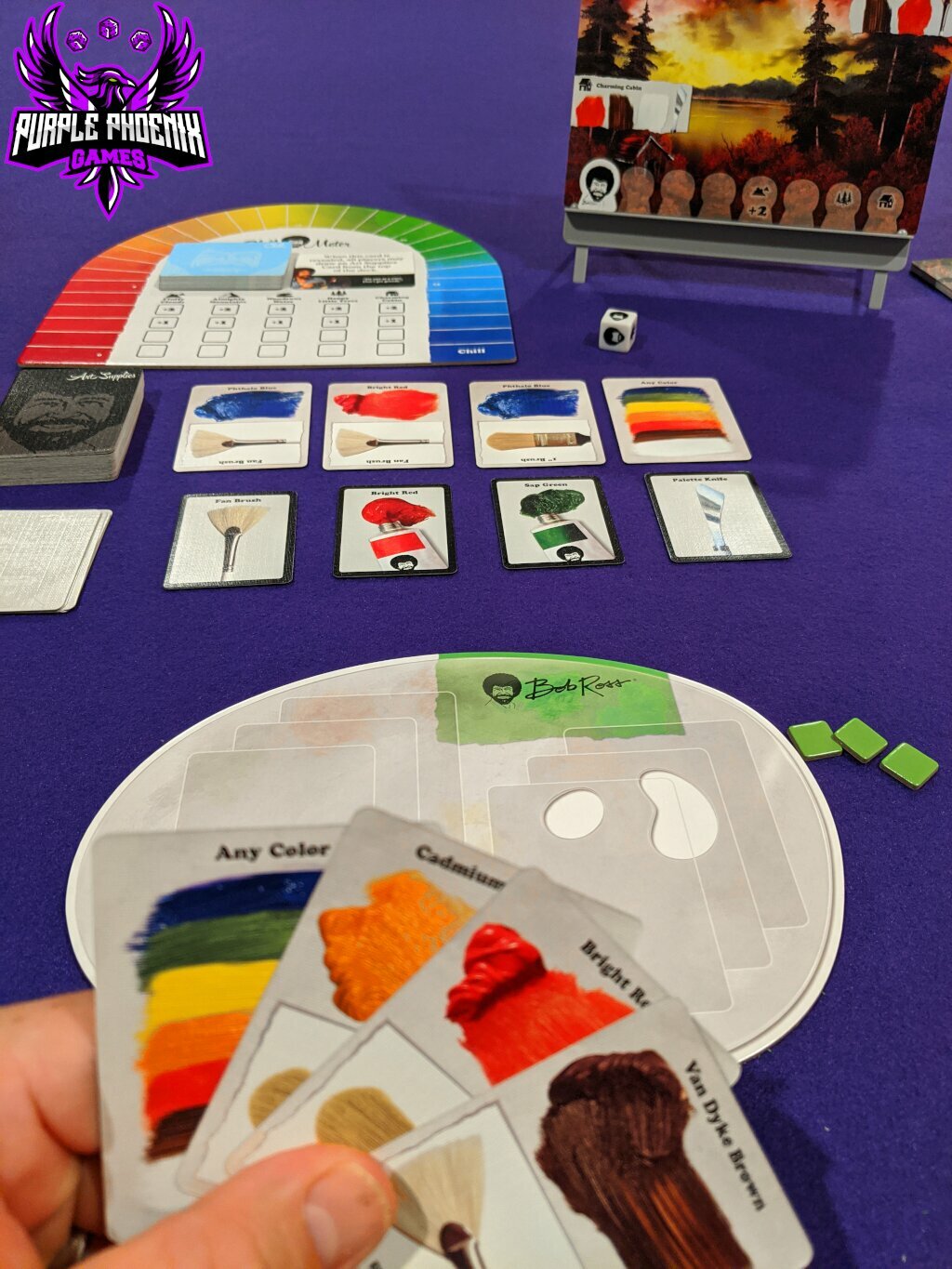
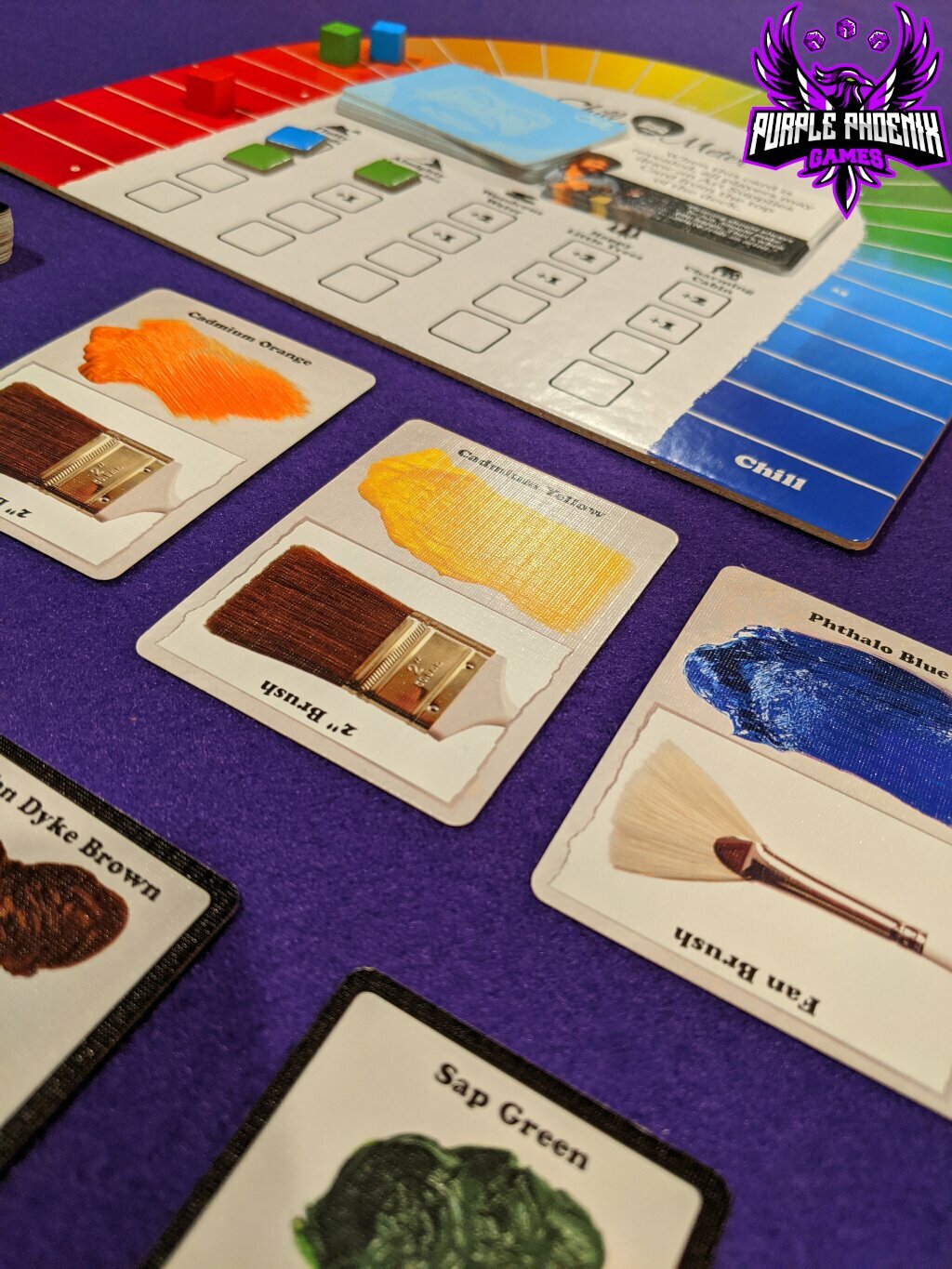
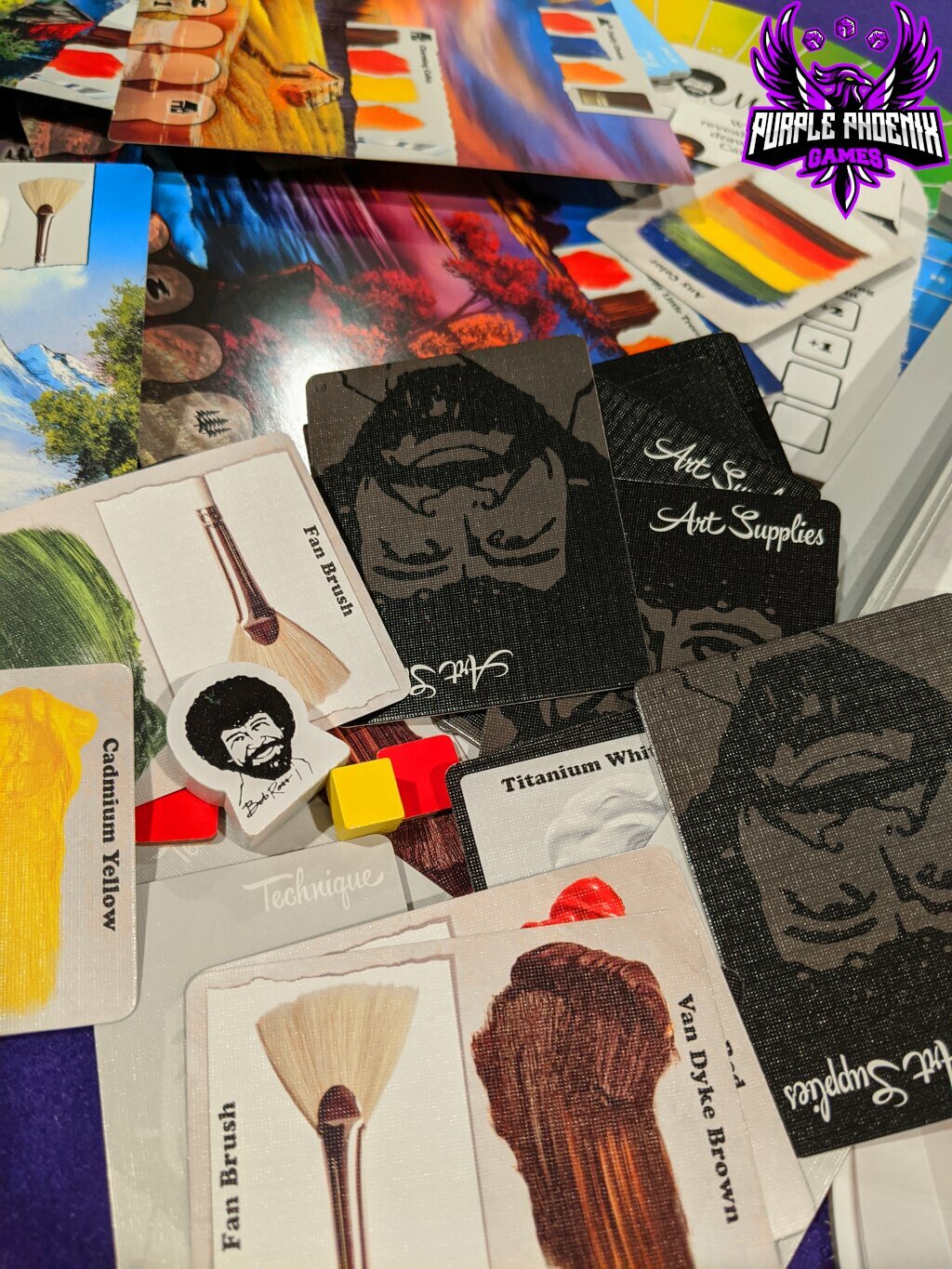
To setup, place the easel and one of the shuffled painting panels upon it. Place the other panels (paintings) nearby. Place the main scoreboard nearby as well and place the shuffled Chill Cards on its space upon the board. The Technique Cards deck and the Art Supplies Card decks will be shuffled separately and placed below the board with four cards from each deck revealed as an offer. Place the Bob Mover (Bobeeple) on the easel in the first location printed on the panel. Each player will receive a palette, the scoring cube of their color to be placed on the scoreboard, the three Feature Markers, and three random Art Supplies Cards. The game may now begin!
On a turn players will be rolling the Bob die and carrying out its action. These actions are playing a paint card from hand onto their palette, drawing one Art Supplies Card from the deck to their hand, performing one free Action prior to the Action phase, or resolving the Bob die face. The Bob die face requires players to reveal a new Chill Card and resolve its immediate effects, or effects that will remain in play until a new Chill Card is revealed. Secondly, the Bobeeple will move to the next printed stopping point on the panel.
Once the die has been rolled and resolved, the active player will be able to take any three actions available in any order: Draw an Art Supplies Card (from the deck or from the offer), Sweep the Art Supplies Card (discard all face-up cards and reveal four new ones), Apply Paint to Your Palette (by placing it on your palette from your hand of cards), Wash Your Palette (by discarding cards from one of the palette areas to clear it), Earn a Technique Card (by discarding two like-cards from the hand of cards in order to score more VP for painting features in the future), or Paint a Feature (by discarding the required brush from the player’s hand of cards and the correct matching paints already applied to their palette).
Once complete, the next player will take their turn of rolling the die and completing three actions. Should players paint a feature on the panel before Bob moves to that spot on the panel the player(s) will gain extra bonus Chill points. Players may still paint features for points if Bob already has as well, they just will not receive the bonus Bob points. Turns will continue in this fashion until the moment one player has reached ultimate Chill and won the game.
Components. This game has a fair amount of components and I am happy to say they are all great! The cardboard components (palettes, score board) are good. The cards are all lovely linen-finished. The other player components are fine as well. The painting panels are excellent and feature actual Bob Ross masterpieces, and there are 15 double-sided panels in the box! The coolest component is certainly the easel though. It seems to be a somewhat real and functional easel (not that you would really want to paint on it) and it amps up the table appeal when setup and in play. I love the components and I am so glad that Big G Creative made a Bob Ross game with beautiful components. Anything less would be sacrilege.
It probably comes as no surprise that I love this game. I have always loved watching Bob Ross from when I was a child even up through my adulthood and I am relieved to be able to still watch him in action via Netflix. The game, though, is rather surprising. I certainly wasn’t expecting to like this as much as I do and was quite shocked to find out that there was actual substance in a Bob Ross game. Especially when it was stationed next to “games” like Who Wants to Be a Millionaire, Throw Throw Burrito, and the like. I enjoy the nostalgia in seeing my favorite colors in my hands like Phthalo Blue, Cadmium Orange, and Sap Green.
I don’t know if I would really consider this a gateway game, though I believe it really depends on the gamers with whom you are playing. There will be many times when you are concentrating on collecting the colors needed to finish a feature before Bob only to frustratingly never see that color on offer nor in the cards you draw and then the painting has to be refreshed because people can’t seem to stop rolling Bob on the die. However, if you play with people who can literally chill when things don’t go their way, this is a gem. Purple Phoenix Games gives Bob Ross: Art of Chill a 21 / 24. The only thing missing here is a way to, “beat the devil out of it,” and it would make my heart sing.

Purple Phoenix Games (2266 KP) rated Tiny Epic Mechs in Tabletop Games
Jun 30, 2021
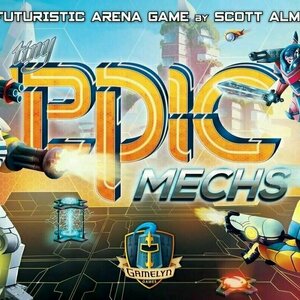

Disclaimer: I do not intend to rehash the entire rulebook in this review, but give a general overview of turns and gameplay. For a more in-depth look at the rules, pick up a copy of the game from the publisher or your FLGS! -L
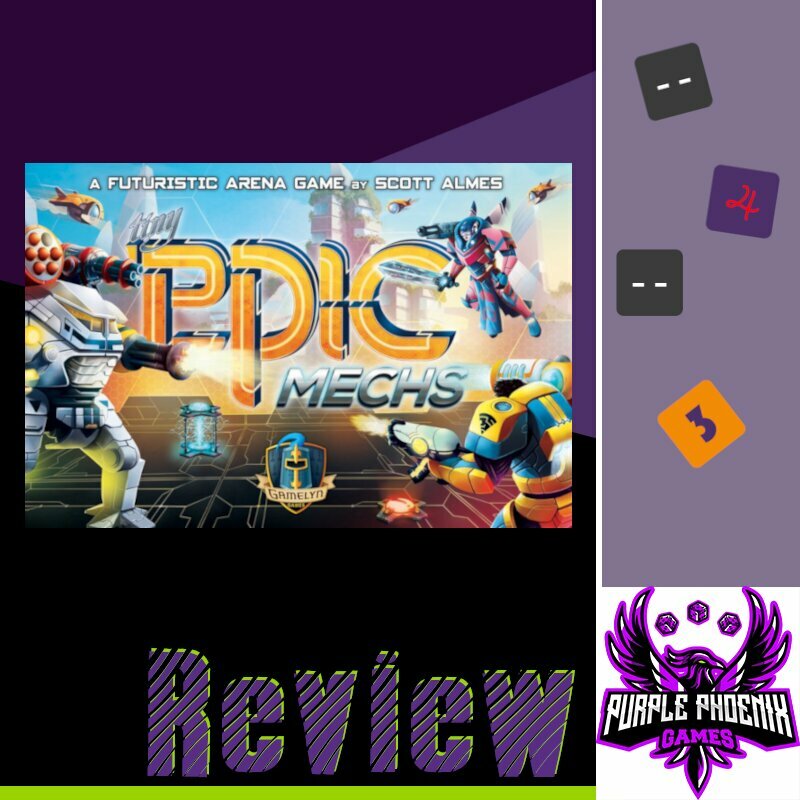
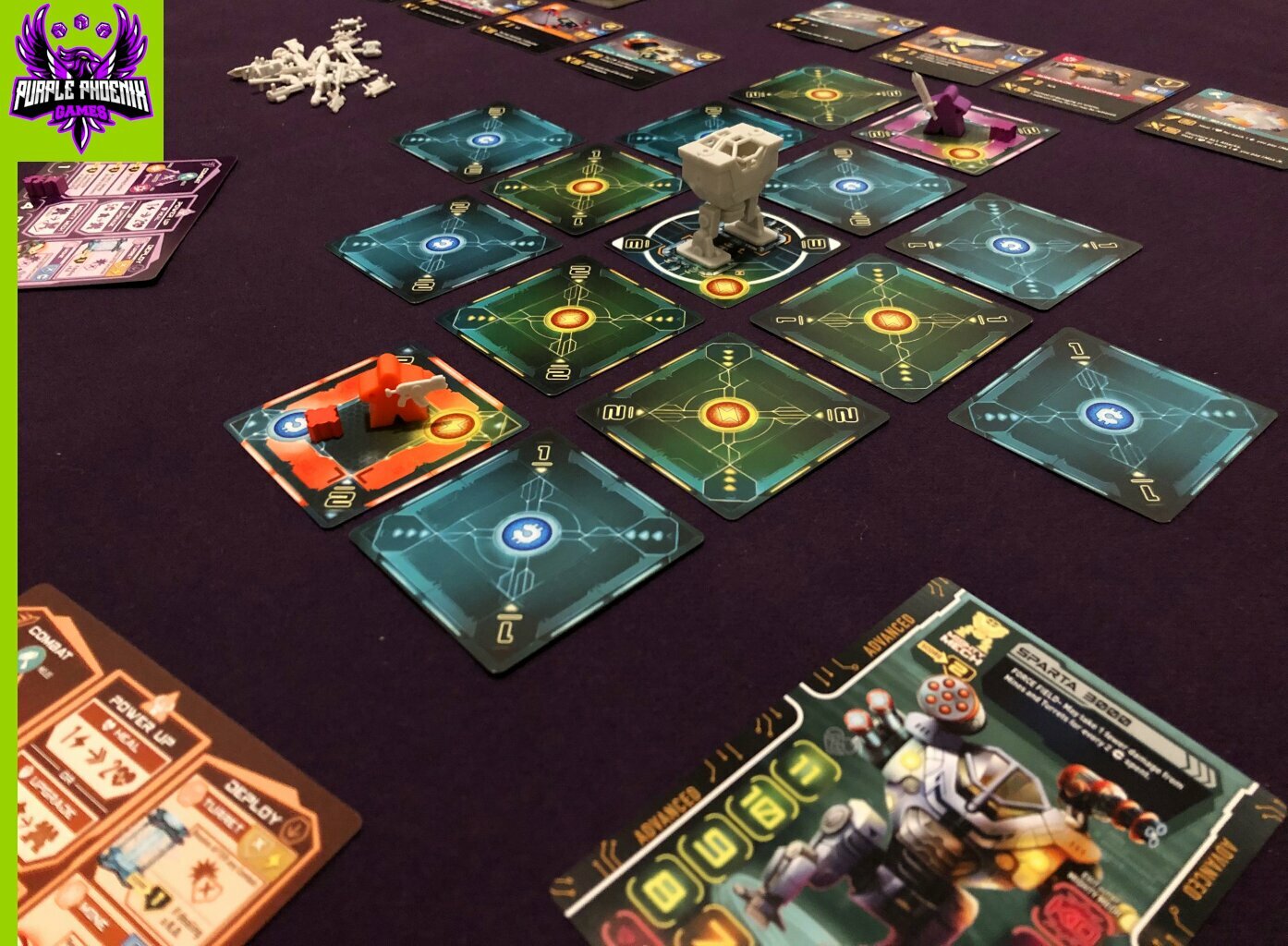
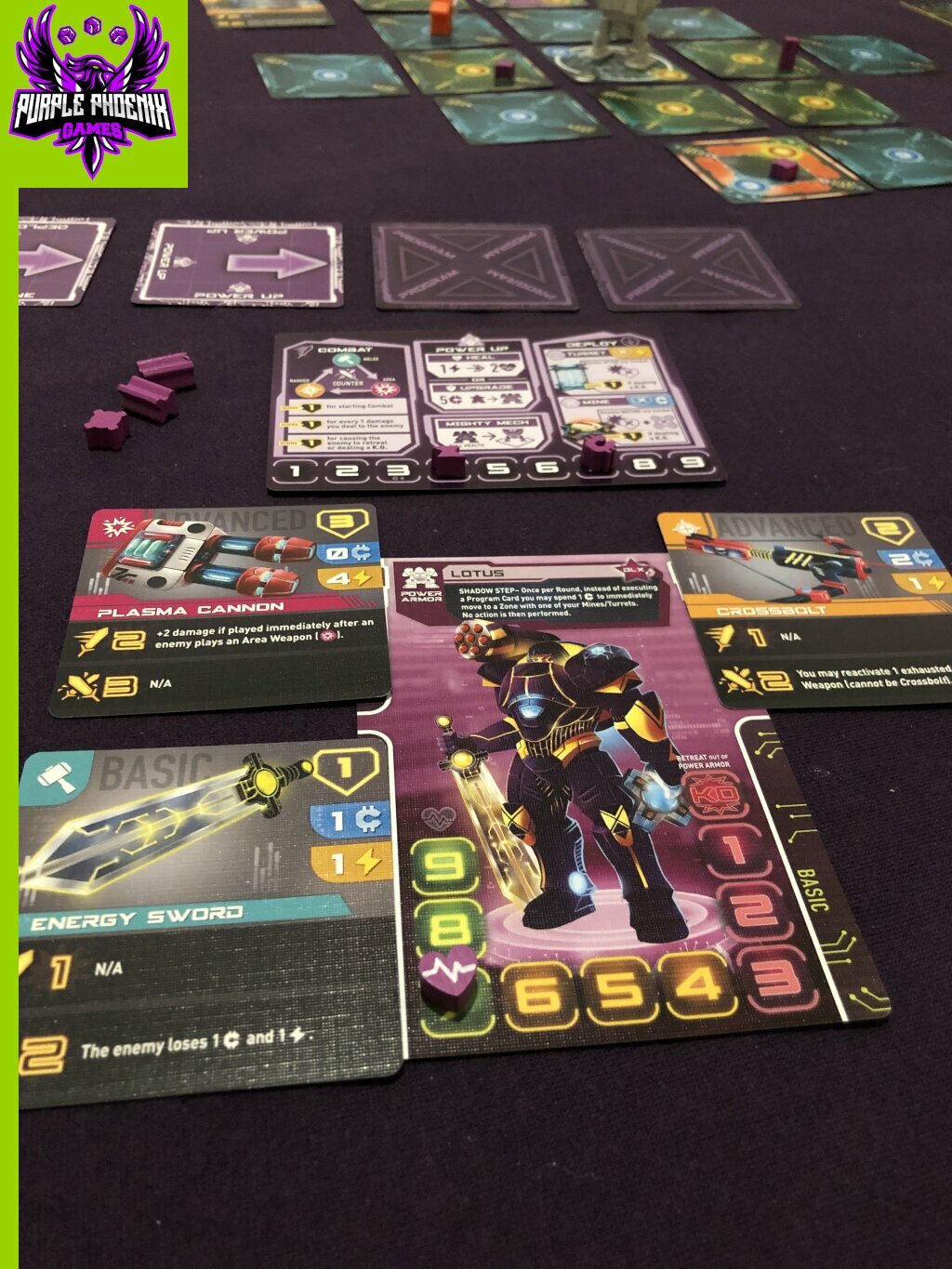
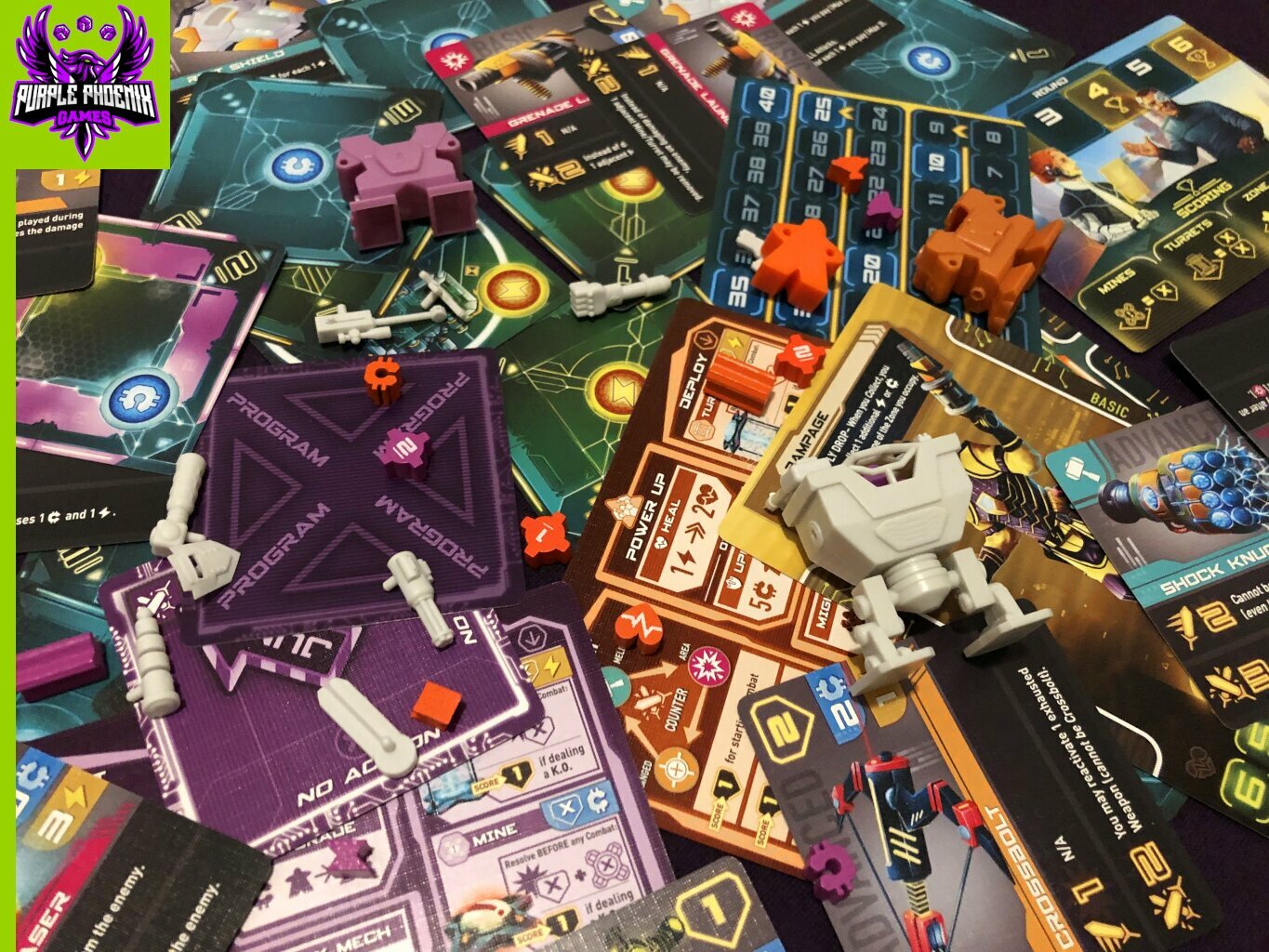
Tiny Epic Mechs is a game of action programming in which players take on the roles of Mech pilots competing in an arena-style battle royale event. Through the purchase of new weapons, powering up into Mech suits, combat with opponents (either face-to-face, or through the deployment of mines and turrets), and controlling different zones of the arena, players are trying to earn the most Victory Points by the end of 6 rounds of play. To begin, follow the setup instructions for the arena, based on the player count. Each player receives a player card (to track resources, and also acts as a reference card), a Pilot card, components in their chosen player color, and 1 Basic Weapon card to equip on their Pilot. Set the Round Tracker to round 1, create a market row of Advanced Weapons, place the Mighty Mech suit on it’s corresponding zone card, and the game is ready to begin!
Each round consists of 3 phases: Program, Execution, and Scoring. During the Program phase, players will secretly choose 4 Program Cards from their hand to represent their 4 moves/actions for this round. The chosen Program Cards will be laid out in order above the player card, and will immediately be covered by a face-down unused Program Card. (There are 8 Program Cards total, only 4 of which are used each round). It is important to note that the orientation of the Program Cards matters – Program Cards must be played parallel to the zone cards of the arena. Since they dictate the directions in which you move, you must place them exactly as you want to move. During the second phase, Execution, players will take turns revealing their Program Cards, one at a time and in order, and resolving the actions. To Execute a Program Card, you will first move your Pilot in the direction of the card’s arrow, and then resolve the action listed on the card. Movement is a must and cannot be skipped.
After Movement, you may perform the action on your card – Collect Resources, Purchase a Weapon, Deploy a Mine or a Turret, or Power Up. The first three of these are pretty self-explanatory. The Power Up action allows your Pilot to either heal themselves or upgrade into a Mech suit. Now to discuss crux of the game – combat. During the Execution phase, if you enter into the same zone as another player, you must immediately begin Combat. You will use your equipped weapons to battle your opponent, in hopes of knocking them out or forcing them to retreat. Weapons will deal base damage, or Power Attack damage, based on the circumstances of the combat. To attack with a weapon, you will deal the base damage immediately to your opponent. After your attack, the weapon you used is Exhausted and cannot be used again this combat. Your opponent then has the chance to attack back – either regularly or via Power Attack (I’ll leave that for you to discover on your own). Combat continues, alternating between players, until either a player is KO’d, or is forced to retreat because all of their weapons have been Exhausted. Initiating combat, dealing damage, and defeating your opponent all earn you VP, so combat is a vital part of the game!
After all players have revealed and performed their final Program Card, the round ends. At the end of the 2nd, 4th, and 6th round, players will perform a Scoring phase, earning points for any zones occupied by their own mines, turrets, or Pilot. At the end of the 6th and final round, scoring takes place as stated above, but players will also earn VP for all weapons they have purchased throughout the game. The player with the highest VP is the winner!
I have to admit that I am not a person who generally enjoys the mechanic of action programming. I like to really think through my strategy, and execute it exactly as I want. Action programming makes strategizing more difficult because your success or failure depends on the actions selected in advance by your opponents. You can’t really adapt mid-round, you kind of just have to deal with what’s happening. That being said, Tiny Epic Mechs, in my opinion, has a good balance of combat and actions/resource management. Your entire strategy can’t be based on combat – you need to upgrade weapons, climb into your Mech suit, etc. – and the ability to vary combat with individual upgrades makes the gameplay feel more strategic. Yes, your opponents might still mess up some of your best-laid plans, but you have to be prepared for any situation.
The overall gameplay can feel calculated or chaotic simply based on the player count. In a 2-player game, obviously there are only 2 people, and you have more opportunities to really focus on your individual Pilot before necessarily traipsing into combat. In a game with 3 or 4 players, interactions between players are inevitable and can really make the action programming mechanic stand out/feel more random/etc. Especially with a small play arena, Pilots will be crossing paths at probably every turn, and you may be forced into more combats that you anticipated. With only 2 players, there are interactions between players, but it feels a little more calm overall, and you can really work with a strategy instead of having to adapt to sudden changes in the arena.
Let’s touch on components for a minute. As always, this Tiny Epic delivers on quality components. The cards are colorful and sturdy, the text easy to read. The wooden components for tracking health/resources are good, but maybe just a little too small, even for my regularly-sized hands. The ITEMeeples, Mech suits, and weapons are always fun to play with, and sturdy enough to hold up to lots of plays. All in all, great work from Gamelyn Games once again.
For being a game of action programming, I have to admit that I enjoyed Tiny Epic Mechs more than I thought I would. At least at a 2-player count. Anything more feels too chaotic and random to me. The elements of programming and combat are engaging and elevate the gameplay, but it’s just not my favorite mechanic. Will I keep this game? Definitely. For what it is, I think it does a good job. Will I get more action programming games in the future? Probably not. I’d say Tiny Epic Mechs fills that spot for me, and that is all good in my book. Check this one out if you’re looking for something fun and relatively simple that utilizes this mechanic. Purple Phoenix Games gives it a mechanical 7 / 12.

Jim LeBaron (69 KP) rated The Quacks of Quedlinburg in Tabletop Games
Mar 12, 2019
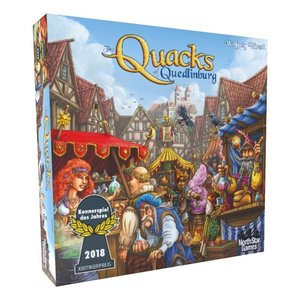

What are some of the things I loved?
A balanced press your luck component: If you press your luck too far you pay a price but that price isn't as steep as it is in other games
Catch up mechanism: Falling behind? No problem, Quacks helps you out until you are a little more caught up.
Replay Value: Each reagent has 4 variants so each game can be a little different. There are also two sided player boards. One for a beginner's game and one for the advanced game.
Simultaneous play: Players get to decide at the same time what they are going to do so you don't spend as much time waiting on others.
No Take That: From what I have seen there is no direct conflict between players, some people like that in a game some don't so I thought I'd list it.

Johnny-Mac Willcox-Beney (10 KP) rated The Quiet Year in Tabletop Games
Jul 20, 2019

When a card is drawn it introduces a new choice to be made by a player about your community, with limited organised discussions about these choices replicating failures in communications in real communities. This choice is then represented on a map of your community that you build as you play.
This game is absolutely brilliant as a first TTRPG, a first session to build the setting for a post apocalyptic game in another system or just as a standalone one shot. It only takes one 2-3 hour session, some paper, pens, 6 sided dice, a standard deck of playing cards and the PDF. The questions it asks prompt very interesting ideas about your community to build somewhere that feels alive and fully fleshed out. A great buy!

Erika (17789 KP) rated The Adventures of Tintin: The Secret of the Unicorn (2011) in Movies
Mar 20, 2020

Instead of choosing to go with one adventure, or even two that were sequels/two-parts, the decision was made to mash up The Crab with the Golden Claws, and the Secret of the Unicorn. Tintin originally met Captain Haddock in the Crab with the Golden Claws (1941), not the Secret of the Unicorn (1943). Needless to say, I was completely confused. Tintin and Haddock were already friends, and Tintin bought the Unicorn as a gift... It was just bizarre to me. Why and how was that decision made? Yes, there were tons of homages to the adventures of Tintin overall, but the plot just felt all over the place.
I also did not dig the animation/mo-cap, it was very off-putting and distracting. Thank god the technology was improved in Ready Player One.
I think I was expecting too much. I wouldn't be remotely interested in a sequel for this. Maybe Spielberg will try it again? It would work better as a television series anyway, you've got 23 complete adventures, the stories need another chance.

Stickman World
Games and Stickers
App
Stickman World takes place in an underground world after the hero "Stickman" awakes in an unknown...

Unprecedented: The Masters and Me
Tiger Woods and Lorne Rubinstein
Book
In 1997, Tiger Woods was already among the most watched and closely examined athletes in history....

Violated: Exposing Rape at Baylor University and College Football's Sexual Assault Crisis
Paula Lavigne and Mark Schlabach
Book
Anne was one of five women who reported to police that they were either raped or assaulted -- in...
Ask Bearders
Book
What is the highest number of runs a player has scored in Test matches without ever being dismissed?...