
Search
Search results

Motion Math: Fractions!
Education and Games
App
Play the award-winning learning game that puts the action in fraction! * Excellence in Design Award...

Gareth von Kallenbach (980 KP) rated the PC version of Evil Dead: The Game in Video Games
Jun 1, 2022


Back in 1981, Director Sam Raimi unleashed the Evil Dead on audiences and in doing so ignited his career as well as that of star Bruce Campbell. The subsequent sequels only further cemented dysfunctional hero Ash Williams into Pop Culture history as did the recent television series which returned the character to eager fans.
Saber Interactive has given fans a chance to play as Ash or several of the characters from the series with Evil Dead: The Game and take the battle to the demonic hordes and plenty of humor, horror, and action along the way.
The game is played from the third-person perspective and online players can enjoy cross-play so that players on all systems can play with one another. In the multiplayer mode, up to four players can team up to get missing pages of a text over a dark and vast map that is littered with demons and can have a player-controlled demon in the mix as well.
Players will be able to arm up by locating guns, knives, swords, and ammunition along the way as well as matches which are key to lighting up areas to keep enemies from advancing. Ammunition is in limited supply so players will have to be selective about combat as blowing away enemies is tons of fun but having to mix it up or run is not always wise when they attack in masses.
The maps are very large and there are vehicles available that are handy in running down enemies and making it to remote areas of the map. Along the way, there are shops, cabins, homes, and other locales where players can find needed objects to survive.
The longer a player operates in the dark or away from other players makes them increase in fear which allows them to be possessed and turn on their fellow players. When a player is low on health they can regain it by drinking cola that is found around the map or by being assisted by a fellow player which is not easy in the midst of combat as helping others can place you at risk.
The goal is to get a legendary dagger and take on the evil leaders which if successful wins the rounds for the players and their XP levels up. Players also have the option for a regular or furious attack as well as special moves which recharge over time.
The solo portion of the game is set in chapters and requires Ash to complete various tasks to advance to the next one. I found this to be very challenging as at times the maps are so dark it is hard to navigate or see properly and without players to help out, it can be a frustrating defeat.
The game has decent graphics and sound and the numerous clips of star Bruce Campbell offering wisdom and quips are very enjoyable and sets the tone for the game well. The attention to detail from the movies is also very enjoyable as players will want to make sure to take a good look around the cabins to get their nostalgia fix.
The game is a fun diversion and fun in groups and gives fans of the series the action and nostalgia they have come to expect. Some may cite a lack of initial depth to the gameplay and maps but I am sure as time goes on and more updates arrive, the game will continue to grow.
For now, Evil Dead: The Game offers enough action, humor, and nostalgia to keep fans happy.
3.5 stars out of 5
Saber Interactive has given fans a chance to play as Ash or several of the characters from the series with Evil Dead: The Game and take the battle to the demonic hordes and plenty of humor, horror, and action along the way.
The game is played from the third-person perspective and online players can enjoy cross-play so that players on all systems can play with one another. In the multiplayer mode, up to four players can team up to get missing pages of a text over a dark and vast map that is littered with demons and can have a player-controlled demon in the mix as well.
Players will be able to arm up by locating guns, knives, swords, and ammunition along the way as well as matches which are key to lighting up areas to keep enemies from advancing. Ammunition is in limited supply so players will have to be selective about combat as blowing away enemies is tons of fun but having to mix it up or run is not always wise when they attack in masses.
The maps are very large and there are vehicles available that are handy in running down enemies and making it to remote areas of the map. Along the way, there are shops, cabins, homes, and other locales where players can find needed objects to survive.
The longer a player operates in the dark or away from other players makes them increase in fear which allows them to be possessed and turn on their fellow players. When a player is low on health they can regain it by drinking cola that is found around the map or by being assisted by a fellow player which is not easy in the midst of combat as helping others can place you at risk.
The goal is to get a legendary dagger and take on the evil leaders which if successful wins the rounds for the players and their XP levels up. Players also have the option for a regular or furious attack as well as special moves which recharge over time.
The solo portion of the game is set in chapters and requires Ash to complete various tasks to advance to the next one. I found this to be very challenging as at times the maps are so dark it is hard to navigate or see properly and without players to help out, it can be a frustrating defeat.
The game has decent graphics and sound and the numerous clips of star Bruce Campbell offering wisdom and quips are very enjoyable and sets the tone for the game well. The attention to detail from the movies is also very enjoyable as players will want to make sure to take a good look around the cabins to get their nostalgia fix.
The game is a fun diversion and fun in groups and gives fans of the series the action and nostalgia they have come to expect. Some may cite a lack of initial depth to the gameplay and maps but I am sure as time goes on and more updates arrive, the game will continue to grow.
For now, Evil Dead: The Game offers enough action, humor, and nostalgia to keep fans happy.
3.5 stars out of 5

Purple Phoenix Games (2266 KP) rated Gnomes & Wizards in Tabletop Games
Jan 21, 2020
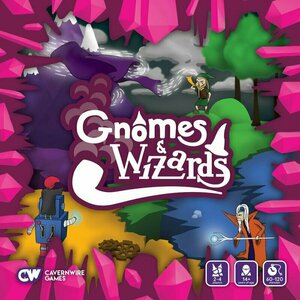
I always thought that Gnomes could BE Wizards. This whole time I was led to believe that a Gnome could take on the class of Wizard and join these two houses splendidly. I did not, however, realize that Gnomes and Wizards were different species and vying for the same power crystals to fuel their magicks… until recently.
Gnomes & Wizards is an area control, map deformation, dice assignment battle game where the players are attempting to earn the most victory points (VP) at the end of the game. Players gain VP by defeating other players’ active characters (clan leaders and tribesmen henchpeople), and having the most hit points (HP) between all their active characters at game end. Sounds easy, right? Read on, my friend.
DISCLAIMER: We were provided a prototype copy of this game for the purposes of this review. These are preview copy components, and the final components will probably be different from these shown. Also, it is not my intention to detail every rule in the game, as there are just too many. You are invited to download the rulebook from the publisher’s website, purchase the game through the Kickstarter campaign, or through any retailers stocking it after fulfillment. -T
As I mentioned in my disclaimer, I will not be explaining every rule for this one as there are quite a few little nuances that make it tick. However, I will cover the basic gameplay, and I will be focusing on a 2-player game for this preview.
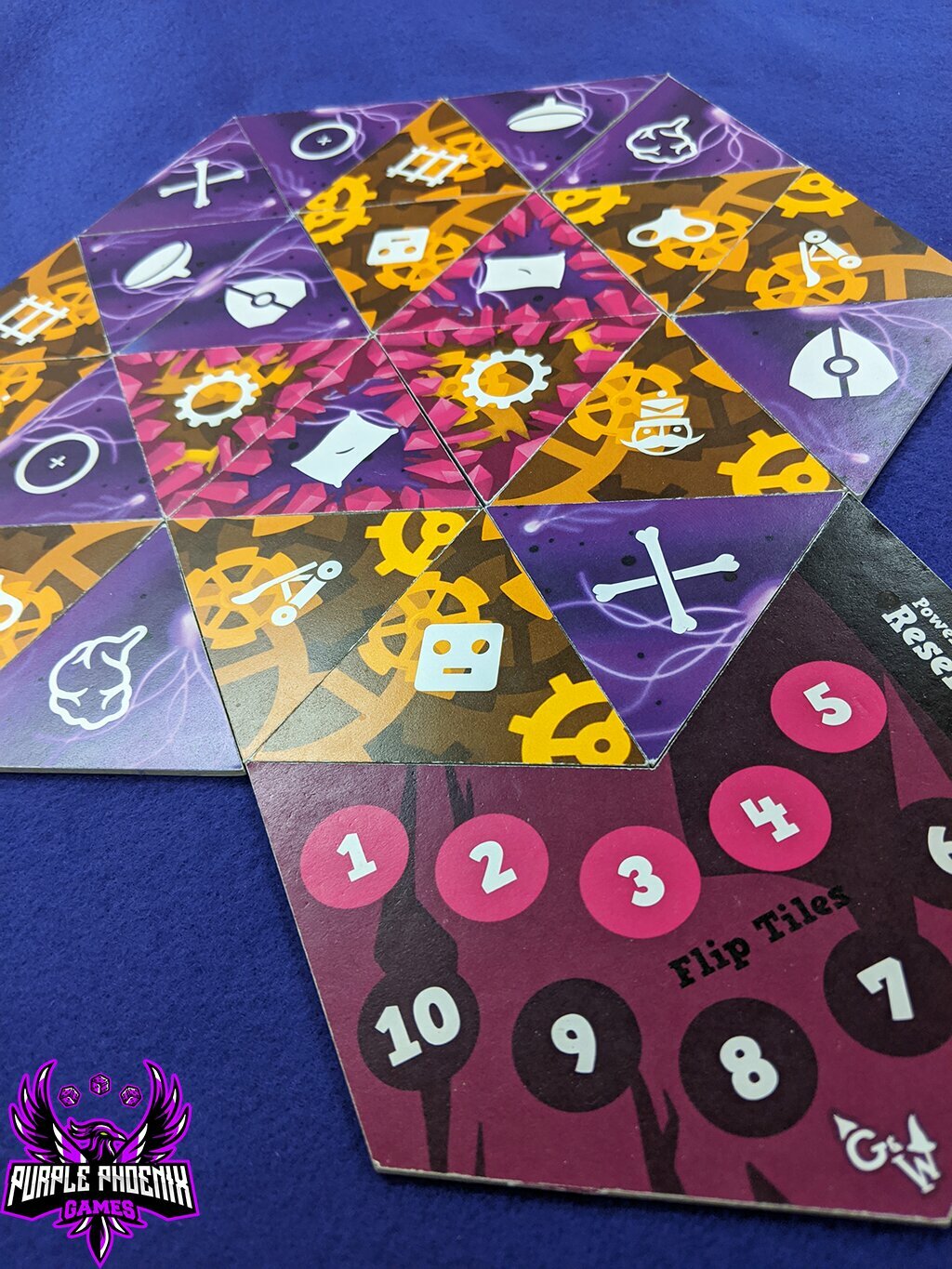
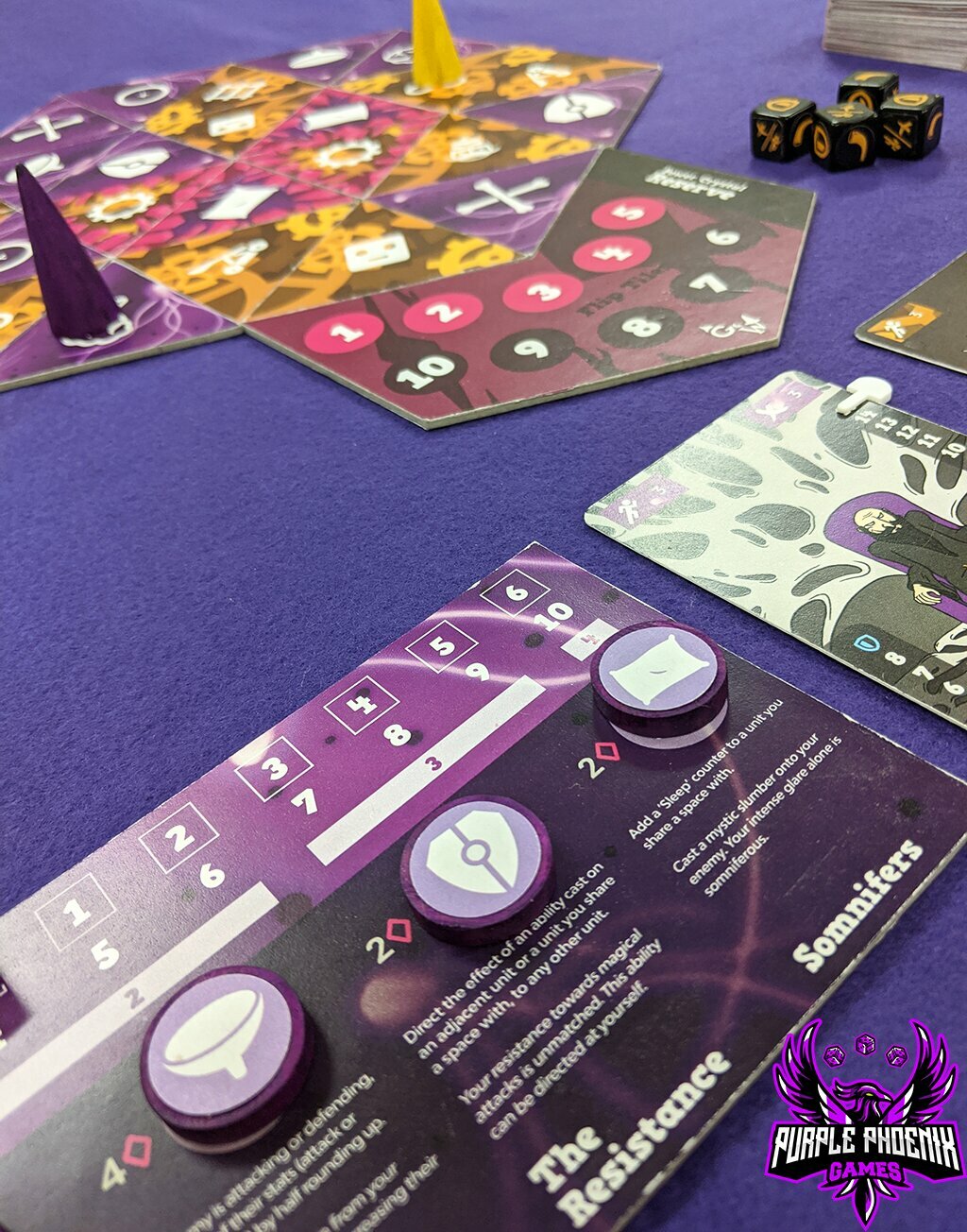
To setup the game, each player receives all the components in their chosen color for their clan. A clan consists of a leader (which is represented by the cone on the board) and six tribesmen (henchpeople represented by discs with their specific icon). The board is an elaborate puzzle of triangular pieces that fit together beautifully and create a very interesting map on the table. In the middle of this puzzle map will always be the mine tiles – tiles that have pink power crystals outlining the inner icons. Each leader will have clips placed on their cards to keep track of HP and Defense, and these cards also show baseline movement speed and attack power. Once all players have completed their setup and the black dice have been rolled to determine the starting player, the game is ready to begin and the crystals are primed to be exploited.
Gnomes & Wizards is a game of dice manipulation and allocation at its core. Leaders and tribesmen will always have base movement, attack, defense, and HP, but the dice rolls can alter these. Perhaps you are a super-aggressive player and are just out to destroy the other clan(s). I have played that way and it works very well. If so, then when rolling you will want to concentrate your efforts on the move/attack die face. These add to either your movement speed or to your attack power (not both). Other die faces include defense (which raise your defense clip), horns (which can buy you an ability card OR help to call a tribe – more on this later), or collect power crystals.
Power crystals are used to charge clan abilities (printed on the clan board) and card abilities (attached to clansmen). You can earn your power crystals via die rolls or by passing through the mine tiles in the center of the board map. These power crystals, and the abilities they fuel, are very powerful and can make or break encounters against other clans.
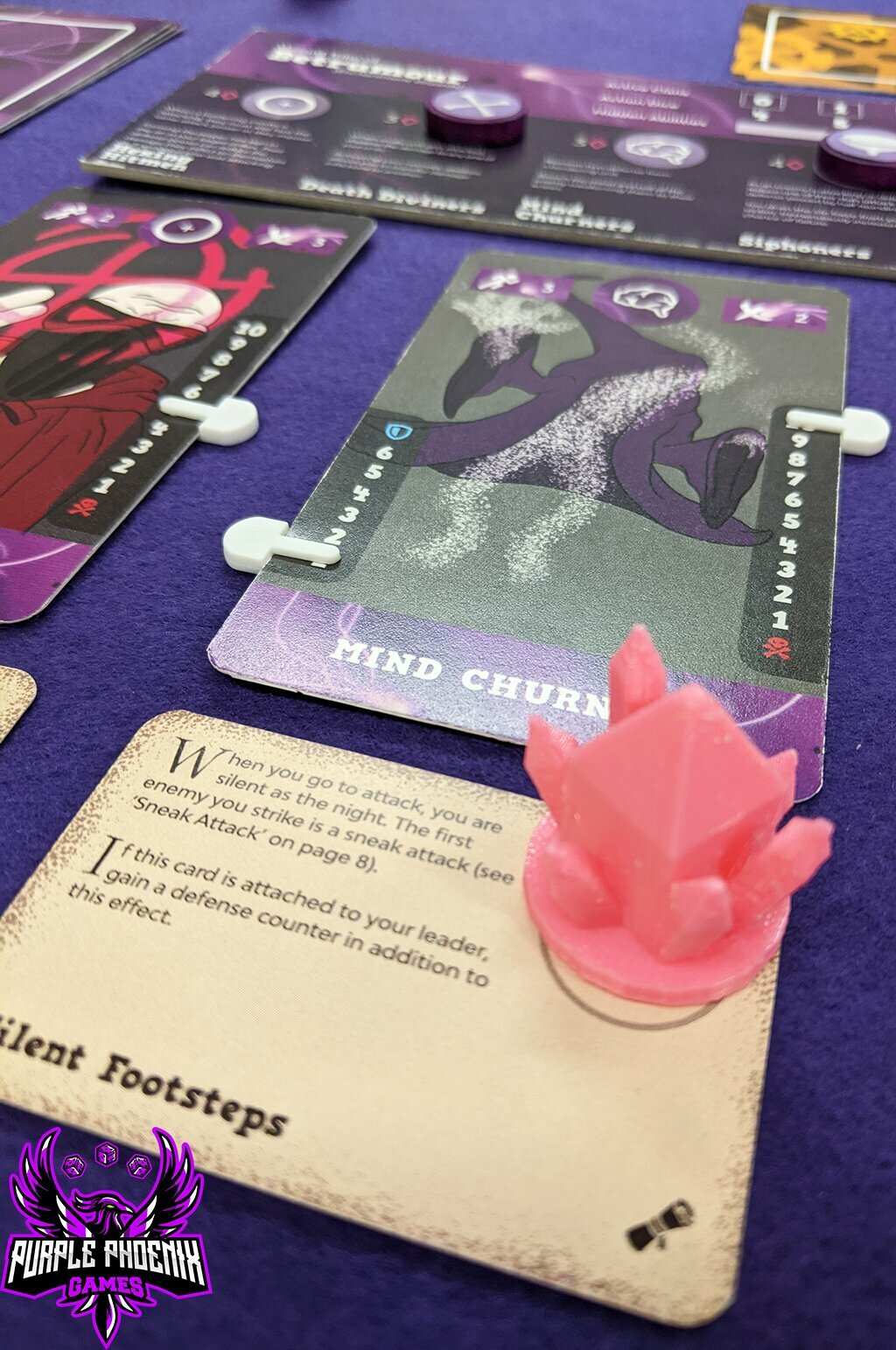
Horns are what need to be rolled to bring more tribesmen on the board. Initially, each clan will only have the leader cones available on the board to play with until more tribesmen can be called to the fray. Rolling three horns and having a leader cone or tribesman disc on tribe-specific icon tiles will allow that tribe to be called onto the board. Did you only roll one or two horns? That’s okay, because horns are also used to draw ability cards from the deck. Draw as many cards as you have rolled horns and choose one of those to keep and the others are discarded to the bottom of the deck. You may attach certain ability cards to your clansmen to be charged by power crystals and used later, or keep certain other cards hidden in your stash to be used any time – even on another player’s turn.
The winner of Gnomes & Wizards is the player who earns the most VP by knocking out opponent clansmen/leaders and earning 1VP per HP remaining on active clansmen cards. I purposely left out a couple twists for you here. Your gameplan needs to be carried out in just 10 rounds in a normal game. So you only have 10 turns to create your all-star clan, earn power crystals, and beat up your opponents. Not enough? Okay how about this – after Round 5 each player will flip over two map tiles at the beginning of their turns – thus eliminating possibilities of calling clansmen to war because their icon is now flipped and unavailable. Each turn is incredibly important to maximize as best as possible as you only get 10 of them, and the map will begin to crumble away.
Components. Again, we were provided a prototype version of the game, so I will not comment on component quality, even though it’s already pretty good. I can see what CavernWire is trying to do here and I am very excited by the plans. The layout on the cards is great. The dice will be cool when final. The amazing power crystals will be a little fragile, so do take care of them, but the design is awesome. The best part about the components on this one – the colors. This game is so wonderfully colorful, and extremely attractive on the table. When playing at work, my coworkers all walked by the table and wanted to know what I was up to. I play games at work a lot, but this one was so vibrant and interesting that they wanted to know more – and they are all mostly non-gamers.
I find Gnomes & Wizards to be a game that I wish I could spend lots of time exploring every strength and weakness of each clan. Trying new strategies, and watching them be dismantled by newcomers. I have not seen every ability card yet. I have not played with each clan yet. But I want to. It’s a deeply colorful game with engaging mechanics (and lots of them) that I feel offers something special to a game collection. So if you are interested in grabbing a copy for yourself, head over to CavernWire’s website and hop on the Kickstarter campaign. Or purchase a copy from your FLGS or favorite online retailer. We dig it.
Gnomes & Wizards is an area control, map deformation, dice assignment battle game where the players are attempting to earn the most victory points (VP) at the end of the game. Players gain VP by defeating other players’ active characters (clan leaders and tribesmen henchpeople), and having the most hit points (HP) between all their active characters at game end. Sounds easy, right? Read on, my friend.
DISCLAIMER: We were provided a prototype copy of this game for the purposes of this review. These are preview copy components, and the final components will probably be different from these shown. Also, it is not my intention to detail every rule in the game, as there are just too many. You are invited to download the rulebook from the publisher’s website, purchase the game through the Kickstarter campaign, or through any retailers stocking it after fulfillment. -T
As I mentioned in my disclaimer, I will not be explaining every rule for this one as there are quite a few little nuances that make it tick. However, I will cover the basic gameplay, and I will be focusing on a 2-player game for this preview.
To setup the game, each player receives all the components in their chosen color for their clan. A clan consists of a leader (which is represented by the cone on the board) and six tribesmen (henchpeople represented by discs with their specific icon). The board is an elaborate puzzle of triangular pieces that fit together beautifully and create a very interesting map on the table. In the middle of this puzzle map will always be the mine tiles – tiles that have pink power crystals outlining the inner icons. Each leader will have clips placed on their cards to keep track of HP and Defense, and these cards also show baseline movement speed and attack power. Once all players have completed their setup and the black dice have been rolled to determine the starting player, the game is ready to begin and the crystals are primed to be exploited.
Gnomes & Wizards is a game of dice manipulation and allocation at its core. Leaders and tribesmen will always have base movement, attack, defense, and HP, but the dice rolls can alter these. Perhaps you are a super-aggressive player and are just out to destroy the other clan(s). I have played that way and it works very well. If so, then when rolling you will want to concentrate your efforts on the move/attack die face. These add to either your movement speed or to your attack power (not both). Other die faces include defense (which raise your defense clip), horns (which can buy you an ability card OR help to call a tribe – more on this later), or collect power crystals.
Power crystals are used to charge clan abilities (printed on the clan board) and card abilities (attached to clansmen). You can earn your power crystals via die rolls or by passing through the mine tiles in the center of the board map. These power crystals, and the abilities they fuel, are very powerful and can make or break encounters against other clans.
Horns are what need to be rolled to bring more tribesmen on the board. Initially, each clan will only have the leader cones available on the board to play with until more tribesmen can be called to the fray. Rolling three horns and having a leader cone or tribesman disc on tribe-specific icon tiles will allow that tribe to be called onto the board. Did you only roll one or two horns? That’s okay, because horns are also used to draw ability cards from the deck. Draw as many cards as you have rolled horns and choose one of those to keep and the others are discarded to the bottom of the deck. You may attach certain ability cards to your clansmen to be charged by power crystals and used later, or keep certain other cards hidden in your stash to be used any time – even on another player’s turn.
The winner of Gnomes & Wizards is the player who earns the most VP by knocking out opponent clansmen/leaders and earning 1VP per HP remaining on active clansmen cards. I purposely left out a couple twists for you here. Your gameplan needs to be carried out in just 10 rounds in a normal game. So you only have 10 turns to create your all-star clan, earn power crystals, and beat up your opponents. Not enough? Okay how about this – after Round 5 each player will flip over two map tiles at the beginning of their turns – thus eliminating possibilities of calling clansmen to war because their icon is now flipped and unavailable. Each turn is incredibly important to maximize as best as possible as you only get 10 of them, and the map will begin to crumble away.
Components. Again, we were provided a prototype version of the game, so I will not comment on component quality, even though it’s already pretty good. I can see what CavernWire is trying to do here and I am very excited by the plans. The layout on the cards is great. The dice will be cool when final. The amazing power crystals will be a little fragile, so do take care of them, but the design is awesome. The best part about the components on this one – the colors. This game is so wonderfully colorful, and extremely attractive on the table. When playing at work, my coworkers all walked by the table and wanted to know what I was up to. I play games at work a lot, but this one was so vibrant and interesting that they wanted to know more – and they are all mostly non-gamers.
I find Gnomes & Wizards to be a game that I wish I could spend lots of time exploring every strength and weakness of each clan. Trying new strategies, and watching them be dismantled by newcomers. I have not seen every ability card yet. I have not played with each clan yet. But I want to. It’s a deeply colorful game with engaging mechanics (and lots of them) that I feel offers something special to a game collection. So if you are interested in grabbing a copy for yourself, head over to CavernWire’s website and hop on the Kickstarter campaign. Or purchase a copy from your FLGS or favorite online retailer. We dig it.

Purple Phoenix Games (2266 KP) rated Xenohunters in Tabletop Games
Mar 22, 2021


What do you find absolutely terrifying? A great many things are on my list, and one of them happens to be the main theme for Xenohunters – heroes attempting to blow up a space station that has been overrun by hostile alien threats, but said aliens are adept at sneaking and can rise up just before you and deliver a deadly blow. I know I can’t be the only one shuddering at THAT thought. So when my friends over at Half-Monster Games contacted me about previewing their new game I knew I was in for one crazy ride.
In Xenohunters one player will act as the main alien force while the other players will divvy up the four hunter characters to oppose. The alien wins when the human threat is eliminated and the humans win once the alien threat is eliminated or once the space station has been blown up with a bomb and at least one human survivor leaving on the spaceship. Tensions run high and every being is on high alert. So let’s get into this! Pre-disclaimer: as this game has many delicate rules I will be giving a high-level overview of gameplay and more opinion on my plays at the end.
DISCLAIMER: We were provided a prototype copy of this game for the purposes of this review. These are preview copy components, and I do not know for sure if the final components will be any different from these shown. Also, it is not my intention to detail every rule in the game, as there are just too many. You are invited to download the rulebook, back the game through the Kickstarter campaign, or through any retailers stocking it after fulfillment. -T
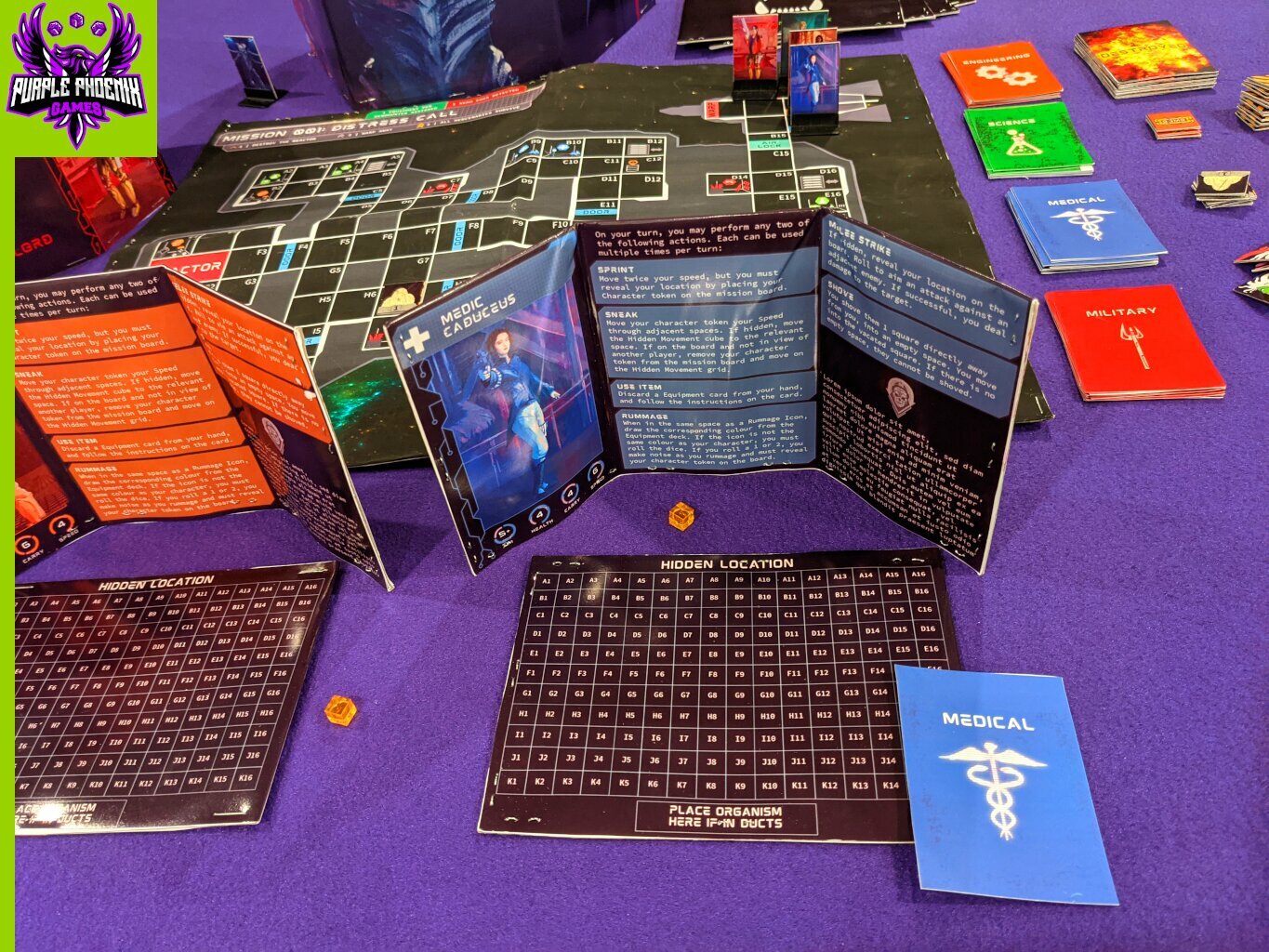
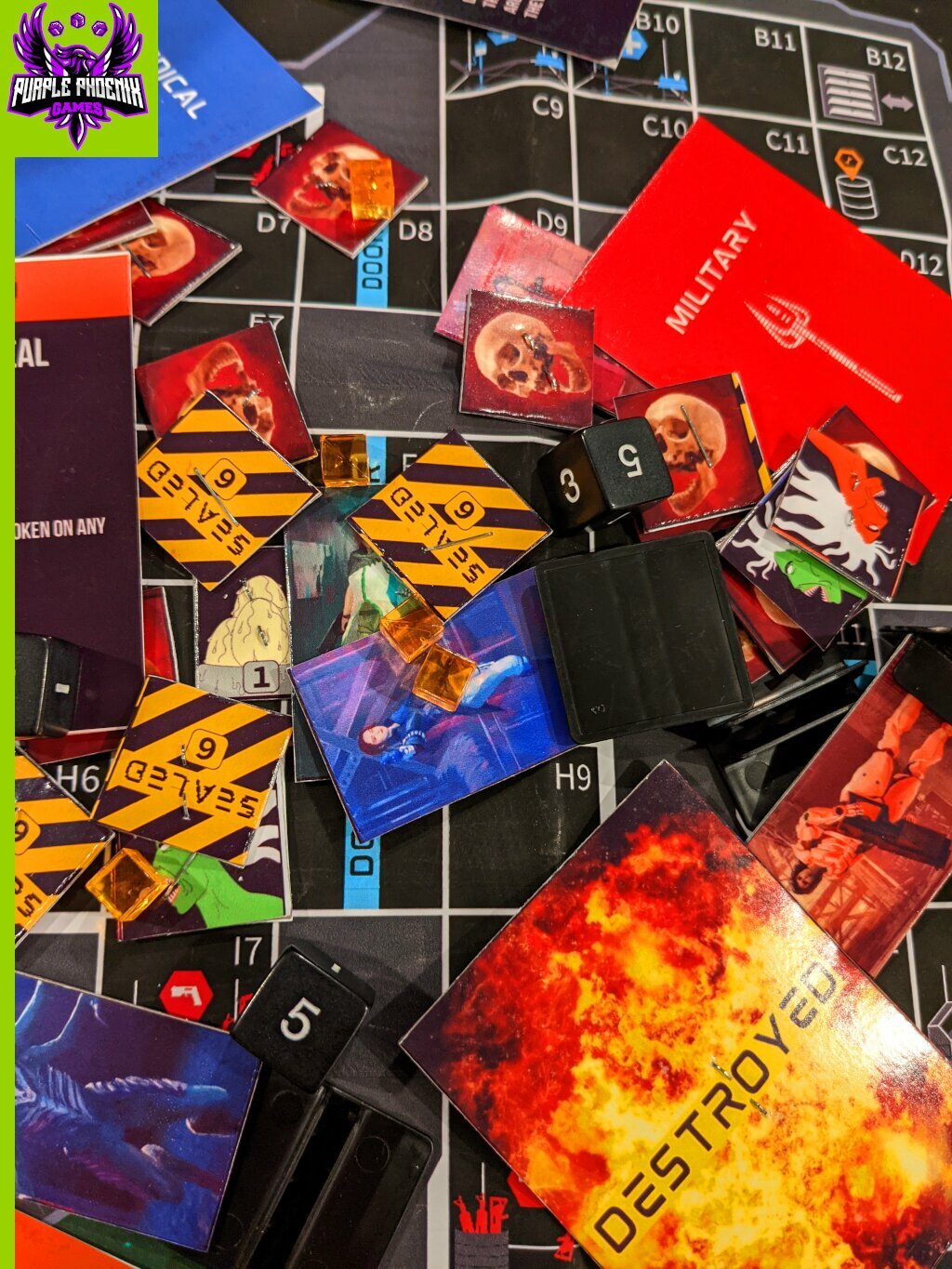
To setup consult the rules until the table looks similar to what is shown below. Beware: this game does take up quite a bit of table real estate to plan accordingly and use “the big table.”
Xenohunters is played in rounds until one side has achieved their win condition, as explained above. The aliens, or “Xenos,” will take their turns first, and then the human squad is able to take theirs. Xenohunters offers a loose turn structure in that each character is allowed two or three actions to take, but the actions and the characters on each side may take turns and actions however they wish in any order they wish. So the Xenos could move Alien 1 (not the name given in the game), then activate something with Alien 2, and then two more actions with Alien 1 before Alien 2 completes their turn. And same goes for the human squad.
Much of the game revolves around movement within the space station, either visible or hidden. Players are able to use abilities, gain special cards, hatch alien eggs, move through the vents, block doorways, and bomb individual rooms on the path to victory. Once a human player is attacked and killed, they immediately switch sides and can be respawned as a Hybrid Spawn that belongs to the Xeno team. The remaining human players are now at a disadvantage toward satisfying their victory condition and have another alien hunting them down.
Play continues in this loose turn fashion until one side can claim victory and the game ends.
Components. Again, this is a rough prototype printed and assembled in house at Half-Monster Games, so it is possible that many of the components will look very different when finalized. That said, I truly enjoy the art style featured on many components, and though the game tone is very dark and brooding (not typically my style), the majority of component choices are well done and well suited for this style. I wish I could see a finalized version to truly comment on, but from what I was provided I believe the game will look amazing once complete.
Gameplay. This is where I wanted to spend most of my preview. This game reminds me of a cross between Escape from the Aliens in Outer Space, the wildly-popular (right? I don’t play it so I don’t really know) Among Us digital game, and most tabletop RPGs on the market. I make these comps because in the former, all movement is hidden until something bad happens. Here in Xenohunters movement is hybrid hidden and visible, but players should try to remain hidden as much as possible. The first game played did not value hidden movement as much and the Xenos won rather quickly by just barreling through the space station and unleashing hellish damage on the humans. In Among Us only the Impostor can travel through vents (right?) and here in Xenohunters only the aliens are able to use the vents initally; the humans will need a special item card in order to use the vents, and even then it is only one time.
Once a player meets on the same space as another player from the opposing team combat can begin. I comped RPGs as well, and combat in Xenohunters utilizes an Aim value that is like an AC of an opponent in that the die roll will need to meet or exceed the Aim value for the attacker or else no damage is dealt. Each Xeno and human has their own stats for Aim, Health, Carry, and Speed, which are all self-explanatory. Humans can use an action to Rummage at certain map locations in order to gain cards that are beneficial in combat, movement, additional actions, and even the coveted Bomb and Detonator cards. In this fashion I see influences from RPGs in Xenohunters.
So what do I think about the game? Well, I have never been great at hidden movement games, and while this one is not solely reliant on that one mechanic I am still bad at it. This does not at all diminish my enjoyment of the game, and I do quite like it. Xenohunters uses mechanics from other great games and employs them pretty well. Yes, the rules are always being improved, even from this point (I am using Rules v.0.9.6), but once this is complete I feel it will be an excellent game to have in one’s collection. I personally have zero games utilizing hidden movement mechanics, so this will certainly fill a niche in my collection that I have neglected.
I love the theme and premise of the game, and it seems ripe for expansions. I can see many new human characters that can be added, more maps and scenarios, and even more big bads being thrown in to increase the difficulty. I have no idea if these are planned at all, but Xenohunters is laying the groundwork for a bevvy of expansions that can be added. The artwork is great (though not final on all pieces), and I know Half-Monster Games is going to give it special treatment to make it really pop.
I am very much looking forward to monitoring the Kickstarter campaign for this one as I think it is an excellent concept and brings horror to the table without being overly graphic and gory. I will not be playing this with my son any time soon (he is four), but when he is old enough I will definitely be introducing him to Xenohunters. While I am not great at this game, I very much look forward to playing lots more and practicing my strategies so I can one day challenge Jack (the designer) at a convention… whenever those happen again.
In Xenohunters one player will act as the main alien force while the other players will divvy up the four hunter characters to oppose. The alien wins when the human threat is eliminated and the humans win once the alien threat is eliminated or once the space station has been blown up with a bomb and at least one human survivor leaving on the spaceship. Tensions run high and every being is on high alert. So let’s get into this! Pre-disclaimer: as this game has many delicate rules I will be giving a high-level overview of gameplay and more opinion on my plays at the end.
DISCLAIMER: We were provided a prototype copy of this game for the purposes of this review. These are preview copy components, and I do not know for sure if the final components will be any different from these shown. Also, it is not my intention to detail every rule in the game, as there are just too many. You are invited to download the rulebook, back the game through the Kickstarter campaign, or through any retailers stocking it after fulfillment. -T
To setup consult the rules until the table looks similar to what is shown below. Beware: this game does take up quite a bit of table real estate to plan accordingly and use “the big table.”
Xenohunters is played in rounds until one side has achieved their win condition, as explained above. The aliens, or “Xenos,” will take their turns first, and then the human squad is able to take theirs. Xenohunters offers a loose turn structure in that each character is allowed two or three actions to take, but the actions and the characters on each side may take turns and actions however they wish in any order they wish. So the Xenos could move Alien 1 (not the name given in the game), then activate something with Alien 2, and then two more actions with Alien 1 before Alien 2 completes their turn. And same goes for the human squad.
Much of the game revolves around movement within the space station, either visible or hidden. Players are able to use abilities, gain special cards, hatch alien eggs, move through the vents, block doorways, and bomb individual rooms on the path to victory. Once a human player is attacked and killed, they immediately switch sides and can be respawned as a Hybrid Spawn that belongs to the Xeno team. The remaining human players are now at a disadvantage toward satisfying their victory condition and have another alien hunting them down.
Play continues in this loose turn fashion until one side can claim victory and the game ends.
Components. Again, this is a rough prototype printed and assembled in house at Half-Monster Games, so it is possible that many of the components will look very different when finalized. That said, I truly enjoy the art style featured on many components, and though the game tone is very dark and brooding (not typically my style), the majority of component choices are well done and well suited for this style. I wish I could see a finalized version to truly comment on, but from what I was provided I believe the game will look amazing once complete.
Gameplay. This is where I wanted to spend most of my preview. This game reminds me of a cross between Escape from the Aliens in Outer Space, the wildly-popular (right? I don’t play it so I don’t really know) Among Us digital game, and most tabletop RPGs on the market. I make these comps because in the former, all movement is hidden until something bad happens. Here in Xenohunters movement is hybrid hidden and visible, but players should try to remain hidden as much as possible. The first game played did not value hidden movement as much and the Xenos won rather quickly by just barreling through the space station and unleashing hellish damage on the humans. In Among Us only the Impostor can travel through vents (right?) and here in Xenohunters only the aliens are able to use the vents initally; the humans will need a special item card in order to use the vents, and even then it is only one time.
Once a player meets on the same space as another player from the opposing team combat can begin. I comped RPGs as well, and combat in Xenohunters utilizes an Aim value that is like an AC of an opponent in that the die roll will need to meet or exceed the Aim value for the attacker or else no damage is dealt. Each Xeno and human has their own stats for Aim, Health, Carry, and Speed, which are all self-explanatory. Humans can use an action to Rummage at certain map locations in order to gain cards that are beneficial in combat, movement, additional actions, and even the coveted Bomb and Detonator cards. In this fashion I see influences from RPGs in Xenohunters.
So what do I think about the game? Well, I have never been great at hidden movement games, and while this one is not solely reliant on that one mechanic I am still bad at it. This does not at all diminish my enjoyment of the game, and I do quite like it. Xenohunters uses mechanics from other great games and employs them pretty well. Yes, the rules are always being improved, even from this point (I am using Rules v.0.9.6), but once this is complete I feel it will be an excellent game to have in one’s collection. I personally have zero games utilizing hidden movement mechanics, so this will certainly fill a niche in my collection that I have neglected.
I love the theme and premise of the game, and it seems ripe for expansions. I can see many new human characters that can be added, more maps and scenarios, and even more big bads being thrown in to increase the difficulty. I have no idea if these are planned at all, but Xenohunters is laying the groundwork for a bevvy of expansions that can be added. The artwork is great (though not final on all pieces), and I know Half-Monster Games is going to give it special treatment to make it really pop.
I am very much looking forward to monitoring the Kickstarter campaign for this one as I think it is an excellent concept and brings horror to the table without being overly graphic and gory. I will not be playing this with my son any time soon (he is four), but when he is old enough I will definitely be introducing him to Xenohunters. While I am not great at this game, I very much look forward to playing lots more and practicing my strategies so I can one day challenge Jack (the designer) at a convention… whenever those happen again.


Gareth von Kallenbach (980 KP) rated Earthfall in Video Games
Jun 19, 2019

Left 4 Dead and its sequel Left 4 Dead 2 became must play games for fans who loved the four player co-op gameplay as players worked with one another to accomplish tasks and survive legions of undead and supernatural enemies.
The sequel came soon after the original and despite rumors and the best hopes of the gaming community; a new chapter in the series has yet to appear.
Thankfully Holospark have stepped up to offer gamers an enjoyable and intense gaming experience for fans who have grown weary of waiting for a new installment of Left 4 Dead. Set in the Pacific Northwest, Earthfall deals with the aftermath of an Alien invasion where four characters must work with one another to accomplish tasks, defeat wave after wave of enemies and survive.
Players can play with one another or play with A.I. controlled Bots whose ability level can be adjusted by players at the start of the level.
Weapons ranging from shotguns, pistols, bladed weapons, machine guns, and heavy weapons can be found along the way or printed at 3D Printers to help the odds of survival. There are also health kits, stations, ammo boxes, and Stimulant shots which will all have their place as the gameplay unfolds.
Teamwork is the key as the enemies are abundant and fast. While they may not have the best A.I. out there and rush straight at you; the fact that they are so abundant and attack from multiple directions at once really increases the challenge.
There are several types of enemies as well as boss Aliens who show up at various points of a level to throw a wrench into your strategy. Once a player is down, they can be revived by other players which often puts players in the difficult task of trying to stay alive or rushing into danger to try to save other players.
There are also devices such as auto and manned gun emplacements which can shred enemies, but overheat if continuous fire is used.
The game does offer various levels of difficulty so players can find one that best meets their gameplay style. Some may find the gameplay a bit dated but when you factor in the game was made by an Indie developer and has a list price for $30.00; it has some great things going for it. I have played the game well-over a year in early access phase and I have really enjoyed seeing the improvements to the game as it made its way to full release. The new maps are really good and there are more coming for gamers to enjoy as well. What is also really enjoyable to see is that Holospark seems very open to suggestions of the community and will continue to tweak the game going forward.
While some will likely say the graphics are a bit out of date and the dialogue is a bit standard, it is important to note that this is a game designed for fans of Left 4 Dead and is done by an smaller developer and not one of the mega-publishers, as such, I found the quality of the graphics and gameplay more than good enough for modern systems and at no time did I ever find it as a distraction to the gameplay as I was immersed from the get go.
If you are a fan of Left 4 Dead and want an affordably priced game that incorporates several of the best elements of the prior game, then you will not want to miss Earthfall.
http://sknr.net/2018/07/16/earthfall/
The sequel came soon after the original and despite rumors and the best hopes of the gaming community; a new chapter in the series has yet to appear.
Thankfully Holospark have stepped up to offer gamers an enjoyable and intense gaming experience for fans who have grown weary of waiting for a new installment of Left 4 Dead. Set in the Pacific Northwest, Earthfall deals with the aftermath of an Alien invasion where four characters must work with one another to accomplish tasks, defeat wave after wave of enemies and survive.
Players can play with one another or play with A.I. controlled Bots whose ability level can be adjusted by players at the start of the level.
Weapons ranging from shotguns, pistols, bladed weapons, machine guns, and heavy weapons can be found along the way or printed at 3D Printers to help the odds of survival. There are also health kits, stations, ammo boxes, and Stimulant shots which will all have their place as the gameplay unfolds.
Teamwork is the key as the enemies are abundant and fast. While they may not have the best A.I. out there and rush straight at you; the fact that they are so abundant and attack from multiple directions at once really increases the challenge.
There are several types of enemies as well as boss Aliens who show up at various points of a level to throw a wrench into your strategy. Once a player is down, they can be revived by other players which often puts players in the difficult task of trying to stay alive or rushing into danger to try to save other players.
There are also devices such as auto and manned gun emplacements which can shred enemies, but overheat if continuous fire is used.
The game does offer various levels of difficulty so players can find one that best meets their gameplay style. Some may find the gameplay a bit dated but when you factor in the game was made by an Indie developer and has a list price for $30.00; it has some great things going for it. I have played the game well-over a year in early access phase and I have really enjoyed seeing the improvements to the game as it made its way to full release. The new maps are really good and there are more coming for gamers to enjoy as well. What is also really enjoyable to see is that Holospark seems very open to suggestions of the community and will continue to tweak the game going forward.
While some will likely say the graphics are a bit out of date and the dialogue is a bit standard, it is important to note that this is a game designed for fans of Left 4 Dead and is done by an smaller developer and not one of the mega-publishers, as such, I found the quality of the graphics and gameplay more than good enough for modern systems and at no time did I ever find it as a distraction to the gameplay as I was immersed from the get go.
If you are a fan of Left 4 Dead and want an affordably priced game that incorporates several of the best elements of the prior game, then you will not want to miss Earthfall.
http://sknr.net/2018/07/16/earthfall/

Ross (3284 KP) rated Awaken Online: Catharsis in Books
Jan 4, 2019

Bloody loved it
Catharsis takes the ideas of LitRPG (see Ready Player One for the best known but lowest explored potential example) and goes to town on it, really showing how open such an online world would be to be exploited.
Jason has always been fairly downtrodden in his high-achieving school and is neglected by his parents. One day, Falling Down-style, events transpire to make him snap and shout at his teacher and headmaster, and is expelled. He rushed home and immerses himself in the brand new online world of AO (Awaken Online).
As with Euphora Online (Phil Tucker), AO has been designed with the help of AI to try and maximise the time gamers would want to spend in the game. We are treated to flashbacks by the developers/testers who are seeing the changes the AI is making to the game's code and are trying to assess whether it remains safe for release.
Jason starts the game from scratch but due to an unusual reaction to an initial test is aligned to evil, and is therefore treated with suspicion by the in-game characters meant to help him train and become familiar with his new surroundings. This begins the chain of events that lead Jason to the path of in-game evil, in true Walter White style as one slightly dubious decision after another sees him become embroiled in some very nasty events.
Over the course of the game, Jason is honest with himself and knows what he's doing is bad but hey its just a game, why not have some fun with it. And he does. As his power grows, so does the nastiness of his actions and he soon becomes very powerful in certain ways (but thankfully more strategically and directing the action than suddenly becoming a battle master or he-man).
The world around Jason develops as he does, and his actions truly start to shape his game experience, and that of other people. I can't really go into much more detail without dropping spoilers but there are some absolutely fantastic sequences.
The game supposedly uses time compression so that an hour in the real world will feel like 3 or 4 hours in the game. My one gripe with the book is that when the game developers notice Jason's unprecedented progress through the game they begin to watch his actions and this seems to be real-time - there is no real attempt to explain how they can watch it as it unfolds (or the fact that what they are seeing will have happened quite some time before and events will have continued from there).
This book has more interaction between Jason's real life and in-game life than Euphoria Online did, which helps to explain his motivation for decisions. His real life troubles and requirements drive his desires in-game.
As usual, there is the evil AI/conspiracy aspect to the world, but this doesn't yet feel quite as big a deal as in other books, but I think that is the groundwork laid for the next two books (plus two side-quests).
I heartily recommend this book, but readers should not expect something like Ready Player one, much more like D&D or The Witcher style gaming.
Jason has always been fairly downtrodden in his high-achieving school and is neglected by his parents. One day, Falling Down-style, events transpire to make him snap and shout at his teacher and headmaster, and is expelled. He rushed home and immerses himself in the brand new online world of AO (Awaken Online).
As with Euphora Online (Phil Tucker), AO has been designed with the help of AI to try and maximise the time gamers would want to spend in the game. We are treated to flashbacks by the developers/testers who are seeing the changes the AI is making to the game's code and are trying to assess whether it remains safe for release.
Jason starts the game from scratch but due to an unusual reaction to an initial test is aligned to evil, and is therefore treated with suspicion by the in-game characters meant to help him train and become familiar with his new surroundings. This begins the chain of events that lead Jason to the path of in-game evil, in true Walter White style as one slightly dubious decision after another sees him become embroiled in some very nasty events.
Over the course of the game, Jason is honest with himself and knows what he's doing is bad but hey its just a game, why not have some fun with it. And he does. As his power grows, so does the nastiness of his actions and he soon becomes very powerful in certain ways (but thankfully more strategically and directing the action than suddenly becoming a battle master or he-man).
The world around Jason develops as he does, and his actions truly start to shape his game experience, and that of other people. I can't really go into much more detail without dropping spoilers but there are some absolutely fantastic sequences.
The game supposedly uses time compression so that an hour in the real world will feel like 3 or 4 hours in the game. My one gripe with the book is that when the game developers notice Jason's unprecedented progress through the game they begin to watch his actions and this seems to be real-time - there is no real attempt to explain how they can watch it as it unfolds (or the fact that what they are seeing will have happened quite some time before and events will have continued from there).
This book has more interaction between Jason's real life and in-game life than Euphoria Online did, which helps to explain his motivation for decisions. His real life troubles and requirements drive his desires in-game.
As usual, there is the evil AI/conspiracy aspect to the world, but this doesn't yet feel quite as big a deal as in other books, but I think that is the groundwork laid for the next two books (plus two side-quests).
I heartily recommend this book, but readers should not expect something like Ready Player one, much more like D&D or The Witcher style gaming.
Purple Phoenix Games (2266 KP) rated Steam Park: Play Dirty in Tabletop Games
Aug 20, 2021

In the expansion review series, we take a look at a game expansion to discuss whether it is a necessary purchase/addition to one’s collection.
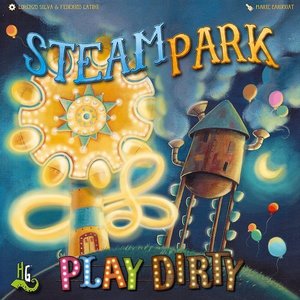
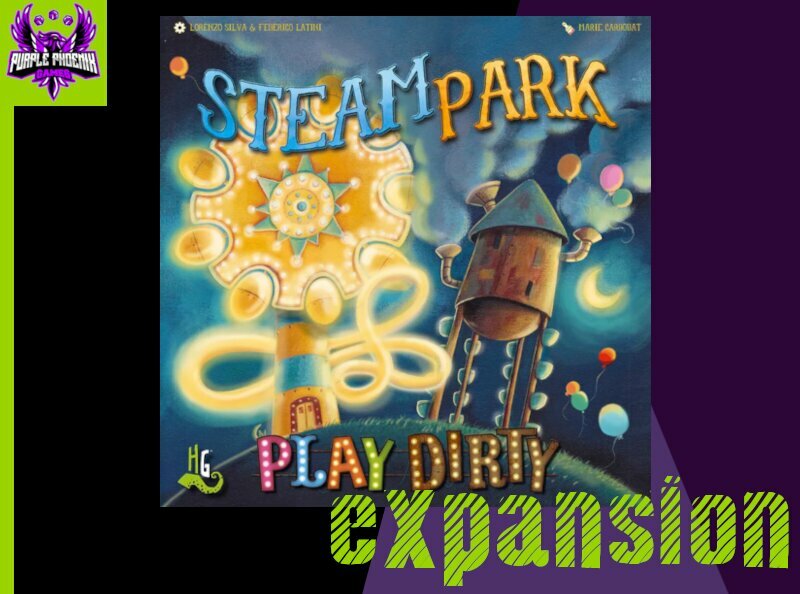
This breakdown is for the action dice-rolling and them park-building game Steam Park’s modular expansion, Play Dirty (as in dirt, not as in adult themes). Play Dirty is a modular expansion, so some modules may be added or left out depending on comfort level and enjoyment of each module.
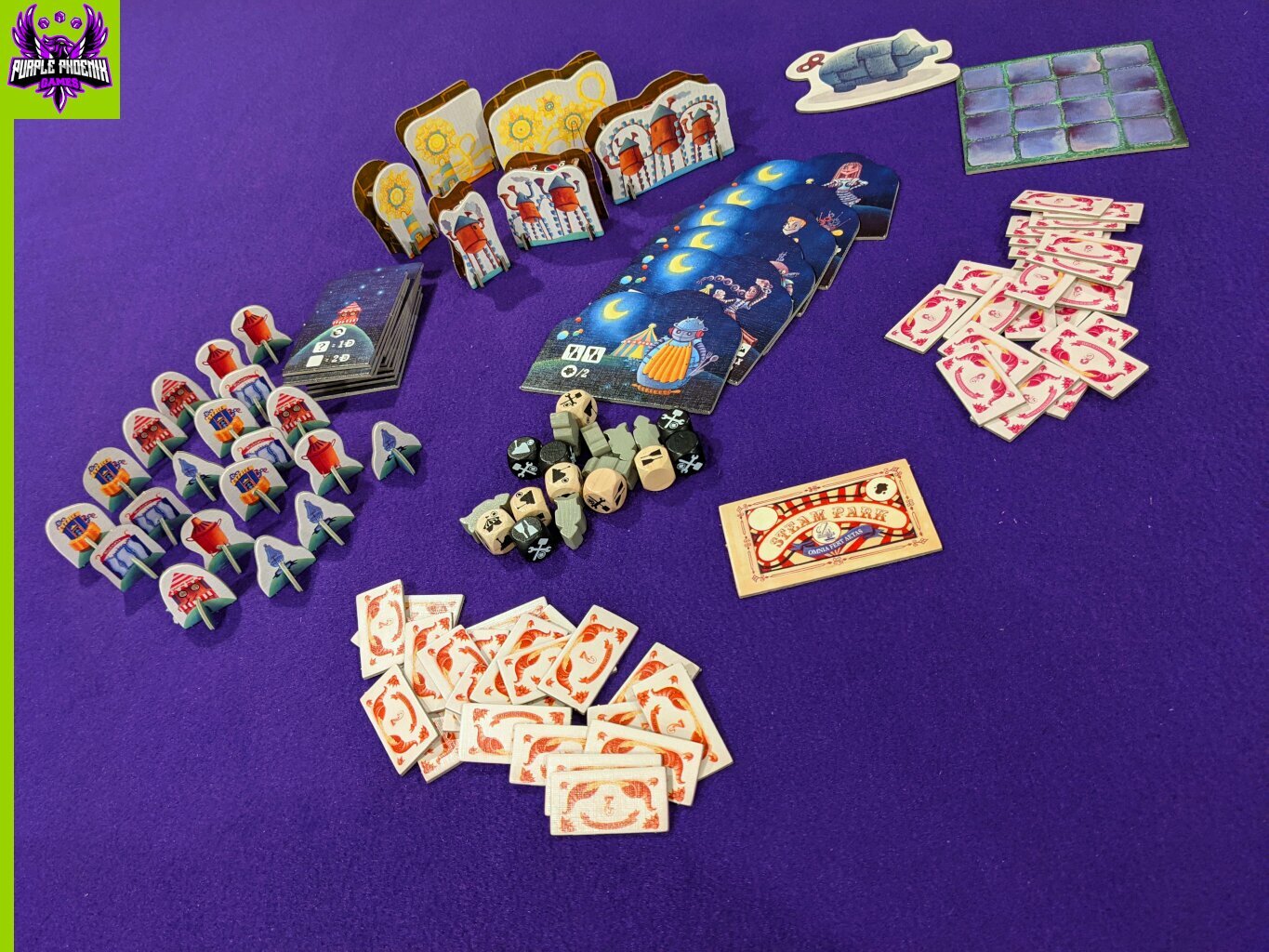
One major module added to this expansion is the addition of a fifth player to Steam Park. As if Steam Park wasn’t frantic enough with four, go ahead and throw in a fifth set of hands going crazy at the table! Also included are gray “Stingy Visitors,” which act as wild visitor types for color, but provide one less Danari (currency in Steam Park) but create NO DIRT. Excellent! Play Dirty also includes a new set of five stands for robots to do business: Fountain, Hall of Mirrors, Office, Shooting Gallery, and Incinerator. Along with these new stands are a set of stand reference tiles to remind players what each stand actually does in the game. Very handy.
The biggest difference-makers in the expansion box are the Ride Extensions, Park Directors, and Espionage Dice. Ride Extensions do just that – extend existing rides in one’s park, but the two different colored extensions (golden and rusty) have their own rules that are triggered depending on colors of robots upon them. The Park Directors module adds a new twist that changes the rules for an aspect of the base game for all players throughout the entire game. These are very powerful changes, and one Park Director is chosen to be used at the beginning of each game. Espionage Dice are very special in that one is added to each player’s white dice and rolled as normal throughout the game. However, the Espionage Dice cost 4 Danari to activate after the Roll Phase. The power here is that the player using the die pays one Danari less to use it when matching the face of white dice in their opponent’s pig sitting to their right. For example, to use a Build Stand face on Espionage Die will cost four Danari normally. However, should the opponent on the right have four Build Stand symbols showing on their white dice, the Espionage Die activates for free!
Must you own the Play Dirty expansion to truly enjoy your plays of Steam Park? Not at all. I do very much enjoy several of the modules in the box though. I really enjoy the powerful Park Directors because it freshens up a rule from the base game or modifies it in interesting ways. I like the new Stands that come in the box as well for additional options during play, but you MUST use the reference tiles, especially if combining all 10 Stands. The other modules are fine, but I would have been happy with just the ones I mentioned here.
Official recommendation: I remember my first play of Steam Park and falling in love with it right away. I have never felt stagnation in my future plays, but adding Play Dirty certainly is a game-changer in every sense of the term. I say definitely pick it up if you are feeling the base game no longer gives you the excitement and frenzy it once did.
This breakdown is for the action dice-rolling and them park-building game Steam Park’s modular expansion, Play Dirty (as in dirt, not as in adult themes). Play Dirty is a modular expansion, so some modules may be added or left out depending on comfort level and enjoyment of each module.
One major module added to this expansion is the addition of a fifth player to Steam Park. As if Steam Park wasn’t frantic enough with four, go ahead and throw in a fifth set of hands going crazy at the table! Also included are gray “Stingy Visitors,” which act as wild visitor types for color, but provide one less Danari (currency in Steam Park) but create NO DIRT. Excellent! Play Dirty also includes a new set of five stands for robots to do business: Fountain, Hall of Mirrors, Office, Shooting Gallery, and Incinerator. Along with these new stands are a set of stand reference tiles to remind players what each stand actually does in the game. Very handy.
The biggest difference-makers in the expansion box are the Ride Extensions, Park Directors, and Espionage Dice. Ride Extensions do just that – extend existing rides in one’s park, but the two different colored extensions (golden and rusty) have their own rules that are triggered depending on colors of robots upon them. The Park Directors module adds a new twist that changes the rules for an aspect of the base game for all players throughout the entire game. These are very powerful changes, and one Park Director is chosen to be used at the beginning of each game. Espionage Dice are very special in that one is added to each player’s white dice and rolled as normal throughout the game. However, the Espionage Dice cost 4 Danari to activate after the Roll Phase. The power here is that the player using the die pays one Danari less to use it when matching the face of white dice in their opponent’s pig sitting to their right. For example, to use a Build Stand face on Espionage Die will cost four Danari normally. However, should the opponent on the right have four Build Stand symbols showing on their white dice, the Espionage Die activates for free!
Must you own the Play Dirty expansion to truly enjoy your plays of Steam Park? Not at all. I do very much enjoy several of the modules in the box though. I really enjoy the powerful Park Directors because it freshens up a rule from the base game or modifies it in interesting ways. I like the new Stands that come in the box as well for additional options during play, but you MUST use the reference tiles, especially if combining all 10 Stands. The other modules are fine, but I would have been happy with just the ones I mentioned here.
Official recommendation: I remember my first play of Steam Park and falling in love with it right away. I have never felt stagnation in my future plays, but adding Play Dirty certainly is a game-changer in every sense of the term. I say definitely pick it up if you are feeling the base game no longer gives you the excitement and frenzy it once did.



MLB.com At Bat
Sports and Entertainment
App
LIVE. EVERY MOMENT. Follow the 2017 MLB Postseason live through the 113th World Series with MLB.com...

24/7 Coach Football
Sports and Education
App
24/7 Coach Football: The Professional Coaching App. Now being used across Europe,...