Search
Search results
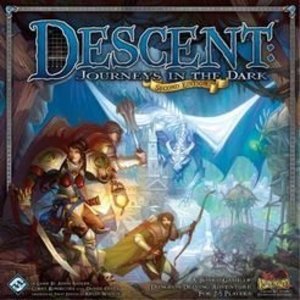
Paul Kellett (118 KP) rated Descent: Journeys in the Dark (Second Edition) in Tabletop Games
May 4, 2019
Plenty of expansions (1 more)
Decent quality miniatures
App can be buggy (1 more)
One side can snowball after a couple of wins
Descent: Journeys In The Dark has been around a long time now, starting as a huge dungeon crawler and morphing into a tactical skirmish / objective-based campaign game. It is supposed to be played with 2-5 players with 1 player being the "Overlord", controlling all the monsters and playing nasty cards on the other players playing the group of heroes (at least 2 heroes required). The game is a fun dice-chucker with a decent amount of strategy and on the whole, well balanced.
With a couple of big-box and half a dozen small-box expansions, not to mention the various hero & monster packs, there is a ton of stuff available and if you own everything, you will be able to choose from 72 heroes with 22 different class decks; fight against 45 different monster types, and encounter around 15 lieutenants over a total of 182 different scenarios. That's plenty to keep you quiet for a while.
So many cards...
Descent: An Overview In The Dark
Descent is a scenario-based game where you work through a tree of different missions, choosing the next one based on whether the heroes or the Overlord worn the last. Each scenario will have specific objectives - anything from stealing an item and reaching the exit to interrogating prisoners and defeating a fearsome Lieutenant of the Overlord. Some of the monsters to be encountered are specified in the scenario text with other free groups able to be chosen from traits specific to that scenario. This gives some variety meaning you will never face exactly the same monsters if you replay the scenarios.
The good players choose a hero from the stack of basic skill types - Fighter, Healer, Scout or Mage and then choose from one of the many class decks for each type so the Fighter could be a Knight or a Berzerker, the Mage a Necromancer and the Healer a Bard, etc. These decks give each hero their skills and form their general strategy.
Meanwhile, the Overlord player chooses one of two Basic decks of cards that will form the base of his defence against the heroes. One deck is more about springing traps while the other has more things to enhance monster attacks. After choosing the basic deck, the Overlord can choose a specialist deck. These can be used to fine tune the Overlord's strategy and at first, only one card is available, the others will be purchased with experience points after each scenario. Finally, if the relevant expansion packs are available, the Overlord can choose a Lieutenant deck which adds further depth to his strategy and also offers the chance to bring a powerful figure into play later in the campaign.
Solo? How So? Redjak has the answer.
With all that going on, it sounds like a fairly daunting if not impossible task to play a solo game of Descent but a fan going by the name of Redjak created two card-driven AI decks - Redjak's Automated Monster Variant (RAMV) and Redjak's Automated Overlord Variant (RAOV). These decks both allow a player, or group of players to play the game as a fully co-operative experience with the cards replacing the Overlord player.
I will say that it is preferable if you have a grasp of the basic rules before jumping into these variants as there can be a lot going on if you are trying to learn the game and the solo rules at the same time. It's probably best to only choose two heroes at first as playing four heroes is more involved but ultimately more rewarding.
These variants are available to download and print out and are also available from the Printer Studio website if you search, although if you are not in the US, then shipping gets expensive.
RAMV
The Monster AI deck is the simpler of the two AI's, being just concerned with the monster actions and leaving out all the Overlord's cards. I haven't played much with this variant but the rules are fairly straightforward. You will set up 4 decks - an Event deck, a Dark Influence deck, a Conditions deck and a Monster deck.
After choosing a scenario to play, you draw cards from the Monster deck, finding ones with icons matching those of the current scenario. This keeps things random and you will always have different things to fight. The selected monster groups will then be placed in "Teams" underneath a row of team cards that will give them their activation order. Finally you will place the encounter objective card for the current scenario. This will give you specific things for each monster group to focus on in terms of stopping you from winning.
You will take your turn alternating hero and monster groups, drawing cards at various points when the monsters should react to attacks, certain scenario triggers ond other in-game events.
It is a fairly simple system but it works really well, giving a solid, straightforward dungeon crawl feel of exploring a map and fighting monsters while trying to complete your quest. Definitely a good starting point and good if you want a 'quick' dungeon crawl.
RAOV
This is the meat, the full experience. Although daunting at first, if you are familiar with the game rules (and have possibly played RAMV a bit), then it will make sense once you get stuck in.
RAOV differs over RAMV in only having one deck, but the rule book is more in depth describing how everything gets played.
You set up as normal, decide on what decks the Overlord will be playing with, draw his starting hand of cards placing them face up on the table. (This variant uses D10 dice anytime you have to make selections)
and take all your heroes actions. If at any point one of your actions would trigger an Overlord card, then that card is played and discarded. Having an open hand means that there are fewer surprises and the Overlord cant be as evil as a human player would be, but it is still tricky and knowing what cards might trigger forces you to think about your strategy in a different way.
Once the heroes have all activated, then the Overlord take its turn, playing any cards that would trigger at the start of the turn. Then, you flip over the top card of the AI deck and activate the first monster group. These cards have a primary target, shown by the corresponding hero symbol and several secondary targets. This gives the monster a focus for its actions. The main text of the card is a list of actions and essentially you work down the list doing whatever actions you are able. Each monster that activates will draw a new card and follow it's orders.
That in a nutshell is it. The Overlord's cards will trigger at the first available opportunity and the monsters will follow a list of options. Once you get used to it, it flows really well and doesn't feel too fiddly at all.
An Open Dungeon
As well as the two AI variants, Redjak also created Delven Deep - a deck of cards each displaying a different map tile that you can use to play a completely randomly generated dungeon crawl. I have yet to try this out, but it is another option if you don't fancy playing through a scripted scenario and just want to explore a random map, killing things.
For The Digital Generation
Fantasy Flight Games have also released an official, free companion app on Android, Steam and IOS that will take control of the Overlord player. This app comes with, I think 2 campaigns - a short training story and a larger, full campaign. Other campaigns a random dungeon generator are available to purchase in the app. None of the printed scenarios are playable using this app and it doesn't use any of the overlord cards, plot decks, event cards or encounter cards.
I will say that I am not a fan of apps for board games and it was actually this app in particular that soured me on the whole idea. Many people really enjoy this app and it has breathed a new lease of life into the game, but unfortunately on my first playthrough, it decided to crash near to the end of a campaign and I essentially lost 6 hours of gaming. I would have had to start all over again from the beginning. That was not a fun experience and put me off completely.
The app borrows heavily from Redjak's work, giving you a list of options to work through when activating the monsters, and various other triggers. Unlike the printed scenarios, all the maps in the digital stories are hidden until you explore them, so you never know what you will encounter. Also, there is a hidden timer in the program that means if you take too long exploring, fighting or whatever, then the game will start throwing nastier and nastier events at you. This makes the game much more of a race than its cardboard cousin and ramps up the difficulty at a fast pace making you feel like you never have enough time to do what you want.
In My opinion, RAOV is the best way to play Descent solo. It uses absolutely everything in the box and gives the most realistic feeling of playing the complete game.
With a couple of big-box and half a dozen small-box expansions, not to mention the various hero & monster packs, there is a ton of stuff available and if you own everything, you will be able to choose from 72 heroes with 22 different class decks; fight against 45 different monster types, and encounter around 15 lieutenants over a total of 182 different scenarios. That's plenty to keep you quiet for a while.
So many cards...
Descent: An Overview In The Dark
Descent is a scenario-based game where you work through a tree of different missions, choosing the next one based on whether the heroes or the Overlord worn the last. Each scenario will have specific objectives - anything from stealing an item and reaching the exit to interrogating prisoners and defeating a fearsome Lieutenant of the Overlord. Some of the monsters to be encountered are specified in the scenario text with other free groups able to be chosen from traits specific to that scenario. This gives some variety meaning you will never face exactly the same monsters if you replay the scenarios.
The good players choose a hero from the stack of basic skill types - Fighter, Healer, Scout or Mage and then choose from one of the many class decks for each type so the Fighter could be a Knight or a Berzerker, the Mage a Necromancer and the Healer a Bard, etc. These decks give each hero their skills and form their general strategy.
Meanwhile, the Overlord player chooses one of two Basic decks of cards that will form the base of his defence against the heroes. One deck is more about springing traps while the other has more things to enhance monster attacks. After choosing the basic deck, the Overlord can choose a specialist deck. These can be used to fine tune the Overlord's strategy and at first, only one card is available, the others will be purchased with experience points after each scenario. Finally, if the relevant expansion packs are available, the Overlord can choose a Lieutenant deck which adds further depth to his strategy and also offers the chance to bring a powerful figure into play later in the campaign.
Solo? How So? Redjak has the answer.
With all that going on, it sounds like a fairly daunting if not impossible task to play a solo game of Descent but a fan going by the name of Redjak created two card-driven AI decks - Redjak's Automated Monster Variant (RAMV) and Redjak's Automated Overlord Variant (RAOV). These decks both allow a player, or group of players to play the game as a fully co-operative experience with the cards replacing the Overlord player.
I will say that it is preferable if you have a grasp of the basic rules before jumping into these variants as there can be a lot going on if you are trying to learn the game and the solo rules at the same time. It's probably best to only choose two heroes at first as playing four heroes is more involved but ultimately more rewarding.
These variants are available to download and print out and are also available from the Printer Studio website if you search, although if you are not in the US, then shipping gets expensive.
RAMV
The Monster AI deck is the simpler of the two AI's, being just concerned with the monster actions and leaving out all the Overlord's cards. I haven't played much with this variant but the rules are fairly straightforward. You will set up 4 decks - an Event deck, a Dark Influence deck, a Conditions deck and a Monster deck.
After choosing a scenario to play, you draw cards from the Monster deck, finding ones with icons matching those of the current scenario. This keeps things random and you will always have different things to fight. The selected monster groups will then be placed in "Teams" underneath a row of team cards that will give them their activation order. Finally you will place the encounter objective card for the current scenario. This will give you specific things for each monster group to focus on in terms of stopping you from winning.
You will take your turn alternating hero and monster groups, drawing cards at various points when the monsters should react to attacks, certain scenario triggers ond other in-game events.
It is a fairly simple system but it works really well, giving a solid, straightforward dungeon crawl feel of exploring a map and fighting monsters while trying to complete your quest. Definitely a good starting point and good if you want a 'quick' dungeon crawl.
RAOV
This is the meat, the full experience. Although daunting at first, if you are familiar with the game rules (and have possibly played RAMV a bit), then it will make sense once you get stuck in.
RAOV differs over RAMV in only having one deck, but the rule book is more in depth describing how everything gets played.
You set up as normal, decide on what decks the Overlord will be playing with, draw his starting hand of cards placing them face up on the table. (This variant uses D10 dice anytime you have to make selections)
and take all your heroes actions. If at any point one of your actions would trigger an Overlord card, then that card is played and discarded. Having an open hand means that there are fewer surprises and the Overlord cant be as evil as a human player would be, but it is still tricky and knowing what cards might trigger forces you to think about your strategy in a different way.
Once the heroes have all activated, then the Overlord take its turn, playing any cards that would trigger at the start of the turn. Then, you flip over the top card of the AI deck and activate the first monster group. These cards have a primary target, shown by the corresponding hero symbol and several secondary targets. This gives the monster a focus for its actions. The main text of the card is a list of actions and essentially you work down the list doing whatever actions you are able. Each monster that activates will draw a new card and follow it's orders.
That in a nutshell is it. The Overlord's cards will trigger at the first available opportunity and the monsters will follow a list of options. Once you get used to it, it flows really well and doesn't feel too fiddly at all.
An Open Dungeon
As well as the two AI variants, Redjak also created Delven Deep - a deck of cards each displaying a different map tile that you can use to play a completely randomly generated dungeon crawl. I have yet to try this out, but it is another option if you don't fancy playing through a scripted scenario and just want to explore a random map, killing things.
For The Digital Generation
Fantasy Flight Games have also released an official, free companion app on Android, Steam and IOS that will take control of the Overlord player. This app comes with, I think 2 campaigns - a short training story and a larger, full campaign. Other campaigns a random dungeon generator are available to purchase in the app. None of the printed scenarios are playable using this app and it doesn't use any of the overlord cards, plot decks, event cards or encounter cards.
I will say that I am not a fan of apps for board games and it was actually this app in particular that soured me on the whole idea. Many people really enjoy this app and it has breathed a new lease of life into the game, but unfortunately on my first playthrough, it decided to crash near to the end of a campaign and I essentially lost 6 hours of gaming. I would have had to start all over again from the beginning. That was not a fun experience and put me off completely.
The app borrows heavily from Redjak's work, giving you a list of options to work through when activating the monsters, and various other triggers. Unlike the printed scenarios, all the maps in the digital stories are hidden until you explore them, so you never know what you will encounter. Also, there is a hidden timer in the program that means if you take too long exploring, fighting or whatever, then the game will start throwing nastier and nastier events at you. This makes the game much more of a race than its cardboard cousin and ramps up the difficulty at a fast pace making you feel like you never have enough time to do what you want.
In My opinion, RAOV is the best way to play Descent solo. It uses absolutely everything in the box and gives the most realistic feeling of playing the complete game.
Purple Phoenix Games (2266 KP) rated Fray: Champions of the Everyverse in Tabletop Games
Jul 1, 2020
Welcome to the Grand Center – an arena of elite combat. As a Watcher, it is your job to bring forth Champions to fight in the ultimate battle royale of the every-verse. It matters not from what time-period your Champion hails, or what fighting styles they possess – if their realm exists, they are viable candidates. Can your Champions collect valuable loot and knock opponents out of the running? Or will they fail to rise above the Fray? The last team standing wins, so put your Champions to the test and claim glory for yourself!
DISCLAIMER: We were provided a prototype copy of this game for the purposes of this review. These are preview copy components, and I do not know for sure if the final components will be any different from these shown. Also, it is not my intention to detail every rule in the game, as there are just too many. You are invited to download the rulebook, back the game through the pending Kickstarter campaign, purchase it from your FLGS, or through any retailers stocking it after fulfillment. -L
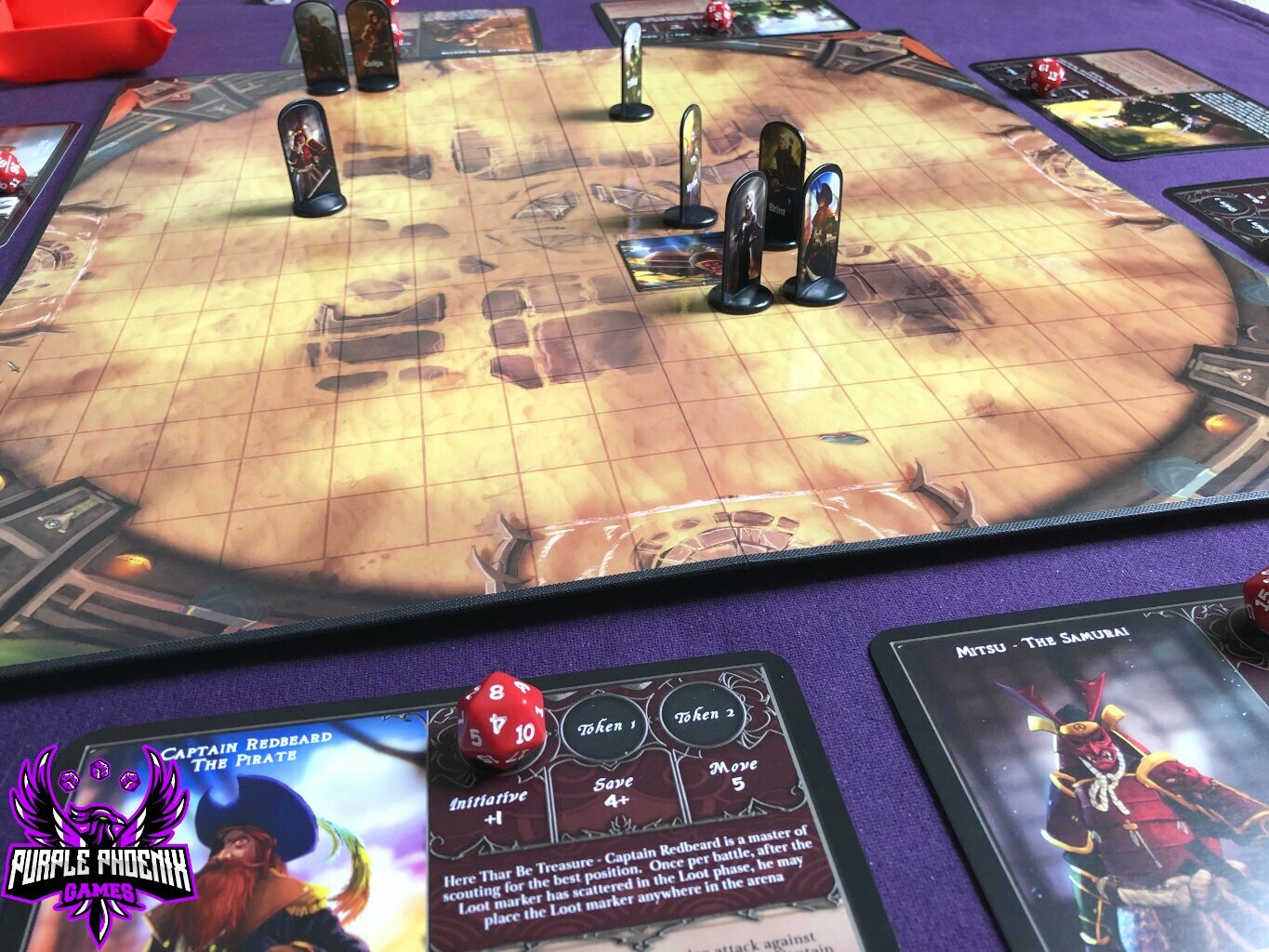
Fray: Champions of the Every-Verse (referred to as just Fray from now on) is a game of dice rolling, grid movement, and fighting in which players are trying to eliminate all opponents and be the last remaining player in the arena. Before setting up to play, you must first determine how many Champions each player will control. Controlling only 1 Champion is considered “Single Mode” and makes for a quicker play-time. Players can control up to 3 Champions in a single game. After determining how many Champions each player will control, set up the game as described in the rulebook. You are now ready to begin!
A game of Fray is divided into a number of rounds, and to begin each round, all players must select one of their Champions to be the round leader, then roll a d6, and add the appropriate Initiative modifier. This determines the turn order for the round – the highest Initiative gets to go first, and so on in descending numerical order. It is important to note that in future rounds when determining Initiative, you may not select the same Champion to lead for consecutive rounds. After Initiative has been determined, player turns begin. On your turn, you will perform 2 Phases: an Item Phase and a Champion Phase. During the Item Phase, you have the opportunity to play as many Item cards from your hand as you wish. Item cards can give you special abilities or buffs for future turns, or can be played as reactions to opponent’s actions, depending on the card.
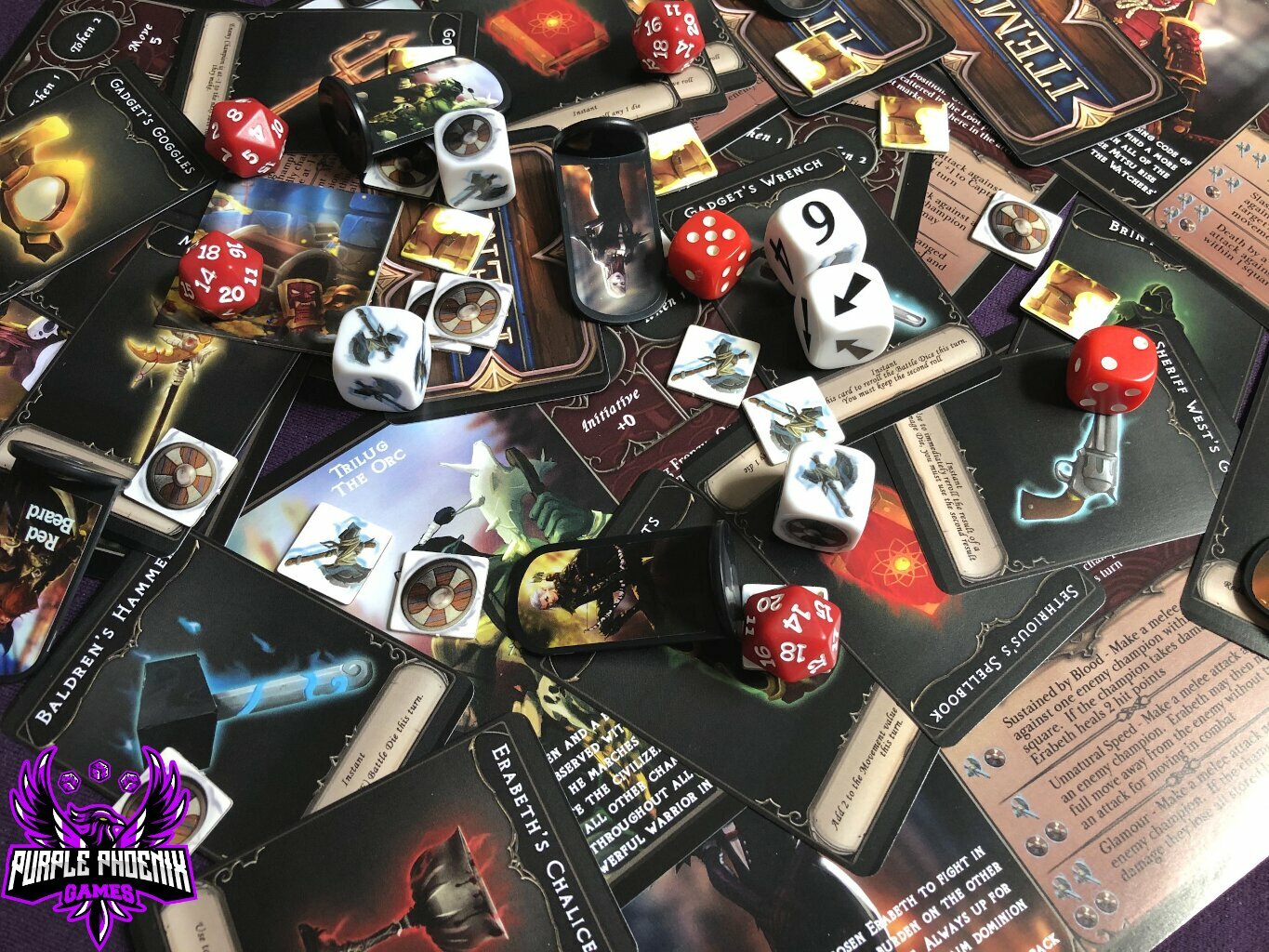
Once your Item Phase is done, you move to the Champion Phase. To begin your Champion Phase, choose which Champion you are using and roll the 3 Battle Dice. These dice help activate abilities on your turn. The chosen Champion may now move a number of squares as stated on their card. After movement, your Champion can now activate 1 action from the following: Attack, Defend, or Champion Ability. All actions require you to spend a number of resources in order to perform them, so this is where the Battle Dice come into play. Once you have performed your action, resolve abilities as needed (rolling a save against an attack, rolling the damage die, etc.). If, after resolving abilities, you still have unused Battle Dice, you can choose to store up to 2 of them for use on your next turn. You then repeat the entire Champion Phase with your next available Champion. Once you have used all of your Champions, your turn ends.
After all players have had their turns in a round, you move to the Loot Phase. Any player with any Champion within 3 spaces of the Loot Marker on the board gets to draw 1 Loot card. The first player then rolls a d6 and the Scatter die, and moves the Loot Marker appropriately for the next round. The new round is ready to begin, with all players rolling for Initiative once again. During play, if a Champion is reduced to 0 hit points, that Champion leaves the game. The player with the last remaining Champion on the board is the winner!
Ok, I know that seems like a lot, but the gameplay is actually pretty intuitive and streamlined. Here’s how a turn breaks down: play Item cards, roll Battle Dice, move Champion, perform 1 action, resolve, repeat with your other Champions, turn ends. That’s it! After going through the steps with my first Champion, the process just clicked and the gameplay flowed pretty seamlessly. It admittedly seemed pretty daunting at first when I was reading through the rules, but in the actual game, it is easy to pick up.
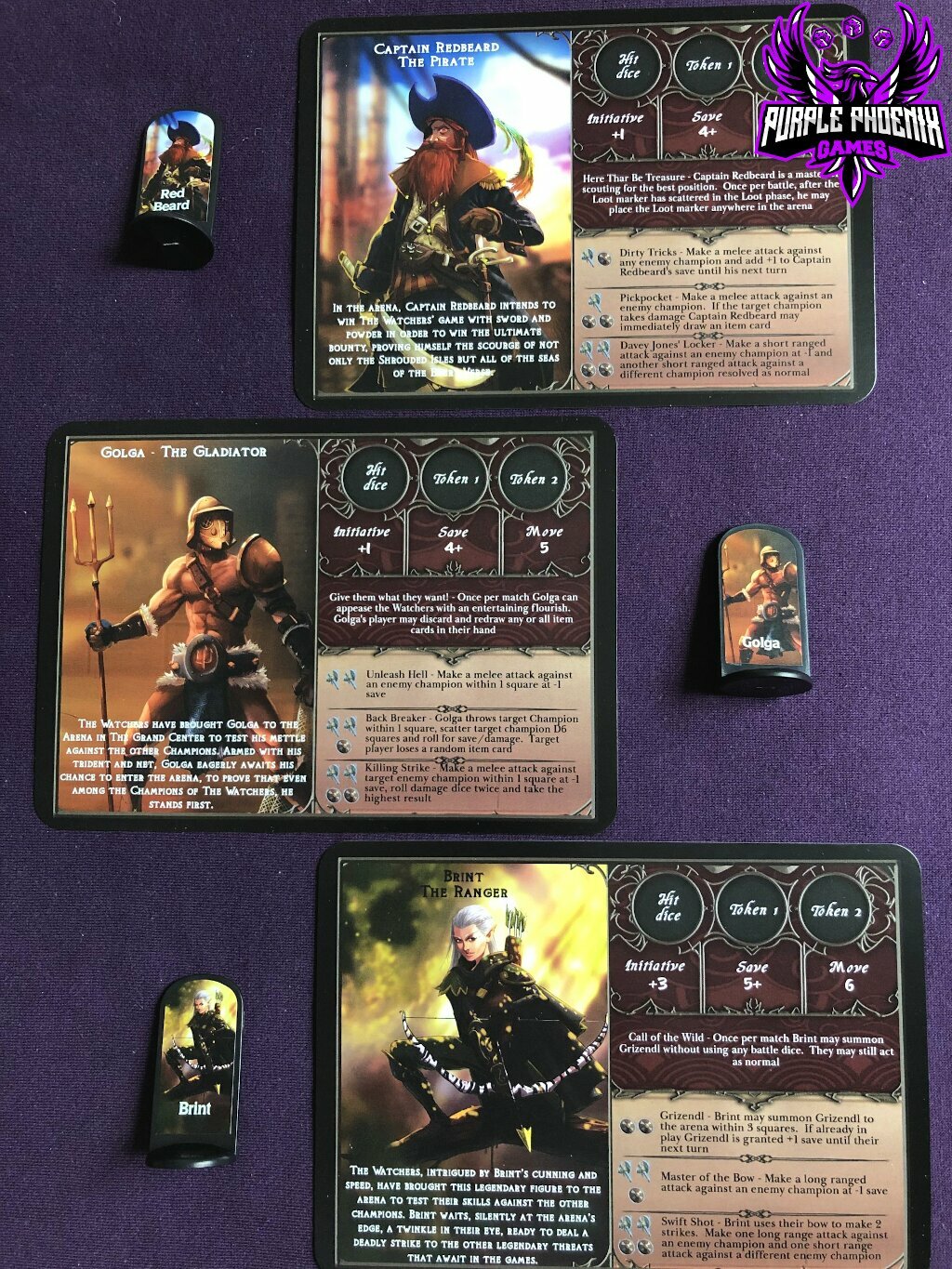
With the purpose of this game being knocking out all your opponents, obviously strategy is a pretty big aspect of the gameplay. All Champions have special abilities, attack combos, and types of attacks. Some Champions are only melee fighters and can interact with opponents 1 square away, others are only short- or long-ranged and must be at a distance to attack, and some have the option to be either melee or ranged. Each Champion requires a bit of a different strategy to be played successfully, and you’ve got to be able to adapt on the fly. That being said, this is a competitive combat game, so some players might not like being pitted directly against opponents and being targeted by others. The other strategic aspect to consider is the location of the Loot Marker on the board. The only way you ever get to draw Item cards is if you are within 3 squares of the Loot Marker at the end of the round. Are you willing to risk combat for a chance to gain an Item card? Or are you content with skirting the battlefield and letting your opponents take each other out? All things to consider when playing Fray.
The biggest drawback of Fray for me has to do with some components, or lack thereof. But as I stated earlier, this is only a prototype copy of the game, and I am sure that these things will be addressed in the final production copies! For starters, I’d like to see Turn Order Markers. Since the turn order varies each round based on Initiative, it would be nice to have some numbered markers to help players keep track of the order for the round. Along those lines, maybe a Turn Order Reference card for players could be added as well. The turn steps are generally pretty straightforward, but just having a reminder of the different types of movement, or what resources are required for which actions would be nice. And my final consideration for edits would be to include on each Champion card whether that Champion is a melee, short-ranged, or long-ranged fighter. That breakdown is in the rulebook, but having it on the card would be beneficial as well! Besides those three notes, the components of this prototype copy are phenomenal. The board, cards, and chits are all nice and sturdy. All of the game dice are high quality and easy to read. I know Brain Sandwich Games has plans for sculpted minis for the Champions, but even the simple standees in this copy are easily identifiable and will withstand many plays. The art of the cards is very detailed and awesome to look at. All in all, already a pretty great quality game!
Ultimately, I think Fray is a great game. It may need a little polishing up with some components, but the current gameplay is ready for production. I am not typically someone who enjoys directly competitive games, but Fray was one that I thoroughly loved. It has enough elements of strategy, combat, and luck of the dice rolls that it doesn’t feel targeting or confrontational. I am eager to follow the Kickstarter campaign and see what else Brain Sandwich Games has in store for an already awesome game! I would definitely recommend checking this one out – it’s a unique twist on a standard arena combat game.
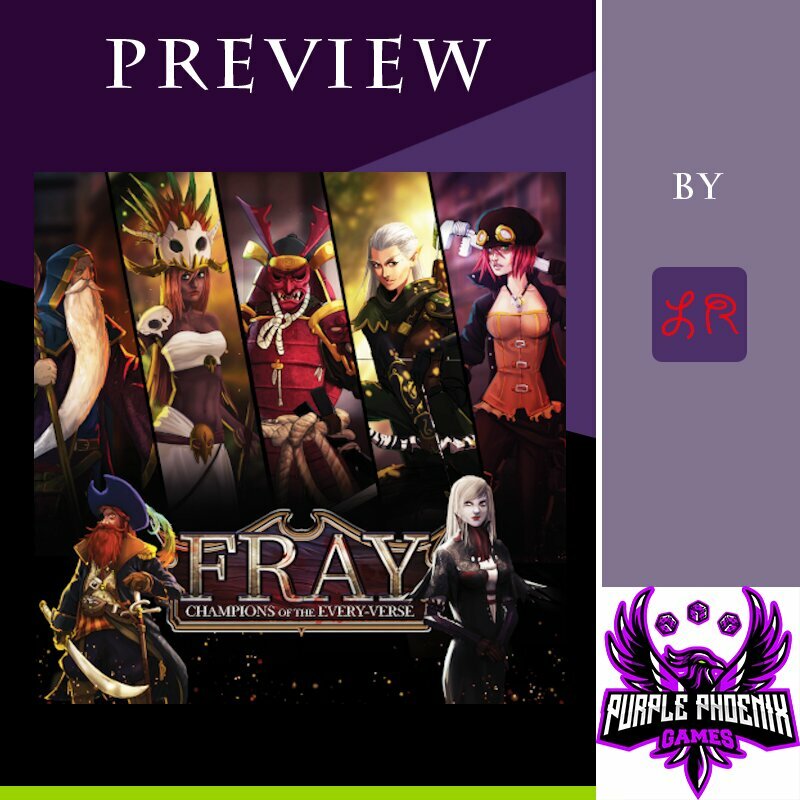
DISCLAIMER: We were provided a prototype copy of this game for the purposes of this review. These are preview copy components, and I do not know for sure if the final components will be any different from these shown. Also, it is not my intention to detail every rule in the game, as there are just too many. You are invited to download the rulebook, back the game through the pending Kickstarter campaign, purchase it from your FLGS, or through any retailers stocking it after fulfillment. -L
Fray: Champions of the Every-Verse (referred to as just Fray from now on) is a game of dice rolling, grid movement, and fighting in which players are trying to eliminate all opponents and be the last remaining player in the arena. Before setting up to play, you must first determine how many Champions each player will control. Controlling only 1 Champion is considered “Single Mode” and makes for a quicker play-time. Players can control up to 3 Champions in a single game. After determining how many Champions each player will control, set up the game as described in the rulebook. You are now ready to begin!
A game of Fray is divided into a number of rounds, and to begin each round, all players must select one of their Champions to be the round leader, then roll a d6, and add the appropriate Initiative modifier. This determines the turn order for the round – the highest Initiative gets to go first, and so on in descending numerical order. It is important to note that in future rounds when determining Initiative, you may not select the same Champion to lead for consecutive rounds. After Initiative has been determined, player turns begin. On your turn, you will perform 2 Phases: an Item Phase and a Champion Phase. During the Item Phase, you have the opportunity to play as many Item cards from your hand as you wish. Item cards can give you special abilities or buffs for future turns, or can be played as reactions to opponent’s actions, depending on the card.
Once your Item Phase is done, you move to the Champion Phase. To begin your Champion Phase, choose which Champion you are using and roll the 3 Battle Dice. These dice help activate abilities on your turn. The chosen Champion may now move a number of squares as stated on their card. After movement, your Champion can now activate 1 action from the following: Attack, Defend, or Champion Ability. All actions require you to spend a number of resources in order to perform them, so this is where the Battle Dice come into play. Once you have performed your action, resolve abilities as needed (rolling a save against an attack, rolling the damage die, etc.). If, after resolving abilities, you still have unused Battle Dice, you can choose to store up to 2 of them for use on your next turn. You then repeat the entire Champion Phase with your next available Champion. Once you have used all of your Champions, your turn ends.
After all players have had their turns in a round, you move to the Loot Phase. Any player with any Champion within 3 spaces of the Loot Marker on the board gets to draw 1 Loot card. The first player then rolls a d6 and the Scatter die, and moves the Loot Marker appropriately for the next round. The new round is ready to begin, with all players rolling for Initiative once again. During play, if a Champion is reduced to 0 hit points, that Champion leaves the game. The player with the last remaining Champion on the board is the winner!
Ok, I know that seems like a lot, but the gameplay is actually pretty intuitive and streamlined. Here’s how a turn breaks down: play Item cards, roll Battle Dice, move Champion, perform 1 action, resolve, repeat with your other Champions, turn ends. That’s it! After going through the steps with my first Champion, the process just clicked and the gameplay flowed pretty seamlessly. It admittedly seemed pretty daunting at first when I was reading through the rules, but in the actual game, it is easy to pick up.
With the purpose of this game being knocking out all your opponents, obviously strategy is a pretty big aspect of the gameplay. All Champions have special abilities, attack combos, and types of attacks. Some Champions are only melee fighters and can interact with opponents 1 square away, others are only short- or long-ranged and must be at a distance to attack, and some have the option to be either melee or ranged. Each Champion requires a bit of a different strategy to be played successfully, and you’ve got to be able to adapt on the fly. That being said, this is a competitive combat game, so some players might not like being pitted directly against opponents and being targeted by others. The other strategic aspect to consider is the location of the Loot Marker on the board. The only way you ever get to draw Item cards is if you are within 3 squares of the Loot Marker at the end of the round. Are you willing to risk combat for a chance to gain an Item card? Or are you content with skirting the battlefield and letting your opponents take each other out? All things to consider when playing Fray.
The biggest drawback of Fray for me has to do with some components, or lack thereof. But as I stated earlier, this is only a prototype copy of the game, and I am sure that these things will be addressed in the final production copies! For starters, I’d like to see Turn Order Markers. Since the turn order varies each round based on Initiative, it would be nice to have some numbered markers to help players keep track of the order for the round. Along those lines, maybe a Turn Order Reference card for players could be added as well. The turn steps are generally pretty straightforward, but just having a reminder of the different types of movement, or what resources are required for which actions would be nice. And my final consideration for edits would be to include on each Champion card whether that Champion is a melee, short-ranged, or long-ranged fighter. That breakdown is in the rulebook, but having it on the card would be beneficial as well! Besides those three notes, the components of this prototype copy are phenomenal. The board, cards, and chits are all nice and sturdy. All of the game dice are high quality and easy to read. I know Brain Sandwich Games has plans for sculpted minis for the Champions, but even the simple standees in this copy are easily identifiable and will withstand many plays. The art of the cards is very detailed and awesome to look at. All in all, already a pretty great quality game!
Ultimately, I think Fray is a great game. It may need a little polishing up with some components, but the current gameplay is ready for production. I am not typically someone who enjoys directly competitive games, but Fray was one that I thoroughly loved. It has enough elements of strategy, combat, and luck of the dice rolls that it doesn’t feel targeting or confrontational. I am eager to follow the Kickstarter campaign and see what else Brain Sandwich Games has in store for an already awesome game! I would definitely recommend checking this one out – it’s a unique twist on a standard arena combat game.
Gareth von Kallenbach (980 KP) rated the PC version of Battleborn in Video Games
Jun 19, 2019
Gearbox and 2K have teamed up yet again create an animated action fest that is filled with colorful characters, humor, and plenty of action. If you thought it was a new entry into the popular Borderlands you would be mistaken although at first glance some might take the similar use of brilliantly cell shaded graphics to be part of the series. That however is where the majority of the similarities end as Battleborn is one of the most frantic and enjoyable action games to come along in a while. I first played the game at E3 last year and was instantly impressed with what I had just played. Subsequent games at PAX Prime and in the early access portion of the game only increased my enjoyment and anticipation for the final product.
The game involves an evil force that has been destroying all the stars in the universe. A team of misfits who specialize in all types of combat known as the “Battleborn” take up the call to save the universe. Accompanying them is a ship captain, and unstable scientist, and is even more unstable A.I, unit who pop up during the campaign with all sorts of humorous commentary to help propel the story along.
The campaign missions for the game are not linear in that players opting to take part of the five player co-op campaigns select which mission they will undertake and at times waiting for a mission that you have not already played does require a bit of patience or for players to leave the party and try again in the matchmaking screen.
Gameplay is of a first-person perspective but in the unique style that players are free to select from 25 playable characters, many of whom unlock as the campaign mode unfolds. There are male, female, and alien characters as well as some other more unique individuals for players to select from. As they go on, players will be able to customize power ups and abilities for players as well as various aspects of their appearance. In the game action, players will have the opportunity to reach 10 different skill levels and each opportunity a new skill or ability that can be deployed during the game and will regenerate itself on a timer after being used.
The key aspect of the game is the variety of the characters as you can go from a slow-moving but massive chain gun wielding character to a clone soldier, a cybernetic butler, a fiendish imp, and so many more. The characters have everything from close quarter and distanced combat abilities and many have support functions as well. This is one of the greatest aspects of the game but also for many one of the biggest tricks in that you have to select a player that best suits your style of play but you are not able to fully comprehend what a character is and is not capable of until you try them in action. Unfortunately once a character is selected, you are required to play them through completion of the mission and do not have the opportunity to change in the middle of a match. I found out the hard way that a selected character did not have much in the way of offensive abilities and therefore had to spend the majority of my match hanging in the background mopping up and offering support whenever needed. This is quite a change from my usual approach of going in the thick of the action and cutting down as many of the enemy forces as I could.
The maps are very clever and creative and have all sorts of things ranging from jump ads which control you will cross the locale, to weapon emplacements were using credits earned from collecting energy shards, players can power up traps and defensive weaponry which will help them with the endless waves of enemies they will encounter.
While there only two main species of enemies, there are plenty of variations amongst them but after a few missions you will have felt that you have seen them all. This is where the clever boss battles come into play and really make the game shine. Players can revive one another should they fall in battle, and also take advantage of various power ups located throughout the map. The missions can take a bit of patience because there is nothing more frustrating than enduring wave after wave of enemies 30 min. into a match and failing a mission because a key locale was left unprotected when a player succumbed to a swarm of enemies while the rest of the team was off defending against a multi-pronged attack.
The developers have promised more characters would be included in future updates and there is also DLC coming that will add new options for players to enjoy.
The game also boasts several multiplayer modes where players can take a break from the campaign and enjoy numerous matches that are more in line with what players might come to expect from a multiplayer experience. There certainly will not be any shortage of options for players as some players will up to play through the campaign with as many different characters as possible, and others like myself will stick to a tried-and-true character and occasionally dabble with one of the others.
The game looks and sounds fantastic and the action as I mentioned is fun, intense, and frequent. I hope that we see plenty of additional Battleborn titles and content in the future as I continue to enjoy the game with its quirky and enjoyable characters and enjoyable premise and gameplay. This is definitely been one of the more enjoyable gaming experiences for me this year and I definitely think it is a game not be missed for fans of this genre.
http://sknr.net/2016/05/23/battleborn/
The game involves an evil force that has been destroying all the stars in the universe. A team of misfits who specialize in all types of combat known as the “Battleborn” take up the call to save the universe. Accompanying them is a ship captain, and unstable scientist, and is even more unstable A.I, unit who pop up during the campaign with all sorts of humorous commentary to help propel the story along.
The campaign missions for the game are not linear in that players opting to take part of the five player co-op campaigns select which mission they will undertake and at times waiting for a mission that you have not already played does require a bit of patience or for players to leave the party and try again in the matchmaking screen.
Gameplay is of a first-person perspective but in the unique style that players are free to select from 25 playable characters, many of whom unlock as the campaign mode unfolds. There are male, female, and alien characters as well as some other more unique individuals for players to select from. As they go on, players will be able to customize power ups and abilities for players as well as various aspects of their appearance. In the game action, players will have the opportunity to reach 10 different skill levels and each opportunity a new skill or ability that can be deployed during the game and will regenerate itself on a timer after being used.
The key aspect of the game is the variety of the characters as you can go from a slow-moving but massive chain gun wielding character to a clone soldier, a cybernetic butler, a fiendish imp, and so many more. The characters have everything from close quarter and distanced combat abilities and many have support functions as well. This is one of the greatest aspects of the game but also for many one of the biggest tricks in that you have to select a player that best suits your style of play but you are not able to fully comprehend what a character is and is not capable of until you try them in action. Unfortunately once a character is selected, you are required to play them through completion of the mission and do not have the opportunity to change in the middle of a match. I found out the hard way that a selected character did not have much in the way of offensive abilities and therefore had to spend the majority of my match hanging in the background mopping up and offering support whenever needed. This is quite a change from my usual approach of going in the thick of the action and cutting down as many of the enemy forces as I could.
The maps are very clever and creative and have all sorts of things ranging from jump ads which control you will cross the locale, to weapon emplacements were using credits earned from collecting energy shards, players can power up traps and defensive weaponry which will help them with the endless waves of enemies they will encounter.
While there only two main species of enemies, there are plenty of variations amongst them but after a few missions you will have felt that you have seen them all. This is where the clever boss battles come into play and really make the game shine. Players can revive one another should they fall in battle, and also take advantage of various power ups located throughout the map. The missions can take a bit of patience because there is nothing more frustrating than enduring wave after wave of enemies 30 min. into a match and failing a mission because a key locale was left unprotected when a player succumbed to a swarm of enemies while the rest of the team was off defending against a multi-pronged attack.
The developers have promised more characters would be included in future updates and there is also DLC coming that will add new options for players to enjoy.
The game also boasts several multiplayer modes where players can take a break from the campaign and enjoy numerous matches that are more in line with what players might come to expect from a multiplayer experience. There certainly will not be any shortage of options for players as some players will up to play through the campaign with as many different characters as possible, and others like myself will stick to a tried-and-true character and occasionally dabble with one of the others.
The game looks and sounds fantastic and the action as I mentioned is fun, intense, and frequent. I hope that we see plenty of additional Battleborn titles and content in the future as I continue to enjoy the game with its quirky and enjoyable characters and enjoyable premise and gameplay. This is definitely been one of the more enjoyable gaming experiences for me this year and I definitely think it is a game not be missed for fans of this genre.
http://sknr.net/2016/05/23/battleborn/
Purple Phoenix Games (2266 KP) rated Elder Sign in Tabletop Games
Jul 16, 2019 (Updated Aug 21, 2019)
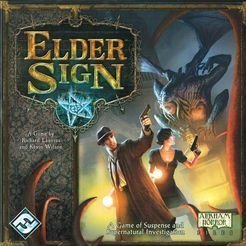
One of the best parts of the board gaming experience is finding a fun group of people with whom to play! Sometimes, though, coordinating a game night is easier said than done. We all must occasionally forego the group experience and face the world as the Lonely Only. But fear not! The world of solo-play is a vast and exciting realm! What follows is a chronicle of my journey into the solo-playing world – notes on gameplay, mechanics, rules, difficulty, and overall experience with solo variations of commonly multiplayer games! I hope this will provide some insight as you continue to grow your collection, or explore your already owned games!
Disclaimer: There are many expansions for Elder Sign. I do not have any of them, nor do I have any gameplay experience with any of them. If and when I do get them added into my base game, I will either amend this review or write a new one! – L
In Elder Sign, players take on the roles of Investigators who must use their supernatural knowledge and keen wit to seal dimensional portals and prevent the Ancient Ones from entering our world and destroying humanity. Just another day at the office, right? Players take turns rolling dice to fight monsters and complete adventures that will reward them with artifacts, health and/or sanity, clues, or even Elder Signs – the symbols necessary for sealing away the Ancient Ones for good. Be careful, though – if you fail to complete an adventure, you will be harshly punished! I’m talking losing health and sanity, accidentally summoning monsters, or even bringing the Ancient One one step closer to our world! As a solo game, Elder Sign plays the same way as it would in a group setting. The only difference is that the solo player cannot use the ‘Assisting’ ability because there are no other players who can offer you aid. Besides that, gameplay remains the same – even a lone Investigator can put their dice to good use to ward off evil!
I enjoy playing Elder Sign as a solo game. Although mostly dominated by dice rolling, there is a fair amount of strategy required for this game. I don’t feel like I’m mindlessly rolling dice – I have to decide which adventures are attainable with my given items, and which rewards benefit me the most in my overall task. There are rewards and consequences to be weighed with every decision, so action must be taken with great thought. Because of the strategic implications, Elder Sign keeps me thoroughly engaged, even when playing solo, and that’s one reason why I keep coming back to it.
On the flip side, one thing that isn’t my favorite about Elder Sign is its reliance on dice rolls to progress in the game. Yeah, I know, it’s a dice game – what did I expect? Sometimes, though, you just can’t roll to save your life (quite literally, in this game) and that can make the game frustrating to play. A series of poor rolls can feel like they completely negate any strategy you’ve enacted and can unravel your entire plan. On a good dice-rolling day for me, I love this game! On a not-so-good dice-rolling day, I find it a little harder to enjoy myself. But hey – if it was totally easy, it wouldn’t be fun, right? One positive of this, I guess, is that I always have to be adjusting my strategy to take the current dice into account. I can’t just pick one strategy and run with it since almost all outcomes are dependent on the luck of the roll! Elder Sign keeps me on my toes, that’s for sure.
I got Elder Sign from Travis as a birthday present last year, and it has been a good addition to my collection. There is enough going on to keep me engaged the entire game, but not so much that I feel overwhelmed. And yeah, maybe I’m not always the greatest dice-roller, but that just makes me adapt my strategy to deal with the current situation. I have read that adding expansions makes the game even more enjoyable, and hopefully one of these days I’ll get to experience that for myself. For the time being, though, I’m content with the base game. If you enjoy Elder Sign, I recommend you try it solo – it doesn’t feel any different to play, and I think you’ll enjoy it just as much as a group game!
Disclaimer: There are many expansions for Elder Sign. I do not have any of them, nor do I have any gameplay experience with any of them. If and when I do get them added into my base game, I will either amend this review or write a new one! – L
In Elder Sign, players take on the roles of Investigators who must use their supernatural knowledge and keen wit to seal dimensional portals and prevent the Ancient Ones from entering our world and destroying humanity. Just another day at the office, right? Players take turns rolling dice to fight monsters and complete adventures that will reward them with artifacts, health and/or sanity, clues, or even Elder Signs – the symbols necessary for sealing away the Ancient Ones for good. Be careful, though – if you fail to complete an adventure, you will be harshly punished! I’m talking losing health and sanity, accidentally summoning monsters, or even bringing the Ancient One one step closer to our world! As a solo game, Elder Sign plays the same way as it would in a group setting. The only difference is that the solo player cannot use the ‘Assisting’ ability because there are no other players who can offer you aid. Besides that, gameplay remains the same – even a lone Investigator can put their dice to good use to ward off evil!
I enjoy playing Elder Sign as a solo game. Although mostly dominated by dice rolling, there is a fair amount of strategy required for this game. I don’t feel like I’m mindlessly rolling dice – I have to decide which adventures are attainable with my given items, and which rewards benefit me the most in my overall task. There are rewards and consequences to be weighed with every decision, so action must be taken with great thought. Because of the strategic implications, Elder Sign keeps me thoroughly engaged, even when playing solo, and that’s one reason why I keep coming back to it.
On the flip side, one thing that isn’t my favorite about Elder Sign is its reliance on dice rolls to progress in the game. Yeah, I know, it’s a dice game – what did I expect? Sometimes, though, you just can’t roll to save your life (quite literally, in this game) and that can make the game frustrating to play. A series of poor rolls can feel like they completely negate any strategy you’ve enacted and can unravel your entire plan. On a good dice-rolling day for me, I love this game! On a not-so-good dice-rolling day, I find it a little harder to enjoy myself. But hey – if it was totally easy, it wouldn’t be fun, right? One positive of this, I guess, is that I always have to be adjusting my strategy to take the current dice into account. I can’t just pick one strategy and run with it since almost all outcomes are dependent on the luck of the roll! Elder Sign keeps me on my toes, that’s for sure.
I got Elder Sign from Travis as a birthday present last year, and it has been a good addition to my collection. There is enough going on to keep me engaged the entire game, but not so much that I feel overwhelmed. And yeah, maybe I’m not always the greatest dice-roller, but that just makes me adapt my strategy to deal with the current situation. I have read that adding expansions makes the game even more enjoyable, and hopefully one of these days I’ll get to experience that for myself. For the time being, though, I’m content with the base game. If you enjoy Elder Sign, I recommend you try it solo – it doesn’t feel any different to play, and I think you’ll enjoy it just as much as a group game!
Purple Phoenix Games (2266 KP) rated Neon Knights: 2086 in Tabletop Games
Sep 10, 2020
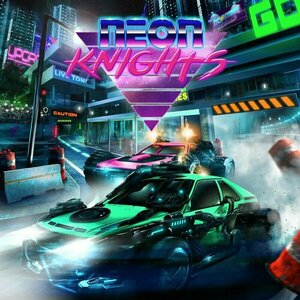
Some of us actually lived through the 1980s. Just barely, but I certainly remember the neon stylizations, the hair, the tight-rolled pants. It’s not a look I ever hope to reincarnate. However, what if the style of the 1980s reappeared in the future? Like in the 2080s? That would be kind of awesome, actually. Or maybe it would be more bodacious or tubular. In any case, some things never go out of style. Things like attacking your fellow racers as they try to pass on the left with their NOS and dangling repair arms. Just me?
Neon Knights 2086 (here forth known as NK) is a car racing game of customization and street battle. The game essentially takes place over three race weeks (rounds) with each week being divided into a preparation period and then the race day itself. The winner of NK is not necessarily the driver who crosses the finish line more often, but rather the driver who wisely invests in upgrades and tempts Lady Luck to be on their side during crucial dice rolls.
DISCLAIMER: We were provided a copy of this game for the purposes of this review. This is a retail copy of the game, so what you see in these photos is exactly what would be received in your box. I do not intend to cover every single rule included in the rulebook, but will describe the overall game flow and major rule set so that our readers may get a sense of how the game plays. For more in depth rules, you may purchase a copy online or from your FLGS. -T
To setup, separate and shuffle each different-backed deck of cards, set them on the board in their places, and display the number of cards equal to the card spaces on the board. Give each player components in their character color, the matching play mat, and starting car parts to be tucked under their mat. Determine the starting player who will construct the first race course out of the provided map chunks and the game may begin!
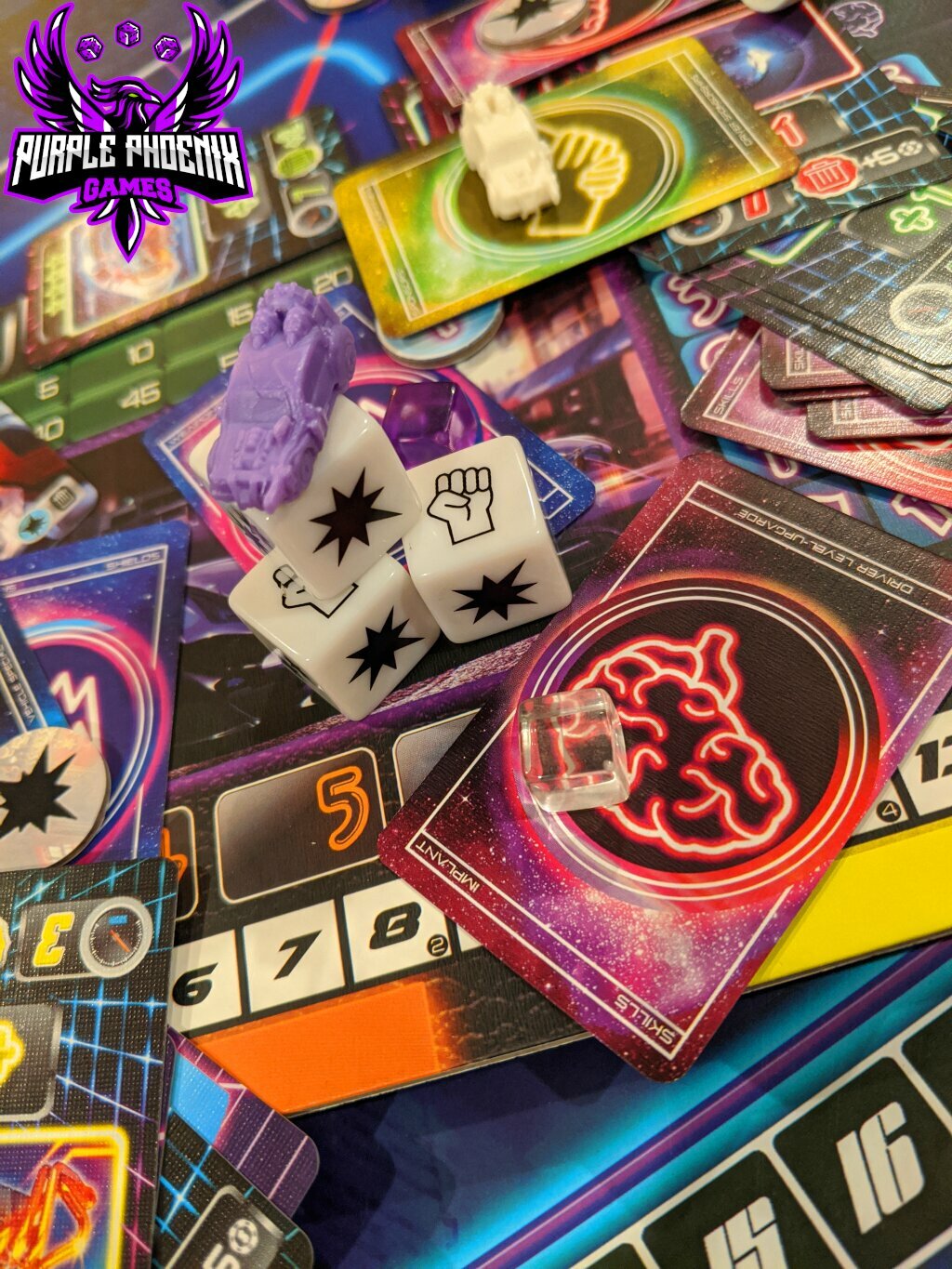
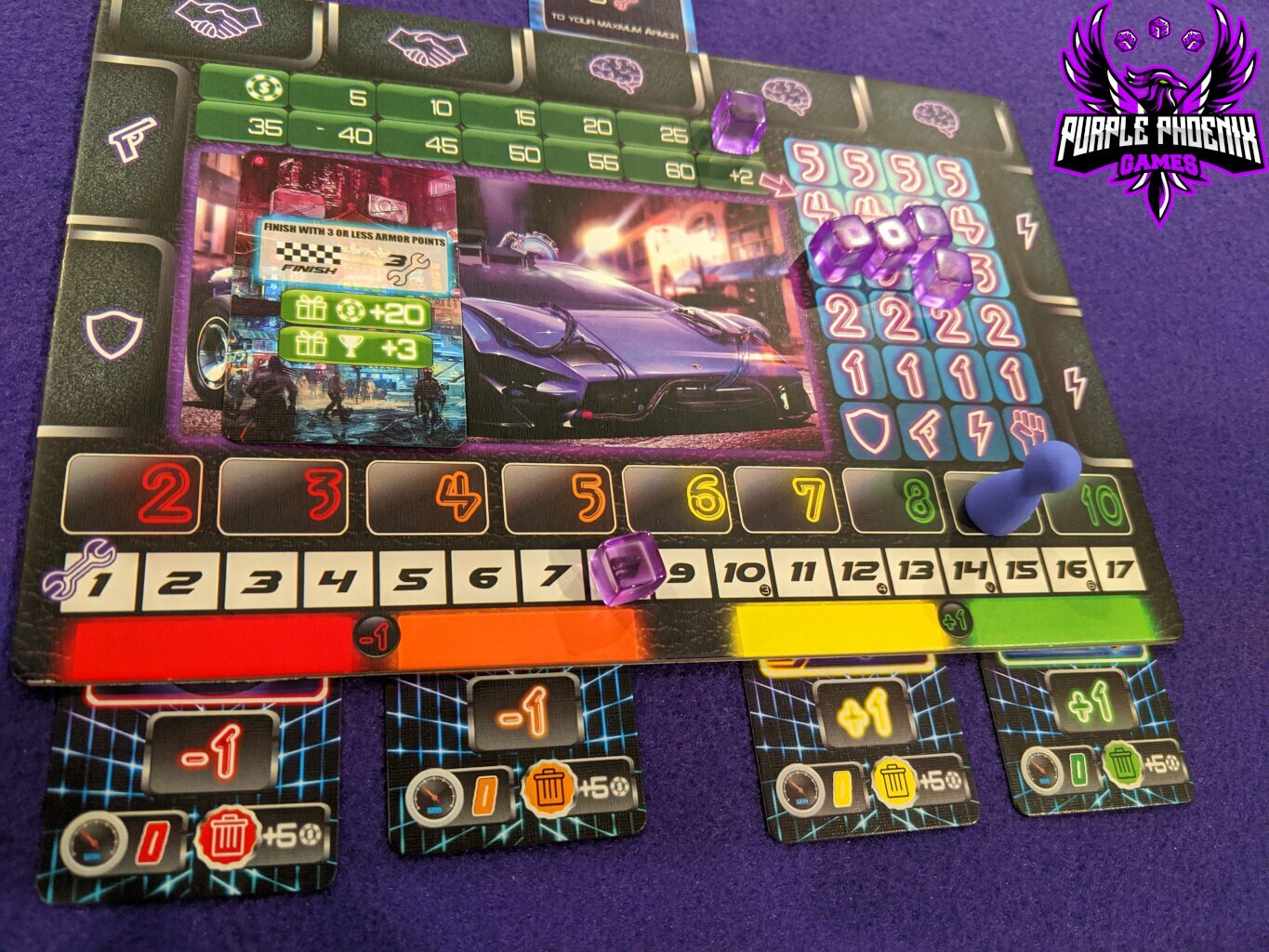
Again, I will not be explaining every rule in the game as there are just too many to cover, but the game is played over three weeks. During the preparation days leading up to the race on day 7 (Sunday I guess), players will be taking actions to draft upgrades to their cars, or implants into their driver’s BRAIN, getting themselves sponsored so they can make bank come pay day, and also accepting bets on how each driver can earn a little extra on the side come race day.
Each day leading up to the race will allow players to complete one action, and pay day is on Day 5. This is when players will be paid out by their sponsors thus allowing players more spending power at the various upgrade shops. However, Race Day looms ahead and drivers will be making sure they have the best car they can afford because racing is a matter of life or death.
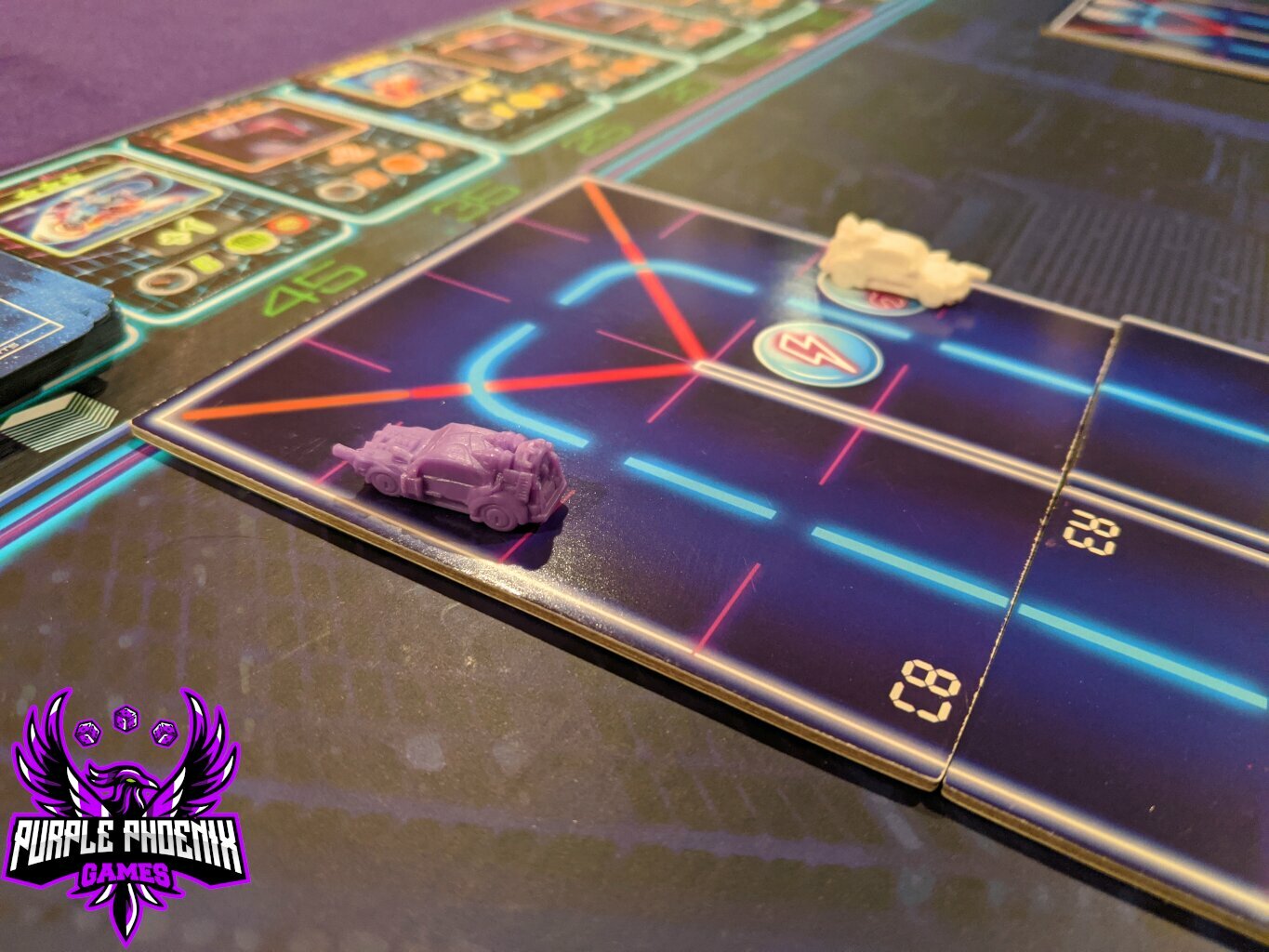
During a race, players will be choosing their initial speed and traveling the course attempting to finish first to gain points, but also to inflict damage on opposing cars and trying to complete their bets they’ve made. Cars will typically travel the number of spaces that the driver has chosen as the speed for the turn, but along the way the cars will be passing over neon lights in the street that are colored according to the suggested speed to overcome them. Go too fast and players will need to roll damage dice to simulate clipping a curb or smashing into a building corner. Go the correct suggested speed or less and pass over the lights no problem and with no damage dice to roll. Of course, car upgrades can assist with this.
When cars end their turn on a space with another car, a battle ensues and damage is calculated. Also, either before or after movement a car can decide to use a weapon on a rival car in range of their weapon to inflict extra damage. After all, a well-damaged car must screech to a halt and possibly use precious resources to repair the damage. Races are flat out bonkers but are the crux of NK. The winner of NK is the player who can amass the most VP at the end of the game and will be able to run a victory lap in the streets.
Components. This game is one of those hefty 12×12 boxes that is packed with goodies. The board is huge. The player components are beautiful and amazing. The player mats are great and laid out really well. The big chunky street map tiles are big and chunky. The colors are perfectly ’80s and perfect for a board game. I have no issues at all with the components. Oh wait, just one little eensy weensy complaint. I wish the font in the rule book was something of the serif variety instead of block all-caps. I felt as if I were being scolded for reading the rules.
All that said, I find Neon Knights 2086 to be a beautiful and relatively quick-playing racing game with the added bonus of car customization akin to that of creating an RPG character (and everyone knows that’s the best part of RPGs). The prep days are super fast to play through because you are basically just taking cards from the offers or drawing cards from the face-down decks to improve your ride, or repairing your car from previous races, and negotiating with sponsors to get those sweet gigs.
The racing, however, is where the game play takes off. It’s here that all the planning and optimizing is put to the test. It’s here where you discover that some of your “upgrades” just ain’t cuttin’ it, and need to be upgraded further. Hopefully a new sweet (and affordable) weapon will come out during the week. Maybe a new sponsor will enter and entice you with tons of money. And then it’s Race Day and you can take your rig out to demolish the competition. Ahh sweet demolition.
This game was a big surprise for me for several reasons. First, I didn’t realize how much I actually enjoyed some of the things from the ’80s. Those colors are just so dang beautiful. That design. So good. But also I just don’t play a lot of car racing games so I was skeptical at first. I’m not a fan of NASCAR so obviously I won’t like any car racing game, right? At least that was my initial thought. Neon Knights 2086 may just have piqued my interest in trying out some other racing titles in the future. For these reasons, Purple Phoenix Games gives this one a bruised 8 / 12. If you are aching for a racing game with battles in the streets and customization in the sheets, check out Neon Knights 2086. I am now a believer, and can’t wait to play this one many more times.
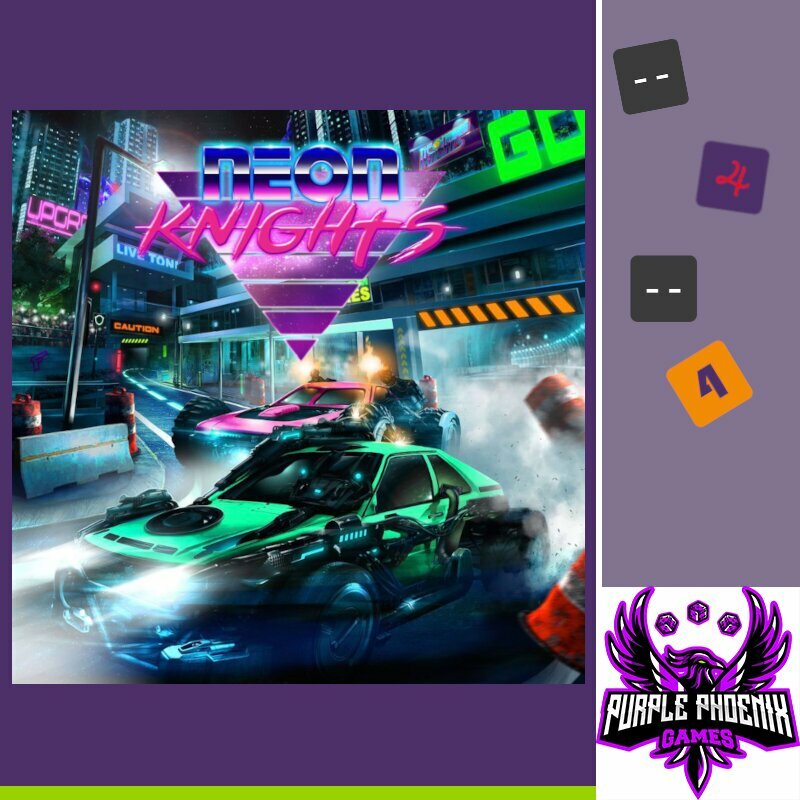
Neon Knights 2086 (here forth known as NK) is a car racing game of customization and street battle. The game essentially takes place over three race weeks (rounds) with each week being divided into a preparation period and then the race day itself. The winner of NK is not necessarily the driver who crosses the finish line more often, but rather the driver who wisely invests in upgrades and tempts Lady Luck to be on their side during crucial dice rolls.
DISCLAIMER: We were provided a copy of this game for the purposes of this review. This is a retail copy of the game, so what you see in these photos is exactly what would be received in your box. I do not intend to cover every single rule included in the rulebook, but will describe the overall game flow and major rule set so that our readers may get a sense of how the game plays. For more in depth rules, you may purchase a copy online or from your FLGS. -T
To setup, separate and shuffle each different-backed deck of cards, set them on the board in their places, and display the number of cards equal to the card spaces on the board. Give each player components in their character color, the matching play mat, and starting car parts to be tucked under their mat. Determine the starting player who will construct the first race course out of the provided map chunks and the game may begin!
Again, I will not be explaining every rule in the game as there are just too many to cover, but the game is played over three weeks. During the preparation days leading up to the race on day 7 (Sunday I guess), players will be taking actions to draft upgrades to their cars, or implants into their driver’s BRAIN, getting themselves sponsored so they can make bank come pay day, and also accepting bets on how each driver can earn a little extra on the side come race day.
Each day leading up to the race will allow players to complete one action, and pay day is on Day 5. This is when players will be paid out by their sponsors thus allowing players more spending power at the various upgrade shops. However, Race Day looms ahead and drivers will be making sure they have the best car they can afford because racing is a matter of life or death.
During a race, players will be choosing their initial speed and traveling the course attempting to finish first to gain points, but also to inflict damage on opposing cars and trying to complete their bets they’ve made. Cars will typically travel the number of spaces that the driver has chosen as the speed for the turn, but along the way the cars will be passing over neon lights in the street that are colored according to the suggested speed to overcome them. Go too fast and players will need to roll damage dice to simulate clipping a curb or smashing into a building corner. Go the correct suggested speed or less and pass over the lights no problem and with no damage dice to roll. Of course, car upgrades can assist with this.
When cars end their turn on a space with another car, a battle ensues and damage is calculated. Also, either before or after movement a car can decide to use a weapon on a rival car in range of their weapon to inflict extra damage. After all, a well-damaged car must screech to a halt and possibly use precious resources to repair the damage. Races are flat out bonkers but are the crux of NK. The winner of NK is the player who can amass the most VP at the end of the game and will be able to run a victory lap in the streets.
Components. This game is one of those hefty 12×12 boxes that is packed with goodies. The board is huge. The player components are beautiful and amazing. The player mats are great and laid out really well. The big chunky street map tiles are big and chunky. The colors are perfectly ’80s and perfect for a board game. I have no issues at all with the components. Oh wait, just one little eensy weensy complaint. I wish the font in the rule book was something of the serif variety instead of block all-caps. I felt as if I were being scolded for reading the rules.
All that said, I find Neon Knights 2086 to be a beautiful and relatively quick-playing racing game with the added bonus of car customization akin to that of creating an RPG character (and everyone knows that’s the best part of RPGs). The prep days are super fast to play through because you are basically just taking cards from the offers or drawing cards from the face-down decks to improve your ride, or repairing your car from previous races, and negotiating with sponsors to get those sweet gigs.
The racing, however, is where the game play takes off. It’s here that all the planning and optimizing is put to the test. It’s here where you discover that some of your “upgrades” just ain’t cuttin’ it, and need to be upgraded further. Hopefully a new sweet (and affordable) weapon will come out during the week. Maybe a new sponsor will enter and entice you with tons of money. And then it’s Race Day and you can take your rig out to demolish the competition. Ahh sweet demolition.
This game was a big surprise for me for several reasons. First, I didn’t realize how much I actually enjoyed some of the things from the ’80s. Those colors are just so dang beautiful. That design. So good. But also I just don’t play a lot of car racing games so I was skeptical at first. I’m not a fan of NASCAR so obviously I won’t like any car racing game, right? At least that was my initial thought. Neon Knights 2086 may just have piqued my interest in trying out some other racing titles in the future. For these reasons, Purple Phoenix Games gives this one a bruised 8 / 12. If you are aching for a racing game with battles in the streets and customization in the sheets, check out Neon Knights 2086. I am now a believer, and can’t wait to play this one many more times.
Purple Phoenix Games (2266 KP) rated Boba Boss in Tabletop Games
Nov 21, 2019 (Updated Nov 21, 2019)

If you are a fan of Purple Phoenix Games then you probably know of our love affair with Happy Salmon. It’s an excellent dexterity card game and it just works in so many different situations. So when I saw the promo video for Boba Boss (linked below) I thought that we might have a contender on our hands. Was I right?
Boba Boss is a quick-playing modular action/dexterity card game of filling your orders for demanding customers of your delicious boba tea. You appease them by filling their order cups with brew, but your opponents are also trying to fill their cups as quickly as possible. Are you able to complete your orders before your competitors?
DISCLAIMER: We were provided a prototype copy of this game for the purposes of this review. These are preview copy components, and I do not know if the final components will be similar or different, or if the Kickstarter campaign will alter or add anything through stretch goals. -T
To setup, you will need to decide which modules of the game you wish to incorporate. The game comes ready to play out of the box for an easier first game. I suggest you play this way to get familiar with how the game plays before you start adding in different modules. Or don’t. I’m not your mother.
Once the game is setup your objective is this: fill all your cups. You do this by frantically flipping cards from your deck hoping to get Straw cards. One straw will fill one cup. Two straws will fill two cups. Play needs to be brisk because the other players are flipping over cards as well and some of them will instruct the player to unflip (re-flip? Probably the same thing…) your readied tea card. This means that you must hope to flip over more straw cards to fill your cups.
There are three ways to play Boba Boss and they all have to do with the spill cards. These are cards that will have text on them in different colors. The three modes of play are identified by using three aspects of the spill cards: splatter color, text color, text text. So a spill card could have a red background (splatter color). If the round is played using splatter color and you flip over one with a red splatter color, you may unflip a readied red cup. The next round you may choose to play these cards with the text color. Each card will also have bubble text in different colors. So maybe that same red splatter card will have green text, so you would unflip a readied green tea card. And the final mode is text text. This means that same card may have the text in green but the word actually spells out “purple,” in which case you will unflip a purple player’s readied tea card. Play continues in this fashion until someone yells, “BOBA!” indicating they have two or less cups to fill. Once a player has filled all their cups they must yell, “BOBA BOSS!” And then they are crowned the victor.
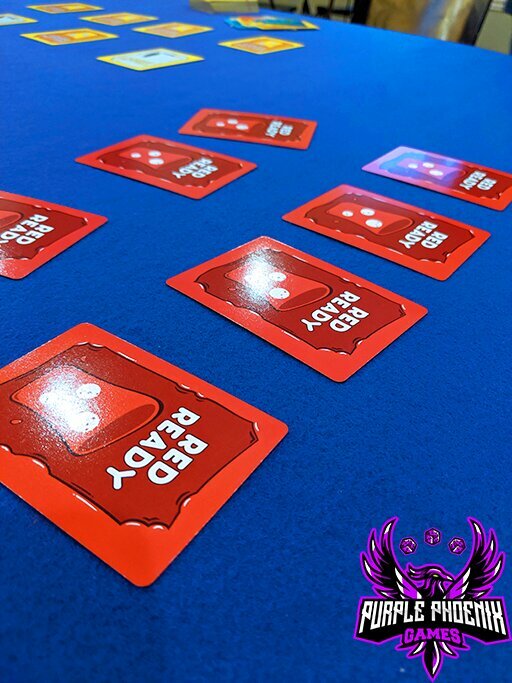
This is just the base base game. Like I said, this game is modular in that you can add different dimensions of difficulty to it to have just a ridiculously confusing and frenzied play experience. One such module will add “optional flavors” to your game to increase the chaos and replayability. One example is shown below – “Karatea” (karate). When you draw and play Karatea you are to kick (flick) another player’s tea cup card where they will need to reset it to continue play. This just increases the time needed for the kicked player to win and just causes mayhem in the process. These extra flavor cards were provided to us but we just could not get all of them into play. The “Royaltea” and “Tea Rex” cards are favorites of ours.
Components. Again, we were provided with a prototype version of this game, so components may end up being very different from what we played with. This game is a box of a ton of cards. Thankfully the cards provided were glossy because they are handled A LOT. The glossy protection will help with survival of the game while being obsessively played. We appreciate that. The art is great on the cards, and the colors are fabulous. No issues with components from us, even in this prototype version.
As if we didn’t already have enough stress in our lives, along comes Boba Boss and makes us sweat in the first 60 seconds. This game is such an adrenaline rush as you are trying to fill customer orders for boba tea. Playing with three different game modes and tons of different cards to be added in modular fashion makes for an excellent balance of chaos and brain adaptation that you just don’t get anywhere else. Honestly, as you can see from our preview, we had so much fun playing that we didn’t have time to take photos of much of the game, but we hope in adding our photo along with a graphic and video from the publisher that you will forgive us. We are very excited to watch this Kickstarter campaign and hopefully our readers will give it a chance. It fills a unique niche and earns a place next to our beloved Happy Salmon. High praise for a great game.

Boba Boss is a quick-playing modular action/dexterity card game of filling your orders for demanding customers of your delicious boba tea. You appease them by filling their order cups with brew, but your opponents are also trying to fill their cups as quickly as possible. Are you able to complete your orders before your competitors?
DISCLAIMER: We were provided a prototype copy of this game for the purposes of this review. These are preview copy components, and I do not know if the final components will be similar or different, or if the Kickstarter campaign will alter or add anything through stretch goals. -T
To setup, you will need to decide which modules of the game you wish to incorporate. The game comes ready to play out of the box for an easier first game. I suggest you play this way to get familiar with how the game plays before you start adding in different modules. Or don’t. I’m not your mother.
Once the game is setup your objective is this: fill all your cups. You do this by frantically flipping cards from your deck hoping to get Straw cards. One straw will fill one cup. Two straws will fill two cups. Play needs to be brisk because the other players are flipping over cards as well and some of them will instruct the player to unflip (re-flip? Probably the same thing…) your readied tea card. This means that you must hope to flip over more straw cards to fill your cups.
There are three ways to play Boba Boss and they all have to do with the spill cards. These are cards that will have text on them in different colors. The three modes of play are identified by using three aspects of the spill cards: splatter color, text color, text text. So a spill card could have a red background (splatter color). If the round is played using splatter color and you flip over one with a red splatter color, you may unflip a readied red cup. The next round you may choose to play these cards with the text color. Each card will also have bubble text in different colors. So maybe that same red splatter card will have green text, so you would unflip a readied green tea card. And the final mode is text text. This means that same card may have the text in green but the word actually spells out “purple,” in which case you will unflip a purple player’s readied tea card. Play continues in this fashion until someone yells, “BOBA!” indicating they have two or less cups to fill. Once a player has filled all their cups they must yell, “BOBA BOSS!” And then they are crowned the victor.
This is just the base base game. Like I said, this game is modular in that you can add different dimensions of difficulty to it to have just a ridiculously confusing and frenzied play experience. One such module will add “optional flavors” to your game to increase the chaos and replayability. One example is shown below – “Karatea” (karate). When you draw and play Karatea you are to kick (flick) another player’s tea cup card where they will need to reset it to continue play. This just increases the time needed for the kicked player to win and just causes mayhem in the process. These extra flavor cards were provided to us but we just could not get all of them into play. The “Royaltea” and “Tea Rex” cards are favorites of ours.
Components. Again, we were provided with a prototype version of this game, so components may end up being very different from what we played with. This game is a box of a ton of cards. Thankfully the cards provided were glossy because they are handled A LOT. The glossy protection will help with survival of the game while being obsessively played. We appreciate that. The art is great on the cards, and the colors are fabulous. No issues with components from us, even in this prototype version.
As if we didn’t already have enough stress in our lives, along comes Boba Boss and makes us sweat in the first 60 seconds. This game is such an adrenaline rush as you are trying to fill customer orders for boba tea. Playing with three different game modes and tons of different cards to be added in modular fashion makes for an excellent balance of chaos and brain adaptation that you just don’t get anywhere else. Honestly, as you can see from our preview, we had so much fun playing that we didn’t have time to take photos of much of the game, but we hope in adding our photo along with a graphic and video from the publisher that you will forgive us. We are very excited to watch this Kickstarter campaign and hopefully our readers will give it a chance. It fills a unique niche and earns a place next to our beloved Happy Salmon. High praise for a great game.

Purple Phoenix Games (2266 KP) rated Crazier Eights: Olympus in Tabletop Games
Feb 25, 2020
War. Old Maid. Go Fish. Crazy Eights. These are classic card games we probably all grew up playing. There have been many re-themes and new difficulty layers spread upon them to make them even more interesting. While UNO certainly has cornered the market on the Crazy Eights base, we have a new contender: Crazier Eights. Recoculous has published several versions of this card game with different themes: Camelot, Avalon, One Thousand & One Nights, and Shahrzad. Today we are taking a preview of Crazier Eights: Olympus.
You HAVE played Crazy Eights right? The card game where you attempt to be the first to exhaust your hand of cards, but you can only play down if you can match the suit or number on top of the discard pile? And if you can’t, you throw down an 8 as a wild and call the color to be played next? Well there you have the easy rules. Crazier Eights: Olympus (which I will from here call C8O) holds basically the same rule-set with a few new mechanics and a theme. The win condition is still the same: be the first to exhaust your hand of cards, but to win you will need to play your hand strategically against your opponents.
DISCLAIMER: We were provided a prototype copy of this game for the purposes of this review. These are preview copy components, and I do not know for sure if the final components will be any different from these shown. Also, it is not my intention to detail every rule in the game. You are invited to back the game through the Kickstarter campaign, or purchase it through any retailers stocking it after fulfillment. -T
To setup, shuffle the large deck of cards and place the deck in the middle of the table. Flip the top card to begin the discard pile and dictate the first card play. Deal each player seven cards and you are ready to begin!
The turn structure is familiar: check for any “start of turn” effects and apply them, draw a card, play and/or discard a card, then resolve any “end of turn” effects. The deck is comprised of Events and Assets in different colors (suits) and numbers like in a typical deck of playing cards. After checking and resolving start of turn effects on Asset cards in your personal tableau, you must draw a card from the deck. This is where C8O strays from OG Crazy Eights a bit. You may play a card from your hand (Assets and Events) and discard a card to the discard pile (matching the suit/number/or an Eight), or simply play a card from your hand without discarding. Cards played from your hand can be Event cards that are played, resolved, and then discarded to the bottom of the discard pile, or an Asset card that is played to your tableau that cause chain reactions or other abilities on future turns. Next, resolve any end of turn effects from Assets in your tableau before the next player begins their turn.
Play continues in this fashion until one player has rid themselves of their hand and is crowned the Master of Olympus! Or at least, the winner of the game.
Components. This game is a box full of cards. Again, as I do not know if these components will be altered at all, I will comment on what we were provided. The cards are fine. The layout makes sense, and the art on the faces of the cards remind me of very classic art depicting ancient Grecian scenes. I am no art historian, so I do not know if they are existing art pieces or new ones crafted for this game, but either way, they are a joy to behold… if you can spend the time appreciating the art instead of tracking what cards you need to play and what effects you can chain together (that was me). Extra points to the Recoculous team for associating symbols with the different suit colors for our colorblind friends. This is something that unfortunately goes unaddressed far too often.
This implementation is the first Crazier Eights we have had the chance to try, and I can say that we really enjoyed our plays of it. The game comes with many interesting and varied effects to craft an ingenious strategy, and the art is stellar. Beware of playing with AP-prone gamers, as there is a lot going on and it is more than just a skinned Crazy Eights. However, now having played this several times, I can say that it is my favorite Crazy Eights derivative and certainly worthy of a look. If your game collection is sorely lacking in ancient Greek-themed card games, or if you want a hybrid game of old school rules with interesting twists, then do consider backing this one or purchasing one of its predecessors.
PS – Don’t worry if, while you are playing, you have all your Assets stolen or destroyed. I have won the game with zero Assets in front of me while opponents have had eight, ironically. Assets are great, but you still need to shed your hand.
You HAVE played Crazy Eights right? The card game where you attempt to be the first to exhaust your hand of cards, but you can only play down if you can match the suit or number on top of the discard pile? And if you can’t, you throw down an 8 as a wild and call the color to be played next? Well there you have the easy rules. Crazier Eights: Olympus (which I will from here call C8O) holds basically the same rule-set with a few new mechanics and a theme. The win condition is still the same: be the first to exhaust your hand of cards, but to win you will need to play your hand strategically against your opponents.
DISCLAIMER: We were provided a prototype copy of this game for the purposes of this review. These are preview copy components, and I do not know for sure if the final components will be any different from these shown. Also, it is not my intention to detail every rule in the game. You are invited to back the game through the Kickstarter campaign, or purchase it through any retailers stocking it after fulfillment. -T
To setup, shuffle the large deck of cards and place the deck in the middle of the table. Flip the top card to begin the discard pile and dictate the first card play. Deal each player seven cards and you are ready to begin!
The turn structure is familiar: check for any “start of turn” effects and apply them, draw a card, play and/or discard a card, then resolve any “end of turn” effects. The deck is comprised of Events and Assets in different colors (suits) and numbers like in a typical deck of playing cards. After checking and resolving start of turn effects on Asset cards in your personal tableau, you must draw a card from the deck. This is where C8O strays from OG Crazy Eights a bit. You may play a card from your hand (Assets and Events) and discard a card to the discard pile (matching the suit/number/or an Eight), or simply play a card from your hand without discarding. Cards played from your hand can be Event cards that are played, resolved, and then discarded to the bottom of the discard pile, or an Asset card that is played to your tableau that cause chain reactions or other abilities on future turns. Next, resolve any end of turn effects from Assets in your tableau before the next player begins their turn.
Play continues in this fashion until one player has rid themselves of their hand and is crowned the Master of Olympus! Or at least, the winner of the game.
Components. This game is a box full of cards. Again, as I do not know if these components will be altered at all, I will comment on what we were provided. The cards are fine. The layout makes sense, and the art on the faces of the cards remind me of very classic art depicting ancient Grecian scenes. I am no art historian, so I do not know if they are existing art pieces or new ones crafted for this game, but either way, they are a joy to behold… if you can spend the time appreciating the art instead of tracking what cards you need to play and what effects you can chain together (that was me). Extra points to the Recoculous team for associating symbols with the different suit colors for our colorblind friends. This is something that unfortunately goes unaddressed far too often.
This implementation is the first Crazier Eights we have had the chance to try, and I can say that we really enjoyed our plays of it. The game comes with many interesting and varied effects to craft an ingenious strategy, and the art is stellar. Beware of playing with AP-prone gamers, as there is a lot going on and it is more than just a skinned Crazy Eights. However, now having played this several times, I can say that it is my favorite Crazy Eights derivative and certainly worthy of a look. If your game collection is sorely lacking in ancient Greek-themed card games, or if you want a hybrid game of old school rules with interesting twists, then do consider backing this one or purchasing one of its predecessors.
PS – Don’t worry if, while you are playing, you have all your Assets stolen or destroyed. I have won the game with zero Assets in front of me while opponents have had eight, ironically. Assets are great, but you still need to shed your hand.
Connor Sheffield (293 KP) rated Bloodborne in Video Games
Aug 13, 2018
Incredible atmosphere (5 more)
Great variety of enemies
Beautiful art and imagery
Interesting Lore (optional)
Plenty of different ways to play
Great combat mechanics
Can be difficult (1 more)
Not as easy and some people make it look
Challenging and Satisfying
Contains spoilers, click to show
Bloodborne is part of the famous series of games such as Demon Souls and Dark Souls, which if you know those previous games, you'll know that they are infamous for their difficulty, even spawning an entire meme phrase that simply says "git gud".
Bloodborne however, stands aside from the souls series because it's combat mechanics are faster and each enemy requires the player to evolve their skills and tactics in order to progress. The first major difference in Bloodborne that might throw previous souls players off, is the fact that there is no shield. Instead the Hunter wields a right handed melee weapon and in the left hand they wild a ranged weapon in place of a shield. This ranged weapon at first is primarily used not for damage, but for parry's/counter attacks.
The lack of shield helps the player evolve their combat from hiding behind a shield like in the souls games, to being more aggressive in a fight but also tactical because during your first run through of the game, you'll simply be dealing with each enemy through trial and error until you learn their attacks and learn how to defeat them. This is something that has been in every souls game and that is why these games are so rewarding.
The reason Bloodborne is my favourite is because of this speed that makes you evolve in combat. I ran into this game thinking it was like other RPG games where I could pretty much take on any beginning level enemy and even if they packed a punch I'd take out the enemy with a thin line of health left, only to use a few health potions and repeat. But Bloodborne? Good God you can't rush this game!
Every enemy has their own attack system that varies. Some Yarnhamites are more vicious that other, and some are more defensive and cautious. There are also enemies that are deceptive. If you were to come across a large, fat troll in a fantasy world, you'd expect them to be rather slow, especially when swinging a weapon. You'd only expect the force and weight of the weapon to give speed to a swing. But the large troll creatures in Bloodborne are deceptively fast and even if you keep some distance between you, they can leap really quickly and instantly pummel you with a cinder block.
But I'm not going to reveal too much about enemies because it's easier and more fun to test out the game for yourself.
Boss fights are the main factor for the infamous difficulty of the souls series and Bloodborne is no stranger to this element either. There are Two bosses in the beginning of the game. One is optional but I would highly recommend facing it. The other boss is your first taste (if you didn't kill the optional boss first) of the challenges you'll face. Both bosses help prepare for later boss fights because of their different combat styles.
The first (optional) boss is the Cleric Beast on the bridge in the beginning level, and it is intimidating as fuck for a beginner of the souls series. If you haven't watched or played a souls game before and you go into Bloodborne (or any of them) with no knowledge of the scale of bosses, then they are intimidating in comparison to your measly character size. However once you learn this boss, and face later bosses, you'll realize that this boss is one of the easiest to face.
The next boss and the main boss of the beginning level, who is not optional as defeating him let's you progress through the story, is Father Gascoigne, another Hunter in the world of Bloodborne and the first of many you'll come across but facing this hunter is by far one of the most painstakingly challenging beginning fights to a game I've ever had to face. In my first run through I died to him so so soooo many times and sometimes it was simply cos he was on low health and I got cocky and fucked up. However defeating this boss, and any boss in this game, really feels like an achievement.
I've realised iv made this review hella long but that's because Bloodborne cannot be easily reviewed in just a few words but I'll do my best to do a quick overall conclusion as to why this is my favourite game:
The level design isn't flawless but it is incredible and the atmosphere created through sound design and soundtrack make this game incredibly in depth and really creepy which I love because even after a few play through I still get creeped out and even jump at some of the jumpscares that I forget about!
The weapons of this game are all well designed aesthetically and though I know certain ones I never use, they are all useable depending on player preference and style of play. There's so much to choose from and learn and every item in this game has a description that teaches the player more about the Lore of the world but that is of course optional and isn't required necessarily to understand the games main quest plot.
This game also requires exploration because the path the player needs to take isn't set out for them which makes the game less linear meaning that you can play this game differently every time you play it. It also might mean that you'll need to look up the paths you need to take online or in a guide in order to just get through the game and complete it. Otherwise it could take you hours, maybe days to figure out where you need to go.
The combat mechanics of Bloodborne are some of the best I've ever seen and played with and that's why it stands out to me above the other souls games.
The boss fights are intense and each new boss helps the player to adapt and evolve their combat skills and tactics in order to overcome the enemy.
The world is very heavily Lovecraftian and therefore the Lore is incredible but also optional. Also, there are easier ways to fight this games enemies including bosses, so if you're struggling, then Google it and there will be hundreds of players in the same boat as you, and in my opinion there's no wrong way to play games like this. If it remains fun and let's me complete the storyline, such as summoning AI for boss battles in offline mode. Then play however you want to because it's you playing the game, not some internet troll who says you're shit and/or cheating the game. If it's possible to do in game, it's part of the game...deal with it!
There are faults such as minor framerate glitches, and glitches with the ragdoll bodies of defeated enemies falling through the environment. There are also some elements that are part of the game such as windows for visceral attacks and hitboxes which sometimes feel like bullshit, but this also helps you evolve so....pros and cons.
My final comment is this;
The best way to learn about this game and enjoy it, is to play it for yourself. It's hard to put into words (even this amount of words in this review) just how incredible this game looks and feels. So if you have a Playstation 4 then grab yourself a copy of Bloodborne and enjoy!
Fear the Old blood!
Bloodborne however, stands aside from the souls series because it's combat mechanics are faster and each enemy requires the player to evolve their skills and tactics in order to progress. The first major difference in Bloodborne that might throw previous souls players off, is the fact that there is no shield. Instead the Hunter wields a right handed melee weapon and in the left hand they wild a ranged weapon in place of a shield. This ranged weapon at first is primarily used not for damage, but for parry's/counter attacks.
The lack of shield helps the player evolve their combat from hiding behind a shield like in the souls games, to being more aggressive in a fight but also tactical because during your first run through of the game, you'll simply be dealing with each enemy through trial and error until you learn their attacks and learn how to defeat them. This is something that has been in every souls game and that is why these games are so rewarding.
The reason Bloodborne is my favourite is because of this speed that makes you evolve in combat. I ran into this game thinking it was like other RPG games where I could pretty much take on any beginning level enemy and even if they packed a punch I'd take out the enemy with a thin line of health left, only to use a few health potions and repeat. But Bloodborne? Good God you can't rush this game!
Every enemy has their own attack system that varies. Some Yarnhamites are more vicious that other, and some are more defensive and cautious. There are also enemies that are deceptive. If you were to come across a large, fat troll in a fantasy world, you'd expect them to be rather slow, especially when swinging a weapon. You'd only expect the force and weight of the weapon to give speed to a swing. But the large troll creatures in Bloodborne are deceptively fast and even if you keep some distance between you, they can leap really quickly and instantly pummel you with a cinder block.
But I'm not going to reveal too much about enemies because it's easier and more fun to test out the game for yourself.
Boss fights are the main factor for the infamous difficulty of the souls series and Bloodborne is no stranger to this element either. There are Two bosses in the beginning of the game. One is optional but I would highly recommend facing it. The other boss is your first taste (if you didn't kill the optional boss first) of the challenges you'll face. Both bosses help prepare for later boss fights because of their different combat styles.
The first (optional) boss is the Cleric Beast on the bridge in the beginning level, and it is intimidating as fuck for a beginner of the souls series. If you haven't watched or played a souls game before and you go into Bloodborne (or any of them) with no knowledge of the scale of bosses, then they are intimidating in comparison to your measly character size. However once you learn this boss, and face later bosses, you'll realize that this boss is one of the easiest to face.
The next boss and the main boss of the beginning level, who is not optional as defeating him let's you progress through the story, is Father Gascoigne, another Hunter in the world of Bloodborne and the first of many you'll come across but facing this hunter is by far one of the most painstakingly challenging beginning fights to a game I've ever had to face. In my first run through I died to him so so soooo many times and sometimes it was simply cos he was on low health and I got cocky and fucked up. However defeating this boss, and any boss in this game, really feels like an achievement.
I've realised iv made this review hella long but that's because Bloodborne cannot be easily reviewed in just a few words but I'll do my best to do a quick overall conclusion as to why this is my favourite game:
The level design isn't flawless but it is incredible and the atmosphere created through sound design and soundtrack make this game incredibly in depth and really creepy which I love because even after a few play through I still get creeped out and even jump at some of the jumpscares that I forget about!
The weapons of this game are all well designed aesthetically and though I know certain ones I never use, they are all useable depending on player preference and style of play. There's so much to choose from and learn and every item in this game has a description that teaches the player more about the Lore of the world but that is of course optional and isn't required necessarily to understand the games main quest plot.
This game also requires exploration because the path the player needs to take isn't set out for them which makes the game less linear meaning that you can play this game differently every time you play it. It also might mean that you'll need to look up the paths you need to take online or in a guide in order to just get through the game and complete it. Otherwise it could take you hours, maybe days to figure out where you need to go.
The combat mechanics of Bloodborne are some of the best I've ever seen and played with and that's why it stands out to me above the other souls games.
The boss fights are intense and each new boss helps the player to adapt and evolve their combat skills and tactics in order to overcome the enemy.
The world is very heavily Lovecraftian and therefore the Lore is incredible but also optional. Also, there are easier ways to fight this games enemies including bosses, so if you're struggling, then Google it and there will be hundreds of players in the same boat as you, and in my opinion there's no wrong way to play games like this. If it remains fun and let's me complete the storyline, such as summoning AI for boss battles in offline mode. Then play however you want to because it's you playing the game, not some internet troll who says you're shit and/or cheating the game. If it's possible to do in game, it's part of the game...deal with it!
There are faults such as minor framerate glitches, and glitches with the ragdoll bodies of defeated enemies falling through the environment. There are also some elements that are part of the game such as windows for visceral attacks and hitboxes which sometimes feel like bullshit, but this also helps you evolve so....pros and cons.
My final comment is this;
The best way to learn about this game and enjoy it, is to play it for yourself. It's hard to put into words (even this amount of words in this review) just how incredible this game looks and feels. So if you have a Playstation 4 then grab yourself a copy of Bloodborne and enjoy!
Fear the Old blood!
Audiobooks HQ – 11,500+ Free + Premium Audio Books
Book and Entertainment
App
***** Over 1,215 5-star ratings Get over 11,500 free audiobooks, 77,500 old time radio dramas, and...
iWritingPad Keyboard Mouse Handwriting Pad for Mac Window Linux
Utilities and Business
App
iWritingPad is able to deliver the same iPad user experience to users on computer PC including...