
Search
Search results

Purple Phoenix Games (2266 KP) rated Marvel United in Tabletop Games
Sep 1, 2021
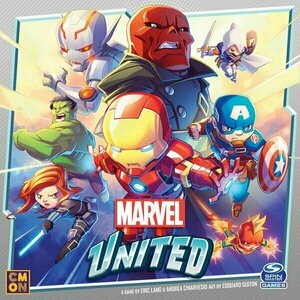

This has probably been mentioned before, but I love Marvel superheroes. My favorite has got to be Spider-Man, hands down. Feel free to send me an email if you’d like to hear my thoughts on who is the best Spider-Man – Tobey Maguire, Andrew Garfield, or Tom Holland. I’m getting off topic here… Anyway – when I saw the massive Kickstarter campaign for Marvel United, I knew it was going to be big. Admittedly, I didn’t join in on the campaign (teacher salaries, amiright?), but I did snag a copy of the base game post-campaign. Does the game live up to my expectations? Or does it fall flat, like a DC movie? (OOOOOOH BURN)
Disclaimer: This review encompasses only the base game of Marvel United. There are a number of expansions, but they will not be addressed in this review. -L
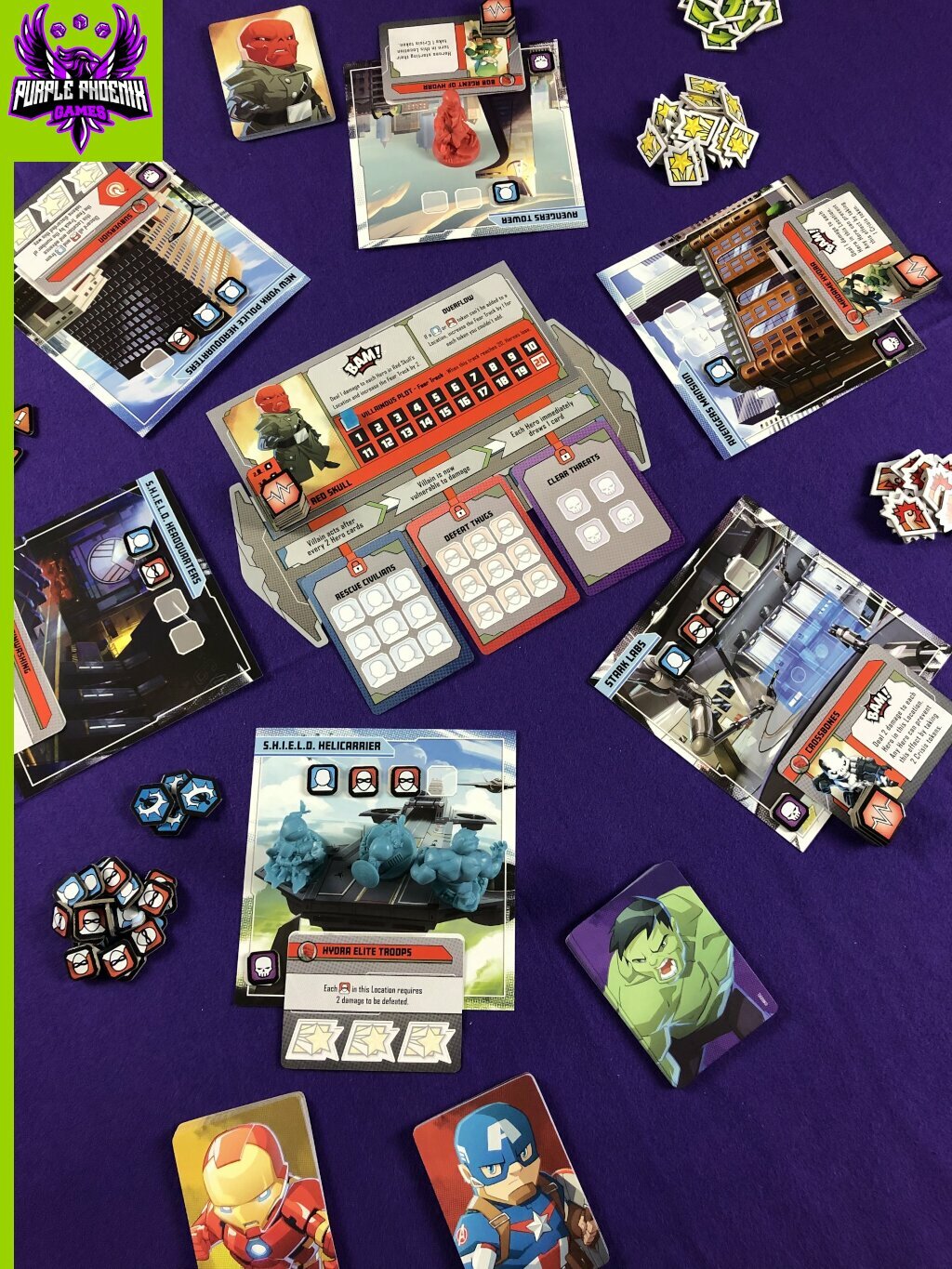
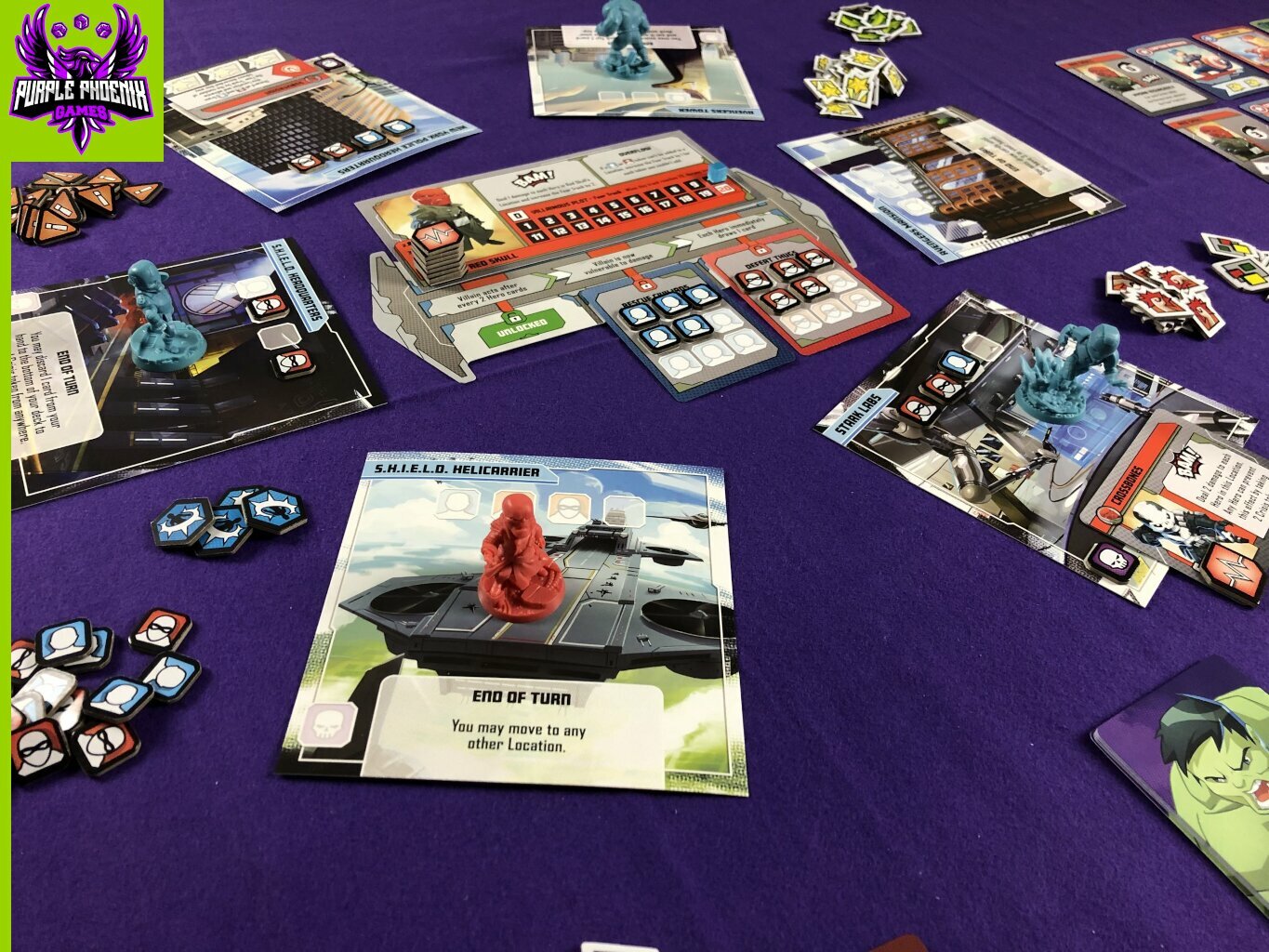
Marvel United is a cooperative game in which players take on the roles of various Marvel superheroes tasked with stopping the main Villain from completing their Villainous Plot. Follow the setup instructions detailed in the rulebook, selecting a Villain with whom to battle, 6 random Locations, and whichever Heroes you decide to use to fight the big bad. Place Threat cards, Civilians, and Thugs on the various Locations as indicated, and place the Villain and Heroes as described in the rules. Shuffle the Master Plan deck and respective Hero decks, and each player draws a hand of 3 cards. Choose a Hero as the ‘starting’ Hero, and the game is now ready to begin!
Over a series of turns, players will be resolving Villain effects and playing Hero cards to perform actions. The game always begins with a Villain turn, and the first step is to reveal a Master Plan card, adding it to the Storyline (table). Master Plan cards have different effects to be resolved – move the Villain to a new Location, BAM! effects (usually attacking Heroes or advancing their Villainous Plot towards victory), and adding Civilians/Thugs to surrounding Locations. Once all effects on the Master Plan card are dealt with, the game moves to a Hero turn. During a Hero turn, the player will perform 4 steps: Draw a card, Play a Card, Resolve Actions, and Location Effects. To start, the player will draw a card from their Hero deck and add it to their hand. They then select a card from their hand to play, adding it to the end of the Storyline.
Looking at the symbols at the bottom of their played card, the Hero will now resolve their actions. Actions could be Movement (to an adjacent Location), Attack (Thugs/Henchmen or the Villain in their current Location), Heroic Actions (rescuing Civilians or working to clear the Threat on their current Location), or Wild (any of the previous actions). During this step, a cool twist comes into play – after all, the game is called Marvel United, right? When a Hero plays a card, they resolve the symbols on the bottom of their card AND the symbols on the bottom of the previously played Hero card! This simulates the various Heroes uniting their efforts to take down the Villain! So when selecting your card, be sure to check out the last card to see if you can create a sweet chain of actions for maximum benefit. The final step is to use Location effects, if applicable. Location effects are only available after the Threat to the Location has been cleared, and allows the player to perform special actions (draw extra cards, move to other Locations, etc.). If you end your turn on a Location that has been cleared, you may use its ability if you so choose.
In order to defeat the Villain, the Heroes must complete Missions. The 3 Missions in each game are to Rescue Civilians, Defeat Thugs, and Clear Threats. So with their actions on their turns, Heroes will be working to complete these Missions, moving them closer to victory. The turn sequence of the game is unique as well – the Villain will take a turn after every 3rd Hero turn, not opposite every single Hero. Keep that in mind as you decide which card to play when! The game essentially continues in this fashion (with a few extra effects) until either the Heroes win or they lose. Heroes win if they defeat the Villain! The Villain is defeated when at least 2 Missions are completed, and the Villain has been sufficiently damaged by Attacks. Heroes lose if the Villain completes their Villainous Plot, the deck of Master Plan cards has run out, or if any Hero starts their turn with no cards left to play. The Heroes either win together or lose together.
So I know that kind of sounds like a lot, but I promise that once you get playing, the game flows really well and is pretty intuitive. Marvel United can basically be broken down into 2 steps: Villain turn and Hero turn. All you are doing is playing cards and resolving actions to complete your goals. One of the coolest things about this gameplay is the fact that on your turn you resolve not only your played card, but also the previously played Hero card as well. It does a good job emulating the Heroes working together, and adds a strategic element to the overall gameplay. Maybe you wanted to play a certain card, but based on the last Hero card, you should play this one to benefit the group the most. Players really are all working together to defeat the Villain, instead of each playing their own Hero and going in for the fight one-on-one.
Another neat aspect of the game is the inclusion of the Missions. Heroes are not allowed to directly attack the Villain until at least 2 Missions have been completed. This ups the gameplay because it stops players from just going straight for the Villain from the start, not taking anything else into account. In ‘real life,’ Heroes are also concerned with saving Civilians and neutralizing threats, so the Mission requirement makes the gameplay feel more authentic. Well, as authentic as a superhero game can feel…. The variability of Locations and the random setup of Threats each game means that you likely won’t play the same game twice. Add in expansions too and you’ve got even more scenarios. With different Hero choices, you get to try out different combinations and find out which Heroes really work well together. The gameplay itself may be simple (draw cards, play cards, resolve cards) but the variety of Heroes, Villains, Locations, Threats, etc. keeps it engaging and entertaining.
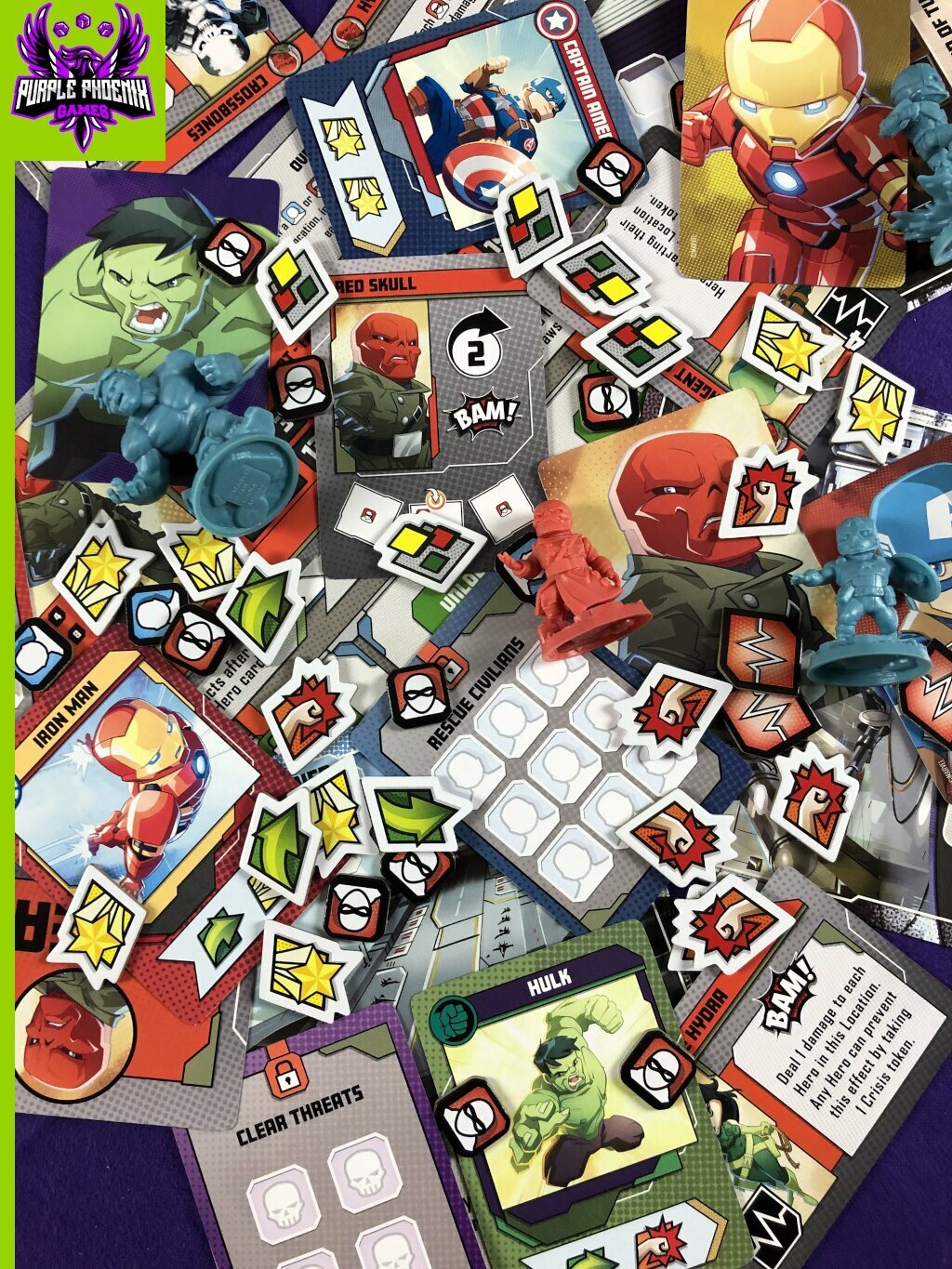
As for components, I only have positive things to say. The Villain/Hero minis are chunky and cute, the artwork is all colorful and fun to look at, and the cardboard tokens are thick and crisp. All the symbolism in the game is clear, and the text is legible and easy to comprehend. One thing to consider is that this game can be a bit of a table hog if you let it. So just be prepared for a bit of a bigger footprint with this one. Overall, great production quality of the base game, and from what I’ve seen of the expansions, those are top notch as well.
Don’t let the cutesy artwork fool you – Marvel United isn’t an easy game by any means. It takes a decent amount of strategy to be successful, and it does really take a team effort. You stay engaged in the gameplay right up until the very end, and it’s more involved than you would think for being a lighter game. I am also a big fan of Marvel Legendary, and I have to say that this gives me those vibes, but in a more simplified and streamlined way. I’m not sure I would go as far as to call Marvel United “Marvel Legendary Jr.,” but it’s also not entirely a bad idea….. Overall though, I really liked Marvel United way more than I first anticipated. It’s light, yet strategic, and has some unique elements that keep you on your toes. I can’t wait to get my hands on some of the expansions to see how I can mix and match and create even more awesome scenarios! Purple Phoenix Games gives this one a heroic 16 / 18.
Disclaimer: This review encompasses only the base game of Marvel United. There are a number of expansions, but they will not be addressed in this review. -L
Marvel United is a cooperative game in which players take on the roles of various Marvel superheroes tasked with stopping the main Villain from completing their Villainous Plot. Follow the setup instructions detailed in the rulebook, selecting a Villain with whom to battle, 6 random Locations, and whichever Heroes you decide to use to fight the big bad. Place Threat cards, Civilians, and Thugs on the various Locations as indicated, and place the Villain and Heroes as described in the rules. Shuffle the Master Plan deck and respective Hero decks, and each player draws a hand of 3 cards. Choose a Hero as the ‘starting’ Hero, and the game is now ready to begin!
Over a series of turns, players will be resolving Villain effects and playing Hero cards to perform actions. The game always begins with a Villain turn, and the first step is to reveal a Master Plan card, adding it to the Storyline (table). Master Plan cards have different effects to be resolved – move the Villain to a new Location, BAM! effects (usually attacking Heroes or advancing their Villainous Plot towards victory), and adding Civilians/Thugs to surrounding Locations. Once all effects on the Master Plan card are dealt with, the game moves to a Hero turn. During a Hero turn, the player will perform 4 steps: Draw a card, Play a Card, Resolve Actions, and Location Effects. To start, the player will draw a card from their Hero deck and add it to their hand. They then select a card from their hand to play, adding it to the end of the Storyline.
Looking at the symbols at the bottom of their played card, the Hero will now resolve their actions. Actions could be Movement (to an adjacent Location), Attack (Thugs/Henchmen or the Villain in their current Location), Heroic Actions (rescuing Civilians or working to clear the Threat on their current Location), or Wild (any of the previous actions). During this step, a cool twist comes into play – after all, the game is called Marvel United, right? When a Hero plays a card, they resolve the symbols on the bottom of their card AND the symbols on the bottom of the previously played Hero card! This simulates the various Heroes uniting their efforts to take down the Villain! So when selecting your card, be sure to check out the last card to see if you can create a sweet chain of actions for maximum benefit. The final step is to use Location effects, if applicable. Location effects are only available after the Threat to the Location has been cleared, and allows the player to perform special actions (draw extra cards, move to other Locations, etc.). If you end your turn on a Location that has been cleared, you may use its ability if you so choose.
In order to defeat the Villain, the Heroes must complete Missions. The 3 Missions in each game are to Rescue Civilians, Defeat Thugs, and Clear Threats. So with their actions on their turns, Heroes will be working to complete these Missions, moving them closer to victory. The turn sequence of the game is unique as well – the Villain will take a turn after every 3rd Hero turn, not opposite every single Hero. Keep that in mind as you decide which card to play when! The game essentially continues in this fashion (with a few extra effects) until either the Heroes win or they lose. Heroes win if they defeat the Villain! The Villain is defeated when at least 2 Missions are completed, and the Villain has been sufficiently damaged by Attacks. Heroes lose if the Villain completes their Villainous Plot, the deck of Master Plan cards has run out, or if any Hero starts their turn with no cards left to play. The Heroes either win together or lose together.
So I know that kind of sounds like a lot, but I promise that once you get playing, the game flows really well and is pretty intuitive. Marvel United can basically be broken down into 2 steps: Villain turn and Hero turn. All you are doing is playing cards and resolving actions to complete your goals. One of the coolest things about this gameplay is the fact that on your turn you resolve not only your played card, but also the previously played Hero card as well. It does a good job emulating the Heroes working together, and adds a strategic element to the overall gameplay. Maybe you wanted to play a certain card, but based on the last Hero card, you should play this one to benefit the group the most. Players really are all working together to defeat the Villain, instead of each playing their own Hero and going in for the fight one-on-one.
Another neat aspect of the game is the inclusion of the Missions. Heroes are not allowed to directly attack the Villain until at least 2 Missions have been completed. This ups the gameplay because it stops players from just going straight for the Villain from the start, not taking anything else into account. In ‘real life,’ Heroes are also concerned with saving Civilians and neutralizing threats, so the Mission requirement makes the gameplay feel more authentic. Well, as authentic as a superhero game can feel…. The variability of Locations and the random setup of Threats each game means that you likely won’t play the same game twice. Add in expansions too and you’ve got even more scenarios. With different Hero choices, you get to try out different combinations and find out which Heroes really work well together. The gameplay itself may be simple (draw cards, play cards, resolve cards) but the variety of Heroes, Villains, Locations, Threats, etc. keeps it engaging and entertaining.
As for components, I only have positive things to say. The Villain/Hero minis are chunky and cute, the artwork is all colorful and fun to look at, and the cardboard tokens are thick and crisp. All the symbolism in the game is clear, and the text is legible and easy to comprehend. One thing to consider is that this game can be a bit of a table hog if you let it. So just be prepared for a bit of a bigger footprint with this one. Overall, great production quality of the base game, and from what I’ve seen of the expansions, those are top notch as well.
Don’t let the cutesy artwork fool you – Marvel United isn’t an easy game by any means. It takes a decent amount of strategy to be successful, and it does really take a team effort. You stay engaged in the gameplay right up until the very end, and it’s more involved than you would think for being a lighter game. I am also a big fan of Marvel Legendary, and I have to say that this gives me those vibes, but in a more simplified and streamlined way. I’m not sure I would go as far as to call Marvel United “Marvel Legendary Jr.,” but it’s also not entirely a bad idea….. Overall though, I really liked Marvel United way more than I first anticipated. It’s light, yet strategic, and has some unique elements that keep you on your toes. I can’t wait to get my hands on some of the expansions to see how I can mix and match and create even more awesome scenarios! Purple Phoenix Games gives this one a heroic 16 / 18.

Purple Phoenix Games (2266 KP) rated Witness in Tabletop Games
Jun 12, 2019



A classic ‘game’ from my childhood (seriously, we played it all the time) was Telephone. You know the one – someone whispers something to their neighbor, that person whispers it to their neighbor, and so on until it’s made its way around the group. Hilarity ensues when the final person reveals what they heard – usually a far cry from the original message! So when Travis pulled out Witness, a modern twist on Telephone, I knew that all my years of training would finally amount to something!
Witness is a cooperative game of memory and deduction set in the world of the 1940’s comic “Blake and Mortimer.” You and your compatriots are working together to solve mysteries! But there’s a catch – you each only know certain information, and are limited in how you are allowed to disclose it to each other. If you could just say it outright, there’d be no fun! Each player gets a character book filled with cases and information. Everyone reads their information for the chosen case, and then, like in Telephone, and in a certain order, players whisper their information to the player next to them. Play continues until everyone has heard (through the grapevine, of course) all 4 players’ information. After all information has been relayed, players get a chance to write down any notes from what they remember – but only after everything has been said! Players then open the Questions booklet to their specific case and answer three questions about their specific puzzle. Players receive points for correct answers, and as a team, are attempting to achieve the highest score possible!
I think that Witness is such a neat game. It’s a fun mechanic – you’re trying to remember all of your information to accurately pass it on, only to hear more information to add to what you already need to remember, to then pass it on again! It definitely makes for some funny misheard information! Another aspect of Witness that I like is that it goes beyond a regular game of Telephone in the fact that there’s an end goal – you’re trying to piece together all of the information as you hear it second- or even third-hand to correctly answer some questions. There’s more pressure to communicate accurately because you and your team are striving for a compilation of perfect information to help you score the most endgame points. Witness ups the stakes more than your average game of Telephone, and that’s what makes it interesting and engaging for me.
The major downside of Witness is that it is a game for EXACTLY 4 players. You can’t play with 3. You can’t play with 5. It absolutely 100% must be played with 4 players. And sometimes that’s just not possible. We all know those game nights where maybe only 2 or 3 people are available. Or maybe those times when you invite a large number of people over and they all come. In either scenario, Witness is out, and that is a bummer because it is such a neat game. Since the information is divided between 4 books, there’s unfortunately no way to adapt it for other player counts. So you can either play Witness or you can’t – there’s no ‘maybe.’
Overall, I enjoy playing Witness. I think it’s a unique approach to a simple game. Unfortunately, I believe this game is out of print, but if you can get your hands on a copy, or you see it on a friend’s shelf, give it a play! Whispering to your neighbor and solving little logic puzzles never seemed so fun! Purple Phoenix Games gives Witness a mysterious 11 / 18.
https://purplephoenixgames.wordpress.com/2019/04/02/witness-review/
Witness is a cooperative game of memory and deduction set in the world of the 1940’s comic “Blake and Mortimer.” You and your compatriots are working together to solve mysteries! But there’s a catch – you each only know certain information, and are limited in how you are allowed to disclose it to each other. If you could just say it outright, there’d be no fun! Each player gets a character book filled with cases and information. Everyone reads their information for the chosen case, and then, like in Telephone, and in a certain order, players whisper their information to the player next to them. Play continues until everyone has heard (through the grapevine, of course) all 4 players’ information. After all information has been relayed, players get a chance to write down any notes from what they remember – but only after everything has been said! Players then open the Questions booklet to their specific case and answer three questions about their specific puzzle. Players receive points for correct answers, and as a team, are attempting to achieve the highest score possible!
I think that Witness is such a neat game. It’s a fun mechanic – you’re trying to remember all of your information to accurately pass it on, only to hear more information to add to what you already need to remember, to then pass it on again! It definitely makes for some funny misheard information! Another aspect of Witness that I like is that it goes beyond a regular game of Telephone in the fact that there’s an end goal – you’re trying to piece together all of the information as you hear it second- or even third-hand to correctly answer some questions. There’s more pressure to communicate accurately because you and your team are striving for a compilation of perfect information to help you score the most endgame points. Witness ups the stakes more than your average game of Telephone, and that’s what makes it interesting and engaging for me.
The major downside of Witness is that it is a game for EXACTLY 4 players. You can’t play with 3. You can’t play with 5. It absolutely 100% must be played with 4 players. And sometimes that’s just not possible. We all know those game nights where maybe only 2 or 3 people are available. Or maybe those times when you invite a large number of people over and they all come. In either scenario, Witness is out, and that is a bummer because it is such a neat game. Since the information is divided between 4 books, there’s unfortunately no way to adapt it for other player counts. So you can either play Witness or you can’t – there’s no ‘maybe.’
Overall, I enjoy playing Witness. I think it’s a unique approach to a simple game. Unfortunately, I believe this game is out of print, but if you can get your hands on a copy, or you see it on a friend’s shelf, give it a play! Whispering to your neighbor and solving little logic puzzles never seemed so fun! Purple Phoenix Games gives Witness a mysterious 11 / 18.
https://purplephoenixgames.wordpress.com/2019/04/02/witness-review/

Matthew Krueger (10051 KP) rated Eternal Darkness: Sanity's Requiem in Video Games
Oct 28, 2019 (Updated Oct 28, 2019)
Psychological Warfare
Contains spoilers, click to show
Eternal Darkness- why does no one talk about this game. It is amazing, its horrorfying, terroryfying, spooky, creepy, thrilling, chilling and so much more. Plus it came out only for the gamecube, which is huge because nintendo doesnt put out or release alot of horror games. This, luigi's mansion and Resident Evil 4 were the big horror games for the gamecube. Maybe more came out, but those 3 were the big ones. Lets talk about this game, shall we....
The narrative of the game's story switches between two phases. The main phase focuses on a series of chapters in which players take control of a new character each time. The other phase acts as an intermission. The game boasts twelve playable characters, split between four distinct locations, and from different periods of time.
The story features multiple paths that can be taken. This choice not only determines which of the game's three other antagonists are aligned to the plot, but it also has subtle effects on the gameplay in chapters and intermission periods. Some changes include slight differences in puzzles and items, but most changes revolve around enemy placement, which will determine how the player engages them. This can even have an effect on the relative difficulty of the game in certain situations. Red tinted enemies, for example, are tougher than their counterparts.
The other distinctive gameplay aspect comes from "Sanity Effects", the game's standout concept that Nintendo patented. Upon beginning the game's second chapter, players must keep watch on a Sanity meter – a green bar which decreases when the player is spotted by an enemy. As the bar becomes low, subtle changes to the environment and random unusual events begin to occur, which reflect the character's slackening grip on reality.
While minor effects include a skewed camera angle, heads of statues following the character, and unsettling noises, stronger effects include bleeding on walls and ceilings, entering a room that is unrealistic before finding that the character never left the previous room, the character suddenly dying, and fourth wall breaking effect such as "To Be Continued" promotions for a "sequel", and simulated errors and anomalies of the TV or GameCube. While the latter does not affect gameplay, they can be misconstrued by the player as being actual technical malfunctions.
Lets talk about the plot/story....
The story of Eternal Darkness takes place over four principal locations which the game skips back and forth between. They include an underground temple complex called the Forbidden City, in Persia; a Khmer temple in Angkor Thom, Cambodia; Oublié Cathedral in Amiens, France (not to be confused with Amiens Cathedral); and the Roivas Family Estate in Rhode Island, which also leads to an ancient underground city named Ehn'gha beneath the mansion. Each time a location is visited, it is done so in a different time period. Spanning from 26 BC to 2000 AD. Almost half of which take place in the 20th century. Each different era and character offers a different periodic and personal perspective on the location.
The chapters found in the game are not discovered in chronological order. Instead, to make the narrative more dramatic, each chapter jumps around the timeline of the plot. However, despite the overall story skipping back and forth through time, the chapters do follow chronological order within their respective locations. This is because each setting also has its own contained story.
This game is so good, its epic, im surprised that not of people know about this game and heard about this game.
I highly reccordmend playing this game.
Lastly shout out to @LeftSideCut for getting the hints/clues for this review.
The narrative of the game's story switches between two phases. The main phase focuses on a series of chapters in which players take control of a new character each time. The other phase acts as an intermission. The game boasts twelve playable characters, split between four distinct locations, and from different periods of time.
The story features multiple paths that can be taken. This choice not only determines which of the game's three other antagonists are aligned to the plot, but it also has subtle effects on the gameplay in chapters and intermission periods. Some changes include slight differences in puzzles and items, but most changes revolve around enemy placement, which will determine how the player engages them. This can even have an effect on the relative difficulty of the game in certain situations. Red tinted enemies, for example, are tougher than their counterparts.
The other distinctive gameplay aspect comes from "Sanity Effects", the game's standout concept that Nintendo patented. Upon beginning the game's second chapter, players must keep watch on a Sanity meter – a green bar which decreases when the player is spotted by an enemy. As the bar becomes low, subtle changes to the environment and random unusual events begin to occur, which reflect the character's slackening grip on reality.
While minor effects include a skewed camera angle, heads of statues following the character, and unsettling noises, stronger effects include bleeding on walls and ceilings, entering a room that is unrealistic before finding that the character never left the previous room, the character suddenly dying, and fourth wall breaking effect such as "To Be Continued" promotions for a "sequel", and simulated errors and anomalies of the TV or GameCube. While the latter does not affect gameplay, they can be misconstrued by the player as being actual technical malfunctions.
Lets talk about the plot/story....
The story of Eternal Darkness takes place over four principal locations which the game skips back and forth between. They include an underground temple complex called the Forbidden City, in Persia; a Khmer temple in Angkor Thom, Cambodia; Oublié Cathedral in Amiens, France (not to be confused with Amiens Cathedral); and the Roivas Family Estate in Rhode Island, which also leads to an ancient underground city named Ehn'gha beneath the mansion. Each time a location is visited, it is done so in a different time period. Spanning from 26 BC to 2000 AD. Almost half of which take place in the 20th century. Each different era and character offers a different periodic and personal perspective on the location.
The chapters found in the game are not discovered in chronological order. Instead, to make the narrative more dramatic, each chapter jumps around the timeline of the plot. However, despite the overall story skipping back and forth through time, the chapters do follow chronological order within their respective locations. This is because each setting also has its own contained story.
This game is so good, its epic, im surprised that not of people know about this game and heard about this game.
I highly reccordmend playing this game.
Lastly shout out to @LeftSideCut for getting the hints/clues for this review.

OPlayer HD Pro
Music and Utilities
App
OPlayer HD is used to boost your iPad's media abilities, you can also use it to streaming audio and...

Connor Sheffield (293 KP) rated Pokémon: Let's Go, Pikachu! in Video Games
Apr 24, 2019


The original 151 Pokémon (5 more)
Not just a remake of yellow
Graphics
Gameplay mechanics
Nostalgic but also very fresh
Being able to see what you're running into
A little too easy (1 more)
Sometimes miss the battles between wild pokemon
Fun, adorable and nostalgic
So I got Lets Go Pikachu, and withing 30-40 minutes, I had completed it, Elite four and all, but I had so much fun!
This game was first introduced to me by a friend who told me it was a refreshed version of Pokémon Yellow, but with Eevee as a starter if you got Pokémon Let's Go Eevee. However this game is so much more than a modern day reboot.
Mechanics wise, they've brought in the catching system from the popular mobile app Pokémon Go, with the player having to use the joy cons, the Pokéball Plus or the switch as a whole, to catch Pokémon by throwing a Pokéball with a chance to get 1 of 3 catch ratings (Nice, Great, or Excellent) if you can throw the ball through a ring that shrinks repeatedly. At first I wasn't sure if I was going to enjoy this because I suck at this on the app, but it's something that grew on me because the switch version of this mechanic is easier to achieve, and when the player uses the whole handheld format of the switch (joy cons still attached to the sides, holding the whole body of the console) it's a lot easier to catch the Pokémon that move around a lot from side to side, other than the player having to try and throw curve balls which can sometimes ache your arms if your building up a catch combo.
I do however miss battling Pokémon in the wild sometimes, to me the old mechanics had this sense of achievement that (as cruel as it sounds, but come on this is Pokémon we're on about) you were able to beat that high level Pokémon in a battle and have therefore not just got lucky with throwing a Pokéball in the hopes that it stays in. Saying that though, you do have to battle the legendaries, Mewtwo and the two sleeping Snorlax's before you can catch them, which is a nice addition they kept in.
On the other hand though, your entire 6 Pokémon party gets experience from catching and battling, which makes it so much easier to level up your entire party without having to send out a weak Pokémon and bring it back or finding the XP share stone from the scientist guy later in the game. I can now judge which Pokémon I need to send out for the particular battle, and feel comfortable in the knowledge that I can keep my strong Pokémon on the battlefield whilst my other Pokémon share in the levelling up.
Some people have complained that they prefer the grind and think that this makes it far too easy, and I can see what they mean, but at the same time, grinding would take 10x longer due to the previous wild encounter mechanics I just spoke of. No more battling wild Pokémon means that grinding now requires a lot more money and Pokéballs.
I do think this game can be too easy at times, your companion Pokémon (the one you receive from the start, either Pikachu or Eevee) is incredibly Over Powered! I was able to defeat near enough every gym with just my starter, because even though the types weren't weak to electric or fighting, if you level up your Pikachu and are say 5-10 levels higher than the gym Pokémon, I was able to kill most of the Pokémon in one hit and a lot of the Gym battles before you reach the leader, only seem to have one Pokémon nowadays, and this isn't because you can't leave and go heal 'cos you can still do that. I thought battling Misty's Gym was a breeze because my Pikachu was two/three levels higher, and everything died in one shot. So I can see why some people complained it was too easy to complete this game. For anything that wasn't effected by electricity, I used double stomp, which in later battles usually took one hit as well, but as your progressing it can take two-four hits depending on the Pokémon your battling.
To argue with the difficulty level though, I would say that if you've never played a Pokémon game, or at least the original Pokémon games, or maybe you want to introduce someone to Pokémon young or old, this is actually a great starting place. The easy difficulty makes it enjoyable and less frustrating, the designs of characters and Pokémon are fantastic, the story is just about the same but you no longer have items that your Pokémon hold like XP Share, or Everstone. (You just have to press B everytime a Pokémon levels up if you don't want it to evolve).
It's a great introduction to Pokémon with added bonuses. You can actually get the Alolan forms of some Pokémon in the game, as there are NPC's around the map that want to trade you for your Kanto versions such as Geodude, Sandslash, Meowth (Eevee exclusive), Vulpix (Eevee exclusive), Exeggutor and a few others. So it's even more fun to hunt for Pokémon in all shapes and sizes and types.
As usual, there are some Pokémon that are exclusive to one version of the game, which is annoying because the only Pokémon I now need for my Pokédex is Pinsir who just happens to be a Let's Go Eevee exclusive, so make sure that like me, you have friends with the opposite game so you can trade, OR, if you have certain game exclusive Pokémon on Pokémon Go, you can send them across to the Go Park in Fuschia City and catch them there. They'll stay in the box you sent them too and even if they flee while you're trying to catch them, fear not, they can't run away if you sent them over. They will stay in the box and you can just try again instantly. I however do not have Pinsir in Pokémon Go but luckily my friend has a spare ?
Overall this game is so much adorable fun, whether it's catching them all, or battling the trainer's and gyms to be the very best, or even just kicking back and having a little play with your companion, you can be sure that with these new mechanics, including a new system that makes shiny Pokémon easier to find/catch, you'll find plenty to do even after you've completed the game.
This game was first introduced to me by a friend who told me it was a refreshed version of Pokémon Yellow, but with Eevee as a starter if you got Pokémon Let's Go Eevee. However this game is so much more than a modern day reboot.
Mechanics wise, they've brought in the catching system from the popular mobile app Pokémon Go, with the player having to use the joy cons, the Pokéball Plus or the switch as a whole, to catch Pokémon by throwing a Pokéball with a chance to get 1 of 3 catch ratings (Nice, Great, or Excellent) if you can throw the ball through a ring that shrinks repeatedly. At first I wasn't sure if I was going to enjoy this because I suck at this on the app, but it's something that grew on me because the switch version of this mechanic is easier to achieve, and when the player uses the whole handheld format of the switch (joy cons still attached to the sides, holding the whole body of the console) it's a lot easier to catch the Pokémon that move around a lot from side to side, other than the player having to try and throw curve balls which can sometimes ache your arms if your building up a catch combo.
I do however miss battling Pokémon in the wild sometimes, to me the old mechanics had this sense of achievement that (as cruel as it sounds, but come on this is Pokémon we're on about) you were able to beat that high level Pokémon in a battle and have therefore not just got lucky with throwing a Pokéball in the hopes that it stays in. Saying that though, you do have to battle the legendaries, Mewtwo and the two sleeping Snorlax's before you can catch them, which is a nice addition they kept in.
On the other hand though, your entire 6 Pokémon party gets experience from catching and battling, which makes it so much easier to level up your entire party without having to send out a weak Pokémon and bring it back or finding the XP share stone from the scientist guy later in the game. I can now judge which Pokémon I need to send out for the particular battle, and feel comfortable in the knowledge that I can keep my strong Pokémon on the battlefield whilst my other Pokémon share in the levelling up.
Some people have complained that they prefer the grind and think that this makes it far too easy, and I can see what they mean, but at the same time, grinding would take 10x longer due to the previous wild encounter mechanics I just spoke of. No more battling wild Pokémon means that grinding now requires a lot more money and Pokéballs.
I do think this game can be too easy at times, your companion Pokémon (the one you receive from the start, either Pikachu or Eevee) is incredibly Over Powered! I was able to defeat near enough every gym with just my starter, because even though the types weren't weak to electric or fighting, if you level up your Pikachu and are say 5-10 levels higher than the gym Pokémon, I was able to kill most of the Pokémon in one hit and a lot of the Gym battles before you reach the leader, only seem to have one Pokémon nowadays, and this isn't because you can't leave and go heal 'cos you can still do that. I thought battling Misty's Gym was a breeze because my Pikachu was two/three levels higher, and everything died in one shot. So I can see why some people complained it was too easy to complete this game. For anything that wasn't effected by electricity, I used double stomp, which in later battles usually took one hit as well, but as your progressing it can take two-four hits depending on the Pokémon your battling.
To argue with the difficulty level though, I would say that if you've never played a Pokémon game, or at least the original Pokémon games, or maybe you want to introduce someone to Pokémon young or old, this is actually a great starting place. The easy difficulty makes it enjoyable and less frustrating, the designs of characters and Pokémon are fantastic, the story is just about the same but you no longer have items that your Pokémon hold like XP Share, or Everstone. (You just have to press B everytime a Pokémon levels up if you don't want it to evolve).
It's a great introduction to Pokémon with added bonuses. You can actually get the Alolan forms of some Pokémon in the game, as there are NPC's around the map that want to trade you for your Kanto versions such as Geodude, Sandslash, Meowth (Eevee exclusive), Vulpix (Eevee exclusive), Exeggutor and a few others. So it's even more fun to hunt for Pokémon in all shapes and sizes and types.
As usual, there are some Pokémon that are exclusive to one version of the game, which is annoying because the only Pokémon I now need for my Pokédex is Pinsir who just happens to be a Let's Go Eevee exclusive, so make sure that like me, you have friends with the opposite game so you can trade, OR, if you have certain game exclusive Pokémon on Pokémon Go, you can send them across to the Go Park in Fuschia City and catch them there. They'll stay in the box you sent them too and even if they flee while you're trying to catch them, fear not, they can't run away if you sent them over. They will stay in the box and you can just try again instantly. I however do not have Pinsir in Pokémon Go but luckily my friend has a spare ?
Overall this game is so much adorable fun, whether it's catching them all, or battling the trainer's and gyms to be the very best, or even just kicking back and having a little play with your companion, you can be sure that with these new mechanics, including a new system that makes shiny Pokémon easier to find/catch, you'll find plenty to do even after you've completed the game.
Purple Phoenix Games (2266 KP) rated Ghoulash in Tabletop Games
Sep 3, 2019
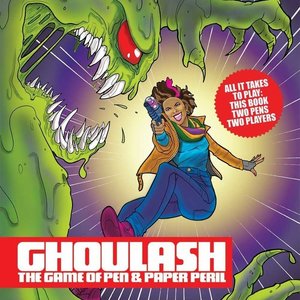
Beef, elbow macaroni, tomato sauce, onions, garlic, many other spices. Combine. This is goulash.
Wait, this is Ghoulash? Ok so ditch the food and add Ghoul meat, dashes of Ghoo, some falling debris, and holes. Also add an opponent to play against and you have a recipe for a really great game. Intrigued by my recipe? Read on. This is Ghoulash.
When you name a game (and game company) using a pun for a delicious meal you just KNOW everyone is going to be making these jokes. I am not below this. However, Ghoulash pits two players against each other in a race to defeat eight Ghouls first – or die trying. This is a pencil and paper game contained on one double-sided sheet of paper (with the rules printed on the other side). With such little in components, this game CAN’T be very good, right?
DISCLAIMER: We were provided with a link to print off the game, so technically it’s a PNP for us. We printed off several copies to play our review games. I do not intend to cover every single rule included in the rule book, but will describe the overall game flow and major rule set so that our readers may get a sense of how the game plays. For more in depth rules, you may purchase a copy from the publisher directly or from your FLGS. -T
To setup a game of Ghoulash: The Game of Pen and Paper Peril (which I will be calling simply Ghoulash for the remainder of this review) grab two copies of the game sheet and two writing utensils. Though the game’s title suggests using a pen, I recommend a pencil. From here, you will need to decide which map grid you want to use for your play map and which will be your DM map. For those who have not played table top RPG’s before, a DM is a Dungeon Master – the person who ultimately runs the game and is typically in charge of placing and playing the monsters, traps, and NPCs of a game. In this case, each player will be each other’s DM. You will see the number of items that must be placed on the map on the main page. You must place (anywhere you want on the map) eight Ghouls, five Holes, five Debris, and three First-Aid Kits. Seriously. Anywhere you want. These are the items and encounters your opponent will be interacting with as you play. You are now ready to begin!
On your turn you will be moving through the map attempting to encounter and kill Ghouls – blobby monsters that want to eat you. You do this by moving onto a square that your opponent has placed a Ghoul and fighting it. Fighting Ghouls is easy: your DM opponent will circle any number on the Ghoul you are fighting. You need to guess this number in order to exploit its weak spot and vanquish it. For every incorrect guess YOU will take a wound from it bashing you. Mark your wounds on the Wound Meters area below the Ghouls. If you happen to take 12 wounds before finding a First-Aid Kit, then you die and you lose the game. Finding a First-Aid Kit, however, will relieve you of all your wounds you have suffered. In this scenario, you will begin tracking your wounds anew on the next Wound Meter on the tracker.
Like I mentioned earlier, other traps will be awaiting you in your personal hell dungeon. When you fall into a Hole you will forfeit the rest of your turn and you will skip your next turn entirely. Should you move onto a square containing Debris, you will be hit for one wound from falling bits of the rickety dungeon. Or perhaps it’s guano. You never know.
The player to defeat all eight ghouls or remain living the longest will be the winner (unless you play hardcore rules and have to defeat all Ghouls to win)!
Usually at this point in my reviews I evaluate the game components. In this case I am going to evaluate how the game art and graphic design work with and for the game. As the entire game is played on one side of one sheet of paper and everything you really need is located on that page, this is really genius to me. Everything is right there, and it’s very clear what to place on the map, how many of each thing to place, and where you can track the Ghouls, wounds, and your Ghoul trophies. It’s really great! The only negative here is we wished the letters and numbers on the x and y axes were darker. It was a little difficult for some people to read the coordinates. This would be an easy fix for me, but it may not be within the designer’s vision for the layout. Many times we were describing our movement with Battleship coordinates: I am moving south to B-1 then east to P-1 then north to P-2, etc. I didn’t have much difficulty with this, but I did hear that others did.
I believe that the intent of the future of Ghoulash is to offer pre-printed charts for sale and possibly have different themed charts to play. The eagle-eyed among you may have noticed that we were playing The City map. I have not seen any other maps, so I cannot comment on them, but even if I only had The City to play forever, I think that I would be happy enough.
That said, I believe this is a really really great game. I enjoyed being able to place out my encounter elements, and being able to freely roam around the map until I ran into something – even if it was a hole in the middle of an intersection that I had to fall through several times (sneaky, sneaky, my brilliant little brother!). The guessing game of fighting Ghouls can be quick and fun, or it can give you five wounds in one encounter. Overall, I think that anyone can enjoy it, but I will give a caveat. Both players MUST be able to read the map and coordinates to follow along with where each player is moving or else you may have some bickering. Oh, just my family? Maybe.
Purple Phoenix Games gives this one a sticky-yet-pleasing 10 / 12. You really should give it a shot. It could work with couples, friends, co-workers, strangers, pets, anyone!
Wait, this is Ghoulash? Ok so ditch the food and add Ghoul meat, dashes of Ghoo, some falling debris, and holes. Also add an opponent to play against and you have a recipe for a really great game. Intrigued by my recipe? Read on. This is Ghoulash.
When you name a game (and game company) using a pun for a delicious meal you just KNOW everyone is going to be making these jokes. I am not below this. However, Ghoulash pits two players against each other in a race to defeat eight Ghouls first – or die trying. This is a pencil and paper game contained on one double-sided sheet of paper (with the rules printed on the other side). With such little in components, this game CAN’T be very good, right?
DISCLAIMER: We were provided with a link to print off the game, so technically it’s a PNP for us. We printed off several copies to play our review games. I do not intend to cover every single rule included in the rule book, but will describe the overall game flow and major rule set so that our readers may get a sense of how the game plays. For more in depth rules, you may purchase a copy from the publisher directly or from your FLGS. -T
To setup a game of Ghoulash: The Game of Pen and Paper Peril (which I will be calling simply Ghoulash for the remainder of this review) grab two copies of the game sheet and two writing utensils. Though the game’s title suggests using a pen, I recommend a pencil. From here, you will need to decide which map grid you want to use for your play map and which will be your DM map. For those who have not played table top RPG’s before, a DM is a Dungeon Master – the person who ultimately runs the game and is typically in charge of placing and playing the monsters, traps, and NPCs of a game. In this case, each player will be each other’s DM. You will see the number of items that must be placed on the map on the main page. You must place (anywhere you want on the map) eight Ghouls, five Holes, five Debris, and three First-Aid Kits. Seriously. Anywhere you want. These are the items and encounters your opponent will be interacting with as you play. You are now ready to begin!
On your turn you will be moving through the map attempting to encounter and kill Ghouls – blobby monsters that want to eat you. You do this by moving onto a square that your opponent has placed a Ghoul and fighting it. Fighting Ghouls is easy: your DM opponent will circle any number on the Ghoul you are fighting. You need to guess this number in order to exploit its weak spot and vanquish it. For every incorrect guess YOU will take a wound from it bashing you. Mark your wounds on the Wound Meters area below the Ghouls. If you happen to take 12 wounds before finding a First-Aid Kit, then you die and you lose the game. Finding a First-Aid Kit, however, will relieve you of all your wounds you have suffered. In this scenario, you will begin tracking your wounds anew on the next Wound Meter on the tracker.
Like I mentioned earlier, other traps will be awaiting you in your personal hell dungeon. When you fall into a Hole you will forfeit the rest of your turn and you will skip your next turn entirely. Should you move onto a square containing Debris, you will be hit for one wound from falling bits of the rickety dungeon. Or perhaps it’s guano. You never know.
The player to defeat all eight ghouls or remain living the longest will be the winner (unless you play hardcore rules and have to defeat all Ghouls to win)!
Usually at this point in my reviews I evaluate the game components. In this case I am going to evaluate how the game art and graphic design work with and for the game. As the entire game is played on one side of one sheet of paper and everything you really need is located on that page, this is really genius to me. Everything is right there, and it’s very clear what to place on the map, how many of each thing to place, and where you can track the Ghouls, wounds, and your Ghoul trophies. It’s really great! The only negative here is we wished the letters and numbers on the x and y axes were darker. It was a little difficult for some people to read the coordinates. This would be an easy fix for me, but it may not be within the designer’s vision for the layout. Many times we were describing our movement with Battleship coordinates: I am moving south to B-1 then east to P-1 then north to P-2, etc. I didn’t have much difficulty with this, but I did hear that others did.
I believe that the intent of the future of Ghoulash is to offer pre-printed charts for sale and possibly have different themed charts to play. The eagle-eyed among you may have noticed that we were playing The City map. I have not seen any other maps, so I cannot comment on them, but even if I only had The City to play forever, I think that I would be happy enough.
That said, I believe this is a really really great game. I enjoyed being able to place out my encounter elements, and being able to freely roam around the map until I ran into something – even if it was a hole in the middle of an intersection that I had to fall through several times (sneaky, sneaky, my brilliant little brother!). The guessing game of fighting Ghouls can be quick and fun, or it can give you five wounds in one encounter. Overall, I think that anyone can enjoy it, but I will give a caveat. Both players MUST be able to read the map and coordinates to follow along with where each player is moving or else you may have some bickering. Oh, just my family? Maybe.
Purple Phoenix Games gives this one a sticky-yet-pleasing 10 / 12. You really should give it a shot. It could work with couples, friends, co-workers, strangers, pets, anyone!
Purple Phoenix Games (2266 KP) rated Tales of Evil in Tabletop Games
Oct 1, 2020
It is no surprise that following the enormous success of Netflix’s “Stranger Things” that creators would begin developing ideas borrowed from the show’s setting or characters. Of course we have seen games in this “80s kids Goonie-esque adventure game” genre before, and I have to say that I love the setting. When I saw the Kickstarter campaign for Tales of Evil I was immediately drawn to it. Did my investment pay off or is this one a gnarly bust?
Tales of Evil is a cooperative, horror, storytelling, adventure game that uses a unique new “Fusion System” throughout the game. Players will be taking on personas of kids from the 1980s who belong to a club named “Pizza & Investigation.” I do not wish to reveal too much in this review, so I will be covering this as a Solo Chronicles using one character going through the introductory tutorial mission.
DISCLAIMER: We are using the Kickstarter Deluxe version of the game. We do have the expansions from the KS campaign, but will not be using those for this review. Also, we do not intend to cover every single rule included in the rule book, but will describe the overall game flow and major rule set so that our readers may get a sense of how the game plays. For more in depth rules, you may purchase a copy from the publisher directly or from your FLGS. -T
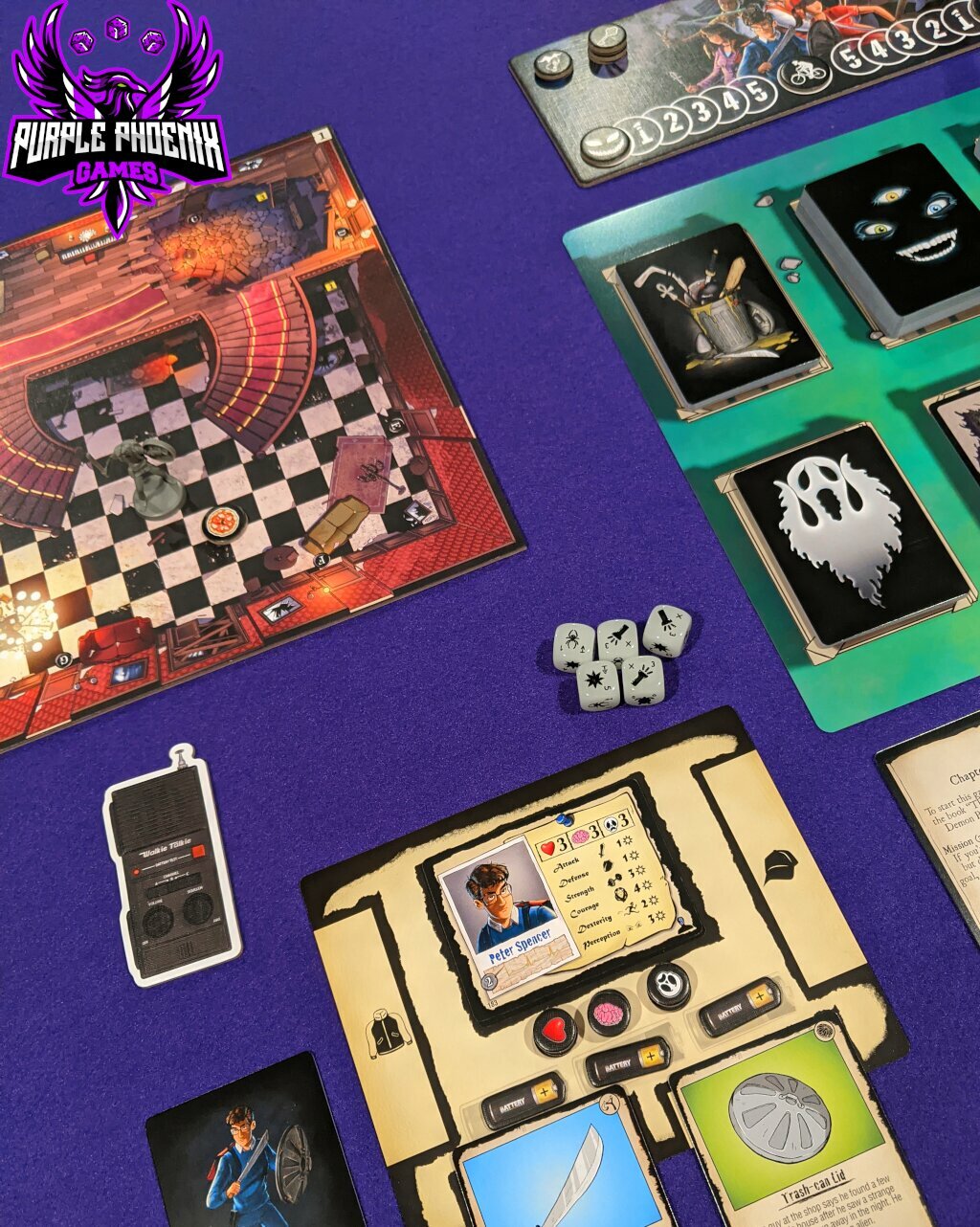
To setup, well, just follow the setup instructions in the rulebook. There’s too much for me to explain here. For one character playing the tutorial scenario, the game setup should look similar to what is pictured below. Maybe. The rulebook does not specifically state WHERE each item should be placed, so players will have ultimate freedom to setup items where they see fit to be most efficient for themselves.
Players in Tales of Evil will have no real “turn structure” as most games do, because all players will be adventuring together as a group. So characters will be moving as a group and never splitting the party (RPGers breathe a sigh of relief… maybe). However, as with many adventure games of this style, once players explore into new areas certain markers will placed on the board (Clue, Darkness, Mystery, Search, etc). These markers signify different actions that can be taken, or entrances to areas that are blocked or found, or something that could be traced from one area to another. The leader of the group for the time being is in possession of the Walkie-Talkie and will make all final decisions for the group after any discussion (for solo players, it is just a nice prop). Usually searching for items will result in a card draw and upon the card will be a test to pass using the stats on the player character mat to roll dice for successes. Of course, the other side of that are horrible losses as well.
Players will be traipsing through the area and reading passages from two actual books: the Story Book and the Event Book. Most of the action happens in the Story Book and it will guide players through the story and once choices are made or tests succeeded/failed, the book will instruct players what to do next and to which section to turn to further the story (a la Tales of the Arabian Nights). The game continues in this fashion until the story ends with victory or defeat.
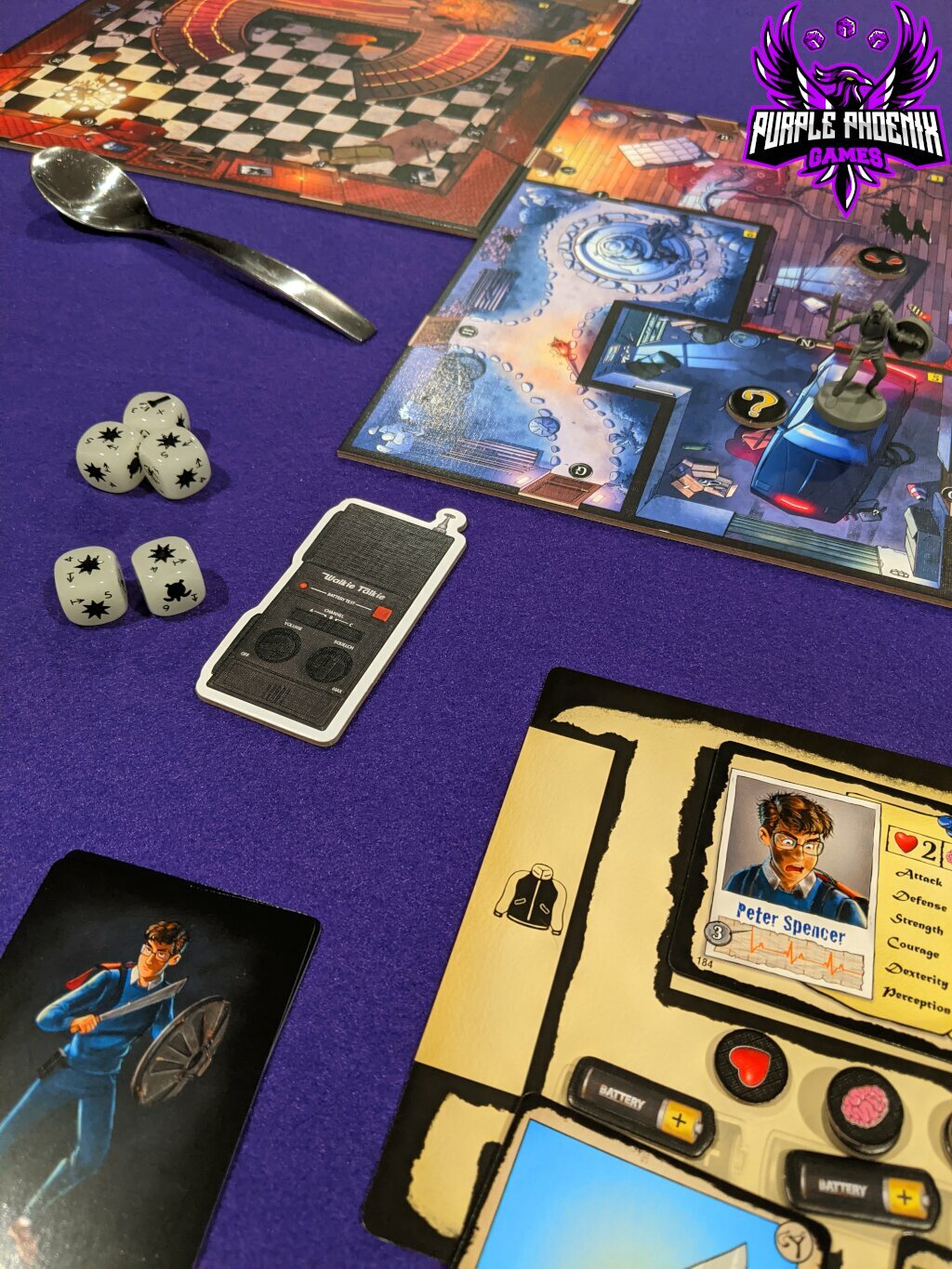
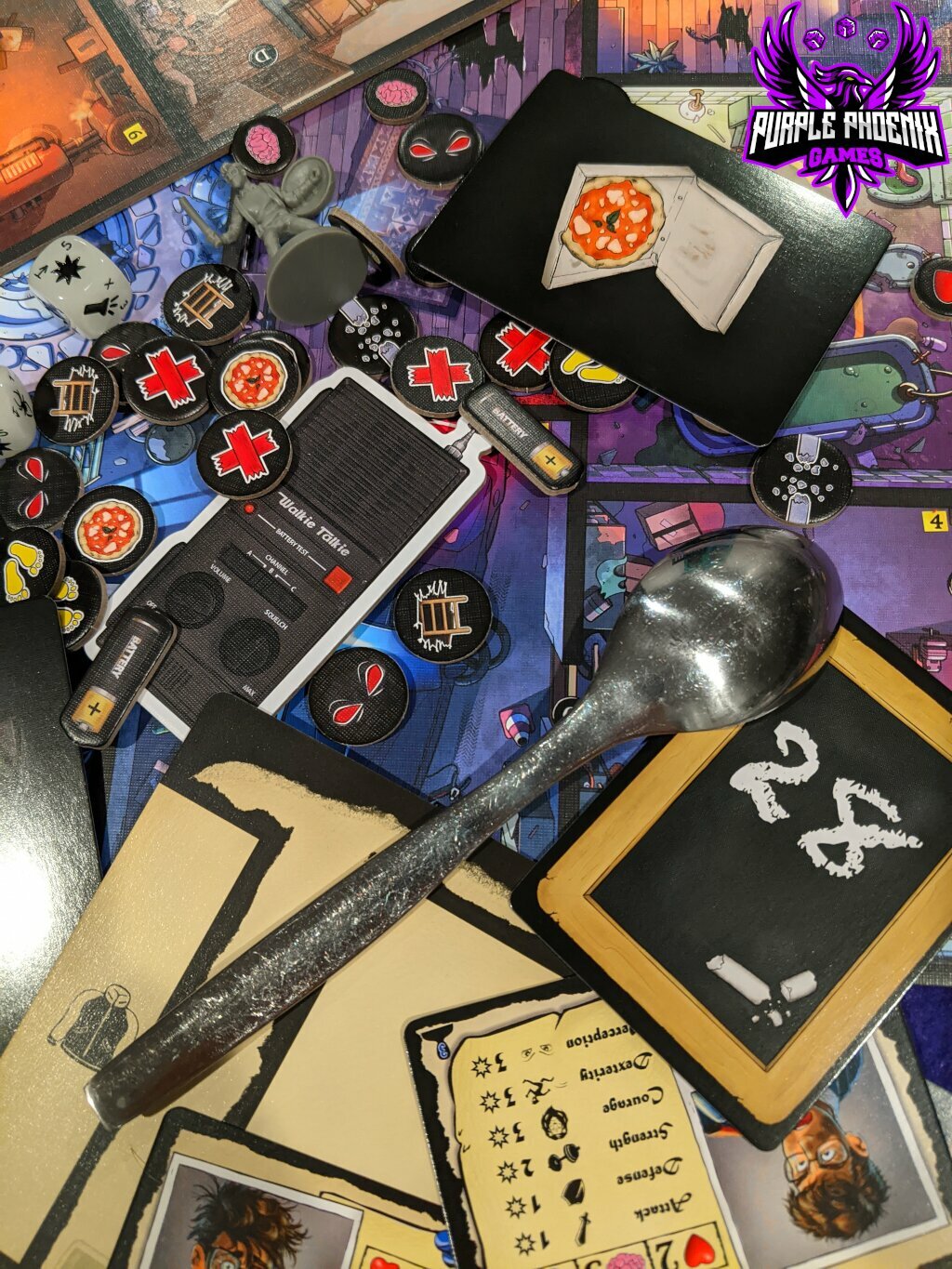
Components. Why yes, that is a real spoon in the photo above. No, it does not come with the game. I will explain in a bit. The components in this game are great. Each character has their own mat for organization, action cards, equipment cards, and status cards that dictate the difficulty of the game and how the character degrades over time in the horror-filled mission. Some components are even glow-in-the-dark! A nice touch, but certainly unnecessary. I find everything to be wonderful quality, even the cards that are kind of polarizing on the KS comments are nice (people are complaining that they are not linen-finished, but I believe the publisher made the right call to make them matte finished if the linen obscured the look and art on them). Thumbs up for components from me.
I wanted to wait until my final thoughts to explain the whole “Fusion System” that is in play here. Tales of Evil uses the catchphrase, “You will get into the game and the game will get into you!” Now, I’m not sure exactly how this game is getting into me, but I’m certainly digging the game and this Fusion System. You see, some cards (in the tutorial, remember, so I’m not really giving much away here) will give players 60 seconds to grab a kitchen spoon for some benefit and a debilitation if they are unable to find one – hence the spoon in my photos. Another card relies on the character (and also then the player) removing their shoes. Still yet another deals with fire or people smoking in the vicinity. If there is fire nearby in real life, it affects the effects of the card drawn. It’s ingenious and I love every little bit of it! I can’t wait to see how the Fusion System will work in this game more and how it can be applied to other games in the future.
All in all I love everything about Tales of Evil. The setting is great, the Pizza & Investigation kids are awesome, and the game itself is incredibly engaging and makes you really think about the choices you make within. Perhaps the haunting feeling of doubting some choices is how the game gets into you, because I did find myself wondering what would have happened had I chosen a different course for some instances. I am very drawn to this game and I want to tackle all of the scenarios. Even solo! And another great thing about Tales of Evil is the fact that a player (or players) can join a game already in progress! So if I am exploring solo and my wife decides she wants to hop in, she just grabs a character mat, sets up the character, and dives right in with me. I LOVE games like that. So versatile.
While I should probably stop gushing at this point I just can’t. This game is so much fun and worth every penny spent on it. I implore you, if you are a fan of exploration adventure games in this vein you definitely need to snatch up a copy whenever you see one. And if you love it as much as I do let me know. We can swap adventure stories.
Oh did I mention the designer is even created a way for us normies to create our own scenarios and upload them to other Tales of Evil players? Yeah, I’m fascinated by that as well…
Tales of Evil is a cooperative, horror, storytelling, adventure game that uses a unique new “Fusion System” throughout the game. Players will be taking on personas of kids from the 1980s who belong to a club named “Pizza & Investigation.” I do not wish to reveal too much in this review, so I will be covering this as a Solo Chronicles using one character going through the introductory tutorial mission.
DISCLAIMER: We are using the Kickstarter Deluxe version of the game. We do have the expansions from the KS campaign, but will not be using those for this review. Also, we do not intend to cover every single rule included in the rule book, but will describe the overall game flow and major rule set so that our readers may get a sense of how the game plays. For more in depth rules, you may purchase a copy from the publisher directly or from your FLGS. -T
To setup, well, just follow the setup instructions in the rulebook. There’s too much for me to explain here. For one character playing the tutorial scenario, the game setup should look similar to what is pictured below. Maybe. The rulebook does not specifically state WHERE each item should be placed, so players will have ultimate freedom to setup items where they see fit to be most efficient for themselves.
Players in Tales of Evil will have no real “turn structure” as most games do, because all players will be adventuring together as a group. So characters will be moving as a group and never splitting the party (RPGers breathe a sigh of relief… maybe). However, as with many adventure games of this style, once players explore into new areas certain markers will placed on the board (Clue, Darkness, Mystery, Search, etc). These markers signify different actions that can be taken, or entrances to areas that are blocked or found, or something that could be traced from one area to another. The leader of the group for the time being is in possession of the Walkie-Talkie and will make all final decisions for the group after any discussion (for solo players, it is just a nice prop). Usually searching for items will result in a card draw and upon the card will be a test to pass using the stats on the player character mat to roll dice for successes. Of course, the other side of that are horrible losses as well.
Players will be traipsing through the area and reading passages from two actual books: the Story Book and the Event Book. Most of the action happens in the Story Book and it will guide players through the story and once choices are made or tests succeeded/failed, the book will instruct players what to do next and to which section to turn to further the story (a la Tales of the Arabian Nights). The game continues in this fashion until the story ends with victory or defeat.
Components. Why yes, that is a real spoon in the photo above. No, it does not come with the game. I will explain in a bit. The components in this game are great. Each character has their own mat for organization, action cards, equipment cards, and status cards that dictate the difficulty of the game and how the character degrades over time in the horror-filled mission. Some components are even glow-in-the-dark! A nice touch, but certainly unnecessary. I find everything to be wonderful quality, even the cards that are kind of polarizing on the KS comments are nice (people are complaining that they are not linen-finished, but I believe the publisher made the right call to make them matte finished if the linen obscured the look and art on them). Thumbs up for components from me.
I wanted to wait until my final thoughts to explain the whole “Fusion System” that is in play here. Tales of Evil uses the catchphrase, “You will get into the game and the game will get into you!” Now, I’m not sure exactly how this game is getting into me, but I’m certainly digging the game and this Fusion System. You see, some cards (in the tutorial, remember, so I’m not really giving much away here) will give players 60 seconds to grab a kitchen spoon for some benefit and a debilitation if they are unable to find one – hence the spoon in my photos. Another card relies on the character (and also then the player) removing their shoes. Still yet another deals with fire or people smoking in the vicinity. If there is fire nearby in real life, it affects the effects of the card drawn. It’s ingenious and I love every little bit of it! I can’t wait to see how the Fusion System will work in this game more and how it can be applied to other games in the future.
All in all I love everything about Tales of Evil. The setting is great, the Pizza & Investigation kids are awesome, and the game itself is incredibly engaging and makes you really think about the choices you make within. Perhaps the haunting feeling of doubting some choices is how the game gets into you, because I did find myself wondering what would have happened had I chosen a different course for some instances. I am very drawn to this game and I want to tackle all of the scenarios. Even solo! And another great thing about Tales of Evil is the fact that a player (or players) can join a game already in progress! So if I am exploring solo and my wife decides she wants to hop in, she just grabs a character mat, sets up the character, and dives right in with me. I LOVE games like that. So versatile.
While I should probably stop gushing at this point I just can’t. This game is so much fun and worth every penny spent on it. I implore you, if you are a fan of exploration adventure games in this vein you definitely need to snatch up a copy whenever you see one. And if you love it as much as I do let me know. We can swap adventure stories.
Oh did I mention the designer is even created a way for us normies to create our own scenarios and upload them to other Tales of Evil players? Yeah, I’m fascinated by that as well…
Purple Phoenix Games (2266 KP) rated Scoville in Tabletop Games
Jan 14, 2020

Have you ever had that thought, where you were sitting, wondering, has there ever been a board game based on “x” theme? Something really obscure, that you were for sure no one has ever thought of before. I think those of us that are avid collectors have this thought often, and it can be quite amusing at times. Sometimes the thought enters our head as this grand world domination scheme where you are going to be the first person to invent this new abstract and ludicrous board game that everyone is going to buy, making you filthy rich! And other times, the thought is just one of those that exists at the very far back stretches of your brain, jusssst to see how comical a title/theme you can come up with. Well, let me welcome everyone to “Scoville” – the board game I bet you never thought existed…..well, until now that is.
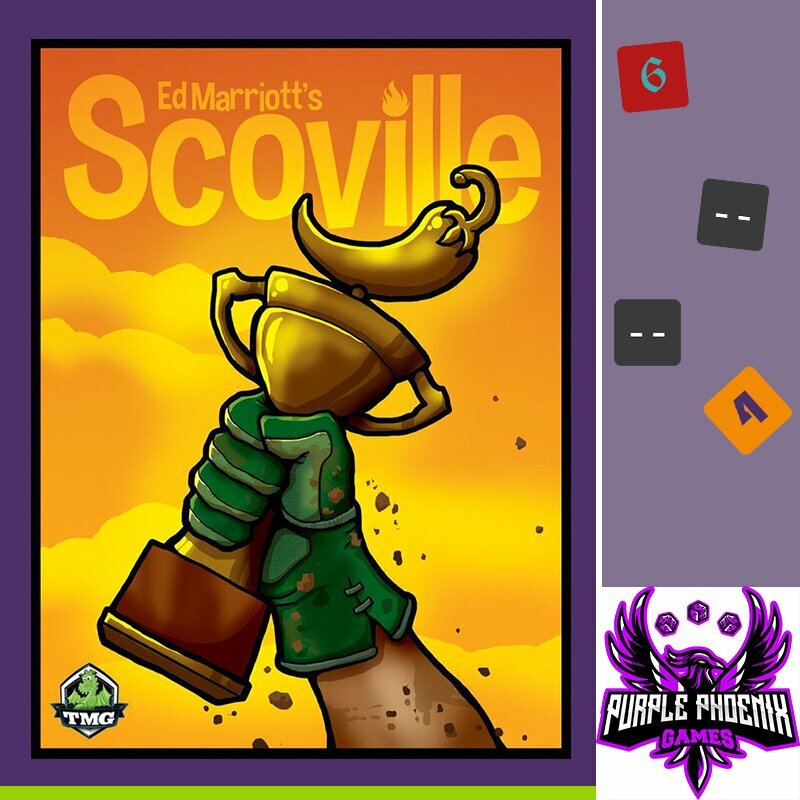
“Scoville” is exactly what you are thinking. Well, if you are a pepper fan or afficionado anyway. You see, Scoville, a term specifically made up by a fellow pepper enthusiast, is a test that measures the “hotness” of a pepper. The test was first used by Wilbur Scoville in 1912, whose namesake became the prodigious word used across the world to catalogue the finest and hottest peppers. The test has become so popular, that each year, farmers across the world make attempts to cross-breed peppers to make even hotter ones, just so they can stake a claim at the highest level of the Scoville scale.
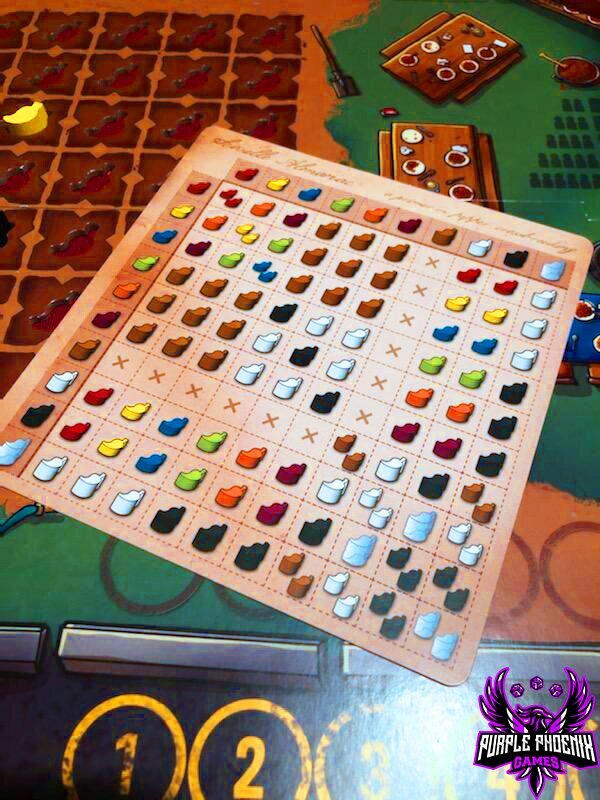
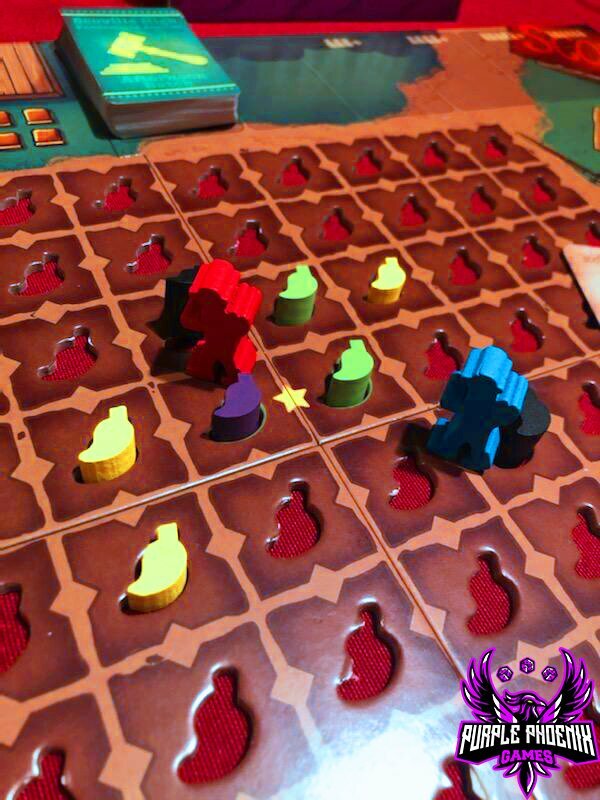
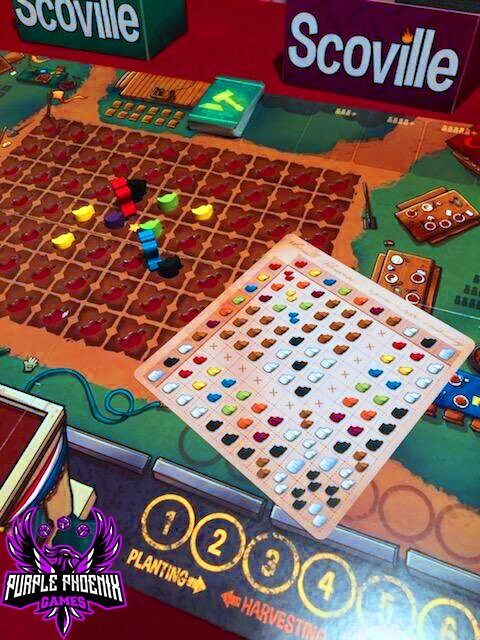
Now that you have an idea of what our theme is all about, let’s talk gameplay. In Scoville, you play a pepper farmer. Your goal is to plant, sell, and breed the hottest peppers in all of town, suitably named, “Scoville.” There are 5 phases in each round of the game. Players complete these 5 phases in order until afternoon occurs in the game. This happens when a set amount of peppers have been sold by the farmers in the “marketplace” based on player count. These 5 phases: Auction, Plant, Harvest, Fulfillment, and Time Check, are described in the rulebook in a short, but thorough way. Each “morning” in the game, farmers take turns selling their peppers for victory points, planting new peppers in the open field plots, harvesting and breeding new peppers to sell later, and completing orders. It sounds like a lot, but the gameplay is one of the smoothest I have experienced in a worker placement style game. It’s unique in that it isn’t truly worker placement where you fill a space and another player is then blocked. The field in this case is wide open and provides ample direction for multiple strategies to get the best peppers on your turn. Once enough peppers have been sold based on the rulebook’s conditions, players enter the “afternoon” phase where they will sell peppers and fulfill any remaining orders they can. Once all players have completed this last trek through the 5 phases, victory points are added up. You’ll get varying points for all orders fulfilled throughout gameplay, points for special award plaques such as the hottest pepper award, points for unused Bonus tiles you are provided at the start (essentially little bumps in the game so no one person can run away with the scoring), and finally points for all money you have left from selling peppers in increments of $3.
While I have only scratched the surface of the breadth of gameplay this game offers, it is by far one of the simplest, yet most strategic, worker placement board games I have come across. The theme is in a very specific niche, yet is so whimsical and fun because of how the game is organized and crafted. It is very accessible for the whole family, and I say even usable as a first gateway game into the worker placement genre. The designer has done great not to let the theme weigh down the game to the point of that typical analysis paralysis that sometimes becomes the crux of most worker placement games. To clarify, actions such as “watering” or “fertilizing” the peppers could have been added to amplify the theme further, but are not included I believe because it truly doesn’t take away from the gameplay and imaginative idea that we are true pepper farmers. Just because we are “farmers” doesn’t mean we have to complete every task a farmer might do. We just have to feel like we are growing some really cool looking peppers (which the unique pepper meeples do the trick!)
While the theme is quite specific to a certain niche of gamer/pepper afficionado, it certainly makes up in fun gameplay that really anyone can enjoy, even us light-weight pepper eaters. It actually gives us light-weights a place to feel inclusive in this world of burn-your-face-off exhilarance that is so apparent on the faces of those that can tackle the likes of the dreaded Ghost pepper or Carolina Reaper. Purple Phoenix Games gives this one a hot 10 / 12. I hope you consider picking up a copy of this at your local game store and give it a try. You won’t regret it. And hey, good luck discovering all sorts of new and exciting types of those hot hot little death pickles!
“Scoville” is exactly what you are thinking. Well, if you are a pepper fan or afficionado anyway. You see, Scoville, a term specifically made up by a fellow pepper enthusiast, is a test that measures the “hotness” of a pepper. The test was first used by Wilbur Scoville in 1912, whose namesake became the prodigious word used across the world to catalogue the finest and hottest peppers. The test has become so popular, that each year, farmers across the world make attempts to cross-breed peppers to make even hotter ones, just so they can stake a claim at the highest level of the Scoville scale.
Now that you have an idea of what our theme is all about, let’s talk gameplay. In Scoville, you play a pepper farmer. Your goal is to plant, sell, and breed the hottest peppers in all of town, suitably named, “Scoville.” There are 5 phases in each round of the game. Players complete these 5 phases in order until afternoon occurs in the game. This happens when a set amount of peppers have been sold by the farmers in the “marketplace” based on player count. These 5 phases: Auction, Plant, Harvest, Fulfillment, and Time Check, are described in the rulebook in a short, but thorough way. Each “morning” in the game, farmers take turns selling their peppers for victory points, planting new peppers in the open field plots, harvesting and breeding new peppers to sell later, and completing orders. It sounds like a lot, but the gameplay is one of the smoothest I have experienced in a worker placement style game. It’s unique in that it isn’t truly worker placement where you fill a space and another player is then blocked. The field in this case is wide open and provides ample direction for multiple strategies to get the best peppers on your turn. Once enough peppers have been sold based on the rulebook’s conditions, players enter the “afternoon” phase where they will sell peppers and fulfill any remaining orders they can. Once all players have completed this last trek through the 5 phases, victory points are added up. You’ll get varying points for all orders fulfilled throughout gameplay, points for special award plaques such as the hottest pepper award, points for unused Bonus tiles you are provided at the start (essentially little bumps in the game so no one person can run away with the scoring), and finally points for all money you have left from selling peppers in increments of $3.
While I have only scratched the surface of the breadth of gameplay this game offers, it is by far one of the simplest, yet most strategic, worker placement board games I have come across. The theme is in a very specific niche, yet is so whimsical and fun because of how the game is organized and crafted. It is very accessible for the whole family, and I say even usable as a first gateway game into the worker placement genre. The designer has done great not to let the theme weigh down the game to the point of that typical analysis paralysis that sometimes becomes the crux of most worker placement games. To clarify, actions such as “watering” or “fertilizing” the peppers could have been added to amplify the theme further, but are not included I believe because it truly doesn’t take away from the gameplay and imaginative idea that we are true pepper farmers. Just because we are “farmers” doesn’t mean we have to complete every task a farmer might do. We just have to feel like we are growing some really cool looking peppers (which the unique pepper meeples do the trick!)
While the theme is quite specific to a certain niche of gamer/pepper afficionado, it certainly makes up in fun gameplay that really anyone can enjoy, even us light-weight pepper eaters. It actually gives us light-weights a place to feel inclusive in this world of burn-your-face-off exhilarance that is so apparent on the faces of those that can tackle the likes of the dreaded Ghost pepper or Carolina Reaper. Purple Phoenix Games gives this one a hot 10 / 12. I hope you consider picking up a copy of this at your local game store and give it a try. You won’t regret it. And hey, good luck discovering all sorts of new and exciting types of those hot hot little death pickles!

Daniel Boyd (1066 KP) rated Sniper Elite 4 in Video Games
Oct 10, 2017 (Updated Oct 10, 2017)

Satisfying gameplay. (2 more)
X-Ray camera.
Neat settings.
Generic characters and plot. (1 more)
Sub par graphics.
Hits It's Target
The fourth game in the third person WW2 shooter series, this game expands on the groundwork laid by it's predecessors. If you are coming off of a story driven game and are just looking for something satisfying and fun, then this is perfect for you. The story and characters are paper thin and the voice acting is all over the place in terms of quality, but that's not why you come to Sniper Elite, you come to watch a Nazi's brains explode from the sheer impact of your well placed bullet.
This is definitely the best game in the series in terms of it's gameplay systems. The control given to the player is clear and specific and if you miss a shot, you have no one to blame but yourself. The infamous X-ray cam makes a glorious return and it is even more detailed and brutal than in previous entries. No matter how many times you make a pair of Nazi testicles go pop from across a beautiful Italian town, it never gets old.
The other great thing about this game is it's various settings. There is an array of different maps that you work your way through during the game's campaign and each is unique and well thought out enough to give you a challenge, but also make you feel like a total bad-ass when you land a near impossible shot, in equal measure.
Although the landscapes are nice to run around in and function well in terms of matching with the game's gameplay style, the quality of the graphics itself isn't going to astonish anyone. We are around halfway through the PS4's life-cycle and this looks at best, like a late generation PS3 game. Again though, it doesn't really matter here, no one is buying Sniper Elite 4 for it's graphical quality.
Overall, there is a ton of fun to be had here. Don't think too much about the story and just enjoy systematically working your way through each various map, popping Nazi skulls as you go.
This is definitely the best game in the series in terms of it's gameplay systems. The control given to the player is clear and specific and if you miss a shot, you have no one to blame but yourself. The infamous X-ray cam makes a glorious return and it is even more detailed and brutal than in previous entries. No matter how many times you make a pair of Nazi testicles go pop from across a beautiful Italian town, it never gets old.
The other great thing about this game is it's various settings. There is an array of different maps that you work your way through during the game's campaign and each is unique and well thought out enough to give you a challenge, but also make you feel like a total bad-ass when you land a near impossible shot, in equal measure.
Although the landscapes are nice to run around in and function well in terms of matching with the game's gameplay style, the quality of the graphics itself isn't going to astonish anyone. We are around halfway through the PS4's life-cycle and this looks at best, like a late generation PS3 game. Again though, it doesn't really matter here, no one is buying Sniper Elite 4 for it's graphical quality.
Overall, there is a ton of fun to be had here. Don't think too much about the story and just enjoy systematically working your way through each various map, popping Nazi skulls as you go.

Goddess in the Stacks (553 KP) rated When Katie Met Cassidy in Books
Jun 20, 2018

This was one of my Book of the Month picks this month, so I got it a little early. It's a very quick read, and a sweet story. Basically, it's lesbian romance fluff. We need more fluff with non-heterosexual romances, so this is great stuff!
The book touches on gender issues - Cassidy is a woman, and seems happy to be so, but abhors feminine clothing and instead dresses solely in men's suits. (The scene with her fabulously gay tailor was an absolute delight!) She flashes back a little onto her childhood when she wasn't allowed to wear the clothing she felt best in. She also has a few conversations with Katie about gender roles. Katie is much more traditionally feminine, wearing dresses and heels and long hair.
I'm a little torn on whether I dislike the use of the trope "straight woman turned gay after breakup" or like the point that Katie isn't sure she likes women, but she knows she likes Cassidy. Cassidy's gender is secondary to her personality. And it's not like Katie decided to go hit on women after her fiance cheated on her; she got practically dragged to the lesbian bar by Cassidy, who saw how much she was hurting and decided to help her.
I enjoyed seeing that Cassidy has casual sex partners, many of them former sex partners, who are still good friends with her. Granted, she has lots of one-night stands who are upset with her since she's quite the player, but there are several women who she's been involved with before the book opens, who are close friends of hers and care about her future. I wish we saw more relationships like this in heterosexual romantic fiction instead of only in GLBT fiction! These kinds of relationships do exist in heterosexual groups, but it seems like romantic fiction is always divided between "heterosexual monogamy" and "everything else." I did read an exception in Next Year, For Sure, but I greatly disliked the ending.
I really loved this book. It was sweet, and light-hearted, and a pleasant breath of fresh air from a lot of what I've been reading recently!
You can find all my reviews at http://goddessinthestacks.wordpress.com
The book touches on gender issues - Cassidy is a woman, and seems happy to be so, but abhors feminine clothing and instead dresses solely in men's suits. (The scene with her fabulously gay tailor was an absolute delight!) She flashes back a little onto her childhood when she wasn't allowed to wear the clothing she felt best in. She also has a few conversations with Katie about gender roles. Katie is much more traditionally feminine, wearing dresses and heels and long hair.
I'm a little torn on whether I dislike the use of the trope "straight woman turned gay after breakup" or like the point that Katie isn't sure she likes women, but she knows she likes Cassidy. Cassidy's gender is secondary to her personality. And it's not like Katie decided to go hit on women after her fiance cheated on her; she got practically dragged to the lesbian bar by Cassidy, who saw how much she was hurting and decided to help her.
I enjoyed seeing that Cassidy has casual sex partners, many of them former sex partners, who are still good friends with her. Granted, she has lots of one-night stands who are upset with her since she's quite the player, but there are several women who she's been involved with before the book opens, who are close friends of hers and care about her future. I wish we saw more relationships like this in heterosexual romantic fiction instead of only in GLBT fiction! These kinds of relationships do exist in heterosexual groups, but it seems like romantic fiction is always divided between "heterosexual monogamy" and "everything else." I did read an exception in Next Year, For Sure, but I greatly disliked the ending.
I really loved this book. It was sweet, and light-hearted, and a pleasant breath of fresh air from a lot of what I've been reading recently!
You can find all my reviews at http://goddessinthestacks.wordpress.com