Purple Phoenix Games (2266 KP) rated My First Stone Age: The Card Game in Tabletop Games
Apr 7, 2021
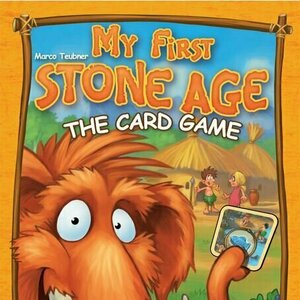
My First Stone Age: The Card Game (that’s a mouthful) is a quick and easy card game that can be played by any child of any age assuming they have the attention span for it (mine didn’t the first couple times). It focuses on memory skills and set collection mechanics.
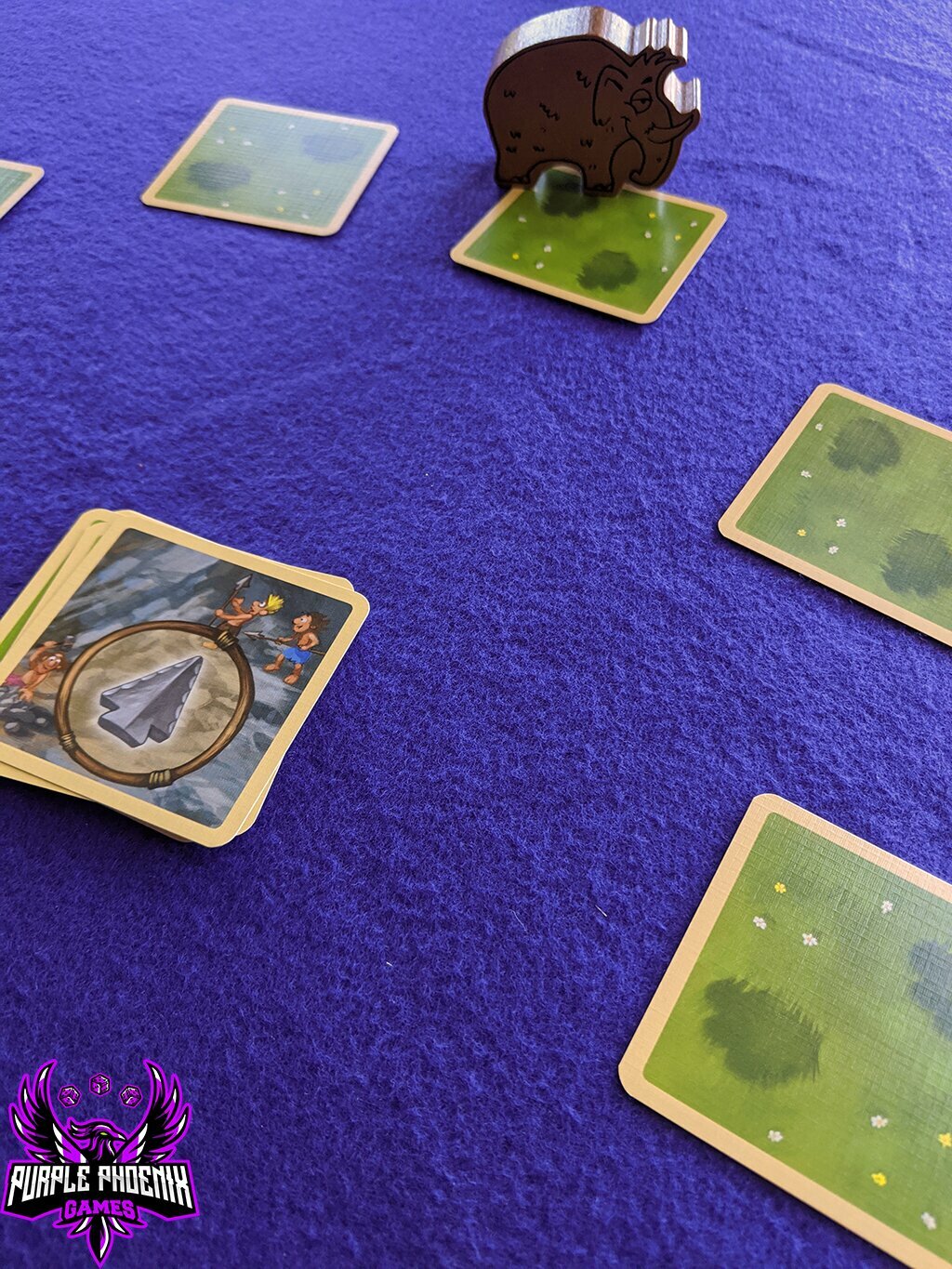
Setting up is easy. Shuffle the Hut Cards and give each player one. Shuffle the Goods Cards and deal nine face-down in a circle. Place the rest of the deck in the middle of the circle face-up. Plop Martin, the mammeeple (mammoth meeple) on or near one of the face-down cards and you’re ready to play!
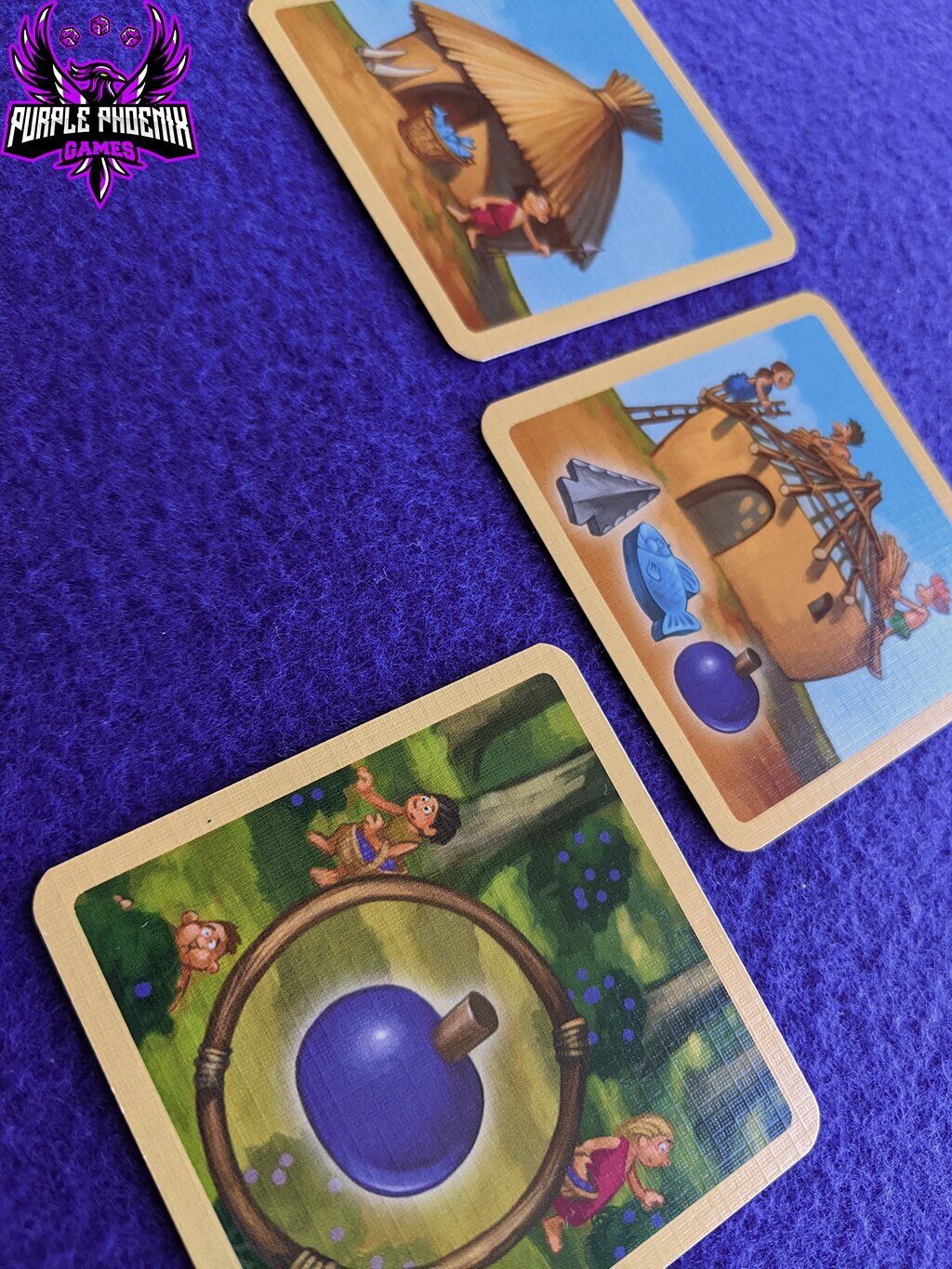
The winner of the game is they who is able to build three huts first. Players can build huts by moving Martin around the circle clock-wise 1-4 spaces, collecting the card if it matches the players’ hut card, and then building the hut by discarding the goods used. Each turn players will be able to move Martin, flip a card to see if it matched their hut card, and build a hut. The game continues in this fashion until the winner has built their third hut!
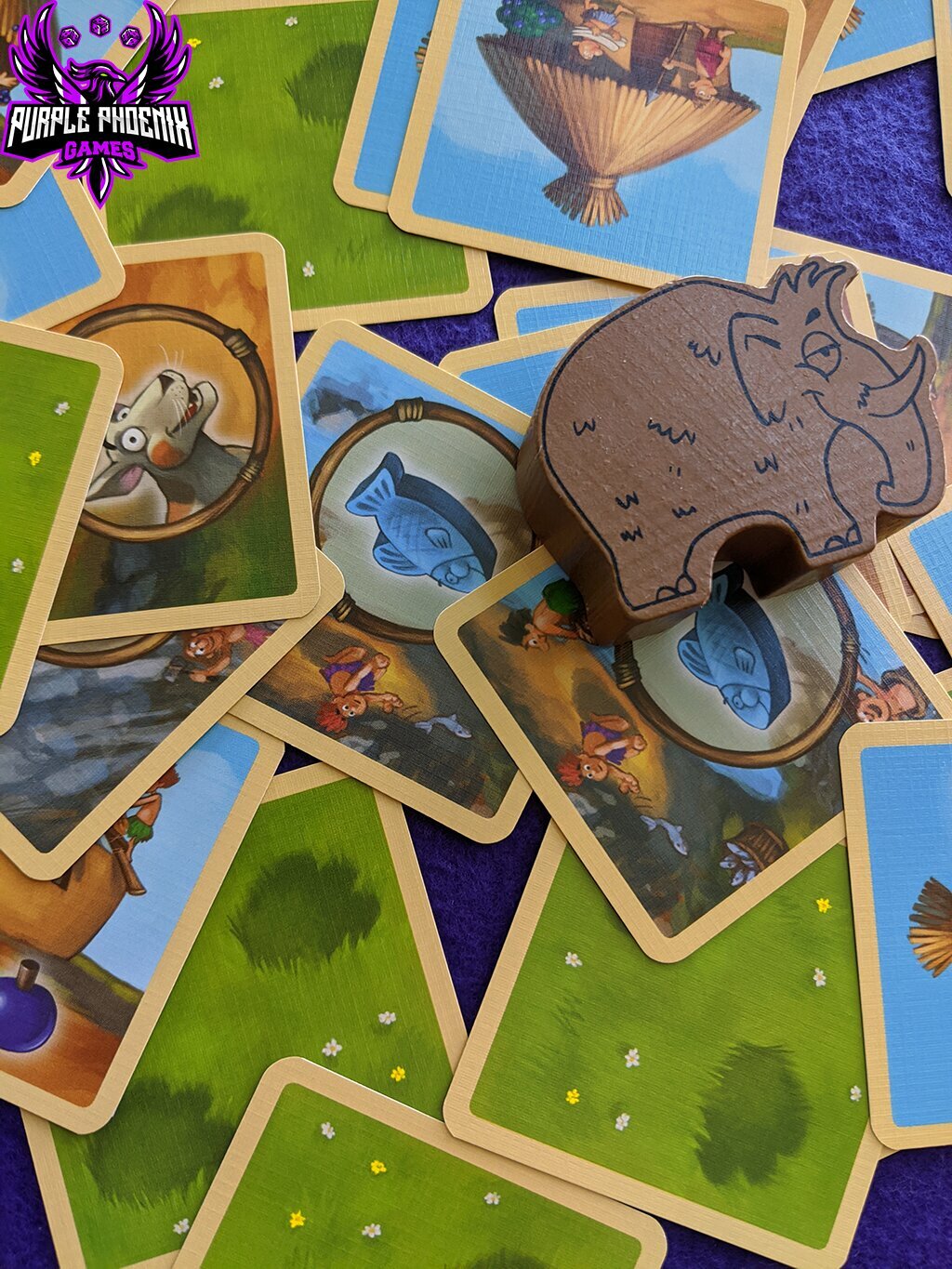
This is a very light game that has very simple rules, and not a ton for the players to have to keep track of or remember. Perfect for young ones and not-so-young ones alike. We love the artwork on the cards and being able to move a large mammeeple around the table searching for fish or arrowheads. While the game is competitive in that there is a winner and therefore also losers, we mitigate that by saying that, “if I win then you get to tickle me, but if you win I get to tickle you!” That usually quells any upset youngsters pretty quickly.
We love this game and it is a great first step into gateway games that target older audiences. It is simple and quick, and a minimal investment for a good few minutes!
Stone Age: The Board Game
Games
App
A classic worker placement game mechanic, one of the modern classics, easy to learn and intuitive,...
BoardGameApp ModernClassic

Talking Tom Pool
Games and Entertainment
App
Get ready to party with Talking Tom in a completely new kind of puzzle game! Grab your bathing suit,...

BIAS Amp for iPhone
Music and Entertainment
App
BIAS is a professional amp designer, modeler and processor that gives you a stunning replications of...

Planica Ski Flying
Games
App
********************************************************** WELCOME ski jumping & flying fans to...
Mission: Red Planet (Second Edition)
Tabletop Game
With technology rapidly developing and the human population growing, Victorian-era Earth is in dire...
Boardgames SpaceGames MarsGames 2015Games GamesMadeBetterThanTheOriginal
Purple Phoenix Games (2266 KP) rated Lagoon: Land of Druids in Tabletop Games
Jun 12, 2019
Lagoon is a land of harmony and balance. Or at least it WAS until the rise of humanity. The three spiritual energies that once existed in a perfect equilibrium are now fighting for dominance and control over the destiny of Lagoon. Each energy has amassed a following of druids who are working to ensure that their chosen energy is victorious! Which energy will you choose to serve, and will your choice be the correct one in the end? There’s only one way to find out!
Lagoon: Land of the Druids is a game of tile placement and exploration. You are the leader of a circle of druids, and they will do your bidding throughout the game. On your turn, you will take any/all of these five actions: Move, Summon (add one of your reserve druids to the play area), Explore (add a new site tile to the table), Invoke (use a Site Action), or Unravel (remove a site tile from play). You can perform as many of these actions as you want, as long as you have the appropriate resources to spend. Each tile in the game is double-sided, and each side has a unique action/ability associated with it. Strategy is everything – which tile side should you choose to bring into play, and how can you best use the available abilities to benefit your chosen energy? You also have to keep an eye on your opponents because they might be trying to undermine your plans to help their energy achieve success! The game ends when all tiles have been explored, and then players count up points dependent upon which energy was ultimately dominant. The player with the most points is the winner!
As a solo game, Lagoon plays similarly to the multi-player game. Instead of competing against other humans, you are playing against an AI opponent (fondly referred to as “AJ” in the rulebook). On its turn, alternating with yours, the AI executes three steps – Explore, Unravel, and Invoke (perform an action dependent on which druids the AI currently has in play). Each of those steps is explained in more detail in the rulebook. The game ends as in a normal group game, and the player (either you or the AI) with the highest score wins.
The first thing I should mention are the solo rules themselves – they are very wordy and contain lots of ambiguity. It took me a couple of read-throughs before I felt comfortable trying to play, and even now I still keep the solo rules easily accessible when I do play. With so many moving elements in this game, clear and concise rules are necessary for an unencumbered game.
When I say there are a lot of moving elements, I mean it. At any point, you could have up to 5 druids in play, with access to up to 5 unique site powers to invoke in addition to the basic actions you can take on your turn. And on top of that, your druids are spiritually connected, so a druid on one site can use the power of a different site as long as you have a druid there as well. There are also lots of opportunities to combo powers this way, and unless you’re 100% focused, you could lose track of what you already did or forget to pay for an action. And in a solo game, you’re not only tracking this for yourself, you also have to make sure you’re executing the AI turns correctly. There’s just a lot going on and it can be easy to accidentally skip a step.
The thing I dislike most about playing Lagoon solo is that I have to make decisions for the AI. When placing tiles on AI turns, I get to choose which side to play. When the AI unravels a site, I get to choose which site to remove. It’s hard to play this game honestly because I can just choose whatever will benefit ME the most, and not necessarily act in the AI’s best interest. Obviously, a human opponent would do whatever they want for themselves, but in a solo game I am in control of my opponent. The rulebook does offer ways to alleviate this, but I either honestly forget to refer back to the rules for certain situations, or I just choose to ignore the suggestions. I know, I know, that sounds like a personal problem. And I guess it is. I just don’t like the responsibility of having to play two competing sides because it is hard to stay honest. Since this game is so dependent on strategy and personal decisions, there is no good way for an AI opponent to be successful.
Lagoon: Land of the Druids is a complex game that requires more strategy than you think. That being said, I don’t like to play it solo. Each turn offers lots of opportunities, but so many options can be overwhelming. Having to make decisions for the AI is not enjoyable for me because I am aware that I do not always make the best decision for the AI – it’s just hard for me to consciously make decisions detrimental to my game. The idea of this game is neat, but the execution of the solo rules (from their editing to their actual gameplay) just doesn’t work well for me. Give it a try solo if you want, but you’re not really missing a lot if you don’t.
https://purplephoenixgames.wordpress.com/2019/03/11/solo-chronicles-lagoon-land-of-the-druids/
Purple Phoenix Games (2266 KP) rated Crazier Eights: Pantheon in Tabletop Games
Aug 25, 2020
War. Old Maid. Go Fish. Crazy Eights. These are classic card games we probably all grew up playing. There have been many re-themes and new difficulty layers spread upon them to make them even more interesting. While UNO certainly has cornered the market on the Crazy Eights base, we have a new contender: Crazier Eights. Recoculous has published several versions of this card game with different themes: Camelot, Avalon, One Thousand & One Nights, Olympus, and Shahrzad. Today we are taking a preview of Crazier Eights: Pantheon.
You HAVE played Crazy Eights right? The card game where you attempt to be the first to exhaust your hand of cards, but you can only play down if you can match the suit or number on top of the discard pile? And if you can’t, you throw down an 8 as a wild and call the color to be played next? Well there you have the easy rules. Crazier Eights: Pantheon (which I will from here call C8P) holds basically the same rule-set with a few new mechanics and a theme. The win condition is still the same: be the first to exhaust your hand of cards, but to win you will need to play your hand strategically against your opponents.
DISCLAIMER: We were provided a copy of this game for the purposes of this review. This is a retail copy of the game, so what you see in these photos is exactly what would be received in your box. I do not intend to cover every single rule included in the rulebook, but will describe the overall game flow and major rule set so that our readers may get a sense of how the game plays. For more in depth rules, you may purchase a copy online or from your FLGS. -T
To setup, shuffle the large deck of cards and place the deck in the middle of the table. Flip the top card to begin the discard pile and dictate the first card play. Deal each player seven cards and you are ready to begin!
The turn structure is familiar: check for any “start of turn” effects and apply them, draw a card, play and/or discard a card, then resolve any “end of turn” effects. The deck is comprised of Events and Assets in different colors (suits) and numbers like in a typical deck of playing cards. After checking and resolving start of turn effects on Asset cards in your personal tableau, you must draw a card from the deck. This is where C8P strays from OG Crazy Eights a bit. You may play a card from your hand (Assets and Events) and discard a card to the discard pile (matching the suit/number/or an Eight), or simply play a card from your hand without discarding. Cards played from your hand can be Event cards that are played, resolved, and then discarded to the bottom of the discard pile, or an Asset card that is played to your tableau that cause chain reactions or other abilities on future turns. Next, resolve any end of turn effects from Assets in your tableau before the next player begins their turn.
Play continues in this fashion until one player has rid themselves of their hand and is crowned the Master of the Pantheon! Or at least, the winner of the game.
Components. This game is a box full of cards. The cards are good. The layout makes sense, and the art on the faces of the cards remind me of very classic art depicting ancient Grecian scenes. I am no art historian, so I do not know if they are existing art pieces or new ones crafted for this game, but either way, they are a joy to behold… if you can spend the time appreciating the art instead of tracking what cards you need to play and what effects you can chain together (that was me). Extra points to the Recoculous team for associating symbols with the different suit colors for our colorblind friends. This is something that unfortunately goes unaddressed far too often.
This implementation is the second Crazier Eights we have had the chance to try, and I can say that we really enjoyed our plays of it (we played Olympus first and will be playing Camelot soon). The game comes with many interesting and varied effects to craft an ingenious strategy, and the art is stellar. Beware of playing with AP-prone gamers, as there is a lot going on and it is more than just a skinned Crazy Eights.
The Pantheon set, specifically, seems to contain more cards that allow players to steal Assets from other players, and also cards that allow players to discard more than one card each turn. These are very interesting adjustments to our first experience of Crazier Eights, and from what we were told, Pantheon can be played as a standalone OR as an expansion to throw into any other set. There are less cards in Pantheon than in Olympus or Camelot (and the other base sets I assume), but the gameplay is the same, and is super quick.
Now having played this family of games several times, I can say that it is my favorite Crazy Eights derivative and certainly worthy of a look. If your game collection is sorely lacking in ancient Greek-themed card games, or if you want a hybrid game of old school rules with interesting twists, then do consider purchasing this or one of its predecessors.
PS – Don’t worry if, while you are playing, you have all your Assets stolen or destroyed. I have won the game with zero Assets in front of me while opponents have had eight, ironically. Assets are great, but you still need to shed your hand.
kelsey (8 KP) rated The Adventure Zone in Podcasts
May 29, 2019
Balance has since ended, and now the podcast has moved on to other TTRPGs like Fate (TAZ: Commitment), Powered By the Apocalypse (TAZ: Dust), and Monster of the Week (TAZ: Amnesty). Commitment and Dust are two short-run "test-drives" run by Clint and Travis respectively, and I personally adored a departure from the 5e system to not only be introduced to different TTRPGs, but to hear the DM-ing (or now GM-ing) styles of the other McElroys. In Amnesty, Griffin once again takes the reigns to run the game, and at the posting of this review, Amnesty is being considered the "second season" for TAZ. For some, these diversions from the 5e system may not work, but I recommend listening. They're just as creative and fun as Balance was, though different. I recommend coming in with an open mind, as going from the way Balance was to now, the show is quite different, but the heart is still there and the stories are still stunning.
If those aren't your speed, though, the McElroys post bonus games (like Four Sherlock Holmes) that are meant to be silly one-shot arcs AND they host a number of live-shows that bring back the beloved Balance characters into hilarious one-shot adventures, so you're never short of a dose of Magnus, Taako, and Merle. Being honest, the live shows are some of the funniest things I've listened to. They're marvelously fun, and the added time pressure of the show adds to the comedy. They also really bring back the actual-play atmosphere that sometimes gets lost during edited episodes.
I cannot recommend TAZ enough. Being honest, it pretty much saved my life. It brought (and still brings) me so much joy, and it encouraged me to try out TTRPGs--seriously, I took up DMing because of TAZ, and now I run TTRPG games weekly.
Do yourself a favor, roll perception with advantage and give this one a listen.