Search
Search results
Purple Phoenix Games (2266 KP) rated Deckscape: The Mystery of Eldorado in Tabletop Games
Mar 12, 2021
Who out there has ever gone to an escape room and not enjoyed themselves? I know nobody (though if that’s you, it’s okay). I have only been to one in my life (eek!) and I absolutely loved it! I have watched videos of celebrities tackling escape rooms and have been riveted. I like the shows you can now find streaming of similar type activities and am always glued to the screen. Heck, I have played the EXIT and Unlock systems of board games and enjoyed them as well. So having the experience I have and never having played the Deckscape system, how did it fare for me? Decent. Read on.
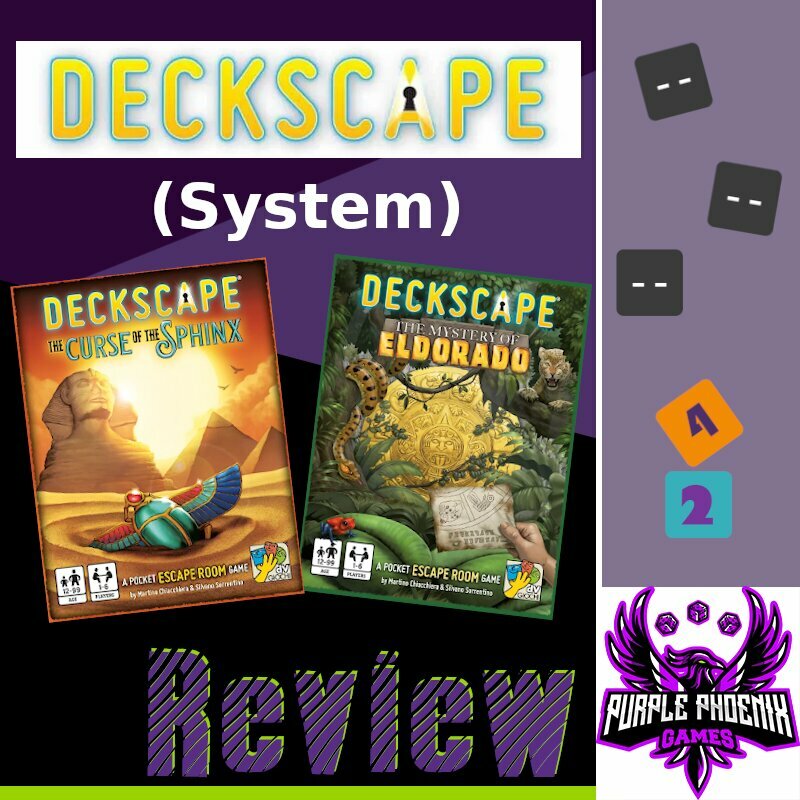
Imagine yourself trapped on a jungle island after your plane crashes. Or being locked within a pyramid whilst visiting Egypt. These are the settings for the pair of games we reviewed and I really cannot and will not be going further into a lot of detail so as to avoid any spoilers as best I can.
DISCLAIMER: We were provided a copy of both The Curse of the Sphinx and The Mystery of Eldorado for the purposes of this review. These are retail copies of the games, so what you see in these photos is exactly what would be received in your boxes. I will describe the overall game flow and major rule set so that our readers may get a sense of how the game plays. For more info, you may purchase a copy online or from your FLGS. -T
To setup a game of Deckscape, open the box and take out the cards. You are now ready to play. Seriously. No rules to read. Nothing to teach others. Just read the top card and do as it says. You have now begun your adventure!
Playing the games involves players (or a solo player) encountering cards in the 60-card deck in order to solve puzzles and use items found to best finish the scenario. There are no turns in these games, and players are encouraged to discuss possibilities before committing to answers to the puzzles. Randy from Dora and the Lost City of Gold would be so happy to be figuring out “Jungle Puzzles” and “Pyramid Puzzles.”
Each card is either a puzzle or an item and each card will more than likely be encountered throughout the game. Players are trying to figure out the puzzle clues and best solve them. Incorrect guesses will result in costly errors that affect endgame scoring. Sometimes correct guesses will allow the players to erase errors or give other positive clues.
Once the players have made their way through the game solving puzzles and riddles they will consult the table at the end to see how well they scored. Usually time is of the essence, and finishing the games sooner is better than later. Once the game is over and the score tallied the game owner may gift the game away as the final result is known and replaying is kinda cheating.
Components. Okay, these games are small boxes full of large cards. There are 60 cards in each game and the cards are beautifully illustrated and laid out well. We had no problems reading anything or deciphering any part of the games, so thumbs up on components from us.
Gameplay is a little polarizing, we found. I like the flow of the game and puzzles within. My wife, however, couldn’t stand them. But she later admitted to now understanding that she just does not enjoy escape room styled board and card games. That said, these games play more like Choose Your Own Adventure games than the typical EXIT/Unlock style games, as most (if not all) cards in Deckscape require players to complete them before moving to the next card in numerical order with either a success or penalty. This can rub players the wrong way if they are used to the other style of escape room games. It was no problem for me, and I enjoyed my plays.
What I liked most about these games is that the story is easy to follow and the puzzles mostly make logical sense. A few of them stumped me, but luckily players may find helper cards to give clues to puzzles in the game. We relied on these helpers a few times, but I did not feel like we were consulting them for every puzzle. So that’s a definite positive. I also liked the thematic immersion. For a card game I felt drawn into the stories and wanted to complete them as well as I could.
What I disliked most about these games is the fact that you end up encountering every card or nearly every card. The intrigue of other escape room games I have played is wondering what was on some of those other cards. Or what did I miss on a card that I should have noticed? While you get SOME of that here, I found Deckscape to be more entry-level in difficulty. That is certainly not a bad thing for most gamers. We were expecting something different than what we played, and I think that unfortunately immediately put us off at first.
However, I played the second game solo and I liked it quite a bit. I think I mostly liked it because I didn’t have my wife around to figure out the puzzles with me and I was truly all alone. This added to my anxiety to finish well, or finish at all! I definitely cannot see myself playing these games with the full compliment of six players as I feel I would be too overwhelmed with people shouting out their guesses and trying to parse everything. But that’s just me. I prefer these with low player counts.
All in all these games are pretty good, and a decent something different from the other games in the same style. If you have yet to try Deckscape and like escape room games in general, I reccomend you give them a try. They are quick (and even quicker as your goal is finish in a short amount of time for the best scores), easy to play with zero teaching and setup time, and gives a great amount of puzzles to decipher. Purple Phoenix Games gives the Deckscape system of games an unsure-but-you-seem-confident-about-your-answer-so-let’s-just-go-with-yours 6 / 12. If you see them on the shelves pick one up and try it out. Add these to your growing collection of escape room games for show, or play them and pass them along, as I intend to do.
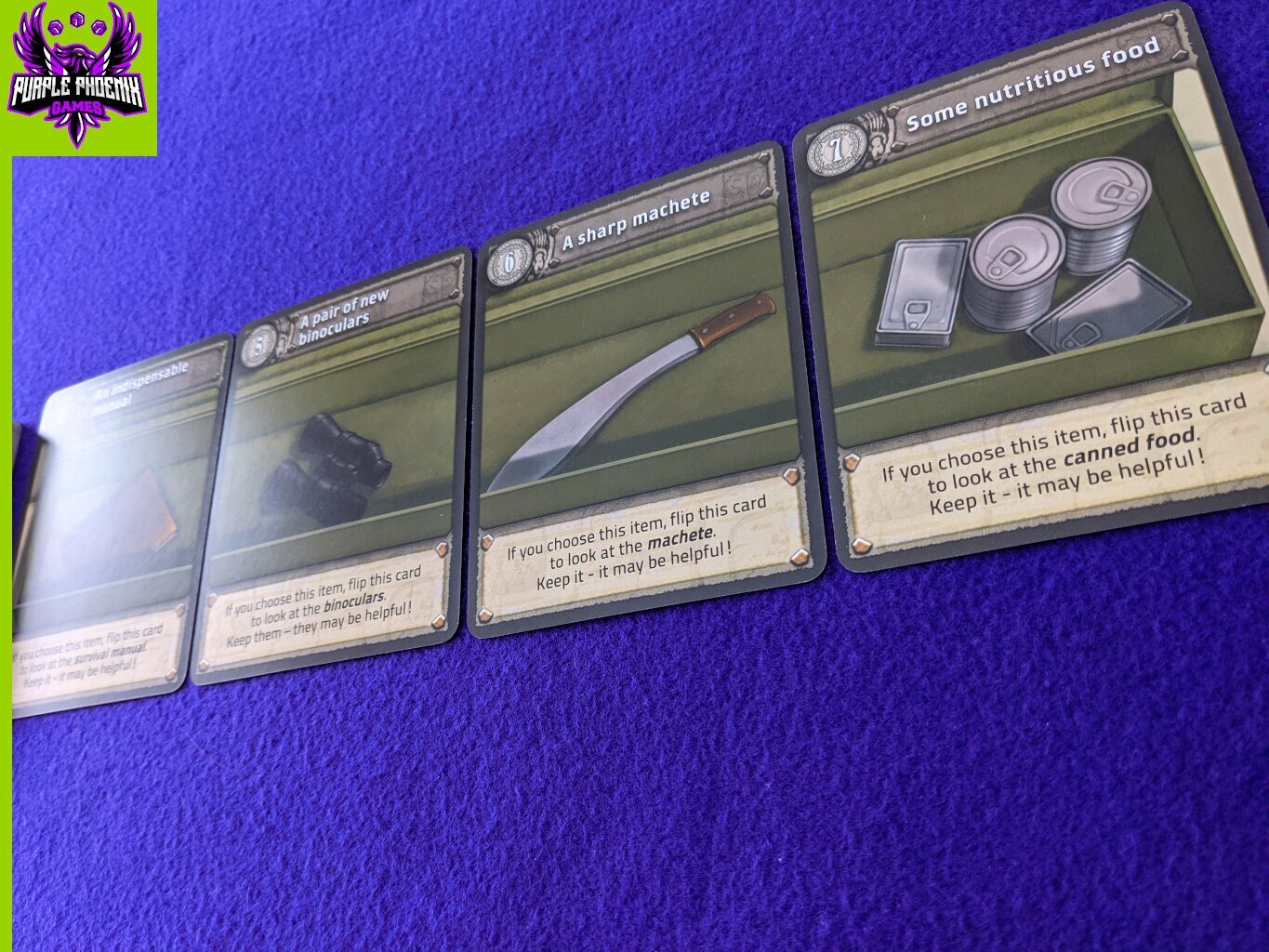
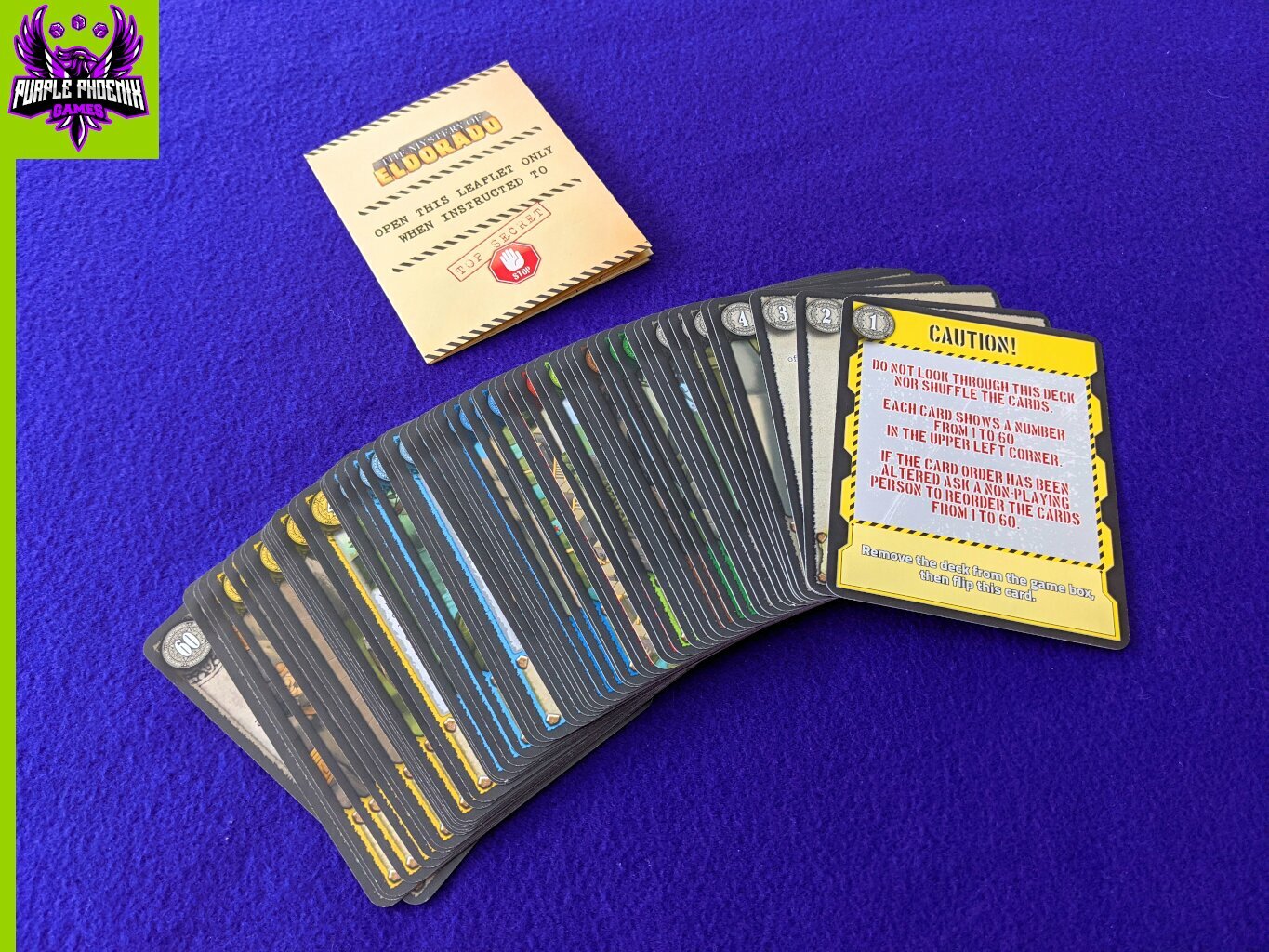
(Note: I usually add a messy components photo at the end of my reviews, but I don’t want to spoil anything, so I’ll just throw some cards down that won’t really ruin anything at all.)
Imagine yourself trapped on a jungle island after your plane crashes. Or being locked within a pyramid whilst visiting Egypt. These are the settings for the pair of games we reviewed and I really cannot and will not be going further into a lot of detail so as to avoid any spoilers as best I can.
DISCLAIMER: We were provided a copy of both The Curse of the Sphinx and The Mystery of Eldorado for the purposes of this review. These are retail copies of the games, so what you see in these photos is exactly what would be received in your boxes. I will describe the overall game flow and major rule set so that our readers may get a sense of how the game plays. For more info, you may purchase a copy online or from your FLGS. -T
To setup a game of Deckscape, open the box and take out the cards. You are now ready to play. Seriously. No rules to read. Nothing to teach others. Just read the top card and do as it says. You have now begun your adventure!
Playing the games involves players (or a solo player) encountering cards in the 60-card deck in order to solve puzzles and use items found to best finish the scenario. There are no turns in these games, and players are encouraged to discuss possibilities before committing to answers to the puzzles. Randy from Dora and the Lost City of Gold would be so happy to be figuring out “Jungle Puzzles” and “Pyramid Puzzles.”
Each card is either a puzzle or an item and each card will more than likely be encountered throughout the game. Players are trying to figure out the puzzle clues and best solve them. Incorrect guesses will result in costly errors that affect endgame scoring. Sometimes correct guesses will allow the players to erase errors or give other positive clues.
Once the players have made their way through the game solving puzzles and riddles they will consult the table at the end to see how well they scored. Usually time is of the essence, and finishing the games sooner is better than later. Once the game is over and the score tallied the game owner may gift the game away as the final result is known and replaying is kinda cheating.
Components. Okay, these games are small boxes full of large cards. There are 60 cards in each game and the cards are beautifully illustrated and laid out well. We had no problems reading anything or deciphering any part of the games, so thumbs up on components from us.
Gameplay is a little polarizing, we found. I like the flow of the game and puzzles within. My wife, however, couldn’t stand them. But she later admitted to now understanding that she just does not enjoy escape room styled board and card games. That said, these games play more like Choose Your Own Adventure games than the typical EXIT/Unlock style games, as most (if not all) cards in Deckscape require players to complete them before moving to the next card in numerical order with either a success or penalty. This can rub players the wrong way if they are used to the other style of escape room games. It was no problem for me, and I enjoyed my plays.
What I liked most about these games is that the story is easy to follow and the puzzles mostly make logical sense. A few of them stumped me, but luckily players may find helper cards to give clues to puzzles in the game. We relied on these helpers a few times, but I did not feel like we were consulting them for every puzzle. So that’s a definite positive. I also liked the thematic immersion. For a card game I felt drawn into the stories and wanted to complete them as well as I could.
What I disliked most about these games is the fact that you end up encountering every card or nearly every card. The intrigue of other escape room games I have played is wondering what was on some of those other cards. Or what did I miss on a card that I should have noticed? While you get SOME of that here, I found Deckscape to be more entry-level in difficulty. That is certainly not a bad thing for most gamers. We were expecting something different than what we played, and I think that unfortunately immediately put us off at first.
However, I played the second game solo and I liked it quite a bit. I think I mostly liked it because I didn’t have my wife around to figure out the puzzles with me and I was truly all alone. This added to my anxiety to finish well, or finish at all! I definitely cannot see myself playing these games with the full compliment of six players as I feel I would be too overwhelmed with people shouting out their guesses and trying to parse everything. But that’s just me. I prefer these with low player counts.
All in all these games are pretty good, and a decent something different from the other games in the same style. If you have yet to try Deckscape and like escape room games in general, I reccomend you give them a try. They are quick (and even quicker as your goal is finish in a short amount of time for the best scores), easy to play with zero teaching and setup time, and gives a great amount of puzzles to decipher. Purple Phoenix Games gives the Deckscape system of games an unsure-but-you-seem-confident-about-your-answer-so-let’s-just-go-with-yours 6 / 12. If you see them on the shelves pick one up and try it out. Add these to your growing collection of escape room games for show, or play them and pass them along, as I intend to do.
(Note: I usually add a messy components photo at the end of my reviews, but I don’t want to spoil anything, so I’ll just throw some cards down that won’t really ruin anything at all.)
Paul Kellett (118 KP) rated Fallen Land: A Post Apocalyptic Board Game in Tabletop Games
May 9, 2019
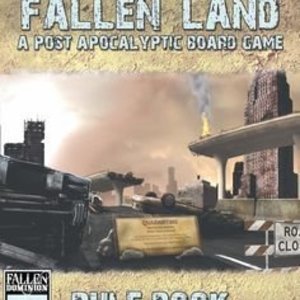
Great theme, very immersive (2 more)
Solo playable
Plenty of replayability
A bit fiddly to keep track of things (1 more)
A lot of little rules to remember
An Immersive Post Apocalyptic survival game
I don't know where I was when this launched on Kickstarter, but it totally passed me by until I started seeing a few posts on Facebook groups a couple of weeks ago. My interest was piqued and after watching a few videos and reading the reviews here, I took the plunge and ordered it from Fallen Dominion Studios. I got the base came and the expansion which adds more cards, rules for an epic 6 player game as well as 2 solo variants. Delivery to the UK was super quick, about 10 days and the shipping price was good.
On first opening the box, you are greeted with a few punchboards, the game board and a ton of cards, there is a lot contained in such a small box.
After punching and organising everything, I read the rules, painted the little plastic faction tokens and made some character inventory sleeves to help keep the play area neat.
The rules are really well written and easy to follow & understand with plenty of examples and pictures. there is a helpful index on the inside back page so you can quickly find anything you need mid-game.
The first solo variant is basically just a "reach the victory point win in as few turns as possible" - a great way to quickly learn the basics of the game and very enjoyable. It will be good if you just want to play a fairly quick (60-90 minute) survival/exploration game.
The second solo rule set is where the game really kicks into high gear. You choose a number of opponent factions depending on how much of a challenge you want and during the Town Business Phase, roll a D10 for each faction, comparing the result to a chart in the book to see what each faction does. these results can boost each faction up one or both of the victory point tracks (getting to the top of either one is a win) or more importantly, initiating PvP combat against your faction.
While this is still not the same as playing against real opponents, it offers a great challenge that will test your luck and skill to beat.
So what sets this game out as a solo gem? It's one of the most immersive games I've played. It's part open-world survival boardgame, part rpg and part story book.
You are the leader of a faction of survivors following a devastating war that destroyed the US leaving pockets of survivors trying to eke out a living among the radioactive ruins. As you make your way around the map, trying to secure vital resources or checking out points of interest, you will be drawing encounter cards and trying to complete them.
You control a team of 5 characters plus a vehicle if you are lucky and start the game with 10 items (from assault rifles to baseball bats, med kits to body armour and everything in between) which you can equip to each character any way you see fit. Some characters will get a bonus if they have certain items and some items can grant boosts to your entire party.
Here is where the RPG feel comes in. Each character and Item has a row of skill attribute boxes along the bottom edge of the card with skills such as Combat, Survival, Medical, Mechanics and Diplomacy. Your character card has a maximum carrying capacity and each item a weight so your character can only carry a certain number of items.
Skill checks are simple, you add up the total values in each attribute column of your character plus his/her equipment. Every 10 is an automatic success. Then you roll a D10 and must roll equal to or lower than the unit value. So, if your combat total is 14, then you get 1 success for the 10 and then must roll 4 or less to get a second success. This makes equipping items very important as not only do you want your skills to be as high as possible, it's often preferable to store an item for later if it would result in a lower unit thus making the die roll harder.
On to the encounters. There are a lot of them. Seriously, loads and each one on them has a mini story delving into another aspect of life after 'the war'. These add so much to the feeling of being immersed in a full world and are varied and well written. Each encounter will list a series of skill checks and the number of successes you need to pass. This is Ameritrash at it's finest Read a story, roll a bunch of dice and the deal with the outcome. A successful result will see you off with a new stash of items, victory points or maybe even new characters you can rotate into your team to replace injured members or just improve your chances with better skills.
There is so much in this game, the sheer number of cards is immense. the replayability is sky high as you will never see everything this game can offer. There are character combinations that complement each other if used together (what are the chances of drawing a husband and his wife together out of a deck of over 100 cards?), locations and storylines that trigger bonus effects if you have the right gear and 10 different factions each with their own skills and bonuses.
This game is certainly not for everyone - if you don't like luck-based games then you might not enjoy the amount of dice rolling and card drawing in Fallen Land.
The art is also divisive. It's very stylized and cartoony but it works with the feel of the game. It's not a pretty experience, everything is broken and destroyed, it's a harsh, Mad Max world of brutal survival and the art on the cards kind of fits this feel and to be honest, most of it ends up covered up and you concentrate more on reading the stories and trying to survive.
All in all a great so experience and a fantastic, brutal multiplayer game.
On first opening the box, you are greeted with a few punchboards, the game board and a ton of cards, there is a lot contained in such a small box.
After punching and organising everything, I read the rules, painted the little plastic faction tokens and made some character inventory sleeves to help keep the play area neat.
The rules are really well written and easy to follow & understand with plenty of examples and pictures. there is a helpful index on the inside back page so you can quickly find anything you need mid-game.
The first solo variant is basically just a "reach the victory point win in as few turns as possible" - a great way to quickly learn the basics of the game and very enjoyable. It will be good if you just want to play a fairly quick (60-90 minute) survival/exploration game.
The second solo rule set is where the game really kicks into high gear. You choose a number of opponent factions depending on how much of a challenge you want and during the Town Business Phase, roll a D10 for each faction, comparing the result to a chart in the book to see what each faction does. these results can boost each faction up one or both of the victory point tracks (getting to the top of either one is a win) or more importantly, initiating PvP combat against your faction.
While this is still not the same as playing against real opponents, it offers a great challenge that will test your luck and skill to beat.
So what sets this game out as a solo gem? It's one of the most immersive games I've played. It's part open-world survival boardgame, part rpg and part story book.
You are the leader of a faction of survivors following a devastating war that destroyed the US leaving pockets of survivors trying to eke out a living among the radioactive ruins. As you make your way around the map, trying to secure vital resources or checking out points of interest, you will be drawing encounter cards and trying to complete them.
You control a team of 5 characters plus a vehicle if you are lucky and start the game with 10 items (from assault rifles to baseball bats, med kits to body armour and everything in between) which you can equip to each character any way you see fit. Some characters will get a bonus if they have certain items and some items can grant boosts to your entire party.
Here is where the RPG feel comes in. Each character and Item has a row of skill attribute boxes along the bottom edge of the card with skills such as Combat, Survival, Medical, Mechanics and Diplomacy. Your character card has a maximum carrying capacity and each item a weight so your character can only carry a certain number of items.
Skill checks are simple, you add up the total values in each attribute column of your character plus his/her equipment. Every 10 is an automatic success. Then you roll a D10 and must roll equal to or lower than the unit value. So, if your combat total is 14, then you get 1 success for the 10 and then must roll 4 or less to get a second success. This makes equipping items very important as not only do you want your skills to be as high as possible, it's often preferable to store an item for later if it would result in a lower unit thus making the die roll harder.
On to the encounters. There are a lot of them. Seriously, loads and each one on them has a mini story delving into another aspect of life after 'the war'. These add so much to the feeling of being immersed in a full world and are varied and well written. Each encounter will list a series of skill checks and the number of successes you need to pass. This is Ameritrash at it's finest Read a story, roll a bunch of dice and the deal with the outcome. A successful result will see you off with a new stash of items, victory points or maybe even new characters you can rotate into your team to replace injured members or just improve your chances with better skills.
There is so much in this game, the sheer number of cards is immense. the replayability is sky high as you will never see everything this game can offer. There are character combinations that complement each other if used together (what are the chances of drawing a husband and his wife together out of a deck of over 100 cards?), locations and storylines that trigger bonus effects if you have the right gear and 10 different factions each with their own skills and bonuses.
This game is certainly not for everyone - if you don't like luck-based games then you might not enjoy the amount of dice rolling and card drawing in Fallen Land.
The art is also divisive. It's very stylized and cartoony but it works with the feel of the game. It's not a pretty experience, everything is broken and destroyed, it's a harsh, Mad Max world of brutal survival and the art on the cards kind of fits this feel and to be honest, most of it ends up covered up and you concentrate more on reading the stories and trying to survive.
All in all a great so experience and a fantastic, brutal multiplayer game.
Purple Phoenix Games (2266 KP) rated Chronicles of Crime: 1900 in Tabletop Games
Apr 23, 2021
WARNING: Extremely minor spoilers ahead (in the photos)! Don’t say I didn’t warn you (they aren’t big spoilers).
If you have been following us for a while now you have probably noticed we have published another title from the Millennium Series – Chronicles of Crime: 1400. While that title takes place in the year, well, 1400, this new title is set 500 years later in Paris. How do these games compare? What about the link to the original Chronicles of Crime (review to be posted later)? Should one purchase copies of all Chronicles of Crime games?
Chronicles of Crime: 1900 (which I shall refer to as CoC1900 from here) is a cooperative campaign, deduction, storytelling, puzzle solving adventure game, but I prefer to play it, and its relatives, solo. In it, the player(s) take control of the journalist Victor Lavel, a descendent of the main character from CoC1400. Victor has a limited amount of time to complete his investigation and return the scoop to the local newspaper by which he is employed. Players will be tackling the investigations of our noble hero in attempts to solve the case that is presented.
DISCLAIMER: We were provided a copy of this game for the purposes of this review. This is a retail copy of the game, so what you see in these photos is exactly what would be received in your box. I do not intend to cover every single rule included in the rulebook, but will describe the overall game flow and major rule set so that our readers may get a sense of how the game plays. For more in depth rules, you may purchase a copy online or from your FLGS. -T
To setup, place the main card holder board on the table. Anywhere. I called it. Next, keep the card decks in order (or don’t) and place them near the board. Similarly, place the location boards on the table and ready the main newspaper board for play. Launch the Chronicles of Crime app on a device, choose 1900, and select the scenario you wish to play. The app will drive the remainder of the game, so hold onto your butts!
How do I explain this game succinctly? Well, each of the cases will involve players traveling to different Location Boards and meeting Characters at these locations. Many cases will be involving several Special Items and, new for the 1900 version, Puzzle Cards that players will need to solve or use in special ways in order to progress with certain leads. These Puzzle Cards do not really give the story away or anything, but are merely tools to be used to help solve the cases.
By using the app and scanning the QR codes on the boards and cards players will be learning about the case, viewing the scene of the crime(s), inspecting items, and chatting up locals for information. Play will continue not so much in “rounds” but until the players have enough evidence and a good handle on the situation enough to return to the paper’s office to report to their coworkers all the details of the crime(s) by scanning answers to their questions about the case. The app then assesses the accuracy of the answers and outputs a score. Based on the score achieved players can play again to pick up clues they missed along the way or try another scenario entirely.
Components. As with all CoC games I have played, the components are simply wonderful. Most of what is in the box is cardstock of varying thickness, but the art is what really stands out. This is a gorgeous game and when it is displayed on the table, people become fascinated by its presence. Then when the onlookers see an app driving the gameplay they are hooked. I have heard complaints from other reviewers that the Character cards in the game are lacking in variation, and I would have to agree. Yes, it is set in 1900 Paris, but all the Character cards feature white people, most of whom seem to be upper crust, and with most of the males sporting an awful mustache. So I get that complaint and agree. With inclusivity and diversity being major hot issues currently, you would expect to see more of it in our industry. I would have liked to have come across more diverse characters, and maybe a mini expansion can add many alternate art characters to the game.
All in all I loved this theme of Chronicles of Crime. Being set in Paris and following a young investigative journalist is a nice twist on the protagonists commonly featured in these games. The gameplay is the same as previous versions of CoC, save for the new Puzzle cards. I do enjoy their addition, and look to find more of these in future versions. I love the Chronicles of Crime system so I was bound to love this one as well.
Now, should you buy this version if you already have base Chronicles of Crime? Sure! Why? I like this one because it adds a different mechanic to the game with all-new scenarios, and I enjoy having more of a good thing. I think I personally prefer the theme in 1400 more, but 1900 is a great addition to the family. If you are someone who has and enjoys the base CoC, or any of its iterations, and are looking for more content to devour, then definitely grab a copy of 1900. If you are new to the system, I say go ahead and start with 1900. The Puzzle cards do not add enough complexity to take it out of reach for beginner gamers or those who enjoy lighter games, but certainly add a new and welcome layer to the series. Purple Phoenix Games certainly recommends this one to all our fans. Can’t get enough Chronicles of Crime? Grab 1900. Want to start in the series but London or Medieval times don’t do it for you? Grab 1900. Like tons of portraits of mustachioed white dudes and floofy ladies? Grab 1900. Whatever your motivation, play the game and let me know how you score. I am not advertising my first score here because I am mortified by my performance. (I did get better on subsequent plays.)
If you have been following us for a while now you have probably noticed we have published another title from the Millennium Series – Chronicles of Crime: 1400. While that title takes place in the year, well, 1400, this new title is set 500 years later in Paris. How do these games compare? What about the link to the original Chronicles of Crime (review to be posted later)? Should one purchase copies of all Chronicles of Crime games?
Chronicles of Crime: 1900 (which I shall refer to as CoC1900 from here) is a cooperative campaign, deduction, storytelling, puzzle solving adventure game, but I prefer to play it, and its relatives, solo. In it, the player(s) take control of the journalist Victor Lavel, a descendent of the main character from CoC1400. Victor has a limited amount of time to complete his investigation and return the scoop to the local newspaper by which he is employed. Players will be tackling the investigations of our noble hero in attempts to solve the case that is presented.
DISCLAIMER: We were provided a copy of this game for the purposes of this review. This is a retail copy of the game, so what you see in these photos is exactly what would be received in your box. I do not intend to cover every single rule included in the rulebook, but will describe the overall game flow and major rule set so that our readers may get a sense of how the game plays. For more in depth rules, you may purchase a copy online or from your FLGS. -T
To setup, place the main card holder board on the table. Anywhere. I called it. Next, keep the card decks in order (or don’t) and place them near the board. Similarly, place the location boards on the table and ready the main newspaper board for play. Launch the Chronicles of Crime app on a device, choose 1900, and select the scenario you wish to play. The app will drive the remainder of the game, so hold onto your butts!
How do I explain this game succinctly? Well, each of the cases will involve players traveling to different Location Boards and meeting Characters at these locations. Many cases will be involving several Special Items and, new for the 1900 version, Puzzle Cards that players will need to solve or use in special ways in order to progress with certain leads. These Puzzle Cards do not really give the story away or anything, but are merely tools to be used to help solve the cases.
By using the app and scanning the QR codes on the boards and cards players will be learning about the case, viewing the scene of the crime(s), inspecting items, and chatting up locals for information. Play will continue not so much in “rounds” but until the players have enough evidence and a good handle on the situation enough to return to the paper’s office to report to their coworkers all the details of the crime(s) by scanning answers to their questions about the case. The app then assesses the accuracy of the answers and outputs a score. Based on the score achieved players can play again to pick up clues they missed along the way or try another scenario entirely.
Components. As with all CoC games I have played, the components are simply wonderful. Most of what is in the box is cardstock of varying thickness, but the art is what really stands out. This is a gorgeous game and when it is displayed on the table, people become fascinated by its presence. Then when the onlookers see an app driving the gameplay they are hooked. I have heard complaints from other reviewers that the Character cards in the game are lacking in variation, and I would have to agree. Yes, it is set in 1900 Paris, but all the Character cards feature white people, most of whom seem to be upper crust, and with most of the males sporting an awful mustache. So I get that complaint and agree. With inclusivity and diversity being major hot issues currently, you would expect to see more of it in our industry. I would have liked to have come across more diverse characters, and maybe a mini expansion can add many alternate art characters to the game.
All in all I loved this theme of Chronicles of Crime. Being set in Paris and following a young investigative journalist is a nice twist on the protagonists commonly featured in these games. The gameplay is the same as previous versions of CoC, save for the new Puzzle cards. I do enjoy their addition, and look to find more of these in future versions. I love the Chronicles of Crime system so I was bound to love this one as well.
Now, should you buy this version if you already have base Chronicles of Crime? Sure! Why? I like this one because it adds a different mechanic to the game with all-new scenarios, and I enjoy having more of a good thing. I think I personally prefer the theme in 1400 more, but 1900 is a great addition to the family. If you are someone who has and enjoys the base CoC, or any of its iterations, and are looking for more content to devour, then definitely grab a copy of 1900. If you are new to the system, I say go ahead and start with 1900. The Puzzle cards do not add enough complexity to take it out of reach for beginner gamers or those who enjoy lighter games, but certainly add a new and welcome layer to the series. Purple Phoenix Games certainly recommends this one to all our fans. Can’t get enough Chronicles of Crime? Grab 1900. Want to start in the series but London or Medieval times don’t do it for you? Grab 1900. Like tons of portraits of mustachioed white dudes and floofy ladies? Grab 1900. Whatever your motivation, play the game and let me know how you score. I am not advertising my first score here because I am mortified by my performance. (I did get better on subsequent plays.)
Purple Phoenix Games (2266 KP) rated Chronicles of Crime: 2400 in Tabletop Games
Nov 17, 2021
I have reviewed and previewed the base Chronicles of Crime, and each of the entries in the Millennium Series (1400, 1900, and now 2400). I have the Noir expansion coming in my next order from an online retailer once another title gets off the pre-order list, and will most likely be ordering Welcome to Redvale soon as well. To say I am a fan of the series is a massive understatement. The system is just so unique and I love exploring the games inside. Now, I definitely prefer 1400 to 1900, but where does this newest entry fall in the pecking order? I bet you’re… dying… to find out!
Chronicles of Crime: 2400 (which I shall shorten to 2400 for the duration of this preview) is an app-assisted campaign, murder-infested, cooperative storytelling game for one to four players. If you are familiar with the original Chronicles of Crime, you already mostly know how to play 2400 (there are a few new mechanics here). However, should ye be of the uninitiated, allow me to set the stage for this incredible gaming experience.
DISCLAIMER: We were provided an advance retail copy of this game for the purposes of this preview. These are retail copy components, so they should be exactly what you would receive in your copy. Also, it is not my intention to detail every rule in the game, as there are just too many. You are invited to download the rulebook, purchase directly from the publisher, or through any retailers stocking it after fulfillment. -T
To setup, place the Evidence Board in the middle of the table and the Home Location Board near. Keep all the decks of cards nearby (shuffled or unshuffled, whatever is your liking) as well as the alphabetically-labeled, double-sided Location Boards. Place out the Implant Board and the Raven card within reach (new to 2400). Fire up the Chronicles of Crime app, choose “2400,” and then choose the case you would like to play. The app will walk players through the additional setup steps for the case being played. For this solo preview the photos represent happenings in the Tutorial scenario. Also, to be completely upfront I got a perfect 100/100 for a final score… for the introductory Tutorial. Autographs can be purchased at the end of the preview.
Each of the cases will involve players traveling to different Location Boards and meeting Characters at these locations. Many cases will be involving several Special Items and, new for the 2400 version, augments to the main character, Kalia Lavel, and her cybernetically-enhanced pet Raven. The Raven (unnamed in the game) acts as a portable computer, able to access information across the web and provide insight into certain aspects of the case being solved.
By using the app and scanning the QR codes on the boards and cards players will be learning about the case, viewing the scene of the crime(s), inspecting items, chatting up locals for information, and also new for 2400: visiting new Cyberspace Locations (a la The Oasis in Ready Player One)! With so many new additions to the CoC series here in the 2400 chapter, seasoned vets will find something for which they can be excited.
Play will continue not so much in “rounds” but until the players have enough evidence and a good handle on the situation enough to return Home to recharge, or visiting HQ to divulge case information by scanning answers to their questions about the case. The app then assesses the accuracy of the answers and outputs a score. For reference, though I did receive 100/100 on my first play of 2400 I did only receive a 70/100 on my first runthrough of the original Chronicles of Crime, so playing this style of game several times seems to improve how one plays.
Components. As most items in the box of the game are card or cardboard-based, and all really great quality, I will speak on other component items. Firstly, the art and art style throughout the game is simply stunning. I mean look at those Location cards and character art! This art really speaks to me and it says, “I’m gorgeous.” As a side note, I think I will be contacting Lucky Duck Games to get my hands on the font used on the Evidence Category cards. It’s just a perfect choice in this setting.
The app. I have only great things to say about the app. It’s the same app that you would use for all Chronicles of Crime games, and operates the exact same way. For me it has been flawless to use and just a joy to bring technology into the gaming world, especially for a game set in the year 2400. I am obviously no purist game enthusiast, as I enjoy these hybrid model games. Once you play with the app you will see how ingenious a system it really is. The app coupled with the nondescript cards and other components in the game make for infinite storytelling possibilities that can only be limited by creativity and time constraints. I love the components in the box AND the marvelous app.
Gameplay for me is also just glorious. I love being able to sit down, setup the game, and let the app tell me what’s going on. So what should I do first? Oh, let’s mosey on down here to this Location Board and drum up some information. Ooh I found an Item! I should have the Raven scan it for any historical information. Hmm, it registers as being hot? Okay, time to go back to that location and speak with the other person who was in there. OH CRAP, I wasted too much (in game) time and now that other person is gone?! Uh oh, I better stop messing around here…
It’s just amazing, and I love this family of games. I am so stoked to delve more into 2400 and discover more shenanigans happening in futuristic Paris. My implants (no jokes here please), Raven, and I are out to solve all the cases and beg for more. If you are looking for a game that uses a hybrid board game/app model, are a fan of this setting, or just want to have a really great experience playing a game, I urge you to consider Chronicles of Crime: 2400. It has everything I love in a unique game and I just can’t get enough! Oh, and for me, this is the best one of the bunch. I don’t know what it is exactly that I love so much, but it adds the right amount of extra stuff to CoC that I just feel like playing these scenarios endlessly. That is, until I have run out of scenarios and have to cry to LDG or fans to create more and more. If only I were more creative.
Chronicles of Crime: 2400 (which I shall shorten to 2400 for the duration of this preview) is an app-assisted campaign, murder-infested, cooperative storytelling game for one to four players. If you are familiar with the original Chronicles of Crime, you already mostly know how to play 2400 (there are a few new mechanics here). However, should ye be of the uninitiated, allow me to set the stage for this incredible gaming experience.
DISCLAIMER: We were provided an advance retail copy of this game for the purposes of this preview. These are retail copy components, so they should be exactly what you would receive in your copy. Also, it is not my intention to detail every rule in the game, as there are just too many. You are invited to download the rulebook, purchase directly from the publisher, or through any retailers stocking it after fulfillment. -T
To setup, place the Evidence Board in the middle of the table and the Home Location Board near. Keep all the decks of cards nearby (shuffled or unshuffled, whatever is your liking) as well as the alphabetically-labeled, double-sided Location Boards. Place out the Implant Board and the Raven card within reach (new to 2400). Fire up the Chronicles of Crime app, choose “2400,” and then choose the case you would like to play. The app will walk players through the additional setup steps for the case being played. For this solo preview the photos represent happenings in the Tutorial scenario. Also, to be completely upfront I got a perfect 100/100 for a final score… for the introductory Tutorial. Autographs can be purchased at the end of the preview.
Each of the cases will involve players traveling to different Location Boards and meeting Characters at these locations. Many cases will be involving several Special Items and, new for the 2400 version, augments to the main character, Kalia Lavel, and her cybernetically-enhanced pet Raven. The Raven (unnamed in the game) acts as a portable computer, able to access information across the web and provide insight into certain aspects of the case being solved.
By using the app and scanning the QR codes on the boards and cards players will be learning about the case, viewing the scene of the crime(s), inspecting items, chatting up locals for information, and also new for 2400: visiting new Cyberspace Locations (a la The Oasis in Ready Player One)! With so many new additions to the CoC series here in the 2400 chapter, seasoned vets will find something for which they can be excited.
Play will continue not so much in “rounds” but until the players have enough evidence and a good handle on the situation enough to return Home to recharge, or visiting HQ to divulge case information by scanning answers to their questions about the case. The app then assesses the accuracy of the answers and outputs a score. For reference, though I did receive 100/100 on my first play of 2400 I did only receive a 70/100 on my first runthrough of the original Chronicles of Crime, so playing this style of game several times seems to improve how one plays.
Components. As most items in the box of the game are card or cardboard-based, and all really great quality, I will speak on other component items. Firstly, the art and art style throughout the game is simply stunning. I mean look at those Location cards and character art! This art really speaks to me and it says, “I’m gorgeous.” As a side note, I think I will be contacting Lucky Duck Games to get my hands on the font used on the Evidence Category cards. It’s just a perfect choice in this setting.
The app. I have only great things to say about the app. It’s the same app that you would use for all Chronicles of Crime games, and operates the exact same way. For me it has been flawless to use and just a joy to bring technology into the gaming world, especially for a game set in the year 2400. I am obviously no purist game enthusiast, as I enjoy these hybrid model games. Once you play with the app you will see how ingenious a system it really is. The app coupled with the nondescript cards and other components in the game make for infinite storytelling possibilities that can only be limited by creativity and time constraints. I love the components in the box AND the marvelous app.
Gameplay for me is also just glorious. I love being able to sit down, setup the game, and let the app tell me what’s going on. So what should I do first? Oh, let’s mosey on down here to this Location Board and drum up some information. Ooh I found an Item! I should have the Raven scan it for any historical information. Hmm, it registers as being hot? Okay, time to go back to that location and speak with the other person who was in there. OH CRAP, I wasted too much (in game) time and now that other person is gone?! Uh oh, I better stop messing around here…
It’s just amazing, and I love this family of games. I am so stoked to delve more into 2400 and discover more shenanigans happening in futuristic Paris. My implants (no jokes here please), Raven, and I are out to solve all the cases and beg for more. If you are looking for a game that uses a hybrid board game/app model, are a fan of this setting, or just want to have a really great experience playing a game, I urge you to consider Chronicles of Crime: 2400. It has everything I love in a unique game and I just can’t get enough! Oh, and for me, this is the best one of the bunch. I don’t know what it is exactly that I love so much, but it adds the right amount of extra stuff to CoC that I just feel like playing these scenarios endlessly. That is, until I have run out of scenarios and have to cry to LDG or fans to create more and more. If only I were more creative.
Acanthea Grimscythe (300 KP) rated Deliver Her in Books
May 16, 2018
Like many of the readers that have turned the pages of this book, I selected <i>Deliver Her: A Novel</i> because it was one of this month's options for Amazon Prime subscribers via Kindle First. Listed under suspense, the title's description hinted at an edge-of-your-seat, fast-paced story. While the tragic tale of Alex Carmody, her dysfunctional family, and the hired transport were entertaining, it did not live up to my expectations when it comes to a novel of this genre.
After the horrific death of her best friend, Alex Carmody spirals out of control and she becomes the typical angst filled, rebellious teenager. In a last-ditch effort to save Alex from herself, her mother decides to hire Carl Alden, owner of Begin Again Transport, to take her to The Birches, a boarding school for troubled youth. En route, as stated in the description, Alex goes missing and things begin to spiral out of control.
The plot of the story is fairly simple and does bear realistic elements, even if a few of them, such as Alex's behavior, are a bit too cliche. While the story is centered around Alex's transport to The Birches, it seems as if her mother plays the most dominant role in the book. It is easier to feel "in touch" with Meg's thoughts, feelings, and realizations than it is Carl's or Alex's. Many times, I felt that Meg was closer to the brink of losing control than Alex was, perhaps due to the way in which her entire life was deteriorating around her. In her portrayal of a dysfunctional family and a marriage in shambles, Donovan succeeded in creating a feeling of empathy for the Carmodys.
On the other hand, the story progressed fairly slowly, and at times the style was inconsistent. There were many occasions in which I felt the word choice was too verbose, only to become more simple a few pages later. This, coupled with the frequent change in point of view, interrupted the story's flow while simultaneously blurring the line as to which of the three main characters served as the protagonist.
The minor characters seemed, more often than not, to be a convenient scapegoat, used to justify certain actions and outcomes. Evan is introduced to the reader as your typical drug-abusing kid, and despite Alex's feelings for him, plays a very minor role in the book. It's mentioned that Alex is his mule, however that subject isn't really touched upon beyond simple acknowledgment. Jacob, Alex's father, sits backseat for the majority of the story, only to become a major player toward the end, bringing to light his own shortcomings - and the truth behind some of the accusations that Alex has suffered. Shana appears to exist solely to substantiate the tragedy that started Alex's decline, while her brother is mentioned only in memories, despite the crucial role he's played in the Carmody family history.
Despite its shortcomings, and the fact that I do not feel it should be categorized as suspense, <i>Deliver Her: A Novel</i> was a fun read. I do not regret the time that I spent turning its pages, and should Donovan decide to turn this into a Transport series, I would probably read further installments.
<b>This book was acquired free of charge via Amazon Prime Kindle First. My review is an accurate expression of my own opinion, without bias.</b>
After the horrific death of her best friend, Alex Carmody spirals out of control and she becomes the typical angst filled, rebellious teenager. In a last-ditch effort to save Alex from herself, her mother decides to hire Carl Alden, owner of Begin Again Transport, to take her to The Birches, a boarding school for troubled youth. En route, as stated in the description, Alex goes missing and things begin to spiral out of control.
The plot of the story is fairly simple and does bear realistic elements, even if a few of them, such as Alex's behavior, are a bit too cliche. While the story is centered around Alex's transport to The Birches, it seems as if her mother plays the most dominant role in the book. It is easier to feel "in touch" with Meg's thoughts, feelings, and realizations than it is Carl's or Alex's. Many times, I felt that Meg was closer to the brink of losing control than Alex was, perhaps due to the way in which her entire life was deteriorating around her. In her portrayal of a dysfunctional family and a marriage in shambles, Donovan succeeded in creating a feeling of empathy for the Carmodys.
On the other hand, the story progressed fairly slowly, and at times the style was inconsistent. There were many occasions in which I felt the word choice was too verbose, only to become more simple a few pages later. This, coupled with the frequent change in point of view, interrupted the story's flow while simultaneously blurring the line as to which of the three main characters served as the protagonist.
The minor characters seemed, more often than not, to be a convenient scapegoat, used to justify certain actions and outcomes. Evan is introduced to the reader as your typical drug-abusing kid, and despite Alex's feelings for him, plays a very minor role in the book. It's mentioned that Alex is his mule, however that subject isn't really touched upon beyond simple acknowledgment. Jacob, Alex's father, sits backseat for the majority of the story, only to become a major player toward the end, bringing to light his own shortcomings - and the truth behind some of the accusations that Alex has suffered. Shana appears to exist solely to substantiate the tragedy that started Alex's decline, while her brother is mentioned only in memories, despite the crucial role he's played in the Carmody family history.
Despite its shortcomings, and the fact that I do not feel it should be categorized as suspense, <i>Deliver Her: A Novel</i> was a fun read. I do not regret the time that I spent turning its pages, and should Donovan decide to turn this into a Transport series, I would probably read further installments.
<b>This book was acquired free of charge via Amazon Prime Kindle First. My review is an accurate expression of my own opinion, without bias.</b>
Gareth von Kallenbach (980 KP) rated World War Z in Video Games
Jun 19, 2019
While the cinematic follow up to the movie “World War Z” has been in developmental hell and likely not happening anytime soon with the recent cancellation of the proposed sequel; The developers at Saber Interactive have brought an exciting new chapter to the series.
Played from a third person perspective; teams of four players either human or A.I. battle hordes of undead as they attempt to survive and complete various tasks. The game is set in four chapters, New York, Jerusalem, Moscow, and Tokyo, and each segment allows players to select from four new characters to play during the various segments of each locale.
Players start with a primary and secondary weapon and will have the ability to pick up more along the way. Weapons include various machine guns, rifles, grenades, pistols, crossbows, and heavy weapons which have a limited use but pack a big punch.
Players also have bladed weapons which can be used to slash their way through hordes but this needs to be used sparingly as players can become overrun in no time.
Players can also find useful items such as machine gun emplacements, electrical traps, and other weapons which can be deployed in certain areas to help stem the onslaught of undead.
Missions often detail searching for items, activating or deactivating items, escorting an individual, and so on but do keep up the intensity and the highly detailed maps are very engaging.
The enemies consist of standard Zombies, a Bull Zombie who rushes and can do great amounts of damage, a Lurker that hides in the shadows and pounces. There is the Screamer who lets out tons of noise and attracts large crowds of Undead, and the Gasbag which releases a toxic gas when shot.
Players can use health kits to heal themselves and others and ammunition and supplies can be found in chests as well as Breaching Charges which allow players to enter locked areas.
The biggest issues with most of the enemies is that they have a similar look and tend to just mass and rush straight at you. It is funny that you will see characters looking like they are dressed for the New York Subway running around Tokyo, Jerusalem, and Moscow while the playable characters are clearly dressed for and specific to the locale they are in.
The game also features a multiplayer function but to me this was a real disappointment. Hit detection was bad as emptying a full clip in an another player seemed to do nothing yet they could kill you with a single shot. There were also numerous Spawn Campers who picked off players whenever they entered the map. I am sure it will be adjusted in time but I was so disappointed with it that I spent the majority of my time playing the campaign which to me was a far superior experience.
The game retails for $39.99 which makes it a real bargain and new content has been promised to arrive at a future date which will extend the enjoyment of the game.
While the gaming community eagerly hopes and awaits for a new Left 4 Dead game, World War Z is the closest to the fun and excitement of that series as getting your friends or being matched with others online to take down legions of Undead is a real thrill and one that this game has really captured where so many other recent efforts have failed.
http://sknr.net/2019/05/05/world-war-z-the-best-co-op-zombie-game-since-left-4-dead/
Played from a third person perspective; teams of four players either human or A.I. battle hordes of undead as they attempt to survive and complete various tasks. The game is set in four chapters, New York, Jerusalem, Moscow, and Tokyo, and each segment allows players to select from four new characters to play during the various segments of each locale.
Players start with a primary and secondary weapon and will have the ability to pick up more along the way. Weapons include various machine guns, rifles, grenades, pistols, crossbows, and heavy weapons which have a limited use but pack a big punch.
Players also have bladed weapons which can be used to slash their way through hordes but this needs to be used sparingly as players can become overrun in no time.
Players can also find useful items such as machine gun emplacements, electrical traps, and other weapons which can be deployed in certain areas to help stem the onslaught of undead.
Missions often detail searching for items, activating or deactivating items, escorting an individual, and so on but do keep up the intensity and the highly detailed maps are very engaging.
The enemies consist of standard Zombies, a Bull Zombie who rushes and can do great amounts of damage, a Lurker that hides in the shadows and pounces. There is the Screamer who lets out tons of noise and attracts large crowds of Undead, and the Gasbag which releases a toxic gas when shot.
Players can use health kits to heal themselves and others and ammunition and supplies can be found in chests as well as Breaching Charges which allow players to enter locked areas.
The biggest issues with most of the enemies is that they have a similar look and tend to just mass and rush straight at you. It is funny that you will see characters looking like they are dressed for the New York Subway running around Tokyo, Jerusalem, and Moscow while the playable characters are clearly dressed for and specific to the locale they are in.
The game also features a multiplayer function but to me this was a real disappointment. Hit detection was bad as emptying a full clip in an another player seemed to do nothing yet they could kill you with a single shot. There were also numerous Spawn Campers who picked off players whenever they entered the map. I am sure it will be adjusted in time but I was so disappointed with it that I spent the majority of my time playing the campaign which to me was a far superior experience.
The game retails for $39.99 which makes it a real bargain and new content has been promised to arrive at a future date which will extend the enjoyment of the game.
While the gaming community eagerly hopes and awaits for a new Left 4 Dead game, World War Z is the closest to the fun and excitement of that series as getting your friends or being matched with others online to take down legions of Undead is a real thrill and one that this game has really captured where so many other recent efforts have failed.
http://sknr.net/2019/05/05/world-war-z-the-best-co-op-zombie-game-since-left-4-dead/
Gareth von Kallenbach (980 KP) rated Nerve (2016) in Movies
Aug 6, 2019
I walked into Nerve expecting it to be a teenage version of the morose 2014 horror/thriller 13 Sins. While similar in premise, 13 Sins is dark and sinister, while Nerve is something different all together. Based on the 2012 young adult novel by the same name, Nerve is a story about an unassuming high school senior who decides to challenge her own comfort zone by playing an online reality game of where “watchers” (Like Facebook Followers) offer up various “Dare’s” for players to complete which nets them money. The more “watchers” players gain, the bigger the possible rewards, but at what cost?
Nerve feels like its two movies in one. For the first two acts, Nerve is a young adult/teen film where we follow Vee (Emma Roberts) as she breaks free from her unassertive personality that has her in the background among her friends and afraid to tell her family where she wants to go to college. She is a good kid, but too timid to go after anything she really wants. Instead through the challenges of the game Nerve, she gains confidence in herself as she becomes involved with another Nerve player Ian (Dave Franco). Together, along with a fast paced uplifting soundtrack, we are taken on a fun and entertaining ride where you cannot help but care about these two and wonder what you would do in their situation.
Roberts and Franco are likable in their roles and they lead a stellar young cast who are all realistic in their youthful portrayal. Not too surprising because they are actually young actors, but it is important to note that the cast feels “real,” which helps sell the believability that a game like “Nerve” could actually exist in our world. Especially in a world where we are glued to our phones, tablets and computers in order to be the “star of our own lives” through the instant gratification of social media. Along with the recent emergence of the popularity of augmented reality games like Pokémon Go, it is conceivable that a game like Nerve could exist in our near future.
But this is where the film starts to fall apart. In the third act, the film hastily transitions into a social commentary of the anonymity of the internet, mob think and what we are willing to share online. While I understand this is a message that seem appropriate a story like this, that message would have been better served in a sinister film like the aforementioned, 13 Sins, and not in a movie which up to that point, felt that it was headed towards being an inspiring and uplifting film. It doesn’t help that the resolution of that social commentary was comical in its execution that completely pulls you out of the film. It was an unnecessary turn that wanted us to focus on the game Nerve rather than the characters the story made us care about. It’s a shame really because up until that point, the film Nerve was fun, enjoyable and inspiring, only to fall apart for no real reason other than to make a weak attempt at being something more than a teen movie.
I am sure the young adult/teenage audience this film is marketed towards will enjoy Nerve, but this film is really more of a rental or at most, a matinee.
Nerve feels like its two movies in one. For the first two acts, Nerve is a young adult/teen film where we follow Vee (Emma Roberts) as she breaks free from her unassertive personality that has her in the background among her friends and afraid to tell her family where she wants to go to college. She is a good kid, but too timid to go after anything she really wants. Instead through the challenges of the game Nerve, she gains confidence in herself as she becomes involved with another Nerve player Ian (Dave Franco). Together, along with a fast paced uplifting soundtrack, we are taken on a fun and entertaining ride where you cannot help but care about these two and wonder what you would do in their situation.
Roberts and Franco are likable in their roles and they lead a stellar young cast who are all realistic in their youthful portrayal. Not too surprising because they are actually young actors, but it is important to note that the cast feels “real,” which helps sell the believability that a game like “Nerve” could actually exist in our world. Especially in a world where we are glued to our phones, tablets and computers in order to be the “star of our own lives” through the instant gratification of social media. Along with the recent emergence of the popularity of augmented reality games like Pokémon Go, it is conceivable that a game like Nerve could exist in our near future.
But this is where the film starts to fall apart. In the third act, the film hastily transitions into a social commentary of the anonymity of the internet, mob think and what we are willing to share online. While I understand this is a message that seem appropriate a story like this, that message would have been better served in a sinister film like the aforementioned, 13 Sins, and not in a movie which up to that point, felt that it was headed towards being an inspiring and uplifting film. It doesn’t help that the resolution of that social commentary was comical in its execution that completely pulls you out of the film. It was an unnecessary turn that wanted us to focus on the game Nerve rather than the characters the story made us care about. It’s a shame really because up until that point, the film Nerve was fun, enjoyable and inspiring, only to fall apart for no real reason other than to make a weak attempt at being something more than a teen movie.
I am sure the young adult/teenage audience this film is marketed towards will enjoy Nerve, but this film is really more of a rental or at most, a matinee.
Sight Words Ninja - Slicing Game to Learn to Read
Education and Games
App
"A great way to give parents a break and let your kid have fun and learn to read at the same time."...
iDo Food – Kids with special needs learn dining skills (Full version)
Education
App
iDo Food is an innovative and comprehensive application, ideal for learning cooking and dining...
Monster Trucks Nitro 2
Games and Entertainment
App
◆◆◆◆◆ OVER 2 MILLION DOWNLOADS IN 10 DAYS! PLAY NOW! Live out your car crushing dreams...