
Search
Search results
LoganCrews (2861 KP) rated Happy Feet (2006) in Movies
Sep 3, 2021


Gets a pass exclusively on how weird it is - seriously, this thing is bananas. In fact, it's theoretically amazing: a cutesy dancing penguin movie gradually morphs into a surreal trek through racism, religion, existentialism, and environmentalism where Robin Williams has a thick Mexican accent and I'm still not sure how I feel about them giving the lady penguins those pseudo-titty mounds. For all intents and purposes this should be something I sing the praises of as a great, underappreciated freakish gem... but its oddness is all it has, since there's approximately zero emotional thrust to anything else here. Elijah Wood is totally nondescript as Mumble and I don't really care about any of the other characters either; not to mention it has no sense of pacing so the last act comes and goes in an anticlimactic flash. Miller's signature visual kinetic energy is cool as hell at least, but then the story is also utterly naïve - I'm pretty sure a viral video of a bunch of penguins dancing isn't going to stop humans from pillaging their ecosystem. And at this point I know I'm looking too deeply into this shit but in this happy penguin world where singing makes them who they are and keeps them alive or whatever that was all about, is it so hard to fathom that these things should be way less bigoted towards dancing? Like you're all out here jamming to Fat Joe but then tap dancing is where you draw the line? Okay I'm done now, still a nice movie for what is essentially the more eccentric 𝘚𝘪𝘯𝘨 (2016) with not-as-good animation (but better cinematography).

Hazel (1853 KP) rated Small Great Things in Books
May 24, 2017
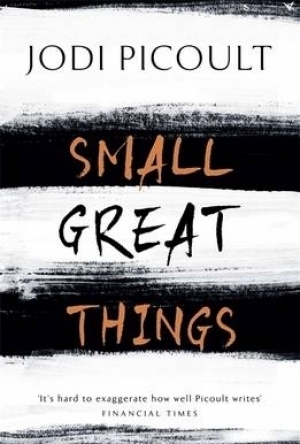


Small is an Understatement
Jodi Picoult has been my favourite author since I first came across her novels in 2008. With twenty-three novels under her belt, she continues to delight readers with her page-turning stories. Most of Picoult’s books contain a moral issue, often, but not always, in the form of medical ethics, as well as a hefty court case. Although following along similar lines, Small Great Things is a radical, revolutionary book, which, with great courage, Picoult has written with the intent to expose the reader to truths that most of us, as a society, are intentionally oblivious to.
The gist of the storyline is that a baby dies whilst under the care of a nurse, prompting the grieving parents to take her to court with the accusation of murder. Although that sounds like an interesting story, it barely begins to describe what the book is about. The character on trial, Ruth, is an African American labour and delivery nurse – something that in this day and age need not by an issue. On the other hand, the parents of the baby are White Supremacists: seriously racist with the belief that white people are the master race. The father, Turk, refuses to let his wife and child be treated by Ruth, however circumstances result in her being the only nurse available to watch Davis, when, unfortunately, he so happens to go into cardiac arrest. Although the reader knows that Ruth is not at fault, Turk insists she murdered his child – but is he accusing her of medical negligence, or punishing her for being black?
Three characters, all with different views and experience when it comes to racism, alternately narrate Small Great Things. Ruth and Turk represent the extremes at either side of the scale. Ruth experiences first hand the negative impact of prejudice in the American system and society, not only through this court case, but in everyday life as well. She also reveals the difficulties growing up in a predominately white environment, never feeling like she fitted in with her peers. Alternatively, Turk spent his teenage years attending KKK rallies, participating in a white power movement, and beating up anyone who was different: black, foreign, gay, Jewish and so forth.
The third character represents the majority of white people living in America. Kennedy is a public defender and the lawyer assigned to Ruth’s case. Like most of the population, she believes that she is not racist, and persuades Ruth to leave the colour of her skin out of the argument. However, as she gets to know her client, she begins to realize that it is nigh on impossible to ignore racial prejudice.
Picoult shocks the reader on two accounts: one, the way that people of colour have been, and still are, treated; and two, the revelation that an invisible empire of White Supremacists are living amongst us. Yet there is a third way in which Picoult provokes outrage – she indirectly accuses the reader of being racist, too.
There is always something to learn in a Jodi Picoult novel, for instance medical terminology, or the way in which a court trial is conducted. Small Great Things provides a lot more eye opening information than any of her previous books, unveiling facts about such a controversial subject.
Through Kennedy, the reader’s eyes are opened to the racial discrimination that we all turn a blind eye to. Ignored are the difficulties African Americans suffer when going shopping, applying for jobs, attending school, walking down the street, sitting on a bus, and so forth. Picoult asks me as a reader to think about how my life has been affected by racial discrimination: being served politely in shops because I am white, not having my ethnicity questioned when applying for college etc. Living in Britain I have not experienced openly hateful comments or behaviours towards people with a different skin tone – I used to believe this was primarily an American problem. Yet, Small Great Things has really made me think about the hierarchy of power within society, particularly in regards to the ethnicity of those at the top, compared with those at the bottom.
Jodi Picoult sat on the idea of writing a book about racism for well over a decade, yet it is particularly apt that it is published now, with the current predicaments America is facing. Although we have come a long way in attempts to achieve equality for all – compare the trial in To Kill A Mockingbird to Picoult’s version – recent events have revealed that we are no where near.
Small Great Things will shock everyone who reads it regardless of their ethnicity and so forth. Many may find it uncomfortable to read, become upset or outraged, and even feel like they are being directly targeted. If this is the case, then good – it should do that. Everyone needs to read this book. On the one hand it is a brilliant, well told story with a beautiful, almost poetic narrative, and on the other, it causes us to face up to the issues we are forever making light of or overlooking entirely. We have grown up believing that racism is a form of hatred when, actually, it is about power. However Small Great Things makes you feel, it is definitely worth reading, especially for the satisfying ending – one that you do not see coming.
The gist of the storyline is that a baby dies whilst under the care of a nurse, prompting the grieving parents to take her to court with the accusation of murder. Although that sounds like an interesting story, it barely begins to describe what the book is about. The character on trial, Ruth, is an African American labour and delivery nurse – something that in this day and age need not by an issue. On the other hand, the parents of the baby are White Supremacists: seriously racist with the belief that white people are the master race. The father, Turk, refuses to let his wife and child be treated by Ruth, however circumstances result in her being the only nurse available to watch Davis, when, unfortunately, he so happens to go into cardiac arrest. Although the reader knows that Ruth is not at fault, Turk insists she murdered his child – but is he accusing her of medical negligence, or punishing her for being black?
Three characters, all with different views and experience when it comes to racism, alternately narrate Small Great Things. Ruth and Turk represent the extremes at either side of the scale. Ruth experiences first hand the negative impact of prejudice in the American system and society, not only through this court case, but in everyday life as well. She also reveals the difficulties growing up in a predominately white environment, never feeling like she fitted in with her peers. Alternatively, Turk spent his teenage years attending KKK rallies, participating in a white power movement, and beating up anyone who was different: black, foreign, gay, Jewish and so forth.
The third character represents the majority of white people living in America. Kennedy is a public defender and the lawyer assigned to Ruth’s case. Like most of the population, she believes that she is not racist, and persuades Ruth to leave the colour of her skin out of the argument. However, as she gets to know her client, she begins to realize that it is nigh on impossible to ignore racial prejudice.
Picoult shocks the reader on two accounts: one, the way that people of colour have been, and still are, treated; and two, the revelation that an invisible empire of White Supremacists are living amongst us. Yet there is a third way in which Picoult provokes outrage – she indirectly accuses the reader of being racist, too.
There is always something to learn in a Jodi Picoult novel, for instance medical terminology, or the way in which a court trial is conducted. Small Great Things provides a lot more eye opening information than any of her previous books, unveiling facts about such a controversial subject.
Through Kennedy, the reader’s eyes are opened to the racial discrimination that we all turn a blind eye to. Ignored are the difficulties African Americans suffer when going shopping, applying for jobs, attending school, walking down the street, sitting on a bus, and so forth. Picoult asks me as a reader to think about how my life has been affected by racial discrimination: being served politely in shops because I am white, not having my ethnicity questioned when applying for college etc. Living in Britain I have not experienced openly hateful comments or behaviours towards people with a different skin tone – I used to believe this was primarily an American problem. Yet, Small Great Things has really made me think about the hierarchy of power within society, particularly in regards to the ethnicity of those at the top, compared with those at the bottom.
Jodi Picoult sat on the idea of writing a book about racism for well over a decade, yet it is particularly apt that it is published now, with the current predicaments America is facing. Although we have come a long way in attempts to achieve equality for all – compare the trial in To Kill A Mockingbird to Picoult’s version – recent events have revealed that we are no where near.
Small Great Things will shock everyone who reads it regardless of their ethnicity and so forth. Many may find it uncomfortable to read, become upset or outraged, and even feel like they are being directly targeted. If this is the case, then good – it should do that. Everyone needs to read this book. On the one hand it is a brilliant, well told story with a beautiful, almost poetic narrative, and on the other, it causes us to face up to the issues we are forever making light of or overlooking entirely. We have grown up believing that racism is a form of hatred when, actually, it is about power. However Small Great Things makes you feel, it is definitely worth reading, especially for the satisfying ending – one that you do not see coming.
Hazel (1853 KP) rated Small Great Things in Books
Dec 7, 2018
Jodi Picoult has been my favourite author since I first came across her novels in 2008. With twenty-three novels under her belt, she continues to delight readers with her page-turning stories. Most of Picoult’s books contain a moral issue, often, but not always, in the form of medical ethics, as well as a hefty court case. Although following along similar lines, <i>Small Great Thing</i>s is a radical, revolutionary book, which, with great courage, Picoult has written with the intent to expose the reader to truths that most of us, as a society, are <s>intentionally</s> oblivious to.
The gist of the storyline is that a baby dies whilst under the care of a nurse, prompting the grieving parents to take her to court with the accusation of murder. Although that sounds like an interesting story, it barely begins to describe what the book is about. The character on trial, Ruth, is an African American labour and delivery nurse – something that in this day and age need not by an issue. On the other hand, the parents of the baby are White Supremacists: seriously racist with the belief that white people are the master race. The father, Turk, refuses to let his wife and child be treated by Ruth, however circumstances result in her being the only nurse available to watch Davis, when, unfortunately, he so happens to go into cardiac arrest. Although the reader knows that Ruth is not at fault, Turk insists she murdered his child – but is he accusing her of medical negligence, or punishing her for being black?
Three characters, all with different views and experience when it comes to racism, alternately narrate<i> Small Great Things</i>. Ruth and Turk represent the extremes at either side of the scale. Ruth experiences first hand the negative impact of prejudice in the American system and society, not only through this court case, but in everyday life as well. She also reveals the difficulties growing up in a predominately white environment, never feeling like she fitted in with her peers. Alternatively, Turk spent his teenage years attending KKK rallies, participating in a white power movement, and beating up anyone who was different: black, foreign, gay, Jewish and so forth.
The third character represents the majority of white people living in America. Kennedy is a public defender and the lawyer assigned to Ruth’s case. Like most of the population, she believes that she is not racist, and persuades Ruth to leave the colour of her skin out of the argument. However, as she gets to know her client, she begins to realize that it is nigh on impossible to ignore racial prejudice.
Picoult shocks the reader on two accounts: one, the way that people of colour have been, and still are, treated; and two, the revelation that an invisible empire of White Supremacists are living amongst us. Yet there is a third way in which Picoult provokes outrage – she indirectly accuses the reader of being racist, too.
There is always something to learn in a Jodi Picoult novel, for instance medical terminology, or the way in which a court trial is conducted. <i>Small Great Things</i> provides a lot more eye opening information than any of her previous books, unveiling facts about such a controversial subject.
Through Kennedy, the reader’s eyes are opened to the racial discrimination that we all turn a blind eye to. Ignored are the difficulties African Americans suffer when going shopping, applying for jobs, attending school, walking down the street, sitting on a bus, and so forth. Picoult asks me as a reader to think about how my life has been affected by racial discrimination: being served politely in shops because I am white, not having my ethnicity questioned when applying for college etc. Living in Britain I have not experienced openly hateful comments or behaviours towards people with a different skin tone – I used to believe this was primarily an American problem. Yet, <i>Small Great Things</i> has really made me think about the hierarchy of power within society, particularly in regards to the ethnicity of those at the top, compared with those at the bottom.
Jodi Picoult sat on the idea of writing a book about racism for well over a decade, yet it is particularly apt that it is published now, with the current predicaments America is facing. Although we have come a long way in attempts to achieve equality for all – compare the trial in <i>To Kill A Mockingbird</i> to Picoult’s version – recent events have revealed that we are no where near.
<i>Small Great Things</i> will shock everyone who reads it regardless of their ethnicity and so forth. Many may find it uncomfortable to read, become upset or outraged, and even feel like they are being directly targeted. If this is the case, then good – it should do that. Everyone needs to read this book. On the one hand it is a brilliant, well told story with a beautiful, almost poetic narrative, and on the other, it causes us to face up to the issues we are forever making light of or overlooking entirely. We have grown up believing that racism is a form of hatred when, actually, it is about power. However <i>Small Great Things </i>makes you feel, it is definitely worth reading, especially for the satisfying ending – one that you do not see coming.
The gist of the storyline is that a baby dies whilst under the care of a nurse, prompting the grieving parents to take her to court with the accusation of murder. Although that sounds like an interesting story, it barely begins to describe what the book is about. The character on trial, Ruth, is an African American labour and delivery nurse – something that in this day and age need not by an issue. On the other hand, the parents of the baby are White Supremacists: seriously racist with the belief that white people are the master race. The father, Turk, refuses to let his wife and child be treated by Ruth, however circumstances result in her being the only nurse available to watch Davis, when, unfortunately, he so happens to go into cardiac arrest. Although the reader knows that Ruth is not at fault, Turk insists she murdered his child – but is he accusing her of medical negligence, or punishing her for being black?
Three characters, all with different views and experience when it comes to racism, alternately narrate<i> Small Great Things</i>. Ruth and Turk represent the extremes at either side of the scale. Ruth experiences first hand the negative impact of prejudice in the American system and society, not only through this court case, but in everyday life as well. She also reveals the difficulties growing up in a predominately white environment, never feeling like she fitted in with her peers. Alternatively, Turk spent his teenage years attending KKK rallies, participating in a white power movement, and beating up anyone who was different: black, foreign, gay, Jewish and so forth.
The third character represents the majority of white people living in America. Kennedy is a public defender and the lawyer assigned to Ruth’s case. Like most of the population, she believes that she is not racist, and persuades Ruth to leave the colour of her skin out of the argument. However, as she gets to know her client, she begins to realize that it is nigh on impossible to ignore racial prejudice.
Picoult shocks the reader on two accounts: one, the way that people of colour have been, and still are, treated; and two, the revelation that an invisible empire of White Supremacists are living amongst us. Yet there is a third way in which Picoult provokes outrage – she indirectly accuses the reader of being racist, too.
There is always something to learn in a Jodi Picoult novel, for instance medical terminology, or the way in which a court trial is conducted. <i>Small Great Things</i> provides a lot more eye opening information than any of her previous books, unveiling facts about such a controversial subject.
Through Kennedy, the reader’s eyes are opened to the racial discrimination that we all turn a blind eye to. Ignored are the difficulties African Americans suffer when going shopping, applying for jobs, attending school, walking down the street, sitting on a bus, and so forth. Picoult asks me as a reader to think about how my life has been affected by racial discrimination: being served politely in shops because I am white, not having my ethnicity questioned when applying for college etc. Living in Britain I have not experienced openly hateful comments or behaviours towards people with a different skin tone – I used to believe this was primarily an American problem. Yet, <i>Small Great Things</i> has really made me think about the hierarchy of power within society, particularly in regards to the ethnicity of those at the top, compared with those at the bottom.
Jodi Picoult sat on the idea of writing a book about racism for well over a decade, yet it is particularly apt that it is published now, with the current predicaments America is facing. Although we have come a long way in attempts to achieve equality for all – compare the trial in <i>To Kill A Mockingbird</i> to Picoult’s version – recent events have revealed that we are no where near.
<i>Small Great Things</i> will shock everyone who reads it regardless of their ethnicity and so forth. Many may find it uncomfortable to read, become upset or outraged, and even feel like they are being directly targeted. If this is the case, then good – it should do that. Everyone needs to read this book. On the one hand it is a brilliant, well told story with a beautiful, almost poetic narrative, and on the other, it causes us to face up to the issues we are forever making light of or overlooking entirely. We have grown up believing that racism is a form of hatred when, actually, it is about power. However <i>Small Great Things </i>makes you feel, it is definitely worth reading, especially for the satisfying ending – one that you do not see coming.

Miguel Covarrubias (143 KP) rated We Cast a Shadow in Books
Apr 30, 2019

This was a difficult book for me to get through. Not because of the writing but by seeing too much of myself in the main protagonist. I am a multi-racial father of a multi-racial son. This story resonated so much with me and wanting to 'protect' my son from the injustices of this world and this country. As a white skinned latin-x person, I've struggled so much with the changes of peoples moods and attitudes when they find out my name or my heritage from many different means. So many of the moments where the narrator struggles with his own identity within his heritage context as well as the context of society made me have to stop and take stock of my own life.
So many don't realize the struggle of a parent trying to find one's identity amidst the current racism. Especially for Latin-x people during the reign of Trump and Trumpian ideals within the United Sates. We are being equated with animals and the worst of the worst that share our heritage. Yes, there are some bad people out there, but there are bad people of every skin color or heritage. I want so much to protect my son, and ensure that he gets every opportunity without the problems that this evil presents currently.
This is a near future story, that says so much about who we are today. Especially for those of us who are Multi-Racial. Many of us aren't even accepted in either societies that are full heritage-ly made up. This book was not without it's issues, but it is a very important story. It is a great read for those trying to understand the struggle of Multi-Racial Parents and children. Highly recommend.
So many don't realize the struggle of a parent trying to find one's identity amidst the current racism. Especially for Latin-x people during the reign of Trump and Trumpian ideals within the United Sates. We are being equated with animals and the worst of the worst that share our heritage. Yes, there are some bad people out there, but there are bad people of every skin color or heritage. I want so much to protect my son, and ensure that he gets every opportunity without the problems that this evil presents currently.
This is a near future story, that says so much about who we are today. Especially for those of us who are Multi-Racial. Many of us aren't even accepted in either societies that are full heritage-ly made up. This book was not without it's issues, but it is a very important story. It is a great read for those trying to understand the struggle of Multi-Racial Parents and children. Highly recommend.