
Search

Jordan Binkerd (567 KP) rated The Long Earth in Books
Aug 13, 2019
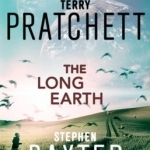


Note: this review is transposted from my personal review blog, and so was originally written several years ago. I figured if I reposted it here, someone might actually read it….
I’m a huge fan of Terry Pratchett’s work, in case you hadn’t noticed. I’m slowly working my way through his Discworld novels and Good Omens: The Nice and Accurate Predictions of Agnes Nutter, Witch, cowritten with Neil Gaiman, is among my favorite books of all time.* So when I discovered The Long Earth at my local library, I was ecstatic. I’d heard good things about Stephen Baxter, but never actually read any of his material. What I found was one of the best novels I have read in a very long time.
The premise here is that there are infinite worlds parallel to ours, spread out across the vast “contingency tree” of possible Earths, and in all of the Long Earth only one iteration has developed Human life–ours. Throughout our history there have always been a few with the natural ability to “step” between worlds at will, and still others who did so unintentionally and disappeared forever, but the world at large was unaware of this phenomenon until a reclusive scientist posted the blueprint for a “stepper” device on the internet and promptly disappeared from his apartment. Suddenly, the whole of the Long Earth is opened up to humanity. Suddenly, there is no shortage of land or resources. Economies are hard hit, jobs are lost, and once again humanity’s pioneer spirit is stirred to go out into the frontier and try to make their way….
Joshua Valiente is a so-called “natural stepper,” but he is probably unique among humanity. In the stress of childbirth, his mother stepped out of her world and into a parallel forest before slipping back without him. She managed to get back and recover him pretty quickly, but nevertheless young Joshua spent the first ten minutes or so of his life completely alone in his universe. As a result, he is uniquely attuned to the Long Earth. He can step between worlds without nausea, and is keenly sensitive to the number of people around, growing intensely uncomfortable the more crowded things get. Now, fifteen years after the world learned of the Long Earth, he spends most of his time exploring where no man has gone before. Lobsang, on the other hand, is a keenly intelligent AI, who may or may not be the latest reincarnation of a Tibetan motorcycle repairman. In collaboration with the shadowy Black Corporation, Lobsang has conceived a plan to test just how far the Long Earth goes. And he wants Joshua to go with him….the resulting journey is as much an exploration of what may have been as it is a geographical one, with most worlds mirroring our own, but a few display the effects of a cosmic “toss of a coin” going the other way–for example, there’s one where the Earth was completely destroyed by an asteroid strike sometime in the distant past.
Put quite plainly, this was the best thing I’ve read in a very long time. Very original, and to my (admittedly limited) understanding very faithful to the relevant science without losing quality of narrative or character. Pratchett’s humor and sardonic narrative voice shines through quite often in the interpersonal or introspective moments as well as those detailing more plot driven points–those scenes that would, in a film, become some form of montage showing that time is passing and this is what’s happening in the meantime. As I mentioned, I’ve never read Baxter before, so it’s harder to pick out his voice from their collaboration.
Infodumping has become something of a cardinal sin in the science fiction world, but sometimes you just have to throw some information at the reader so that he doesn’t get lost. I felt that The Long Earth handled that very well. We get our first glimpse at the long earth in montage mode, a series of vignettes that don’t make sense on their own, people popping in and out of worlds without understanding themselves what is going on. This is followed by the main story, twenty years after the discovery of the Long Earth, in which the bare bones are presented via a TV interview a character is half-watching while he waits. These bare bones of the conceptual basis of the book are then fleshed out in more detail as Joshua and Lobsang and introduced and get to know each other, discussing the various theories regarding the Long Earth at length in an effort to better understand it themselves. This is interspersed with flashbacks, sometimes Joshua recalling his experiences, sometimes Lobsang telling stories of other people based on his research into early encounters with the Long Earth. In this way Pratchett and Baxter manage to convey how humanity as a whole is dealing, not just Joshua and Lobsang. If I have one complaint with this it is not always clear why or how we are being told this–you don’t discover until the end of the chapter that Lobsang is telling this to Joshua instead of the authors just throwing in a tangential bit with no direct connection. And it is all connected–every revelation, every character you visit and then abandon early in the book will come back and have significance later on.
This is perhaps not the easiest read–you do have to engage it to understand it properly–but neither is it an incomprehensible enigma. As long as you pay attention you should be fine.
CONTENT: Some R-rated language, but not nearly what you could find elsewhere. Some violence, some grisly aftermath of violence. Sexual references, but nothing explicit.
*I’m frankly a little surprised I don’t have a review of that one up here, I must have reread it last just before I started doing this. I’ll have to fix that in the near future….
Original post: https://jordanbinkerd.wordpress.com/2013/09/18/review-the-long-earth-by-terry-pratchett-stephen-baxter/
I’m a huge fan of Terry Pratchett’s work, in case you hadn’t noticed. I’m slowly working my way through his Discworld novels and Good Omens: The Nice and Accurate Predictions of Agnes Nutter, Witch, cowritten with Neil Gaiman, is among my favorite books of all time.* So when I discovered The Long Earth at my local library, I was ecstatic. I’d heard good things about Stephen Baxter, but never actually read any of his material. What I found was one of the best novels I have read in a very long time.
The premise here is that there are infinite worlds parallel to ours, spread out across the vast “contingency tree” of possible Earths, and in all of the Long Earth only one iteration has developed Human life–ours. Throughout our history there have always been a few with the natural ability to “step” between worlds at will, and still others who did so unintentionally and disappeared forever, but the world at large was unaware of this phenomenon until a reclusive scientist posted the blueprint for a “stepper” device on the internet and promptly disappeared from his apartment. Suddenly, the whole of the Long Earth is opened up to humanity. Suddenly, there is no shortage of land or resources. Economies are hard hit, jobs are lost, and once again humanity’s pioneer spirit is stirred to go out into the frontier and try to make their way….
Joshua Valiente is a so-called “natural stepper,” but he is probably unique among humanity. In the stress of childbirth, his mother stepped out of her world and into a parallel forest before slipping back without him. She managed to get back and recover him pretty quickly, but nevertheless young Joshua spent the first ten minutes or so of his life completely alone in his universe. As a result, he is uniquely attuned to the Long Earth. He can step between worlds without nausea, and is keenly sensitive to the number of people around, growing intensely uncomfortable the more crowded things get. Now, fifteen years after the world learned of the Long Earth, he spends most of his time exploring where no man has gone before. Lobsang, on the other hand, is a keenly intelligent AI, who may or may not be the latest reincarnation of a Tibetan motorcycle repairman. In collaboration with the shadowy Black Corporation, Lobsang has conceived a plan to test just how far the Long Earth goes. And he wants Joshua to go with him….the resulting journey is as much an exploration of what may have been as it is a geographical one, with most worlds mirroring our own, but a few display the effects of a cosmic “toss of a coin” going the other way–for example, there’s one where the Earth was completely destroyed by an asteroid strike sometime in the distant past.
Put quite plainly, this was the best thing I’ve read in a very long time. Very original, and to my (admittedly limited) understanding very faithful to the relevant science without losing quality of narrative or character. Pratchett’s humor and sardonic narrative voice shines through quite often in the interpersonal or introspective moments as well as those detailing more plot driven points–those scenes that would, in a film, become some form of montage showing that time is passing and this is what’s happening in the meantime. As I mentioned, I’ve never read Baxter before, so it’s harder to pick out his voice from their collaboration.
Infodumping has become something of a cardinal sin in the science fiction world, but sometimes you just have to throw some information at the reader so that he doesn’t get lost. I felt that The Long Earth handled that very well. We get our first glimpse at the long earth in montage mode, a series of vignettes that don’t make sense on their own, people popping in and out of worlds without understanding themselves what is going on. This is followed by the main story, twenty years after the discovery of the Long Earth, in which the bare bones are presented via a TV interview a character is half-watching while he waits. These bare bones of the conceptual basis of the book are then fleshed out in more detail as Joshua and Lobsang and introduced and get to know each other, discussing the various theories regarding the Long Earth at length in an effort to better understand it themselves. This is interspersed with flashbacks, sometimes Joshua recalling his experiences, sometimes Lobsang telling stories of other people based on his research into early encounters with the Long Earth. In this way Pratchett and Baxter manage to convey how humanity as a whole is dealing, not just Joshua and Lobsang. If I have one complaint with this it is not always clear why or how we are being told this–you don’t discover until the end of the chapter that Lobsang is telling this to Joshua instead of the authors just throwing in a tangential bit with no direct connection. And it is all connected–every revelation, every character you visit and then abandon early in the book will come back and have significance later on.
This is perhaps not the easiest read–you do have to engage it to understand it properly–but neither is it an incomprehensible enigma. As long as you pay attention you should be fine.
CONTENT: Some R-rated language, but not nearly what you could find elsewhere. Some violence, some grisly aftermath of violence. Sexual references, but nothing explicit.
*I’m frankly a little surprised I don’t have a review of that one up here, I must have reread it last just before I started doing this. I’ll have to fix that in the near future….
Original post: https://jordanbinkerd.wordpress.com/2013/09/18/review-the-long-earth-by-terry-pratchett-stephen-baxter/

Heather Cranmer (2721 KP) rated The Thousand Year Curse in Books
Jun 7, 2018


(This review can be found on my blog <a href="http://themisadventuresofatwentysomething.blogspot.com/">The (Mis)Adventures of a Twenty-Something Year Old Girl</a> towards the end of September).
When I first found out about this book, I was very interested. I couldn't wait to read it! Luckily, it totally delivered.
Ryder is a 17 year old high school student who isn't very popular. Her ex-best friend makes her life a living hell at school. When Ollie arrives, he takes an immediate interest. Ryder is thrilled and feels as if Ollie is her soul mate. Not much later, Ari turns up, and Ryder can't help but feel as if she's known him. There's also some kind of attraction there. Ryder must choose between the two boys. As if that wasn't hard enough, Ryder has just found out her mother is a Greek goddess. Ryder wants to find her mother but doing so may put everyone in danger.
The title is definitely interesting. It does go with what the books about, and I think it's an awesome choice.
To be honest, I'm not really a fan of the cover. I think it's just a personal thing simply because I'm not a big fan of symbolism. I do like the whole pretty flower in the midst of dead things, but I just don't like it for this book. It doesn't really say much about the book.
The world building is alright. There's a few things that hurt the world building. For example, it seemed to me that Ryder just accepted everything she was told at face value. Sure, a few weird things are happening to her, but it's like she's told by a boy she just met, and she believes it all. Her best friend is even worse. He's told that Ryder is a half-goddess, and he just believes it with no questions asked. Also, I don't really think this whole curse is explained well enough. In fact, I'm still a little confused about the curse. So if both guys find her, even if she chooses one, she'll die a horrible death and be reincarnated? I'm just wondering how long she has before she dies because it just seemed like the curse wasn't that imminent. There's also Ryder's powers. She's had super strength since the beginning of the book, yet later on she has another super strength episode, and she acts like it's the first one she's had and is all shocked. Another thing that I found confusing was the whole reincarnation thing. She's been reincarnated by Hades for a thousand years. This life, she is a half goddess which makes things a bit difficult for Hades. Surely if Hades is the one that put the curse on her, then he should've been able to make her human. Saying that, I don't want people to think the world building is horribly written. It's far from it actually. The world is very interesting, but I just tend to over think things, I think. (See what I mean)?
The pacing is great in this book. The pacing really picks up during the Hell scenes, I thought. These were the scenes that held my attention the most although the whole book held my attention. The Hell scenes just made me want to read faster to find out what would happen next!
The plot is definitely an interesting one. I love the infusion of Greek mythology, and Ms. Lavati does an excellent job of making mythology work in her book. I've read a few books where the author tried to use some sort of mythology, and the book was just too boring. However, The Thousand Year Curse is by no means boring! There is a love triangle, and I usually hate them, but this one works in this story. I also like the fact that the plot involved going into Hell. That was definitely a good move on Ms. Lavati's part to include it in her book. There's no cliff hangar ending, but there are questions left unanswered to make way for the second book in the series. I, personally, am looking forward to the next book in the series.
The characters were written really well. I liked Ryder, and I liked how she dealt with her problems. At times, I did get annoyed with her because I just wanted her to choose one guy. However, I would have to remind myself that without this problem, there'd be no series. Ryder felt like a real girl and not just words on a paper. Ollie was written really well, but I just didn't like him. For one, I felt like he was just too serious. I also felt like he was too distant with Ryder a lot of the time. I also wanted to see more about Ollie in the book. My favorite character was Ari. I swooned over Ari! He had enough of that bad boy personality without being too much of an annoying character. I liked how he liked to take chances, and it seemed like he knew how to have fun. I'm Team Ari all the way! I'm hoping that Ryder ends up with Ari in the long run. I can actually feel the chemistry between those two.
There are quite a lot of grammar errors in this book. I feel that it does affect the quality of the book a little bit, but not so much so that it makes it unreadable. However, the dialogue in this book is fantastic especially in the scenes that Ari is in. (Okay, so I'm a bit biased). The characters all speak like they're from this time period even though two of them are gods. I was super thankful the characters spoke like normal people. I've read a book before where the character who is a god spoke rather strangely hence why I was so happy with the dialogue in this book.
Overall, The Thousand Year Curse by Taylor Lavati is an enjoyable read. Sure, it could do with some better editing and the world building could've used a little bit of work, but it's still really interesting. Plus, I've learned that Ms. Lavati wrote this book in 30 days for the NaNoWriMo competition. After learning that, my respect for Ms. Lavati went up a lot! To write a book as good as The Thousand Year Curse in 30 days is no small feat. After saying that, I'm definitely looking forward to reading the next book in the series!
I'd recommend this book to those aged 17+ who are after a fantastic book with Greek mythology infusions.
(I was provided with a free paperback copy of this title from the author in exchange for a fair and honest review).
When I first found out about this book, I was very interested. I couldn't wait to read it! Luckily, it totally delivered.
Ryder is a 17 year old high school student who isn't very popular. Her ex-best friend makes her life a living hell at school. When Ollie arrives, he takes an immediate interest. Ryder is thrilled and feels as if Ollie is her soul mate. Not much later, Ari turns up, and Ryder can't help but feel as if she's known him. There's also some kind of attraction there. Ryder must choose between the two boys. As if that wasn't hard enough, Ryder has just found out her mother is a Greek goddess. Ryder wants to find her mother but doing so may put everyone in danger.
The title is definitely interesting. It does go with what the books about, and I think it's an awesome choice.
To be honest, I'm not really a fan of the cover. I think it's just a personal thing simply because I'm not a big fan of symbolism. I do like the whole pretty flower in the midst of dead things, but I just don't like it for this book. It doesn't really say much about the book.
The world building is alright. There's a few things that hurt the world building. For example, it seemed to me that Ryder just accepted everything she was told at face value. Sure, a few weird things are happening to her, but it's like she's told by a boy she just met, and she believes it all. Her best friend is even worse. He's told that Ryder is a half-goddess, and he just believes it with no questions asked. Also, I don't really think this whole curse is explained well enough. In fact, I'm still a little confused about the curse. So if both guys find her, even if she chooses one, she'll die a horrible death and be reincarnated? I'm just wondering how long she has before she dies because it just seemed like the curse wasn't that imminent. There's also Ryder's powers. She's had super strength since the beginning of the book, yet later on she has another super strength episode, and she acts like it's the first one she's had and is all shocked. Another thing that I found confusing was the whole reincarnation thing. She's been reincarnated by Hades for a thousand years. This life, she is a half goddess which makes things a bit difficult for Hades. Surely if Hades is the one that put the curse on her, then he should've been able to make her human. Saying that, I don't want people to think the world building is horribly written. It's far from it actually. The world is very interesting, but I just tend to over think things, I think. (See what I mean)?
The pacing is great in this book. The pacing really picks up during the Hell scenes, I thought. These were the scenes that held my attention the most although the whole book held my attention. The Hell scenes just made me want to read faster to find out what would happen next!
The plot is definitely an interesting one. I love the infusion of Greek mythology, and Ms. Lavati does an excellent job of making mythology work in her book. I've read a few books where the author tried to use some sort of mythology, and the book was just too boring. However, The Thousand Year Curse is by no means boring! There is a love triangle, and I usually hate them, but this one works in this story. I also like the fact that the plot involved going into Hell. That was definitely a good move on Ms. Lavati's part to include it in her book. There's no cliff hangar ending, but there are questions left unanswered to make way for the second book in the series. I, personally, am looking forward to the next book in the series.
The characters were written really well. I liked Ryder, and I liked how she dealt with her problems. At times, I did get annoyed with her because I just wanted her to choose one guy. However, I would have to remind myself that without this problem, there'd be no series. Ryder felt like a real girl and not just words on a paper. Ollie was written really well, but I just didn't like him. For one, I felt like he was just too serious. I also felt like he was too distant with Ryder a lot of the time. I also wanted to see more about Ollie in the book. My favorite character was Ari. I swooned over Ari! He had enough of that bad boy personality without being too much of an annoying character. I liked how he liked to take chances, and it seemed like he knew how to have fun. I'm Team Ari all the way! I'm hoping that Ryder ends up with Ari in the long run. I can actually feel the chemistry between those two.
There are quite a lot of grammar errors in this book. I feel that it does affect the quality of the book a little bit, but not so much so that it makes it unreadable. However, the dialogue in this book is fantastic especially in the scenes that Ari is in. (Okay, so I'm a bit biased). The characters all speak like they're from this time period even though two of them are gods. I was super thankful the characters spoke like normal people. I've read a book before where the character who is a god spoke rather strangely hence why I was so happy with the dialogue in this book.
Overall, The Thousand Year Curse by Taylor Lavati is an enjoyable read. Sure, it could do with some better editing and the world building could've used a little bit of work, but it's still really interesting. Plus, I've learned that Ms. Lavati wrote this book in 30 days for the NaNoWriMo competition. After learning that, my respect for Ms. Lavati went up a lot! To write a book as good as The Thousand Year Curse in 30 days is no small feat. After saying that, I'm definitely looking forward to reading the next book in the series!
I'd recommend this book to those aged 17+ who are after a fantastic book with Greek mythology infusions.
(I was provided with a free paperback copy of this title from the author in exchange for a fair and honest review).

Gareth von Kallenbach (980 KP) rated Cloud Atlas (2012) in Movies
Aug 7, 2019
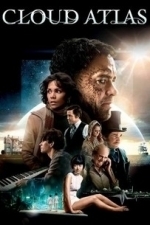

While I am not familiar with the novel, I was not excited to review the film adaptation of David Mitchell’s Cloud Atlas. Though the Screenplay was written and directed by the Wachowskis (The Matrix) and Tom Tykwer (Run Lola Run) I did not know exactly what I was getting into. The trailer shows it as an epic sci-fi film crossing the time and lives of several stories and how everything and everyone is connected. Needless to say my curiosity was piqued. But I was nervous because I knew it would take a grand effort to keep this epic and ambitious project from falling flat. And well, I can honestly say that I am not quite sure if the combined effort succeeded.
Allow me to explain. About an hour into the film I had a young film reviewer to my left and I noticed he started to nod his head in approval at each new developing story throughout the film. To my right was a friend of mine, I would consider as an average film viewer, who at this same time I could tell was counting the minutes till the lights came up but felt trapped with nowhere to go but forward. And for me, I can see both sides of these reactions.
The plot is comprised of a multi-narrative of six stories, each with a complete beginning, middle and end. These stories are told from different timelines following a group of souls throughout the ages to show how everything is woven together and the connection between them; From the 1849 slave trader, to a young composer in 1936 Britain, to a 1973 journalist attempting to uncover corruption of the big business ruling class, to a 2012 literary publisher who’s life becomes a daring escape from a geriatric home, to a 2144 Neo-Soul synthetic learning to become human, to a post-apocalyptic tribesman trying to save his world and family… Lost yet? Believe me you will want to focus during the first hour of this film as we are introduced to the sudden shift of timelines. All of the main actors appear as varying characters of significance in every narrative, each with different accents and types of language. It is a bit of an unexpected bother to keep everything straight at first, however if you pay attention it is fairly easy to follow. This first hour is where I feel the film becomes a make or break for those actively thinking about what they are watching and the average movie viewer who is just there to be entertained and see the new Tom Hanks (Extremely Loud and Incredibly Close) or Halle Berry (Perfect Stanger) movie. For those who make it through that first hour still engaged, the film moves along at a steady pace and provides everything from romance to action that keeps you guessing and intrigued at what is next to come.
The Wachowskis and Tykwer do an outstanding job of visually fleshing out each timeline in its own visual style, especially the futuristic ones, which subtlety organize each narrative for the viewer. Additionally, there are so many talented actors in this film and it is somewhat fascinating to try and pick them out throughout the film. It is almost like a giant game of Where’s Waldo on screen as the makeup and special effects artists do a fantastic job of making the actors fit each character in every timeline. In fact, during the fourth or fifth timeline a lady in my row asked her partner if the man on screen was Forrest Gump, which was surprising because Hanks was the easiest character to pick out among them all.
Tom Hanks delivers one of his better performances in years. We watch his character’s soul transition from a sinister and vile doctor to a tribesman making the righteous choice while struggling with that inkling of evil that is the devil within us all. It was refreshing to see Hanks play parts that were not just an “everyman” that he has played in recent years.
Halle Berry’s performance is mostly average in her parts with the exception of 1973 journalist role where she is the main protagonist. Hugo Weaving channels a bit of his Agent Smith role from The Matrix as he plays a villain throughout the timelines. Hugh Grant (Love Actually) makes unexpected soild appearances throughout the timelines. With Jim Sturgess (One Day), James D’Arcy (Mansfield Park) and Ben Whishaw (who is the new Q in the upcoming James Bond film Skyfall) rounding out the cast with a young contrast to the already heavy acting handled by the bigger names of this film. Each of these young actors hold’s their own against their older more notable counterparts. Whishaw’s performance as the lead in the 1936 composer role is especially noteworthy.
The other stand out performance in the film comes from Jim Broadbent best known in the states as Professor Slughorn in the Harry Potter Films. His performance in the 1936 composer and 2012 literary publisher are excellent. The Publisher story was my favorite timeline throughout the film. Not only did it deliver some much needed comic relief to an emotionally engaging and heavy film, but it also made me care the most about the elderly characters trying to escape the clutches of the geriatric prison of a nursing home. Unfortunately, other than the aforementioned comic relief this timeline seemed the most unnecessary to the overarching story at hand.
When I left the film and talked it over with my friend I was indifferent to the film. It was not great, it was not bad either. As my friend described it, it was a movie that was trying too hard. We agreed that somewhere in the six storylines there may be a great film, but we were not sure if we watched it.
However as the days have passed I have found myself thinking about the stories constantly. More specifically about how the main protagonist played by a different actor in each narrative has the same birthmark of a shooting star that in some way symbolizes some universal soul encompassing a new shell of a body in each timeline. Like some kind of reincarnation of that soul is fighting the same revolution throughout the ages against the powerful class and illusion of natural order. Additionally how each of the central characters found themselves connected with the main characters in the stories that preceded them through some kind of medium; whether it was by an old journal, or love letters, or a written story, or film, or message of hope. These subtle insights of growth and change for this main soul leaping into a new life in each timeline has caused me to examine our world and how we as people can be truly connected to one another not only today, but throughout the ages. I want to view the film again and am inspired to read the novel in some sort of effort to better understand these concepts.
Nevertheless as a film that is almost three hours long it does its best to be an epic sci-fi film and give something for everyone. And while it succeeds in many aspects of feel, it also falls short in aspects that are probably best accomplished in a literary form. As I said above, somewhere in the six storylines there may be a great film, but I am not sure if I watched it. Or maybe I am not intelligent enough to comprehend it. Because of that I can only give it an average score. Though I believe if you ask me after a second viewing, I may be inclined to raise it.
Allow me to explain. About an hour into the film I had a young film reviewer to my left and I noticed he started to nod his head in approval at each new developing story throughout the film. To my right was a friend of mine, I would consider as an average film viewer, who at this same time I could tell was counting the minutes till the lights came up but felt trapped with nowhere to go but forward. And for me, I can see both sides of these reactions.
The plot is comprised of a multi-narrative of six stories, each with a complete beginning, middle and end. These stories are told from different timelines following a group of souls throughout the ages to show how everything is woven together and the connection between them; From the 1849 slave trader, to a young composer in 1936 Britain, to a 1973 journalist attempting to uncover corruption of the big business ruling class, to a 2012 literary publisher who’s life becomes a daring escape from a geriatric home, to a 2144 Neo-Soul synthetic learning to become human, to a post-apocalyptic tribesman trying to save his world and family… Lost yet? Believe me you will want to focus during the first hour of this film as we are introduced to the sudden shift of timelines. All of the main actors appear as varying characters of significance in every narrative, each with different accents and types of language. It is a bit of an unexpected bother to keep everything straight at first, however if you pay attention it is fairly easy to follow. This first hour is where I feel the film becomes a make or break for those actively thinking about what they are watching and the average movie viewer who is just there to be entertained and see the new Tom Hanks (Extremely Loud and Incredibly Close) or Halle Berry (Perfect Stanger) movie. For those who make it through that first hour still engaged, the film moves along at a steady pace and provides everything from romance to action that keeps you guessing and intrigued at what is next to come.
The Wachowskis and Tykwer do an outstanding job of visually fleshing out each timeline in its own visual style, especially the futuristic ones, which subtlety organize each narrative for the viewer. Additionally, there are so many talented actors in this film and it is somewhat fascinating to try and pick them out throughout the film. It is almost like a giant game of Where’s Waldo on screen as the makeup and special effects artists do a fantastic job of making the actors fit each character in every timeline. In fact, during the fourth or fifth timeline a lady in my row asked her partner if the man on screen was Forrest Gump, which was surprising because Hanks was the easiest character to pick out among them all.
Tom Hanks delivers one of his better performances in years. We watch his character’s soul transition from a sinister and vile doctor to a tribesman making the righteous choice while struggling with that inkling of evil that is the devil within us all. It was refreshing to see Hanks play parts that were not just an “everyman” that he has played in recent years.
Halle Berry’s performance is mostly average in her parts with the exception of 1973 journalist role where she is the main protagonist. Hugo Weaving channels a bit of his Agent Smith role from The Matrix as he plays a villain throughout the timelines. Hugh Grant (Love Actually) makes unexpected soild appearances throughout the timelines. With Jim Sturgess (One Day), James D’Arcy (Mansfield Park) and Ben Whishaw (who is the new Q in the upcoming James Bond film Skyfall) rounding out the cast with a young contrast to the already heavy acting handled by the bigger names of this film. Each of these young actors hold’s their own against their older more notable counterparts. Whishaw’s performance as the lead in the 1936 composer role is especially noteworthy.
The other stand out performance in the film comes from Jim Broadbent best known in the states as Professor Slughorn in the Harry Potter Films. His performance in the 1936 composer and 2012 literary publisher are excellent. The Publisher story was my favorite timeline throughout the film. Not only did it deliver some much needed comic relief to an emotionally engaging and heavy film, but it also made me care the most about the elderly characters trying to escape the clutches of the geriatric prison of a nursing home. Unfortunately, other than the aforementioned comic relief this timeline seemed the most unnecessary to the overarching story at hand.
When I left the film and talked it over with my friend I was indifferent to the film. It was not great, it was not bad either. As my friend described it, it was a movie that was trying too hard. We agreed that somewhere in the six storylines there may be a great film, but we were not sure if we watched it.
However as the days have passed I have found myself thinking about the stories constantly. More specifically about how the main protagonist played by a different actor in each narrative has the same birthmark of a shooting star that in some way symbolizes some universal soul encompassing a new shell of a body in each timeline. Like some kind of reincarnation of that soul is fighting the same revolution throughout the ages against the powerful class and illusion of natural order. Additionally how each of the central characters found themselves connected with the main characters in the stories that preceded them through some kind of medium; whether it was by an old journal, or love letters, or a written story, or film, or message of hope. These subtle insights of growth and change for this main soul leaping into a new life in each timeline has caused me to examine our world and how we as people can be truly connected to one another not only today, but throughout the ages. I want to view the film again and am inspired to read the novel in some sort of effort to better understand these concepts.
Nevertheless as a film that is almost three hours long it does its best to be an epic sci-fi film and give something for everyone. And while it succeeds in many aspects of feel, it also falls short in aspects that are probably best accomplished in a literary form. As I said above, somewhere in the six storylines there may be a great film, but I am not sure if I watched it. Or maybe I am not intelligent enough to comprehend it. Because of that I can only give it an average score. Though I believe if you ask me after a second viewing, I may be inclined to raise it.