Search

Search only in certain items:

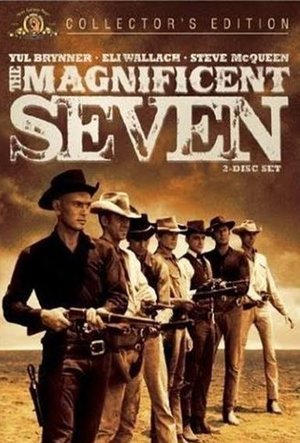
The Magnificent Seven (1960)
1960 | Action, Adventure, Western

"My fondness for the western has probably got to be included in here, but it can’t be something like Hombre, which is kind of silly. You know, I’d probably go Magnificent Seven, truthfully, if I’m going five, because seeing Charles Bronson, seeing Steve McQueen come into his own and just sit there and steal focus is kind of awesome. It’s one of those movies that has a pretty simple story, like a lot of great westerns, and I love simple storytelling. I think it’s so powerful. And I think The Magnificent Seven’s very simple storytelling and seeing that crazy group of guys – Yul Brynner, Bronson, across the board – all on horseback, sort of wondering what it was like shooting that, to me, as an actor, that always fascinates me. Knowing the amount of egos and the points in their careers when they had to shoot that movie, that, to me, as an adult, makes me put that on this list. When you watch the McQueen documentary about him, it breaks down how, whereas Paul Newman always seemed so relaxed and cool on set, McQueen was a fighter. He was an orphan who was constantly fighting for validation, you know? And they would talk about how, if you were in a scene with him, forget it. He was going to steal focus. In one scene, I think he’s reloading his gun, and it’s not even his scene, and it’s like, forget it. He wants you to just stare him in the eyes. [laughs] It’s pretty great."

Source
  
40x40

ClareR (6101 KP) rated The Nine in Books

Jul 29, 2021  
The Nine
The Nine
Gwen Strauss | 2021 | Education, History & Politics
9
9.0 (3 Ratings)
Book Rating
The Nine is the true story of nine women who escaped a German-led Death March at the end of WWII - and it makes for compelling reading.

I had heard of death marches, but in a very vague way. The Nine gives a face and a story to one of the many groups of people who were forced to march until they died of exhaustion, starvation, dehydration and exposure. This was thought to be easier than shooting them.

These nine women escaped and walked to freedom - but it wasn’t easy. They encountered many dangers, not least the ordinary Germans who thought that they must be criminals, or worse still, Jews. These women had skills though: they were Resistance fighters, and some were multi-lingual. The fact that they could speak many languages, and in particular German, is what helped them on their journey. These were determined, brave and resourceful women, and their escape to freedom used all of their collective strength.

I really liked that the story didn’t end at the point where they reached US soldiers. Gwen Strauss was able to find out what the women’s lives were like after the end of the war. How what had happened impacted on their personal lives.

It’s such a well-researched, fascinating read. It’s only through learning about the history and horrific treatment of the many people targeted by the Nazis, that we will hopefully remember and learn that these acts can never be allowed to happen again.

Many thanks to The Pigeonhole for serialising this book.
  
Indiana Jones and the Temple of Doom (1984)
1984 | Action, Adventure
Comedy comes in many forms and is certainly subjective. Unfortunately, slapstick comedy which is plastered all over the second outing for Indiana Jones really holds the film back as a whole for me.
Where Raiders of the Lost Ark and The Last Crusade are more straight shooting adventures, the comedic elements in them are placed fantastically, sparingly, and add to the overall experience. Temple of Doom is more of a gauntlet of jokes and over the top silliness, and most of it unfortunately doesn't land.
A lot of this comes from Willie Scott (Kate Capshaw), who acts as (constant) comic relief and Indiana Jones' love interest. The character is written in a way that she ends up at worst not being remotely likable, and at best being hugely grating.

Thankfully, the final third of Temple of Doom redeems matters a fair bit. The whole last sequence is unrelenting in its series of events. The action is masterfully executed, and feels like Spielberg was just constantly trying to one up himself in what he was doing, and his efforts result in an extremely fun and thrilling final act.
Once again, a lot of practical effects on display that lends this blockbuster series a sense of magic in a pre CGI age, and an as-per-usual incredible score from John Williams can be considered huge positives.

Overall then, Temple of Doom is a mixed bag for me, and easily my least favourite of the initial trilogy, even if I do have some find childhood memories attached to it!