
Search
Search results

Purple Phoenix Games (2266 KP) rated Forest Fighters in Tabletop Games
Oct 22, 2020
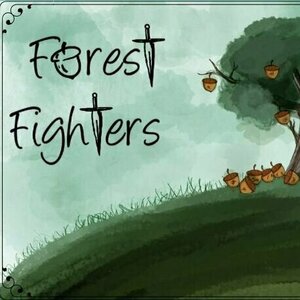

My back yard at my house is half lawn and the back half is woods. The woods are expansive and house many species of wildlife, some of which I care not to ever see. I have squirrels running through my yard and up my trees all the time. I have deer running freely through the neighborhood, and those dang raccoons to tear up my yard when it’s grub season. So when I heard about Forest Fighters being a game about squirrels and possibly fighting against raccoons I knew it had to be reviewed.
Forest Fighters pits players against each other, being rival squirrel clans preparing to gather acorns for the winter. Only one clan can succeed because there is but one oak tree in the entire forest from which acorns may be gathered. Players will be recruiting other animal species onto their side by way of deck building game mechanics and using gained cards to send to battle against their opponents.
DISCLAIMER: We were provided a copy of this game for the purposes of this review. This is a retail copy of the game, so what you see in these photos is exactly what would be received in your box. I do not intend to cover every single rule included in the rulebook, but will describe the overall game flow and major rule set so that our readers may get a sense of how the game plays. For more in depth rules, you may purchase a copy online or from your FLGS. -T
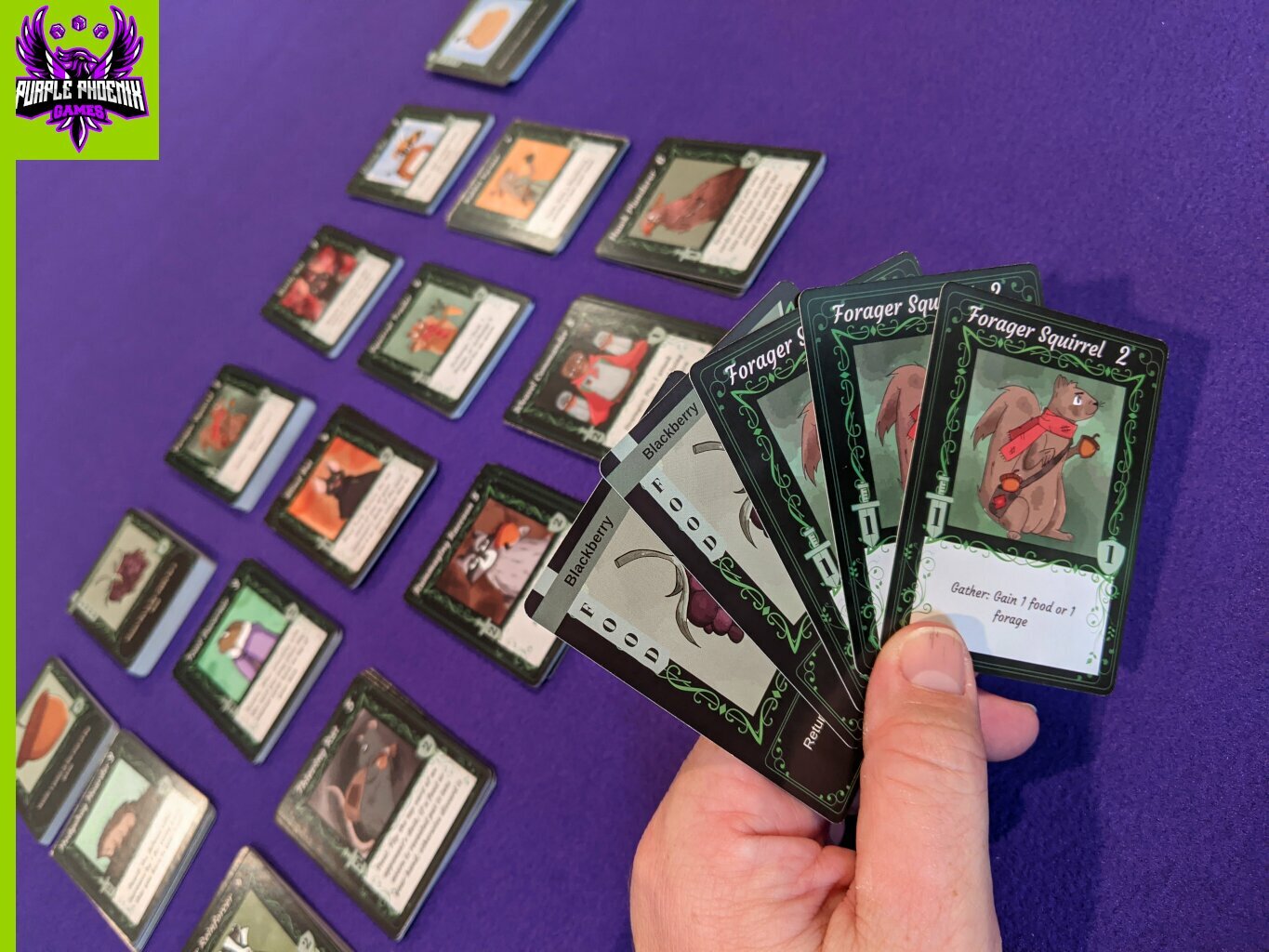
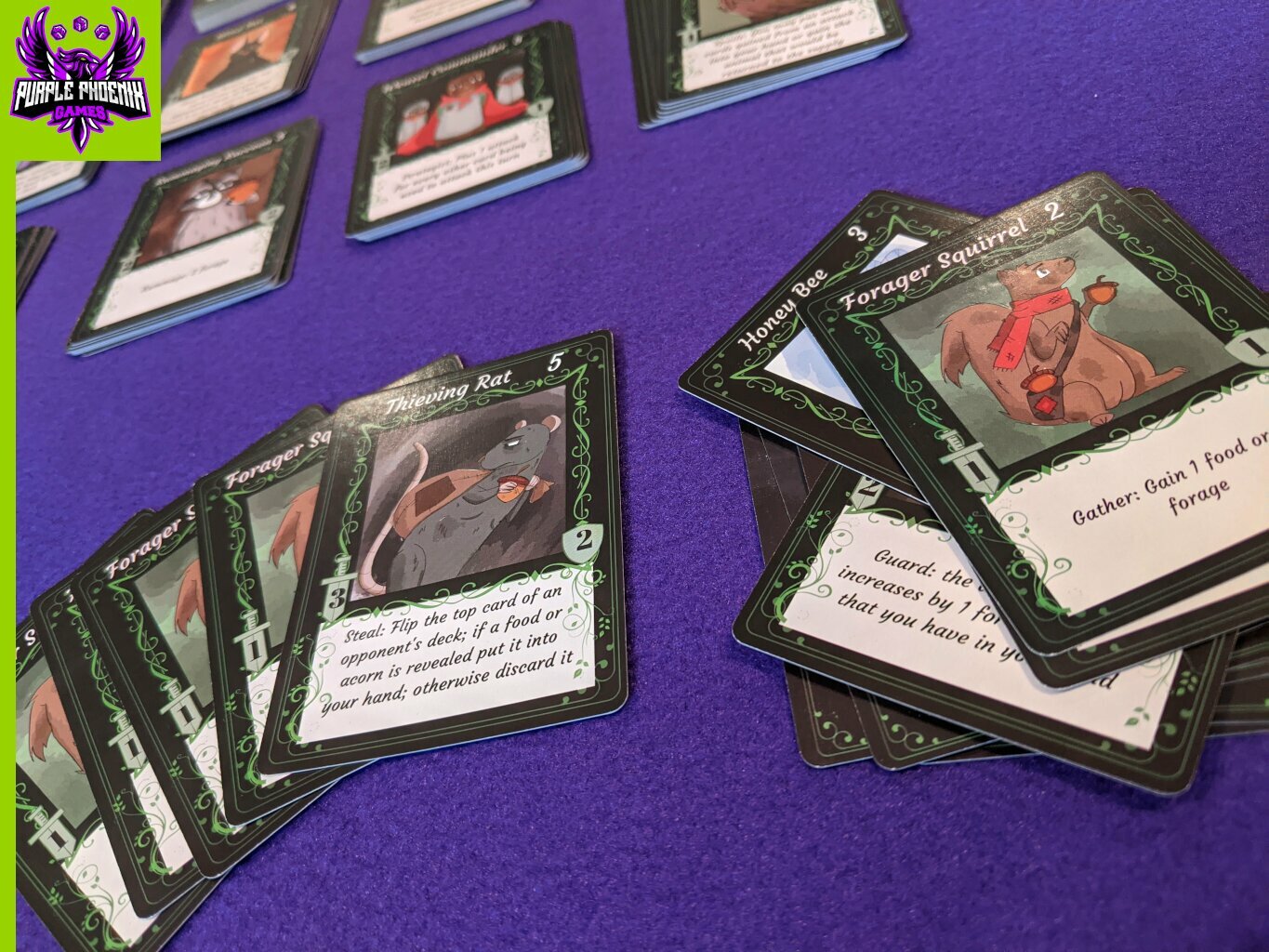
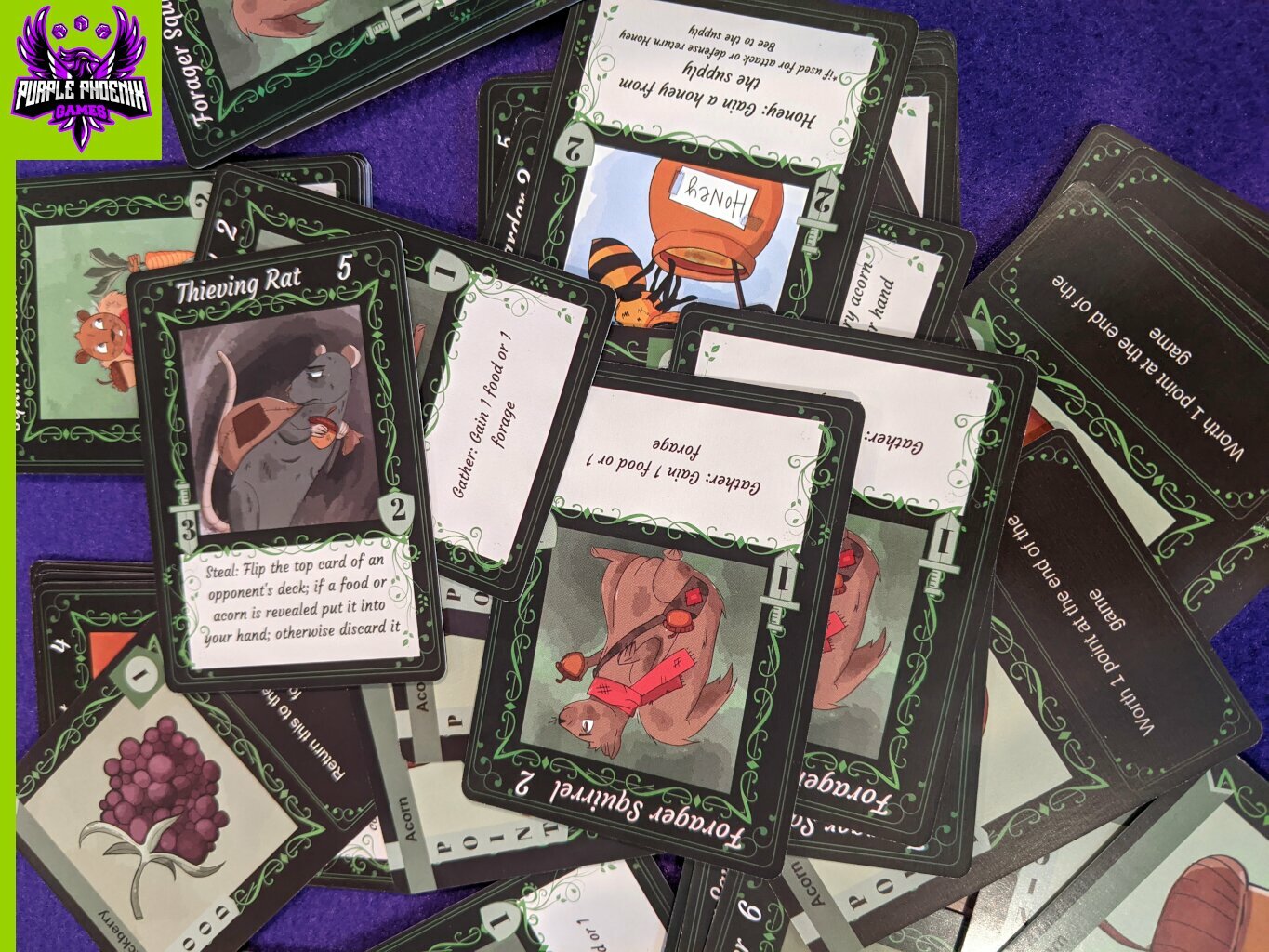
To setup, separate the cards into their respective decks. Deal each player five Forager Squirrels, two Acorns, and three Blackberries. This creates the 10 card deck players will shuffle and begin the game playing. Players will also choose 12 other animal deck types to use for the game and display all the decks within reach of all players. Each player will then draw the top five cards from their shuffled deck to create their starting hand. The game may now begin!
On a turn a player will use all the cards from their hand to purchase new cards from the main display to be added to their discard pile, like every other deck building game out there. The cards have multiple uses, however, and up to two currency values. Most animals will be recruited using Food (like Blackberries and Honey), and Food cards can mostly be obtained by using Forage values. Example: the starter Forager Squirrel can be used as one Food, one Forage, or even one Attack.
Speaking of Attack, on a player’s turn, should they be done shopping for other cards, they may attempt to attack an opponent using animal cards in their hand. Players will add up the Attack value on the cards they wish to use and declare an opponent who will reveal cards whose Defense value meets or exceeds the Attack value. Should the attacker win they will be able to take possession of Blackberries and Honey cards in the loser’s hand, send an animal back to its stack, or take all the Acorn cards. Acorns are both VP and the determining factor in ending the game; once all Acorn cards have been purchased the game is over.
Each animal card recruited will also have a special ability that can be used during a turn, and some of them are quite powerful. Turns continue in this fashion until either all Acorns have been purchased or all players except one have been eliminated. A player is eliminated once they can no longer purchase cards and have no more animals in their deck.
Components. Let me tell you about the good and the okay. The rulebook is a small pamphlet style that has only five pages of rules. And honestly, if you have played deck builders before, could have only taken one page. I like that. There is just enough information to get the game going, but doesn’t explain every card’s abilities, or throw in three pages of game art. Similarly, if any questions arise with card abilities, the card dividers provide more text to help clear up the questions. The cards are all good quality, and there are a ton of them.
The okay part of the game is the art on the cards. It is not at all bad, but it could use a different art style to be a bit more attractive. The last little concern I have is the design of the box. The size, shape, color, and all that is fine. What I wish was different was having the title of the game on all sides. My shelves are organized in a way that I try to pack as much as I can into the space by orienting the boxes to be as small and deep as possible so that the smallest side of the box is showing. I cannot do that with Forest Fighters because the smallest sides have a few art slides and credits. Honestly, this isn’t quite as egregious as some games (I’m looking at you, Oceans), so it’s not a huge deal, but worth mentioning for me.
All in all the game is a solid deck-builder with that extra bit of attacking and stealing from opponents. I have never been a fan of Dominion as I find its themelessness boring and its mechanics antiquated. Now, I think I might be able to use Forest Fighters as a gateway deck builder that is more interesting, but still considered light for new gamers.
I am kind of sad that I missed the Kickstarter for this one because I would have liked to have splurged for the higher tier (those yummy extras), but I am happy to have added Forest Fighters to my collection. I believe it is a great entry into deck-building and if you are looking to find a similar game with a cute theme, an interesting new take on the genre, and can play up to five comfortably, then I recommend you give this one a try. I think you’ll like it. Just don’t ever use the raccoons against me or I will be attacking you every turn.
Forest Fighters pits players against each other, being rival squirrel clans preparing to gather acorns for the winter. Only one clan can succeed because there is but one oak tree in the entire forest from which acorns may be gathered. Players will be recruiting other animal species onto their side by way of deck building game mechanics and using gained cards to send to battle against their opponents.
DISCLAIMER: We were provided a copy of this game for the purposes of this review. This is a retail copy of the game, so what you see in these photos is exactly what would be received in your box. I do not intend to cover every single rule included in the rulebook, but will describe the overall game flow and major rule set so that our readers may get a sense of how the game plays. For more in depth rules, you may purchase a copy online or from your FLGS. -T
To setup, separate the cards into their respective decks. Deal each player five Forager Squirrels, two Acorns, and three Blackberries. This creates the 10 card deck players will shuffle and begin the game playing. Players will also choose 12 other animal deck types to use for the game and display all the decks within reach of all players. Each player will then draw the top five cards from their shuffled deck to create their starting hand. The game may now begin!
On a turn a player will use all the cards from their hand to purchase new cards from the main display to be added to their discard pile, like every other deck building game out there. The cards have multiple uses, however, and up to two currency values. Most animals will be recruited using Food (like Blackberries and Honey), and Food cards can mostly be obtained by using Forage values. Example: the starter Forager Squirrel can be used as one Food, one Forage, or even one Attack.
Speaking of Attack, on a player’s turn, should they be done shopping for other cards, they may attempt to attack an opponent using animal cards in their hand. Players will add up the Attack value on the cards they wish to use and declare an opponent who will reveal cards whose Defense value meets or exceeds the Attack value. Should the attacker win they will be able to take possession of Blackberries and Honey cards in the loser’s hand, send an animal back to its stack, or take all the Acorn cards. Acorns are both VP and the determining factor in ending the game; once all Acorn cards have been purchased the game is over.
Each animal card recruited will also have a special ability that can be used during a turn, and some of them are quite powerful. Turns continue in this fashion until either all Acorns have been purchased or all players except one have been eliminated. A player is eliminated once they can no longer purchase cards and have no more animals in their deck.
Components. Let me tell you about the good and the okay. The rulebook is a small pamphlet style that has only five pages of rules. And honestly, if you have played deck builders before, could have only taken one page. I like that. There is just enough information to get the game going, but doesn’t explain every card’s abilities, or throw in three pages of game art. Similarly, if any questions arise with card abilities, the card dividers provide more text to help clear up the questions. The cards are all good quality, and there are a ton of them.
The okay part of the game is the art on the cards. It is not at all bad, but it could use a different art style to be a bit more attractive. The last little concern I have is the design of the box. The size, shape, color, and all that is fine. What I wish was different was having the title of the game on all sides. My shelves are organized in a way that I try to pack as much as I can into the space by orienting the boxes to be as small and deep as possible so that the smallest side of the box is showing. I cannot do that with Forest Fighters because the smallest sides have a few art slides and credits. Honestly, this isn’t quite as egregious as some games (I’m looking at you, Oceans), so it’s not a huge deal, but worth mentioning for me.
All in all the game is a solid deck-builder with that extra bit of attacking and stealing from opponents. I have never been a fan of Dominion as I find its themelessness boring and its mechanics antiquated. Now, I think I might be able to use Forest Fighters as a gateway deck builder that is more interesting, but still considered light for new gamers.
I am kind of sad that I missed the Kickstarter for this one because I would have liked to have splurged for the higher tier (those yummy extras), but I am happy to have added Forest Fighters to my collection. I believe it is a great entry into deck-building and if you are looking to find a similar game with a cute theme, an interesting new take on the genre, and can play up to five comfortably, then I recommend you give this one a try. I think you’ll like it. Just don’t ever use the raccoons against me or I will be attacking you every turn.
Purple Phoenix Games (2266 KP) rated Firefly Adventures: Brigands and Browncoats in Tabletop Games
Sep 1, 2021

Okay! Yes. Firefly, a great IP. Check! Gale Force Nine, a publisher that brought a previous Firefly game to life and was pretty darn good. Check! Solo, Cooperative, or Competitive? Check! So far so good, so how does it stack up and have I finally found my gorram Firefly love?
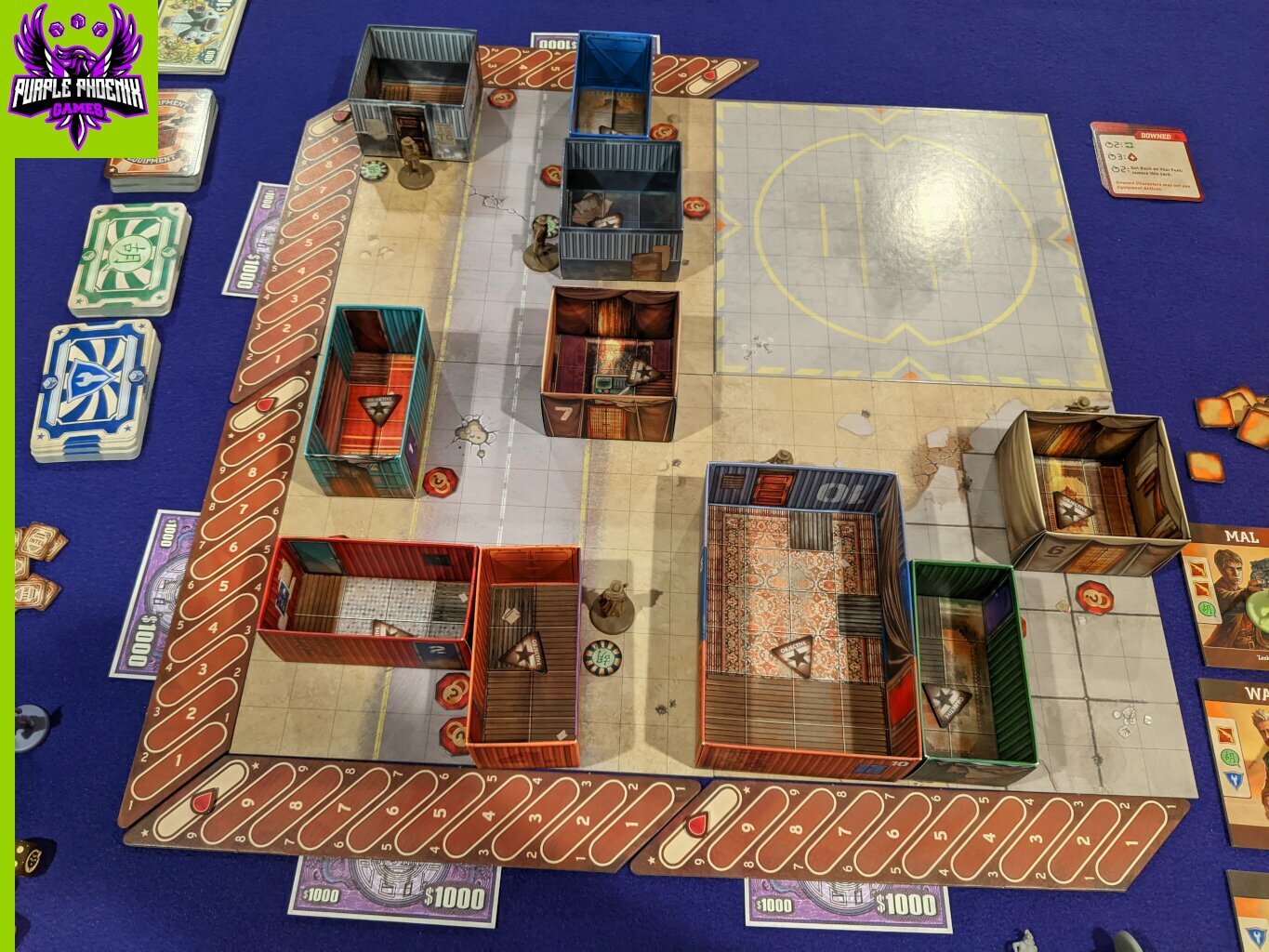
Firefly Adventures: Brigands and Browncoats (from here just Firefly) is a miniatures skirmish game that can be played as a one-off game experience or as a campaign style story game. In it players will either control one or more Crew (the heroes of the show) or all of the Goons (the bad guys). For the solo experience I will be detailing here the solo player will control all characters on both sides. The Crew will be attempting to pull off The Rescue Job by rescuing an injured comrade hostage stashed in one of the 10 buildings on the board. After the hostage has been rescued all Crew and hostage must make it to the landing pad area before time for the Job runs out.
To setup, follow the instructions on the included Job pamphlet (there are four included in the box). The beginning of the Job will look similar to the photo below, though other components outside the board setup may be in whatever location fits the player best. After Equipment cards have been revealed and shopping completed, the game may begin in earnest, and best be quick – you only have 50 Moments to complete the Job!
Firefly is a turn-based minis game, but turns will probably never be in the same order. Each action taken by a character costs Moments in time, tracked by the brown Moments tracker around the board. Each character, be they Crew or Goons, will have their own Time Marker to show where in the 50 Moments the character currently resides. The character whose Time Marker is furthest in the rear of the pack will take their turn next. On a turn characters will have several choices of actions to take: Move, Complete a Test, Heal, Assist, or even Brawl and Shoot!
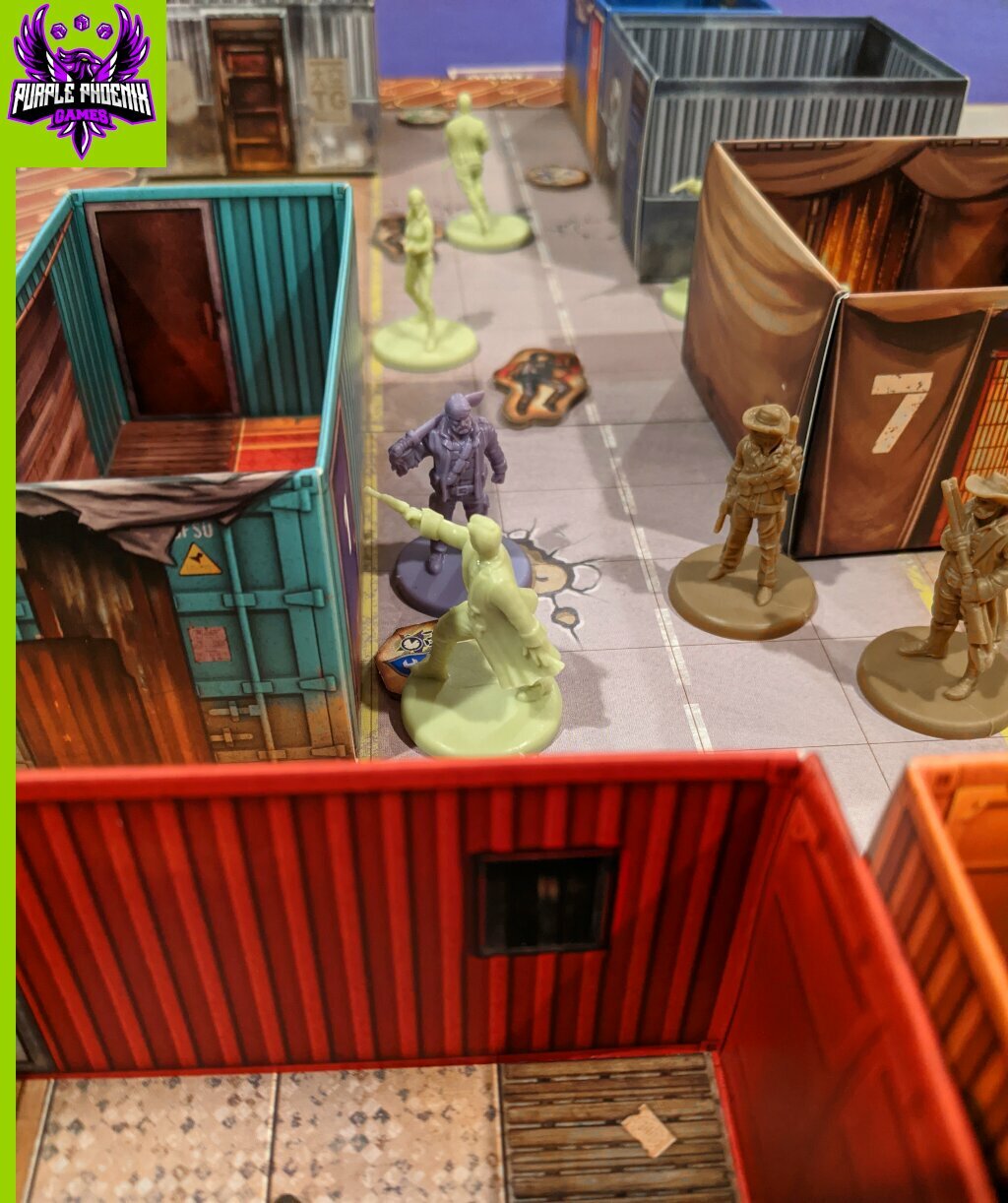
This Job focuses on gathering Intel from a terminal in one of the buildings or by chatting up nearby Cowboys. These Intel chips may be turned in for information to help narrow down exactly in which building the hostage is being held. Along the way, however, certain events may cause the Crew to have to “act heroic,” which means swapping out their gray “casual” mini for their green “heroic” mini in order to complete the event. Funny thing though, once a Crew member acts heroic, if ending their turn within line of sight of a Goon, that Goon becomes Alerted and joins the Timeline with their own mini and Time Marker. The Goons will now be trying to take out the beloved Crew member! As in the photo below, poor Mal is being surrounded by Goons with Zoe and Jayne nearby to help.
When all is said and done, Crew and Goons will be taking actions and spending Moments to do so. Should the Crew get to the landing pad with the hostage in tow the Crew wins! However, if time runs out on the Job (as it did with me twice) then the Job has failed. In either case the Crew may receive Rewards in various amounts of credits or Intel or other rewards that they may carry with to the next Job if playing a Story (several Jobs in succession).
Components. I am a HUGE fan of the components in this box. Not only are the minis great, the tokens chunky, and the artwork very good, but each 3D building is pre-assembled right out of the box. They nest very tightly and neatly within the box (whose bottom is also a very large building), but you will need to provide a bunch of baggies or other storage means because all the small components will be dumped into these buildings otherwise. I love all the components in this game, and they are all wonderful to handle… except one – the Time Markers. These are the tokens that represent the characters on the Moments tracker. As characters move along the tracker their Time Markers will be placed on a blank spot, or more often than not, on top of a stack of other Markers. No problem usually, unless your big man-hands tend not to be dextrous enough to grab the top Marker cleanly off the stack and it causes a giant mess of Time Markers on the board. I mean, not that it happened to me several times, of course…
In any case, Firefly is a marvelous scenario-based minis game that I have had nothing but great times playing – even solo! I honestly cannot imagine having more fun by adding more players, so this may be another “solo only” game for me. I will probably try it with my wife, maybe, or someone else once the COVID is gone. I love being able to figure out how best to maneuver each character in order to achieve the goals of the Job, but then something always causing me to have to act heroic and end my turn in LOS of a Goon, so now they are coming after me. I would not necessarily compare it to an action-programming game where you make plans only to have randomness obliterate them, but it certainly adds a giant amount of tactics to the game. In fact, during one play Mal alerted four Cowboys at once, and then the game was no longer a strategic stealthy experience but an all-out melee just to survive. I lost the Job, but only by a few Moments.
Ahh, this one is fabulous, and I am so happy that I have finally found that perfect-for-me Firefly game. If you are a fan of the Firefly mythos and are looking for a game that does it justice while having a ton of replayability, then please check out Firefly Adventures: Brigands and Browncoats. I am seriously also considering purchasing the expansions to add Book, Inara, Simon, and River. I mean, how could you NOT want to add River to your game?? I’ll be in my bunk.
Firefly Adventures: Brigands and Browncoats (from here just Firefly) is a miniatures skirmish game that can be played as a one-off game experience or as a campaign style story game. In it players will either control one or more Crew (the heroes of the show) or all of the Goons (the bad guys). For the solo experience I will be detailing here the solo player will control all characters on both sides. The Crew will be attempting to pull off The Rescue Job by rescuing an injured comrade hostage stashed in one of the 10 buildings on the board. After the hostage has been rescued all Crew and hostage must make it to the landing pad area before time for the Job runs out.
To setup, follow the instructions on the included Job pamphlet (there are four included in the box). The beginning of the Job will look similar to the photo below, though other components outside the board setup may be in whatever location fits the player best. After Equipment cards have been revealed and shopping completed, the game may begin in earnest, and best be quick – you only have 50 Moments to complete the Job!
Firefly is a turn-based minis game, but turns will probably never be in the same order. Each action taken by a character costs Moments in time, tracked by the brown Moments tracker around the board. Each character, be they Crew or Goons, will have their own Time Marker to show where in the 50 Moments the character currently resides. The character whose Time Marker is furthest in the rear of the pack will take their turn next. On a turn characters will have several choices of actions to take: Move, Complete a Test, Heal, Assist, or even Brawl and Shoot!
This Job focuses on gathering Intel from a terminal in one of the buildings or by chatting up nearby Cowboys. These Intel chips may be turned in for information to help narrow down exactly in which building the hostage is being held. Along the way, however, certain events may cause the Crew to have to “act heroic,” which means swapping out their gray “casual” mini for their green “heroic” mini in order to complete the event. Funny thing though, once a Crew member acts heroic, if ending their turn within line of sight of a Goon, that Goon becomes Alerted and joins the Timeline with their own mini and Time Marker. The Goons will now be trying to take out the beloved Crew member! As in the photo below, poor Mal is being surrounded by Goons with Zoe and Jayne nearby to help.
When all is said and done, Crew and Goons will be taking actions and spending Moments to do so. Should the Crew get to the landing pad with the hostage in tow the Crew wins! However, if time runs out on the Job (as it did with me twice) then the Job has failed. In either case the Crew may receive Rewards in various amounts of credits or Intel or other rewards that they may carry with to the next Job if playing a Story (several Jobs in succession).
Components. I am a HUGE fan of the components in this box. Not only are the minis great, the tokens chunky, and the artwork very good, but each 3D building is pre-assembled right out of the box. They nest very tightly and neatly within the box (whose bottom is also a very large building), but you will need to provide a bunch of baggies or other storage means because all the small components will be dumped into these buildings otherwise. I love all the components in this game, and they are all wonderful to handle… except one – the Time Markers. These are the tokens that represent the characters on the Moments tracker. As characters move along the tracker their Time Markers will be placed on a blank spot, or more often than not, on top of a stack of other Markers. No problem usually, unless your big man-hands tend not to be dextrous enough to grab the top Marker cleanly off the stack and it causes a giant mess of Time Markers on the board. I mean, not that it happened to me several times, of course…
In any case, Firefly is a marvelous scenario-based minis game that I have had nothing but great times playing – even solo! I honestly cannot imagine having more fun by adding more players, so this may be another “solo only” game for me. I will probably try it with my wife, maybe, or someone else once the COVID is gone. I love being able to figure out how best to maneuver each character in order to achieve the goals of the Job, but then something always causing me to have to act heroic and end my turn in LOS of a Goon, so now they are coming after me. I would not necessarily compare it to an action-programming game where you make plans only to have randomness obliterate them, but it certainly adds a giant amount of tactics to the game. In fact, during one play Mal alerted four Cowboys at once, and then the game was no longer a strategic stealthy experience but an all-out melee just to survive. I lost the Job, but only by a few Moments.
Ahh, this one is fabulous, and I am so happy that I have finally found that perfect-for-me Firefly game. If you are a fan of the Firefly mythos and are looking for a game that does it justice while having a ton of replayability, then please check out Firefly Adventures: Brigands and Browncoats. I am seriously also considering purchasing the expansions to add Book, Inara, Simon, and River. I mean, how could you NOT want to add River to your game?? I’ll be in my bunk.



Bob Mann (459 KP) rated Independence Day: Resurgence (2016) in Movies
Sep 29, 2021
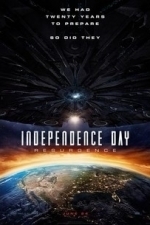


Why Will Smith is a wise, wise man.
I’m catching up on a few of the big films I missed during 2016. But Roland Emmerich has a lot to answer for with this one. Twenty years after Independence Day smashed the summer box office of 1996, the aliens are back: bigger and badder than ever. Steven Hiller (Will Smith) is no longer on the scene but, to give Emmerich a little credit, he has gathered an impressive array of the original stars to return led by Hiller’s wife Jasmine (Vivica Fox), President Whitmore (Bill Pullman), Dr Okun (Brent Spiner), David Levinson (Jeff Goldblum) and his dad (Judd Hirsch). The great Robert Loggia even turns up, who played the original General Grey, looking like he is about to expire (which unfortunately he did late last year, and the film is in memorial to him). All of them have weathered over the years apart from Judd Hirsch who must have a picture in his attic.
Playing the new generation (Hiller’s young son Dylan and the president’s daughter Patricia) are Jessie Usher and the comely Maika Monroe respectively, the latter having the pout of a young Jessica Alba and showing promise. Rounding off the young ‘uns, and playing an enormously irritating hunk/hero and his sidekick buddy are Jake (Liam Hemsworth – yes, younger brother of Chris) and Floyd (Nicolas Wright). And with the obvious needs of summer blockbusters to appeal to the ravenous Chinese market there is also Shanghai-born Angelababy as a young hotshot pilot and Chin Han as her uncle, moonbase commander Commander Jiang.
It’s hard to know where to start with criticism of this film. It’s like you’ve caught someone desecrating the grave of a dearly departed relative. The plot is ludicrous…. Uh oh…here comes another One Mann’s Movies Showcase Theatre….
The scene: onboard the alien craft high above central Asia
DRONE K’FAALL: “The use of the anti-gravity weapon worked a treat your Majesty. We have ripped up Shanghai and dumped in from a great height on London! Take that Queenie! All hail our weapons superiority! I take it we should just ‘rinse and repeat’ around the world to wipe them all out? ”
QUEEN ALIEN BEE: “No K’Fall. Let’s land in the Atlantic and then go fight them one-on-one with our little ships in the desert near Area 51.”
DRONE K’FALL: “B-b-b-but your Majesty, with our gravity weapon we could eliminate all threat, drill out the earth’s core and find what we came here for in perfect safety!”.
QUEEN ALIEN BEE: “No… that’s just what they’ll be expecting us to do…”
I thought the Oscar for the dumbest aliens of the year was a shoe-in for the ones who chose a similar tactic in “The 5th Wave” – but no… we have another contender for the crown. This ridiculous London-based CGI sequence – a virtual re-shoot of the ridiculous CGI sequence in Emmerich’s “2012” where John Cusack is fleeing by plane a collapsing Los Angeles – is mitigated only by Goldblum’s witty comment about them “Always going for the landmarks” – the best line in the film.
Elsewhere, the story and screenplay – by an army of writers (never a good sign) – is risible and an insult to intelligence, alien or otherwise. The ludicrous plot points go on and on…
Why on earth is the single landed alien craft from 1996 owned by an African warlord? If mankind have ‘benefited’ so much from the alien technology that must surely have been through the UN-dismantling of that ship?
There seems to be no logical connection between the “visions” (stolen from “Close Encounters”) and the alien craft. The visions might have well have been of the alien’s last shopping list (“six cans of Kraag beans; one bottle of Vollufi ale; … “);
The alien craft is big enough to span the WHOLE Atlantic when it lands, but – who would believe it? – comes to a stop with its edge in Washington JUST ENOUGH to dip the White House flag to a jaunty angle. #cringe;
The alien ship – apparently open to the elements – allows our heroic hunks to wander around without spacesuits;
Breathless… or not. Jessie T Usher and Liam Hemsworth (foreground) not dying of asphyxiation or cold.
At one point it looked like our curvaceous heroine was going to defeat the alien queen in good ol’ Wild West fashion armed only with a handgun (but no, my head could come out of my hands again);
And don’t even get me started on the opening “excitement” about propping up a collapsing supergun on the moon with a spaceship. Gerry Anderson would be spinning in his grave.
The dialogue is little better. The original “Independence Day” was probably most famous for two scenes: the impressive destruction of the White House and Bill Paxton’s ludicrously corny “We will not go quietly into the night” speech. Here trying to go one better we have not just one version of this but two with William Fichner’s General Adams chipping one in from the rough before Paxton delivers an impromptu hanger speech that is toe-curlingly excruciating.
Much of the acting is of the “I really don’t want to be here but it’s good for the pension” variety with Paxton and Goldblum going through the motions and Charlotte Gainsborough being horribly miscast as a French anthropologist running around the world on the trail of Pokemon Go characters… or symbols… or something. Only Brent Spiner and Judd Hirsch really get into their stride with likeably over-the-top performances.
Goldblum and Charlotte Gainsborough. A less likely historic romantic attachment its difficult to imagine.
If this was a standalone story it might scrape a double-Fad… but as it so horrendously sullies a classic movie experience it incurs my cinematic wrath. It might have made Roland Emmer-richer (sic)…. but my recommendation would be to get a big bag of popcorn, the original 1996 movie on DVD and enjoy. Avoid, avoid, avoid.
Playing the new generation (Hiller’s young son Dylan and the president’s daughter Patricia) are Jessie Usher and the comely Maika Monroe respectively, the latter having the pout of a young Jessica Alba and showing promise. Rounding off the young ‘uns, and playing an enormously irritating hunk/hero and his sidekick buddy are Jake (Liam Hemsworth – yes, younger brother of Chris) and Floyd (Nicolas Wright). And with the obvious needs of summer blockbusters to appeal to the ravenous Chinese market there is also Shanghai-born Angelababy as a young hotshot pilot and Chin Han as her uncle, moonbase commander Commander Jiang.
It’s hard to know where to start with criticism of this film. It’s like you’ve caught someone desecrating the grave of a dearly departed relative. The plot is ludicrous…. Uh oh…here comes another One Mann’s Movies Showcase Theatre….
The scene: onboard the alien craft high above central Asia
DRONE K’FAALL: “The use of the anti-gravity weapon worked a treat your Majesty. We have ripped up Shanghai and dumped in from a great height on London! Take that Queenie! All hail our weapons superiority! I take it we should just ‘rinse and repeat’ around the world to wipe them all out? ”
QUEEN ALIEN BEE: “No K’Fall. Let’s land in the Atlantic and then go fight them one-on-one with our little ships in the desert near Area 51.”
DRONE K’FALL: “B-b-b-but your Majesty, with our gravity weapon we could eliminate all threat, drill out the earth’s core and find what we came here for in perfect safety!”.
QUEEN ALIEN BEE: “No… that’s just what they’ll be expecting us to do…”
I thought the Oscar for the dumbest aliens of the year was a shoe-in for the ones who chose a similar tactic in “The 5th Wave” – but no… we have another contender for the crown. This ridiculous London-based CGI sequence – a virtual re-shoot of the ridiculous CGI sequence in Emmerich’s “2012” where John Cusack is fleeing by plane a collapsing Los Angeles – is mitigated only by Goldblum’s witty comment about them “Always going for the landmarks” – the best line in the film.
Elsewhere, the story and screenplay – by an army of writers (never a good sign) – is risible and an insult to intelligence, alien or otherwise. The ludicrous plot points go on and on…
Why on earth is the single landed alien craft from 1996 owned by an African warlord? If mankind have ‘benefited’ so much from the alien technology that must surely have been through the UN-dismantling of that ship?
There seems to be no logical connection between the “visions” (stolen from “Close Encounters”) and the alien craft. The visions might have well have been of the alien’s last shopping list (“six cans of Kraag beans; one bottle of Vollufi ale; … “);
The alien craft is big enough to span the WHOLE Atlantic when it lands, but – who would believe it? – comes to a stop with its edge in Washington JUST ENOUGH to dip the White House flag to a jaunty angle. #cringe;
The alien ship – apparently open to the elements – allows our heroic hunks to wander around without spacesuits;
Breathless… or not. Jessie T Usher and Liam Hemsworth (foreground) not dying of asphyxiation or cold.
At one point it looked like our curvaceous heroine was going to defeat the alien queen in good ol’ Wild West fashion armed only with a handgun (but no, my head could come out of my hands again);
And don’t even get me started on the opening “excitement” about propping up a collapsing supergun on the moon with a spaceship. Gerry Anderson would be spinning in his grave.
The dialogue is little better. The original “Independence Day” was probably most famous for two scenes: the impressive destruction of the White House and Bill Paxton’s ludicrously corny “We will not go quietly into the night” speech. Here trying to go one better we have not just one version of this but two with William Fichner’s General Adams chipping one in from the rough before Paxton delivers an impromptu hanger speech that is toe-curlingly excruciating.
Much of the acting is of the “I really don’t want to be here but it’s good for the pension” variety with Paxton and Goldblum going through the motions and Charlotte Gainsborough being horribly miscast as a French anthropologist running around the world on the trail of Pokemon Go characters… or symbols… or something. Only Brent Spiner and Judd Hirsch really get into their stride with likeably over-the-top performances.
Goldblum and Charlotte Gainsborough. A less likely historic romantic attachment its difficult to imagine.
If this was a standalone story it might scrape a double-Fad… but as it so horrendously sullies a classic movie experience it incurs my cinematic wrath. It might have made Roland Emmer-richer (sic)…. but my recommendation would be to get a big bag of popcorn, the original 1996 movie on DVD and enjoy. Avoid, avoid, avoid.

honingwords (32 KP) rated No Good Reason in Books
Jul 5, 2018
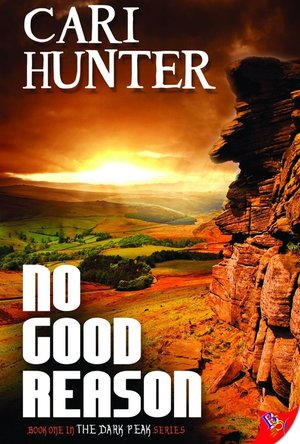

Cari Hunter is most definitely as top notch a writer as you are going to find in crime/thriller writing.
Cari Hunter’s Dark Peak crime series, starting with No Good Reason, was recommended to me by a Lesfic author. I reckon you have to be pretty good for your peers to claim you are ‘top notch’ and after reading four of her books in quick succession I can guarantee that Cari is most definitely as top notch a writer as you are going to find in crime/thriller writing.
Let me admit to you that I generally find crime novels too much hard work to follow. I like my books to be romances, and the sexier the better. I’m surprised as all get out to find I love Cari’s thrilling ride through these Police stroke Hospital novels. Especially as there is almost no juicy sex to lubricate the grit. The infrequency of sex scenes is because the main characters, Sanne and Meg, aren’t officially a couple. Or maybe they are. It’s entirely possible everyone knows they are, except themselves.
The story isn't necessarily about their sexual tension, but it was always in the back of my mind that they would see sense in the end and I patiently waited them out.
I have found in the last few years that there are many padded-out books on the market by well-respected authors, where you can skip through whole pages at a time without losing any real sense of the plot. Not so with No Good Reason which kept me riveted through each paragraph and exquisite word right from the tense prologue.
Cari definitely makes every single word count and I felt engaged in the story and with her main characters within the first few pages.
I’d already read Snowbound, which was a fantastic debut novel, but the characters in No Good Reason are one smidge more sophisticatedly written.
Sanne and Meg go back a very long time, from before their first kiss at the age of twelve, and they know each other better than they know themselves. They have generated a world around them where they are each others’ support and comfort. They are BFFs, they are Friends With Benefits, but somehow Cari has written them as even more than these things. They are each others’ absolute other halves.
These two girls have aches and bruises, and tears and emotions, and genuine exhaustion from their ridiculously long work hours.
They do things like accidentally drop perishable shopping on the floor, but eat it anyway; burn their tea; and turn the shower off when the toilet flushes for fear of being scalded.
I love details like these. I love that they can have a discussion about putting the bins out and HobNobs can fall in their tea the same as they do for you and me, without making the whole book boring and mundane. It simply endears the characters to me all the more.
They made me smile a lot. Meg prefers ham and quaver butties, for goodness sake, what’s not to love?
It doesn’t take long for Cari to completely draw you into their world in Northern England, around the Manchester area, and mainly in the Peak District which is where Cari lives and I feel like I have travelled the hills and crunched the snow and tramped through the same streets as she has now.
This area has its own accent, Northern English, and it is noticeable that she uses phrases and words particular to there. I can’t remember which words I picked up on first, probably some dialogue, but you quickly become used to the fact this is not written by an American. It’s refreshing to have only regional UK main characters: no Londoners; no Americans.
Don’t let the idea of a local accent and local characters put you off, there is nothing in the book you wouldn’t understand, it is still all ‘plain English’ and if you come across a word you can’t decipher I will more than happily translate for you!
Other than the almost-a-romance-but-so-much-more between the two girls there is also this whole other kidnapping / crime malarkey going on. Sanne is a little too personally involved in the case right from the beginning, being caught up in the initial rescue of the victim. She and her police partner, the sensitive, caring, supportive, gorgeously written Nelson, are embroiled in working the case together. Needless to say they spend a lot of time visiting Meg in her role as A&E Doctor in the local hospital for one reason or another. Nelson is a beautiful soul and just the kind of partner Sanne needs, but that writers seldom allow their straight characters to be, especially in Police fiction.
The kidnapping plot is fast paced and exciting. The characters on both sides of the investigation were all believable and there was an audible ‘Huh!’ out of me with the final twist at the end. I really didn’t see that coming. Such a simple way to pull the whole plot together. Chilling!
Cari has a remarkable flair for descriptive writing and she pays particular attention to details like sounds and how things feel against skin. You are left in no doubt every time a character is sore, almost feeling the pain and peeling off the scabs with them.
Sometimes you have to reread a passage to understand the gist of what an author means, or furrow your brow over a combination of words because they just don’t make sense or even belong together, but with Cari Hunter the only thing I can point out to her is ‘Try feeding goldfinches niger seeds instead of nuts.’ That’s it. No other tweaking or corrections required. Nothing. Cari Hunter writes sheer perfection.
My favourite line in the book is the first one I stopped at, blinked appreciatively and re-read.
“Sanne ran her fingertips across the gritstone, letting it wear away her skin like an over-keen emery board.”
From that point on I knew I was going to love not only the book, but also Cari’s style and I wasn’t disappointed with further chapters.
I have a simple test for new authors, to find out how much I like them. The test is ‘how sick has this author made me?’ By that I mean - how long did they keep me awake reading when I ought to have been asleep for work the next day. If I am awake too long it makes me sick for several days after - it shouldn’t be something I am proud of but
Let me admit to you that I generally find crime novels too much hard work to follow. I like my books to be romances, and the sexier the better. I’m surprised as all get out to find I love Cari’s thrilling ride through these Police stroke Hospital novels. Especially as there is almost no juicy sex to lubricate the grit. The infrequency of sex scenes is because the main characters, Sanne and Meg, aren’t officially a couple. Or maybe they are. It’s entirely possible everyone knows they are, except themselves.
The story isn't necessarily about their sexual tension, but it was always in the back of my mind that they would see sense in the end and I patiently waited them out.
I have found in the last few years that there are many padded-out books on the market by well-respected authors, where you can skip through whole pages at a time without losing any real sense of the plot. Not so with No Good Reason which kept me riveted through each paragraph and exquisite word right from the tense prologue.
Cari definitely makes every single word count and I felt engaged in the story and with her main characters within the first few pages.
I’d already read Snowbound, which was a fantastic debut novel, but the characters in No Good Reason are one smidge more sophisticatedly written.
Sanne and Meg go back a very long time, from before their first kiss at the age of twelve, and they know each other better than they know themselves. They have generated a world around them where they are each others’ support and comfort. They are BFFs, they are Friends With Benefits, but somehow Cari has written them as even more than these things. They are each others’ absolute other halves.
These two girls have aches and bruises, and tears and emotions, and genuine exhaustion from their ridiculously long work hours.
They do things like accidentally drop perishable shopping on the floor, but eat it anyway; burn their tea; and turn the shower off when the toilet flushes for fear of being scalded.
I love details like these. I love that they can have a discussion about putting the bins out and HobNobs can fall in their tea the same as they do for you and me, without making the whole book boring and mundane. It simply endears the characters to me all the more.
They made me smile a lot. Meg prefers ham and quaver butties, for goodness sake, what’s not to love?
It doesn’t take long for Cari to completely draw you into their world in Northern England, around the Manchester area, and mainly in the Peak District which is where Cari lives and I feel like I have travelled the hills and crunched the snow and tramped through the same streets as she has now.
This area has its own accent, Northern English, and it is noticeable that she uses phrases and words particular to there. I can’t remember which words I picked up on first, probably some dialogue, but you quickly become used to the fact this is not written by an American. It’s refreshing to have only regional UK main characters: no Londoners; no Americans.
Don’t let the idea of a local accent and local characters put you off, there is nothing in the book you wouldn’t understand, it is still all ‘plain English’ and if you come across a word you can’t decipher I will more than happily translate for you!
Other than the almost-a-romance-but-so-much-more between the two girls there is also this whole other kidnapping / crime malarkey going on. Sanne is a little too personally involved in the case right from the beginning, being caught up in the initial rescue of the victim. She and her police partner, the sensitive, caring, supportive, gorgeously written Nelson, are embroiled in working the case together. Needless to say they spend a lot of time visiting Meg in her role as A&E Doctor in the local hospital for one reason or another. Nelson is a beautiful soul and just the kind of partner Sanne needs, but that writers seldom allow their straight characters to be, especially in Police fiction.
The kidnapping plot is fast paced and exciting. The characters on both sides of the investigation were all believable and there was an audible ‘Huh!’ out of me with the final twist at the end. I really didn’t see that coming. Such a simple way to pull the whole plot together. Chilling!
Cari has a remarkable flair for descriptive writing and she pays particular attention to details like sounds and how things feel against skin. You are left in no doubt every time a character is sore, almost feeling the pain and peeling off the scabs with them.
Sometimes you have to reread a passage to understand the gist of what an author means, or furrow your brow over a combination of words because they just don’t make sense or even belong together, but with Cari Hunter the only thing I can point out to her is ‘Try feeding goldfinches niger seeds instead of nuts.’ That’s it. No other tweaking or corrections required. Nothing. Cari Hunter writes sheer perfection.
My favourite line in the book is the first one I stopped at, blinked appreciatively and re-read.
“Sanne ran her fingertips across the gritstone, letting it wear away her skin like an over-keen emery board.”
From that point on I knew I was going to love not only the book, but also Cari’s style and I wasn’t disappointed with further chapters.
I have a simple test for new authors, to find out how much I like them. The test is ‘how sick has this author made me?’ By that I mean - how long did they keep me awake reading when I ought to have been asleep for work the next day. If I am awake too long it makes me sick for several days after - it shouldn’t be something I am proud of but


Well written (1 more)
Great characters
If the world ended, could you keep your morals and values? Imagine that your a father, with a young child in a burned-out world, barely surviving out on the road, and there are cannibals and murderers out to get you. Over time, you would watch your child become thinner and thinner, and every now and then you're lucky enough to find some canned or jarred food here and there, but it's only a matter of time before you can't find anymore. Soon, you would both be too weak to move - - - would you murder someone if they had food? Yet, most people out on the road are just like you, with no food and searching for more - - - in that case, could you kill and eat a person to survive? Or would you let yourself and your child starve, keeping your morals and values intact?
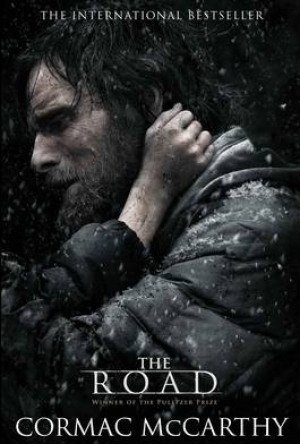
This is a scenario people may have to face one day, especially with the shape the world is in today. Even now people are faced with sticking with their morals and values, from helping our fellow man to the decision of holding a door open for a stranger. The Road, Cormac McCarthy's Pulitzer Prize winning novel, brings the very question of humanity to the forefront, as well as how hard it is to hold onto it.
The father, The Road's main character, takes us on a journey through the mountains in a burned-out America, but the fires that took over are never explained and they didn't need to be. Apparently having been on the move for a couple of years, he wants to take his young son South to survive the winter months that are very close by. Readers get glimpses of what happened the night the grid went down from the father's point-of-view, but so many years have passed that the memories are few, the facts aren't completely straight, and any type of life before the fires seems to have been just a dream. So the two begin the story heading South, dragging everything they have scavenged in their travels inside of a metal shopping cart, and the father isn't sure they'll make it out of the mountains before winter. He only has tattered pieces of a map that they have carried for a long time, having numbered each piece with a broken crayon they had found, making it hard to estimate how far they need to travel.
While traveling, they very rarely run into other people, at one point, when they run into a very bad man, the father realizes he hasn't spoken to another person (other than his son) in at least a year. This is mostly because the majority of people that are still alive are the type of people that would rather kill you and take whatever you have than speak to you. Even most of the houses they come upon are burned and abandoned, but the father sees these buildings as a chance to find food and supplies: "The roadside hedges were gone to rows of black and twisted brambles. No sign of life. He left the boy standing in the road holding the pistol while he climbed an old set of limestone steps and walked down the porch of the farmhouse shading his eyes and peering in the windows. He let himself in through the kitchen. Trash in the floor, old newsprint. China in a breakfront, cups hanging from their hooks. He went down the hallway and stood in the door to the parlor. There was an antique pumporgan in the corner. A television set. Cheap stuffed furniture together with an old handmade cherrywood chifforobe. He climbed the stairs and walked through the bedrooms. Everything covered with ash. A child's room with a stuffed dog on the windowsill looking out at the garden. He went through the closets. He stripped back the beds and came away with two good woolen blankets and went back down the stairs. In the pantry were three jars of homecanned tomatoes. He blew the dust from the lids and studied them. Someone before him had not trusted them and in the end neither did he and he walked out with the blankets over his shoulder and they set off along the road again. " The young son is usually left close by outside because he seems scared that either there will be bad people or dead people inside.
Throughout this incredible, heart wrenching novel, the father slowly becomes more ill with what seems to be a case of pneumonia, possibly caused by all of the ash that is in the air from the fires; this makes him cough uncontrollably. Yet, he doesn't focus on that he may not live too much longer, instead he tries everything to get his son as far South as possible without too much of a plan of what to do when they get there.
The horror of this book is brought to light by the realism of what could happen if the world were to end, when people lose their humanity and begin to kill and eat their fellow humans. It leaves us wondering if we could hold onto what we are today when the basic need for shelter and food become more important than another person's life. But the father and son are examples of the few individuals who are able to hold onto their humanity during the end of the world: they share supplies if they can, they don't kill humans or animals to feed themselves, and they live by one rule: if a person is still alive, they take nothing from them.
The struggle these two go through is very real and believable, and McCarthy's writing is so well done that this book is hard to put down. Even while reading, most won't notice that there is only one character in the entire story that is given a name; our two main characters are never addressed by anything other than Papa or son/boy. The father's worry about keeping his son alive and unharmed is heartbreaking, for instance, one scene where he believes that he and his son are going to be found by cannibals, he quickly goes over with his son on how to shoot himself with the pistol, so neither of them will be taken alive. As a parent, I choked up in quite a few scenes, including this one - - - and as with the film adaptation, I cried heartily at the end.
This emotional, dark novel is an amazing book to read. The Road is bound to leave readers questioning what they would do in the same circumstances as the father. I highly recommend this book to people who love dystopian novels, but beware, this is a story you won't be able to forget.
This is a scenario people may have to face one day, especially with the shape the world is in today. Even now people are faced with sticking with their morals and values, from helping our fellow man to the decision of holding a door open for a stranger. The Road, Cormac McCarthy's Pulitzer Prize winning novel, brings the very question of humanity to the forefront, as well as how hard it is to hold onto it.
The father, The Road's main character, takes us on a journey through the mountains in a burned-out America, but the fires that took over are never explained and they didn't need to be. Apparently having been on the move for a couple of years, he wants to take his young son South to survive the winter months that are very close by. Readers get glimpses of what happened the night the grid went down from the father's point-of-view, but so many years have passed that the memories are few, the facts aren't completely straight, and any type of life before the fires seems to have been just a dream. So the two begin the story heading South, dragging everything they have scavenged in their travels inside of a metal shopping cart, and the father isn't sure they'll make it out of the mountains before winter. He only has tattered pieces of a map that they have carried for a long time, having numbered each piece with a broken crayon they had found, making it hard to estimate how far they need to travel.
While traveling, they very rarely run into other people, at one point, when they run into a very bad man, the father realizes he hasn't spoken to another person (other than his son) in at least a year. This is mostly because the majority of people that are still alive are the type of people that would rather kill you and take whatever you have than speak to you. Even most of the houses they come upon are burned and abandoned, but the father sees these buildings as a chance to find food and supplies: "The roadside hedges were gone to rows of black and twisted brambles. No sign of life. He left the boy standing in the road holding the pistol while he climbed an old set of limestone steps and walked down the porch of the farmhouse shading his eyes and peering in the windows. He let himself in through the kitchen. Trash in the floor, old newsprint. China in a breakfront, cups hanging from their hooks. He went down the hallway and stood in the door to the parlor. There was an antique pumporgan in the corner. A television set. Cheap stuffed furniture together with an old handmade cherrywood chifforobe. He climbed the stairs and walked through the bedrooms. Everything covered with ash. A child's room with a stuffed dog on the windowsill looking out at the garden. He went through the closets. He stripped back the beds and came away with two good woolen blankets and went back down the stairs. In the pantry were three jars of homecanned tomatoes. He blew the dust from the lids and studied them. Someone before him had not trusted them and in the end neither did he and he walked out with the blankets over his shoulder and they set off along the road again. " The young son is usually left close by outside because he seems scared that either there will be bad people or dead people inside.
Throughout this incredible, heart wrenching novel, the father slowly becomes more ill with what seems to be a case of pneumonia, possibly caused by all of the ash that is in the air from the fires; this makes him cough uncontrollably. Yet, he doesn't focus on that he may not live too much longer, instead he tries everything to get his son as far South as possible without too much of a plan of what to do when they get there.
The horror of this book is brought to light by the realism of what could happen if the world were to end, when people lose their humanity and begin to kill and eat their fellow humans. It leaves us wondering if we could hold onto what we are today when the basic need for shelter and food become more important than another person's life. But the father and son are examples of the few individuals who are able to hold onto their humanity during the end of the world: they share supplies if they can, they don't kill humans or animals to feed themselves, and they live by one rule: if a person is still alive, they take nothing from them.
The struggle these two go through is very real and believable, and McCarthy's writing is so well done that this book is hard to put down. Even while reading, most won't notice that there is only one character in the entire story that is given a name; our two main characters are never addressed by anything other than Papa or son/boy. The father's worry about keeping his son alive and unharmed is heartbreaking, for instance, one scene where he believes that he and his son are going to be found by cannibals, he quickly goes over with his son on how to shoot himself with the pistol, so neither of them will be taken alive. As a parent, I choked up in quite a few scenes, including this one - - - and as with the film adaptation, I cried heartily at the end.
This emotional, dark novel is an amazing book to read. The Road is bound to leave readers questioning what they would do in the same circumstances as the father. I highly recommend this book to people who love dystopian novels, but beware, this is a story you won't be able to forget.
Bob Mann (459 KP) rated Roma (2018) in Movies
Sep 28, 2021
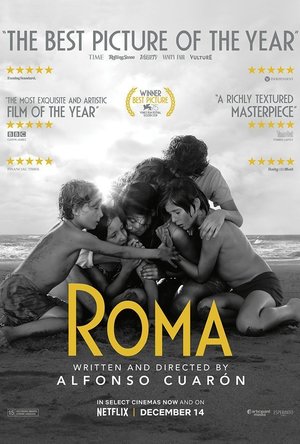
“Siempre estamos solas”
Alfonso Cuarón‘s “Roma” has been lauded with praise and award’s hype, and I must admit to have been a little bit snooty about it. A black-and-white Spanish language film with subtitles that – to be honest – looks a bit dreary: can it really be that good? Having now (finally) seen it on Netflix I can confirm that’s a big YES from my point of view. It’s a novelty of a glacially slow film that grips like a vice.
A primer on 70’s Mexican History.
This is a film about ordinary life set against tumultuous times. Set in the Colonia Roma district of Mexico City (if you were puzzled, as I was, where the title came from) it is an “Upstairs, Downstairs” tale of Cleo (Yalitza Aparicio), a maid and nanny to a middle class family in the early 70’s.
There are two intertwined stories here: Cleo’s personal story and that of the family background in which she works.
Cleo has a pleasant enough life working as partners in crime in the household with Adela (Nancy García García). Life is about getting the work done (well, more of less), keeping the four children happy – to who she is devoted – and scraping enough by to spend her downtime with her martial arts boyfriend Ramón (José Manuel Guerrero Mendoza).
Meanwhile the lady of the house Senora Sofia (Marina de Tavira) has an affluent and cosseted lifestyle amid her loving family.
But times are about to change for all of the players, as events – not just the events of the ‘Mexican Dirty War’ of 1971 going on in the background – transpire to change all their lives forever.
A masterclass in framing.
It’s criminal that I wasn’t able to get to see this in the cinema. Since every frame of this movie is a masterpiece of detail. There is just so much going on that your eyes dart this way and that, and you could probably watch it five times and see more. Even the opening titles are mesmerising, as the cobbled floor becomes a screen and an airliner lazily flies across it.
Even major action sequences, that other directors would fill the screen with (“Do you KNOW how much this scene is costing for God’s sake??”), are seen as they would typically be seen in real life – second hand, from a place of hiding. This is typified by the depiction of the Corpus Christi Massacre of June ’71, where the military, and more controversially the elite El Halconazo (The Hawks) of the Mexican army, turned on a student protest. Most of the action is seen as glimpses through the windows by the characters during a shopping trip to the second floor of a department store. How this was enacted and directed is a mystery to me, but it works just brilliantly.
A masterclass in pacing and panning.
One of Cuarón’s trademarks is the long take (think “Children of Men”) and here he (literally!) goes to town with the technique. An incredibly impressive scene has Cleo and Adela running through the streets of the City to meet their lovers at the cinema. It’s a continuous pan that again defies belief in the brilliance of its execution.
Even the mundane act of Cleo tidying up the apartment is done with a glorious slow pan around the room. Some of this panning is done to set the mood for the film (“Get settled in… this is going to be a long haul”) but others manage to evoke a sense of rising dread, an example at the beach being a brilliant case in point.
The cinematography was supposed to have been done by the great Emmanuel Lubezki, but he was unavailable so Cuarón did it himself! And it’s quite brilliant. So, that’s a lesson learned then that will reduce the budget for next time!
A personal story.
Cuarón wrote the script. Of course he did… it’s his story! He’s the same age as I am, so was nine years old for the autobiographical events featured in the film (he is the kid who gets punished for eavesdropping). Numerous aspects of the film are from his own childhood, including the fact that his younger brother kept spookily coming out with things that he’d done in his past lives! It’s a painful true story of his upbringing and of the life of Liboria Rodríguez: “Libo” to whom the film is dedicated.
Where the script is delightful is in never destroying the mood with lengthy exposition. Both of the key stories evolve slowly and only gradually do you work out what’s really going on. This is grown-up cinema at its finest.
It’s also a love letter from Cuarón to the cinema of his youth, a passion that sparked his eventual career. We see a number of trips to the local fleapit, and in one cute scene we seen a clip from the Gregory Peck space epic “Marooned”: the film that inspired Cuarón’s own masterpiece “Gravity“.
A naturalistic cast.
Casting a large proportion of the cast from unknowns feels like a great risk, but its a risk that pays off handsomely, particularly in the case of Yalitza Aparicio, who is breathtakingly naturalistic. Cuarón withheld the script from his cast, so some of the “acting” is not acting at all – specifically a gruelling and heartrending scene featuring Cleo later in the film. That’s real and raw emotion on the screen.
Marina de Tavira, although an actress with a track record, is also mightily impressive as the beleaguered and troubled wife.
Final Thoughts.
This is a masterpiece, and thoroughly deserves the “Best Picture” awards it has been getting. It’s certainly my odds on favourite, as well as being my pick, for the Oscar on Sunday. Will it be for everyone? Probably not.
There are some scenes which feel slightly ostentatious. A forest fire scene is brilliantly done (“Put out the small fires kids”), but then a guy in a monster suit pulls off his head-wear and starts singing a long and mournful song. Sorry?
There will also be many I suspect who will find the leisurely pace of the film excruciating; “JUST GET ON WITH IT” I hear them yelling at the screen. But if you give it the time and let it soak in, then you WILL be moved and you WILL remember the film long after you’ve seen it.
I remain cross however that this was released through Netflix. This is a film that deserves a full and widespread cinema release in 70mm format. It’s like taking an iPhone snap of the Mona Lisa and putting the phone on display instead.
A primer on 70’s Mexican History.
This is a film about ordinary life set against tumultuous times. Set in the Colonia Roma district of Mexico City (if you were puzzled, as I was, where the title came from) it is an “Upstairs, Downstairs” tale of Cleo (Yalitza Aparicio), a maid and nanny to a middle class family in the early 70’s.
There are two intertwined stories here: Cleo’s personal story and that of the family background in which she works.
Cleo has a pleasant enough life working as partners in crime in the household with Adela (Nancy García García). Life is about getting the work done (well, more of less), keeping the four children happy – to who she is devoted – and scraping enough by to spend her downtime with her martial arts boyfriend Ramón (José Manuel Guerrero Mendoza).
Meanwhile the lady of the house Senora Sofia (Marina de Tavira) has an affluent and cosseted lifestyle amid her loving family.
But times are about to change for all of the players, as events – not just the events of the ‘Mexican Dirty War’ of 1971 going on in the background – transpire to change all their lives forever.
A masterclass in framing.
It’s criminal that I wasn’t able to get to see this in the cinema. Since every frame of this movie is a masterpiece of detail. There is just so much going on that your eyes dart this way and that, and you could probably watch it five times and see more. Even the opening titles are mesmerising, as the cobbled floor becomes a screen and an airliner lazily flies across it.
Even major action sequences, that other directors would fill the screen with (“Do you KNOW how much this scene is costing for God’s sake??”), are seen as they would typically be seen in real life – second hand, from a place of hiding. This is typified by the depiction of the Corpus Christi Massacre of June ’71, where the military, and more controversially the elite El Halconazo (The Hawks) of the Mexican army, turned on a student protest. Most of the action is seen as glimpses through the windows by the characters during a shopping trip to the second floor of a department store. How this was enacted and directed is a mystery to me, but it works just brilliantly.
A masterclass in pacing and panning.
One of Cuarón’s trademarks is the long take (think “Children of Men”) and here he (literally!) goes to town with the technique. An incredibly impressive scene has Cleo and Adela running through the streets of the City to meet their lovers at the cinema. It’s a continuous pan that again defies belief in the brilliance of its execution.
Even the mundane act of Cleo tidying up the apartment is done with a glorious slow pan around the room. Some of this panning is done to set the mood for the film (“Get settled in… this is going to be a long haul”) but others manage to evoke a sense of rising dread, an example at the beach being a brilliant case in point.
The cinematography was supposed to have been done by the great Emmanuel Lubezki, but he was unavailable so Cuarón did it himself! And it’s quite brilliant. So, that’s a lesson learned then that will reduce the budget for next time!
A personal story.
Cuarón wrote the script. Of course he did… it’s his story! He’s the same age as I am, so was nine years old for the autobiographical events featured in the film (he is the kid who gets punished for eavesdropping). Numerous aspects of the film are from his own childhood, including the fact that his younger brother kept spookily coming out with things that he’d done in his past lives! It’s a painful true story of his upbringing and of the life of Liboria Rodríguez: “Libo” to whom the film is dedicated.
Where the script is delightful is in never destroying the mood with lengthy exposition. Both of the key stories evolve slowly and only gradually do you work out what’s really going on. This is grown-up cinema at its finest.
It’s also a love letter from Cuarón to the cinema of his youth, a passion that sparked his eventual career. We see a number of trips to the local fleapit, and in one cute scene we seen a clip from the Gregory Peck space epic “Marooned”: the film that inspired Cuarón’s own masterpiece “Gravity“.
A naturalistic cast.
Casting a large proportion of the cast from unknowns feels like a great risk, but its a risk that pays off handsomely, particularly in the case of Yalitza Aparicio, who is breathtakingly naturalistic. Cuarón withheld the script from his cast, so some of the “acting” is not acting at all – specifically a gruelling and heartrending scene featuring Cleo later in the film. That’s real and raw emotion on the screen.
Marina de Tavira, although an actress with a track record, is also mightily impressive as the beleaguered and troubled wife.
Final Thoughts.
This is a masterpiece, and thoroughly deserves the “Best Picture” awards it has been getting. It’s certainly my odds on favourite, as well as being my pick, for the Oscar on Sunday. Will it be for everyone? Probably not.
There are some scenes which feel slightly ostentatious. A forest fire scene is brilliantly done (“Put out the small fires kids”), but then a guy in a monster suit pulls off his head-wear and starts singing a long and mournful song. Sorry?
There will also be many I suspect who will find the leisurely pace of the film excruciating; “JUST GET ON WITH IT” I hear them yelling at the screen. But if you give it the time and let it soak in, then you WILL be moved and you WILL remember the film long after you’ve seen it.
I remain cross however that this was released through Netflix. This is a film that deserves a full and widespread cinema release in 70mm format. It’s like taking an iPhone snap of the Mona Lisa and putting the phone on display instead.