
Search
Search results

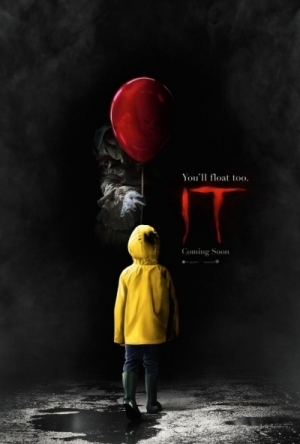


IT… didn’t really float my boat.
IT is based on the Stephen King novel, and tells the disturbing recurring events that happen within the town of Derry in Maine. Kids keep disappearing and sightings of a spooky clown, other visitations and red balloons occur. A group of bullied high school kids – one directly impacted by the disappearances – work to get to the bottom of the supernatural goings on. (Fortunately they don’t have a dog called Scooby).
I had in mind that with the disturbing and dangerous “clowning around” that happened in the summer of 2016 that this film had been shot a while ago and the release delayed until now for fear of adding ‘clown-flavoured fuel’ to the fire. But it appears that filming only completed in September of last year, so that appears not to be the case.
The film starts memorably and brutally with the “drain scene” from the trailer. And very effective it is too. “Great!” you think… this is a spookfest that has legs! Unfortunately, for me at least, it all went downhill from there. The film really doesn’t seem to know WHAT it’s trying to be. There are elements of “Stand By Me”; elements of “Alien”; elements of “The Conjuring”, all thrown into a cinematic blender and pulsed well.
The most endearing aspects of the movie are the interactions of the small-town kids, with this aspect of the film bearing the closest comparison with J.J. Abrams’ “Super 8”. This is carried by the great performances of the young actors involved, with Jaeden Lieberher (so memorable in “Midnight Special”) as Bill; Jeremy Ray Taylor (“Ant Man”) as Ben (‘the chubby one’); and Finn Wolfhard, in his big-screen premiere and sporting an absurd set of glasses, as the wise-cracking Ritchie.
Standout for my though was the then 14-year old Sophia Lillis as Beverly (the nearest equivalent to the Elle Fanning role in “Super 8”). This young lady has SUCH screen presence, reminiscent of Emma Watson in the Harry Potter films. I think she is a name to watch!
While commenting on the acting I do need to acknowledge Bill Skarsgård (“Atomic Blonde” and son of Stellan Skarsgård) who is creepily effective as Pennywise the clown.
Having a film that just centred on the pubescent interplay between the youngsters and their battles against the near-psychopathic school bully Bowers (Nicholas Hamilton, “Captain Fantastic”) would have kept me well-entertained for two hours. However, in the same way that the hugely over-inflated Sci-Fi ending of “Super 8” rather detracted from that film, so the clown-related story popping up all the time just irritated me to distraction. (“WILL YOU JUST FECK OFF AND LEAVE US TO FIND OUT WHO BEVERLY GETS OFF WITH???!!”)
While the film has a number of good jump-scares, a lot of them – especially those with excessive use of CGI – just don’t really work. There are normally no “outcomes” from the scares. It’s all a bit like a ghost train where the carriage rounds a corner, something jumps out, and then the carriage moves on round the corner again! What makes a great horror film is where the “science” of the horror is well thought through. “Alien” was an exceptional example of that, where the science wasn’t just “physics” but also “biology”. Here (and I’m not sure whether this is true to the book… this is one of Stephen King’s I haven’t read) there seems to be no rules involved at all. Things happen fairly randomly: shape-shifting and effects on physical objects happen with no rational explanation; the kids can see things adults can’t see. (Why?). In fact the “adults” – the usual mix of Stephen King dysfunctional small-town crazies – seem to have no significant part in the story at all. It’s all like some lame teenage fantasy where actions (a number of individuals in the story meet their demise) seem to carry no legal consequences whatsoever. I half expected Bill to wake up – Dallas style – at the end and realise it had all been an “awful dream”!
In particular, the denouement is highly dissatisfying. An opportunity for a (very black) twist in the plot is discarded. Pennywise the clown’s departure is both lame and unconvincing. And there are numerous loose ends that are never properly tied down (what was that “floaters descending” dialogue about?…. it was just never followed through!).
It’s not all bad though. The location shoots in Bangor, Maine and the Ontario countryside are all beautifully rendered by cinematographer Chung-hoon Chung (“Stoker”) and where the film clicks with the young cast it clicks well and enjoyably. I just wish that the overall film wasn’t just such a jumbled-up mess. Blame for that must lie with the screenwriting team and director Andy Muschietti (“Mama”). I’m going to give it a kicking in my rating, since with all the marketing build-up it was certainly a disappointment. I see though that at the time of writing that this film sports an unfathomably high imdb rating of 8.0/10 so I’ll acknowledge that somebody must have seen something more in this than I did!!
I had in mind that with the disturbing and dangerous “clowning around” that happened in the summer of 2016 that this film had been shot a while ago and the release delayed until now for fear of adding ‘clown-flavoured fuel’ to the fire. But it appears that filming only completed in September of last year, so that appears not to be the case.
The film starts memorably and brutally with the “drain scene” from the trailer. And very effective it is too. “Great!” you think… this is a spookfest that has legs! Unfortunately, for me at least, it all went downhill from there. The film really doesn’t seem to know WHAT it’s trying to be. There are elements of “Stand By Me”; elements of “Alien”; elements of “The Conjuring”, all thrown into a cinematic blender and pulsed well.
The most endearing aspects of the movie are the interactions of the small-town kids, with this aspect of the film bearing the closest comparison with J.J. Abrams’ “Super 8”. This is carried by the great performances of the young actors involved, with Jaeden Lieberher (so memorable in “Midnight Special”) as Bill; Jeremy Ray Taylor (“Ant Man”) as Ben (‘the chubby one’); and Finn Wolfhard, in his big-screen premiere and sporting an absurd set of glasses, as the wise-cracking Ritchie.
Standout for my though was the then 14-year old Sophia Lillis as Beverly (the nearest equivalent to the Elle Fanning role in “Super 8”). This young lady has SUCH screen presence, reminiscent of Emma Watson in the Harry Potter films. I think she is a name to watch!
While commenting on the acting I do need to acknowledge Bill Skarsgård (“Atomic Blonde” and son of Stellan Skarsgård) who is creepily effective as Pennywise the clown.
Having a film that just centred on the pubescent interplay between the youngsters and their battles against the near-psychopathic school bully Bowers (Nicholas Hamilton, “Captain Fantastic”) would have kept me well-entertained for two hours. However, in the same way that the hugely over-inflated Sci-Fi ending of “Super 8” rather detracted from that film, so the clown-related story popping up all the time just irritated me to distraction. (“WILL YOU JUST FECK OFF AND LEAVE US TO FIND OUT WHO BEVERLY GETS OFF WITH???!!”)
While the film has a number of good jump-scares, a lot of them – especially those with excessive use of CGI – just don’t really work. There are normally no “outcomes” from the scares. It’s all a bit like a ghost train where the carriage rounds a corner, something jumps out, and then the carriage moves on round the corner again! What makes a great horror film is where the “science” of the horror is well thought through. “Alien” was an exceptional example of that, where the science wasn’t just “physics” but also “biology”. Here (and I’m not sure whether this is true to the book… this is one of Stephen King’s I haven’t read) there seems to be no rules involved at all. Things happen fairly randomly: shape-shifting and effects on physical objects happen with no rational explanation; the kids can see things adults can’t see. (Why?). In fact the “adults” – the usual mix of Stephen King dysfunctional small-town crazies – seem to have no significant part in the story at all. It’s all like some lame teenage fantasy where actions (a number of individuals in the story meet their demise) seem to carry no legal consequences whatsoever. I half expected Bill to wake up – Dallas style – at the end and realise it had all been an “awful dream”!
In particular, the denouement is highly dissatisfying. An opportunity for a (very black) twist in the plot is discarded. Pennywise the clown’s departure is both lame and unconvincing. And there are numerous loose ends that are never properly tied down (what was that “floaters descending” dialogue about?…. it was just never followed through!).
It’s not all bad though. The location shoots in Bangor, Maine and the Ontario countryside are all beautifully rendered by cinematographer Chung-hoon Chung (“Stoker”) and where the film clicks with the young cast it clicks well and enjoyably. I just wish that the overall film wasn’t just such a jumbled-up mess. Blame for that must lie with the screenwriting team and director Andy Muschietti (“Mama”). I’m going to give it a kicking in my rating, since with all the marketing build-up it was certainly a disappointment. I see though that at the time of writing that this film sports an unfathomably high imdb rating of 8.0/10 so I’ll acknowledge that somebody must have seen something more in this than I did!!

Purple Phoenix Games (2266 KP) rated Harsh Shadows in Tabletop Games
Apr 20, 2021

I am definitely a social gamer, but if there is one positive thing to come from the year 2020, it was rediscovering my love of playing solo games. So when Wonderspell reached out about previewing their newest casual solo card game, I was hooked! Taking on the role of a secret agent trying to track down an enemy spy? Yes please! Keep reading to find out more.
Disclaimer: We were provided a copy of this game for the purposes of this preview. The pictured components might not be finalized, and could differ after a successful Kickstarter campaign. -L
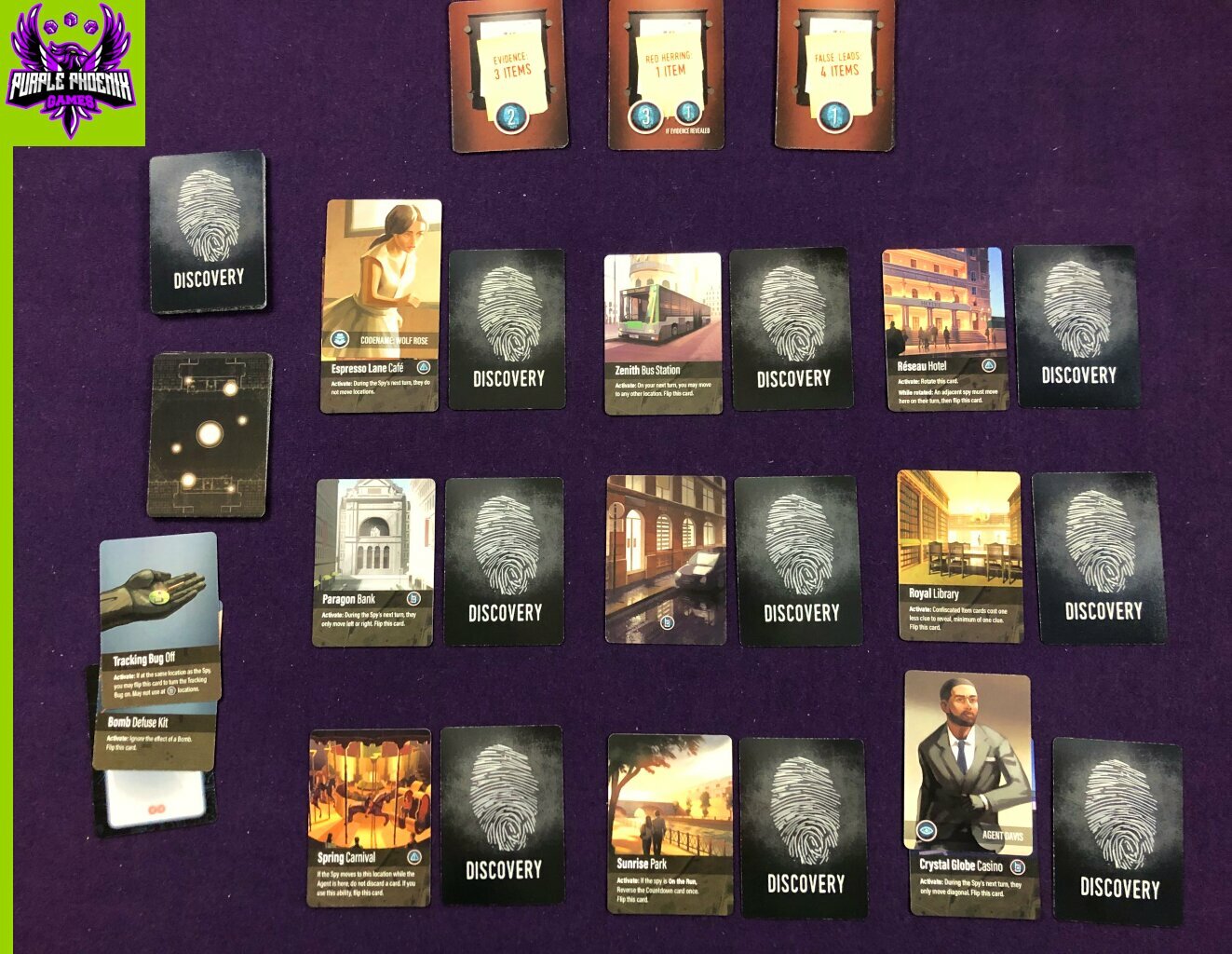
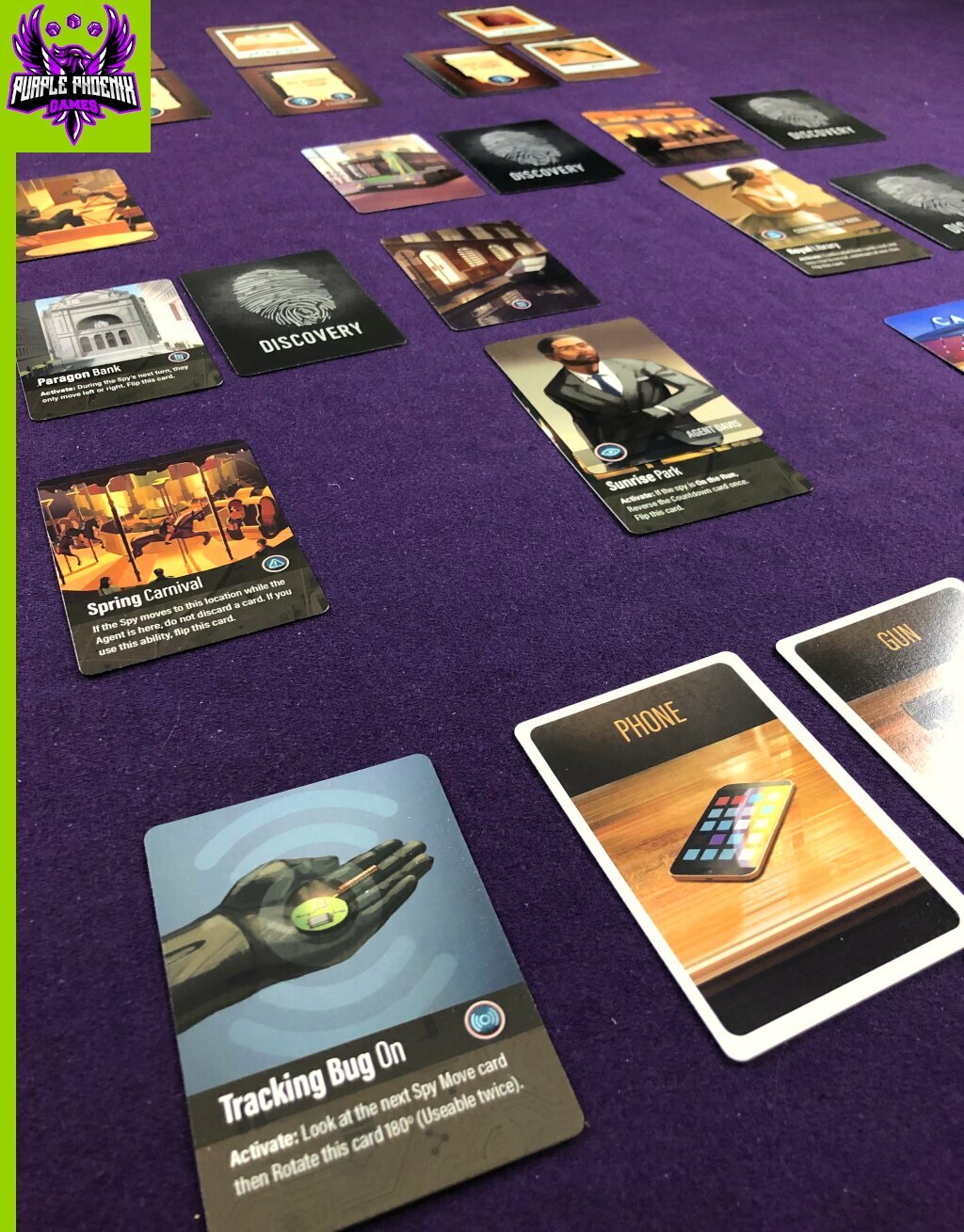
Harsh Shadows is a solo card game of hand management, grid movement, and deduction where you are an agent working to collect evidence necessary to apprehend an enemy spy. To setup for a game, randomly place the 9 Location cards in a 3×3 grid. Prepare the Discovery deck as described in the rules, place 1 face-down Discovery card to the right of each Location, and place the rest of the deck off to the side of the grid. Shuffle the Confiscated Item cards and deal the appropriate number to each of the Case File cards – 3 to Evidence, 1 to Red Herring, and 4 to False Leads. The Spy card is placed on the upper-left-most Location, and your Agent card on the lower-right-most Location. Shuffle the Spy Movement cards, and the game is ready to begin! It should look similar to the picture below.
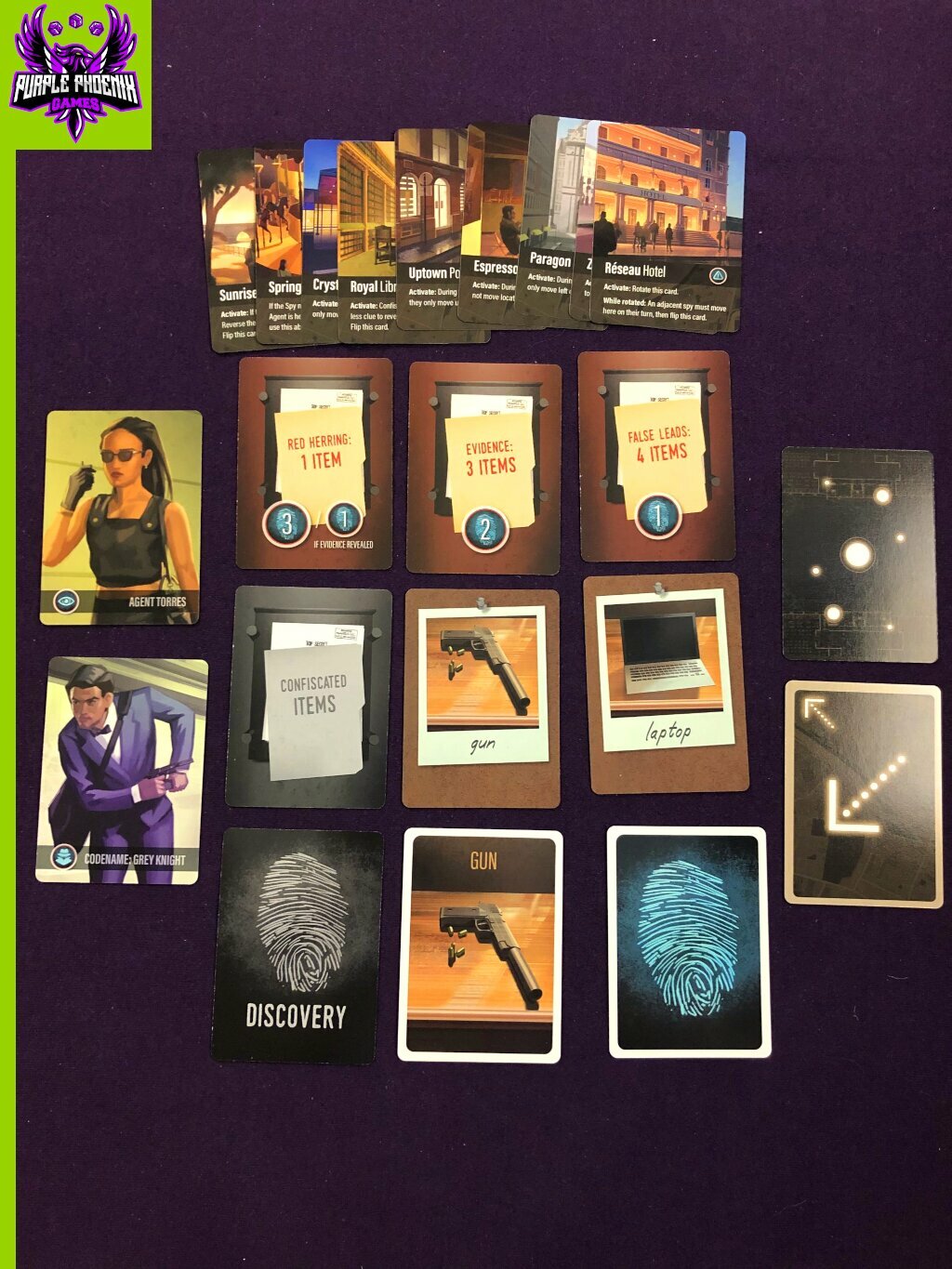
The game is played over a series of rounds in which you will be moving your Agent, performing additional actions, and then moving the Spy. The goal is to track down the Spy, with the correct evidence in hand, before the Spy is able to flee the scene. The first thing that you will do each round is to move your Agent. You may only move to a Location that is adjacent or diagonal to your current Location. Once you move to a new Location, you will draw the top Discovery card from that Location. Discovery cards will either be Items, Clues, or Bombs. Items are collected as potential Evidence, Clues are used to reveal Confiscated Items from Case Files, and Bombs force you to discard a card from your tableau. After you have moved and collected a new Discovery card, you may perform any/all of these additional actions: Use Clue Cards, Place the Tracking Bug, Track the Spy, or Use your current Location’s ability. To Use Clue cards, you will discard a number of clues in order to reveal a Confiscated Item card from a Case File. The Confiscated Items under the Evidence Case File show the 3 items you are required to have in hand to apprehend the Spy by the end of the game. The item under the Red Herring, if you have it in hand at game’s end, will cause you to automatically lose. The 4 items under the False Leads will neither help you win, nor cause you to lose – they simply offer fodder for you to discard when necessary.
Another element required to win the game is to place the Tracking Bug on the Spy. On your turn, you may place the Tracking Bug at your current Location card – if the Spy moves to the Location on a future turn, they are considered to be ‘bugged’ and the Tracking Bug is live! Twice per game, you are allowed to Track the Spy. To do so, you will look at the top card of the Spy Movement deck, and return it to the top. This just lets you see to which Location the Spy is about to move. And finally, you can use your Location’s ability. Once you have taken as many of the additional actions as you want, it is time to move the Spy. Reveal the top card of the Spy Movement deck, and move the Spy in the appropriate direction to a new Location. At the Spy’s new Location, add a Discovery card to its pile. Play continues in this manner until either you make an accusation, or the Spy escapes. In order to make an accusation, you must have Evidence cards in hand, the Spy must be bugged, and you must be at the same Location as the Spy. When you make an accusation, you will reveal any remaining cards under the Evidence and Red Herring Case Files. If you have the 3 matching Evidence cards, you win and apprehend the Spy! BUT if you have the Red Herring card, or you are missing any of the required Evidence cards, you lose. If you haven’t made an accusation in time, the Spy could escape, causing you to lose the game as well – I’ll leave those details for you to discover on your own!
In theory, Harsh Shadows seems like a neat and strategic card game, but how does it hold up in reality? Pretty well, actually! The first thing I want to talk about is how strategic it is, even with its elements of deduction. You need to collect Evidence fast in order to catch the Spy, so what’s the best plan of movement? Also, each Location has a special ability, so is there an ability you need to use now or do you want to wait a bit longer? After using a Location’s ability, it is no longer available for the rest of the game, so you have to time those uses carefully. Along those lines comes the deduction. Sure, you can try to reveal all the Confiscated Items so that you’re 100% sure that you’ve got the right Evidence. But if you don’t work fast enough, the Spy could escape. Are you willing to risk only knowing for sure what 1 piece of Evidence in order to confront the Spy before it’s too late? Or do you want to save up Clues to purchase that coveted Red Herring, to know for sure what not to keep in order to win. There’s a balance of risk with deduction, as well as a real-time element in the sense that the game has a finite amount of rounds. You’re not racing a physical clock, but once the Discovery deck runs out, the Spy is considered to be on the run, on the verge of escaping. Overall, this is a casual card game, but it has a decent amount of strategy to keep you engaged and entertained.
Let’s touch on components for a second. Obviously, this is just a card game, and this is a preview copy. As I said earlier, the final production could differ from this version, but I have to say that this preview copy is good quality. The cards are nice and thick, the artwork thematic and clean. I imagine the rules would get some final edits for slight clarifications, but for the most part the production quality is already pretty decent.
I have to say that Harsh Shadows surprised me. I’d never played a solo game with deduction elements, and it was actually quite exciting. Usually the deduction games I’ve played are based around sussing out a traitor amongst a group of people, so there is that human interaction element that can really help guide your thoughts and decisions. In Harsh Shadows, there’s nobody but yourself – you can’t look for tells in other players because the cards won’t speak to you. It feels riskier in this way because it’s more a game of odds then, instead of your ability to pick out social cues. Other people may feel differently, but I thought this was a neat twist on the deduction mechanic. If you’re looking for a strategic solo game, that plays relatively quickly and casually, I would definitely recommend checking out Harsh Shadows. It goes live on Kickstarter here in April, and I look forward to following its progress!
Disclaimer: We were provided a copy of this game for the purposes of this preview. The pictured components might not be finalized, and could differ after a successful Kickstarter campaign. -L
Harsh Shadows is a solo card game of hand management, grid movement, and deduction where you are an agent working to collect evidence necessary to apprehend an enemy spy. To setup for a game, randomly place the 9 Location cards in a 3×3 grid. Prepare the Discovery deck as described in the rules, place 1 face-down Discovery card to the right of each Location, and place the rest of the deck off to the side of the grid. Shuffle the Confiscated Item cards and deal the appropriate number to each of the Case File cards – 3 to Evidence, 1 to Red Herring, and 4 to False Leads. The Spy card is placed on the upper-left-most Location, and your Agent card on the lower-right-most Location. Shuffle the Spy Movement cards, and the game is ready to begin! It should look similar to the picture below.
The game is played over a series of rounds in which you will be moving your Agent, performing additional actions, and then moving the Spy. The goal is to track down the Spy, with the correct evidence in hand, before the Spy is able to flee the scene. The first thing that you will do each round is to move your Agent. You may only move to a Location that is adjacent or diagonal to your current Location. Once you move to a new Location, you will draw the top Discovery card from that Location. Discovery cards will either be Items, Clues, or Bombs. Items are collected as potential Evidence, Clues are used to reveal Confiscated Items from Case Files, and Bombs force you to discard a card from your tableau. After you have moved and collected a new Discovery card, you may perform any/all of these additional actions: Use Clue Cards, Place the Tracking Bug, Track the Spy, or Use your current Location’s ability. To Use Clue cards, you will discard a number of clues in order to reveal a Confiscated Item card from a Case File. The Confiscated Items under the Evidence Case File show the 3 items you are required to have in hand to apprehend the Spy by the end of the game. The item under the Red Herring, if you have it in hand at game’s end, will cause you to automatically lose. The 4 items under the False Leads will neither help you win, nor cause you to lose – they simply offer fodder for you to discard when necessary.
Another element required to win the game is to place the Tracking Bug on the Spy. On your turn, you may place the Tracking Bug at your current Location card – if the Spy moves to the Location on a future turn, they are considered to be ‘bugged’ and the Tracking Bug is live! Twice per game, you are allowed to Track the Spy. To do so, you will look at the top card of the Spy Movement deck, and return it to the top. This just lets you see to which Location the Spy is about to move. And finally, you can use your Location’s ability. Once you have taken as many of the additional actions as you want, it is time to move the Spy. Reveal the top card of the Spy Movement deck, and move the Spy in the appropriate direction to a new Location. At the Spy’s new Location, add a Discovery card to its pile. Play continues in this manner until either you make an accusation, or the Spy escapes. In order to make an accusation, you must have Evidence cards in hand, the Spy must be bugged, and you must be at the same Location as the Spy. When you make an accusation, you will reveal any remaining cards under the Evidence and Red Herring Case Files. If you have the 3 matching Evidence cards, you win and apprehend the Spy! BUT if you have the Red Herring card, or you are missing any of the required Evidence cards, you lose. If you haven’t made an accusation in time, the Spy could escape, causing you to lose the game as well – I’ll leave those details for you to discover on your own!
In theory, Harsh Shadows seems like a neat and strategic card game, but how does it hold up in reality? Pretty well, actually! The first thing I want to talk about is how strategic it is, even with its elements of deduction. You need to collect Evidence fast in order to catch the Spy, so what’s the best plan of movement? Also, each Location has a special ability, so is there an ability you need to use now or do you want to wait a bit longer? After using a Location’s ability, it is no longer available for the rest of the game, so you have to time those uses carefully. Along those lines comes the deduction. Sure, you can try to reveal all the Confiscated Items so that you’re 100% sure that you’ve got the right Evidence. But if you don’t work fast enough, the Spy could escape. Are you willing to risk only knowing for sure what 1 piece of Evidence in order to confront the Spy before it’s too late? Or do you want to save up Clues to purchase that coveted Red Herring, to know for sure what not to keep in order to win. There’s a balance of risk with deduction, as well as a real-time element in the sense that the game has a finite amount of rounds. You’re not racing a physical clock, but once the Discovery deck runs out, the Spy is considered to be on the run, on the verge of escaping. Overall, this is a casual card game, but it has a decent amount of strategy to keep you engaged and entertained.
Let’s touch on components for a second. Obviously, this is just a card game, and this is a preview copy. As I said earlier, the final production could differ from this version, but I have to say that this preview copy is good quality. The cards are nice and thick, the artwork thematic and clean. I imagine the rules would get some final edits for slight clarifications, but for the most part the production quality is already pretty decent.
I have to say that Harsh Shadows surprised me. I’d never played a solo game with deduction elements, and it was actually quite exciting. Usually the deduction games I’ve played are based around sussing out a traitor amongst a group of people, so there is that human interaction element that can really help guide your thoughts and decisions. In Harsh Shadows, there’s nobody but yourself – you can’t look for tells in other players because the cards won’t speak to you. It feels riskier in this way because it’s more a game of odds then, instead of your ability to pick out social cues. Other people may feel differently, but I thought this was a neat twist on the deduction mechanic. If you’re looking for a strategic solo game, that plays relatively quickly and casually, I would definitely recommend checking out Harsh Shadows. It goes live on Kickstarter here in April, and I look forward to following its progress!
Purple Phoenix Games (2266 KP) rated Custom Heroes in Tabletop Games
Feb 7, 2022
You know that feeling when you play a game that FEELS familiar, but has really improved on certain aspects? Take, for example, the famed “Yahtzee mechanic” that has been extended and improved upon by so many games. Or the “I Cut, You Choose mechanic” that has shown up in several titles with slight variations to improve it? Well such was my feeling when cracking open Custom Heroes. I thought to myself, “Man, this feels natural in my hands, but it’s better.” I know I left myself open for tons of jokes here, but this is a PG(ish) forum, so keep it classy, everyone.
Custom Heroes is a fantasy/sci-fi-themed, customization, ladder-climbing, trick-taking card game for two to six players. In it players are using their hand of cards to win tricks (a la Tichu). The twist is that each card is able to be upgraded by using various Advancements that are added directly into the same sleeve as the base card. The winner of the game is they who amass 10 or more points and win a subsequent hand.
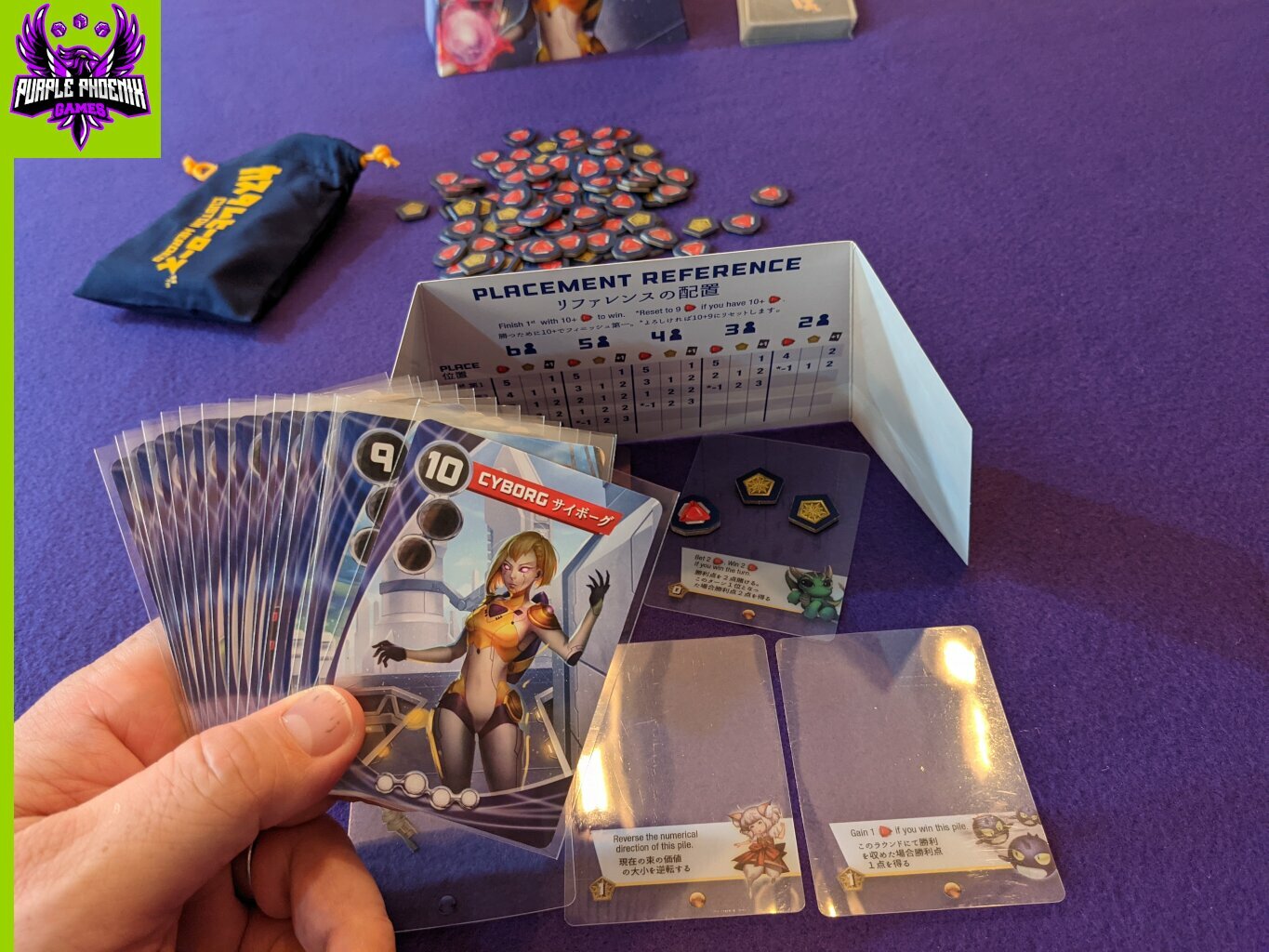
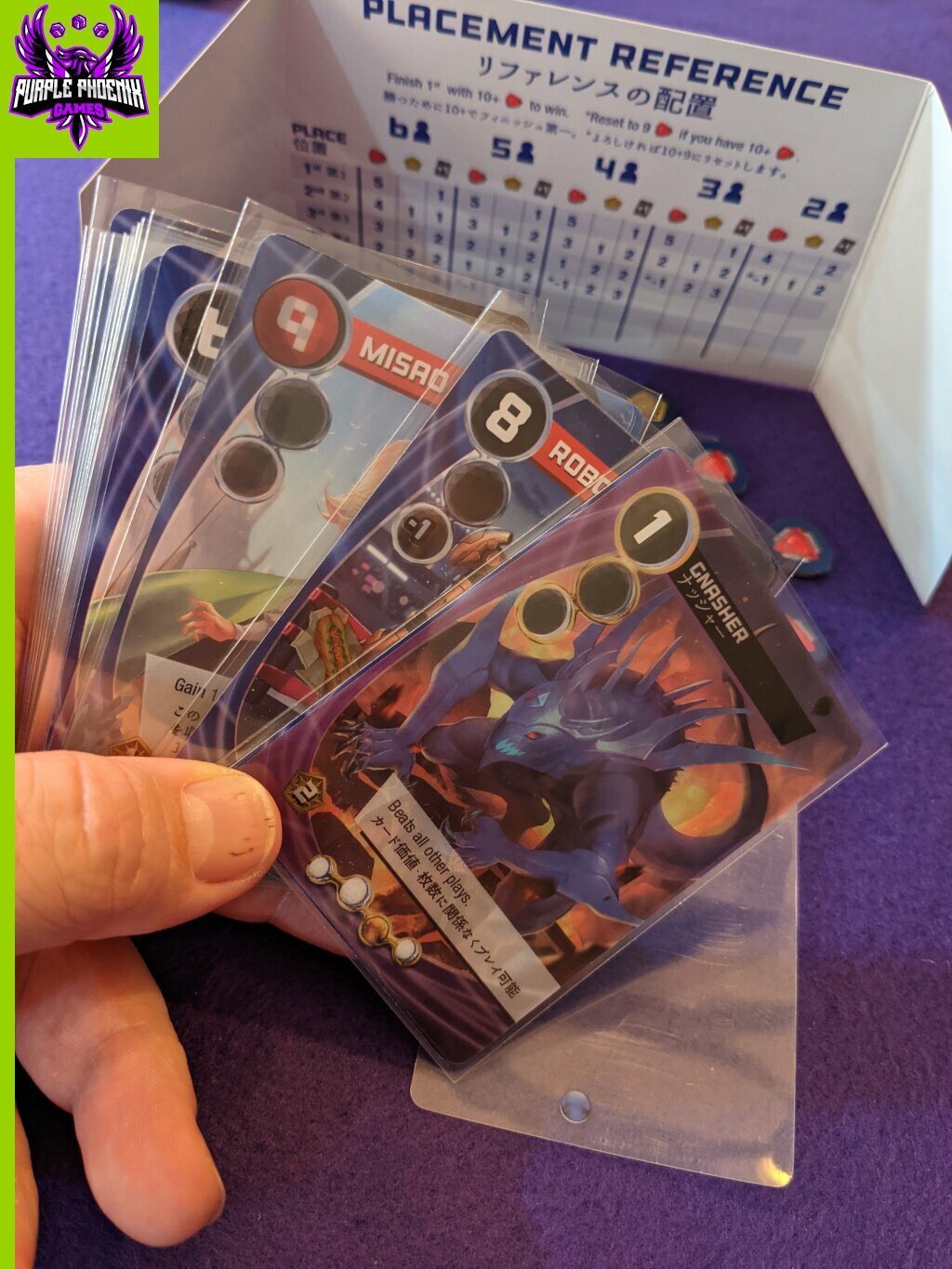
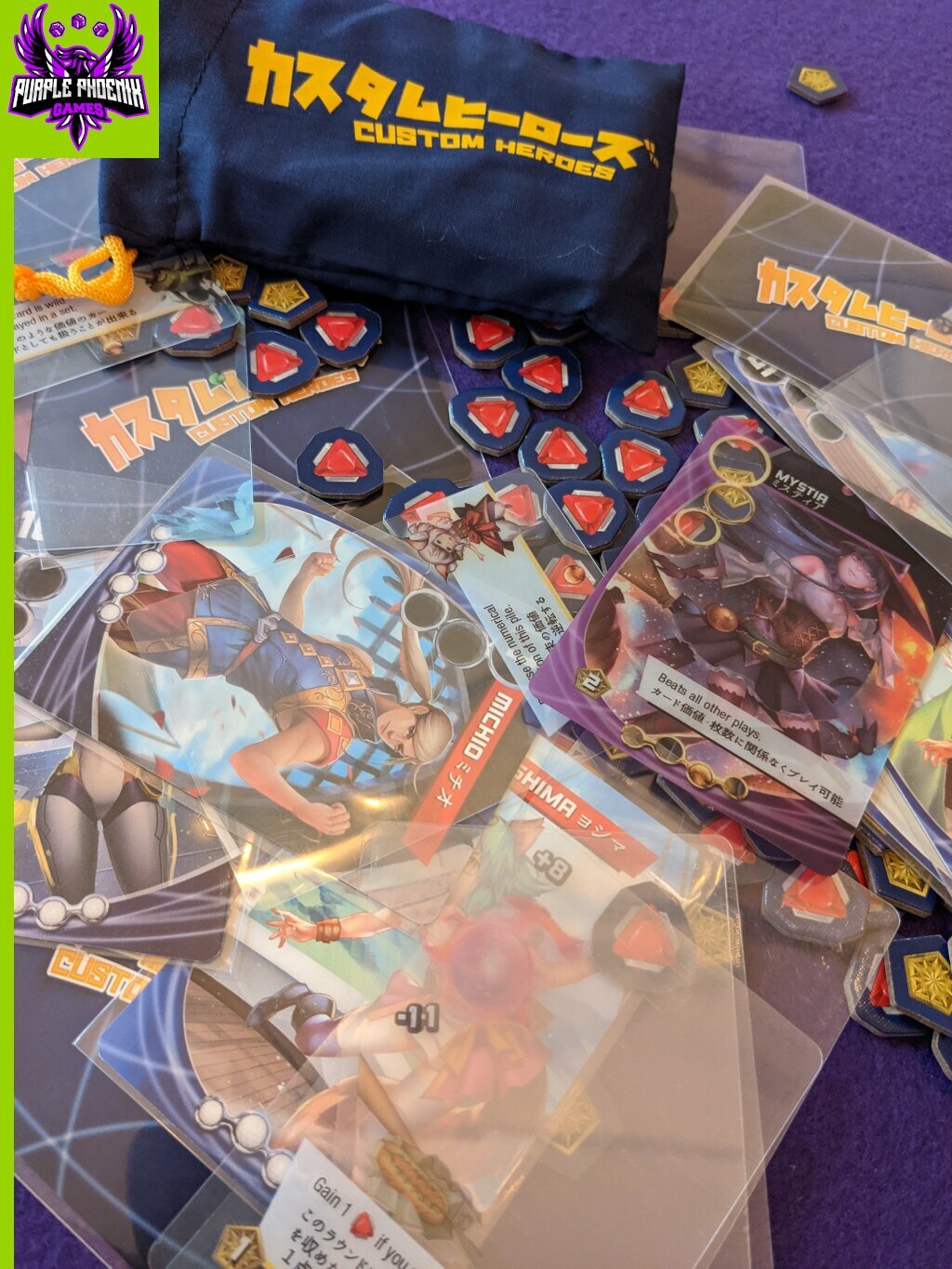
Before the first game after unboxing, all Character Cards will need to be sleeved. These Character Cards are numbered from 1-10 and come in six sets (one set of 10 cards for each player, at max player count). To setup the game, each player chooses a Player Screen to hide their resources and provide the scoring table. Shuffle the Character cards and deal each player a hand of 10 cards. For this review, I will be using the two-player rules. Players also begin with 1VP Token and 2 Power Tokens, along with an Ascended Form Advancement Card and Kodora Advancement Card. In a two-player game, players begin with three total Advancement Cards, as shown in the photo below. The rest of the VP Tokens and Power Tokens are placed (or thrown, in my case) on the table, and the remainder of the Advancement Cards are shuffled and placed in the bag to be drawn randomly throughout the game. The battle for tricks may now begin!
As with all (most?) trick-taking games, Custom Heroes is played over a series of rounds. However, Custom Heroes is played across three phases: Upkeep, Main, Scoring. During the Upkeep phase, the deck of Character Cards is shuffled and 10 cards are dealt to each player. On each player’s turn during the Main phase, they will decide if they would like to upgrade any card by sleeving Advancement Cards along with the Character Cards. These Advancement Cards are clear plastic and will alter the value of the card, provide special abilities, or provide modifiers to the card’s value. Sleeving new Advancements may be done at any time during the turn, before playing it, but the caveat is that ALL cards are shuffled and dealt to players after every round, so the chances of receiving that same card in future hands diminishes with each additional player at the table!
Once Advancements have been applied, or whilst applying, the players will determine the lead play. A lead could be a single card or several matching cards in a set. The following player will need to play a card, or cards, of the same number, but of higher value. For example, if a single 7 was led, only a single 8, 9, or 10 will beat it. However, if a pair of 5s was led, a pair of 6-10 will beat that lead. Players may pass if they cannot, or choose not to, beat the current trick, and can engage in play on a future trick. Once a player has run out of cards for the hand, or all players have passed. The first player to run out of cards, or the last player to play a card, wins the hand and receives the benefits listed on the scoring table shown below. Again, when a player earns 10 VP and wins a hand, they win!
A few notes about Advancement Cards. The Ascended Form card given to all players at setup will allow the player to win the trick for that round once played. It is essentially a wild insta-win card. That is, unless another player plays an Ascended Form on top of it and wins with the most recent Ascended Form. The Kodora card, however, can be played to the player’s tableau instead of as a card in a trick. When played this way, the player “bets” two VP Tokens that they will win the hand. If they do, they gain an additional two VP Tokens, but lose their bet if they do not finish in 1st Place. All other Advancement Cards may be added to the Character Card sleeve as long as the associated gem icon at the bottom is not already present in the sleeve. As there are four gem slots on Character Cards, each Character may be upgraded four total times.
Components. This one comes with a number of components of different types. The tokens are all small, but not too small, the bag is cool, but obviously the main attractions are the clear plastic cards and sleeves common to the Card Crafting System that AEG produced. I think I first saw this idea of layering plastic cards on top of one another in the Gloom series, though it may have existed even before that. I adore this idea and really fell in love with it when I was big into Mystic Vale, also from John D. Clair and AEG. So components for me get a big ol’ seal of approval. I love ’em.
Similarly, I think the gameplay gets a big seal of approval from me. Like I said, I was big into Mystic Vale for a while, but I think that Cusom Heroes, to me, trumps it in many ways. Though both boxes mention games approximately taking around 45 minutes, I found Mystic Vale to be much longer, mostly due to having to explain and re-explain rules and oddities to players at the table. It feels like Custom Heroes has cut down the complexity of gameplay, especially for newer gamers. I can bring out Custom Heroes and have it taught and played in under an hour – a feat I still haven’t mastered with Mystic Vale.
I think that I also prefer the trick-taking style of Custom Heroes a bit more. My family really enjoys playing Euchre at family reunions and other events, and while Custom Heroes isn’t a Euchre clone at all, the feel is very similar. There is still a led card, and cards that are more valuable to be played atop them in order to win tricks. While there isn’t necessarily any suits in Custom Heroes, the ability to trump an entire hand with an Ascended Form Advancement or other Advancements adds a layer (see what I did there) of strategy and tactics that is just so satisfying. I am a big fan of games that allow players to upgrade their starting resources, or level up their characters, and this one fits right inside a little 60 minute pocket and is relatively easy to teach and play.
All in all, I am so glad I found this one at my FLGS (well, not super local), and there was a big sale going on. I picked it up solely for the Card Crafting System logo and it was a big hit for me. This will completely replace Mystic Vale for me in my collection, and I couldn’t be happier with that. If you are looking for something quick, easy, but full of choices and modifications, this is certainly the game for you. It’s the game for me, and that’s why Purple Phoenix Games gives Custom Heroes a mostly-upgraded 5 / 6. Could this reach into my Top 10 someday, or earn a Golden Feather Award? It is entirely possible. We shall see with more and more plays. I am excited to give it many more plays and find out! Are you in?
Custom Heroes is a fantasy/sci-fi-themed, customization, ladder-climbing, trick-taking card game for two to six players. In it players are using their hand of cards to win tricks (a la Tichu). The twist is that each card is able to be upgraded by using various Advancements that are added directly into the same sleeve as the base card. The winner of the game is they who amass 10 or more points and win a subsequent hand.
Before the first game after unboxing, all Character Cards will need to be sleeved. These Character Cards are numbered from 1-10 and come in six sets (one set of 10 cards for each player, at max player count). To setup the game, each player chooses a Player Screen to hide their resources and provide the scoring table. Shuffle the Character cards and deal each player a hand of 10 cards. For this review, I will be using the two-player rules. Players also begin with 1VP Token and 2 Power Tokens, along with an Ascended Form Advancement Card and Kodora Advancement Card. In a two-player game, players begin with three total Advancement Cards, as shown in the photo below. The rest of the VP Tokens and Power Tokens are placed (or thrown, in my case) on the table, and the remainder of the Advancement Cards are shuffled and placed in the bag to be drawn randomly throughout the game. The battle for tricks may now begin!
As with all (most?) trick-taking games, Custom Heroes is played over a series of rounds. However, Custom Heroes is played across three phases: Upkeep, Main, Scoring. During the Upkeep phase, the deck of Character Cards is shuffled and 10 cards are dealt to each player. On each player’s turn during the Main phase, they will decide if they would like to upgrade any card by sleeving Advancement Cards along with the Character Cards. These Advancement Cards are clear plastic and will alter the value of the card, provide special abilities, or provide modifiers to the card’s value. Sleeving new Advancements may be done at any time during the turn, before playing it, but the caveat is that ALL cards are shuffled and dealt to players after every round, so the chances of receiving that same card in future hands diminishes with each additional player at the table!
Once Advancements have been applied, or whilst applying, the players will determine the lead play. A lead could be a single card or several matching cards in a set. The following player will need to play a card, or cards, of the same number, but of higher value. For example, if a single 7 was led, only a single 8, 9, or 10 will beat it. However, if a pair of 5s was led, a pair of 6-10 will beat that lead. Players may pass if they cannot, or choose not to, beat the current trick, and can engage in play on a future trick. Once a player has run out of cards for the hand, or all players have passed. The first player to run out of cards, or the last player to play a card, wins the hand and receives the benefits listed on the scoring table shown below. Again, when a player earns 10 VP and wins a hand, they win!
A few notes about Advancement Cards. The Ascended Form card given to all players at setup will allow the player to win the trick for that round once played. It is essentially a wild insta-win card. That is, unless another player plays an Ascended Form on top of it and wins with the most recent Ascended Form. The Kodora card, however, can be played to the player’s tableau instead of as a card in a trick. When played this way, the player “bets” two VP Tokens that they will win the hand. If they do, they gain an additional two VP Tokens, but lose their bet if they do not finish in 1st Place. All other Advancement Cards may be added to the Character Card sleeve as long as the associated gem icon at the bottom is not already present in the sleeve. As there are four gem slots on Character Cards, each Character may be upgraded four total times.
Components. This one comes with a number of components of different types. The tokens are all small, but not too small, the bag is cool, but obviously the main attractions are the clear plastic cards and sleeves common to the Card Crafting System that AEG produced. I think I first saw this idea of layering plastic cards on top of one another in the Gloom series, though it may have existed even before that. I adore this idea and really fell in love with it when I was big into Mystic Vale, also from John D. Clair and AEG. So components for me get a big ol’ seal of approval. I love ’em.
Similarly, I think the gameplay gets a big seal of approval from me. Like I said, I was big into Mystic Vale for a while, but I think that Cusom Heroes, to me, trumps it in many ways. Though both boxes mention games approximately taking around 45 minutes, I found Mystic Vale to be much longer, mostly due to having to explain and re-explain rules and oddities to players at the table. It feels like Custom Heroes has cut down the complexity of gameplay, especially for newer gamers. I can bring out Custom Heroes and have it taught and played in under an hour – a feat I still haven’t mastered with Mystic Vale.
I think that I also prefer the trick-taking style of Custom Heroes a bit more. My family really enjoys playing Euchre at family reunions and other events, and while Custom Heroes isn’t a Euchre clone at all, the feel is very similar. There is still a led card, and cards that are more valuable to be played atop them in order to win tricks. While there isn’t necessarily any suits in Custom Heroes, the ability to trump an entire hand with an Ascended Form Advancement or other Advancements adds a layer (see what I did there) of strategy and tactics that is just so satisfying. I am a big fan of games that allow players to upgrade their starting resources, or level up their characters, and this one fits right inside a little 60 minute pocket and is relatively easy to teach and play.
All in all, I am so glad I found this one at my FLGS (well, not super local), and there was a big sale going on. I picked it up solely for the Card Crafting System logo and it was a big hit for me. This will completely replace Mystic Vale for me in my collection, and I couldn’t be happier with that. If you are looking for something quick, easy, but full of choices and modifications, this is certainly the game for you. It’s the game for me, and that’s why Purple Phoenix Games gives Custom Heroes a mostly-upgraded 5 / 6. Could this reach into my Top 10 someday, or earn a Golden Feather Award? It is entirely possible. We shall see with more and more plays. I am excited to give it many more plays and find out! Are you in?


Luke (12 KP) rated Bloodborne in Video Games
Oct 2, 2017

Strategic, challenging, and rewarding combat (6 more)
Excellent orchestrated soundtrack
Great aesthetic and visual design
Cool boss designs
Old Hunters expansion adds extra challenge
30-40 hour campaign with loads of content
Lovecraftian horror at its finest
Bloodborne is an action RPG developed by From Software and directed by Hidetaka Miyazaki, creator of the Dark Souls series. Bloodborne takes elements from the Dark Souls games and mixes in elements of Gothic and Lovecraftian horror to make one truly unique experience exclusively for the Playstation 4.
You play as a Hunter and you have come to the city of Yharnam on the night of the Hunt where the lines between man and beast are blurred. Initially, your goal is quite simple: just go out and kill some beasts of all manner. Everything from werewolves to madmen to even other NPC Hunters. But as you progress through the game, you begin to unravel a conspiracy involving ancient gods from the cosmos coming down to incite this madness upon the townsfolk. Souls games aren't really known for their stories. Most of the game's backstory can often be found in item descriptions. However, Bloodborne differentiates itself by having one of the most fleshed out and intriguing plots of the entire Soulsborne series.
The presentation here is breathtaking. It evokes the style of olden Gothic horror tales from days long past. Towering spires line the horizon clearly inspired by Victorian and Gothic style architecture of Romania and this is reflected in the games level design. Blood spills out in a vibrant crimson color. Most of the game is completely silent save for the excellent sound design. The soundtrack only kicks in during boss fights and other key moments in the game making it even more special.
If you are familiar with any of the Dark Souls games, then you pretty much know what to expect from Bloodborne's combat. Bloodborne emphasizes speed and aggression with its combat system, but it is still quite strategic and very challenging. Don't go in thinking you can just rush through this in a weekend. This game takes patience and effort from the player to be rewarded. The weapon variety is significantly smaller than that of the Dark Souls games, but that's not necessarily a bad thing. Each weapon feels unique, and each one will cater to a specific play style. And since you can transform almost all the weapons in the game, they almost feel like two weapons in one. For example, a shortsword can be transformed into a greatsword and so on. Instead of giving you a shield, Bloodborne instead gives you a wide variety of firearms, from pistols and shotguns, to a flamesprayer and a cannon. You can use these guns on enemies to riposte and perform a visceral attack for massive damage, even on some of the bosses. Armor sets are all really cool, reflecting the games Gothic design. The good thing is that you don't need to worry about upgrading armor sets like in previous Souls games. And the boss designs here are great, some of the hardest and most challenging fights in any game. You have to learn and figure out the timings of their attacks in order to know when best to strike. And if you ever feel like you're getting stuck, you can always bring in a friend with the game's co-op system. The side characters are also great, some of them giving you optional quests that you can carry out if you choose to do so.
There are optional chalice dungeons that you can complete should you choose to do so. The good thing is that they aren't required to finish the game. The bad thing is that these aren't designed as well as the main game. These dungeons are randomly generated and it certainly feels that way as rooms are often copy pasted together to the point where you feel like you're going in circles. Enemy designs are also lazy as hell here, some of them being reused as bosses. It feels like these chalice dungeons were thrown in at the last minute to offer some kind of replay value when they clearly weren't needed in the first place. I'm baffled by their inclusion as some trophies are linked to the completion of these optional missions. But since these are completely optional, they don't take away from the overall score.
There are also a few more minor gripes that I have with Bloodborne. The camera can often get in the way of the surrounding architecture at times. The framerate dips during some instances, even after several patches. Fortunately, these things don't happen all that often. And why can't I warp between lanterns? This doesn't make much sense as if you want to get to a new area, you have to warp to the hub zone and then warp to the area you want to go to. I feel like this would save a lot of load times if you are going back and forth for farming runs. Oh well.
Bloodborne is never impossibly hard. It does have a high learning curve for new players, but if you keep at it and if you are patient enough, you will discover just how rewarding this experience can be. This was my first foray into the Souls series and I am so looking forward to going back in to Bloodborne to try out new builds, new play styles, new weapons, and even greater challenge in New Game Plus mode. Bloodborne is now one of my all time favorite games ever made.
You play as a Hunter and you have come to the city of Yharnam on the night of the Hunt where the lines between man and beast are blurred. Initially, your goal is quite simple: just go out and kill some beasts of all manner. Everything from werewolves to madmen to even other NPC Hunters. But as you progress through the game, you begin to unravel a conspiracy involving ancient gods from the cosmos coming down to incite this madness upon the townsfolk. Souls games aren't really known for their stories. Most of the game's backstory can often be found in item descriptions. However, Bloodborne differentiates itself by having one of the most fleshed out and intriguing plots of the entire Soulsborne series.
The presentation here is breathtaking. It evokes the style of olden Gothic horror tales from days long past. Towering spires line the horizon clearly inspired by Victorian and Gothic style architecture of Romania and this is reflected in the games level design. Blood spills out in a vibrant crimson color. Most of the game is completely silent save for the excellent sound design. The soundtrack only kicks in during boss fights and other key moments in the game making it even more special.
If you are familiar with any of the Dark Souls games, then you pretty much know what to expect from Bloodborne's combat. Bloodborne emphasizes speed and aggression with its combat system, but it is still quite strategic and very challenging. Don't go in thinking you can just rush through this in a weekend. This game takes patience and effort from the player to be rewarded. The weapon variety is significantly smaller than that of the Dark Souls games, but that's not necessarily a bad thing. Each weapon feels unique, and each one will cater to a specific play style. And since you can transform almost all the weapons in the game, they almost feel like two weapons in one. For example, a shortsword can be transformed into a greatsword and so on. Instead of giving you a shield, Bloodborne instead gives you a wide variety of firearms, from pistols and shotguns, to a flamesprayer and a cannon. You can use these guns on enemies to riposte and perform a visceral attack for massive damage, even on some of the bosses. Armor sets are all really cool, reflecting the games Gothic design. The good thing is that you don't need to worry about upgrading armor sets like in previous Souls games. And the boss designs here are great, some of the hardest and most challenging fights in any game. You have to learn and figure out the timings of their attacks in order to know when best to strike. And if you ever feel like you're getting stuck, you can always bring in a friend with the game's co-op system. The side characters are also great, some of them giving you optional quests that you can carry out if you choose to do so.
There are optional chalice dungeons that you can complete should you choose to do so. The good thing is that they aren't required to finish the game. The bad thing is that these aren't designed as well as the main game. These dungeons are randomly generated and it certainly feels that way as rooms are often copy pasted together to the point where you feel like you're going in circles. Enemy designs are also lazy as hell here, some of them being reused as bosses. It feels like these chalice dungeons were thrown in at the last minute to offer some kind of replay value when they clearly weren't needed in the first place. I'm baffled by their inclusion as some trophies are linked to the completion of these optional missions. But since these are completely optional, they don't take away from the overall score.
There are also a few more minor gripes that I have with Bloodborne. The camera can often get in the way of the surrounding architecture at times. The framerate dips during some instances, even after several patches. Fortunately, these things don't happen all that often. And why can't I warp between lanterns? This doesn't make much sense as if you want to get to a new area, you have to warp to the hub zone and then warp to the area you want to go to. I feel like this would save a lot of load times if you are going back and forth for farming runs. Oh well.
Bloodborne is never impossibly hard. It does have a high learning curve for new players, but if you keep at it and if you are patient enough, you will discover just how rewarding this experience can be. This was my first foray into the Souls series and I am so looking forward to going back in to Bloodborne to try out new builds, new play styles, new weapons, and even greater challenge in New Game Plus mode. Bloodborne is now one of my all time favorite games ever made.

Naomi Forrest (42 KP) rated The Toy Makers in Books
Jan 2, 2019

The first thing on the very first page that I loved was the narrator setting the scene and talking directly to you:
‘See the woman with the cage of pipe-cleaner birds, the vagrant soldier marvelling at the stuffed dogs lounging in their baskets? Keep a careful eye on them; you will see them again’.
I knew just from this descriptive ‘setting the scene’ chapter this book was going to be amazing, there was so much magic encapsulated in those first five pages. Papa Jack’s Emporium is the most wonderful shop you could imagine, a labyrinth of joy, surprises around every aisle and so much more. If you have ever seen the toy shop on Home Alone 2 that looked so amazing as a child, it has nothing on this! I was pretty sure for at least half of the book that Papa Jack was indeed Father Christmas.
After the initial chapter, the reader is introduced to Cathy, a fifteen year old who, shamefully (the year is 1906), is unmarried and pregnant. Plans are made for her to go to a special home where she will give birth and her child will be adopted. However, Cathy spots an advert looking for staff for the Emporium and runs away and so, the magic begins! The reader is catapulted into the world of the emporium and soon meets Papa Jack’s sons, Emil and Kaspar, who assist their father in the running of the store and the making of the toys, which are so much more than toys as we know them. People flock from far and wide to the emporium for it’s sublime creations and the memories and pleasures that they evoke.
The first half of the novel was like a fairytale, building beautifully to a gorgeous climax, full of wonder, friendship and subtle romance (perfectly done, so as not to detract from more pressing themes). In my head, toy soldiers and paper trees were everywhere and the wendy house is the stuff that dreams are made of. I loved observing (as I stood in the corner of the emporium, I’m sure, so convincing is Dinsdale) the relationships the built between Cathy and Emil and Cathy and Kaspar, though at times I felt sorry for Emil, never quite catching up to Kaspar as he wishes. If only the story had ended at page 187. And yet, that would not have been satisfying, not enough, so really, I’m glad it didn’t.
The second part of the novel, that is where Dinsdale really takes us on a journey. A couple of darker themes are touched upon in part one, where we learn of Jekab’s history (Papa Jack) but it ramps up in the second part, which ties in with World War I and beyond. You would think going from such wonderment and happiness to a bleak world of misery and reality would make you want to stop reading but I could not put this book down. I read 3/4 of it in one go! It is in the second part that Dinsdale brings in themes of shell shock, betrayal, sibling jealousy, bitterness and true, deep, familial love. Without spoilers, some characters truly lose everything and I cried during and after the book as it moved me so greatly (I mean, I am a crier anyway but not usually with books!). The entire novel is shaped around the ‘war’ between the brothers with some shocking twists along the way. Though part two draws in more realities, more brutalities and some heartbreaking moments, magic still punctuates and carries the reader through to the end. The ending is bitter sweet and my emotions were cloudy here, anger, joy, sadness and warmth all merging into a big teary mess.
I won’t say too much about specifics because some kinds of magic need to be discovered for yourself. The most beautiful sentiment in this novel though is that toys can’t save a life but they can save a soul, because toys transport many of us back to times of happiness, of wonder and of innocence, when things were simpler and problems remedied more easily. Times change but the joy of toys doesn’t. I can recall going through toy exhibits at both the castle museum in York and a toy museum in Edinburgh and it was so thrilling not only to see toys from my childhood but toys from before. Toys have the power to make magic we never knew existed, even if it is only in our head. The Toy Makers has yielded many comparisons with Erin Morgensten’s The Night Circus but for me, this novel surpassed anything I have read before in a similar vein. I have truly been blown away into a world that I honestly believe I will carry with me forever more. If, like me, you are a Harry Potter fan, you will know what I mean when I say that this book matches up to that first trip to Diagon Alley, to Hogwarts and to Honeydukes or that journey up Enid Blyton’s faraway tree as a child but it is even more exciting as an adult. It isn’t only the description that is first rate though; Dinsdale’s narrative style and use of language pulls you in and flows so smoothly, you are carried away from the first page whether you are prepared for it or not. Some reviews have said it is too fantastical but I cannot rate this book highly enough. It isn’t always easy reading – prepare to have your heart broken in several places- but go in looking for magic. You won’t be disappointed!
‘See the woman with the cage of pipe-cleaner birds, the vagrant soldier marvelling at the stuffed dogs lounging in their baskets? Keep a careful eye on them; you will see them again’.
I knew just from this descriptive ‘setting the scene’ chapter this book was going to be amazing, there was so much magic encapsulated in those first five pages. Papa Jack’s Emporium is the most wonderful shop you could imagine, a labyrinth of joy, surprises around every aisle and so much more. If you have ever seen the toy shop on Home Alone 2 that looked so amazing as a child, it has nothing on this! I was pretty sure for at least half of the book that Papa Jack was indeed Father Christmas.
After the initial chapter, the reader is introduced to Cathy, a fifteen year old who, shamefully (the year is 1906), is unmarried and pregnant. Plans are made for her to go to a special home where she will give birth and her child will be adopted. However, Cathy spots an advert looking for staff for the Emporium and runs away and so, the magic begins! The reader is catapulted into the world of the emporium and soon meets Papa Jack’s sons, Emil and Kaspar, who assist their father in the running of the store and the making of the toys, which are so much more than toys as we know them. People flock from far and wide to the emporium for it’s sublime creations and the memories and pleasures that they evoke.
The first half of the novel was like a fairytale, building beautifully to a gorgeous climax, full of wonder, friendship and subtle romance (perfectly done, so as not to detract from more pressing themes). In my head, toy soldiers and paper trees were everywhere and the wendy house is the stuff that dreams are made of. I loved observing (as I stood in the corner of the emporium, I’m sure, so convincing is Dinsdale) the relationships the built between Cathy and Emil and Cathy and Kaspar, though at times I felt sorry for Emil, never quite catching up to Kaspar as he wishes. If only the story had ended at page 187. And yet, that would not have been satisfying, not enough, so really, I’m glad it didn’t.
The second part of the novel, that is where Dinsdale really takes us on a journey. A couple of darker themes are touched upon in part one, where we learn of Jekab’s history (Papa Jack) but it ramps up in the second part, which ties in with World War I and beyond. You would think going from such wonderment and happiness to a bleak world of misery and reality would make you want to stop reading but I could not put this book down. I read 3/4 of it in one go! It is in the second part that Dinsdale brings in themes of shell shock, betrayal, sibling jealousy, bitterness and true, deep, familial love. Without spoilers, some characters truly lose everything and I cried during and after the book as it moved me so greatly (I mean, I am a crier anyway but not usually with books!). The entire novel is shaped around the ‘war’ between the brothers with some shocking twists along the way. Though part two draws in more realities, more brutalities and some heartbreaking moments, magic still punctuates and carries the reader through to the end. The ending is bitter sweet and my emotions were cloudy here, anger, joy, sadness and warmth all merging into a big teary mess.
I won’t say too much about specifics because some kinds of magic need to be discovered for yourself. The most beautiful sentiment in this novel though is that toys can’t save a life but they can save a soul, because toys transport many of us back to times of happiness, of wonder and of innocence, when things were simpler and problems remedied more easily. Times change but the joy of toys doesn’t. I can recall going through toy exhibits at both the castle museum in York and a toy museum in Edinburgh and it was so thrilling not only to see toys from my childhood but toys from before. Toys have the power to make magic we never knew existed, even if it is only in our head. The Toy Makers has yielded many comparisons with Erin Morgensten’s The Night Circus but for me, this novel surpassed anything I have read before in a similar vein. I have truly been blown away into a world that I honestly believe I will carry with me forever more. If, like me, you are a Harry Potter fan, you will know what I mean when I say that this book matches up to that first trip to Diagon Alley, to Hogwarts and to Honeydukes or that journey up Enid Blyton’s faraway tree as a child but it is even more exciting as an adult. It isn’t only the description that is first rate though; Dinsdale’s narrative style and use of language pulls you in and flows so smoothly, you are carried away from the first page whether you are prepared for it or not. Some reviews have said it is too fantastical but I cannot rate this book highly enough. It isn’t always easy reading – prepare to have your heart broken in several places- but go in looking for magic. You won’t be disappointed!
Purple Phoenix Games (2266 KP) rated Goblin Teeth in Tabletop Games
Nov 5, 2019

You know a game is going to be great when you actually enjoy reading the rules. Please take a moment to consider what I just wrote. I *enjoyed* reading the rules to a game. To this game. Why? Well, the intro to the rules that introduces the setting of the game, is written in the voice of a goblin. For those of you who may uninitiated into fantasy lore, goblins are small, gross humanoids that are greedy and not at all known for their academic prowess. Ok, so the rules started out pretty entertaining. Did this set us up for an entertaining game or a boring slug… er, slog? I have high expectations from Jellybean Games now, so will this be a winner as well?
Goblin Teeth is a fantasy take-that, auction, set collection, dice and card game. Each player is a goblin attempting to impress the goblin boss enough to become the right hand gobbie by offering a collection of items that the boss enjoys.
DISCLAIMER: We were provided a prototype copy of this game for the purposes of this review. As this is a preview copy of the game, I do not know if the final rules or components will be similar or different to what we were provided. -T
To setup, create the offering mat by randomly drawing a red and blue offering card to be placed in their respective locations. Shuffle the Cheat cards and Item cards into separate decks. Each goblin player chooses a set of three matching dice they will use throughout the game. Give each goblin one Cheat card to begin their collection. From the Item cards, place as many Items face-up as the number of players and one more face-down at the end of the row near where the sacrifice altar will be placed. You now have your offer row for the first round and are ready to play.
Before the round begins, all players will roll all three of their dice simultaneously. These dice represent your bid amounts for the Item cards on display (including the face-down Item). Whomever is in possession of the first-player marker will take their turn first. This goblin may choose to play any number of Cheat cards in their hand, and then must place a die on an Item card or into the altar. These Item cards feature items to be collected and used to satisfy an Offering card – like skulls, goblin teeth, glow worms, and others. By placing a die on an Item card, a goblin is casting their bid. By placing a die into the sacrificing altar, the goblin is instead giving up a bid die in exchange for drawing a Cheat card (which can be very powerful). Once the die is placed, the next goblin in clockwise order can take their turn following the same order of operations. The goblin who wins the face-down Item card becomes the new first player and receives the first player token. A new round can now begin by laying out new Items and rolling all dice simultaneously.
The game continues in this fashion until one sneaky goblin has all the Items they need to satisfy one of the Offering cards (or the pre-printed space on the Offering mat). There are dice placement rules and Cheats-a-plenty that I did not describe at all, but per the disclaimer, you can back the game or purchase from your favorite board game retailer (naturally, your FLGS). All goblins then tear each other to shreds over jealousy and greed. Ok, I added that last bit myself, but it should go into the rules. Just sayin’.
Components. Again, this is a prototype version of the game and some components may (and probably will) change over the course of a successful Kickstarter campaign. That said, I will comment on what I can here. The physical components themselves are fine for a prototype game. The cards are big tarot cards that are fun to handle. I hope they keep that size. The first player token in this is a green translucent plastic meeple that I’m sure they will be upgrading during the campaign. Similarly, the dice will more than likely see an upgrade (I am totally projecting here, I have no information on any future plans for components). What needs very little upgrading is the art on the cards. The card backs for the Cheat and Item cards feature an excellent logo (I hope) for the game, and the art on the Item cards are clear and really really good. I hope the art style doesn’t change as the art is amazing here. The Cheat cards look good, are clear, and although they feature several different fonts, I was not at all ever turned off by the presentation.
So here are my thoughts. Goblin Teeth is an excellent game of outbidding your opponents, double-think, and Cheating your way to victory! I absolutely adore this game. Without those Cheat cards it would still be decent, but those Cheats are what make this game special. Being able to play as many Cheat cards as you want on your turn, with some of them being good and some bad, but being able to place them on yourself or your opponents is just gold. I cannot wait to see this game go to Kickstarter and just kill it. Seriously, it’s an amusing, frustrating, beautiful game that I cannot wait to own in its full glory. If you enjoy experiences that pit you against your opponents and you find yourself giggling at thwarting their plans, this is the game for you.
Goblin Teeth is a fantasy take-that, auction, set collection, dice and card game. Each player is a goblin attempting to impress the goblin boss enough to become the right hand gobbie by offering a collection of items that the boss enjoys.
DISCLAIMER: We were provided a prototype copy of this game for the purposes of this review. As this is a preview copy of the game, I do not know if the final rules or components will be similar or different to what we were provided. -T
To setup, create the offering mat by randomly drawing a red and blue offering card to be placed in their respective locations. Shuffle the Cheat cards and Item cards into separate decks. Each goblin player chooses a set of three matching dice they will use throughout the game. Give each goblin one Cheat card to begin their collection. From the Item cards, place as many Items face-up as the number of players and one more face-down at the end of the row near where the sacrifice altar will be placed. You now have your offer row for the first round and are ready to play.
Before the round begins, all players will roll all three of their dice simultaneously. These dice represent your bid amounts for the Item cards on display (including the face-down Item). Whomever is in possession of the first-player marker will take their turn first. This goblin may choose to play any number of Cheat cards in their hand, and then must place a die on an Item card or into the altar. These Item cards feature items to be collected and used to satisfy an Offering card – like skulls, goblin teeth, glow worms, and others. By placing a die on an Item card, a goblin is casting their bid. By placing a die into the sacrificing altar, the goblin is instead giving up a bid die in exchange for drawing a Cheat card (which can be very powerful). Once the die is placed, the next goblin in clockwise order can take their turn following the same order of operations. The goblin who wins the face-down Item card becomes the new first player and receives the first player token. A new round can now begin by laying out new Items and rolling all dice simultaneously.
The game continues in this fashion until one sneaky goblin has all the Items they need to satisfy one of the Offering cards (or the pre-printed space on the Offering mat). There are dice placement rules and Cheats-a-plenty that I did not describe at all, but per the disclaimer, you can back the game or purchase from your favorite board game retailer (naturally, your FLGS). All goblins then tear each other to shreds over jealousy and greed. Ok, I added that last bit myself, but it should go into the rules. Just sayin’.
Components. Again, this is a prototype version of the game and some components may (and probably will) change over the course of a successful Kickstarter campaign. That said, I will comment on what I can here. The physical components themselves are fine for a prototype game. The cards are big tarot cards that are fun to handle. I hope they keep that size. The first player token in this is a green translucent plastic meeple that I’m sure they will be upgrading during the campaign. Similarly, the dice will more than likely see an upgrade (I am totally projecting here, I have no information on any future plans for components). What needs very little upgrading is the art on the cards. The card backs for the Cheat and Item cards feature an excellent logo (I hope) for the game, and the art on the Item cards are clear and really really good. I hope the art style doesn’t change as the art is amazing here. The Cheat cards look good, are clear, and although they feature several different fonts, I was not at all ever turned off by the presentation.
So here are my thoughts. Goblin Teeth is an excellent game of outbidding your opponents, double-think, and Cheating your way to victory! I absolutely adore this game. Without those Cheat cards it would still be decent, but those Cheats are what make this game special. Being able to play as many Cheat cards as you want on your turn, with some of them being good and some bad, but being able to place them on yourself or your opponents is just gold. I cannot wait to see this game go to Kickstarter and just kill it. Seriously, it’s an amusing, frustrating, beautiful game that I cannot wait to own in its full glory. If you enjoy experiences that pit you against your opponents and you find yourself giggling at thwarting their plans, this is the game for you.
Purple Phoenix Games (2266 KP) rated Gorinto in Tabletop Games
Mar 2, 2020

I have been noticing that as I do more and more reviews and previews I am learning to absolutely adore abstract strategy games. Like, I LOVE them now. So when a call for reviewers came out for a new abstract game with art by Josh Cappel, I was immediately intrigued. I love games with an Asian style (even if loosely themed), and games that reward players for thinking ahead and maximizing their turns. Wait, it plays in 30-60 minutes too? I’m a fan.
A “gorinto” is a Japanese five-tier pagoda tower where each tier is representative of something of religious importance. In this game, each tier is representative of one of the elements: fire, water, wind, earth, and void. In this prototype version, the season tracking pawn is a representative gorinto. To gain deeper understanding of these elements and attain ultimate Wisdom is the goal of the game of Gorinto.
DISCLAIMER: We were provided a prototype copy of this game for the purposes of this review. These are preview copy components, and the final components will be different from these shown. Also, it is not my intention to detail every rule in the game. You are invited to download the rulebook, back the game through the Kickstarter campaign running until March 4, 2020, or purchase through any retailers stocking it after fulfillment. -T
To setup, each player will choose a color, take the play mat of matching color, and place their score marker on the score board. The season tracker will be placed on the scoreboard as well, along with the randomized Goal cards and end-of-game element scoring cards. The main play board will be populated with randomized element tiles pulled from the bag in the shape of a mountain, with 10 tiles placed along the side and top edges of the built mountain of tiles. Determine the first player and the game is ready to be played.
On a player’s turn they will choose one of these outlying tiles to move onto the board. Once placed, the player will choose tiles, based on the placed tile’s power, from the board. For example, “fire spreads tall,” so if a Fire tile is placed on the board, a player may choose any tile from the column where it was placed two spaces above or below the placed tile. The number of tiles that can be plucked from the board depends on the player’s “understanding” of the element (the number of tiles of that type on the player’s board +1). With two tiles on a player’s personal board, they can choose three tiles when moving that type of tile, in the example – fire.
Tiles moved from the left side of the mountain can only move horizontally in their row and tiles moved from the top of the mountain can only move vertically in their column. With each of the elements possessing different ways tiles can be chosen from the mountain, and understanding of each element affecting how many tiles can be chosen, players need to plan ahead for their turns… except that other players will be doing the same and planning their own strategies to destroy their opponents’ plans.
When there are fewer tiles to be moved outside the mountain than there are players, the season (round) ends. At this point, players will score the Goal cards before setting up for the next season.
Each season the Goal cards will be scored – so players will know throughout the game upon what they should be concentrating their efforts. Examples of these Goal cards are: score your tallest stack (1 point per tile), then score your shortest stack (0 points if no tiles on a stack); score your stacks with odd number of tiles twice; score the stack with the median number of tiles three times. By being able to manipulate and keep track of the tile stacks players can be planning their scores ahead of time for each season.
Components. Again, this is a prototype copy of the game, but already one can see the direction this game is headed, and it’s glorious! I have seen the Kickstarter page, and am super excited about seeing nearly every component get a fantastic upgrade. The art direction is incredible, the physical components are plastic and cardboard heaven. I am even pretty happy with this prototype copy. Yeah, the tiles are squarish wooden tiles with stickers, and the retail copy will have sexy interlocking plastic tokens, and the player boards in prototype are rectangular, but the retail copy will have a fancy contoured edge. Even so! The game looks amazing on the table, and will be even more so once it goes to manufacturing in earnest.
I mentioned in my intro that I am falling more in love with abstracts the more I play them. Has it just been that abstracts have been getting better and better lately, or am I leveling up as a gamer? I don’t know and I don’t care. Abstracts hold a very special place in my heart now, and this one is one of the best I have played. Most abstracts get a bad rap for being themeless and boring to look at, but Gorinto brings it and I’m totally diggin’ it. I love games like Gekitai, Calico, Elementos, Hive, and Onitama, and now there’s another to add to my display case of amazing abstracts.
If you enjoy themed abstract strategy games, games that make you think without bogging you down, and games that make you smile even when you lose simply because you enjoyed the experience, you should check this one out. There is still time to back it through Kickstarter, but the campaign ends on Wednesday, March 6. At the time of writing, the campaign is funded at over 500%.
A “gorinto” is a Japanese five-tier pagoda tower where each tier is representative of something of religious importance. In this game, each tier is representative of one of the elements: fire, water, wind, earth, and void. In this prototype version, the season tracking pawn is a representative gorinto. To gain deeper understanding of these elements and attain ultimate Wisdom is the goal of the game of Gorinto.
DISCLAIMER: We were provided a prototype copy of this game for the purposes of this review. These are preview copy components, and the final components will be different from these shown. Also, it is not my intention to detail every rule in the game. You are invited to download the rulebook, back the game through the Kickstarter campaign running until March 4, 2020, or purchase through any retailers stocking it after fulfillment. -T
To setup, each player will choose a color, take the play mat of matching color, and place their score marker on the score board. The season tracker will be placed on the scoreboard as well, along with the randomized Goal cards and end-of-game element scoring cards. The main play board will be populated with randomized element tiles pulled from the bag in the shape of a mountain, with 10 tiles placed along the side and top edges of the built mountain of tiles. Determine the first player and the game is ready to be played.
On a player’s turn they will choose one of these outlying tiles to move onto the board. Once placed, the player will choose tiles, based on the placed tile’s power, from the board. For example, “fire spreads tall,” so if a Fire tile is placed on the board, a player may choose any tile from the column where it was placed two spaces above or below the placed tile. The number of tiles that can be plucked from the board depends on the player’s “understanding” of the element (the number of tiles of that type on the player’s board +1). With two tiles on a player’s personal board, they can choose three tiles when moving that type of tile, in the example – fire.
Tiles moved from the left side of the mountain can only move horizontally in their row and tiles moved from the top of the mountain can only move vertically in their column. With each of the elements possessing different ways tiles can be chosen from the mountain, and understanding of each element affecting how many tiles can be chosen, players need to plan ahead for their turns… except that other players will be doing the same and planning their own strategies to destroy their opponents’ plans.
When there are fewer tiles to be moved outside the mountain than there are players, the season (round) ends. At this point, players will score the Goal cards before setting up for the next season.
Each season the Goal cards will be scored – so players will know throughout the game upon what they should be concentrating their efforts. Examples of these Goal cards are: score your tallest stack (1 point per tile), then score your shortest stack (0 points if no tiles on a stack); score your stacks with odd number of tiles twice; score the stack with the median number of tiles three times. By being able to manipulate and keep track of the tile stacks players can be planning their scores ahead of time for each season.
Components. Again, this is a prototype copy of the game, but already one can see the direction this game is headed, and it’s glorious! I have seen the Kickstarter page, and am super excited about seeing nearly every component get a fantastic upgrade. The art direction is incredible, the physical components are plastic and cardboard heaven. I am even pretty happy with this prototype copy. Yeah, the tiles are squarish wooden tiles with stickers, and the retail copy will have sexy interlocking plastic tokens, and the player boards in prototype are rectangular, but the retail copy will have a fancy contoured edge. Even so! The game looks amazing on the table, and will be even more so once it goes to manufacturing in earnest.
I mentioned in my intro that I am falling more in love with abstracts the more I play them. Has it just been that abstracts have been getting better and better lately, or am I leveling up as a gamer? I don’t know and I don’t care. Abstracts hold a very special place in my heart now, and this one is one of the best I have played. Most abstracts get a bad rap for being themeless and boring to look at, but Gorinto brings it and I’m totally diggin’ it. I love games like Gekitai, Calico, Elementos, Hive, and Onitama, and now there’s another to add to my display case of amazing abstracts.
If you enjoy themed abstract strategy games, games that make you think without bogging you down, and games that make you smile even when you lose simply because you enjoyed the experience, you should check this one out. There is still time to back it through Kickstarter, but the campaign ends on Wednesday, March 6. At the time of writing, the campaign is funded at over 500%.
Purple Phoenix Games (2266 KP) rated Yarr Harr! in Tabletop Games
Jul 2, 2020

Ahoy – it’s time to set sail for the open seas like the pirates we are! So cast off your lines and… wait… what? What do you mean you don’t have a ship ready yet? Still under construction? Seriously?! Well I can see those other pirates building up their ships too, so you better hurry up and finish yours first so you can lay claim to the vast treasures of the world! And I’m not saying you should, but if those other guys ran into some… problems… with finishing their ships, that wouldn’t be too bad if you catch my drift.
Disclaimer: We were provided a copy of Yarr Harr! for the purposes of this preview. The final components of the upcoming Kickstarter campaign might vary slightly from those pictured below. Also, our copy had some extra cards/content that will be available as Stretch Goals during the campaign. -L
Yarr Harr! is a competitive card game in which players are building up their individual pirate ships and trying to amass the most Doubloons by the end of the game. The gameplay itself is pretty simple, but actually winning takes more strategy than you might think. To setup the game, every player receives a Bow and Stern card for their Harbor (play area), and a starting hand with 5 cards. The remaining cards form the Draw deck for the game, and is placed in the center of the play area. On your turn, you will draw 2 cards from the Draw deck, and then play up to 3 cards. There are 2 different types of cards that can be played: Ship cards and Action cards. Ship cards, played between your own Bow and Stern cards, are used to build up your ship and score points at the end of the game. Action cards are used to sabotage opponents or to give yourself a buff. You may not play more than 2 Ship cards in one turn, and you may only have a maximum of 8 cards in your hand at the end of your turn. Play continues as such, until the end-game requirement has been met. That requirement depends on the number of players in the game, and tells you how many Ship cards must be in your own Harbor for the game to end. As soon as any 1 player achieves that number, the game ends. Players then tally up all of the Doubloon points on the Ship cards in their Harbor, subtracting any negative points from Action cards affecting their ship, and the player with the most Doubloons wins!
The thing that I like about Yarr Harr! the most is that it can be played with differing levels of strategy. The game comes with a number of Captain cards and Objective cards that are optional to use in play. To include Captain cards, each player receives 1 Captain card at the start of the game, which grants special abilities throughout the game, depending on the given Captain. To play with Objective cards, each player receives 3 Objective cards at the start of the game, and then selects 2 to keep for play. Objectives are kept secret from your opponents, and will earn you end-game Doubloons upon completing them. With these optional modes of play, you can really cater the strategic level to that of your current game group. You can play with younger gamers with no extra content, just the base game as described above. If you are looking to turn this into a possibly more difficult game, add in those Captain and Objective cards. Offering those optional elements is a huge plus because it makes Yarr Harr! accessible to more gamers. So that’s a big win to me.
The other thing that I really like about Yarr Harr! is that the gameplay is pretty light and fast. It is easy to teach, learn, and play, thus lending itself to lots of gaming situations. Need something quick to play before dinner is ready? Yarr Harr! Want to pick the pace back up after a long, brain-burning game at game night? Yarr Harr! It can fit in wherever you want, and because of that, I can see myself bringing it to the table often. The only warning I have for this game is that, since it is competitive, more sensitive gamers might not find it enjoyable. There are Action cards to be played to directly sabotage and inhibit your opponents, and sometimes that can feel like personal attacks against a player. To alleviate that, I recommend playing at higher player counts, so it doesn’t feel like players are ganging up on a single player. Just something to be aware of! Let’s talk components. This is a card game, and the quality of the cards we received was pretty good. They are nice and sturdy, and could hold up for many plays. The artwork is thematic, creative, colorful, and just enjoyable to look at overall.
All in all, I think Yarr Harr! is a fast and fun game for any type of gamer. The varying degrees of difficulty and strategy make it a versatile game, and I really appreciate that aspect. It is a competitive game, but it feels more light-hearted than cutthroat and that helps keep it enjoyable for all players. If you’re looking for something fun, yet strategic, and easy to play, look no further than Yarr Harr! The Kickstarter campaign begins on June 23rd, so be on the lookout for this awesome little card game!
Disclaimer: We were provided a copy of Yarr Harr! for the purposes of this preview. The final components of the upcoming Kickstarter campaign might vary slightly from those pictured below. Also, our copy had some extra cards/content that will be available as Stretch Goals during the campaign. -L
Yarr Harr! is a competitive card game in which players are building up their individual pirate ships and trying to amass the most Doubloons by the end of the game. The gameplay itself is pretty simple, but actually winning takes more strategy than you might think. To setup the game, every player receives a Bow and Stern card for their Harbor (play area), and a starting hand with 5 cards. The remaining cards form the Draw deck for the game, and is placed in the center of the play area. On your turn, you will draw 2 cards from the Draw deck, and then play up to 3 cards. There are 2 different types of cards that can be played: Ship cards and Action cards. Ship cards, played between your own Bow and Stern cards, are used to build up your ship and score points at the end of the game. Action cards are used to sabotage opponents or to give yourself a buff. You may not play more than 2 Ship cards in one turn, and you may only have a maximum of 8 cards in your hand at the end of your turn. Play continues as such, until the end-game requirement has been met. That requirement depends on the number of players in the game, and tells you how many Ship cards must be in your own Harbor for the game to end. As soon as any 1 player achieves that number, the game ends. Players then tally up all of the Doubloon points on the Ship cards in their Harbor, subtracting any negative points from Action cards affecting their ship, and the player with the most Doubloons wins!
The thing that I like about Yarr Harr! the most is that it can be played with differing levels of strategy. The game comes with a number of Captain cards and Objective cards that are optional to use in play. To include Captain cards, each player receives 1 Captain card at the start of the game, which grants special abilities throughout the game, depending on the given Captain. To play with Objective cards, each player receives 3 Objective cards at the start of the game, and then selects 2 to keep for play. Objectives are kept secret from your opponents, and will earn you end-game Doubloons upon completing them. With these optional modes of play, you can really cater the strategic level to that of your current game group. You can play with younger gamers with no extra content, just the base game as described above. If you are looking to turn this into a possibly more difficult game, add in those Captain and Objective cards. Offering those optional elements is a huge plus because it makes Yarr Harr! accessible to more gamers. So that’s a big win to me.
The other thing that I really like about Yarr Harr! is that the gameplay is pretty light and fast. It is easy to teach, learn, and play, thus lending itself to lots of gaming situations. Need something quick to play before dinner is ready? Yarr Harr! Want to pick the pace back up after a long, brain-burning game at game night? Yarr Harr! It can fit in wherever you want, and because of that, I can see myself bringing it to the table often. The only warning I have for this game is that, since it is competitive, more sensitive gamers might not find it enjoyable. There are Action cards to be played to directly sabotage and inhibit your opponents, and sometimes that can feel like personal attacks against a player. To alleviate that, I recommend playing at higher player counts, so it doesn’t feel like players are ganging up on a single player. Just something to be aware of! Let’s talk components. This is a card game, and the quality of the cards we received was pretty good. They are nice and sturdy, and could hold up for many plays. The artwork is thematic, creative, colorful, and just enjoyable to look at overall.
All in all, I think Yarr Harr! is a fast and fun game for any type of gamer. The varying degrees of difficulty and strategy make it a versatile game, and I really appreciate that aspect. It is a competitive game, but it feels more light-hearted than cutthroat and that helps keep it enjoyable for all players. If you’re looking for something fun, yet strategic, and easy to play, look no further than Yarr Harr! The Kickstarter campaign begins on June 23rd, so be on the lookout for this awesome little card game!

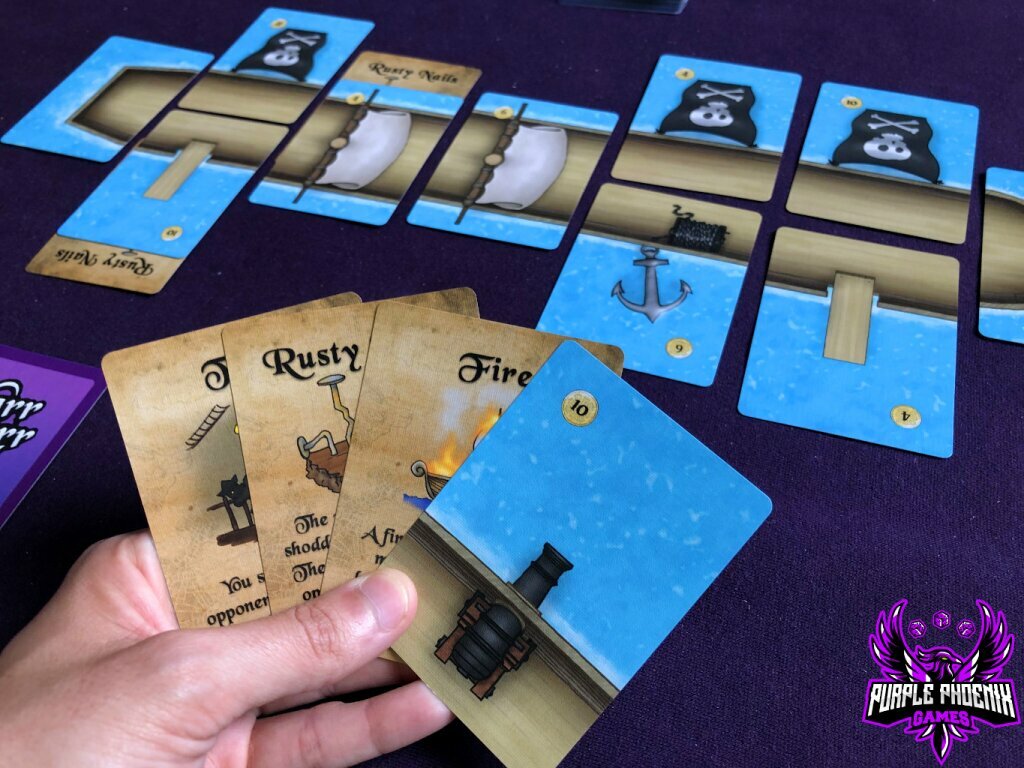
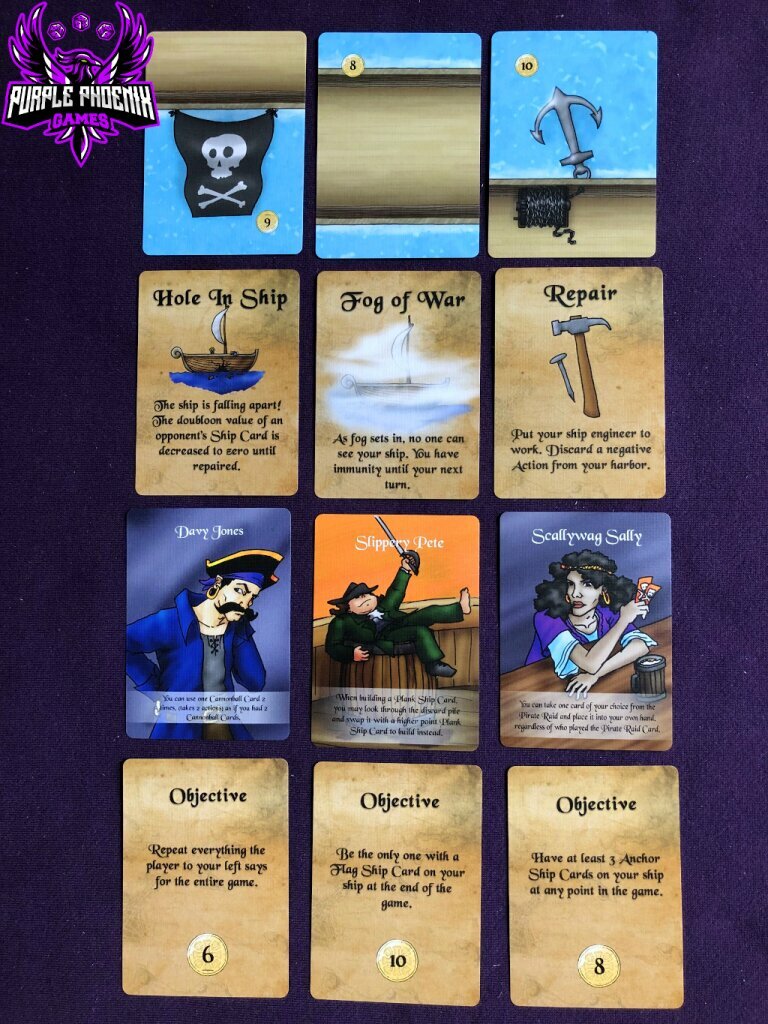
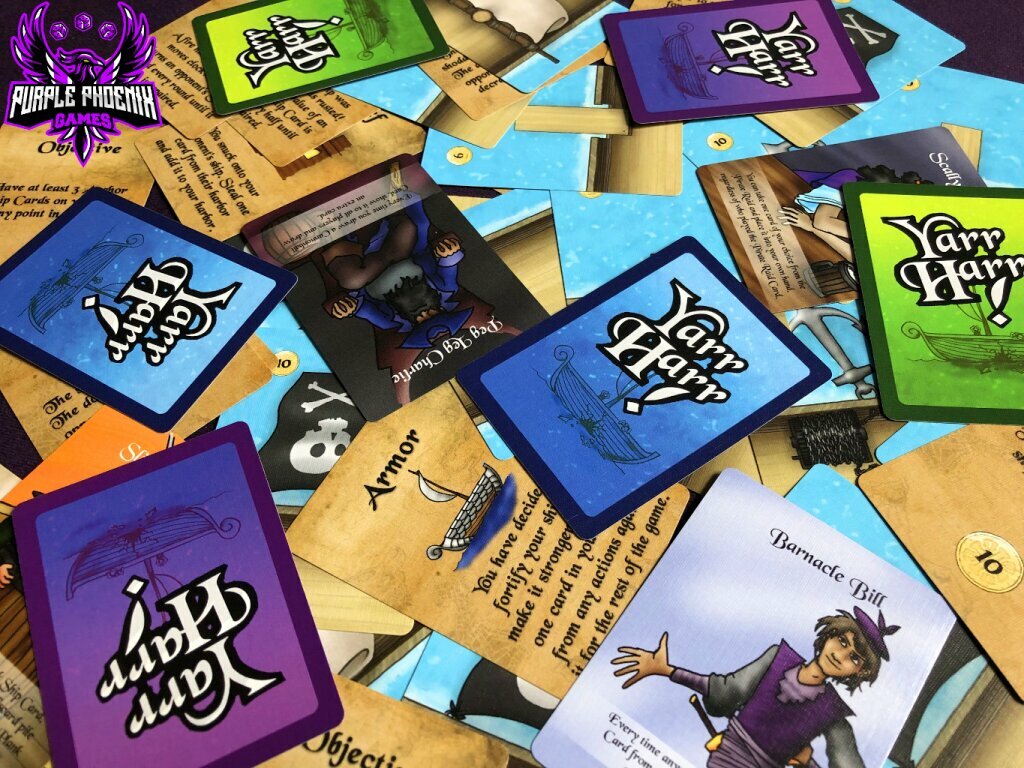
Purple Phoenix Games (2266 KP) rated Sacred Rites in Tabletop Games
Jan 14, 2021
You know when you are about to be initiated into the cult you’ve been following for a while and you feel completely ready to smash all the steps to the initiation ritual? But then your friend Roger always comes to sacrifice lessons late and just bumbles his way through, so you feel like you have to carry him and his irresponsibility? Well, you always told him that you wouldn’t be able to help him on initiation day and guess who still hasn’t arrived to the bonfire…
Sacred Rites is a semi-cooperative, social deduction party game for three to nine initiates. These special few are about to be accepted into the cult full-time, assuming they all know the rites and traditions to be celebrated. Did you remember all your moves to the required interpretive dance?
DISCLAIMER: We were provided a copy of this game for the purposes of this review. This is a retail copy of the game, so what you see in these photos is exactly what would be received in your box. I do not intend to cover every single rule included in the rulebook, but will describe the overall game flow and major rule set so that our readers may get a sense of how the game plays. For more in depth rules, you may purchase a copy online or from your FLGS. -T
To setup gather enough windowed Believer envelopes for the number of players and also include the two Outsider envelopes. Believer envelopes have a cutout section whereas the Outsider envelopes have no cutouts. Shuffle these together and place them on the table Crown-side up (so one cannot see which have windows and which do not). Each player chooses an envelope. Shuffle the deck of Rite cards into a draw pile and similarly shuffle the Tradition tiles into a draw pile. Sprinkle the flower tokens around the table (which I just now considered and should have included that little setup action for more immersion) within reach of all initiates. The game may now begin!
To start a round one player chooses a Rite card from the pile and slides it into their envelope. After contemplating the meaning, they then slide out the Rite and pass it to the next player in table order to peruse in their window (if they have one). This continues around the table so everyone has a chance to “look” at it. Each player then chooses a Tradition tile from the pile and similarly secretly peruses it.
Once everyone has completed these steps the Ritual may begin. Any player may begin by revealing their Tradition tile to the group and stating, “The (whatever Tradition tile says) of our Sacred Rite is…” At this point the player will attempt to give the group a clue as to what the Rite card said without being blatant about it. This could be a word, a movement, a sound, or whatever they so choose. When done, the rest of the initiates respond with, “Ahhhh, (whatever the player just said/did/etc).” Every player will need to present their idea of the Rite with their Tradition, even if they are an Outsider.
When all players have performed, a count of three is made and all players will then either point to the player they feel is an Outsider, or point to the sky to declare they believe no initiate is an Outsider. Initiates who guess correctly immediately score two VP (white flowers), and any initiate not accused will score one VP flower. At this point the Outsider(s) will have a chance to guess the Rite, scoring two VP for a correct guess. The round ends and a new round begins. The winner is the initiate who earns 13 points (or more) first!
Components. This is a BEAUTIFUL game to look at and play. The minimalistic style and color palette are perfect choices for this style and theme of game. The cards are those nice smaller cards, and the tiles are lovely wooden tiles. The VP flower tokens are a nice touch, and it also comes with a great little embroidered bag. This is one of the prettiest games I have played and I love all the component choices made.
The gameplay is something that surprised me. I typically do not enjoy my plays of a similar game called Spyfall, but found myself loving every play of Sacred Rites. You see, in Spyfall players ask each other questions in order to suss out the spy, and rounds can go for too many minutes. In Sacred Rites, each turn is similar in timeframe and have a “shoot-them-to-vote-them-out” mechanic like is found in Ca$h ‘n Guns. I much prefer Sacred Rites to Spyfall and will be pulling it off the shelf every time we get the itch to be shady.
I understand that some people may not be into the theme of rituals for cult initiation, but this isn’t a dark game or have any sort of strange, questionable content. I would feel comfortable playing this with my in-laws as much as I would with anyone’s sweet granny. That said, Purple Phoenix Games gives this one a moonbeam hippy flowerstone 10 / 12. I believe it to be a wonderful addition to any collection, especially if it lacks a somewhat silly game of accusations and performance, or if, like me, your plays of Spyfall are falling flat. I am so happy to have this one I may actually do a full-length interpretive dance right now. Just let me turn off my webcam…
Sacred Rites is a semi-cooperative, social deduction party game for three to nine initiates. These special few are about to be accepted into the cult full-time, assuming they all know the rites and traditions to be celebrated. Did you remember all your moves to the required interpretive dance?
DISCLAIMER: We were provided a copy of this game for the purposes of this review. This is a retail copy of the game, so what you see in these photos is exactly what would be received in your box. I do not intend to cover every single rule included in the rulebook, but will describe the overall game flow and major rule set so that our readers may get a sense of how the game plays. For more in depth rules, you may purchase a copy online or from your FLGS. -T
To setup gather enough windowed Believer envelopes for the number of players and also include the two Outsider envelopes. Believer envelopes have a cutout section whereas the Outsider envelopes have no cutouts. Shuffle these together and place them on the table Crown-side up (so one cannot see which have windows and which do not). Each player chooses an envelope. Shuffle the deck of Rite cards into a draw pile and similarly shuffle the Tradition tiles into a draw pile. Sprinkle the flower tokens around the table (which I just now considered and should have included that little setup action for more immersion) within reach of all initiates. The game may now begin!
To start a round one player chooses a Rite card from the pile and slides it into their envelope. After contemplating the meaning, they then slide out the Rite and pass it to the next player in table order to peruse in their window (if they have one). This continues around the table so everyone has a chance to “look” at it. Each player then chooses a Tradition tile from the pile and similarly secretly peruses it.
Once everyone has completed these steps the Ritual may begin. Any player may begin by revealing their Tradition tile to the group and stating, “The (whatever Tradition tile says) of our Sacred Rite is…” At this point the player will attempt to give the group a clue as to what the Rite card said without being blatant about it. This could be a word, a movement, a sound, or whatever they so choose. When done, the rest of the initiates respond with, “Ahhhh, (whatever the player just said/did/etc).” Every player will need to present their idea of the Rite with their Tradition, even if they are an Outsider.
When all players have performed, a count of three is made and all players will then either point to the player they feel is an Outsider, or point to the sky to declare they believe no initiate is an Outsider. Initiates who guess correctly immediately score two VP (white flowers), and any initiate not accused will score one VP flower. At this point the Outsider(s) will have a chance to guess the Rite, scoring two VP for a correct guess. The round ends and a new round begins. The winner is the initiate who earns 13 points (or more) first!
Components. This is a BEAUTIFUL game to look at and play. The minimalistic style and color palette are perfect choices for this style and theme of game. The cards are those nice smaller cards, and the tiles are lovely wooden tiles. The VP flower tokens are a nice touch, and it also comes with a great little embroidered bag. This is one of the prettiest games I have played and I love all the component choices made.
The gameplay is something that surprised me. I typically do not enjoy my plays of a similar game called Spyfall, but found myself loving every play of Sacred Rites. You see, in Spyfall players ask each other questions in order to suss out the spy, and rounds can go for too many minutes. In Sacred Rites, each turn is similar in timeframe and have a “shoot-them-to-vote-them-out” mechanic like is found in Ca$h ‘n Guns. I much prefer Sacred Rites to Spyfall and will be pulling it off the shelf every time we get the itch to be shady.
I understand that some people may not be into the theme of rituals for cult initiation, but this isn’t a dark game or have any sort of strange, questionable content. I would feel comfortable playing this with my in-laws as much as I would with anyone’s sweet granny. That said, Purple Phoenix Games gives this one a moonbeam hippy flowerstone 10 / 12. I believe it to be a wonderful addition to any collection, especially if it lacks a somewhat silly game of accusations and performance, or if, like me, your plays of Spyfall are falling flat. I am so happy to have this one I may actually do a full-length interpretive dance right now. Just let me turn off my webcam…
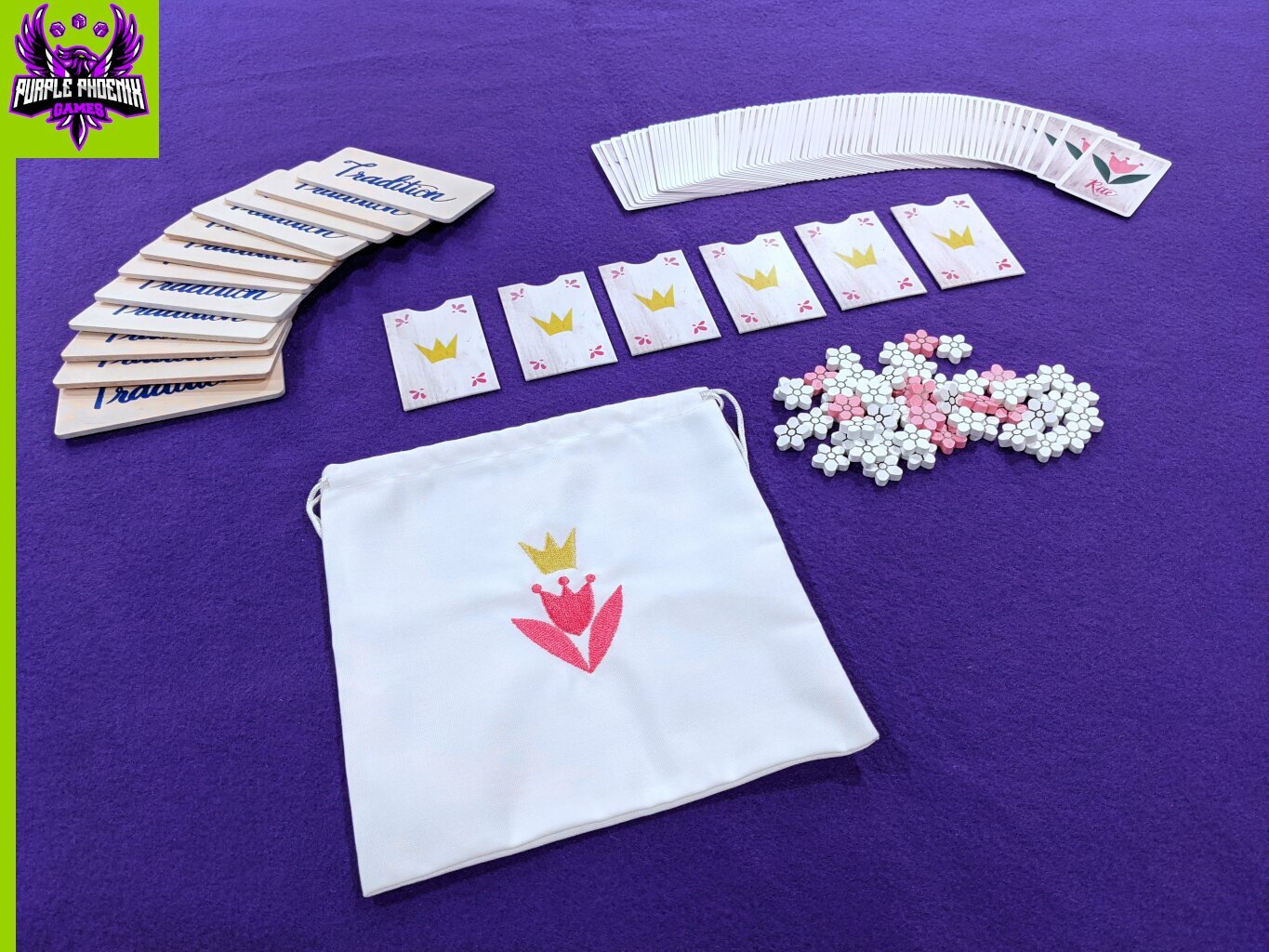

BankofMarquis (1832 KP) rated A League of Their Own (1992) in Movies
May 26, 2020

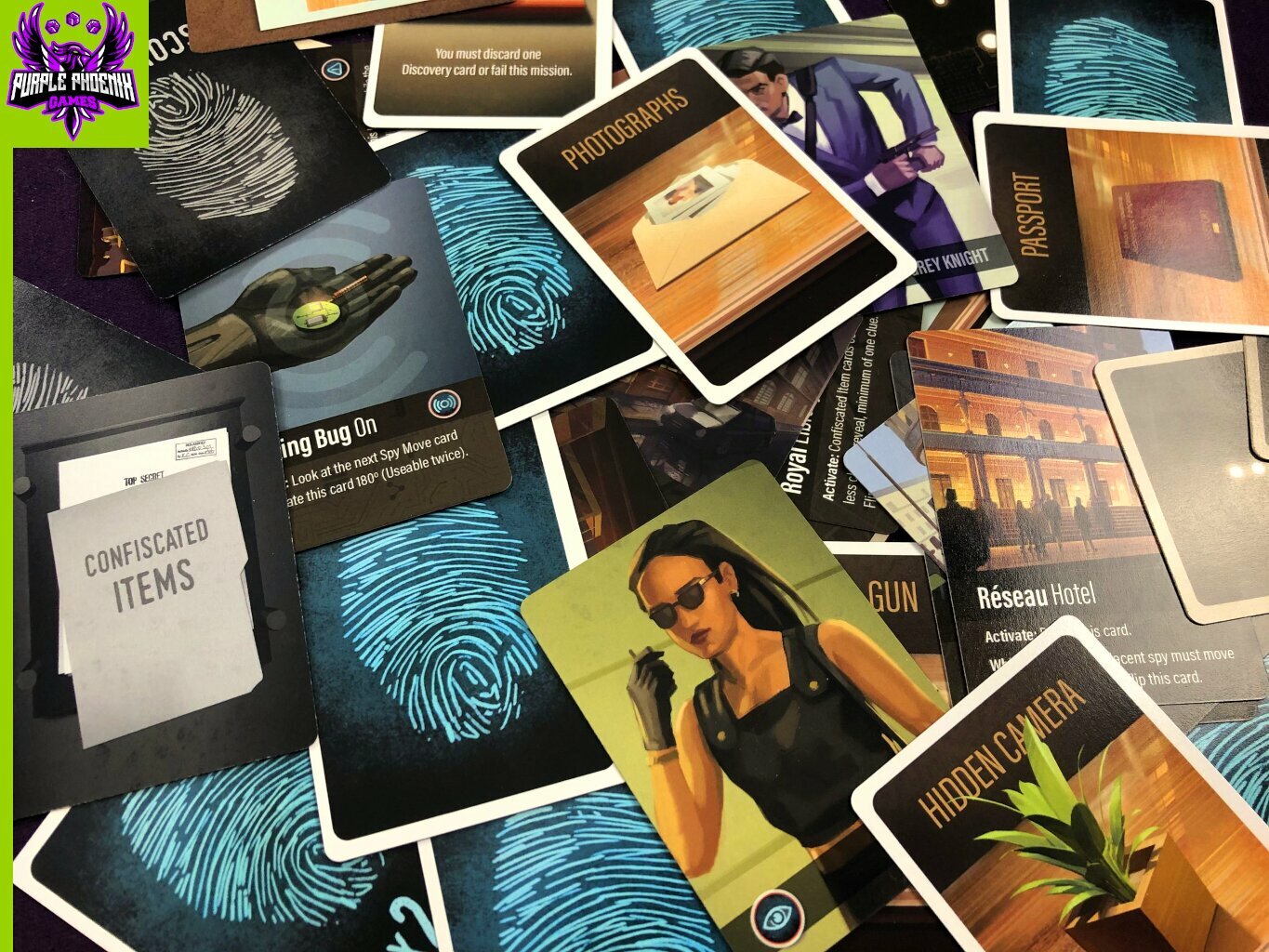
My Favorite Baseball Movie of All Time
I am a big fan of movies. I am a big fan of baseball. So, inevitably, I get asked what my favorite baseball movie is - and my answer surprises many. Beyond a doubt, my favorite baseball movie is the 1992 comedy A LEAGUE OF THEIR OWN, directed by Penny Marshall and starring Geena Davis and Tom Hanks.
I just rewatched this film (for the umpteenth time) and it still works very, very well.
Set during WWII, A LEAGUE OF THEIR OWN tells the story of the All American Girls Professional Baseball League - set up by owners of Major League baseball as many, many of the male professional baseball players were overseas fighting in the war.
Set up as a sibling rivalry story between star player Dottie Henson (Geena Davis) and her kid sister Kit (Lori Petty) who is always in Dottie's shadow, ALOTO shows the start-up of the league, the initial reluctance of the general public to embrace it and the eventual winning over of those that mocked it by actually playing good, hard-nosed ball.
This indifference (turned to acceptance) of this league is shown through the eyes of alcoholic, former Major League star Jimmy Dugan (a pre-Oscars Tom Hanks). After a strong 1980's in film, the first part of the 1990's was not kind to Hanks (JOE vs. THE VOLCANO tanked and the less that can be said about BONFIRE OF THE VANITIES the better). This film was considered a bit of a "comeback" film for him and he came back very, very well. His Jimmy Dugan is irascible, vulgar and angry but has a good heart that shines through. It was this role that would catapult Hanks into SuperStardom later in this decade (with films like PHILADELPHIA, FOREST GUMP, SAVING PRIVATE RYAN, SLEEPLESS IN SEATTLE, APOLLO 13 and THE GREEN MILE). So, remember, without Jimmy Duggan, their probably would not be a Woody from TOY STORY (at least not a Woody voiced by Hanks).
Geena Davis is strong in the lead role of Dottie. Davis is a natural athlete and a very intelligent individual (she was a semi-finalist for the U.S. Olympic Archery team and is a member of MENSA) and both attributes shine through in her portrayal of Dottie. She is strong, graceful and sure-headed in her approach to her goal - to be the best at what she is currently doing. The pairing of Davis and Hanks is interesting for you see great chemistry between these two characters - 2 characters that are compatriots and, perhaps, friends, but...which is unusual in a film such as this...NOT love interests for each other.
Faring less well in this film is Lori Petty as kid sister Kit who just wants a chance to get out from under her sister's shadow. I don't blame Petty's performance - she does the best she can with the material she is given, but her character is "whiny, pouty and shouty" throughout the film and was just not someone I cared about.
That cannot be said for the strong list of actresses that were cast as members of the Rockford Peaches - the team that Dottie and Kit play for (and that Jimmy Dugan manages). Director Penny Marshall insisted that all of the women cast actually be able to play baseball, so cut many, many good actresses that just couldn't be believed as baseball players. Madonna (of all people) shows a passable ability to play ball - as well as a winning personality as "All the Way" Mae, the team's centerfielder. In her first film role, Rosie O'Donnell almost steals the film as loud Long Island 3b Doris Murphy. Megan Cavanagh (2b Marla Hooch), Tracy Reiner (LF/P Betty "Spaghetti" Horn), Bitty Schram (RF Evelyn Gardner who was the cryer in the "there's no crying in baseball" scene), Ann Cusack (illiterate OF Shirley Baker), Anne Ramsey (1B Helen Haley) and Freddie Simpson (SS/P Ellen Sue Gotlander) all make a believably passable group of ballplayers that you want to spend time with.
Special notice needs to be made to the always dependable David Strathairn (as Ira Lowenstein - the guiding light to this league) and Jon Lovitz (who is the star of the first 1/4 of this film as Scout Ernie Capadino). They both bring needed life to moments of the film when it need it the most.
All of these elements are brought together wonderfully by the smart, thoughtful and emotionally rich direction of Penny Marshall. She was on a bit of a roll in this part of her career, having helmed BIG (1988) and AWAKENINGS (1990 - with Robin Williams and Robert DeNiro) previously. She went "3 for 3" as a Director with this one. She keeps the film moving along smartly, pausing just long enough at times to bring in some emotion and then follows it right up with some gut-busting laughs.
While I am not thrilled by the events of the final game (I think it is a little contrived and one of the principal characters gets a reward they don't deserve) but that is a "nit" on this film, for it is the journey - with characters that are fun to spend some time with - that makes this film works.
Oh...and Marshall also puts in some of the real players from the league in a finale that serves as a well-deserved salute to these womeon
Letter Grade: A
9 stars (out of 10) and you can take that to the Bank(ofMarquis)
I just rewatched this film (for the umpteenth time) and it still works very, very well.
Set during WWII, A LEAGUE OF THEIR OWN tells the story of the All American Girls Professional Baseball League - set up by owners of Major League baseball as many, many of the male professional baseball players were overseas fighting in the war.
Set up as a sibling rivalry story between star player Dottie Henson (Geena Davis) and her kid sister Kit (Lori Petty) who is always in Dottie's shadow, ALOTO shows the start-up of the league, the initial reluctance of the general public to embrace it and the eventual winning over of those that mocked it by actually playing good, hard-nosed ball.
This indifference (turned to acceptance) of this league is shown through the eyes of alcoholic, former Major League star Jimmy Dugan (a pre-Oscars Tom Hanks). After a strong 1980's in film, the first part of the 1990's was not kind to Hanks (JOE vs. THE VOLCANO tanked and the less that can be said about BONFIRE OF THE VANITIES the better). This film was considered a bit of a "comeback" film for him and he came back very, very well. His Jimmy Dugan is irascible, vulgar and angry but has a good heart that shines through. It was this role that would catapult Hanks into SuperStardom later in this decade (with films like PHILADELPHIA, FOREST GUMP, SAVING PRIVATE RYAN, SLEEPLESS IN SEATTLE, APOLLO 13 and THE GREEN MILE). So, remember, without Jimmy Duggan, their probably would not be a Woody from TOY STORY (at least not a Woody voiced by Hanks).
Geena Davis is strong in the lead role of Dottie. Davis is a natural athlete and a very intelligent individual (she was a semi-finalist for the U.S. Olympic Archery team and is a member of MENSA) and both attributes shine through in her portrayal of Dottie. She is strong, graceful and sure-headed in her approach to her goal - to be the best at what she is currently doing. The pairing of Davis and Hanks is interesting for you see great chemistry between these two characters - 2 characters that are compatriots and, perhaps, friends, but...which is unusual in a film such as this...NOT love interests for each other.
Faring less well in this film is Lori Petty as kid sister Kit who just wants a chance to get out from under her sister's shadow. I don't blame Petty's performance - she does the best she can with the material she is given, but her character is "whiny, pouty and shouty" throughout the film and was just not someone I cared about.
That cannot be said for the strong list of actresses that were cast as members of the Rockford Peaches - the team that Dottie and Kit play for (and that Jimmy Dugan manages). Director Penny Marshall insisted that all of the women cast actually be able to play baseball, so cut many, many good actresses that just couldn't be believed as baseball players. Madonna (of all people) shows a passable ability to play ball - as well as a winning personality as "All the Way" Mae, the team's centerfielder. In her first film role, Rosie O'Donnell almost steals the film as loud Long Island 3b Doris Murphy. Megan Cavanagh (2b Marla Hooch), Tracy Reiner (LF/P Betty "Spaghetti" Horn), Bitty Schram (RF Evelyn Gardner who was the cryer in the "there's no crying in baseball" scene), Ann Cusack (illiterate OF Shirley Baker), Anne Ramsey (1B Helen Haley) and Freddie Simpson (SS/P Ellen Sue Gotlander) all make a believably passable group of ballplayers that you want to spend time with.
Special notice needs to be made to the always dependable David Strathairn (as Ira Lowenstein - the guiding light to this league) and Jon Lovitz (who is the star of the first 1/4 of this film as Scout Ernie Capadino). They both bring needed life to moments of the film when it need it the most.
All of these elements are brought together wonderfully by the smart, thoughtful and emotionally rich direction of Penny Marshall. She was on a bit of a roll in this part of her career, having helmed BIG (1988) and AWAKENINGS (1990 - with Robin Williams and Robert DeNiro) previously. She went "3 for 3" as a Director with this one. She keeps the film moving along smartly, pausing just long enough at times to bring in some emotion and then follows it right up with some gut-busting laughs.
While I am not thrilled by the events of the final game (I think it is a little contrived and one of the principal characters gets a reward they don't deserve) but that is a "nit" on this film, for it is the journey - with characters that are fun to spend some time with - that makes this film works.
Oh...and Marshall also puts in some of the real players from the league in a finale that serves as a well-deserved salute to these womeon
Letter Grade: A
9 stars (out of 10) and you can take that to the Bank(ofMarquis)