Search
Search results

Purple Phoenix Games (2266 KP) rated The Artemis Project in Tabletop Games
Apr 6, 2021
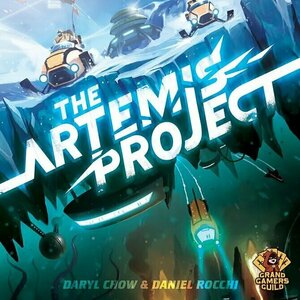

I don’t know about you, but I spend more time than I should probably admit perusing Kickstarter and checking out new projects. Although, that is how I came across The Artemis Project. A game about exploration and colonization of one of Jupiter’s moons? Yes please! The campaign looked promising, the gameplay looked engaging, and the hype was real. Once I finally got the game, did it live up to my expectations? Keep reading to find out!
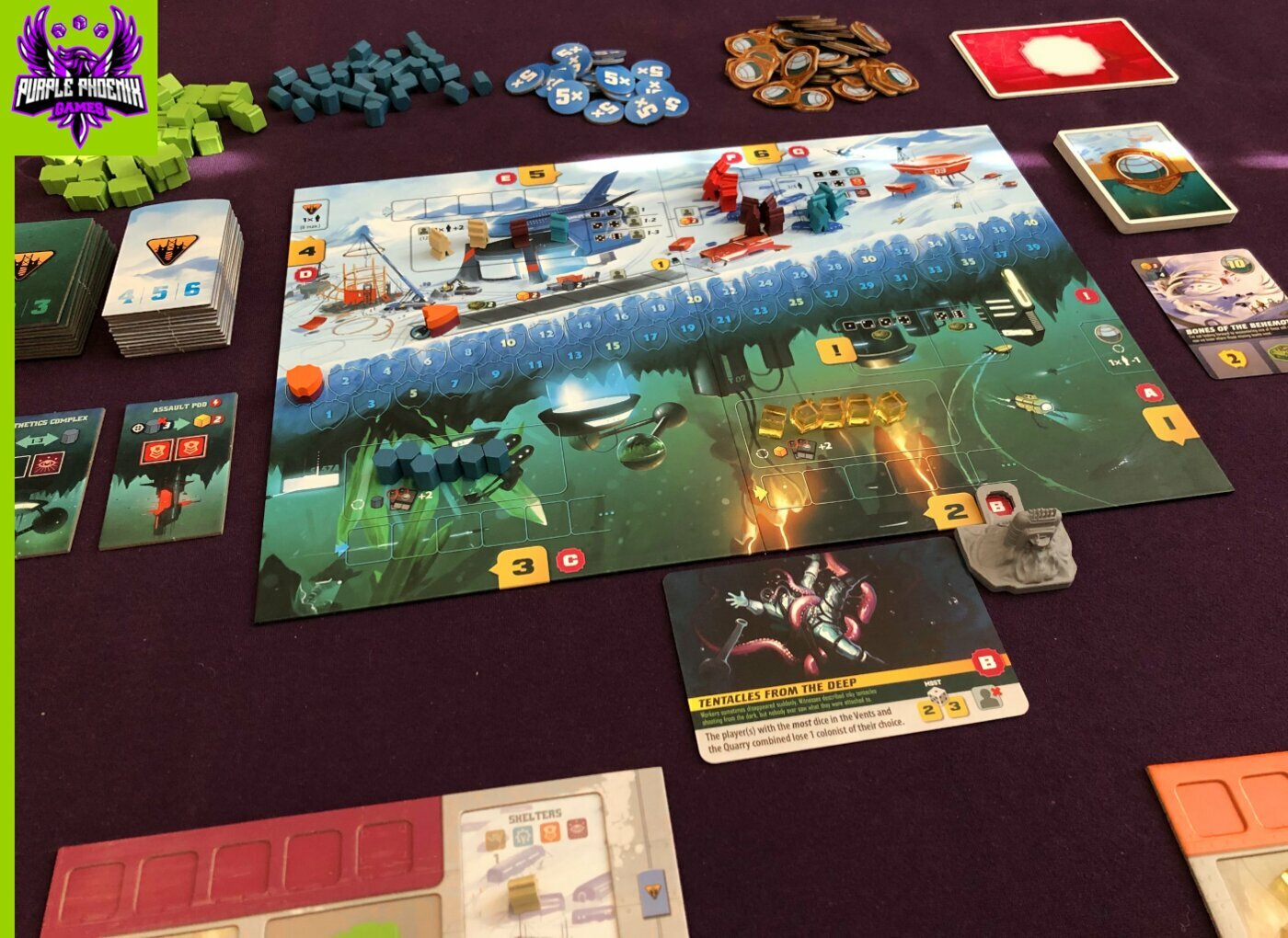
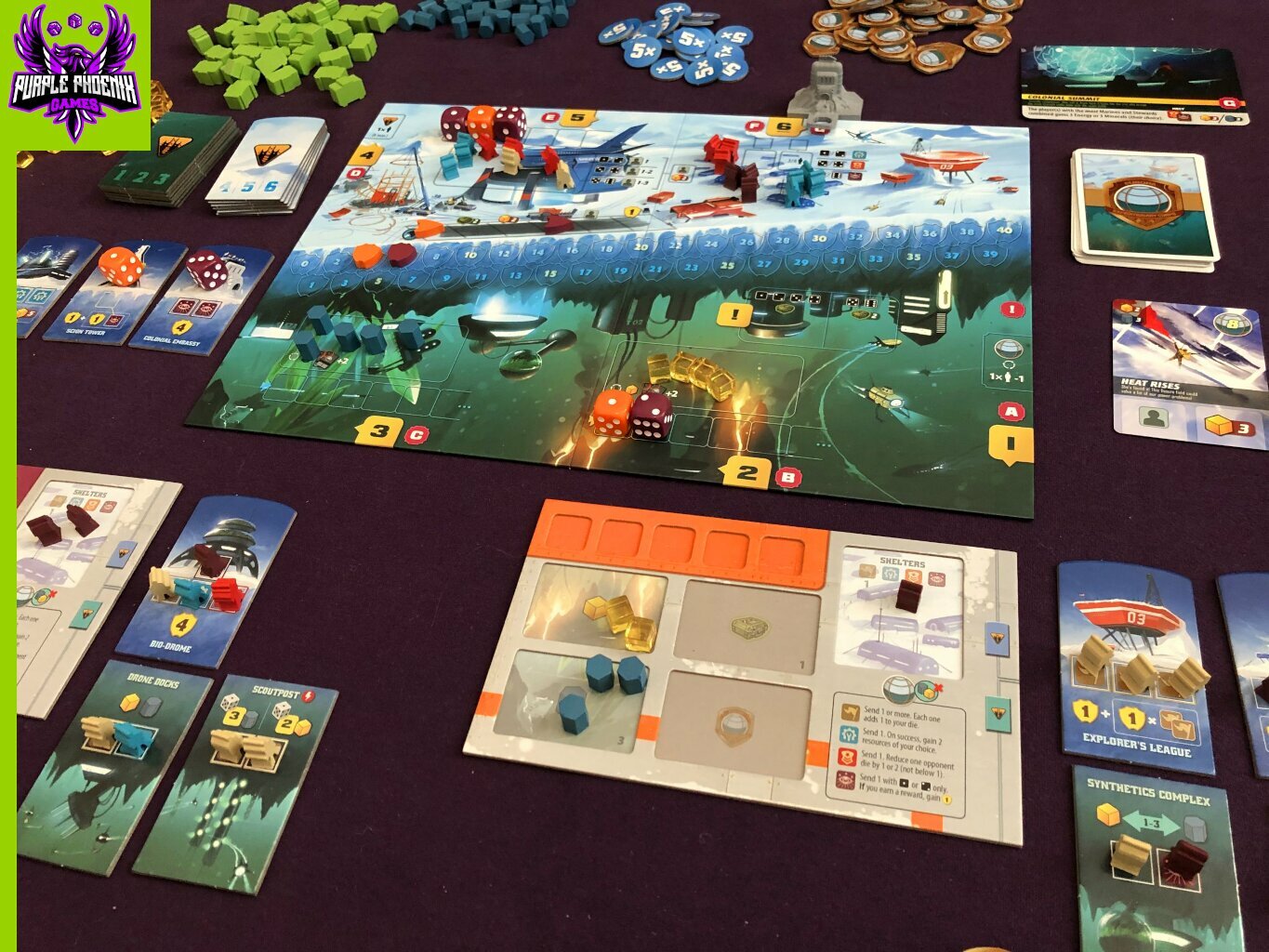
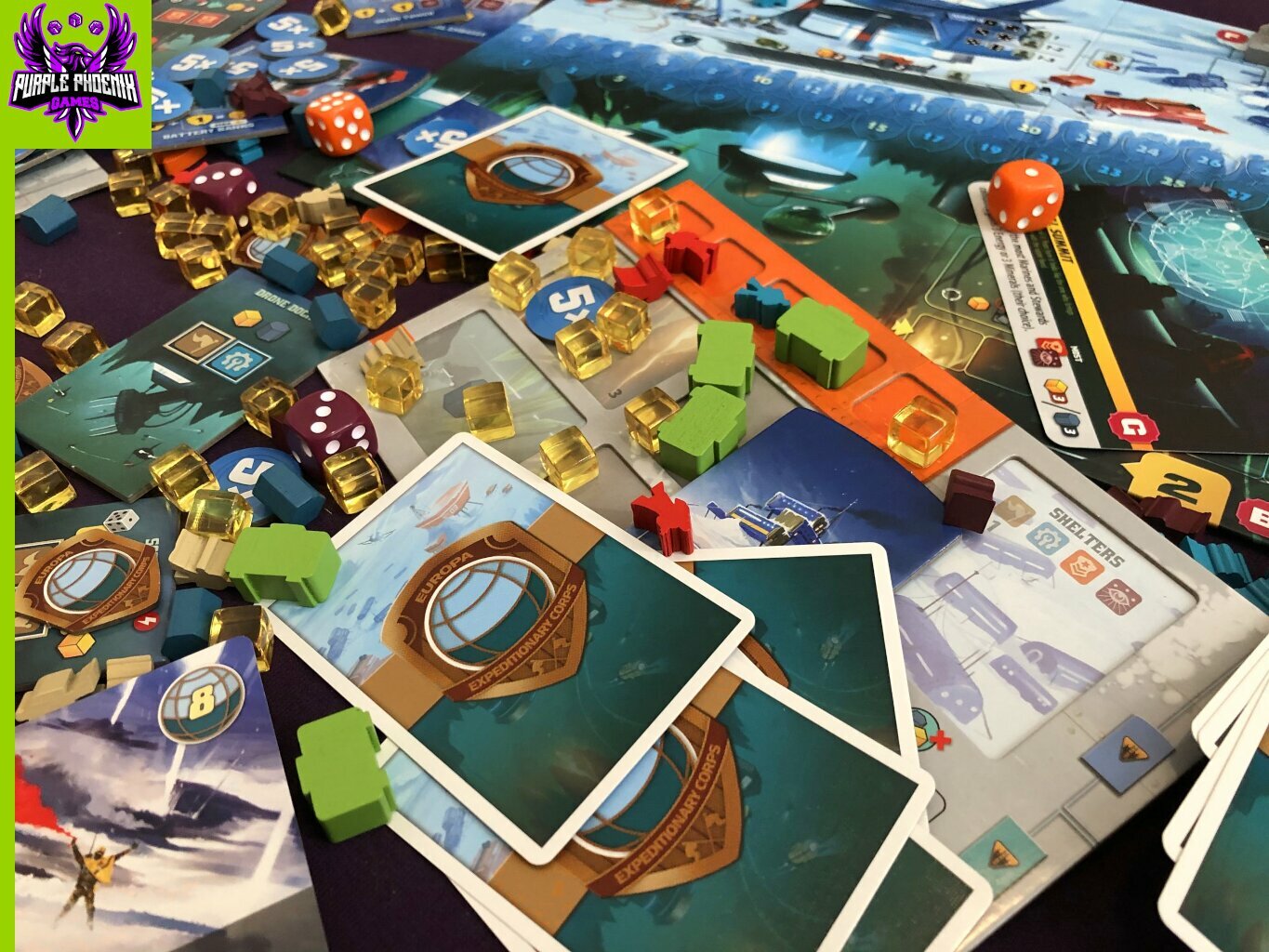
The Artemis Project is a game of dice/worker placement in which players are trying to build and sustain a prosperous colony on Jupiter’s moon Europa. Played over 6 rounds, players will take turns rolling and placing dice across the regions of the board to collect resources, construct buildings, recruit and train colonists, and partake in expeditions to explore this vast ice-land. To begin, follow the setup instructions in the rulebook for the appropriate player count. Each player receives a player board, dice, and markers in their chosen color. Populate the board for the first round, select a starting player, and the game is ready to begin!
Disclaimer: I do not intend to rehash the entire rulebook in this review, as there are just too many details. For a more in-depth look at The Artemis Project, pick up a copy from your FLGS or directly from the publisher! -L
To start each round, all players will simultaneously roll all 5 of their dice. Once players are happy with their results, the round is ready to properly begin. Each round is broken into three phases: Placement, Resolution, and Upkeep. To begin the Placement phase, starting with the first player, players will take turns assigning one die at a time to the 7 regions of the board. These regions are: Basecamp, Vents, Quarry, Gantry, Doorstep, Academy, and Outfitters. (I will explain each region in more detail in the next section!) The value of the dice placed in any region is important, because it will dictate what you are allowed to do, or when you are allowed to resolve the action for that region – so choose your placements wisely.
Once every player has placed all 5 of their dice, the Resolution phase begins. During the Resolution phase, each of the regions of the board will be resolved in order, allowing players to perform their region-specific actions. Resolution starts with Basecamp. Placing dice at Basecamp allows players to partake in Expeditions in an effort to earn Expedition Badges (which translate to end-game VP), as well as extra rewards. Each Expedition has a difficulty level which must be equaled or surpassed by the total of all dice placed on that card. If the difficulty is surpassed, the Expedition is a success and rewards are doled out accordingly, but if the Expedition fails, no rewards are earned by anyone.
The next 2 regions, Vents and Quarry, allow players to collect Energy and Minerals, respectively, and are resolved in the same way. Players will collect a number of resources equal to their played die value. Pretty straight-forward! Moving on to the Gantry region, the value of dice placed on any building tiles are considered bids for buying/constructing that building. You can bid against opponents for building tiles, but each bid must increase the previous amount. When resolving the Gantry, the highest value die on a tile is the winner, and that player must pay their die-amount in Minerals to collect that tile. Buildings are added to your colony, and allow you to perform special actions once they are fully-staffed (all colonist slots on the tile are filled).
Next is the Doorstep – depending on the value of dice you placed there, you will be able to recruit 1-3 new colonists. Recruiting a colonist costs you 2 Energy per new addition, and any new colonists you recruit can be placed immediately into any of your buildings (if space is available), or into your Shelter where they will wait to be used. The Academy region allows you to exchange a colonist of your choice for one of a different type/occupation, again, depending on the value of the die used. And finally, the Outfitters region does not resolved during this phase, because it’s action is performed immediately upon dice placement. Any dice placed to the Outfitters gives Tool Kits (used to manipulate die values at the start of each round) to the player, based upon the die value.
The remaining element of the Resolution phase is the Even card. At the start of each round, an Event card is drawn, and will pertain to a certain region of the board. During the Resolution phase, when that region is reached, the Event card will be resolved – either penalizing players or benefitting them in some way. I have purposefully left out a few elements of the Resolution phase for you to discover on your own!
Once all regions have been resolved, the round moves to the Upkeep phase. During this phase, all players can choose to move 1 colonist to a building tile, or swap any 2 colonists between buildings. This is not required, but can only be performed once during this phase. Next, if any players have fully-staffed buildings (all colonist slots are filled), they may activate the listed ability. And finally, for any colonists left in your shelter and not in a building, you must pay 1 Energy for each to keep them warm! The game board is now refreshed for the next round, a new starting player is selected, and the new round is ready to begin. After the 6th and final round, VPs are tallied – earned through number of building tiles, Expedition Badges, sets of resources, and sets of colonists – and the player with the most VP is the winner!
I know that seems like a lot, but I promise that once you start the first round, everything is pretty intuitive and the game flows well. The turn sequence and phases are logical and easy to understand. The game board itself has lots of helpful icons that work as reminders throughout gameplay, and the rulebook has a nice and concise round overview on the last page as well, which is easy to refer back to at a moment’s notice. I’ll go ahead and touch on components here, since I kind of already started to do so. The components in this game are great! The game board and cards are all sturdy and have colorful and immersive artwork. The dual-layered player boards are high quality, the colonist meeples are cute and effective, the building tiles and cardboard chits are strong and can definitely hold up to many plays, and the dice are easy to roll and read. Definitely an A+ on components from me.
I have to admit that The Artemis Project surprised me. At its core, it is a worker placement game, and that in and of itself lends itself to a certain gameplay. You’re trying to complete your own agenda, being the first to snag those important placements that you need to accomplish those goals, while also blocking opponents from doing the same. The thing that makes The Artemis Project unique is that the ‘workers’ in this game are dice. And their value is what dictates the resolution of each region. Just because you place a die in a region first, does not necessarily mean that you will get to resolve first – depending on how your opponents play, they could block you entirely! The use of dice adds an extra layer of strategy to the gameplay that really elevates it beyond a simple worker placement mechanic. Another great thing about this game is that there is no one way to win – there are several strategies that you could play by in an effort to earn VPs. Maybe you are trying to complete as many Expeditions as possible, or want to construct as many buildings as possible. Either strategy can work, and all strategies can easily be adapted and altered during gameplay.
I am so happy that I came across this game on Kickstarter. The game is strategic, engaging, and just fun to play. I’m not necessarily a huge fan of worker placement games, but the approach to the mechanic taken by The Artemis Project really puts a unique twist on it that adds to the gameplay. This is one KickStarter that was definitely worth the investment. Check it out if you haven’t heard of it, or if you’re looking to elevate your worker placement games. Purple Phoenix Games gives it an enterprising 10 / 12.
The Artemis Project is a game of dice/worker placement in which players are trying to build and sustain a prosperous colony on Jupiter’s moon Europa. Played over 6 rounds, players will take turns rolling and placing dice across the regions of the board to collect resources, construct buildings, recruit and train colonists, and partake in expeditions to explore this vast ice-land. To begin, follow the setup instructions in the rulebook for the appropriate player count. Each player receives a player board, dice, and markers in their chosen color. Populate the board for the first round, select a starting player, and the game is ready to begin!
Disclaimer: I do not intend to rehash the entire rulebook in this review, as there are just too many details. For a more in-depth look at The Artemis Project, pick up a copy from your FLGS or directly from the publisher! -L
To start each round, all players will simultaneously roll all 5 of their dice. Once players are happy with their results, the round is ready to properly begin. Each round is broken into three phases: Placement, Resolution, and Upkeep. To begin the Placement phase, starting with the first player, players will take turns assigning one die at a time to the 7 regions of the board. These regions are: Basecamp, Vents, Quarry, Gantry, Doorstep, Academy, and Outfitters. (I will explain each region in more detail in the next section!) The value of the dice placed in any region is important, because it will dictate what you are allowed to do, or when you are allowed to resolve the action for that region – so choose your placements wisely.
Once every player has placed all 5 of their dice, the Resolution phase begins. During the Resolution phase, each of the regions of the board will be resolved in order, allowing players to perform their region-specific actions. Resolution starts with Basecamp. Placing dice at Basecamp allows players to partake in Expeditions in an effort to earn Expedition Badges (which translate to end-game VP), as well as extra rewards. Each Expedition has a difficulty level which must be equaled or surpassed by the total of all dice placed on that card. If the difficulty is surpassed, the Expedition is a success and rewards are doled out accordingly, but if the Expedition fails, no rewards are earned by anyone.
The next 2 regions, Vents and Quarry, allow players to collect Energy and Minerals, respectively, and are resolved in the same way. Players will collect a number of resources equal to their played die value. Pretty straight-forward! Moving on to the Gantry region, the value of dice placed on any building tiles are considered bids for buying/constructing that building. You can bid against opponents for building tiles, but each bid must increase the previous amount. When resolving the Gantry, the highest value die on a tile is the winner, and that player must pay their die-amount in Minerals to collect that tile. Buildings are added to your colony, and allow you to perform special actions once they are fully-staffed (all colonist slots on the tile are filled).
Next is the Doorstep – depending on the value of dice you placed there, you will be able to recruit 1-3 new colonists. Recruiting a colonist costs you 2 Energy per new addition, and any new colonists you recruit can be placed immediately into any of your buildings (if space is available), or into your Shelter where they will wait to be used. The Academy region allows you to exchange a colonist of your choice for one of a different type/occupation, again, depending on the value of the die used. And finally, the Outfitters region does not resolved during this phase, because it’s action is performed immediately upon dice placement. Any dice placed to the Outfitters gives Tool Kits (used to manipulate die values at the start of each round) to the player, based upon the die value.
The remaining element of the Resolution phase is the Even card. At the start of each round, an Event card is drawn, and will pertain to a certain region of the board. During the Resolution phase, when that region is reached, the Event card will be resolved – either penalizing players or benefitting them in some way. I have purposefully left out a few elements of the Resolution phase for you to discover on your own!
Once all regions have been resolved, the round moves to the Upkeep phase. During this phase, all players can choose to move 1 colonist to a building tile, or swap any 2 colonists between buildings. This is not required, but can only be performed once during this phase. Next, if any players have fully-staffed buildings (all colonist slots are filled), they may activate the listed ability. And finally, for any colonists left in your shelter and not in a building, you must pay 1 Energy for each to keep them warm! The game board is now refreshed for the next round, a new starting player is selected, and the new round is ready to begin. After the 6th and final round, VPs are tallied – earned through number of building tiles, Expedition Badges, sets of resources, and sets of colonists – and the player with the most VP is the winner!
I know that seems like a lot, but I promise that once you start the first round, everything is pretty intuitive and the game flows well. The turn sequence and phases are logical and easy to understand. The game board itself has lots of helpful icons that work as reminders throughout gameplay, and the rulebook has a nice and concise round overview on the last page as well, which is easy to refer back to at a moment’s notice. I’ll go ahead and touch on components here, since I kind of already started to do so. The components in this game are great! The game board and cards are all sturdy and have colorful and immersive artwork. The dual-layered player boards are high quality, the colonist meeples are cute and effective, the building tiles and cardboard chits are strong and can definitely hold up to many plays, and the dice are easy to roll and read. Definitely an A+ on components from me.
I have to admit that The Artemis Project surprised me. At its core, it is a worker placement game, and that in and of itself lends itself to a certain gameplay. You’re trying to complete your own agenda, being the first to snag those important placements that you need to accomplish those goals, while also blocking opponents from doing the same. The thing that makes The Artemis Project unique is that the ‘workers’ in this game are dice. And their value is what dictates the resolution of each region. Just because you place a die in a region first, does not necessarily mean that you will get to resolve first – depending on how your opponents play, they could block you entirely! The use of dice adds an extra layer of strategy to the gameplay that really elevates it beyond a simple worker placement mechanic. Another great thing about this game is that there is no one way to win – there are several strategies that you could play by in an effort to earn VPs. Maybe you are trying to complete as many Expeditions as possible, or want to construct as many buildings as possible. Either strategy can work, and all strategies can easily be adapted and altered during gameplay.
I am so happy that I came across this game on Kickstarter. The game is strategic, engaging, and just fun to play. I’m not necessarily a huge fan of worker placement games, but the approach to the mechanic taken by The Artemis Project really puts a unique twist on it that adds to the gameplay. This is one KickStarter that was definitely worth the investment. Check it out if you haven’t heard of it, or if you’re looking to elevate your worker placement games. Purple Phoenix Games gives it an enterprising 10 / 12.
Purple Phoenix Games (2266 KP) rated Way Too Many Cats! in Tabletop Games
Jan 24, 2022


Before we had children and pets my wife and I would love to visit the humane societies back home on a Saturday morning. Sometimes looking for ourselves, sometimes just to see the lovelies being kept, and maybe once or twice volunteering to walk the animals. One place I never really enjoyed visiting was the cat room. I am a dog person. Actually, the older I get, the more I am becoming strictly an aquatic animal lover. Give me a 55 gallon saltwater tank and I’ll be happy raising my Firefish Gobies and Coral Beauty Angelfish. However, when I was asked to preview Way Too Many Cats, I just couldn’t say no. One of my favorite publishers calls for help, I will do my best. Just know I wish it were fish themed instead of cats. Cats…
Way Too Many Cats is a cat and kitten drafting and spatial puzzle game for one to six players. In it, players work at feline adoption centers with the goal of having all stock adopted. To do this, players will be placing specific cats adjacent to other favorable cats for points, giving kittens a habitat of their own, and even supplying the cats with toys. The player who completes these tasks most effectively by the end of the game will score the most points and win!
DISCLAIMER: We were provided a prototype copy of this game for the purposes of this review. These are preview copy components, and I do not know for sure if the final components will be any different from these shown. Also, it is not my intention to detail every rule in the game, as there are just too many. You are invited to download the rulebook, back the game through the Kickstarter campaign, or through any retailers stocking it after fulfillment. -T
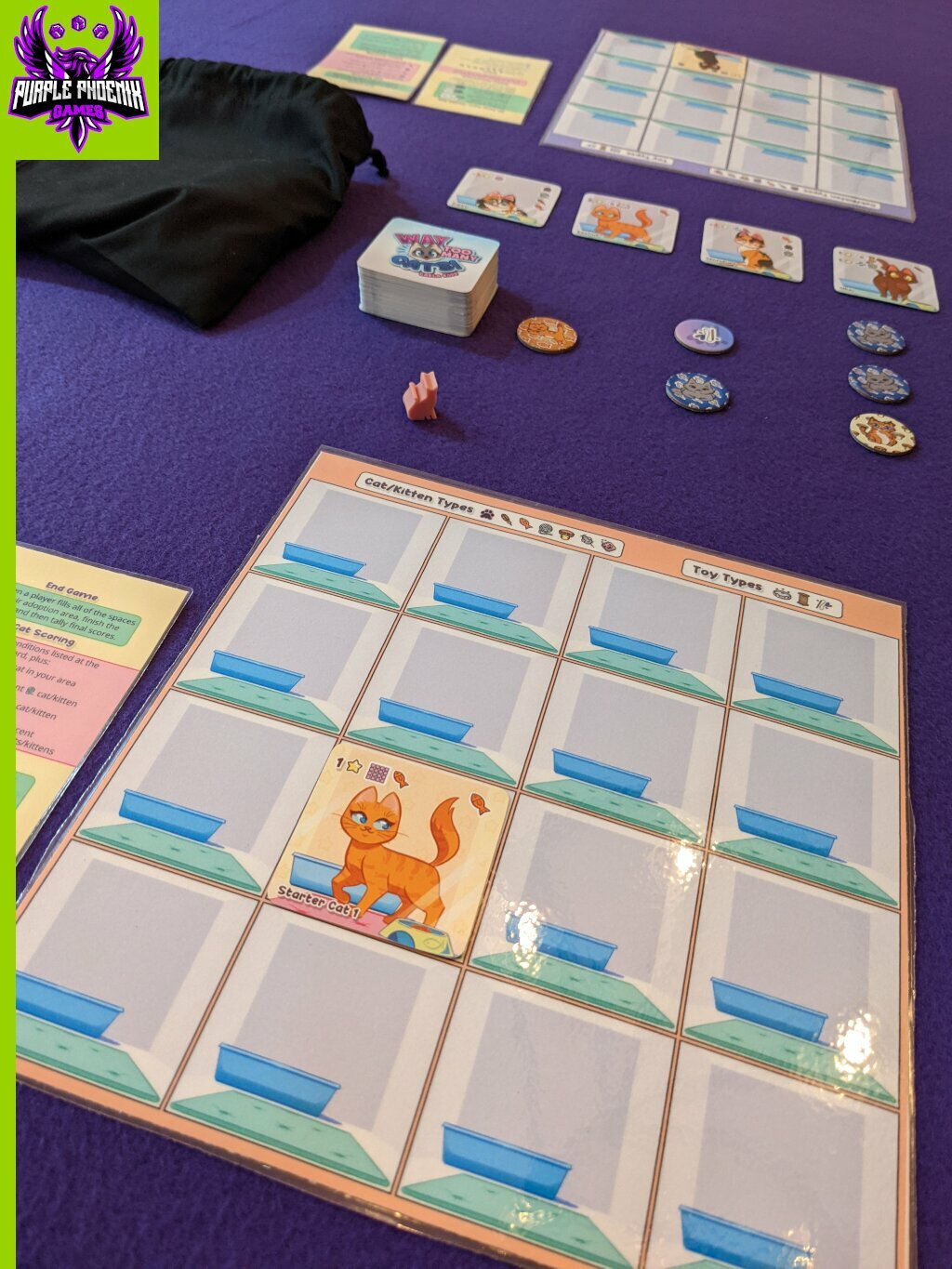
To setup, each player receives an adoption center board, starter cat tile, and a reference card. The kitten and toy tokens are placed into the provided bag to be shuffled and drawn later. The stack of adoptable cats is shuffled, and four drawn and revealed to create Cat Alley (from which players will be drafting). Nearby, three stacks of kitten/toy tokens are made with one stack containing one token, the next stack containing two, and the final stack containing three tokens. The starting player marker is given to the player who most recently pet a cat (aka probably attacked by a cat) and the game may begin!
A game of Way Too Many Cats lasts many rounds, and ends once all players have had the same amount of turns and one player having completely filled their adoption center. On a turn, the active player will take one mandatory action, and then will choose to take another two actions. The mandatory action that all players take each turn is to Choose a Token Set and Cat Card(s) and Place Them. A bit wordy, but this is a prototype, so I will let it slide. In any case, the player will choose to (1) take the smallest group of tokens and two Cat tiles of their choice, (2) take the mid-sized group of tokens and one Cat tile of their choice, or (3) take the largest group of tokens and the right-most Cat tile from Cat Alley (the offer row). Once the choice has been made and all components taken, the player then refreshes Cat Alley by sliding all tiles to the right and refilling to four tiles. Also, the player pulls three tokens from the bag and adds one to each group of tokens on the table. Note, as the player has just chosen a group of tokens, one of the groups will be empty until they place a token there – thus creating the smallest group and embiggening (I’m on a Marvel kick right now) the other two groups.
As an optional second action, the player may choose to give any cat in their adoption center a toy from their personal supply. Cat tiles show icons for toys that the cat will appreciate, though not every cat is into toys. Note, the toy tokens may be given to the cats on any turn, and even at the end of the game just before scoring.
Finally, at the end of the turn, the player may Create a Kitten Habitat by discarding three toy tokens to the bag. The player then designates a space on their adoption center to be the kitty haven and it can house any number of kittens.
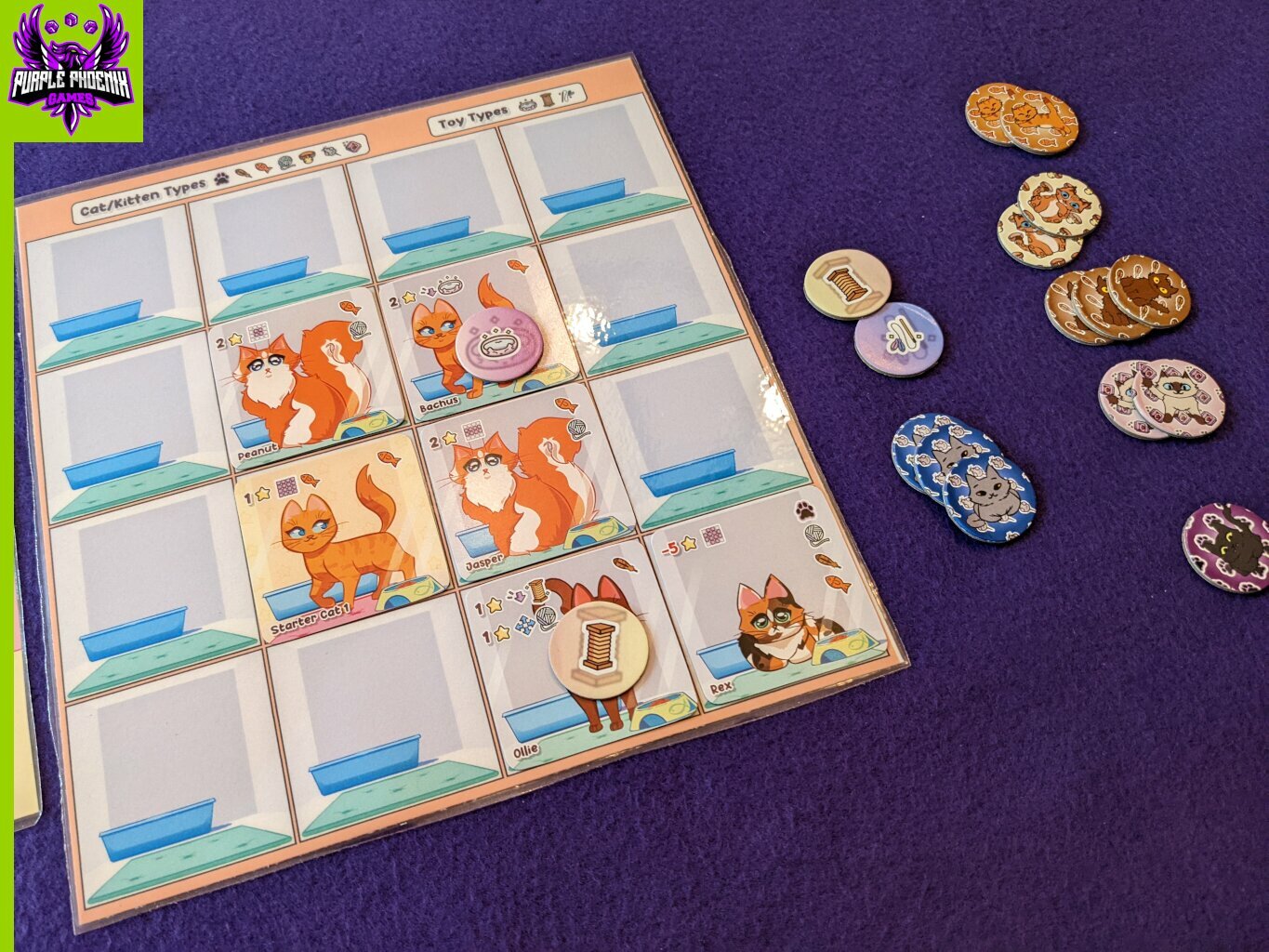
Once a player fills their last adoption center slot, the end game is triggered. Players will finish out the round so that all have an equal amount of turns. Then, points are tallied and scored following an involved scoring process. Points in this game are scored in numerous ways. Firstly, the starter cats are scored, and then each type of cat is scored. For example, the paw icon on cat tiles earn 1 VP for each adjacent cat of a different color. Each ball of yarn icon on cat tiles scores 2 VP. The goldfish cracker icon scores 2 VP for each adjacent cat or kitten sporting a ball of yarn icon. Finally, the feather icon scores 3/7/12/18 VP for each group of adjacent feather cats of train size 2/3/4/5 cats. So placement is very important in this game. Not enough scoring?
Players will score more points for kittens and for specific icons on cat tiles. 15 VP is awarded to a player who holds a complete set of the seven different types of kitten tokens, while another 8 VP is earned for holding a set of four matching kitten types. The player receives a -2VP penalty for each kitten token not associated with either type of set nor in a habitat on the board. Additionally, for each cat tile on the board, special scoring will be earned for supplying the tile with the requested toy, or placing it in the preferred space in the center, or even for other adjacency considerations.
Players will be scoring hundreds of points, and hopefully having their felines adopted by unsuspecting travelers and goo-goo eyed children. The player with the most VP at the end of the game is the winner!
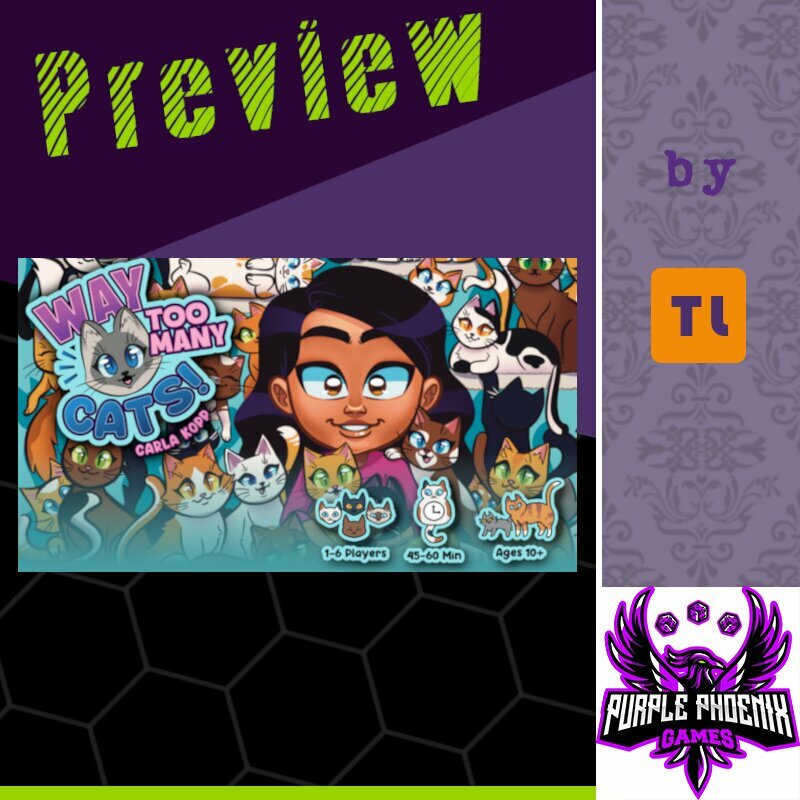
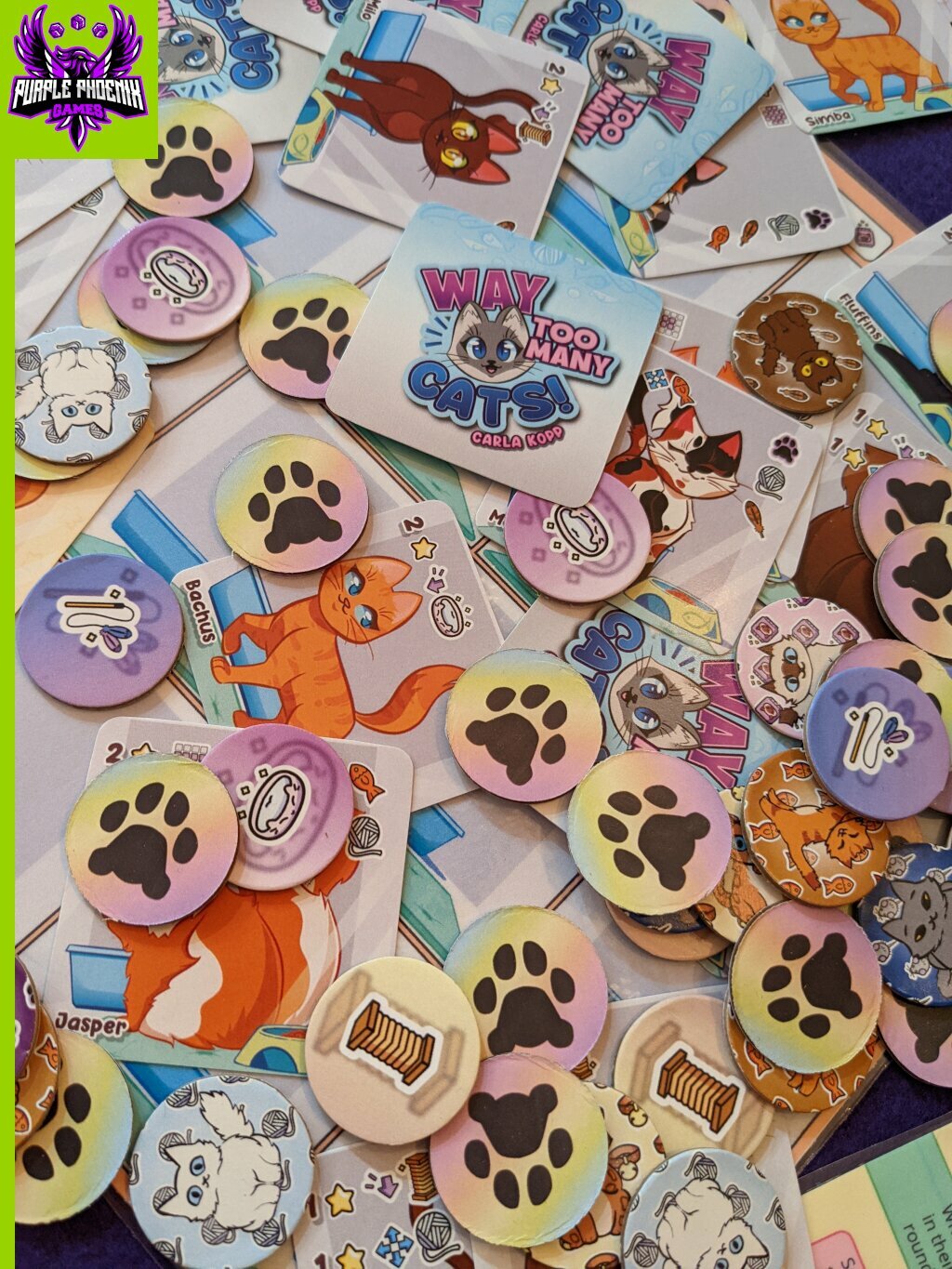
Components. Again, this is a prototype copy of the game, so I know that these are not final components at all. Having had many opportunities to preview for Weird Giraffe Games now, I am confident that the final game will be sparkling with upgrades and cool features. To reiterate, my interest in the theme is on the lower side, as I am not a cat person, but I can definitely understand the theme and it works well with this type of game. I guarantee that you will be able to spot Way Too Many Cats in stores right away because that box art is super colorful and busy. I do enjoy the cartoony art style, and it fits the theme really well. The final version of the game will undoubtedly affect this paragraph in the future, but for now this is well on the way to being a very solid title with regards to components, artwork, and theme.
But do I like it? Surprisingly, yes I do. Quite a bit. Theme goes a really long way with me, but I have been known to enjoy other games with themes that don’t necessarily resonate with me, so perhaps “surprising” isn’t the best term here. I really enjoy the spatial puzzle aspect of the game. I highlighted puzzle because that’s exactly what is going on here. When I am playing, I have to debate whether to take all those kitten tokens to complete my sets and be stuck with the right-most card, or perhaps taking the smallest group is more beneficial so that I can draft the two best cards for what I am building on my board. Is it really worth it to me to grab Taco just because I am starting to realize I have a food themed cat dispensary? Why does this cat need a scratching post token when it’s clearly been de-clawed?? These are serious questions, folks!
I kid, but only because this is a very light game, and one that I think works well in many situations. Have newer to intermediate level players coming over tonight? Grab Way Too Many Cats! Having an animal-themed game night? Pull this one out! Sticking with a mechanic-specific lineup? You got it. Now, I haven’t seen the Kickstarter page yet, nor have I asked Carla (the designer) what the plans are for it, but I know this one is close to many peoples’ hearts, so I imagine it will get all the love that’s possible in making this a wonder in a box. The mechanics are there. The theme is… great for some. Way Too Many Cats is a thinker in a catsuit disguise, but it is not too heavy to turn off casual or intermediate gamers. I can certainly add my stamp of approval and recommend checking out Way Too Many Cats. Look for it to hit Kickstarter in February and click here to be notified on launch. You will probably want to get in on this project early if any of this sounds appealing to you.
PS – How many catfolk did I offend in this preview? How many aquarists have I now befriended? What up, my peeps!
Way Too Many Cats is a cat and kitten drafting and spatial puzzle game for one to six players. In it, players work at feline adoption centers with the goal of having all stock adopted. To do this, players will be placing specific cats adjacent to other favorable cats for points, giving kittens a habitat of their own, and even supplying the cats with toys. The player who completes these tasks most effectively by the end of the game will score the most points and win!
DISCLAIMER: We were provided a prototype copy of this game for the purposes of this review. These are preview copy components, and I do not know for sure if the final components will be any different from these shown. Also, it is not my intention to detail every rule in the game, as there are just too many. You are invited to download the rulebook, back the game through the Kickstarter campaign, or through any retailers stocking it after fulfillment. -T
To setup, each player receives an adoption center board, starter cat tile, and a reference card. The kitten and toy tokens are placed into the provided bag to be shuffled and drawn later. The stack of adoptable cats is shuffled, and four drawn and revealed to create Cat Alley (from which players will be drafting). Nearby, three stacks of kitten/toy tokens are made with one stack containing one token, the next stack containing two, and the final stack containing three tokens. The starting player marker is given to the player who most recently pet a cat (aka probably attacked by a cat) and the game may begin!
A game of Way Too Many Cats lasts many rounds, and ends once all players have had the same amount of turns and one player having completely filled their adoption center. On a turn, the active player will take one mandatory action, and then will choose to take another two actions. The mandatory action that all players take each turn is to Choose a Token Set and Cat Card(s) and Place Them. A bit wordy, but this is a prototype, so I will let it slide. In any case, the player will choose to (1) take the smallest group of tokens and two Cat tiles of their choice, (2) take the mid-sized group of tokens and one Cat tile of their choice, or (3) take the largest group of tokens and the right-most Cat tile from Cat Alley (the offer row). Once the choice has been made and all components taken, the player then refreshes Cat Alley by sliding all tiles to the right and refilling to four tiles. Also, the player pulls three tokens from the bag and adds one to each group of tokens on the table. Note, as the player has just chosen a group of tokens, one of the groups will be empty until they place a token there – thus creating the smallest group and embiggening (I’m on a Marvel kick right now) the other two groups.
As an optional second action, the player may choose to give any cat in their adoption center a toy from their personal supply. Cat tiles show icons for toys that the cat will appreciate, though not every cat is into toys. Note, the toy tokens may be given to the cats on any turn, and even at the end of the game just before scoring.
Finally, at the end of the turn, the player may Create a Kitten Habitat by discarding three toy tokens to the bag. The player then designates a space on their adoption center to be the kitty haven and it can house any number of kittens.
Once a player fills their last adoption center slot, the end game is triggered. Players will finish out the round so that all have an equal amount of turns. Then, points are tallied and scored following an involved scoring process. Points in this game are scored in numerous ways. Firstly, the starter cats are scored, and then each type of cat is scored. For example, the paw icon on cat tiles earn 1 VP for each adjacent cat of a different color. Each ball of yarn icon on cat tiles scores 2 VP. The goldfish cracker icon scores 2 VP for each adjacent cat or kitten sporting a ball of yarn icon. Finally, the feather icon scores 3/7/12/18 VP for each group of adjacent feather cats of train size 2/3/4/5 cats. So placement is very important in this game. Not enough scoring?
Players will score more points for kittens and for specific icons on cat tiles. 15 VP is awarded to a player who holds a complete set of the seven different types of kitten tokens, while another 8 VP is earned for holding a set of four matching kitten types. The player receives a -2VP penalty for each kitten token not associated with either type of set nor in a habitat on the board. Additionally, for each cat tile on the board, special scoring will be earned for supplying the tile with the requested toy, or placing it in the preferred space in the center, or even for other adjacency considerations.
Players will be scoring hundreds of points, and hopefully having their felines adopted by unsuspecting travelers and goo-goo eyed children. The player with the most VP at the end of the game is the winner!
Components. Again, this is a prototype copy of the game, so I know that these are not final components at all. Having had many opportunities to preview for Weird Giraffe Games now, I am confident that the final game will be sparkling with upgrades and cool features. To reiterate, my interest in the theme is on the lower side, as I am not a cat person, but I can definitely understand the theme and it works well with this type of game. I guarantee that you will be able to spot Way Too Many Cats in stores right away because that box art is super colorful and busy. I do enjoy the cartoony art style, and it fits the theme really well. The final version of the game will undoubtedly affect this paragraph in the future, but for now this is well on the way to being a very solid title with regards to components, artwork, and theme.
But do I like it? Surprisingly, yes I do. Quite a bit. Theme goes a really long way with me, but I have been known to enjoy other games with themes that don’t necessarily resonate with me, so perhaps “surprising” isn’t the best term here. I really enjoy the spatial puzzle aspect of the game. I highlighted puzzle because that’s exactly what is going on here. When I am playing, I have to debate whether to take all those kitten tokens to complete my sets and be stuck with the right-most card, or perhaps taking the smallest group is more beneficial so that I can draft the two best cards for what I am building on my board. Is it really worth it to me to grab Taco just because I am starting to realize I have a food themed cat dispensary? Why does this cat need a scratching post token when it’s clearly been de-clawed?? These are serious questions, folks!
I kid, but only because this is a very light game, and one that I think works well in many situations. Have newer to intermediate level players coming over tonight? Grab Way Too Many Cats! Having an animal-themed game night? Pull this one out! Sticking with a mechanic-specific lineup? You got it. Now, I haven’t seen the Kickstarter page yet, nor have I asked Carla (the designer) what the plans are for it, but I know this one is close to many peoples’ hearts, so I imagine it will get all the love that’s possible in making this a wonder in a box. The mechanics are there. The theme is… great for some. Way Too Many Cats is a thinker in a catsuit disguise, but it is not too heavy to turn off casual or intermediate gamers. I can certainly add my stamp of approval and recommend checking out Way Too Many Cats. Look for it to hit Kickstarter in February and click here to be notified on launch. You will probably want to get in on this project early if any of this sounds appealing to you.
PS – How many catfolk did I offend in this preview? How many aquarists have I now befriended? What up, my peeps!