
Search
Search results

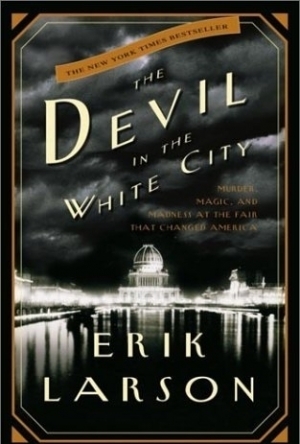
Hadley (567 KP) rated The Devil in the White City: Murder, Magic, and Madness in Books
Jan 18, 2021

History (1 more)
Well-written
H.H. Holmes had many aliases and lives.
He's been a doctor and a licensed pharmacist, who then conned an old couple into selling their drug store to him where he preyed on young girls and ignorant customers that would buy whatever Holmes would tell them to buy, whether it were real or fake tonics.
He was a building owner who had a murder hotel secretly built with " a wooden chute that would descend from a secret location on the second floor all the way to the basement... ", "a room next to his office fitted with a large walk-in vault, with airtight seams and asbestos-coated iron walls. A gas jet embedded in one wall would be controlled from his closet...", "a large basement with hidden chambers and a sub-basement for the permanent storage of sensitive material. "
He owned and ran an alcohol-treatment company known as the Silver Ash Institute that claimed to have the cure for alcoholism.
He was a traveling business man, who had two wives and two children. He established the Campbell-Yates Manufacturing Company, which made nothing and sold nothing.
He was also labeled as America's first serial killer. His body count is unknown even today; his victims were frequently young women, which included stenographers and house wives. He was best known for convincing people who trusted him to sign him as the beneficiary of their life insurance policies, only to kill them and make it seem an accident so he could collect the money.
Holmes grew up in a small farming village in New Hampshire, where he briefly spoke about an early fear of a human skeleton that hung in a doctor's office: " 'I had daily to pass the office of one village doctor, the door of which was seldom if ever barred,' he wrote in a later memoir. 'Partly from its being associated in my mind as the source of all the nauseous mixtures that had been my childish terror (for this was before the day of children's medicines), and partly because of vague rumors I had heard regarding its contents, this place was one of peculiar abhorrence to me.' "... "Two children discovered Mudgett's [Holmes' real last name] fear and one day captured him and dragged him 'struggling and shrieking' into the doctor's office. 'Nor did they desist,' Mudgett wrote, 'until I had been brought face to face with one of its grinning skeletons, which, with arms outstretched, seemed ready in its turn to seize me. It was a wicked and dangerous thing to do to a child of tender years and health,' he wrote, ' but it proved an heroic method of treatment, destined ultimately to cure me of my fears, and to inculcate in me, first, a strong feeling of curiosity, and, later, a desire to learn, which resulted years afterwards in my adopting medicine as a profession.' "
Erik Larson's fourth book, the Devil in the White City, is only partly about Holmes and his dark trail of murder and lies. The story told is mostly centered around the planning and building of the 1893 World's Fair. The prologue opens with one of the architects aboard a ship long after the fair has ended - - - 1912 to be exact- - - where he begins to write of the fair in his diary. The next chapter continues on with Chicago competing against other major cities to win the rights to host the World's Fair. Chicago was not the ideal place for the fair because it was known for it's crime and slaughter houses - - - this was exactly why the politicians wanted it so badly there, so it would help to lighten the image of Chicago for the rest of the world. Even the local Whitechapel Club that had sprouted up after the infamous murders by Jack the Ripper, were excited to win the rights to host the fair in their city, and celebrated in a macabre way:
"Upon learning that Chicago had won the fair, the men of the Whitechapel Club composed a telegram to Chauncey Depew, who more than any other man symbolized New York and its campaign to win the fair. Previously Depew had promised the members of the Whitechapel Club that if Chicago prevailed he would present himself at the club's next meeting, to be hacked apart by the Ripper himself - - - metaphorically, he presumed, although at the Whitechapel Club could one ever be certain? The club's coffin, for example, had once been used to transport the body of a member who had committed suicide. After claiming his body, the club hauled it to the Indiana Dunes on Lake Michigan, where members erected an immense pyre. They placed the body on top, then set it alight. Carrying torches and wearing black hooded robes, they circled the fire singing hymns to the dead between sips of whiskey. The club also had a custom of sending robed members to kidnap visiting celebrities and steal them away in a black coach with covered windows, all without saying a word.
The club's telegram reached Depew in Washington twenty minutes after the final ballot, just as Chicago's congressional delegation began celebrating at the Willard Hotel near the White House. The telegram asked, 'When may we see you at our dissecting table?' "
There are chapters in-between, technically reading like a side story, that tell us about Holmes and his misdeeds in Chicago, but there just wasn't enough about Holmes that I could consider this a True Crime book, nor an informative book about Holmes. Unfortunately, when the reader begins to really dwell into the story of Holmes, it's quickly ended by having two or more chapters about the building of the World's Fair. One interesting point about the story is that the reader does get to see how many inventions were brought to light because of the Fair, such as the invention of the Ferris Wheel. Larson's writing is very coherent and the descriptions are so well done that the reader is practically transported back to the late 1800s, yet, before I finished the book, I felt misled by the title... then coming across everything that happened to not only the Fair, but the people who were involved with it, it's hard not to wonder if the whole thing was cursed, thus the Devil being in the White City.
One of the side stories I did really enjoy was the slow unfolding of a man named Prendergast. A delusional young man who ran one of the groups of paperboys in Chicago, who was also obsessed with politics, became a determined supporter of Mayor Harrison; after Harrison was voted into office again, Prendergast believed it was because of him and the letters he sent out to numerous politicians and potential voters. Prendergast also believed he deserved a chair on the council for Harrison's re-election, for which he even showed up at City Hall to take over. This incident was the straw that broke the camel's back for Prendergast - - - he was humiliated when the people there laughed in his face. Prendergast then decided to take matters into his own hands, and bought a revolver. The day before the Fair would end, Prendergast showed up at Harrison's home and shot him. Harrison died minutes later. Prendergast turned himself in for the murder as soon as he left Harrison's residence. When asked why he had done it, Prendergast responded: " ' Because he betrayed my confidence. I supported him through his campaign and he promised to appoint me corporation counsel. He didn't live up to his word.' "
This book has been voted as a top True Crime must-read novel. I don't agree with this. As I said before: Holmes' chapters are few; eighty percent of this book is about the building of the World's Fair. As a True Crime junkie, I didn't enjoy this one, but also as a history junkie, I enjoyed learning about the Fair and everything that happened. I can't recommend this book to TC fans or horror fans. It's mostly history and architecture.
He's been a doctor and a licensed pharmacist, who then conned an old couple into selling their drug store to him where he preyed on young girls and ignorant customers that would buy whatever Holmes would tell them to buy, whether it were real or fake tonics.
He was a building owner who had a murder hotel secretly built with " a wooden chute that would descend from a secret location on the second floor all the way to the basement... ", "a room next to his office fitted with a large walk-in vault, with airtight seams and asbestos-coated iron walls. A gas jet embedded in one wall would be controlled from his closet...", "a large basement with hidden chambers and a sub-basement for the permanent storage of sensitive material. "
He owned and ran an alcohol-treatment company known as the Silver Ash Institute that claimed to have the cure for alcoholism.
He was a traveling business man, who had two wives and two children. He established the Campbell-Yates Manufacturing Company, which made nothing and sold nothing.
He was also labeled as America's first serial killer. His body count is unknown even today; his victims were frequently young women, which included stenographers and house wives. He was best known for convincing people who trusted him to sign him as the beneficiary of their life insurance policies, only to kill them and make it seem an accident so he could collect the money.
Holmes grew up in a small farming village in New Hampshire, where he briefly spoke about an early fear of a human skeleton that hung in a doctor's office: " 'I had daily to pass the office of one village doctor, the door of which was seldom if ever barred,' he wrote in a later memoir. 'Partly from its being associated in my mind as the source of all the nauseous mixtures that had been my childish terror (for this was before the day of children's medicines), and partly because of vague rumors I had heard regarding its contents, this place was one of peculiar abhorrence to me.' "... "Two children discovered Mudgett's [Holmes' real last name] fear and one day captured him and dragged him 'struggling and shrieking' into the doctor's office. 'Nor did they desist,' Mudgett wrote, 'until I had been brought face to face with one of its grinning skeletons, which, with arms outstretched, seemed ready in its turn to seize me. It was a wicked and dangerous thing to do to a child of tender years and health,' he wrote, ' but it proved an heroic method of treatment, destined ultimately to cure me of my fears, and to inculcate in me, first, a strong feeling of curiosity, and, later, a desire to learn, which resulted years afterwards in my adopting medicine as a profession.' "
Erik Larson's fourth book, the Devil in the White City, is only partly about Holmes and his dark trail of murder and lies. The story told is mostly centered around the planning and building of the 1893 World's Fair. The prologue opens with one of the architects aboard a ship long after the fair has ended - - - 1912 to be exact- - - where he begins to write of the fair in his diary. The next chapter continues on with Chicago competing against other major cities to win the rights to host the World's Fair. Chicago was not the ideal place for the fair because it was known for it's crime and slaughter houses - - - this was exactly why the politicians wanted it so badly there, so it would help to lighten the image of Chicago for the rest of the world. Even the local Whitechapel Club that had sprouted up after the infamous murders by Jack the Ripper, were excited to win the rights to host the fair in their city, and celebrated in a macabre way:
"Upon learning that Chicago had won the fair, the men of the Whitechapel Club composed a telegram to Chauncey Depew, who more than any other man symbolized New York and its campaign to win the fair. Previously Depew had promised the members of the Whitechapel Club that if Chicago prevailed he would present himself at the club's next meeting, to be hacked apart by the Ripper himself - - - metaphorically, he presumed, although at the Whitechapel Club could one ever be certain? The club's coffin, for example, had once been used to transport the body of a member who had committed suicide. After claiming his body, the club hauled it to the Indiana Dunes on Lake Michigan, where members erected an immense pyre. They placed the body on top, then set it alight. Carrying torches and wearing black hooded robes, they circled the fire singing hymns to the dead between sips of whiskey. The club also had a custom of sending robed members to kidnap visiting celebrities and steal them away in a black coach with covered windows, all without saying a word.
The club's telegram reached Depew in Washington twenty minutes after the final ballot, just as Chicago's congressional delegation began celebrating at the Willard Hotel near the White House. The telegram asked, 'When may we see you at our dissecting table?' "
There are chapters in-between, technically reading like a side story, that tell us about Holmes and his misdeeds in Chicago, but there just wasn't enough about Holmes that I could consider this a True Crime book, nor an informative book about Holmes. Unfortunately, when the reader begins to really dwell into the story of Holmes, it's quickly ended by having two or more chapters about the building of the World's Fair. One interesting point about the story is that the reader does get to see how many inventions were brought to light because of the Fair, such as the invention of the Ferris Wheel. Larson's writing is very coherent and the descriptions are so well done that the reader is practically transported back to the late 1800s, yet, before I finished the book, I felt misled by the title... then coming across everything that happened to not only the Fair, but the people who were involved with it, it's hard not to wonder if the whole thing was cursed, thus the Devil being in the White City.
One of the side stories I did really enjoy was the slow unfolding of a man named Prendergast. A delusional young man who ran one of the groups of paperboys in Chicago, who was also obsessed with politics, became a determined supporter of Mayor Harrison; after Harrison was voted into office again, Prendergast believed it was because of him and the letters he sent out to numerous politicians and potential voters. Prendergast also believed he deserved a chair on the council for Harrison's re-election, for which he even showed up at City Hall to take over. This incident was the straw that broke the camel's back for Prendergast - - - he was humiliated when the people there laughed in his face. Prendergast then decided to take matters into his own hands, and bought a revolver. The day before the Fair would end, Prendergast showed up at Harrison's home and shot him. Harrison died minutes later. Prendergast turned himself in for the murder as soon as he left Harrison's residence. When asked why he had done it, Prendergast responded: " ' Because he betrayed my confidence. I supported him through his campaign and he promised to appoint me corporation counsel. He didn't live up to his word.' "
This book has been voted as a top True Crime must-read novel. I don't agree with this. As I said before: Holmes' chapters are few; eighty percent of this book is about the building of the World's Fair. As a True Crime junkie, I didn't enjoy this one, but also as a history junkie, I enjoyed learning about the Fair and everything that happened. I can't recommend this book to TC fans or horror fans. It's mostly history and architecture.
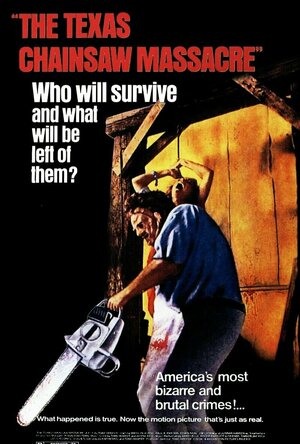
The Texas Chain Saw Massacre (1974)
8.3 Rate It
Movie Watch
The film opens by revealing that a cemetery in rural Texas has been vandalized; several gravesites...
horror

Cody Cook (8 KP) rated Writings Of Thomas Paine Volume 4 (1794 1796); The Age Of Reason in Books
Jun 29, 2018


Thomas Paine was a political theorist who was perhaps best known for his support for the American Revolution in his pamphlet Common Sense. In what might be his second best known work, The Age of Reason, Paine argued in favor of deism and against the Christian religion and its conception of God. By deism it is meant the belief in a creator God who does not violate the laws of nature by communicating through revelation or miracles The book was very successful and widely read partly due to the fact that it was written in a style which appealed to a popular audience and often implemented a sarcastic, derisive tone to make its points.
The book seems to have had three major objectives: the support of deism, the ridicule of what Paine found loathsome in Christian theology, and the demonstration of how poor an example the Bible is as a reflection of God.
In a sense, Paine's arguments against Christian theology and scripture were meant to prop up his deistic philosophy. Paine hoped that in demonizing Christianity while giving evidences for God, he would somehow have made the case for deism. But this is not so. If Christianity is false, but God exists nonetheless, we are not left only with deism. There are an infinite number of possibilities for us to examine regarding the nature of God, and far too many left over once we have eliminated the obviously false ones. In favor of deism Paine has only one argument—his dislike of supernatural revelation, which is to say that deism appeals to his culturally derived preferences. In any case, Paine's thinking on the matter seemed to be thus: if supernatural revelation could be shown to be inadequate and the development of complex theology shown to be an error, one could still salvage a belief in God as Creator, but not as an interloper in human affairs who required mediators.
That being said, in his support of deism, Paine makes some arguments to demonstrate the reasonableness in belief in, if not the logical necessity of the existence of, God which could be equally used by Christians.
For instance, just as the apostle Paul argued in his epistle to the Romans that, "what can be known about God is plain to [even pagans], because God has shown it to them. For his invisible attributes, namely, his eternal power and divine nature, have been clearly perceived, ever since the creation of the world, in the things that have been made" (Romans 1:19-20, ESV), so also Paine can say that, "the Creation speaketh an universal language [which points to the existence of God], independently of human speech or human language, multiplied and various as they be."
The key point on which Paine differs from Paul on this issue is in his optimism about man's ability to reason to God without His assisting from the outside. Whereas Paul sees the plainness of God from natural revelation as an argument against the inherent goodness of a species which can read the record of nature and nevertheless rejects its Source's obvious existence, Paine thinks that nature and reason can and do lead us directly to the knowledge of God's existence apart from any gracious overtures or direct revelation.
On the witness of nature, Paine claims, and is quite correct, that, "THE WORD OF GOD IS THE CREATION WE BEHOLD: And it is in this word, which no human invention can counterfeit or alter, that God speaketh universally to man." What is not plainly clear, however, is that man is free enough from the noetic effects of sin to reach such an obvious conclusion on his own. Indeed, the attempts of mankind to create a religion which represents the truth have invariably landed them at paganism. By paganism I mean a system of belief based, as Yehezkel Kaufmann and John N. Oswalt have shown, on continuity.iv In polytheism, even the supernatural is not really supernatural, but is perhaps in some way above humans while not being altogether distinct from us. What happens to the gods is merely what happens to human beings and the natural world writ large, which is why the gods are, like us, victims of fate, and why pagan fertility rituals have attempted to influence nature by influencing the gods which represent it in accordance with the deeper magic of the eternal universe we all inhabit.
When mankind has looked at nature without the benefit of supernatural revelation, he has not been consciously aware of a Being outside of nature which is necessarily responsible for it. His reasoning to metaphysics is based entirely on his own naturalistic categories derived from his own experience. According to Moses, it took God revealing Himself to the Hebrews for anyone to understand what Paine thinks anyone can plainly see.
The goal of deism is to hold onto what the western mind, which values extreme independence of thought, views as attractive in theism while casting aside what it finds distasteful. But as C.S. Lewis remarked, Aslan is not a tame lion. If a sovereign God exists, He cannot be limited by your desires of what you'd like Him to be. For this reason, the deism of men like Paine served as a cultural stepping stone toward the atheism of later intellectuals.
For Paine, as for other deists and atheists like him, it is not that Christianity has been subjected to reason and found wanting, but that it has been subjected to his own private and culturally-determined tastes and preferences and has failed to satisfy. This is the flipside of the anti-religious claim that those who believe in a given religion only do so because of their cultural conditioning: the anti-religionist is also conditioned in a similar way. Of course, how one comes to believe a certain thing has no bearing on whether that thing is true in itself, and this is true whether Christianity, atheism, or any other view is correct. But it must be stated that the deist or atheist is not immune from the epistemic difficulties which he so condescendingly heaps on theists.
One of the befuddling ironies of Paine's work is that around the time he was writing about the revealed religions as, “no other than human inventions set up to terrify and enslave mankind, and monopolize power and profit," the French were turning churches into “temples of reason” and murdering thousands at the guillotine (an instrument of execution now most strongly identified with France's godless reign of terror). Paine, who nearly lost his own life during the French Revolution, saw the danger of this atheism and hoped to stay its progress, despite the risk to his own life in attempting to do so.
What is odd is that Paine managed to blame this violent atheism upon the Christian faith! Obfuscated Paine:
"The Idea, always dangerous to Society as it is derogatory to the Almighty, — that priests could forgive sins, — though it seemed to exist no longer, had blunted the feelings of humanity, and callously prepared men for the commission of all crimes. The intolerant spirit of church persecution had transferred itself into politics; the tribunals, stiled Revolutionary, supplied the place of an Inquisition; and the Guillotine of the Stake. I saw many of my most intimate friends destroyed; others daily carried to prison; and I had reason to believe, and had also intimations given me, that the same danger was approaching myself."
That Robespierre's deism finally managed to supplant the revolutionary state's atheism and that peace, love, and understanding did not then spread throughout the land undermines Paine's claims. Paine felt that the revolution in politics, especially as represented in America, would necessarily lead to a revolution in religion, and that this religious revolution would result in wide acceptance of deism. The common link between these two revolutions was the idea that the individual man was sovereign and could determine for himself what was right and wrong based on his autonomous reason. What Paine was too myopic to see was that in France's violence and atheism was found the logical consequence of his individualistic philosophy. In summary, it is not Christianity which is dangerous, but the spirit of autonomy which leads inevitably into authoritarianism by way of human desire.
As should be clear by now, Paine failed to understand that human beings have a strong tendency to set impartial reason aside and to simply evaluate reality based on their desires and psychological states. This is no more obvious than in his own ideas as expressed in The Age of Reason. Like Paine's tendency to designate every book in the Old Testament which he likes as having been written originally by a gentile and translated into Hebrew, so many of his criticisms of Christian theology are far more a reflection upon himself than of revealed Christianity. One has only to look at Paine's description of Jesus Christ as a “virtuous reformer and revolutionist” to marvel that Paine was so poor at introspection so as to not understand that he was describing himself.
There is much more that could be said about this work, but in the interest of being somewhat concise, I'll end my comments here. If you found this analysis to be useful, be sure to check out my profile and look for my work discussing Paine and other anti-Christian writers coming soon.
The book seems to have had three major objectives: the support of deism, the ridicule of what Paine found loathsome in Christian theology, and the demonstration of how poor an example the Bible is as a reflection of God.
In a sense, Paine's arguments against Christian theology and scripture were meant to prop up his deistic philosophy. Paine hoped that in demonizing Christianity while giving evidences for God, he would somehow have made the case for deism. But this is not so. If Christianity is false, but God exists nonetheless, we are not left only with deism. There are an infinite number of possibilities for us to examine regarding the nature of God, and far too many left over once we have eliminated the obviously false ones. In favor of deism Paine has only one argument—his dislike of supernatural revelation, which is to say that deism appeals to his culturally derived preferences. In any case, Paine's thinking on the matter seemed to be thus: if supernatural revelation could be shown to be inadequate and the development of complex theology shown to be an error, one could still salvage a belief in God as Creator, but not as an interloper in human affairs who required mediators.
That being said, in his support of deism, Paine makes some arguments to demonstrate the reasonableness in belief in, if not the logical necessity of the existence of, God which could be equally used by Christians.
For instance, just as the apostle Paul argued in his epistle to the Romans that, "what can be known about God is plain to [even pagans], because God has shown it to them. For his invisible attributes, namely, his eternal power and divine nature, have been clearly perceived, ever since the creation of the world, in the things that have been made" (Romans 1:19-20, ESV), so also Paine can say that, "the Creation speaketh an universal language [which points to the existence of God], independently of human speech or human language, multiplied and various as they be."
The key point on which Paine differs from Paul on this issue is in his optimism about man's ability to reason to God without His assisting from the outside. Whereas Paul sees the plainness of God from natural revelation as an argument against the inherent goodness of a species which can read the record of nature and nevertheless rejects its Source's obvious existence, Paine thinks that nature and reason can and do lead us directly to the knowledge of God's existence apart from any gracious overtures or direct revelation.
On the witness of nature, Paine claims, and is quite correct, that, "THE WORD OF GOD IS THE CREATION WE BEHOLD: And it is in this word, which no human invention can counterfeit or alter, that God speaketh universally to man." What is not plainly clear, however, is that man is free enough from the noetic effects of sin to reach such an obvious conclusion on his own. Indeed, the attempts of mankind to create a religion which represents the truth have invariably landed them at paganism. By paganism I mean a system of belief based, as Yehezkel Kaufmann and John N. Oswalt have shown, on continuity.iv In polytheism, even the supernatural is not really supernatural, but is perhaps in some way above humans while not being altogether distinct from us. What happens to the gods is merely what happens to human beings and the natural world writ large, which is why the gods are, like us, victims of fate, and why pagan fertility rituals have attempted to influence nature by influencing the gods which represent it in accordance with the deeper magic of the eternal universe we all inhabit.
When mankind has looked at nature without the benefit of supernatural revelation, he has not been consciously aware of a Being outside of nature which is necessarily responsible for it. His reasoning to metaphysics is based entirely on his own naturalistic categories derived from his own experience. According to Moses, it took God revealing Himself to the Hebrews for anyone to understand what Paine thinks anyone can plainly see.
The goal of deism is to hold onto what the western mind, which values extreme independence of thought, views as attractive in theism while casting aside what it finds distasteful. But as C.S. Lewis remarked, Aslan is not a tame lion. If a sovereign God exists, He cannot be limited by your desires of what you'd like Him to be. For this reason, the deism of men like Paine served as a cultural stepping stone toward the atheism of later intellectuals.
For Paine, as for other deists and atheists like him, it is not that Christianity has been subjected to reason and found wanting, but that it has been subjected to his own private and culturally-determined tastes and preferences and has failed to satisfy. This is the flipside of the anti-religious claim that those who believe in a given religion only do so because of their cultural conditioning: the anti-religionist is also conditioned in a similar way. Of course, how one comes to believe a certain thing has no bearing on whether that thing is true in itself, and this is true whether Christianity, atheism, or any other view is correct. But it must be stated that the deist or atheist is not immune from the epistemic difficulties which he so condescendingly heaps on theists.
One of the befuddling ironies of Paine's work is that around the time he was writing about the revealed religions as, “no other than human inventions set up to terrify and enslave mankind, and monopolize power and profit," the French were turning churches into “temples of reason” and murdering thousands at the guillotine (an instrument of execution now most strongly identified with France's godless reign of terror). Paine, who nearly lost his own life during the French Revolution, saw the danger of this atheism and hoped to stay its progress, despite the risk to his own life in attempting to do so.
What is odd is that Paine managed to blame this violent atheism upon the Christian faith! Obfuscated Paine:
"The Idea, always dangerous to Society as it is derogatory to the Almighty, — that priests could forgive sins, — though it seemed to exist no longer, had blunted the feelings of humanity, and callously prepared men for the commission of all crimes. The intolerant spirit of church persecution had transferred itself into politics; the tribunals, stiled Revolutionary, supplied the place of an Inquisition; and the Guillotine of the Stake. I saw many of my most intimate friends destroyed; others daily carried to prison; and I had reason to believe, and had also intimations given me, that the same danger was approaching myself."
That Robespierre's deism finally managed to supplant the revolutionary state's atheism and that peace, love, and understanding did not then spread throughout the land undermines Paine's claims. Paine felt that the revolution in politics, especially as represented in America, would necessarily lead to a revolution in religion, and that this religious revolution would result in wide acceptance of deism. The common link between these two revolutions was the idea that the individual man was sovereign and could determine for himself what was right and wrong based on his autonomous reason. What Paine was too myopic to see was that in France's violence and atheism was found the logical consequence of his individualistic philosophy. In summary, it is not Christianity which is dangerous, but the spirit of autonomy which leads inevitably into authoritarianism by way of human desire.
As should be clear by now, Paine failed to understand that human beings have a strong tendency to set impartial reason aside and to simply evaluate reality based on their desires and psychological states. This is no more obvious than in his own ideas as expressed in The Age of Reason. Like Paine's tendency to designate every book in the Old Testament which he likes as having been written originally by a gentile and translated into Hebrew, so many of his criticisms of Christian theology are far more a reflection upon himself than of revealed Christianity. One has only to look at Paine's description of Jesus Christ as a “virtuous reformer and revolutionist” to marvel that Paine was so poor at introspection so as to not understand that he was describing himself.
There is much more that could be said about this work, but in the interest of being somewhat concise, I'll end my comments here. If you found this analysis to be useful, be sure to check out my profile and look for my work discussing Paine and other anti-Christian writers coming soon.

5 Minute Movie Guy (379 KP) rated Godzilla (2014) in Movies
Jun 26, 2019

Godzilla's gigantic scale is impressive. (1 more)
Bryan Cranston gives a terrific performance.
Aaron Taylor-Johnson is a horribly lifeless protagonist. (2 more)
The film repeatedly obscures our chances to see Godzilla or cuts away from him completely.
There seems to be very little sense of panic or concern despite Godzilla and MUTO's destruction.
As promising as this new Godzilla movie may appear to be, it falls far short of expectations, and dare I say, it isn’t even much better than the 1998 version.
This year marks the 60th anniversary of the original Godzilla film, when the King of the Monsters first emerged from the Pacific and terrorized Tokyo, Japan. Roughly 10 years after America dropped two atomic bombs on Japan to end World War II, Godzilla was artistically created to be a physical, living representation of the destructive force of those bombs. Even the texture of his skin is modelled after keloid scars, which were found on survivors as a result of the radiation. Godzilla’s arrival and subsequent attacks were spurred by the use of nuclear weapons, and he as a character wholly embodies the consequences of nuclear warfare.
60 years later, Godzilla remains a global icon, having spawned dozens of movie sequels, while introducing several other enormous monsters to battle with. Then 16 years ago, he was reimagined as he first came to America in Roland Emmerich’s lackluster 1998 film Godzilla, leaving many fans severely disappointed with not only the film, but also the new rendition of the famous monster. While Godzilla is visually depicted much more accurately in Gareth Edward’s new 2014 Godzilla than he was in ’98, his entire presence is surprisingly different than usual. This isn’t the angry, vengeful Godzilla of the past. He actually now seems almost entirely indifferent to humans. Unfortunately, as promising as this new Godzilla movie may appear to be, it falls far short of expectations, and dare I say, it isn’t even much better than the 1998 Godzilla.
Godzilla (2014) starts off pretty well, strengthened by the performance of Bryan Cranston, who plays Joe Brody, a nuclear power plant engineer living in Japan. Brody is present when an unknown disaster occurs at the plant, costing many innocent lives. Despite what the trailers suggest, Cranston’s Brody is not the main character of the film. Nor is it fellow all-star actor Ken Watanabe. The main character is actually only seen for about 4 seconds of the film’s original 2 and a half minute trailer. It’s Joe Brody’s son, Ford, played by Aaron Taylor-Johnson, in a performance that is decent but far from engaging. The protagonist Ford Brody is a character that is largely uninteresting, and who just casually wants to get back to his family after the monster invasion. He fails to convey any genuine sense of urgency amidst the chaos, although the same can be said for the entire cast, with the exception of Cranston’s Brody. Cranston’s performance is the only one that has any emotional weight to it, but he can’t carry the film alone. Meanwhile, Ken Watanabe is essentially reduced to being the quiet, ever-present voice of reason that no one wants to listen to. The film has a solid cast of actors, but they’re not given enough to work with in this convoluted mess of a movie.
For a movie that has so much death and destruction, the people in the film never seem all that concerned. You get no sense of global panic and hysteria. You have a 300-foot-tall monster destroying cities, with millions of people dying, and yet nobody seems all that freaked out by it. It’s almost like the situation isn’t treated as a serious threat, and there’s a major lack of suspense altogether. There’s rarely any edge-of-your-seat terror or excitement, and the lack of emotion just makes the action come off as sort of flat and dull. Not only that, the majority of the destruction that’s taking place isn’t even seen, with the movie instead opting to show you the aftermath. Throughout the first two-thirds of the movie, the camera continuously cuts away from the action you’ve been waiting for. Rather than showing you what you want to see in full-glory, the movie frequently will take you to a different location where you’ll briefly see a few seconds of the catastrophe being watched by someone on television. It feels like a cheap trick to build up to some amazing climax, but it’s incredibly frustrating. It’s like when watching a reality TV show and then the show cuts to a commercial break before revealing the winner. Perhaps it would be more forgivable if the end was enjoyable, but even though it does give you a full display of the showdown, it’s bogged down by a tiresome human story and still lacks any real emotional punch. Despite the fact that the movie tries to convey a serious tone, it’s also incredibly cheesy. To the extent that the big finale that this movie has been trying so hard to build up to ends up being almost laughable. Ultimately the movie ends up just being unsatisfying, disappointing, and overly long.
There are a lot of ways in which Godzilla goes wrong, despite the film’s great potential. One of my issues is with the musical score, which ends up coming off like a bad punchline. Music is supposed to accentuate the action and drama of a film, yet the film feels emotionless and boring. The only time the music really stood out to me was when it was being used to heighten the suspense of the climactic battle, and essentially narrate who was winning. It was done so ineffectively that it was both kind of comical and embarrassing. I also have an issue with all of the special effects, which are being touted as absolutely amazing. They’re not. However, I will say that the use of special effects in the movie is quite ambitious, but it works to the film’s detriment. There’s simply too much of them, and this excessive nature of the film is, I think, its biggest mistake. Godzilla (2014) is ridiculously CGI-heavy, and while their scope is admirable, I really think the quality would have been substantially improved if they didn’t overdo it so much. I think a less-is-more approach would have benefited the film in many ways. It’s excessive to the point of making good things turn bad. Everything is way too over the top, causing the action to lose its impact. It’s evident the filmmakers were trying so hard to make this big-budget movie as epic as possible, but this enormous scale ends up backfiring. The rampage covers two continents, multiple cities, and even traverses the length of the Pacific Ocean. I can appreciate their attempt, but the movie is trying to do too much. In other words, Godzilla (2014) bites off more than it can chew.
I also have some problems with the film’s treatment of the titular character, Godzilla. First of all, for a movie named after him, he sure doesn’t appear much in it. He’s the reason why we want to see the movie, but he’s absent for the majority of the film. Even when he’s around, he’s largely obscured by CGI smoke and storm clouds, up until the final moments of the movie. I’m also not particularly fond of his appearance. He just doesn’t quite look like Godzilla to me. It’s like looking at a T-Rex head on Godzilla’s body. I’m aware that Godzilla’s facial appearance has changed many times over 60 years, but something just doesn’t look quite right here. Additionally, I feel that Godzilla’s face is actually too expressive in this new film. I wonder if this was done to cause viewers to feel more sympathetic to him, because in the film, Godzilla is actually depicted as something of a tragic hero, rather than a colossal beast. This is my biggest concern with the movie’s handling of his character. Godzilla’s destruction in the film is treated like it’s all unintentional, and just a result of his massive size. Even though humans attack him, he’s not angry about it or anything. Never mind the movie’s claim that all of America’s nuclear bomb tests after Hiroshima and Nagasaki were actually secretive but unsuccessful attempts to kill Godzilla. He doesn’t mind. He’s just a poor gentle giant that’s misunderstood. Really, Hollywood? Give me a break!
To say that Godzilla (2014) is almost as bad of a film as Godzilla (1998) is a statement that I don’t take lightly. It’s a bold and controversial thing to say, and it may seem a bit absurd considering that this film goes in the right direction, whereas the previous film was all wrong from the beginning. Yet while the new movie has all the right pieces for greatness, it extends its reach too far and attempts to do too much, while never managing to make any of it very good. In all seriousness, I was more entertained with the ’98 film than I was with this one. I can hardly comprehend how a movie with a giant 300-foot-tall monster destroying cities can be so boring. Godzilla (2014) focuses so much on trying to build up to an epic conclusion that it forgets to worry about making the audience care, or even about keeping them entertained, and it just gets worse as it goes on. It repeatedly tries to raise the stakes, as well as our expectations, while attempting to delay gratification until the end. It’s a risky move, and unsurprisingly, it certainly doesn’t pay off. On the bright side, Godzilla (2014) is probably a pretty sweet movie if you’re a 12-year-old. There’s plenty of action, some cool special effects, and he’s still a pretty awesome monster. However, for me, I was totally pumped up for this movie, but an hour and a half into it, I had endured enough and wanted to walk out. Godzilla (2014) disappointed me on so many levels. It’s a movie without a beating heart. It’s predictable, overly long, has uninspired characters and a weak story, and the action just never hits the right note. A little more emotion and a little less CGI could have a gone a long way in making this movie better. As a fan of Godzilla, I felt frustrated, detached, and perplexed with how they were able to do so much wrong when they had the groundwork for something great. You know, perhaps I’m wrong in claiming it’s comparably bad as Godzilla (1998). After all, the last time I saw that movie was in the theaters when I was 12.
(This review was originally posted at 5mmg.com on 5.17.14.)
60 years later, Godzilla remains a global icon, having spawned dozens of movie sequels, while introducing several other enormous monsters to battle with. Then 16 years ago, he was reimagined as he first came to America in Roland Emmerich’s lackluster 1998 film Godzilla, leaving many fans severely disappointed with not only the film, but also the new rendition of the famous monster. While Godzilla is visually depicted much more accurately in Gareth Edward’s new 2014 Godzilla than he was in ’98, his entire presence is surprisingly different than usual. This isn’t the angry, vengeful Godzilla of the past. He actually now seems almost entirely indifferent to humans. Unfortunately, as promising as this new Godzilla movie may appear to be, it falls far short of expectations, and dare I say, it isn’t even much better than the 1998 Godzilla.
Godzilla (2014) starts off pretty well, strengthened by the performance of Bryan Cranston, who plays Joe Brody, a nuclear power plant engineer living in Japan. Brody is present when an unknown disaster occurs at the plant, costing many innocent lives. Despite what the trailers suggest, Cranston’s Brody is not the main character of the film. Nor is it fellow all-star actor Ken Watanabe. The main character is actually only seen for about 4 seconds of the film’s original 2 and a half minute trailer. It’s Joe Brody’s son, Ford, played by Aaron Taylor-Johnson, in a performance that is decent but far from engaging. The protagonist Ford Brody is a character that is largely uninteresting, and who just casually wants to get back to his family after the monster invasion. He fails to convey any genuine sense of urgency amidst the chaos, although the same can be said for the entire cast, with the exception of Cranston’s Brody. Cranston’s performance is the only one that has any emotional weight to it, but he can’t carry the film alone. Meanwhile, Ken Watanabe is essentially reduced to being the quiet, ever-present voice of reason that no one wants to listen to. The film has a solid cast of actors, but they’re not given enough to work with in this convoluted mess of a movie.
For a movie that has so much death and destruction, the people in the film never seem all that concerned. You get no sense of global panic and hysteria. You have a 300-foot-tall monster destroying cities, with millions of people dying, and yet nobody seems all that freaked out by it. It’s almost like the situation isn’t treated as a serious threat, and there’s a major lack of suspense altogether. There’s rarely any edge-of-your-seat terror or excitement, and the lack of emotion just makes the action come off as sort of flat and dull. Not only that, the majority of the destruction that’s taking place isn’t even seen, with the movie instead opting to show you the aftermath. Throughout the first two-thirds of the movie, the camera continuously cuts away from the action you’ve been waiting for. Rather than showing you what you want to see in full-glory, the movie frequently will take you to a different location where you’ll briefly see a few seconds of the catastrophe being watched by someone on television. It feels like a cheap trick to build up to some amazing climax, but it’s incredibly frustrating. It’s like when watching a reality TV show and then the show cuts to a commercial break before revealing the winner. Perhaps it would be more forgivable if the end was enjoyable, but even though it does give you a full display of the showdown, it’s bogged down by a tiresome human story and still lacks any real emotional punch. Despite the fact that the movie tries to convey a serious tone, it’s also incredibly cheesy. To the extent that the big finale that this movie has been trying so hard to build up to ends up being almost laughable. Ultimately the movie ends up just being unsatisfying, disappointing, and overly long.
There are a lot of ways in which Godzilla goes wrong, despite the film’s great potential. One of my issues is with the musical score, which ends up coming off like a bad punchline. Music is supposed to accentuate the action and drama of a film, yet the film feels emotionless and boring. The only time the music really stood out to me was when it was being used to heighten the suspense of the climactic battle, and essentially narrate who was winning. It was done so ineffectively that it was both kind of comical and embarrassing. I also have an issue with all of the special effects, which are being touted as absolutely amazing. They’re not. However, I will say that the use of special effects in the movie is quite ambitious, but it works to the film’s detriment. There’s simply too much of them, and this excessive nature of the film is, I think, its biggest mistake. Godzilla (2014) is ridiculously CGI-heavy, and while their scope is admirable, I really think the quality would have been substantially improved if they didn’t overdo it so much. I think a less-is-more approach would have benefited the film in many ways. It’s excessive to the point of making good things turn bad. Everything is way too over the top, causing the action to lose its impact. It’s evident the filmmakers were trying so hard to make this big-budget movie as epic as possible, but this enormous scale ends up backfiring. The rampage covers two continents, multiple cities, and even traverses the length of the Pacific Ocean. I can appreciate their attempt, but the movie is trying to do too much. In other words, Godzilla (2014) bites off more than it can chew.
I also have some problems with the film’s treatment of the titular character, Godzilla. First of all, for a movie named after him, he sure doesn’t appear much in it. He’s the reason why we want to see the movie, but he’s absent for the majority of the film. Even when he’s around, he’s largely obscured by CGI smoke and storm clouds, up until the final moments of the movie. I’m also not particularly fond of his appearance. He just doesn’t quite look like Godzilla to me. It’s like looking at a T-Rex head on Godzilla’s body. I’m aware that Godzilla’s facial appearance has changed many times over 60 years, but something just doesn’t look quite right here. Additionally, I feel that Godzilla’s face is actually too expressive in this new film. I wonder if this was done to cause viewers to feel more sympathetic to him, because in the film, Godzilla is actually depicted as something of a tragic hero, rather than a colossal beast. This is my biggest concern with the movie’s handling of his character. Godzilla’s destruction in the film is treated like it’s all unintentional, and just a result of his massive size. Even though humans attack him, he’s not angry about it or anything. Never mind the movie’s claim that all of America’s nuclear bomb tests after Hiroshima and Nagasaki were actually secretive but unsuccessful attempts to kill Godzilla. He doesn’t mind. He’s just a poor gentle giant that’s misunderstood. Really, Hollywood? Give me a break!
To say that Godzilla (2014) is almost as bad of a film as Godzilla (1998) is a statement that I don’t take lightly. It’s a bold and controversial thing to say, and it may seem a bit absurd considering that this film goes in the right direction, whereas the previous film was all wrong from the beginning. Yet while the new movie has all the right pieces for greatness, it extends its reach too far and attempts to do too much, while never managing to make any of it very good. In all seriousness, I was more entertained with the ’98 film than I was with this one. I can hardly comprehend how a movie with a giant 300-foot-tall monster destroying cities can be so boring. Godzilla (2014) focuses so much on trying to build up to an epic conclusion that it forgets to worry about making the audience care, or even about keeping them entertained, and it just gets worse as it goes on. It repeatedly tries to raise the stakes, as well as our expectations, while attempting to delay gratification until the end. It’s a risky move, and unsurprisingly, it certainly doesn’t pay off. On the bright side, Godzilla (2014) is probably a pretty sweet movie if you’re a 12-year-old. There’s plenty of action, some cool special effects, and he’s still a pretty awesome monster. However, for me, I was totally pumped up for this movie, but an hour and a half into it, I had endured enough and wanted to walk out. Godzilla (2014) disappointed me on so many levels. It’s a movie without a beating heart. It’s predictable, overly long, has uninspired characters and a weak story, and the action just never hits the right note. A little more emotion and a little less CGI could have a gone a long way in making this movie better. As a fan of Godzilla, I felt frustrated, detached, and perplexed with how they were able to do so much wrong when they had the groundwork for something great. You know, perhaps I’m wrong in claiming it’s comparably bad as Godzilla (1998). After all, the last time I saw that movie was in the theaters when I was 12.
(This review was originally posted at 5mmg.com on 5.17.14.)