Search
Search results

Ryan Hill (152 KP) rated Wonder Woman (2017) in Movies
May 18, 2019



"I can save today, you can save the world"
Remember when some trickster claiming to be a former worker from Warner Bros. wrote an open letter saying that Wonder Woman was just another mess of a DC movie, et cetera? I remember how Patty Jenkins responded to that. She tweeted: "Just wait and you'll see".
Honestly, I don't know how anyone could even consider that there was the slightest chance of this movie not being good, and I'm gonna tell you why: this is the very first big female-led superhero movie, in which the title character also happens to be the greatest female superhero in history. If you really think that Patty Jenkins, also the first woman to ever direct a superhero movie of this caliber in a industry where women barely stand any chances to get to direct major blockbusters, would let this movie be anything less than great... You've got another thing coming, mate.
Wonder Woman is a traditional, oldschool superhero movie, but the first essentially feminist one at it, and they couldn't have chosen a better setting to tell this story, or a better character to star in it. The movie's social comments are strong and constantly present, but never forced, because it is only natural: by placing Diana, a princess raised in an island of warrior women, in the middle of the reality of World War I, the absurdities of the feminine role in the world - and so many other human corruptions - automatically come to light. The way Diana reacts to this world raises a great sense of awareness, with a touch of poignant humor to it. There is a very funny subtle arc of her wanting to take out her cloak, but not being able to because her armor is "barely any clothes", hinting not only at society's sexist feminine dressing code - which is still a thing today -, but also gradually adding power to the iconography of Wonder Woman in full costume; this is Wonder Woman's much awaited debut on the big screen in a solo movie, and like Superman and Batman before her, her first appearance needed to be something incredibly striking. Patty knew that, Gal knew that, and they made it happen. Even if we already saw her in BVS, the very first time Wonder Woman walks up in full costume here is undoubtedly one of the most iconic moments in superhero cinema.
Jenkins is extremely devoted to giving Wonder Woman the iconic debut film she deserves, and she nails it - there's quite a bit of remarkable shots and set pieces that let out the same imagetic power as in Donner's Superman, Burton's Batman or even Raimi's Spider-Man, and I must highlight the No Man's Land sequence. It's my favorite part of the movie; Jenkins and Heinberg carefully work on Diana's mindset as she first witness the horrors of human war, not being able to help everyone, horses being hurt so they can move faster, a mother and a child begging for help, and it all leads up to the powerful moment of a woman crossing the land no man could cross - and Heinberg's dialogue doesn't rely on obvious statements such as "fortunately I'm a woman" (I'm looking at you, Batwoman trailer), it simply lets the image strike us, because it is powerful enough by itself, and boy did that cause some serious goosebumps.
Speaking of dialogue... It's so terrific, so well written. The exchanges between Diana and Steve Trevor are very clever and funny, but most of all natural. All the characters are also extremely likable; Allan Heinberg's writing knows that not all of them can be given deep development, but nonetheless he gives them stories, personalities and purposes, and that - plus the charismatic performances - makes them very empathetic. The villains are not as remarkable as in some of the other DCEU films, but they didn't need to be; the movie doesn't require in-depth arcs from its villains. They have a strong presence when they're in scene and a well elaborated lore, and that's everything they need.
Contrary to the Nordic mythology depicted in the MCU, here we are talking about real gods, true deities, not superpowerful aliens that only strike a similar image - and that also brings a few narrative dangers along with it, after all, it was in greek mythological stories that the concept of Deus Ex Machina first appeared. Heinberg's screenplay, though, makes a few clever twists in that mythology to avoid easy solutions, which adds to the storytelling, the world building and the developing of the themes as well. The lore surrounding the God of War Ares, for example, is not a simple Diabolus Ex Machina as "he influences men to war and if you kill him every man goes back to being good and everything's alright", no, it's more narratively complicated and socially engaging than that.
And Gal Gadot... I'm at a loss for words. I'll confess right here that when she was first announced as Wonder Woman, I was one of the few who were very opposed to that casting. I've never been so wrong in my life, and I've never been so happy about it. She really is Wonder Woman. She's so graceful and adorable, but a major badass when she needs to be. The way she moves, the way she curiously looks at things, the way she speaks, and the way she incarnates Diana's evolving from her naive beginnings to the wise warrior... She's not only an icon, she's a true hero. Comparisons to Christopher Reeve's Superman were made for good reasons.
Chris Pine is also great, he walks perfectly in the line between funny and serious, Steve Trevor is a darling character and his chemistry with Gal is on point. Their relationship is very well constructed and becomes highly emotional by the end - there are scenes that filled my heart with joy, and others that made it ache.
The action is exciting and full of originality, and I like how Jenkins uses slow-motion differently than Zack Snyder. I know that Snyder helped her direct some of the action sequences, which is understandable since Jenkins had no experience with this type of movie, but you can tell it's not the same. In the fights themselves, there's this feel of sensibility to how these people react to Diana, and it's slightly different from the typical "regular people react to superhumans among them" trope. The cinematography is very keen on portraying the difference between Themyscira - an island of colors and natural beauty - and "jolly ol' London" - desaturated and smoggy, a scenario in which Diana's colorful armor shines in a most beautiful contrast.
And the soundtrack. Rupert Gregson-Williams made a beautiful score that brings out the best in every scene. It's heroic, very heartfelt, and loyal to the foundations of what makes superhero music so memorable. Gregson-Williams adds new themes to compose Wonder Woman's musical identity, but Hans Zimmer's main theme from BVS still lives, and it plays in some heart-pounding scenes. I love that they're dedicating that much attention to the musical continuity, because amongst Marvel's many qualities, they're doing a lousy job in that area. Wonder Woman's theme is the most catchy superhero theme in a long time, it quickly gained a lot of appreciation and by continuing on using it, Gregson-Williams collaborates to making Wonder Woman the strong cinematic icon she's setting out to be.
The irregular reception of previous DCEU movies also extols the impact of Wonder Woman, as do the distinct styles between the films. One of the DCEU's biggest virtues is that singularity of each film; be it a near disaster movie epic such as Man Of Steel, a complex deconstruction of heroic values such as Batman v Superman, an stylish chaos such as Suicide Squad or a traditional, graceful superhero film such as Wonder Woman, these movies are all in the same universe, and that very fact is an example of its richness. A lot of people will think Wonder Woman is the best DCEU movie of the lot, some will stick to BVS, others to MOS, maybe for some it's Shazam, but that's the fun of it: we can discuss this forever. Each of these movies mean different things to different people, we're way past simply labelling one as "better" and the other as "worse".
Wonder Woman, however, is not simply a movie about a very strong woman. It's an achievement for every woman. There were tons of girls dressed up as Wonder Woman in the theater, and just seeing how ecstatic they were after the movie brought me joy. There were tons of applause. It's a mark. Be that as it may, Wonder Woman will be remembered as the most impactful superhero film of its time. In 1978, Superman showed to the world how a man could fly; in 2017, Wonder Woman showed to the world how a woman can fight.
Honestly, I don't know how anyone could even consider that there was the slightest chance of this movie not being good, and I'm gonna tell you why: this is the very first big female-led superhero movie, in which the title character also happens to be the greatest female superhero in history. If you really think that Patty Jenkins, also the first woman to ever direct a superhero movie of this caliber in a industry where women barely stand any chances to get to direct major blockbusters, would let this movie be anything less than great... You've got another thing coming, mate.
Wonder Woman is a traditional, oldschool superhero movie, but the first essentially feminist one at it, and they couldn't have chosen a better setting to tell this story, or a better character to star in it. The movie's social comments are strong and constantly present, but never forced, because it is only natural: by placing Diana, a princess raised in an island of warrior women, in the middle of the reality of World War I, the absurdities of the feminine role in the world - and so many other human corruptions - automatically come to light. The way Diana reacts to this world raises a great sense of awareness, with a touch of poignant humor to it. There is a very funny subtle arc of her wanting to take out her cloak, but not being able to because her armor is "barely any clothes", hinting not only at society's sexist feminine dressing code - which is still a thing today -, but also gradually adding power to the iconography of Wonder Woman in full costume; this is Wonder Woman's much awaited debut on the big screen in a solo movie, and like Superman and Batman before her, her first appearance needed to be something incredibly striking. Patty knew that, Gal knew that, and they made it happen. Even if we already saw her in BVS, the very first time Wonder Woman walks up in full costume here is undoubtedly one of the most iconic moments in superhero cinema.
Jenkins is extremely devoted to giving Wonder Woman the iconic debut film she deserves, and she nails it - there's quite a bit of remarkable shots and set pieces that let out the same imagetic power as in Donner's Superman, Burton's Batman or even Raimi's Spider-Man, and I must highlight the No Man's Land sequence. It's my favorite part of the movie; Jenkins and Heinberg carefully work on Diana's mindset as she first witness the horrors of human war, not being able to help everyone, horses being hurt so they can move faster, a mother and a child begging for help, and it all leads up to the powerful moment of a woman crossing the land no man could cross - and Heinberg's dialogue doesn't rely on obvious statements such as "fortunately I'm a woman" (I'm looking at you, Batwoman trailer), it simply lets the image strike us, because it is powerful enough by itself, and boy did that cause some serious goosebumps.
Speaking of dialogue... It's so terrific, so well written. The exchanges between Diana and Steve Trevor are very clever and funny, but most of all natural. All the characters are also extremely likable; Allan Heinberg's writing knows that not all of them can be given deep development, but nonetheless he gives them stories, personalities and purposes, and that - plus the charismatic performances - makes them very empathetic. The villains are not as remarkable as in some of the other DCEU films, but they didn't need to be; the movie doesn't require in-depth arcs from its villains. They have a strong presence when they're in scene and a well elaborated lore, and that's everything they need.
Contrary to the Nordic mythology depicted in the MCU, here we are talking about real gods, true deities, not superpowerful aliens that only strike a similar image - and that also brings a few narrative dangers along with it, after all, it was in greek mythological stories that the concept of Deus Ex Machina first appeared. Heinberg's screenplay, though, makes a few clever twists in that mythology to avoid easy solutions, which adds to the storytelling, the world building and the developing of the themes as well. The lore surrounding the God of War Ares, for example, is not a simple Diabolus Ex Machina as "he influences men to war and if you kill him every man goes back to being good and everything's alright", no, it's more narratively complicated and socially engaging than that.
And Gal Gadot... I'm at a loss for words. I'll confess right here that when she was first announced as Wonder Woman, I was one of the few who were very opposed to that casting. I've never been so wrong in my life, and I've never been so happy about it. She really is Wonder Woman. She's so graceful and adorable, but a major badass when she needs to be. The way she moves, the way she curiously looks at things, the way she speaks, and the way she incarnates Diana's evolving from her naive beginnings to the wise warrior... She's not only an icon, she's a true hero. Comparisons to Christopher Reeve's Superman were made for good reasons.
Chris Pine is also great, he walks perfectly in the line between funny and serious, Steve Trevor is a darling character and his chemistry with Gal is on point. Their relationship is very well constructed and becomes highly emotional by the end - there are scenes that filled my heart with joy, and others that made it ache.
The action is exciting and full of originality, and I like how Jenkins uses slow-motion differently than Zack Snyder. I know that Snyder helped her direct some of the action sequences, which is understandable since Jenkins had no experience with this type of movie, but you can tell it's not the same. In the fights themselves, there's this feel of sensibility to how these people react to Diana, and it's slightly different from the typical "regular people react to superhumans among them" trope. The cinematography is very keen on portraying the difference between Themyscira - an island of colors and natural beauty - and "jolly ol' London" - desaturated and smoggy, a scenario in which Diana's colorful armor shines in a most beautiful contrast.
And the soundtrack. Rupert Gregson-Williams made a beautiful score that brings out the best in every scene. It's heroic, very heartfelt, and loyal to the foundations of what makes superhero music so memorable. Gregson-Williams adds new themes to compose Wonder Woman's musical identity, but Hans Zimmer's main theme from BVS still lives, and it plays in some heart-pounding scenes. I love that they're dedicating that much attention to the musical continuity, because amongst Marvel's many qualities, they're doing a lousy job in that area. Wonder Woman's theme is the most catchy superhero theme in a long time, it quickly gained a lot of appreciation and by continuing on using it, Gregson-Williams collaborates to making Wonder Woman the strong cinematic icon she's setting out to be.
The irregular reception of previous DCEU movies also extols the impact of Wonder Woman, as do the distinct styles between the films. One of the DCEU's biggest virtues is that singularity of each film; be it a near disaster movie epic such as Man Of Steel, a complex deconstruction of heroic values such as Batman v Superman, an stylish chaos such as Suicide Squad or a traditional, graceful superhero film such as Wonder Woman, these movies are all in the same universe, and that very fact is an example of its richness. A lot of people will think Wonder Woman is the best DCEU movie of the lot, some will stick to BVS, others to MOS, maybe for some it's Shazam, but that's the fun of it: we can discuss this forever. Each of these movies mean different things to different people, we're way past simply labelling one as "better" and the other as "worse".
Wonder Woman, however, is not simply a movie about a very strong woman. It's an achievement for every woman. There were tons of girls dressed up as Wonder Woman in the theater, and just seeing how ecstatic they were after the movie brought me joy. There were tons of applause. It's a mark. Be that as it may, Wonder Woman will be remembered as the most impactful superhero film of its time. In 1978, Superman showed to the world how a man could fly; in 2017, Wonder Woman showed to the world how a woman can fight.

Purple Phoenix Games (2266 KP) rated Buru in Tabletop Games
Feb 22, 2021
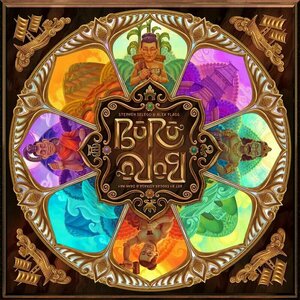
I would consider myself somewhat of a world traveler. I haven’t quite visited as many places as I would like, and certain worldwide pandemics have prevented me from scheduling any international travel plans. My family and I enjoy cruises and visiting all sorts of different countries. Now, Buru has never been specifically on our list of places to visit, but should we ever get the chance to head to Indonesia, now after playing this game I think I will want to visit this little island.
Buru (http://burugame.com/)is a mid-weight economic worker placement game with a large dose of bidding thrown in for fun. In it players are visitors to the island sent to compete to become the governor of Buru by hiring indigenous peoples to assist with tasks, by providing fish for the peoples, pleasing the island’s elders, and by paying homages to the spirits of the land. The emissary who can utilize all their resources efficiently and impactfully will be deemed governor of Buru and winner of the game.
DISCLAIMER: We were provided a prototype copy of this game for the purposes of this review. These are preview copy components, and I do not know for sure if the final components will be any different from these shown. Also, it is not my intention to detail every rule in the game, as there are just too many. You are invited to download the rulebook, back the game through the Kickstarter campaign, or through any retailers stocking it after fulfillment. -T
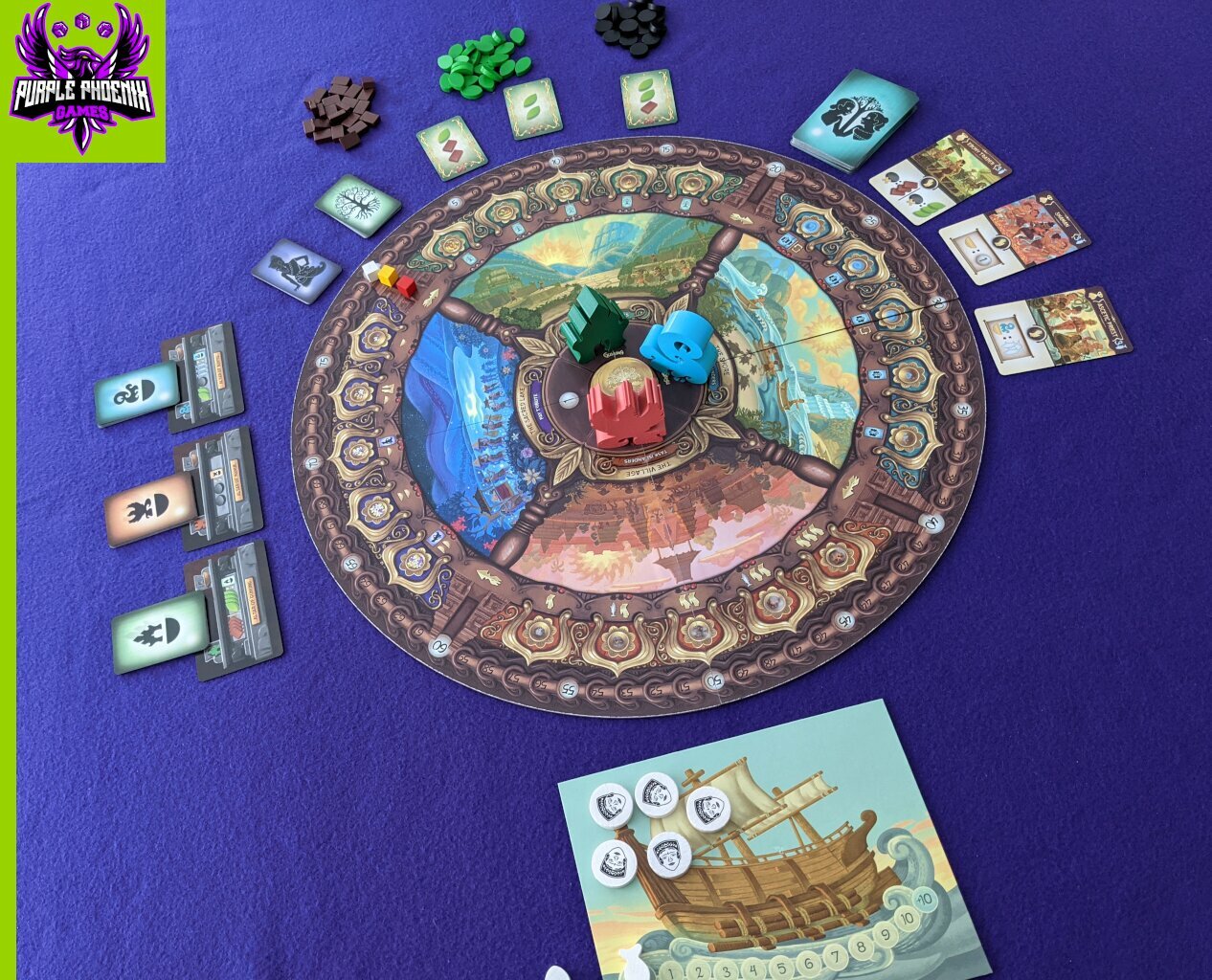
To setup, follow the instructions in the rulebook. There are just too many steps to detail here and the rulebook is fantastic. Once setup, the play area should look similar to the photo below.
The game of Buru lasts five rounds, and each round consists of five phases of the day: Dawn, Morning, Noon, Afternoon, and Dusk. At the end of the fifth round the game is over and players will tally points to arrive at the winner.
During the Dawn phase players will flip over the top two Decrees tokens from the middle of the main circular board. These Decrees will be placed in certain areas and are worth bonus points or other advantages for the round. Also during this phase the Forest cards will be reset from the previous round. Once complete play moves to the Morning phase.
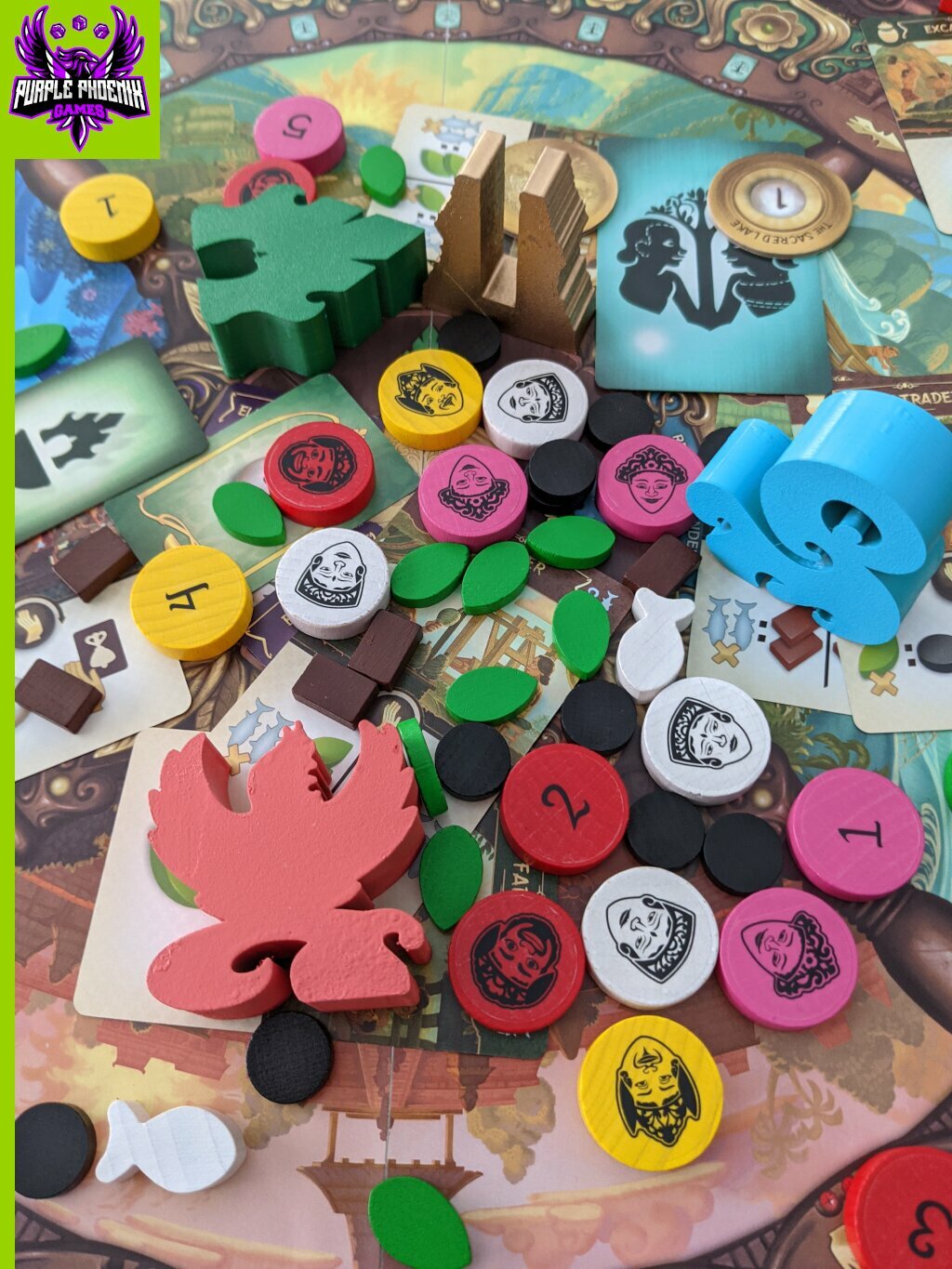
In the Morning players will be sending out their numbered Explorer tokens (from 1-5) onto the various board areas in turn starting with the current Emissary (first player). Each player will place one of their Explorer tokens at a time until each player has only one Explorer token left. Players may place multiple Explorers in a location to increase their bid for majority, but these Explorer tokens are placed face-up (literally with the face showing and the number on the board not showing) so that their values are hidden. Once Explorers are placed, play moves to the Noon phase.
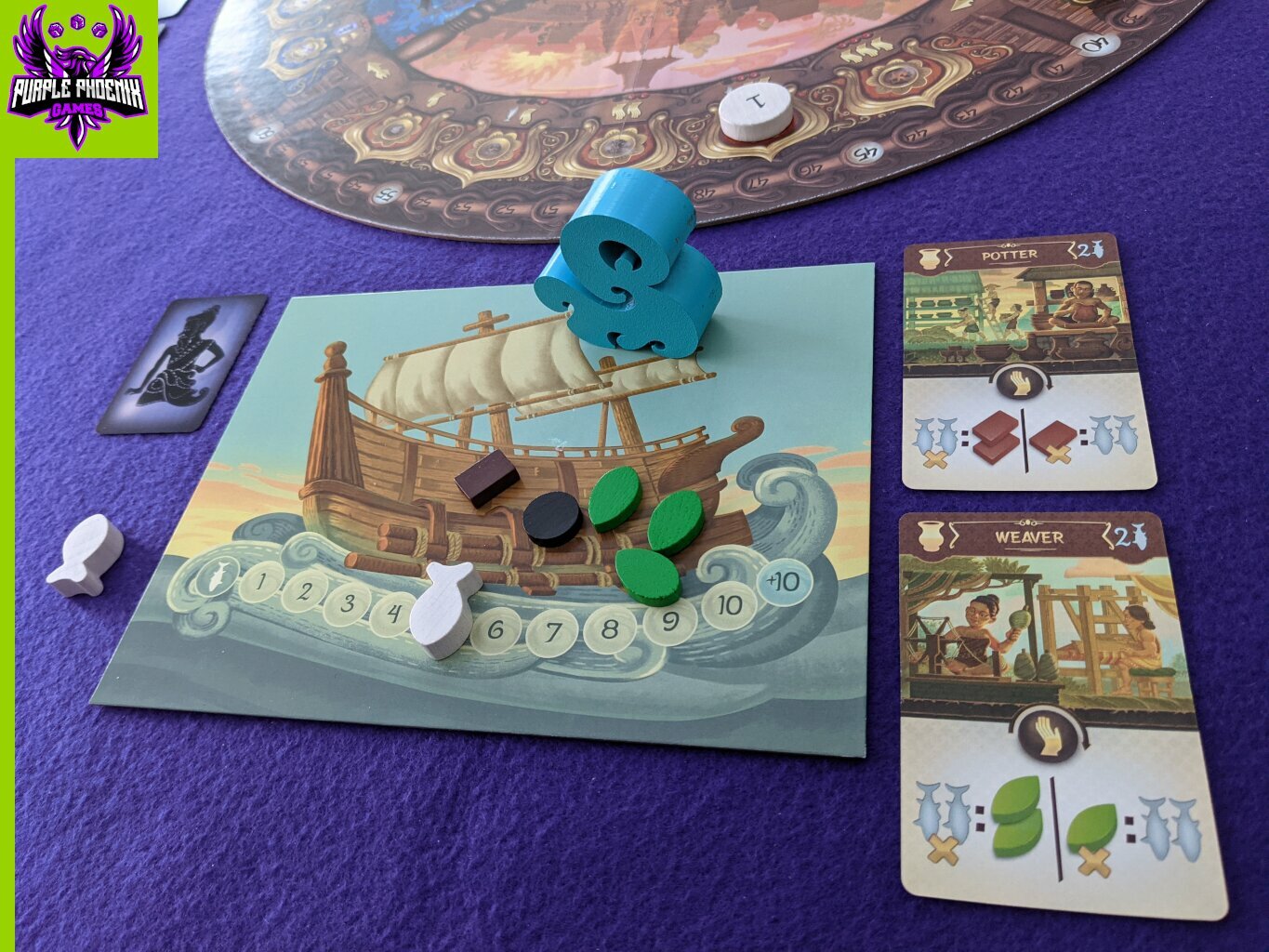
At Noon the people must fish for food and have lunch. The leftover Explorer token that was not used in the Morning is then revealed and its value is converted to fish. Fish are needed to recruit islanders and are converted into other resources. Fish are tracked on the individual player boards. After a hearty lunch play continues into the Afternoon.
The Afternoon is where much of the action in Buru takes place. During this phase the Explorer tokens that were placed in the Morning are revealed and players take actions in each area by order of majority in each area. First the highest-bidding player will claim their chosen action space, then the next highest bidder, and so on. The Forest is resolved first. Players reveal the Explorer tokens in the Forest and whichever player has majority in this area is able to place their tokens a claim space on the board and will receive a Forest card of their choice. Forest cards are typically resources immediately earned by the player. Resources include Clay, Palm Leaves, and Ebony. The player with majority also earns the favor of Gunung (green spirit) and takes its giant statueeple.
Next, the Shore is resolved in the same manner. The Shore is where players may use their supplies of fish to recruit islanders to their taskforces and carry out tasks. The majority leader in this area chooses a space to place their Explorer tokens and resolves the action. This could include purchasing islander cards and refreshing the offer of islander cards in whichever order the player chooses. The player with the majority also earns the favor of Banyu (blue spirit) and takes its giant statueeple.
The Village is the area where islanders are able to complete tasks. The majority leader in this area chooses a space and takes the actions. These actions include activating islanders for the actions printed on the bottom of their cards and possibly even earning more fish. The player with the majority also earns the favor of Manuk (orange spirit) and takes its giant statueeple.
Finally, The Sacred Lake is resolved in the same manner. Here players are able to pay tributes to the spirits in order to earn bonuses from them. The majority leader in this area chooses a space to place their Explorer tokens, earns an immediate Esteem (VP tracked along the outer edge of the board), and takes the action of the space claimed. These spaces offer opportunities to pay tribute to one or more of the spirits as well as earning an Elder card, which provides conditions for earning bonus points at the end of the game. When a spirit is tributed they offer bonus Esteem cards and other benefits to be used. Once this area is completely resolved and players have all taken their turns play moves onto Dusk.
In Dusk players will reset the board for the next round of play. Players retrieve all their Explorer tokens from the board and untask their islanders that have completed tasks this day. After the fifth round the game is over and players tally their scores from their position on the Esteem track, any spirit Tribute cards earned, and Elder card point conditions met. The player with the most points will be crowned the winner!
Components. Okay, I have to give a giant shout-out to the team at Crafty Games. This is one of the highest-quality prototypes I have ever played in terms of component quality. When I opened the game box all components were separated into baggies and card cases and LABELED with the number of components, the titles, and even a picture of the components to be placed within. I don’t even organize my games to this level and I feel I am a tad OCD about my game organization. Kudos here. But also the components are all fine quality and the finished product promises to be just spectacular if this is what is received as a prototype.
I love the art and art style throughout this game. It is difficult to have theme shine through in a very Euro-style game, but I did feel the theme here. The art is very suggestive of island life, and Crafty Games even hired Cultural Consultants to assure all avenues are culturally appropriate. What a great call. I wish all publishers would be so thorough.
The gameplay is also quite stunning. The game just flows so naturally and everything makes complete sense. Of course you need to collect natural resources before recruiting islanders before asking said islanders to complete tasks before you pay respects to their spirits. I like the flow, and after a couple rounds I no longer needed the rulebook as a crutch.
I have very much enjoyed my plays of Buru for many reasons. The game is absolutely gorgeous. The art sings and truly adds to the gameplay. The rules are not light, but not over my head, and I appreciate that. The choices given to each player are crunchy without being too burdensome, and players of many skill levels will be able to find joy contemplating when and where to send their Explorers in each area. The game builds up to a big ending where many points are scored from places unknown to opponents and bulleting ahead from last place to first from exploiting bonus cards is so satisfying.
It is easy to understand why I love this game and would certainly recommend it to all gamers. If you have been looking for something a little heavier in your collection but don’t want to go TOO heavy, please do yourself a favor and consider backing Buru. Crafty Games has been working on some truly great games here the past couple years and I am excited to see where Buru ends up after another undoubtedly successful Kickstarter campaign. I will always be up for a game of Buru, and I hope to play it often as the years continue.
Buru (http://burugame.com/)is a mid-weight economic worker placement game with a large dose of bidding thrown in for fun. In it players are visitors to the island sent to compete to become the governor of Buru by hiring indigenous peoples to assist with tasks, by providing fish for the peoples, pleasing the island’s elders, and by paying homages to the spirits of the land. The emissary who can utilize all their resources efficiently and impactfully will be deemed governor of Buru and winner of the game.
DISCLAIMER: We were provided a prototype copy of this game for the purposes of this review. These are preview copy components, and I do not know for sure if the final components will be any different from these shown. Also, it is not my intention to detail every rule in the game, as there are just too many. You are invited to download the rulebook, back the game through the Kickstarter campaign, or through any retailers stocking it after fulfillment. -T
To setup, follow the instructions in the rulebook. There are just too many steps to detail here and the rulebook is fantastic. Once setup, the play area should look similar to the photo below.
The game of Buru lasts five rounds, and each round consists of five phases of the day: Dawn, Morning, Noon, Afternoon, and Dusk. At the end of the fifth round the game is over and players will tally points to arrive at the winner.
During the Dawn phase players will flip over the top two Decrees tokens from the middle of the main circular board. These Decrees will be placed in certain areas and are worth bonus points or other advantages for the round. Also during this phase the Forest cards will be reset from the previous round. Once complete play moves to the Morning phase.
In the Morning players will be sending out their numbered Explorer tokens (from 1-5) onto the various board areas in turn starting with the current Emissary (first player). Each player will place one of their Explorer tokens at a time until each player has only one Explorer token left. Players may place multiple Explorers in a location to increase their bid for majority, but these Explorer tokens are placed face-up (literally with the face showing and the number on the board not showing) so that their values are hidden. Once Explorers are placed, play moves to the Noon phase.
At Noon the people must fish for food and have lunch. The leftover Explorer token that was not used in the Morning is then revealed and its value is converted to fish. Fish are needed to recruit islanders and are converted into other resources. Fish are tracked on the individual player boards. After a hearty lunch play continues into the Afternoon.
The Afternoon is where much of the action in Buru takes place. During this phase the Explorer tokens that were placed in the Morning are revealed and players take actions in each area by order of majority in each area. First the highest-bidding player will claim their chosen action space, then the next highest bidder, and so on. The Forest is resolved first. Players reveal the Explorer tokens in the Forest and whichever player has majority in this area is able to place their tokens a claim space on the board and will receive a Forest card of their choice. Forest cards are typically resources immediately earned by the player. Resources include Clay, Palm Leaves, and Ebony. The player with majority also earns the favor of Gunung (green spirit) and takes its giant statueeple.
Next, the Shore is resolved in the same manner. The Shore is where players may use their supplies of fish to recruit islanders to their taskforces and carry out tasks. The majority leader in this area chooses a space to place their Explorer tokens and resolves the action. This could include purchasing islander cards and refreshing the offer of islander cards in whichever order the player chooses. The player with the majority also earns the favor of Banyu (blue spirit) and takes its giant statueeple.
The Village is the area where islanders are able to complete tasks. The majority leader in this area chooses a space and takes the actions. These actions include activating islanders for the actions printed on the bottom of their cards and possibly even earning more fish. The player with the majority also earns the favor of Manuk (orange spirit) and takes its giant statueeple.
Finally, The Sacred Lake is resolved in the same manner. Here players are able to pay tributes to the spirits in order to earn bonuses from them. The majority leader in this area chooses a space to place their Explorer tokens, earns an immediate Esteem (VP tracked along the outer edge of the board), and takes the action of the space claimed. These spaces offer opportunities to pay tribute to one or more of the spirits as well as earning an Elder card, which provides conditions for earning bonus points at the end of the game. When a spirit is tributed they offer bonus Esteem cards and other benefits to be used. Once this area is completely resolved and players have all taken their turns play moves onto Dusk.
In Dusk players will reset the board for the next round of play. Players retrieve all their Explorer tokens from the board and untask their islanders that have completed tasks this day. After the fifth round the game is over and players tally their scores from their position on the Esteem track, any spirit Tribute cards earned, and Elder card point conditions met. The player with the most points will be crowned the winner!
Components. Okay, I have to give a giant shout-out to the team at Crafty Games. This is one of the highest-quality prototypes I have ever played in terms of component quality. When I opened the game box all components were separated into baggies and card cases and LABELED with the number of components, the titles, and even a picture of the components to be placed within. I don’t even organize my games to this level and I feel I am a tad OCD about my game organization. Kudos here. But also the components are all fine quality and the finished product promises to be just spectacular if this is what is received as a prototype.
I love the art and art style throughout this game. It is difficult to have theme shine through in a very Euro-style game, but I did feel the theme here. The art is very suggestive of island life, and Crafty Games even hired Cultural Consultants to assure all avenues are culturally appropriate. What a great call. I wish all publishers would be so thorough.
The gameplay is also quite stunning. The game just flows so naturally and everything makes complete sense. Of course you need to collect natural resources before recruiting islanders before asking said islanders to complete tasks before you pay respects to their spirits. I like the flow, and after a couple rounds I no longer needed the rulebook as a crutch.
I have very much enjoyed my plays of Buru for many reasons. The game is absolutely gorgeous. The art sings and truly adds to the gameplay. The rules are not light, but not over my head, and I appreciate that. The choices given to each player are crunchy without being too burdensome, and players of many skill levels will be able to find joy contemplating when and where to send their Explorers in each area. The game builds up to a big ending where many points are scored from places unknown to opponents and bulleting ahead from last place to first from exploiting bonus cards is so satisfying.
It is easy to understand why I love this game and would certainly recommend it to all gamers. If you have been looking for something a little heavier in your collection but don’t want to go TOO heavy, please do yourself a favor and consider backing Buru. Crafty Games has been working on some truly great games here the past couple years and I am excited to see where Buru ends up after another undoubtedly successful Kickstarter campaign. I will always be up for a game of Buru, and I hope to play it often as the years continue.

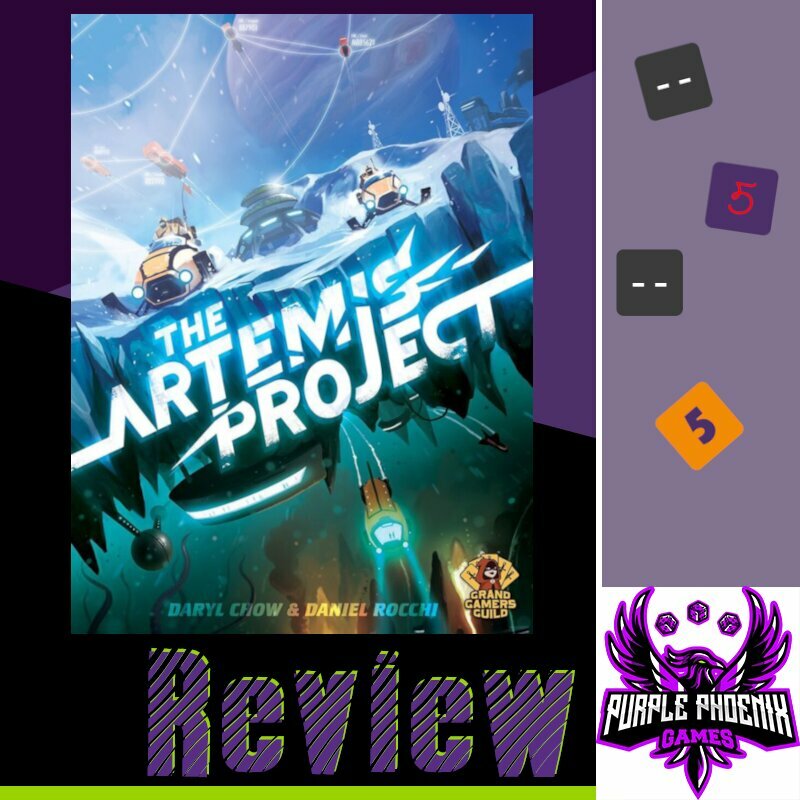
Purple Phoenix Games (2266 KP) rated The Artemis Project in Tabletop Games
Apr 6, 2021
I don’t know about you, but I spend more time than I should probably admit perusing Kickstarter and checking out new projects. Although, that is how I came across The Artemis Project. A game about exploration and colonization of one of Jupiter’s moons? Yes please! The campaign looked promising, the gameplay looked engaging, and the hype was real. Once I finally got the game, did it live up to my expectations? Keep reading to find out!
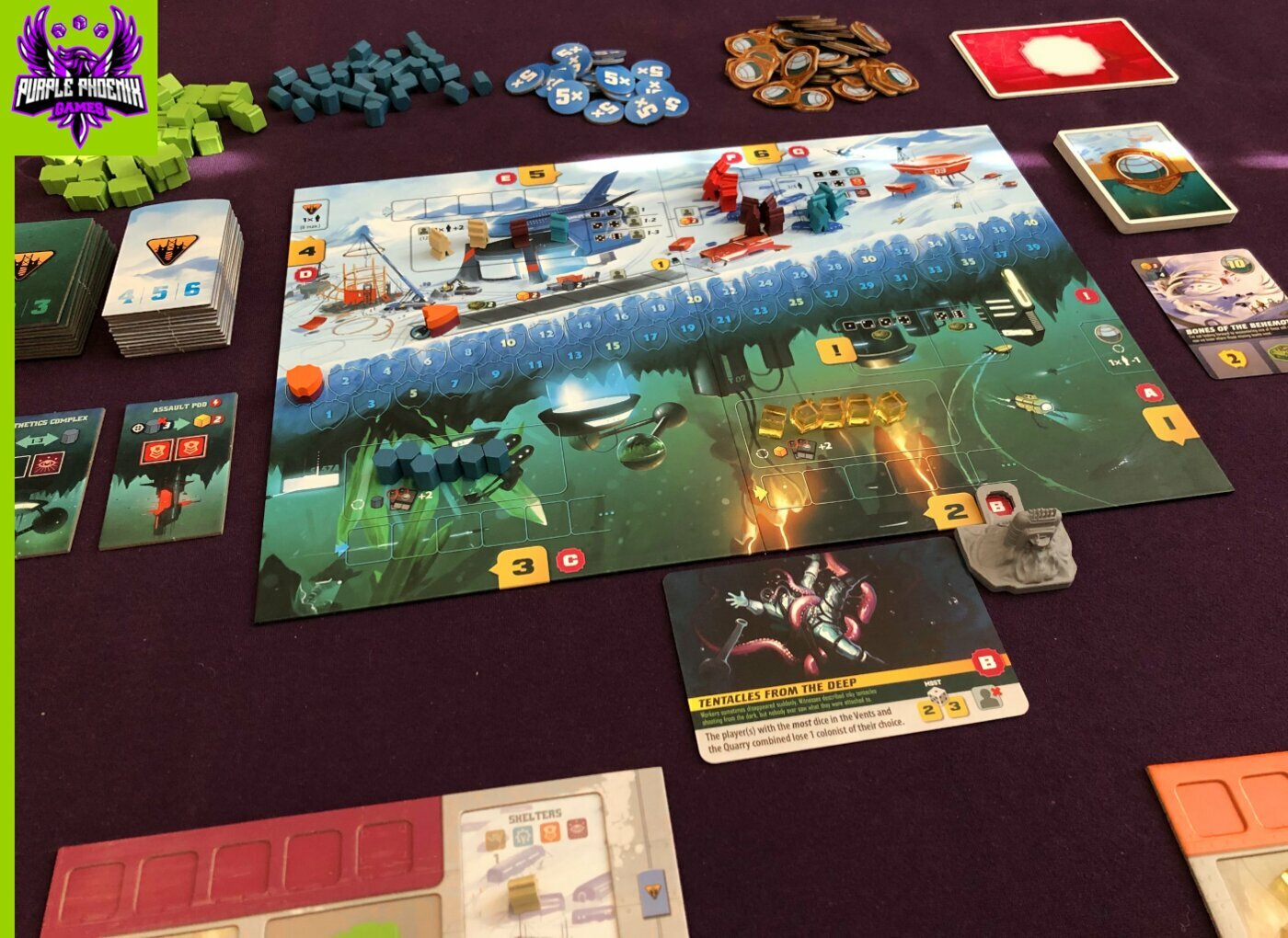
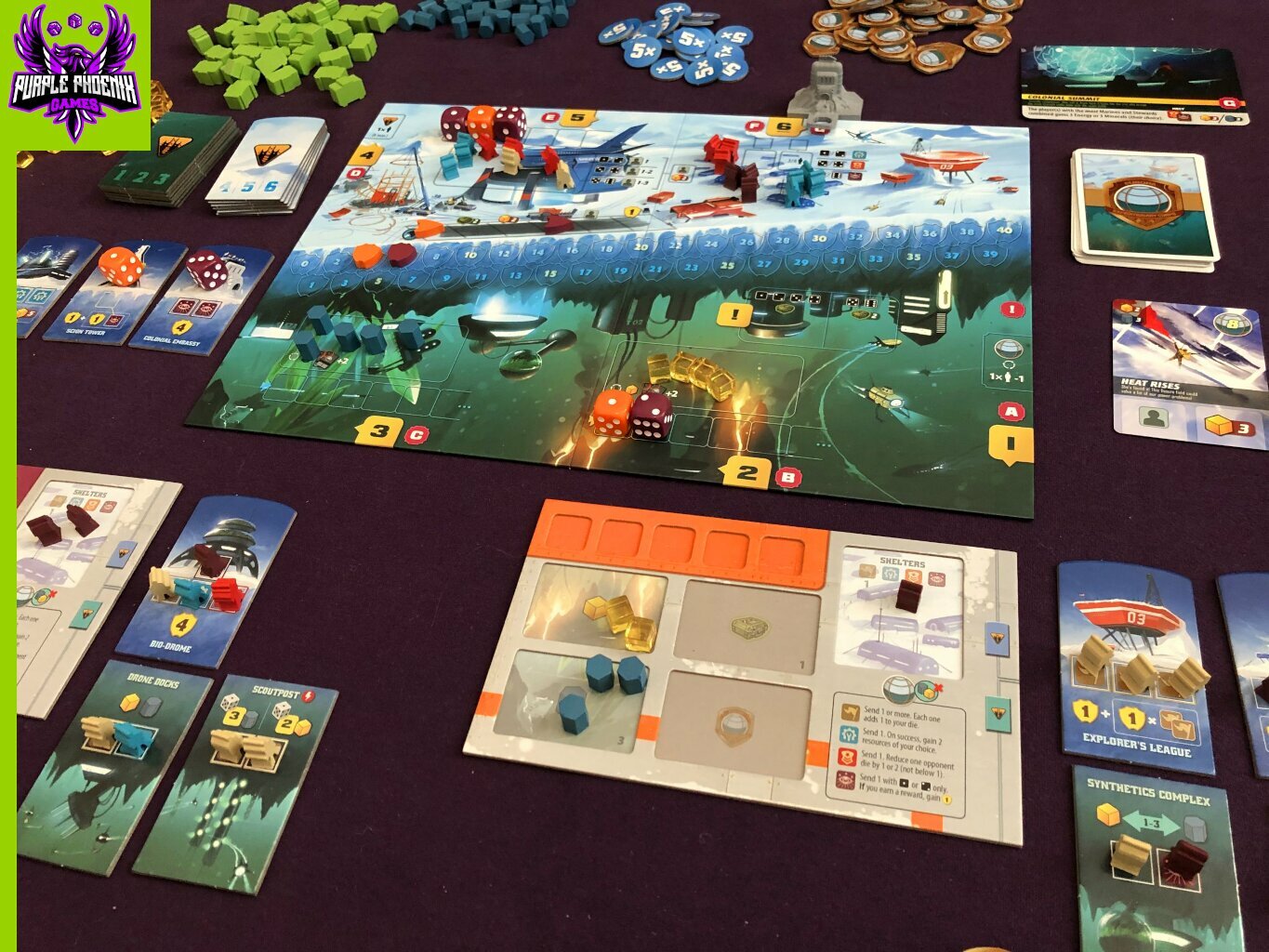
The Artemis Project is a game of dice/worker placement in which players are trying to build and sustain a prosperous colony on Jupiter’s moon Europa. Played over 6 rounds, players will take turns rolling and placing dice across the regions of the board to collect resources, construct buildings, recruit and train colonists, and partake in expeditions to explore this vast ice-land. To begin, follow the setup instructions in the rulebook for the appropriate player count. Each player receives a player board, dice, and markers in their chosen color. Populate the board for the first round, select a starting player, and the game is ready to begin!
Disclaimer: I do not intend to rehash the entire rulebook in this review, as there are just too many details. For a more in-depth look at The Artemis Project, pick up a copy from your FLGS or directly from the publisher! -L
To start each round, all players will simultaneously roll all 5 of their dice. Once players are happy with their results, the round is ready to properly begin. Each round is broken into three phases: Placement, Resolution, and Upkeep. To begin the Placement phase, starting with the first player, players will take turns assigning one die at a time to the 7 regions of the board. These regions are: Basecamp, Vents, Quarry, Gantry, Doorstep, Academy, and Outfitters. (I will explain each region in more detail in the next section!) The value of the dice placed in any region is important, because it will dictate what you are allowed to do, or when you are allowed to resolve the action for that region – so choose your placements wisely.
Once every player has placed all 5 of their dice, the Resolution phase begins. During the Resolution phase, each of the regions of the board will be resolved in order, allowing players to perform their region-specific actions. Resolution starts with Basecamp. Placing dice at Basecamp allows players to partake in Expeditions in an effort to earn Expedition Badges (which translate to end-game VP), as well as extra rewards. Each Expedition has a difficulty level which must be equaled or surpassed by the total of all dice placed on that card. If the difficulty is surpassed, the Expedition is a success and rewards are doled out accordingly, but if the Expedition fails, no rewards are earned by anyone.
The next 2 regions, Vents and Quarry, allow players to collect Energy and Minerals, respectively, and are resolved in the same way. Players will collect a number of resources equal to their played die value. Pretty straight-forward! Moving on to the Gantry region, the value of dice placed on any building tiles are considered bids for buying/constructing that building. You can bid against opponents for building tiles, but each bid must increase the previous amount. When resolving the Gantry, the highest value die on a tile is the winner, and that player must pay their die-amount in Minerals to collect that tile. Buildings are added to your colony, and allow you to perform special actions once they are fully-staffed (all colonist slots on the tile are filled).
Next is the Doorstep – depending on the value of dice you placed there, you will be able to recruit 1-3 new colonists. Recruiting a colonist costs you 2 Energy per new addition, and any new colonists you recruit can be placed immediately into any of your buildings (if space is available), or into your Shelter where they will wait to be used. The Academy region allows you to exchange a colonist of your choice for one of a different type/occupation, again, depending on the value of the die used. And finally, the Outfitters region does not resolved during this phase, because it’s action is performed immediately upon dice placement. Any dice placed to the Outfitters gives Tool Kits (used to manipulate die values at the start of each round) to the player, based upon the die value.
The remaining element of the Resolution phase is the Even card. At the start of each round, an Event card is drawn, and will pertain to a certain region of the board. During the Resolution phase, when that region is reached, the Event card will be resolved – either penalizing players or benefitting them in some way. I have purposefully left out a few elements of the Resolution phase for you to discover on your own!
Once all regions have been resolved, the round moves to the Upkeep phase. During this phase, all players can choose to move 1 colonist to a building tile, or swap any 2 colonists between buildings. This is not required, but can only be performed once during this phase. Next, if any players have fully-staffed buildings (all colonist slots are filled), they may activate the listed ability. And finally, for any colonists left in your shelter and not in a building, you must pay 1 Energy for each to keep them warm! The game board is now refreshed for the next round, a new starting player is selected, and the new round is ready to begin. After the 6th and final round, VPs are tallied – earned through number of building tiles, Expedition Badges, sets of resources, and sets of colonists – and the player with the most VP is the winner!
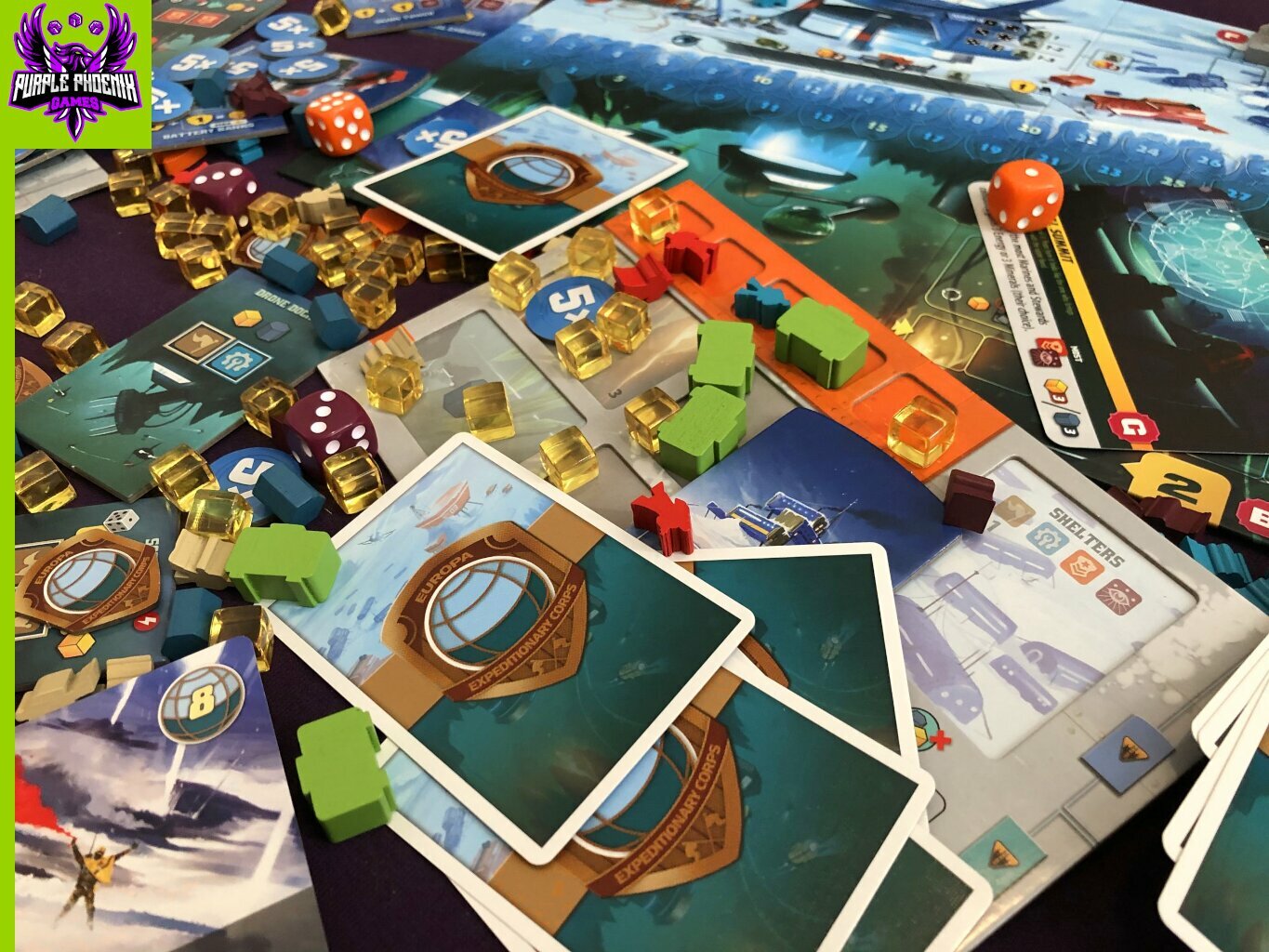
I know that seems like a lot, but I promise that once you start the first round, everything is pretty intuitive and the game flows well. The turn sequence and phases are logical and easy to understand. The game board itself has lots of helpful icons that work as reminders throughout gameplay, and the rulebook has a nice and concise round overview on the last page as well, which is easy to refer back to at a moment’s notice. I’ll go ahead and touch on components here, since I kind of already started to do so. The components in this game are great! The game board and cards are all sturdy and have colorful and immersive artwork. The dual-layered player boards are high quality, the colonist meeples are cute and effective, the building tiles and cardboard chits are strong and can definitely hold up to many plays, and the dice are easy to roll and read. Definitely an A+ on components from me.
I have to admit that The Artemis Project surprised me. At its core, it is a worker placement game, and that in and of itself lends itself to a certain gameplay. You’re trying to complete your own agenda, being the first to snag those important placements that you need to accomplish those goals, while also blocking opponents from doing the same. The thing that makes The Artemis Project unique is that the ‘workers’ in this game are dice. And their value is what dictates the resolution of each region. Just because you place a die in a region first, does not necessarily mean that you will get to resolve first – depending on how your opponents play, they could block you entirely! The use of dice adds an extra layer of strategy to the gameplay that really elevates it beyond a simple worker placement mechanic. Another great thing about this game is that there is no one way to win – there are several strategies that you could play by in an effort to earn VPs. Maybe you are trying to complete as many Expeditions as possible, or want to construct as many buildings as possible. Either strategy can work, and all strategies can easily be adapted and altered during gameplay.
I am so happy that I came across this game on Kickstarter. The game is strategic, engaging, and just fun to play. I’m not necessarily a huge fan of worker placement games, but the approach to the mechanic taken by The Artemis Project really puts a unique twist on it that adds to the gameplay. This is one KickStarter that was definitely worth the investment. Check it out if you haven’t heard of it, or if you’re looking to elevate your worker placement games. Purple Phoenix Games gives it an enterprising 10 / 12.
The Artemis Project is a game of dice/worker placement in which players are trying to build and sustain a prosperous colony on Jupiter’s moon Europa. Played over 6 rounds, players will take turns rolling and placing dice across the regions of the board to collect resources, construct buildings, recruit and train colonists, and partake in expeditions to explore this vast ice-land. To begin, follow the setup instructions in the rulebook for the appropriate player count. Each player receives a player board, dice, and markers in their chosen color. Populate the board for the first round, select a starting player, and the game is ready to begin!
Disclaimer: I do not intend to rehash the entire rulebook in this review, as there are just too many details. For a more in-depth look at The Artemis Project, pick up a copy from your FLGS or directly from the publisher! -L
To start each round, all players will simultaneously roll all 5 of their dice. Once players are happy with their results, the round is ready to properly begin. Each round is broken into three phases: Placement, Resolution, and Upkeep. To begin the Placement phase, starting with the first player, players will take turns assigning one die at a time to the 7 regions of the board. These regions are: Basecamp, Vents, Quarry, Gantry, Doorstep, Academy, and Outfitters. (I will explain each region in more detail in the next section!) The value of the dice placed in any region is important, because it will dictate what you are allowed to do, or when you are allowed to resolve the action for that region – so choose your placements wisely.
Once every player has placed all 5 of their dice, the Resolution phase begins. During the Resolution phase, each of the regions of the board will be resolved in order, allowing players to perform their region-specific actions. Resolution starts with Basecamp. Placing dice at Basecamp allows players to partake in Expeditions in an effort to earn Expedition Badges (which translate to end-game VP), as well as extra rewards. Each Expedition has a difficulty level which must be equaled or surpassed by the total of all dice placed on that card. If the difficulty is surpassed, the Expedition is a success and rewards are doled out accordingly, but if the Expedition fails, no rewards are earned by anyone.
The next 2 regions, Vents and Quarry, allow players to collect Energy and Minerals, respectively, and are resolved in the same way. Players will collect a number of resources equal to their played die value. Pretty straight-forward! Moving on to the Gantry region, the value of dice placed on any building tiles are considered bids for buying/constructing that building. You can bid against opponents for building tiles, but each bid must increase the previous amount. When resolving the Gantry, the highest value die on a tile is the winner, and that player must pay their die-amount in Minerals to collect that tile. Buildings are added to your colony, and allow you to perform special actions once they are fully-staffed (all colonist slots on the tile are filled).
Next is the Doorstep – depending on the value of dice you placed there, you will be able to recruit 1-3 new colonists. Recruiting a colonist costs you 2 Energy per new addition, and any new colonists you recruit can be placed immediately into any of your buildings (if space is available), or into your Shelter where they will wait to be used. The Academy region allows you to exchange a colonist of your choice for one of a different type/occupation, again, depending on the value of the die used. And finally, the Outfitters region does not resolved during this phase, because it’s action is performed immediately upon dice placement. Any dice placed to the Outfitters gives Tool Kits (used to manipulate die values at the start of each round) to the player, based upon the die value.
The remaining element of the Resolution phase is the Even card. At the start of each round, an Event card is drawn, and will pertain to a certain region of the board. During the Resolution phase, when that region is reached, the Event card will be resolved – either penalizing players or benefitting them in some way. I have purposefully left out a few elements of the Resolution phase for you to discover on your own!
Once all regions have been resolved, the round moves to the Upkeep phase. During this phase, all players can choose to move 1 colonist to a building tile, or swap any 2 colonists between buildings. This is not required, but can only be performed once during this phase. Next, if any players have fully-staffed buildings (all colonist slots are filled), they may activate the listed ability. And finally, for any colonists left in your shelter and not in a building, you must pay 1 Energy for each to keep them warm! The game board is now refreshed for the next round, a new starting player is selected, and the new round is ready to begin. After the 6th and final round, VPs are tallied – earned through number of building tiles, Expedition Badges, sets of resources, and sets of colonists – and the player with the most VP is the winner!
I know that seems like a lot, but I promise that once you start the first round, everything is pretty intuitive and the game flows well. The turn sequence and phases are logical and easy to understand. The game board itself has lots of helpful icons that work as reminders throughout gameplay, and the rulebook has a nice and concise round overview on the last page as well, which is easy to refer back to at a moment’s notice. I’ll go ahead and touch on components here, since I kind of already started to do so. The components in this game are great! The game board and cards are all sturdy and have colorful and immersive artwork. The dual-layered player boards are high quality, the colonist meeples are cute and effective, the building tiles and cardboard chits are strong and can definitely hold up to many plays, and the dice are easy to roll and read. Definitely an A+ on components from me.
I have to admit that The Artemis Project surprised me. At its core, it is a worker placement game, and that in and of itself lends itself to a certain gameplay. You’re trying to complete your own agenda, being the first to snag those important placements that you need to accomplish those goals, while also blocking opponents from doing the same. The thing that makes The Artemis Project unique is that the ‘workers’ in this game are dice. And their value is what dictates the resolution of each region. Just because you place a die in a region first, does not necessarily mean that you will get to resolve first – depending on how your opponents play, they could block you entirely! The use of dice adds an extra layer of strategy to the gameplay that really elevates it beyond a simple worker placement mechanic. Another great thing about this game is that there is no one way to win – there are several strategies that you could play by in an effort to earn VPs. Maybe you are trying to complete as many Expeditions as possible, or want to construct as many buildings as possible. Either strategy can work, and all strategies can easily be adapted and altered during gameplay.
I am so happy that I came across this game on Kickstarter. The game is strategic, engaging, and just fun to play. I’m not necessarily a huge fan of worker placement games, but the approach to the mechanic taken by The Artemis Project really puts a unique twist on it that adds to the gameplay. This is one KickStarter that was definitely worth the investment. Check it out if you haven’t heard of it, or if you’re looking to elevate your worker placement games. Purple Phoenix Games gives it an enterprising 10 / 12.

Cody Cook (8 KP) rated Writings Of Thomas Paine Volume 4 (1794 1796); The Age Of Reason in Books
Jun 29, 2018


Thomas Paine was a political theorist who was perhaps best known for his support for the American Revolution in his pamphlet Common Sense. In what might be his second best known work, The Age of Reason, Paine argued in favor of deism and against the Christian religion and its conception of God. By deism it is meant the belief in a creator God who does not violate the laws of nature by communicating through revelation or miracles The book was very successful and widely read partly due to the fact that it was written in a style which appealed to a popular audience and often implemented a sarcastic, derisive tone to make its points.
The book seems to have had three major objectives: the support of deism, the ridicule of what Paine found loathsome in Christian theology, and the demonstration of how poor an example the Bible is as a reflection of God.
In a sense, Paine's arguments against Christian theology and scripture were meant to prop up his deistic philosophy. Paine hoped that in demonizing Christianity while giving evidences for God, he would somehow have made the case for deism. But this is not so. If Christianity is false, but God exists nonetheless, we are not left only with deism. There are an infinite number of possibilities for us to examine regarding the nature of God, and far too many left over once we have eliminated the obviously false ones. In favor of deism Paine has only one argument—his dislike of supernatural revelation, which is to say that deism appeals to his culturally derived preferences. In any case, Paine's thinking on the matter seemed to be thus: if supernatural revelation could be shown to be inadequate and the development of complex theology shown to be an error, one could still salvage a belief in God as Creator, but not as an interloper in human affairs who required mediators.
That being said, in his support of deism, Paine makes some arguments to demonstrate the reasonableness in belief in, if not the logical necessity of the existence of, God which could be equally used by Christians.
For instance, just as the apostle Paul argued in his epistle to the Romans that, "what can be known about God is plain to [even pagans], because God has shown it to them. For his invisible attributes, namely, his eternal power and divine nature, have been clearly perceived, ever since the creation of the world, in the things that have been made" (Romans 1:19-20, ESV), so also Paine can say that, "the Creation speaketh an universal language [which points to the existence of God], independently of human speech or human language, multiplied and various as they be."
The key point on which Paine differs from Paul on this issue is in his optimism about man's ability to reason to God without His assisting from the outside. Whereas Paul sees the plainness of God from natural revelation as an argument against the inherent goodness of a species which can read the record of nature and nevertheless rejects its Source's obvious existence, Paine thinks that nature and reason can and do lead us directly to the knowledge of God's existence apart from any gracious overtures or direct revelation.
On the witness of nature, Paine claims, and is quite correct, that, "THE WORD OF GOD IS THE CREATION WE BEHOLD: And it is in this word, which no human invention can counterfeit or alter, that God speaketh universally to man." What is not plainly clear, however, is that man is free enough from the noetic effects of sin to reach such an obvious conclusion on his own. Indeed, the attempts of mankind to create a religion which represents the truth have invariably landed them at paganism. By paganism I mean a system of belief based, as Yehezkel Kaufmann and John N. Oswalt have shown, on continuity.iv In polytheism, even the supernatural is not really supernatural, but is perhaps in some way above humans while not being altogether distinct from us. What happens to the gods is merely what happens to human beings and the natural world writ large, which is why the gods are, like us, victims of fate, and why pagan fertility rituals have attempted to influence nature by influencing the gods which represent it in accordance with the deeper magic of the eternal universe we all inhabit.
When mankind has looked at nature without the benefit of supernatural revelation, he has not been consciously aware of a Being outside of nature which is necessarily responsible for it. His reasoning to metaphysics is based entirely on his own naturalistic categories derived from his own experience. According to Moses, it took God revealing Himself to the Hebrews for anyone to understand what Paine thinks anyone can plainly see.
The goal of deism is to hold onto what the western mind, which values extreme independence of thought, views as attractive in theism while casting aside what it finds distasteful. But as C.S. Lewis remarked, Aslan is not a tame lion. If a sovereign God exists, He cannot be limited by your desires of what you'd like Him to be. For this reason, the deism of men like Paine served as a cultural stepping stone toward the atheism of later intellectuals.
For Paine, as for other deists and atheists like him, it is not that Christianity has been subjected to reason and found wanting, but that it has been subjected to his own private and culturally-determined tastes and preferences and has failed to satisfy. This is the flipside of the anti-religious claim that those who believe in a given religion only do so because of their cultural conditioning: the anti-religionist is also conditioned in a similar way. Of course, how one comes to believe a certain thing has no bearing on whether that thing is true in itself, and this is true whether Christianity, atheism, or any other view is correct. But it must be stated that the deist or atheist is not immune from the epistemic difficulties which he so condescendingly heaps on theists.
One of the befuddling ironies of Paine's work is that around the time he was writing about the revealed religions as, “no other than human inventions set up to terrify and enslave mankind, and monopolize power and profit," the French were turning churches into “temples of reason” and murdering thousands at the guillotine (an instrument of execution now most strongly identified with France's godless reign of terror). Paine, who nearly lost his own life during the French Revolution, saw the danger of this atheism and hoped to stay its progress, despite the risk to his own life in attempting to do so.
What is odd is that Paine managed to blame this violent atheism upon the Christian faith! Obfuscated Paine:
"The Idea, always dangerous to Society as it is derogatory to the Almighty, — that priests could forgive sins, — though it seemed to exist no longer, had blunted the feelings of humanity, and callously prepared men for the commission of all crimes. The intolerant spirit of church persecution had transferred itself into politics; the tribunals, stiled Revolutionary, supplied the place of an Inquisition; and the Guillotine of the Stake. I saw many of my most intimate friends destroyed; others daily carried to prison; and I had reason to believe, and had also intimations given me, that the same danger was approaching myself."
That Robespierre's deism finally managed to supplant the revolutionary state's atheism and that peace, love, and understanding did not then spread throughout the land undermines Paine's claims. Paine felt that the revolution in politics, especially as represented in America, would necessarily lead to a revolution in religion, and that this religious revolution would result in wide acceptance of deism. The common link between these two revolutions was the idea that the individual man was sovereign and could determine for himself what was right and wrong based on his autonomous reason. What Paine was too myopic to see was that in France's violence and atheism was found the logical consequence of his individualistic philosophy. In summary, it is not Christianity which is dangerous, but the spirit of autonomy which leads inevitably into authoritarianism by way of human desire.
As should be clear by now, Paine failed to understand that human beings have a strong tendency to set impartial reason aside and to simply evaluate reality based on their desires and psychological states. This is no more obvious than in his own ideas as expressed in The Age of Reason. Like Paine's tendency to designate every book in the Old Testament which he likes as having been written originally by a gentile and translated into Hebrew, so many of his criticisms of Christian theology are far more a reflection upon himself than of revealed Christianity. One has only to look at Paine's description of Jesus Christ as a “virtuous reformer and revolutionist” to marvel that Paine was so poor at introspection so as to not understand that he was describing himself.
There is much more that could be said about this work, but in the interest of being somewhat concise, I'll end my comments here. If you found this analysis to be useful, be sure to check out my profile and look for my work discussing Paine and other anti-Christian writers coming soon.
The book seems to have had three major objectives: the support of deism, the ridicule of what Paine found loathsome in Christian theology, and the demonstration of how poor an example the Bible is as a reflection of God.
In a sense, Paine's arguments against Christian theology and scripture were meant to prop up his deistic philosophy. Paine hoped that in demonizing Christianity while giving evidences for God, he would somehow have made the case for deism. But this is not so. If Christianity is false, but God exists nonetheless, we are not left only with deism. There are an infinite number of possibilities for us to examine regarding the nature of God, and far too many left over once we have eliminated the obviously false ones. In favor of deism Paine has only one argument—his dislike of supernatural revelation, which is to say that deism appeals to his culturally derived preferences. In any case, Paine's thinking on the matter seemed to be thus: if supernatural revelation could be shown to be inadequate and the development of complex theology shown to be an error, one could still salvage a belief in God as Creator, but not as an interloper in human affairs who required mediators.
That being said, in his support of deism, Paine makes some arguments to demonstrate the reasonableness in belief in, if not the logical necessity of the existence of, God which could be equally used by Christians.
For instance, just as the apostle Paul argued in his epistle to the Romans that, "what can be known about God is plain to [even pagans], because God has shown it to them. For his invisible attributes, namely, his eternal power and divine nature, have been clearly perceived, ever since the creation of the world, in the things that have been made" (Romans 1:19-20, ESV), so also Paine can say that, "the Creation speaketh an universal language [which points to the existence of God], independently of human speech or human language, multiplied and various as they be."
The key point on which Paine differs from Paul on this issue is in his optimism about man's ability to reason to God without His assisting from the outside. Whereas Paul sees the plainness of God from natural revelation as an argument against the inherent goodness of a species which can read the record of nature and nevertheless rejects its Source's obvious existence, Paine thinks that nature and reason can and do lead us directly to the knowledge of God's existence apart from any gracious overtures or direct revelation.
On the witness of nature, Paine claims, and is quite correct, that, "THE WORD OF GOD IS THE CREATION WE BEHOLD: And it is in this word, which no human invention can counterfeit or alter, that God speaketh universally to man." What is not plainly clear, however, is that man is free enough from the noetic effects of sin to reach such an obvious conclusion on his own. Indeed, the attempts of mankind to create a religion which represents the truth have invariably landed them at paganism. By paganism I mean a system of belief based, as Yehezkel Kaufmann and John N. Oswalt have shown, on continuity.iv In polytheism, even the supernatural is not really supernatural, but is perhaps in some way above humans while not being altogether distinct from us. What happens to the gods is merely what happens to human beings and the natural world writ large, which is why the gods are, like us, victims of fate, and why pagan fertility rituals have attempted to influence nature by influencing the gods which represent it in accordance with the deeper magic of the eternal universe we all inhabit.
When mankind has looked at nature without the benefit of supernatural revelation, he has not been consciously aware of a Being outside of nature which is necessarily responsible for it. His reasoning to metaphysics is based entirely on his own naturalistic categories derived from his own experience. According to Moses, it took God revealing Himself to the Hebrews for anyone to understand what Paine thinks anyone can plainly see.
The goal of deism is to hold onto what the western mind, which values extreme independence of thought, views as attractive in theism while casting aside what it finds distasteful. But as C.S. Lewis remarked, Aslan is not a tame lion. If a sovereign God exists, He cannot be limited by your desires of what you'd like Him to be. For this reason, the deism of men like Paine served as a cultural stepping stone toward the atheism of later intellectuals.
For Paine, as for other deists and atheists like him, it is not that Christianity has been subjected to reason and found wanting, but that it has been subjected to his own private and culturally-determined tastes and preferences and has failed to satisfy. This is the flipside of the anti-religious claim that those who believe in a given religion only do so because of their cultural conditioning: the anti-religionist is also conditioned in a similar way. Of course, how one comes to believe a certain thing has no bearing on whether that thing is true in itself, and this is true whether Christianity, atheism, or any other view is correct. But it must be stated that the deist or atheist is not immune from the epistemic difficulties which he so condescendingly heaps on theists.
One of the befuddling ironies of Paine's work is that around the time he was writing about the revealed religions as, “no other than human inventions set up to terrify and enslave mankind, and monopolize power and profit," the French were turning churches into “temples of reason” and murdering thousands at the guillotine (an instrument of execution now most strongly identified with France's godless reign of terror). Paine, who nearly lost his own life during the French Revolution, saw the danger of this atheism and hoped to stay its progress, despite the risk to his own life in attempting to do so.
What is odd is that Paine managed to blame this violent atheism upon the Christian faith! Obfuscated Paine:
"The Idea, always dangerous to Society as it is derogatory to the Almighty, — that priests could forgive sins, — though it seemed to exist no longer, had blunted the feelings of humanity, and callously prepared men for the commission of all crimes. The intolerant spirit of church persecution had transferred itself into politics; the tribunals, stiled Revolutionary, supplied the place of an Inquisition; and the Guillotine of the Stake. I saw many of my most intimate friends destroyed; others daily carried to prison; and I had reason to believe, and had also intimations given me, that the same danger was approaching myself."
That Robespierre's deism finally managed to supplant the revolutionary state's atheism and that peace, love, and understanding did not then spread throughout the land undermines Paine's claims. Paine felt that the revolution in politics, especially as represented in America, would necessarily lead to a revolution in religion, and that this religious revolution would result in wide acceptance of deism. The common link between these two revolutions was the idea that the individual man was sovereign and could determine for himself what was right and wrong based on his autonomous reason. What Paine was too myopic to see was that in France's violence and atheism was found the logical consequence of his individualistic philosophy. In summary, it is not Christianity which is dangerous, but the spirit of autonomy which leads inevitably into authoritarianism by way of human desire.
As should be clear by now, Paine failed to understand that human beings have a strong tendency to set impartial reason aside and to simply evaluate reality based on their desires and psychological states. This is no more obvious than in his own ideas as expressed in The Age of Reason. Like Paine's tendency to designate every book in the Old Testament which he likes as having been written originally by a gentile and translated into Hebrew, so many of his criticisms of Christian theology are far more a reflection upon himself than of revealed Christianity. One has only to look at Paine's description of Jesus Christ as a “virtuous reformer and revolutionist” to marvel that Paine was so poor at introspection so as to not understand that he was describing himself.
There is much more that could be said about this work, but in the interest of being somewhat concise, I'll end my comments here. If you found this analysis to be useful, be sure to check out my profile and look for my work discussing Paine and other anti-Christian writers coming soon.
Purple Phoenix Games (2266 KP) rated TEN in Tabletop Games
Nov 28, 2021

When it comes to game mechanics, set collection is my JAM. Auction/bidding and push your luck, not so much….. So when Alderac Entertainment Group brought TEN into my life, I was a bit wary at first. A game of collecting sequences/sets of numbers? Awesome!! Add in bidding for Wildcards or pushing your luck to not Bust each turn? A bit too risky, at least for my gaming tastes. After having had the opportunity to play TEN, were my initial feelings misplaced? Spoiler: Yes. For me, TEN was a prime example of “Don’t judge a game by its mechanics.” Keep reading to find out why.
Disclaimer: We were provided with a copy of TEN for the purposes of this review. This is a final production copy, so what you see pictured is what you would receive in a retail copy of the game. -L
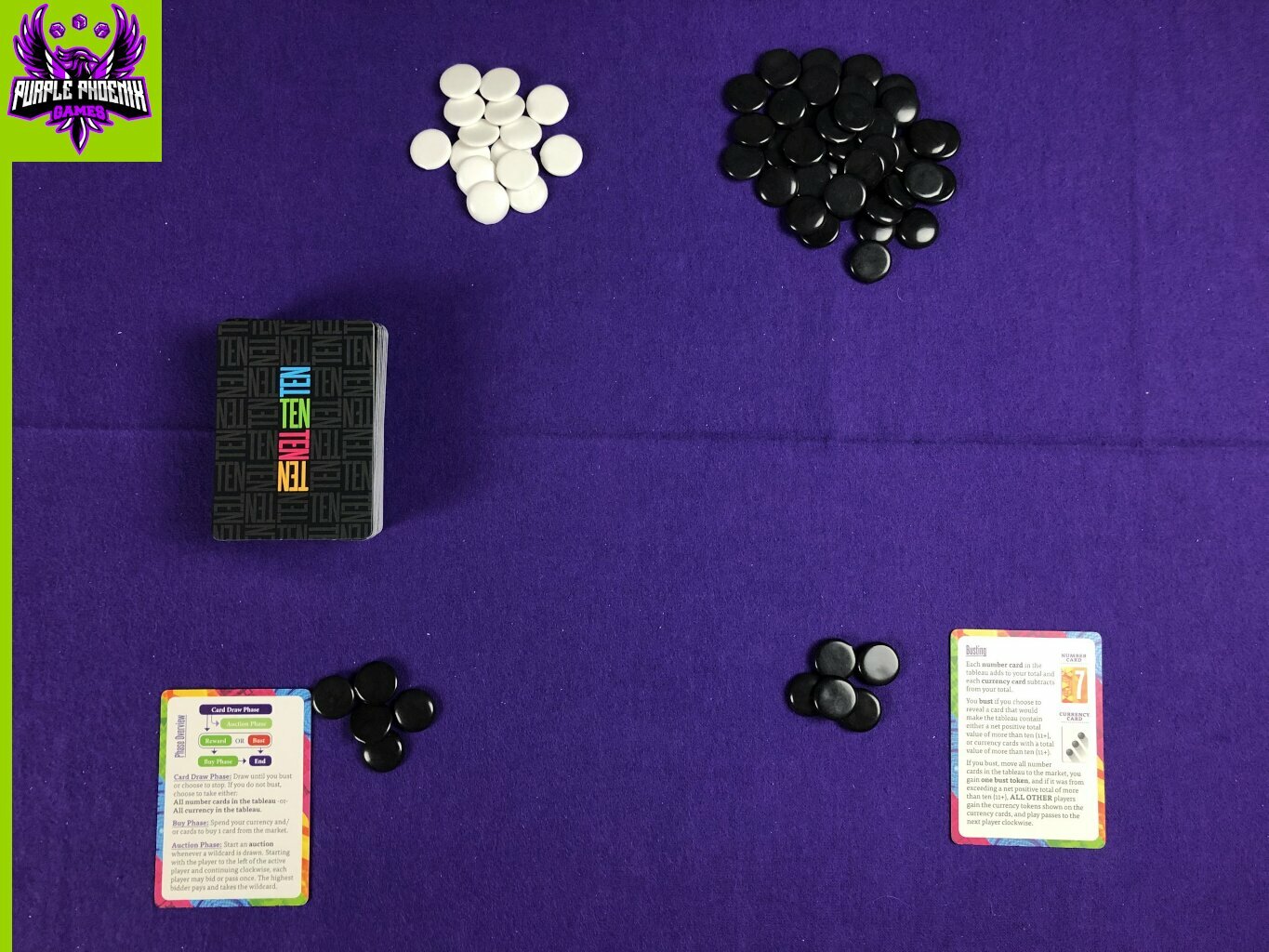
TEN is a push-your-luck game of set collection and auction/bidding in which players are trying to amass the most points by the end of the game. Points are earned by collecting sets of numeric sequences in the 4 colors of the game: Blue, Green, Pink, and Orange. Played over a series of turns, players will be drawing/collecting cards from the tableau, buying cards from the Market, or Busting if they push their luck a bit too far. To setup for a game, assemble the deck of cards as dictated by the player count and set it in the play area. Each player gets 5 Currency tokens with which to start the game, and are all dealt a random reference card. The player who was dealt the reference card with the Starting Player symbol will begin the game. Before getting into the actual gameplay, I want to mention the different card types, as to provide a better understanding when reading this review. In each of the 4 colors, there are card values numbered 1-9, with more copies of the lower numbers and fewer of the higher numbers. There are also Wildcards that can be used to represent any #/color, depending on the card. Some cards in the deck are Currency cards and show a value of 1-5 Currency. Should you choose to take these from the tableau, you collect that amount of Currency to be used for auctions or buying cards in later turns.
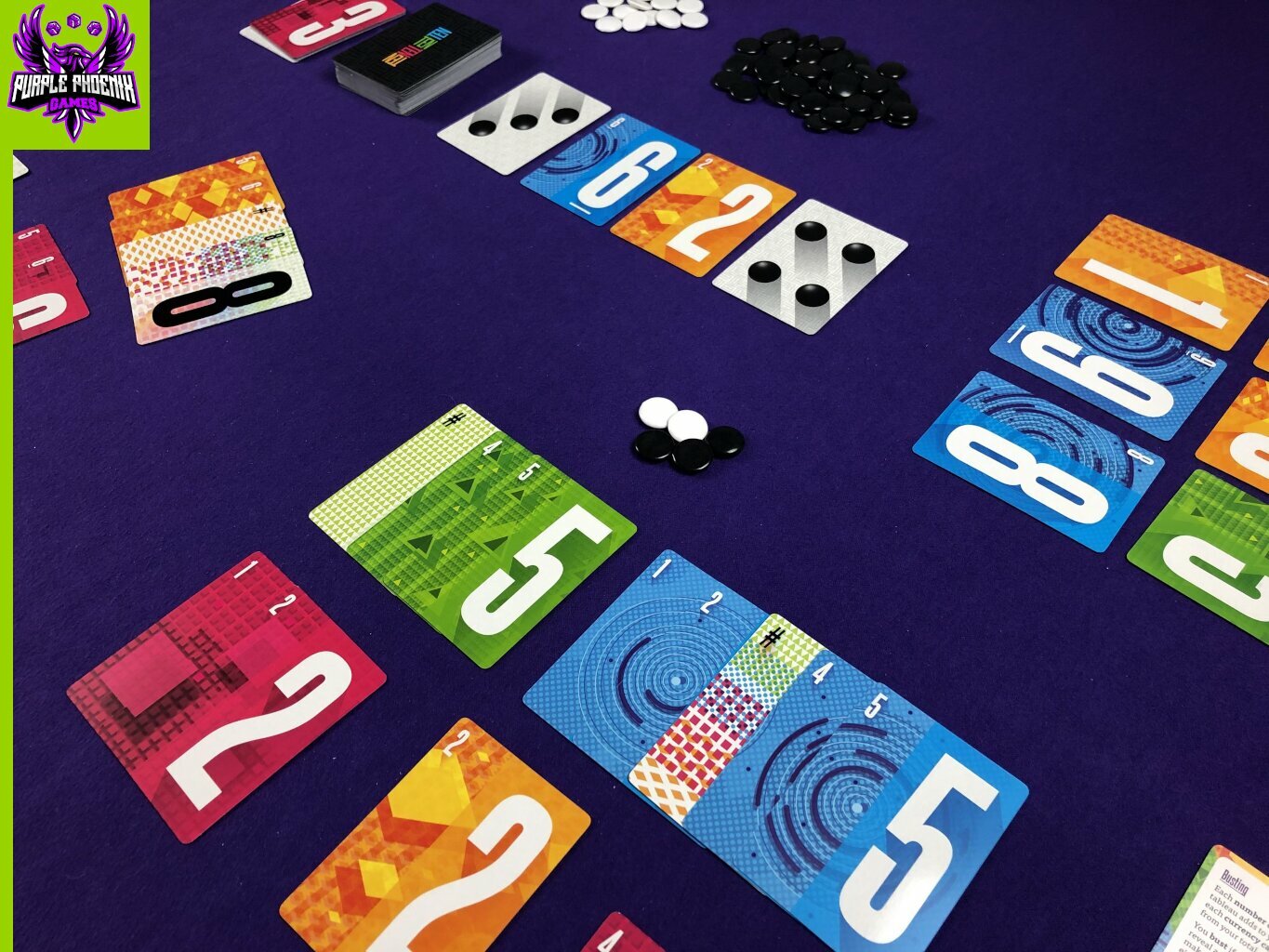
On your turn, you will perform a series of actions, the first of which is Draw a Card. You will draw a card from the top of the deck and place it in the tableau. If the card is a # card or a Currency card, you will then decide if you wish to continue drawing cards. If you do, draw the next card, and so on, until either you decide to stop or you Bust (more on this in a bit). As long as you do not Bust, you can decide when to stop drawing cards to the tableau. You may then take one of the following rewards: take all the # cards to your play area, or take Currency tokens (equal to the amount shown on the Currency cards in the tableau). When you take the # cards, they go into your play area and all other players will collect Currency tokens. You then have the opportunity to Buy a card from the Market (by paying the numeric value of the card) and add it to your play area. If you instead choose to collect Currency, you will take Currency equal to the total value of Currency in the tableau, and all other players receive nothing from your turn. All # cards are moved to the Market, and your turn ends. In the picture below, if I choose to take the # cards, I would take the Orange 2 and Blue 6 to my play area, and all other players would collect 7 Currency. Conversely, I could choose to take 7 Currency, and the # cards are added to the Market (on the right-hand side of the picture).
So how does Busting work? The tableau may never have a value of more than 10. Every # card you draw adds to your total value, and any Currency card drawn subtracts from the total. If you were to draw a # card that would give you a total value of more than 10, you Bust! OR if you ever have Currency cards that total more than 10, you Bust as well. So there’s a bit of math involved, with addition and subtraction, but you have to make sure you never get more than 10! For example, in the picture below, the net total value of the tableau is 1. (8 from # cards, -7 from Currency cards) If I were to draw a Currency card of 4-5, I would Bust, because that totals more than 10. In this pictured instance, any # card I draw would not make me Bust, as the highest total would only be a 10, given the current cards in play. If you ever push your luck too far and end up Busting, all # cards in the tableau are moved to the Market, and you gain a Bust token (worth 3 Currency). If you Busted with # cards, then all other players will collect Currency tokens, but if you Bust with Currency cards, nobody receives anything. After resolving a Bust, your turn ends and the game continues to the next player.
If, on your turn, you ever draw a Wildcard, your turn pauses and the Wildcard is auctioned. Each player will have one chance to either bid (increasing the bid from the previous) or pass. Whomever wins the auction must pay their bid, and they collect the Wildcard to their play area. Once the auction has been resolved, your turn continues as normal. It is possible to have multiple auctions on your turn – it all depends on the cards. The game continues in this fashion, players taking turns drawing cards, collecting cards/Currency, buying from the Market, bidding in auctions, etc., until the draw deck has been depleted. The active player finishes their turn as normal, but may not draw any more cards. Points are then tallied. All players will arrange their cards to create consecutive sequences of numbers in the 4 different colors. You receive 1 point per card in your longest sequence of each color. If you have a complete set of numbers 1-9 in a color, you get a bonus point. Players count up all their points, and the player with the highest value is the winner!
That kind of seems like a lot, but I promise it’s actually pretty intuitive when you get playing. Also, huge shoutout to AEG for providing such a well-done reference card – it includes a little flowchart to help you with how the turns flow. The gameplay itself is essentially pretty straightforward. You draw a card, and then react based on what it is. Bust? Collect a Bust token and your turn ends. No Bust? Decide if you want to keep drawing. Done pushing your luck? Collect either the # cards or Currency. Try to make sequential runs of numbers in the different colors – the more cards you get in sequence, the more points you’ll get at the end of the game. The thing that elevates TEN beyond a simple push-your-luck game to me is that it requires more strategy than just luck. You can see what cards are available in the Market – is there something you need to buy? You can see everyone else’s playing area – do they need any of the numbers you just revealed? You know how much Currency every player has – do you bid high on this Wildcard because your neighbor can’t outbid you? There is so much more than just luck in this game, and that is what takes it to the next level for me. I know that Travis has reviewed No, Thanks! in the past, and I would say that this gives me similar vibes, but way better in my opinion.
When it comes to playing games, I am generally not a huge risk-taker. I like making logical choices based on known information and end-game strategy. But something about this game just gets me. I think one element that makes me love this game is the different types of cards – # cards and Currency cards. When you’re pushing your luck and drawing cards, there’s an added element of excitement, because the two different types of cards affect the net total differently. It doesn’t all positively add to the net total, which makes me more likely to keep drawing in hopes that things will cancel out and I can maximize the turn. If everything all added together, and you just couldn’t get more than 10, I would probably only ever draw 2 cards per turn, max., just to make sure I didn’t Bust. But the fact that Currency cards subtract from the net total encourages players to keep pushing their luck, and either earning a big payoff or a big Bust. This game is exciting, engaging, and entertaining to play, and that makes it fun!
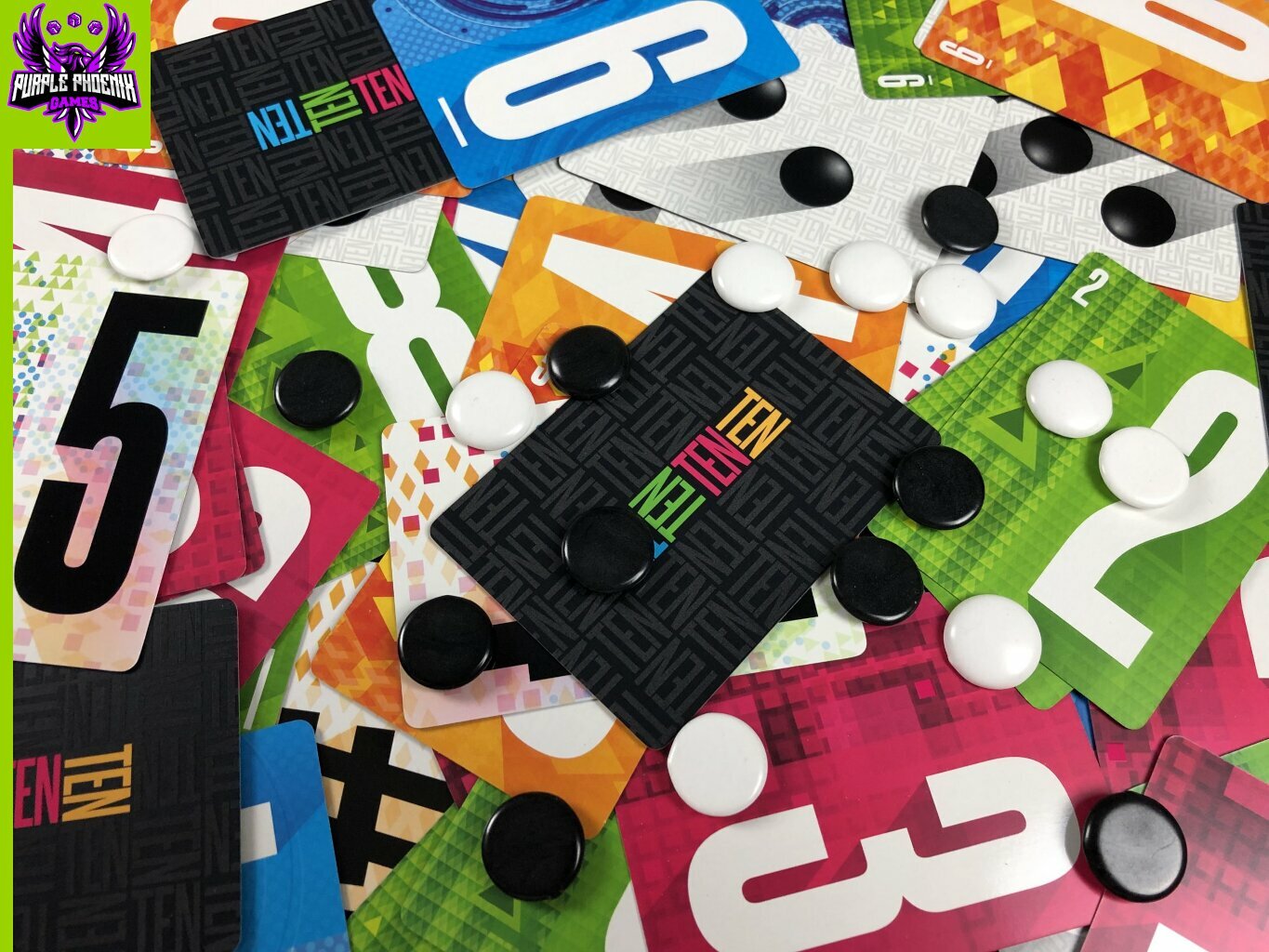
To touch on components, AEG always hits it out of the park – and TEN is no exception. The game is mostly just a bunch of cards, and some white/black Currency tokens. The tokens themselves are nice plastic, and are smooth and chunky in hand. The cards are thick and sturdy, and hold up to shuffling pretty well. The colors of the game are bright and vibrant, and they are very clear to differentiate between. It’s a nice pop of color on the table, and that adds to the overall enjoyment of the game. Each of the 4 colors, and the Wildcards for that matter, have a unique background design – which can help our colorblind friends who may not necessarily be able to differentiate between the colors. Just an added plus to help the gamers tell what cards belong to what colors! The game box is equally as colorful, and is eye-catching on the shelf. All in all, I’d say AEG gets a 10 for their production quality here. (Get it?)
I spoke earlier about judging a game by its mechanics, and how TEN really challenged me on that. I was expecting a game that I would like, but would be kind of just ok overall for me. What I got is a game that is highly strategic, yet also unpredictable at times. I am definitely a planner when it comes to strategy, but the unpredictability of this game is light, fun, and engaging for all players at all times. It just is fun to play. This is a game that I see staying in my collection for a long time, and hopefully getting to the table quite often when I need a quick filler that isn’t so light that it’s mindless, but not heavy enough that it’s a brain-burner. If you’re in the market for a fun little game that challenges all players, I would definitely recommend checking out TEN. Purple Phoenix Games rates our games on a scale of 1-6 (not 10 unfortunately in this case), and we give this one a solid 5 / 6.
Disclaimer: We were provided with a copy of TEN for the purposes of this review. This is a final production copy, so what you see pictured is what you would receive in a retail copy of the game. -L
TEN is a push-your-luck game of set collection and auction/bidding in which players are trying to amass the most points by the end of the game. Points are earned by collecting sets of numeric sequences in the 4 colors of the game: Blue, Green, Pink, and Orange. Played over a series of turns, players will be drawing/collecting cards from the tableau, buying cards from the Market, or Busting if they push their luck a bit too far. To setup for a game, assemble the deck of cards as dictated by the player count and set it in the play area. Each player gets 5 Currency tokens with which to start the game, and are all dealt a random reference card. The player who was dealt the reference card with the Starting Player symbol will begin the game. Before getting into the actual gameplay, I want to mention the different card types, as to provide a better understanding when reading this review. In each of the 4 colors, there are card values numbered 1-9, with more copies of the lower numbers and fewer of the higher numbers. There are also Wildcards that can be used to represent any #/color, depending on the card. Some cards in the deck are Currency cards and show a value of 1-5 Currency. Should you choose to take these from the tableau, you collect that amount of Currency to be used for auctions or buying cards in later turns.
On your turn, you will perform a series of actions, the first of which is Draw a Card. You will draw a card from the top of the deck and place it in the tableau. If the card is a # card or a Currency card, you will then decide if you wish to continue drawing cards. If you do, draw the next card, and so on, until either you decide to stop or you Bust (more on this in a bit). As long as you do not Bust, you can decide when to stop drawing cards to the tableau. You may then take one of the following rewards: take all the # cards to your play area, or take Currency tokens (equal to the amount shown on the Currency cards in the tableau). When you take the # cards, they go into your play area and all other players will collect Currency tokens. You then have the opportunity to Buy a card from the Market (by paying the numeric value of the card) and add it to your play area. If you instead choose to collect Currency, you will take Currency equal to the total value of Currency in the tableau, and all other players receive nothing from your turn. All # cards are moved to the Market, and your turn ends. In the picture below, if I choose to take the # cards, I would take the Orange 2 and Blue 6 to my play area, and all other players would collect 7 Currency. Conversely, I could choose to take 7 Currency, and the # cards are added to the Market (on the right-hand side of the picture).
So how does Busting work? The tableau may never have a value of more than 10. Every # card you draw adds to your total value, and any Currency card drawn subtracts from the total. If you were to draw a # card that would give you a total value of more than 10, you Bust! OR if you ever have Currency cards that total more than 10, you Bust as well. So there’s a bit of math involved, with addition and subtraction, but you have to make sure you never get more than 10! For example, in the picture below, the net total value of the tableau is 1. (8 from # cards, -7 from Currency cards) If I were to draw a Currency card of 4-5, I would Bust, because that totals more than 10. In this pictured instance, any # card I draw would not make me Bust, as the highest total would only be a 10, given the current cards in play. If you ever push your luck too far and end up Busting, all # cards in the tableau are moved to the Market, and you gain a Bust token (worth 3 Currency). If you Busted with # cards, then all other players will collect Currency tokens, but if you Bust with Currency cards, nobody receives anything. After resolving a Bust, your turn ends and the game continues to the next player.
If, on your turn, you ever draw a Wildcard, your turn pauses and the Wildcard is auctioned. Each player will have one chance to either bid (increasing the bid from the previous) or pass. Whomever wins the auction must pay their bid, and they collect the Wildcard to their play area. Once the auction has been resolved, your turn continues as normal. It is possible to have multiple auctions on your turn – it all depends on the cards. The game continues in this fashion, players taking turns drawing cards, collecting cards/Currency, buying from the Market, bidding in auctions, etc., until the draw deck has been depleted. The active player finishes their turn as normal, but may not draw any more cards. Points are then tallied. All players will arrange their cards to create consecutive sequences of numbers in the 4 different colors. You receive 1 point per card in your longest sequence of each color. If you have a complete set of numbers 1-9 in a color, you get a bonus point. Players count up all their points, and the player with the highest value is the winner!
That kind of seems like a lot, but I promise it’s actually pretty intuitive when you get playing. Also, huge shoutout to AEG for providing such a well-done reference card – it includes a little flowchart to help you with how the turns flow. The gameplay itself is essentially pretty straightforward. You draw a card, and then react based on what it is. Bust? Collect a Bust token and your turn ends. No Bust? Decide if you want to keep drawing. Done pushing your luck? Collect either the # cards or Currency. Try to make sequential runs of numbers in the different colors – the more cards you get in sequence, the more points you’ll get at the end of the game. The thing that elevates TEN beyond a simple push-your-luck game to me is that it requires more strategy than just luck. You can see what cards are available in the Market – is there something you need to buy? You can see everyone else’s playing area – do they need any of the numbers you just revealed? You know how much Currency every player has – do you bid high on this Wildcard because your neighbor can’t outbid you? There is so much more than just luck in this game, and that is what takes it to the next level for me. I know that Travis has reviewed No, Thanks! in the past, and I would say that this gives me similar vibes, but way better in my opinion.
When it comes to playing games, I am generally not a huge risk-taker. I like making logical choices based on known information and end-game strategy. But something about this game just gets me. I think one element that makes me love this game is the different types of cards – # cards and Currency cards. When you’re pushing your luck and drawing cards, there’s an added element of excitement, because the two different types of cards affect the net total differently. It doesn’t all positively add to the net total, which makes me more likely to keep drawing in hopes that things will cancel out and I can maximize the turn. If everything all added together, and you just couldn’t get more than 10, I would probably only ever draw 2 cards per turn, max., just to make sure I didn’t Bust. But the fact that Currency cards subtract from the net total encourages players to keep pushing their luck, and either earning a big payoff or a big Bust. This game is exciting, engaging, and entertaining to play, and that makes it fun!
To touch on components, AEG always hits it out of the park – and TEN is no exception. The game is mostly just a bunch of cards, and some white/black Currency tokens. The tokens themselves are nice plastic, and are smooth and chunky in hand. The cards are thick and sturdy, and hold up to shuffling pretty well. The colors of the game are bright and vibrant, and they are very clear to differentiate between. It’s a nice pop of color on the table, and that adds to the overall enjoyment of the game. Each of the 4 colors, and the Wildcards for that matter, have a unique background design – which can help our colorblind friends who may not necessarily be able to differentiate between the colors. Just an added plus to help the gamers tell what cards belong to what colors! The game box is equally as colorful, and is eye-catching on the shelf. All in all, I’d say AEG gets a 10 for their production quality here. (Get it?)
I spoke earlier about judging a game by its mechanics, and how TEN really challenged me on that. I was expecting a game that I would like, but would be kind of just ok overall for me. What I got is a game that is highly strategic, yet also unpredictable at times. I am definitely a planner when it comes to strategy, but the unpredictability of this game is light, fun, and engaging for all players at all times. It just is fun to play. This is a game that I see staying in my collection for a long time, and hopefully getting to the table quite often when I need a quick filler that isn’t so light that it’s mindless, but not heavy enough that it’s a brain-burner. If you’re in the market for a fun little game that challenges all players, I would definitely recommend checking out TEN. Purple Phoenix Games rates our games on a scale of 1-6 (not 10 unfortunately in this case), and we give this one a solid 5 / 6.