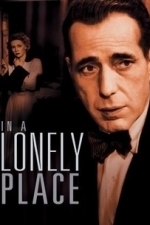
"“I was born when she kissed me. I died when she left me. I lived a few weeks while she loved me.”
One of the great lines of this story, again based on a novel by Dorothy B. Hughes. I have recommended this movie to many a brooding actor, one of whom called me the next day only to admonish me, “Why did you think I needed to see this film?” I’m a dame, so don’t crawl all over me, but I think men like this film because they can watch it and be tormented, with a glass of scotch in hand, and think about all the dames who ruined them.
In a Lonely Place asks: Can violence be romantic? Are all men violent by nature? Do women drive men to be violent toward them? Do women sometimes desire men to be violent? The film touches disturbingly on the psychology of physical abuse, so women, beware. It seems to say: I beat you because I love you, because I can’t live without you. And if I can’t have you, if you want to leave me, I may have to kill you. The fact that a love-hate relationship was going on during the making of the film between the people who made it—director Nicholas Ray and Ray’s then wife, star Gloria Grahame—only gives it an added dimension. It’s interesting to note that In a Lonely Place was made during a time when that sort of behavior toward women was more acceptable, was even considered love. Read up on Bogart’s third marriage, to actress Mayo Methot. They nearly killed each other but, while married, were affectionately referred to as “the battling Bogarts.”
Humphrey Bogart always played a tough guy on-screen. He had an inner violence that escaped in a knowing snarl, or a slap or two for poor Peter Lorre in The Maltese Falcon. This Bogart is pretty ugly. Was he playing himself? He’s the producer here, so it seems obvious he wanted to expose himself within the confines of the story. Bogart plays Dixon Steele, a washed-up, once-famous screenwriter. He’s a loner, he’s an alcoholic, and he’s also quite the snappy dresser—which I thought was a great touch. It’s a signal that he sets himself apart. He’s better than everyone else. He doesn’t have to follow the rules. He has his own code of behavior, and if you don’t like it, he’ll smash your face in.
He’s someone who seems so far removed from his own actions that it’s hard to even root for him. Although he is a violent drunk, he never sees it that way. He’s noble. There’s some kind of masculine honor in Dix that Bogart and Ray seem to say is lacking in every other man in Hollywood. Ah, when men were men, and you could booze and brawl all night.
Every sadist needs a masochist, and no one plays sexy-doomed better than Gloria Grahame. Her suffering was usually some sort of retribution. Lee Marvin throws hot coffee in her face in The Big Heat. She becomes a prostitute in the nightmare vision of Bedford Falls, Pottersville, in It’s a Wonderful Life. She dies in a plane crash after cheating on Dick Powell in The Bad and the Beautiful. She shines here. And could someone explain to me the undercurrent of her relationship with her female masseuse? “She beats me black and blue.” Hmmm . . . In In a Lonely Place, she is the wrong girl who moved into the wrong place and got hooked up with the wrong guy while running away from another wrong guy. Laurel Gray. Wonder if they took the name from Laurel Canyon, a winding road in LA. She’s never going to find happiness, especially with a man like Dix, and you know that from the minute you see her. The original ending of In a Lonely Place has Laurel strangled by Dix in the heat of their last argument as she attempts to leave him. He then calmly finishes his screenplay as the police come to arrest him. That’s Hollywood. In spite of killing his girlfriend, he finishes his screenplay. I would have preferred that, because I think that’s a reflection of what Ray and Bogart really felt. Instead, Ray got cold feet, and the ending, though tragic, lets Dix off the hook, leaving us to believe he will forever be in that lonely place. He’s the victim. Is there nobility in that?
Maybe Ray was looking for his own happy ending. He and Grahame divorced in 1952. In 1956, Ray made Bigger Than Life, another film I love that explores a man driven to almost killing his wife."
Source


 Rate It