

Purple Phoenix Games (2266 KP) rated Abstract Academy in Tabletop Games
Feb 25, 2022

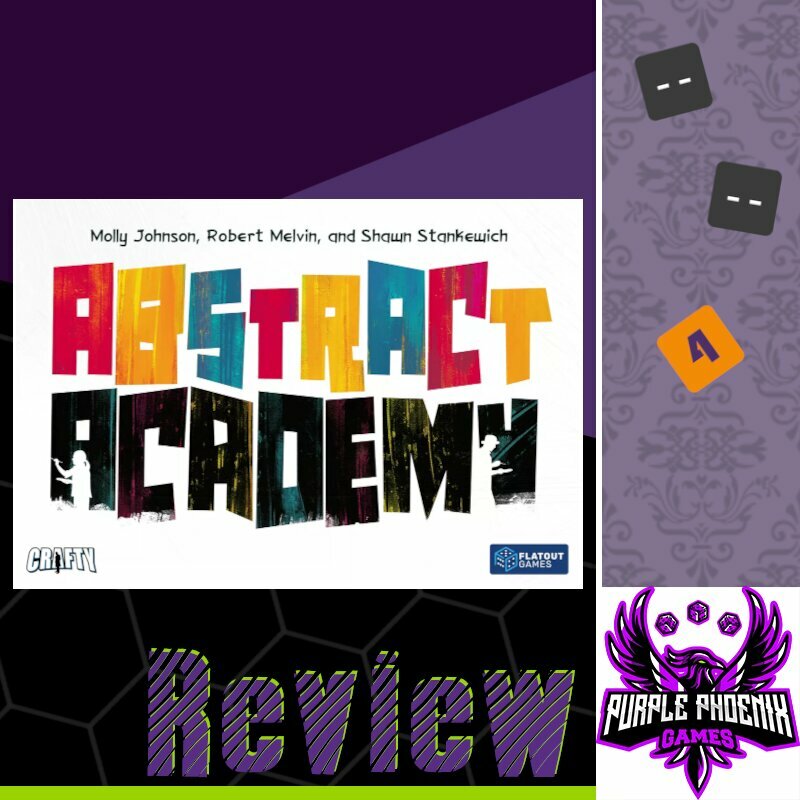
Abstract Academy is a card laying, hand management, pattern building game for two to four players. In it, players become art school students trying to impress their teachers. The only problem is that they must share a canvas, as the costs of school allow them very few luxuries. The player who can most effectively build masterpieces and satisfy all tested requirements over three rounds will ace the class and claim victory over the other starving artists.
DISCLAIMER 1: We were provided a copy of this game for the purposes of this review. This is a retail copy of the game, so what you see in these photos is exactly what would be received in your box. I do not intend to cover every single rule included in the rulebook, but will describe the overall game flow and major rule set so that our readers may get a sense of how the game plays. For more in depth rules, you may purchase a copy online or from your FLGS. -T
DISCLAIMER 2: My current temporary housing did not want me to have great lighting for photos in this review. Please try to ignore the yellow tint; I do not enjoy over-editing game photos.
To setup, shuffle each deck type and place the decks on the table. The rulebook does not specify where, so just throw them wherever. This is a game about art, so be creative. Each player draws a hand of three Canvas cards (with the whitish back and colors on the faces). The starting Teacher’s Pet player will then reveal cards according to the round from the respective decks, per the rules and provided reference cards. Each round will reveal different sets of Assignment and Professor cards. Players also draw one Inspiration card and the game is ready to begin! Paintbrushes at the ready!
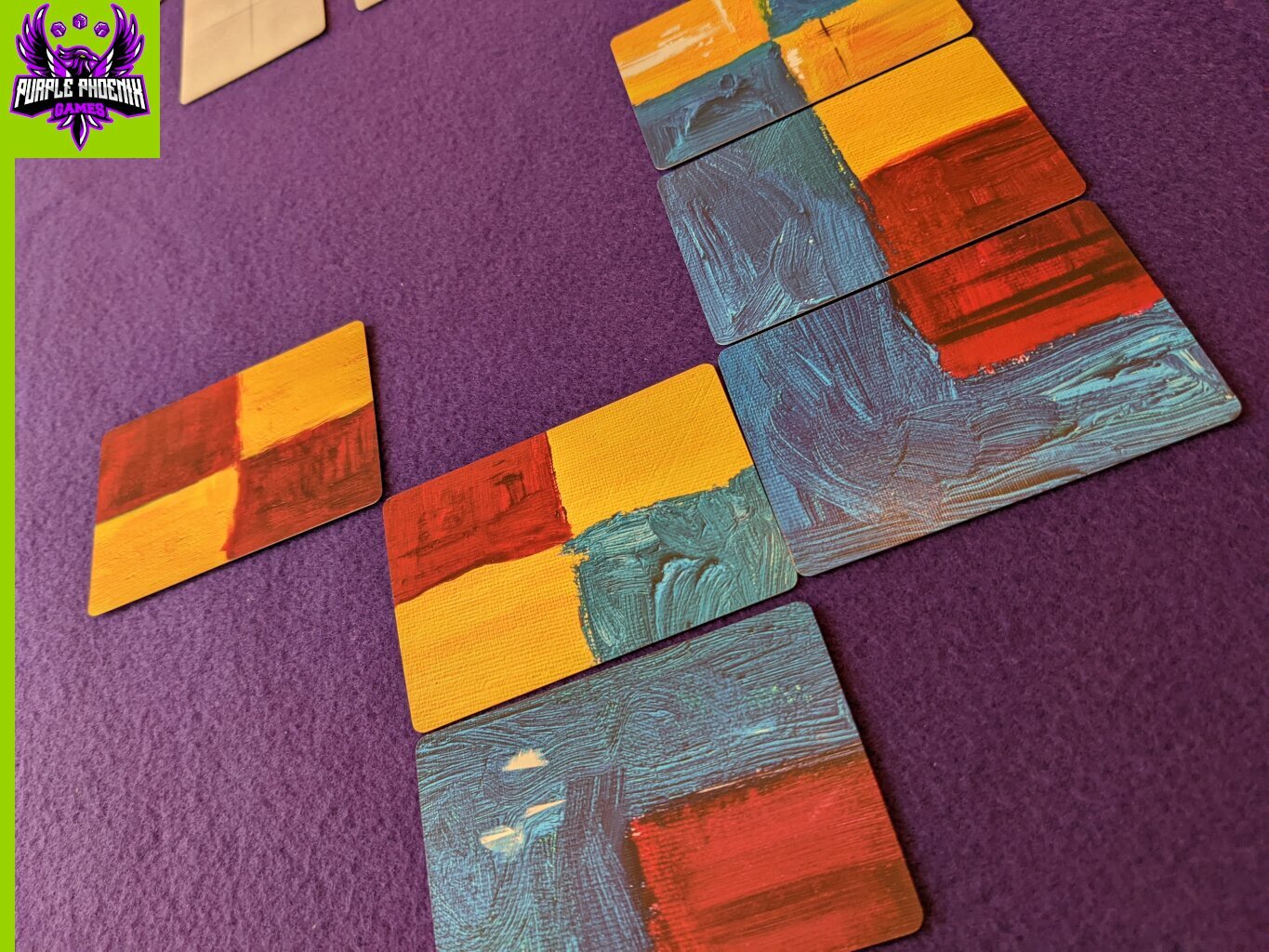
Turns could not be simpler: Play a Canvas card, and then Draw a Canvas card. Both of these actions are self-explanatory, but let me expound on this a bit. Once the first Canvas card has been played by the current Teacher’s Pet, each subsequent card must be played orthogonally adjacent to another card on the table. To define the size of the entire project’s canvas, players will be confined to a 4 x 4 grid of cards. Once a column (the cards that would lead a path to the opponent) has been completed with four cards, the rows gain special rules. Firstly, the row closest to each player becomes the “Home Row.” Players may only play cards into their own Home Row, unless the only legal place to play a card is in the opponent’s Home Row. Secondly, the Home Row and the row above it is now consider the Scoring Zone, and will dictate which cards are able to be used to satisfy Inspiration, Professor, and Assignment requirements for VP. Therefore, until the 4 x 4 grid has been solidified, players are unaware which cards may end up in their Home Rows or Scoring Zones!
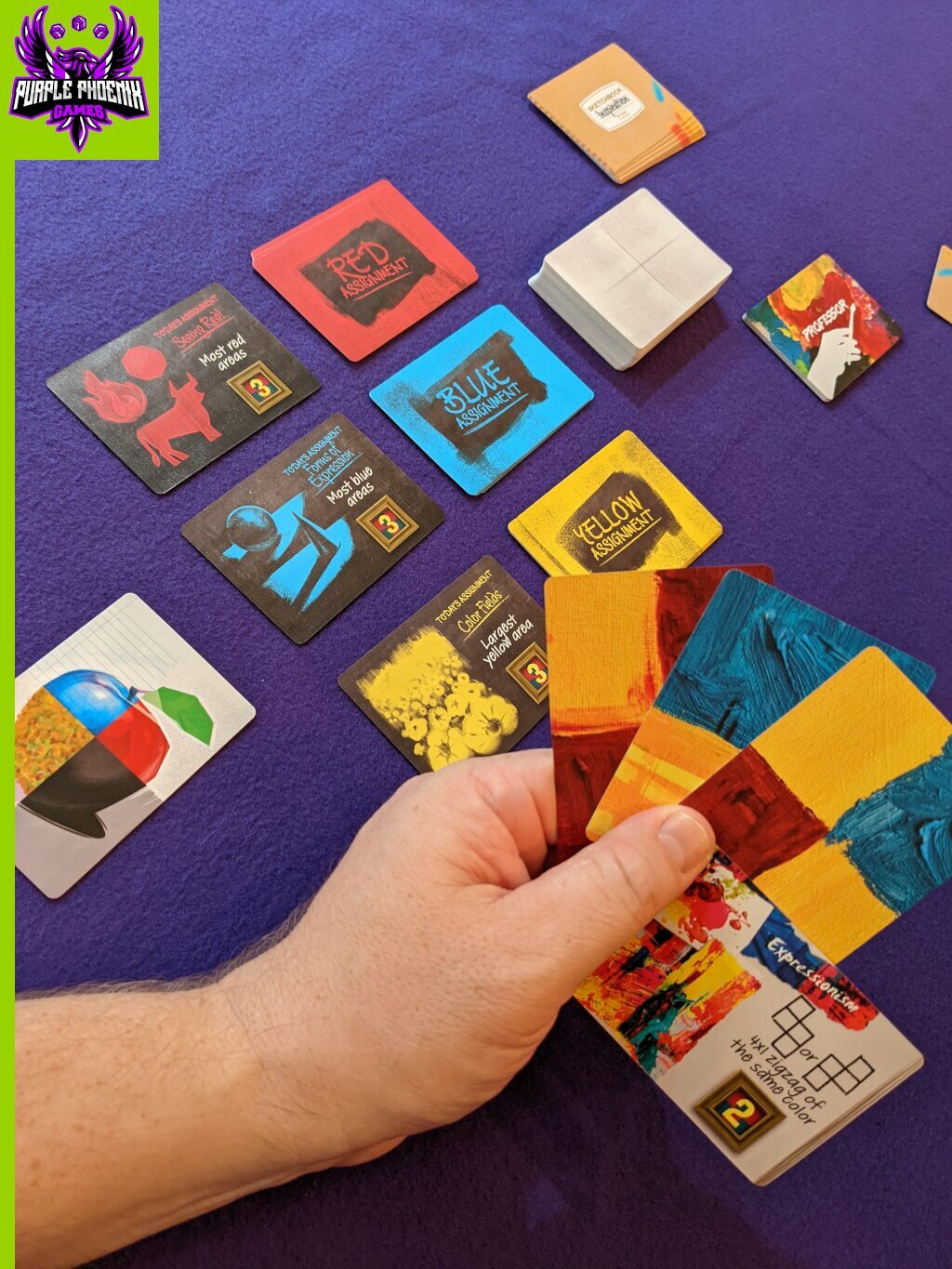
Victory Points are earned by scoring the special requirements of Inspiration, Professor, and Assignment cards once the entire 4 x 4 grid of Canvas cards is complete. Oftentimes players will need to compare scores to determine which player earns the points. For example, the Moret Professor card states that five VP are earned when the player controls the “most color areas with four or more quadrants.” Each Canvas card is divided into four quadrants, and quadrants are colored with one of the primary colors. A “color area” is simply a connected network of the same color within the player’s Scoring Zone. So, to satisfy Professor Moret, the player who controls the most amount of color areas that are four quadrants or larger.
Assignment cards come in Red, Blue, and Yellow, and pertain to those colors. For example, the red “Get to the Point!” Assignment requires the “most red areas with only one quadrant.” So the assignment is asking players to dapple their canvas with unconnected red quadrants.
In stark contrast, the Inspiration card requirements resemble shapes of quadrants, as opposed to colors or numbers of quadrants. Most of the shapes on these cards are reminiscent of Tetris-style shapes, where players will score their Inspiration cards by building the correct shape of connected quadrants of the same color within their Scoring Zone.
Once these cards are all scored for the round, the Teacher’s Pet sets up for the next round per the rulebook/reference cards. The subsequent rounds will require alternate decks to reveal cards, or choice of decks. When the third and final round has been scored, the points are tallied and the victor is crowned! With a construction paper and macaroni crown, most likely. They ARE starving artists, after all.
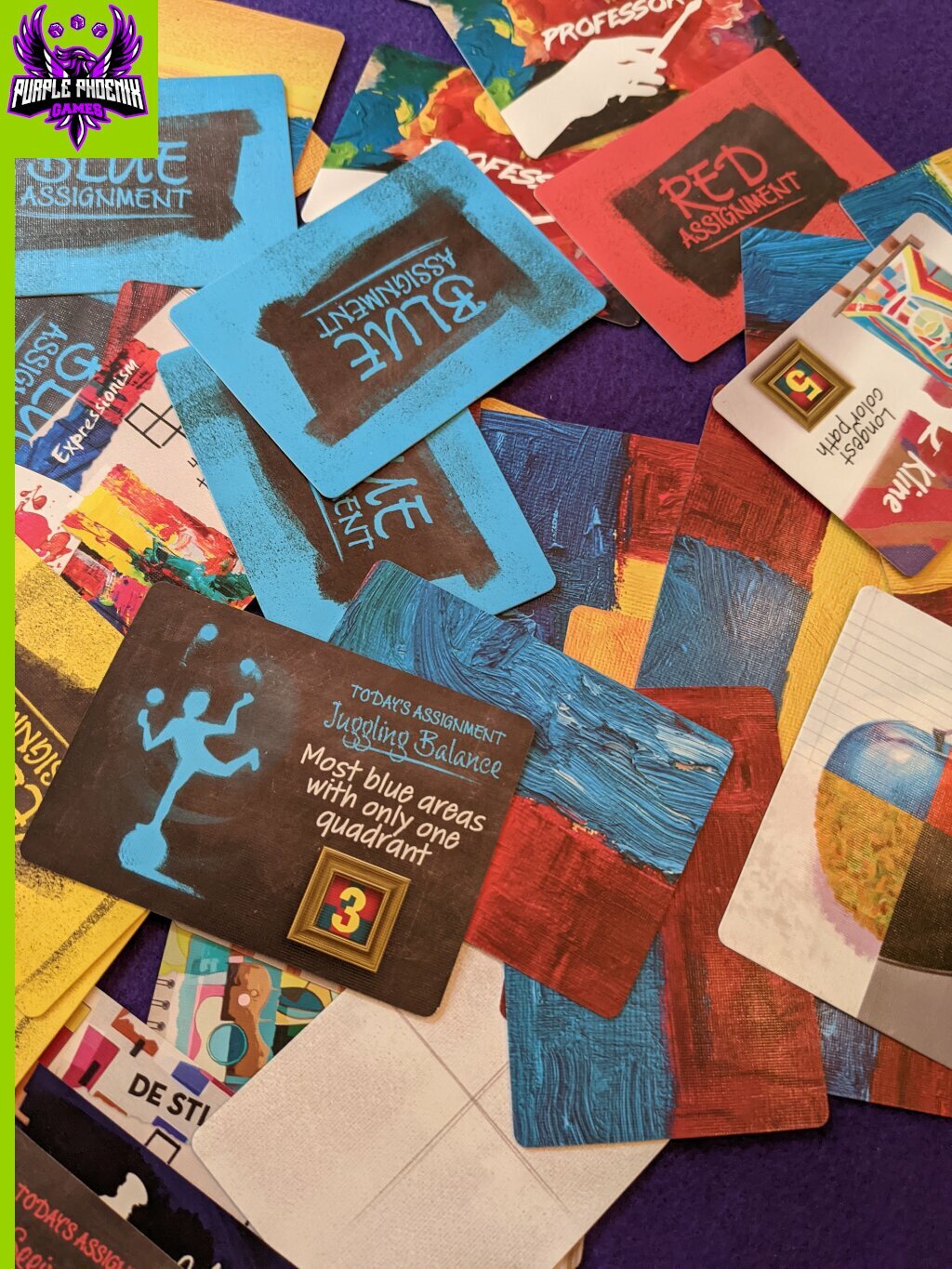
Components. This game is a double-card-deck box with 90+ cards and a rulebook. The cards are great quality, but the true hero here is, and appropriately so, the artwork. Every card is very stylish, the Professors are all nods to real artists (well, except maybe not the promo), and it has just a really great look overall. While being played, it just has an amazing table presence. I like that a lot.
I struggled with assigning a score to this one for a few reasons. First, I like so much about this game, and I dislike a few things. I very much enjoy having so many ways to score points each round, as it keeps my mind busy with trying to put the puzzle together. The monkey wrench, though, is that when you start a round, you play cards that may not even end up in your Scoring Zone. As your hand is always three cards, it is difficult to really plan too far in advance to create a perfect Scoring Zone. Is that a bad thing? Maybe, but I think it is also quite necessary to add a little chaos to this specific game. I will explain what I mean in a bit. Perhaps a few points docked for that.
Playing Canvas cards effectively is absolutely the crux of this game, because if a pattern or shape is being built to your benefit, your opponent can easily (and definitely accidentally) ruin your best laid plans with an ill-placed card to wonkify the grid. I think that is both delicious and very very frustrating. You know what? I will decide to give a few points back for this.
The ability for the Teacher’s Pet, a title that can be passed to the other player throughout the game, to choose which two of the three Assignment decks to reveal during Round 3 just adds to the replayability factor of Abstract Academy. True, there are only five cards in each Assignments deck, and there are mathematical or statistical formulae that can calculate the exact number of possible different unique games, the ever-changing grid of cards is what makes this nearly infinitely replayable. Okay, more points earned here.
I guess I judged too harshly, and my true rating is a little lower than perhaps this little game deserves. I absolutely know that I will be playing this a whole lot more – with gamers of all ages and weight preferences. It is easy to teach, keeps the brain engaged throughout, and forces players to step back and truly appreciate that which they have equally built together. I can completely foresee my score for Abstract Academy increasing with more and more plays, so please do not regard a 4 / 6 from Purple Phoenix Games as an absolute and inflexible score.
If you are a gamer who enjoys just a little chaos added to their careful planning, light and quick card games that pack more punch than expected, and some truly awesome table presence, then you most certainly need to grab a copy of Abstract Academy. I am soon to be culling my collection and curating it to only include games I thoroughly enjoy. I have a feeling Abstract Academy is going to make the cut. It checks off so many boxes for me and how I game, and I cannot wait to introduce my kiddos to it when they can grasp the concepts.
Purple Phoenix Games (2266 KP) rated Sea of Clouds in Tabletop Games
Sep 5, 2019 (Updated Jul 1, 2020)
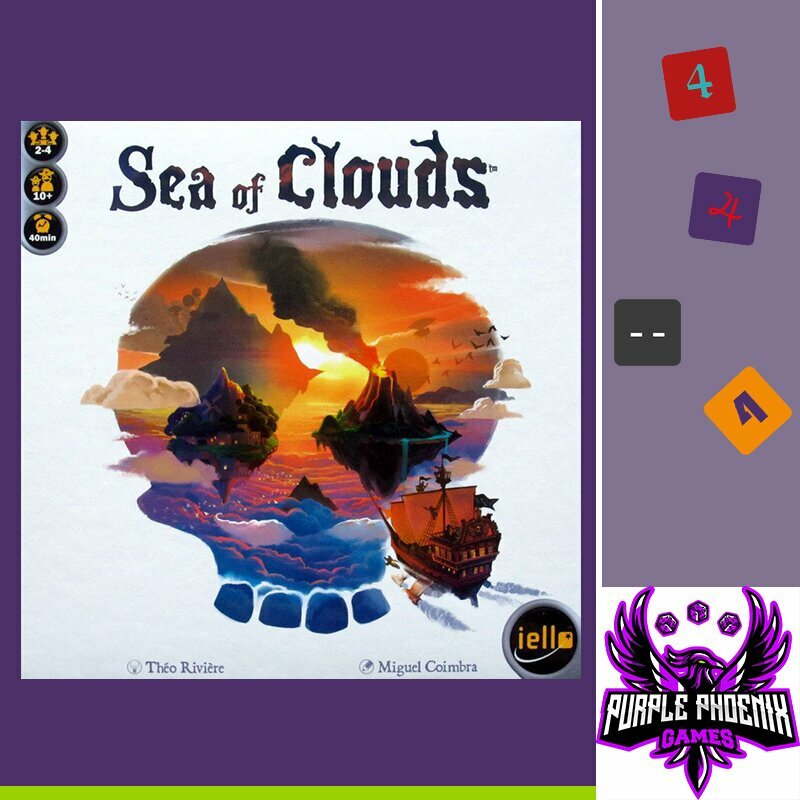
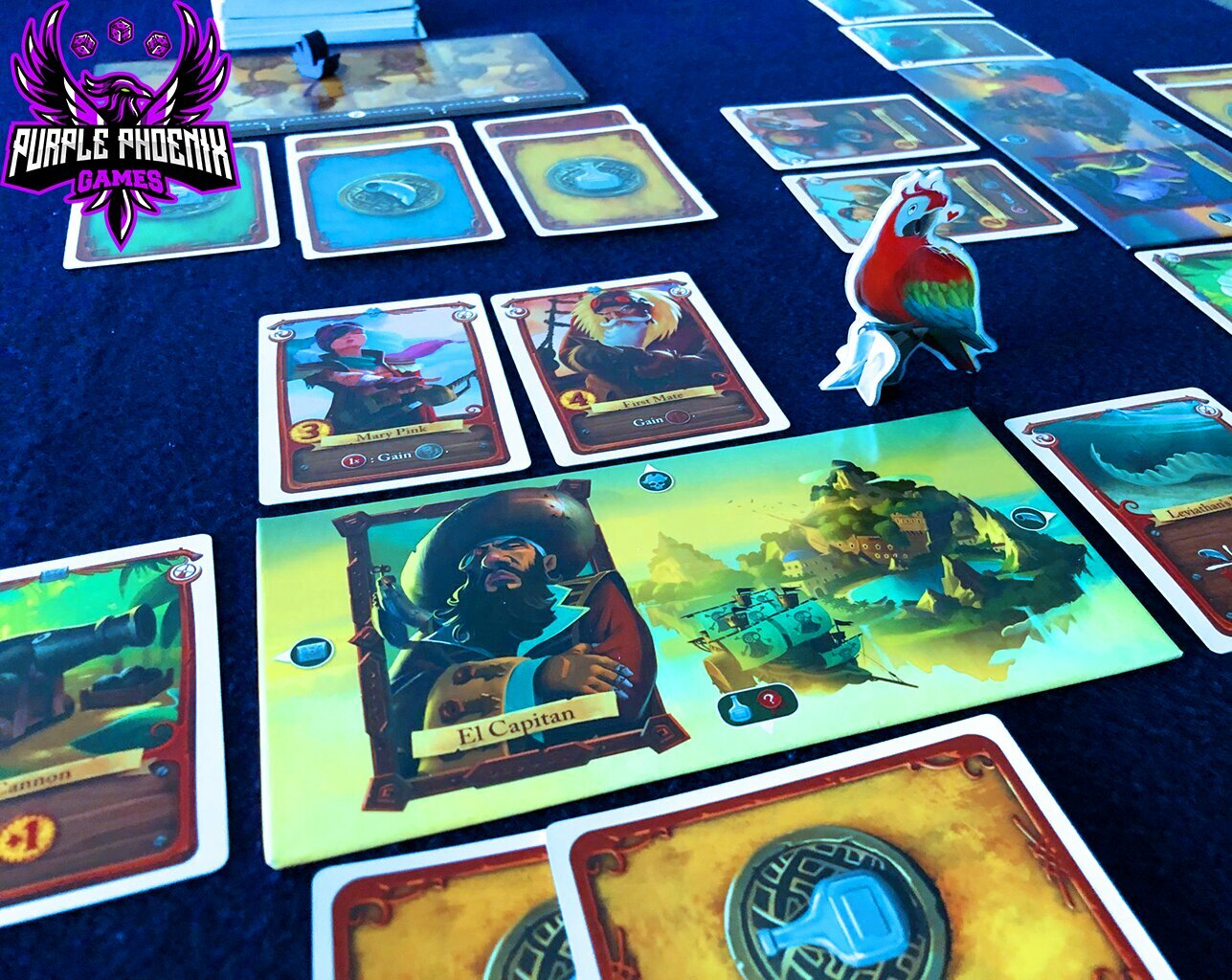
In Sea of Clouds, players are Captains of mighty air pirate ships. That’s right – flying pirate ships! Just like the pirate days of yore, your goal is to recruit the best crew, plunder for treasure and relics, and find the best rum along the way. But be careful because your rival pirate Captains have their eyes on the same prize – so make sure you’ve got a way to outsmart them and sail your way to victory!
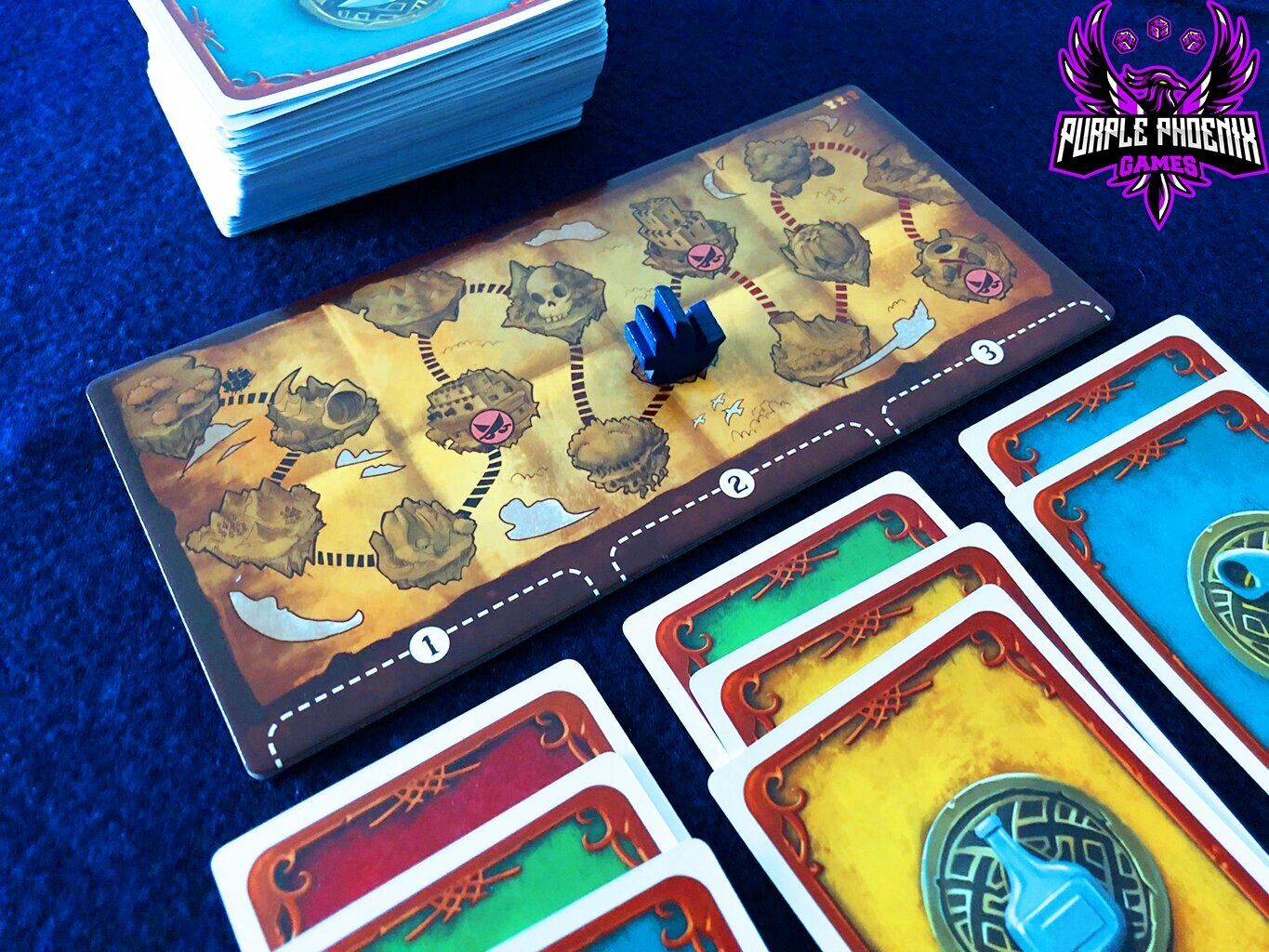
Sea of Clouds is a game of card drafting, set collection, and push your luck in which players are trying to amass the most end-game victory points. Played over a series of rounds, players take turns drafting cards, performing bonus actions, and engaging in combat with their neighboring Captains. To setup, each player takes their chosen Captain board, the central board is placed in the middle of all players, and 1 loot card is placed face-down on each of the 3 loot spaces on the central board. The remaining cards are shuffled and create a draw pile. Now you are ready to play!
Each round consists of divvying up shares of loot between all players. On your turn, you will take the face-down card(s) in the #1 loot spot and look at them secretly. Decide whether you want to take the share, or leave it and look at the next one. If you decide to keep the card(s), add them directly around your Captain board in their corresponding spaces. If you decided to leave the share, add 1 card from the top of the draw pile to that share, and then look secretly at the cards in the #2 loot spot. Proceed in the same manner as before with the cards in the #2 and #3 loot spots, if necessary. If none of the shares catch your fancy, draw 1 card from the top of the draw deck to add to your ship. Play continues to the left, and once everyone has had their turn, move the round marker ahead on the central board, and continue on to the next round in the same fashion. At the end of certain rounds of the game, following the divvying of shares, there will be a boarding/combat turn – players will compare the combat strength of their crew (recruited during the divvying of shares) to that of their neighboring Captains. If your crew’s strength is greater than your neighbor, resolve any rewards/effects on your pirate cards. If your strength is less than your neighbor, you lose the combat and do not collect any rewards. Once all combats have been resolved, everyone discards all their crew cards, and the next round begins. At the end of the game, players count up their victory points, and the player who has amassed the most is the winner!
I’m going to get right to the spoilers and say that I love Sea of Clouds. It has some of my favorite mechanics (set collection and card drafting) and it is easy to teach, learn, and play. Do not let the simplicity of play fool you, however, because strategy is definitely a key to victory. One thing that takes this strategy to the next level for me is that there will be times when all players know what cards are in each share of loot. You’ve got to pay attention to which shares your opponents are taking, and figure out a way to stop them from collecting complete sets, or try to force them to collect a share they may not necessarily want. Also, as shares go unclaimed, they get more cards (and eventually money) added to them, so you have to weigh the risks of collecting a share because of one specific card, even though there may be a ‘bad’ card in that share for you. You always have to be adjusting your strategy based on what cards show up in each share, so there is no idle time for any player in this game.
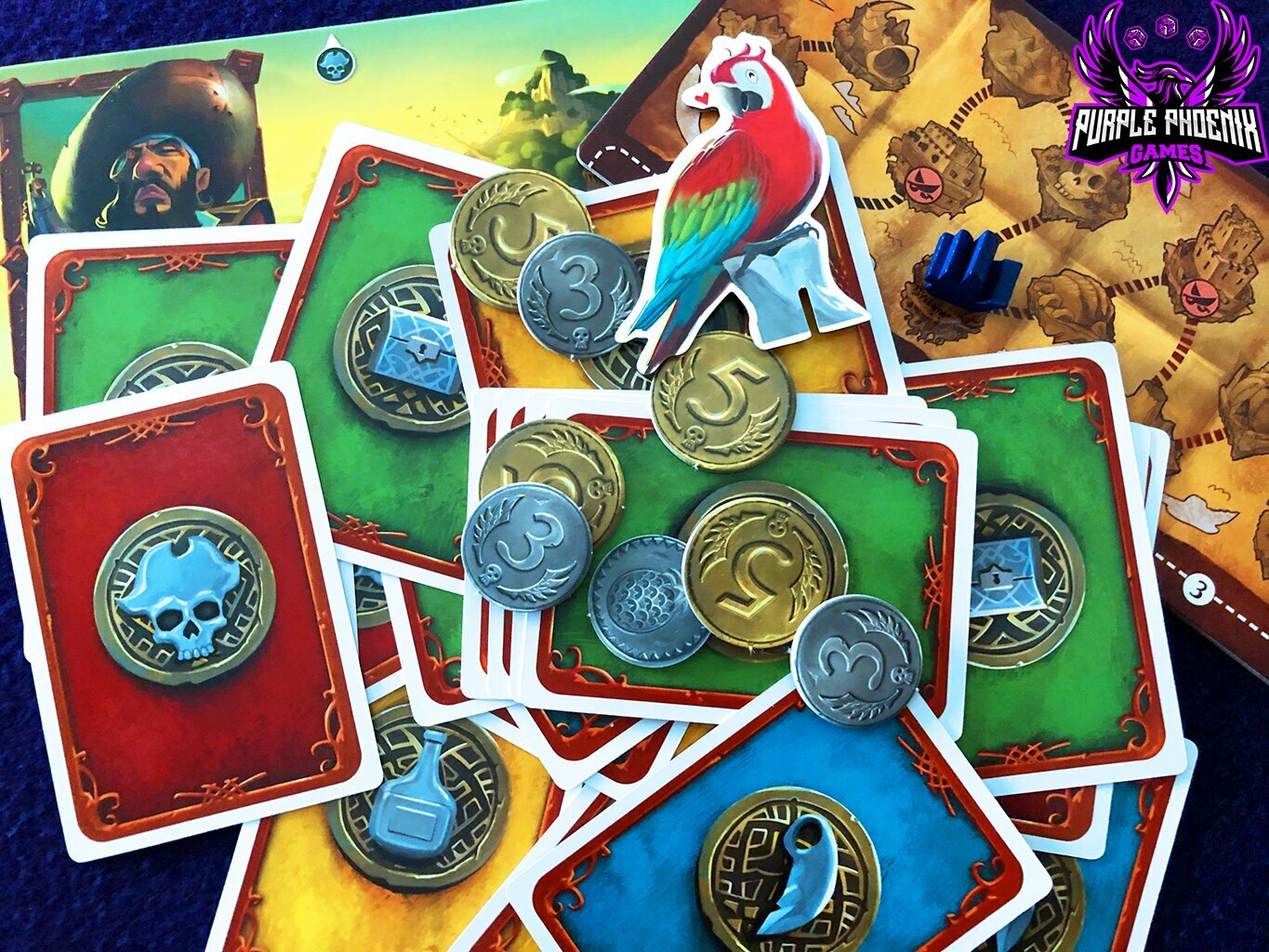
Another neat thing I like about the strategy of this game is that all the cards have backs based on their card type. So all Relic cards have the same back, all Crew cards have the same back, etc. Even though you may not know what is on the other side of the card, you might just take a chance on a share of loot because it has the card types you are trying to get. That’s where the push your luck comes in, because until you look at a share of loot, you aren’t sure if that card is the one you need. Maybe share #1 has a couple cards you could use, but share #2 has a relic card that could be the final one in your set! Are you willing to risk passing up a decent share of loot to see if the next share has what you need? Or maybe the top of the draw deck has the card type you want – would you pass up all 3 shares of loot for one blindly draw card in hopes that it is to your benefit? There is no single ‘right’ way to play, and that is what makes this fun.
The only drawbacks of this game for me are the boarding/combat turns. I like the idea of this player interaction, but it doesn’t always work fairly in my opinion. At the end of each boarding/combat turn, all players discard all of their Crew cards, and you have until the next boarding phase to recruit a new crew. And sometimes, just based on the luck of the draw, you just never get the opportunity to hire anybody. Maybe your opponent takes the share with a Crew member before you get a chance to, or maybe the deck just isn’t evenly shuffled enough to get enough Crew cards out into the playing field. So if you have no Crew, you automatically lose the combat, and that can be detrimental to your strategy – opponents could steal or discard some of your cards, and cause you to lose end-game points. Maybe if there was a draw pile where you could pay a certain amount of gold to hire a Crew member, that would make the game feel a little more fair in the combat department. But ultimately, you’re at the mercy of the luck of the shuffle/draw, and sometimes it just doesn’t balance out.
All in all, I think Sea of Clouds is a great game. It’s a relatively simple game, but one that still requires strategic thought. The push your luck element feels unique in this game because you don’t really lose anything if your luck runs out, you just don’t necessarily get as far as you wanted. The game itself is pretty to look at – the artwork is very well-done and the colors really pop and draw the eye to the cards. This may not be in my Top 10 of favorite games, but it’s one that I will definitely be keeping in my collection. Take a chance on this one if you haven’t so far – it might surprise you. Purple Phoenix Games gives Sea of Clouds a high-flying 12 / 18.

Video & TV Cast Pro for Google Cast: Stream Movies
Photo & Video and Entertainment
App
Watch web-videos, online-movies, livestreams and live-tv shows by using Google Cast on your Vizio...



Kill Shot Bravo
Games and Entertainment
App
Kill Shot Bravo - Play the #1 Shooter on Mobile! Become the Deadliest Special Forces Solider! Arm...
Purple Phoenix Games (2266 KP) rated Dreams of Tomorrow in Tabletop Games
Sep 17, 2020

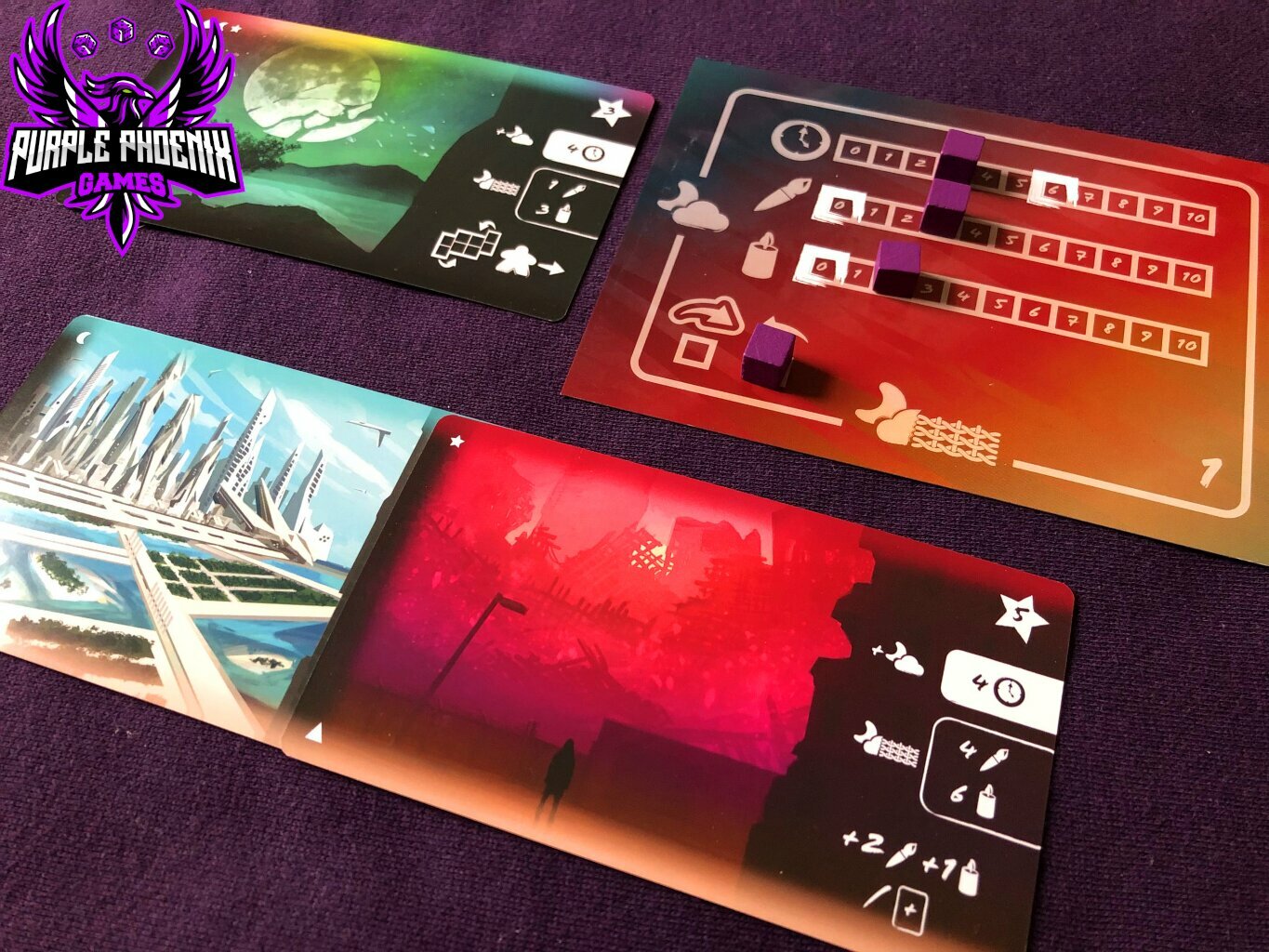
Dreams of Tomorrow is game of set collection that utilizes a shifting rondel (I had to look up the definition too) in which players are working to weave a series of dreams into a complete Dream Sequence. Set in the future, players take on the roles of Dream Engineers, who are tasked with creating Dream Sequences to be sent to the past in an effort to save the future. Can you weave the most powerful Dream Sequence to alter the path of your present life, or is the future doomed to fall?
DISCLAIMER: We were provided a copy of this game for the purposes of this review. This is a retail copy of the game, so what you see in these photos is exactly what would be received in your box. I do not intend to cover every single rule included in the rulebook, but will describe the overall game flow and major rule set so that our readers may get a sense of how the game plays. For more in depth rules, you may purchase a copy online or from your FLGS. -L
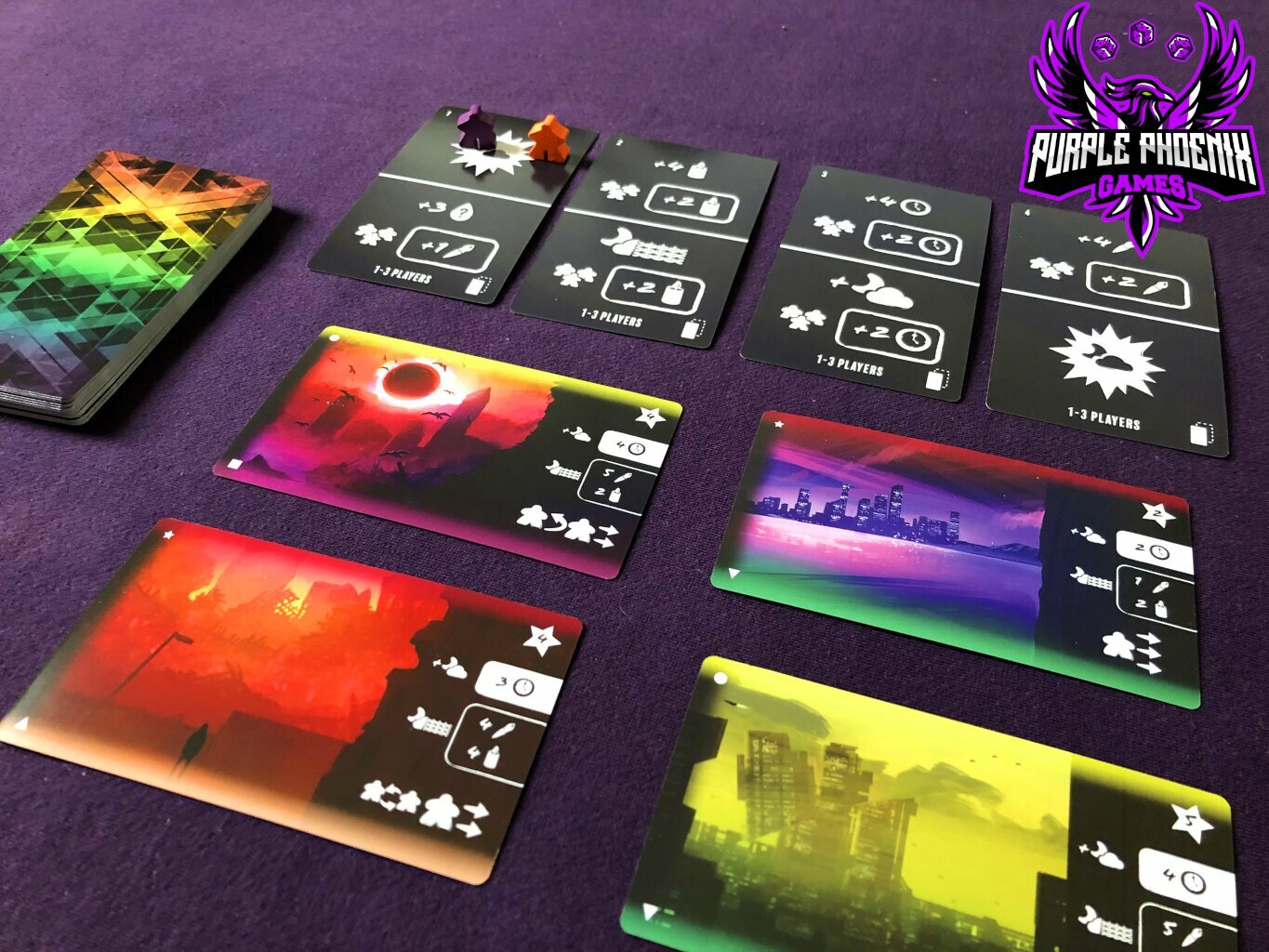
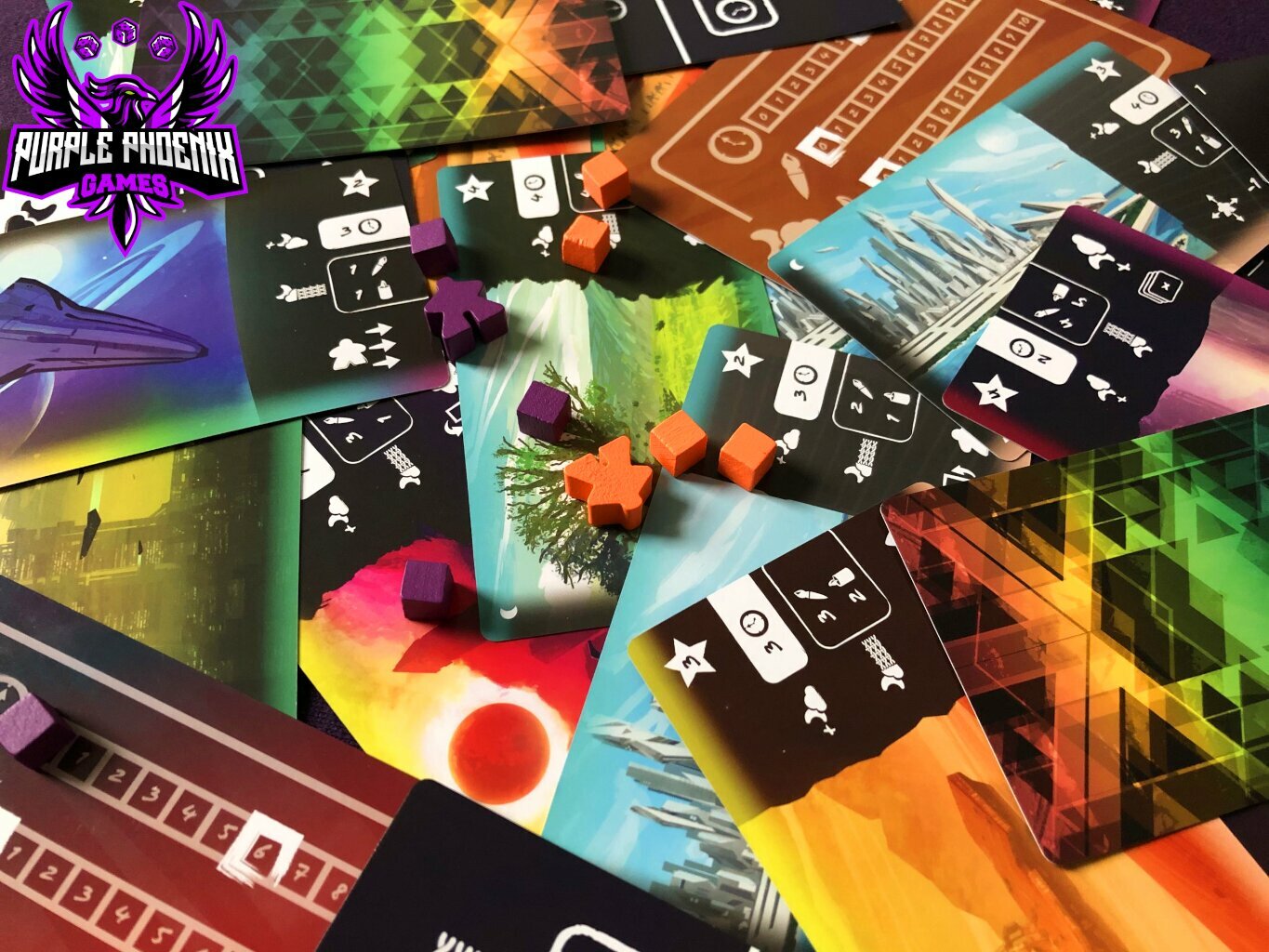
To setup the game, place the Collective Consciousness (the rondel) in numerical order within reach of all players. Reveal a number of Dream cards from the Dream deck, based on the number of players, and these cards will create the communal Dreamscape. Each player receives a player card, cubes, and meeple in their chosen color, and sets their resources to the starting numbers, as described in the rulebook. All players begin with their meeples in the first space of the rondel, and in clockwise order, will select and pay for a Dream from the Dreamscape to be placed in their Dream Catcher (waiting area). Once all players have selected a Dream, and adjusted their resources accordingly, the game is ready to begin.
Dreams of Tomorrow is played over a series of rounds in which players will take turns performing 2 actions: Move and Take Action. Movement happens sequentially around the rondel, and players may choose how many spaces to move. To move 1-3 spaces is free, but to move more than 3 spaces will cost a number of resources. When a player decides to end their movement, they will then take the action indicated on the space on which they landed. These actions include: Gaining resources, Catching a Dream, Weaving a Dream, or Activating a Dream Ability. Gaining resources is pretty self-explanatory, and there is one neat thing to note: even if it is not your active turn, most of the rondel spaces have a Shared Effect, which grants an off-turn action to all non-active players. Catching a Dream means that you pay the requisite resources and select a Dream from the Dreamscape. Any caught Dreams go into your Dream Catcher until you are able to perform the Weave a Dream action. When you Weave a Dream, you again pay the requisite resources displayed on the Dream card and move the Dream from your Dream Catcher into your Dream Sequence (play area). To Activate a Dream Ability, you select a Dream card in your tableau, and use the ability printed on it. It is important to note that once Dreams are woven into your Dream Sequence, they will overlap each other, and only one Dream Ability will ever be available for use, so create that sequence wisely! Play continues in turns until one player has woven a Dream Sequence of five Dreams total. The round ends once all players have taken the same number of turns, and then final points are counted. The player with the highest score is the winner!
So all-in-all, how is Dreams of Tomorrow as a whole? I actually was very surprised at how much I enjoyed this game. When reading through the rules, it seemed kind of complicated and I was a bit worried before my first play. Once you actually get playing, however, the game is pretty intuitive and simple to play. One thing I particularly enjoyed about this game is its iconography. With only three resources and four actions, there are only seven icons of which to keep track. It keeps the cards from being cluttered with text, and makes the costs/abilities clear to understand. The iconography of the Dream Abilities, however, can be a liiiittle more complicated, but the game does come with Reference Cards which explain what every single icon means!
Another neat thing I enjoyed about this gameplay is the addition of Shared Effects. Even if you are not the active player, you will always gain some resource on everyone else’s turn. That adds an extra element of strategy because you have to amass your own resources for Dreams, but you have to be careful not to be giving your opponents too much extra help for themselves! Probably my favorite part of Dreams of Tomorrow are the actual Dream Abilities themselves. Performing the regular turn actions are pretty straight-forward, but Dream Abilities are more special and allow you to do even more on your turn. For example, some Dream Abilities allow you to change directions, move extra spaces, or even alter the Collective Consciousness, re-arranging the cards in a way to benefit you and hopefully hinder your opponents. The Dream Abilities are literal game-changers, and they really keep all players on their toes.
Talking about components, this game is of a pretty good quality. The cards are nice and sturdy, the player boards are decent, and the meeples and cubes are your standard wooden tokens. I’ve said in reviews before, but I always appreciate when games include Reference Cards for players, and Dreams of Tomorrow certainly delivered on theirs. The cards are clear, concise, and helpful during play. The artwork of this game is very vibrantly colorful and just plain pretty to look at. I found myself getting distracted by admiring the artwork, or catching Dreams based on their artwork, instead of taking their point-values or resources requirements into consideration. Oops. That’s just my bad, but the artwork really helps make the game more immersive.
Overall, I would say that Dreams of Tomorrow is a great little game. Admittedly, the rulebook is kind of daunting and seems a little overly complicated at first, but once you get into an actual game, it flows very quickly and easily. After just one turn, I got exactly what was happening and had no further questions about the gameplay. It really went above and beyond my expectations, and is one that I definitely look forward to bringing out in future game nights. Purple Phoenix Games gives it a dreamy 10 / 12. Check this one out if you haven’t before, it may just be the game of your dreams. (Ha, get it?)

David McK (3814 KP) rated Battlefront II: Inferno Squad (Star Wars) in Books
Jan 30, 2019


I don't know whether that because, this time around, the source online shooter game actually (and finally!) has a single-player campaign, meaning the author can actually concentrate on proper chatacters instead of the expendable cannon-fodder of the previous, or if it's because this time aroudn it's told from the point of view of the 'bad guys': that is, from the PoV from dyed-in-the-wool Imperials.
This picks up towards the end of the first Star Wars film (Episode IV, retroactively entitled 'A New Hope'),w ith the attack on the Death Star occuring in the opening pages of the novel and with the central character of Iden Versio actively participating in the defense of the Space Station, before crash-landing on the planet of Yavin IV and making her way back to Imperial Space (that bit told in passing).
This also ties into Rogue One, with an offshoot of Saw Garrera's violent Partisan group - naming themselves The Dreamers - providing the antagonists rather than The Rebellion, allowing the story and the characters to go undercover into that group without breaking with the commonly-held lore - lets face it, since Inferno Squad is meant to be the best of the best it would be hard to place them in Leia / Han's / Luke's path without somehow having to wave the explanation away!

Libby, by OverDrive
Book and Entertainment
8.2 Rate It
App
Meet Libby. Did you know your local library has thousands of ebooks and audiobooks? You can borrow...
Tower Dash
Games and Stickers
App
Play Tower Dash! The super addictive new game from the creators of Bird Climb and Spider Square. In...