
Search
Search results

Bob Mann (459 KP) rated The Nutcracker and the Four Realms (2018) in Movies
Sep 28, 2021
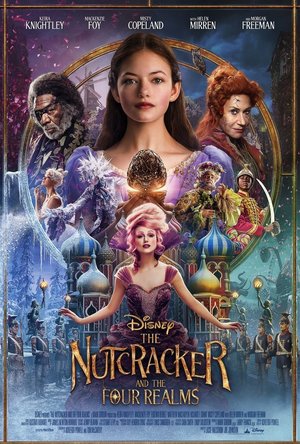


A fantasy that’s glossy and beautiful to look at.
Before the heavyweight juggernaut of “Mary Poppins Returns” arrives at Christmas, here’s another Disney live action feature to get everyone in the festive spirit.
The Plot.
It’s Victorian London and Young Clara (Mackenzie Foy) lives with her father (Matthew Macfadyen), her older sister Louise (Ellie Bamber) and her younger brother Fritz (Tom Sweet). It’s Christmas and the family are having a hard time as they are grieving the recent death of wife and mother Marie (Anna Madeley). Like her mother, Clara has an astute mind with an engineering bias and is encouraged in this pursuit by her quirky inventor godfather, Drosselmeyer (Morgan Freeman). At his fabled Christmas ball, Clara asks for his help in accessing a gift Clara’s mother has bequeathed to her. This leads Clara on a magical adventure to a parallel world with four realms, where everything is not quite peace and harmony.
The Review.
This is a film that visually delights from the word go. The film opens with a swooping tour of Victorian London (who knew the Disney castle was in the capital’s suburbs?!) via Westminster bridge and into the Stahlbaum’s attic. It’s a spectacular tour-de-force of special-effects wizardry and sets up the expectation of what’s to come. For every scene that follows is a richly decorated feast for the eyes. Drosselmeyer’s party is a glorious event, full of extras, strong on costume design and with a rich colour palette as filmed by Linus Sandgren (“La La Land“). When we are pitched into the Four Realms – no wardrobe required – the magical visions continue.
The film represents a Narnia-esque take on the four compass-point lands of Oz, and on that basis it’s a bit formulaic. But the good vs evil angles are more subtley portrayed. Of the Four Realms leaders, Keira Knightley as Sugar Plum rather steals the show from the others (played by Richard E. Grant, Eugenio Derbez and Helen Mirren). Mirren in particular is given little to do.
What age kids would this be suitable for? Well, probably a good judge would be the Wizard of Oz. If your kids are not completely freaked out by the Wicked Witch of the West and the flying monkeys, then they will probably cope OK with the scary bits of the “Realm of Entertainment”. Although those who suffer from either musophobia or (especially) coulrophobia might want to give it a miss! All kids are different though, and the “loss of the mother” is also an angle to consider: that might worry and upset young children. It is definitely a “PG” certificate rather than a “U” certificate.
Young people who also enjoy ballet (I nearly fell into a sexist trap there!) will also get a kick out of some of the dance sequences, which are “Fantasia-esque” in their presentation and feature Misty Copeland, famously the first African American Female Principal Dancer with the American Ballet Theatre. (I have no appreciation at all for ballet, but I’m sure it was brilliant!)
As for the moral tone of the film, the female empowerment message is rather ladled on with a trowel, but as it’s a good message I have no great problem with that. I am often appalled at how lacking in confidence young people are in their own abilities. Here is a young lady (an engineer!) learning self-resilience and the confidence to be able to do anything in life she puts her mind to. Well said.
The story is rather generic – child visits a magical other world – but the screenplay is impressive given its the first-feature screenplay for Ashleigh Powell: there is an article on her approach to screenwriting that you might find interesting here.
The film is credited with two directors. This – particularly if there is also an army of screenwriters – is normally a warning sign on a film. (As a case in point, the chaotic 1967 version of “Casino Royale” had six different directors, and it shows!). Here, there clearly were issues with the filming since Disney insisted on reshoots for which the original director, Lasse Hallström, was not available. This is where the “Captain America” director Joe Johnston stepped in.
The turns.
I really enjoyed Mackenzie Foy‘s performance as Clara. Now 18, she is a feisty and believable Disney princess for the modern age. (If, like me, you are struggling to place where you’ve heard her name before, she was the young Murph in Nolan’s “Interstellar“).
Another name I was struggling with was Ellie Bamber as her sister. Ellie was excellent in the traumatic role of the daughter in the brilliant “Nocturnal Animals“, one of my favourite films of 2016. (Hopefully the therapy has worked and Ellie can sleep at night again!).
A newcomer with a big role is Jayden Fowora-Knight as the Nutcracker soldier: Jayden had a bit part in “Ready Player One” but does a great job here in a substantial role in the film. He stands out as a black actor in a Disney feature: notwithstanding the Finn character in “Star Wars”, this is a long-overdue and welcome approach from Disney.
British comedians Omid Djalili and Jack Whitehouse turn up to add some light relief, but the humour seems rather forced and not particularly fitting.
Final thoughts
I wasn’t expecting to enjoy this one much, but I did. Prinicipally because it is such a visual feast and worth going to see just for that alone: I have a prediction that this film will be nominated for production design, costume design and possible special effects.
I think kids of the right age – I would have thought 6 to 10 sort of range – will enjoy this a lot, particularly if they like dance. Young girls in particular will most relate to the lead character. For such kids, I’d rate this a 4*. The rating below reflects my rating as an adult: so I don’t think ‘drag-a-long’ parents in the Christmas holidays (if it is still on by then) will not be totally bored.
The Plot.
It’s Victorian London and Young Clara (Mackenzie Foy) lives with her father (Matthew Macfadyen), her older sister Louise (Ellie Bamber) and her younger brother Fritz (Tom Sweet). It’s Christmas and the family are having a hard time as they are grieving the recent death of wife and mother Marie (Anna Madeley). Like her mother, Clara has an astute mind with an engineering bias and is encouraged in this pursuit by her quirky inventor godfather, Drosselmeyer (Morgan Freeman). At his fabled Christmas ball, Clara asks for his help in accessing a gift Clara’s mother has bequeathed to her. This leads Clara on a magical adventure to a parallel world with four realms, where everything is not quite peace and harmony.
The Review.
This is a film that visually delights from the word go. The film opens with a swooping tour of Victorian London (who knew the Disney castle was in the capital’s suburbs?!) via Westminster bridge and into the Stahlbaum’s attic. It’s a spectacular tour-de-force of special-effects wizardry and sets up the expectation of what’s to come. For every scene that follows is a richly decorated feast for the eyes. Drosselmeyer’s party is a glorious event, full of extras, strong on costume design and with a rich colour palette as filmed by Linus Sandgren (“La La Land“). When we are pitched into the Four Realms – no wardrobe required – the magical visions continue.
The film represents a Narnia-esque take on the four compass-point lands of Oz, and on that basis it’s a bit formulaic. But the good vs evil angles are more subtley portrayed. Of the Four Realms leaders, Keira Knightley as Sugar Plum rather steals the show from the others (played by Richard E. Grant, Eugenio Derbez and Helen Mirren). Mirren in particular is given little to do.
What age kids would this be suitable for? Well, probably a good judge would be the Wizard of Oz. If your kids are not completely freaked out by the Wicked Witch of the West and the flying monkeys, then they will probably cope OK with the scary bits of the “Realm of Entertainment”. Although those who suffer from either musophobia or (especially) coulrophobia might want to give it a miss! All kids are different though, and the “loss of the mother” is also an angle to consider: that might worry and upset young children. It is definitely a “PG” certificate rather than a “U” certificate.
Young people who also enjoy ballet (I nearly fell into a sexist trap there!) will also get a kick out of some of the dance sequences, which are “Fantasia-esque” in their presentation and feature Misty Copeland, famously the first African American Female Principal Dancer with the American Ballet Theatre. (I have no appreciation at all for ballet, but I’m sure it was brilliant!)
As for the moral tone of the film, the female empowerment message is rather ladled on with a trowel, but as it’s a good message I have no great problem with that. I am often appalled at how lacking in confidence young people are in their own abilities. Here is a young lady (an engineer!) learning self-resilience and the confidence to be able to do anything in life she puts her mind to. Well said.
The story is rather generic – child visits a magical other world – but the screenplay is impressive given its the first-feature screenplay for Ashleigh Powell: there is an article on her approach to screenwriting that you might find interesting here.
The film is credited with two directors. This – particularly if there is also an army of screenwriters – is normally a warning sign on a film. (As a case in point, the chaotic 1967 version of “Casino Royale” had six different directors, and it shows!). Here, there clearly were issues with the filming since Disney insisted on reshoots for which the original director, Lasse Hallström, was not available. This is where the “Captain America” director Joe Johnston stepped in.
The turns.
I really enjoyed Mackenzie Foy‘s performance as Clara. Now 18, she is a feisty and believable Disney princess for the modern age. (If, like me, you are struggling to place where you’ve heard her name before, she was the young Murph in Nolan’s “Interstellar“).
Another name I was struggling with was Ellie Bamber as her sister. Ellie was excellent in the traumatic role of the daughter in the brilliant “Nocturnal Animals“, one of my favourite films of 2016. (Hopefully the therapy has worked and Ellie can sleep at night again!).
A newcomer with a big role is Jayden Fowora-Knight as the Nutcracker soldier: Jayden had a bit part in “Ready Player One” but does a great job here in a substantial role in the film. He stands out as a black actor in a Disney feature: notwithstanding the Finn character in “Star Wars”, this is a long-overdue and welcome approach from Disney.
British comedians Omid Djalili and Jack Whitehouse turn up to add some light relief, but the humour seems rather forced and not particularly fitting.
Final thoughts
I wasn’t expecting to enjoy this one much, but I did. Prinicipally because it is such a visual feast and worth going to see just for that alone: I have a prediction that this film will be nominated for production design, costume design and possible special effects.
I think kids of the right age – I would have thought 6 to 10 sort of range – will enjoy this a lot, particularly if they like dance. Young girls in particular will most relate to the lead character. For such kids, I’d rate this a 4*. The rating below reflects my rating as an adult: so I don’t think ‘drag-a-long’ parents in the Christmas holidays (if it is still on by then) will not be totally bored.

Hadley (567 KP) rated The Amazing Crime and Trial of Leopold and Loeb in Books
Apr 13, 2019

"The crime itself was indefensible. The brilliant, spoiled and bored sons of two of Chicago's wealthiest families planned to commit the perfect crime both for the thrill of and to prove their perverse misunderstanding of Friedrich Nietzsche's philosophy of the 'superman,' who was above all law so long as he made no mistake. Their plan, worked out over several months, was to kidnap and immediately kill one of their younger neighbors and hide his body. They would then demand and collect a ransom. The body would never be discovered, the crime would never be solved and only they would know that they had prevailed over ordinary human beings and their simple-minded legal system. But far from being the 'perfect crime,' the murder of 14-year-old Bobby Franks turned out to be amateurishly botched. Before any ransom could be paid, the boy's body was discovered in a culvert near where Nathan Leopold often went bird-watching. A pair of telltale glasses were found adjacent to the body. They were easily traced to Leopold who first came up with a paper-thin alibi and soon thereafter confessed to the crime. His fellow murderer likewise confessed. Each of the 'superboys' placed blame for the actual killing on the other." - Alan M. Dershowitz
If you mentioned the names Leopold and Loeb today, many people wouldn't know who you were talking about, but if you had mentioned them just thirty years ago, many people would recall the 'murder of the century.'
If you are a fan of the True Crime genre, you'll come across the case of two wealthy Chicago boys who thought they could get away with murder. (The trial is probably the most talked about trial to-date because this is the first time that psychology was brought before a court room.)
For a good part of the late 1920's, Leopold and Loeb were household names for good reason: they came from millionaire families, they were college graduates before they were 18-years-old, and their trial was the first time in history that the world saw psychology put in front of a judge. The trial was even more unforgettable due to a closing speech given by famous defense attorney, Clarence Darrow, which is reprinted in its entirety,spanning a hefty 93 pages.
Nathan Leopold, Jr. and Richard Loeb were two people who should have never met, according to the courtroom. The two met at about the age of fifteen, soon after they began to embark on criminal acts together, ranging from theft to arson. It's stated in 'the Amazing Crime and Trial of Leopold and Loeb' that Loeb had created a fantasy world where he was a crime ringleader that was too smart for the police to catch. Readers get to judge for themselves whether or not they believe Loeb was the cause of their crimes, or if Leopold was the one really in charge.
After robbing Loeb's fraternity house together, Leopold and Loeb came up with a plan to kidnap a wealthy child that they could then ransom. "They began to devise elaborate plans for this kidnapping, and soon the planning became the all-important thing. They gave up the idea of kidnapping this particular person [a young man named William], and settled on the idea of kidnapping anyone who would fit in their kidnapping plans." Throughout the book, we find out that the boys were pretty desperate for a kidnapping victim, that they even thought about kidnapping one of their close friends:
"The plan of kidnaping Dick Rubel was given up because Dick Rubel's father was so tight we might not get any money from him."
Leopold and Loeb discussed everything from how they would receive the ransom, what weapons they would use, how they would get the victim inside a rented vehicle, and what they would do with the body afterwards. "In March, 1924, the patient [Loeb] conceived the idea of securing the money by having it thrown off a moving train. This idea was discussed in great detail, and gradually developed into a carefully systematized plan. As time wore on the plan became greatly modified from the original one. They discussed at considerable length the choice of a suitable subject for kidnapping. The patient's companion [Leopold] suggested that they kidnap a young girl instead of a boy, but the patient [Loeb] objected to this. His companion [Leopold] also suggested that they kidnap the patient's [Loeb] younger brother, but the patient apparently did not seriously consider doing this. They then considered half a dozen boys, any one of whom would do, for the following reasons: that they were physically small enough to be easily handled and their parents were extremely wealthy and would have no difficulty or disinclination to pay ransom money."
During the trial, Leopold and Loeb's psychological evaluations became the forefront of their guilty plea, stating that they were not responsible for their actions due to their upbringing and environment. "I submit the facts do not rest on the evidence of these boys alone. It is proven by the writings; it is proven by every act. It is proven by their companions, and there can by no question about it." Clarence Darrow explains in his famous closing statement. "We brought into this courtroom a number of their boy friends, whom they had known day by day, who had associated with them in the club house, were their constant companions, and they tell the same stories. They tell the story that neither of these two boys was responsible for his conduct."
'The Amazing Crime and Trial of Leopold and Loeb' contains the portions of the psychiatric evaluations that were submitted in court,but the testimony of character witnesses is omitted. For a factual telling of a real life trial, this book is okay. If the reader pays attention, they may notice that some of the book contradicts itself, such as one page states that the car robe used to wrap up Franks' body was found buried near Lake Michigan,but then pages later, the book states it had been burned at Loeb's home.
The psychiatric reports are very repetitive,just using different words to describe the same things. Yet, these reports are the backbone of the trial and well worth a read. The evaluations and Darrow's extensive speech were what saved Leopold and Loeb from a death sentence.
There are very few books written about the 'murder of the century,' and even less about the 'lawyer of the century.' Leopold and Loeb, as well as Darrow, have faded into the obscurity of the True Crime genre, but because the boys' mental state was brought into question, we now accept forensic science/psychology in the court room today. I feel that only people who are truly interested in True Crime, or even have a fascination for the court room are the only ones who will enjoy 'The Amazing Crime and Trial of Leopold and Loeb.'
If you mentioned the names Leopold and Loeb today, many people wouldn't know who you were talking about, but if you had mentioned them just thirty years ago, many people would recall the 'murder of the century.'
If you are a fan of the True Crime genre, you'll come across the case of two wealthy Chicago boys who thought they could get away with murder. (The trial is probably the most talked about trial to-date because this is the first time that psychology was brought before a court room.)
For a good part of the late 1920's, Leopold and Loeb were household names for good reason: they came from millionaire families, they were college graduates before they were 18-years-old, and their trial was the first time in history that the world saw psychology put in front of a judge. The trial was even more unforgettable due to a closing speech given by famous defense attorney, Clarence Darrow, which is reprinted in its entirety,spanning a hefty 93 pages.
Nathan Leopold, Jr. and Richard Loeb were two people who should have never met, according to the courtroom. The two met at about the age of fifteen, soon after they began to embark on criminal acts together, ranging from theft to arson. It's stated in 'the Amazing Crime and Trial of Leopold and Loeb' that Loeb had created a fantasy world where he was a crime ringleader that was too smart for the police to catch. Readers get to judge for themselves whether or not they believe Loeb was the cause of their crimes, or if Leopold was the one really in charge.
After robbing Loeb's fraternity house together, Leopold and Loeb came up with a plan to kidnap a wealthy child that they could then ransom. "They began to devise elaborate plans for this kidnapping, and soon the planning became the all-important thing. They gave up the idea of kidnapping this particular person [a young man named William], and settled on the idea of kidnapping anyone who would fit in their kidnapping plans." Throughout the book, we find out that the boys were pretty desperate for a kidnapping victim, that they even thought about kidnapping one of their close friends:
"The plan of kidnaping Dick Rubel was given up because Dick Rubel's father was so tight we might not get any money from him."
Leopold and Loeb discussed everything from how they would receive the ransom, what weapons they would use, how they would get the victim inside a rented vehicle, and what they would do with the body afterwards. "In March, 1924, the patient [Loeb] conceived the idea of securing the money by having it thrown off a moving train. This idea was discussed in great detail, and gradually developed into a carefully systematized plan. As time wore on the plan became greatly modified from the original one. They discussed at considerable length the choice of a suitable subject for kidnapping. The patient's companion [Leopold] suggested that they kidnap a young girl instead of a boy, but the patient [Loeb] objected to this. His companion [Leopold] also suggested that they kidnap the patient's [Loeb] younger brother, but the patient apparently did not seriously consider doing this. They then considered half a dozen boys, any one of whom would do, for the following reasons: that they were physically small enough to be easily handled and their parents were extremely wealthy and would have no difficulty or disinclination to pay ransom money."
During the trial, Leopold and Loeb's psychological evaluations became the forefront of their guilty plea, stating that they were not responsible for their actions due to their upbringing and environment. "I submit the facts do not rest on the evidence of these boys alone. It is proven by the writings; it is proven by every act. It is proven by their companions, and there can by no question about it." Clarence Darrow explains in his famous closing statement. "We brought into this courtroom a number of their boy friends, whom they had known day by day, who had associated with them in the club house, were their constant companions, and they tell the same stories. They tell the story that neither of these two boys was responsible for his conduct."
'The Amazing Crime and Trial of Leopold and Loeb' contains the portions of the psychiatric evaluations that were submitted in court,but the testimony of character witnesses is omitted. For a factual telling of a real life trial, this book is okay. If the reader pays attention, they may notice that some of the book contradicts itself, such as one page states that the car robe used to wrap up Franks' body was found buried near Lake Michigan,but then pages later, the book states it had been burned at Loeb's home.
The psychiatric reports are very repetitive,just using different words to describe the same things. Yet, these reports are the backbone of the trial and well worth a read. The evaluations and Darrow's extensive speech were what saved Leopold and Loeb from a death sentence.
There are very few books written about the 'murder of the century,' and even less about the 'lawyer of the century.' Leopold and Loeb, as well as Darrow, have faded into the obscurity of the True Crime genre, but because the boys' mental state was brought into question, we now accept forensic science/psychology in the court room today. I feel that only people who are truly interested in True Crime, or even have a fascination for the court room are the only ones who will enjoy 'The Amazing Crime and Trial of Leopold and Loeb.'
Hadley (567 KP) rated Frankenstein in Books
Apr 30, 2019

Great main character (1 more)
Beautiful writing
Over usage of some words (1 more)
Secondary characters have hardly a back story
In the horror genre, I have very few favorite female writers, but Mary Shelley is one of them. The way she weaves environments with character defining scenes is beautifully done in 'Frankenstein.' At the tender age of 18, Shelley was able to convey grief and loss through a single story. She created a relatable 'creature' that many readers will have pity for, but also an obsessive young man that can hardly be hated. Some people may be intimidated by the more diverse English language from the early 1800's, but, in my opinion, the story would not have had the same impact if it had been written today.
Not just horror readers will enjoy 'Frankenstein,' but also those who like to read philosophy. Shelley brings up life discerning questions that even society meddles with today. It's amazing to think that a two century old book discusses problems we still deal with.
The book begins with a sea captain that picks up a stranger that was stranded on a raft of ice, and this man has a fascinating story to tell. The entire book is a letter written by the sea captain to his sister, which he details every bit of Victor Frankenstein's several year tale. Readers get to follow Frankenstein's life from the moment his 'creature' is made to the end of his days, which traverses the globe. When Shelley begins to lull over her love of environments, she quickly picks up with character or story development that keeps our attention from wandering.
'Frankenstein' focuses on the need to be loved and accepted to live a happy existence,as well as reaching our dreams, but Shelley shows how achieving such things can cause a crushing defeat in the latter pursuit: "Night was far advanced when I came to the halfway resting-place, and seated myself beside the fountain. The stars shone at intervals, as the clouds passed from over them; the dark pines rose before me, and every here and there a broken tree lay on the ground: it was a scene of wonderful solemnity, and stirred strange thoughts within me. I wept bitterly; and clasping my hands in agony, I exclaimed, 'Oh! stars, and clouds, and winds, ye are all about to mock me: if ye really pity me, crush sensation and memory; let me become as nought; but if not, depart, depart, and leave me in darkness.' "
There are other characters we read of, including Frankenstein's best friend, Henry, and his long time love interest, Elizabeth (both of who grew up with Frankenstein). Henry comes from a well-to-do merchant family, while Elizabeth was orphaned from a wealthy family, then adopted by the Frankensteins as a future wife for Victor. Unfortunately, we learn little about them or Victor's family, that when any of them do die, it's not felt personally by the reader. There are other characters that had major events in the story, but as with the friends, they weren't developed enough to bring up any emotion at their passing.
After Frankenstein sets out after his creation,we meet the 'creature' at the top of a mountain. He is devastated that his creator hates him, and that the other humans he has met also hated him. "I expected this reception,' said the demon. 'All men hate the wretched; how, then, must I be hated, who am miserable beyond all living things! Yet you, my creator, detest and spurn me, thy creature, to whom thou art bound by ties only dissoluble by the annihilation of one of us. You purpose to kill me. How dare you sport thus with life? Do your duty towards me, and I will do mine towards you and the rest of mankind. If you will comply with my conditions, I will leave them and you at peace; but if you refuse, I will glut the maw of death, until it be satiated with the blood of your remaining friends.' "
The 'creature' gives Frankenstein an ultimatum: he either makes him a female companion or he will kill everyone Frankenstein loves and adores." 'What I ask of you is reasonable and moderate; I demand a creature of another sex, but as hideous as myself; the gratification is small, but it is all that I can receive,and it shall content me.' " Although, by this time, the 'creature' has already murdered Frankenstein's youngest brother, Victor agrees to make him a companion, but with serious regret soon after.
The majority of the story concerns Frankenstein trying fool-hardly to protect all those he loves while the 'creature' murders them one by one. The most surprising of the murders is Henry's. After Frankenstein changes his mind on making another creation, the 'creature' quickly finds Henry and kills him, but Frankenstein is accused of the murder and spends quite some time in prison for it. "But I was doomed to live; and, in two months, found myself as awaking from a dream, in a prison, stretched on a wretched bed, surrounded by gaolers, turnkeys, bolts, and all the miserable apparatus of a dungeon. "
Frankenstein is eventually released from prison when the evidence doesn't add up, and witnesses come forward, claiming to have seen Victor elsewhere at the time of the murder. Frankenstein is, at this time, in a drowning melancholy and madness, but this doesn't stop him from marrying Elizabeth. The 'creature' foretold Frankenstein that he would be with him on his wedding night, and Victor uses this to his advantage - arming himself with pistols and knives on the honeymoon. Yet, to no avail, Frankenstein is unable to outlive or outsmart the 'creature' at any turn.
'Frankenstein' is a must-read for all readers. Although many horror stories today pertain to a creature killing it's master, none of them can reach the grief stricken peaks as Shelley has. Every passage in this book reads like poetry. Every interaction between Frankenstein and his 'creature' is fascinating to the reader. And, before Frankenstein dies, he leaves the sea captain with words of wisdom that even readers could benefit from: "Seek happiness in tranquillity and avoid ambition, even if it be only the apparently innocent one of distinguishing yourself in science and discoveries."
Highly recommend!
Not just horror readers will enjoy 'Frankenstein,' but also those who like to read philosophy. Shelley brings up life discerning questions that even society meddles with today. It's amazing to think that a two century old book discusses problems we still deal with.
The book begins with a sea captain that picks up a stranger that was stranded on a raft of ice, and this man has a fascinating story to tell. The entire book is a letter written by the sea captain to his sister, which he details every bit of Victor Frankenstein's several year tale. Readers get to follow Frankenstein's life from the moment his 'creature' is made to the end of his days, which traverses the globe. When Shelley begins to lull over her love of environments, she quickly picks up with character or story development that keeps our attention from wandering.
'Frankenstein' focuses on the need to be loved and accepted to live a happy existence,as well as reaching our dreams, but Shelley shows how achieving such things can cause a crushing defeat in the latter pursuit: "Night was far advanced when I came to the halfway resting-place, and seated myself beside the fountain. The stars shone at intervals, as the clouds passed from over them; the dark pines rose before me, and every here and there a broken tree lay on the ground: it was a scene of wonderful solemnity, and stirred strange thoughts within me. I wept bitterly; and clasping my hands in agony, I exclaimed, 'Oh! stars, and clouds, and winds, ye are all about to mock me: if ye really pity me, crush sensation and memory; let me become as nought; but if not, depart, depart, and leave me in darkness.' "
There are other characters we read of, including Frankenstein's best friend, Henry, and his long time love interest, Elizabeth (both of who grew up with Frankenstein). Henry comes from a well-to-do merchant family, while Elizabeth was orphaned from a wealthy family, then adopted by the Frankensteins as a future wife for Victor. Unfortunately, we learn little about them or Victor's family, that when any of them do die, it's not felt personally by the reader. There are other characters that had major events in the story, but as with the friends, they weren't developed enough to bring up any emotion at their passing.
After Frankenstein sets out after his creation,we meet the 'creature' at the top of a mountain. He is devastated that his creator hates him, and that the other humans he has met also hated him. "I expected this reception,' said the demon. 'All men hate the wretched; how, then, must I be hated, who am miserable beyond all living things! Yet you, my creator, detest and spurn me, thy creature, to whom thou art bound by ties only dissoluble by the annihilation of one of us. You purpose to kill me. How dare you sport thus with life? Do your duty towards me, and I will do mine towards you and the rest of mankind. If you will comply with my conditions, I will leave them and you at peace; but if you refuse, I will glut the maw of death, until it be satiated with the blood of your remaining friends.' "
The 'creature' gives Frankenstein an ultimatum: he either makes him a female companion or he will kill everyone Frankenstein loves and adores." 'What I ask of you is reasonable and moderate; I demand a creature of another sex, but as hideous as myself; the gratification is small, but it is all that I can receive,and it shall content me.' " Although, by this time, the 'creature' has already murdered Frankenstein's youngest brother, Victor agrees to make him a companion, but with serious regret soon after.
The majority of the story concerns Frankenstein trying fool-hardly to protect all those he loves while the 'creature' murders them one by one. The most surprising of the murders is Henry's. After Frankenstein changes his mind on making another creation, the 'creature' quickly finds Henry and kills him, but Frankenstein is accused of the murder and spends quite some time in prison for it. "But I was doomed to live; and, in two months, found myself as awaking from a dream, in a prison, stretched on a wretched bed, surrounded by gaolers, turnkeys, bolts, and all the miserable apparatus of a dungeon. "
Frankenstein is eventually released from prison when the evidence doesn't add up, and witnesses come forward, claiming to have seen Victor elsewhere at the time of the murder. Frankenstein is, at this time, in a drowning melancholy and madness, but this doesn't stop him from marrying Elizabeth. The 'creature' foretold Frankenstein that he would be with him on his wedding night, and Victor uses this to his advantage - arming himself with pistols and knives on the honeymoon. Yet, to no avail, Frankenstein is unable to outlive or outsmart the 'creature' at any turn.
'Frankenstein' is a must-read for all readers. Although many horror stories today pertain to a creature killing it's master, none of them can reach the grief stricken peaks as Shelley has. Every passage in this book reads like poetry. Every interaction between Frankenstein and his 'creature' is fascinating to the reader. And, before Frankenstein dies, he leaves the sea captain with words of wisdom that even readers could benefit from: "Seek happiness in tranquillity and avoid ambition, even if it be only the apparently innocent one of distinguishing yourself in science and discoveries."
Highly recommend!

Purple Phoenix Games (2266 KP) rated Jetpack Joyride in Tabletop Games
Jan 8, 2020 (Updated Jan 8, 2020)


It should come as no surprise that I love to play board games. Hence my involvement in this wonderful group! But besides board games, I also enjoy my fair share of video games too. These two worlds of gaming occasionally collide when a classic from one realm is transferred over to the other! Is the adaptation as fun as the original, or does it leave much to be desired?
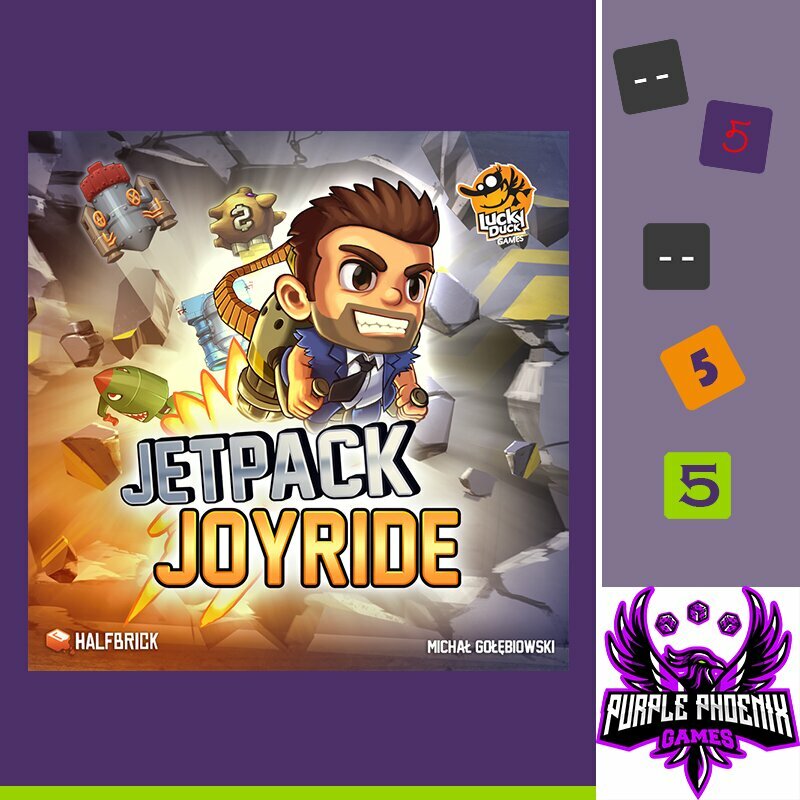
Originally a mobile game, Jetpack Joyride follows our main character, Barry, as he attempts to escape a top-secret lab with a stolen jetpack! He must avoid being hit by zappers, annihilated by lasers, and blown away by missiles in the process. If Barry succeeds, he escapes with not only the high-tech jetpack, but also with as many gold coins and other top-secret gadgets as he can get his hands on! So the risk is definitely worth the reward. But if Barry is unable to escape, he will face the consequences for his unauthorized joyride… In all honesty, I had never heard of Jetpack Joyride before I Kickstarted the board game version, so I downloaded it on my phone to see how it plays. Do you remember Flappy Bird? The mobile version of Jetpack Joyride is kiiiinda like that, but more exciting and way less infuriating. It’s free to download in the App Store and Google Play Store, so check it out if you’re interested! Anyway, back to the board game version. The premise is the same as the app – you have to create a path for Barry to use for his escape from the lab, utilizing the gadgets available to you and collecting gold coins on your way.
DISCLAIMER: We are using the Kickstarter Deluxe version of the game. We do have the expansions from the KS campaign, but will not be using those for this review. Also, we do not intend to cover every single rule included in the rule book, but will describe the overall game flow and major rule set so that our readers may get a sense of how the game plays. For more in depth rules, you may purchase a copy from the publisher directly or from your FLGS. -T
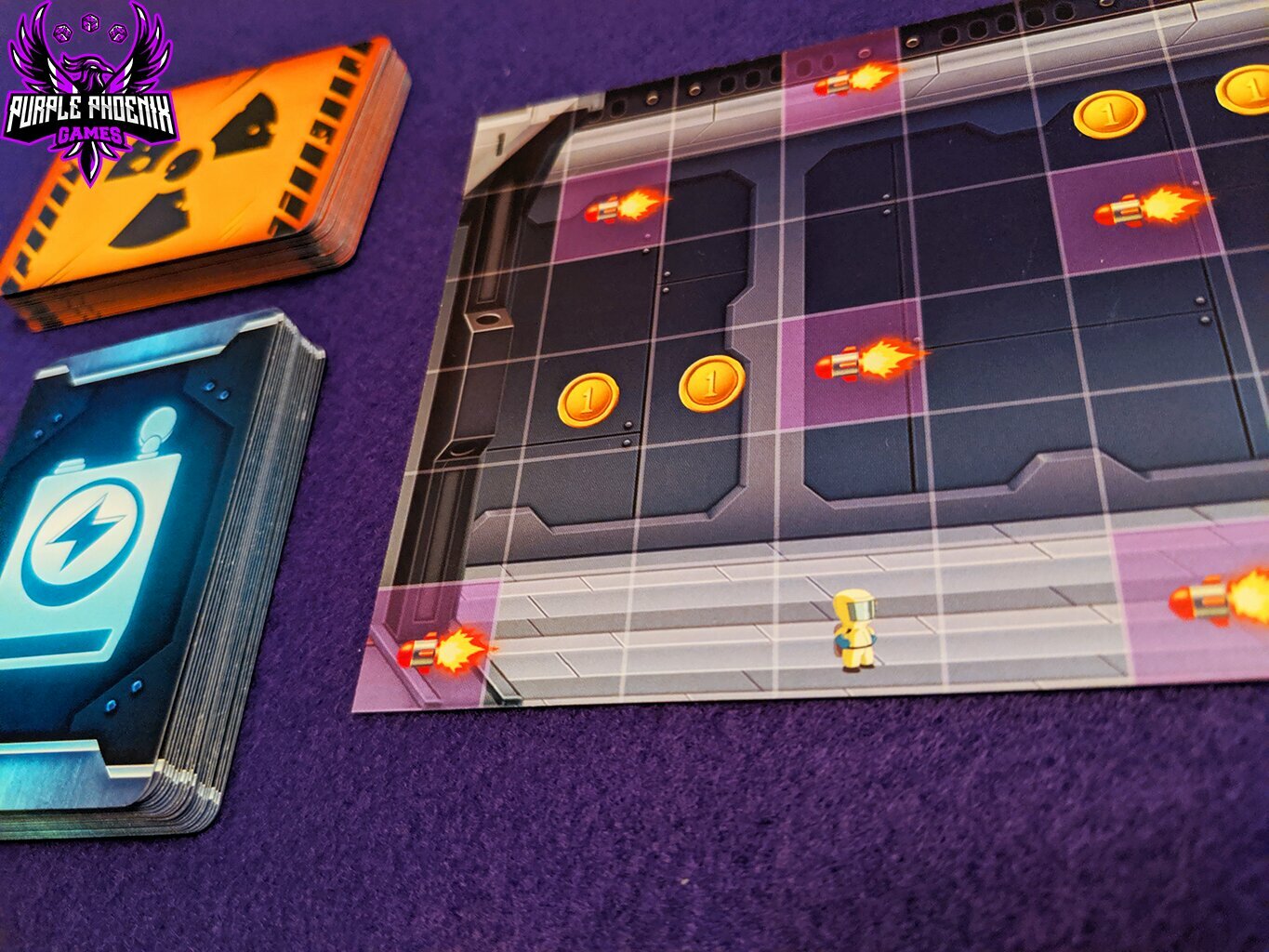
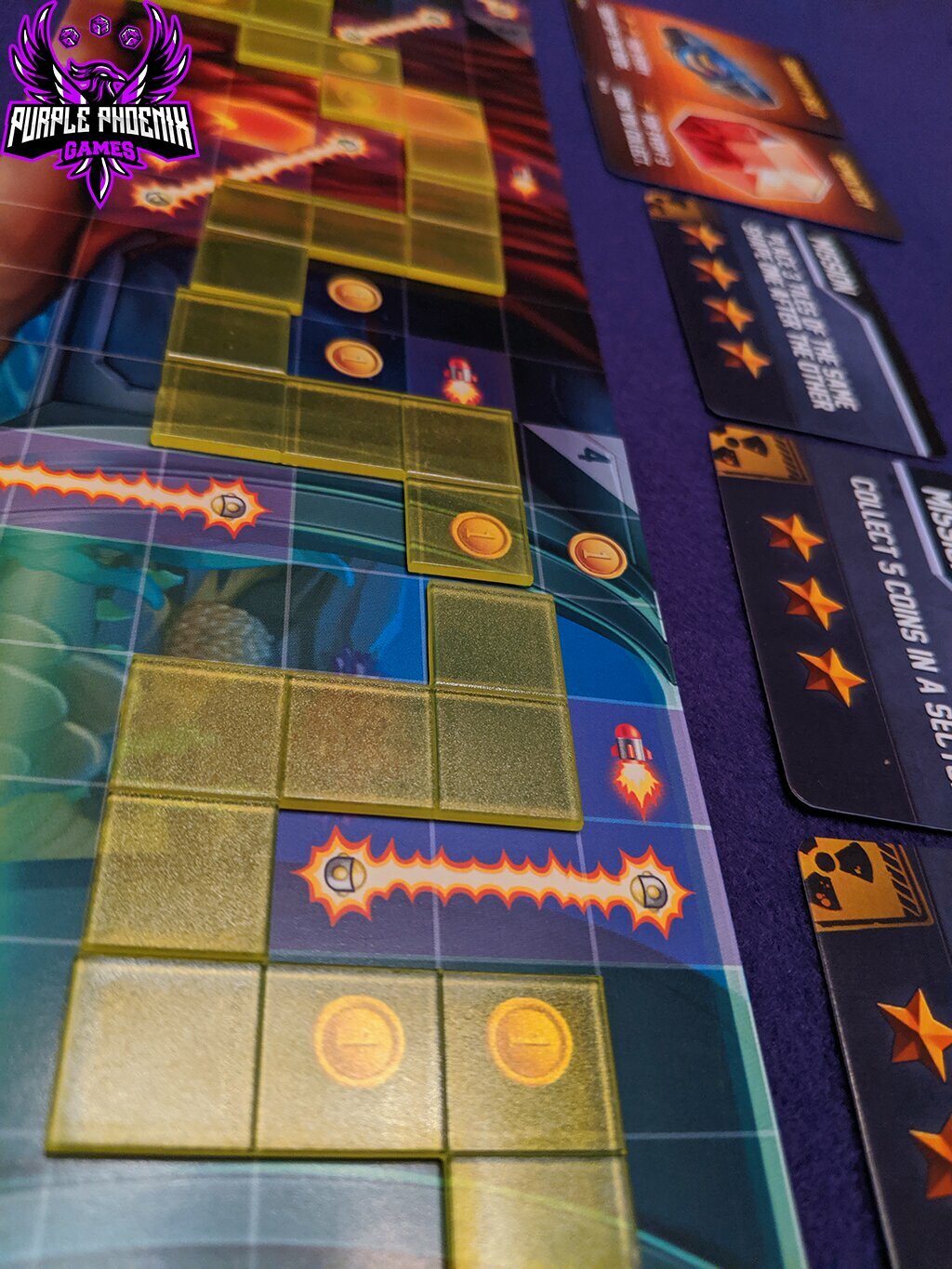
Jetpack Joyride is a real-time game of tile placement in which players are racing to see who can complete their run (path through the lab) the fastest. The game lasts for 3 runs, and points are earned throughout all runs. To setup, each player receives a set of 4 lab sector cards and sets them on the table in front of them in numerical order, 1-4. Three mission cards (cards that score points at the end of the run) are revealed and available for all players. Players may also have gadgets, available only to them, to help score extra points. When a run begins, all players grab translucent polyominoes (like matte versions of bits from Blokus) from the common pool and place them on their lab cards to create an unbroken path through the lab. There are specific placement restrictions that I will leave for you to discover in the rulebook. The game has no set time limit for each run, but it is a race to complete a path before your opponents. At the end of the run, points are tallied for completed missions and gadget cards. Easy, right? Here’s a small twist – before starting the next run, all players pick up their lab cards and pass them to the player on their left. So each run, players are looking at new cards and must find new paths through the lab! New mission cards and gadgets are revealed before subsequent runs as well. The player with the most points at the end of all 3 runs is the winner!
Jetpack Joyride is a fast-paced, exciting, and surprisingly strategic game that keeps all players engaged and entertained. And that’s what I love about it. First of all, real-time games are always high-energy, at least in my opinion. It’s nearly impossible to stay calm and collected when you’re literally racing against your opponents! Jetpack Joyride is definitely not a passive game, and there’s so much action and excitement that you sometimes forget you’re literally just laying tiles on cards. The next thing I love about this game is how deceptively strategic it is. Laying tiles to form a legal path across cards is not complicated, but doing so while also trying to earn extra points by completing missions (like placing 3 tiles of the same shape in a row, for example) adds a strategic element that you don’t expect. You’re not only trying to finish your run the fastest, but you’ve also got to fulfill the requirements for multiple mission and gadget cards too. One misplaced tile could decimate a run for you, so you’ve always got to be thinking several tiles in advance.
Going along with that, another neat thing about Jetpack Joyride is that all players are drawing tiles from a common pool. There is a finite number of tiles, and a specific number of the different shapes, so if the shape of tile you need is gone from the pool, you’re outta luck! You have to think and move quickly, otherwise you might get knocked out of a run, and that costs you valuable end-game points. For such a simple game, Jetpack Joyride also has a lot of variability. All lab cards are double-sided, and can be mixed and matched in any combination, as long as they are in a numerical set of 1-4. There are so many possibilities, chances are you won’t ever play with the same card combo twice….and if you do, chances are you won’t remember it 😛 All of these aspects elevate this game from a simple party game to a strategically fun game that can be played with any player count.
Overall, I think Jetpack Joyride is great. After my first play, I rated it a 4+, but after a few more I’ve changed my rating to a 5. As you can see from our scores above, Travis and our guest judge Luke enjoyed it as well. It’s a nice, light game that can be used as a filler between heavier games, or as a main-event game all on its own. Definitely a game I will use with newer gamers, and the strategic side will keep me coming back for more. I think Jetpack Joyride will get a lot of playtime from me, and it was worth my investment on Kickstarter. Purple Phoenix Games gives it a jet-powered 15 / 18.
Originally a mobile game, Jetpack Joyride follows our main character, Barry, as he attempts to escape a top-secret lab with a stolen jetpack! He must avoid being hit by zappers, annihilated by lasers, and blown away by missiles in the process. If Barry succeeds, he escapes with not only the high-tech jetpack, but also with as many gold coins and other top-secret gadgets as he can get his hands on! So the risk is definitely worth the reward. But if Barry is unable to escape, he will face the consequences for his unauthorized joyride… In all honesty, I had never heard of Jetpack Joyride before I Kickstarted the board game version, so I downloaded it on my phone to see how it plays. Do you remember Flappy Bird? The mobile version of Jetpack Joyride is kiiiinda like that, but more exciting and way less infuriating. It’s free to download in the App Store and Google Play Store, so check it out if you’re interested! Anyway, back to the board game version. The premise is the same as the app – you have to create a path for Barry to use for his escape from the lab, utilizing the gadgets available to you and collecting gold coins on your way.
DISCLAIMER: We are using the Kickstarter Deluxe version of the game. We do have the expansions from the KS campaign, but will not be using those for this review. Also, we do not intend to cover every single rule included in the rule book, but will describe the overall game flow and major rule set so that our readers may get a sense of how the game plays. For more in depth rules, you may purchase a copy from the publisher directly or from your FLGS. -T
Jetpack Joyride is a real-time game of tile placement in which players are racing to see who can complete their run (path through the lab) the fastest. The game lasts for 3 runs, and points are earned throughout all runs. To setup, each player receives a set of 4 lab sector cards and sets them on the table in front of them in numerical order, 1-4. Three mission cards (cards that score points at the end of the run) are revealed and available for all players. Players may also have gadgets, available only to them, to help score extra points. When a run begins, all players grab translucent polyominoes (like matte versions of bits from Blokus) from the common pool and place them on their lab cards to create an unbroken path through the lab. There are specific placement restrictions that I will leave for you to discover in the rulebook. The game has no set time limit for each run, but it is a race to complete a path before your opponents. At the end of the run, points are tallied for completed missions and gadget cards. Easy, right? Here’s a small twist – before starting the next run, all players pick up their lab cards and pass them to the player on their left. So each run, players are looking at new cards and must find new paths through the lab! New mission cards and gadgets are revealed before subsequent runs as well. The player with the most points at the end of all 3 runs is the winner!
Jetpack Joyride is a fast-paced, exciting, and surprisingly strategic game that keeps all players engaged and entertained. And that’s what I love about it. First of all, real-time games are always high-energy, at least in my opinion. It’s nearly impossible to stay calm and collected when you’re literally racing against your opponents! Jetpack Joyride is definitely not a passive game, and there’s so much action and excitement that you sometimes forget you’re literally just laying tiles on cards. The next thing I love about this game is how deceptively strategic it is. Laying tiles to form a legal path across cards is not complicated, but doing so while also trying to earn extra points by completing missions (like placing 3 tiles of the same shape in a row, for example) adds a strategic element that you don’t expect. You’re not only trying to finish your run the fastest, but you’ve also got to fulfill the requirements for multiple mission and gadget cards too. One misplaced tile could decimate a run for you, so you’ve always got to be thinking several tiles in advance.
Going along with that, another neat thing about Jetpack Joyride is that all players are drawing tiles from a common pool. There is a finite number of tiles, and a specific number of the different shapes, so if the shape of tile you need is gone from the pool, you’re outta luck! You have to think and move quickly, otherwise you might get knocked out of a run, and that costs you valuable end-game points. For such a simple game, Jetpack Joyride also has a lot of variability. All lab cards are double-sided, and can be mixed and matched in any combination, as long as they are in a numerical set of 1-4. There are so many possibilities, chances are you won’t ever play with the same card combo twice….and if you do, chances are you won’t remember it 😛 All of these aspects elevate this game from a simple party game to a strategically fun game that can be played with any player count.
Overall, I think Jetpack Joyride is great. After my first play, I rated it a 4+, but after a few more I’ve changed my rating to a 5. As you can see from our scores above, Travis and our guest judge Luke enjoyed it as well. It’s a nice, light game that can be used as a filler between heavier games, or as a main-event game all on its own. Definitely a game I will use with newer gamers, and the strategic side will keep me coming back for more. I think Jetpack Joyride will get a lot of playtime from me, and it was worth my investment on Kickstarter. Purple Phoenix Games gives it a jet-powered 15 / 18.

Purple Phoenix Games (2266 KP) rated The Quest Kids: Matching Adventure in Tabletop Games
Mar 25, 2021
Those of you with kids: you know how you are just aching for a good game to come out that will satisfy your 3-year-old’s interest, keep their attention throughout, and even get them talking about board games afterward? At least a game that isn’t super-basic and boring? Well have I a treat for you today. I may have just found the game for us!
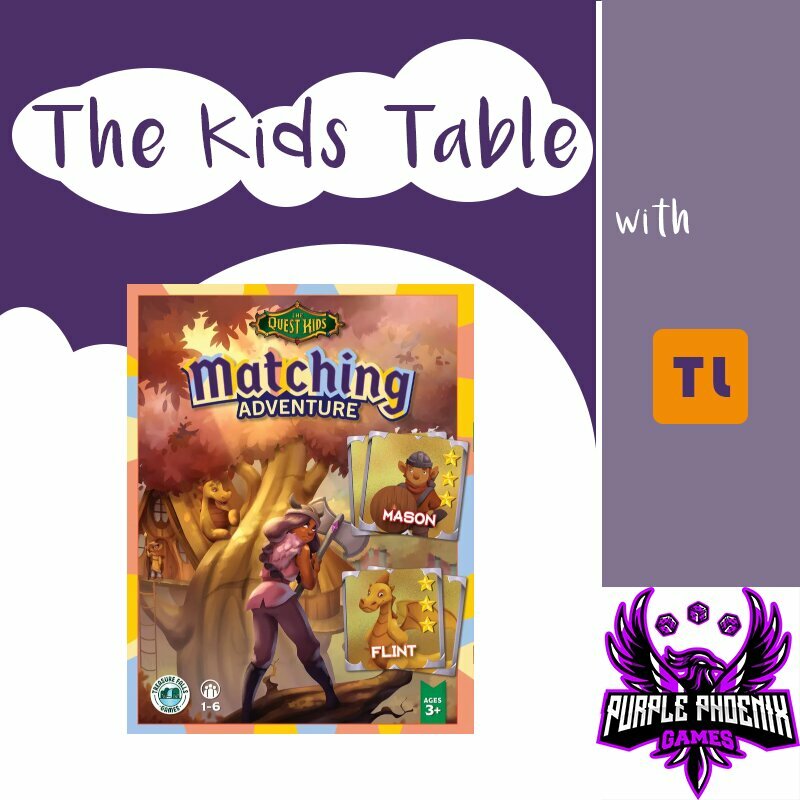
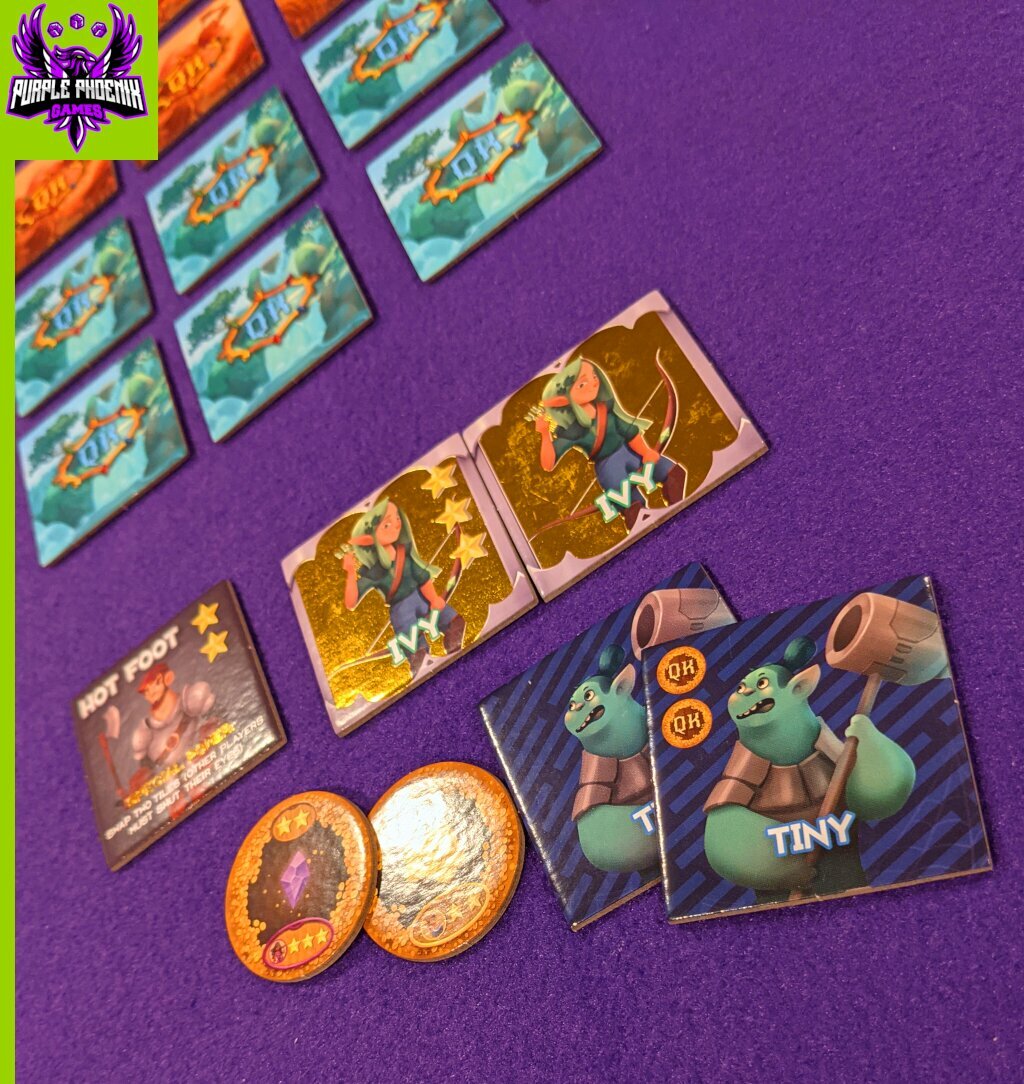
The Quest Kids: Matching Adventure (can I please just call it MA from here please?) is a tile matching game based off the old evergreen Memory mechanic. However, this isn’t your gramma’s Memory. In it players are recruiting The Quest Kids to scare off the silly bad guys by matching tiles and collecting treasures. The player with the most stars at the end of the game will be the winner! But in actuality, all the players will be winners because all will have had a great time.
DISCLAIMER: We were provided a copy of this game for the purposes of this review. This is a retail copy of the game, so what you see in these photos is exactly what would be received in your box. I do not intend to cover every single rule included in the rulebook, but will describe the overall game flow and major rule set so that our readers may get a sense of how the game plays. For more in depth rules, you may purchase a copy online or from your FLGS. -T
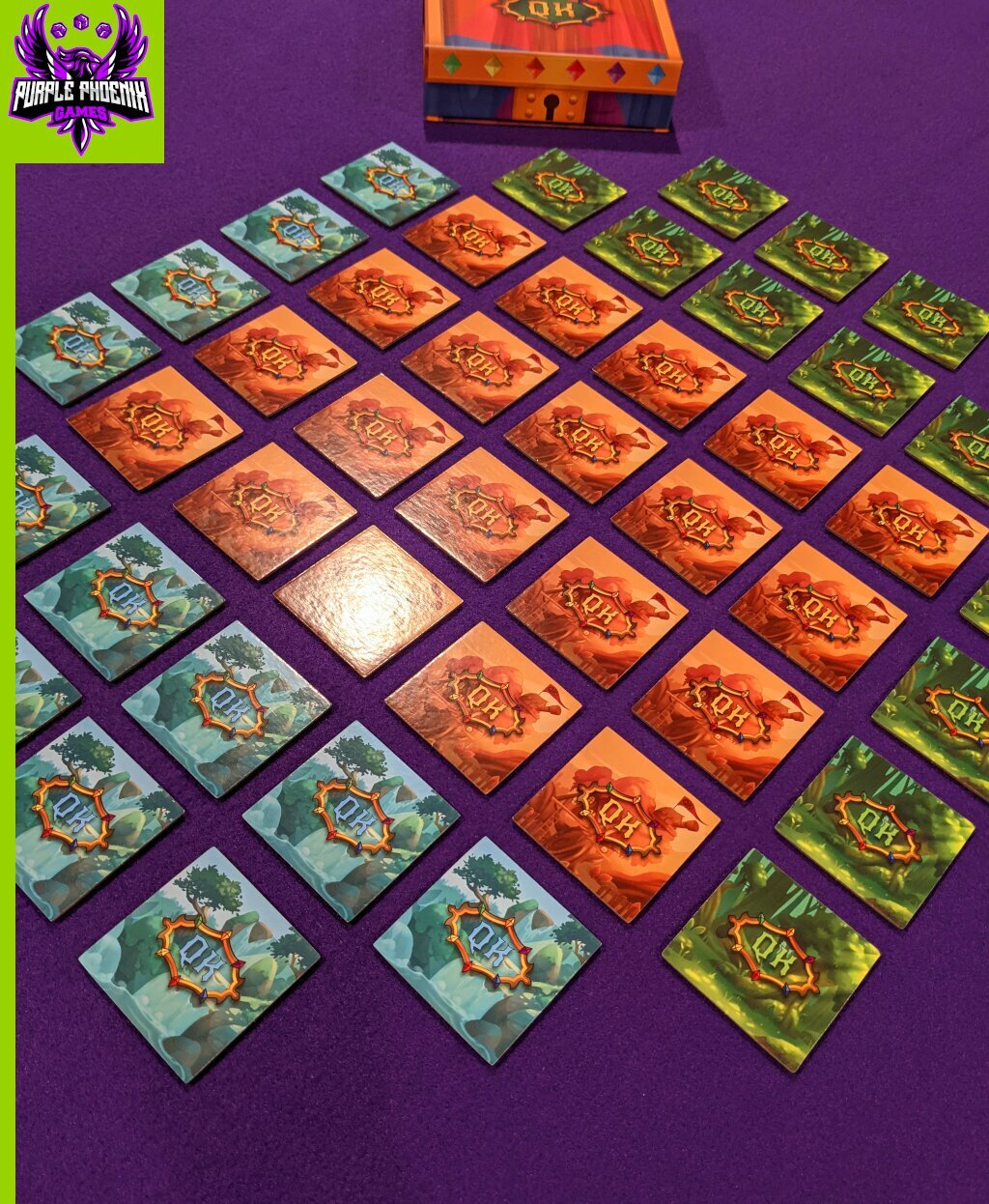
To setup, shuffle the brown tiles, forest tiles, and river tiles separately. Lay out the brown treehouse tiles face-down into a 5 x 4 grid. Around these brown tiles will be placed the river tiles and forest tiles, the numbers of which are dependent upon how lengthy the players wish the game to be. Add the appropriate types of treasure tokens to the provided treasure chest and the game is ready to begin! We ALWAYS let our little go first. They like that.
On a turn each player will attempt to recruit a Quest Kid Hero from the brown treehouse tiles. Once a match has been found the player may begin taking their hero on an adventure! Adventures can only be attempted when a player has matched two Hero tiles from the treehouse. An adventure consists of finding a matching pair of bad guys, one each from the forest and river. For example, in order to find the matching Honey Beard bad guy tiles a Hero would need to search the river for one tile AND the forest for its match.
When bad guys are matched they provide the player with a certain number of treasures, as printed on their tile. The player reaches into the treasure chest and pulls out the correct number of treasures (my son’s favorite part). These treasures provide a number of stars (VP) depending on whether the player has matched a specific hero or not. Less stars are awarded if the appropriate hero is absent, more stars if that hero has been matched by the player.
Some treehouse tiles contain Quest Kid Allies. These Allies provide stars, but also very helpful special abilities to be used on a future turn. When these Allies are matched, the active player keeps the tile with stars and gives away the matching tile to another player. So that other player may also use the Ally for its special ability on a future turn. Alliances with a 3-year-old? I can dig it! Alliances that do not involve said 3-year-old? Watch out for the forthcoming tantrum.
Play continues in this fashion of matching tiles, scaring away bad guys and receiving treasures, and utilizing Ally special abilities until all tiles have been matched and claimed. Players all add up their stars on their collected tiles and treasures, and the most stars collected wins the game!
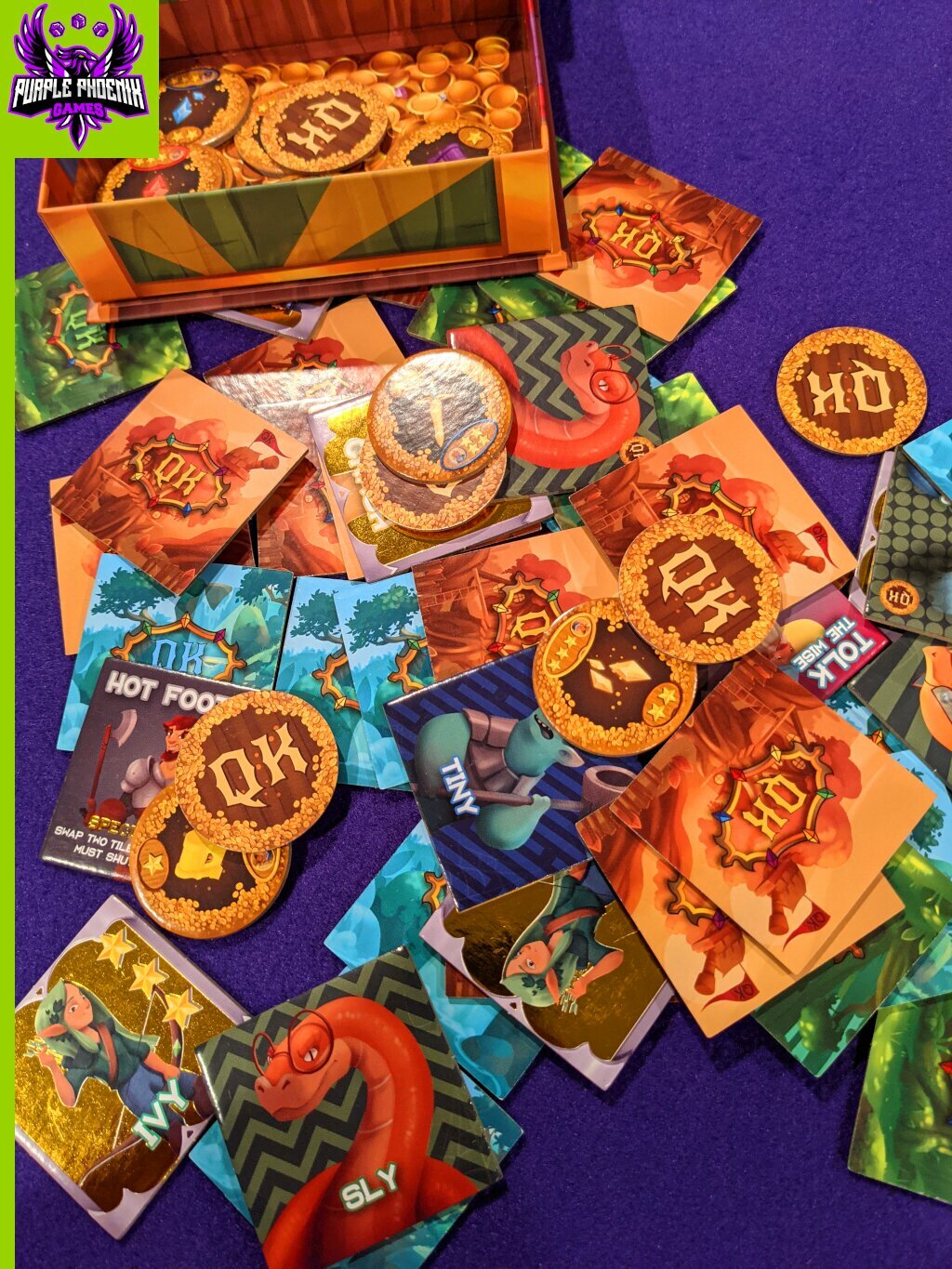
Components. This game is a ton of tiles and treasure tokens. That equates to, well, a whole bunch of thick cardboard in a box. The material quality is very good, but I am most impressed with the art style. I love game art that can be cartoony while also being interesting and detailed. Such is the art here. The characters are really well illustrated and each have their own personality. I have one gripe about the components: the treasure tokens feature a small picture of the Hero that allows it to be worth more stars. That Hero picture is very very tiny and details do not really transfer well to the small space, so it IS difficult to know which Kid will power up the treasure. I did find a workaround if players are not colorblind: each Hero is featured along with a color. That same color is used as the token icon and can more easily be matched to the Hero. It may save some headache if players are able to use the color as the indicator instead of the tiny picture.
In a nutshell this is Memory with strategy. The main game mechanic is memory – matching up the tiles in order to collect them. However, by throwing in the randomness of treasure token pulls and the Ally special abilities, MA just becomes a thousand percent more compelling for children and adults alike. At the end of the game my son is having a great time and almost always asks to play again. The adults are also impressed that Memory can be so much fun!
So if you are looking for that game to introduce to your youngster that actually challenges their little minds, then I strongly recommend The Quest Kids: Matching Adventure. Yes, it’s Memory, but it’s Memory that is actually fun. It’s Memory with a theme, and a kid-based theme at that. It gives the littles an opportunity to look up to these kid heroes and lets them imagine being heroes themselves. Any game that helps to empower my children will definitely be a well-loved addition to my collection. Purple Phoenix Games (well, my wife, my son, and I) give this one a victoriously heroic 16 / 18. I won’t say that I will beat you every time, but my son may. I dare you to play against him. Just make sure you throw all your extra Allies to him or he will get real mad real quick.
The Quest Kids: Matching Adventure (can I please just call it MA from here please?) is a tile matching game based off the old evergreen Memory mechanic. However, this isn’t your gramma’s Memory. In it players are recruiting The Quest Kids to scare off the silly bad guys by matching tiles and collecting treasures. The player with the most stars at the end of the game will be the winner! But in actuality, all the players will be winners because all will have had a great time.
DISCLAIMER: We were provided a copy of this game for the purposes of this review. This is a retail copy of the game, so what you see in these photos is exactly what would be received in your box. I do not intend to cover every single rule included in the rulebook, but will describe the overall game flow and major rule set so that our readers may get a sense of how the game plays. For more in depth rules, you may purchase a copy online or from your FLGS. -T
To setup, shuffle the brown tiles, forest tiles, and river tiles separately. Lay out the brown treehouse tiles face-down into a 5 x 4 grid. Around these brown tiles will be placed the river tiles and forest tiles, the numbers of which are dependent upon how lengthy the players wish the game to be. Add the appropriate types of treasure tokens to the provided treasure chest and the game is ready to begin! We ALWAYS let our little go first. They like that.
On a turn each player will attempt to recruit a Quest Kid Hero from the brown treehouse tiles. Once a match has been found the player may begin taking their hero on an adventure! Adventures can only be attempted when a player has matched two Hero tiles from the treehouse. An adventure consists of finding a matching pair of bad guys, one each from the forest and river. For example, in order to find the matching Honey Beard bad guy tiles a Hero would need to search the river for one tile AND the forest for its match.
When bad guys are matched they provide the player with a certain number of treasures, as printed on their tile. The player reaches into the treasure chest and pulls out the correct number of treasures (my son’s favorite part). These treasures provide a number of stars (VP) depending on whether the player has matched a specific hero or not. Less stars are awarded if the appropriate hero is absent, more stars if that hero has been matched by the player.
Some treehouse tiles contain Quest Kid Allies. These Allies provide stars, but also very helpful special abilities to be used on a future turn. When these Allies are matched, the active player keeps the tile with stars and gives away the matching tile to another player. So that other player may also use the Ally for its special ability on a future turn. Alliances with a 3-year-old? I can dig it! Alliances that do not involve said 3-year-old? Watch out for the forthcoming tantrum.
Play continues in this fashion of matching tiles, scaring away bad guys and receiving treasures, and utilizing Ally special abilities until all tiles have been matched and claimed. Players all add up their stars on their collected tiles and treasures, and the most stars collected wins the game!
Components. This game is a ton of tiles and treasure tokens. That equates to, well, a whole bunch of thick cardboard in a box. The material quality is very good, but I am most impressed with the art style. I love game art that can be cartoony while also being interesting and detailed. Such is the art here. The characters are really well illustrated and each have their own personality. I have one gripe about the components: the treasure tokens feature a small picture of the Hero that allows it to be worth more stars. That Hero picture is very very tiny and details do not really transfer well to the small space, so it IS difficult to know which Kid will power up the treasure. I did find a workaround if players are not colorblind: each Hero is featured along with a color. That same color is used as the token icon and can more easily be matched to the Hero. It may save some headache if players are able to use the color as the indicator instead of the tiny picture.
In a nutshell this is Memory with strategy. The main game mechanic is memory – matching up the tiles in order to collect them. However, by throwing in the randomness of treasure token pulls and the Ally special abilities, MA just becomes a thousand percent more compelling for children and adults alike. At the end of the game my son is having a great time and almost always asks to play again. The adults are also impressed that Memory can be so much fun!
So if you are looking for that game to introduce to your youngster that actually challenges their little minds, then I strongly recommend The Quest Kids: Matching Adventure. Yes, it’s Memory, but it’s Memory that is actually fun. It’s Memory with a theme, and a kid-based theme at that. It gives the littles an opportunity to look up to these kid heroes and lets them imagine being heroes themselves. Any game that helps to empower my children will definitely be a well-loved addition to my collection. Purple Phoenix Games (well, my wife, my son, and I) give this one a victoriously heroic 16 / 18. I won’t say that I will beat you every time, but my son may. I dare you to play against him. Just make sure you throw all your extra Allies to him or he will get real mad real quick.
Purple Phoenix Games (2266 KP) rated Dungeon Academy in Tabletop Games
Dec 8, 2020
Roll-and-write style games have come a really long way over the past couple years. In the olden days we had Yahtzee, and that satisfied us. But then designers began dusting off that olde mechanic and breathing new life into it. While roll-and-write may never become my favorite mechanic, I am starting to appreciate the good ones more and more each time I play them. Dungeon Academy is one of these good games.
In Dungeon Academy players are taking the roles of students attempting their finals to become graduated warriors and mages in the land. They must pass their tests though, and that entails surviving through the dreaded Dungeon four times and surpassing all opponents to receive their degree.
DISCLAIMER: We were provided a copy of this game for the purposes of this review. This is a retail copy of the game, so what you see in these photos is exactly what would be received in your box. I do not intend to cover every single rule included in the rulebook, but will describe the overall game flow and major rule set so that our readers may get a sense of how the game plays. For more in depth rules, you may purchase a copy online or from your FLGS. -T
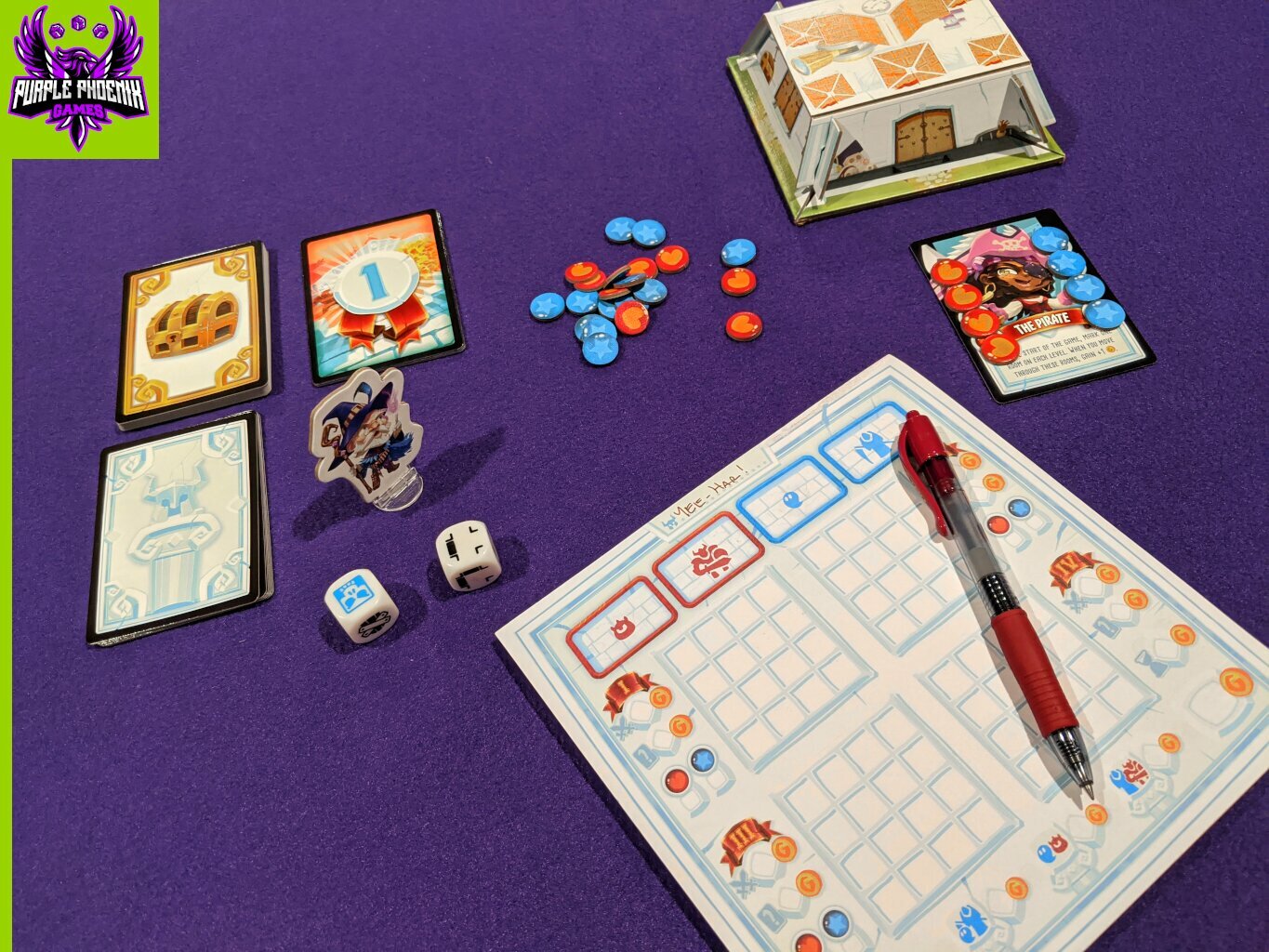
To setup a solo game of Dungeon Academy, assemble the Dungeon component per the instructions. The player is dealt a character card with a special ability and markers to track Health and Mana throughout the game. Pile the Health and Mana tokens on the table, shuffle the Loot cards into a deck, and place the Teacher pawn nearby. Grab the pad of paper and pen and you are ready to begin.
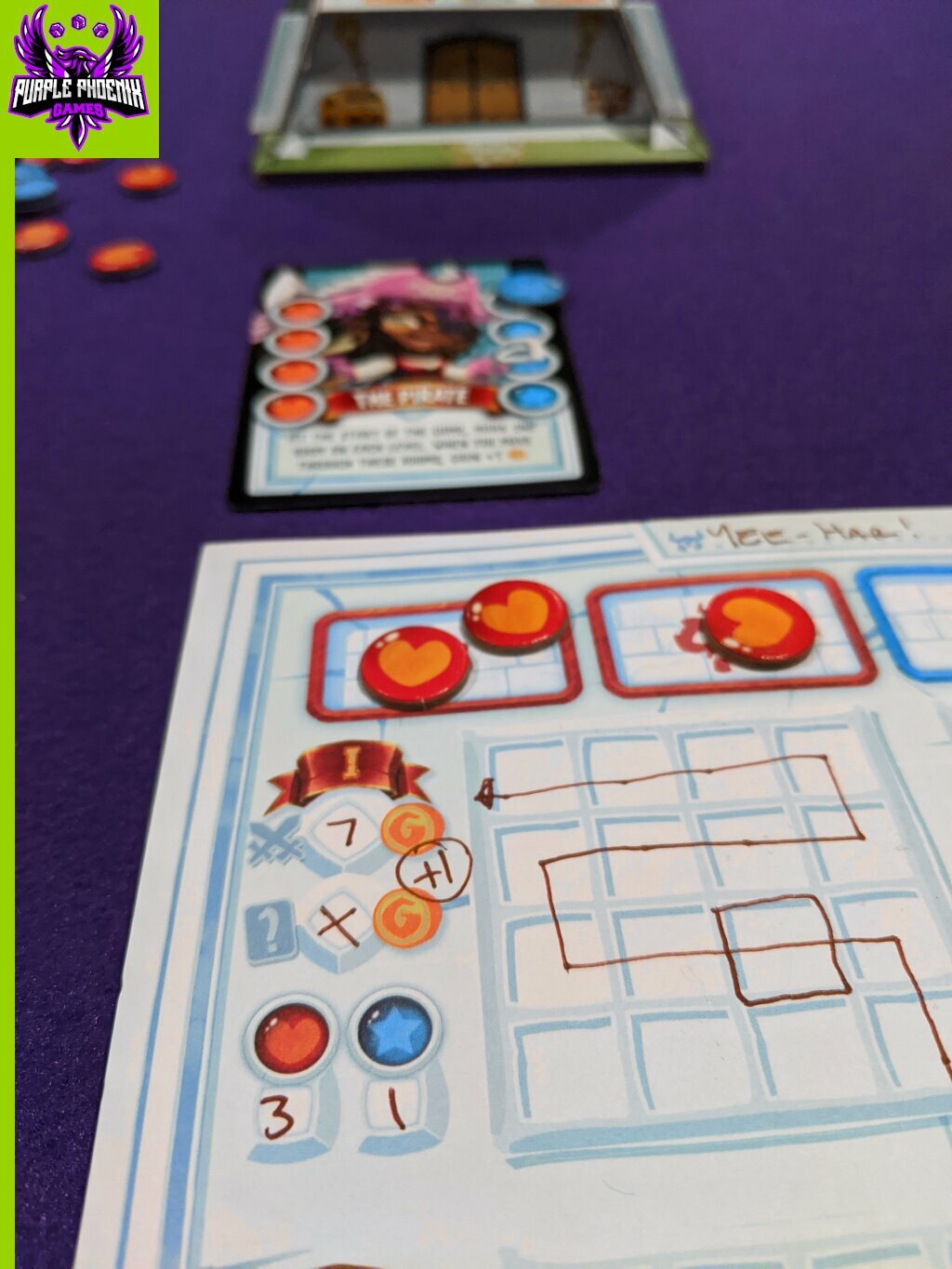
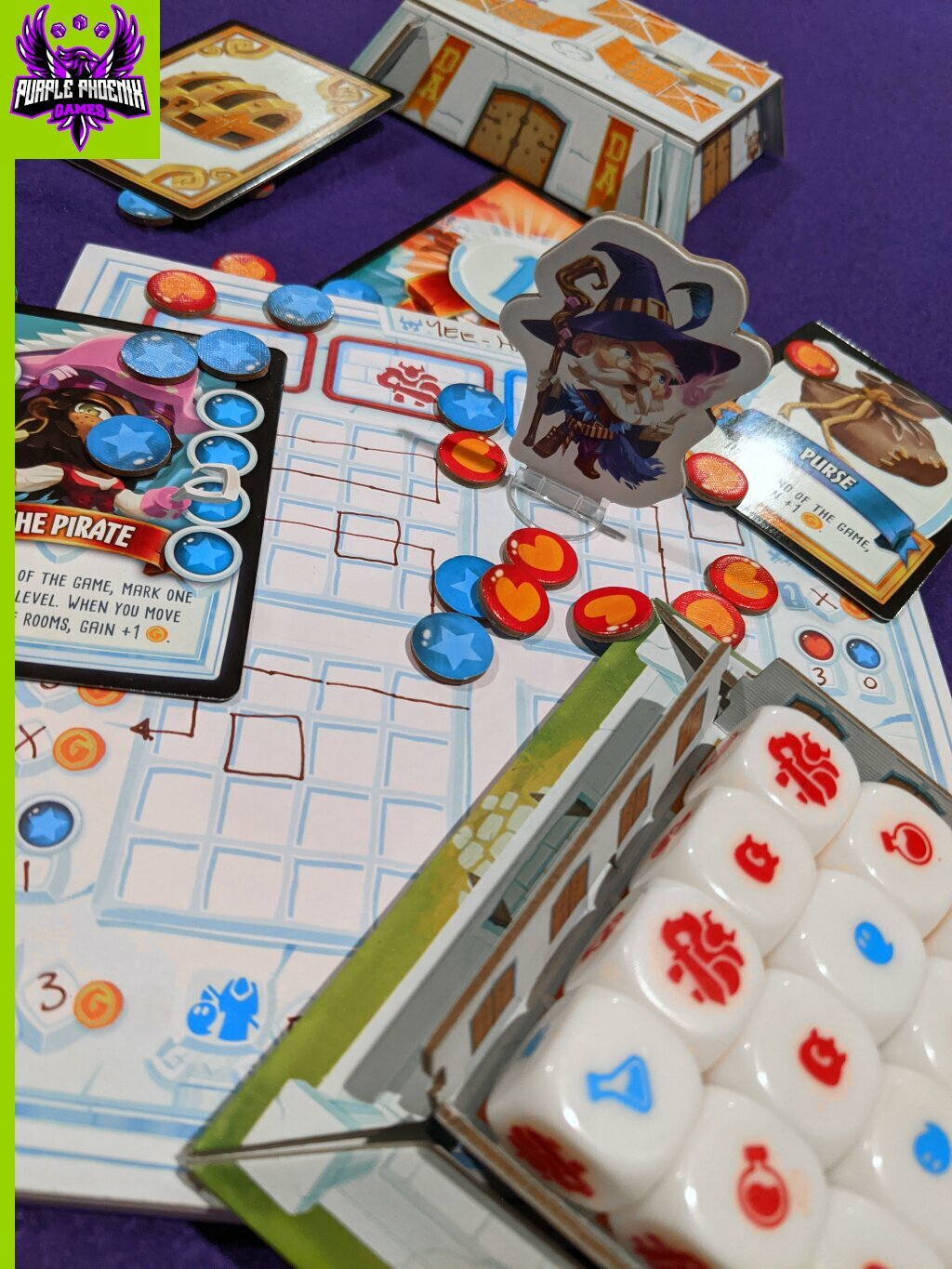
Each attempt in the Dungeon will require the 16 Base Dice to be rolled and set inside the Dungeon. It is then flipped upside down when the timer begins and the mad dash to the Exit commences. As the player marks a line through every “room” (each die is considered a “room” in the Dungeon) they create a path to be checked at the end of the round. Once the player has made it through the Dungeon satisfactorily the Teacher will check the path.
The Teacher pawn is now used to track movement in the Dungeon. As the player tracks the path they drew on the paper, the Teacher is moved through the rooms. In each room (each die face) will be one of these possible encounters: a Mana potion to refill an empty Mana space on the character card, a Health potion, a small red Blob, a small blue Ghost, a large red Colossus, or a large blue Reaper. Each small foe encountered will be overtaken by spending one Health or Mana token from the character card. Each potion will restore spent Health or Mana. Each large foe encountered will require two Health or Mana to be spent. As the Teacher follows the path set by the player, Health and Mana will be spent and replenished on the character card, and foes defeated tracked on the sheet.
Once complete, the player will add up all the points from defeated foes (1VP per foe) and any VP from special character abilities or Loot cards. Additionally, the player will choose one of the four Quests at the bottom of the sheet to score each round for extra VP. They write these numbers on the sheet and prepare for the next level. After four total levels the game ends and the total is compared to a scale in the rulebook.
Multiplayer Dungeon Academy works the exact same way except once a player exits the Dungeon, they must grab the lowest-numbered Exit card as representation of the place finished in the Dungeon (so the first one out grabs the 1 card, etc.). The other difference from solo play is that players all compare total VP at the game end to determine the winner.
Components. This game has a large scorepad of 150 double-sided sheets, a bunch of cards for Hero characters, Loot, and Exits, as well as 18 total dice, about a trillion double-sided Health/Mana tokens and an impressive cardboard Dungeon. Everything is of wonderful Matagot quality… except for the Duneon. In my copy the Dungeon does not stay together very well. I may attempt some glue to keep the parts down that need to stay down, but it is still functional and a great design. The art style across the game is cute and fun, and I like the muted bright color scheme. That feels so weird to say/type, but the colors are vibrant hues, but muted so they stay out of the way. It’s strange and I love it.
Speaking of I love it, I love this game! It is quickly becoming one of my favorite roll-and-write games, and I can play it solo. In about 15 minutes. These are all positives, and I haven’t even really touched on the gameplay. Being able to get through a light solo game in 15 minutes while having a great time throughout is an achievement, and one I would like to applaud here. I wasn’t really sure going into this if I was going to enjoy it, but it has blown me away. Trying to evaluate the best path through the Dungeon while keeping track of how the Health and Mana is always in flux gives my brain a welcomed workout that is just a breath of fresh air for me. I love the art style and the theme, and the simple but easy to understand iconography on the dice is much appreciated.
I think that if you are looking for or lacking a similar type game in your collection you should do yourself a favor and check out Dungeon Academy. It is super quick, easy to grasp and play, requires little table space, and is simply a great time alone or with your gamer friends and family. I know I am going to be tracking lots of plays with this one. I am going to have to find a place on my shelves at eye-level because I don’t want it to be overshadowed down at foot-level.
If you already enjoy roll-and-write games and want something a little different with a great theme, or you don’t have any roll-and-writes and want to check one out for the first time, or you simply cannot get enough games featuring great art about wizards in school check this one out. I recommend it.
In Dungeon Academy players are taking the roles of students attempting their finals to become graduated warriors and mages in the land. They must pass their tests though, and that entails surviving through the dreaded Dungeon four times and surpassing all opponents to receive their degree.
DISCLAIMER: We were provided a copy of this game for the purposes of this review. This is a retail copy of the game, so what you see in these photos is exactly what would be received in your box. I do not intend to cover every single rule included in the rulebook, but will describe the overall game flow and major rule set so that our readers may get a sense of how the game plays. For more in depth rules, you may purchase a copy online or from your FLGS. -T
To setup a solo game of Dungeon Academy, assemble the Dungeon component per the instructions. The player is dealt a character card with a special ability and markers to track Health and Mana throughout the game. Pile the Health and Mana tokens on the table, shuffle the Loot cards into a deck, and place the Teacher pawn nearby. Grab the pad of paper and pen and you are ready to begin.
Each attempt in the Dungeon will require the 16 Base Dice to be rolled and set inside the Dungeon. It is then flipped upside down when the timer begins and the mad dash to the Exit commences. As the player marks a line through every “room” (each die is considered a “room” in the Dungeon) they create a path to be checked at the end of the round. Once the player has made it through the Dungeon satisfactorily the Teacher will check the path.
The Teacher pawn is now used to track movement in the Dungeon. As the player tracks the path they drew on the paper, the Teacher is moved through the rooms. In each room (each die face) will be one of these possible encounters: a Mana potion to refill an empty Mana space on the character card, a Health potion, a small red Blob, a small blue Ghost, a large red Colossus, or a large blue Reaper. Each small foe encountered will be overtaken by spending one Health or Mana token from the character card. Each potion will restore spent Health or Mana. Each large foe encountered will require two Health or Mana to be spent. As the Teacher follows the path set by the player, Health and Mana will be spent and replenished on the character card, and foes defeated tracked on the sheet.
Once complete, the player will add up all the points from defeated foes (1VP per foe) and any VP from special character abilities or Loot cards. Additionally, the player will choose one of the four Quests at the bottom of the sheet to score each round for extra VP. They write these numbers on the sheet and prepare for the next level. After four total levels the game ends and the total is compared to a scale in the rulebook.
Multiplayer Dungeon Academy works the exact same way except once a player exits the Dungeon, they must grab the lowest-numbered Exit card as representation of the place finished in the Dungeon (so the first one out grabs the 1 card, etc.). The other difference from solo play is that players all compare total VP at the game end to determine the winner.
Components. This game has a large scorepad of 150 double-sided sheets, a bunch of cards for Hero characters, Loot, and Exits, as well as 18 total dice, about a trillion double-sided Health/Mana tokens and an impressive cardboard Dungeon. Everything is of wonderful Matagot quality… except for the Duneon. In my copy the Dungeon does not stay together very well. I may attempt some glue to keep the parts down that need to stay down, but it is still functional and a great design. The art style across the game is cute and fun, and I like the muted bright color scheme. That feels so weird to say/type, but the colors are vibrant hues, but muted so they stay out of the way. It’s strange and I love it.
Speaking of I love it, I love this game! It is quickly becoming one of my favorite roll-and-write games, and I can play it solo. In about 15 minutes. These are all positives, and I haven’t even really touched on the gameplay. Being able to get through a light solo game in 15 minutes while having a great time throughout is an achievement, and one I would like to applaud here. I wasn’t really sure going into this if I was going to enjoy it, but it has blown me away. Trying to evaluate the best path through the Dungeon while keeping track of how the Health and Mana is always in flux gives my brain a welcomed workout that is just a breath of fresh air for me. I love the art style and the theme, and the simple but easy to understand iconography on the dice is much appreciated.
I think that if you are looking for or lacking a similar type game in your collection you should do yourself a favor and check out Dungeon Academy. It is super quick, easy to grasp and play, requires little table space, and is simply a great time alone or with your gamer friends and family. I know I am going to be tracking lots of plays with this one. I am going to have to find a place on my shelves at eye-level because I don’t want it to be overshadowed down at foot-level.
If you already enjoy roll-and-write games and want something a little different with a great theme, or you don’t have any roll-and-writes and want to check one out for the first time, or you simply cannot get enough games featuring great art about wizards in school check this one out. I recommend it.
Purple Phoenix Games (2266 KP) rated Tsuro: Phoenix Rising in Tabletop Games
Oct 6, 2021
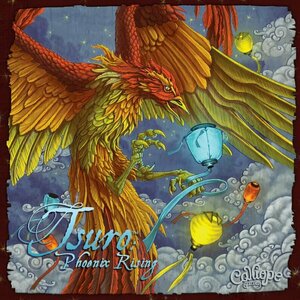

When we decided to start this board game review group, coming up with a name was definitely a challenge. We threw out so many ideas, my head was spinning with the possibilities! In our name search, someone suggested Purple Phoenix Games. It sounds cool, we all like the color purple, and it was a name upon which we could all finally agree! Ever since settling on our name, I have taken a keen interest in any game that has any mention of Phoenix, so when Travis backed Tsuro: Phoenix Rising on Kickstarter, I knew I’d have to play it. Does the game meet our expectations, or does this Phoenix struggle to rise from the ashes?
Tsuro: Phoenix Rising (referred to as just Tsuro for the remainder of this review) is a game of tile placement and network building in which players will each guide their Phoenix across the night sky to find Lanterns and collect Stars. To setup for a game, assemble the board and give each player a Life token and a Phoenix pawn in their chosen color. Each player will then place their Phoenix next to one of the empty Edge spaces of the board. Now shuffle and populate the Center tiles as described in the rules, place Lanterns on their specified tiles, deal each player 2 Edge tiles, and you are ready to begin.
Played over a series of rounds, players will take turns placing tiles and moving their Phoenix pawns along the paths that have been created. On your turn, you will perform the following actions: Create your path, Travel your path, and Prepare for your next turn. To Create your path, you will either play a tile from your hand, or you will flip/rotate a tile. To play a tile from your hand, the space in front of your Phoenix must be empty. Select one of the two tiles from your hand, add it to the board in an orientation that continues your current path, and discard the remaining tile. If the space in front of your Phoenix is already occupied by a tile, you will either flip or rotate that tile to extend your path.
Once your path has been Created, you will Follow it. Move your Phoenix along your new path until you either reach a dead end or are forced to leave the board – by following a path off of the board, colliding with another Phoenix, or entering an endless loop. During this step of your turn is when Stars will be created and earned. If during your movement your Phoenix enters and exits a tile with a Lantern on it, place a Star token onto that tile. Once your movement has ended, for each tile with a Star, you must move that Lantern to a different tile with its corresponding icon. Collect the Stars you created, and they are immediately scored. If, as a result of someone else’s turn, the path for your Phoenix has been extended, you will move your Phoenix along that new path after the active player has completed scoring any Stars. An important note – you can also earn Stars through this out-of-turn movement!
The last step of your turn is to Prepare for your next turn. Draw 2 new tiles from the draw stack if the space in front of your Phoenix is empty, otherwise draw no tiles. Play then continues on to the next player in turn order. If at any point in the game, your Phoenix has been forced off the board, you may spend your Life token on your next turn to Rise from the Ashes. This can only be performed if there is at least one empty space on the board with no tile on it. After a certain amount of time, the board will be completely filled and your opportunity to Rise from the Ashes will be gone! Rounds continue in the above fashion until one player has scored at least 7 Stars. Players will complete the current round, and then the game ends. OR if there comes a time during the game in which only 1 Phoenix pawn remains on the board, the game ends and that remaining player is declared the winner.
All in all, I really enjoy playing Tsuro, and not only because of our Phoenix connection. For such a seemingly simple game – create a path and move on it – the gameplay requires a good amount of strategy. The ability to rotate, and even flip, tiles adds so many strategic possibilities that really elevates the gameplay from that of the original. Also, with the addition of the Lanterns and Stars, the game offers another focus instead of simple player elimination. Strategies can, and will, vary between players, and that makes the game more engaging for all involved. Add in the fact that your Phoenix will move if another player has extended your path on their turn, and you’ve got all players playing on every turn of the game.
Another aspect of Tsuro that I really like is the addition of the Life token and the opportunity to Rise from the Ashes. Just because an opponent forces you off the board does not necessarily mean that you are out of the game for good. The chance to Rise is a unique second chance for players to stay involved in the game. I think it works well because of its limited timing. If there are no open spaces on the board, you are out of luck! It really ups the ante and keeps players on their toes.
Let’s touch on components for a minute. They are pretty stellar in this game. The board is nice and sturdy, the cardboard tiles are thick, the Stars and Lanterns are of excellent quality, and the Phoenix pawns are nicely detailed and just plain fun to look at. No complaints about components from me in this game!
Compared to the original, I think that Tsuro: Phoenix Rising really lives up to its name. The gameplay is definitely elevated with new strategic options, and I believe that it does rise above the OG Tsuro. If you’ve never played either version, I highly recommend Phoenix Rising. It is entertaining, engaging, and has more to it than meets the eye. Purple Phoenix Games gives Tsuro: Phoenix Rising a mighty 11 / 18.
Tsuro: Phoenix Rising (referred to as just Tsuro for the remainder of this review) is a game of tile placement and network building in which players will each guide their Phoenix across the night sky to find Lanterns and collect Stars. To setup for a game, assemble the board and give each player a Life token and a Phoenix pawn in their chosen color. Each player will then place their Phoenix next to one of the empty Edge spaces of the board. Now shuffle and populate the Center tiles as described in the rules, place Lanterns on their specified tiles, deal each player 2 Edge tiles, and you are ready to begin.
Played over a series of rounds, players will take turns placing tiles and moving their Phoenix pawns along the paths that have been created. On your turn, you will perform the following actions: Create your path, Travel your path, and Prepare for your next turn. To Create your path, you will either play a tile from your hand, or you will flip/rotate a tile. To play a tile from your hand, the space in front of your Phoenix must be empty. Select one of the two tiles from your hand, add it to the board in an orientation that continues your current path, and discard the remaining tile. If the space in front of your Phoenix is already occupied by a tile, you will either flip or rotate that tile to extend your path.
Once your path has been Created, you will Follow it. Move your Phoenix along your new path until you either reach a dead end or are forced to leave the board – by following a path off of the board, colliding with another Phoenix, or entering an endless loop. During this step of your turn is when Stars will be created and earned. If during your movement your Phoenix enters and exits a tile with a Lantern on it, place a Star token onto that tile. Once your movement has ended, for each tile with a Star, you must move that Lantern to a different tile with its corresponding icon. Collect the Stars you created, and they are immediately scored. If, as a result of someone else’s turn, the path for your Phoenix has been extended, you will move your Phoenix along that new path after the active player has completed scoring any Stars. An important note – you can also earn Stars through this out-of-turn movement!
The last step of your turn is to Prepare for your next turn. Draw 2 new tiles from the draw stack if the space in front of your Phoenix is empty, otherwise draw no tiles. Play then continues on to the next player in turn order. If at any point in the game, your Phoenix has been forced off the board, you may spend your Life token on your next turn to Rise from the Ashes. This can only be performed if there is at least one empty space on the board with no tile on it. After a certain amount of time, the board will be completely filled and your opportunity to Rise from the Ashes will be gone! Rounds continue in the above fashion until one player has scored at least 7 Stars. Players will complete the current round, and then the game ends. OR if there comes a time during the game in which only 1 Phoenix pawn remains on the board, the game ends and that remaining player is declared the winner.
All in all, I really enjoy playing Tsuro, and not only because of our Phoenix connection. For such a seemingly simple game – create a path and move on it – the gameplay requires a good amount of strategy. The ability to rotate, and even flip, tiles adds so many strategic possibilities that really elevates the gameplay from that of the original. Also, with the addition of the Lanterns and Stars, the game offers another focus instead of simple player elimination. Strategies can, and will, vary between players, and that makes the game more engaging for all involved. Add in the fact that your Phoenix will move if another player has extended your path on their turn, and you’ve got all players playing on every turn of the game.
Another aspect of Tsuro that I really like is the addition of the Life token and the opportunity to Rise from the Ashes. Just because an opponent forces you off the board does not necessarily mean that you are out of the game for good. The chance to Rise is a unique second chance for players to stay involved in the game. I think it works well because of its limited timing. If there are no open spaces on the board, you are out of luck! It really ups the ante and keeps players on their toes.
Let’s touch on components for a minute. They are pretty stellar in this game. The board is nice and sturdy, the cardboard tiles are thick, the Stars and Lanterns are of excellent quality, and the Phoenix pawns are nicely detailed and just plain fun to look at. No complaints about components from me in this game!
Compared to the original, I think that Tsuro: Phoenix Rising really lives up to its name. The gameplay is definitely elevated with new strategic options, and I believe that it does rise above the OG Tsuro. If you’ve never played either version, I highly recommend Phoenix Rising. It is entertaining, engaging, and has more to it than meets the eye. Purple Phoenix Games gives Tsuro: Phoenix Rising a mighty 11 / 18.
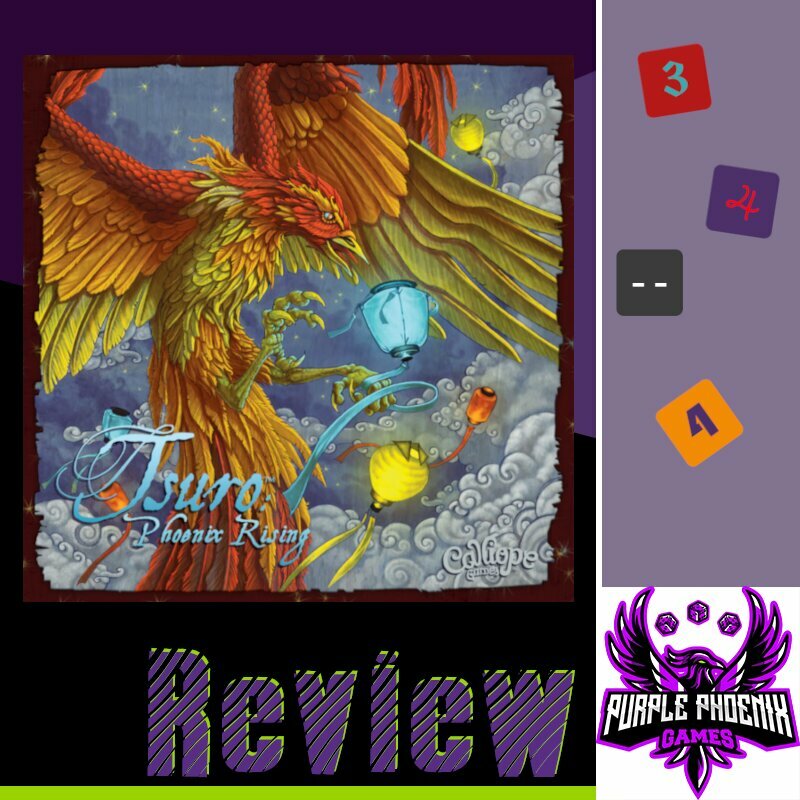
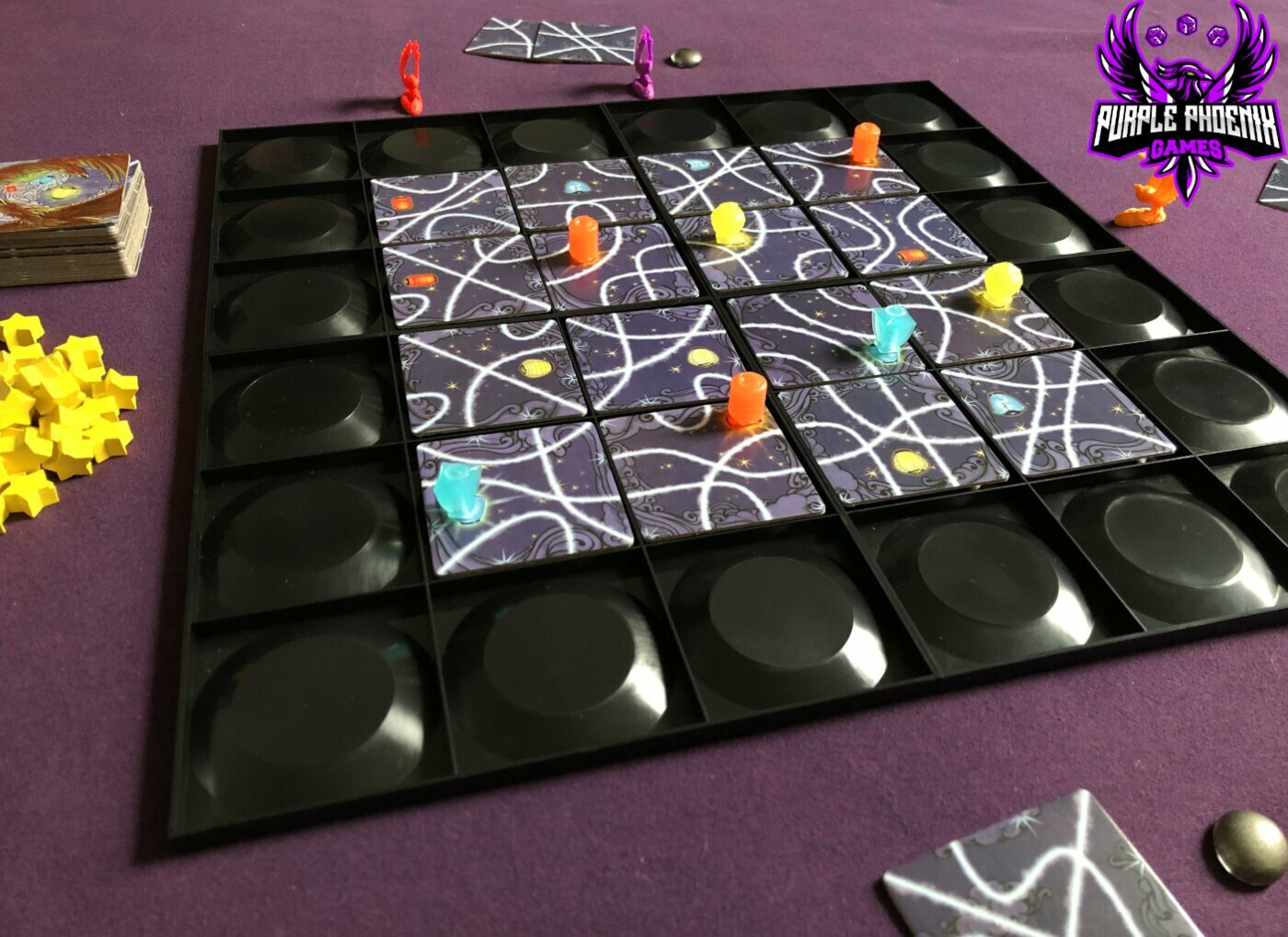
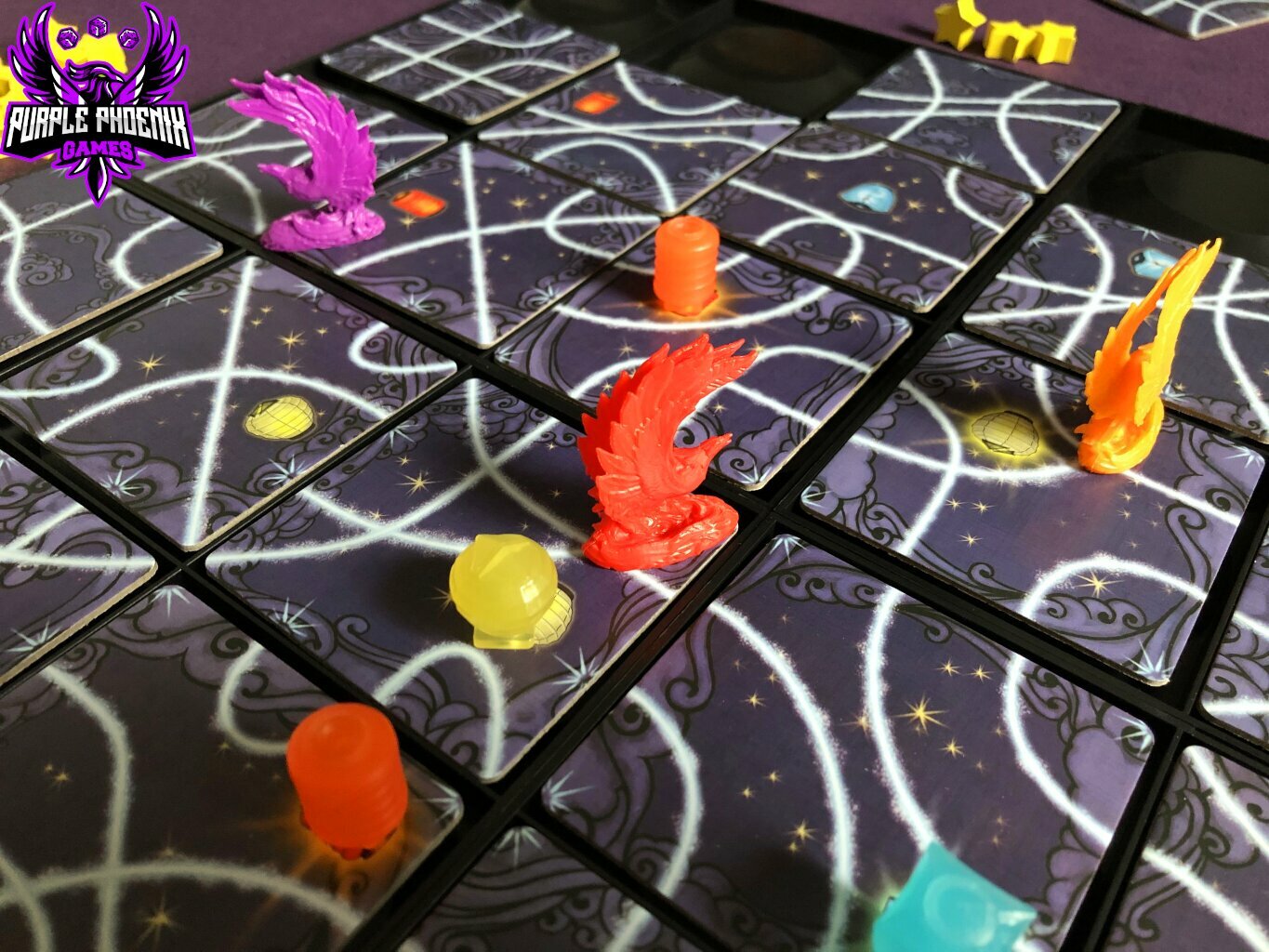
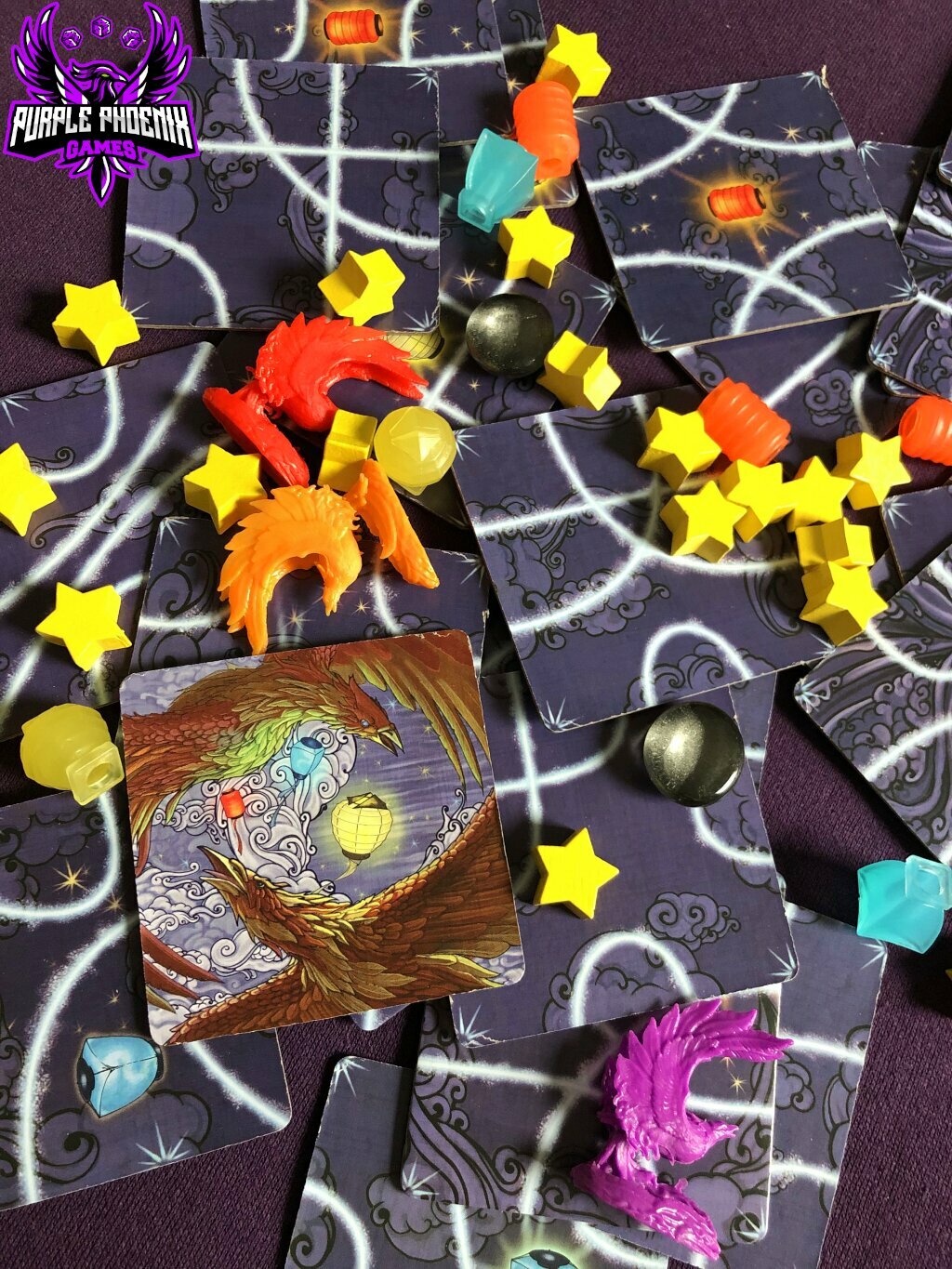
Purple Phoenix Games (2266 KP) rated Among the Stars in Tabletop Games
Dec 3, 2021
If there is a mechanic that we at Purple Phoenix Games seem to really love, it is card drafting. One such game that has been a big hit for us (well, at least for 3 of us….) is 7 Wonders. Draft a card, pass the rest to your neighbor, draft another card from those received from your other neighbor, and repeat. Set in the Ancient World, you are working to build the most wondrous city. But Laura, why all the 7 Wonders talk in this review? Well, because Among the Stars gives me major 7 Wonders vibes, but IN SPACE. Keep reading to see what I mean.
Disclaimer: Among the Stars can be played in two different modes – Aggressive and Non-Aggressive. This review covers the core game Non-Aggressive mode of play. -L
Among the Stars is a game of card drafting and tile placement in which players take on the roles of different alien races attempting to build the most efficient space station over the span of 4 years (rounds). After the 4th and final round, players calculate their final scores, and the player with the highest score is the winner! To setup for a game, assemble the Location deck as described in the rules. Each player takes a Main Reactor card and score marker in their chosen color. Score markers are placed at zero on the score board, and players put their Main Reactor card face-up in front of them, along with 2 Energy Cubes. Players choose, or are randomly given, a Race Tile with a special Racial Ability to be used throughout the game. Randomly draw the requisite number of Objective cards and put them face-up near the score board. The game is now ready to begin!
Over the course of 4 rounds, players will be drafting cards and playing them into their Space Station. At the start of each round, every player collects 10 Credits (game currency), and draws a hand of 6 Location cards. Every turn, players will select one card from their hand, place it face-down in front of them, and will pass the remaining cards in their hand to the next player (in either clockwise or counter-clockwise direction, depending on the round). Players will then simultaneously reveal their chosen card and perform one of three actions: Build a Location, Build Power Reactor, or Discard and gain 3 Credits. To Build a Location, you pay its listed cost in Credits and/or Energy and add it to your Space Station. Locations must be placed orthogonally adjacent to an existing Location. When you build a Location, you immediately gain the listed number of VP (tracked on the score board), and may use its ability. Some abilities are immediate and earn you extra VP now, while some are delayed and will be counted at the end of the game. To Build a Power Reactor, you will first discard your selected card for the turn. Pay the 1 Credit cost of a Power Reactor and place it into your Space Station, along with 2 Energy Cubes. Every round, you get 10 Credits, but Energy Cubes do not replenish unless you build more Power Reactors, so keep an eye on your resources! The last possible action is to Discard and gain 3 Credits, and is pretty self-explanatory.
Players continue taking turns (drafting cards, passing cards, and playing cards) until they are left with no cards in hand. The round is now over. Move the round marker to the next space, and begin a new round by drawing another hand of 6 cards. After the 4th round of play, the game ends and final VP are scored. Victory Points have been earned throughout the game, but now any delayed abilities are triggered and scored, Objective points are added, and players gain points for Power Reactors and remaining Credits. The player with the highest score is the winner!
See what I mean about being 7 Wonders in space? The overall gameplay is pretty much the same thing – draft a card, pass cards, play the card – even though thematically they’re on opposite ends of time. That familiarity and simplicity of the gameplay definitely added to my enjoyment of the game. And when I say ‘simplicity’ of gameplay, I do not mean that it is an easy game necessarily. It still requires a decent amount of strategy! Not only do you have to decide what card to draft for maximum benefit, but you also need to figure out exactly where to put it in your Space Station too. Some Locations may give you extra VP for being adjacent to certain other Locations, or they may even earn more VP for distance between two Locations. You’ve got to be thinking in advance, but also able to adapt on the fly. Do you draft a card that you don’t necessarily want because you can see your opponent needs it? Or do you keep your head down and try to fly under the radar? The strategy and mechanics work very well together in creating an engaging and entertaining game.
Components. This game basically just consists of cards, a score board, and some tokens. So even though it’s nothing too fancy or anything, they’re still pretty decent quality! The artwork is thematic and fun to look at, and the layout of the cards is easy to understand. The cards are square, so that makes for some interesting shuffling, but the square shape really lends itself well to the tile-laying aspect of the gameplay. So all in all, good production quality. Just be warned – as the game progresses, it turns into quite a table hog, since you are constantly adding cards to your Space Station. Not a knock on the game, just a heads up so you give yourself plenty of room!
Will Among the Stars replace 7 Wonders for me? Ultimately, no. Don’t get me wrong, it’s still a great game, but 7 Wonders just offers a little more strategy that bumps it to a higher level than Among the Stars. To introduce players to these mechanics and gameplay style, I would use Among the Stars because it is a little ‘lighter’ than 7 Wonders, if you ask me. If you are a fan of 7 Wonders and are interested in a more futuristic theme, I would definitely recommend checking out Among the Stars. It’s a neat game that has been hiding on my game shelf without the playtime it deserves. Purple Phoenix Games gives this one a stellar 15 / 18.
Disclaimer: Among the Stars can be played in two different modes – Aggressive and Non-Aggressive. This review covers the core game Non-Aggressive mode of play. -L
Among the Stars is a game of card drafting and tile placement in which players take on the roles of different alien races attempting to build the most efficient space station over the span of 4 years (rounds). After the 4th and final round, players calculate their final scores, and the player with the highest score is the winner! To setup for a game, assemble the Location deck as described in the rules. Each player takes a Main Reactor card and score marker in their chosen color. Score markers are placed at zero on the score board, and players put their Main Reactor card face-up in front of them, along with 2 Energy Cubes. Players choose, or are randomly given, a Race Tile with a special Racial Ability to be used throughout the game. Randomly draw the requisite number of Objective cards and put them face-up near the score board. The game is now ready to begin!
Over the course of 4 rounds, players will be drafting cards and playing them into their Space Station. At the start of each round, every player collects 10 Credits (game currency), and draws a hand of 6 Location cards. Every turn, players will select one card from their hand, place it face-down in front of them, and will pass the remaining cards in their hand to the next player (in either clockwise or counter-clockwise direction, depending on the round). Players will then simultaneously reveal their chosen card and perform one of three actions: Build a Location, Build Power Reactor, or Discard and gain 3 Credits. To Build a Location, you pay its listed cost in Credits and/or Energy and add it to your Space Station. Locations must be placed orthogonally adjacent to an existing Location. When you build a Location, you immediately gain the listed number of VP (tracked on the score board), and may use its ability. Some abilities are immediate and earn you extra VP now, while some are delayed and will be counted at the end of the game. To Build a Power Reactor, you will first discard your selected card for the turn. Pay the 1 Credit cost of a Power Reactor and place it into your Space Station, along with 2 Energy Cubes. Every round, you get 10 Credits, but Energy Cubes do not replenish unless you build more Power Reactors, so keep an eye on your resources! The last possible action is to Discard and gain 3 Credits, and is pretty self-explanatory.
Players continue taking turns (drafting cards, passing cards, and playing cards) until they are left with no cards in hand. The round is now over. Move the round marker to the next space, and begin a new round by drawing another hand of 6 cards. After the 4th round of play, the game ends and final VP are scored. Victory Points have been earned throughout the game, but now any delayed abilities are triggered and scored, Objective points are added, and players gain points for Power Reactors and remaining Credits. The player with the highest score is the winner!
See what I mean about being 7 Wonders in space? The overall gameplay is pretty much the same thing – draft a card, pass cards, play the card – even though thematically they’re on opposite ends of time. That familiarity and simplicity of the gameplay definitely added to my enjoyment of the game. And when I say ‘simplicity’ of gameplay, I do not mean that it is an easy game necessarily. It still requires a decent amount of strategy! Not only do you have to decide what card to draft for maximum benefit, but you also need to figure out exactly where to put it in your Space Station too. Some Locations may give you extra VP for being adjacent to certain other Locations, or they may even earn more VP for distance between two Locations. You’ve got to be thinking in advance, but also able to adapt on the fly. Do you draft a card that you don’t necessarily want because you can see your opponent needs it? Or do you keep your head down and try to fly under the radar? The strategy and mechanics work very well together in creating an engaging and entertaining game.
Components. This game basically just consists of cards, a score board, and some tokens. So even though it’s nothing too fancy or anything, they’re still pretty decent quality! The artwork is thematic and fun to look at, and the layout of the cards is easy to understand. The cards are square, so that makes for some interesting shuffling, but the square shape really lends itself well to the tile-laying aspect of the gameplay. So all in all, good production quality. Just be warned – as the game progresses, it turns into quite a table hog, since you are constantly adding cards to your Space Station. Not a knock on the game, just a heads up so you give yourself plenty of room!
Will Among the Stars replace 7 Wonders for me? Ultimately, no. Don’t get me wrong, it’s still a great game, but 7 Wonders just offers a little more strategy that bumps it to a higher level than Among the Stars. To introduce players to these mechanics and gameplay style, I would use Among the Stars because it is a little ‘lighter’ than 7 Wonders, if you ask me. If you are a fan of 7 Wonders and are interested in a more futuristic theme, I would definitely recommend checking out Among the Stars. It’s a neat game that has been hiding on my game shelf without the playtime it deserves. Purple Phoenix Games gives this one a stellar 15 / 18.

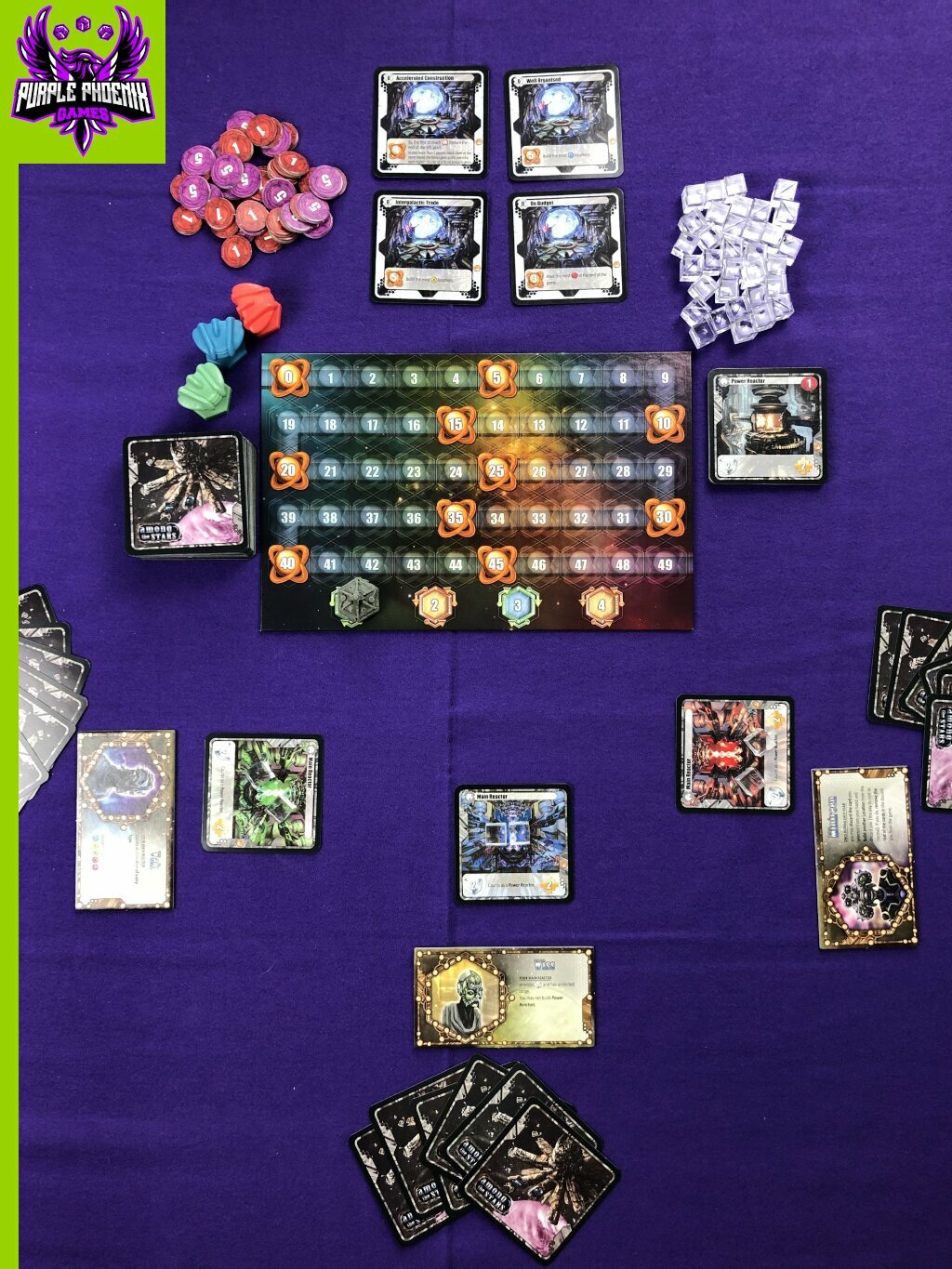
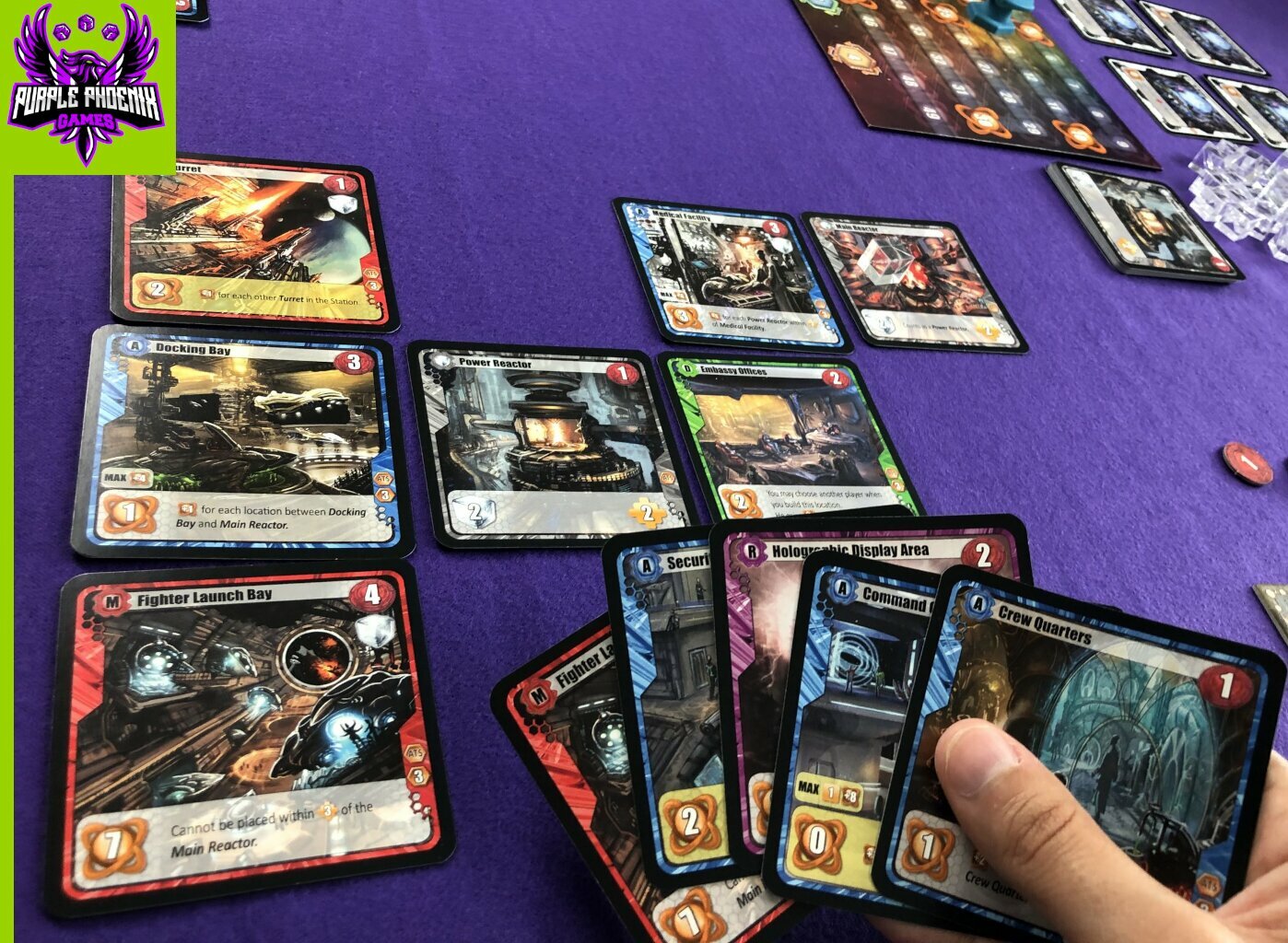

Purple Phoenix Games (2266 KP) rated Horreos in Tabletop Games
Jan 23, 2022
I’m not a huge history buff or anything, but I am definitely interested in my family lineage/ancestry. What does that have to do with this game? Well, with the last name Rodriguez, I’m sure you guessed that there’s some Spanish heritage in my background. My Dad will often talk about how our family originally came from Spain a loooooong time ago. Specifically from Galicia, Spain. So when I saw this ButtonShy game based on the real-life location of Galicia, my roots were calling to me and I had to get it. Hórreos gives us a small glimpse into life in 18th century Galicia – and it sounds pretty great!
Hórreos is a 2-player game in which players are competing to build the most effective and aesthetically pleasing hórreo in town. What is a hórreo? It is a building for storing grain, elevated from the ground to prevent rodents from infiltrating the structure. So in this game, players are building long and ornate hórreos that not only look stunning, but can keep the rats out of the grain! To setup for a game, each player receives 2 Action cards and the Hórreo cards are shuffled. The deck is placed between the players, and the top card is placed beside the deck to form a 2-card Market. The Leader card is placed beside the Market, facing the starting player. Pictured below is the setup for the beginning of a game.
Over a series of rounds, players will be taking 1 of 4 possible actions as they attempt to build the highest-scoring structure. Each player has 2 Action cards at their disposal. Each Action card has 2 possible Actions on it – one card is Sabotage or Plan, the other is Steal or Build. Both players will secretly choose whichever Action they wish to perform this turn, and place their card face-down in front of them. Players will then simultaneous reveal their chosen Actions, and they will be resolved in the following order – Sabotage, Plan, Steal, and Build. If a player has chosen to Sabotage, they will rotate their opponent’s Action card, forcing them to perform the other listed action this round. To perform the Plan action, the player will select one of the cards from the Market to be placed into their personal supply tableau. If you have chosen to Steal, you will select a card from your opponent’s supply, and take it into your own supply tableau. And finally, to Build is to move a card from your supply to your hórreo. Cards in your hórreo cannot be stolen. As with many other ButtonShy games, cards in your hórreo may be placed adjacent to, or even overlapping, previously played cards – cards may never be tucked under cards in your existing hórreo.
If both players have chosen the same action, the player with the Leader card facing them gets to decide which player will resolve their action first. The Leader card is then rotated to face the opposite player, and so on, for future ‘ties’. An important note – you cannot pick the same Action twice in a row, you must pick one of the other 3 Actions. So take that strategic tidbit into consideration when deciding what to do each round! The game continues in this fashion, with players selecting/simultaneously revealing Actions, resolving their Actions in order, and building their hórreo until there is 1 or fewer cards left in the Market and the players’ supplies at the end of a round. At that point, the game ends, points are tallied, and the winner is declared!
Points are scored in several ways. Most of the hórreo cards are ‘decorated’ with crosses and pikes, and each pair you have in your final hórreo will earn you points. Similarly, the number of doors in your hórreo, as well as adjacent pillars supporting your structure, will earn you points dependent upon the number (the more doors you have, the more points you earn, etc.). As mentioned earlier, you’re trying to keep these pesky rats out of your grain, so any rat pictured on your cards is worth -2 points, but each owl you have pictured eats (cancels out) one rat. And of course, whichever player has build the longest hórreo earns extra points. All points are tallied, and the player with the highest score is the winner!
I have to admit that Hórreos surprised me. The gameplay seems simple enough, so I honestly wasn’t really expecting a lot from this game. For such a small game, Hórreos is all about strategy. Each round, you only have 4 Actions from which to choose, and that really forces you to think long-term with your strategy. But at the same time, since Actions are revealed simultaneously and resolved in a set order, you have to consider what your opponent might do. For example, the Sabotage action forces the opposing player to use the other Action of their chosen card this round. Can you bluff your opponent into playing that Sabotage, forcing you to switch Actions, thus letting you perform the Action you really wanted to perform? That goes hand in hand with the fact that you cannot choose the same Action twice in a row. Can you anticipate your opponents moves to benefit your strategy? Or will you be out of touch, and thus be forced to essentially waste a turn performing an Action that you actually didn’t want to? And don’t forget the Leader card – if players both pick the same Action, the Leader can decide who resolves first. Maybe it’s strategically better to let your opponent resolve first, so then you can just negate what they just did, or vice versa.
To touch on components for a minute, this is a game of 18 cards in a wallet. So nothing out of the ordinary for ButtonShy. That being said, production quality is always top notch with these games, and I have no complaints. the cards are thick and sturdy, and the wallet is nice and supportive. The artwork is thematic and refreshing, while not being too overwhelming. Is it the most beautiful game I’ve ever seen? No. But it is aesthetically and thematically appropriate, and gives a serene and peaceful vibe. ButtonShy has yet to disappoint with their components, so I am definitely a big fan!
Hórreos is a pretty solid game. I’m not personally a huge fan of ‘take that’ type games, and there is an element of that in this gameplay. But there seems to be enough strategy needed to negate some of that direct competitiveness. The game itself is fast to teach, learn, and play, and that adds to the overall appeal. It’s not necessarily my favorite 2-player game, but it’s one that I can see myself pulling out often when I’ve got a quick minute between other games, or when I’ve got a little downtime. Purple Phoenix Games gives this one a structural 4 / 6. Check it out if you’re in the market for something small, yet strategic!
Hórreos is a 2-player game in which players are competing to build the most effective and aesthetically pleasing hórreo in town. What is a hórreo? It is a building for storing grain, elevated from the ground to prevent rodents from infiltrating the structure. So in this game, players are building long and ornate hórreos that not only look stunning, but can keep the rats out of the grain! To setup for a game, each player receives 2 Action cards and the Hórreo cards are shuffled. The deck is placed between the players, and the top card is placed beside the deck to form a 2-card Market. The Leader card is placed beside the Market, facing the starting player. Pictured below is the setup for the beginning of a game.
Over a series of rounds, players will be taking 1 of 4 possible actions as they attempt to build the highest-scoring structure. Each player has 2 Action cards at their disposal. Each Action card has 2 possible Actions on it – one card is Sabotage or Plan, the other is Steal or Build. Both players will secretly choose whichever Action they wish to perform this turn, and place their card face-down in front of them. Players will then simultaneous reveal their chosen Actions, and they will be resolved in the following order – Sabotage, Plan, Steal, and Build. If a player has chosen to Sabotage, they will rotate their opponent’s Action card, forcing them to perform the other listed action this round. To perform the Plan action, the player will select one of the cards from the Market to be placed into their personal supply tableau. If you have chosen to Steal, you will select a card from your opponent’s supply, and take it into your own supply tableau. And finally, to Build is to move a card from your supply to your hórreo. Cards in your hórreo cannot be stolen. As with many other ButtonShy games, cards in your hórreo may be placed adjacent to, or even overlapping, previously played cards – cards may never be tucked under cards in your existing hórreo.
If both players have chosen the same action, the player with the Leader card facing them gets to decide which player will resolve their action first. The Leader card is then rotated to face the opposite player, and so on, for future ‘ties’. An important note – you cannot pick the same Action twice in a row, you must pick one of the other 3 Actions. So take that strategic tidbit into consideration when deciding what to do each round! The game continues in this fashion, with players selecting/simultaneously revealing Actions, resolving their Actions in order, and building their hórreo until there is 1 or fewer cards left in the Market and the players’ supplies at the end of a round. At that point, the game ends, points are tallied, and the winner is declared!
Points are scored in several ways. Most of the hórreo cards are ‘decorated’ with crosses and pikes, and each pair you have in your final hórreo will earn you points. Similarly, the number of doors in your hórreo, as well as adjacent pillars supporting your structure, will earn you points dependent upon the number (the more doors you have, the more points you earn, etc.). As mentioned earlier, you’re trying to keep these pesky rats out of your grain, so any rat pictured on your cards is worth -2 points, but each owl you have pictured eats (cancels out) one rat. And of course, whichever player has build the longest hórreo earns extra points. All points are tallied, and the player with the highest score is the winner!
I have to admit that Hórreos surprised me. The gameplay seems simple enough, so I honestly wasn’t really expecting a lot from this game. For such a small game, Hórreos is all about strategy. Each round, you only have 4 Actions from which to choose, and that really forces you to think long-term with your strategy. But at the same time, since Actions are revealed simultaneously and resolved in a set order, you have to consider what your opponent might do. For example, the Sabotage action forces the opposing player to use the other Action of their chosen card this round. Can you bluff your opponent into playing that Sabotage, forcing you to switch Actions, thus letting you perform the Action you really wanted to perform? That goes hand in hand with the fact that you cannot choose the same Action twice in a row. Can you anticipate your opponents moves to benefit your strategy? Or will you be out of touch, and thus be forced to essentially waste a turn performing an Action that you actually didn’t want to? And don’t forget the Leader card – if players both pick the same Action, the Leader can decide who resolves first. Maybe it’s strategically better to let your opponent resolve first, so then you can just negate what they just did, or vice versa.
To touch on components for a minute, this is a game of 18 cards in a wallet. So nothing out of the ordinary for ButtonShy. That being said, production quality is always top notch with these games, and I have no complaints. the cards are thick and sturdy, and the wallet is nice and supportive. The artwork is thematic and refreshing, while not being too overwhelming. Is it the most beautiful game I’ve ever seen? No. But it is aesthetically and thematically appropriate, and gives a serene and peaceful vibe. ButtonShy has yet to disappoint with their components, so I am definitely a big fan!
Hórreos is a pretty solid game. I’m not personally a huge fan of ‘take that’ type games, and there is an element of that in this gameplay. But there seems to be enough strategy needed to negate some of that direct competitiveness. The game itself is fast to teach, learn, and play, and that adds to the overall appeal. It’s not necessarily my favorite 2-player game, but it’s one that I can see myself pulling out often when I’ve got a quick minute between other games, or when I’ve got a little downtime. Purple Phoenix Games gives this one a structural 4 / 6. Check it out if you’re in the market for something small, yet strategic!

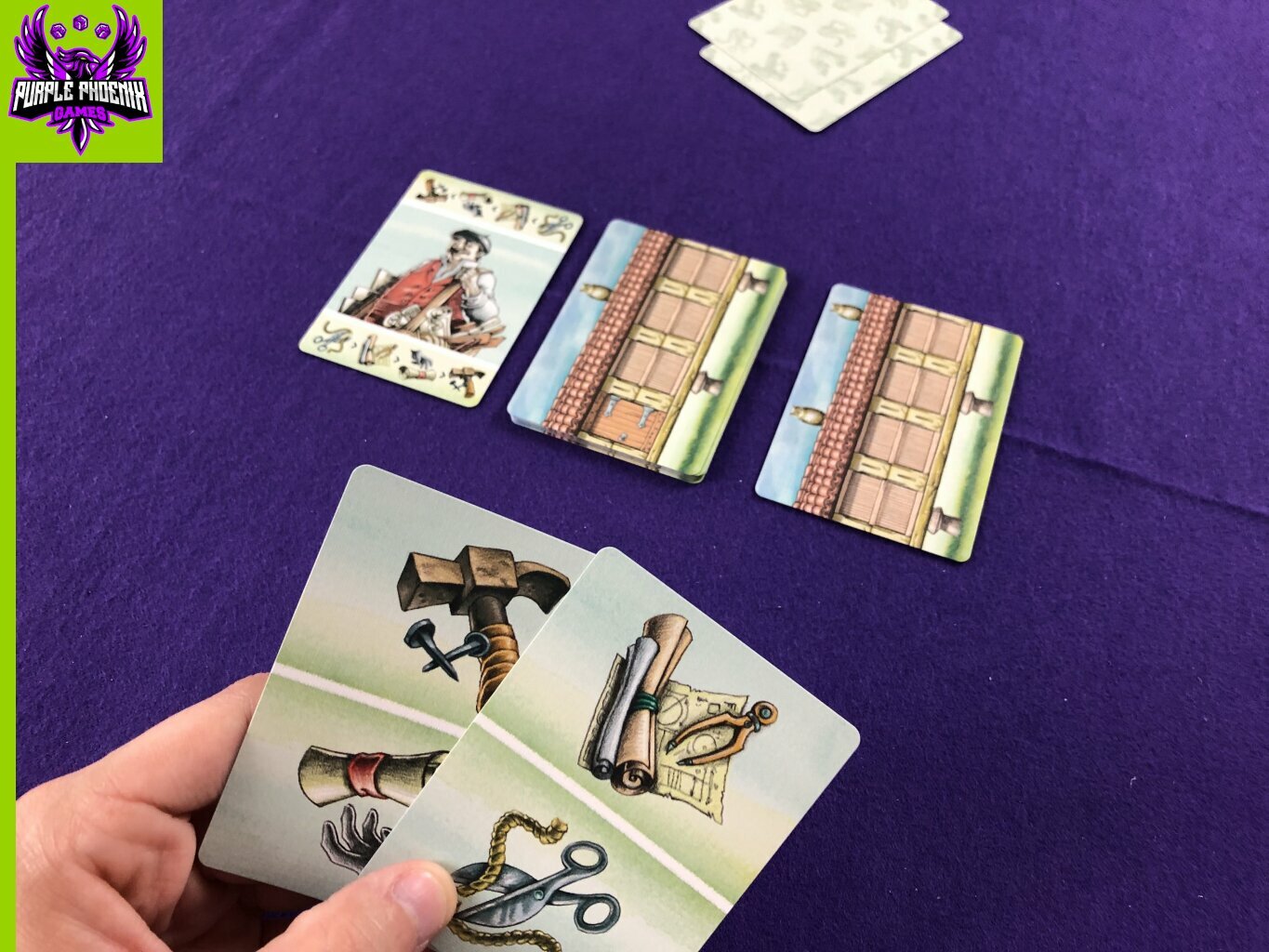
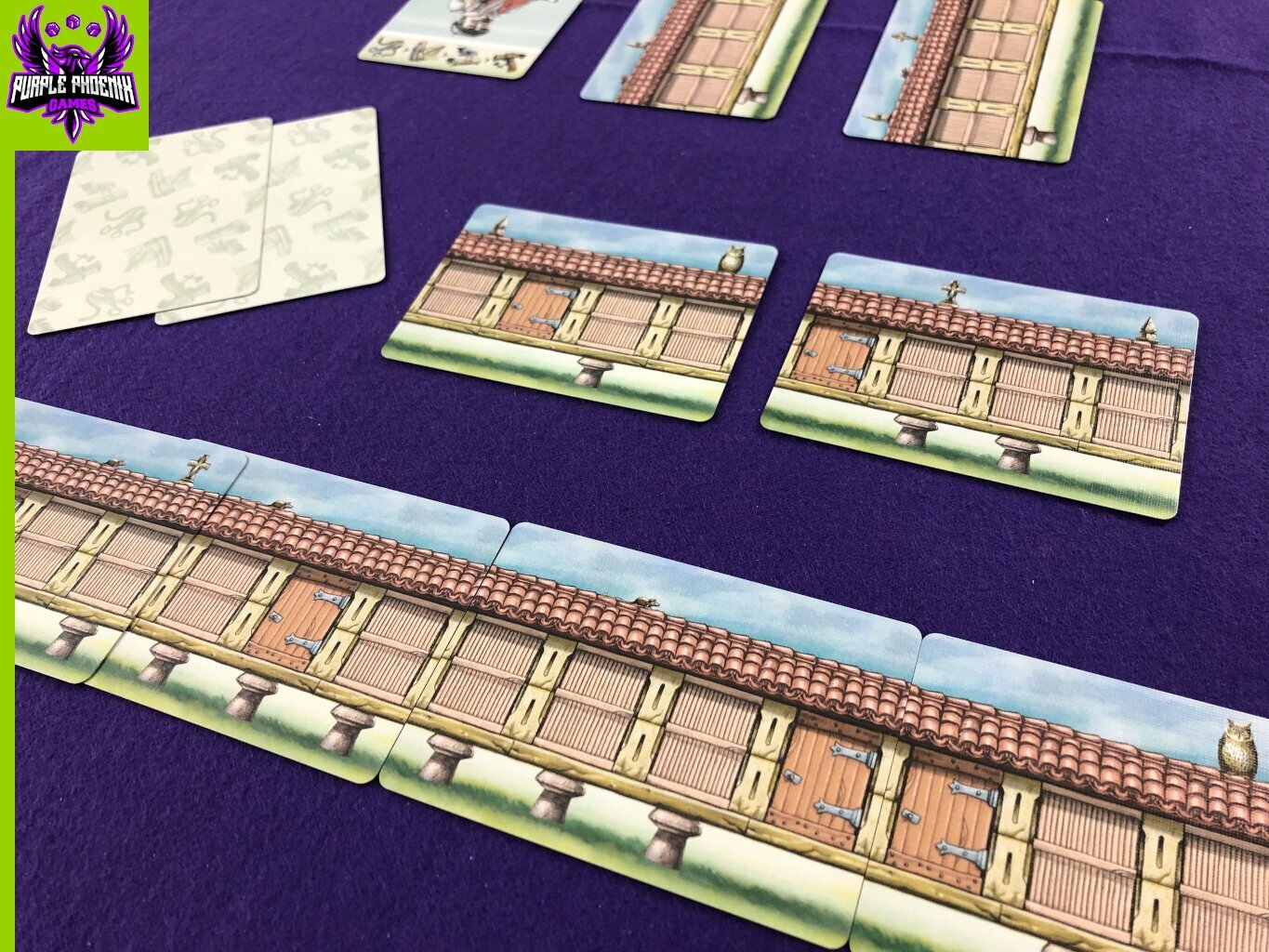
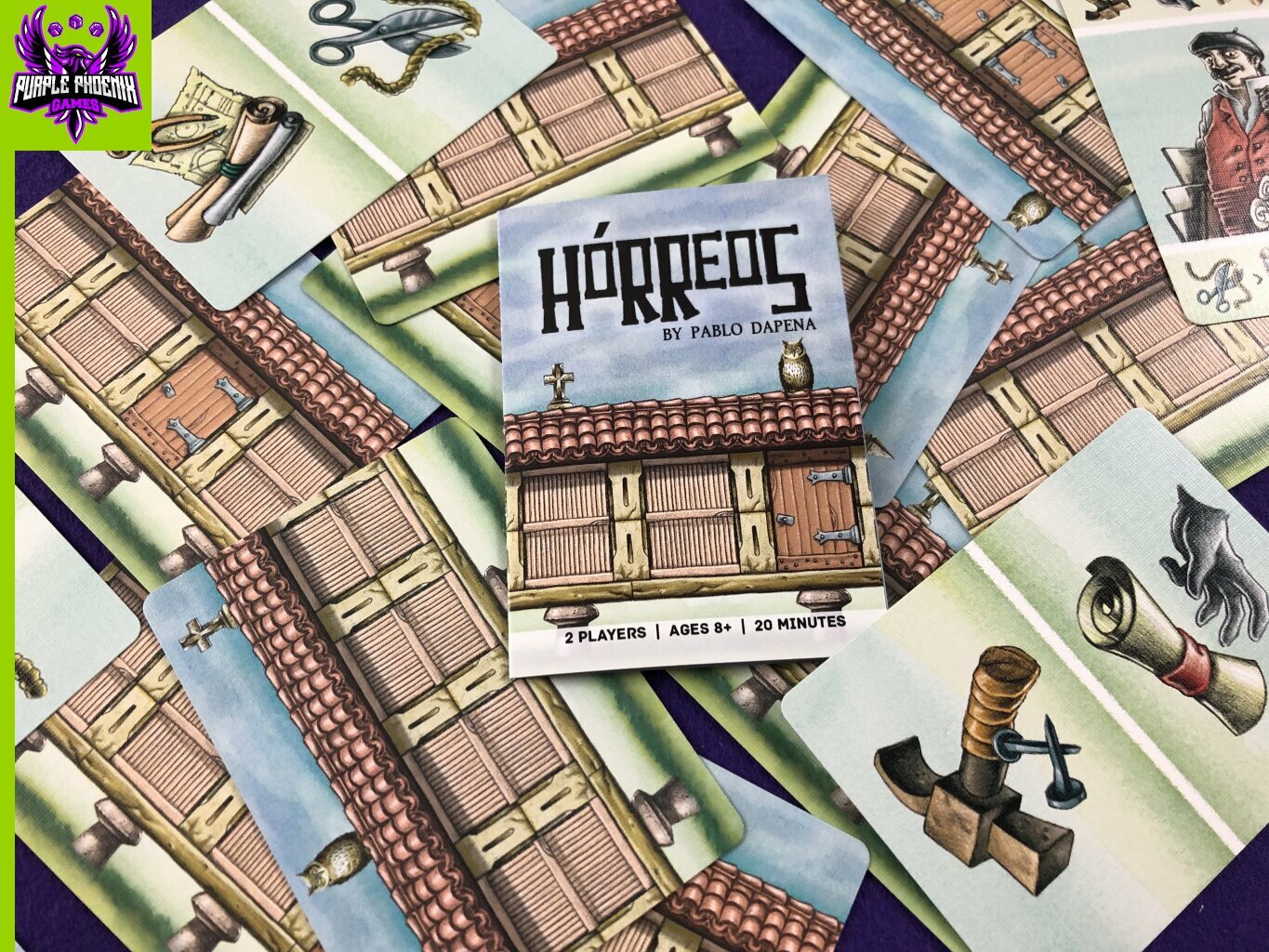
Purple Phoenix Games (2266 KP) rated Viceroy in Tabletop Games
Jun 12, 2019
One of the best parts of the board gaming experience is finding a fun group of people with whom to play! Sometimes, though, coordinating a game night is easier said than done. We all must occasionally forego the group experience and face the world as the Lonely Only. But fear not! The world of solo-play is a vast and exciting realm! What follows is a chronicle of my journey into the solo-playing world – notes on gameplay, mechanics, rules, difficulty, and overall experience with solo variations of commonly multiplayer games! I hope this will provide some insight as you continue to grow your collection, or explore your already owned games!
Power. That’s what everyone wants, isn’t it? Well, at least it is in Viceroy! As an inhabitant of the world of Laar, you are fighting to become the ultimate ruler. Recruit allies who provide strategic advantages and enact laws that solidify your claim for power. Do you have what it takes to build and maintain a powerful kingdom, or will your attempts fall short?
DISCLAIMER: There is an expansion to this game, but we are not reviewing it at this time. Should we review it in the future we will either update this review or post a link to the new material here. -T
Viceroy, a game of card drafting and tile placement, is played over 12 turns in which players build a pyramid with their cards – paying to place each card and collecting rewards based upon which level of the pyramid a card is placed. Each turn is divided into two phases: Auction and Development. During the Auction Phase, players bid gemstones to buy a card from the auction line. Once every player has either collected 1 card from auction or passed, play moves to the Development Phase. During the Development Phase, players can either play a card into their pyramid, pass, or discard a card and take 2 gemstones from the reserve. To play a Law card into your pyramid, you place it for free. To play a Character card into your pyramid, you have to pay for it with gems. The cost is dependent upon which level of the pyramid the card is to be placed. You must pay for the level the card will sit on, as well as pay the cost for every level beneath it. For example, to add a card to the third level of the pyramid, you must pay the cost for the 3rd level, AND 2nd level, AND 1st level. The rewards gained from adding a card to the pyramid, however, are taken only for the level on which the card sits. In the earlier example, you would only get the reward for the third level alone, since that is the level on which the card sits. The Development Phase is played over 3 rounds, so a player could play up to 3 cards into their pyramid during 1 Development Phase. After the 3 rounds are up, the next turn begins again in the Auction Phase. When all cards are gone from the Auction Deck, the game ends. Players count up all of their Power Points, and the player with the highest Power value wins!
The only change in Viceroy between a group and solo game is during the Auction Phase. Obviously, if you are playing solo, there is nobody to bid against for cards. How that is alleviated is that you still bid your gemstone as normal, and you randomly draw an unused gemstone from the box as an AI bid. If the colors match, you lose your gem and go on to the next auction. If the colors do not match, you collect your choice card, and the card the AI would have collected gets discarded. If the AI color does not match an available card, you just discard one of the remaining cards. This mimics group play in the sense that you might not always get the card you want from auction! The Development Phase is played as normal. At the end of the game, count points as normal and try to beat your own high score.
Viceroy is a neat game. Every card has so many options that there is no one single strategy that is a sure-win every time. Maybe one game I’ll go for Magic tokens. And maybe the next I’ll try to go for raw Power Point tokens. The possibilities really are endless, and that keeps this game fresh for me. I don’t feel like I’m just going through the motions because every card will act differently depending on where it is played. Strategy really is everything here. On the flip-side of that, however, is that sometimes the options can be a little overwhelming. With so many possibilities for each card, it can get hard for me to decide on what strategy I really want to use. It should also be noted that a card can only be played onto a level if it can sit on exactly 2 cards on the level beneath it. So sometimes I buy a card to play on a certain level only to get to the Development Phase and realize I don’t have a legal place to which I can play it. So do I sacrifice other cards/gemstones to build a slot for this one card, or do I play it to a different level and change my strategy a bit? There’s a little bit of a learning curve, but the more I play, the better I get (or at least, the better I think I get).
Another grievance with Viceroy is that I find myself running out of cards in my hand a lot. The only opportunity to draw cards is if you play a card into your pyramid that allows you to do so. And since I’m usually focused on other strategic routes, I don’t use those cards for those purposes. So then I play all of the cards in my hand (leaving me empty-handed), get 1 card at the next auction, play it, and am again left with no cards in my hand. To fix this issue, I wish one of the actions you could take during the Development Phase was to draw 1 card. I’m not sure if other people have this issue, or if it’s just me, but it’s a problem I run into almost every game.
Overall, I think Viceroy is a good game. It’s unique in the sense that there are so many possibilities that you’ll probably never play the same game twice, even if you decide to play by the same strategy. The mechanics and gameplay are cool too – it’s fun to watch your pyramid literally grow in front of you as the game progresses. This game takes a little more focus and thought than you might think, so it’s not one I’d necessarily just pull out for some light fun. I think Viceroy is as exciting as a solo game as it is as a group game since there really aren’t any differences between the two settings. If you like Viceroy, give it a try solo! If you’ve never played Viceroy, try it either solo or in a group – it’s the same game after all!
https://purplephoenixgames.wordpress.com/2019/04/18/solo-chronicles-viceroy/
Power. That’s what everyone wants, isn’t it? Well, at least it is in Viceroy! As an inhabitant of the world of Laar, you are fighting to become the ultimate ruler. Recruit allies who provide strategic advantages and enact laws that solidify your claim for power. Do you have what it takes to build and maintain a powerful kingdom, or will your attempts fall short?
DISCLAIMER: There is an expansion to this game, but we are not reviewing it at this time. Should we review it in the future we will either update this review or post a link to the new material here. -T
Viceroy, a game of card drafting and tile placement, is played over 12 turns in which players build a pyramid with their cards – paying to place each card and collecting rewards based upon which level of the pyramid a card is placed. Each turn is divided into two phases: Auction and Development. During the Auction Phase, players bid gemstones to buy a card from the auction line. Once every player has either collected 1 card from auction or passed, play moves to the Development Phase. During the Development Phase, players can either play a card into their pyramid, pass, or discard a card and take 2 gemstones from the reserve. To play a Law card into your pyramid, you place it for free. To play a Character card into your pyramid, you have to pay for it with gems. The cost is dependent upon which level of the pyramid the card is to be placed. You must pay for the level the card will sit on, as well as pay the cost for every level beneath it. For example, to add a card to the third level of the pyramid, you must pay the cost for the 3rd level, AND 2nd level, AND 1st level. The rewards gained from adding a card to the pyramid, however, are taken only for the level on which the card sits. In the earlier example, you would only get the reward for the third level alone, since that is the level on which the card sits. The Development Phase is played over 3 rounds, so a player could play up to 3 cards into their pyramid during 1 Development Phase. After the 3 rounds are up, the next turn begins again in the Auction Phase. When all cards are gone from the Auction Deck, the game ends. Players count up all of their Power Points, and the player with the highest Power value wins!
The only change in Viceroy between a group and solo game is during the Auction Phase. Obviously, if you are playing solo, there is nobody to bid against for cards. How that is alleviated is that you still bid your gemstone as normal, and you randomly draw an unused gemstone from the box as an AI bid. If the colors match, you lose your gem and go on to the next auction. If the colors do not match, you collect your choice card, and the card the AI would have collected gets discarded. If the AI color does not match an available card, you just discard one of the remaining cards. This mimics group play in the sense that you might not always get the card you want from auction! The Development Phase is played as normal. At the end of the game, count points as normal and try to beat your own high score.
Viceroy is a neat game. Every card has so many options that there is no one single strategy that is a sure-win every time. Maybe one game I’ll go for Magic tokens. And maybe the next I’ll try to go for raw Power Point tokens. The possibilities really are endless, and that keeps this game fresh for me. I don’t feel like I’m just going through the motions because every card will act differently depending on where it is played. Strategy really is everything here. On the flip-side of that, however, is that sometimes the options can be a little overwhelming. With so many possibilities for each card, it can get hard for me to decide on what strategy I really want to use. It should also be noted that a card can only be played onto a level if it can sit on exactly 2 cards on the level beneath it. So sometimes I buy a card to play on a certain level only to get to the Development Phase and realize I don’t have a legal place to which I can play it. So do I sacrifice other cards/gemstones to build a slot for this one card, or do I play it to a different level and change my strategy a bit? There’s a little bit of a learning curve, but the more I play, the better I get (or at least, the better I think I get).
Another grievance with Viceroy is that I find myself running out of cards in my hand a lot. The only opportunity to draw cards is if you play a card into your pyramid that allows you to do so. And since I’m usually focused on other strategic routes, I don’t use those cards for those purposes. So then I play all of the cards in my hand (leaving me empty-handed), get 1 card at the next auction, play it, and am again left with no cards in my hand. To fix this issue, I wish one of the actions you could take during the Development Phase was to draw 1 card. I’m not sure if other people have this issue, or if it’s just me, but it’s a problem I run into almost every game.
Overall, I think Viceroy is a good game. It’s unique in the sense that there are so many possibilities that you’ll probably never play the same game twice, even if you decide to play by the same strategy. The mechanics and gameplay are cool too – it’s fun to watch your pyramid literally grow in front of you as the game progresses. This game takes a little more focus and thought than you might think, so it’s not one I’d necessarily just pull out for some light fun. I think Viceroy is as exciting as a solo game as it is as a group game since there really aren’t any differences between the two settings. If you like Viceroy, give it a try solo! If you’ve never played Viceroy, try it either solo or in a group – it’s the same game after all!
https://purplephoenixgames.wordpress.com/2019/04/18/solo-chronicles-viceroy/