
Search
Search results
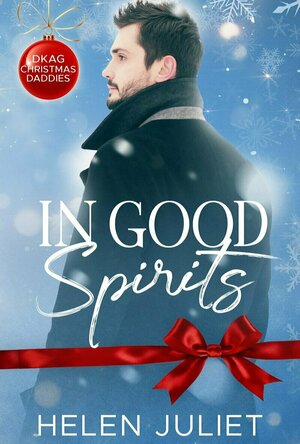
Debbiereadsbook (1839 KP) rated In Good Spirits: An MMMM Christmas Daddy Romance in Books
Dec 23, 2024

so much love from these men!
I was gifted my copy of this book.
Helen Juliet usually retells fairy tales, and a cracking job she has of those too! This is not a fairy tale, but a literary classic. And a cracking job she does of this too!
I have one minor niggle, and it really is just a personal preference.
First person
Present tense
AND
Multi point of view!
Now, if you follow my reviews you'll know I have dumped many MANY books that I discover are written this way. I will make no apologies for that, I know what I like and I will own it every time. I wasn't able to dump this one, as apart from this point I really enjoyed it!
Sai and Jude are married, and they have Tian as their third. It has been so for 3 years. But Tian looks at Evan and sees so much pain, he just wants to be such a good boy for him.
The established 3-way works best because of 2 rules: you always come home, and communication. I found the communication in this book between Tian, Jude and Sai was outstanding and it paved the way for all three men to find themselves attracted to Evan in ways they really didn't see coming.
I loved how things changed for them all over time. Sai found himself wanting to be looked after, even though he was the Daddy in the three way. Jude wanted to be a good boy for Daddy Evan, while he was a brat to Daddy Sai. And Tian? Well just was just gonna be the bestest little boy a Daddy could wish for. Evan changed too, settling his ghosts to rest, and letting someone else into his heart. Well, someones, plural.
It's incredibly well written, and well delivered. It pushes most of my buttons, (point already made!) and is Ms Juliet at her best. Sweet and so very smexy. But deeply emotional too. Mostly from Evan letting go of Beau.
I loved how I was able to slot this book along side the Dickens version, and even if he might be not be best pleased, I really loved it!
4 very VERY good stars
*same worded review will appear elsewhere
Helen Juliet usually retells fairy tales, and a cracking job she has of those too! This is not a fairy tale, but a literary classic. And a cracking job she does of this too!
I have one minor niggle, and it really is just a personal preference.
First person
Present tense
AND
Multi point of view!
Now, if you follow my reviews you'll know I have dumped many MANY books that I discover are written this way. I will make no apologies for that, I know what I like and I will own it every time. I wasn't able to dump this one, as apart from this point I really enjoyed it!
Sai and Jude are married, and they have Tian as their third. It has been so for 3 years. But Tian looks at Evan and sees so much pain, he just wants to be such a good boy for him.
The established 3-way works best because of 2 rules: you always come home, and communication. I found the communication in this book between Tian, Jude and Sai was outstanding and it paved the way for all three men to find themselves attracted to Evan in ways they really didn't see coming.
I loved how things changed for them all over time. Sai found himself wanting to be looked after, even though he was the Daddy in the three way. Jude wanted to be a good boy for Daddy Evan, while he was a brat to Daddy Sai. And Tian? Well just was just gonna be the bestest little boy a Daddy could wish for. Evan changed too, settling his ghosts to rest, and letting someone else into his heart. Well, someones, plural.
It's incredibly well written, and well delivered. It pushes most of my buttons, (point already made!) and is Ms Juliet at her best. Sweet and so very smexy. But deeply emotional too. Mostly from Evan letting go of Beau.
I loved how I was able to slot this book along side the Dickens version, and even if he might be not be best pleased, I really loved it!
4 very VERY good stars
*same worded review will appear elsewhere
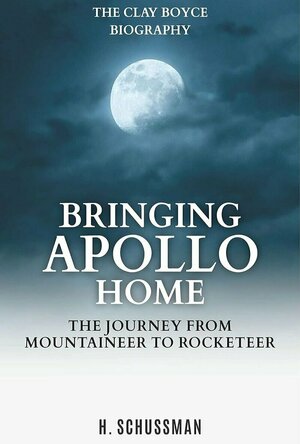
Bringing Apollo Home
Book
Like a lot of people, Clay Boyce led an interesting life. The difference is, he’s a natural...
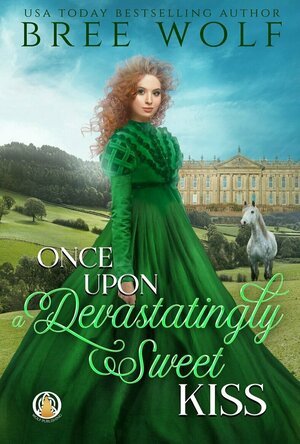
Once Upon a Devastatingly Sweet Kiss
Book
In this opposites-attract Regency romance by USA Today bestselling and HOLT Medallion winning author...
romance historical romance regency romance bookbuzz
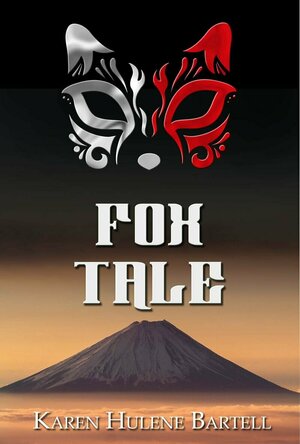
Debbiereadsbook (1839 KP) rated Fox Tale (Sacred Emblems #0) in Books
Apr 27, 2024

great reading about Japan.
Independent reviewer for Archaeolibrarian, I was gifted my copy of this book.
Ava is in Japan, writing a travel article. Meeting Chase, with his wonderful tales of Japanese myths and legends, helps her write a different take. But she never expected to meet up with her ex, Rafe, who left her two years ago without a word. Both men are hiking things. Can Ava choose?
I don't read reviews before I read a book, not anymore, but I will read them AFTER I've read said book, but before I write my review for one reason only: did they feel the same about this book as I did.
In this case: nope. They all loved this book and I . . . didn't.
I'm not saying I didn't like this book, I just found it hard work.
It's almost all written from Ava's point of view, in the first person. Rafe gets two very small bits, not even a chapter, in the third. I needed more from Rafe, and Chase, to be fair, to offset Ava.
There is a huge amount of repeated wording. Mostly around how Ava feels and thinks about Chase. "Apart from his silver hair, he looks young" or words to that effect are the most common. It began to get a bit much. "Seven hundred and seventy *something*, next winter" is another. The same things about the fox stories from Japanese lore pop up time and again too.
Apart from that, I liked this book. I couldn't see where it was going, nor how it was getting there, so when it did all go down, I was surprised and I liked the way it all happened.
Although there is the repetition of the lore, I did enjoy reading about the Japanese traditions and myths and legends.
There are some difficult topics here: death of a spouse, suicide, mental health issues and readers do need to be aware. Things are not how they seem, however, but the warning still needs to be made.
This is the first I've read of this author, and I always ask myself, will I read more? Not at this time. I won't say no to reading something else at a later date though.
3 good stars
*same worded review will appear elsewhere
Ava is in Japan, writing a travel article. Meeting Chase, with his wonderful tales of Japanese myths and legends, helps her write a different take. But she never expected to meet up with her ex, Rafe, who left her two years ago without a word. Both men are hiking things. Can Ava choose?
I don't read reviews before I read a book, not anymore, but I will read them AFTER I've read said book, but before I write my review for one reason only: did they feel the same about this book as I did.
In this case: nope. They all loved this book and I . . . didn't.
I'm not saying I didn't like this book, I just found it hard work.
It's almost all written from Ava's point of view, in the first person. Rafe gets two very small bits, not even a chapter, in the third. I needed more from Rafe, and Chase, to be fair, to offset Ava.
There is a huge amount of repeated wording. Mostly around how Ava feels and thinks about Chase. "Apart from his silver hair, he looks young" or words to that effect are the most common. It began to get a bit much. "Seven hundred and seventy *something*, next winter" is another. The same things about the fox stories from Japanese lore pop up time and again too.
Apart from that, I liked this book. I couldn't see where it was going, nor how it was getting there, so when it did all go down, I was surprised and I liked the way it all happened.
Although there is the repetition of the lore, I did enjoy reading about the Japanese traditions and myths and legends.
There are some difficult topics here: death of a spouse, suicide, mental health issues and readers do need to be aware. Things are not how they seem, however, but the warning still needs to be made.
This is the first I've read of this author, and I always ask myself, will I read more? Not at this time. I won't say no to reading something else at a later date though.
3 good stars
*same worded review will appear elsewhere


Trigger Warnings: Child abuse, child neglect, homelessness, mention of drug use, rape, suicide, homophobia, prison/juvie
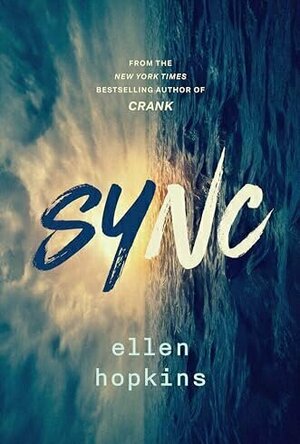
Twins Storm and Lake have always been in sync growing up - until they get separated within the foster care system. Storm’s been through juvie but his current foster dad and his girlfriend are helping him find a normal life again - until an incident makes him lose control again. Lake likes girls, but her bible loving foster parents would immediately kick her out if they find out - so she and her foster sibling, Parker, must keep their relationship secret. Both twins have rough patches ahead and both fight to come out on the other side.
Sooo, I’ve never read an Ellen Hopkins book - at least that I can remember anyway. I did NOT keep track of books I read until I was in my late 20’s… That being said, I feel like I would remember the emotional damage that probably would have been done with her books, especially with how I feel after finishing this one.
Hopkins didn’t shy away from the hard topics. Doing so allowed me to feel every emotion alongside the twins as they were. I’ve recently really gotten into novel-in-verse books and it absolutely makes me understand how poetry can really hit your gut with just so few words; Hopkins didn’t have to go into detail about what things looked like for you to understand what was going on.
The ending was bittersweet because I didn’t want it to be over, but at the same time, Hopkins finished it beautifully without needing the words. God, this book is going to stay with me for quite some time. I’m going to think of Storm and Lake and hope they’re doing okay.
Overall, this book will grab your heart and twist it tight, absolutely leaving an imprint when it finally releases you on the last page. Even though it’s a 400+ page novel, it reads quickly and one could probably finish it in one setting. The only reason I hadn’t was because I started it super late at night and then had plans the following morning.
*Thank you Nancy Paulsen Books and BookishFirst for an advance copy of this book in exchange for an honest review
Twins Storm and Lake have always been in sync growing up - until they get separated within the foster care system. Storm’s been through juvie but his current foster dad and his girlfriend are helping him find a normal life again - until an incident makes him lose control again. Lake likes girls, but her bible loving foster parents would immediately kick her out if they find out - so she and her foster sibling, Parker, must keep their relationship secret. Both twins have rough patches ahead and both fight to come out on the other side.
Sooo, I’ve never read an Ellen Hopkins book - at least that I can remember anyway. I did NOT keep track of books I read until I was in my late 20’s… That being said, I feel like I would remember the emotional damage that probably would have been done with her books, especially with how I feel after finishing this one.
Hopkins didn’t shy away from the hard topics. Doing so allowed me to feel every emotion alongside the twins as they were. I’ve recently really gotten into novel-in-verse books and it absolutely makes me understand how poetry can really hit your gut with just so few words; Hopkins didn’t have to go into detail about what things looked like for you to understand what was going on.
The ending was bittersweet because I didn’t want it to be over, but at the same time, Hopkins finished it beautifully without needing the words. God, this book is going to stay with me for quite some time. I’m going to think of Storm and Lake and hope they’re doing okay.
Overall, this book will grab your heart and twist it tight, absolutely leaving an imprint when it finally releases you on the last page. Even though it’s a 400+ page novel, it reads quickly and one could probably finish it in one setting. The only reason I hadn’t was because I started it super late at night and then had plans the following morning.
*Thank you Nancy Paulsen Books and BookishFirst for an advance copy of this book in exchange for an honest review
Kim Pook (101 KP) rated Love you to death (2019) in Movies
Jun 2, 2022
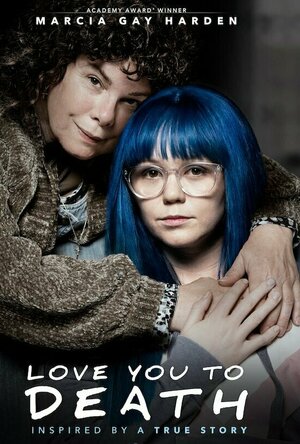

Police arrive at a house in 2013, The door is unlocked so they enter to find a dead body on the bed. We are shown a montage of pictures of a sick teen girl called Esme and her mum, it seems they had been raising a lot of money because of her illness.
Rewind to a few months before the death, it's Esmes 16th birthday and then her routine appointment, but sadly she is showing no signs of improving. During a shopping trip they bump into Esmes estranged dad, and it's clear there is hostility between him and Esmes mum. We soon discover that Esme has had the illness since she was 4 years old and also has a learning disability which just adds to the sadness of her illness.
It soon becomes evident how controlling her mother is though, she refuses to let anyone take Esme anywhere, controls what she eats as well as which doctors are allowed to treat her. After Esme is attacked at a gaming convention, the mother purchases a gun for protection and it isn't long before she's using it against an intruder.
About half an hour into the movie, we are thrown back to 2005, and we see Esmes side of the story. Esmes mum has a conversation with a nurse who confirms that Esme was misdiagnosed and she was fine, I won't go into that too much incase you want to watch it, but basically Esmes mum continues to fake Esmes illness. You will have to watch the movie to see how she achieves this, by tricking everyone including medical staff.
I enjoyed the movie but I was so shocked to find out it was based on a true story, I immediately went on to watch the documentary to compare and I felt they did do the true story justice, they included Esmes mum always holding her hand and hitting her if she didn't do as she was expected to do. The way Esme (gypsy rose) meets her boyfriend was different in real life, I felt the movie made him out to be this sweet guy trying to save Esme but in real life he was very disturbed, but then again it was told through Esmes eyes, so it was probably to show what she saw at the time.
Rewind to a few months before the death, it's Esmes 16th birthday and then her routine appointment, but sadly she is showing no signs of improving. During a shopping trip they bump into Esmes estranged dad, and it's clear there is hostility between him and Esmes mum. We soon discover that Esme has had the illness since she was 4 years old and also has a learning disability which just adds to the sadness of her illness.
It soon becomes evident how controlling her mother is though, she refuses to let anyone take Esme anywhere, controls what she eats as well as which doctors are allowed to treat her. After Esme is attacked at a gaming convention, the mother purchases a gun for protection and it isn't long before she's using it against an intruder.
About half an hour into the movie, we are thrown back to 2005, and we see Esmes side of the story. Esmes mum has a conversation with a nurse who confirms that Esme was misdiagnosed and she was fine, I won't go into that too much incase you want to watch it, but basically Esmes mum continues to fake Esmes illness. You will have to watch the movie to see how she achieves this, by tricking everyone including medical staff.
I enjoyed the movie but I was so shocked to find out it was based on a true story, I immediately went on to watch the documentary to compare and I felt they did do the true story justice, they included Esmes mum always holding her hand and hitting her if she didn't do as she was expected to do. The way Esme (gypsy rose) meets her boyfriend was different in real life, I felt the movie made him out to be this sweet guy trying to save Esme but in real life he was very disturbed, but then again it was told through Esmes eyes, so it was probably to show what she saw at the time.

Purple Phoenix Games (2266 KP) rated Fort in Tabletop Games
Jul 27, 2021
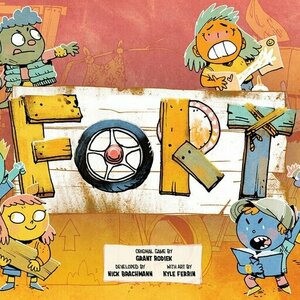
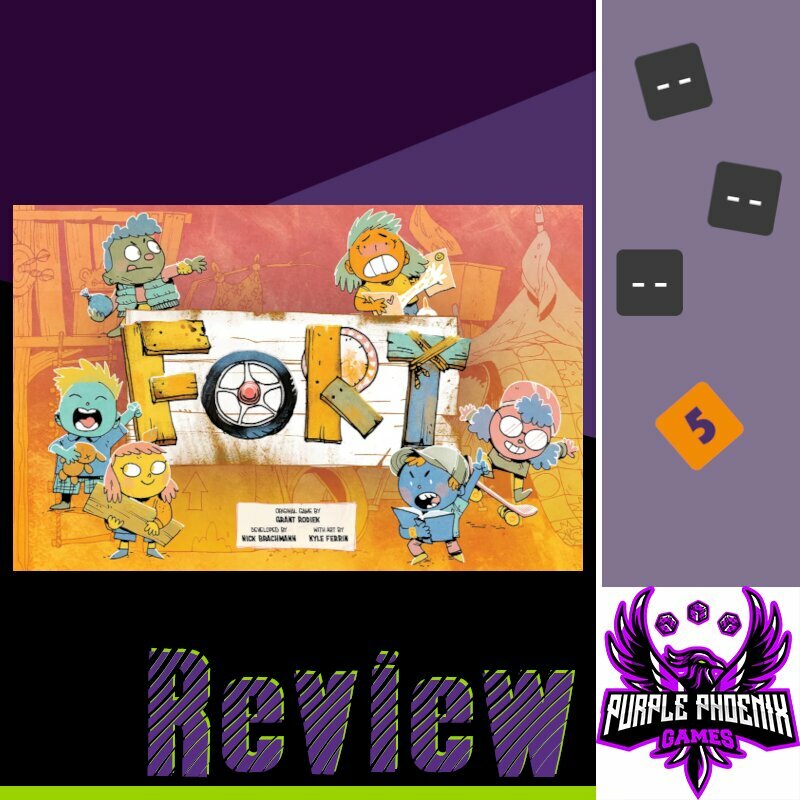
One activity my 5-year-old son will never tire of: building forts. Mostly pillow/blanket-based, but all I am doing is grooming him for an eventual treehouse fort of his own in the backyard someday. What an excellent theme for a game, and when I had a chance to speak with Brooke from Leder Games about reviewing this one, I absolutely jumped for joy for the opportunity. No guessing whether we like a game here at Purple Phoenix Games – we put our ratings right on the first graphic of every review, so you know already that I love Fort. Let’s see why.
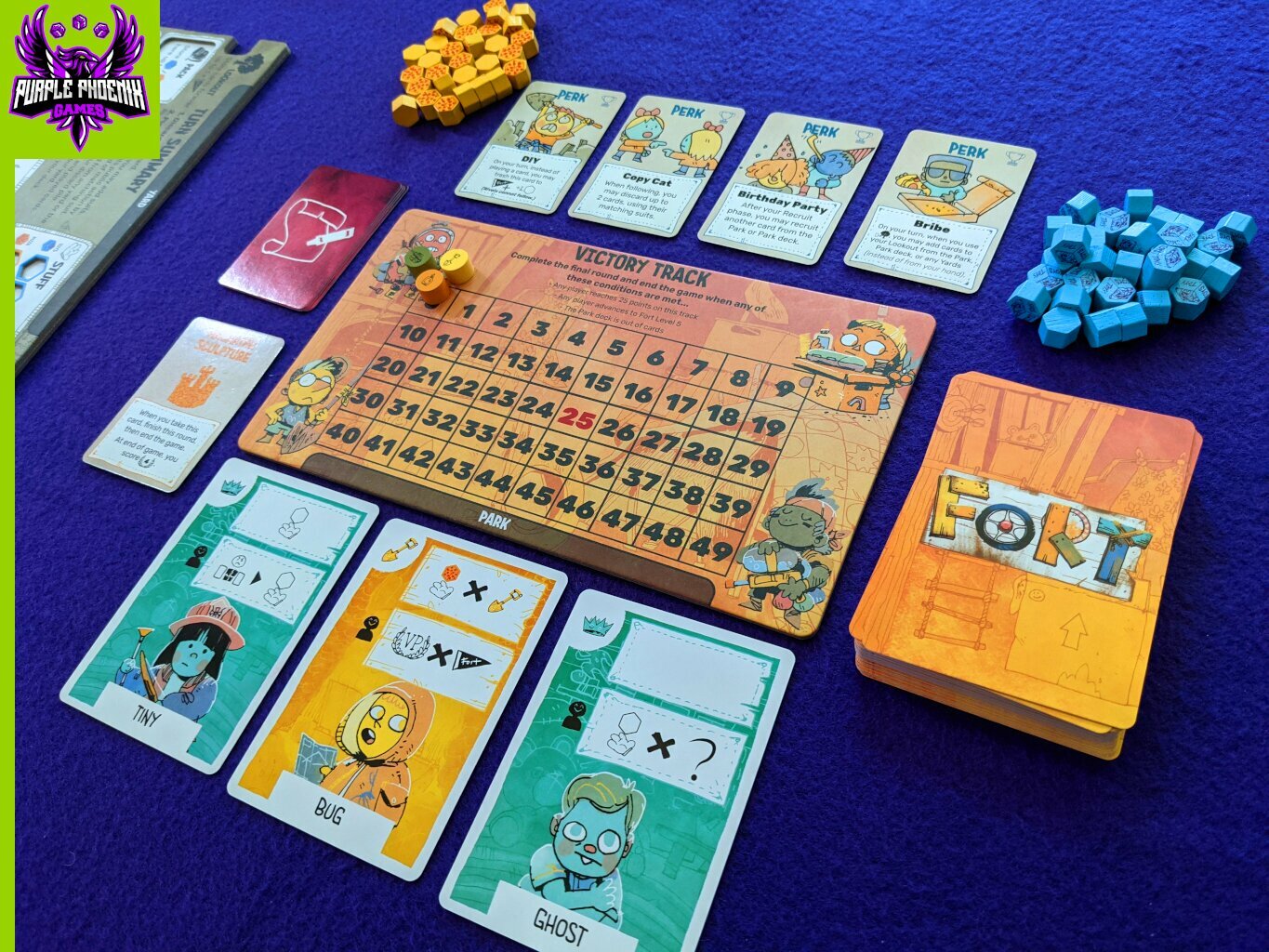
Fort is a hand management, deck-building game with a follow mechanic for two to four players. In it, players are assuming the roles of everyday kids trying to build their forts, play with their toys, and eat pizza with their buddies. The winner of the game is they who is able to score the most victory points (VP) at the end of the game, which can end in one of three different fashions.
DISCLAIMER: We were provided a copy of this game for the purposes of this review. This is a retail copy of the game, so what you see in these photos is exactly what would be received in your box. I do not intend to cover every single rule included in the rulebook, but will describe the overall game flow and major rule set so that our readers may get a sense of how the game plays. For more in depth rules, you may purchase a copy online or from your FLGS. -T
To setup, each player chooses a player color and takes all items belonging to them, including the Best Friends cards from the stack. Every other component is then separated by type and cards shuffled. Per the rules, some decks of cards will only have a certain amount on the table, whereas the main deck of kid cards is always used. Each player will draw eight kid cards from the deck to add to their Best Friends and shuffle them. They will also place their score markers on the 0 space of the Victory Track board. Randomly determine the starting player and give them the coveted First Player card, and the game may now begin!
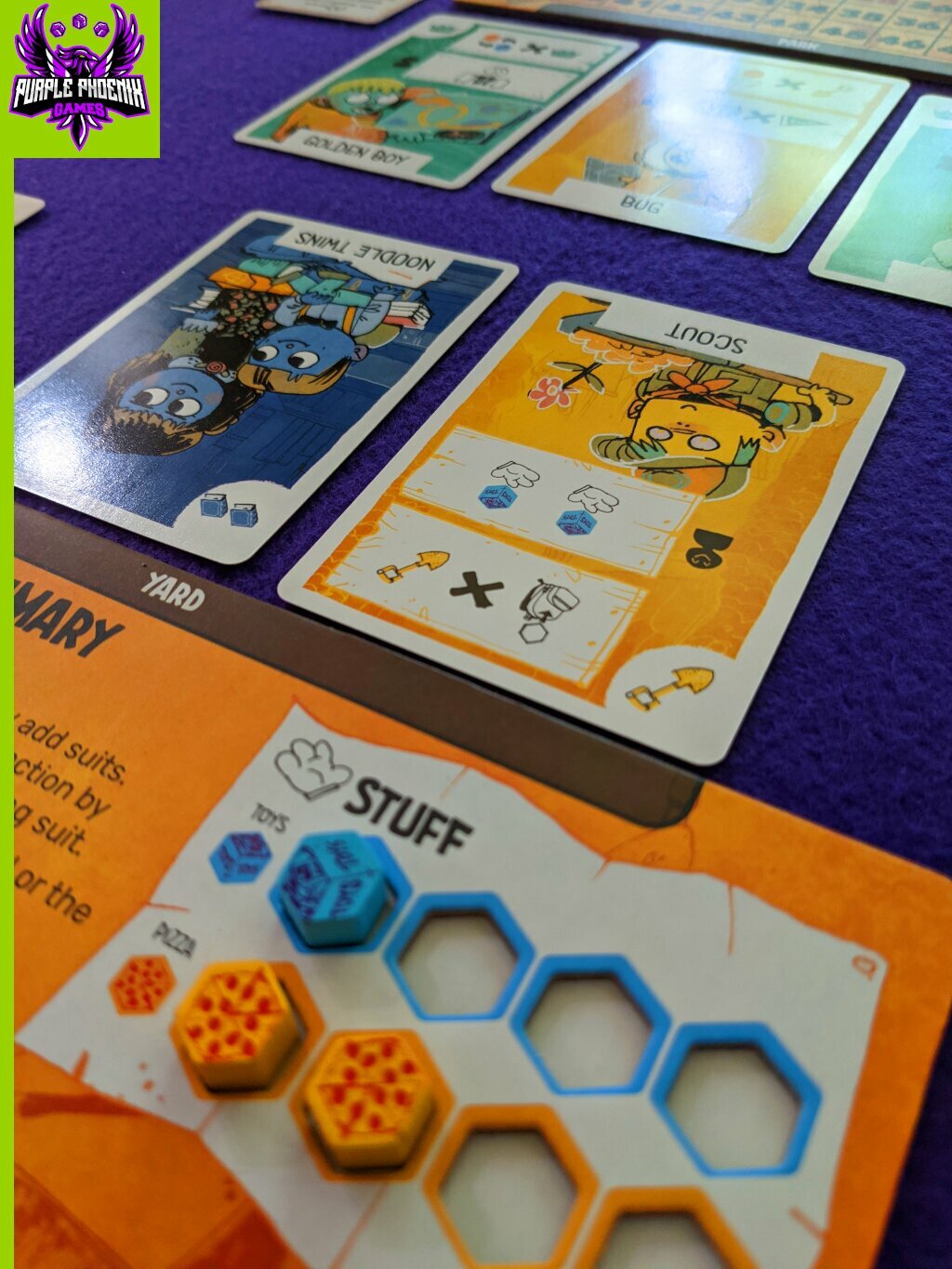
Fort is played in turns, with each turn consisting of five phases (the first phase is skipped on the first turn). The first phase is Cleanup. To Cleanup, the active player takes all kid cards remaining in their Yard and places them in their own discard pile. Next, the active player will Play a kid card from their hand. On each card is a space for up to two actions to be taken: the public action on top and the private action on bottom. The player may complete both, but MUST complete at least one of the actions in its entirety. If using the public action of the card, then other players at the table may also follow the action by discarding one card of the matching suit of the card originally played. However, the leader (active player) may also play additional cards from their hand, of the same suit, in order to boost the effects of the actions. Followers may not. These actions include gaining “stuff” (pizza and toys) to be placed in their Stuff area or backpack, trashing cards in their hands, or gaining VP.
After the players have Played cards, the next phase is Recruit. The active player may choose any kid card that exists in the Park (the space underneath the Victory Track that is always full of kids), another player’s Yard (the space above the player’s main board that they neglected to play with their previous turn), or they may simply draw a kid card blindly from the Park deck. These kids are sent directly to the discard pile to be drawn on a later turn.
Finally, phases four and five end a player’s turn. Phase four is Discard, where the active player will discard all their Best Friends, kid cards they played this turn, and recruited kids. The kid cards leftover that were not used are sent to the player’s Yard above their main boards to possibly be stolen by another player during their Recruit phase. After Discarding, the final phase is Draw, where the active player will draw another hand of five cards to prepare to follow other players and to prepare for the next round. Fort continues in this fashion of each player taking turns and following others’ actions until one player earns 25 VP on the track, any player increases their Fort to level 5, or the Park deck becomes empty. All players will finish their turns so that they all have played an equal amount of turns, and then the players total their scores to crown the winner!
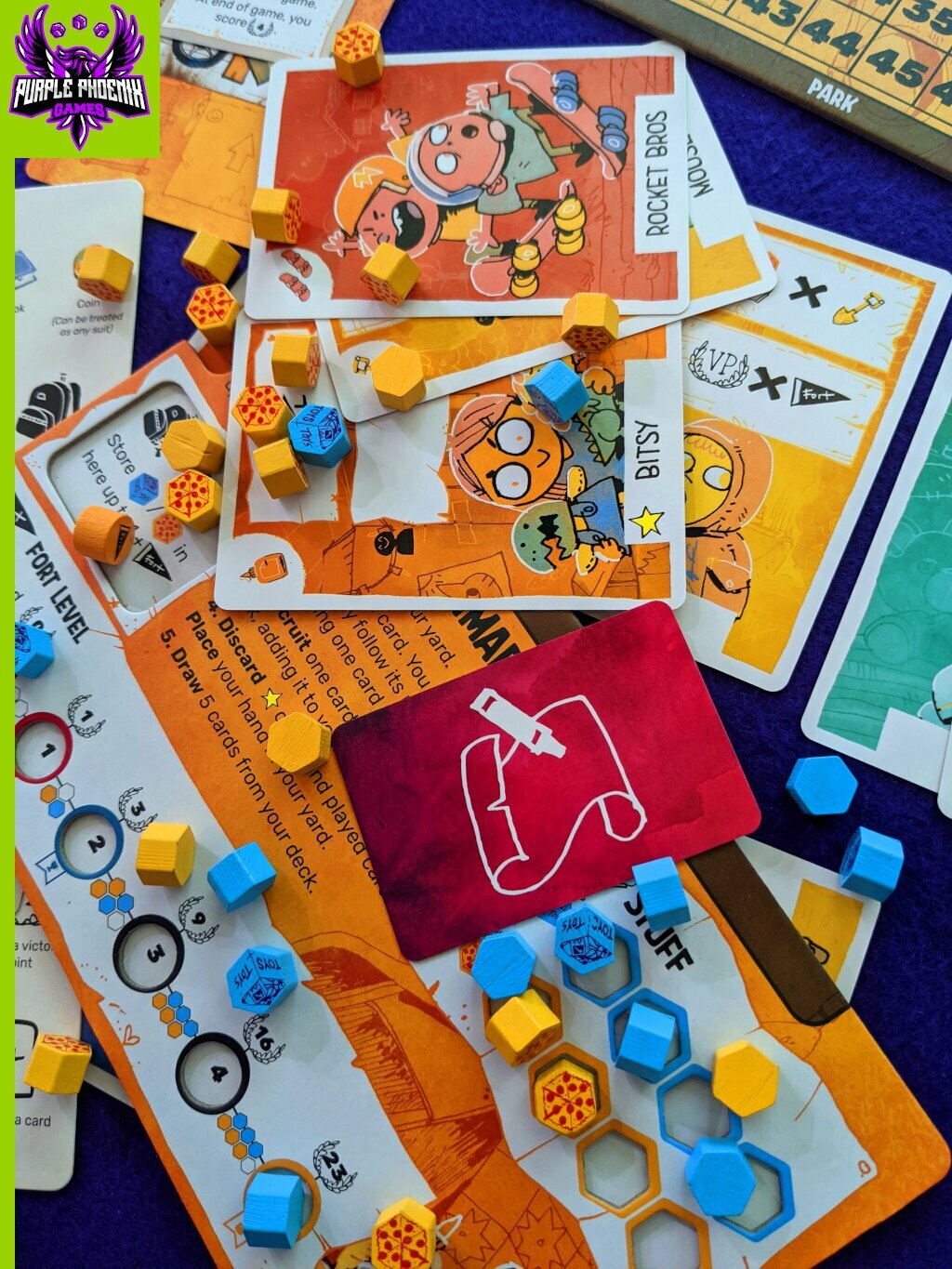
Components. This game has super great components. The little pizza and toys bits are awesome, the double-layered boards are cool, and the art is amazing as well. If it looks familiar in style, it’s because you have seen this art on Root, Oath, and Vast, among others. I love it so much and it is a perfect match for this theme. I really have little negative to say about Fort except that I wish the player colors were different. The orange and yellow are a little close in hue, and the brownish/olive is drab. Everything else, though, *chef’s kiss.
It is probably no surprise why I love this one. Deck-building has long been one of my favorite mechanics, and I have always enjoyed the follow mechanic found in Tiny Epic Galaxies and Villages of Valeria. Mix those up with much more going on and an excellent theme and it’s definitely a big time winner for me. I think what puts me over the edge here is that cards can be used for a couple different actions, and they can be boosted with the right strategies. Get your deck in order to really maximize each turn and the game opens up for you. Several times I have been able to focus my deck and really pound some powerful abilities, but it certainly doesn’t always work out for me, especially when others catch on to what I am doing and hate-draft me into other tactics.
If you are into a fresh new look at deck-building and enjoy more wacky themes, as I do, then I urge you to check out Fort. Officially, Purple Phoenix Games gives this one a playful 5 / 6, but even though it probably won’t break into my Top 10, I do think it will come to the table more often than most games in my Top 10. So should I reconsider my Top 10? Hmm. Anyway, Fort is awesome and everyone I have played with seem to agree with me. So grab a copy or two for yourself. Heck, the gift-giving season is fast approaching, and I know these fit very well under trees and other significant symbols of festivities…
Fort is a hand management, deck-building game with a follow mechanic for two to four players. In it, players are assuming the roles of everyday kids trying to build their forts, play with their toys, and eat pizza with their buddies. The winner of the game is they who is able to score the most victory points (VP) at the end of the game, which can end in one of three different fashions.
DISCLAIMER: We were provided a copy of this game for the purposes of this review. This is a retail copy of the game, so what you see in these photos is exactly what would be received in your box. I do not intend to cover every single rule included in the rulebook, but will describe the overall game flow and major rule set so that our readers may get a sense of how the game plays. For more in depth rules, you may purchase a copy online or from your FLGS. -T
To setup, each player chooses a player color and takes all items belonging to them, including the Best Friends cards from the stack. Every other component is then separated by type and cards shuffled. Per the rules, some decks of cards will only have a certain amount on the table, whereas the main deck of kid cards is always used. Each player will draw eight kid cards from the deck to add to their Best Friends and shuffle them. They will also place their score markers on the 0 space of the Victory Track board. Randomly determine the starting player and give them the coveted First Player card, and the game may now begin!
Fort is played in turns, with each turn consisting of five phases (the first phase is skipped on the first turn). The first phase is Cleanup. To Cleanup, the active player takes all kid cards remaining in their Yard and places them in their own discard pile. Next, the active player will Play a kid card from their hand. On each card is a space for up to two actions to be taken: the public action on top and the private action on bottom. The player may complete both, but MUST complete at least one of the actions in its entirety. If using the public action of the card, then other players at the table may also follow the action by discarding one card of the matching suit of the card originally played. However, the leader (active player) may also play additional cards from their hand, of the same suit, in order to boost the effects of the actions. Followers may not. These actions include gaining “stuff” (pizza and toys) to be placed in their Stuff area or backpack, trashing cards in their hands, or gaining VP.
After the players have Played cards, the next phase is Recruit. The active player may choose any kid card that exists in the Park (the space underneath the Victory Track that is always full of kids), another player’s Yard (the space above the player’s main board that they neglected to play with their previous turn), or they may simply draw a kid card blindly from the Park deck. These kids are sent directly to the discard pile to be drawn on a later turn.
Finally, phases four and five end a player’s turn. Phase four is Discard, where the active player will discard all their Best Friends, kid cards they played this turn, and recruited kids. The kid cards leftover that were not used are sent to the player’s Yard above their main boards to possibly be stolen by another player during their Recruit phase. After Discarding, the final phase is Draw, where the active player will draw another hand of five cards to prepare to follow other players and to prepare for the next round. Fort continues in this fashion of each player taking turns and following others’ actions until one player earns 25 VP on the track, any player increases their Fort to level 5, or the Park deck becomes empty. All players will finish their turns so that they all have played an equal amount of turns, and then the players total their scores to crown the winner!
Components. This game has super great components. The little pizza and toys bits are awesome, the double-layered boards are cool, and the art is amazing as well. If it looks familiar in style, it’s because you have seen this art on Root, Oath, and Vast, among others. I love it so much and it is a perfect match for this theme. I really have little negative to say about Fort except that I wish the player colors were different. The orange and yellow are a little close in hue, and the brownish/olive is drab. Everything else, though, *chef’s kiss.
It is probably no surprise why I love this one. Deck-building has long been one of my favorite mechanics, and I have always enjoyed the follow mechanic found in Tiny Epic Galaxies and Villages of Valeria. Mix those up with much more going on and an excellent theme and it’s definitely a big time winner for me. I think what puts me over the edge here is that cards can be used for a couple different actions, and they can be boosted with the right strategies. Get your deck in order to really maximize each turn and the game opens up for you. Several times I have been able to focus my deck and really pound some powerful abilities, but it certainly doesn’t always work out for me, especially when others catch on to what I am doing and hate-draft me into other tactics.
If you are into a fresh new look at deck-building and enjoy more wacky themes, as I do, then I urge you to check out Fort. Officially, Purple Phoenix Games gives this one a playful 5 / 6, but even though it probably won’t break into my Top 10, I do think it will come to the table more often than most games in my Top 10. So should I reconsider my Top 10? Hmm. Anyway, Fort is awesome and everyone I have played with seem to agree with me. So grab a copy or two for yourself. Heck, the gift-giving season is fast approaching, and I know these fit very well under trees and other significant symbols of festivities…

RəX Regent (349 KP) rated The Passion of Joan of Arc (1928) in Movies
Feb 19, 2019

Silent cinema is not my strongest subject but one which I have been making a concerted effort to learn about over the past decade, but admittedly at a slow pace. The idea of sitting through a silent film can seem to be chore to a modern audience and to be honest, it can be inconceivable to the vast majority, but these attitudes only serve to deprive us of 30 years of cinema, both in primitive evolution and cinematic excellence.
The notion is that silent movies where almost amateurish is style, a three decade long film school to keep up occupied until the Talkies turned up and “film” as we know it, was born. This is wrong. Film is visual medium, Movies, moving pictures, all of which were accompanied by music by the way, so the term “silent” only really refers to the lack of synchronized sound and dialogue.
ydvjeYet, the core of film is visual. Modern cinema is a about perfecting the mesh of media forms, music, photography, narrative and sound. But without dialogue, silent movies had a challenge on their hands and one which The Passion Of Joan Of Arc, one of the last silent movies of the era, rose to perfectly.
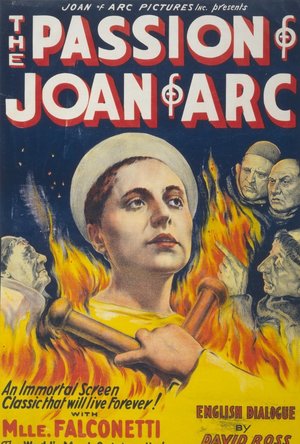
Visually, this could have been made yesterday. A truly timeless blend of artistic and innovative cinematography, fast paced editing and outstanding performances. The Danish director, Carl Theodore Dreyer mastered the close up, naturalistic acting and manages to tell the procedural story of the trial of Joan Of Arc in such a gripping manner that you will forget that there is no spoken dialogue, yet you are literally putting the intertitles in to the mouths of the cast.
Not a single cast member is wasted, with every one pouring their hearts and souls in to the camera in such nuanced ways that it can be left to debate and interpretation as to exactly who is thinking or feeling what as Joan, Maria Falconetti in her third and final film role, steals the screen with her tortured soul and face shown almost entirely in close up.
the-passion-of-joan-of-arc-large-pictureOver acting has given way to strong acting, each shot designed to allow us access to her soul as she, in a plot not to dissimilar from the last hours of Jesus Christ, is torn between torture and certain death of abandoning her faith and spending the rest of her life imprisoned with only bread and water to look forward too.
The script is based on the actually accounts of the future saint’s trial in 1431 but the real events took place over 18 months whilst this either compresses this into one day or takes place on the last one, but the feeling is that this is the one and only trial of Joan so in that sense, theatrical licence has been taken but it hardly matters. The facts are present and the story is harrowing, made more so by an almost perfect production, led by a controversial, almost Kubrickian director, forcing his cast to suffer for their art, yet this version of events is also contested.
joan-of-arc-soundtrackFor everyone out there who believes that Silent movies are just cut to the chase comedies, or overly flamboyant and patronising filler until “real films” are made, this may just serve as wake up call, that films have evolved, but Sound would actually set the industry back in the 1930’s, as the new audio based art form evolved just as movies had up until this point., but Joan Of Arc should help all see that film has always been able to convey anything, from humour to horror; Real of make-believe.
Many believe that this movie is one of the best ever made and I do believe that to be true. An outstanding and forgotten film to all but critics and film buffs, one which everyone should see.
VERSION
The version which I watched was The Criterion Edition of the 1985 restoration of Dreyer’s “Lost” original cut. The music to this film was never deemed to be that important so there are several compositions which have been attached to the film over the years.
The “Lo Duca” cut, which was the a 61 minute version (1951) doing the rounds for years after the original cut was lost in a fire soon after the film’s release, was cut together by Joseph-Marie Lo Duca after discovering a negative in a vault. This version, as well as the “Director’s Cut” are both available on the Blu-ray, whilst it appeared that the 1985 restoration (Director’s Cut) is more widely available on DVD.
The notion is that silent movies where almost amateurish is style, a three decade long film school to keep up occupied until the Talkies turned up and “film” as we know it, was born. This is wrong. Film is visual medium, Movies, moving pictures, all of which were accompanied by music by the way, so the term “silent” only really refers to the lack of synchronized sound and dialogue.
ydvjeYet, the core of film is visual. Modern cinema is a about perfecting the mesh of media forms, music, photography, narrative and sound. But without dialogue, silent movies had a challenge on their hands and one which The Passion Of Joan Of Arc, one of the last silent movies of the era, rose to perfectly.
Visually, this could have been made yesterday. A truly timeless blend of artistic and innovative cinematography, fast paced editing and outstanding performances. The Danish director, Carl Theodore Dreyer mastered the close up, naturalistic acting and manages to tell the procedural story of the trial of Joan Of Arc in such a gripping manner that you will forget that there is no spoken dialogue, yet you are literally putting the intertitles in to the mouths of the cast.
Not a single cast member is wasted, with every one pouring their hearts and souls in to the camera in such nuanced ways that it can be left to debate and interpretation as to exactly who is thinking or feeling what as Joan, Maria Falconetti in her third and final film role, steals the screen with her tortured soul and face shown almost entirely in close up.
the-passion-of-joan-of-arc-large-pictureOver acting has given way to strong acting, each shot designed to allow us access to her soul as she, in a plot not to dissimilar from the last hours of Jesus Christ, is torn between torture and certain death of abandoning her faith and spending the rest of her life imprisoned with only bread and water to look forward too.
The script is based on the actually accounts of the future saint’s trial in 1431 but the real events took place over 18 months whilst this either compresses this into one day or takes place on the last one, but the feeling is that this is the one and only trial of Joan so in that sense, theatrical licence has been taken but it hardly matters. The facts are present and the story is harrowing, made more so by an almost perfect production, led by a controversial, almost Kubrickian director, forcing his cast to suffer for their art, yet this version of events is also contested.
joan-of-arc-soundtrackFor everyone out there who believes that Silent movies are just cut to the chase comedies, or overly flamboyant and patronising filler until “real films” are made, this may just serve as wake up call, that films have evolved, but Sound would actually set the industry back in the 1930’s, as the new audio based art form evolved just as movies had up until this point., but Joan Of Arc should help all see that film has always been able to convey anything, from humour to horror; Real of make-believe.
Many believe that this movie is one of the best ever made and I do believe that to be true. An outstanding and forgotten film to all but critics and film buffs, one which everyone should see.
VERSION
The version which I watched was The Criterion Edition of the 1985 restoration of Dreyer’s “Lost” original cut. The music to this film was never deemed to be that important so there are several compositions which have been attached to the film over the years.
The “Lo Duca” cut, which was the a 61 minute version (1951) doing the rounds for years after the original cut was lost in a fire soon after the film’s release, was cut together by Joseph-Marie Lo Duca after discovering a negative in a vault. This version, as well as the “Director’s Cut” are both available on the Blu-ray, whilst it appeared that the 1985 restoration (Director’s Cut) is more widely available on DVD.

Heather Cranmer (2721 KP) rated What Alice Forgot in Books
Feb 27, 2019
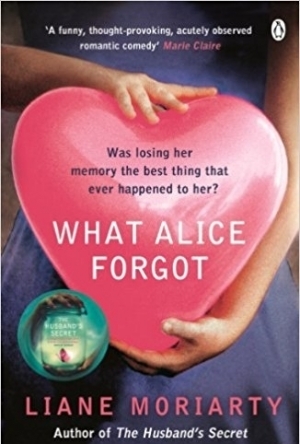
For some reason, I kept seeing What Alice Forgot by Liane Moriarty almost every book place I would look. At first, I wasn't interested, but it kept showing up. Eventually, I took it as a sign that maybe I should read What Alice Forgot. I'm glad I did because it was a great book!
The plot for What Alice Forgot is a complex and deep one. It's not just about Alice. It's also about her sister Elisabeth, whom we learn more through letters to her therapist, Jeremy. Elisabeth is trying to conceive. She keeps going through failed IVF treatments time and time again. We learn about her struggle and how she's handling that. We also learn about Frannie, Alice's surrogate grandmother, through letters with a man named Phil. At the center of the story is Alice. After falling off a stationary bike and bumping her head during spin class, Alice wakes up to find some can't remember anything that happened for the past 10 years. Alice believes she is still 29, and she finds it frustrating and a tad funny that she's really almost 40 years old. Alice can't believe who she's turned into at 39. She would hate herself! The book explains if Alice will be more loving and carefree like her 29 year old self or if she'll be that rushed, cynical woman she was at 39 when and if she gets her memories back. There were one or two plot twists although I wouldn't consider them major. All of my questions were answered, and Liane Moriarty did an excellent job of tying up any loose ends and writing a great epilogue explaining what happened to each character years later.
I loved the characters in What Alice Forgot! I felt they were all very fleshed out and felt like I was reading about real live people. It was interesting to see Alice at odds with herself when her old self was surprised by what her new self (before she hit her head and lost her memory for the past 10 years) was like. I, personally, liked Alice after she forgot her memory. She was more fun loving and carefree. New Alice was always rushed and snippy. I also liked Nick, Alice's soon to be ex-husband. Although he was rushed with work, I loved how he still would help out Alice. I really related to Alice's oldest daughter, Madison, the most. Madison had experienced so much in her short life, so she was acting out a lot of the time. I just wanted to hug her. Alice's youngest daughter, Olivia, was really cute and funny. I loved how she referred to everything as "darling." My heart really went out to Elisabeth. I just wanted Elisabeth to finally have a baby of her own after miscarrying so many times in the past. Frannie was such a fun character! I was moved by her love of Elisabeth and Alice, and I really appreciated her humor at times!
The pacing for What Alice Forgot was a bit hit and miss sometimes. There were a lot of times, mostly during the first 60 percent or so in the book, that I thought about just giving up and finding something else to read. However, I would read a bit more, and the pacing would pick up again. Then it would go back to being slow. Once I got about 65 percent through the book, the pacing found its footing, and it was smooth sailing from there. My eyes devoured the rest of the pages, and I couldn't wait to find out if Alice would get her memory back or if she'd end up with Nick or Dominick. (I was Team Nick throughout the book.) I also wanted to know what would come of Elisabeth's IVF treatment. I really wanted her to have a baby of her own!
Trigger warnings for What Alice Forgot include miscarriages, failed fertility treatments, amnesia, divorce, death, drinking, some profanities, and a few mentions of sex but no details.
Overall, What Alice Forgot is a lovely read even though the pacing is a bit off for the first half or so in the book. Luckily, the pacing redeems itself, and with a great plot and fantastic characters, this book does make a good read. I would definitely recommend What Alice Forgot by Liane Moriarty to everyone aged 16+ who loves a feel good novel.
The plot for What Alice Forgot is a complex and deep one. It's not just about Alice. It's also about her sister Elisabeth, whom we learn more through letters to her therapist, Jeremy. Elisabeth is trying to conceive. She keeps going through failed IVF treatments time and time again. We learn about her struggle and how she's handling that. We also learn about Frannie, Alice's surrogate grandmother, through letters with a man named Phil. At the center of the story is Alice. After falling off a stationary bike and bumping her head during spin class, Alice wakes up to find some can't remember anything that happened for the past 10 years. Alice believes she is still 29, and she finds it frustrating and a tad funny that she's really almost 40 years old. Alice can't believe who she's turned into at 39. She would hate herself! The book explains if Alice will be more loving and carefree like her 29 year old self or if she'll be that rushed, cynical woman she was at 39 when and if she gets her memories back. There were one or two plot twists although I wouldn't consider them major. All of my questions were answered, and Liane Moriarty did an excellent job of tying up any loose ends and writing a great epilogue explaining what happened to each character years later.
I loved the characters in What Alice Forgot! I felt they were all very fleshed out and felt like I was reading about real live people. It was interesting to see Alice at odds with herself when her old self was surprised by what her new self (before she hit her head and lost her memory for the past 10 years) was like. I, personally, liked Alice after she forgot her memory. She was more fun loving and carefree. New Alice was always rushed and snippy. I also liked Nick, Alice's soon to be ex-husband. Although he was rushed with work, I loved how he still would help out Alice. I really related to Alice's oldest daughter, Madison, the most. Madison had experienced so much in her short life, so she was acting out a lot of the time. I just wanted to hug her. Alice's youngest daughter, Olivia, was really cute and funny. I loved how she referred to everything as "darling." My heart really went out to Elisabeth. I just wanted Elisabeth to finally have a baby of her own after miscarrying so many times in the past. Frannie was such a fun character! I was moved by her love of Elisabeth and Alice, and I really appreciated her humor at times!
The pacing for What Alice Forgot was a bit hit and miss sometimes. There were a lot of times, mostly during the first 60 percent or so in the book, that I thought about just giving up and finding something else to read. However, I would read a bit more, and the pacing would pick up again. Then it would go back to being slow. Once I got about 65 percent through the book, the pacing found its footing, and it was smooth sailing from there. My eyes devoured the rest of the pages, and I couldn't wait to find out if Alice would get her memory back or if she'd end up with Nick or Dominick. (I was Team Nick throughout the book.) I also wanted to know what would come of Elisabeth's IVF treatment. I really wanted her to have a baby of her own!
Trigger warnings for What Alice Forgot include miscarriages, failed fertility treatments, amnesia, divorce, death, drinking, some profanities, and a few mentions of sex but no details.
Overall, What Alice Forgot is a lovely read even though the pacing is a bit off for the first half or so in the book. Luckily, the pacing redeems itself, and with a great plot and fantastic characters, this book does make a good read. I would definitely recommend What Alice Forgot by Liane Moriarty to everyone aged 16+ who loves a feel good novel.

Zuky the BookBum (15 KP) rated The Good Kind of Bad in Books
Mar 15, 2018

Firstly Id like to thank Netgalley and Rita Brassington for the opportunity to read this in exchange for an honest review.
<b>3.5 stars!
<i>Secrets don't stay secret for long.</i></b>
This was definitely slow to start. After getting into my last read almost instantly <a href="https://www.goodreads.com/review/show/1637742966">;(All The Ugly and Wonderful Things)</a> this one didnt seem like it was going to be my cup of tea, but after I got to around the 20% mark things started getting a little more interesting. I did enjoy reading this book, it was a much lighter read than my previous so it was nice to not really feel anything <b>I really do mean that in the nicest way possible btw!</b> For me, this book was an easy & quick read that was entertaining but just a little bit OTT. I think this book has a lot of cliches, all very predictable, things I guessed rather easily and so if it hadnt been for that, this would have probably been rated higher, but I prefer books that challenge and shock me.
Another problem I had with this book was that I felt like there are whole chunks of time missing from the story that either really could have helped with character and plot development or could have been explained better so we realised it had disappeared before our eyes... <spoiler>eg. she runs to Ninas apartment (which she says is only a short distance), sees Nina die, then runs away to the police station, stays outside for a little bit pondering what she should do (and obviously she doesnt choose the right thing) then ends up a cafe, only for Evan to walk in a claim shes been gone hours? Like where the <i>heck</i> did all those hours go?</spoiler>
Everything in this book was <i>massively</i> over the top. Ive said before in a review that books are supposed to take you away from everything and land you into something fictional and exciting. But there does get a point where things become too fictional. The crazy storyline wouldnt have mattered so much if it wasnt for the fact that all the characters were completely unrealistic people.
However the biggest downfall for this book was the characters. To love a book, youve got to love the characters, and I didnt.
Our main lady (we never find out her first name) of the book was beyond irritating. I felt like every single little thing she did was the wrong thing. She faced some really awful stuff throughout the book and then went about sorting it out in all the wrongs ways! She wanted you to think she was a high class, intelligent, independant lady, but in actual fact she was airheaded, weak and damn right ridiculous. What annoyed me most about her was the fact that she was ready to believe <i>anyone.</i> She knew all the people in this book for 3 months tops and she always just believed what they said, no questions asked. <spoiler>Also no questions asked as to why Evan was calling her honey & baby all of a sudden!</spoiler>
As for Joe, its pretty obvious why you wouldnt like him. Hes a cock from the start of the relationship, I dont understand what she saw in him to begin with to be honest.
Then theres Evan, the good guy cop who comes to save the damsel in distress how predictable he is. Hes the easiest character to work out in the world of fictional characters. I mean cmon, there was no mystery to him at all.
After all my complaining, this was still an enjoyable read for me. It wasn't one of those books I try and force myself to read just to finish it, I actually wanted to find out what was happening. I will say that I <b>hadnt</b> predicted the <i>ending</i> ending. I had predicted most of what was going to happen but there were elements I hadnt been expecting. Thats definitely what gave it the extra point 5 of a star, otherwise it would have just remained a mediocre 3 stars. I would recommend this to people who like fast paced thrillers. I think this is the perfect holiday book!
<b>3.5 stars!
<i>Secrets don't stay secret for long.</i></b>
This was definitely slow to start. After getting into my last read almost instantly <a href="https://www.goodreads.com/review/show/1637742966">;(All The Ugly and Wonderful Things)</a> this one didnt seem like it was going to be my cup of tea, but after I got to around the 20% mark things started getting a little more interesting. I did enjoy reading this book, it was a much lighter read than my previous so it was nice to not really feel anything <b>I really do mean that in the nicest way possible btw!</b> For me, this book was an easy & quick read that was entertaining but just a little bit OTT. I think this book has a lot of cliches, all very predictable, things I guessed rather easily and so if it hadnt been for that, this would have probably been rated higher, but I prefer books that challenge and shock me.
Another problem I had with this book was that I felt like there are whole chunks of time missing from the story that either really could have helped with character and plot development or could have been explained better so we realised it had disappeared before our eyes... <spoiler>eg. she runs to Ninas apartment (which she says is only a short distance), sees Nina die, then runs away to the police station, stays outside for a little bit pondering what she should do (and obviously she doesnt choose the right thing) then ends up a cafe, only for Evan to walk in a claim shes been gone hours? Like where the <i>heck</i> did all those hours go?</spoiler>
Everything in this book was <i>massively</i> over the top. Ive said before in a review that books are supposed to take you away from everything and land you into something fictional and exciting. But there does get a point where things become too fictional. The crazy storyline wouldnt have mattered so much if it wasnt for the fact that all the characters were completely unrealistic people.
However the biggest downfall for this book was the characters. To love a book, youve got to love the characters, and I didnt.
Our main lady (we never find out her first name) of the book was beyond irritating. I felt like every single little thing she did was the wrong thing. She faced some really awful stuff throughout the book and then went about sorting it out in all the wrongs ways! She wanted you to think she was a high class, intelligent, independant lady, but in actual fact she was airheaded, weak and damn right ridiculous. What annoyed me most about her was the fact that she was ready to believe <i>anyone.</i> She knew all the people in this book for 3 months tops and she always just believed what they said, no questions asked. <spoiler>Also no questions asked as to why Evan was calling her honey & baby all of a sudden!</spoiler>
As for Joe, its pretty obvious why you wouldnt like him. Hes a cock from the start of the relationship, I dont understand what she saw in him to begin with to be honest.
Then theres Evan, the good guy cop who comes to save the damsel in distress how predictable he is. Hes the easiest character to work out in the world of fictional characters. I mean cmon, there was no mystery to him at all.
After all my complaining, this was still an enjoyable read for me. It wasn't one of those books I try and force myself to read just to finish it, I actually wanted to find out what was happening. I will say that I <b>hadnt</b> predicted the <i>ending</i> ending. I had predicted most of what was going to happen but there were elements I hadnt been expecting. Thats definitely what gave it the extra point 5 of a star, otherwise it would have just remained a mediocre 3 stars. I would recommend this to people who like fast paced thrillers. I think this is the perfect holiday book!