
Search


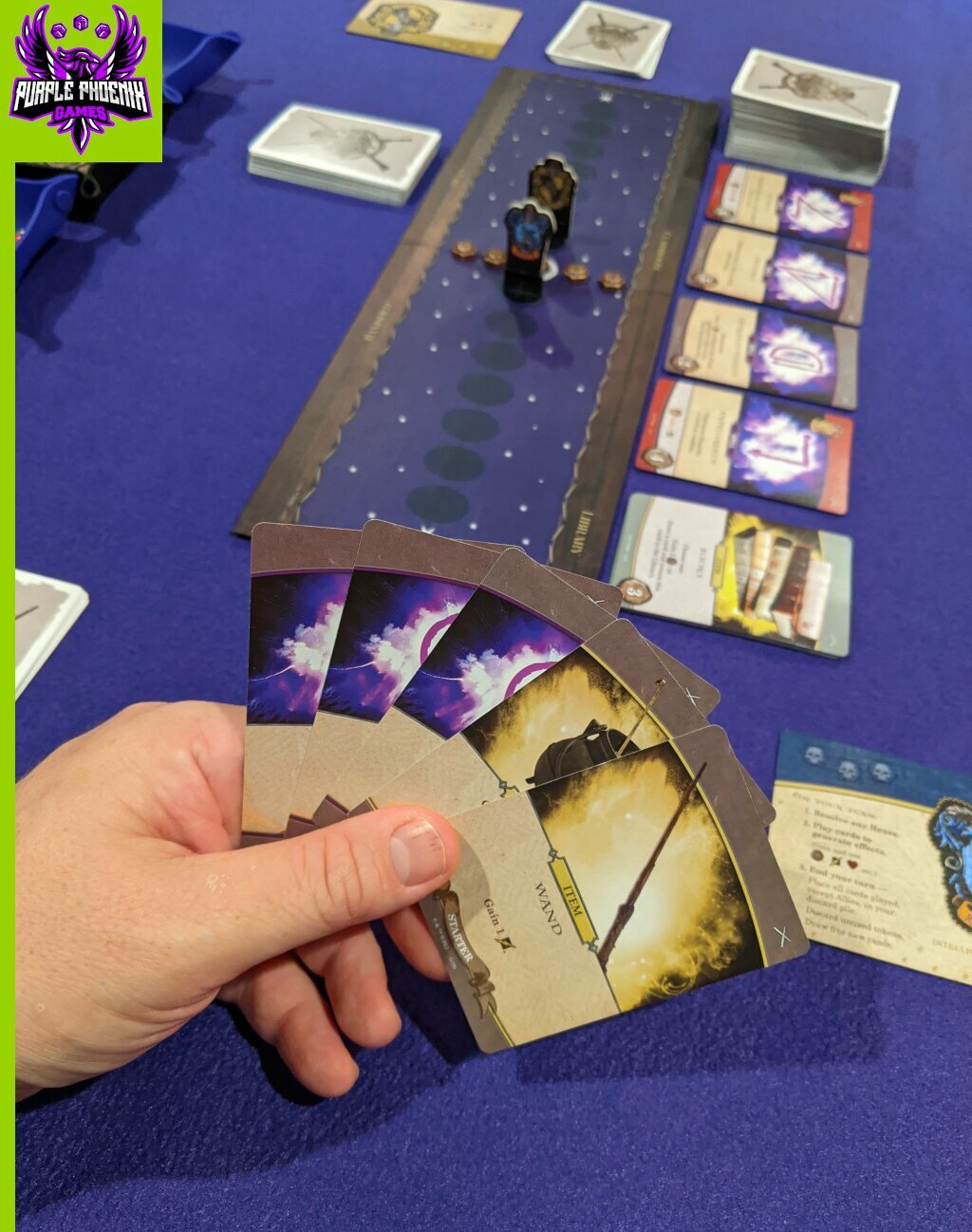
“OMG when is Purple Phoenix Games gonna review another Harry Potter game??” We listened. So here is the next installment of our unofficial Harry Potter games series. In Harry Potter: Hogwarts Battle – Defence Against the Dark Arts (which I will gladly reduce to Defence throughout the review, even though my American English Spidey-Senses are all over that spelling), players will be playing through a duel in the classroom using spells, allies, and items to push back and stun their opponent. Have you got the wand strength to stand up to your rival?
Like I just mentioned, Defence pits two players against each other in a sparring scenario. Players will be drafting cards that represent Spells to sling, Allies to aid, and Items to help knock opponents off their balance. The winner of Defence is the wizard who can stun their opponent three times. Only then will they be able to stand a chance against their dark foes.
DISCLAIMER: We were provided a copy of this game for the purposes of this review. This is a retail copy of the game, so what you see in these photos is exactly what would be received in your box. I do not intend to cover every single rule included in the rulebook, but will describe the overall game flow and major rule set so that our readers may get a sense of how the game plays. For more in depth rules, you may purchase a copy online or from your FLGS. -T
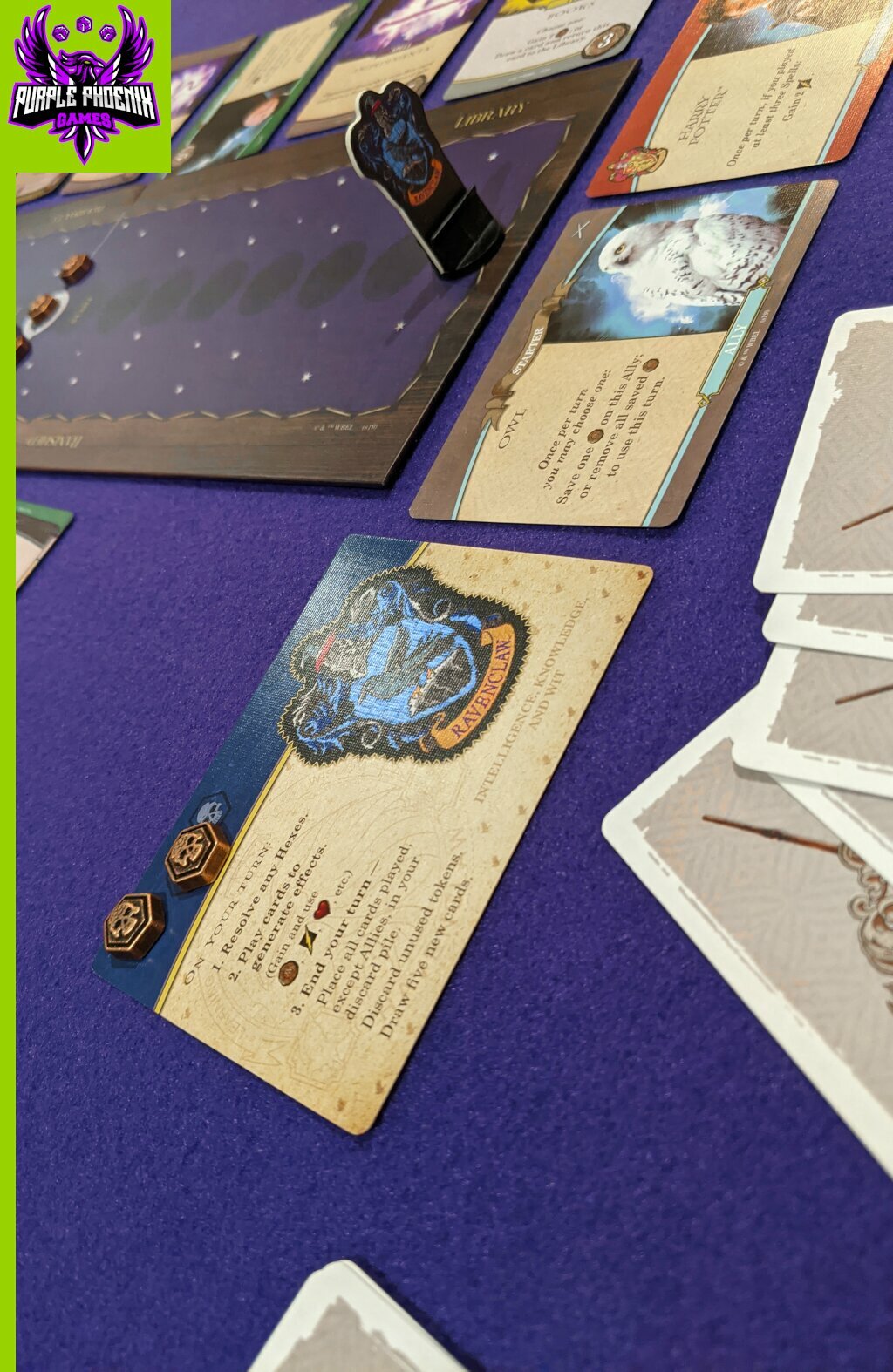
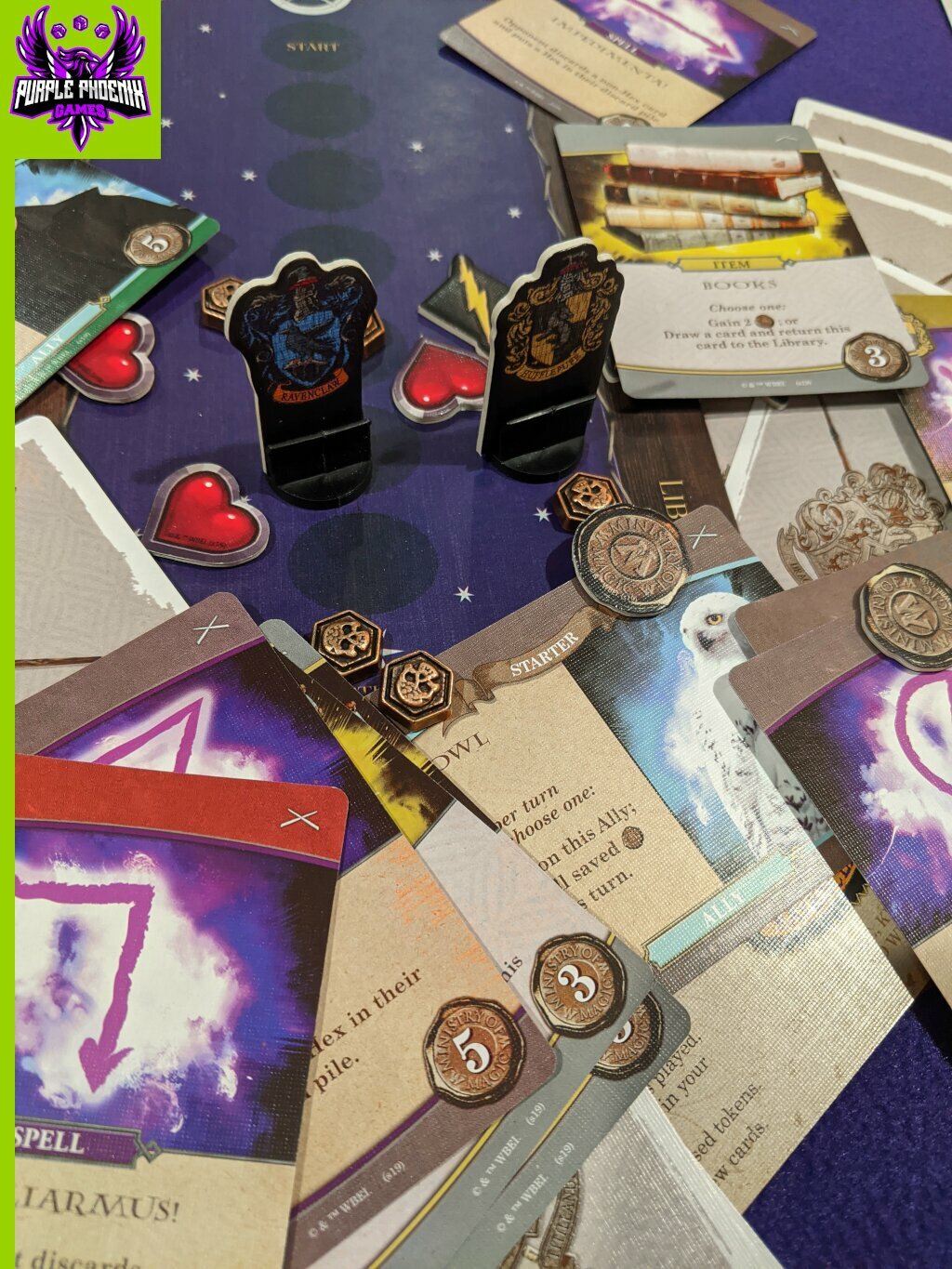
To setup a game, follow the rulebook instructions to lay out the main duel board and its shuffled decks that will surround it. These include the Hogwarts deck (from which players will be purchasing cards to add to their discard piles), the Library deck (which includes only Books cards that add influence or the ability to draw the top card of the player deck), Hexes (which are placed directly in the opponent’s discard pile and must be dealt with first when in hand), and Banished cards. Each player will choose a House card and a matching mover token to be placed on the board. Likewise, each player will have a starting hand of seven Alohomora! cards, one Wand, one Cauldron, and one starter Ally: Owl, Toad, or Cat. Each player will shuffle their starting deck, drawing five for their starting hand. Determine the starting player and the duel may begin!
On a player’s turn they will first deal with any Hex cards they have acquired, following the instructions written on the card. Once cleared, the active player will play cards from their hand in any order they wish to gain Influence to purchase cards from the Classroom (market), Attack points to push back their opponent towards the Stun space, or Health points to move their own mover token one space closer to the Starting space on the board.
Cards that are purchased from the Classroom can be Items, Spells, or even Allies. Items and Spells typically provide Influence, Health, or Attack, and some will have House bonuses in addition to normal effects. In order to take advantage of the House bonus, a player will either need to be from the affiliated House, or have an active Ally belonging to the affiliated House. This is a new mechanic in this game and adds another layer of strategy to a player’s purchasing.
As wizards duel back and forth slinging Spells, recruiting and activating Allies, and using Items to push back their opponent, one wizard will be stunned. When this happens the players will reset their play areas by combining all of their cards they have in their possession. Shuffle the lot of them, draw another hand of five cards and reset their mover token back to the Starting space. The next round is ready to begin and the wizard who stuns their opponent thrice will be crowned champion! Or get an A for the day… or whatever the Common Core equivalent is nowadays.
Components. I have many great things to say about the components in this box and a couple little gripes. Gripelets, really. First gripe: the box comes with a cardstock sleeve. It is very cool and looks great, but it’s unnecessary and I find it keeps snagging on other boxes and such. Not a big deal, as I can always get rid of it, but that’s an opinion. Second, the board is very dark. It features a very dark purple (yay purple!) with black spaces upon which players move their tokens. The colors are very close under certain lighting and I wish there was even just a faint outline of the spaces in a white or gray. Lastly, and probably just me and the way I play, the Attack and Health trackers are almost completely unnecessary. I know you are supposed to take a token every time you “Gain” a Health or Attack point, but I always just keep track in my head thus negating the need for the tokens.
But onto the great. Literally everything else is great. I have always enjoyed the components in the original game, and as this one contains many of the same, I also enjoy these. The art style is interesting and pretty cool, and I really don’t mind screencaps as much as many others do. So for me, overall, I really enjoy the components here.
All in all I truly love this game. I am almost always in the mood to play Harry Potter: Hogwarts Battle, but it is cooperative and my wife doesn’t really enjoy the OG HP game. This one, however, she does enjoy because she can just flex on me and stun me into oblivion with her superior deckbuilding abilities. This one is quicker to setup and play, and holds a much smaller footprint. The mechanics are familiar without being totally duplicating, and I just love deckbuilders in general. So this one was bound to be a big hit with me from the start.
If you are looking for a great Harry Potter-themed deckbuilding game and are not completely sold on the bigger cooperative game, take a look at this much smaller two-player competitive title. Do try to take some of the cards with a grain of salt, as I am sure it is difficult to imagine having both Hermione and Draco as allies simultaneously, but it can happen in the game. Purple Phoenix Games gives this one a very enthusiastic 11 / 12. Just a word of caution, try not to Flipendo your table when you lose. It won’t end well.
Like I just mentioned, Defence pits two players against each other in a sparring scenario. Players will be drafting cards that represent Spells to sling, Allies to aid, and Items to help knock opponents off their balance. The winner of Defence is the wizard who can stun their opponent three times. Only then will they be able to stand a chance against their dark foes.
DISCLAIMER: We were provided a copy of this game for the purposes of this review. This is a retail copy of the game, so what you see in these photos is exactly what would be received in your box. I do not intend to cover every single rule included in the rulebook, but will describe the overall game flow and major rule set so that our readers may get a sense of how the game plays. For more in depth rules, you may purchase a copy online or from your FLGS. -T
To setup a game, follow the rulebook instructions to lay out the main duel board and its shuffled decks that will surround it. These include the Hogwarts deck (from which players will be purchasing cards to add to their discard piles), the Library deck (which includes only Books cards that add influence or the ability to draw the top card of the player deck), Hexes (which are placed directly in the opponent’s discard pile and must be dealt with first when in hand), and Banished cards. Each player will choose a House card and a matching mover token to be placed on the board. Likewise, each player will have a starting hand of seven Alohomora! cards, one Wand, one Cauldron, and one starter Ally: Owl, Toad, or Cat. Each player will shuffle their starting deck, drawing five for their starting hand. Determine the starting player and the duel may begin!
On a player’s turn they will first deal with any Hex cards they have acquired, following the instructions written on the card. Once cleared, the active player will play cards from their hand in any order they wish to gain Influence to purchase cards from the Classroom (market), Attack points to push back their opponent towards the Stun space, or Health points to move their own mover token one space closer to the Starting space on the board.
Cards that are purchased from the Classroom can be Items, Spells, or even Allies. Items and Spells typically provide Influence, Health, or Attack, and some will have House bonuses in addition to normal effects. In order to take advantage of the House bonus, a player will either need to be from the affiliated House, or have an active Ally belonging to the affiliated House. This is a new mechanic in this game and adds another layer of strategy to a player’s purchasing.
As wizards duel back and forth slinging Spells, recruiting and activating Allies, and using Items to push back their opponent, one wizard will be stunned. When this happens the players will reset their play areas by combining all of their cards they have in their possession. Shuffle the lot of them, draw another hand of five cards and reset their mover token back to the Starting space. The next round is ready to begin and the wizard who stuns their opponent thrice will be crowned champion! Or get an A for the day… or whatever the Common Core equivalent is nowadays.
Components. I have many great things to say about the components in this box and a couple little gripes. Gripelets, really. First gripe: the box comes with a cardstock sleeve. It is very cool and looks great, but it’s unnecessary and I find it keeps snagging on other boxes and such. Not a big deal, as I can always get rid of it, but that’s an opinion. Second, the board is very dark. It features a very dark purple (yay purple!) with black spaces upon which players move their tokens. The colors are very close under certain lighting and I wish there was even just a faint outline of the spaces in a white or gray. Lastly, and probably just me and the way I play, the Attack and Health trackers are almost completely unnecessary. I know you are supposed to take a token every time you “Gain” a Health or Attack point, but I always just keep track in my head thus negating the need for the tokens.
But onto the great. Literally everything else is great. I have always enjoyed the components in the original game, and as this one contains many of the same, I also enjoy these. The art style is interesting and pretty cool, and I really don’t mind screencaps as much as many others do. So for me, overall, I really enjoy the components here.
All in all I truly love this game. I am almost always in the mood to play Harry Potter: Hogwarts Battle, but it is cooperative and my wife doesn’t really enjoy the OG HP game. This one, however, she does enjoy because she can just flex on me and stun me into oblivion with her superior deckbuilding abilities. This one is quicker to setup and play, and holds a much smaller footprint. The mechanics are familiar without being totally duplicating, and I just love deckbuilders in general. So this one was bound to be a big hit with me from the start.
If you are looking for a great Harry Potter-themed deckbuilding game and are not completely sold on the bigger cooperative game, take a look at this much smaller two-player competitive title. Do try to take some of the cards with a grain of salt, as I am sure it is difficult to imagine having both Hermione and Draco as allies simultaneously, but it can happen in the game. Purple Phoenix Games gives this one a very enthusiastic 11 / 12. Just a word of caution, try not to Flipendo your table when you lose. It won’t end well.


Lee Ronaldo recommended Kollaps by Einsturzende Neubauten in Music (curated)



Purple Phoenix Games (2266 KP) rated Aristotle's Elements and Space in Tabletop Games
Nov 5, 2020


The Cosmos! So many of us dream of flying up into space to enjoy the views and hopes of a better life on another planet. Some would like to study space more closely to unravel its mysteries. Still others would think it’s just kinda cool to be weightless and IN SPACE! I’m a mixture of all these, so when I heard a call for reviewers for a game whose title includes a major philosopher, elements of all matter, AND SPACE I just had to know more and play it. Would Aristotle take pride in this card game’s premise or has it shot for the moon and is now drifting among the space junk?
Aristotle’s Elements and Space is a party style card game for three to five players. Players will be attempting to play elements to triumph over their opponents by using tried and true rock-paper-scissors style play.
DISCLAIMER: We were provided a prototype copy of this game for the purposes of this review. These are preview copy components, and I do not know for sure if the final components will be any different from these shown. Also, it is not my intention to detail every rule in the game, as there are just too many. You are invited to download the rulebook, back the game through the Kickstarter campaign, or through any retailers stocking it after fulfillment. -T
To setup stock the token bag (not pictured) with tokens according to the rulebook suggestions for number of players. Each player will blindly choose three tokens from the bag to place in front of themselves within reach of all players. Shuffle the element cards and deal each player seven. Determine the first Aristotle player and place the Aristotle card facing that player. Shuffle and deal out three Element of Surprise cards face-down within reach of all players. The game may now begin!
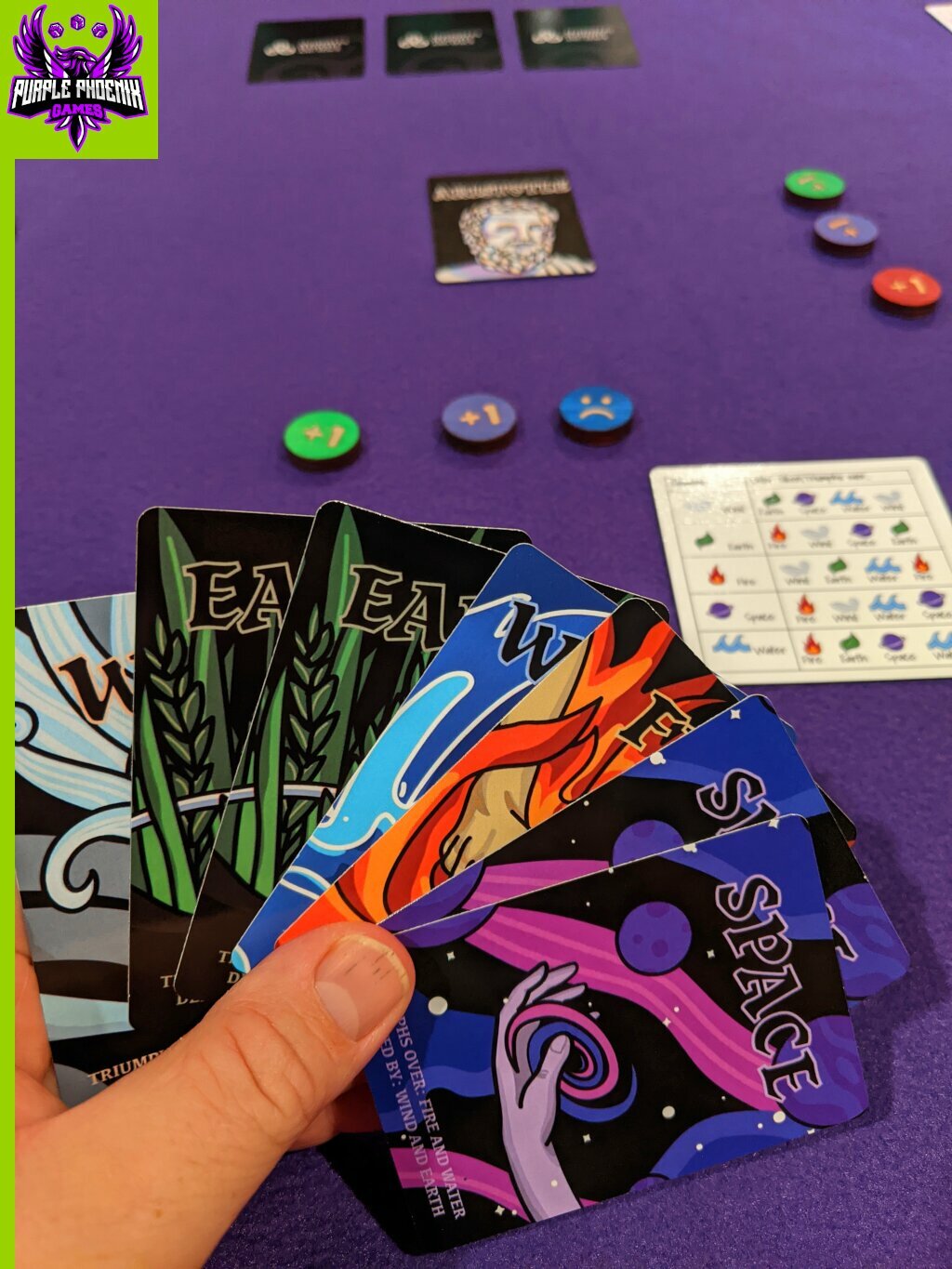
Each game lasts seven rounds. At the start of each round players will secretly choose a card from hand to play to the table face down. Once all players are ready all players must simultaneously say out loud, “Aristotle,” while flipping over their cards. When all cards are revealed the Aristotle player will compare cards with the player on their left. Whichever element card played triumphs over the other will win that battle and continue onward clockwise to battle the other players. This continues until one player has triumphed all the cards and taken the trick. The Aristotle card is then given to the next player in clockwise seating to begin a new round. This is how a basic game is played.
More advanced games will include Power Up Tokens and the Element of Surprise Cards. In order to use a Power Up Token a player would first need to have successfully stolen another player’s token during a round of play. To successfully steal a token the player will physically take a token from another player without being touched by that player. Should the defending player touch or slap the offensive player’s hand during the theft, the heist is unsuccessful. Once stolen a token may be used on a subsequent round.
The Power Up Tokens increase the number of elements that may be triumphed using a particular element. For instance, Fire typically triumphs over Earth and Wind, but with the Power Up Token also applied the Fire triumphs over Earth, Wind, AND Water. A most welcome twist! Also, during a round in which a player is acting as Aristotle they may, once cards are revealed, call, “Element of Surprise!,” and choose a face-down card to read aloud to the group. These cards add a goofy rule that must be thenceforth followed, gives prompts for the players to discuss, or has players searching the room/house/wherever for items to bring back to the table first.
Play continues in this fashion until the last round, where triumph rules are reversed. When all cards have been played the winner is the player who won the most tricks.
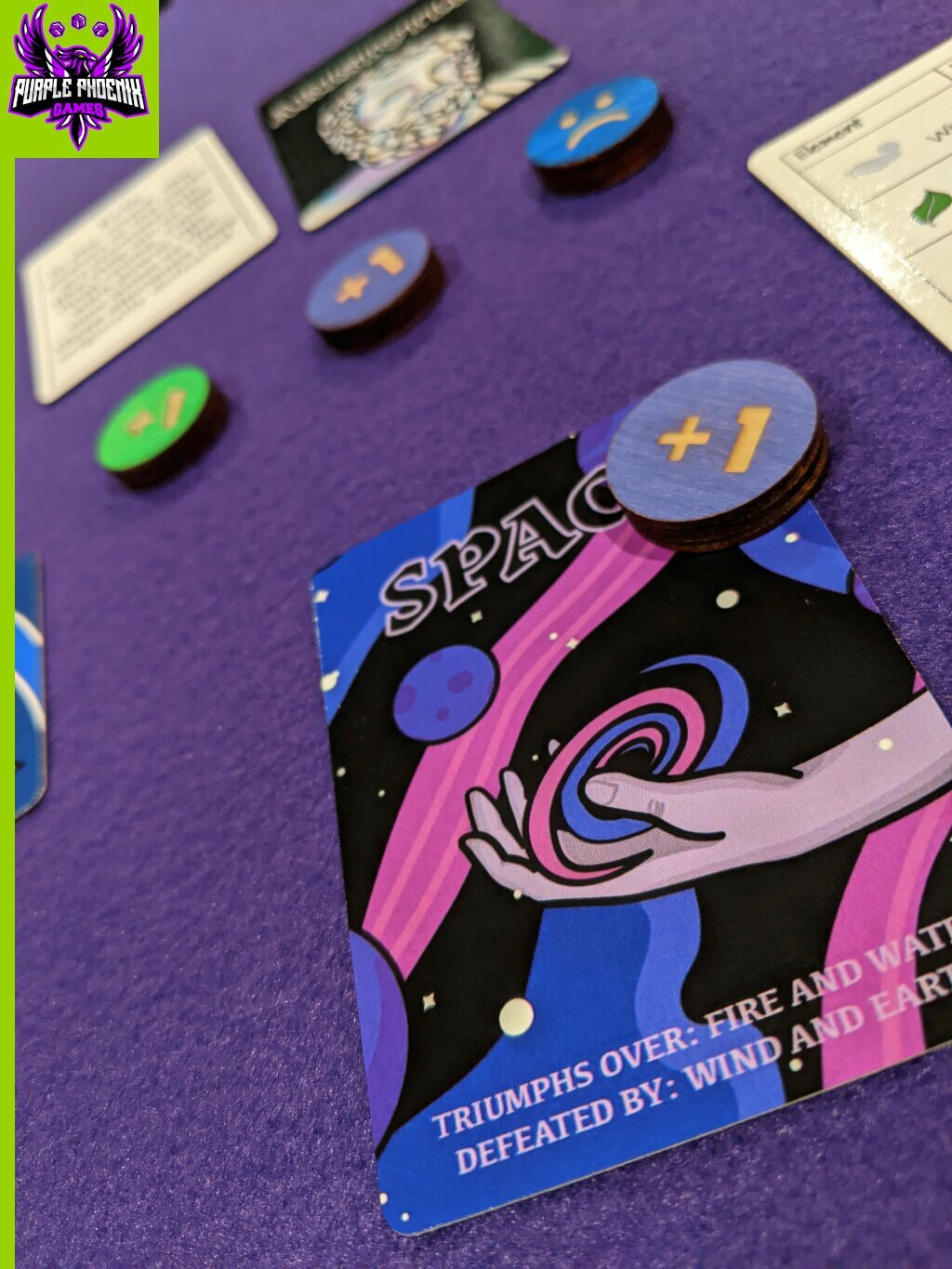
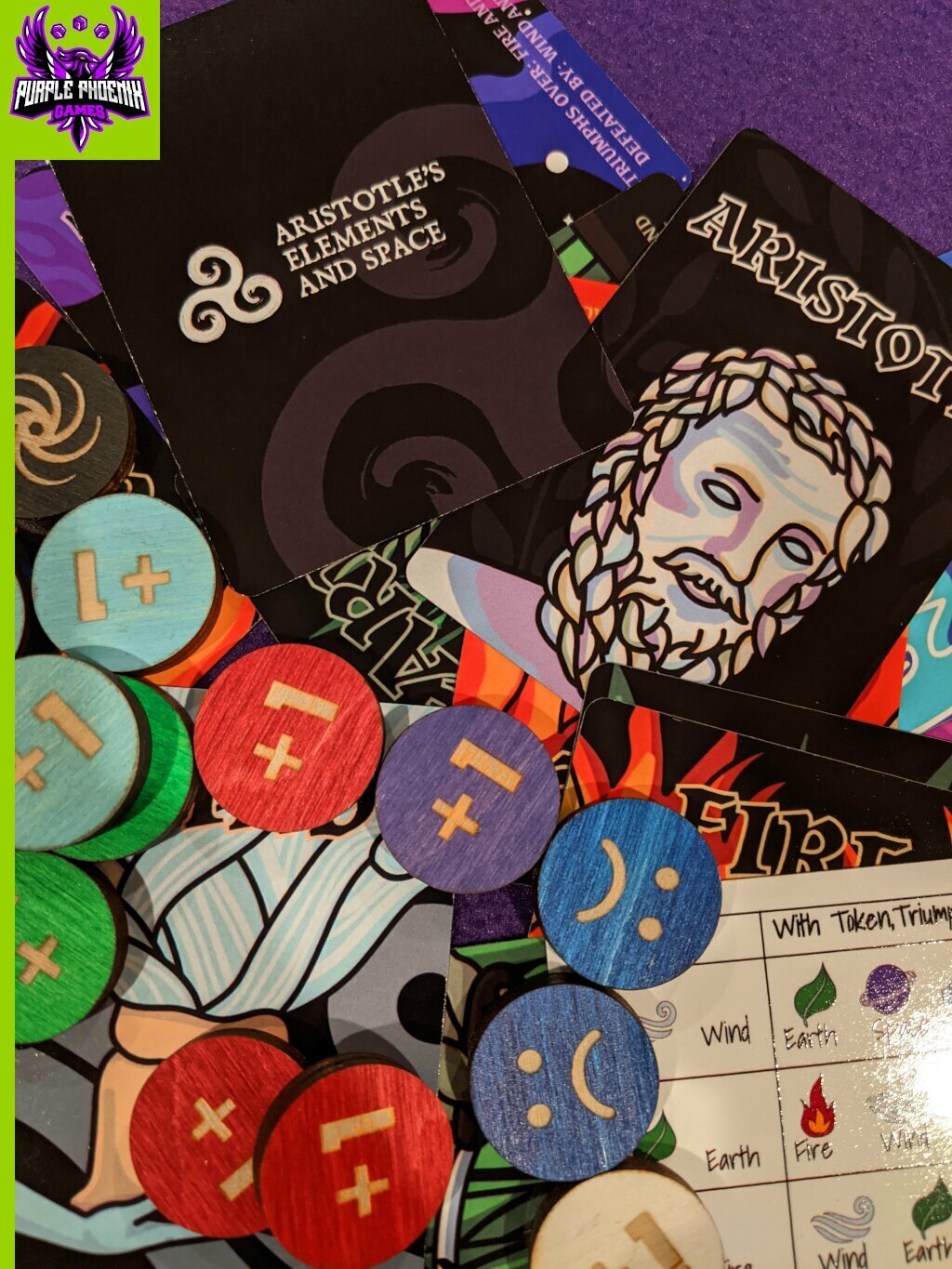
Components. Again, this is a prototype version of the game. That said, what we received was a bunch of cards and the Power Up Tokens. The tokens are fine – laser cut plywood discs painted on both sides to match the elements they modify. The cards are glossy and feature unique art. The art is, well, just okay for me. It’s not terribly exciting, but it is very colorful and not bad, necessarily. I feel like the art could be improved some, but art is always a personal preference.
The gameplay itself is certainly a hodge-podge of mechanics from other games that, for the most part, are well-used for a very light trick-taking card game. I enjoy playing it using the Power Up Tokens, but for me and my group, we passed on the Element of Surprise cards. They add a different twist to the game that isn’t necessarily Quelf-ish, but also doesn’t add much to the game. They merely add a distraction from the game. I can see many people totally diggin’ those cards, and I probably would use them if converting a game-noob, but for more serious gamers, just leave them out.
If you are looking for a very light and different trick-taking card game, check out Aristotle’s Elements and Space. I am not entirely sure if any components will be updated before going to retail, but even if not, they are pretty decent. The gameplay is quick and easy to teach; I think I will try it with my 4-year-old as well. This is a decent gateway filler that could fit very well in many collections. Give it a look!
Aristotle’s Elements and Space is a party style card game for three to five players. Players will be attempting to play elements to triumph over their opponents by using tried and true rock-paper-scissors style play.
DISCLAIMER: We were provided a prototype copy of this game for the purposes of this review. These are preview copy components, and I do not know for sure if the final components will be any different from these shown. Also, it is not my intention to detail every rule in the game, as there are just too many. You are invited to download the rulebook, back the game through the Kickstarter campaign, or through any retailers stocking it after fulfillment. -T
To setup stock the token bag (not pictured) with tokens according to the rulebook suggestions for number of players. Each player will blindly choose three tokens from the bag to place in front of themselves within reach of all players. Shuffle the element cards and deal each player seven. Determine the first Aristotle player and place the Aristotle card facing that player. Shuffle and deal out three Element of Surprise cards face-down within reach of all players. The game may now begin!
Each game lasts seven rounds. At the start of each round players will secretly choose a card from hand to play to the table face down. Once all players are ready all players must simultaneously say out loud, “Aristotle,” while flipping over their cards. When all cards are revealed the Aristotle player will compare cards with the player on their left. Whichever element card played triumphs over the other will win that battle and continue onward clockwise to battle the other players. This continues until one player has triumphed all the cards and taken the trick. The Aristotle card is then given to the next player in clockwise seating to begin a new round. This is how a basic game is played.
More advanced games will include Power Up Tokens and the Element of Surprise Cards. In order to use a Power Up Token a player would first need to have successfully stolen another player’s token during a round of play. To successfully steal a token the player will physically take a token from another player without being touched by that player. Should the defending player touch or slap the offensive player’s hand during the theft, the heist is unsuccessful. Once stolen a token may be used on a subsequent round.
The Power Up Tokens increase the number of elements that may be triumphed using a particular element. For instance, Fire typically triumphs over Earth and Wind, but with the Power Up Token also applied the Fire triumphs over Earth, Wind, AND Water. A most welcome twist! Also, during a round in which a player is acting as Aristotle they may, once cards are revealed, call, “Element of Surprise!,” and choose a face-down card to read aloud to the group. These cards add a goofy rule that must be thenceforth followed, gives prompts for the players to discuss, or has players searching the room/house/wherever for items to bring back to the table first.
Play continues in this fashion until the last round, where triumph rules are reversed. When all cards have been played the winner is the player who won the most tricks.
Components. Again, this is a prototype version of the game. That said, what we received was a bunch of cards and the Power Up Tokens. The tokens are fine – laser cut plywood discs painted on both sides to match the elements they modify. The cards are glossy and feature unique art. The art is, well, just okay for me. It’s not terribly exciting, but it is very colorful and not bad, necessarily. I feel like the art could be improved some, but art is always a personal preference.
The gameplay itself is certainly a hodge-podge of mechanics from other games that, for the most part, are well-used for a very light trick-taking card game. I enjoy playing it using the Power Up Tokens, but for me and my group, we passed on the Element of Surprise cards. They add a different twist to the game that isn’t necessarily Quelf-ish, but also doesn’t add much to the game. They merely add a distraction from the game. I can see many people totally diggin’ those cards, and I probably would use them if converting a game-noob, but for more serious gamers, just leave them out.
If you are looking for a very light and different trick-taking card game, check out Aristotle’s Elements and Space. I am not entirely sure if any components will be updated before going to retail, but even if not, they are pretty decent. The gameplay is quick and easy to teach; I think I will try it with my 4-year-old as well. This is a decent gateway filler that could fit very well in many collections. Give it a look!


Nicole Hadley (380 KP) rated When We Fall in Books
Jun 18, 2018

<a href="https://awindowintobooks.wordpress.com">Full Review</a>
I received this book for free from Goodreads in exchange for an honest review.
The book “When We Fall” by Emily Liebert is a definite page turner. While there are some flaws I give this book a 4/5 star rating. The main character, Allison Parker, 11 years prior to the story suddenly was faced with the death of her husband, and still 11 years later she is trying to pick up the pieces. Her husband, Jack, was in a bus accident that caused his untimely death which resulted in him never to meet his son Logan. Allison was left raise Logan alone as a single mom. Allison, an artist, put her career on hold me be the best mom she could be even though her life was fall apart around here. Prior to moving to Wincourt to have a fresh new start, Allison and Logan lived in New York. Wincourt is a suburb of New York. Allison found a house with a place where she could focus on her art career and Logan could attend a good school.
On Logan’s first day of school, Allison meets Charlotte who is Gia’s mom and Logan’s classmate. Come to find out the Charlotte is the wife and Gia the daughter of Charlie who was Jack’s best friend. Charlie and Jack worked and attended the same summer camp. Sadly, Charlie never called Allison after Jack died. Immediately, Charlotte and Allison became fast friends. They both were in need of a good friend so it was perfect timing, but then things get complicated and everything fell apart.
Allison and Charlotte became friends, good friends even. But Charlotte has a friend named Sabrina who tries to make everyone miserable. Sabrina told a lie to Charlotte that Allison and Charlie were having an affaire even though that was far from the truth. It caused a strain in Charlotte and Allison’s relationship, which left Allison utterly confused and Charlotte feeling hurt.
The relationships are well developed and true. It’s easy to identify with the characters of the story if you have ever been in a relationship or lost someone close to you. There is heartbreak but there is also hope. Hope that while relationships can have strains if you work things out there is hope that all things will work together. The minor characters bring an added level of trueness to the story.
I received this book for free from Goodreads in exchange for an honest review.
The book “When We Fall” by Emily Liebert is a definite page turner. While there are some flaws I give this book a 4/5 star rating. The main character, Allison Parker, 11 years prior to the story suddenly was faced with the death of her husband, and still 11 years later she is trying to pick up the pieces. Her husband, Jack, was in a bus accident that caused his untimely death which resulted in him never to meet his son Logan. Allison was left raise Logan alone as a single mom. Allison, an artist, put her career on hold me be the best mom she could be even though her life was fall apart around here. Prior to moving to Wincourt to have a fresh new start, Allison and Logan lived in New York. Wincourt is a suburb of New York. Allison found a house with a place where she could focus on her art career and Logan could attend a good school.
On Logan’s first day of school, Allison meets Charlotte who is Gia’s mom and Logan’s classmate. Come to find out the Charlotte is the wife and Gia the daughter of Charlie who was Jack’s best friend. Charlie and Jack worked and attended the same summer camp. Sadly, Charlie never called Allison after Jack died. Immediately, Charlotte and Allison became fast friends. They both were in need of a good friend so it was perfect timing, but then things get complicated and everything fell apart.
Allison and Charlotte became friends, good friends even. But Charlotte has a friend named Sabrina who tries to make everyone miserable. Sabrina told a lie to Charlotte that Allison and Charlie were having an affaire even though that was far from the truth. It caused a strain in Charlotte and Allison’s relationship, which left Allison utterly confused and Charlotte feeling hurt.
The relationships are well developed and true. It’s easy to identify with the characters of the story if you have ever been in a relationship or lost someone close to you. There is heartbreak but there is also hope. Hope that while relationships can have strains if you work things out there is hope that all things will work together. The minor characters bring an added level of trueness to the story.

JT (287 KP) rated Only God Forgives (2013) in Movies
Mar 10, 2020



Now here is a film that completely split critics. It’s not going to be everyone’s cup of tea and it’s clear to see why. Anyone expecting a well constructed follow up to Winding Refn’s hit Drive are going to be sorely disappointed, as Only God Forgives serves up a mix of beautiful neon visuals, character dreamscapes and minimal dialogue.
Julian (Ryan Gosling) runs a Thai boxing club deep in the heart of Bangkok using it as front for a drug smuggling ring with his brother. Events take a horrific turn when his brother rapes and murders an underage prostitute. Enter retired cop Chang (Vithaya Pansringarm), more well known as the ‘Angel of Vengeance’ who has a unique and almost godlike way of handing out retribution to those who cross his path.
When he allows Julian’s brother to be murdered by the father of the girl he killed, Julian’s mother Crystal and family matriarch heads out to demand that Julian take revenge for his brothers death.
Only God Forgives is a film doused in deep colours that awash the actors on screen and cast them in a variety of different lights. It feels a bit art house and at times arrogant. This must have been the easiest pay cheque that Gosling has ever picked up. He barely speaks and stamps any authority on screen by long drawn out stares of which he is the master.
Scott Thomas is not the mother figure that you would expect to have. Goading Julian into submission in a vile and disgusting manner she belittles him, prompting the question that he is half the man his brother is. She is one of the few standouts. All blonde hair and jewellery along with a arsenal of foul language. However, it will be Chang that leaves the afterthought, as he glides about unleashing his sword on those who stand in his way.
Only God Forgives is violent, and it is certainly not for the faint-hearted, the spilling of blood (particularly one hard to watch scene) is in keeping with the tonal colour of the setting. It doesn’t have Drive’s slickness but does come with an equally pulsating sound track.
There is no arguing that from a cinematography point of view this film his head and shoulders above others. But there is the odd occasion when you really have to question the director and what it was that he set out to achieve?
Julian (Ryan Gosling) runs a Thai boxing club deep in the heart of Bangkok using it as front for a drug smuggling ring with his brother. Events take a horrific turn when his brother rapes and murders an underage prostitute. Enter retired cop Chang (Vithaya Pansringarm), more well known as the ‘Angel of Vengeance’ who has a unique and almost godlike way of handing out retribution to those who cross his path.
When he allows Julian’s brother to be murdered by the father of the girl he killed, Julian’s mother Crystal and family matriarch heads out to demand that Julian take revenge for his brothers death.
Only God Forgives is a film doused in deep colours that awash the actors on screen and cast them in a variety of different lights. It feels a bit art house and at times arrogant. This must have been the easiest pay cheque that Gosling has ever picked up. He barely speaks and stamps any authority on screen by long drawn out stares of which he is the master.
Scott Thomas is not the mother figure that you would expect to have. Goading Julian into submission in a vile and disgusting manner she belittles him, prompting the question that he is half the man his brother is. She is one of the few standouts. All blonde hair and jewellery along with a arsenal of foul language. However, it will be Chang that leaves the afterthought, as he glides about unleashing his sword on those who stand in his way.
Only God Forgives is violent, and it is certainly not for the faint-hearted, the spilling of blood (particularly one hard to watch scene) is in keeping with the tonal colour of the setting. It doesn’t have Drive’s slickness but does come with an equally pulsating sound track.
There is no arguing that from a cinematography point of view this film his head and shoulders above others. But there is the odd occasion when you really have to question the director and what it was that he set out to achieve?

Lonely Planet Sydney
Lonely Planet, Peter Dragicevich and Miriam Raphael
Book
Lonely Planet: The world's leading travel guide publisher Lonely Planet Sydney is your passport to...

Your First Garden
Book
In her latest book, accomplished garden writer Judith Adam targets new homeowners in the brand new,...

Out of Africa
Book
Karen Blixen's Out of Africa is the lyrical and luminous memoir of Kenya that launched a million...

Neon's Nerd Nexus (360 KP) rated Gretel & Hansel (2020) in Movies
Sep 10, 2020
Something Wicked
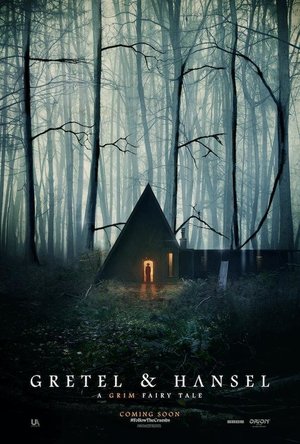
Gretel and hansel is everything I hoped it would be & more, a devilsh dive into witchcraft & an utterly nightmarish visual feast for both the eyes & senses. Gretel & Hansel is a new take on the well known Grimm fairytale & for a simple comparison it's much like one of my favourite horror films of all time 2015's The witch. Now I'm guessing that's put some people off already but those who are still with me are in for a delightful treat. Think Suspira if it were boiled in a pot with the witch, hagazussa & it comes at night & you have painted a picture of what to expect here. Extremely slow pacing, constantly lingering ominous dread & a soundtrack that's likely to cause the hairs on your neck to stand up every time it drones. To say this film is absolutely gorgeous is an insult, every single frame is awash with beautifully striking & highly interesting to explore imagery & colour. It's so visually striking & breathtaking I could happily of sat & watched it with no sound & still be as entranced by its wicked ways. However the way these visuals mash with the synth & droning soundtrack honestly kept me glued to the screen seemingly bewitched & fixated in a trance like state. As you can tell these types of films are my passion when it comes to horror, I much prefer the slow lingering constant sense of dread & creepy imagery that lead up to a shocking pay off while also intertwining the kind of depth & philosophy you have to unravel yourself instead of being spoon fed the plot by the characters themselves. This film is no different & as we delve deep into such themes as female empowerment, innocence, sacrifice, responsibility, naivety, addiction & greed as a viewer the web spun for you begins to unravel about what the film is truly trying to say at its core. Sophia Lillis who you may know from IT does wonders here as Gretel & it's her character, acting & attachment that really hooks you & makes every scene with her in feel calming amongst all the oddities going on. I honestly can not praise this film enough & say if your into art house cinema do not hesitate at grabbing this on glorious 4k. A stunning, breathless wonder of a movie to that will leave you feeling body unnerved & your mind shaken.

Black Edge
Book
The rise over the last two decades of a powerful new class of billionaire financiers marks a...
Finance