
Search
Search results

BankofMarquis (1832 KP) rated Extraction (2020) in Movies
May 6, 2020
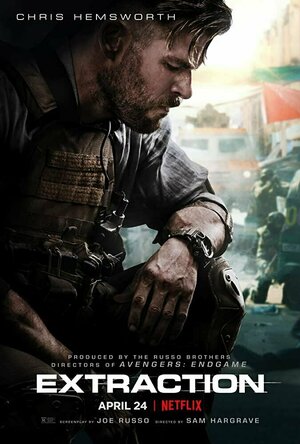

Fun, by-the-book, action flick
I'm pretty sure that no matter what, I was going to enjoy the Chris Hemsworth action flick EXTRACTION whether it was good or not. It is, after all, a NEW movie, albeit one that was made "Direct to Netflix", so those can be of lesser quality.
I'm happy to report that in the case of EXTRACTION, that is not the case. This is a good (if by the books) popcorn action flick with a charismatic lead keeping you company throughout.
In EXTRACTION, Chris Hemsworth stars as an Australian Mercenary (who knew there was such a thing), hired to extract the kidnapped son of a drug lord from the hands of his fiercest rival.
This is a pretty "by-the-numbers" action film:
1). The mercenary has "baggage" - will the events (and the subject he is to extract) help him come to terms with his pent-up emotions in order to move past his traumatic "baggage"?
2). Will there be some sort of "double-cross" that screws up the extraction causing our hero to go "on the run" with his "Extraction"?
3). Will there be a buddy that our hero trusts who will, ultimately, double-cross him?
What do you think?
The fun of this film was not the plot machinations (they are pretty basic), but the execution of these machinations - and this execution is pretty fun/enjoyable.
Start with Chris Hemsworth as our mercenary - with the great action flick name of Tyler Rake. Hemsworth knows exactly what kind of film he is in - and he brings the goods. If he chose to, I think Hemsworth could be an action hero staple like Jason Statham or Dwayne "The Rock" Johnson - but I think Hemsworth is not really interested in that. But here, he is steely eyed and calm taking hits and doling out punishment to hoards of "red shirt" bad guys in his way. He has the action hero chops. He also has the acting chops to make the overwrought "emotional" scenes palatable. He makes weak writing enjoyable.
Joining him is Rudhraksh Jaiswal as "the extraction" - and his interactions with Hemsworth are fun. Randeep Hodha and Golshifteh Farahani do a nice job in the roles that they play in the action and the always watchable David Harbour eats a ton of scenery in his limited time on the screen. All are fun to watch.
But it is the telling of the story by first time Director Sam Hargrave that was a (pleasant) surprise for me. After doubling Chris Evans in the first CAPTAIN AMERICA film, Hargrave became the "go to" guy for Marvel action choreography, so (I'm sure) he got to know Hemsworth there. He brings a fast-paced style to this film that works. He doesn't stop to examine much at all (which helps the plot holes in the script) and his action work with his stunt actors is top-notch. If you watch nothing else in this film, check out the chase scene at about the 1/3 mark of the film. Hemsworth and "the extraction" are being chased - and it is filmed in the "shaky cam/cinema veritae/ make it look like one long tracking shot" style that I often criticize in my reviews - but here it worked and worked well. I'll be keeping my eye on what Hargrave does next (word is it that there will be an Extraction 2).
All of this is brought together by Producers Joe and Anthony Russo - the Directors of many Marvel films (including INFINITY WAR and ENDGAME). Not only did they Produce this film, but they wrote the story from where this film came from. It's obvious that they turned the majority of the screenplay writing to others (most notably Ande Parks) and this film is based on a graphic novel...so it plays like an over-the-top comic book action flick (think John Wick-lite) where the dialogue is sparse and cliche-ridden. This part of the film was far less interesting than the action parts.
But, the action is fast, fun and furious and Hemsworth is worth watching for the 1 hour 56 minute running time.
All-in-all, a good time was had while watching the first "new" film in over 6 weeks.
Letter Grade: B+
7 1/2 stars (out of 10) and you can take that to the Bank(ofMarquis)
I'm happy to report that in the case of EXTRACTION, that is not the case. This is a good (if by the books) popcorn action flick with a charismatic lead keeping you company throughout.
In EXTRACTION, Chris Hemsworth stars as an Australian Mercenary (who knew there was such a thing), hired to extract the kidnapped son of a drug lord from the hands of his fiercest rival.
This is a pretty "by-the-numbers" action film:
1). The mercenary has "baggage" - will the events (and the subject he is to extract) help him come to terms with his pent-up emotions in order to move past his traumatic "baggage"?
2). Will there be some sort of "double-cross" that screws up the extraction causing our hero to go "on the run" with his "Extraction"?
3). Will there be a buddy that our hero trusts who will, ultimately, double-cross him?
What do you think?
The fun of this film was not the plot machinations (they are pretty basic), but the execution of these machinations - and this execution is pretty fun/enjoyable.
Start with Chris Hemsworth as our mercenary - with the great action flick name of Tyler Rake. Hemsworth knows exactly what kind of film he is in - and he brings the goods. If he chose to, I think Hemsworth could be an action hero staple like Jason Statham or Dwayne "The Rock" Johnson - but I think Hemsworth is not really interested in that. But here, he is steely eyed and calm taking hits and doling out punishment to hoards of "red shirt" bad guys in his way. He has the action hero chops. He also has the acting chops to make the overwrought "emotional" scenes palatable. He makes weak writing enjoyable.
Joining him is Rudhraksh Jaiswal as "the extraction" - and his interactions with Hemsworth are fun. Randeep Hodha and Golshifteh Farahani do a nice job in the roles that they play in the action and the always watchable David Harbour eats a ton of scenery in his limited time on the screen. All are fun to watch.
But it is the telling of the story by first time Director Sam Hargrave that was a (pleasant) surprise for me. After doubling Chris Evans in the first CAPTAIN AMERICA film, Hargrave became the "go to" guy for Marvel action choreography, so (I'm sure) he got to know Hemsworth there. He brings a fast-paced style to this film that works. He doesn't stop to examine much at all (which helps the plot holes in the script) and his action work with his stunt actors is top-notch. If you watch nothing else in this film, check out the chase scene at about the 1/3 mark of the film. Hemsworth and "the extraction" are being chased - and it is filmed in the "shaky cam/cinema veritae/ make it look like one long tracking shot" style that I often criticize in my reviews - but here it worked and worked well. I'll be keeping my eye on what Hargrave does next (word is it that there will be an Extraction 2).
All of this is brought together by Producers Joe and Anthony Russo - the Directors of many Marvel films (including INFINITY WAR and ENDGAME). Not only did they Produce this film, but they wrote the story from where this film came from. It's obvious that they turned the majority of the screenplay writing to others (most notably Ande Parks) and this film is based on a graphic novel...so it plays like an over-the-top comic book action flick (think John Wick-lite) where the dialogue is sparse and cliche-ridden. This part of the film was far less interesting than the action parts.
But, the action is fast, fun and furious and Hemsworth is worth watching for the 1 hour 56 minute running time.
All-in-all, a good time was had while watching the first "new" film in over 6 weeks.
Letter Grade: B+
7 1/2 stars (out of 10) and you can take that to the Bank(ofMarquis)

Bob Mann (459 KP) rated Kingsman: The Golden Circle (2017) in Movies
Sep 29, 2021
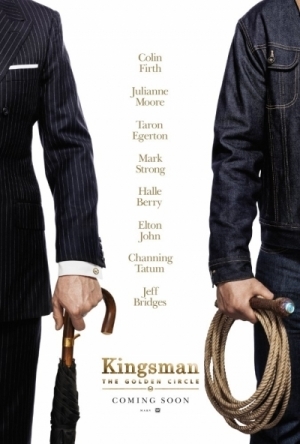
Vaughn and Golding cross the pond to deliver more of the same.
You would probably need to be living under a rock not to know that “Kingsman: The Golden Circle” is the follow-up film to Matthew Vaughn and Jane Goldman’s highly successful 2015 offering “Kingsman: The Secret Service”: a raucous, violent and rude entry into the spy-caper genre. And the sequel is more of the same: why mess with a crowd-pleasing formula?
The fledgling agent Eggsy (Taron Egerton (“Eddie the Eagle“), curiously called “Eggy” at various points in the film for reasons I didn’t understand) is now the new “Galahad” following the demise in the first film of the original, played by Colin Firth (“Magic in the Moonlight“, “Bridget Jones’ Baby“). But just as he’s getting into his stride the whole Kingsman organisation, now headed by Michael Gambon (“Harry Potter”) as Arthur , is ripped apart by an evil drugs cartel called “The Golden Circle” headed by smiling but deadly Poppy (Juliane Moore, “Still Alice”).
Eggsy and Lancelot (Mark Strong, “Miss Sloane“) in desperation turn to Statesman – the US equivalent organisation – and together with some surprising allies set out to defeat the evil plot to poison all casual drug users.
Subtle this film certainly is not, featuring brash and absurdly unrealistic action scenes that are 90% CGI but – for me at least – enormous fun to watch. As with the first film (and I’m thinking of the grotesquely violent church scene here) the action moves however from ‘edgy’ to “over-the-top/offensive” at times. The ‘burger scene’ and (particularly) the ‘Glastonbury incident’ are the standout moments for all the wrong reasons. I have a theory about how these *might* have come about…
One Mann’s Movies Showcase Theatre
The scene: Matthew Vaughn and Jane Golding are working “The Golden Circle” script at Goldman’s English home.
Vaughn: “OK, so Eggsy is in the tent with Clara and needs to plant the tracking device on her.”
Goldman’s husband Jonathan Ross sticks his head round the door.
Ross: “Hey Guys, I’ve an idea about that. I was on the phone to Wussell Bwand and we came up with a GWEAT idea.”
Vaughn: (rolling his eyes, mutters to himself): “Oh God, not again…”
Ross: “We thought that Eggsy could use his finger to stick the tracker right up her – ahem – ‘lady canal’ and… and… here’s the really great bit… the camera’s gonna be his finger. A camera up the muff! It’ll be weally weally funny!”
Vaughn: “But Jonathan…”.
Goldman nudges him hard.
Goldman (whispering): “Just let it go Matthew… you know what he’s like if he doesn’t get at least a couple of his ideas into the film”.
You can only hope a stunt vagina was used for this scene, else Poppy Delavigne (older sister of Cara) is going to find it very hard to find credible future work. One can only guess what tasteful interlude is being planned for Kingsman 3 – – a prostate-based tracker perhaps?
The film works best when the core team of Taron Egerton, Mark Strong and Colin Firth (yes, Colin Firth!) are together. Jeff Bridges (“Hell or High Water“), Channing Tatum (“Foxcatcher“) and Halle Berry (“Monster’s Ball”) all turn up as key members of ‘Statesman’ – adding star power but not a lot else – together with Pedro Pascal (“The Great Wall“) as ‘Whiskey’…. who I expected to be someone equally famous behind the moustache but wasn’t!
There’s also a very entertaining cameo from a star (no spoilers from me) whose foul-mouthed tirades I found very funny, and who also has the funniest line in the film (playing off one of the most controversial elements of the first film). It’s fair to say though that others I’ve spoken to didn’t think this appearance fitted the film at all.
Julianne Moore makes for an entertaining – if less than credible – villain, as does Bruce Greenwood (“Star Trek: Into Darkness”) as a barely disguised Trump. None of the motivations of the bad ‘uns however support any scrutiny whatsoever: this is very much a “park your brain at the door” film.
I really shouldn’t enjoy this crass, brash, brainless movie fast-food… and I know many have hated it! But my guilty secret is that I really did like it – one of the best nights of unadulterated escapist fun I’ve had since “Baby Driver”. Classy it’s certainly NOT, but I enjoyed this just as much as the original.
The fledgling agent Eggsy (Taron Egerton (“Eddie the Eagle“), curiously called “Eggy” at various points in the film for reasons I didn’t understand) is now the new “Galahad” following the demise in the first film of the original, played by Colin Firth (“Magic in the Moonlight“, “Bridget Jones’ Baby“). But just as he’s getting into his stride the whole Kingsman organisation, now headed by Michael Gambon (“Harry Potter”) as Arthur , is ripped apart by an evil drugs cartel called “The Golden Circle” headed by smiling but deadly Poppy (Juliane Moore, “Still Alice”).
Eggsy and Lancelot (Mark Strong, “Miss Sloane“) in desperation turn to Statesman – the US equivalent organisation – and together with some surprising allies set out to defeat the evil plot to poison all casual drug users.
Subtle this film certainly is not, featuring brash and absurdly unrealistic action scenes that are 90% CGI but – for me at least – enormous fun to watch. As with the first film (and I’m thinking of the grotesquely violent church scene here) the action moves however from ‘edgy’ to “over-the-top/offensive” at times. The ‘burger scene’ and (particularly) the ‘Glastonbury incident’ are the standout moments for all the wrong reasons. I have a theory about how these *might* have come about…
One Mann’s Movies Showcase Theatre
The scene: Matthew Vaughn and Jane Golding are working “The Golden Circle” script at Goldman’s English home.
Vaughn: “OK, so Eggsy is in the tent with Clara and needs to plant the tracking device on her.”
Goldman’s husband Jonathan Ross sticks his head round the door.
Ross: “Hey Guys, I’ve an idea about that. I was on the phone to Wussell Bwand and we came up with a GWEAT idea.”
Vaughn: (rolling his eyes, mutters to himself): “Oh God, not again…”
Ross: “We thought that Eggsy could use his finger to stick the tracker right up her – ahem – ‘lady canal’ and… and… here’s the really great bit… the camera’s gonna be his finger. A camera up the muff! It’ll be weally weally funny!”
Vaughn: “But Jonathan…”.
Goldman nudges him hard.
Goldman (whispering): “Just let it go Matthew… you know what he’s like if he doesn’t get at least a couple of his ideas into the film”.
You can only hope a stunt vagina was used for this scene, else Poppy Delavigne (older sister of Cara) is going to find it very hard to find credible future work. One can only guess what tasteful interlude is being planned for Kingsman 3 – – a prostate-based tracker perhaps?
The film works best when the core team of Taron Egerton, Mark Strong and Colin Firth (yes, Colin Firth!) are together. Jeff Bridges (“Hell or High Water“), Channing Tatum (“Foxcatcher“) and Halle Berry (“Monster’s Ball”) all turn up as key members of ‘Statesman’ – adding star power but not a lot else – together with Pedro Pascal (“The Great Wall“) as ‘Whiskey’…. who I expected to be someone equally famous behind the moustache but wasn’t!
There’s also a very entertaining cameo from a star (no spoilers from me) whose foul-mouthed tirades I found very funny, and who also has the funniest line in the film (playing off one of the most controversial elements of the first film). It’s fair to say though that others I’ve spoken to didn’t think this appearance fitted the film at all.
Julianne Moore makes for an entertaining – if less than credible – villain, as does Bruce Greenwood (“Star Trek: Into Darkness”) as a barely disguised Trump. None of the motivations of the bad ‘uns however support any scrutiny whatsoever: this is very much a “park your brain at the door” film.
I really shouldn’t enjoy this crass, brash, brainless movie fast-food… and I know many have hated it! But my guilty secret is that I really did like it – one of the best nights of unadulterated escapist fun I’ve had since “Baby Driver”. Classy it’s certainly NOT, but I enjoyed this just as much as the original.

The Bandersnatch (199 KP) rated Goodnight Mister Tom in Books
Nov 7, 2019
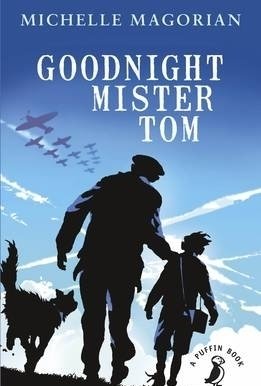


In September 1939, as Britain stands on the brink of the war, many young children from the cities are evacuated tot he countryside to escape an imminent German bombardment. Willie Beech, a boy from Deptford who is physically and emotionally abused by his mother, arrives at the home of Tom Oakley, a widower in his sixties who lives in the village of Little Weirwold. The boy is thinly clad, underfed and covered with painful bruises, and believes he is full of sin, a result of his upbringing by his mother, a domineering, insane, God-fearing widow.
"Mister Tom", as William christens his new guardian, is reclusive and bad-tempered, and as such is avoided by the community. Willie lives with him as his Mother wants him to live with someone who is either religious or lives next to a church. Though initially distant, he is touched after discovering William's home-life and treats him with kindness and understanding, helping to educate him. Under his care, William begins to thrive, forming a small circle of friends at school among his classmates including fellow-evacuee Zach. He also becomes proficient in drawing and dramatics. As William is changed by Tom, so is Tom transformed by William's presence in his home. It is revealed that Tom lost his wife and baby son to Scarlatina some 40 years previously, and he has become reclusive because of this.
The growing bond between William and Tom is threatened when William's mother requests that the boy returns to her in the city, telling him she is sick. At first, William thinks this will be a good thing, as he can be helpful to his mother. However, his mother is not pleased to learn the details of his time with Tom, feeling that he has not been disciplined properly. While William has been away, she has become pregnant and had a girl, but is neglecting the baby. After a bad reunion, where his mother becomes furious upon learning the details of her son's life with Tom, abhorring his association with the Jewish Zach among other things, she hits William and puts him in the under-stairs cupboard, chains him to the piping. William regains consciousness briefly to find himself in the cupboard – he has been stripped of his clothes, minus his underwear, and his ankle is twisted. He quietly sobs for Tom, before he falls asleep.
Back in Little Weirwold, Tom has a premonition that something is not right with William. Although he has never travelled beyond his immediate locality, he ventures into London and eventually locates William's neighbourhood of Deptford and his home. He persuades a local policeman to break down the door of the apparently empty home, to be greeted with a vile stench. They find William in the closet with the baby, who had also been locked under the stairs by William's mother and has now died. William is malnourished and badly bruised as he had been locked under the stairs for a number of days. William is hospitalised, but whilst there suffers horrific nightmares and is drugged simply to prevent his screams from disturbing other children. Tom is warned that it is likely that William will be taken to a children's home, and, unable to observe William's distress any longer, kidnaps him from the hospital and takes him back to Little Weirwold.
Back with Mister Tom, William is much damaged by his ordeal and is also blaming himself for the death of his sister as he had not been able to provide enough milk to feed her whilst locked away, and becomes very depressed. Later, when his favourite teacher Annie Hartridge has a baby, William is shocked to learn from Zach that a woman cannot conceive a child on her own, and realises that his mother was having a relationship with a man, even though she had previously told him that it was wrong for unmarried couples to live together or have children together (something which society in general had regarded as unacceptable at this time). Tom is traced by the authorities, who have come to tell William that his mother is dead, having committed suicide. They also offer him a place in a children's home, as they've been unable to trace any other relatives who may have been able to take care of him. Luckily the authorities realise that William has already found a good home and allow Tom to adopt him.
Tom, William and Zach then enjoy a holiday at the seaside village of Salmouth, where they stay in the house of a widow whose sons have been sent out to war. Zach then receives news that his father has been injured by a German bomb in London and he hurries home on the next train saying farewell to all his friends. Unfortunately this is the last time they see him. William later learns that Zach has been killed and is grief-stricken for some time, but his grief is later healed by another recluse, Geoffery Sanderton. Geoffery, a young man who had lost a leg during the war and takes William for private art lessons,recognises the signs of grief and gives William a pipe to paint along with a picture of two smiling young men. One of the men is Geoffery and he tells William about the loss of his own best friend, the other man in the picture and the owner of the pipe. This is when William starts to come to terms with Zach's death. Adding to this, Doctor Little, the village doctor, who was Zach's guardian while he was evacuated, is surprised but pleased when William asks to have Zach's bike. Through learning to ride it, William realises that Zach lives on inside him and he will never forget his wonderful companion that Zach was.
In the months following, William grows closer to Carrie, one of his friends. One night, on returning home to Tom (whom he now calls "Dad"), he thinks back on how much he has changed since arriving in Little Weirwold and realises that he is growing.
Goodnight Mr Tom Wiki.
Goodnight Mr Tom was published by Kestrel in 1981 and later on in that same year in the US by Harper and Row. The book won Author Michelle Magorian the annual Guardian Children's fiction prize. Magorian was also a runner up for the Carnegie Medal. The book has been adapted as a Movie, a play and a musical. The most recent theatrical adaption won the Laurence Olivier award for Best Entertainment.
I came across the book when I was 10/11 years old. I needed the book for English at primary school, since we needed to read the book and complete a series of assignments for our teacher. I have in the subsequent years read and re-read the book. The book is rather good and I recommand it for children from the ages of 9/10 upwards. The book is a good representation of what happened during WW2 in a fictional setting. And William and Mr Tom healing each other from what they both experienced (Tom loosing family to Scarlatina and William being abused by his mother). I give the book an 8/10.
"Mister Tom", as William christens his new guardian, is reclusive and bad-tempered, and as such is avoided by the community. Willie lives with him as his Mother wants him to live with someone who is either religious or lives next to a church. Though initially distant, he is touched after discovering William's home-life and treats him with kindness and understanding, helping to educate him. Under his care, William begins to thrive, forming a small circle of friends at school among his classmates including fellow-evacuee Zach. He also becomes proficient in drawing and dramatics. As William is changed by Tom, so is Tom transformed by William's presence in his home. It is revealed that Tom lost his wife and baby son to Scarlatina some 40 years previously, and he has become reclusive because of this.
The growing bond between William and Tom is threatened when William's mother requests that the boy returns to her in the city, telling him she is sick. At first, William thinks this will be a good thing, as he can be helpful to his mother. However, his mother is not pleased to learn the details of his time with Tom, feeling that he has not been disciplined properly. While William has been away, she has become pregnant and had a girl, but is neglecting the baby. After a bad reunion, where his mother becomes furious upon learning the details of her son's life with Tom, abhorring his association with the Jewish Zach among other things, she hits William and puts him in the under-stairs cupboard, chains him to the piping. William regains consciousness briefly to find himself in the cupboard – he has been stripped of his clothes, minus his underwear, and his ankle is twisted. He quietly sobs for Tom, before he falls asleep.
Back in Little Weirwold, Tom has a premonition that something is not right with William. Although he has never travelled beyond his immediate locality, he ventures into London and eventually locates William's neighbourhood of Deptford and his home. He persuades a local policeman to break down the door of the apparently empty home, to be greeted with a vile stench. They find William in the closet with the baby, who had also been locked under the stairs by William's mother and has now died. William is malnourished and badly bruised as he had been locked under the stairs for a number of days. William is hospitalised, but whilst there suffers horrific nightmares and is drugged simply to prevent his screams from disturbing other children. Tom is warned that it is likely that William will be taken to a children's home, and, unable to observe William's distress any longer, kidnaps him from the hospital and takes him back to Little Weirwold.
Back with Mister Tom, William is much damaged by his ordeal and is also blaming himself for the death of his sister as he had not been able to provide enough milk to feed her whilst locked away, and becomes very depressed. Later, when his favourite teacher Annie Hartridge has a baby, William is shocked to learn from Zach that a woman cannot conceive a child on her own, and realises that his mother was having a relationship with a man, even though she had previously told him that it was wrong for unmarried couples to live together or have children together (something which society in general had regarded as unacceptable at this time). Tom is traced by the authorities, who have come to tell William that his mother is dead, having committed suicide. They also offer him a place in a children's home, as they've been unable to trace any other relatives who may have been able to take care of him. Luckily the authorities realise that William has already found a good home and allow Tom to adopt him.
Tom, William and Zach then enjoy a holiday at the seaside village of Salmouth, where they stay in the house of a widow whose sons have been sent out to war. Zach then receives news that his father has been injured by a German bomb in London and he hurries home on the next train saying farewell to all his friends. Unfortunately this is the last time they see him. William later learns that Zach has been killed and is grief-stricken for some time, but his grief is later healed by another recluse, Geoffery Sanderton. Geoffery, a young man who had lost a leg during the war and takes William for private art lessons,recognises the signs of grief and gives William a pipe to paint along with a picture of two smiling young men. One of the men is Geoffery and he tells William about the loss of his own best friend, the other man in the picture and the owner of the pipe. This is when William starts to come to terms with Zach's death. Adding to this, Doctor Little, the village doctor, who was Zach's guardian while he was evacuated, is surprised but pleased when William asks to have Zach's bike. Through learning to ride it, William realises that Zach lives on inside him and he will never forget his wonderful companion that Zach was.
In the months following, William grows closer to Carrie, one of his friends. One night, on returning home to Tom (whom he now calls "Dad"), he thinks back on how much he has changed since arriving in Little Weirwold and realises that he is growing.
Goodnight Mr Tom Wiki.
Goodnight Mr Tom was published by Kestrel in 1981 and later on in that same year in the US by Harper and Row. The book won Author Michelle Magorian the annual Guardian Children's fiction prize. Magorian was also a runner up for the Carnegie Medal. The book has been adapted as a Movie, a play and a musical. The most recent theatrical adaption won the Laurence Olivier award for Best Entertainment.
I came across the book when I was 10/11 years old. I needed the book for English at primary school, since we needed to read the book and complete a series of assignments for our teacher. I have in the subsequent years read and re-read the book. The book is rather good and I recommand it for children from the ages of 9/10 upwards. The book is a good representation of what happened during WW2 in a fictional setting. And William and Mr Tom healing each other from what they both experienced (Tom loosing family to Scarlatina and William being abused by his mother). I give the book an 8/10.

Purple Phoenix Games (2266 KP) rated Vendarla in Tabletop Games
Oct 6, 2020

The kobolds and dragons have taken over the mountain that once belonged to the noble dwarves in this land. The Queen has decided it’s time to take it back. She needs as many fine-crafted armory items as possible using the materials found in the mountain, but she will be pleased with the first craftsperson to finish three of them for her army. Are you prepared to brave the mountain’s dangers in order to secure the materials needed to craft her required items, or will the dragons and kobolds prove too difficult for you to overcome? This is Vendarla.
Vendarla is a press-your-luck, hand management, set collection card game where players are working against one another to collect the proper materials to craft three Queen’s Armory items while avoiding kobold warriors and thieves, as well as several dragons guarding the mountain.
DISCLAIMER: We were provided a prototype copy of this game for the purposes of this review. These are preview copy components, and the final components may be different from these shown. Also, it is not my intention to detail every rule in the game, as there are just too many. You are invited to back the game through the upcoming Kickstarter campaign, order from your FLGS, or purchase through any retailers stocking it after fulfillment. -T
To setup, follow the rulebook advice for your number of players, but generally Vendarla will be setup on the table in different areas: the Market, the Mountain, the Queen’s Armory, and the gold stash. Each player will receive five gold, and their choice of either two or three (depending on play count) Queen’s Armory items to begin working on during the game. Determine first player by giving the dragon token, shown below, to the player who most recently watched a dragon movie and the game is ready to begin!
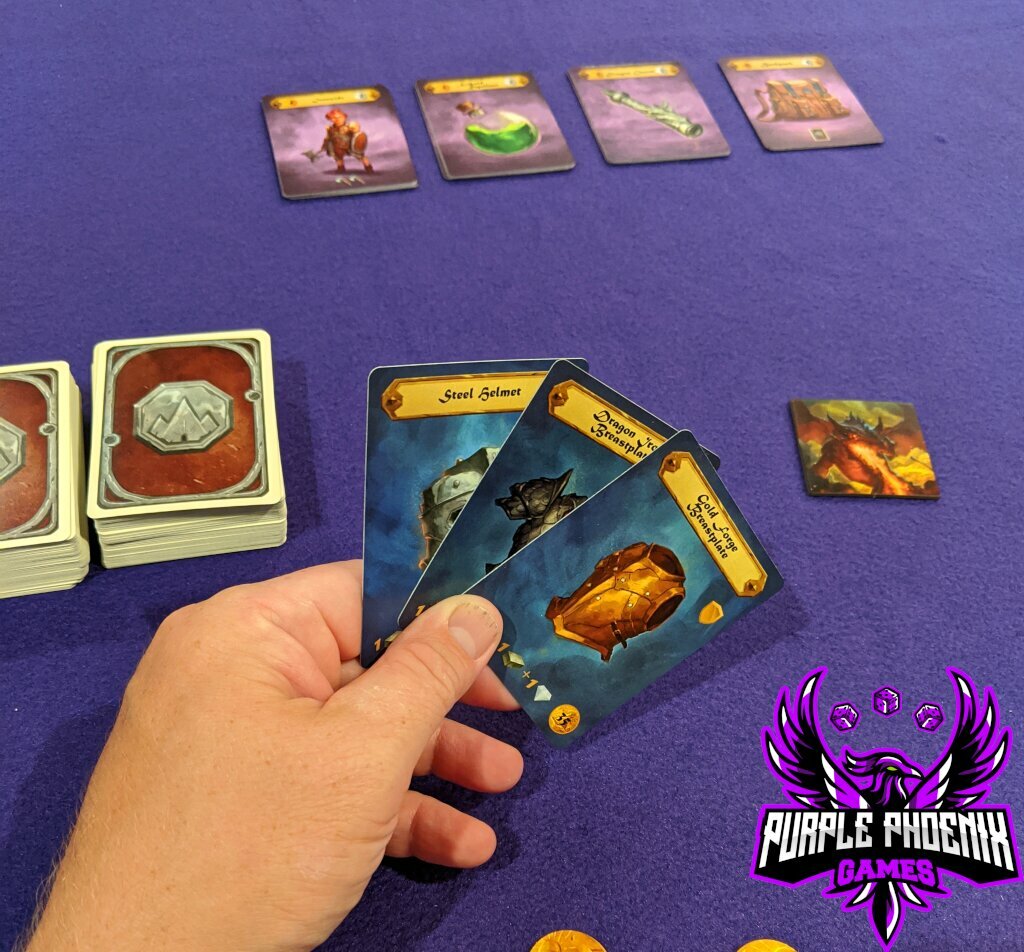
On their turn a player will choose whether to visit the Market or the Mountain. When a player visits the Market, they may choose to purchase any previously sold materials, sell their own materials, purchase items for use in mountain runs, or exchange Queen’s Armory item cards.
Should the player instead wish to visit the Mountain, they will flip over a mountain card from the giant stack of mountain cards and decide how to continue. If a material card was flipped, the player may choose to take that card or continue flipping cards. This action can be replicated until up to 10 cards have been flipped. The active player will then need to choose a card (or two if they have a Backpack equipped) to place face-up in their play area. Each other player at the table, in player order, will then be allowed to take a material or gold card from the flipped offering by paying the active player one gold.
Should the active player flip over a second kobold warrior for the turn, they must stop flipping unless they had previously purchased from the market a kobold repellent or Ironsides (dwarven warrior) to combat it. If the kobold warrior, or the kobold thief for that matter, is overcome by ANY player then the active player may continue flipping cards from the mountain. Should the player flip a dragon card over, they may use a previously purchased Dragon Charm to charm the dragon back to sleep or taking the dragon card into their play area and suffering a negative 10 points at game end.
Play continues in this fashion of active player visiting the Market to take actions for themselves only, or visiting the Mountain to excavate materials to be used to craft their Queen’s Armory items and opponents also being able to follow the action using their flipped materials. Once a player has the proper materials to craft their Queen’s Armory items on their turn, they may, and the player who crafts their third item will trigger the end of the game. Players will finish the turn, count up their points and a winner will be declared!
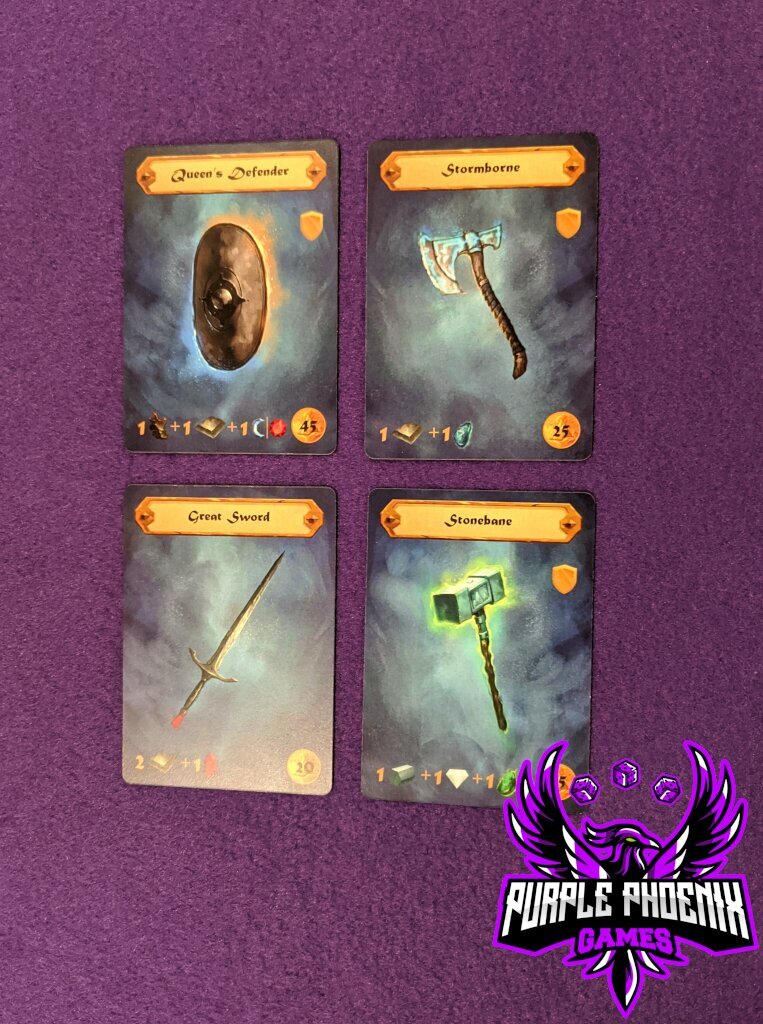
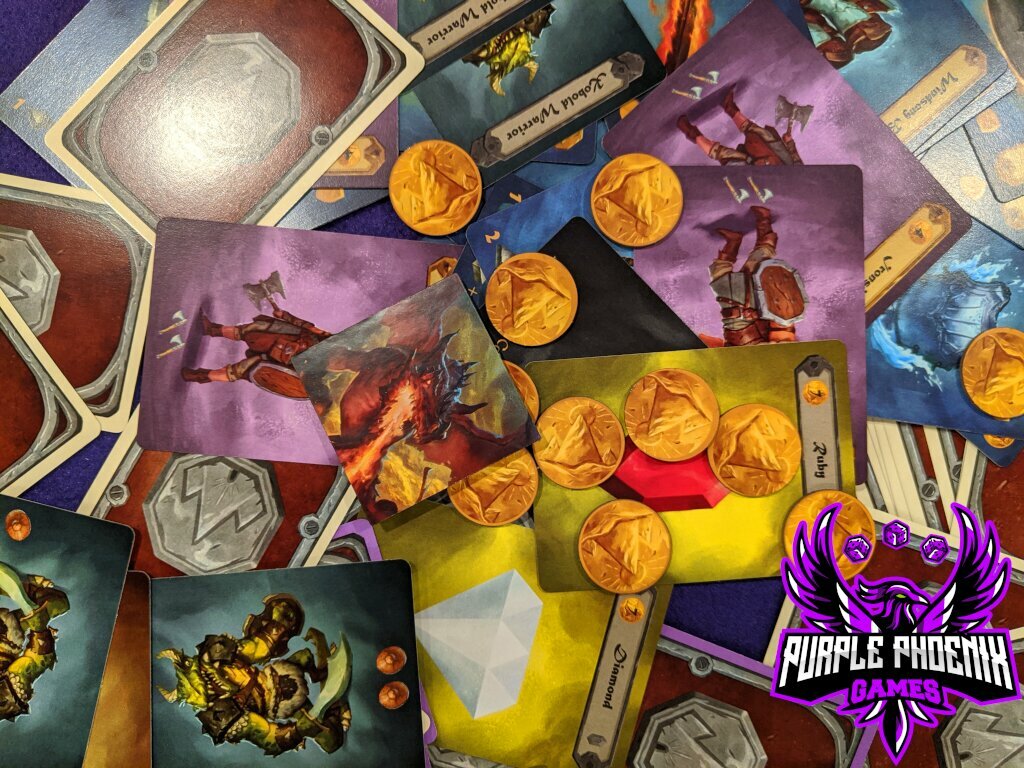
Components. Again, this is a prototype copy of the game, so what we were provided may or may not be the same as the final version of the game. That said, this game is a ton of cards, and some gold coins. The card are fine quality, but I would probably want to sleeve them, as they are handled a bit and are a little thin. The gold coins are thick cardboard and look great. Speaking of looking great, the art in Vendarla is really really good. I love the art style used and the colors are vibrant and lovely. Though I had no problems with the iconography, my wife did a few times. Luckily, handy reference cards are included and that solved any questions we had with iconography. All in all the components are good, and the game looks great.
The “flip cards until you have to stop, choose to stop, or flip over something bad” is a mechanic that is used in many games, and in Vendarla I truly enjoy it because for every “bad” card another card may be able to neutralize it. And the best part about that is the neutralizing card can come from ANY player. Why would someone want to lull the dragon back to sleep on someone else’s turn? Well perhaps a material was flipped that they need to complete an item craft and they want to make sure they have a chance to get it for one measly coin. I love that. I also love games that include ways for other players to be involved in each turn taken. This isn’t a “multiplayer solitaire” game. Yeah you could go to the restroom during other players’ turns, but you may miss out on that elusive gem you need for your items.
I found that playing this I had to find a good balance between keeping my Market items stocked and going to the Mountain to grab materials. There may be several turns in a row, especially in the beginning of the game, where your turns are just flipping over a kobold warrior for which you are unprepared to handle and forfeiting your turn, but as the game progresses you will be hopefully be outfitting yourself appropriately.
While this game seems very involved and you may think there are many tiny rules when reading the rulebook, it plays really quickly. In my two-player games with my wife the games were 30 minutes or less, INCLUDING the teach the first time.
So even though I have a prototype copy of the game, I will certainly be holding onto this one and pulling it out quite a bit. When you can get a great play experience out of 30 minutes and feel like you did something interesting, I feel that’s a sign of a great game. If you are looking for a game that fills a hole in your collection (or even want to replace Port Royal, as I did), please check out the Kickstarter campaign for Vendarla launching October 27, 2020. If you like fantasy themed card games with press your luck and set collection, this one is for you!
Vendarla is a press-your-luck, hand management, set collection card game where players are working against one another to collect the proper materials to craft three Queen’s Armory items while avoiding kobold warriors and thieves, as well as several dragons guarding the mountain.
DISCLAIMER: We were provided a prototype copy of this game for the purposes of this review. These are preview copy components, and the final components may be different from these shown. Also, it is not my intention to detail every rule in the game, as there are just too many. You are invited to back the game through the upcoming Kickstarter campaign, order from your FLGS, or purchase through any retailers stocking it after fulfillment. -T
To setup, follow the rulebook advice for your number of players, but generally Vendarla will be setup on the table in different areas: the Market, the Mountain, the Queen’s Armory, and the gold stash. Each player will receive five gold, and their choice of either two or three (depending on play count) Queen’s Armory items to begin working on during the game. Determine first player by giving the dragon token, shown below, to the player who most recently watched a dragon movie and the game is ready to begin!
On their turn a player will choose whether to visit the Market or the Mountain. When a player visits the Market, they may choose to purchase any previously sold materials, sell their own materials, purchase items for use in mountain runs, or exchange Queen’s Armory item cards.
Should the player instead wish to visit the Mountain, they will flip over a mountain card from the giant stack of mountain cards and decide how to continue. If a material card was flipped, the player may choose to take that card or continue flipping cards. This action can be replicated until up to 10 cards have been flipped. The active player will then need to choose a card (or two if they have a Backpack equipped) to place face-up in their play area. Each other player at the table, in player order, will then be allowed to take a material or gold card from the flipped offering by paying the active player one gold.
Should the active player flip over a second kobold warrior for the turn, they must stop flipping unless they had previously purchased from the market a kobold repellent or Ironsides (dwarven warrior) to combat it. If the kobold warrior, or the kobold thief for that matter, is overcome by ANY player then the active player may continue flipping cards from the mountain. Should the player flip a dragon card over, they may use a previously purchased Dragon Charm to charm the dragon back to sleep or taking the dragon card into their play area and suffering a negative 10 points at game end.
Play continues in this fashion of active player visiting the Market to take actions for themselves only, or visiting the Mountain to excavate materials to be used to craft their Queen’s Armory items and opponents also being able to follow the action using their flipped materials. Once a player has the proper materials to craft their Queen’s Armory items on their turn, they may, and the player who crafts their third item will trigger the end of the game. Players will finish the turn, count up their points and a winner will be declared!
Components. Again, this is a prototype copy of the game, so what we were provided may or may not be the same as the final version of the game. That said, this game is a ton of cards, and some gold coins. The card are fine quality, but I would probably want to sleeve them, as they are handled a bit and are a little thin. The gold coins are thick cardboard and look great. Speaking of looking great, the art in Vendarla is really really good. I love the art style used and the colors are vibrant and lovely. Though I had no problems with the iconography, my wife did a few times. Luckily, handy reference cards are included and that solved any questions we had with iconography. All in all the components are good, and the game looks great.
The “flip cards until you have to stop, choose to stop, or flip over something bad” is a mechanic that is used in many games, and in Vendarla I truly enjoy it because for every “bad” card another card may be able to neutralize it. And the best part about that is the neutralizing card can come from ANY player. Why would someone want to lull the dragon back to sleep on someone else’s turn? Well perhaps a material was flipped that they need to complete an item craft and they want to make sure they have a chance to get it for one measly coin. I love that. I also love games that include ways for other players to be involved in each turn taken. This isn’t a “multiplayer solitaire” game. Yeah you could go to the restroom during other players’ turns, but you may miss out on that elusive gem you need for your items.
I found that playing this I had to find a good balance between keeping my Market items stocked and going to the Mountain to grab materials. There may be several turns in a row, especially in the beginning of the game, where your turns are just flipping over a kobold warrior for which you are unprepared to handle and forfeiting your turn, but as the game progresses you will be hopefully be outfitting yourself appropriately.
While this game seems very involved and you may think there are many tiny rules when reading the rulebook, it plays really quickly. In my two-player games with my wife the games were 30 minutes or less, INCLUDING the teach the first time.
So even though I have a prototype copy of the game, I will certainly be holding onto this one and pulling it out quite a bit. When you can get a great play experience out of 30 minutes and feel like you did something interesting, I feel that’s a sign of a great game. If you are looking for a game that fills a hole in your collection (or even want to replace Port Royal, as I did), please check out the Kickstarter campaign for Vendarla launching October 27, 2020. If you like fantasy themed card games with press your luck and set collection, this one is for you!



It’s about 6 weeks since I finished season 3 of this incredible show from Netflix. I have been putting off writing about it, because I wanted to let it settle. And also because I have a hell of a lot to say about it. I am gonna try and be comprehensive, without giving too much away in terms of spoilers. I am going to assume you have seen some of it, or have heard the hype, at least. If you haven’t got around to it yet, then all I can say is: what are you doing with your entertainment life? Get on it, now! It is as ubiquitous as Breaking Bad, The Sopranos, or The Wire, and sits comfortably in that group for consistent quality and lasting impressions.
Season one first aired in July 2017. I heard good things very quickly, albeit with some hesitation. It was dark, sometimes literally, utilising a trademark washed-out effect visually, that instantly gave it a bleak feel, which was not to everyone’s taste, but I loved. General consensus had it that the writing was great; the situation and concept drew you in from minute one. In fact, I believe the first episode is one of the best pilots seen in the last decade, bar none. It made no bones about what we were to expect from the start: intelligent dialogue, a lot of tension and a hefty chunk of jaw-dropping brutality.
Jason Bateman has enjoyed a remarkable career in the last ten years, putting behind him a patchy child-star and B actor tag, to emerge as the go to guy for deadpan comedy pathos, rivalled only, perhaps by Paul Rudd. Ozark is Bateman’s show in many regards, fulfilling his ambition to produce and direct as well as act, and he is a superb central pivot to the show, as hard nosed accountant turned drug cartel puppet, Marty Byrde. He excels in all three roles on every level, and if you are a fan of his lighter work, chances are you will fall head over heels for his dubious charm in Ozark.
But, whilst he is the lynchpin of the show, and a compelling character in every subtley drawn way, there is so much more to the show than him. Laura Linney, as his initially timid wife, Wendy, is never less than interesting. Perfectly cast, utilising her skill for portraying strong yet flawed women at every turn; she grows into a character so full of contradictions and conflicts, that you change your mind whether you like her or not almost episode to episode. Time will tell, but she may yet emerge in season 4 as the most fully realised character in the show, depending on how her arc ends. The potential is huge, and despite a CV of solid roles over the years, this could be the defining work of her career. It’s already close.
Then there are the kids in this very modern nuclear family, Charlotte and Jonah, played by Sofia Hublitz and Skylar Gaetner. These characters could have been set decoration in lesser hands, but in this show they are given the chance to grow and become pivotal to the ongoing story in remarkable ways. There is nothing stereotypical about either of them, and the two young actors more than rise to the challenge of matching the more experienced pros. Many a show has been ruined by miscast youths that can’t match the more sophisticated adult content, but I remain impressed by these two, both as characters and actors. Again, they have the scope to go into very fascinating places within the story when season four emerges.
The true strength of the show, however, may lie in its consistently solid output of great supporting characters. Julia Gartner, as older than her years redneck with ambitions to rise above it, Ruth, has garnered all the plaudits, quite rightly. You grow to like her in usual ways. At first mistrusting her and then ended up 100% on her side. At times, she is the only one making sense and making the right decisions. The continual ways she is forced to grow up fast and bounce back from traumatic situations is so beautifully handled, that when she does show her vulnerable side it is at once shocking and heart- rending.
A lot of characters come and go; some forever, much quicker than you anticipated… for the sake of non spoilers, I won’t go into a who’s who here, but many meet a very sticky end, and it isn’t always who you think it will be. Especially by season 3, which largely drops the dark filter on the camera lens, but cranks up the body count exponentially, you start to feel that no one is safe, and anyone can go at any minute. Except, when they do, and why they do, is so well interwoven into the plot that you forget to look for the sucker punch and are still left with your jaw hitting the floor.
There were moments on season three where I was actually talking to the screen, begging certain characters not to do what they were doing; a sure sign of complete emotional investment. A big part of that was the addition of Tom Pelphrey as Wendy’s brother, who from the start puts a genius new spin on the family dynamic, becoming intertwined in interesting and ultimately devastating ways. His character takes a while to warm up, but by mid-season he is guaranteed to be your favourite person in it. And in episode 9, he delivers a monologue and a performance that I would quite honestly say is one of the absolute best things I’ve ever seen in a TV show.
I was moderately outraged then, to see he wasn’t rewarded with at least a nomination for the 2020 Emmy Awards. An oversight rather than a snub, for sure, but when Bateman, Linney and Garner all got nominated and he didn’t it felt like a real injustice, and a lot of online vitriol reflected that. Such a shame, especially if it turns out to be the best work he ever does – and I can’t imagine anything better, but who knows where he will go from here.
By the end of season 3 I felt exhausted. Each episode is slightly over an hour long, but can feel like you just watched a self contained movie. The quality certainly feels that way. I was both elated and shocked by the way it was left on a cliff edge, and relieved that I could take a break from it now. Although, waiting potentially up to two years to see how the story ends now seems like a long wait.
And it will be the end, one way or another, as the production announced season four will be the last, however stretching from 10 to 14 episodes, divided into 2 halves of 7; a trick Breaking Bad also did in its fifth and final season. I love that idea. Knowing the finish line is coming, rather than having it stretch out for years until the ideas and the momentum have long run out. Dexter springs to mind: a show that should have ended two seasons earlier, for sure.
I can really only see two ways it can go from here: either everyone dies, and that seems quite likely right now, or they win big. There simply is no inbetween I can imagine that would be satisfying. And I’m on the fence which I will prefer… The only certainty is that I will be very excited indeed when it comes around. And shows that make you feel that way are rare. In the meantime, I’m gonna watch a lot of comedies. I need a laugh after this…
Season one first aired in July 2017. I heard good things very quickly, albeit with some hesitation. It was dark, sometimes literally, utilising a trademark washed-out effect visually, that instantly gave it a bleak feel, which was not to everyone’s taste, but I loved. General consensus had it that the writing was great; the situation and concept drew you in from minute one. In fact, I believe the first episode is one of the best pilots seen in the last decade, bar none. It made no bones about what we were to expect from the start: intelligent dialogue, a lot of tension and a hefty chunk of jaw-dropping brutality.
Jason Bateman has enjoyed a remarkable career in the last ten years, putting behind him a patchy child-star and B actor tag, to emerge as the go to guy for deadpan comedy pathos, rivalled only, perhaps by Paul Rudd. Ozark is Bateman’s show in many regards, fulfilling his ambition to produce and direct as well as act, and he is a superb central pivot to the show, as hard nosed accountant turned drug cartel puppet, Marty Byrde. He excels in all three roles on every level, and if you are a fan of his lighter work, chances are you will fall head over heels for his dubious charm in Ozark.
But, whilst he is the lynchpin of the show, and a compelling character in every subtley drawn way, there is so much more to the show than him. Laura Linney, as his initially timid wife, Wendy, is never less than interesting. Perfectly cast, utilising her skill for portraying strong yet flawed women at every turn; she grows into a character so full of contradictions and conflicts, that you change your mind whether you like her or not almost episode to episode. Time will tell, but she may yet emerge in season 4 as the most fully realised character in the show, depending on how her arc ends. The potential is huge, and despite a CV of solid roles over the years, this could be the defining work of her career. It’s already close.
Then there are the kids in this very modern nuclear family, Charlotte and Jonah, played by Sofia Hublitz and Skylar Gaetner. These characters could have been set decoration in lesser hands, but in this show they are given the chance to grow and become pivotal to the ongoing story in remarkable ways. There is nothing stereotypical about either of them, and the two young actors more than rise to the challenge of matching the more experienced pros. Many a show has been ruined by miscast youths that can’t match the more sophisticated adult content, but I remain impressed by these two, both as characters and actors. Again, they have the scope to go into very fascinating places within the story when season four emerges.
The true strength of the show, however, may lie in its consistently solid output of great supporting characters. Julia Gartner, as older than her years redneck with ambitions to rise above it, Ruth, has garnered all the plaudits, quite rightly. You grow to like her in usual ways. At first mistrusting her and then ended up 100% on her side. At times, she is the only one making sense and making the right decisions. The continual ways she is forced to grow up fast and bounce back from traumatic situations is so beautifully handled, that when she does show her vulnerable side it is at once shocking and heart- rending.
A lot of characters come and go; some forever, much quicker than you anticipated… for the sake of non spoilers, I won’t go into a who’s who here, but many meet a very sticky end, and it isn’t always who you think it will be. Especially by season 3, which largely drops the dark filter on the camera lens, but cranks up the body count exponentially, you start to feel that no one is safe, and anyone can go at any minute. Except, when they do, and why they do, is so well interwoven into the plot that you forget to look for the sucker punch and are still left with your jaw hitting the floor.
There were moments on season three where I was actually talking to the screen, begging certain characters not to do what they were doing; a sure sign of complete emotional investment. A big part of that was the addition of Tom Pelphrey as Wendy’s brother, who from the start puts a genius new spin on the family dynamic, becoming intertwined in interesting and ultimately devastating ways. His character takes a while to warm up, but by mid-season he is guaranteed to be your favourite person in it. And in episode 9, he delivers a monologue and a performance that I would quite honestly say is one of the absolute best things I’ve ever seen in a TV show.
I was moderately outraged then, to see he wasn’t rewarded with at least a nomination for the 2020 Emmy Awards. An oversight rather than a snub, for sure, but when Bateman, Linney and Garner all got nominated and he didn’t it felt like a real injustice, and a lot of online vitriol reflected that. Such a shame, especially if it turns out to be the best work he ever does – and I can’t imagine anything better, but who knows where he will go from here.
By the end of season 3 I felt exhausted. Each episode is slightly over an hour long, but can feel like you just watched a self contained movie. The quality certainly feels that way. I was both elated and shocked by the way it was left on a cliff edge, and relieved that I could take a break from it now. Although, waiting potentially up to two years to see how the story ends now seems like a long wait.
And it will be the end, one way or another, as the production announced season four will be the last, however stretching from 10 to 14 episodes, divided into 2 halves of 7; a trick Breaking Bad also did in its fifth and final season. I love that idea. Knowing the finish line is coming, rather than having it stretch out for years until the ideas and the momentum have long run out. Dexter springs to mind: a show that should have ended two seasons earlier, for sure.
I can really only see two ways it can go from here: either everyone dies, and that seems quite likely right now, or they win big. There simply is no inbetween I can imagine that would be satisfying. And I’m on the fence which I will prefer… The only certainty is that I will be very excited indeed when it comes around. And shows that make you feel that way are rare. In the meantime, I’m gonna watch a lot of comedies. I need a laugh after this…

Heather Cranmer (2721 KP) rated Don't Stop Believin' in Books
May 28, 2019
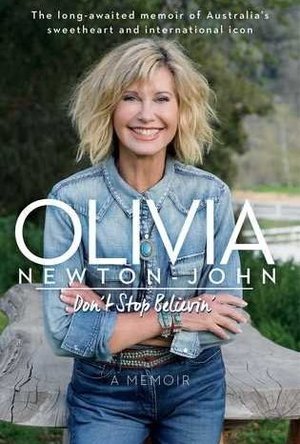

I was obsessed with Olivia Newton-John as a little girl. As a little girl, I knew all of her songs by heart, and I had watched all of her movies over and over. I do admit that as I grew up, my obsession faded. However, when I saw Olivia's autobiography, Don't Stop Believin', on the shelf at my local library, I decided to give it a read. While it was enjoyable, it just came across as kind of preachy.
Olivia Newton-John rose to fame in the United States as the character of Sandy in the movie Grease. She also had a bunch of hit songs and records afterwards. Olivia's autobiography does mention her rise to fame although I felt as if there wasn't enough time spent on her rise to fame. She does write about her time with Grease and other films as well as recording her songs throughout the book. I felt the movies and songs were written about well.
We get a taste of her life as a child in England and Australia, although I felt she didn't discuss her pre-fame life too much. I would have liked to read more about her childhood instead of just being rushed into when she started performing. I know Olivia Newton-John likes to keep her private life out of the limelight, but when writing an autobiography, it's important to give the reader a little more details than what Don't Stop Believin' gave us.
There was so much name dropping throughout this book! While I understand that famous people know other famous people, sometimes I felt as if Olivia was dropping names just for show instead of because it fit the story. You have a lot of famous friends. We get it!
Another thing that annoyed me about the book was how some parts seemed like an advertisement for her Olivia Newton-John Cancer Wellness and Research Centre as well as for her husband, John Easterling's, herb company. I know she's done so much for her cancer center, (which I give her mad props for), but she goes on and on about how great and lovely of a place it was especially after she was an inpatient there. Of course the staff would treat her better when her name is on the building! There's more than one chapter devoted to how great the place is. I'm sure it is lovely, but I felt like I didn't need to a chapter (and more) about how great it is. As for her husband's herb company, she went on and on towards the end of the book how his herbs really helped her out which is great, but again, does the reader really need the specifics and being told over and over again how helpful it was?
The major thing that annoyed me was how preachy Don't Stop Believin' was in a lot of chapters. In fact, it made me feel guilty sometimes that I rely on modern medicine. Olivia writes how she'd rather take the natural approach to fighting off viruses and diseases, and I get that because I don't like to take medicine needlessly either, but sometimes, it's the best thing. However, I just felt that Olivia was berating those who choose to go the medicinal route. I felt like she was implying that natural remedies work better than modern medicine. This can be dangerous especially if someone gets off their medicines they need to survive to try the natural approach. People should always discuss any changes of medication with their doctors.
To me, Don't Stop Believin' writes like someone who's always been privileged and sheltered throughout their life. A lot of it feels like Olivia Newton-John is out of touch with reality and like she's living in La-La Land. I just found it hard to relate to her throughout the book. Yes, she has gone through some hardships such as deaths in the family, her cancer diagnoses, and her ex-boyfriend disappearing, but for the most part, her autobiography is just too sunshine and rainbows for me to truly relate.
Don't Stop Believin' flows beautifully though, and the writing is done very well, so it has that going for it. I did find myself enjoying the book most of the time when Olivia wasn't been preachy or advertising something. There were some interesting tidbits about her life throughout the book.
Trigger warnings include some profanity use, death, cancer, drinking, and smoking.
Overall, Don't Stop Believin' isn't a bad book, quite the contrary. It's just a bit too hippie dippy for me to have truly enjoyed it to its fullest. I did find the book interesting though despite some flaws. I would recommend Don't Stop Believin' by Olivia Newton-John especially to those who have been diagnosed with cancer as this book does come with a bunch of positivity when it comes to dealing with cancer.
Olivia Newton-John rose to fame in the United States as the character of Sandy in the movie Grease. She also had a bunch of hit songs and records afterwards. Olivia's autobiography does mention her rise to fame although I felt as if there wasn't enough time spent on her rise to fame. She does write about her time with Grease and other films as well as recording her songs throughout the book. I felt the movies and songs were written about well.
We get a taste of her life as a child in England and Australia, although I felt she didn't discuss her pre-fame life too much. I would have liked to read more about her childhood instead of just being rushed into when she started performing. I know Olivia Newton-John likes to keep her private life out of the limelight, but when writing an autobiography, it's important to give the reader a little more details than what Don't Stop Believin' gave us.
There was so much name dropping throughout this book! While I understand that famous people know other famous people, sometimes I felt as if Olivia was dropping names just for show instead of because it fit the story. You have a lot of famous friends. We get it!
Another thing that annoyed me about the book was how some parts seemed like an advertisement for her Olivia Newton-John Cancer Wellness and Research Centre as well as for her husband, John Easterling's, herb company. I know she's done so much for her cancer center, (which I give her mad props for), but she goes on and on about how great and lovely of a place it was especially after she was an inpatient there. Of course the staff would treat her better when her name is on the building! There's more than one chapter devoted to how great the place is. I'm sure it is lovely, but I felt like I didn't need to a chapter (and more) about how great it is. As for her husband's herb company, she went on and on towards the end of the book how his herbs really helped her out which is great, but again, does the reader really need the specifics and being told over and over again how helpful it was?
The major thing that annoyed me was how preachy Don't Stop Believin' was in a lot of chapters. In fact, it made me feel guilty sometimes that I rely on modern medicine. Olivia writes how she'd rather take the natural approach to fighting off viruses and diseases, and I get that because I don't like to take medicine needlessly either, but sometimes, it's the best thing. However, I just felt that Olivia was berating those who choose to go the medicinal route. I felt like she was implying that natural remedies work better than modern medicine. This can be dangerous especially if someone gets off their medicines they need to survive to try the natural approach. People should always discuss any changes of medication with their doctors.
To me, Don't Stop Believin' writes like someone who's always been privileged and sheltered throughout their life. A lot of it feels like Olivia Newton-John is out of touch with reality and like she's living in La-La Land. I just found it hard to relate to her throughout the book. Yes, she has gone through some hardships such as deaths in the family, her cancer diagnoses, and her ex-boyfriend disappearing, but for the most part, her autobiography is just too sunshine and rainbows for me to truly relate.
Don't Stop Believin' flows beautifully though, and the writing is done very well, so it has that going for it. I did find myself enjoying the book most of the time when Olivia wasn't been preachy or advertising something. There were some interesting tidbits about her life throughout the book.
Trigger warnings include some profanity use, death, cancer, drinking, and smoking.
Overall, Don't Stop Believin' isn't a bad book, quite the contrary. It's just a bit too hippie dippy for me to have truly enjoyed it to its fullest. I did find the book interesting though despite some flaws. I would recommend Don't Stop Believin' by Olivia Newton-John especially to those who have been diagnosed with cancer as this book does come with a bunch of positivity when it comes to dealing with cancer.

Movie Metropolis (309 KP) rated X-Men: Dark Phoenix (2019) in Movies
Jun 10, 2019 (Updated Jun 10, 2019)
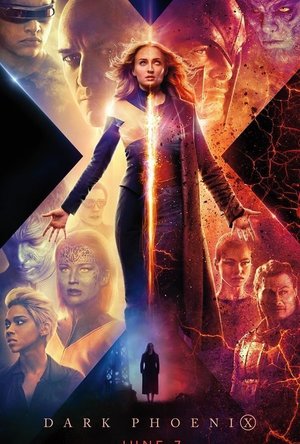

Goodbye Normal Jean
It would be easy to write off X-Men: Dark Phoenix as a complete and utter disaster. With the departure of Bryan Singer (again) from the franchise, first-time director Simon Kinberg taking his place and rumours of costly reshoots pushing the budget north of $200million, things weren’t looking good for this adaptation of the popular Marvel comic.
Let’s not forget that the last time Fox tried to adapt this storyline we ended up with 2006’s The Last Stand, and the less said about that the better. Looking back over the last 20 years, the X-Men’s film franchise history has been chequered to say the least.
Nevertheless, this particular timeline that started with Matthew Vaughn’s adequate First Class, followed up by the excellent Days of Future Past and the flabby Apocalypse ends with Dark Phoenix. But is it worthy of your consideration?
This is the story of one of the X-Men’s most beloved characters, Jean Grey (Sophie Turner), as she evolves into the iconic Phoenix. During a rescue mission in space, Jean is hit by a cosmic force that transforms her into one of the most powerful mutants of all. Wrestling with this increasingly unstable power as well as her own personal demons, Jean spirals out of control, tearing the X-Men family apart and threatening to destroy the very fabric of our planet.
First things first – this is not a bad film. Yes, you heard me right. Leagues above Apocalypse and much better than The Last Stand, Dark Phoenix is a film that has been let down by catastrophically poor marketing. It’s not perfect, as we’ll discover in this review, but it tries a different approach, and for that it should be applauded.
For this reviewer, the modern day cast of characters has always been a weak spot for the series and that doesn’t really change in Dark Phoenix. James McAvoy remains miscast as Charles Xavier, especially since packing on the muscle for this Glass, but he performs much better here than he did in its predecessor. His transition into egotistical maniac, obsessed by the celebrity status the X-Men have acquired at the outset of the film is an intriguing diversion from where he was at the end of Apocalypse.
The younger cast are more likeable. Kodi Smitt-McPhee’s portrayal of Nightcrawler is fabulous and he gets more to do this time around. Tye Sheridan is great as young Cyclops and Evan Peters’ Quicksilver remains a highlight, though it’s unfortunate he’s cast aside relatively quickly – for fans of his set pieces from the previous two films, you’ll be disappointed here. Michael Fassbender and Nicholas Hoult bring their a-games, but they even seem a little bored by what’s going on. “You’re always sorry, Charles. And there’s always a speech. But nobody cares anymore!” bites Michael Fassbender at one point in the film – perhaps he’s onto something?
The first hour is perhaps the best the series has been since Days of Future Past
Of the female cast, Sophie Turner does her best with the material she’s given, and her Jean Grey is full of anger, angst and melancholy. The script struggles to provide her with any other emotion, but she’s a pleasing protagonist for the most part. Unfortunately, Jennifer Lawrence completely phones in her performance as Mystique and Jessica Chastain’s horrifically underwritten villain wastes a fabulous actor in a thankless role – much like Oscar Issac in Apocalypse.
With reports of heavy reshoots, you’d be forgiven for thinking that the film would end up a royal mess. Thankfully, the first hour is perhaps the best the series has been since Days of Future Past. Focusing on character development rather than all-out action, it’s a pleasing change and one which is more than welcome. Unfortunately, as time ticks away, the film loses all semblance of sanity and becomes muddled as it steamrolls towards an underwhelming climax.
And despite the reported budget of $200million, some of the shot choices and outfits feel cheap. It’s clear director Simon Kinberg is a fan of the series, but the X-Men costumes are bland, ill-fitting and a world away from what we’ve seen before. Closer to the comics they may be, but that’s not always a good thing. Elsewhere, the film feels cut-rate, almost TV-movie like and that’s a real shame because the special effects are top-notch. Mercifully, Hans Zimmer’s score is wonderful. The soaring orchestral soundtrack works brilliantly with the film – it’s probably the best music in the series to date.
Overall, X-Men: Dark Phoenix has been a victim of poor marketing with trailers that spoilt perhaps the most pivotal moment of the film (which we won’t spoil here). Nevertheless, the first hour is great and the special effects provide the film with some thrilling set pieces. It’s a shame then that the film offers up nothing new to the table despite some committed performances – this Phoenix just doesn’t quite rise to the occasion.
https://moviemetropolis.net/2019/06/07/x-men-dark-phoenix-review-goodbye-normal-jean/
Let’s not forget that the last time Fox tried to adapt this storyline we ended up with 2006’s The Last Stand, and the less said about that the better. Looking back over the last 20 years, the X-Men’s film franchise history has been chequered to say the least.
Nevertheless, this particular timeline that started with Matthew Vaughn’s adequate First Class, followed up by the excellent Days of Future Past and the flabby Apocalypse ends with Dark Phoenix. But is it worthy of your consideration?
This is the story of one of the X-Men’s most beloved characters, Jean Grey (Sophie Turner), as she evolves into the iconic Phoenix. During a rescue mission in space, Jean is hit by a cosmic force that transforms her into one of the most powerful mutants of all. Wrestling with this increasingly unstable power as well as her own personal demons, Jean spirals out of control, tearing the X-Men family apart and threatening to destroy the very fabric of our planet.
First things first – this is not a bad film. Yes, you heard me right. Leagues above Apocalypse and much better than The Last Stand, Dark Phoenix is a film that has been let down by catastrophically poor marketing. It’s not perfect, as we’ll discover in this review, but it tries a different approach, and for that it should be applauded.
For this reviewer, the modern day cast of characters has always been a weak spot for the series and that doesn’t really change in Dark Phoenix. James McAvoy remains miscast as Charles Xavier, especially since packing on the muscle for this Glass, but he performs much better here than he did in its predecessor. His transition into egotistical maniac, obsessed by the celebrity status the X-Men have acquired at the outset of the film is an intriguing diversion from where he was at the end of Apocalypse.
The younger cast are more likeable. Kodi Smitt-McPhee’s portrayal of Nightcrawler is fabulous and he gets more to do this time around. Tye Sheridan is great as young Cyclops and Evan Peters’ Quicksilver remains a highlight, though it’s unfortunate he’s cast aside relatively quickly – for fans of his set pieces from the previous two films, you’ll be disappointed here. Michael Fassbender and Nicholas Hoult bring their a-games, but they even seem a little bored by what’s going on. “You’re always sorry, Charles. And there’s always a speech. But nobody cares anymore!” bites Michael Fassbender at one point in the film – perhaps he’s onto something?
The first hour is perhaps the best the series has been since Days of Future Past
Of the female cast, Sophie Turner does her best with the material she’s given, and her Jean Grey is full of anger, angst and melancholy. The script struggles to provide her with any other emotion, but she’s a pleasing protagonist for the most part. Unfortunately, Jennifer Lawrence completely phones in her performance as Mystique and Jessica Chastain’s horrifically underwritten villain wastes a fabulous actor in a thankless role – much like Oscar Issac in Apocalypse.
With reports of heavy reshoots, you’d be forgiven for thinking that the film would end up a royal mess. Thankfully, the first hour is perhaps the best the series has been since Days of Future Past. Focusing on character development rather than all-out action, it’s a pleasing change and one which is more than welcome. Unfortunately, as time ticks away, the film loses all semblance of sanity and becomes muddled as it steamrolls towards an underwhelming climax.
And despite the reported budget of $200million, some of the shot choices and outfits feel cheap. It’s clear director Simon Kinberg is a fan of the series, but the X-Men costumes are bland, ill-fitting and a world away from what we’ve seen before. Closer to the comics they may be, but that’s not always a good thing. Elsewhere, the film feels cut-rate, almost TV-movie like and that’s a real shame because the special effects are top-notch. Mercifully, Hans Zimmer’s score is wonderful. The soaring orchestral soundtrack works brilliantly with the film – it’s probably the best music in the series to date.
Overall, X-Men: Dark Phoenix has been a victim of poor marketing with trailers that spoilt perhaps the most pivotal moment of the film (which we won’t spoil here). Nevertheless, the first hour is great and the special effects provide the film with some thrilling set pieces. It’s a shame then that the film offers up nothing new to the table despite some committed performances – this Phoenix just doesn’t quite rise to the occasion.
https://moviemetropolis.net/2019/06/07/x-men-dark-phoenix-review-goodbye-normal-jean/

Kristy H (1252 KP) rated The Sunshine Sisters in Books
Jan 21, 2018
Good beach read
Ronni Sunshine has summoned her daughters home. The aging actress is ill, and she wants her daughters by her side. This, however, will be easier said than done, as her three children--Nell, Meredith, and Lizzy--are estranged, both from each other and their mother: the result of a traumatic childhood. Even Ronni will now readily admit she focused on her acting career and beauty rather than her daughters. Her constant belittlement and pressure on the girls made them turn on each other as well. Nell lives the closest to her mother, on a nearby farm, and her son River is in grad school. Middle child Meredith spent her childhood struggling with her weight, thanks to endless biting comments from Ronni; she fled to England and is now engaged. Youngest Lizzie escaped most of her mother's wrath and appears to be the "golden child": she's a successful chef and celebrity, with a TV show and line of related products, but her marriage and personal life aren't all that they seem. Frustrated by their mother's long history of hypochondria, the girls reluctantly return home, excepting to find her fine. However, it seems this time Ronni may be telling the truth: she's really sick. Can the Sunshine sisters set aside their differences? And can they ever forgive their mother?
In some ways, I'm not sure why I keep giving Jane Green books a chance. I liked Summer Secrets well-enough, but was really let down by Saving Grace and Falling. I was intrigued that in her acknowledgements, Green mentions that this is the first book in while where she's felt like herself. I went in hoping that this was true, but still wary, and truthfully, this wariness may have clouded some of my thoughts and feelings about the book.
Overall, this is a summery read, though it does deal with some serious subject matter. If you're looking for a book that will surprise you, this isn't it. Most of these plot points I saw coming from a few miles away; I predicted the majority of the twists and turns before they happened. And, truly, I think the ending is a foregone conclusion. Green relies a bit to heavily on some tropes, as well. Serious older sister? Check. Insecure middle sister? Check. Flighty younger sister? She's here, too, don't worry.
Still, this was a fun book--despite the dark topic at its core--and I found myself compelled to read through the second half in nearly one sitting. Despite some of the transparency of the characters, I was oddly invested in their lives. The novel starts out with a brief glimpse of Ronni summoning her daughters home, then goes back in the past, allowing us to learn about the Sunshine family via various snippets from the sisters at different points in time. In this way, we sort of catch up with the family fast-forward style--it's like a cheat sheet of sorts. It also allows us to get to know each sister a bit better and explore their relationship with their mother (and other sisters). It's easy to see how much influence Ronni had on their lives and how she shaped them into the women they are today.
The girls can certainly be frustrating at times. Poor, needy Meredith drove me nearly mad, with her insecurities and inability to stand up for herself. There's also a point in the book where Meredith magically cleans up after a party (everything is fixed) and later loses a large amount of weight (everything is fixed, again!). I would have liked to have seen a little more plot realism. It was also hard to see how anyone could be quite as big of a doormat as Meredith, even with her mother's influence. And, truly, Ronni is pretty bad. It's an interesting technique--learning how terrible of a mother she is after we're told in the beginning of the novel that she's sick. But, in this way, we're allowed to see how the sisters were alienated by their poor upbringing and how everyone has reached the point we are at today.
Eventually, we reach the present day, with the girls learning about their mother's illness and coming to grips with reality. And, Ronni, of course, must grapple with the kind of mother she was to her children. She's a surprisingly compelling character considering how awful she was to her children, so that's a testament to Green's characterization. To me, the novel picked up a bit more in the present day time period. There were still some silly, unbelievable moments, but I truly did find myself invested in Meredith, Nell, and Lizzy (and Ronni).
The book does wrap things up too easily, as I stated. It's often quite trite and cliche, so you have to go in prepared. Think Lifetime movie, wrapped up in a bow. Still, it's fun at times and certainly a quick read. Well-suited for the beach or a vacation.
I received a copy of this novel from the publisher and Netgalley (thank you!).
In some ways, I'm not sure why I keep giving Jane Green books a chance. I liked Summer Secrets well-enough, but was really let down by Saving Grace and Falling. I was intrigued that in her acknowledgements, Green mentions that this is the first book in while where she's felt like herself. I went in hoping that this was true, but still wary, and truthfully, this wariness may have clouded some of my thoughts and feelings about the book.
Overall, this is a summery read, though it does deal with some serious subject matter. If you're looking for a book that will surprise you, this isn't it. Most of these plot points I saw coming from a few miles away; I predicted the majority of the twists and turns before they happened. And, truly, I think the ending is a foregone conclusion. Green relies a bit to heavily on some tropes, as well. Serious older sister? Check. Insecure middle sister? Check. Flighty younger sister? She's here, too, don't worry.
Still, this was a fun book--despite the dark topic at its core--and I found myself compelled to read through the second half in nearly one sitting. Despite some of the transparency of the characters, I was oddly invested in their lives. The novel starts out with a brief glimpse of Ronni summoning her daughters home, then goes back in the past, allowing us to learn about the Sunshine family via various snippets from the sisters at different points in time. In this way, we sort of catch up with the family fast-forward style--it's like a cheat sheet of sorts. It also allows us to get to know each sister a bit better and explore their relationship with their mother (and other sisters). It's easy to see how much influence Ronni had on their lives and how she shaped them into the women they are today.
The girls can certainly be frustrating at times. Poor, needy Meredith drove me nearly mad, with her insecurities and inability to stand up for herself. There's also a point in the book where Meredith magically cleans up after a party (everything is fixed) and later loses a large amount of weight (everything is fixed, again!). I would have liked to have seen a little more plot realism. It was also hard to see how anyone could be quite as big of a doormat as Meredith, even with her mother's influence. And, truly, Ronni is pretty bad. It's an interesting technique--learning how terrible of a mother she is after we're told in the beginning of the novel that she's sick. But, in this way, we're allowed to see how the sisters were alienated by their poor upbringing and how everyone has reached the point we are at today.
Eventually, we reach the present day, with the girls learning about their mother's illness and coming to grips with reality. And, Ronni, of course, must grapple with the kind of mother she was to her children. She's a surprisingly compelling character considering how awful she was to her children, so that's a testament to Green's characterization. To me, the novel picked up a bit more in the present day time period. There were still some silly, unbelievable moments, but I truly did find myself invested in Meredith, Nell, and Lizzy (and Ronni).
The book does wrap things up too easily, as I stated. It's often quite trite and cliche, so you have to go in prepared. Think Lifetime movie, wrapped up in a bow. Still, it's fun at times and certainly a quick read. Well-suited for the beach or a vacation.
I received a copy of this novel from the publisher and Netgalley (thank you!).

Ivana A. | Diary of Difference (1171 KP) rated Never Forgotten (Never Forgotten, #1) in Books
Aug 23, 2018
''All changes, even the most longed for, have their melancholy; for what we leave behind us is a part of ourselves; we must die to one life before we can enter another. - Anatole France''
How can one day go so very wrong? One minute Meara Quinn is making plans for how she will spend the Summer before her senior year and the next she's finding out that her mother's cancer has returned and they are moving away from the only home she's ever known.
Now she is in a new country, taking care of her mother, living with grandparents she never met, meeting new friends at school and a guy she really likes and having weird visions of a father who was absent her entire life. There is a secret of who Meara is, and everyone seems to know this except her.
Meara is determined to find out the secrets that will change her life forever.
Review:
The beginning of this book in unbelievably good! Amazing intro and perfect character development. I loved how you could feel with Meara all the time, and go through with her while she leans about her mum's sickness and the movement to another country. It is very realistically described, and we manage to see this all through the eyes of a troubled teenager. And the descriptions of the scenes? Ahhh, just see for yourselves:
''The room was a deep purple and accented with an eclectic blend of antiques and comfortable furnishings. It was the kind of room that made a person long to grab a book and cozy into the oversized couch for a several hours.''
Thought, sometimes, there would be things that didn't make sense to me:
''The guy who delivered the pizza forgot plates and napkins. So, we just opened the box and dug in.''
Which delivery place on Earth, for God's sake, delivers plates and napkins? Is this an American thing? If I order pizza, I expect to dig into it with all my fingers, get really messy, and then lick them in the end. Just saying…
There were many twists and turns, mostly little ones in this first book, but the middle of the book gets really slow paced. For a moment, I thought this might be an unpleasant read, but it turned out to just be a calm before the storm, where the biggest twist happens right before the end, and it leaves us wanting more - therefore, the second book. Nicely done, Kelly Risser, nicely done!
Meara is an amazing girl, and we follow her story. She finds out her mum's cancer is back again, and they have to move from USA to Canada. For a teenage girl, that is a huge change. I loved the way she coped with it, even though, at the beginning she made me quite agitated - her mum is dying, and her thought are - life is unfair, why do I have to move to another country, and change schools and lose my friends? It made me incredibly angry, but as much as I don't want to admit it, those are the exact thoughts a teen would have in such moments. We don’t really tend to think about how our parents feel until we get older and wiser, do we?
I liked Meara, apart her irritating personality at times. She is a typical teenage girl, and many girls, me included, can relate to her so well! She is a good person, and she cares about the people around her.
I loved Evan - he is just the sweetest person / boyfriend a girl can have. I honestly wish I had a boyfriend like him when I was 13-years-old. He made sandwiches, and they watched a movie in the car because it was raining, and he would come to Meara's house with flowers, and offer to help out with the chores? He is the cutest person ever.
''He was about six foot tall with wavy, black hair that curled over his ears. Tanned skin, lean muscles, and strong hands that ended in long, graceful fingers.''
But then, there is Kieran… I know he is the bad boy, but I might be able to ship him and Meara together - maybe? We'll see… It's an unpopular opinion, but I actually want to see them together. Even though Evan is just the sweetest thing, and it would be horrible if Meara broke his heart.
I really enjoyed this book - maybe I enjoyed it the most from all the other Young-Adult paranormal books I've read. It was a great first beginning to a series, and I can't wait to dig in the rest of the series.
As a finale - I had to also include this quote from the book:
''Humans are spiteful creatures. They destroy more than they create. That is why I do not associate with them.''
How can one day go so very wrong? One minute Meara Quinn is making plans for how she will spend the Summer before her senior year and the next she's finding out that her mother's cancer has returned and they are moving away from the only home she's ever known.
Now she is in a new country, taking care of her mother, living with grandparents she never met, meeting new friends at school and a guy she really likes and having weird visions of a father who was absent her entire life. There is a secret of who Meara is, and everyone seems to know this except her.
Meara is determined to find out the secrets that will change her life forever.
Review:
The beginning of this book in unbelievably good! Amazing intro and perfect character development. I loved how you could feel with Meara all the time, and go through with her while she leans about her mum's sickness and the movement to another country. It is very realistically described, and we manage to see this all through the eyes of a troubled teenager. And the descriptions of the scenes? Ahhh, just see for yourselves:
''The room was a deep purple and accented with an eclectic blend of antiques and comfortable furnishings. It was the kind of room that made a person long to grab a book and cozy into the oversized couch for a several hours.''
Thought, sometimes, there would be things that didn't make sense to me:
''The guy who delivered the pizza forgot plates and napkins. So, we just opened the box and dug in.''
Which delivery place on Earth, for God's sake, delivers plates and napkins? Is this an American thing? If I order pizza, I expect to dig into it with all my fingers, get really messy, and then lick them in the end. Just saying…
There were many twists and turns, mostly little ones in this first book, but the middle of the book gets really slow paced. For a moment, I thought this might be an unpleasant read, but it turned out to just be a calm before the storm, where the biggest twist happens right before the end, and it leaves us wanting more - therefore, the second book. Nicely done, Kelly Risser, nicely done!
Meara is an amazing girl, and we follow her story. She finds out her mum's cancer is back again, and they have to move from USA to Canada. For a teenage girl, that is a huge change. I loved the way she coped with it, even though, at the beginning she made me quite agitated - her mum is dying, and her thought are - life is unfair, why do I have to move to another country, and change schools and lose my friends? It made me incredibly angry, but as much as I don't want to admit it, those are the exact thoughts a teen would have in such moments. We don’t really tend to think about how our parents feel until we get older and wiser, do we?
I liked Meara, apart her irritating personality at times. She is a typical teenage girl, and many girls, me included, can relate to her so well! She is a good person, and she cares about the people around her.
I loved Evan - he is just the sweetest person / boyfriend a girl can have. I honestly wish I had a boyfriend like him when I was 13-years-old. He made sandwiches, and they watched a movie in the car because it was raining, and he would come to Meara's house with flowers, and offer to help out with the chores? He is the cutest person ever.
''He was about six foot tall with wavy, black hair that curled over his ears. Tanned skin, lean muscles, and strong hands that ended in long, graceful fingers.''
But then, there is Kieran… I know he is the bad boy, but I might be able to ship him and Meara together - maybe? We'll see… It's an unpopular opinion, but I actually want to see them together. Even though Evan is just the sweetest thing, and it would be horrible if Meara broke his heart.
I really enjoyed this book - maybe I enjoyed it the most from all the other Young-Adult paranormal books I've read. It was a great first beginning to a series, and I can't wait to dig in the rest of the series.
As a finale - I had to also include this quote from the book:
''Humans are spiteful creatures. They destroy more than they create. That is why I do not associate with them.''

Gareth von Kallenbach (980 KP) rated Gravity (2013) in Movies
Jun 19, 2019
We’ve long been spoiled by depictions of space in most science fiction, or at least in popular science fiction. A frontier, a futuristic ocean of sorts for maritime-type traversal. It’s hardly ever depicted as a particularly dangerous place. That’s exactly why Alfanso Cuaron’s Gravity is so incredibly refreshing and surprisingly so at that. All he really had to do was set out to depict a story in space that highlights how dangerous it really is. And boy does he succeed. Gravity is not only intriguing in its science, but also an incredibly gripping thriller.
The premise is focused and simple for the betterment of the film. Sandra Bullock plays Ryan Stone, a scientist who is on her first space walk installing new components onto the Hubble telescope. She is accompanied by George Clooney’s character, Kowalski, an experienced astronaut who’s calm in crisis helps guide the frightened Bullock through the following events. A massive accident leaves the characters stranded in space with no way home, periled by the hazards that go with being stuck in the abyss.
At its core, Gravity is a survival thriller movie. There is no villain other than the environment, no schemes or whacky plot twists. It’s reminiscent of a film like Cast Away, albeit quicker in pace because survival is more immediately at stake. The film takes so much into account, impressively, about the kinds of hazards one might face in a crisis that leaves them stuck in orbit. Oxygen, debris, structural damage, even how objects interact with one another or move in zero gravity. Most films in space neglect the ‘no sound in space’ rule, largely because of how awkward it would be to watch a Star Wars battle with no sound. But this film follows the rule, for the most part, and just that tiny detail alone adds so much to the anxiety of the situation. Watching speeding debris silently obliterate an entire space station while only hearing the internal suit audio of the protagonist might be the most frightening and memorable moments of any science fiction thriller I have seen in years.
Alfonso Cuaron is no stranger to striking imagery and near masterful shooting of important scenes. He has done so in his previous works, like Children of Men and Harry Potter and the Prisoner of Azkaban. He does so again through the action in Gravity. Although I will say a few visual metaphors in Gravity are a bit heavy handed in how they refer to the back story of the protagonist; yet nevertheless they end up having quite an impact despite arguable cheesiness.
The two leads do great in their roles; not hugely surprising considering Clooney and Bullock are established actors with great works under their belts. But at the same time both characters are light in their characterization, perhaps even ‘one-note’, particularly the case for Clooney. I do not necessarily think this is a bad thing, because it keeps the action of the film focused on the survival and the intensity of the situation. But, when those quieter scenes come by to pad the action, leaving the characters to mingle, I can’t help but feel like the drama is a little forced. There to give the audience someone to care about and desire to not die in space, and only for that purpose. Even if it’s forced, the personal struggle of Bullock’s character is admittedly compelling and you do want to see her make it out alive. Both the writing an acting for her character do an excellent job portraying her as someone overcoming an extremely difficult situation that she’s ill-equipped to deal with.
I’m not usually a fan of 3D, I think it’s often distracting and gimmicky. But this is one film that the 3D effect soars in. In the non-action moments it is nearly unnoticeable. And in those sequences where vessels are exploding spectacularly, space debris splintering in every direction, the 3D effect adds an extra layer of chaos and intensity around the characters’ fate. I seldom recommend going to see a film in 3D, but this is one I thoroughly recommend doing so.
Gravity is a pure focused thriller that tackles an environment so rich with possibility for great survival storytelling. Forget all the safe depictions of space like Star Wars and Star Trek, because this will make you as frightened of being stuck in space as Jaws did of being out in open water. It’s not perfect, certainly, as its drama ultimately draws too much attention to itself as a device of the plot, feeling a bit forced. Nevertheless, the superb acting on the parts of both leads ends up overcoming the potential shallowness of the characterization and makes you care about their survival – an absolute necessity in a film like this. The situations dealt with not only feel realistic, but are so excellently shot that the intensity is simply stunning.
http://sknr.net/2013/10/04/gravity/
The premise is focused and simple for the betterment of the film. Sandra Bullock plays Ryan Stone, a scientist who is on her first space walk installing new components onto the Hubble telescope. She is accompanied by George Clooney’s character, Kowalski, an experienced astronaut who’s calm in crisis helps guide the frightened Bullock through the following events. A massive accident leaves the characters stranded in space with no way home, periled by the hazards that go with being stuck in the abyss.
At its core, Gravity is a survival thriller movie. There is no villain other than the environment, no schemes or whacky plot twists. It’s reminiscent of a film like Cast Away, albeit quicker in pace because survival is more immediately at stake. The film takes so much into account, impressively, about the kinds of hazards one might face in a crisis that leaves them stuck in orbit. Oxygen, debris, structural damage, even how objects interact with one another or move in zero gravity. Most films in space neglect the ‘no sound in space’ rule, largely because of how awkward it would be to watch a Star Wars battle with no sound. But this film follows the rule, for the most part, and just that tiny detail alone adds so much to the anxiety of the situation. Watching speeding debris silently obliterate an entire space station while only hearing the internal suit audio of the protagonist might be the most frightening and memorable moments of any science fiction thriller I have seen in years.
Alfonso Cuaron is no stranger to striking imagery and near masterful shooting of important scenes. He has done so in his previous works, like Children of Men and Harry Potter and the Prisoner of Azkaban. He does so again through the action in Gravity. Although I will say a few visual metaphors in Gravity are a bit heavy handed in how they refer to the back story of the protagonist; yet nevertheless they end up having quite an impact despite arguable cheesiness.
The two leads do great in their roles; not hugely surprising considering Clooney and Bullock are established actors with great works under their belts. But at the same time both characters are light in their characterization, perhaps even ‘one-note’, particularly the case for Clooney. I do not necessarily think this is a bad thing, because it keeps the action of the film focused on the survival and the intensity of the situation. But, when those quieter scenes come by to pad the action, leaving the characters to mingle, I can’t help but feel like the drama is a little forced. There to give the audience someone to care about and desire to not die in space, and only for that purpose. Even if it’s forced, the personal struggle of Bullock’s character is admittedly compelling and you do want to see her make it out alive. Both the writing an acting for her character do an excellent job portraying her as someone overcoming an extremely difficult situation that she’s ill-equipped to deal with.
I’m not usually a fan of 3D, I think it’s often distracting and gimmicky. But this is one film that the 3D effect soars in. In the non-action moments it is nearly unnoticeable. And in those sequences where vessels are exploding spectacularly, space debris splintering in every direction, the 3D effect adds an extra layer of chaos and intensity around the characters’ fate. I seldom recommend going to see a film in 3D, but this is one I thoroughly recommend doing so.
Gravity is a pure focused thriller that tackles an environment so rich with possibility for great survival storytelling. Forget all the safe depictions of space like Star Wars and Star Trek, because this will make you as frightened of being stuck in space as Jaws did of being out in open water. It’s not perfect, certainly, as its drama ultimately draws too much attention to itself as a device of the plot, feeling a bit forced. Nevertheless, the superb acting on the parts of both leads ends up overcoming the potential shallowness of the characterization and makes you care about their survival – an absolute necessity in a film like this. The situations dealt with not only feel realistic, but are so excellently shot that the intensity is simply stunning.
http://sknr.net/2013/10/04/gravity/