

Purple Phoenix Games (2266 KP) rated Orchard: A 9 Card Solitaire Game in Tabletop Games
Mar 1, 2022

Orchard: A 9 Card Solitaire Game (simply Orchard from here on out) is a solo game where the player is attempting to harvest the most fruit from trees that are bred for high yield. As there are no players to play against, the player will instead compare their ending score with a table in the rulebook. Will the player’s game result in a “Pal-tree” score or will they score enough to be considered “Almost imposs-apple!”?
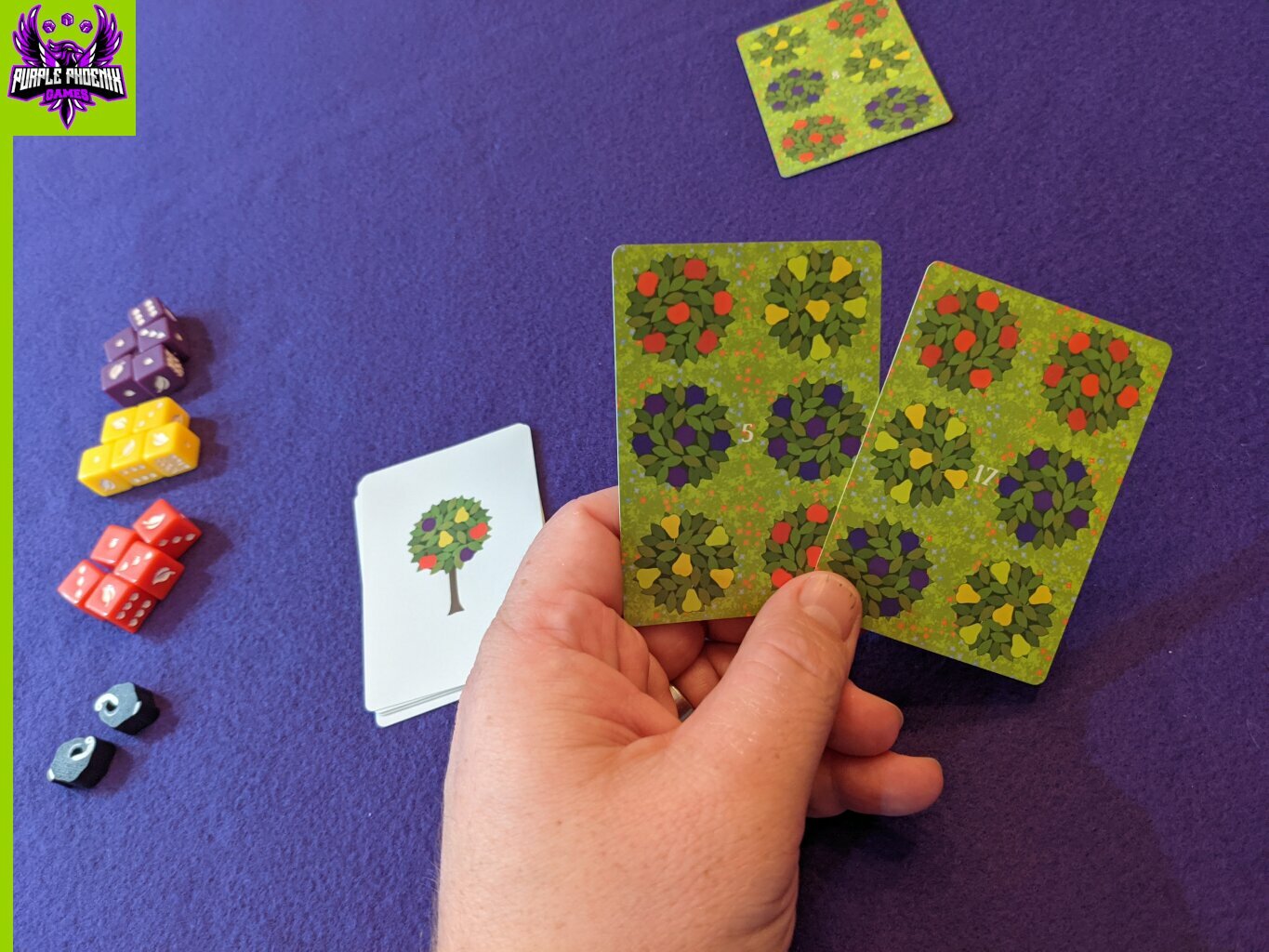
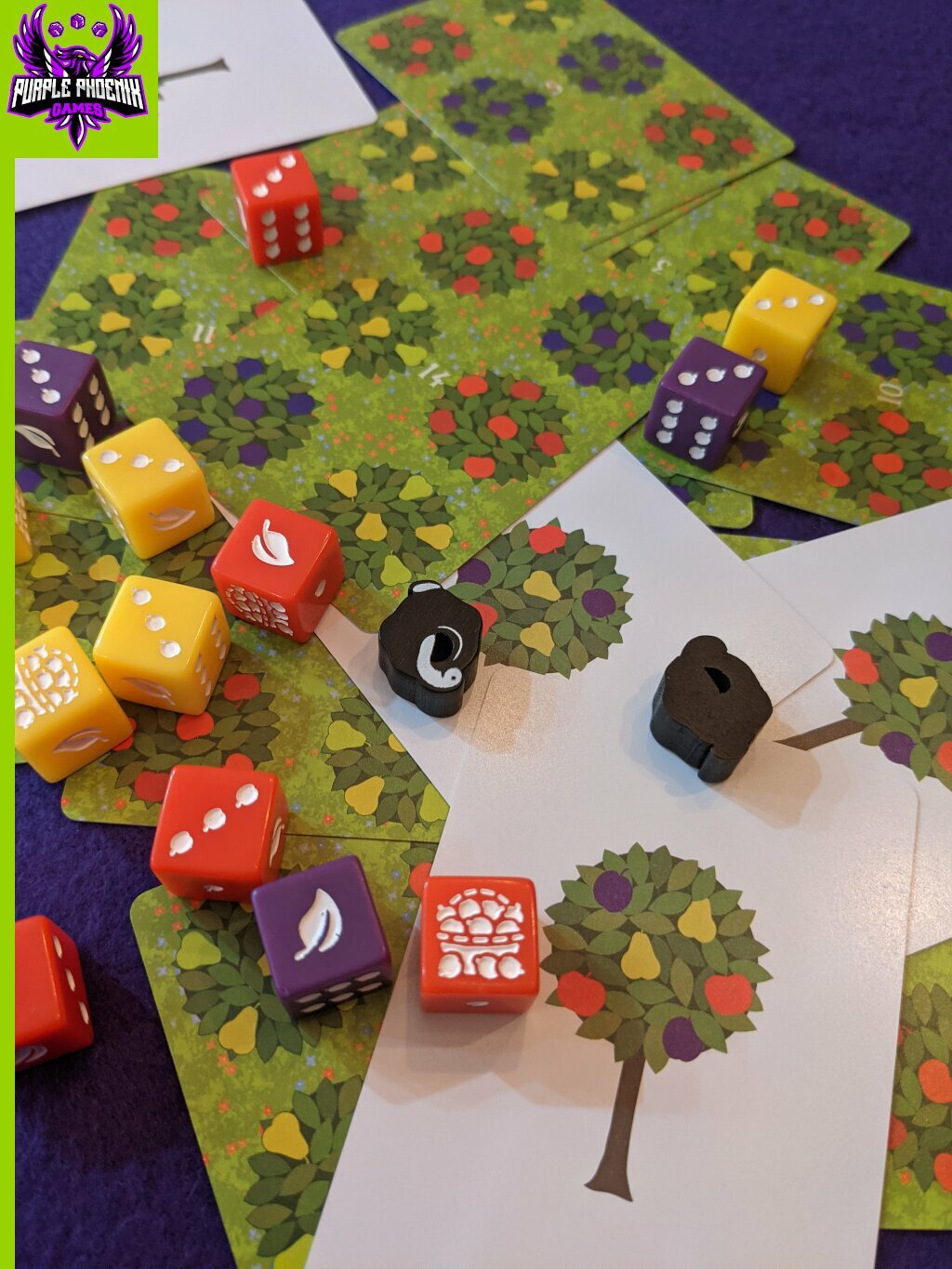
To setup, place the dice and Rotten Fruiteeple on the table. Shuffle the 18 cards, deal two decks of nine cards (two games worth), and choose a deck to play. Flip the first card over to start the orchard, shuffle the remaining cards and draw two into hand. The game is now setup and ready to begin!
Turns in Orchard could not be simpler: Play a Card, Place Dice, Draw a Card. From the two-card hand, choose one to be placed in the orchard with one very important rule: the newly-placed card must overlap another card in the orchard by overlapping matching tree types. So, a card can only be placed if the apple tree overlaps an apple tree, etc. More than one icon may overlap the existing card, but each icon must match types below it.
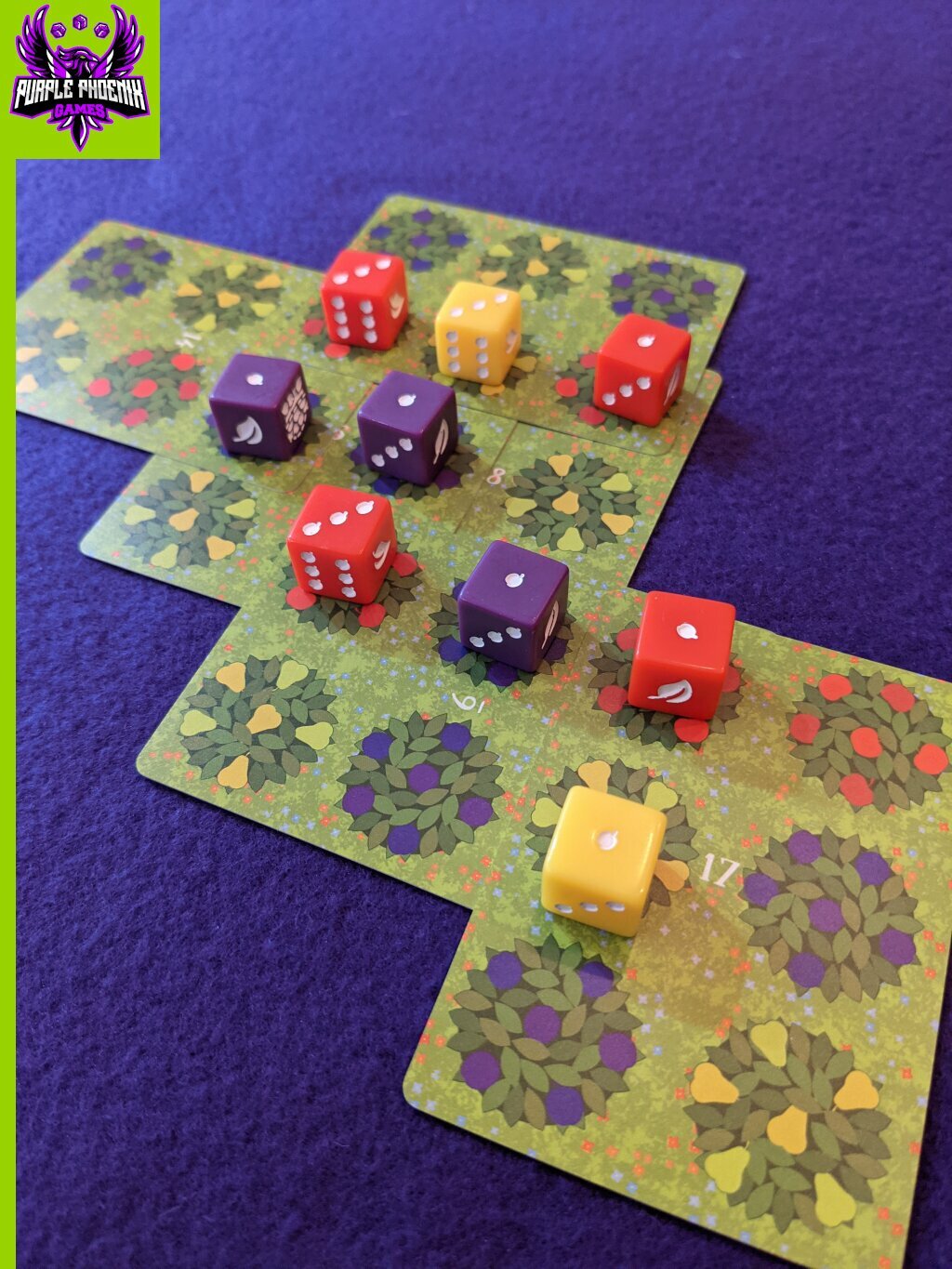
Once the new card has been placed, for each icon overlapped, a die matching the fruit type is placed on the icon. If this is the first time the tree has been overlapped, the die face is placed with value 1 showing. However, the die will increase in value each subsequent time it is overlapped (total die values of 1, 3, 6, 10). Therefore, when a card has been overlapped four times on the same icon, the maximum number of points has been reached for that icon. Should a player wish instead to forego any die placement and be unable (or unwilling) to place a card correctly, they may place any card, overlap an icon, and then add a Rotten Fruiteeple atop the mismatched icon. This spoils the fruit for the remainder of the game, so no further dice may be placed upon it, and also reduces the final score by three VP at game end for each token placed.
Finally, when the card and die have been placed, the player draws another card into their hand. When the final card has been played, or no further legal placements can be made, the game ends and the player totals up the dice values to arrive at their final score.
Components. This game is 18 cards of good quality, a bunch of custom dice, and two Rotten Fruit meeples. Everything is good quality and size, and it fits into a really cool sliding deck-box. The art, for me, is fine. The colors match fruits from the real world, and the dice match those color well enough too. I feel like different fruit choices could have been made to increase accessibility for our color-blind gamer friends. The plums and apples are both small and round (with an ever-so-slight different shape on the apple). I don’t know what other fruits would have been more appropriate – I’m not a botanist. Similarly, the dice are custom made with the pips looking like a plum or apple, and two sides of the dice showing a leaf icon. Perhaps in the interest of differentiation, instead of the leaves, the different dice colors could instead show the matching fruit style (if only the plum and apple looked differently enough). So instead of leaves, the red dice could show apples, the yellow dice could show pears, and the purple dice could show, I don’t know, eggplants? I am not color-blind, so these do not affect me, but it is something I have taken to commenting on as I review more and more games.
All in all, Orchard is a really good little game of overlapping and puzzling out next moves. The games are super-quick and engaging, and I always want to improve my score each time I play. When a game forces me to play again and again I feel it is a sign of a good game. I have plans to keep this one in its own special place where I can just grab it and go, instead of being dwarfed by my collection of much larger game boxes. If you are like me and pine for good solo play, then perhaps you should check out Orchard: A 9 Card Solitaire Game. The rules are light, game play is simple and fast, and it keeps drawing me in every time I look at the box.
Also let me know your highest score because I apparently am trash at this game, even though I really enjoy playing it. Have you scored in the top tier? Those must be some delicious fruits.

Rachel King (13 KP) rated The Sandalwood Tree in Books
Feb 11, 2019


The British are pulling out of India and separating the religious factions of Muslims and Hindus into the two countries of India and Pakistan, causing chaos and mayhem all over the country of India. The imagery and descriptions that Newmark fills the pages with are mesmerizing in their intensity and splendor. The colors, smells, and sounds have me half-falling in love with India to the point that I search for images online to match what I am reading to get a clearer picture of what the characters experience. Even though I struggled to stay interested in the plot for the first third of the book, the descriptions kept me reading and reading.
Felicity and Adela's story begins from childhood, describing how Felicity was born in India, but fostered with Adela's family. The infamous husband hunt brought them both back to India through different means, though neither had any interest in a husband, for different scandalous reasons. Residing in the same home that Evie now occupies, Felicity and Adela shun the conventional life of an Englishwoman in India, instead adopting an independent lifestyle and embracing India in all its diverse beauty.
Evie herself also seeks to shun what is expected of her, desiring to fully experience the culture of India all around her and use it to heal the problems in her own life. Eventually, she reconnects with the story of the two other women, even as major obstacles present themselves in both her private life and in the immediate villages. Letters take over the narration of Felicity and Adela's tale as Evie finds more to continue the story, instead of the author simply narrating what Evie can't find.
On the whole, the novel was beautifully written and contained a worthwhile plot, though I struggled to stay interested at the beginning. I would recommend this book to anyone who enjoys a mystery and craves the beauty of India.

Cynthia Armistead (17 KP) rated The Horns of Elfland in Books
Mar 1, 2018
Most of the stories were a bit darker than anticipated. 1997 was not such a depressing time to me, so I'm not sure why that would be the case.
I've had to send the book back to the library already, so I don't have it at hand despite finishing it last night.
The first standout story was "The Drummer and the Skins" by [a:John Brunner|23113|John Brunner|http://photo.goodreads.com/authors/1234623516p2/23113.jpg]. Finding a reference to a Yoruban peoples' tradition in a white British author's story was somewhat surprising, but go figure. I'm a white southern American woman, too. I suppose some people might argue that neither of us have no right to be interested/know about such things/whatever. I think of Brunner as a very hard SF writer, so that was especially surprising from him. His inclusion in a fantasy anthology was a surprise altogether. These surprises are some of the things I enjoy about anthologies - they challenge my assumptions.
I was rather bitter when I first thought I understood what [a:Terri Windling|46137|Terri Windling|http://photo.goodreads.com/authors/1235254340p2/46137.jpg]'s novelette "The Color of Angels was about. "Just what I need to read about," I told Sam. "A story about a woman gradually losing everything she loves to illness." MS, in the story (not one of my diagnoses, but it hit far too close to home, anyway). Suffice it to say that I was glad that I continued to read.
Even if I hadn't been happy with where the story went, I would not have been able to resist Windling's writing. She brings in so much of the world - colors, textures, music - so that I felt far more immersed in that one piece than I have in my own life at times. She is marvelously evocative. I haven't managed to put my hands on any of the Bordertown/Borderlands books, despite seeking them for a long time. Now I'm adding her solo works to to the "look for" list, and pushing them much higher on the priority scale.
"The Death of Raven" by [a:Ellen Kushner|11889|Ellen Kushner|http://photo.goodreads.com/authors/1243007888p2/11889.jpg] was unexpectedly comforting. Very brief, quite simply, but one I would love to see reprinted to increase its availability. (It may have been reprinted, for all I know. I certainly hope that it has been.) I've got Kushner's novels on my "to-read" shelf, but I think I'll move them up a bit.

Gareth von Kallenbach (980 KP) rated Ouija: Origin of Evil (2016) in Movies
Jul 15, 2019

As always, some of the best scenes in any film are usually displayed in the trailer to reel us in and that’s precisely what happened.
The film is based in 1965 with a young widowed mother Alice (Elizabeth Reaser) raising two daughters Paulina and Doris. Alice and the girls use old school seance scams to make ends meet.
The somewhat rebellious teen daughter Paulina sneaks out to a party where a Ouija board is used and suggests that her mother should buy one and add it to the act. Her mother decides that it just might be what they need to liven up the show. Thinking that this would only be one of her many parlor tricks she buys one.
While setting up the board for a practice session she decides to see if it might actually work. She doesn’t realize that she has now opened a can of worms and her youngest daughter Doris is in the throws of a malevolent force.
Is it the board, is it the house, is it their father. With the help of their school priest they are able to understand what is truly happening.
The film in a whole was just okay, not the best but not the worst either. The problem that I had with it specifically was how long you have to get through to get to the scary parts of the film. I was hopeful that it would get better and to my surprise it did.
Yes the lines weren’t great but the cast seemed fitting for their characters. Elizabeth Reaser who I’ve had the pleasure of meeting was perfect as Alice and the young girls as well. I don’t usually go on about editing and lighting but I must say that I really enjoyed the cinematography in the film. The drab colors and filming techniques were very well executed and added to the 60’s style horror films of the past.
In all honesty I would recommend seeing this in theaters. With the energy of the audience and darkness of the theater it makes for a fun and spooky Halloween event.
Just be aware that the build up to the better scenes is long and drawn out. The jump scares are few and far between however it still is worth a watch.

Phillip McSween (751 KP) rated The Grand Budapest Hotel (2014) in Movies
Apr 3, 2020


Acting: 10
Ralph Fiennes really makes this movie pop as Gustave. His wit is a huge part of his charm and impacts the way he acts out each scene. Characters like his are refreshing and hook you into the movie. I enjoyed Tony Revolori’s role as well playing bellhop Zero Moustafa. The two work so well together and enhance the movie as a result.
Beginning: 10
The beginning isn’t perfect, but I gave it a perfect score because it’s extremely intriguing. By the closing of the first ten minutes, I had a strong feeling I was in for a treat the rest of the way through. I was right.
Characters: 10
Cinematography/Visuals: 10
Director Wes Anderson is known for a specific style that’s so different from anything else out there and The Grand Budapest Hotel is no exception. Colors pop and images jump out at you in exactly the way he is trying to convey. His style, hard to explain at times, is hard not to appreciate and enjoy. When you watch a movie like this, you truly feel like you are getting a full-on cinematic experience.
Conflict: 10
There is a scene towards the back half of the movie that I call “The Escape”. It is action-packed yet has some subtle nuances at the same time. Definitely one of my favorite scenes in the movie, but not the only one hinging on conflict. Despite a comedic overtone, the film relies on a number of different points of tension to drive the plot.
Entertainment Value: 9
Memorability: 10
Gustave and Zero are easily one of my favorite duos since Jack and Rose in Titanic. They have a strange relationship, one that contributes to making the movie unforgettable. There are so many moments that stand out (the reading of the will comes to mind) making this a movie hard not to think about. It’s a movie you can watch a number of times and see something new each time.
Pace: 10
Plot: 10
Flawless storytelling. Magical and original. Enough said.
Resolution: 4
Overall: 93
2014 is one of my all-time favorite years for movies and it’s because of movies like The Grand Budapest Hotel. It takes storytelling to new heights with a crisp, original way of looking at filmmaking. This movie definitely made me a believer and a fan of Wes Anderson.

Alien Buddies – Preschool Learning Activities
Education and Games
App
Parents' Choice Award Winner ________________________________ REVIEWERS SAY... - Alien Buddies is...

Visual Attention Therapy – Left Neglect
Medical and Education
App
RETRAIN THE BRAIN to move the eyes correctly by scanning from left to right across the screen....

Michaelis Dicionário de Português e Inglês
Reference and Education
App
▶▶▶ PORTUGUESE DICTIONARY COMPLETELY REVIEWED, UPDATED AND EXPANDED! ◀◀◀ Get in a...

English <-> Russian Talking Academical Dictionary
Reference and Education
App
Big Academic English-Russian-English Dictionary presented in a program of "XXI Century Dictionaries"...

World Cup Table Tennis™ HD
Games and Sports
App
World Cup Table Tennis HD. A #1 game in 94 countries. And of course, the #1 Table Tennis game on the...