

Hazel (1853 KP) rated One of us is Lying in Books
Dec 7, 2018
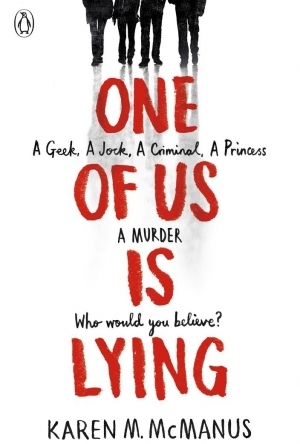

Inspired by <i>The Breakfast Club</i>, Karen M. McManus has set the stakes high with her debut novel <i>One of Us is Lying</i>. Taking typical young adult themes and adding a mix of mystery has resulted in a gripping book that intrigues as well as entertains the reader.
Five high school students find themselves in afterschool detention, but only four of them leave alive. Simon Kelleher suffers a fatal allergic reaction after drinking from a cup laced with peanut oil. It is clear that someone intentionally caused Simon’s death, but who, and why? The remaining four students are the immediate suspects, but they all claim to have nothing to do with it.
The main characters are all walking teen movie stereotypes. Bronwyn is a typical geek, getting high marks in all her exams. Cooper, the jock, is destined to become an exceptional baseball player. “Princess” Addy is perfect and popular, looking down on anyone who does not fit in with her social group. And then there is Nate, the drug dealer who is currently on probation for his reckless and capricious behaviour. Naturally, it is Nate that is the most suspect, but as certain secrets come to light, the others begin to look just as guilty.
Simon was known for his gossip app that revealed shaming secrets of students at Bayview High. As the police investigation begins, it is discovered that the four suspects were due to have their failings exposed in the next app update, thus giving them each a motive. However, the four are adamant that they were not involved and are desperate to clear their name. So, simultaneously with the police inquiry, the Bayview Four dedicate their time to unearthing the real culprit.
As the four unlikely friends become closer, romance blossoms and personalities alter, leaving no one unchanged. Gone are the original stereotypes. Despite upsetting circumstances, Bronwyn, Cooper, Addy and Nate are given the chance to discover who they truly are, and not just what society labels them. Putting aside the potential ruination of their futures, Simon’s death has serendipitous results for the suspects, or rather, the victims.
Nothing is given away during the narrative until the closing paragraphs, leaving readers guessing all the way through. Admittedly, I did entertain the thought of true culprit toward the beginning of the story, but McManus throws in so many red herrings and possible motives that the main suspect is constantly changing.
Dealing with themes of drugs, alcoholism, suicide and homosexuality,<i> One of Us is Lying</i> covers far more than a general murder mystery story. Some authors forget about the characters’ lives, only focusing on the plot at hand, however, McManus was far more detailed in the backgrounds of the four students, making it possible to understand and sympathise with each character.
<i>One of Us is Lying</i> shows how unfair the justice system can be, and although the saying is “innocent until proven guilty”, it is not often easy when every little move is judged and analysed by the police.
With a satisfying ending, Karen M. McManus’ introduction to the literary world is a significant taste of potential works to come. With a deep insight into young adult minds, McManus successfully connects with the reader, drawing them into a world that is hard to shake off. <i>One of Us is Lying</i> is definitely a book to look out for.

Gareth von Kallenbach (980 KP) rated Cloud Atlas (2012) in Movies
Aug 7, 2019
Allow me to explain. About an hour into the film I had a young film reviewer to my left and I noticed he started to nod his head in approval at each new developing story throughout the film. To my right was a friend of mine, I would consider as an average film viewer, who at this same time I could tell was counting the minutes till the lights came up but felt trapped with nowhere to go but forward. And for me, I can see both sides of these reactions.
The plot is comprised of a multi-narrative of six stories, each with a complete beginning, middle and end. These stories are told from different timelines following a group of souls throughout the ages to show how everything is woven together and the connection between them; From the 1849 slave trader, to a young composer in 1936 Britain, to a 1973 journalist attempting to uncover corruption of the big business ruling class, to a 2012 literary publisher who’s life becomes a daring escape from a geriatric home, to a 2144 Neo-Soul synthetic learning to become human, to a post-apocalyptic tribesman trying to save his world and family… Lost yet? Believe me you will want to focus during the first hour of this film as we are introduced to the sudden shift of timelines. All of the main actors appear as varying characters of significance in every narrative, each with different accents and types of language. It is a bit of an unexpected bother to keep everything straight at first, however if you pay attention it is fairly easy to follow. This first hour is where I feel the film becomes a make or break for those actively thinking about what they are watching and the average movie viewer who is just there to be entertained and see the new Tom Hanks (Extremely Loud and Incredibly Close) or Halle Berry (Perfect Stanger) movie. For those who make it through that first hour still engaged, the film moves along at a steady pace and provides everything from romance to action that keeps you guessing and intrigued at what is next to come.
The Wachowskis and Tykwer do an outstanding job of visually fleshing out each timeline in its own visual style, especially the futuristic ones, which subtlety organize each narrative for the viewer. Additionally, there are so many talented actors in this film and it is somewhat fascinating to try and pick them out throughout the film. It is almost like a giant game of Where’s Waldo on screen as the makeup and special effects artists do a fantastic job of making the actors fit each character in every timeline. In fact, during the fourth or fifth timeline a lady in my row asked her partner if the man on screen was Forrest Gump, which was surprising because Hanks was the easiest character to pick out among them all.
Tom Hanks delivers one of his better performances in years. We watch his character’s soul transition from a sinister and vile doctor to a tribesman making the righteous choice while struggling with that inkling of evil that is the devil within us all. It was refreshing to see Hanks play parts that were not just an “everyman” that he has played in recent years.
Halle Berry’s performance is mostly average in her parts with the exception of 1973 journalist role where she is the main protagonist. Hugo Weaving channels a bit of his Agent Smith role from The Matrix as he plays a villain throughout the timelines. Hugh Grant (Love Actually) makes unexpected soild appearances throughout the timelines. With Jim Sturgess (One Day), James D’Arcy (Mansfield Park) and Ben Whishaw (who is the new Q in the upcoming James Bond film Skyfall) rounding out the cast with a young contrast to the already heavy acting handled by the bigger names of this film. Each of these young actors hold’s their own against their older more notable counterparts. Whishaw’s performance as the lead in the 1936 composer role is especially noteworthy.
The other stand out performance in the film comes from Jim Broadbent best known in the states as Professor Slughorn in the Harry Potter Films. His performance in the 1936 composer and 2012 literary publisher are excellent. The Publisher story was my favorite timeline throughout the film. Not only did it deliver some much needed comic relief to an emotionally engaging and heavy film, but it also made me care the most about the elderly characters trying to escape the clutches of the geriatric prison of a nursing home. Unfortunately, other than the aforementioned comic relief this timeline seemed the most unnecessary to the overarching story at hand.
When I left the film and talked it over with my friend I was indifferent to the film. It was not great, it was not bad either. As my friend described it, it was a movie that was trying too hard. We agreed that somewhere in the six storylines there may be a great film, but we were not sure if we watched it.
However as the days have passed I have found myself thinking about the stories constantly. More specifically about how the main protagonist played by a different actor in each narrative has the same birthmark of a shooting star that in some way symbolizes some universal soul encompassing a new shell of a body in each timeline. Like some kind of reincarnation of that soul is fighting the same revolution throughout the ages against the powerful class and illusion of natural order. Additionally how each of the central characters found themselves connected with the main characters in the stories that preceded them through some kind of medium; whether it was by an old journal, or love letters, or a written story, or film, or message of hope. These subtle insights of growth and change for this main soul leaping into a new life in each timeline has caused me to examine our world and how we as people can be truly connected to one another not only today, but throughout the ages. I want to view the film again and am inspired to read the novel in some sort of effort to better understand these concepts.
Nevertheless as a film that is almost three hours long it does its best to be an epic sci-fi film and give something for everyone. And while it succeeds in many aspects of feel, it also falls short in aspects that are probably best accomplished in a literary form. As I said above, somewhere in the six storylines there may be a great film, but I am not sure if I watched it. Or maybe I am not intelligent enough to comprehend it. Because of that I can only give it an average score. Though I believe if you ask me after a second viewing, I may be inclined to raise it.

Audio Books by Audiobooks
Book and Entertainment
App
Wish you could read more but don’t have the time? You’ll love audiobooks! Audiobooks.com is the...

Kara Skinner (332 KP) rated Bascomville in Books
Jun 12, 2019

Page Count: 284
Average Goodreads Rating: 4.67 out of 5 stars
My rating: 4.5 out of 5 stars
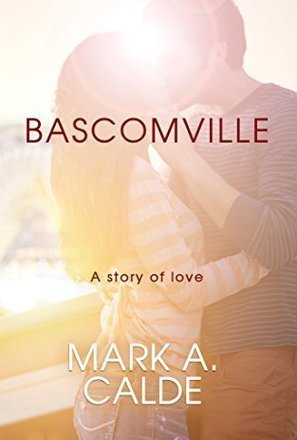
Welcome to the life of Max Bascom, whose home is Bascomville. Bascomville has its own special kind of normal, where fathers can get job leads from their sons and Christmas dinners can end up to be Chinese take out. Max does his best to navigate Bascomville and to keep it running as smoothly as possible through good times and tragedy. And he also forms a special bond with the girl next door, Janice, who understands Bascomville despite coming from a world much different.
This book is so fabulously written. I usually don’t take review requests, but I’m glad I did for this book. It’s part romance, part literary masterpiece, and it captures “growing up” so well. I wish I had this book when I was in middle school or high school because I can relate to making your own kind of normal.
“Us? Normal?”
“How do you know we aren’t? How do we know everybody doesn’t make their own?”
She considered this for a moment then dismissed it. “If everybody made their own then nothing would be normal. Nothing could ever be normal.”
“Exactly.”
That’s my kind of definition of normal. And I think everyone needs to remember that normalcy doesn’t really exist a little bit more.
I didn’t see the plot twists coming ahead of time and I never got bored. On top of that, this book is incredibly quotable. There’s some good life advice in here, like when Max helped Janice cover up vandalism on her house:
And I knew then that ultimately we can save neither ourselves nor our loved ones from life. We can only live it.
Max is a complex character that I like and dislike. He is, ultimately, human, not a hero. He tends to overreact sometimes when Janice is involved, but for the most part he’s likeable. He’s loyal to his family, loves his little sister, and wishes for a world with a level playing field.
My favorite character is his little sister Lily, though. She actually has it worse than Max. She lives at home with her parents after Max goes to college and has to deal with her mother pretending she doesn’t exist and her father pretending to be her best friend to make up for it. Her home life is lousy at best and she practically raises herself for her last years of high school. But she’s strong enough to not break under pressure and she’s not one for self-pity.
“Fair is for dorks. I don’t need fair to make things work.”– Lily Bascom
So why only a 4.5 instead of a 5?
It’s because of the long descriptions, like this one that characterizes Mr. Birnbaum, Janice’s father, through his workshop.
I stepped inside and caught my breath. It was, to me, a foreign wonderland, this workshop. I am not a particularly handy person, and the panorama of neatly arranged rows of tools hanging on pegboards, the fittings categorized in plastic bins, the copper piping slung above the rafters, the worktables and vises and clamps and braided electrical cords all echoed the prowess of this man. I felt humbled, and strangely calm. I still wasn’t sure if I was doing the right thing but I was no longer nervous about it. I could leave disappointed, even chastised, and be all right with it. Such was the power of Sheldon Birnbaum and this place.
While these descriptions certainly add character and depth to the story, they can sometimes be a little excessive and make my attention lag. This book is certainly not a fluff book and isn’t meant to be one, but the long descriptions make it slightly more harder to get through than it has to be.
This is a good book for anyone to read and I can’t recommend it enough, especially to teens. It helps us remember that we all need to make our own normal.
Gareth von Kallenbach (980 KP) rated John Carter (2012) in Movies
Aug 7, 2019

The film is based on the first book of eleven, a series that began in 1911 and ran through 1964 when the last book was published posthumously. John Carter stars Tylor Kitsch as the title character, a bitter Civil War veteran who, despite an accomplished service record, no longer wants anything to do with the military. Instead he is fixated upon finding a cave of gold.
Despite the fact that he served for the Confederacy, John Carter draws the attention of the U.S. Cavalry whose leader is anxious to recruit an officer of Carter’s skills and experience to aid them in their skirmishes with the Apache tribes. No longer willing to fight or get involved, Carter declines the offer but soon finds himself caught in the middle of an unplanned battle between both sides. As he attempts to find shelter for himself and a wounded officer, Carter accidentally stumbles upon the cave of gold he was seeking.
Carter’s surprise soon turns to shock when he’s attacked by a mysterious individual who presses a glowing amulet in his hand and utters a phrase that transports John Carter instantly to the planet Mars. Of course, Carter at first has no idea where he is but soon realizes that he has incredible leaping abilities due to the lower gravity of the planet.
Shortly after his arrival he gains the attention of Tars Tarkas (Willem Dafoe), the chief of a race of tall, skinny, four armed alien warriors. At first intrigued by Carter, Tarkas and his people become divided over what to do with the new arrival. This becomes further complicated when airships arrive and begin a massive gunbattle. Carter immediately leaps into action with his newfound ability which quickly gains the attention of Dejah Thoris (Lynn Collins), princess of the city of Helium.
It is learned that Princess Dejah is being forced to marry an evil warlord who possesses an awesome destructive ability and is using it to subjugate all those he encounters. Desperate to save their city, the princess is offered up to appease the warlord. Naturally this does not sit well with the free-spirited and feisty princess and before long she and John Carter find themselves united in their quest to save Helium. Despite his reluctance to get involved and fight, Carter realizes the princess may be his only way to get home.
A stranger in a strange land, with danger all around him, John Carter takes his audience on an epic adventure. Despite having little star power, the movie works exceptionally well with amazing special effects. The CGI used to create the various alien characters infuses them with personality and vitality rarely seen in artificially created characters. The film is visually spectacular from the legions of aliens locked in combat, to the stark splendor of the planet and its inhabitants.
Even though the film was presented in converted 3-D which, as many of you will know has long been a very touchy subject with me, the final product was actually better than most conversions. While it was nowhere near the quality of films shot in 3-D, it nonetheless offered an immersive quality to epic battle scenes and did not rely on the gimmicky trick of trying to make things pop out of the screen in order to sell the film.
Kitsch does a great job handling the action of the film and manages to interact with his CGI costars in a believable enough manner to establish as much chemistry with them as he did with the flesh and blood Collins. Although some moments of the film drag, it does have enough action to sustain the nearly two-hour runtime with a touch of humor and romance thrown in for good measure.
I first became aware of the film a year ago at the D23 Expo when Disney showed a few clips and had Kitsch, Collins and Dafoeon hand to promote the pending release. While intriguing, I did not see anything that really made the film stand out as a must-see. I am very happy to say that upon seeing the completed film, the scenes that were shown to us not only had even greater effects in the finished product but were also much more entertaining and dynamic once shown within the full context of the story line.
Director Andrew Stanton, who has made a name for himself with his animated films at Pixar, skillfully blends live-action and CGI to create a very energetic and enjoyable action-adventure film that was a very pleasant surprise.
While the acting, character development, and plot are nothing spectacular in and of themselves, they combined well and set the stage effectively for what should be a series of John Carter films in the future.
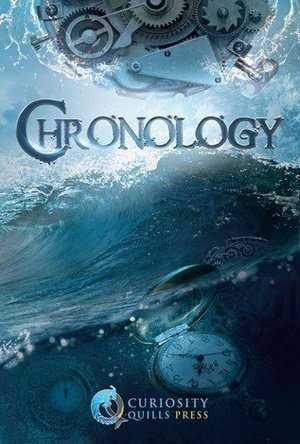
Curiosity Quills: Chronology
Richard Roberts, Tony Healey, Piers Anthony, J.R. Rain, Jordan Elizabeth Mierek, James Wymore, Stan Swanson, Darin Kennedy , Julie Frost , Andrew Buckley , J.P. Moynahan, B. C. Johnson, J. P. Sloan, Andrew J. Rausch, Katie Young , Scott Nicholson, Wilbert Stanton, Tara Tyler, Mark W. Woodring, J. E. Anckorn, Nathan L. Yocum, G. Miki Hayden, Matthew S. Cox and Matthew Graybosch
6.0 Rate It
Book
It's time... for time! Embark on a literary journey through the ages with Curiosity Quills Press in...
Mandy and G.D. Burkhead (26 KP) rated Poison Study (Study, #1) in Books
May 20, 2018
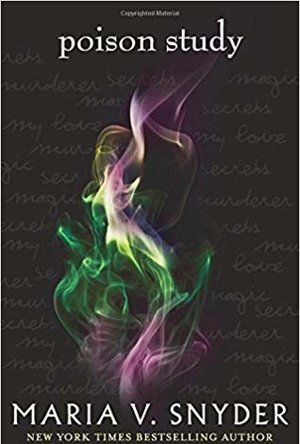
The first trilogy, comprised of Poison Study, Fire Study, and Magic Study, follows Yelena Zaltana. The second series, also called the Glass series, follows her friend Opal Cowan in Storm Glass, Sea Glass, and Spy Glass. The final trilogy, Shadow Study, Night Study, and Dawn Study, is where things get a bit odd. Maria V. Snyder had thrown in a few short stories/novellas throughout from different characters’ points of view. Perhaps she got bored of just sticking to one POV, or maybe fans wanted more from the other characters, so the third trilogy is from Yelena’s POV in first person and the POV’s of multiple characters (mainly Valek, Leif, and Janco, with a few others popping in from time to time) in third person.
I’m not sure which editor thought it would be a good idea to have POV switch from first person to third person in the same novel, but—yikes—is it jarring. Even with the wonky POV stuff in the third trilogy, these books are amazing and absolutely worth your time to read. Snyder’s world-building is compelling, detailed, and original. The books take place mostly between two pre-industrial countries: Ixia and Sitia. Ixia is a post-revolution country ruled by Commander Ambrose. His personal body guard and assassin is Valek. In the first novel Yelena is in prison for murder and is offered the choice to be the Commander’s food taster in exchange for her life. She agrees, and throughout the first book she and Valek begin to fall in love.
Ixia reminded me a lot of Communist Russia or China. In its attempts to throw away the corrupt government and society that came before, it has also thrown out all culture in the process. The country has been re-divided into districts with numbers instead of names, everyone is forced to wear a uniform, all art and extravagance has been destroyed, people have to have passes to travel between districts, and magic is forbidden. Anyone born with it is killed (or so the reader is led to believe). But Maria V. Snyder does a wonderful job of showing the good with the bad in this totalitarian dictatorship. Everyone has a job and nobody goes hungry, women are now equal to men, and violence and sexual assault are intolerable. This is why Yelena ends up in prison in the first place: she murdered the man that raped her. Now, this is probably my first major gripe with the series. We learn that Commander Ambrose loathes sexual assault and will execute anyone found guilty of it, but apparently killing a rapist in self-defense is also an executable offense. And all of that being said, Ambrose still has his own personal assassin. It all feels a bit contradictory, but again, that’s what I like about this series: it does an excellent job of peeling back the layers of her fictional societies and pointing out that governments and people in power tend to be hypocritical.
Now, the series name (or rather one of them) is Chronicles of Ixia, but honestly, it should have been called Chronicles of Sitia, because that is where most of the story takes place and is by far the more interesting and vibrant country. Sitia is part jungle, part desert, and full of magic. The peoples are divided into multiple clans or tribes that are all unique and compelling. In the second book, Yelena flees to Sitia after the Commander learns she has magic, and there she finds the family she was kidnapped from as a small child. They are part of the Zaltana clan, a group of people that live high in the trees in the jungle. Whenever I read about them, I would have to remind myself that they were not wood elves or dryads, because while there is magic in these books, there are no fantastical creatures: all characters are human or animal.
Another fascinating tribe is the Sandseeds, a group of nomads in the desert known for two major things: breeding super smart horses and having Storyweavers. The Storyweavers are people who have the magical ability to see the future and guide others, but who have to do it really cryptically because reasons (I appreciate that this gets pointed out by an annoyed Yelena multiple times). And of course, the Sandseed horses are fantastic; they choose their rider and able to mentally communicate with magical people. They even have their own horse names for people that they like.
Besides the different clans throughout Sitia, there is also the capitol, the Citadel, which is home to the magic school and the Sitian Council. While very different from Ixia, Sitia is by no means perfect. Its Council epitomizes everything annoying and dysfunctional about a bureaucracy. While the council members are elected and come from every clan in Sitia, they are at best useless and at worst actively impede the main characters.
The magic school is interesting, though the story doesn’t actually spend much time there. I like how magic was done in this series: it usually runs in families, most people with it have control over one or two things (ie. fire, mind-control, telepathy, etc.), but those who have the ability to master more can become Master Magicians after enduring a daunting trial. Magic is bound in people’s blood, so blood magic is a thing and is obviously bad, and magic (and a person’s soul) can be stolen using an intricate and gruesome blood ritual that involves prolonged torture, rape, and then murder.
The power blanket is another interesting concept used in this series. Essentially is resides over the entire world and is the essence of magic, so magicians can pull from it to augment their own magic. However, if they pull too much and lose control, they can flame out, killing themselves and temporarily damaging the blanket in the process. I thought this was a good literary tool to prevent magical characters from being too OP (at least most of the time).
I especially like the romantic relationships in this series. Valek and Yelena are of course the main couple. In the first book they fall in love, in the second book they get separated, and throughout the series they regularly cross paths and save one another. Yelena and Valek are heartmates, and as the series progresses they both have to mature and learn how to trust one another. My biggest complaint about the romance is that all sex scenes are just fade to black, which I personally find a bit boring.
The other major romantic relationship is between Opal and Devlen. This one was a bit awkward. Opal actually goes through a couple of guys first: a stormdancer named Kade and another glassmaker named Ulrick. And I really liked that the author included this. Many people have multiple partners before finding their soulmate, and a woman who does is not a slut. Her relationship with Devlen, however . . . Well, she’s a more forgiving person than me.
You see, it turns out that Devlen is the man who kidnapped Opal a few years earlier and tortured her because he was trying to steal her magic. But he didn’t actually enjoy torturing her and never raped her, which I guess makes it better? Well, he manages to switch bodies with Ulrick and, as Ulrick, tricks Opal into dating him, then, when he’s discovered, kidnaps and tortures her (again) to gain more power. But then she steals his magic, he spends some time in prison, and the combination of the two miraculously turn him into a good guy, claiming that magic is what made him evil in the first place.
I’m going to be honest, I didn’t completely buy his redemption arc even at the end of the third book in the Glass series, but by the ninth book they’re still together and he’s on the good guys’ side, so I guess it was real. And I have definitely watched/read much worse evil asshole to boyfriend stories. At least Devlen genuinely feels guilty for the horrible things he did in the past and attempts to make up for them, and in her defense, Opal has to do a lot of soul-searching before she can find it in her to forgive and trust him, and even more before she can develop romantic feelings for him (that aren’t based on deception, anyway). Also, Ulrick becomes a huge jerk because of his newfound magical abilities, tries to kill Opal, and later gets assassinated by Valek. I appreciate what Maria V. Snyder is trying to do here, which is to teach through her storytelling how good people can become evil, and evil people can redeem themselves and be good. Their romance was uncomfortable to read, but it was supposed to be uncomfortable, because that’s how all parties involved felt.
Now, let’s talk about Commander Ambrose. Towards the end of the first book, Yelena discovers that Ambrose is a female to male trans person. This is revealed to be why Ambrose hates magicians so much: he is afraid that one of them will read his mind and then reveal his secret (which is how Yelena discovers it). After I read the first book, I was really pleased that Snyder did such a good job of depicting a trans person, as that’s really only a small part of his character, and those who know (mainly Valek and Yelena) don’t make a big deal out of it.
And then . . . I really wish that the author would have just left the issue of the Commander being trans alone. Yelena discovers it in the first book, she keeps it to herself because it’s nobody else’s business, the end. But by creating this weird intricate background to explain why Ambrose is trans, Snyder just kind of shoots herself in the foot.
Throughout the rest of the series, I kept hoping for some other LGBTQ+ characters to show up to redeem the blunder with Ambrose. I actually believed that Ari and Janco were a gay couple for the longest time, what with their banter and often being referred to as partners. However, if this was the author’s intention, it was never really explicitly stated, and the partner thing just seems to refer to them being partners in combat and nothing else.

Heather Cranmer (2721 KP) rated Edison Jones and The ANTI-GRAV Elevator in Books
Apr 2, 2020
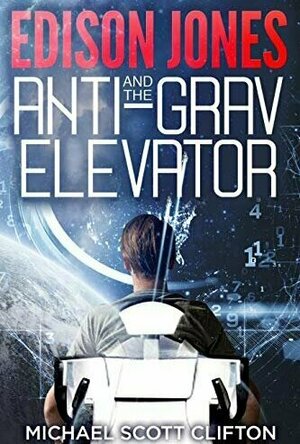
Edison Jones is a 12 year old seventh grader. After a car accident (that really wasn't an accident) left him paralyzed from the waist down and killed his parents, he's been living a very sheltered life with his grandpa. Edison isn't like most 12 year olds though. He's highly intelligent and has come up with a way to invent a anti-gravity space elevator. He's just go to prove to NASA that it works. Oh, and he's also being enrolled into the local public junior high school for the first time which also presents problems of its own. Edison will have to prove his space elevator has what it takes while also navigating the new realm of school and friendship if he's going to make his dreams come true.
The plot for Edison Jones and The ANTI-GRAV Elevator definitely was an interesting one for sure. While there are similar books out there, Michael Scott Clifton really made his book stand out. I liked how the main character had a disability which made it harder for him when it came to everything. It's refreshing to see a main character that's different from the mainstream. There is a bunch of science speak and terminology which can be a little overwhelming for the average person, but eventually, you get used to it. Plus, you don't need to know all of the terminology to enjoy this book. Context clues are also available to help make the terminology a bit more understandable. Descriptive scenes abound throughout this novel which makes it very easy to get lost in this book. In fact, many times I forgot where I was because I was so focused on this novel. The anticipation that Clifton sets up for major events throughout Edison Jones and The ANTI-GRAV Elevator is done brilliantly. I was definitely holding my breath and turning the page quickly to find out what would happen next especially when it came to scenes with the Breakstone twins, the robotics competition, the last junior high football game, and the launching of Edison's space elevator! The build up in those scenes was amazing! The ending does leave the possibility of another Edison Jones story being released in the future.
One thing that did irk me quite a bit was the stereotype that all of those who live in mobile homes are trashy. I felt like the author played into that a bit too much during one chapter. Here's one example which can be found at the end of chapter 26 when discussing Markie Franks who is a bully and Hondo's house (Hondo, Edison's friend, comes from a home where his mom chooses her boyfriend over him, and the boyfriend and Hondo don't get along.): "Markie's house surprised Edison. Although more modest than Bree's, it was also a brick home with an immaculate yard and appearance. He wasn't sure what he expected--maybe a mobile home with rusting cars on blocks in the yard--not the tidy home the bully lived in. Hondo...did live in a mobile home complete with a yard full of foot-high weeds. The only light came from the blue flicker of a TV through a grimy window next to the front door. With a grimace, Hondo got out and waved, his shoes pushing a path through the brown weeds and grass." It's stereotypes like this that make those who live in mobile homes easy targets for bullying as well as making those that live in mobile homes feel horrible about their life. It really shouldn't have been discussed like this at all. Not everyone who lives in a mobile home is trailer trash which is what I felt this book was implying.
I did feel like all the characters in Edison Jones and The ANTI-GRAV Elevator where very fleshed out and realistic. Edison is extremely intelligent when it comes to science, but he struggles with fitting in as he's been sheltered his whole life. Even though Edison isn't your average 12 year old when it comes to smarts, it was refreshing to see just how average he was when it came to navigating friendships and romance. I loved reading about Edison's thought process when it came to his crush on Carly as well as his friendship between Bree, Hondo, and Carly. I liked how Edison, for the most part, wouldn't give that bully, Markie Franks, the satisfaction of knowing that he bothered him. I admired Hondo after all he had been through. Throughout most of the book, I was trying to figure out if Hondo was a genuine person or if he would end up double crossing Edison. Bree and Carly were great friends to Edison, and it was obvious how much they admired Edison. I liked how they would stand up for him. The Breakstone Twins were also very interesting. I can't wait to see more of them in future books (if the author chooses to make this a series). I liked how cunning and calculated they both were.
Trigger warnings for Edison Jones and The ANTI-GRAV Elevator include some profanity, name calling including using the word pussy which I didn't like, some stereotyping, some violence, bullying, attempted murder, murder, a mention of drugs (being stoned), some underage smoking, and a mention of beer.
All in all, Edison Jones and The Anti-GRAV Elevator is a fantastic story that straps you in for a very exciting adventure throughout its pages. The plot is fantastic, the characters are diverse, and the action abounds. I would definitely recommend Edison Jones and The ANTI-GRAV Elevator by Michael Scott Clifton to those aged 13+ who seek adventure in their life. This would appeal mostly to those interested in science, but I think everyone who enjoys a solid story would like it.
--
(A special thank you to Lone Star Literary Life for the tour and to Michael Scott Clifton for sending me a paperback of Edison Jones and The ANTI-GRAV Elevator in exchange for an honest and unbiased review.)

Nymphomaniac Volume II (2014)
6.3
Rate It
Movie Watch
Joe becomes annoyed with Seligman, accusing him of overlooking the severity of her lost sexuality to...