Mechanic Mike - First Tune Up
Games and Entertainment
App
~~> All in one garage game! Fix, upgrade, paint and even get an X-ray test for your car. ~~> Get on...

Cash Journal
Finance and Productivity
App
The app which will keep you from losing track of your expenditures! On the go, on vacation, business...

DB Navigator
Travel and Navigation
App
My DB Navigator – the perfect travel app: Mobile phone tickets, real-time information, delay...

Lloyds Bank Mobile Banking
Finance and Business
App
When it’s hard to find a moment to do those small but important things, our Mobile Banking app is...

Strip Designer
Photo & Video and Lifestyle
App
Make your photos come to live and tell a story you can share with friends and family. With Strip...

Discographic for Discogs
Music and Reference
App
Discographic is the best and most complete Discogs app currently available. Look what Discographic...
RollerCoaster Tycoon® Classic
Games and Entertainment
App
RollerCoaster Tycoon® Classic is a new RCT experience, combining the best features from two of the...

Kirk Bage (1775 KP) rated Coco (2017) in Movies
Mar 3, 2020 (Updated Mar 3, 2020)

Also, for every good one there are several really lame ones, designed to get families into cinemas and take their money without much concession to a good script. It only takes the bad experience of a couple of those to put you off the genre as an adult. It can be hard to remember that some are made only with 6 year olds in mind. Frozen, for example. They have their place, and the phenomenon of which ones kids are drawn to is a different study altogether. For the purposes of my list, I am looking for the ones that can entertain young and older audiences at the same time. And, to date, no one has done that better than Pixar.
The benchmark, for me, remains Monsters Inc, The Incredibles and the Toy Story series. The latter especially, have a great knack of pleasing all generations. The key is always the writing. Animation styles and techniques can impress the eye, but it is always the theme, the relationships and the words that make an animated film enduring. Music also plays a big part; as does the level of humour. Both incredibly intangible arts that you can’t just buy.
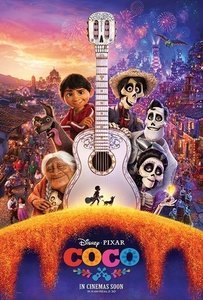
I watched Coco on a Sunday morning – the perfect time to watch an animated film, by law! Chances are you will be a little hungover (I was) and susceptible to the inevitable sentimentality you are about to experience. The first thing that struck me was the colours! Embracing a Latin American cultural canvas, I don’t think I have ever seen such a vivid rainbow attacking my senses. From the naked flames of the candles, to the warm tones of the sunlight and the almost neon glow on display around the dead and the world of the afterlife, it was a visual treat I can honestly say I have never experienced before.
Oh, yes, Coco is about dying, if you didn’t know! And to say more about the genius of their approach to it, would be classed as a spoiler! The action takes place on Diá de Muertos (the day of the dead), when family members can revisit their loved ones, as long as they have been remembered. Our hero, young Miguel, loves music. But his family have banned him from listening to, or playing, it because of the shame surrounding a long dead ancestor. The magic of the day leads him to the underworld of the dead, to find out the truth and save the day.
Of course, once there, he meets all sorts of strange characters, and is lead on a fateful journey with lots of unexpected twists. Again, we won’t go into who, or why for the sake of spoilers. Suffice to say, the ideas, emotion and sense of righteousness flow, stirred up in the mix of constant moments of humour, some that land, some that don’t quite, at a pace fitting, and demanded, by young audiences. The ultimate aim being to reveal the truth behind the family story and to allow the dead to be remembered for their real worth.
On the negatives first: it is all pitched at quite a young audience, in the same way one of Pixar’s less successful films, Cars, is. Which means a lot of the humour lacks the sophistication needed to make it a classic. Also, for a film about the love and joy of music, the songs are only OK, and not especially memorable, although the Oscar winning main theme “Remember Me” serves its purpose very well in the climax. There are also one or two dips in the pacing of scenes that break the spell; surely the cornerstone rule of animated films: don’t drop the ball! Something both Wall-E and Up do at points, spoiling the overall impression of something so glorious in their best moments.
The power of Grandmas
To be more positive, we have to acknowledge the very, very high bar that Pixar set themselves. From an animation point of view, if this film had been released in 2001, we’d be in raptures about it! It is beautiful to look at! And the attention to detail is extraordinary, allowing for many re-watches, just to see the things they have put in there to largely amuse themselves. As a vision of an idea brought to life it is a consummate success! It is, essentially, so likeable. And at its heart, once again, right on the money.
It isn’t called Miguel. It isn’t called The Day of the Dead. It is called Coco. And by the end, you realise why that is important. Death is sad. Dementia is also an awful, awful thing. The strength of Coco is taking these difficult subjects and shining a meaningful light on them, that not only comments intelligently on them, but breaks the heart with the truth of it all. It takes a while to get there with this one, but the pay-off is sublime, yet again! Remember me, a simple sentiment that goes a long, long way!
As a side note, there is a controversial, but massively effective medical technique being utilised in the real world, with alzheimers sufferers, that uses music to trigger memory. It’s application and results are astonishing, for their ability to bring people “back to life”. Which, naturally, moved me immensely. To think the best moment of Coco isn’t just wish fulfilment in a sentimental world, but a real thing that can be done!
Sentimentality aside, Coco is a good film, in every sense of the word. As a parent, I would revel in the opportunity to show this to a child, for the positive conversations it might invoke. The aspects of cinema magic needed to make it an experience worth having are all there. To fault it is only to be unnecessarily picky. Better to go on the journey and enjoy it for what it is. Which, increasingly, is my mantra for watching anything. Who would not hope that someone chooses to celebrate life, with the thought “Remember Me”?

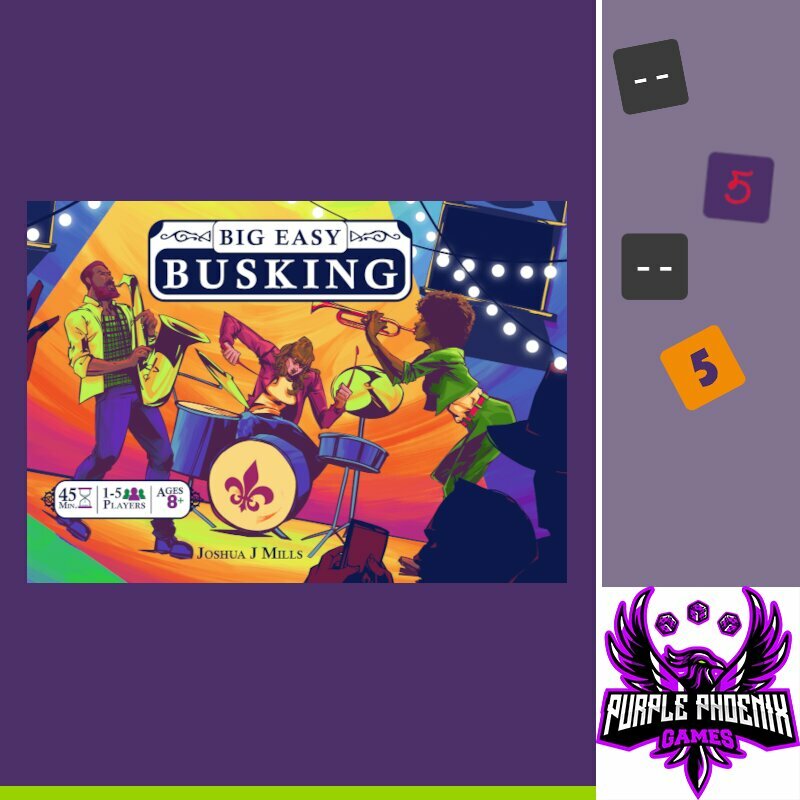
Purple Phoenix Games (2266 KP) rated Big Easy Busking in Tabletop Games
Sep 15, 2020
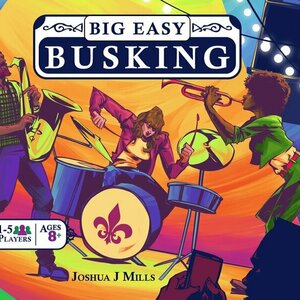

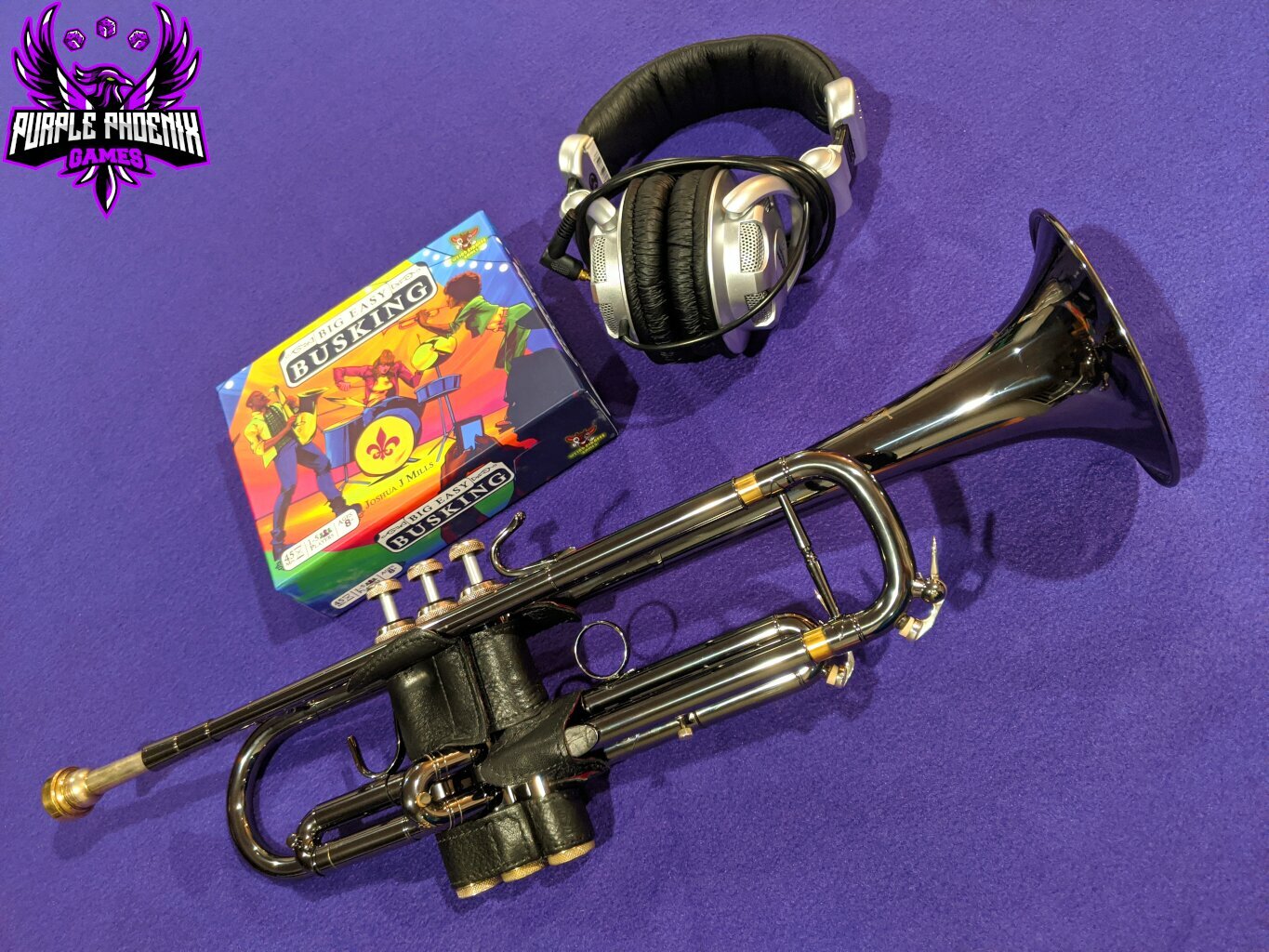
Big Easy Busking is a card-based area control game with a sweet sweet music theme. Players will be taking turns learning charts, playing charts, and transferring energy from the musicians to the crowd and back. The winner of Big Easy Busking is the player who can score the biggest haul in tips for the weekend to become the hottest band in town.
DISCLAIMER: We were provided a copy of this game for the purposes of this review. This is a retail copy of the game, so what you see in these photos is exactly what would be received in your box. I do not intend to cover every single rule included in the rulebook, but will describe the overall game flow and major rule set so that our readers may get a sense of how the game plays. For more in depth rules, you may purchase a copy online or from your FLGS. -T
To setup, two “streets” in New Orleans will need to be populated with song cards, both standards and learnable tunes. Crowd cards will be placed under the streets to depict certain crowds and what the moods of those crowds are. Each player will receive some starting bread (money for those not in the biz), energy for their 3-piece band of sax, trumpet, and drums, a starting set list of three tunes, and a reference card that has nothing to do with the metaphor. Decide who can play the highest note (if you are all trumpet players) and the gig may begin!
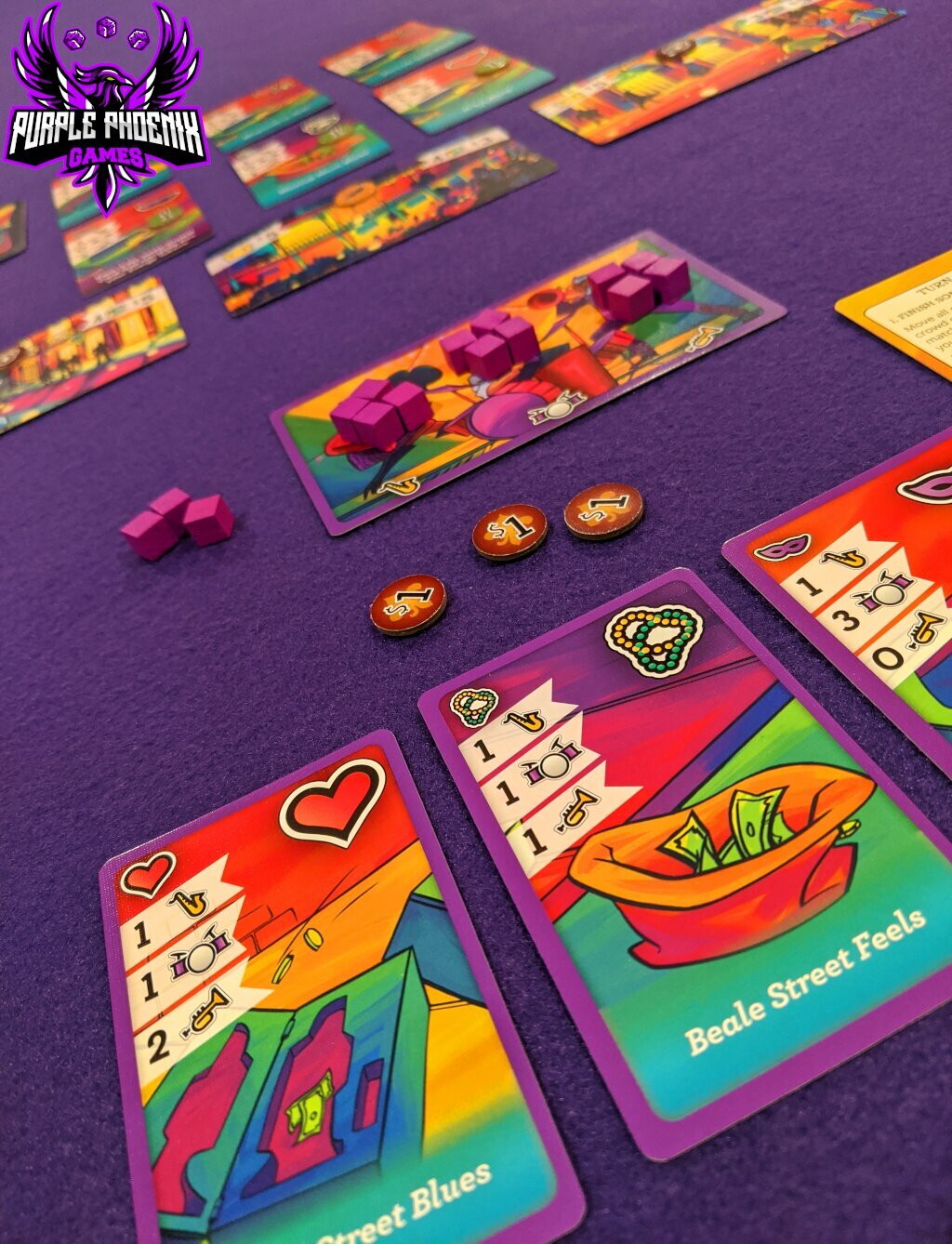
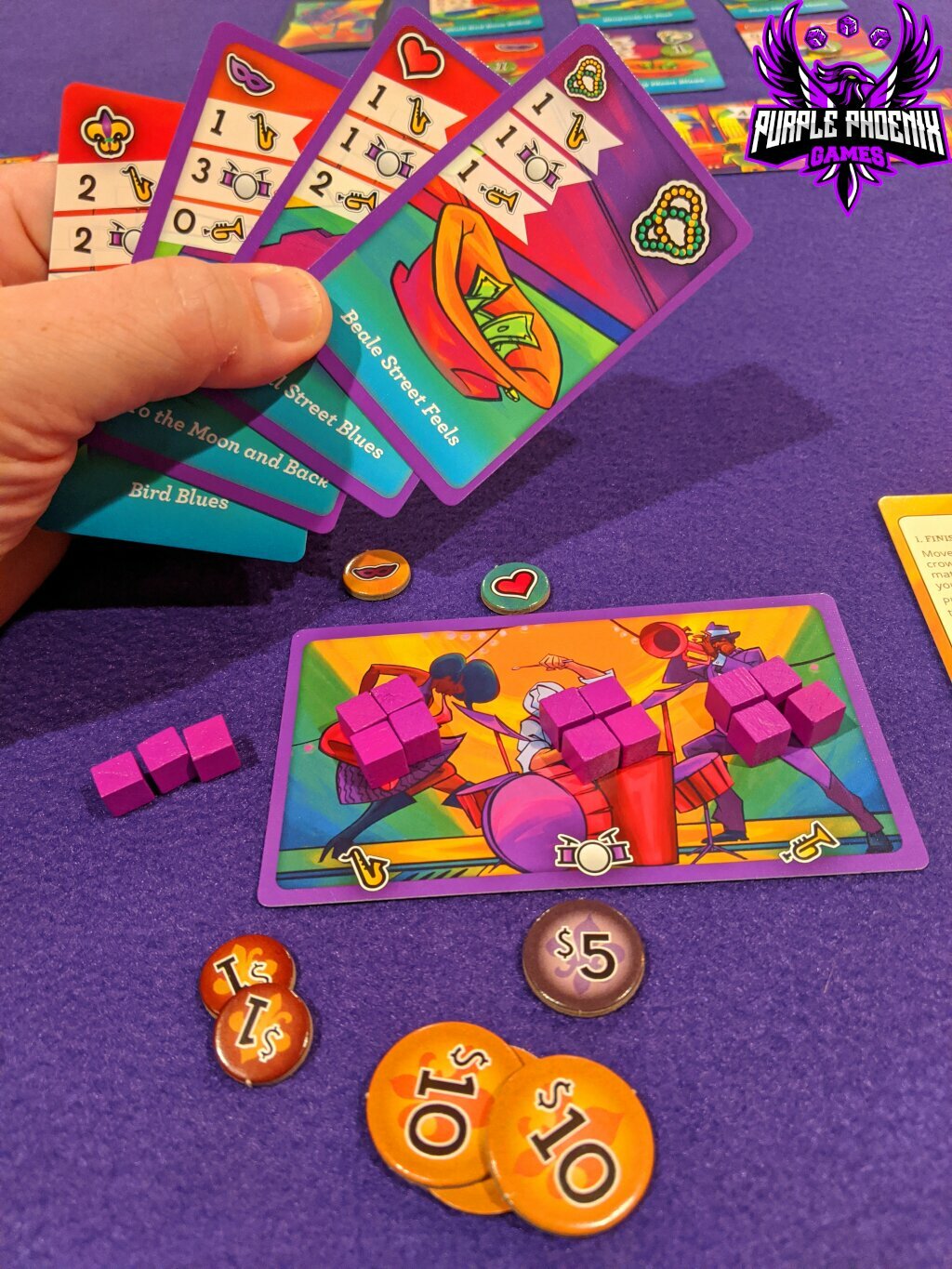
A turn is broken down into a few different parts. The first thing to be done on a turn is to finish playing the song that had been started in the previous round. Obviously you need to START playing a song to be able to finish, so the primary phase of the turn would be to either learn a song from the song offer or start playing a song from those dealt during setup. To play a song, players will choose a song card, place it under a crowd card (hopefully matching their mood: masks, hearts, beads, fleur-de-lis), gather the required energy from the musicians appropriately, and add those energy cubes to the song card.
After a song is started or learned, the player’s turn is over. On the next turn the player will finish playing the song by moving the spent energy to the crowd in full and taking $1 or moving some of the energy to the crowd and some back to their band members to be used on future songs.
The middle step in a turn (yes, I know I am explaining it out of order, but you do have to start playing a song before you can finish it) is to optionally tip your band members by trading in money for energy at a 1:1 ratio.
Once all players have used up their energy cubes or simply wish to, they will announce that they are “taking a break.” In other words, they pass for the remainder of the round. As the last player takes their break the end of round activities begin. Printed on each crowd card are two important icons: payout amounts for majority of energy and payout amounts for energy reaching the threshold. Resolving each crowd card will determine the players that hold majority or shared majority in each crowd location. For the majority holders payouts will reflect what is printed on the upper left of the crowd card. The upper right of the crowd card displays the number of energy needed upon it to meet the threshold in order to be paid the amount shown. When all crowd cards have been scored players will setup for the next night (round) per the rules. Play continues in this way over three rounds with the winner being the player at the end of the game with the most money.
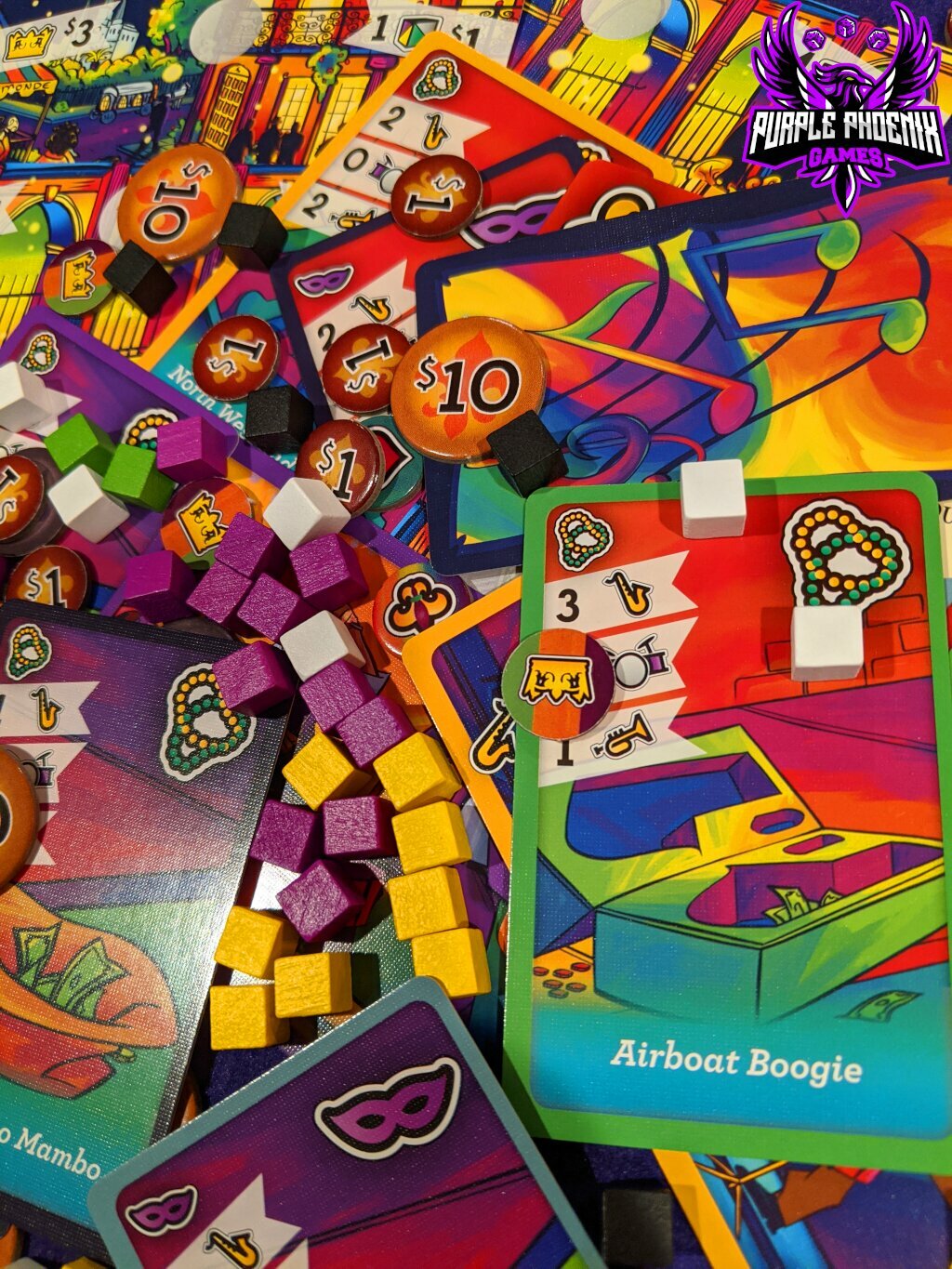
Components. This is a smaller box (not exactly the same size, but think Tiny Epic), but it is packed with some really amazing bits. First off, as you can tell from the photos the art and color palette used here is simply phenomenal. I absolutely love the color scheme and the art certainly reminds me of some paintings we purchased from an artist on Jackson Square last time we were able to visit. The cards are nice, but I think I will want to sleeve them eventually as I had them in my hands the whole game. The cardboard money and mood tokens are fine, and the wooden cubes reflect the colorful nature of this little gem. All in all, exactly what I would expect from components in a Weird Giraffe Games production. Stellar (see what I did there, Carla?).
I have not really enjoyed a ton of area control games in my gaming history. So this came as a little bit of a shock as I truly loved playing this game. Even the solo rules are engaging and DIFFICULT to win. I came close though – within $1. The game is super quick as you are trying to please the crowds and their distinct moods with your best charts, but having to be mindful of not overextending your musicians lest they be too exhausted to give you the gas when you need it. THAT part resonates with me personally. Being a musician myself, I can tell you that crowds that are into a tune or a band and give them all the energy they have will be rewarded with even more from the band. I definitely give it more when the crowd digs what we’re laying down.
In any case, this is a game review, not a nostalgic trip down my musical memory lane. But then again, a little card game just brought me back wonderful memories of my band, and of visiting New Orleans, and of the joy of live music. Does Big Easy Busking completely mimic what it’s like to be a musician? Well, no, I can’t imagine how any game truly could, but it certainly shows the cyclical nature of energy being exchanged between musicians and appreciative crowds. Oh, the names of the tunes are also pretty funny on some. This all said, I super love this game and will be kicking out something in my collection to make room for it. If you are needing a smaller card game that you can bring out with musicians or non-musicians that appreciate the theme but also want to start introducing area control in a more accessible form, please do check out Big Easy Busking. Purple Phoenix Games gives it a good-for-the-soul 10 / 12. Maybe once I get into video I will do a Dan King (Game Boy Geek) serenade for Big Easy Busking as it travels into my collection.