Search

Purple Phoenix Games (2266 KP) rated Matryoshka in Tabletop Games
Apr 8, 2022


I don’t know about you, but I have always been fascinated by Russian nesting dolls, known as Matryoshka dolls. Something about opening the outer-most doll and finding an exact replica, but smaller, just brings me so much joy and satisfaction. I could play with them all day. So whilst perusing Miniature Market, I came across this little card game. Does Matryoshka give me the same sense of satisfaction as playing with physical nesting dolls? Or does it leave me feeling empty, like a Matryoshka that is missing its inner dolls? (This analogy is a stretch, but I’m sticking with it)
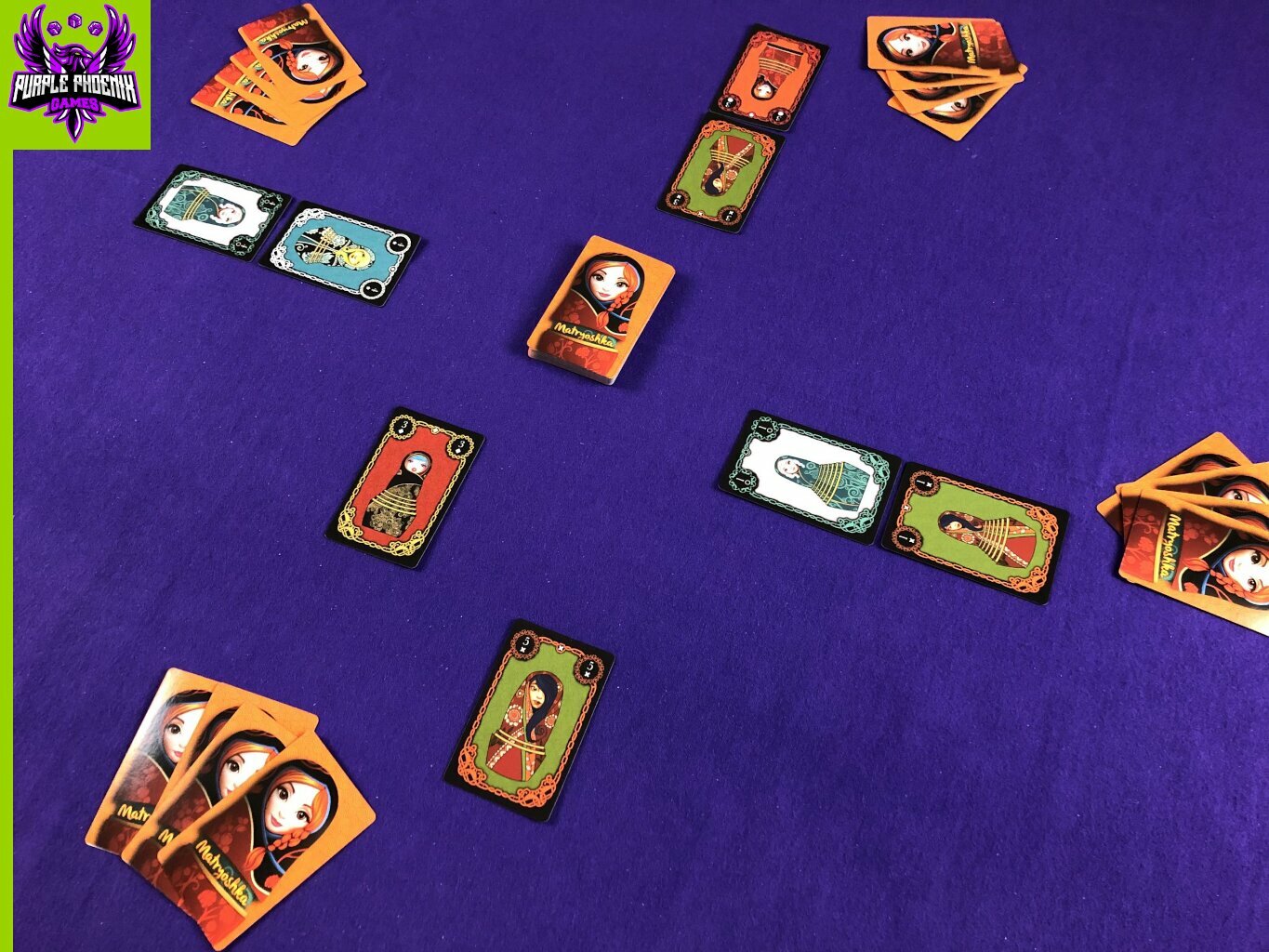
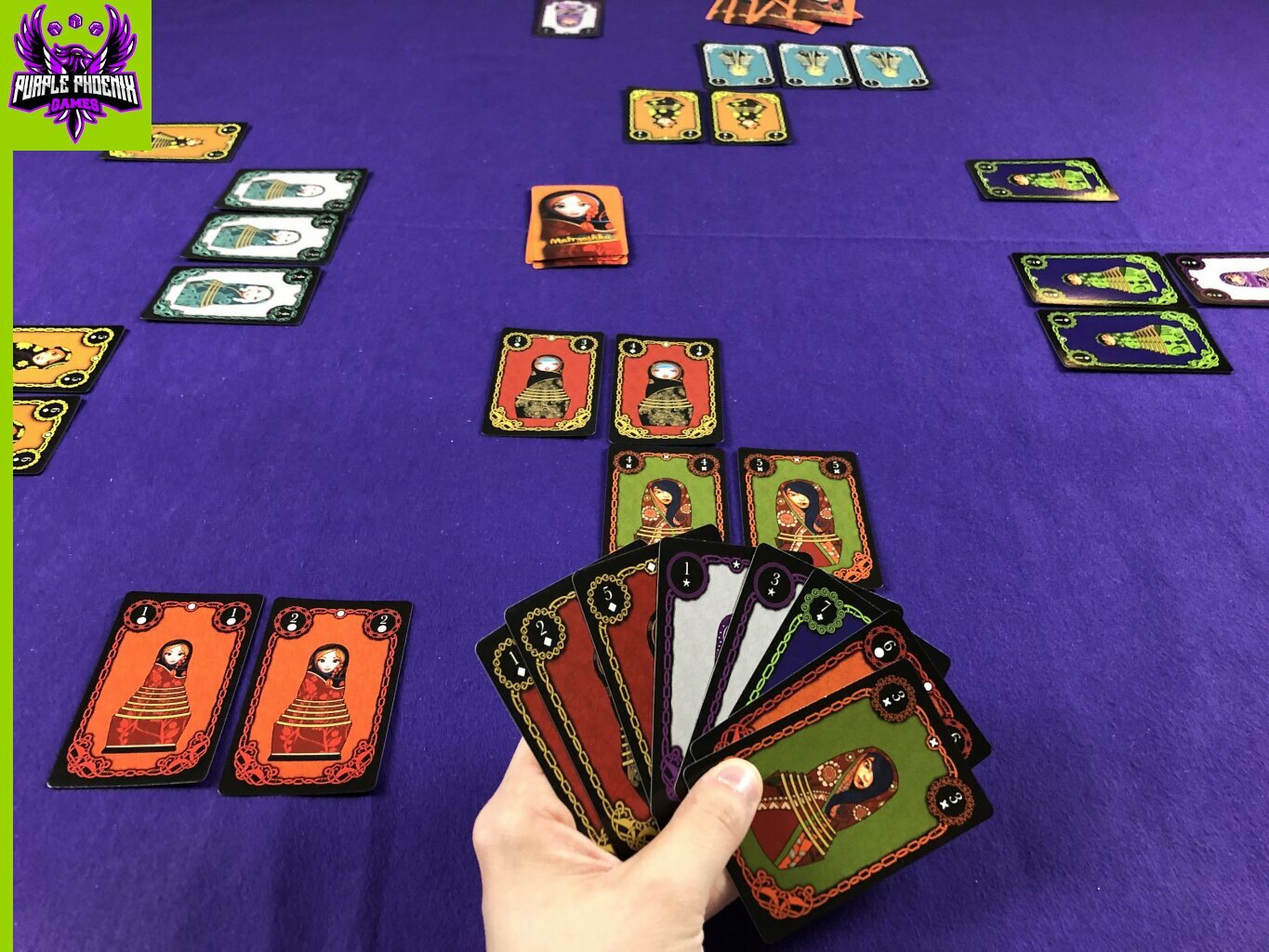
Matryoshka is a card game of hand management and set collection in which players are antique collectors attempting to gather complete sets of valuable Matryoshka dolls. Over the course of 4 rounds, players will be trading (in a sort of auction/bidding way) cards in their attempts to collect different sets of numerically ascending Matryoshka dolls. To setup for a game, you will first create the game deck. Depending on the player count, you will use a specific number of Matryoshka sets for the game – each set ranging from values 1-7. Shuffle the deck and deal 6 cards to each player, placing the remaining cards in the middle of the play area in a face-down draw deck. Players will then select 2 cards from their hand to place in their Display (tableau), organized as described in the rules. Cards in your display are visible to all players, and provide information as to what cards you have, and what cards you may be looking for. So deciding which cards to Display is part of your strategy. Select a starting player, and the game is ready to begin! Pictured below is the setup for a four-player game.
Each round is consists of 3 phases: Draw, Exchange, and Display. To begin the round, all players will draw 2 new cards from the deck. The Exchange phase is played in turns, beginning with the starting player as the active player. The active player will select one card from their hand to be placed face-up in the middle of the table. This is the card that is up for trade. All other players must then choose one card from their hands to be offered in exchange. Players keep their offer cards hidden, and the active player will secretly look at all offer cards. The active player then chooses one of the offer cards to take into their hand, and the player whose card was chosen takes the active player’s face-up card. All other players take their offer cards back into their own hand. Play then moves clock-wise, beginning another Exchange with a new active player.
When all players have had the opportunity to be the active player, the game moves to the Display phase. Players take all cards from their Display into their hand, and will then create a new Display. As the game rounds progress, the number of cards in each Display increases. To start the game, all players Display 2 cards. After the first round, the Display will have 4 cards, then 6, 8, and finally 13 to end the game. Again, cards in your Display are visible to all players, and that information could be used strategically when Exchanging cards in the second game phase. After the fourth and final round, players will have a total of 13 cards in their Display. Each Display is now scored, earning points for consecutive cards per row as well as sets of the same size of doll. The player with the highest total score is the winner of the game!
I should probably start by saying that I’m a sucker for set collection. So when I stumbled across Matryoshka, the theme drew me in and the set collection mechanic prompted me to hit ‘Add to Cart.’ And I have to say that I am loving this game. One major element that I like about Matryoshka is the simplicity of the gameplay. Draw 2 cards each round, offer cards from your hand in Exchange for others, create Displays of your sets. Easy as pie.
What really takes this game above and beyond for me are the strategic elements. Deciding which cards to Display at the end of each round is a major strategy point of the game. You have to be careful with which cards you choose to Display, because they are visible to all players. So maybe you’ve got a set of 5 consecutive cards, but do you really want your opponents to know that? Is it better to only Display a couple and use other sets to finish your Display? Or maybe you do want people to know you’re gunning for that set, as it may prompt them to offer any of those cards from their hand, for which you would pay a pretty price. You scratch my back, I’ll scratch yours, right? Along with that comes the negotiation tactic. During every Exchange, players are allowed to try to influence the active player for certain trades. Take my card now and I’ll owe you a favor later sort of thing. It’s neat to see what strategies players will try with each passing round.
ALSO it pays to pay careful attention to all opponents each round. When creating your Display at the end of every round, you do not have to use the same cards as in your last Display. So you can strategize to bait opponents to giving you cards you want, or to try and keep your chosen sets secret. That being said, paying attention to opposing Displays can be a good tactic. Maybe your neighbor just had a consecutive run of 3 cards in their Display, but now are choosing to only Display 1 of those cards – just because you can’t see the others, doesn’t mean they’re not necessarily there. So changing up Displays can be a way to maybe trick your opponents into thinking you do or do not have specific cards. If you keep a careful eye out, you may be able to deduce what everyone is hiding…
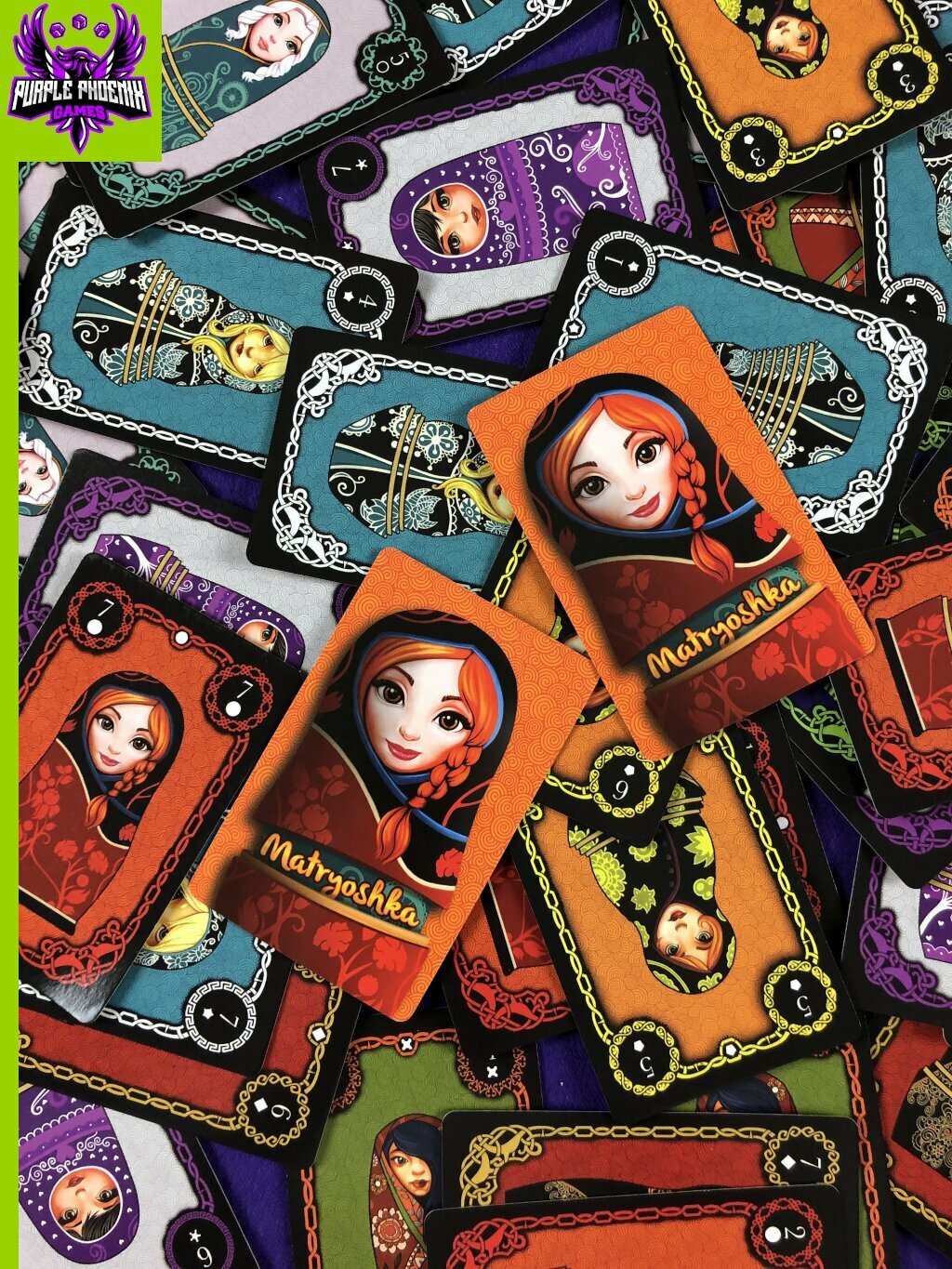
A quick note on components – this game is a stack of cards in a small magnetically-closing box. The artwork is thematic and unique, the rules and scoring aids are understandable, and the box itself is nice and sturdy. The cards are not the most high-quality I’ve seen in games, but as long as my players are gentle, that shouldn’t be a problem in the long run.
So all in all, I think you can tell that I love Matryoshka. The gameplay is simple and fast, yet the strategic options really get you thinking and perhaps second-guessing every Exchange that is made. I really like the element of changing Displays at the end of every round, as it allows players to adapt their strategy for the coming round. I wasn’t really sure what to expect when I picked up this game, but I was pleasantly surprised. It’s one that I’m definitely happy to have, and can see myself pulling it out often for a quick, yet strategic game between some of the bigger games out there. To bring back my analogy from my intro (yep, I’m committed to this joke), I would say that Matryoshka is nearly as satisfying as playing with a physical set of nesting dolls. If you’re looking for something light yet engaging, I would definitely recommend picking this one up. Purple Phoenix Games gives Matryoshka a nestled 5 / 6.
Matryoshka is a card game of hand management and set collection in which players are antique collectors attempting to gather complete sets of valuable Matryoshka dolls. Over the course of 4 rounds, players will be trading (in a sort of auction/bidding way) cards in their attempts to collect different sets of numerically ascending Matryoshka dolls. To setup for a game, you will first create the game deck. Depending on the player count, you will use a specific number of Matryoshka sets for the game – each set ranging from values 1-7. Shuffle the deck and deal 6 cards to each player, placing the remaining cards in the middle of the play area in a face-down draw deck. Players will then select 2 cards from their hand to place in their Display (tableau), organized as described in the rules. Cards in your display are visible to all players, and provide information as to what cards you have, and what cards you may be looking for. So deciding which cards to Display is part of your strategy. Select a starting player, and the game is ready to begin! Pictured below is the setup for a four-player game.
Each round is consists of 3 phases: Draw, Exchange, and Display. To begin the round, all players will draw 2 new cards from the deck. The Exchange phase is played in turns, beginning with the starting player as the active player. The active player will select one card from their hand to be placed face-up in the middle of the table. This is the card that is up for trade. All other players must then choose one card from their hands to be offered in exchange. Players keep their offer cards hidden, and the active player will secretly look at all offer cards. The active player then chooses one of the offer cards to take into their hand, and the player whose card was chosen takes the active player’s face-up card. All other players take their offer cards back into their own hand. Play then moves clock-wise, beginning another Exchange with a new active player.
When all players have had the opportunity to be the active player, the game moves to the Display phase. Players take all cards from their Display into their hand, and will then create a new Display. As the game rounds progress, the number of cards in each Display increases. To start the game, all players Display 2 cards. After the first round, the Display will have 4 cards, then 6, 8, and finally 13 to end the game. Again, cards in your Display are visible to all players, and that information could be used strategically when Exchanging cards in the second game phase. After the fourth and final round, players will have a total of 13 cards in their Display. Each Display is now scored, earning points for consecutive cards per row as well as sets of the same size of doll. The player with the highest total score is the winner of the game!
I should probably start by saying that I’m a sucker for set collection. So when I stumbled across Matryoshka, the theme drew me in and the set collection mechanic prompted me to hit ‘Add to Cart.’ And I have to say that I am loving this game. One major element that I like about Matryoshka is the simplicity of the gameplay. Draw 2 cards each round, offer cards from your hand in Exchange for others, create Displays of your sets. Easy as pie.
What really takes this game above and beyond for me are the strategic elements. Deciding which cards to Display at the end of each round is a major strategy point of the game. You have to be careful with which cards you choose to Display, because they are visible to all players. So maybe you’ve got a set of 5 consecutive cards, but do you really want your opponents to know that? Is it better to only Display a couple and use other sets to finish your Display? Or maybe you do want people to know you’re gunning for that set, as it may prompt them to offer any of those cards from their hand, for which you would pay a pretty price. You scratch my back, I’ll scratch yours, right? Along with that comes the negotiation tactic. During every Exchange, players are allowed to try to influence the active player for certain trades. Take my card now and I’ll owe you a favor later sort of thing. It’s neat to see what strategies players will try with each passing round.
ALSO it pays to pay careful attention to all opponents each round. When creating your Display at the end of every round, you do not have to use the same cards as in your last Display. So you can strategize to bait opponents to giving you cards you want, or to try and keep your chosen sets secret. That being said, paying attention to opposing Displays can be a good tactic. Maybe your neighbor just had a consecutive run of 3 cards in their Display, but now are choosing to only Display 1 of those cards – just because you can’t see the others, doesn’t mean they’re not necessarily there. So changing up Displays can be a way to maybe trick your opponents into thinking you do or do not have specific cards. If you keep a careful eye out, you may be able to deduce what everyone is hiding…
A quick note on components – this game is a stack of cards in a small magnetically-closing box. The artwork is thematic and unique, the rules and scoring aids are understandable, and the box itself is nice and sturdy. The cards are not the most high-quality I’ve seen in games, but as long as my players are gentle, that shouldn’t be a problem in the long run.
So all in all, I think you can tell that I love Matryoshka. The gameplay is simple and fast, yet the strategic options really get you thinking and perhaps second-guessing every Exchange that is made. I really like the element of changing Displays at the end of every round, as it allows players to adapt their strategy for the coming round. I wasn’t really sure what to expect when I picked up this game, but I was pleasantly surprised. It’s one that I’m definitely happy to have, and can see myself pulling it out often for a quick, yet strategic game between some of the bigger games out there. To bring back my analogy from my intro (yep, I’m committed to this joke), I would say that Matryoshka is nearly as satisfying as playing with a physical set of nesting dolls. If you’re looking for something light yet engaging, I would definitely recommend picking this one up. Purple Phoenix Games gives Matryoshka a nestled 5 / 6.

Purple Phoenix Games (2266 KP) rated Sheriff of Nottingham in Tabletop Games
Nov 16, 2021
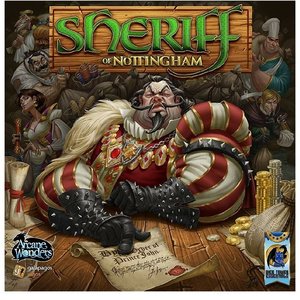


One neat thing about the board gaming hobby is how many new games are designed/created daily. So much innovation, creativity, and hype surrounds new releases and helps keep us gamers hooked! That being said, what happens to older games as time goes on? Can they still hold their own over the years? Do they still feel new and novel to first-time players who are getting to them late? The latter describes me with Sheriff of Nottingham. I only received it for Christmas two years ago, and it has sadly been sitting on my Shelf of Shame until recently. So now that I’ve finally gotten it to the table, how does it hold up? Keep reading to find out!
Disclaimer: I have the first edition of this game, so the pictures below do not reflect the art/component changes brought in the recently released second edition. -L
Sheriff of Nottingham is a party game of bluffing, negotiation, and set collection in which players are trying to earn the most money by bringing their goods (Legal or Contraband!) to market. However, before those goods can get to your merchant stand, they must be cleared to pass by the Sheriff of Nottingham. Are you honest in your declarations, or are you trying to sneak something past the town authority? Bluff, bribe, or negotiate your way to victory and collect the most gold!
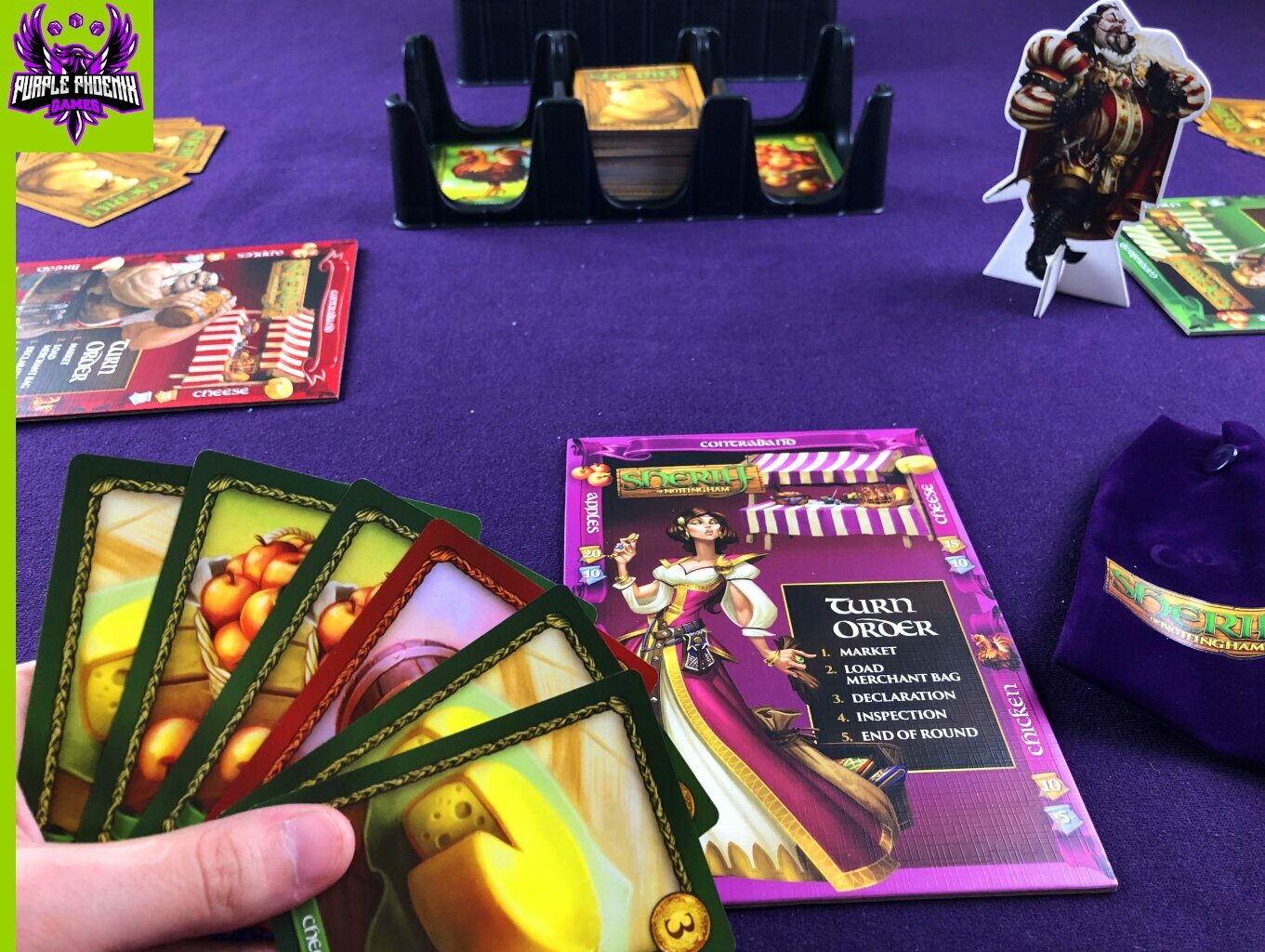
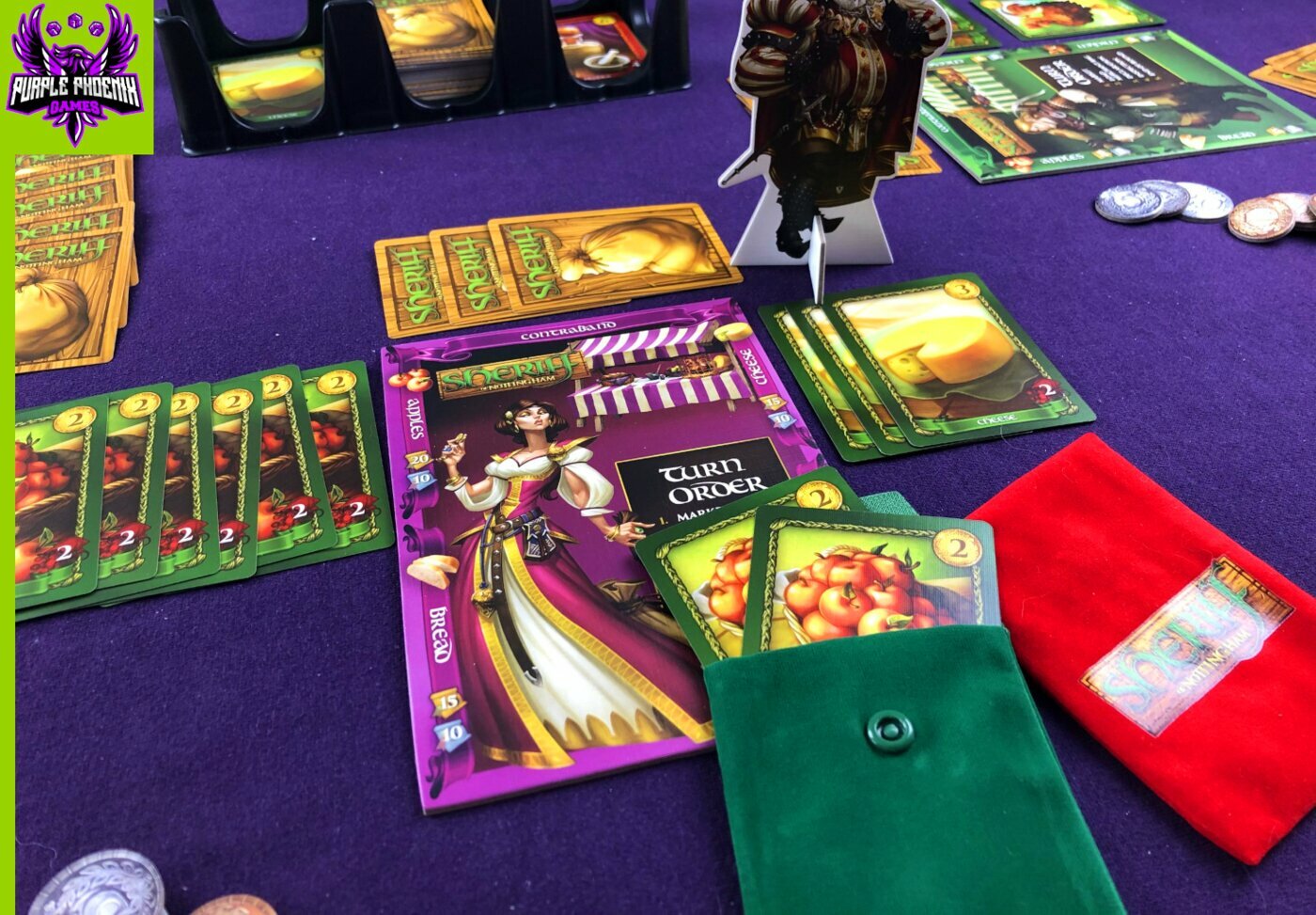
To setup for a game of Sheriff of Nottingham, each player receives a merchant stand board and bag in their chosen color, 20 starting gold, and 6 Goods cards. The remaining Goods cards are placed in a draw pile, with 2 adjacent discard piles. Turn over 5 cards to each discard pile, select a starting Sheriff, and the game is ready to begin! Sheriff of Nottingham is played over a series of rounds, and each round is broken down into 5 phases: Market, Load Merchant Bag, Declaration, Inspection, and End of Round. Important note – the player acting as Sheriff for the round will only act in the Inspection phase of a round. During the Market phase, players have the opportunity to discard unwanted Goods from their hand in order to draw cards from the draw pile or either discard pile. New cards are drawn one at a time, and you will draw as many cards as you have chosen to discard. The cards you discard will be placed in either discard pile, in whatever order you choose.
The next phase, Load Merchant Bag, is pretty self-explanatory. All merchant players will select up to 5 cards from their hand to place in their merchant bag. Snap it closed, and place it in front of you for the next phase, Declaration. In this phase, players will take turns declaring what good they are bringing to market. You must say exactly how many cards you are bringing, and you may only declare 1 type of Legal good! Even if your bag has multiple types of goods, you must declare only 1 type. Here is where your bluffing skills come into play! Once all players have made their declarations, the game moves to the Inspection phase, and it is now time for the Sheriff to act! In this phase, the Sheriff will get to decide if they wish to inspect any of the merchant bags, and merchants will have the opportunity to negotiate or bribe the Sheriff to not inspect their bag, or to inspect an opponent’s bag instead. If you make a deal with the Sheriff, you must hold up your end of the agreement!
Once the Sheriff has made their decision, they will either inspect bags or allow them to pass. If you are allowed to pass, you will take back your bag, open it, and add all goods to your merchant stand in their corresponding locations. Legal goods are known to all players, but Contraband goods are kept face-down. If the Sheriff chose to inspect your bag, they will open it and reveal the cards inside. If you were in fact telling the truth, and the cards inside are exactly what you declared, you add them to your merchant stand and the Sheriff will pay you a penalty for each Good card in your bag. If you were lying, a few things happen. First, any goods that were truthfully declared will go to your merchant stand as normal. Any goods that you lied about are confiscated by the Sheriff, and placed onto either discard pile. You then will pay the Sheriff a penalty fee for each confiscated good! The final phase, End of Round, has all players draw back up to 6 cards in hand, and the Sheriff title passes to the next player. The game continues in this fashion until all players have been the Sheriff twice (or three times in a 3-player game). Points are counted up – from your goods in your merchant stand, any gold coins you possess, and any bonus points for majority of Legal goods compared to opponents. Once all points have been tallied, the player with the highest score wins!
I know that I have said before that I generally don’t like bluffing games, but I think that Sheriff of Nottingham might be an exception. Yes, in some cases you will have to bluff about the contents of your merchant bag, but the ability to bribe/negotiate with the Sheriff takes some focus off the actual bluffing part. Can you convince the Sheriff to inspect another player’s bag just because you are trying to hinder that player? Or do you try to get the Sheriff to inspect your own bag, because then they will have to pay you a penalty fee for your honesty (this round, at least). It feels like there is more strategic gameplay here than simple bluffing, and I like the opportunity to strategize instead of relying solely on my (admittedly horrendous) poker-face.
Another thing that I really like about Sheriff of Nottingham is that it can technically be categorized as a party game, but it doesn’t feel like a typical party game to me. It takes strategy to play, and doesn’t just rely on crude/adult humor for laughs. This game really engages all players at all times, as you’re constantly watching your opponents, keeping track of what goods they seem to be collecting, and trying to catch them in a lie. The gameplay itself is pretty streamlined and straightforward, and that just helps to make it flow naturally and logically. The playing time is listed as 60 minutes, but it doesn’t feel like a long game to me at all. It’s just a light, fun, and entertaining game for really any type of game night.
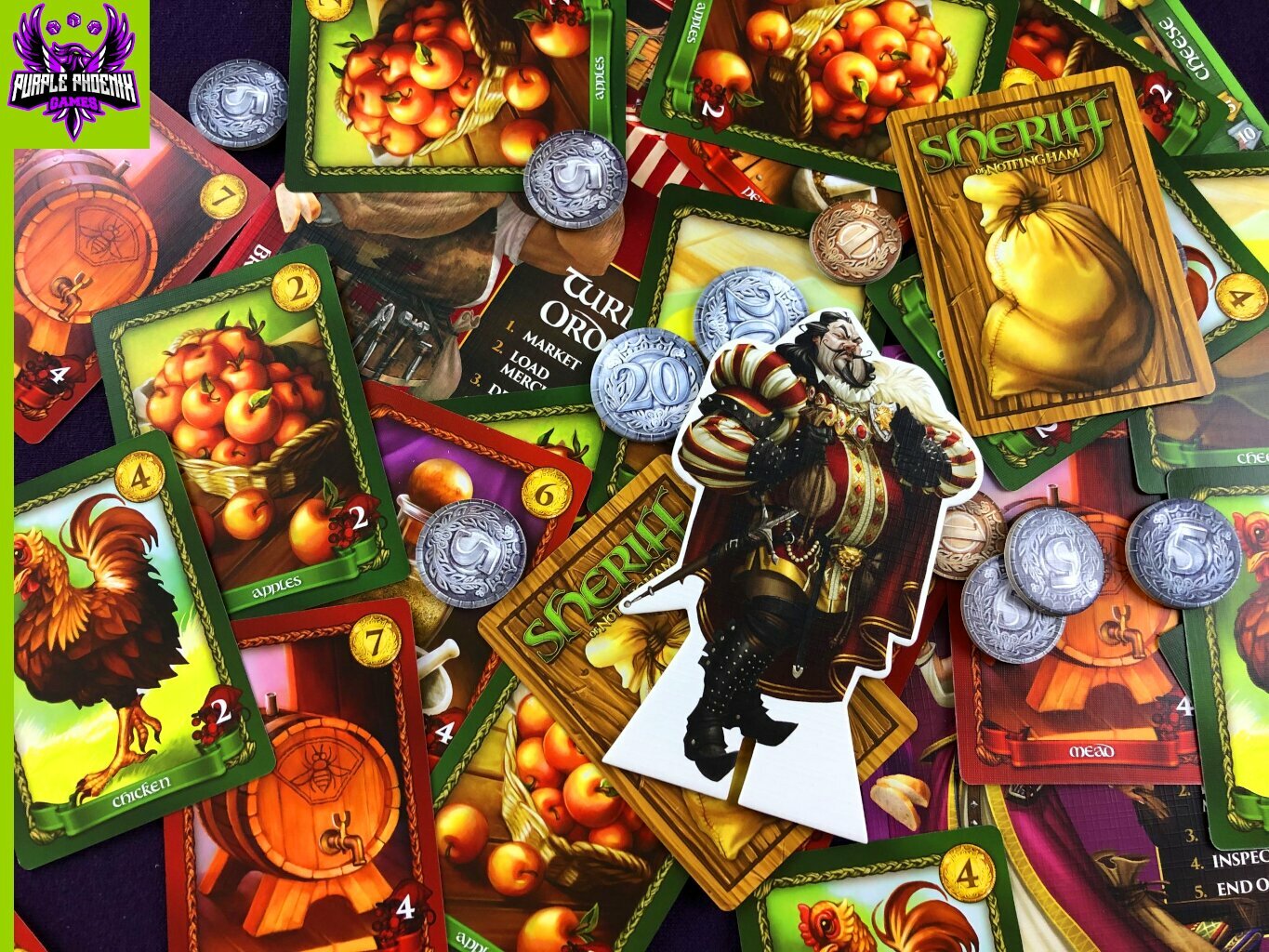
Let’s talk components for a minute. Again, I have the first edition of the game, so I cannot speak as to any component changes in the second edition. But overall, the quality of the first edition is pretty nice! The merchant stand boards are nice, thick cardboard, and are colorful and clear. Perhaps my favorite part of the boards is they each have a turn order reference on them. Not that the gameplay is that complicated, but it’s nice to just have that quick guide. The Goods cards are good quality and feel nice in hand. The artwork is mostly pretty simple, but I like that, since the crux of the gameplay is in the player interactions. The cardboard coins are chunky, and the insert doubles as a draw/discard pile organizer – which to me is a lifesaver! Nothing bothers me more than unruly stacks of cards. The merchant bags are nice and mostly functional. My biggest issue with them is that sometimes the snaps are a little hard to open, and it feels like you might tear the bag if you pull on them too hard. To alleviate that, I just don’t have players actually close the snap, instead just folding over the flap, and that works just as well! Great production quality in my opinion.
So if I seem to like this game, why did I only give it a 4 out of 6? The simple answer to that is that I do like the game, but I don’t love it. It’s fun and serves its purpose well, but it’s not a game that I am dying to pull out every game night. It’s one that will stay in my collection for sure, because there are some occasions that are just perfect for it. But it’s not one that will ever make its way to my Top 10. All in all, it holds up well for being an ‘older’ game, but it doesn’t exactly have me jumping up and down to play. That’s why Purple Phoenix Games gives this one an 11 / 18.
Disclaimer: I have the first edition of this game, so the pictures below do not reflect the art/component changes brought in the recently released second edition. -L
Sheriff of Nottingham is a party game of bluffing, negotiation, and set collection in which players are trying to earn the most money by bringing their goods (Legal or Contraband!) to market. However, before those goods can get to your merchant stand, they must be cleared to pass by the Sheriff of Nottingham. Are you honest in your declarations, or are you trying to sneak something past the town authority? Bluff, bribe, or negotiate your way to victory and collect the most gold!
To setup for a game of Sheriff of Nottingham, each player receives a merchant stand board and bag in their chosen color, 20 starting gold, and 6 Goods cards. The remaining Goods cards are placed in a draw pile, with 2 adjacent discard piles. Turn over 5 cards to each discard pile, select a starting Sheriff, and the game is ready to begin! Sheriff of Nottingham is played over a series of rounds, and each round is broken down into 5 phases: Market, Load Merchant Bag, Declaration, Inspection, and End of Round. Important note – the player acting as Sheriff for the round will only act in the Inspection phase of a round. During the Market phase, players have the opportunity to discard unwanted Goods from their hand in order to draw cards from the draw pile or either discard pile. New cards are drawn one at a time, and you will draw as many cards as you have chosen to discard. The cards you discard will be placed in either discard pile, in whatever order you choose.
The next phase, Load Merchant Bag, is pretty self-explanatory. All merchant players will select up to 5 cards from their hand to place in their merchant bag. Snap it closed, and place it in front of you for the next phase, Declaration. In this phase, players will take turns declaring what good they are bringing to market. You must say exactly how many cards you are bringing, and you may only declare 1 type of Legal good! Even if your bag has multiple types of goods, you must declare only 1 type. Here is where your bluffing skills come into play! Once all players have made their declarations, the game moves to the Inspection phase, and it is now time for the Sheriff to act! In this phase, the Sheriff will get to decide if they wish to inspect any of the merchant bags, and merchants will have the opportunity to negotiate or bribe the Sheriff to not inspect their bag, or to inspect an opponent’s bag instead. If you make a deal with the Sheriff, you must hold up your end of the agreement!
Once the Sheriff has made their decision, they will either inspect bags or allow them to pass. If you are allowed to pass, you will take back your bag, open it, and add all goods to your merchant stand in their corresponding locations. Legal goods are known to all players, but Contraband goods are kept face-down. If the Sheriff chose to inspect your bag, they will open it and reveal the cards inside. If you were in fact telling the truth, and the cards inside are exactly what you declared, you add them to your merchant stand and the Sheriff will pay you a penalty for each Good card in your bag. If you were lying, a few things happen. First, any goods that were truthfully declared will go to your merchant stand as normal. Any goods that you lied about are confiscated by the Sheriff, and placed onto either discard pile. You then will pay the Sheriff a penalty fee for each confiscated good! The final phase, End of Round, has all players draw back up to 6 cards in hand, and the Sheriff title passes to the next player. The game continues in this fashion until all players have been the Sheriff twice (or three times in a 3-player game). Points are counted up – from your goods in your merchant stand, any gold coins you possess, and any bonus points for majority of Legal goods compared to opponents. Once all points have been tallied, the player with the highest score wins!
I know that I have said before that I generally don’t like bluffing games, but I think that Sheriff of Nottingham might be an exception. Yes, in some cases you will have to bluff about the contents of your merchant bag, but the ability to bribe/negotiate with the Sheriff takes some focus off the actual bluffing part. Can you convince the Sheriff to inspect another player’s bag just because you are trying to hinder that player? Or do you try to get the Sheriff to inspect your own bag, because then they will have to pay you a penalty fee for your honesty (this round, at least). It feels like there is more strategic gameplay here than simple bluffing, and I like the opportunity to strategize instead of relying solely on my (admittedly horrendous) poker-face.
Another thing that I really like about Sheriff of Nottingham is that it can technically be categorized as a party game, but it doesn’t feel like a typical party game to me. It takes strategy to play, and doesn’t just rely on crude/adult humor for laughs. This game really engages all players at all times, as you’re constantly watching your opponents, keeping track of what goods they seem to be collecting, and trying to catch them in a lie. The gameplay itself is pretty streamlined and straightforward, and that just helps to make it flow naturally and logically. The playing time is listed as 60 minutes, but it doesn’t feel like a long game to me at all. It’s just a light, fun, and entertaining game for really any type of game night.
Let’s talk components for a minute. Again, I have the first edition of the game, so I cannot speak as to any component changes in the second edition. But overall, the quality of the first edition is pretty nice! The merchant stand boards are nice, thick cardboard, and are colorful and clear. Perhaps my favorite part of the boards is they each have a turn order reference on them. Not that the gameplay is that complicated, but it’s nice to just have that quick guide. The Goods cards are good quality and feel nice in hand. The artwork is mostly pretty simple, but I like that, since the crux of the gameplay is in the player interactions. The cardboard coins are chunky, and the insert doubles as a draw/discard pile organizer – which to me is a lifesaver! Nothing bothers me more than unruly stacks of cards. The merchant bags are nice and mostly functional. My biggest issue with them is that sometimes the snaps are a little hard to open, and it feels like you might tear the bag if you pull on them too hard. To alleviate that, I just don’t have players actually close the snap, instead just folding over the flap, and that works just as well! Great production quality in my opinion.
So if I seem to like this game, why did I only give it a 4 out of 6? The simple answer to that is that I do like the game, but I don’t love it. It’s fun and serves its purpose well, but it’s not a game that I am dying to pull out every game night. It’s one that will stay in my collection for sure, because there are some occasions that are just perfect for it. But it’s not one that will ever make its way to my Top 10. All in all, it holds up well for being an ‘older’ game, but it doesn’t exactly have me jumping up and down to play. That’s why Purple Phoenix Games gives this one an 11 / 18.