

Bob Mann (459 KP) rated They Shall Not Grow Old (2018) in Movies
Sep 28, 2021
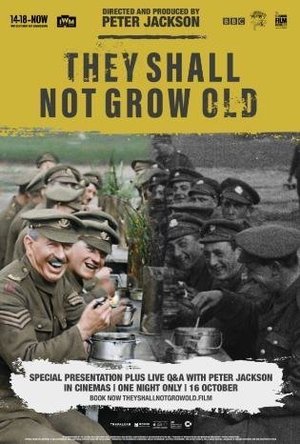


The results are outstanding. Jackson wisely focuses the film on the specific slice of WW1 action from the trenches. And those anonymous figures become real, live, breathing humans on screen. It is obviously tragic that some (and as commented by Jackson, many in one scene) are not to be breathing humans for much longer.
These effects take a while to kick in. The early scenes in the documentary are in the original black and white, describing the recruitment process, and how many of the recruits were under-age. (To explain the varied comments in the film, they should have been 18, although officially shouldn’t have been sent overseas until 19).
It is when the troops arrive in France that we suddenly go from black-and-white to the fully restored and colourised footage, and it is a gasp-inducing moment.
Audio magic
All of the audio commentary is from original BBC recordings of war veterans recounting their actual experiences in the trench. Some sound like heroes; some sound like rogues; all came out changed men. Supporting music of WW1 ditties, including the incredibly rude “Mademoiselle from Armentières” over the end credits, is provided by Plan 9.
But equally impressive is the dubbing of the characters onscreen. Jackson employed forensic lip-readers to determine what the soldiers on-screen were saying, and reproduced the speech using appropriate regional accents for the regiments concerned. Jackson also recounts how the words associated with a “pep-talk” speech to troops by an officer he found on an original slip of paper within the regimental records: outstanding. Added sound effects include real-life shelling by the New Zealand army. It all adds to the overall atmosphere of the film.
3D = less
The film itself is a masterpiece of technical innovation that will change in the future the way in which we should be able to see this sort of early film footage forever. As a documentary it’s near-perfection. But if I have a criticism of the cinema showing I attended it is that the 3D tended to detract rather than add to the film. Perhaps this is just my eyesight, but 3D always tends to make images slightly more blurry. Where (like “Gravity”) there are great 3D effects to showcase, it’s worth the slight negative to get the massive positive. But here, there was no such benefit: 2D would have been better. For those in the UK (and possibly through other broadcasters worldwide) the film is being shown on BBC2 tonight (11/11/18) at 9:30: I will be watching it again to compare and contrast.
Final Thoughts
Jackson dedicated the film to his grandfather. And almost all of us Brits will have relatives affected by this “war to end all wars”. In my case, my grandfather was shot and severely wounded at Leuze Wood on the Somme, lying in the mud for four days and four nights before being recovered… by the Germans! Fortunately he was well-treated and, although dying young, recovered enough to father my father – else I wouldn’t be here today writing this. On this Rememberance Sunday, 100 years on, it is a time for us to truly remember the sacrifice these men and boys gave to what, all in the film agree, was a pretty obstinate and pointless conflict.
I’ll finish the review by reproducing one of the war poems of my wife’s Uncle Ivor (available in a collection here), written on 11/11/18 a hundred years ago:
Peace
At last O Lord the Day has come,
And hushed is now the noise of guns.
Peace is proclaimed over land and sea,
Our heartfelt thanks we give to Thee.
I thank thee Father for Thy care,
That thou hasn’t answered all my prayers.
This day I see in manhood’s strength,
The Peace we longed for, come at length.
O may my future actions be,
Worthy of all Thy care to me.
Let me forget not Thy Great Love,
Remembering chums who live Above.
I.G.H. 11/11/1918, France.

China to Chitral: Mountains are the Beginning and End of All Scenery
Book
'Upon this trackless waste of snow, cut by a shrewd wind they sat down and wept.' In China to...
Modernity Britain: 1957-1962
Book
David Kynaston's history of post-war Britain has so far taken us from the radically reforming Labour...
Religious Lessons: Catholic Sisters and the Captured Schools Crisis in New Mexico
Book
Religious Lessons tells the story of Zellers v. Huff, a court case that challenged the employment of...

The Newcomers: Finding Refuge, Friendship, and Hope in an American Classroom
Book
From the award-winning author of Soldier Girls and Just Like Us, a "fascinating" (The New York...

Austerlitz
James Wood, Anthea Bell and W.G. Sebald
Book
Austerlitz is W. G. Sebald's haunting novel of post-war Europe. In 1939, five-year-old Jacques...

Ta-ra-ra-boom-de-ay: The Dodgy Business of Popular Music
Book
Simon Napier-Bell is a legend in the music business. Not only was he the manager of The Yardbirds, T...

In Search of the Essence of Place
Petr Kral and Christopher Moncrieff
Book
A moving and reflective memoir, In Search of the Essence of Place is a Remembrance of Things Past...
Oliver!: A Dickensian Musical
Book
When the show was first produced in 1960, at a time when transatlantic musical theatre was dominated...
The Matter of High Words: Naturalism, Normativity, and the Postwar Sage
Book
In a world of matter, how can we express what matters? When the explanations of the natural sciences...