
Search
Search results

Chris Sawin (602 KP) rated Inglourious Basterds (2009) in Movies
Jun 21, 2019 (Updated Jun 22, 2019)
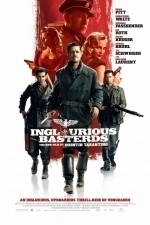

It's the middle of World War II and France is overrun with Nazis. A group of Jewish-American soldiers is making a name for themselves as, "The Basterds," as they have the full intention of scalping each and every Nazi involved in the Third Reich. The Basterds soon become a real nuisance to The Fuhrer as their reputation strengthens and fear spreads like wildfire amongst the Nazis. Shosanna Dreyfus, a French-Jew whose family was killed by the Nazis, now owns a movie theater that catches the eye of Joseph Goebbels and his new film. The smaller, more private theater gets handpicked by Fredrick Zoller, a Nazi war hero and star of Goebbels film Nation's Pride, for the premiere of his new film. As the premiere becomes an intimate gathering of the Nazis, including the most important people of the Third Reich, The Basterds realize this may be their chance to end this war once and for all.
Inglourious Basterds had the potential to be one of the greatest films of the year. It's the first full-length film from Quentin Tarantino since Death Proof and his films from the past 12 years have escalated him into being one of the most well-respected filmmakers of our time. That along with an incredibly strong cast led by Brad Pitt and the fact that the film took place during World War II had me incredibly excited for the film. I'm a fairly big admirer of most of Tarantino's previous works and there's something about World War II and Nazis that I've always found fascinating. The final product was still good, but just didn't wind up meeting my expectations.
The concept of Inglourious Basterds is rather ingenious. A group of Jewish-Americans coming together and killing as many Nazis as they can. An ultimate form of revenge. Not only that, but an incredible sense of satisfaction washes over them while they partake in it. It's great and is pulled off rather flawlessly when we actually get to see The Basterds in action. As much as I love Tarantino's dialogue, it just seemed like the majority of the film was spent waiting around and talking about what was actually going to happen. Significant events still took place, but there's really only three or four scenes that come to mind that you could label as being exciting. Whether the film needed more of that is fully up to the viewer, but I'm under the impression that the film was a bit lacking in that department. Something else that should be mentioned, the film is not historically accurate. It's more of a World War II set in the Tarantino-verse kind of deal and is more of an alternate universe. Knowing that before seeing the movie helped a great deal in enjoying the film a bit more.
As enjoyable as Brad Pitt's performance as Lt. Aldo Raine was, I believe the real performance worth noting is Christoph Waltz's portrayal of Col. Hans Landa. He's somehow able to walk the thin line between being polite and charming to being a frightening lunatic rather flawlessly. Even as he closes in on The Basterds and their plans, he still manages to steal most of the scenes he's in (the discussion about comparing Jews to rats at the beginning of the film, the "That's-a-bingo!" conversation with Aldo, etc). Landa is just an incredible detective with a marvelous personality that might just be one of the greatest characters Tarantino has ever written.
Inglourious Basterds is an extremely solid effort from Tarantino. The dialogue is definitely up to Tarantino's standard greatness, the performances are quite incredible, and the story is an entertaining one even with it straying away from what actually happened during that time period. It's just a shame it didn't meet the expectations I had based on the trailers and how much I enjoyed the past few Tarantino films. The hard hitting action scenes are magnificent, but it felt like there were too few and far between. The best suggestion I could give would be to go into the film expecting nothing and I think you'll walk away satisfied.
Inglourious Basterds had the potential to be one of the greatest films of the year. It's the first full-length film from Quentin Tarantino since Death Proof and his films from the past 12 years have escalated him into being one of the most well-respected filmmakers of our time. That along with an incredibly strong cast led by Brad Pitt and the fact that the film took place during World War II had me incredibly excited for the film. I'm a fairly big admirer of most of Tarantino's previous works and there's something about World War II and Nazis that I've always found fascinating. The final product was still good, but just didn't wind up meeting my expectations.
The concept of Inglourious Basterds is rather ingenious. A group of Jewish-Americans coming together and killing as many Nazis as they can. An ultimate form of revenge. Not only that, but an incredible sense of satisfaction washes over them while they partake in it. It's great and is pulled off rather flawlessly when we actually get to see The Basterds in action. As much as I love Tarantino's dialogue, it just seemed like the majority of the film was spent waiting around and talking about what was actually going to happen. Significant events still took place, but there's really only three or four scenes that come to mind that you could label as being exciting. Whether the film needed more of that is fully up to the viewer, but I'm under the impression that the film was a bit lacking in that department. Something else that should be mentioned, the film is not historically accurate. It's more of a World War II set in the Tarantino-verse kind of deal and is more of an alternate universe. Knowing that before seeing the movie helped a great deal in enjoying the film a bit more.
As enjoyable as Brad Pitt's performance as Lt. Aldo Raine was, I believe the real performance worth noting is Christoph Waltz's portrayal of Col. Hans Landa. He's somehow able to walk the thin line between being polite and charming to being a frightening lunatic rather flawlessly. Even as he closes in on The Basterds and their plans, he still manages to steal most of the scenes he's in (the discussion about comparing Jews to rats at the beginning of the film, the "That's-a-bingo!" conversation with Aldo, etc). Landa is just an incredible detective with a marvelous personality that might just be one of the greatest characters Tarantino has ever written.
Inglourious Basterds is an extremely solid effort from Tarantino. The dialogue is definitely up to Tarantino's standard greatness, the performances are quite incredible, and the story is an entertaining one even with it straying away from what actually happened during that time period. It's just a shame it didn't meet the expectations I had based on the trailers and how much I enjoyed the past few Tarantino films. The hard hitting action scenes are magnificent, but it felt like there were too few and far between. The best suggestion I could give would be to go into the film expecting nothing and I think you'll walk away satisfied.
Chris Sawin (602 KP) rated John Carpenter's Vampires (1998) in Movies
Jun 22, 2019
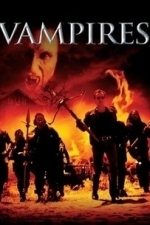

A group of eccentric vampire hunters lead by the rugged and cold-hearted Jack Crow (James Woods) never really stop working. Taking great pride in the fruits of their labor, they work hard and play even harder as their celebrations after a job well done consist of alcohol flowing freely and plenty of women to take their minds off of work. But this particular job didn't go exactly as planned and it's weighing heavily on the mind of Jack Crow. Even after killing what's referred to as a "nest" of nine vampires, the master was no where to be found. Hardly a reason to celebrate in Jack's eyes. Unfortunately, his gut instinct was right as things get a hell of a lot worse for Jack's team when the master shows up to their little shindig. But this master is different from the others; stronger, more powerful, and why does he know Jack's name? There's something more elaborate going on and Jack Crow is going to find out exactly what it is while eradicating as many vampires as he possibly can along the way.
Judging by the ratings this film has (34% fresh on Rotten Tomatoes, 5.8/10 on IMDb), I guess it's safe to say that this could be a guilty pleasure of mine. I love most of John Carpenter's work and I really enjoyed his take on vampires. Jack Crow is certainly reason alone to sit through this and although the character originated in John Steakley's novel, I feel Crow is just as strong of a character in Carpenter's world as Snake Plissken from Escape From New York. Even though he's basically a mean spirited SOB, you can't help but sympathize with the character as the film moves on. Considering all that's happened to him in his lifetime, he seems to be a decent guy deep down underneath that extremely thick and rough exterior. His dialogue was also a lot of fun. Gems such as him asking Father Adam Guiteau if he had wood after the fight they just had or when he's explaining the true mythos behind vampires and to "forget whatever you've seen in the movies" was just classic.
Other than Jack Crow, I actually really enjoyed the storyline which seemed to be a breaking point for a lot of people. A vampire seeking a black cross to finish a reverse exorcism, so he can walk in daylight without turning to dust. Only Carpenter could pull something like that off. Their methods of killing vampires were also a bit more original and unorthodox compared to other vampire films of the past. Jack Crow would shoot an arrow from a crossbow, which would be attached to a wire on the bottom of a jeep that would be reeled in by Daniel Baldwin's Anthony Montoya that would drag the vampire into the sunlight where their body would burst into flames. Maybe it's considered cheesy to some, but it was refreshing to see something different for a change. As big of a horror fan that I am, I don't really think of myself as a fan of vampires. I'm not sure if it's because I'm picky or because it seems like everything is being recycled when it comes to storylines in horror films these days, but I like to think when a vampire film does make an impact on me that it says more than the average horror film containing vampires.
John Carpenter, the master of horror, delivers a refreshing and interesting take on vampires with the aptly named Vampires. It also dawns another strong lead character in a Carpenter film in the form of Jack Crow and contains some of the most witty and enjoyable dialogue of any horror film from the late '90s. The storyline is also magnificently peculiar, which is a definite plus in my book. This would definitely make my list of favorite vampire films, if I ever decided to make one. If you're a fan of John Carpenter and haven't seen this gem, I highly recommend doing so. Or if you have, maybe it's time to dust it off and give it another watch.
Judging by the ratings this film has (34% fresh on Rotten Tomatoes, 5.8/10 on IMDb), I guess it's safe to say that this could be a guilty pleasure of mine. I love most of John Carpenter's work and I really enjoyed his take on vampires. Jack Crow is certainly reason alone to sit through this and although the character originated in John Steakley's novel, I feel Crow is just as strong of a character in Carpenter's world as Snake Plissken from Escape From New York. Even though he's basically a mean spirited SOB, you can't help but sympathize with the character as the film moves on. Considering all that's happened to him in his lifetime, he seems to be a decent guy deep down underneath that extremely thick and rough exterior. His dialogue was also a lot of fun. Gems such as him asking Father Adam Guiteau if he had wood after the fight they just had or when he's explaining the true mythos behind vampires and to "forget whatever you've seen in the movies" was just classic.
Other than Jack Crow, I actually really enjoyed the storyline which seemed to be a breaking point for a lot of people. A vampire seeking a black cross to finish a reverse exorcism, so he can walk in daylight without turning to dust. Only Carpenter could pull something like that off. Their methods of killing vampires were also a bit more original and unorthodox compared to other vampire films of the past. Jack Crow would shoot an arrow from a crossbow, which would be attached to a wire on the bottom of a jeep that would be reeled in by Daniel Baldwin's Anthony Montoya that would drag the vampire into the sunlight where their body would burst into flames. Maybe it's considered cheesy to some, but it was refreshing to see something different for a change. As big of a horror fan that I am, I don't really think of myself as a fan of vampires. I'm not sure if it's because I'm picky or because it seems like everything is being recycled when it comes to storylines in horror films these days, but I like to think when a vampire film does make an impact on me that it says more than the average horror film containing vampires.
John Carpenter, the master of horror, delivers a refreshing and interesting take on vampires with the aptly named Vampires. It also dawns another strong lead character in a Carpenter film in the form of Jack Crow and contains some of the most witty and enjoyable dialogue of any horror film from the late '90s. The storyline is also magnificently peculiar, which is a definite plus in my book. This would definitely make my list of favorite vampire films, if I ever decided to make one. If you're a fan of John Carpenter and haven't seen this gem, I highly recommend doing so. Or if you have, maybe it's time to dust it off and give it another watch.
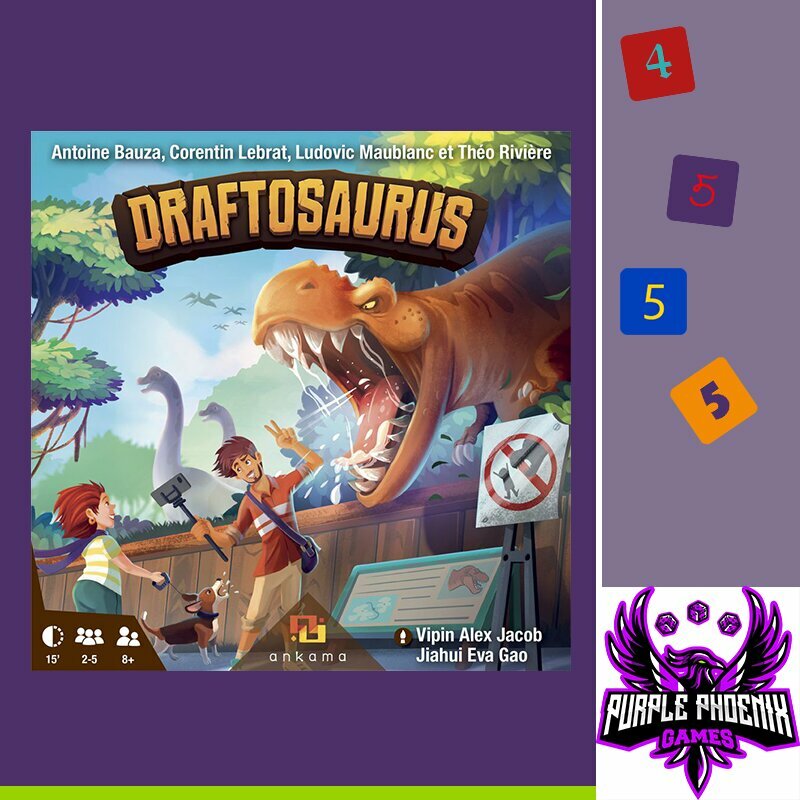
Purple Phoenix Games (2266 KP) rated Draftosaurus in Tabletop Games
May 14, 2021
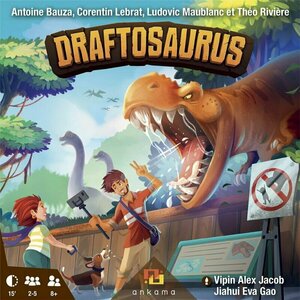
YESSSSS Let’s build a dinopark! I have been waiting for this for years! Yes, I know that Dinosaur Island exists. It’s a good game. In fact, I think it’s a great game. But I have been waiting for a quick game of building a dinopark that I can also share with my young kids. Have I found it with Draftosaurus, or is this just another in a long line of drafting games?
Draftosaurus is so appropriately named due to being a drafting game with a dinosaur theme. Instead of typically drafting cards, however, players are drafting adorable little dinomeeples to populate their theme park attractions. Each attraction, or pen in the game, offers different points for having different dinos in each, or the same, or just one, or exactly three, et al. The player with the most points from these pens at the end of the game is the winner!
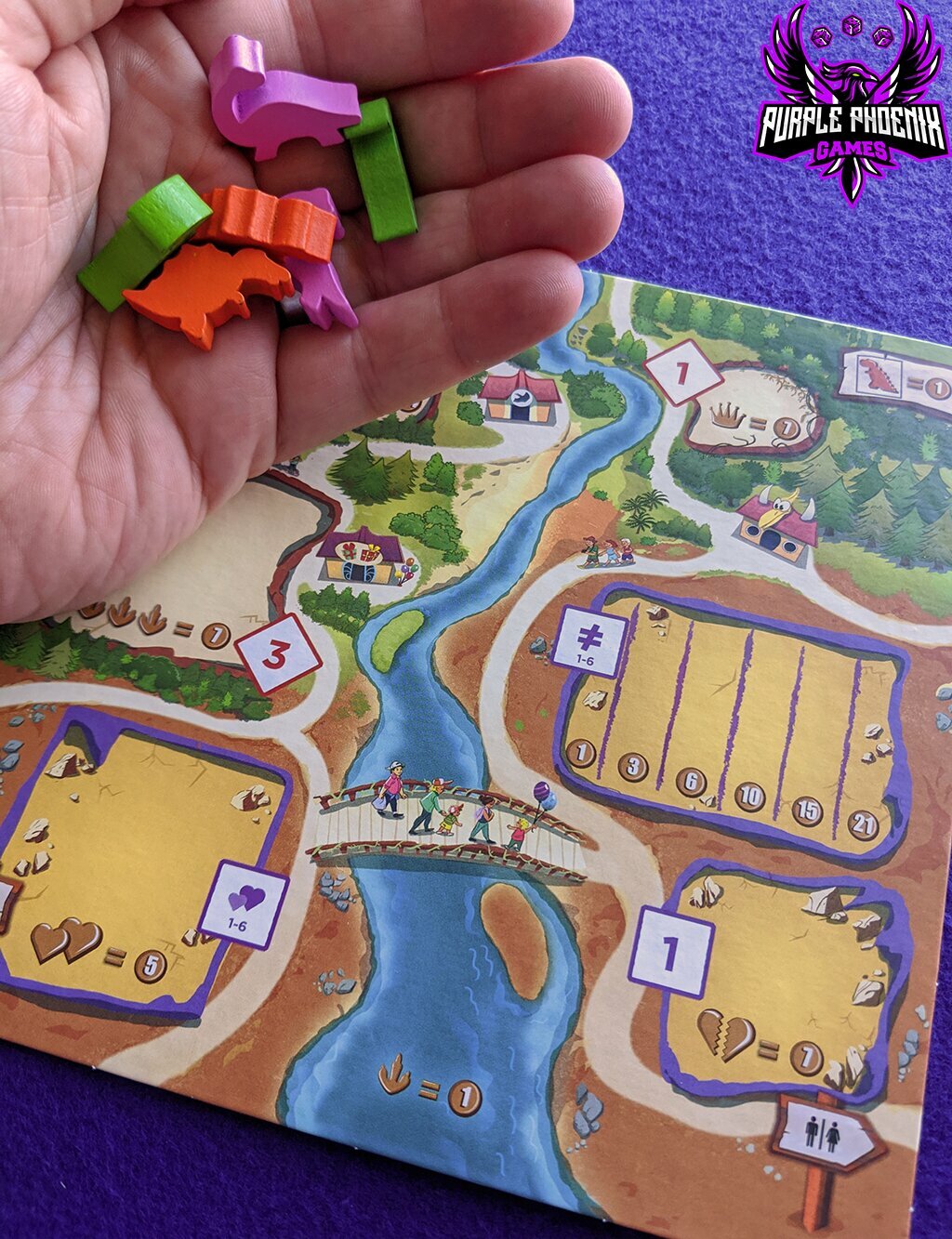
To setup, every player receives a park board. Populate the draw bag with dinomeeples based on the number of players using the table in the rulebook. Give the wooden placement die to the youngest player and play can begin!
A game of Draftosaurus spans exactly two rounds. Each round is exactly the same: each player grabs six dinomeeples from the bag, active player rolls the die, players draft dinos, players pass the remaining dinos. Repeat these steps starting at die rolling, but the die is passed along with the dinos from the active player. This is repeated until all dinos have been drafted and placed in pens. Easy right?
The true nature of the game and the most fun part is in the placement die and placement of the dinos in the pens. When the die is rolled, this signifies specific placement rules for all players except the active player. So perhaps the die shows that dinos must be placed in the Grasslands, which are the pens on the bottom portion of the boards. Or maybe the die shows that new dinos may only be added to pens that currently have no dinos in them. Again, these rules do not apply to they that rolled the die, but rather every other player. Herein lies the scrumptious struggle: where does one place the dinos they currently possess in their hand from their neighbor? What pens will score the most points at endgame? Can a T.Rex really be appropriate in this pen? The choices can be maddening, or one can play the game with complete laissez-faire and still have a great time. After two rounds the game ends and players look upon their parks with pride as they count up their final scores.
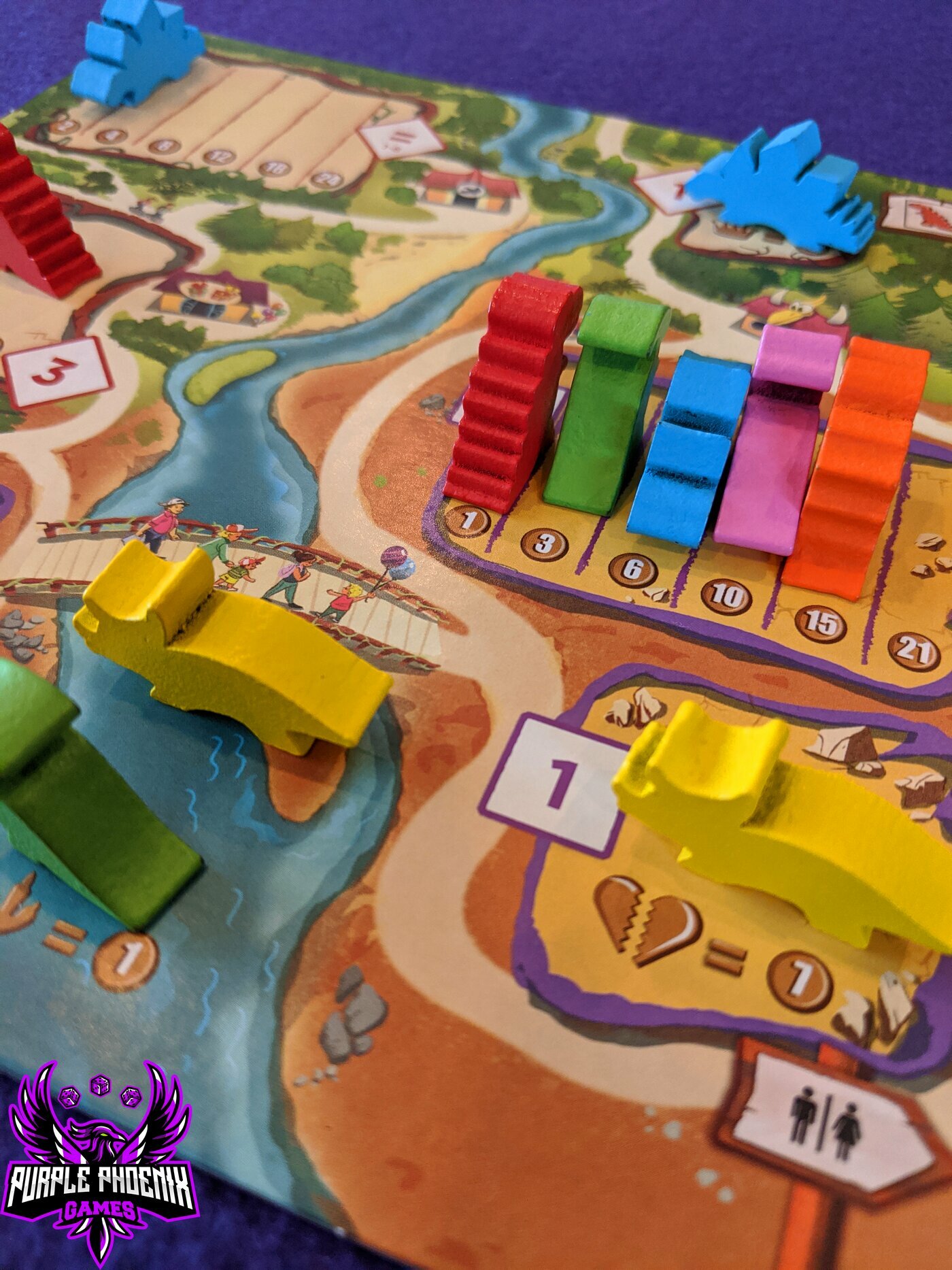
Components. I really only know Ankama from the Krosmaster games, which though I am not really a fan of, the components are great. I believe Ankama has provided excellent components for Draftosaurus. The dinomeeples are all excellently colored and designed. The boards are good quality, though I question the “Grasslands” being brown and kinda devoid of grass. All in all, the components are great and I love handling them and playing with them.
Yes, we always include our scores at the beginning of each review. So you all already know what I’m about to say here. I love this game! I love having so many options available to me, only to have the die roll tell me I can’t do exactly what I want, so I have to alter my strategy on a dime. I love being able to see my dinos filling up the park (or swimming in the River if there are no places for them) and watching them frolic… well, okay not frolic in tight spaced pens. No wonder they all went crazy and escaped in those movies. In any case, if you or your family/friends/playdates enjoy drafting games, but want something a little different, while respecting your playtime (something that many drafting games extend) take a look at Draftosaurus. Even children can get in on the action, as there is no need to be able to read, necessarily. I haven’t yet tried it with my 3-year-old, but I think I will this weekend now. That all said, Purple Phoenix Games gives this one an enthusiastically Triassic 19 / 24. Just keep Newman and Nick Fury away from your game table.
Draftosaurus is so appropriately named due to being a drafting game with a dinosaur theme. Instead of typically drafting cards, however, players are drafting adorable little dinomeeples to populate their theme park attractions. Each attraction, or pen in the game, offers different points for having different dinos in each, or the same, or just one, or exactly three, et al. The player with the most points from these pens at the end of the game is the winner!
To setup, every player receives a park board. Populate the draw bag with dinomeeples based on the number of players using the table in the rulebook. Give the wooden placement die to the youngest player and play can begin!
A game of Draftosaurus spans exactly two rounds. Each round is exactly the same: each player grabs six dinomeeples from the bag, active player rolls the die, players draft dinos, players pass the remaining dinos. Repeat these steps starting at die rolling, but the die is passed along with the dinos from the active player. This is repeated until all dinos have been drafted and placed in pens. Easy right?
The true nature of the game and the most fun part is in the placement die and placement of the dinos in the pens. When the die is rolled, this signifies specific placement rules for all players except the active player. So perhaps the die shows that dinos must be placed in the Grasslands, which are the pens on the bottom portion of the boards. Or maybe the die shows that new dinos may only be added to pens that currently have no dinos in them. Again, these rules do not apply to they that rolled the die, but rather every other player. Herein lies the scrumptious struggle: where does one place the dinos they currently possess in their hand from their neighbor? What pens will score the most points at endgame? Can a T.Rex really be appropriate in this pen? The choices can be maddening, or one can play the game with complete laissez-faire and still have a great time. After two rounds the game ends and players look upon their parks with pride as they count up their final scores.
Components. I really only know Ankama from the Krosmaster games, which though I am not really a fan of, the components are great. I believe Ankama has provided excellent components for Draftosaurus. The dinomeeples are all excellently colored and designed. The boards are good quality, though I question the “Grasslands” being brown and kinda devoid of grass. All in all, the components are great and I love handling them and playing with them.
Yes, we always include our scores at the beginning of each review. So you all already know what I’m about to say here. I love this game! I love having so many options available to me, only to have the die roll tell me I can’t do exactly what I want, so I have to alter my strategy on a dime. I love being able to see my dinos filling up the park (or swimming in the River if there are no places for them) and watching them frolic… well, okay not frolic in tight spaced pens. No wonder they all went crazy and escaped in those movies. In any case, if you or your family/friends/playdates enjoy drafting games, but want something a little different, while respecting your playtime (something that many drafting games extend) take a look at Draftosaurus. Even children can get in on the action, as there is no need to be able to read, necessarily. I haven’t yet tried it with my 3-year-old, but I think I will this weekend now. That all said, Purple Phoenix Games gives this one an enthusiastically Triassic 19 / 24. Just keep Newman and Nick Fury away from your game table.


Inventory Now
Business and Productivity
App
Inventory Now is designed to help retailers track their inventory through the product life cycle. ...

EQ Player Plus
Music and Entertainment
App
The best equalizing technologies are applied for you who want to experience true sound. No more...
FF

FreshMenu: Food Ordering App
Food & Drink
App
Craving for a meal without the hassles of cooking or stepping out? The FreshMenu food delivery app...

Bob Mann (459 KP) rated Finding your feet (2018) in Movies
Sep 29, 2021
Foot tapping and Tear Jerking.
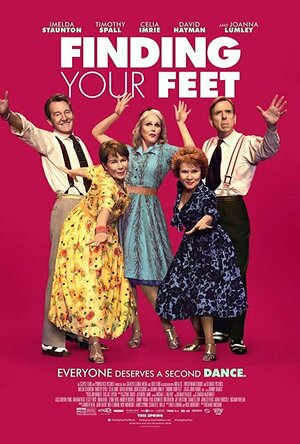
There are some films whose trailers really don’t properly represent their contents. The trailer for the new ‘grey-pound’ film “Finding Your Feet” promised a light hearted and witty foray into an elderly dance-club. And, yes, you get some laughs. But it’s very much a bitter sweet comedy, and the bitterness is ladled on by the bucketload leading to more tears than smiles through the majority of the running time.
Sandra (Imelda Staunton, “Pride“) – now Lady Sandra, after her husband’s latest knighthood – is in a predictable, sex-free but reasonably happy marriage to legal beagle Mike (John Sessions, “Denial“, “Florence Foster Jenkins“) when her world is shaken to its core on discovering that Mike has been having a five-year affair with her best friend Pamela (Josie Lawrence). Moving in with her Bohemian sister Bif (Celia Imrie, “Bridget Jones Baby“), she struggles to integrate into her decidedly lower class lifestyle and find common ground with Bif’s dance club friends Charlie (Timothy Spall, “Denial“, “Mr Turner”), Ted (David Hayman) and Jackie (Joanna Lumley, “The Wolf of Wall Street“).
Can Sandra turn her downward spiral around and find love and happiness again? Well, the posters scream “The Feel Good Film of the Year” so you don’t need to be a rocket scientist to know the answer to that! But it’s a bumpy journey for sure.
Getting all the acting honours is Timothy Spall, who is far too good to be buried away in this small British rom com. To watch him do “ordinary bloke doing ordinary things” is an absolute delight. He adds class and distinction to every scene he’s in, especially for those concerned with his truly tragic and upsetting back-story. Running a close second is Celia Imrie who has a wicked smile off to perfection and adds a lot of emotional depth to her performance: and she needs the range, since she too is on a pretty emotional journey through the second half of the film.
John Sessions and Josie Lawrence – old compatriots of course from the original version of TV’s “Whose Line Is It Anyway” – also deliver marvellous cameo performances, as does Phoebe Nicholls (“The Elephant Man”, “Downton Abbey”) as the tennis playing friend Janet.
Less convincing for me was Imelda Staunton, particularly in the first half of the film: for me she never quite pulls off the icy cold emotional wreck of Sandra, but is much better once the thaw has set in.
The film is written by Meg Leonard (in a debut script) and Nick Moorcroft (who did the “St Trinians” scripts). And there are some funny lines in there, although it has to be said that there are not enough of them. The majority of the best ones in fact are in the trailer, never bettered by Joanna Lumley’s zinger…. “My last marriage ended for religious reasons…. he thought he was God and I didn’t”! There’s not much more room for comic lines, since the rest of the script is stuffed with the dramatic outcomes from various flavours of old-age malady. Fortunately I was one of the younger members of the generally grey-haired audience, but for those further up the scale it must have been like staring into the void!
The film will win no awards for choreography, since the dance scenes are gloriously inept and out of sync. But this all rather adds to the charm of the piece.
Directed by Richard Loncraine, director of the equally forgettable Brit-flick “Wimbledon” and the rather more memorable “Brimstone and Treacle”, this is as Douglas Adams would have said “Mostly Harmless”: a film that most over-50’s will find a pleasant way to spend two hours. But go in expecting a drama with comic moments, rather than the hilarious comedy predicted by the trailer, and you will be better prepared.
(I should comment that the rating below is my view: my illustrious wife declared it a triumphant chick-flick and gave it FFFFf).
Sandra (Imelda Staunton, “Pride“) – now Lady Sandra, after her husband’s latest knighthood – is in a predictable, sex-free but reasonably happy marriage to legal beagle Mike (John Sessions, “Denial“, “Florence Foster Jenkins“) when her world is shaken to its core on discovering that Mike has been having a five-year affair with her best friend Pamela (Josie Lawrence). Moving in with her Bohemian sister Bif (Celia Imrie, “Bridget Jones Baby“), she struggles to integrate into her decidedly lower class lifestyle and find common ground with Bif’s dance club friends Charlie (Timothy Spall, “Denial“, “Mr Turner”), Ted (David Hayman) and Jackie (Joanna Lumley, “The Wolf of Wall Street“).
Can Sandra turn her downward spiral around and find love and happiness again? Well, the posters scream “The Feel Good Film of the Year” so you don’t need to be a rocket scientist to know the answer to that! But it’s a bumpy journey for sure.
Getting all the acting honours is Timothy Spall, who is far too good to be buried away in this small British rom com. To watch him do “ordinary bloke doing ordinary things” is an absolute delight. He adds class and distinction to every scene he’s in, especially for those concerned with his truly tragic and upsetting back-story. Running a close second is Celia Imrie who has a wicked smile off to perfection and adds a lot of emotional depth to her performance: and she needs the range, since she too is on a pretty emotional journey through the second half of the film.
John Sessions and Josie Lawrence – old compatriots of course from the original version of TV’s “Whose Line Is It Anyway” – also deliver marvellous cameo performances, as does Phoebe Nicholls (“The Elephant Man”, “Downton Abbey”) as the tennis playing friend Janet.
Less convincing for me was Imelda Staunton, particularly in the first half of the film: for me she never quite pulls off the icy cold emotional wreck of Sandra, but is much better once the thaw has set in.
The film is written by Meg Leonard (in a debut script) and Nick Moorcroft (who did the “St Trinians” scripts). And there are some funny lines in there, although it has to be said that there are not enough of them. The majority of the best ones in fact are in the trailer, never bettered by Joanna Lumley’s zinger…. “My last marriage ended for religious reasons…. he thought he was God and I didn’t”! There’s not much more room for comic lines, since the rest of the script is stuffed with the dramatic outcomes from various flavours of old-age malady. Fortunately I was one of the younger members of the generally grey-haired audience, but for those further up the scale it must have been like staring into the void!
The film will win no awards for choreography, since the dance scenes are gloriously inept and out of sync. But this all rather adds to the charm of the piece.
Directed by Richard Loncraine, director of the equally forgettable Brit-flick “Wimbledon” and the rather more memorable “Brimstone and Treacle”, this is as Douglas Adams would have said “Mostly Harmless”: a film that most over-50’s will find a pleasant way to spend two hours. But go in expecting a drama with comic moments, rather than the hilarious comedy predicted by the trailer, and you will be better prepared.
(I should comment that the rating below is my view: my illustrious wife declared it a triumphant chick-flick and gave it FFFFf).
Bob Mann (459 KP) rated Nocturnal Animals (2016) in Movies
Sep 29, 2021
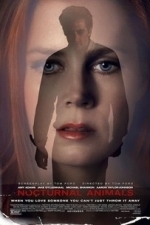

Putting the crisis into mid-life crisis.
“Do you think your life has turned into something you never intended?” So asks Susan Morrow (Amy Adams) to her young assistant, who obviously looks baffled. “Of course, not – you’re still young”. Susan is in a mid-life crisis. While successful within the opulent Los Angeles art scene her personal life is crashing to the ground around her: her marriage (to Hutton (Armie Hammer, “The Man From Uncle”) ) appears to be cooling fast amid financial worries.
In the midst of this rudderless time a manuscript from her ex-husband, struggling writer Edward Sheffield (Jake Gyllenhaal), turns up out of the blue. As we see in flashback, Edward is a man let down on multiple levels by Susan in the past. His novel – “Nocturnal Animals”, dedicated to Susan – is a primal scream of twenty years worth of hurt, pain, regret and vengeance; a railing against a loss of love; a railing against a loss of life.
As Susan painfully turns the pages we live the book as a ‘film within a film’ – with characters casually modelled on Edward, Susan and Susan’s daughter, actually played by Gyllenhaal, Amy-Adams-lookalike Isla Fisher (“Grimsby”) and Ellie Bamber (“Pride and Prejudice and Zombies”) respectively. The insomniac Susan is seriously moved. She feels likes someone who’s fallen asleep on the train of life and doesn’t recognise any of the stations when she wakes up. How will Susan’s regrets translate into action? Should she take up Edwards offer to meet up for dinner?
This Tom Ford film – only his second after the wildly successful “A Single Man” in 2009 – is a challenging film to watch. The opening titles of naked overweight woman ‘twerkers’ is challenging enough (#wobble). After this shocking opening (that morphs into an art gallery installation) the LA scenes have a gloriously Hitchcockian/noir feel to them, being gorgeously filmed by cinematographer Seamus McGarvey (“The Accountant”, “The Avengers”) – an Oscar nomination I would suggest should be in the offing.
And then comes the start of the “book” segment: one of the most uncomfortably tense scenes I’ve seen this year. A Texan family horror film featuring a lonely highway and a trio of “deplorables” (to quote an unfortunate put-down by Hilary Clinton). As stark contrast to the sharp lines and glamour of LA, these scenes are reminiscent of “No Country for Old Men” with a searingly unpleasant performance from Aaron Taylor-Johnson (“Kick-Ass”) and an equally queasy turn by local law enforcer Bobby Andes (Michael Shannon, Zod in “Batman v Superman: Dawn of Justice”). Either or both of these gentlemen could be contenders for a Supporting Actor nomination. The tension is superbly notched up by a mesmerising cello/violin score by Polish composer Abel Korzeniowski.
Amy Adams is fantastic in the leading role (what with “Arrival” this month, this is quite a month for the actress) as is Jake Gyllenhaal, channelling so much emotion, angst and guilt at his own impotence. After “Nightcrawler” Gyllenhaal is building up a formidable reputation that must translate into an Oscar some time soon: possibly this is it. Some excellent cameos from Laura Linney (as Susan’s sad-eyed mother) and Michael Sheen (in a superb purple jacket) rounds off an excellent ensemble cast.
The concept of a “film within a film” is not new. The most memorable example (I realise with a shock – #midlifecrisis) was “The French Lieutenant’s Woman” with a young but striking Meryl Streep 35 years ago. Here the LA sequence, the book and the flashback scenes are beautifully merged into a seamless whole where you never seem to get lost or disorientated.
If there is a criticism to be made, the second half of the ‘book’ is not as satisfying as the first with some rather clunky plot points that fall a little too easily.
However, this is a nuanced film where every step and every scene feels sculpted and filled with meaning. It is a film that deserves repeat viewings, since it raises questions and thoughts that survive long after the lights have come up. Tom Ford’s output may be of a sparsity of Kubrick proportions, but like Kubrick his output is certainly worth waiting for.
Recommended, but go mentally prepared: this was a UK 15 certificate, but it felt like it should be more of a UK 18.
In the midst of this rudderless time a manuscript from her ex-husband, struggling writer Edward Sheffield (Jake Gyllenhaal), turns up out of the blue. As we see in flashback, Edward is a man let down on multiple levels by Susan in the past. His novel – “Nocturnal Animals”, dedicated to Susan – is a primal scream of twenty years worth of hurt, pain, regret and vengeance; a railing against a loss of love; a railing against a loss of life.
As Susan painfully turns the pages we live the book as a ‘film within a film’ – with characters casually modelled on Edward, Susan and Susan’s daughter, actually played by Gyllenhaal, Amy-Adams-lookalike Isla Fisher (“Grimsby”) and Ellie Bamber (“Pride and Prejudice and Zombies”) respectively. The insomniac Susan is seriously moved. She feels likes someone who’s fallen asleep on the train of life and doesn’t recognise any of the stations when she wakes up. How will Susan’s regrets translate into action? Should she take up Edwards offer to meet up for dinner?
This Tom Ford film – only his second after the wildly successful “A Single Man” in 2009 – is a challenging film to watch. The opening titles of naked overweight woman ‘twerkers’ is challenging enough (#wobble). After this shocking opening (that morphs into an art gallery installation) the LA scenes have a gloriously Hitchcockian/noir feel to them, being gorgeously filmed by cinematographer Seamus McGarvey (“The Accountant”, “The Avengers”) – an Oscar nomination I would suggest should be in the offing.
And then comes the start of the “book” segment: one of the most uncomfortably tense scenes I’ve seen this year. A Texan family horror film featuring a lonely highway and a trio of “deplorables” (to quote an unfortunate put-down by Hilary Clinton). As stark contrast to the sharp lines and glamour of LA, these scenes are reminiscent of “No Country for Old Men” with a searingly unpleasant performance from Aaron Taylor-Johnson (“Kick-Ass”) and an equally queasy turn by local law enforcer Bobby Andes (Michael Shannon, Zod in “Batman v Superman: Dawn of Justice”). Either or both of these gentlemen could be contenders for a Supporting Actor nomination. The tension is superbly notched up by a mesmerising cello/violin score by Polish composer Abel Korzeniowski.
Amy Adams is fantastic in the leading role (what with “Arrival” this month, this is quite a month for the actress) as is Jake Gyllenhaal, channelling so much emotion, angst and guilt at his own impotence. After “Nightcrawler” Gyllenhaal is building up a formidable reputation that must translate into an Oscar some time soon: possibly this is it. Some excellent cameos from Laura Linney (as Susan’s sad-eyed mother) and Michael Sheen (in a superb purple jacket) rounds off an excellent ensemble cast.
The concept of a “film within a film” is not new. The most memorable example (I realise with a shock – #midlifecrisis) was “The French Lieutenant’s Woman” with a young but striking Meryl Streep 35 years ago. Here the LA sequence, the book and the flashback scenes are beautifully merged into a seamless whole where you never seem to get lost or disorientated.
If there is a criticism to be made, the second half of the ‘book’ is not as satisfying as the first with some rather clunky plot points that fall a little too easily.
However, this is a nuanced film where every step and every scene feels sculpted and filled with meaning. It is a film that deserves repeat viewings, since it raises questions and thoughts that survive long after the lights have come up. Tom Ford’s output may be of a sparsity of Kubrick proportions, but like Kubrick his output is certainly worth waiting for.
Recommended, but go mentally prepared: this was a UK 15 certificate, but it felt like it should be more of a UK 18.

Haley Mathiot (9 KP) rated Uncertain Magic in Books
Apr 27, 2018

Uncertain Magic by Laura Kinsale
Genre: Adult Historical romance
ISBN: 9781402237027
Published: May 4th 2010 by Sourcebooks Casablanca (first published March 2nd 1987)
Rating: 5
Roddy has a "gift"—or as she thinks of it, a curse—that allows her to hear the mind and feel the emotions of every human and animal on earth. Because of this, and her family history, she knows she will never be married, never have her own family… because what man wants every single thought and emotion on display for his wife? Past failed marriages in the family have shown her that her happiness is a hopeless cause… until she meets one man whom she does not have access to his thoughts and feelings. So Roddy takes things into her own hands. She realizes a little too late what kind of man she's gotten interested in her: Lord Iveragh. The Devil Earl of Ireland.
She carries out her plan, however, and he seems to like her enough to marry her. But The Devil Earl is hiding things from her… and possibly himself. Roddy finds that she can help him… but it will require more than she may be willing to give. If she doesn't, though, she will loose him forever… and maybe loose herself, too.
I loved Uncertain Magic. I wasn't sure what to expect when I started reading it. It was certainly a romance, and a very good one at that. But it was so much more than a romance novel: It was a clever blend of romance, adventure, historical events, family secrets, and Gaelic magic. The plot incorporated a rebellion in Ireland, smuggling, murder, and magic. There were horse races, escaping soldiers, and midnight balls with the dead.
The relationship between Roddy and Faelan (Lord Iveragh) started off a little random: a chance meeting, Roddy saving his horse from a heart attack, her pretending to be a stable boy and bragging on his employer (herself, of course) and Faelan seeing through it and embarrassing her. As it continued, I was a little surprised at the speed it progressed: They were married by chapter five. But them being married though the book was such an important aspect, that I understood it later. Of course, no marriage is perfect, and many romances are victims of happyland syndrome, where their relationship is so perfect that it's almost Holy.
Not this one.
There were misunderstandings, tears, heartbreak, scandals, possible affairs, redemption, and healing. And plenty of love-making.
With that said: the characters were great. Roddy was sweet and soft, but she had her spunk and I liked her immediately (especially when she took out a rude stableboy with a single kick). Faelan was, as his nickname describes him, a devil—but he was good that way. He was a little obnoxious, he had his sarcastic moments, and he certainly had his pride. He's the kind of dark secretive hero that everyone looks for… but with a touch of madness—or maybe magic—to make him even more mysterious. I love Roddy, I adore Faelan, and his mother (let's just say she never. shuts. up.) makes me laugh… the characters in this story are gems.
Just as I didn't expect the twisting exciting plot, I didn't expect the writing to be so good. It felt great to read, and the dialogue was easy to speak and felt natural. It flowed well, and was descriptive and lyrical. I liked the way Kinsale described Roddy experiencing everyone else's thoughts and emotions, and I liked the way she didn't over-describe everything—every little facial expression, every little movement—leaving out some for your imagination, but added enough description to allow you to see everything.
There were disappearing faeries and blind men who could see (try figuring that one out!) and missing chunks of time… all tied up beautifully at the end. Although it was, at first, a little confusing to figure out what had just happened on the last few pages, I loved the ending. There wasn't quite enough closure, but it didn't need to be closed: it was more like an opening for their new life together. After reading it, you know what will happen… so it doesn't need to be said.
This is probably one of my favorite books I've read this year, and it demands a re-read in the future.
Content/Recommendation: Some sex, mild language. Ages 18+
Review copyright Haley Mathiot 2010. Review copy supplied by publisher.
Genre: Adult Historical romance
ISBN: 9781402237027
Published: May 4th 2010 by Sourcebooks Casablanca (first published March 2nd 1987)
Rating: 5
Roddy has a "gift"—or as she thinks of it, a curse—that allows her to hear the mind and feel the emotions of every human and animal on earth. Because of this, and her family history, she knows she will never be married, never have her own family… because what man wants every single thought and emotion on display for his wife? Past failed marriages in the family have shown her that her happiness is a hopeless cause… until she meets one man whom she does not have access to his thoughts and feelings. So Roddy takes things into her own hands. She realizes a little too late what kind of man she's gotten interested in her: Lord Iveragh. The Devil Earl of Ireland.
She carries out her plan, however, and he seems to like her enough to marry her. But The Devil Earl is hiding things from her… and possibly himself. Roddy finds that she can help him… but it will require more than she may be willing to give. If she doesn't, though, she will loose him forever… and maybe loose herself, too.
I loved Uncertain Magic. I wasn't sure what to expect when I started reading it. It was certainly a romance, and a very good one at that. But it was so much more than a romance novel: It was a clever blend of romance, adventure, historical events, family secrets, and Gaelic magic. The plot incorporated a rebellion in Ireland, smuggling, murder, and magic. There were horse races, escaping soldiers, and midnight balls with the dead.
The relationship between Roddy and Faelan (Lord Iveragh) started off a little random: a chance meeting, Roddy saving his horse from a heart attack, her pretending to be a stable boy and bragging on his employer (herself, of course) and Faelan seeing through it and embarrassing her. As it continued, I was a little surprised at the speed it progressed: They were married by chapter five. But them being married though the book was such an important aspect, that I understood it later. Of course, no marriage is perfect, and many romances are victims of happyland syndrome, where their relationship is so perfect that it's almost Holy.
Not this one.
There were misunderstandings, tears, heartbreak, scandals, possible affairs, redemption, and healing. And plenty of love-making.
With that said: the characters were great. Roddy was sweet and soft, but she had her spunk and I liked her immediately (especially when she took out a rude stableboy with a single kick). Faelan was, as his nickname describes him, a devil—but he was good that way. He was a little obnoxious, he had his sarcastic moments, and he certainly had his pride. He's the kind of dark secretive hero that everyone looks for… but with a touch of madness—or maybe magic—to make him even more mysterious. I love Roddy, I adore Faelan, and his mother (let's just say she never. shuts. up.) makes me laugh… the characters in this story are gems.
Just as I didn't expect the twisting exciting plot, I didn't expect the writing to be so good. It felt great to read, and the dialogue was easy to speak and felt natural. It flowed well, and was descriptive and lyrical. I liked the way Kinsale described Roddy experiencing everyone else's thoughts and emotions, and I liked the way she didn't over-describe everything—every little facial expression, every little movement—leaving out some for your imagination, but added enough description to allow you to see everything.
There were disappearing faeries and blind men who could see (try figuring that one out!) and missing chunks of time… all tied up beautifully at the end. Although it was, at first, a little confusing to figure out what had just happened on the last few pages, I loved the ending. There wasn't quite enough closure, but it didn't need to be closed: it was more like an opening for their new life together. After reading it, you know what will happen… so it doesn't need to be said.
This is probably one of my favorite books I've read this year, and it demands a re-read in the future.
Content/Recommendation: Some sex, mild language. Ages 18+
Review copyright Haley Mathiot 2010. Review copy supplied by publisher.
Beatriz (17 KP) rated Lilo & Stitch (2002) in Movies
Feb 22, 2019
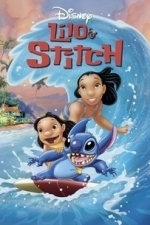
Lilo & Sitch (2002)
Lilo & Stitch is one of my most favourite Disney films.
It was released in 2002 passed in Hawaii. It tells the story about a girl (Lilo) and her sister (Nani) that fight to stay together as Nani is trying to prove to the social worker Cobra Bubbles that she is fit to take care of her younger sister. In the meawhile Lilo is bullied and feels different so Nani takes her to a dog shelter to adopt a dog. There Lilo meets Stitch, a mutated alien (or more specifically, experiment 626) that is hiding, from the Galactic Police, on Earth, and ends up using Lilo as his shield. But with time Lilo and Stitch become Ohana ( "Ohana means family and family means no one gets left behind or forgotten)
Its a fun and emotional film that touched a lot of childrens and adults hearts (including mine)
Here are some interesting facts that i found about the film...
- The original story focused solely on an alien living in a forest, trying to overcome his isolation and find out where he came from.
Lilo didn’t become a part of the film until much later during story development.
- Stitch was not originally supposed to talk, but when the filmmakers realized the story hinged on him being able to express himself at the film’s end,
they began developing his voice. Director Chris Sanders provided Stitch’s voice during test animation, and eventually everyone got so used to it that they
decided to keep it.
- After an early test screening showed that audiences thought Nani was Lilo’s mother, filmmakers reworked some key scenes to make their sisterly relationship clear.
- Lilo & Stitch was the first Disney animated film since Dumbo to use watercolor painted backgrounds.
- While on a tour of Kaua?i, filmmakers noticed that their Hawaiian tour guide seemed to know someone everywhere they went. They were so struck by the guide’s
explanation of the term “‘ohana” as it relates to an extended family, that they made it the central theme of the film.
- In the climax of the movie, Jumba can be seen flying around in a huge red spaceship that looks very similar to an airplane. This is because in the originaL
edit of the film, it WAS an airplane! In the original edit, the writers and animators had Jumba hijacking a Boeing 747 from the Lihue airport and crashing it
into buildings throughout Honolulu.
Unfortunately, the movie came out right after 9/11/2001. The animators felt this was much too close to the attacks that happened on September 11th, so they
remodeled Jumba’s spaceship to look a bit different than a Boeing 747, and also changed the buildings to mountains.
- All of the landscapes in the movie are recognizable locations in Hawaii
- Not only was the setting and plot of the movie unique, Lilo & Stitch was also very unique in the way that Disney promoted the movie. Disney released a set
of trailers in which they inserted the character of Stitch into some of their more “classic” films.
Some examples of the movies they inserted Stitch into, are as follows: The Little Mermaid; Stitch surfs on a wave that crashes down onto Ariel. Beauty and the
Beast; Stitch can be seen loosening the chandelier during the ballroom dance scene and it almost lands on Beast and Belle. Aladdin; he steals Jasmine away
during their magic carpet ride. The Lion King; Stitch is on Pride Rock instead of Simba.
- Did you know that the character of Stitch was actually created way back in 1985? Stitch was created by one of the directors of the film named Chris Sanders
for a children’s book he was writing. The children’s book was never published, and Stitch was made into a movie 17 years later.
Chris Sanders was not only one of the directors of Lilo & Stitch, but he was also a co-screenwriter, a co-character designer, and also provided the voice acting
for Stitch.
- During the animation stage of Lilo & Stitch, the animators made a conscious effort to design the "alien" aspects of the film a certain way.
Since the movie was going to take place on the island of Hawaii, they decided to design all of the alien aspects of the movie to resemble marine animals.
This makes sense, since Hawaii is famous for its diverse marine plant and animal life that resides on the island.
It was released in 2002 passed in Hawaii. It tells the story about a girl (Lilo) and her sister (Nani) that fight to stay together as Nani is trying to prove to the social worker Cobra Bubbles that she is fit to take care of her younger sister. In the meawhile Lilo is bullied and feels different so Nani takes her to a dog shelter to adopt a dog. There Lilo meets Stitch, a mutated alien (or more specifically, experiment 626) that is hiding, from the Galactic Police, on Earth, and ends up using Lilo as his shield. But with time Lilo and Stitch become Ohana ( "Ohana means family and family means no one gets left behind or forgotten)
Its a fun and emotional film that touched a lot of childrens and adults hearts (including mine)
Here are some interesting facts that i found about the film...
- The original story focused solely on an alien living in a forest, trying to overcome his isolation and find out where he came from.
Lilo didn’t become a part of the film until much later during story development.
- Stitch was not originally supposed to talk, but when the filmmakers realized the story hinged on him being able to express himself at the film’s end,
they began developing his voice. Director Chris Sanders provided Stitch’s voice during test animation, and eventually everyone got so used to it that they
decided to keep it.
- After an early test screening showed that audiences thought Nani was Lilo’s mother, filmmakers reworked some key scenes to make their sisterly relationship clear.
- Lilo & Stitch was the first Disney animated film since Dumbo to use watercolor painted backgrounds.
- While on a tour of Kaua?i, filmmakers noticed that their Hawaiian tour guide seemed to know someone everywhere they went. They were so struck by the guide’s
explanation of the term “‘ohana” as it relates to an extended family, that they made it the central theme of the film.
- In the climax of the movie, Jumba can be seen flying around in a huge red spaceship that looks very similar to an airplane. This is because in the originaL
edit of the film, it WAS an airplane! In the original edit, the writers and animators had Jumba hijacking a Boeing 747 from the Lihue airport and crashing it
into buildings throughout Honolulu.
Unfortunately, the movie came out right after 9/11/2001. The animators felt this was much too close to the attacks that happened on September 11th, so they
remodeled Jumba’s spaceship to look a bit different than a Boeing 747, and also changed the buildings to mountains.
- All of the landscapes in the movie are recognizable locations in Hawaii
- Not only was the setting and plot of the movie unique, Lilo & Stitch was also very unique in the way that Disney promoted the movie. Disney released a set
of trailers in which they inserted the character of Stitch into some of their more “classic” films.
Some examples of the movies they inserted Stitch into, are as follows: The Little Mermaid; Stitch surfs on a wave that crashes down onto Ariel. Beauty and the
Beast; Stitch can be seen loosening the chandelier during the ballroom dance scene and it almost lands on Beast and Belle. Aladdin; he steals Jasmine away
during their magic carpet ride. The Lion King; Stitch is on Pride Rock instead of Simba.
- Did you know that the character of Stitch was actually created way back in 1985? Stitch was created by one of the directors of the film named Chris Sanders
for a children’s book he was writing. The children’s book was never published, and Stitch was made into a movie 17 years later.
Chris Sanders was not only one of the directors of Lilo & Stitch, but he was also a co-screenwriter, a co-character designer, and also provided the voice acting
for Stitch.
- During the animation stage of Lilo & Stitch, the animators made a conscious effort to design the "alien" aspects of the film a certain way.
Since the movie was going to take place on the island of Hawaii, they decided to design all of the alien aspects of the movie to resemble marine animals.
This makes sense, since Hawaii is famous for its diverse marine plant and animal life that resides on the island.