Search

Kirk Bage (1775 KP) rated Roma (2018) in Movies
Mar 2, 2020 (Updated Mar 3, 2020)
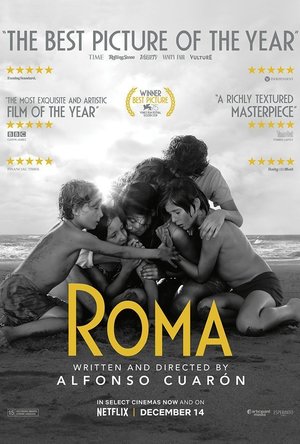


I watched Roma exactly a week ago today. And although I knew 20 minutes in that I loved it, and at the end that I really loved it, I have taken that time to let it settle within me in before coming to write about it. Some films are so good that you have to do that: let it sink into you fully, before doing anything so trivial as judging and comparing them. Roma is incomparable! I have never seen anything like it, or felt as deeply moved by a film in a long time.
Not that it didn’t get attention at the time of its release, it did, receiving 10 Oscar nominations and winning 3, for best foreign language film, director and cinematography, but it certainly wasn’t seen by as many people as it should have been, despite its presence on Netflix from the start. Having digested it now, and spending some time reading about how and why it was made, I feel a slight mission to recommend it to as many people as I can.
Based on Alfonso Cuarón’s own childhood in Mexico City, and his memories of his family and especially their housemaid, Liboria (Libo) Rodriguez, to whom the film is dedicated, it is a masterpiece labour of love that few directors ever achieve or even attempt to make. After a strong career of exceptional films, including Y Tu Mamá También, Children of Men and Gravity, it was the box office and critical success of the latter that gave Cuarón carte blanche to go and make whatever project he chose. Where many might have been tempted by the big money of superhero or fantasy movies (for which he had some experience with Harry Potter and the Prisoner of Azkaban) he went back to his roots and shot a very personal non-English film, in black and white, where no music exists except that which occurs naturally, and on the surface not much happens.
At least it feels like not much is happening, such is the naturalistic, almost improvised (although it wasn’t) style and pace; shot with a lens capturing detail and nuance with some of the most beautiful photography I have ever had the privilege to see. Truly, an awful lot is happening, but you have to feel and experience it, not simply be told it by the narrative. It takes a while for our Hollywood conditioned brains to accept this at first, and many might come to it and give up half an hour in because of that challenge. I can promise, however, there is not a single thing boring about this film, unless humanity is boring.
Oscar nominated lead Yalitza Aparicio as the shy, loving maid, Cleo, was not an actor before this film. She auditioned and was hand picked by Cuarón from hundreds of young women, without knowing who he was or what the film was about. Apparently, the film was shot in sequence so as not to confuse her emotionally on her extraordinary journey. She is so unassuming and natural that part of you falls in love with her immediately. In time, we almost come to forget we are watching an act at all, and almost become her, such is the empathy she evokes.
Which isn’t an easy ride, as we watch her be gently and then cruelly ignored, mistreated and used; climaxing in one of the most astonishingly painful and jaw-dropping scenes imaginable, and then a scene of such powerful redemption and humanity it instantly breaks the heart and lifts the soul. All the while she never asks for attention or love, but is just herself: a young woman living a difficult but beautiful life in a country and time full of turmoil, prejudice and social change.
The recreation of Mexico in 1970 is so breathtaking, it is hard to imagine at times we are not watching a documentary from that era. But, it is the detail the lens chooses to capture that reminds you this is a visual poem and a love-letter to a time, a place and a family far away in history and the memory of one man (represented by ten year old Carlos Peralta as Paco). At times it evokes the work of the very greatest film artists of all time: Bergman, Fellini, Hitchcock etc. Not one image is wasted or insignificant, from the reflection of the sky in water, to the dog-shit constantly lining the driveway. Everything is chosen and meaningful in the full context of the work.
There is no awkward exposition, no dramatic moments milked for all they are worth, no sequences of heightened excitement that manipulate us; simply truthful moments that hang in the air for what they are, leaving us to decide how we relate to them without ever preaching or teaching us how. In that way, it is a work of such maturity that I doubt many living directors could emulate it at all. The closest comparison I can think of is the personal passion Spielberg put into Shindler’s List, but really it is a moot comparison, and in fact owes much more to films like Haneke’s The White Ribbon.
Can it be faulted? Well, yes, certainly. But, honestly, I don’t see the point in trying. It is as close to perfection a small story of this kind can be. Importantly, I think it is an open film, that allows us to take from it whatever we like, relating to our own experiences and cares. For me, it said that any pain and hardship can be overcome, as long as there is love and beauty walking by its side. A message of no small importance. If you haven’t seen it, I urge you to do so. If you have, then please keep spreading the word. I believe it to be a genuine classic that will endure the criticism of many decades to come. Without a doubt in my mind something very special indeed.
Not that it didn’t get attention at the time of its release, it did, receiving 10 Oscar nominations and winning 3, for best foreign language film, director and cinematography, but it certainly wasn’t seen by as many people as it should have been, despite its presence on Netflix from the start. Having digested it now, and spending some time reading about how and why it was made, I feel a slight mission to recommend it to as many people as I can.
Based on Alfonso Cuarón’s own childhood in Mexico City, and his memories of his family and especially their housemaid, Liboria (Libo) Rodriguez, to whom the film is dedicated, it is a masterpiece labour of love that few directors ever achieve or even attempt to make. After a strong career of exceptional films, including Y Tu Mamá También, Children of Men and Gravity, it was the box office and critical success of the latter that gave Cuarón carte blanche to go and make whatever project he chose. Where many might have been tempted by the big money of superhero or fantasy movies (for which he had some experience with Harry Potter and the Prisoner of Azkaban) he went back to his roots and shot a very personal non-English film, in black and white, where no music exists except that which occurs naturally, and on the surface not much happens.
At least it feels like not much is happening, such is the naturalistic, almost improvised (although it wasn’t) style and pace; shot with a lens capturing detail and nuance with some of the most beautiful photography I have ever had the privilege to see. Truly, an awful lot is happening, but you have to feel and experience it, not simply be told it by the narrative. It takes a while for our Hollywood conditioned brains to accept this at first, and many might come to it and give up half an hour in because of that challenge. I can promise, however, there is not a single thing boring about this film, unless humanity is boring.
Oscar nominated lead Yalitza Aparicio as the shy, loving maid, Cleo, was not an actor before this film. She auditioned and was hand picked by Cuarón from hundreds of young women, without knowing who he was or what the film was about. Apparently, the film was shot in sequence so as not to confuse her emotionally on her extraordinary journey. She is so unassuming and natural that part of you falls in love with her immediately. In time, we almost come to forget we are watching an act at all, and almost become her, such is the empathy she evokes.
Which isn’t an easy ride, as we watch her be gently and then cruelly ignored, mistreated and used; climaxing in one of the most astonishingly painful and jaw-dropping scenes imaginable, and then a scene of such powerful redemption and humanity it instantly breaks the heart and lifts the soul. All the while she never asks for attention or love, but is just herself: a young woman living a difficult but beautiful life in a country and time full of turmoil, prejudice and social change.
The recreation of Mexico in 1970 is so breathtaking, it is hard to imagine at times we are not watching a documentary from that era. But, it is the detail the lens chooses to capture that reminds you this is a visual poem and a love-letter to a time, a place and a family far away in history and the memory of one man (represented by ten year old Carlos Peralta as Paco). At times it evokes the work of the very greatest film artists of all time: Bergman, Fellini, Hitchcock etc. Not one image is wasted or insignificant, from the reflection of the sky in water, to the dog-shit constantly lining the driveway. Everything is chosen and meaningful in the full context of the work.
There is no awkward exposition, no dramatic moments milked for all they are worth, no sequences of heightened excitement that manipulate us; simply truthful moments that hang in the air for what they are, leaving us to decide how we relate to them without ever preaching or teaching us how. In that way, it is a work of such maturity that I doubt many living directors could emulate it at all. The closest comparison I can think of is the personal passion Spielberg put into Shindler’s List, but really it is a moot comparison, and in fact owes much more to films like Haneke’s The White Ribbon.
Can it be faulted? Well, yes, certainly. But, honestly, I don’t see the point in trying. It is as close to perfection a small story of this kind can be. Importantly, I think it is an open film, that allows us to take from it whatever we like, relating to our own experiences and cares. For me, it said that any pain and hardship can be overcome, as long as there is love and beauty walking by its side. A message of no small importance. If you haven’t seen it, I urge you to do so. If you have, then please keep spreading the word. I believe it to be a genuine classic that will endure the criticism of many decades to come. Without a doubt in my mind something very special indeed.


Purple Phoenix Games (2266 KP) rated Horreos in Tabletop Games
Jan 23, 2022
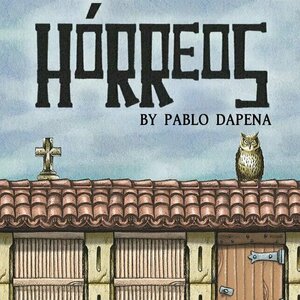

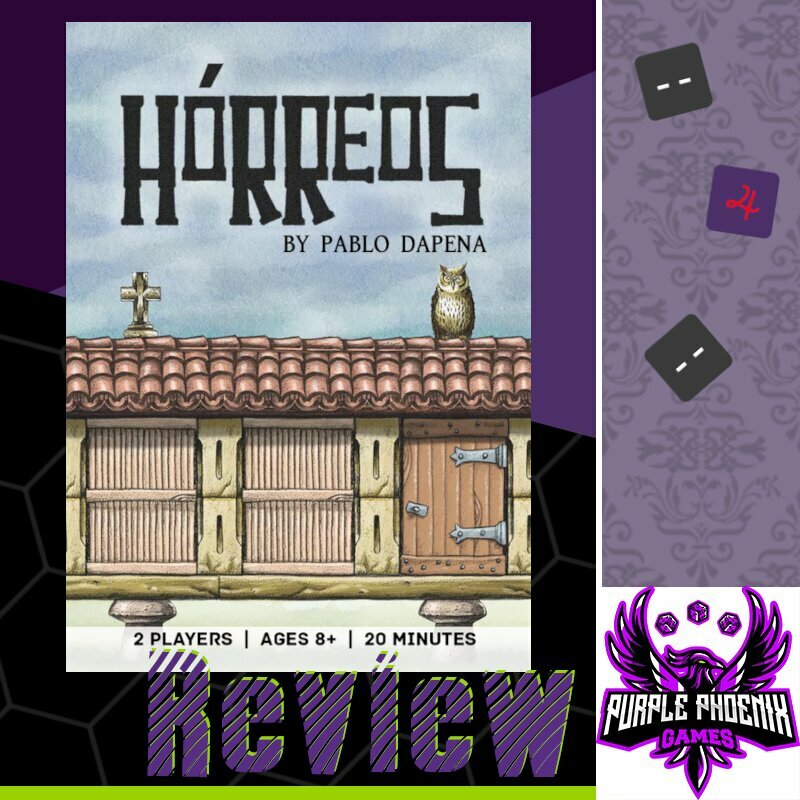
I’m not a huge history buff or anything, but I am definitely interested in my family lineage/ancestry. What does that have to do with this game? Well, with the last name Rodriguez, I’m sure you guessed that there’s some Spanish heritage in my background. My Dad will often talk about how our family originally came from Spain a loooooong time ago. Specifically from Galicia, Spain. So when I saw this ButtonShy game based on the real-life location of Galicia, my roots were calling to me and I had to get it. Hórreos gives us a small glimpse into life in 18th century Galicia – and it sounds pretty great!
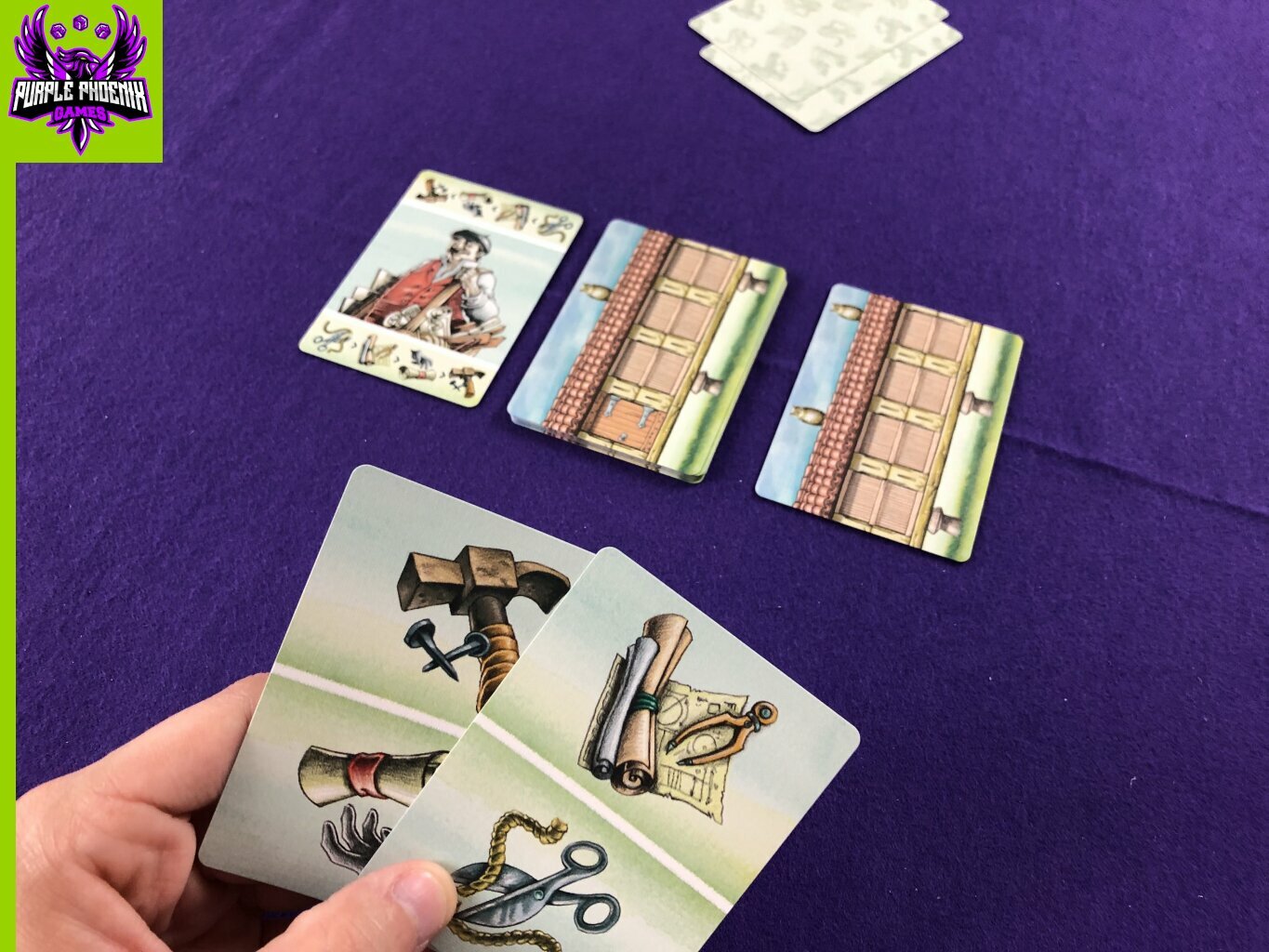
Hórreos is a 2-player game in which players are competing to build the most effective and aesthetically pleasing hórreo in town. What is a hórreo? It is a building for storing grain, elevated from the ground to prevent rodents from infiltrating the structure. So in this game, players are building long and ornate hórreos that not only look stunning, but can keep the rats out of the grain! To setup for a game, each player receives 2 Action cards and the Hórreo cards are shuffled. The deck is placed between the players, and the top card is placed beside the deck to form a 2-card Market. The Leader card is placed beside the Market, facing the starting player. Pictured below is the setup for the beginning of a game.
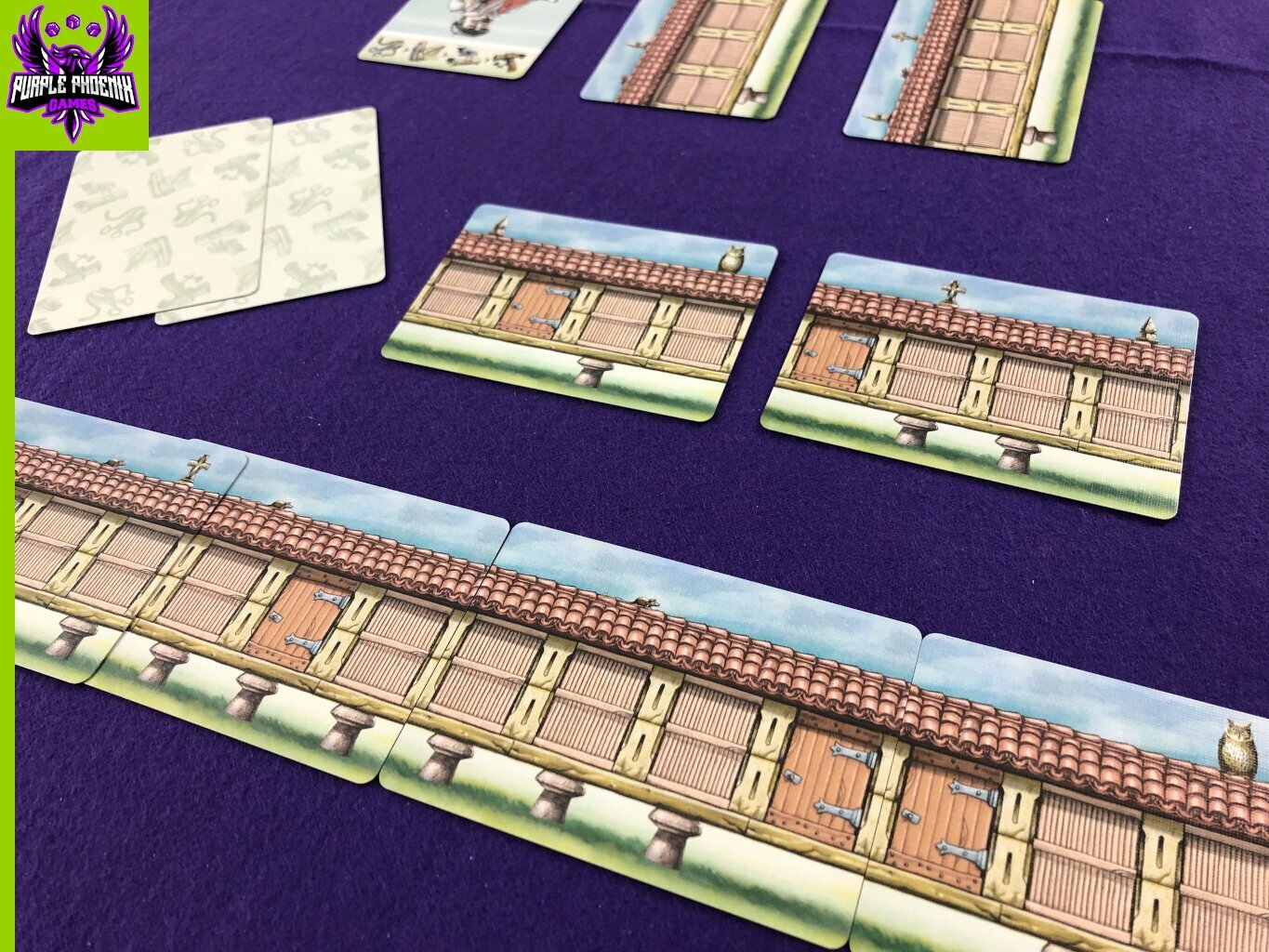
Over a series of rounds, players will be taking 1 of 4 possible actions as they attempt to build the highest-scoring structure. Each player has 2 Action cards at their disposal. Each Action card has 2 possible Actions on it – one card is Sabotage or Plan, the other is Steal or Build. Both players will secretly choose whichever Action they wish to perform this turn, and place their card face-down in front of them. Players will then simultaneous reveal their chosen Actions, and they will be resolved in the following order – Sabotage, Plan, Steal, and Build. If a player has chosen to Sabotage, they will rotate their opponent’s Action card, forcing them to perform the other listed action this round. To perform the Plan action, the player will select one of the cards from the Market to be placed into their personal supply tableau. If you have chosen to Steal, you will select a card from your opponent’s supply, and take it into your own supply tableau. And finally, to Build is to move a card from your supply to your hórreo. Cards in your hórreo cannot be stolen. As with many other ButtonShy games, cards in your hórreo may be placed adjacent to, or even overlapping, previously played cards – cards may never be tucked under cards in your existing hórreo.
If both players have chosen the same action, the player with the Leader card facing them gets to decide which player will resolve their action first. The Leader card is then rotated to face the opposite player, and so on, for future ‘ties’. An important note – you cannot pick the same Action twice in a row, you must pick one of the other 3 Actions. So take that strategic tidbit into consideration when deciding what to do each round! The game continues in this fashion, with players selecting/simultaneously revealing Actions, resolving their Actions in order, and building their hórreo until there is 1 or fewer cards left in the Market and the players’ supplies at the end of a round. At that point, the game ends, points are tallied, and the winner is declared!
Points are scored in several ways. Most of the hórreo cards are ‘decorated’ with crosses and pikes, and each pair you have in your final hórreo will earn you points. Similarly, the number of doors in your hórreo, as well as adjacent pillars supporting your structure, will earn you points dependent upon the number (the more doors you have, the more points you earn, etc.). As mentioned earlier, you’re trying to keep these pesky rats out of your grain, so any rat pictured on your cards is worth -2 points, but each owl you have pictured eats (cancels out) one rat. And of course, whichever player has build the longest hórreo earns extra points. All points are tallied, and the player with the highest score is the winner!
I have to admit that Hórreos surprised me. The gameplay seems simple enough, so I honestly wasn’t really expecting a lot from this game. For such a small game, Hórreos is all about strategy. Each round, you only have 4 Actions from which to choose, and that really forces you to think long-term with your strategy. But at the same time, since Actions are revealed simultaneously and resolved in a set order, you have to consider what your opponent might do. For example, the Sabotage action forces the opposing player to use the other Action of their chosen card this round. Can you bluff your opponent into playing that Sabotage, forcing you to switch Actions, thus letting you perform the Action you really wanted to perform? That goes hand in hand with the fact that you cannot choose the same Action twice in a row. Can you anticipate your opponents moves to benefit your strategy? Or will you be out of touch, and thus be forced to essentially waste a turn performing an Action that you actually didn’t want to? And don’t forget the Leader card – if players both pick the same Action, the Leader can decide who resolves first. Maybe it’s strategically better to let your opponent resolve first, so then you can just negate what they just did, or vice versa.
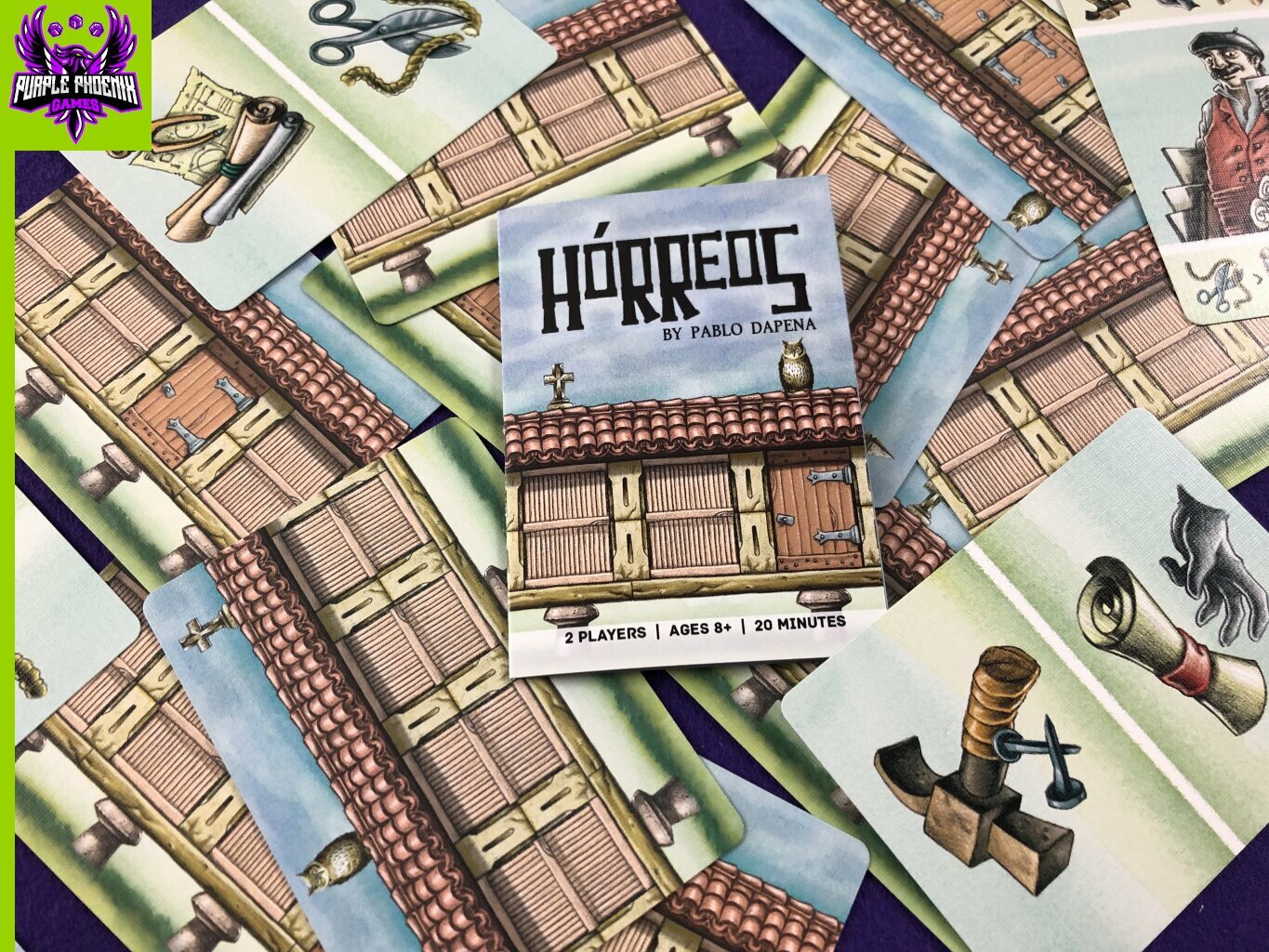
To touch on components for a minute, this is a game of 18 cards in a wallet. So nothing out of the ordinary for ButtonShy. That being said, production quality is always top notch with these games, and I have no complaints. the cards are thick and sturdy, and the wallet is nice and supportive. The artwork is thematic and refreshing, while not being too overwhelming. Is it the most beautiful game I’ve ever seen? No. But it is aesthetically and thematically appropriate, and gives a serene and peaceful vibe. ButtonShy has yet to disappoint with their components, so I am definitely a big fan!
Hórreos is a pretty solid game. I’m not personally a huge fan of ‘take that’ type games, and there is an element of that in this gameplay. But there seems to be enough strategy needed to negate some of that direct competitiveness. The game itself is fast to teach, learn, and play, and that adds to the overall appeal. It’s not necessarily my favorite 2-player game, but it’s one that I can see myself pulling out often when I’ve got a quick minute between other games, or when I’ve got a little downtime. Purple Phoenix Games gives this one a structural 4 / 6. Check it out if you’re in the market for something small, yet strategic!
Hórreos is a 2-player game in which players are competing to build the most effective and aesthetically pleasing hórreo in town. What is a hórreo? It is a building for storing grain, elevated from the ground to prevent rodents from infiltrating the structure. So in this game, players are building long and ornate hórreos that not only look stunning, but can keep the rats out of the grain! To setup for a game, each player receives 2 Action cards and the Hórreo cards are shuffled. The deck is placed between the players, and the top card is placed beside the deck to form a 2-card Market. The Leader card is placed beside the Market, facing the starting player. Pictured below is the setup for the beginning of a game.
Over a series of rounds, players will be taking 1 of 4 possible actions as they attempt to build the highest-scoring structure. Each player has 2 Action cards at their disposal. Each Action card has 2 possible Actions on it – one card is Sabotage or Plan, the other is Steal or Build. Both players will secretly choose whichever Action they wish to perform this turn, and place their card face-down in front of them. Players will then simultaneous reveal their chosen Actions, and they will be resolved in the following order – Sabotage, Plan, Steal, and Build. If a player has chosen to Sabotage, they will rotate their opponent’s Action card, forcing them to perform the other listed action this round. To perform the Plan action, the player will select one of the cards from the Market to be placed into their personal supply tableau. If you have chosen to Steal, you will select a card from your opponent’s supply, and take it into your own supply tableau. And finally, to Build is to move a card from your supply to your hórreo. Cards in your hórreo cannot be stolen. As with many other ButtonShy games, cards in your hórreo may be placed adjacent to, or even overlapping, previously played cards – cards may never be tucked under cards in your existing hórreo.
If both players have chosen the same action, the player with the Leader card facing them gets to decide which player will resolve their action first. The Leader card is then rotated to face the opposite player, and so on, for future ‘ties’. An important note – you cannot pick the same Action twice in a row, you must pick one of the other 3 Actions. So take that strategic tidbit into consideration when deciding what to do each round! The game continues in this fashion, with players selecting/simultaneously revealing Actions, resolving their Actions in order, and building their hórreo until there is 1 or fewer cards left in the Market and the players’ supplies at the end of a round. At that point, the game ends, points are tallied, and the winner is declared!
Points are scored in several ways. Most of the hórreo cards are ‘decorated’ with crosses and pikes, and each pair you have in your final hórreo will earn you points. Similarly, the number of doors in your hórreo, as well as adjacent pillars supporting your structure, will earn you points dependent upon the number (the more doors you have, the more points you earn, etc.). As mentioned earlier, you’re trying to keep these pesky rats out of your grain, so any rat pictured on your cards is worth -2 points, but each owl you have pictured eats (cancels out) one rat. And of course, whichever player has build the longest hórreo earns extra points. All points are tallied, and the player with the highest score is the winner!
I have to admit that Hórreos surprised me. The gameplay seems simple enough, so I honestly wasn’t really expecting a lot from this game. For such a small game, Hórreos is all about strategy. Each round, you only have 4 Actions from which to choose, and that really forces you to think long-term with your strategy. But at the same time, since Actions are revealed simultaneously and resolved in a set order, you have to consider what your opponent might do. For example, the Sabotage action forces the opposing player to use the other Action of their chosen card this round. Can you bluff your opponent into playing that Sabotage, forcing you to switch Actions, thus letting you perform the Action you really wanted to perform? That goes hand in hand with the fact that you cannot choose the same Action twice in a row. Can you anticipate your opponents moves to benefit your strategy? Or will you be out of touch, and thus be forced to essentially waste a turn performing an Action that you actually didn’t want to? And don’t forget the Leader card – if players both pick the same Action, the Leader can decide who resolves first. Maybe it’s strategically better to let your opponent resolve first, so then you can just negate what they just did, or vice versa.
To touch on components for a minute, this is a game of 18 cards in a wallet. So nothing out of the ordinary for ButtonShy. That being said, production quality is always top notch with these games, and I have no complaints. the cards are thick and sturdy, and the wallet is nice and supportive. The artwork is thematic and refreshing, while not being too overwhelming. Is it the most beautiful game I’ve ever seen? No. But it is aesthetically and thematically appropriate, and gives a serene and peaceful vibe. ButtonShy has yet to disappoint with their components, so I am definitely a big fan!
Hórreos is a pretty solid game. I’m not personally a huge fan of ‘take that’ type games, and there is an element of that in this gameplay. But there seems to be enough strategy needed to negate some of that direct competitiveness. The game itself is fast to teach, learn, and play, and that adds to the overall appeal. It’s not necessarily my favorite 2-player game, but it’s one that I can see myself pulling out often when I’ve got a quick minute between other games, or when I’ve got a little downtime. Purple Phoenix Games gives this one a structural 4 / 6. Check it out if you’re in the market for something small, yet strategic!