
Search

Timeline Cover Photo Maker Free - Design and create your own custom Facebook profile page covers that reflects your personality!
Photo & Video and Social Networking
App
The App Store's most popular Cover Photo Making App for your Timeline now has a FREE version! ...

Purple Phoenix Games (2266 KP) rated Ticket to Ride in Tabletop Games
Jan 9, 2020
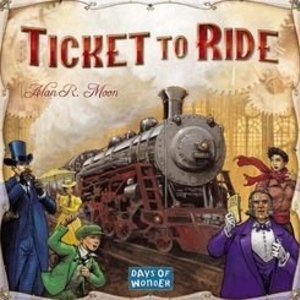

I am one of the remaining few who reviewers who haven’t put in their two cents on Ticket to Ride. Why? Is it bad? No. Am I lazy? No. It’s really because I don’t think I have anything new to say about it that hasn’t already been said a hundred times. So this review on this game will be a little different from me. Instead of going over the rules and such (however truncated they typically are from me) I will question how well this game has aged for me.
Ticket to Ride is one of those games that has really hit it big in the mass market. You can find it all over in big box stores, in FLGS, online, secondary market, just everywhere. But why? And for this long? Ticket to Ride (TTR) came out in 2004. A mere 15 years ago. While that doesn’t really sound like a long time, in contrast to today’s game industry it is an eternity. With thousands upon thousands of games being released into the market through direct publish, Kickstarter/crowd funding, and big releases at conventions it’s hard to believe that you can still find this hanging with the exciting, fresh new games.
What I truly believe is magical about this game is its simplicity. “You have two main options: take some cards or play some cards.” When you can start a teach of a game by saying that, your players are invested right away because they know you aren’t going to bog them down with rules upon rules. “If you decide to take cards you can take these colored train cards or you can take new route ticket cards.” So now players have two choices from gaining cards. “If you decide to play cards you need to play cards of a color and number matching whichever route between two connecting cities on the map you like.” Done. The game is explained. Yeah, you can fight me about the endgame scoring stuff like longest route and whatnot, but for new gamers, you have explained this classic in three sentences. It’s so beautiful when a game allows you to teach it so quickly.
But that surely means that this is an easy game, right? With so few rules and such. Well, no. It’s not really “easy” at all. While your main rules are light, the strategy and tactics during play can cause feelings of joy and delight as well as frustration and concern as you see someone claim the route you need to connect to two cities on the map. Of course, you can’t explain that to your new players right away. You want them to experience these feelings organically and fully. It’s what makes TTR a really great game: having your well-laid plans just shot to smithereens by the guy who can’t tell the difference between the white train cars and the wild rainbow train cars.
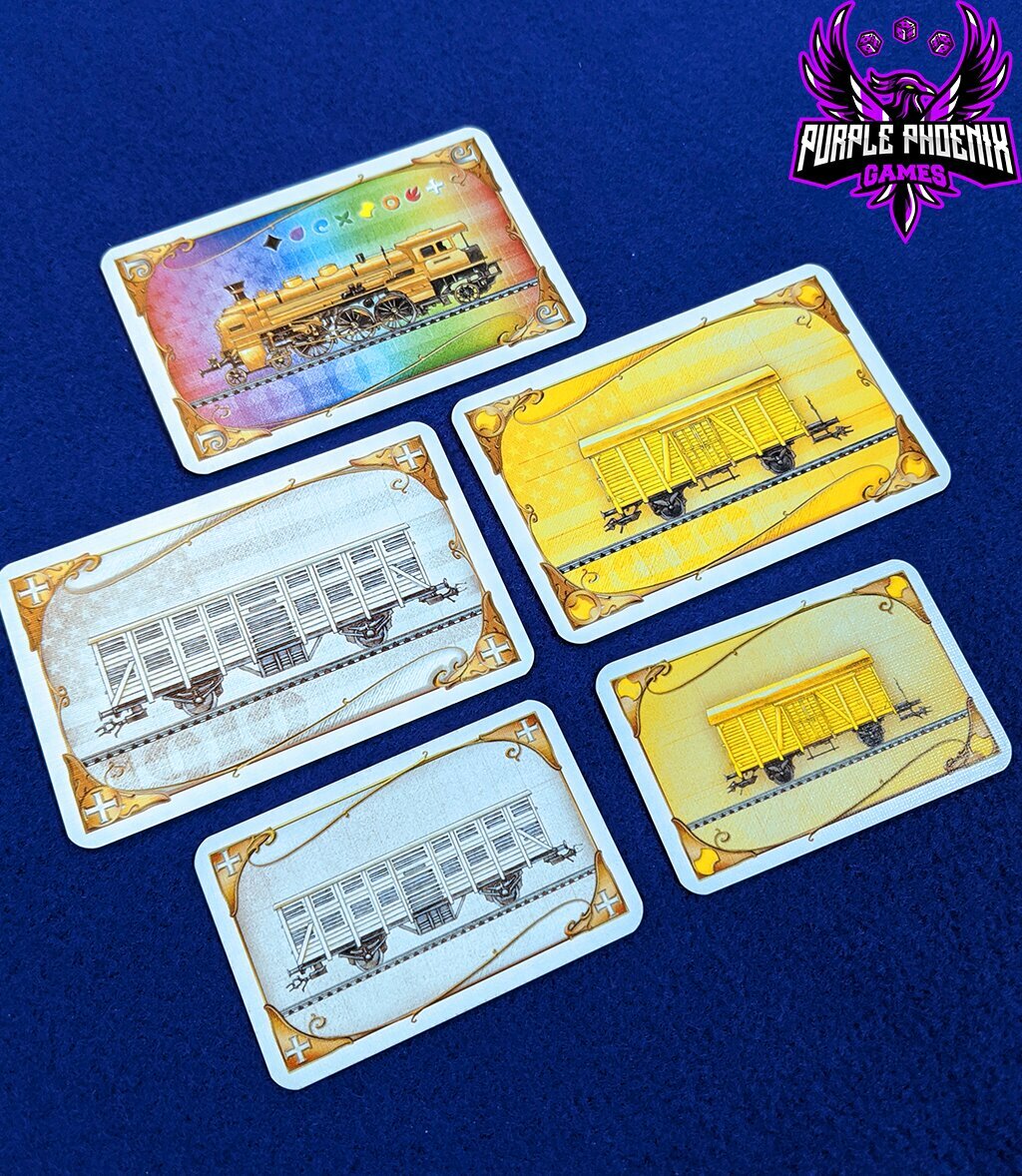
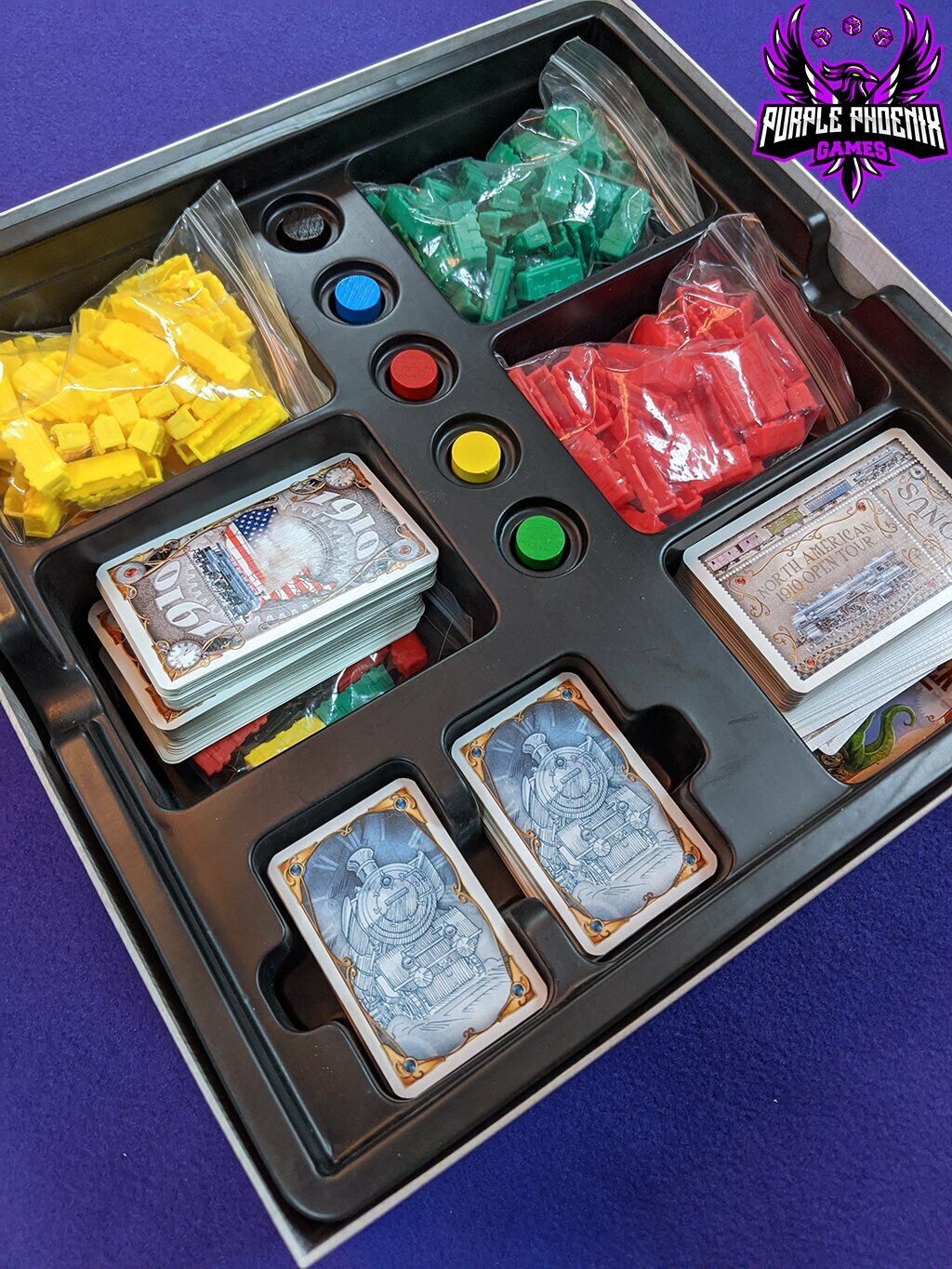
DISCLAIMER: I play with the 1910 expansion, which is a MUST. The larger cards are way easier to play with. See photo below with comparisons from base game on bottom with the larger 1910 cards above. YMMV, but I will always play using this expansion. -T
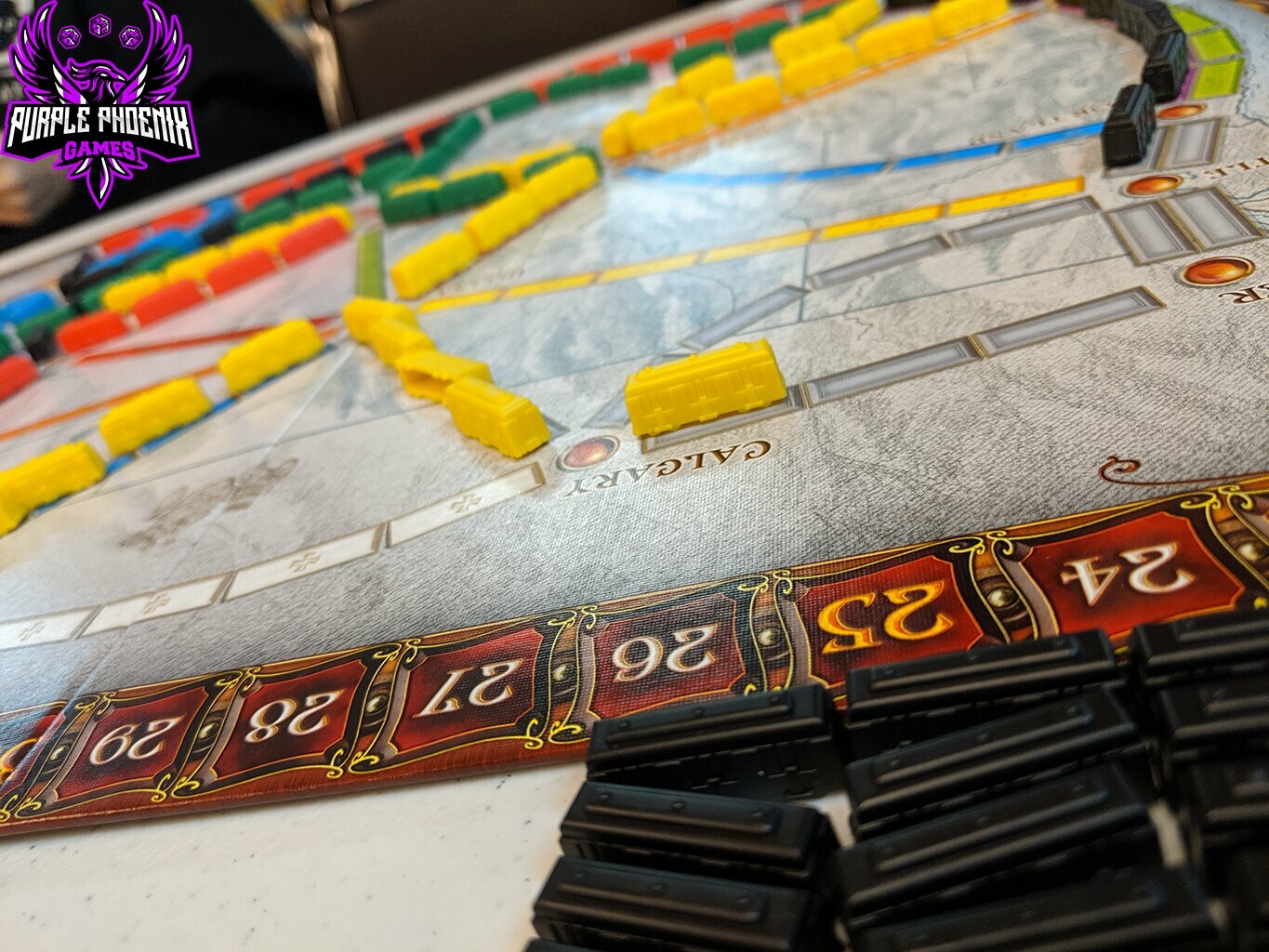
Components. Let’s compare components to some current or newer games. The game board is laid out really well, and the artwork is sparse and not over-busy on the board. This is a HUGE plus for me. I like nothing more than for the board to offer thematic elements and feeling without pelting my eyes with too much distraction. The cards were a bad choice. Not because the art or the quality on them is bad – because that’s not what I am saying. The size of the cards was a poor choice. I did purchase the 1910 expansion and simply will not play my copy without it. I recently played TTR for GenCan’t 2019 at my FLGS with OG base cards and found myself dreaming of the 1910 cards. The score tracker discs are of industry-standard quality for scoring discs. The plastic train car pieces are still just as wonderful to handle and play with as are many other more modern components. Seriously just as good. TTR components (and really, most of the time Days of Wonder components in general) are really great.
So do I still enjoy playing it? You betcha, don’tcha know. I still love seeing the board in front of me, agonizing over the route tickets I am dealt, and trying to decide if I should go for the New York to Los Angeles, or keep it simple with multiple routes along the Mississippi River. I still love the panic that ensues when I see people hoarding train cards, just knowing that they will soon be on the attack and their train car collection will dwindle to almost endgame levels in too few rounds for me to complete my masterpiece. I guess I still really love it.
Is Ticket to Ride my favorite game? No. But I’ll tell you what. I hadn’t played it in a couple years, and after this weekend’s play, it has moved up on my list by several spaces. It still holds a special place in my heart, and also the hearts of my team. That’s why Purple Phoenix Games gives Ticket to Ride a retrospective 20 / 24. It’s still great!
Ticket to Ride is one of those games that has really hit it big in the mass market. You can find it all over in big box stores, in FLGS, online, secondary market, just everywhere. But why? And for this long? Ticket to Ride (TTR) came out in 2004. A mere 15 years ago. While that doesn’t really sound like a long time, in contrast to today’s game industry it is an eternity. With thousands upon thousands of games being released into the market through direct publish, Kickstarter/crowd funding, and big releases at conventions it’s hard to believe that you can still find this hanging with the exciting, fresh new games.
What I truly believe is magical about this game is its simplicity. “You have two main options: take some cards or play some cards.” When you can start a teach of a game by saying that, your players are invested right away because they know you aren’t going to bog them down with rules upon rules. “If you decide to take cards you can take these colored train cards or you can take new route ticket cards.” So now players have two choices from gaining cards. “If you decide to play cards you need to play cards of a color and number matching whichever route between two connecting cities on the map you like.” Done. The game is explained. Yeah, you can fight me about the endgame scoring stuff like longest route and whatnot, but for new gamers, you have explained this classic in three sentences. It’s so beautiful when a game allows you to teach it so quickly.
But that surely means that this is an easy game, right? With so few rules and such. Well, no. It’s not really “easy” at all. While your main rules are light, the strategy and tactics during play can cause feelings of joy and delight as well as frustration and concern as you see someone claim the route you need to connect to two cities on the map. Of course, you can’t explain that to your new players right away. You want them to experience these feelings organically and fully. It’s what makes TTR a really great game: having your well-laid plans just shot to smithereens by the guy who can’t tell the difference between the white train cars and the wild rainbow train cars.
DISCLAIMER: I play with the 1910 expansion, which is a MUST. The larger cards are way easier to play with. See photo below with comparisons from base game on bottom with the larger 1910 cards above. YMMV, but I will always play using this expansion. -T
Components. Let’s compare components to some current or newer games. The game board is laid out really well, and the artwork is sparse and not over-busy on the board. This is a HUGE plus for me. I like nothing more than for the board to offer thematic elements and feeling without pelting my eyes with too much distraction. The cards were a bad choice. Not because the art or the quality on them is bad – because that’s not what I am saying. The size of the cards was a poor choice. I did purchase the 1910 expansion and simply will not play my copy without it. I recently played TTR for GenCan’t 2019 at my FLGS with OG base cards and found myself dreaming of the 1910 cards. The score tracker discs are of industry-standard quality for scoring discs. The plastic train car pieces are still just as wonderful to handle and play with as are many other more modern components. Seriously just as good. TTR components (and really, most of the time Days of Wonder components in general) are really great.
So do I still enjoy playing it? You betcha, don’tcha know. I still love seeing the board in front of me, agonizing over the route tickets I am dealt, and trying to decide if I should go for the New York to Los Angeles, or keep it simple with multiple routes along the Mississippi River. I still love the panic that ensues when I see people hoarding train cards, just knowing that they will soon be on the attack and their train car collection will dwindle to almost endgame levels in too few rounds for me to complete my masterpiece. I guess I still really love it.
Is Ticket to Ride my favorite game? No. But I’ll tell you what. I hadn’t played it in a couple years, and after this weekend’s play, it has moved up on my list by several spaces. It still holds a special place in my heart, and also the hearts of my team. That’s why Purple Phoenix Games gives Ticket to Ride a retrospective 20 / 24. It’s still great!
Purple Phoenix Games (2266 KP) rated Hamsters vs. Hippos in Tabletop Games
Oct 1, 2021

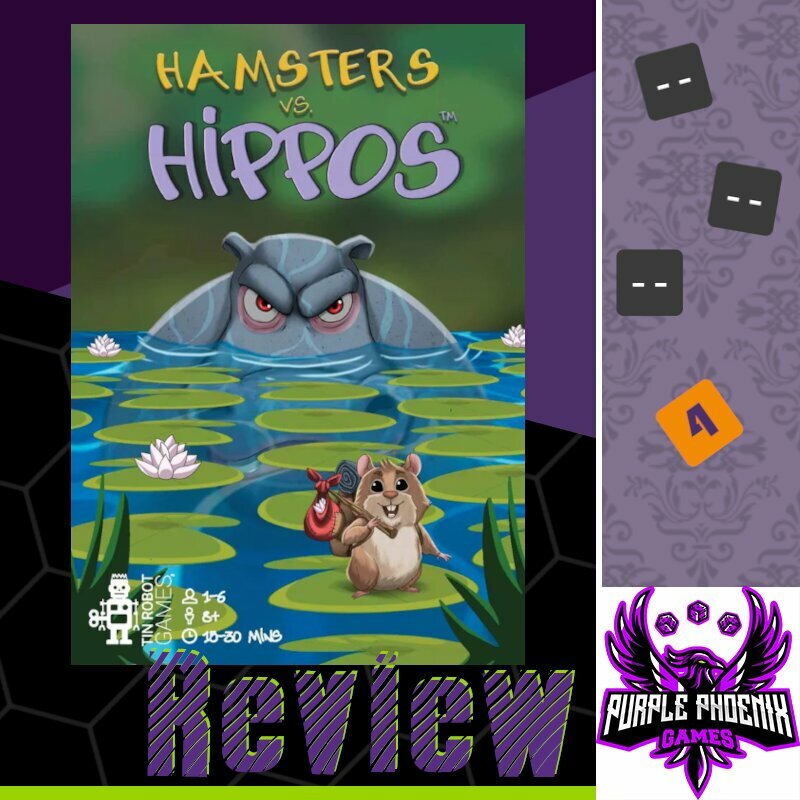
Deeply consider this question: what is your natural predator? We are the top of the food chain, right? Right? And what we all learned in school is that some animals are herbivores, some are carnivores, and some are omnivores. At least in the Midwest, that’s what we were taught. Now, I don’t remember ever being taught that hippopotamuses (hippopotami?) eat anything other than grass. However, I have been wrong so many times in my life that I am interested to find out why they would snack on fleeing hamsters. Perhaps a board game can help me!
Hamsters vs. Hippos is a press-your-luck tile flipping game where players are cute little hamsterinos escaping the zoo and nearing freedom. However, along the way they must traverse the hippo enclosure. Typically hippos only eat grass, but in this game universe they are attracted to the delectable little rodents and are as hangry as my kids after a day at the playground. The hamster who can collect the most lotus flowers from the hippo lily pads at the end of the game will be the winner and be able to escape the zoo in peace. All other players will be snacked.
DISCLAIMER: We were provided a copy of this game for the purposes of this review. This is a retail copy of the game, so what you see in these photos is exactly what would be received in your box. I do not intend to cover every single rule included in the rulebook, but will describe the overall game flow and major rule set so that our readers may get a sense of how the game plays. For more in depth rules, you may purchase a copy online or from your FLGS. -T
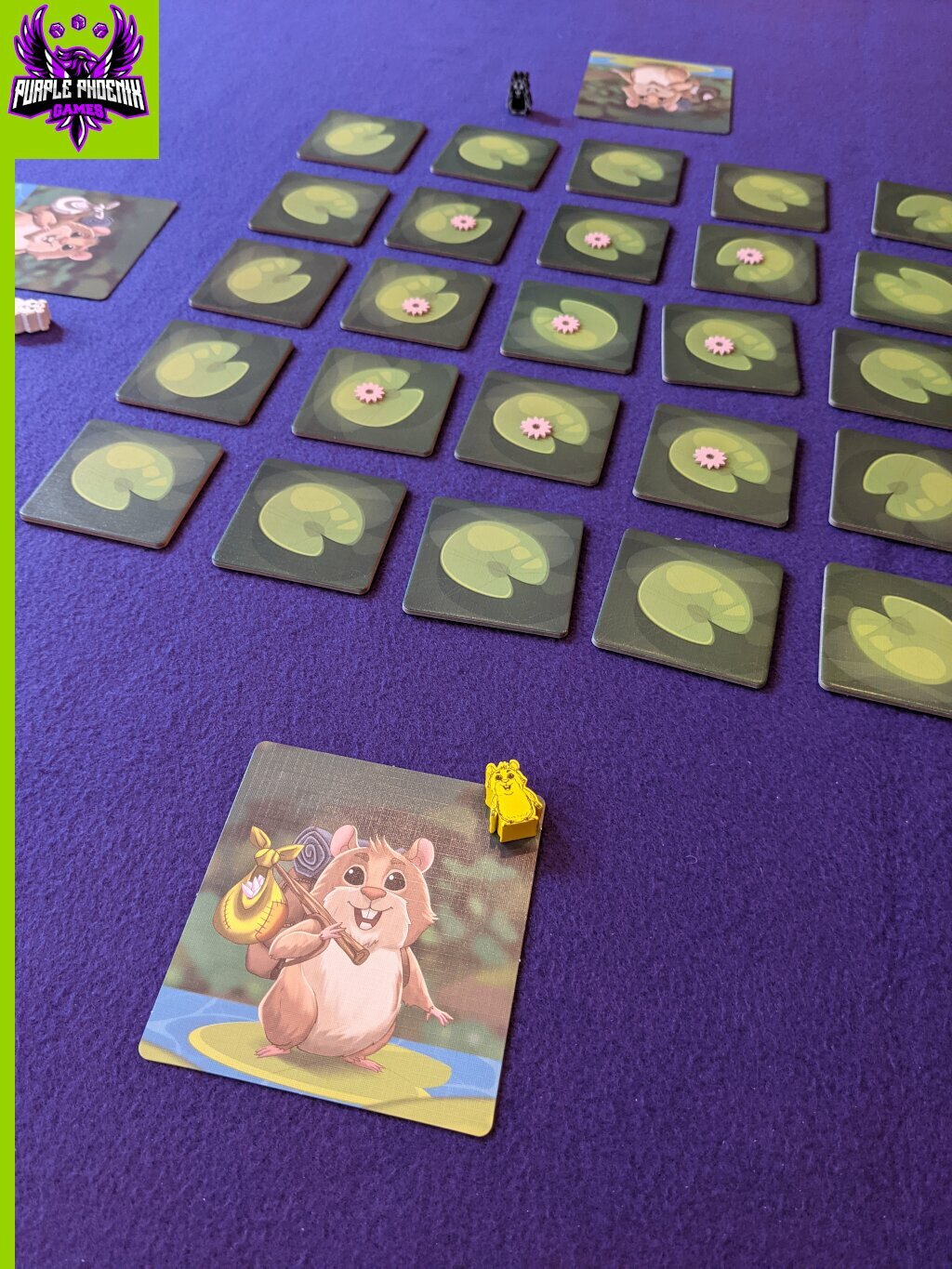
To setup, determine the appropriate grid size for the number of players per the rulebook. Shuffle all the lily pad tiles face-down, place them in the grid, then place upon them nine lotus flower tokens. Each player will select their hamsteeple and mat and the game may now begin!
Hamsters vs. Hippos is played over four rounds and each turn players will have two actions they must complete. For the first action, each hamster must move onto the grid to explore a face-down tile, or explore another face-down tile if already on the grid. For the second action the hamster may continue exploring new tiles or be taken off the grid to score their collected lotus flowers. Movement can be orthogonally or diagonally, but every time they move, the hamsters must move to an unexplored tile. Flipping these tiles will reveal empty lily pads, some special actions to be taken, lotus flowers to be collected, or hippos that end the hamster’s round and makes the hamster forfeit their collected lotus flowers this round.
The game continues in this fashion over four rounds where hamsters are moving onto and off the grid, moving around the grid, collecting flowers, and possibly being eaten. At the end of the fourth round players total their lotus flowers they were able to keep and the hamster with the most lotus flowers wins!
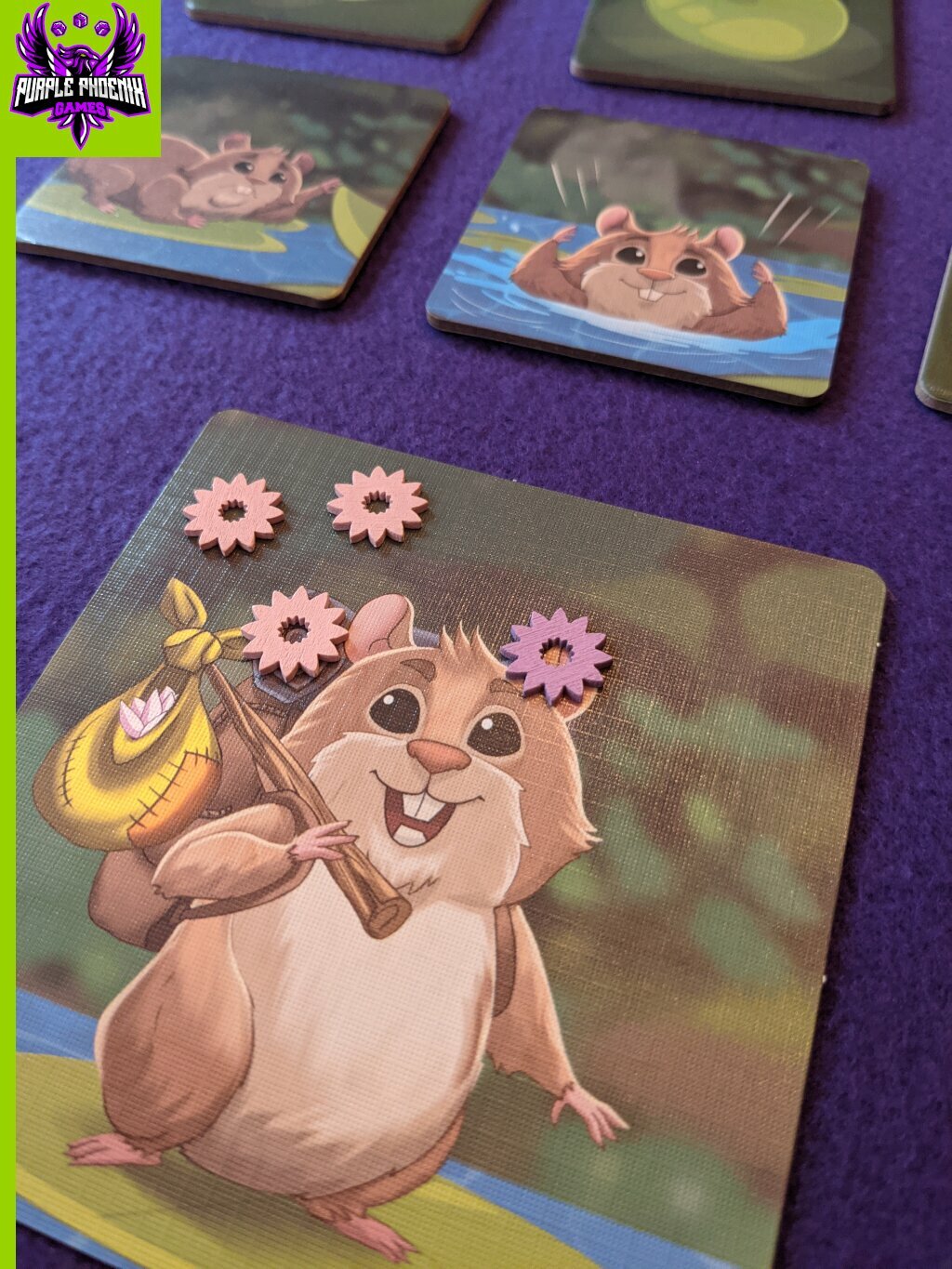
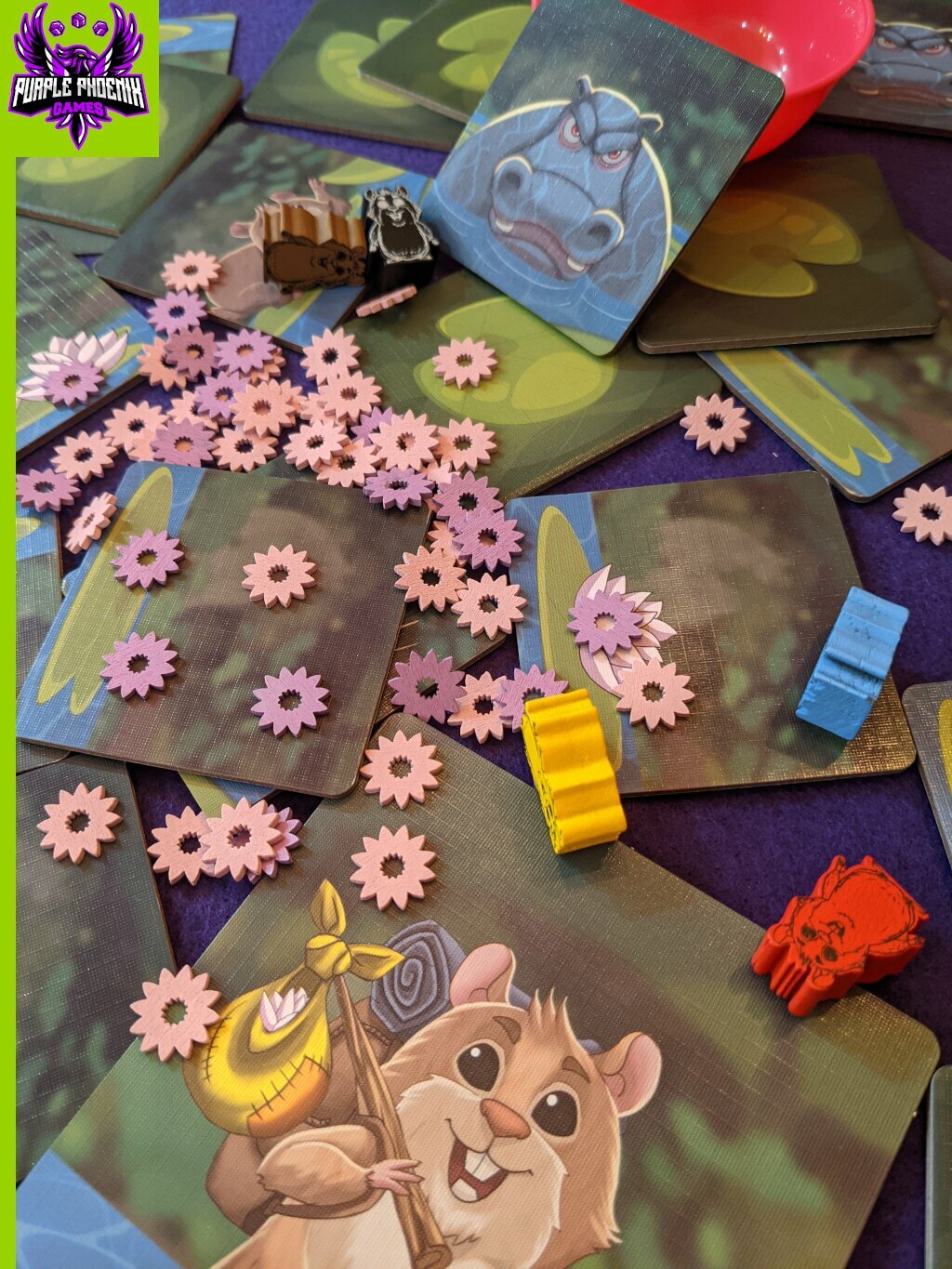
Components. This one is easy. This game is a bunch of lily pad tiles, some cardstock player mats, wooden lotus flower tokens, and cute little hamsteeples. The tiles are good quality, the player mats are big and nice, and the hamsteeples are precious. I enjoy the lighthearted art style quite a bit – even the angry-looking hippo tiles. My only issue lies with the lotus flower tokens. They are very thin painted wooden tokens in two colors – pastel pink (worth 1 VP)and slightly darker pastel purple (worth 3 VP). I am not colorblind, but I like to make mention of items I would think are not colorblind friendly. The difference in color is not great enough, even for me of acceptable color differentiation. Another thing about these is they are very thin and delicate. Normally this isn’t an issue for me, but this is clearly a game my children want to play. When they play this with me I am always holding my breath just waiting for them to break a lotus flower. It hasn’t happened yet, but I might see about adding sturdier components to my copy when I play with little ones.
Game play is very very light. This is purely a press-your-luck game of deciding to move to a tile, flipping it over, and hoping for the best. There are a few special action tiles that can help mitigate the luck factor a little, but most of the time it’s a leap before you look scenario. That may turn off a large faction of gamers, but I will be playing this primarily with my children (who are nowhere near the suggested age of 8+). I could have reviewed this under our Kids Table series, but it doesn’t seem to be marketed specifically to children. As a game for adults, this is novelty at best, but for children it’s a decent press-your-luck style game. Purple Phoenix Games gives this one a 4 / 6, but only because it works so well with kids. If I didn’t have children I couldn’t see myself playing it a whole lot at all. Consider this when you look at the amazing cover art and intriguing theme. It’s good for what it is, but will not be for all collections and play groups.
Hamsters vs. Hippos is a press-your-luck tile flipping game where players are cute little hamsterinos escaping the zoo and nearing freedom. However, along the way they must traverse the hippo enclosure. Typically hippos only eat grass, but in this game universe they are attracted to the delectable little rodents and are as hangry as my kids after a day at the playground. The hamster who can collect the most lotus flowers from the hippo lily pads at the end of the game will be the winner and be able to escape the zoo in peace. All other players will be snacked.
DISCLAIMER: We were provided a copy of this game for the purposes of this review. This is a retail copy of the game, so what you see in these photos is exactly what would be received in your box. I do not intend to cover every single rule included in the rulebook, but will describe the overall game flow and major rule set so that our readers may get a sense of how the game plays. For more in depth rules, you may purchase a copy online or from your FLGS. -T
To setup, determine the appropriate grid size for the number of players per the rulebook. Shuffle all the lily pad tiles face-down, place them in the grid, then place upon them nine lotus flower tokens. Each player will select their hamsteeple and mat and the game may now begin!
Hamsters vs. Hippos is played over four rounds and each turn players will have two actions they must complete. For the first action, each hamster must move onto the grid to explore a face-down tile, or explore another face-down tile if already on the grid. For the second action the hamster may continue exploring new tiles or be taken off the grid to score their collected lotus flowers. Movement can be orthogonally or diagonally, but every time they move, the hamsters must move to an unexplored tile. Flipping these tiles will reveal empty lily pads, some special actions to be taken, lotus flowers to be collected, or hippos that end the hamster’s round and makes the hamster forfeit their collected lotus flowers this round.
The game continues in this fashion over four rounds where hamsters are moving onto and off the grid, moving around the grid, collecting flowers, and possibly being eaten. At the end of the fourth round players total their lotus flowers they were able to keep and the hamster with the most lotus flowers wins!
Components. This one is easy. This game is a bunch of lily pad tiles, some cardstock player mats, wooden lotus flower tokens, and cute little hamsteeples. The tiles are good quality, the player mats are big and nice, and the hamsteeples are precious. I enjoy the lighthearted art style quite a bit – even the angry-looking hippo tiles. My only issue lies with the lotus flower tokens. They are very thin painted wooden tokens in two colors – pastel pink (worth 1 VP)and slightly darker pastel purple (worth 3 VP). I am not colorblind, but I like to make mention of items I would think are not colorblind friendly. The difference in color is not great enough, even for me of acceptable color differentiation. Another thing about these is they are very thin and delicate. Normally this isn’t an issue for me, but this is clearly a game my children want to play. When they play this with me I am always holding my breath just waiting for them to break a lotus flower. It hasn’t happened yet, but I might see about adding sturdier components to my copy when I play with little ones.
Game play is very very light. This is purely a press-your-luck game of deciding to move to a tile, flipping it over, and hoping for the best. There are a few special action tiles that can help mitigate the luck factor a little, but most of the time it’s a leap before you look scenario. That may turn off a large faction of gamers, but I will be playing this primarily with my children (who are nowhere near the suggested age of 8+). I could have reviewed this under our Kids Table series, but it doesn’t seem to be marketed specifically to children. As a game for adults, this is novelty at best, but for children it’s a decent press-your-luck style game. Purple Phoenix Games gives this one a 4 / 6, but only because it works so well with kids. If I didn’t have children I couldn’t see myself playing it a whole lot at all. Consider this when you look at the amazing cover art and intriguing theme. It’s good for what it is, but will not be for all collections and play groups.
Purple Phoenix Games (2266 KP) rated Arctic Scavengers in Tabletop Games
Jun 12, 2019

One of the best parts of the board gaming experience is finding a fun group of people with whom to play! Sometimes, though, coordinating a game night is easier said than done. We all must occasionally forego the group experience and face the world as the Lonely Only. But fear not! The world of solo-play is a vast and exciting realm! What follows is a chronicle of my journey into the solo-playing world – notes on gameplay, mechanics, rules, difficulty, and overall experience with solo variations of commonly multiplayer games! I hope this will provide some insight as you continue to grow your collection, or explore your already owned games!
Welcome to the Ice Age. No, not the animated movie. I’m talking about the real deal. Arctic Scavengers is set in a post-apocalyptic ice age where the cold is deadly and the resources are scarce. Any surviving humans have banded together to form ‘tribes’ that are competing for dominance in this frigid tundra. Can you and your tribe outwit your competitors to become the most powerful group? Or will a bigger and more menacing tribe overpower you and jeopardize your survival?
Disclaimer: The solo variant is only addressed in the Recon Expansion rules. There IS another expansion – HQ – but I have not used that content in my solo plays. This review only encompasses the Base Game and Recon Expansion.
Arctic Scavengers is a deck-building game where players are recruiting mercenaries to their tribes, searching for general resources, and battling other tribes for contested resources. Each turn has two main phases – Resource Gathering and Skirmish. During Resource Gathering, you play cards from your hand to either recruit new mercenaries or search the junkyard for general resources. Any remaining cards in your hand are then used during the Skirmish phase – where the player with the highest ‘fight’ value wins the contested resource for that round. At the end of the game, the player with the biggest tribe wins!
The solo variant has some minor differences, but is played essentially the same way. In a solo game, the contested resource cards are divided into 7 skirmishes to be encountered throughout the game. You can decide when to engage in a skirmish – it is not a requirement to encounter one each turn. After each skirmish, you either win and earn a contested resource, or lose and must permanently discard a card from your losing hand. The game ends when all 7 skirmishes have been encountered. The other difference is that each time you have to re-shuffle your discard pile, you must permanently remove the top card of your new deck from the game. Beyond those changes, the game remains the same. At the end of the game, all cards in your tribe are worth certain numbers of points – the goal is to beat your own personal best score.
In theory, this game sounds super cool! But when I actually got to play it solo, I was seriously underwhelmed. The game feels stagnant in the sense that there is no tension or urgency in your strategy. Since YOU get to decide when to engage in a skirmish, it is possible to just while away the time building up your deck until you have enough cards to beat every skirmish. Yes, you permanently discard a card each time you re-shuffle your discard pile, but if you are able to recruit one or two new cards each turn, it negates the penalty of discarding a card. The ability to choose when to engage in skirmishes is seriously over-powered because there is nothing stopping you from ignoring skirmishes and amassing cards for end-game scoring.
The other grievance I have with the game is regarding the Junkyard – the deck of cards where you ‘search’ for resources. The solo rules do not explicitly address setting up the Junkyard deck at all. So do you use one or not? Not having the Junkyard deck can be a serious hinderance – certain mercenaries cannot be recruited without certain resources. If you DO play with the Junkyard, how many cards do you use? Do you use the corresponding cards from the Base game and BOTH expansions? Only Base game and one expansion? Again, not explicitly addressed. I’ve tried using all of the Junkyard cards and that is difficult – there are just too many cards in that deck. I have gone entire games without coming across a necessary resource just because the size of the deck is too large (and I’m apparently a poor card-shuffler). The simple solution to this ambiguity would have been to just address it in the rulebook. But it’s not there, so I’m left guessing as to how I should set it up every time.
I really like the idea of this game. I really don’t like the solo variant though. Not having forced skirmishes makes the game extremely boring for me – I don’t really need a strategy since I can just recruit cards until I can draw a powerful hand. If there was a timeline for skirmishes – maybe something like “You must encounter one skirmish every other turn” – the game would be vastly different. I would actually need to strategize what cards to recruit and how I should delegate my cards on turns with a skirmish. In most games, I will reach a certain point where I choose to encounter a skirmish (that I know I will lose) just because I am starting to get bored. I appreciate the sentiment of including a solo variant, but this one just does not work.
Arctic Scavengers requires decent strategy and it offers good player interaction in group games. In a solo game, however, it is just imbalanced and boring. This is one solo variant that I would not recommend that you try, unless you are including drastic house rules.
https://purplephoenixgames.wordpress.com/2019/03/06/solo-chronicles-arctic-scavengers/
Welcome to the Ice Age. No, not the animated movie. I’m talking about the real deal. Arctic Scavengers is set in a post-apocalyptic ice age where the cold is deadly and the resources are scarce. Any surviving humans have banded together to form ‘tribes’ that are competing for dominance in this frigid tundra. Can you and your tribe outwit your competitors to become the most powerful group? Or will a bigger and more menacing tribe overpower you and jeopardize your survival?
Disclaimer: The solo variant is only addressed in the Recon Expansion rules. There IS another expansion – HQ – but I have not used that content in my solo plays. This review only encompasses the Base Game and Recon Expansion.
Arctic Scavengers is a deck-building game where players are recruiting mercenaries to their tribes, searching for general resources, and battling other tribes for contested resources. Each turn has two main phases – Resource Gathering and Skirmish. During Resource Gathering, you play cards from your hand to either recruit new mercenaries or search the junkyard for general resources. Any remaining cards in your hand are then used during the Skirmish phase – where the player with the highest ‘fight’ value wins the contested resource for that round. At the end of the game, the player with the biggest tribe wins!
The solo variant has some minor differences, but is played essentially the same way. In a solo game, the contested resource cards are divided into 7 skirmishes to be encountered throughout the game. You can decide when to engage in a skirmish – it is not a requirement to encounter one each turn. After each skirmish, you either win and earn a contested resource, or lose and must permanently discard a card from your losing hand. The game ends when all 7 skirmishes have been encountered. The other difference is that each time you have to re-shuffle your discard pile, you must permanently remove the top card of your new deck from the game. Beyond those changes, the game remains the same. At the end of the game, all cards in your tribe are worth certain numbers of points – the goal is to beat your own personal best score.
In theory, this game sounds super cool! But when I actually got to play it solo, I was seriously underwhelmed. The game feels stagnant in the sense that there is no tension or urgency in your strategy. Since YOU get to decide when to engage in a skirmish, it is possible to just while away the time building up your deck until you have enough cards to beat every skirmish. Yes, you permanently discard a card each time you re-shuffle your discard pile, but if you are able to recruit one or two new cards each turn, it negates the penalty of discarding a card. The ability to choose when to engage in skirmishes is seriously over-powered because there is nothing stopping you from ignoring skirmishes and amassing cards for end-game scoring.
The other grievance I have with the game is regarding the Junkyard – the deck of cards where you ‘search’ for resources. The solo rules do not explicitly address setting up the Junkyard deck at all. So do you use one or not? Not having the Junkyard deck can be a serious hinderance – certain mercenaries cannot be recruited without certain resources. If you DO play with the Junkyard, how many cards do you use? Do you use the corresponding cards from the Base game and BOTH expansions? Only Base game and one expansion? Again, not explicitly addressed. I’ve tried using all of the Junkyard cards and that is difficult – there are just too many cards in that deck. I have gone entire games without coming across a necessary resource just because the size of the deck is too large (and I’m apparently a poor card-shuffler). The simple solution to this ambiguity would have been to just address it in the rulebook. But it’s not there, so I’m left guessing as to how I should set it up every time.
I really like the idea of this game. I really don’t like the solo variant though. Not having forced skirmishes makes the game extremely boring for me – I don’t really need a strategy since I can just recruit cards until I can draw a powerful hand. If there was a timeline for skirmishes – maybe something like “You must encounter one skirmish every other turn” – the game would be vastly different. I would actually need to strategize what cards to recruit and how I should delegate my cards on turns with a skirmish. In most games, I will reach a certain point where I choose to encounter a skirmish (that I know I will lose) just because I am starting to get bored. I appreciate the sentiment of including a solo variant, but this one just does not work.
Arctic Scavengers requires decent strategy and it offers good player interaction in group games. In a solo game, however, it is just imbalanced and boring. This is one solo variant that I would not recommend that you try, unless you are including drastic house rules.
https://purplephoenixgames.wordpress.com/2019/03/06/solo-chronicles-arctic-scavengers/
Purple Phoenix Games (2266 KP) rated Fantasy Ranch in Tabletop Games
Jun 12, 2019 (Updated Jun 12, 2019)

Little known fact: my family used to be involved with local harness racing and horse training. Not much actually rubbed off on me, personally, but I do remember going to the stables to visit with the horses, and I was even allowed to ride the stable goat since I wasn’t yet big enough to get on the horses. Ahh, memories. So when I heard that a game existed with a horse ranching theme, I just HAD to get it to the table. Is it a good game though? Let’s find out! (spoilers: IT’S EXCELLENT!)
DISCLAIMER: The game comes with three modes of difficulty AND an included children’s game that also can be played on three modes of difficulty. For this review we are concentrating only on adult mode two. We felt mode one was too introductory, but we did not want to go all in right away on mode three. -T
As with most board games, you are trying to amass trophies (VP) and the winner at the end of five rounds is the rancher with the most trophies. On your turn you can take one Limited (standard) Action and as many Free Actions as you would like. Limited Actions include: buy a horse, buy a location on your ranch board, or farm your ranch for goods. Free Actions include: sell a horse, move horses to/from your home area to/from a different area on your ranch board, or trade goods at a 2:1 ratio. Once every player has taken their turn, you enter a show using the horses you have collected.
Buying a horse requires different amounts of food (in carrots) that you gain from different actions (farming your ranch, selling a horse). Luckily, spending food is a one-time action and you don’t have to feed your horses every turn. A great improvement over other “feed your villagers” games, in my opinion – yeah, I said it. Buying a location on your ranch board/playmat requires “tack,” which is symbolized by boot tokens (as seen below). You can always get more food and tack by farming your ranch, and you receive six goods of any combination, but that’s a Limited Action and prevents you from doing the other actions.
Selling a horse is easy, yet the separation anxiety is real, as you simply discard the horse for the amount of food it costs to purchase. Moving horses is easy too – your Home area of your ranch/playmat can only hold so many horses, so you will need to move horses of certain types to unlocked (purchased) matching areas on your ranch. This is important, as you cannot keep buying red horses or you will certainly run out of room for them, even if you unlock the red area on your ranch board. Plus unlocking sections of your ranch provides you with trophies at game end. The last free action is trading goods, which you do at a 2:1 ratio. So trade in two food for a tack or vice versa.
At shows you use horses for their specific specialty skills plus a die roll. Each horse has specialty in one area, and some skill in other areas. The number associated with a skill icon indicates the starting skill “strength” that you will add to your die roll. You roll all three dice of your color, take the highest result from the roll, and add the skill strength of the horse skill. That’s your score for the show. The highest number is awarded 1st place and the rewards printed, and so on and so forth for the other placing horses. This could result in more food or tack, or even your choice of horses for free from the sales barn.
On the very last turn of the game you will compete in three shows (instead of the normal two shows at the end of each turn) and can only use World Class horses, or buy your way into the show with food. The show process is the same, but it is the final push to earn as many trophies as possible before game end. And that’s it!
Components: This game is FULL of components. It’s a pretty stocked and heavy box, but still only the size of a Ticket to Ride box. The playmats, game boards, and cardboard chits are all of really great quality. The cards are great quality as well with photos of real existing horses (as well as the photos of real existing ranches on the giant ranch cards that are essentially beautiful player reference cards and resource holders). The best components of the game are the super cute little horeeples (oh no, that can’t possibly be correct). Horse-meeples. They come in different colors to match the areas on your ranch that you need to unlock and move them into so you don’t overcrowd your Home area. Even though my copy came with a green horse who lost his front legs, we know that he competes hard and lives his best life. The art is really really great and, though busy on the board at times, the game looks really good on the table. No qualms with the components on this one at all.
Here’s what I really like about this one. It’s a euro through and through, but it’s a euro that is actually exciting, with a unique theme, and one that I genuinely cannot wait to play again. I want to try mode three as soon as I can, and I really want to introduce my son to the game as soon as he is able to handle it. I am finding it really really hard to think of a game that comes ready to play three ways for adults, has components included to play the game three ways with children, and is actually super fun. I can’t think of any. This game is truly in a class by itself.
I love that no matter how tactical you play or how strategic you want to make it, sometimes the dice love/hate you and it could make all the difference. As you can see in the scores, we all love it (with the exception of my cousin Tony who rated it a three because of the dice – WHICH is odd because it is his father that was the harness racing jockey of the family). This review would have been live a week ago, but immediately after playing last weekend Josh said he would like to bring it home to play with his family. His wife is from Kentucky, and they kinda like horses and horse racing there. Well, his wife and son also rated this game out of 6. His wife gave Fantasy Ranch a 15 and his son rated it a 16. As that completely throws off my rating scale I did not add them, but as you can see we at Purple Phoenix Games give this one a very boot-kickin’ 19 / 24. If only we hadn’t invited Tony over to destroy the scores… We highly recommend you check this winner out. Seriously, it’s great.
https://purplephoenixgames.wordpress.com/2019/06/04/fantasy-ranch-review/
DISCLAIMER: The game comes with three modes of difficulty AND an included children’s game that also can be played on three modes of difficulty. For this review we are concentrating only on adult mode two. We felt mode one was too introductory, but we did not want to go all in right away on mode three. -T
As with most board games, you are trying to amass trophies (VP) and the winner at the end of five rounds is the rancher with the most trophies. On your turn you can take one Limited (standard) Action and as many Free Actions as you would like. Limited Actions include: buy a horse, buy a location on your ranch board, or farm your ranch for goods. Free Actions include: sell a horse, move horses to/from your home area to/from a different area on your ranch board, or trade goods at a 2:1 ratio. Once every player has taken their turn, you enter a show using the horses you have collected.
Buying a horse requires different amounts of food (in carrots) that you gain from different actions (farming your ranch, selling a horse). Luckily, spending food is a one-time action and you don’t have to feed your horses every turn. A great improvement over other “feed your villagers” games, in my opinion – yeah, I said it. Buying a location on your ranch board/playmat requires “tack,” which is symbolized by boot tokens (as seen below). You can always get more food and tack by farming your ranch, and you receive six goods of any combination, but that’s a Limited Action and prevents you from doing the other actions.
Selling a horse is easy, yet the separation anxiety is real, as you simply discard the horse for the amount of food it costs to purchase. Moving horses is easy too – your Home area of your ranch/playmat can only hold so many horses, so you will need to move horses of certain types to unlocked (purchased) matching areas on your ranch. This is important, as you cannot keep buying red horses or you will certainly run out of room for them, even if you unlock the red area on your ranch board. Plus unlocking sections of your ranch provides you with trophies at game end. The last free action is trading goods, which you do at a 2:1 ratio. So trade in two food for a tack or vice versa.
At shows you use horses for their specific specialty skills plus a die roll. Each horse has specialty in one area, and some skill in other areas. The number associated with a skill icon indicates the starting skill “strength” that you will add to your die roll. You roll all three dice of your color, take the highest result from the roll, and add the skill strength of the horse skill. That’s your score for the show. The highest number is awarded 1st place and the rewards printed, and so on and so forth for the other placing horses. This could result in more food or tack, or even your choice of horses for free from the sales barn.
On the very last turn of the game you will compete in three shows (instead of the normal two shows at the end of each turn) and can only use World Class horses, or buy your way into the show with food. The show process is the same, but it is the final push to earn as many trophies as possible before game end. And that’s it!
Components: This game is FULL of components. It’s a pretty stocked and heavy box, but still only the size of a Ticket to Ride box. The playmats, game boards, and cardboard chits are all of really great quality. The cards are great quality as well with photos of real existing horses (as well as the photos of real existing ranches on the giant ranch cards that are essentially beautiful player reference cards and resource holders). The best components of the game are the super cute little horeeples (oh no, that can’t possibly be correct). Horse-meeples. They come in different colors to match the areas on your ranch that you need to unlock and move them into so you don’t overcrowd your Home area. Even though my copy came with a green horse who lost his front legs, we know that he competes hard and lives his best life. The art is really really great and, though busy on the board at times, the game looks really good on the table. No qualms with the components on this one at all.
Here’s what I really like about this one. It’s a euro through and through, but it’s a euro that is actually exciting, with a unique theme, and one that I genuinely cannot wait to play again. I want to try mode three as soon as I can, and I really want to introduce my son to the game as soon as he is able to handle it. I am finding it really really hard to think of a game that comes ready to play three ways for adults, has components included to play the game three ways with children, and is actually super fun. I can’t think of any. This game is truly in a class by itself.
I love that no matter how tactical you play or how strategic you want to make it, sometimes the dice love/hate you and it could make all the difference. As you can see in the scores, we all love it (with the exception of my cousin Tony who rated it a three because of the dice – WHICH is odd because it is his father that was the harness racing jockey of the family). This review would have been live a week ago, but immediately after playing last weekend Josh said he would like to bring it home to play with his family. His wife is from Kentucky, and they kinda like horses and horse racing there. Well, his wife and son also rated this game out of 6. His wife gave Fantasy Ranch a 15 and his son rated it a 16. As that completely throws off my rating scale I did not add them, but as you can see we at Purple Phoenix Games give this one a very boot-kickin’ 19 / 24. If only we hadn’t invited Tony over to destroy the scores… We highly recommend you check this winner out. Seriously, it’s great.
https://purplephoenixgames.wordpress.com/2019/06/04/fantasy-ranch-review/

Connor Sheffield (293 KP) rated Bloodborne in Video Games
Aug 13, 2018
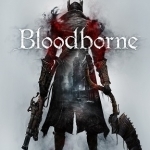

Incredible atmosphere (5 more)
Great variety of enemies
Beautiful art and imagery
Interesting Lore (optional)
Plenty of different ways to play
Great combat mechanics
Can be difficult (1 more)
Not as easy and some people make it look
Challenging and Satisfying
Contains spoilers, click to show
Bloodborne is part of the famous series of games such as Demon Souls and Dark Souls, which if you know those previous games, you'll know that they are infamous for their difficulty, even spawning an entire meme phrase that simply says "git gud".
Bloodborne however, stands aside from the souls series because it's combat mechanics are faster and each enemy requires the player to evolve their skills and tactics in order to progress. The first major difference in Bloodborne that might throw previous souls players off, is the fact that there is no shield. Instead the Hunter wields a right handed melee weapon and in the left hand they wild a ranged weapon in place of a shield. This ranged weapon at first is primarily used not for damage, but for parry's/counter attacks.
The lack of shield helps the player evolve their combat from hiding behind a shield like in the souls games, to being more aggressive in a fight but also tactical because during your first run through of the game, you'll simply be dealing with each enemy through trial and error until you learn their attacks and learn how to defeat them. This is something that has been in every souls game and that is why these games are so rewarding.
The reason Bloodborne is my favourite is because of this speed that makes you evolve in combat. I ran into this game thinking it was like other RPG games where I could pretty much take on any beginning level enemy and even if they packed a punch I'd take out the enemy with a thin line of health left, only to use a few health potions and repeat. But Bloodborne? Good God you can't rush this game!
Every enemy has their own attack system that varies. Some Yarnhamites are more vicious that other, and some are more defensive and cautious. There are also enemies that are deceptive. If you were to come across a large, fat troll in a fantasy world, you'd expect them to be rather slow, especially when swinging a weapon. You'd only expect the force and weight of the weapon to give speed to a swing. But the large troll creatures in Bloodborne are deceptively fast and even if you keep some distance between you, they can leap really quickly and instantly pummel you with a cinder block.
But I'm not going to reveal too much about enemies because it's easier and more fun to test out the game for yourself.
Boss fights are the main factor for the infamous difficulty of the souls series and Bloodborne is no stranger to this element either. There are Two bosses in the beginning of the game. One is optional but I would highly recommend facing it. The other boss is your first taste (if you didn't kill the optional boss first) of the challenges you'll face. Both bosses help prepare for later boss fights because of their different combat styles.
The first (optional) boss is the Cleric Beast on the bridge in the beginning level, and it is intimidating as fuck for a beginner of the souls series. If you haven't watched or played a souls game before and you go into Bloodborne (or any of them) with no knowledge of the scale of bosses, then they are intimidating in comparison to your measly character size. However once you learn this boss, and face later bosses, you'll realize that this boss is one of the easiest to face.
The next boss and the main boss of the beginning level, who is not optional as defeating him let's you progress through the story, is Father Gascoigne, another Hunter in the world of Bloodborne and the first of many you'll come across but facing this hunter is by far one of the most painstakingly challenging beginning fights to a game I've ever had to face. In my first run through I died to him so so soooo many times and sometimes it was simply cos he was on low health and I got cocky and fucked up. However defeating this boss, and any boss in this game, really feels like an achievement.
I've realised iv made this review hella long but that's because Bloodborne cannot be easily reviewed in just a few words but I'll do my best to do a quick overall conclusion as to why this is my favourite game:
The level design isn't flawless but it is incredible and the atmosphere created through sound design and soundtrack make this game incredibly in depth and really creepy which I love because even after a few play through I still get creeped out and even jump at some of the jumpscares that I forget about!
The weapons of this game are all well designed aesthetically and though I know certain ones I never use, they are all useable depending on player preference and style of play. There's so much to choose from and learn and every item in this game has a description that teaches the player more about the Lore of the world but that is of course optional and isn't required necessarily to understand the games main quest plot.
This game also requires exploration because the path the player needs to take isn't set out for them which makes the game less linear meaning that you can play this game differently every time you play it. It also might mean that you'll need to look up the paths you need to take online or in a guide in order to just get through the game and complete it. Otherwise it could take you hours, maybe days to figure out where you need to go.
The combat mechanics of Bloodborne are some of the best I've ever seen and played with and that's why it stands out to me above the other souls games.
The boss fights are intense and each new boss helps the player to adapt and evolve their combat skills and tactics in order to overcome the enemy.
The world is very heavily Lovecraftian and therefore the Lore is incredible but also optional. Also, there are easier ways to fight this games enemies including bosses, so if you're struggling, then Google it and there will be hundreds of players in the same boat as you, and in my opinion there's no wrong way to play games like this. If it remains fun and let's me complete the storyline, such as summoning AI for boss battles in offline mode. Then play however you want to because it's you playing the game, not some internet troll who says you're shit and/or cheating the game. If it's possible to do in game, it's part of the game...deal with it!
There are faults such as minor framerate glitches, and glitches with the ragdoll bodies of defeated enemies falling through the environment. There are also some elements that are part of the game such as windows for visceral attacks and hitboxes which sometimes feel like bullshit, but this also helps you evolve so....pros and cons.
My final comment is this;
The best way to learn about this game and enjoy it, is to play it for yourself. It's hard to put into words (even this amount of words in this review) just how incredible this game looks and feels. So if you have a Playstation 4 then grab yourself a copy of Bloodborne and enjoy!
Fear the Old blood!
Bloodborne however, stands aside from the souls series because it's combat mechanics are faster and each enemy requires the player to evolve their skills and tactics in order to progress. The first major difference in Bloodborne that might throw previous souls players off, is the fact that there is no shield. Instead the Hunter wields a right handed melee weapon and in the left hand they wild a ranged weapon in place of a shield. This ranged weapon at first is primarily used not for damage, but for parry's/counter attacks.
The lack of shield helps the player evolve their combat from hiding behind a shield like in the souls games, to being more aggressive in a fight but also tactical because during your first run through of the game, you'll simply be dealing with each enemy through trial and error until you learn their attacks and learn how to defeat them. This is something that has been in every souls game and that is why these games are so rewarding.
The reason Bloodborne is my favourite is because of this speed that makes you evolve in combat. I ran into this game thinking it was like other RPG games where I could pretty much take on any beginning level enemy and even if they packed a punch I'd take out the enemy with a thin line of health left, only to use a few health potions and repeat. But Bloodborne? Good God you can't rush this game!
Every enemy has their own attack system that varies. Some Yarnhamites are more vicious that other, and some are more defensive and cautious. There are also enemies that are deceptive. If you were to come across a large, fat troll in a fantasy world, you'd expect them to be rather slow, especially when swinging a weapon. You'd only expect the force and weight of the weapon to give speed to a swing. But the large troll creatures in Bloodborne are deceptively fast and even if you keep some distance between you, they can leap really quickly and instantly pummel you with a cinder block.
But I'm not going to reveal too much about enemies because it's easier and more fun to test out the game for yourself.
Boss fights are the main factor for the infamous difficulty of the souls series and Bloodborne is no stranger to this element either. There are Two bosses in the beginning of the game. One is optional but I would highly recommend facing it. The other boss is your first taste (if you didn't kill the optional boss first) of the challenges you'll face. Both bosses help prepare for later boss fights because of their different combat styles.
The first (optional) boss is the Cleric Beast on the bridge in the beginning level, and it is intimidating as fuck for a beginner of the souls series. If you haven't watched or played a souls game before and you go into Bloodborne (or any of them) with no knowledge of the scale of bosses, then they are intimidating in comparison to your measly character size. However once you learn this boss, and face later bosses, you'll realize that this boss is one of the easiest to face.
The next boss and the main boss of the beginning level, who is not optional as defeating him let's you progress through the story, is Father Gascoigne, another Hunter in the world of Bloodborne and the first of many you'll come across but facing this hunter is by far one of the most painstakingly challenging beginning fights to a game I've ever had to face. In my first run through I died to him so so soooo many times and sometimes it was simply cos he was on low health and I got cocky and fucked up. However defeating this boss, and any boss in this game, really feels like an achievement.
I've realised iv made this review hella long but that's because Bloodborne cannot be easily reviewed in just a few words but I'll do my best to do a quick overall conclusion as to why this is my favourite game:
The level design isn't flawless but it is incredible and the atmosphere created through sound design and soundtrack make this game incredibly in depth and really creepy which I love because even after a few play through I still get creeped out and even jump at some of the jumpscares that I forget about!
The weapons of this game are all well designed aesthetically and though I know certain ones I never use, they are all useable depending on player preference and style of play. There's so much to choose from and learn and every item in this game has a description that teaches the player more about the Lore of the world but that is of course optional and isn't required necessarily to understand the games main quest plot.
This game also requires exploration because the path the player needs to take isn't set out for them which makes the game less linear meaning that you can play this game differently every time you play it. It also might mean that you'll need to look up the paths you need to take online or in a guide in order to just get through the game and complete it. Otherwise it could take you hours, maybe days to figure out where you need to go.
The combat mechanics of Bloodborne are some of the best I've ever seen and played with and that's why it stands out to me above the other souls games.
The boss fights are intense and each new boss helps the player to adapt and evolve their combat skills and tactics in order to overcome the enemy.
The world is very heavily Lovecraftian and therefore the Lore is incredible but also optional. Also, there are easier ways to fight this games enemies including bosses, so if you're struggling, then Google it and there will be hundreds of players in the same boat as you, and in my opinion there's no wrong way to play games like this. If it remains fun and let's me complete the storyline, such as summoning AI for boss battles in offline mode. Then play however you want to because it's you playing the game, not some internet troll who says you're shit and/or cheating the game. If it's possible to do in game, it's part of the game...deal with it!
There are faults such as minor framerate glitches, and glitches with the ragdoll bodies of defeated enemies falling through the environment. There are also some elements that are part of the game such as windows for visceral attacks and hitboxes which sometimes feel like bullshit, but this also helps you evolve so....pros and cons.
My final comment is this;
The best way to learn about this game and enjoy it, is to play it for yourself. It's hard to put into words (even this amount of words in this review) just how incredible this game looks and feels. So if you have a Playstation 4 then grab yourself a copy of Bloodborne and enjoy!
Fear the Old blood!