Purple Phoenix Games (2266 KP) rated Elder Sign in Tabletop Games
Jul 16, 2019 (Updated Aug 21, 2019)
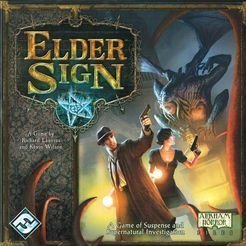


Disclaimer: There are many expansions for Elder Sign. I do not have any of them, nor do I have any gameplay experience with any of them. If and when I do get them added into my base game, I will either amend this review or write a new one! – L
In Elder Sign, players take on the roles of Investigators who must use their supernatural knowledge and keen wit to seal dimensional portals and prevent the Ancient Ones from entering our world and destroying humanity. Just another day at the office, right? Players take turns rolling dice to fight monsters and complete adventures that will reward them with artifacts, health and/or sanity, clues, or even Elder Signs – the symbols necessary for sealing away the Ancient Ones for good. Be careful, though – if you fail to complete an adventure, you will be harshly punished! I’m talking losing health and sanity, accidentally summoning monsters, or even bringing the Ancient One one step closer to our world! As a solo game, Elder Sign plays the same way as it would in a group setting. The only difference is that the solo player cannot use the ‘Assisting’ ability because there are no other players who can offer you aid. Besides that, gameplay remains the same – even a lone Investigator can put their dice to good use to ward off evil!
I enjoy playing Elder Sign as a solo game. Although mostly dominated by dice rolling, there is a fair amount of strategy required for this game. I don’t feel like I’m mindlessly rolling dice – I have to decide which adventures are attainable with my given items, and which rewards benefit me the most in my overall task. There are rewards and consequences to be weighed with every decision, so action must be taken with great thought. Because of the strategic implications, Elder Sign keeps me thoroughly engaged, even when playing solo, and that’s one reason why I keep coming back to it.
On the flip side, one thing that isn’t my favorite about Elder Sign is its reliance on dice rolls to progress in the game. Yeah, I know, it’s a dice game – what did I expect? Sometimes, though, you just can’t roll to save your life (quite literally, in this game) and that can make the game frustrating to play. A series of poor rolls can feel like they completely negate any strategy you’ve enacted and can unravel your entire plan. On a good dice-rolling day for me, I love this game! On a not-so-good dice-rolling day, I find it a little harder to enjoy myself. But hey – if it was totally easy, it wouldn’t be fun, right? One positive of this, I guess, is that I always have to be adjusting my strategy to take the current dice into account. I can’t just pick one strategy and run with it since almost all outcomes are dependent on the luck of the roll! Elder Sign keeps me on my toes, that’s for sure.
I got Elder Sign from Travis as a birthday present last year, and it has been a good addition to my collection. There is enough going on to keep me engaged the entire game, but not so much that I feel overwhelmed. And yeah, maybe I’m not always the greatest dice-roller, but that just makes me adapt my strategy to deal with the current situation. I have read that adding expansions makes the game even more enjoyable, and hopefully one of these days I’ll get to experience that for myself. For the time being, though, I’m content with the base game. If you enjoy Elder Sign, I recommend you try it solo – it doesn’t feel any different to play, and I think you’ll enjoy it just as much as a group game!
Purple Phoenix Games (2266 KP) rated Tiny Epic Galaxies in Tabletop Games
Jul 16, 2019


In Tiny Epic Galaxies, you are the leader of a galactic empire looking to expand its borders and influence across space. Unfortunately, you are not the only one vying for power – competing galactic leaders are also gathering resources and sending out scouts to planets in hopes of bringing them into the folds of their own empires. Can you outwit your opponents and stake your claim on these new planets before your rivals do? Or are you doomed to live under someone else’s rule forever?
DISCLAIMER: There are several expansions to this game, but we are not reviewing them at this time. Should we review them in the future we will either update this review or post a link to the new material here. -T
Tiny Epic Galaxies is a game of dice rolling and area control/influence in which players take turns rolling dice and activating powers in order to gather resources and increase their influence on newly-discovered planets. On your turn, you will roll a specified number of dice, and activate them in any order you choose to perform any of the available actions: move a ship, advance your colonization of a planet, acquire resources, or utilize the special power of a planet you control. Gaining control of a planet earns victory points, and the game ends once a player has reached 21 VPs. Sounds simple enough, right? But here’s a twist – when you activate a die on your turn, any other player can spend a resource to follow your action and perform the same action you just did. Make sure you keep an eye on your opponents’ ships and resources – a beneficial action for you could also earn your opponents a planet!
My absolute favorite part of all the Tiny Epic games is that they have so much more to offer than meets the eye, and Tiny Epic Galaxies is no exception. The premise of the game is simple and easy to learn, yet mastering the strategy is what keeps me coming back for more. There is no single strategy for guaranteed success, and the necessity to adapt strategy based upon your dice rolls keeps the game engaging and exciting. You may have a plan in mind, but unless the dice cooperate, you’ll have to adjust that plan on the fly. And you’ve also got to pay attention to your resources and your opponents’ turns, because you might be able to capitalize on their dice if you can afford the cost. It could potentially always be your turn, even if it’s not your official turn, since you have the ability to follow an opponent’s action. You’re coming up with your own strategy, while also trying to decipher your opponents’ strategies so you can outwit them and earn the most VPs the fastest.
Another great part of this game is that there is a good amount of player interaction, but not in a way that feels confrontational. In some situations it may feel like a bit of ‘take that,’ but remember – you’re the one who gave them the opportunity to take that action! Without you taking the action in the first place, your opponent would not have had the chance to follow you! Your strategy must transcend your individual galaxy and also take into account every other galaxy in play. In Tiny Epic Galaxies, you’re constantly interacting – some interactions are just more subtle than others.
Tiny Epic Galaxies is perhaps my favorite Tiny Epic game to date. It’s quick, simple, and yet deceptively strategic. Plus the little spaceships are so cute! If I had to pick one Tiny Epic game to use to introduce someone to the series, I would pick this one. Purple Phoenix Games gives Tiny Epic Galaxies an out-of-this-world 17 / 18.

Dean Gregory (18 KP) rated Hive in Tabletop Games
May 25, 2019 (Updated May 25, 2019)
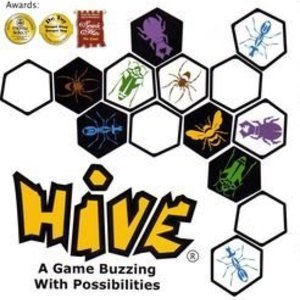
I've come the think of Hive as Chess Lite. This is because it has a similar sort of depth, in that the key to success lies in the player's understanding of each bug's strengths and weaknesses in a given situation. Also, one of the focal points of the game is trapping a particularly vulnerable piece - the king in Chess, and the queen bee in Hive.
One of the best aspects of the game is how it adapts to the space it is played in. Players have a degree of control over how the Hive grows as they place their pieces and move them around. This means if you play on a small table, you can easily make the game fit. However, some games I have played have ended up getting a little out of control and outgrowing the playing space, which ruled out some moves available.
There is a travel version of the game available in which the pieces are about a third of the size, but even in the full size version, it lends itself to travel fairly well. Both versions of the game come with handy travel bags which take up little space, so for the gamer on the go, this one would certainly suit your collection.
One minor gripe I have is that the way the pieces move around and affect each other leads to only a handful of defensive strategy, which means that particularly for more experienced players, the game can be heavily skewed in favour of whoever goes first. However if you're willing to invest in it a little more, there are a few add-on pieces available that can mitigate this somewhat, while also adding more spice to the game.
Overall, this has proved to be among my favourite and most endearing games I own. It is endlessly replayable, the components are a joy to hold and use, it appeals to both my casual gamer friends as well as those who enjoy a deeper strategy experience, and while it offers plenty as a base game, the add-ons really work as wildcards to change things up.
Highly recommended.
The Change Catalyst: Successfully Instigating Sustainable Change: Secrets to Successful and Sustainable Business Change
Book
The essential companion for delivering successful and sustainable change. 'The Change Catalyst is...

Summoners War
Games and Entertainment
App
2017 Summoners War World Arena Championship! Who will be the strongest Summoner of all? Sep. 16th...

Wonderlines: match-3 puzzle game
Games
App
Once, during an expedition to South America, a famous archaeologist found some strange hieroglyphic...

Iron Marines
Games and Entertainment
App
From the creators of the award winner Kingdom Rush trilogy comes the most extraordinary space...

Celtic Tribes - MMO
Games and Entertainment
App
Celtic Tribes - Real-time strategy for true chiefs Peaceful settlers as well as the battle hungry...
Purple Phoenix Games (2266 KP) rated Dicetopia in Tabletop Games
Jun 12, 2019

Welcome to the Dicetopia – a vast city teeming with opportunity. Some people capitalize on those opportunities for the greater good, but not you. You and your faction have more dubious motivations – you see a city ripe for the taking. Unfortunately for you, other factions in the city see the same thing. Now, you must work quickly and quietly to gain control over the city’s neighborhoods before your opponents! Pick up loot, carry out secret missions, and undermine your opponent in any way possible. The sneakiest and most clever faction will come out on top – will it be yours?
In Dicetopia, you are a member of a faction vying for control of the city. You and your opponents have secret missions to complete, and your strategy will vary depending on those missions. On your turn, you will swap one of the agents from your faction board with a die from any neighborhood. Each neighborhood has an action associated with it, and placing an agent there allows you to take the designated action. Neighborhood actions could be beneficial for you (re-rolling a die on your faction board), or they could be detrimental for your opponent (swapping one of their dice for one from the board). A controlling presence is one key to success, so make sure you have more agents than your opponent in any neighborhood! End-game scoring is in three parts: 1. Die total from your faction board, 2. Points for controlling a neighborhood, and 3. Successful completion of your secret missions. The player with the highest score wins!
Overall, I love Dicetopia. It’s kind of a game of worker placement without the weight that is sometimes associated with that mechanic. As someone who has not played many worker placement games before, I think Dicetopia does a good job introducing players to the mechanic. You place your agent, take the die, perform the corresponding action, and that’s your turn. Easy peasy. And since your secret missions dictate your strategy, the game is really more about dice/set collection than it is about worker placement. Another thing I like about the game is that it is dictated by dice, which means you’ll never play the same game twice. All of the dice are rolled and randomly placed during setup, so your city board will always be different for each game. And depending on your secret missions, the die values could make completing your secret missions easier or harder! That means you have to strategize your use of neighborhood actions even more! There is so much more strategy involved in this game than meets the eye, and I love that.
The one thing I do not like about Dicetopia is that whenever you place an agent in a neighborhood, you must take the corresponding action. Even if you don’t want to, or if it would be against your best interest. That gets a little frustrating as the game goes on, because some actions (later in the game) could essentially undo your entire game, costing you points by altering your success on secret missions. I wish the neighborhood actions were optional, because then it wouldn’t feel like my entire game strategy had been thrown out the window in the last couple of turns.
Besides my one grievance with the neighborhood actions, I really thoroughly enjoy playing Dicetopia. It was definitely a great find on Kickstarter for me, and I hope you’ll decide to give it a shot too! Purple Phoenix Games gives it a 9 / 12.
https://purplephoenixgames.wordpress.com/2018/12/17/dicetopia-review/
Purple Phoenix Games (2266 KP) rated Villagers in Tabletop Games
Jan 16, 2020

Disclaimer: I do not intent to rehash the entire rulebook in this review, but rather provide an overview of the gameplay, and how it differs between multiplayer and solo play. -L
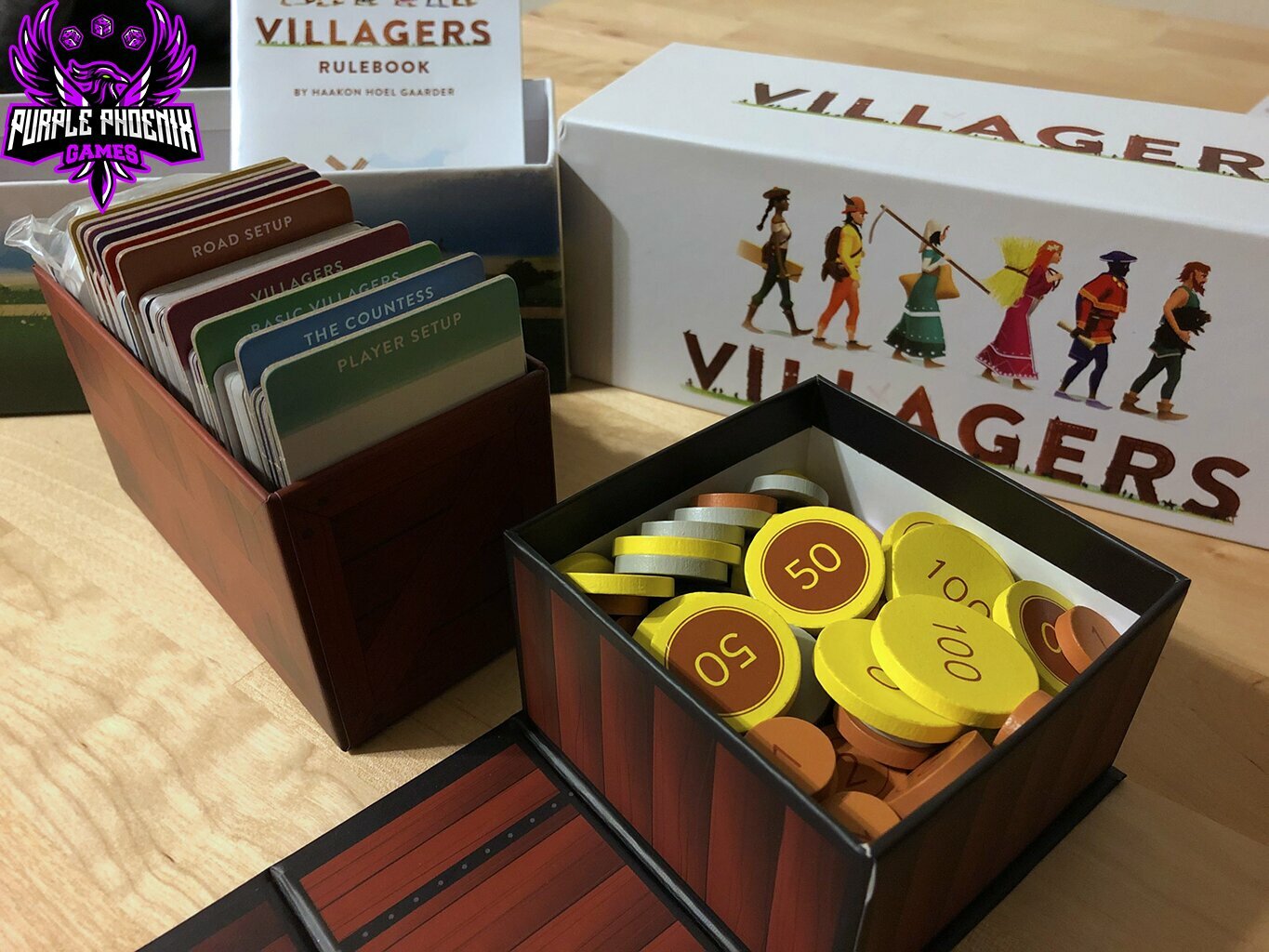
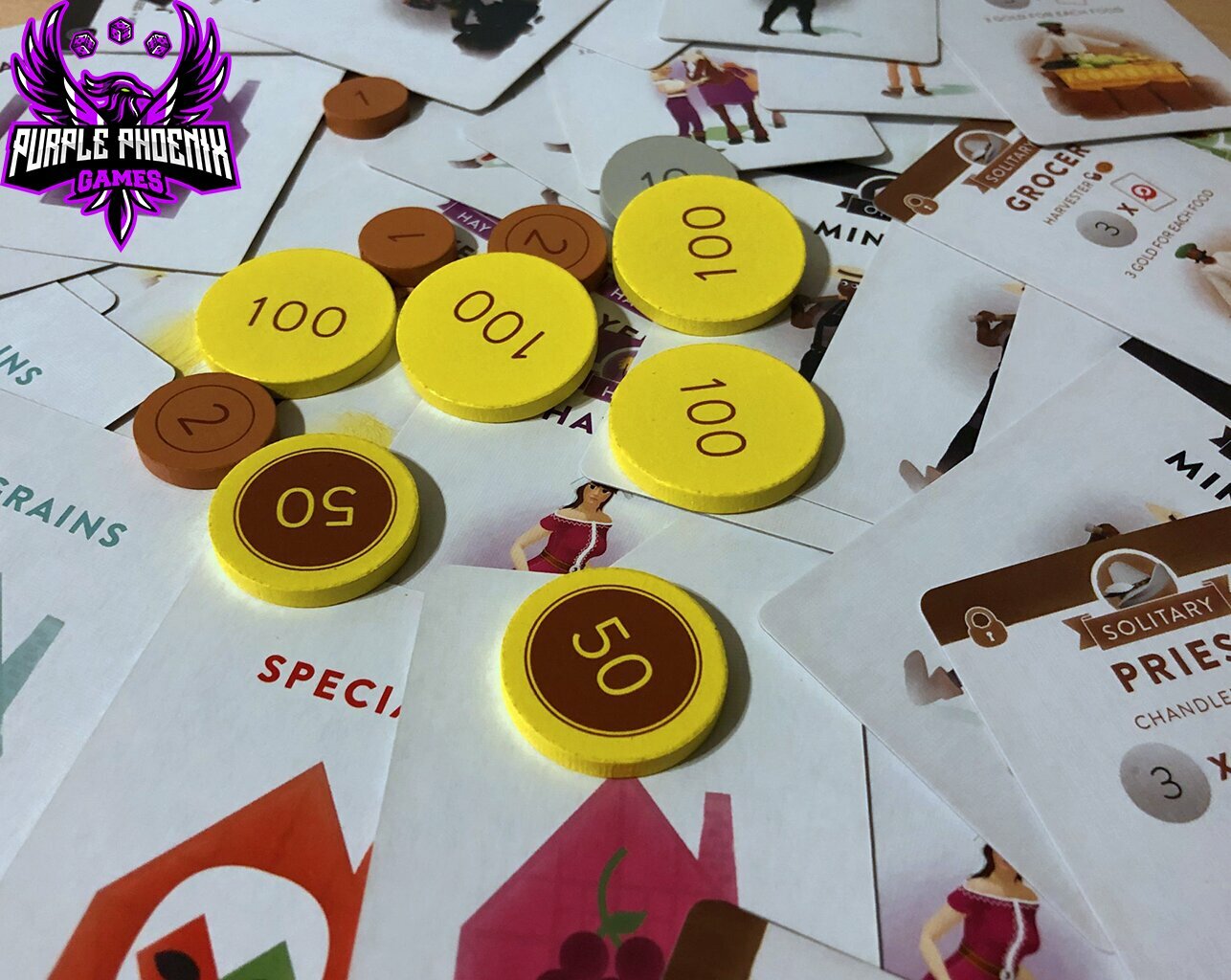
Villagers is a game of card drafting and tableau building in which players are competing to build the most prosperous village in the land. The game is played over a series of rounds, each broken up into the Draft Phase and the Build Phase. During the Draft Phase, players take turns drafting villagers from the available card stacks into their hands. During the Build Phase, players can add villagers from their hand to their tableau. Certain cards can be chained together, and provide more powers and/or end-game points – but they must be added to the village in chain order. At two points throughout the game, the First and Second Market Phases, all players will collect money depending on which cards they have in their villages. The game ends immediately after the Second Market Phase is completed, and the player with the most money is the winner!
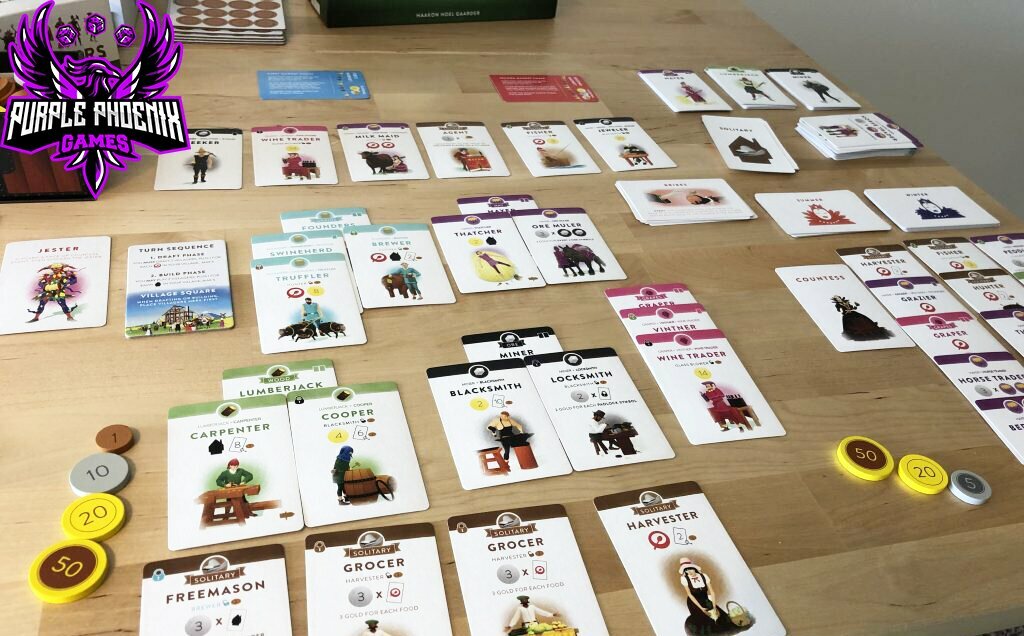
As a solo game, Villagers plays very similarly to group play, with only a couple of differences. First, the solo player is battling against The Countess, an AI character, to create the best village. The Countess is incorporated into the game in a unique way. During the Draft Phase, whenever you draft a villager to your hand, you also select an available villager to go straight into the village of the Countess. The Build Phase is carried out as normal. At the end of every round, you blindly draw a face-down card from the Reserve (draw deck), and it automatically goes into the Countess’ village as well. The other twist to a solo game of Villagers is that there are Event cards in play each round. Events are resolved after the Build Phase, before beginning the next round, and are often detrimental to the player – like making you pay extra gold to unlock padlocks, for example. The First and Second Market Phases work the same as they do in a multiplayer game, and the game ends immediately after the Second Market Phase. If you have managed to accrue more money than the Countess, then you have won!
I want to start off by saying that I love Villagers. Card drafting and set collection are my JAM, and this is a game that highlights those really well without making it too complicated. Even when playing solo, those mechanics still feel balanced, and that makes the overall game enjoyable. From my previous Solo Chronicles, I have stated how much I dislike “Beat your own high score” solo modes, so I was extremely happy when I saw that Villagers pitted the solo player against an AI character – the Countess. For the most part, I think that the Countess works really well in this game. When you draft a card, the Countess gets a card as well. But the best part about that is that you get to choose which card goes to the Countess. That means that you are able to keep some semblance of strategy in your game, because you have the power to decide what cards go where, for the most part.
The other neat thing about solo play is the inclusion of Event cards in the game – which are not present in group play. The Events add an extra element that you have to take into account for the given round. Depending on the Event, it could compromise your strategy quite a bit, but that’s what keeps it interesting. You can’t just get into a groove and grind through the rounds, drafting everything you want, when you want. You have to adapt your strategy based upon the Event(s) in play, and the Countess’ village.
The only downside for me is that at the end of every round, the Countess gets the top face-down card from the Reserve, and depending on what card that is, it could throw a wrench into the strategy you’ve been working hard to set up. I guess that mimics a multiplayer game in a sense, though, because you can’t always control what your opponents will do. The biggest downside about solo play for me has nothing to do with actual gameplay, but rather table space. Every card that goes into the Countess’ village is a stand-alone, meaning that they do not chain together like cards in your village will. So depending on how long the game goes, the Countess’ village will get to be pretty large, and hog lots of the table. I think that just means I need a bigger table though…
All that being said – is Villagers a good game for solo play? I would say mostly yes. Strategy is still required for success, but adaptability of that strategy is what keeps the game engaging and entertaining. Nothing can quite replace the multiplayer experience, but playing against the AI character keeps the competitiveness alive in the game. As someone who does a lot of solo playing these days, I am glad that I have added Villagers to my collection. If you haven’t gotten a chance to play Villagers yet, I would highly recommend checking it out. Solo or multiplayer, it’s a great time!