Search
Bob Mann (459 KP) rated The Death Of Stalin (2017) in Movies
Sep 29, 2021
Death…. Torture…. Child Abuse…. LOL??
Armando Iannucci is most familiar to TV audiences on both sides of the pond for his cutting political satire of the likes of “Veep” and “The Thick of It”, with his only previous foray into directing movies being “In the Loop”: a spin-off of the latter series. Lovers of his work will know that he sails very close to the wind on many occasions, such that watching can be more of a squirm-fest than enjoyment.
Rupert Friend (centre) tries to deliver a eulogy to his father against winged opposition. With (from left to right) Michael Palin, Jeffrey Tambor, Steve Buscemi and Simon Russell Beale.
It should come as no surprise then that his new film – “The Death of Stalin” – follows that same pattern, but transposed into the anarchic and violent world of 1950’s Russia. Based on a French comic strip, the film tells the farcical goings on surrounding the last days of the great dictator in 1953. Stalin keeps distributing his “lists” of undesirables, most of who will meet unpleasant ends before the end of the night. But as Stalin suddenly shuffles off his mortal coil, the race is on among his fellow commissariat members as to who will ultimately succeed him.
Stalin…. Going… but not forgotten.
The constitution dictates that Georgy Malenkov (an excellently vacillating Jeffrey Tambor) secedes but, as a weak man, the job is clearly soon going to become vacant again and spy-chief Lavrentiy Beria (Simon Russell Beale) and Nikita Khrushchev (Steve Buscemi) are jostling for position. (No spoilers, but you’ll never guess who wins!). Colleagues including Molotov (Michael Palin) and Mikoyan (Paul Whitehouse) need to decide who to side with as the machinations around Stalin’s funeral become more and more desperate.
The film starts extremely strongly with the ever-excellent Paddy Considine (“Pride”) playing a Radio Russia producer tasked with recording a classical concert, featuring piano virtuoso Maria Yudina (Olga Kurylenko, “Quantum of Solace”). A definition of paranoia in action!
Great fingering. Olga Kurylenko as Yudina, with more than a hand in the way the evening’s events will unfold.
We then descend into the chaos of Stalin’s Russia, with mass torture and execution colouring the comedy from dark-grey to charcoal-black in turns. There is definitely comedy gold in there: Khrushchev’s translation of his drunken scribblings from the night before (of things that Stalin found funny and – more importantly – things he didn’t) being a high point for me. Stalin’s children Svetlana (Andrea Riseborough, “Nocturnal Animals”) and Vasily (Rupert Friend, “Homeland”) add knockabout humour to offset the darker elements, and army chief Georgy Zhukov (Jason Isaacs, “Harry Potter”) is a riot with a no-nonsense North-of-England accent.
Brass Eye: Jason Isaacs as the army chief from somewhere just north of Wigan.
Production values are universally excellent, with great locations, great sets and a screen populated with enough extras to make the crowd scenes all appear realistic.
Another broad Yorkshire accent: (the almost unknown) Adrian McLoughlin delivers an hysterical speaking voice as Stalin.
The film absolutely held my interest and was thorougly entertaining, but the comedy is just so dark in places it leaves you on edge throughout. The writing is also patchy at times, with some of the lines falling to the ground as heavily as the dispatched Gulag residents.
It’s not going to be for everyone, with significant violence and gruesome scenes, but go along with the black comic theme and this is a film that delivers rewards.

Rupert Friend (centre) tries to deliver a eulogy to his father against winged opposition. With (from left to right) Michael Palin, Jeffrey Tambor, Steve Buscemi and Simon Russell Beale.
It should come as no surprise then that his new film – “The Death of Stalin” – follows that same pattern, but transposed into the anarchic and violent world of 1950’s Russia. Based on a French comic strip, the film tells the farcical goings on surrounding the last days of the great dictator in 1953. Stalin keeps distributing his “lists” of undesirables, most of who will meet unpleasant ends before the end of the night. But as Stalin suddenly shuffles off his mortal coil, the race is on among his fellow commissariat members as to who will ultimately succeed him.
Stalin…. Going… but not forgotten.
The constitution dictates that Georgy Malenkov (an excellently vacillating Jeffrey Tambor) secedes but, as a weak man, the job is clearly soon going to become vacant again and spy-chief Lavrentiy Beria (Simon Russell Beale) and Nikita Khrushchev (Steve Buscemi) are jostling for position. (No spoilers, but you’ll never guess who wins!). Colleagues including Molotov (Michael Palin) and Mikoyan (Paul Whitehouse) need to decide who to side with as the machinations around Stalin’s funeral become more and more desperate.
The film starts extremely strongly with the ever-excellent Paddy Considine (“Pride”) playing a Radio Russia producer tasked with recording a classical concert, featuring piano virtuoso Maria Yudina (Olga Kurylenko, “Quantum of Solace”). A definition of paranoia in action!
Great fingering. Olga Kurylenko as Yudina, with more than a hand in the way the evening’s events will unfold.
We then descend into the chaos of Stalin’s Russia, with mass torture and execution colouring the comedy from dark-grey to charcoal-black in turns. There is definitely comedy gold in there: Khrushchev’s translation of his drunken scribblings from the night before (of things that Stalin found funny and – more importantly – things he didn’t) being a high point for me. Stalin’s children Svetlana (Andrea Riseborough, “Nocturnal Animals”) and Vasily (Rupert Friend, “Homeland”) add knockabout humour to offset the darker elements, and army chief Georgy Zhukov (Jason Isaacs, “Harry Potter”) is a riot with a no-nonsense North-of-England accent.
Brass Eye: Jason Isaacs as the army chief from somewhere just north of Wigan.
Production values are universally excellent, with great locations, great sets and a screen populated with enough extras to make the crowd scenes all appear realistic.
Another broad Yorkshire accent: (the almost unknown) Adrian McLoughlin delivers an hysterical speaking voice as Stalin.
The film absolutely held my interest and was thorougly entertaining, but the comedy is just so dark in places it leaves you on edge throughout. The writing is also patchy at times, with some of the lines falling to the ground as heavily as the dispatched Gulag residents.
It’s not going to be for everyone, with significant violence and gruesome scenes, but go along with the black comic theme and this is a film that delivers rewards.
Purple Phoenix Games (2266 KP) rated Seasons in Tabletop Games
Jul 6, 2019 (Updated Nov 4, 2021)
I have mentioned before that I have a bad habit. Well several, but this one pertains to board games. You see, I once had a collection of games that I loved, but was pulled into the BGG Auctions and would engage in auctioning off many of games that I deemed of good return value. But then I would start to miss them. And then I would start to reacquire them. Then my wife stepped in and made me see how foolish I was to rid myself of them in the first place. Well, next up in this line is a game I recently reacquired and never should have let go in the first place – Seasons!
Seasons is a fantastical dice rolling, card drafting, hand management game for two to four players. In it, players are sorcerers competing in a legendary magical tournament that spans three years in an attempt to be crowned the next Archmage of the kingdom. As the seasons change, sorcerers may draw power from changing mana sources, and utilizing these sources most efficiently and effectively will earn victory over all. So tighten up your belt and get to casting, young mage!
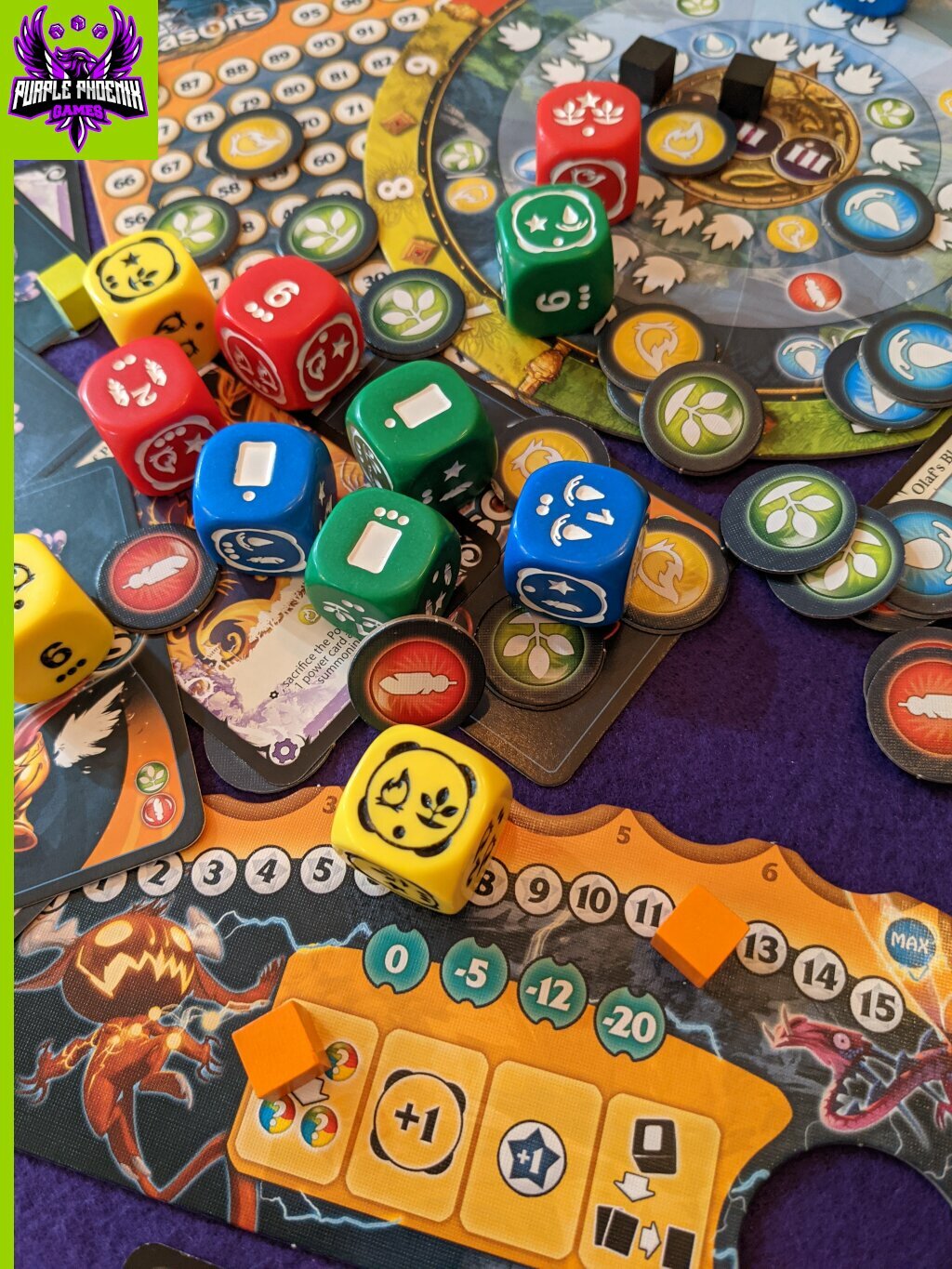
To setup, follow the rules in the rulebook (there are many steps, and I have feeble and weak fingers) until the table looks somewhat similar to the photo below – except for the obvious oversight in placing the orange cube on the zero space of bonus actions. The main areas of interest are the main game board where the years and seasons are tracked, the Crystal score track, and player board/tableau area. Players will be dealt a hand of nine cards to start, and then draft one card at a time, passing to their neighbor each time, and deciding which three cards they would like to start the game with, and assigning three more cards each into the Library for rounds two and three. The game begins in Winter, and the black cube is placed on the number 1 of the seasons board. The game is now setup and ready to begin with the first player!
Each turn the active player will roll all dice in the current season (this game is setup for two players, so three total dice are used each turn). They will choose one die to use for the turn, and other players will choose theirs. The players then gather the resources present on the die face. These could be element tokens, crystals (VP), summon gauge stars, cards drawn from the deck, or even transmutation powers. Once resources are gained, the active player may then choose to play a card from their hand to their personal tableau, given they have adequate summoning power (the number of cards that can be played) available on their board. The cost to play the card is found under the illustration, and is usually paid in crystals, element tokens, or a combination of both. These Power Cards may allow the player immediate benefits, ongoing benefits, or benefits that may be activated at certain times during the game.
Another option players have from their chosen die is the ability to transmutate. When a player chooses a die with this option, they are able to consult the current season on the main board and exchange element tokens for crystals, depending on the provided exchange system. For example, a player wishing to exchange earth tokens (the green plant) during Winter will be provided with three crystals each, while attempting the same transmutation during Spring will only provide one crystal each.
Once each player has taken their turn to collect their resources, complete their turn actions, and pass onto the next player, the unchosen die is resolved. Each die face also shows a number of dotted pips at the bottom. The number of pips shown on the unchosen die refers to the number of spaces the cube on the main board season tracker is to be moved forward around the board. One pip, one space forward. This could result in the current season continuing or progressing into the next season. When the cube progresses from Fall to Winter, players will collect their cards set aside for year two or three, respectively. These cards are added to their hand and available to be used immediately on their turn. If, however, on their turn a player has little they can do, or simply wish to boost their turn, they may use one of four bonus actions, as printed on their player board. These actions allow the player to trade two element tokens from their reserves for any other two element tokens from the main supply, allow transmutation if the symbol is not present on their chosen die face, increase their summoning gauge by one, or draw two power cards from the deck and choose one to add to their hand instead of drawing one, per their die face. Each player can use three total bonus actions for each game at a cost of crystals for each usage. Certainly a trade-off.
Play continues in this fashion of choosing and resolving dice, playing cards, and transmuting tokens for crystals until the cube has completed its three year journey around the main board. At that time crystals are scored from cards and added to the tracker, with five points deducted for each card remaining in hand and points deducted for the usage of bonus actions. The player with the most crystals at the end of the game is the winner!
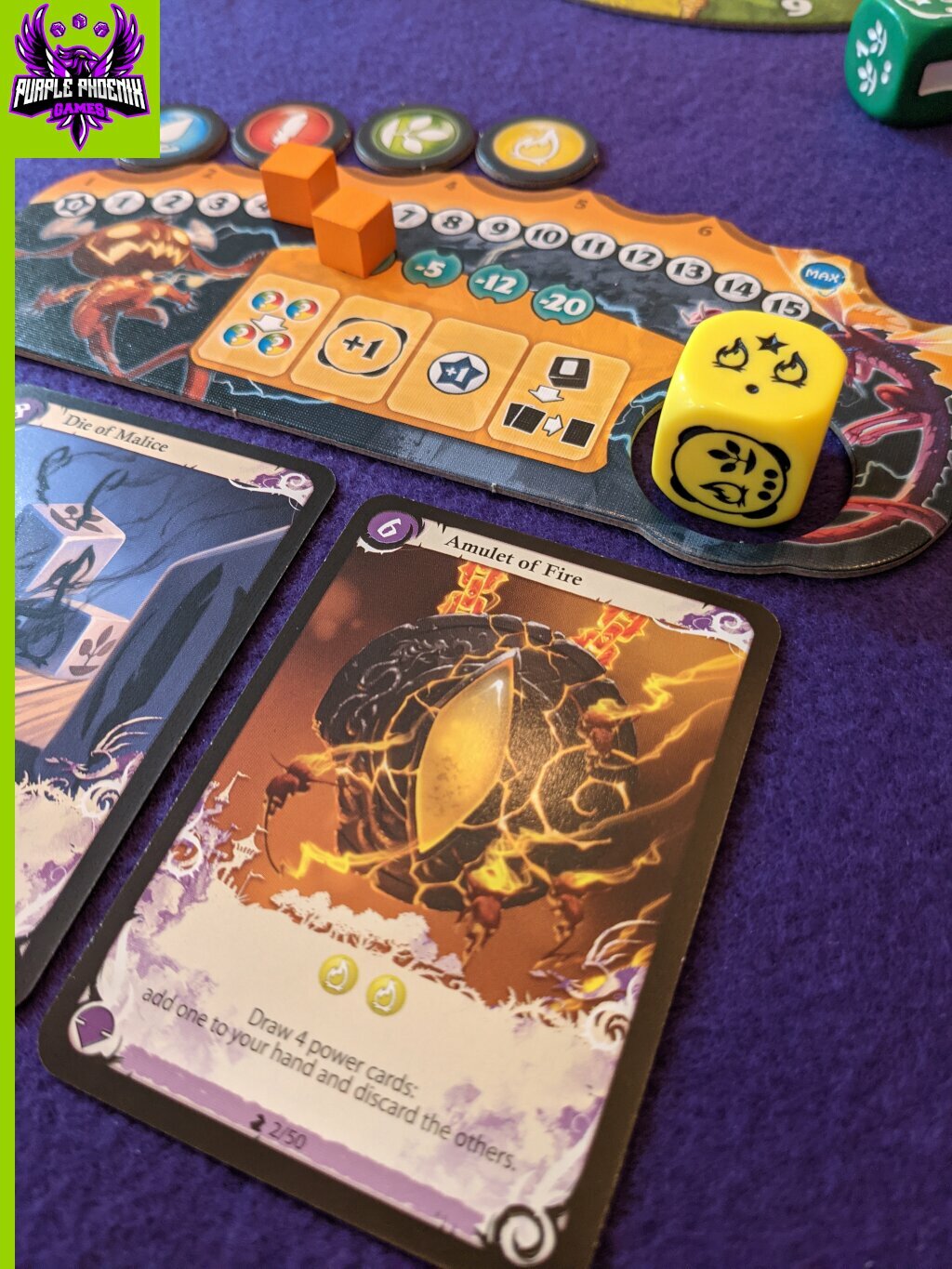
Components. I have a lot to say here, but will attempt to be as succinct as I can. The components in Seasons are simply phenomenal. Yes, the boards, cards, and cubes are all fine quality and unimpressive. However, the art style throughout the game and those big chunky dice are the real standouts to me. I mean, who DOESN’T like to roll big, chunky dice? And the player colors? Oh man, I love them! Players can choose orange, purple, gray, or lime green. Those are some great color options, and such a simple upgrade from primary colors used on many other games. The dice are primary colors, but I still enjoy them and I will let it slide. No real complaints on components from me. I have heard complaints about people not vibing on the color choices associate with the elements/energy, but I applaud the mold-breaking here. Why can’t Fall be red and associated with a feather? Why can’t Summer be yellow and associated with a flame? Fire doesn’t always have to be red. Go on, Seasons! Be you!
Our thoughts on each game should never be a surprise. I will say this for Seasons – I believe that when I auctioned it off the first time, part of the reasoning was because I did not fully understand the rules. I was a newer gamer at the time and was lured in by colors and art style (which are still stunning). More than likely I thought I was smarter than I truly am and included all the cards in my first plays instead of heeding the suggestions given by the rulebook for easier first games. Now, being a more seasoned (I couldn’t resist) gamer, I can better appreciate what is in this box. The unique card play, the dice drafting for resources and actions, the progression of time as a result of the rejected die, all come together to make a very solid and different game. I am trying to think my way through my collection to find a parallel that uses all these mechanics together as well as Seasons does and I am finding it difficult. It is so easy to just throw mechanics into a blender and see the goo that results, but everything with Seasons feels right and I am just in love.
Why did I ever get rid of Seasons? I will claim young and dumb, though I wasn’t very young. Do not emulate my decision to shed this one out of your collection. You don’t have a copy? I would recommend visiting your FLGS to see if they might have a copy in stock. It’s a great one, and one that I will treasure from here on out. Purple Phoenix Games officially gives this one an amazingly colorful 5 / 6. I know the others will enjoy it too, but until they play it, I will be giddy with excitement each time I am able to play my copy. Why are you still here? Go get Seasons!
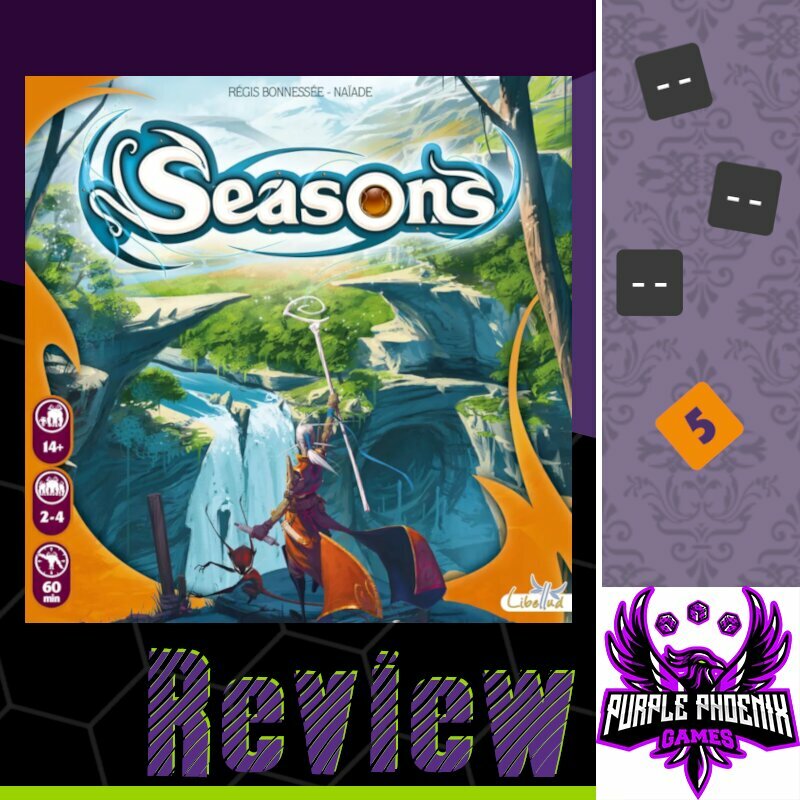
Seasons is a fantastical dice rolling, card drafting, hand management game for two to four players. In it, players are sorcerers competing in a legendary magical tournament that spans three years in an attempt to be crowned the next Archmage of the kingdom. As the seasons change, sorcerers may draw power from changing mana sources, and utilizing these sources most efficiently and effectively will earn victory over all. So tighten up your belt and get to casting, young mage!
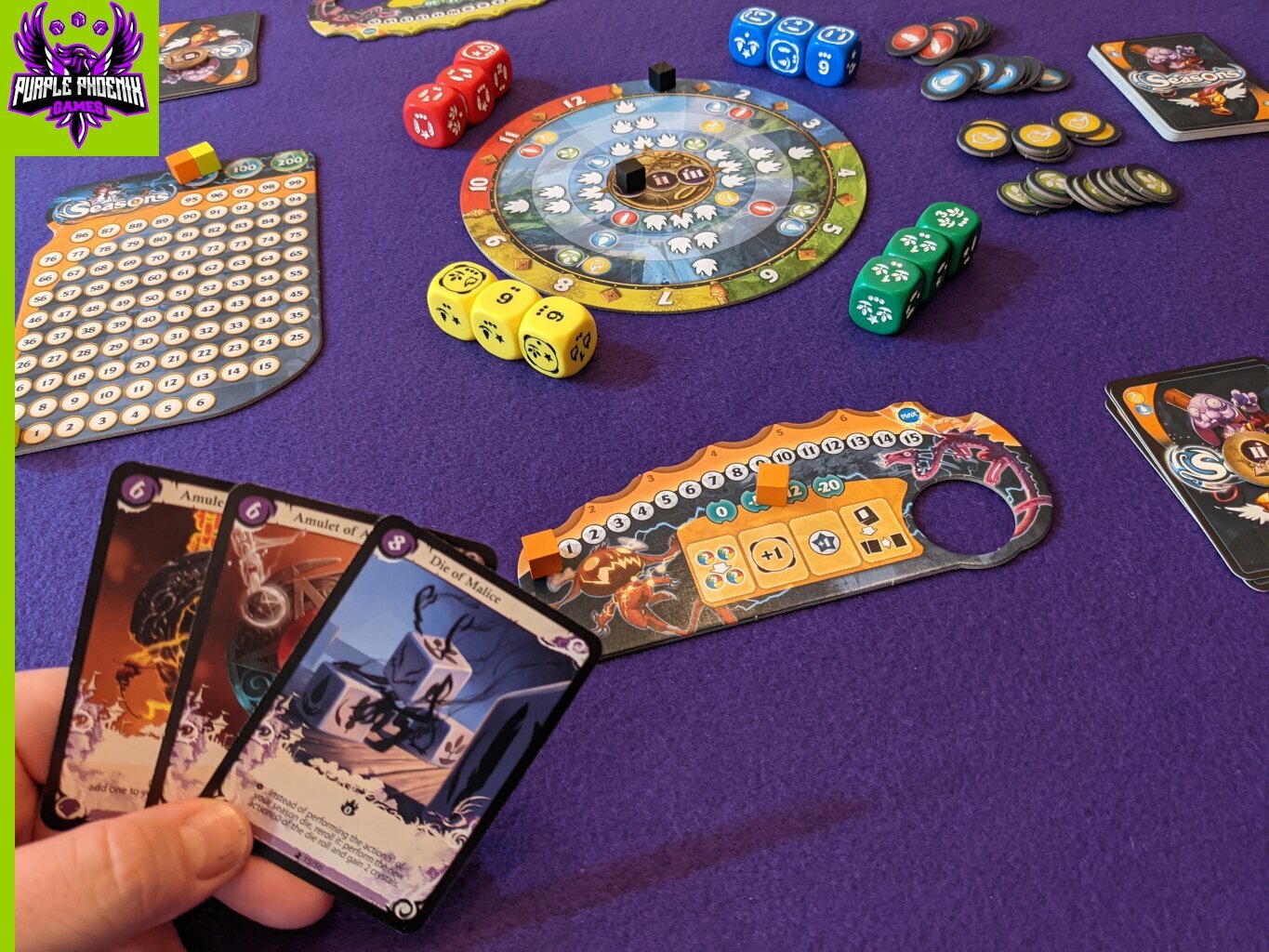
To setup, follow the rules in the rulebook (there are many steps, and I have feeble and weak fingers) until the table looks somewhat similar to the photo below – except for the obvious oversight in placing the orange cube on the zero space of bonus actions. The main areas of interest are the main game board where the years and seasons are tracked, the Crystal score track, and player board/tableau area. Players will be dealt a hand of nine cards to start, and then draft one card at a time, passing to their neighbor each time, and deciding which three cards they would like to start the game with, and assigning three more cards each into the Library for rounds two and three. The game begins in Winter, and the black cube is placed on the number 1 of the seasons board. The game is now setup and ready to begin with the first player!
Each turn the active player will roll all dice in the current season (this game is setup for two players, so three total dice are used each turn). They will choose one die to use for the turn, and other players will choose theirs. The players then gather the resources present on the die face. These could be element tokens, crystals (VP), summon gauge stars, cards drawn from the deck, or even transmutation powers. Once resources are gained, the active player may then choose to play a card from their hand to their personal tableau, given they have adequate summoning power (the number of cards that can be played) available on their board. The cost to play the card is found under the illustration, and is usually paid in crystals, element tokens, or a combination of both. These Power Cards may allow the player immediate benefits, ongoing benefits, or benefits that may be activated at certain times during the game.
Another option players have from their chosen die is the ability to transmutate. When a player chooses a die with this option, they are able to consult the current season on the main board and exchange element tokens for crystals, depending on the provided exchange system. For example, a player wishing to exchange earth tokens (the green plant) during Winter will be provided with three crystals each, while attempting the same transmutation during Spring will only provide one crystal each.
Once each player has taken their turn to collect their resources, complete their turn actions, and pass onto the next player, the unchosen die is resolved. Each die face also shows a number of dotted pips at the bottom. The number of pips shown on the unchosen die refers to the number of spaces the cube on the main board season tracker is to be moved forward around the board. One pip, one space forward. This could result in the current season continuing or progressing into the next season. When the cube progresses from Fall to Winter, players will collect their cards set aside for year two or three, respectively. These cards are added to their hand and available to be used immediately on their turn. If, however, on their turn a player has little they can do, or simply wish to boost their turn, they may use one of four bonus actions, as printed on their player board. These actions allow the player to trade two element tokens from their reserves for any other two element tokens from the main supply, allow transmutation if the symbol is not present on their chosen die face, increase their summoning gauge by one, or draw two power cards from the deck and choose one to add to their hand instead of drawing one, per their die face. Each player can use three total bonus actions for each game at a cost of crystals for each usage. Certainly a trade-off.
Play continues in this fashion of choosing and resolving dice, playing cards, and transmuting tokens for crystals until the cube has completed its three year journey around the main board. At that time crystals are scored from cards and added to the tracker, with five points deducted for each card remaining in hand and points deducted for the usage of bonus actions. The player with the most crystals at the end of the game is the winner!
Components. I have a lot to say here, but will attempt to be as succinct as I can. The components in Seasons are simply phenomenal. Yes, the boards, cards, and cubes are all fine quality and unimpressive. However, the art style throughout the game and those big chunky dice are the real standouts to me. I mean, who DOESN’T like to roll big, chunky dice? And the player colors? Oh man, I love them! Players can choose orange, purple, gray, or lime green. Those are some great color options, and such a simple upgrade from primary colors used on many other games. The dice are primary colors, but I still enjoy them and I will let it slide. No real complaints on components from me. I have heard complaints about people not vibing on the color choices associate with the elements/energy, but I applaud the mold-breaking here. Why can’t Fall be red and associated with a feather? Why can’t Summer be yellow and associated with a flame? Fire doesn’t always have to be red. Go on, Seasons! Be you!
Our thoughts on each game should never be a surprise. I will say this for Seasons – I believe that when I auctioned it off the first time, part of the reasoning was because I did not fully understand the rules. I was a newer gamer at the time and was lured in by colors and art style (which are still stunning). More than likely I thought I was smarter than I truly am and included all the cards in my first plays instead of heeding the suggestions given by the rulebook for easier first games. Now, being a more seasoned (I couldn’t resist) gamer, I can better appreciate what is in this box. The unique card play, the dice drafting for resources and actions, the progression of time as a result of the rejected die, all come together to make a very solid and different game. I am trying to think my way through my collection to find a parallel that uses all these mechanics together as well as Seasons does and I am finding it difficult. It is so easy to just throw mechanics into a blender and see the goo that results, but everything with Seasons feels right and I am just in love.
Why did I ever get rid of Seasons? I will claim young and dumb, though I wasn’t very young. Do not emulate my decision to shed this one out of your collection. You don’t have a copy? I would recommend visiting your FLGS to see if they might have a copy in stock. It’s a great one, and one that I will treasure from here on out. Purple Phoenix Games officially gives this one an amazingly colorful 5 / 6. I know the others will enjoy it too, but until they play it, I will be giddy with excitement each time I am able to play my copy. Why are you still here? Go get Seasons!
Bob Mann (459 KP) rated They Shall Not Grow Old (2018) in Movies
Sep 28, 2021
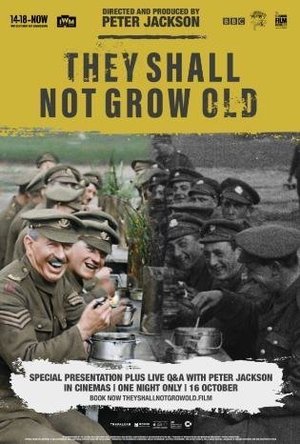
We DO remember them.
“Trapped in a Charlie Chaplin World”. So says director Peter Jackson in a post-screening discussion with Mark Kermode, describing early black and white documentary footage. Whereas modern film runs at 24 fps, most of the old footage is hand cranked, with speeds as low as 12 fps which leads to its jerky nature. Jackson in this project with the Imperial War Museum took their WW1 footage and put it through a ‘pipeline process. This cleaned-up and restored the original footage; used clever computer interpolation to add in the missing 6 to 12 frames per second; and then colourised it.
The results are outstanding. Jackson wisely focuses the film on the specific slice of WW1 action from the trenches. And those anonymous figures become real, live, breathing humans on screen. It is obviously tragic that some (and as commented by Jackson, many in one scene) are not to be breathing humans for much longer.
These effects take a while to kick in. The early scenes in the documentary are in the original black and white, describing the recruitment process, and how many of the recruits were under-age. (To explain the varied comments in the film, they should have been 18, although officially shouldn’t have been sent overseas until 19).
It is when the troops arrive in France that we suddenly go from black-and-white to the fully restored and colourised footage, and it is a gasp-inducing moment.
Audio magic
All of the audio commentary is from original BBC recordings of war veterans recounting their actual experiences in the trench. Some sound like heroes; some sound like rogues; all came out changed men. Supporting music of WW1 ditties, including the incredibly rude “Mademoiselle from Armentières” over the end credits, is provided by Plan 9.
But equally impressive is the dubbing of the characters onscreen. Jackson employed forensic lip-readers to determine what the soldiers on-screen were saying, and reproduced the speech using appropriate regional accents for the regiments concerned. Jackson also recounts how the words associated with a “pep-talk” speech to troops by an officer he found on an original slip of paper within the regimental records: outstanding. Added sound effects include real-life shelling by the New Zealand army. It all adds to the overall atmosphere of the film.
3D = less
The film itself is a masterpiece of technical innovation that will change in the future the way in which we should be able to see this sort of early film footage forever. As a documentary it’s near-perfection. But if I have a criticism of the cinema showing I attended it is that the 3D tended to detract rather than add to the film. Perhaps this is just my eyesight, but 3D always tends to make images slightly more blurry. Where (like “Gravity”) there are great 3D effects to showcase, it’s worth the slight negative to get the massive positive. But here, there was no such benefit: 2D would have been better. For those in the UK (and possibly through other broadcasters worldwide) the film is being shown on BBC2 tonight (11/11/18) at 9:30: I will be watching it again to compare and contrast.
Final Thoughts
Jackson dedicated the film to his grandfather. And almost all of us Brits will have relatives affected by this “war to end all wars”. In my case, my grandfather was shot and severely wounded at Leuze Wood on the Somme, lying in the mud for four days and four nights before being recovered… by the Germans! Fortunately he was well-treated and, although dying young, recovered enough to father my father – else I wouldn’t be here today writing this. On this Rememberance Sunday, 100 years on, it is a time for us to truly remember the sacrifice these men and boys gave to what, all in the film agree, was a pretty obstinate and pointless conflict.
I’ll finish the review by reproducing one of the war poems of my wife’s Uncle Ivor (available in a collection here), written on 11/11/18 a hundred years ago:
Peace
At last O Lord the Day has come,
And hushed is now the noise of guns.
Peace is proclaimed over land and sea,
Our heartfelt thanks we give to Thee.
I thank thee Father for Thy care,
That thou hasn’t answered all my prayers.
This day I see in manhood’s strength,
The Peace we longed for, come at length.
O may my future actions be,
Worthy of all Thy care to me.
Let me forget not Thy Great Love,
Remembering chums who live Above.
I.G.H. 11/11/1918, France.

The results are outstanding. Jackson wisely focuses the film on the specific slice of WW1 action from the trenches. And those anonymous figures become real, live, breathing humans on screen. It is obviously tragic that some (and as commented by Jackson, many in one scene) are not to be breathing humans for much longer.
These effects take a while to kick in. The early scenes in the documentary are in the original black and white, describing the recruitment process, and how many of the recruits were under-age. (To explain the varied comments in the film, they should have been 18, although officially shouldn’t have been sent overseas until 19).
It is when the troops arrive in France that we suddenly go from black-and-white to the fully restored and colourised footage, and it is a gasp-inducing moment.
Audio magic
All of the audio commentary is from original BBC recordings of war veterans recounting their actual experiences in the trench. Some sound like heroes; some sound like rogues; all came out changed men. Supporting music of WW1 ditties, including the incredibly rude “Mademoiselle from Armentières” over the end credits, is provided by Plan 9.
But equally impressive is the dubbing of the characters onscreen. Jackson employed forensic lip-readers to determine what the soldiers on-screen were saying, and reproduced the speech using appropriate regional accents for the regiments concerned. Jackson also recounts how the words associated with a “pep-talk” speech to troops by an officer he found on an original slip of paper within the regimental records: outstanding. Added sound effects include real-life shelling by the New Zealand army. It all adds to the overall atmosphere of the film.
3D = less
The film itself is a masterpiece of technical innovation that will change in the future the way in which we should be able to see this sort of early film footage forever. As a documentary it’s near-perfection. But if I have a criticism of the cinema showing I attended it is that the 3D tended to detract rather than add to the film. Perhaps this is just my eyesight, but 3D always tends to make images slightly more blurry. Where (like “Gravity”) there are great 3D effects to showcase, it’s worth the slight negative to get the massive positive. But here, there was no such benefit: 2D would have been better. For those in the UK (and possibly through other broadcasters worldwide) the film is being shown on BBC2 tonight (11/11/18) at 9:30: I will be watching it again to compare and contrast.
Final Thoughts
Jackson dedicated the film to his grandfather. And almost all of us Brits will have relatives affected by this “war to end all wars”. In my case, my grandfather was shot and severely wounded at Leuze Wood on the Somme, lying in the mud for four days and four nights before being recovered… by the Germans! Fortunately he was well-treated and, although dying young, recovered enough to father my father – else I wouldn’t be here today writing this. On this Rememberance Sunday, 100 years on, it is a time for us to truly remember the sacrifice these men and boys gave to what, all in the film agree, was a pretty obstinate and pointless conflict.
I’ll finish the review by reproducing one of the war poems of my wife’s Uncle Ivor (available in a collection here), written on 11/11/18 a hundred years ago:
Peace
At last O Lord the Day has come,
And hushed is now the noise of guns.
Peace is proclaimed over land and sea,
Our heartfelt thanks we give to Thee.
I thank thee Father for Thy care,
That thou hasn’t answered all my prayers.
This day I see in manhood’s strength,
The Peace we longed for, come at length.
O may my future actions be,
Worthy of all Thy care to me.
Let me forget not Thy Great Love,
Remembering chums who live Above.
I.G.H. 11/11/1918, France.
CT
Composing the World: Harmony in the Medieval Platonic Cosmos
Book
We can hear the universe! This was the triumphant proclamation at a February 2016 press conference...

The Secret of Grisly Manor
Games and Entertainment
App
Free today with ‘App of the Day’. **Anyone encountering a black screen with this update - sorry...

Gareth von Kallenbach (980 KP) rated Call of Duty: WWII - The War Machine in Video Games
Jun 19, 2019
The second of four DLC packs for Call of Duty: WW2 has arrived for PC and Xbox One users and War Machine offers plenty of good things for fans of the series. The pack had been previously released for the PS4 and after 30 days becomes available to the other systems. The DLC set contains three new maps for multiplayer and a new War Map as well as a new chapter for the Zombie Mode saga.
The maps are available for various gameplay modes and I tried them in Hardpoint, Kill Confirmed, and Team Deathmatch modes and found I really enjoyed them.
Dunkirk
The first map I played was a highly-detailed recreation of the famous beach and seaport. Playing in Hardpoint mode, the battle featured plenty of objects to take cover behind as well as buildings with multiple levels which Snipers used to pick off anyone who came their way. I found the open area of the beach required some skillful navigation but the Ferry Terminal and abundant cover soon became my best friend during protracted battles.
Egypt
Believe it or not this is the first time a Call of Duty map has been set in this fabled locale and it is a very beautiful map complete with monuments, temples, and battle debris. The shadows in buildings give enemies a great place to hide and strike from as do the tight tunnels. I played Team Deathmatch in this mode and found myself in a constant state of run and gun as stopping to admire the scenic beauty is not advised.
V2
A rocket launch facility provides plenty of cover for those who want to stay moving but also abundant tunnels and a launch tower where sharpshooters can ply their craft. Playing Kill Confirmed was a fast and exciting experience as stopping to collect tags was highly dangerous thanks to the vast field of view from the launch tower and the abundant places for enemies to emerge from.
For The War mode of the game, the new map is called Operation Husky and it details aspects of the Allied invasion of Sicily where Allied units must locate and retrieve three key pieces of information. The Axis players must of course stop them and Trip Wires and other traps go hand in hand with the firepower one would expect.
If you are lucky enough to complete this phase, then the obtained data must be transmitted to the bomber which if successful, puts players in the cockpit of a fighter plane.
I found the plane very hard to control as it did not respond the way that I had expected it to from past flight simulators, but the action was intense and I at least was able to get a few enemy planes in my sites and unleash some damage along the way.
Of course no set would be complete without a Zombie mode, and The Shadowed Throne brings the heroes to a desolate Berlin where they must battle the unending hordes of undead in a series of locale. From a movie theater, museum, above ground and below, the enemies are fast, deadly, and just keep coming at you. Naturally you can get new weapons, abilities, and tools to help stay alive but I can tell you even after a 1hr and 25 minute match with some very skilled players, you never have enough firepower to truly be safe.
The War Machine takes the best elements of Call of Duty: WW2 and gives fans plenty to enjoy. With two more DLC packs to come and the release of Call of Duty: Black Ops IIII on October 12th, there are plenty of things coming to the series in the next few months.
http://sknr.net/2018/05/12/call-of-duty-ww2-the-war-machine-dlc-pack-2/
The maps are available for various gameplay modes and I tried them in Hardpoint, Kill Confirmed, and Team Deathmatch modes and found I really enjoyed them.
Dunkirk
The first map I played was a highly-detailed recreation of the famous beach and seaport. Playing in Hardpoint mode, the battle featured plenty of objects to take cover behind as well as buildings with multiple levels which Snipers used to pick off anyone who came their way. I found the open area of the beach required some skillful navigation but the Ferry Terminal and abundant cover soon became my best friend during protracted battles.
Egypt
Believe it or not this is the first time a Call of Duty map has been set in this fabled locale and it is a very beautiful map complete with monuments, temples, and battle debris. The shadows in buildings give enemies a great place to hide and strike from as do the tight tunnels. I played Team Deathmatch in this mode and found myself in a constant state of run and gun as stopping to admire the scenic beauty is not advised.
V2
A rocket launch facility provides plenty of cover for those who want to stay moving but also abundant tunnels and a launch tower where sharpshooters can ply their craft. Playing Kill Confirmed was a fast and exciting experience as stopping to collect tags was highly dangerous thanks to the vast field of view from the launch tower and the abundant places for enemies to emerge from.
For The War mode of the game, the new map is called Operation Husky and it details aspects of the Allied invasion of Sicily where Allied units must locate and retrieve three key pieces of information. The Axis players must of course stop them and Trip Wires and other traps go hand in hand with the firepower one would expect.
If you are lucky enough to complete this phase, then the obtained data must be transmitted to the bomber which if successful, puts players in the cockpit of a fighter plane.
I found the plane very hard to control as it did not respond the way that I had expected it to from past flight simulators, but the action was intense and I at least was able to get a few enemy planes in my sites and unleash some damage along the way.
Of course no set would be complete without a Zombie mode, and The Shadowed Throne brings the heroes to a desolate Berlin where they must battle the unending hordes of undead in a series of locale. From a movie theater, museum, above ground and below, the enemies are fast, deadly, and just keep coming at you. Naturally you can get new weapons, abilities, and tools to help stay alive but I can tell you even after a 1hr and 25 minute match with some very skilled players, you never have enough firepower to truly be safe.
The War Machine takes the best elements of Call of Duty: WW2 and gives fans plenty to enjoy. With two more DLC packs to come and the release of Call of Duty: Black Ops IIII on October 12th, there are plenty of things coming to the series in the next few months.
http://sknr.net/2018/05/12/call-of-duty-ww2-the-war-machine-dlc-pack-2/
Universal Harvester
Book
Life in a small town takes a dark turn when mysterious footage begins appearing on VHS cassettes at...
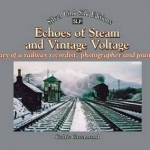
Echoes of Steam and Vintage Voltage: Diary of a Railway Recordist, Photographer and Journalist
Book
This is a vivid, contemporary account of the sights and sounds of the last two years of commercial...

Lee (2222 KP) rated Three Billboards Outside Ebbing, Missouri (2017) in Movies
Jan 3, 2018
Superbly acted, funny and emotional
Every so often I head into a movie knowing very little about it. I don't see the trailer, I don't read any detailed reviews. What I do see are a lot of positive headlines in my movie related news feeds and I decide to just go for it. Last year I did the exact same thing with 'Get Out', which turned out to be my favourite movie of 2017. This year, for my first cinema trip of 2018, it's the oddly titled 'Three Billboards Outside Ebbing, Missouri'. Not quite as wonderful as Get Out, but a very enjoyable movie all the same.
The three billboards in question lie, unused since the 80s, on a barely used road leading to the home of Mildred Hayes (Frances McDormand). While driving past them one day, she stops to ponder for a while, before heading into town to the advertising company responsible for the boards and renting them out for a whole year. The message she spreads across the three boards is a simple one, set to shame the local police force who she feels have become a bit slack when it comes to investigating the brutal rape and murder of her daughter seven months earlier. Chief Willoughby (Woody Harrelson) is named on one of the boards, a respected man of the town, who we later discover is suffering from cancer. Officer Dixon (Sam Rockwell) on the other hand is a man with problems, totally inept at his job, living at home with his momma and recently in trouble for beating up a black suspect.
The billboards have the desired effect, bringing the murder case to everyones attention once again and causing uproar around town. But Mildred is a force to be reckoned with, foul mouthed and out for vengeance, and she's brilliant to watch. The movie effortlessly switches between laugh out loud sharp dialogue and gut wrenching emotional drama. Just when you think you've got the whole thing worked out, something major happens to shake things up again. It's a hugely enjoyable rollercoaster ride.
One of the few things I saw before seeing this movie said that if you like Fargo, then you'll enjoy this, and that's a pretty fair assumption. Interesting characters with interesting stories, beautifully told. I loved it.
The three billboards in question lie, unused since the 80s, on a barely used road leading to the home of Mildred Hayes (Frances McDormand). While driving past them one day, she stops to ponder for a while, before heading into town to the advertising company responsible for the boards and renting them out for a whole year. The message she spreads across the three boards is a simple one, set to shame the local police force who she feels have become a bit slack when it comes to investigating the brutal rape and murder of her daughter seven months earlier. Chief Willoughby (Woody Harrelson) is named on one of the boards, a respected man of the town, who we later discover is suffering from cancer. Officer Dixon (Sam Rockwell) on the other hand is a man with problems, totally inept at his job, living at home with his momma and recently in trouble for beating up a black suspect.
The billboards have the desired effect, bringing the murder case to everyones attention once again and causing uproar around town. But Mildred is a force to be reckoned with, foul mouthed and out for vengeance, and she's brilliant to watch. The movie effortlessly switches between laugh out loud sharp dialogue and gut wrenching emotional drama. Just when you think you've got the whole thing worked out, something major happens to shake things up again. It's a hugely enjoyable rollercoaster ride.
One of the few things I saw before seeing this movie said that if you like Fargo, then you'll enjoy this, and that's a pretty fair assumption. Interesting characters with interesting stories, beautifully told. I loved it.