

Deborah (162 KP) rated Queen's Gambit in Books
Dec 21, 2018


Anyway, the novel deals with part of the life of Katherine Parr, last wife of Henry VIII, starting with the death of her second husband and continuing just past her own demise. I suppose an historical novel will give the author more leeway to explain real events and there is a sort of expectation that a book should be a nice tidy package, explaining everything within its covers. I don't really feel that Fremantle does this with the Parr/Seymour relationship. It's not easy to see why an intelligent woman could be taken in by a man like this anyway, but in the book it was as if Katherine actually was attracted to him against her will, so the relationship never sat quite happily for me. The other main protagonist is a woman called Dorothy (Dot) Fownten, who acts very much as a maidservant to Katherine, and her stepdaughter, Meg Neville. I was interested to learn that Dot was a real historical character, but so little is known of her that Fremantle has had the liberty of embroidering her story.
As I said, not a bad book. Good if you want something fairly undemanding, such as a beach read. I suspect it will appeal to fans of Philippa Gregory and Alison Weir, but those who prefer Penman may find it a little lacking.
Thomas Becket: Warrior, Priest, Rebel, Victim: A 900-year-old Story Retold
Book
From the winner of the 2004 Whitbread Biography Award and the Marsh Biography Award John Guy, comes...

Teaching Shakespeare: Henry V Teacher's Book
Book
Teaching Shakespeare presents over 50 photocopiable worksheets. Different sections of the book cover...
Teaching Shakespeare: Romeo and Juliet Teacher's Book
Book
Teaching Shakespeare presents over 50 photocopiable worksheets. Different sections of the book cover...

Teaching Shakespeare: The Tempest Teacher's Book
8.0 Rate It
Book
Teaching Shakespeare presents over 50 photocopiable worksheets. Different sections of the book cover...
Teaching Shakespeare: Twelfth Night Teacher's Book
Book
Teaching Shakespeare presents over 50 photocopiable worksheets. Different sections of the book cover...

Lyndsey Gollogly (2893 KP) rated A Column of Fire in Books
Aug 6, 2020

Book
A column of fire ( Kingsbridge 3)
By Ken Follet
Christmas 1558, and young Ned Willard returns home to Kingsbridge to find his world has changed.
The ancient stones of Kingsbridge Cathedral look down on a city torn by religious hatred. Europe is in turmoil as high principles clash bloodily with friendship, loyalty and love, and Ned soon finds himself on the opposite side from the girl he longs to marry, Margery Fitzgerald.
Then Elizabeth Tudor becomes queen and all of Europe turns against England. The shrewd, determined young monarch sets up the country's first secret service to give her early warning of assassination plots, rebellions and invasion plans.
Elizabeth knows that alluring, headstrong Mary Queen of Scots lies in wait in Paris. Part of a brutally ambitious French family, Mary has been proclaimed the rightful ruler of England, with her own supporters scheming to get rid of the new queen.
Over a turbulent half-century, the love between Ned and Margery seems doomed, as extremism sparks violence from Edinburgh to Geneva. With Elizabeth clinging precariously to her throne and her principles, protected by a small, dedicated group of resourceful spies and courageous secret agents, it becomes clear that the real enemies - then as now - are not the rival religions.
The true battle pitches those who believe in tolerance and compromise against the tyrants who would impose their ideas on everyone else - no matter the cost.
Ken Follet and this series has completely stolen my heart I love these books! I’m a huge fan of historical based fiction and I think he just does it so well!! I did find some parts were a little rushed but it was still an amazing book. The characters were as usual full of life, I have loved and hated them he has a way of hooking you into these peoples lives. If I had one issue it was this one spent a lot of time away from kingsbridge I think the characters weren’t as linked to the city as they were in other books! I’m looking forward to to the new kingsbridge book!
Innocent Traitor
7.0 Rate It
Book
I am now a condemned traitor . . . I am to die when I have hardly begun to live. Historical...



Immediately, I was struck by Hilary Mantel's remarkable ability to capture life of that time - making it seem strangely familiar, despite the fact it was hundreds of years ago. She made it all seem so real, largely due to her richness of detail, not to mention expert knowledge of the era. The little notes of humour throughout are what really bring it to life - so often, history is treated with utmost seriousness, yet Mantel is absolutely correct - I'm sure people were cracking jokes and saying silly things in the Tudor era too!
The relationships were likewise beautifully illustrated, and the death of Cromwell's wife, genuinely moving. For me, this was one of the most impressive moments of the book, as Mantel captures grief so powerfully and yet so simply.
One thing I did find strange though - the way Mantel uses pronouns throughout the book. I pondered for ages about why it jarred on me every so often, and I think it's because the 3rd person narrative is so intimate, it almost feels like a 1st person in places. Then, when she uses 'he' again, rather than 'I', it is momentarily confusing. I found myself wondering what the book would have been like had she just told it in first person through Cromwell's eyes - my personal belief is that it might have worked better.
Also, although the richness of the detail was spectacular, there were times when I felt that it held up the narrative slightly. I appreciate her desire to capture every moment of these tumultuous historic events, but at times, I did find them a wee bit boring.
However, for the most part, I was really into this book, and loved the character of Cromwell to bits. A man from a humble background, unfailingly pragmatic and clever - fabulous stuff!

Acanthea Grimscythe (300 KP) rated Green Darkness in Books
May 16, 2018
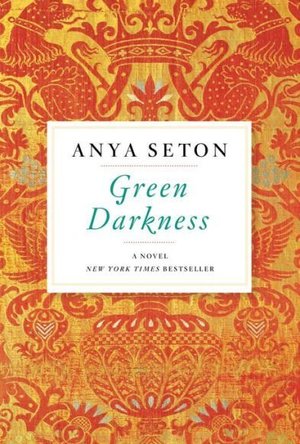
<i>Green Darkness</i> shares the harrowing tale of forbidden love in mid-1500s England between an unfortunate peasant girl and a Benedictine monk, betwixt the reigns of King Edward VI, Queen Mary I, and Queen Elizabeth - a time when Catholicism and Protestantism (depending on the ruler) were met with persecution. It doesn't begin in that era, however; rather, the story starts in the 1960s, when Celia and her newly wedded husband, Richard Marsdon, arrive at his family's ancestral estate in Sussex. A baffling illness befalls the Marsdons, leaving the unorthodox physician, Doctor Akananda, to unravel the mysterious past that haunts the pair from hundreds of years before.
The twisting tale that unravels of that love affair is only a small part of what I enjoyed about this book, as romance is not typically my cup of tea. What truly enticed me was [a:Anya Seton|18930|Anya Seton|https://d.gr-assets.com/authors/1224813438p2/18930.jpg]'s faithfulness not only to history, but to location, legend, and use of historical figures. Cowdray House and Ightham Mote are real places, and an unfounded rumor regarding the Mote suggests that a female skeleton was found within its walls - which Seton used as a basis for her story. Through Seton, I discovered an unknown love for Tudor England, and undoubtedly I will read more books set in that time period.
Despite my praise for the book, I was unable to give it a five star rating because of its conclusion: it was as if Seton ran out of fuel. The idea of reincarnation takes a more ridiculous turn when Doctor Akananda hints at more pasts that conveniently interlock the same people. As if that were not enough of an affront, the resolution itself fell flat. With the Marsdon family tragedy conveniently wrapped up, Celia and Stephen seem aloof and their interaction felt a bit too forced. It is for this reason that I gave the book four stars.