Kristy H (1252 KP) rated The Arrangement in Books
Feb 13, 2018
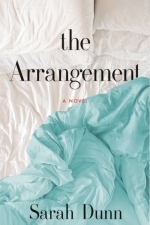

This novel is a different, oddly intriguing read, offering an extremely realistic portrayal of marriage and raising children. Warm and fuzzy it is not, yet it's still engaging and features relatable characters. Lucy and Owen's exhaustion is palatable, as is Lucy's frustration and love for Wyatt, who is an intelligent, fun, and extremely challenging special needs kid. (You will grow to love him, even as you completely empathize with why poor Lucy might need a break--one of the definite strengths of the book.) For a good early portion of the novel, I found myself thinking I would be reading a quite grim look at parenthood and marriage. And it is, in many ways. After all, why are Lucy and Owen so willing to embark on the arrangement, you wonder? Are they bored with their life, with each other? Are they simply tired parents? What causes them to choose this? As the arrangement begins, their reactions to its ongoing presence in their lives is surprising, and Dunn does a good job at capturing some nuance in their character that you might not expect. These are real married people, with real issues.
Still, there are definitely some odd bits and pieces stuck into the story. It seems disjointed at times, and some of the characters and their stories seem to pop up at weird times, forcing you to remind yourself how they fit into Lucy and Owen's life and the town of Beekman (for we don't hear just from our main couple, but several others who live in town). The novel meanders at times, and I wouldn't call the ending closure, per se, though it falls in line with the realism of the novel.
Where Dunn shines is her humor, which slips through even some of the darker moments. Moments with Wyatt are perfectly captured. Lucy's friend, Sunny Bang, is one of the best things about this book, and you'll love every second featuring her. There's a scene at the town church with many of the local kids (and their pets) that is solely worth purchasing the entire book. Seriously, Dunn writes with a sharp wit, and it's one of the main reasons my rating upped to 3.5 stars. The book is often smartly funny and feminist, even if it has its depressing, wandering moments. It's a fascinating look at marriage, for sure, and I was certainly intrigued to see how the arrangement would play out. It was also a welcome break from all the thrillers I'd been reading lately, so thanks! If you like sharp and witty characters coupled with a psychological inside look at modern-day marriage, you'll find this one quite compelling. 3.5 stars.
I received a copy of this novel from the publisher and Netgalley (thank you) in return for an unbiased review. It is available everywhere as of 03/21/2017.
<center><a href="http://justacatandabookatherside.blogspot.com/">Blog</a>; ~ <a href="https://twitter.com/mwcmoto">Twitter</a>; ~ <a href="https://www.facebook.com/justacatandabook/">Facebook</a>; ~ <a href="https://plus.google.com/u/0/+KristyHamiltonbooks">Google+</a></center>;

WeDo: Your second brain.
Productivity, Education and Stickers
App
See why WeDo has been praised by Forbes, Huffington Post, The Verge, Tech Crunch, and more! BEST...
Best Fishing Times
Weather and Utilities
App
Best Fishing Times tells you the best time of the day or night to catch more and bigger fish. You've...

MyFLO Period Tracker by FLO Living LLC
Health & Fitness and Lifestyle
App
MyFLO is the first-ever period tracker and fertility app that tells you what to do to be...


iConnectHue HD for Philips Hue
Lifestyle and Utilities
App
Tidy up your Hue lights: Organize them in groups, let them light up in your favorite colors,...

GPS Navigation, Maps & Traffic - Scout
Navigation and Travel
App
PREMIUM NAVIGATION & MAPS FOR FREE. GLOBAL MAPS INCLUDING ONE ENTIRE COUNTRY FOR OFFLINE USE. NOW...

Purple Phoenix Games (2266 KP) rated Shadow Hunters in Tabletop Games
Jul 24, 2021

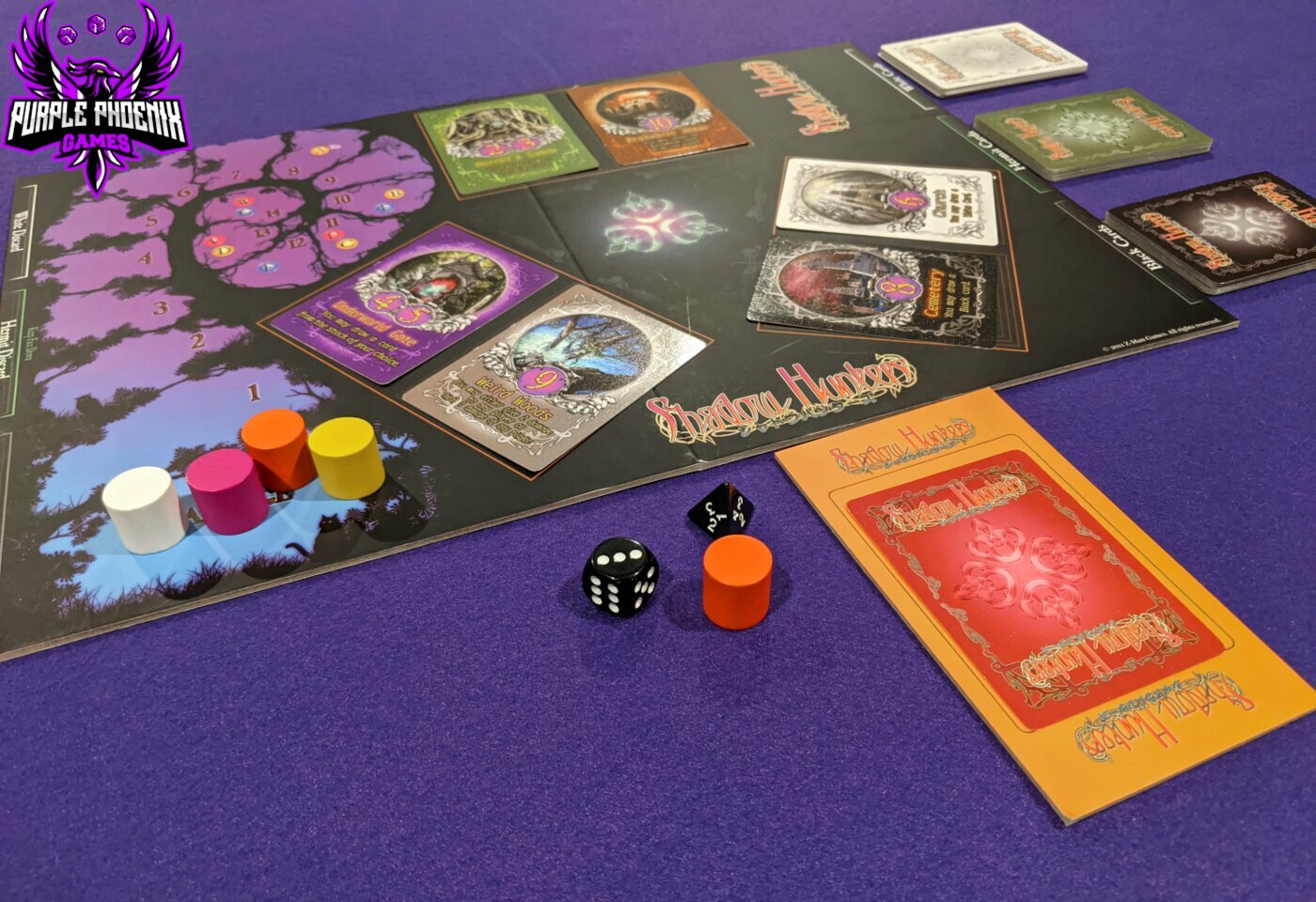
Shadow Hunters is a hidden identity survival card game for groups of 4-8 players. Each player’s drawn persona will belong to the Shadows, the Hunters, or Neutrals (common bystanders). The goals of the players may all be completely different and the game may end at any time due to fulfilling personal agendas. Players may even win when their characters are dead!
To setup place the board on the table and randomly populate the card spaces on the board with the Area Cards. Shuffle the White Cards, Black Cards, and Hermit Cards (why didn’t they just name these the Green Cards?) into their own stacks and place them on the side of the board in their slots. Players choose their preferred colors, take the boards and pieces with that color, and place one of their wooden markers on the No Damage space on the board. The other wooden marker will be used for movement on the board Area cards. Shuffle and deal each player one Character Card to be kept secret from the other players. Determine start player and the game is ready to begin!
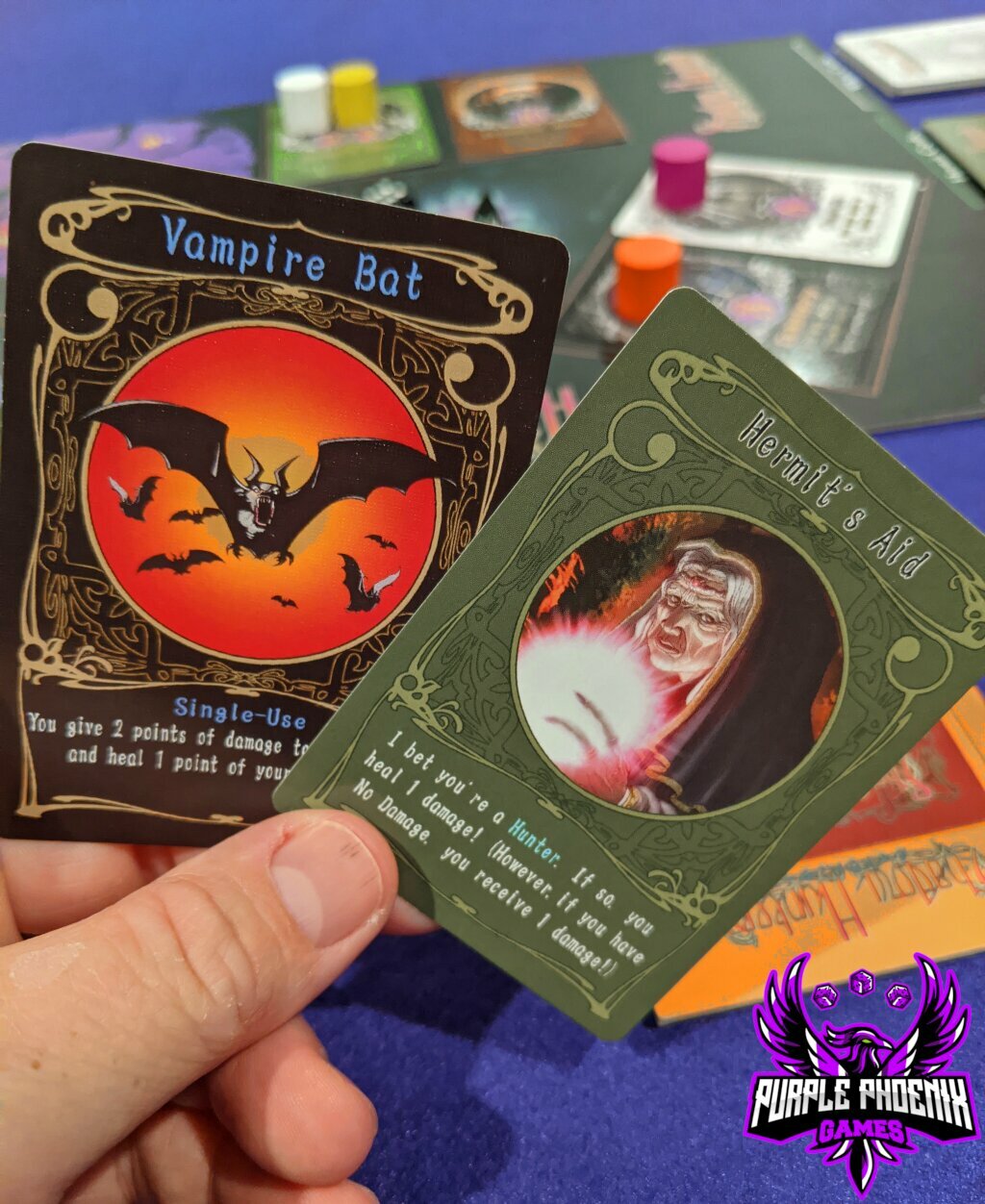
On a player’s turn they will be completing at least one task and then possible other tasks. First, the active player will roll both the 1d6 and 1d4 together to arrive at a number between two and 10. The player will place their marker on the matching Area card on the board. Should a player roll a seven they may choose any location other than the space they are on and move. Each location will have an action printed on its card that a player may choose to complete. These could be drawing cards from the White, Black, or Hermit decks, damaging other players, or stealing equipment cards from them. Lastly, the active player may straight up attack another player within the same Area range (the three different areas are two cards linked together, so either the card the marker shares or the one that is linked).
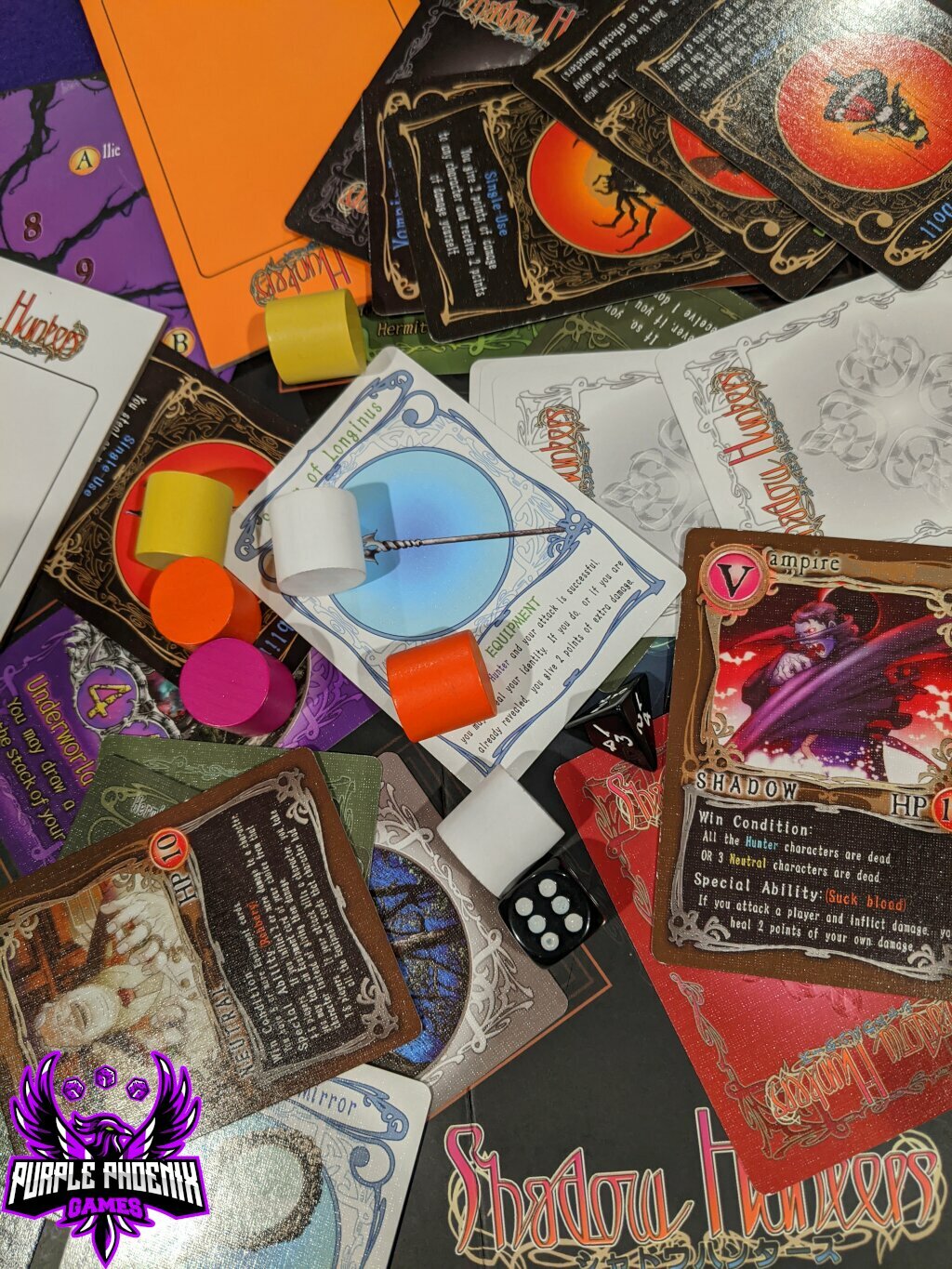
As soon as a character has suffered damage equal to or greater than the HP shown on their Character Card, that character dies. Once a character dies, the owning player flips the Character Card over to reveal the character and, more importantly, their faction to which they belong. If this causes one player to fulfill their character’s goals, they must announce that the game is over. If not, play continues in this fashion until a player’s goal has been achieved to end the game. This could mean the Shadow team or Hunter team wins as a group, or that one player wins alone.
Components. Oddly, this edition of Shadow Hunters is now almost 10 years old, so it fall within the “older games” group. That said, the components are still excellent quality, even by today’s standards. The cards have a faint linen finish, the cardboard components are all thick and matte finished, the wooden player markers are chunky and fun to move around. The only issues I have with components are that I wish the colors matched more on the wooden markers and the player boards. Not a huge deal, but something that makes me cringe just a little inside. The other issue I have is most definitely a personal preference: the numbers on the d4 are on the bottom and I prefer them on the top. I know, purely personal preference and I’m dumb for even mentioning it.
This is a game I love but irks my wife. And not even because she doesn’t like the game. It irks her because of how I play it. Until I use the Hermit Cards to try to help figure out which player is on my team I will certainly be attacking everyone I can every chance I get. That’s not the best way to make friends, and I get it, but I’m not taking that chance of allowing a potential opponent to get a leg up on me. That bothers my wife because many times I’m attacking my teammates. Oh well.
I have played this game so many times with different groups and have had great success with it almost every single time. It’s an easy teach, the theme makes sense, and having different end goals is something that many people can rally behind. I know there are about 3,000 hidden identity games out there, but I consider this one of the best. Even 10 years later it sill holds that sheen and gives us a little different experience than just spamming The Resistance: Avalon every time. Purple Phoenix Games gives this one a hot 17 / 24. Pick this one up if you find it in the wild and want a different feel for your hidden identity collection. I love it and you might too.
Purple Phoenix Games (2266 KP) rated The Resistance: Avalon in Tabletop Games
Jun 12, 2019
The Resistance: Avalon (which we always just refer to as simply Avalon) is a game of hidden roles played over several rounds where the “good guys” from King Arthur’s court are pitted against the “bad guys” in Mordred’s thrall. The number of players at the table determines the number of players to be assigned to the good and bad guys squads and the required goals for victory for each team.
To begin, role cards are divvied up and players secretly find out which team they are on for the game. Blue background cards are good guys, red are bad guys. ALERT! Yes, already. I cannot tell you how many times games have been voided because a player was not quite sure what team they were on, so make sure your players know what’s up before continuing. From here a narrator player reads the script in the rulebook to give instructions to players with their eyes closed (a la Mafia or Werewolf). This allows different members of each team to know certain information about their own team or even the opposite team. Players are then instructed to open their eyes simultaneously and thus begins the game of facades.
A player is chosen at random to be the quest giver for now. This person then assigns other players to go on a quest. The “quest” is just a generic quest where it will either succeed or fail. Once the quest giver has made their choices, everyone at the table has a chance to vote to approve the quest team or deny the quest team. Simple majority vote wins. If the team is approved, the quest happens. If the team is denied, the next player in the circle becomes the quest giver and must create a new team of players to go questing.
Once approved, the quest team players are each given two cards: Success and Fail. Secretly, under the table works best, the players make their choices. ALERT! All good guys MUST CHOOSE SUCCESS CARDS so the quest can succeed. Bad guys can choose either one. The questers then pass their cards to an uninvolved player who will then shuffle the cards without looking at them. Once completed, the cards are revealed and thus the success or failure of the quest. If all cards are Success, then the quest was a success and the good guys mark this on the main board. If even just one Fail card appears the quest fails and the bad guys mark it on the main board. This continues until either the good guys win or the bad guys claim victory!
Components. The box is small (akin to the Tiny Epic size boxes). I’m not sure if the game comes with an insert because I won mine from a BGG auction. The cards included in the game are fine, and I sleeved mine because they get held quite a bit. The other miscellaneous tokens are nice and do the job well. This is a game that is less reliant on components, and much more so on game play.
If my intro seemed dark a foreboding, it was completely intentional. Have I witnessed friendships dissolving as a result of this game? Ok not entirely, but there have been some pretty amazing head turns and surprise reveals coupled with slapping and yelling. Not me, mind you, but others. In any case, this game is definitely one to check out if you are a fan of hidden role games and if you want to add tons of tension to your game night. I honestly have no idea why this game (or its older sibling The Resistance if you are more into that theme) isn’t in every game collection. Yes, I know, there are now TONS of hidden role games out there. But this is my favorite of the lot. By far.
We at Purple Phoenix Games are split somehow, giving this one 18 / 24. Obviously it is because Josh is a minion of Mordred and wants our review to fail.
https://purplephoenixgames.wordpress.com/2019/04/24/the-resistance-avalon-review/