Search

Purple Phoenix Games (2266 KP) rated Bunny Party at Maple Valley in Tabletop Games
Oct 11, 2021


What kinds of pets did you have growing up? My family was allowed one dog throughout my formative years, and I even tried to keep a turtle once in college. I have not ever had rabbits, but my brother did – Brewster. He was a cool bunny. Kinda freaked out sometimes and made a huge mess, but overall a nice little fella. I am trying to imagine an entire village of Brewsters planning a party and inviting all their friends. I can’t really do it, but now I don’t have to – there’s a game I can play.
Bunny Party at Maple Valley (which I shall refer to as simply Bunny Party from here) is a sweet and cute little card game for three or four players. In it players are the titular bunnies decorating for and competing to win the chance to host the Night Sky Party at their place. However, in this game more often than not the victory is shared between they who amass the requisite five decorations and their neighbor who also co-hosts the event! The bunnies gotta get crackin’ so let’s get going!
PS – I will be reviewing the 3-player version of the game, which has ever-so-slightly different rules.
DISCLAIMER: We were provided a copy of this game for the purposes of this review. This is a retail copy of the game, so what you see in these photos is exactly what would be received in your box. I do not intend to cover every single rule included in the rulebook, but will describe the overall game flow and major rule set so that our readers may get a sense of how the game plays. For more in depth rules, you may purchase a copy online or from your FLGS. -T
To setup, character cards are shuffled and two dealt to each player. They choose one to be their avatar and discard the other back to the box. The large deck of cards with the house on the back is shuffled and placed on the table within reach. The villager cards are shuffled and one is drawn and placed outside the play area – it will not be used this round. The other five villagers are arranged as a market of friends. Each player draws three cards on the first round, and the game is ready to begin!
Bunny Party is played over a series of rounds until one player satisfies the win condition. Each round consists of eight phases: Turn Start, Tidy a Card, Villagers Visit, Play Cards, Trade, Play Cards (again), Party Start?, and Villagers Go Home. Turn Start typically involves players setting the table for the round. First, the villager cards are re-shuffled, one set aside to be ignored this round (they are staying home), and the remainders displayed. Then each player draws two cards from the deck and collects one Trade Token.
Next, all players will choose one of their cards they drew during the Tidy a Card step to be placed in a temporary discard pile face-down. Alternatively, a player may forego the Tidy in order to place a card in front of another player by spending one Trade Token. Once all players have tidied a card or placed one in front of another player, the Tidy pile is shuffled, then flipped as a stack to the top of the discard pile, face-up.
The villagers are now becoming impatient, so players will allow them audience during this Villagers Visit phase. Each player chooses a villager from those available to host during their party preparation. These villagers offer special abilities each round and can be very valuable at certain times during the game.
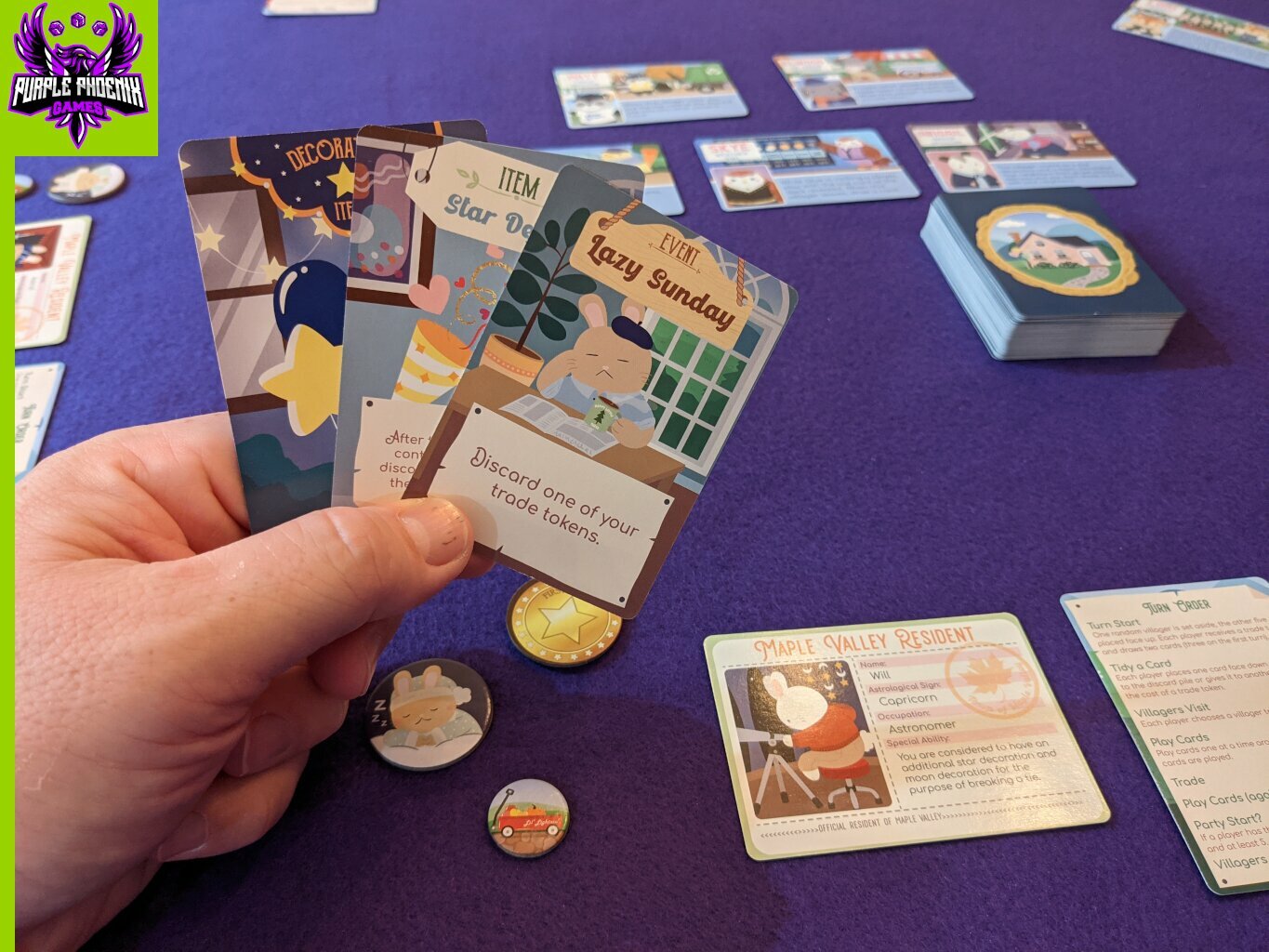
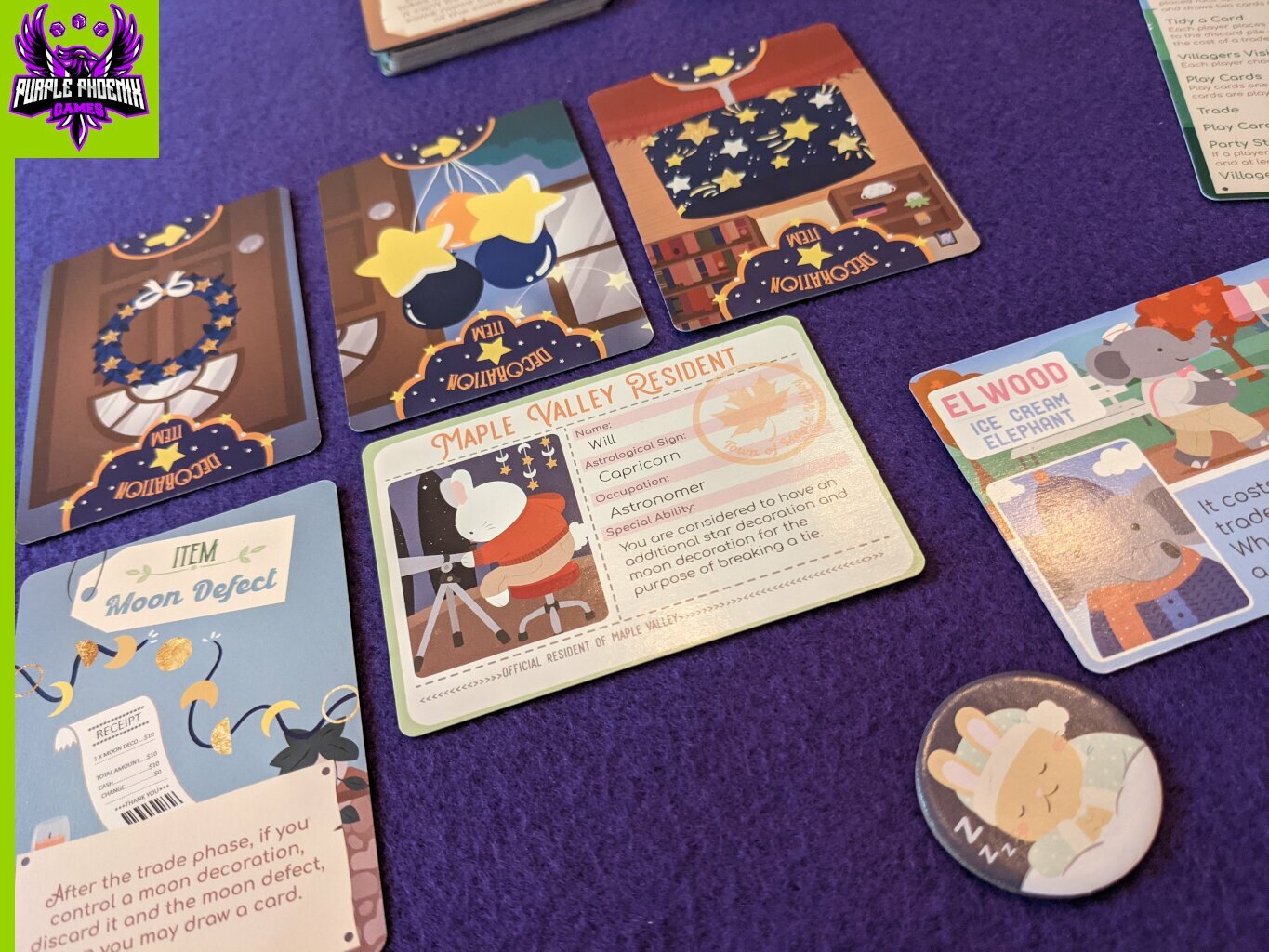
While the villagers are visiting, players may next Play Cards from their hand. These cards are typically of three types: Item, Event, or Decoration. Item cards are placed in the player’s tableau and offer one-time or lingering effects. Event cards are typically one-and-done cards to be completed and then discarded. Decorations are what players are really after, as they are what determine win conditions. With five star or moon cards the player can start the party and end the game. At the bottom of the decoration cards is printed an arrow. This arrow points to the neighbor that will co-host and also win the game. In a three-player game Decoration cards are displayed upside down, so that is why the photo below looks a little strange.
When players have all played their hand of cards, the Trade phase may begin. Players may offer Item cards to other players and a trade may be struck by each player discarding a Trade Token from their stash. This may result in a player receiving a new card to be played. When this happens, the next phase is immediately played (after all trades have been completed). Any player who now holds an unplayed card may Play Cards (again) as before.
If a player (or players) have now collected five or more star or moon Decoration cards, they may claim victory during this Party Start? phase. Again, the Decoration cards have arrows printed to determine the co-host/co-victor in the game, and the winners may then invite the rest of the burrow to their den for the Night Sky Party! However, if no victor emerges during the Party Start? phase, then all the Villagers Go Home, and a new round begins with the Turn Start phase.
Play continues in this fashion until winners have been crowned host and co-host of the Night Sky Party in Maple Valley!
Components. This one is a bunch of cards a few cardboard chits. The cards are all fine quality, as are the chits. What is really great about these components is the art on them. I cannot think of many cuter themes than uber-nice bunnies throwing a party and sharing their victory with a neighbor. So obviously the art has to match the theme, tone, and style of the game. I believe Bunny Party knocks it out of the park here. The art is so playful and cute, and I absolutely have to give a huge shout out to Evan’s Games for the very apparent inclusivity and representation. I see you and I applaud you!
Gameplay for me is where I take just a little issue. Everything works, and once you understand the phases it does flow better, but, I can see myself really only playing this with children or in a gateway/breaking in new gamers situation. It is very light, but there are eight phases to a round! So while each phase is easy to understand and execute, each round takes a little longer because there are a few too many steps. Once my kids really know how to read well they will be playing this with me and I know right now that we will have a great time with it. I really do appreciate the special efforts that were made with regards to representation (yes, even with anthropomorphic cartoon animals) and with the design being more focused on sharing victory and being nice to neighbors. My children will certain have good habits reinforced while playing this, and that is what makes this game important.
Again, this is not the game for hardcore gamers, nor those who are interested in bigger and more complex medium-weight games. This is a quick filler at best during a game night when newer gamers are gathered. That being said, I still find a great deal of value in this one, and will be keeping it for a long time. Purple Phoenix Games gives this one a 4 / 6 on stand-by. I do want to try this with different types of people (once we are able again) to see if my predictions are correct. I have only been able to play it with adult family, and none of them are medium to heavy weight game enthusiasts. If you are needing a nice game that can be played among other games for a themed game night (like Bunny Party + Bob Ross: Art of Chill + Hues and Cues + Escape: The Curse of the Temple) then this certainly fits that niche.
So my official stance, for now, is that Bunny Party has a great theme, excellent art, a wonderful message of harmony, but is both too light and too complex for what it is. I realize that sounds ridiculous. Please try it and let me know your thoughts. For now, I am keeping this close and I will be trying it with various groups with whom I game.
Bunny Party at Maple Valley (which I shall refer to as simply Bunny Party from here) is a sweet and cute little card game for three or four players. In it players are the titular bunnies decorating for and competing to win the chance to host the Night Sky Party at their place. However, in this game more often than not the victory is shared between they who amass the requisite five decorations and their neighbor who also co-hosts the event! The bunnies gotta get crackin’ so let’s get going!
PS – I will be reviewing the 3-player version of the game, which has ever-so-slightly different rules.
DISCLAIMER: We were provided a copy of this game for the purposes of this review. This is a retail copy of the game, so what you see in these photos is exactly what would be received in your box. I do not intend to cover every single rule included in the rulebook, but will describe the overall game flow and major rule set so that our readers may get a sense of how the game plays. For more in depth rules, you may purchase a copy online or from your FLGS. -T
To setup, character cards are shuffled and two dealt to each player. They choose one to be their avatar and discard the other back to the box. The large deck of cards with the house on the back is shuffled and placed on the table within reach. The villager cards are shuffled and one is drawn and placed outside the play area – it will not be used this round. The other five villagers are arranged as a market of friends. Each player draws three cards on the first round, and the game is ready to begin!
Bunny Party is played over a series of rounds until one player satisfies the win condition. Each round consists of eight phases: Turn Start, Tidy a Card, Villagers Visit, Play Cards, Trade, Play Cards (again), Party Start?, and Villagers Go Home. Turn Start typically involves players setting the table for the round. First, the villager cards are re-shuffled, one set aside to be ignored this round (they are staying home), and the remainders displayed. Then each player draws two cards from the deck and collects one Trade Token.
Next, all players will choose one of their cards they drew during the Tidy a Card step to be placed in a temporary discard pile face-down. Alternatively, a player may forego the Tidy in order to place a card in front of another player by spending one Trade Token. Once all players have tidied a card or placed one in front of another player, the Tidy pile is shuffled, then flipped as a stack to the top of the discard pile, face-up.
The villagers are now becoming impatient, so players will allow them audience during this Villagers Visit phase. Each player chooses a villager from those available to host during their party preparation. These villagers offer special abilities each round and can be very valuable at certain times during the game.
While the villagers are visiting, players may next Play Cards from their hand. These cards are typically of three types: Item, Event, or Decoration. Item cards are placed in the player’s tableau and offer one-time or lingering effects. Event cards are typically one-and-done cards to be completed and then discarded. Decorations are what players are really after, as they are what determine win conditions. With five star or moon cards the player can start the party and end the game. At the bottom of the decoration cards is printed an arrow. This arrow points to the neighbor that will co-host and also win the game. In a three-player game Decoration cards are displayed upside down, so that is why the photo below looks a little strange.
When players have all played their hand of cards, the Trade phase may begin. Players may offer Item cards to other players and a trade may be struck by each player discarding a Trade Token from their stash. This may result in a player receiving a new card to be played. When this happens, the next phase is immediately played (after all trades have been completed). Any player who now holds an unplayed card may Play Cards (again) as before.
If a player (or players) have now collected five or more star or moon Decoration cards, they may claim victory during this Party Start? phase. Again, the Decoration cards have arrows printed to determine the co-host/co-victor in the game, and the winners may then invite the rest of the burrow to their den for the Night Sky Party! However, if no victor emerges during the Party Start? phase, then all the Villagers Go Home, and a new round begins with the Turn Start phase.
Play continues in this fashion until winners have been crowned host and co-host of the Night Sky Party in Maple Valley!
Components. This one is a bunch of cards a few cardboard chits. The cards are all fine quality, as are the chits. What is really great about these components is the art on them. I cannot think of many cuter themes than uber-nice bunnies throwing a party and sharing their victory with a neighbor. So obviously the art has to match the theme, tone, and style of the game. I believe Bunny Party knocks it out of the park here. The art is so playful and cute, and I absolutely have to give a huge shout out to Evan’s Games for the very apparent inclusivity and representation. I see you and I applaud you!
Gameplay for me is where I take just a little issue. Everything works, and once you understand the phases it does flow better, but, I can see myself really only playing this with children or in a gateway/breaking in new gamers situation. It is very light, but there are eight phases to a round! So while each phase is easy to understand and execute, each round takes a little longer because there are a few too many steps. Once my kids really know how to read well they will be playing this with me and I know right now that we will have a great time with it. I really do appreciate the special efforts that were made with regards to representation (yes, even with anthropomorphic cartoon animals) and with the design being more focused on sharing victory and being nice to neighbors. My children will certain have good habits reinforced while playing this, and that is what makes this game important.
Again, this is not the game for hardcore gamers, nor those who are interested in bigger and more complex medium-weight games. This is a quick filler at best during a game night when newer gamers are gathered. That being said, I still find a great deal of value in this one, and will be keeping it for a long time. Purple Phoenix Games gives this one a 4 / 6 on stand-by. I do want to try this with different types of people (once we are able again) to see if my predictions are correct. I have only been able to play it with adult family, and none of them are medium to heavy weight game enthusiasts. If you are needing a nice game that can be played among other games for a themed game night (like Bunny Party + Bob Ross: Art of Chill + Hues and Cues + Escape: The Curse of the Temple) then this certainly fits that niche.
So my official stance, for now, is that Bunny Party has a great theme, excellent art, a wonderful message of harmony, but is both too light and too complex for what it is. I realize that sounds ridiculous. Please try it and let me know your thoughts. For now, I am keeping this close and I will be trying it with various groups with whom I game.


Purple Phoenix Games (2266 KP) rated Sheriff of Nottingham in Tabletop Games
Nov 16, 2021

One neat thing about the board gaming hobby is how many new games are designed/created daily. So much innovation, creativity, and hype surrounds new releases and helps keep us gamers hooked! That being said, what happens to older games as time goes on? Can they still hold their own over the years? Do they still feel new and novel to first-time players who are getting to them late? The latter describes me with Sheriff of Nottingham. I only received it for Christmas two years ago, and it has sadly been sitting on my Shelf of Shame until recently. So now that I’ve finally gotten it to the table, how does it hold up? Keep reading to find out!
Disclaimer: I have the first edition of this game, so the pictures below do not reflect the art/component changes brought in the recently released second edition. -L
Sheriff of Nottingham is a party game of bluffing, negotiation, and set collection in which players are trying to earn the most money by bringing their goods (Legal or Contraband!) to market. However, before those goods can get to your merchant stand, they must be cleared to pass by the Sheriff of Nottingham. Are you honest in your declarations, or are you trying to sneak something past the town authority? Bluff, bribe, or negotiate your way to victory and collect the most gold!
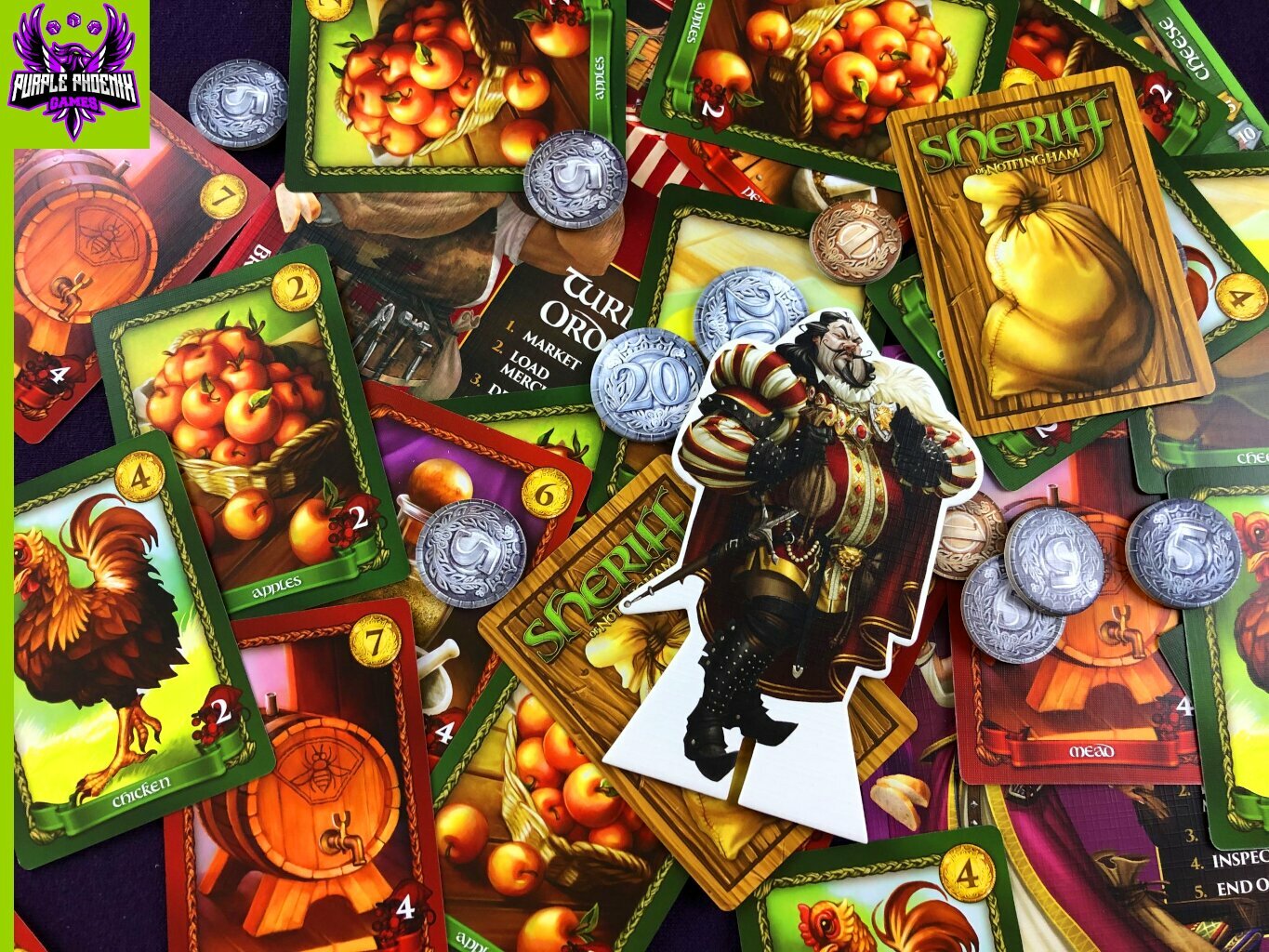
To setup for a game of Sheriff of Nottingham, each player receives a merchant stand board and bag in their chosen color, 20 starting gold, and 6 Goods cards. The remaining Goods cards are placed in a draw pile, with 2 adjacent discard piles. Turn over 5 cards to each discard pile, select a starting Sheriff, and the game is ready to begin! Sheriff of Nottingham is played over a series of rounds, and each round is broken down into 5 phases: Market, Load Merchant Bag, Declaration, Inspection, and End of Round. Important note – the player acting as Sheriff for the round will only act in the Inspection phase of a round. During the Market phase, players have the opportunity to discard unwanted Goods from their hand in order to draw cards from the draw pile or either discard pile. New cards are drawn one at a time, and you will draw as many cards as you have chosen to discard. The cards you discard will be placed in either discard pile, in whatever order you choose.
The next phase, Load Merchant Bag, is pretty self-explanatory. All merchant players will select up to 5 cards from their hand to place in their merchant bag. Snap it closed, and place it in front of you for the next phase, Declaration. In this phase, players will take turns declaring what good they are bringing to market. You must say exactly how many cards you are bringing, and you may only declare 1 type of Legal good! Even if your bag has multiple types of goods, you must declare only 1 type. Here is where your bluffing skills come into play! Once all players have made their declarations, the game moves to the Inspection phase, and it is now time for the Sheriff to act! In this phase, the Sheriff will get to decide if they wish to inspect any of the merchant bags, and merchants will have the opportunity to negotiate or bribe the Sheriff to not inspect their bag, or to inspect an opponent’s bag instead. If you make a deal with the Sheriff, you must hold up your end of the agreement!
Once the Sheriff has made their decision, they will either inspect bags or allow them to pass. If you are allowed to pass, you will take back your bag, open it, and add all goods to your merchant stand in their corresponding locations. Legal goods are known to all players, but Contraband goods are kept face-down. If the Sheriff chose to inspect your bag, they will open it and reveal the cards inside. If you were in fact telling the truth, and the cards inside are exactly what you declared, you add them to your merchant stand and the Sheriff will pay you a penalty for each Good card in your bag. If you were lying, a few things happen. First, any goods that were truthfully declared will go to your merchant stand as normal. Any goods that you lied about are confiscated by the Sheriff, and placed onto either discard pile. You then will pay the Sheriff a penalty fee for each confiscated good! The final phase, End of Round, has all players draw back up to 6 cards in hand, and the Sheriff title passes to the next player. The game continues in this fashion until all players have been the Sheriff twice (or three times in a 3-player game). Points are counted up – from your goods in your merchant stand, any gold coins you possess, and any bonus points for majority of Legal goods compared to opponents. Once all points have been tallied, the player with the highest score wins!
I know that I have said before that I generally don’t like bluffing games, but I think that Sheriff of Nottingham might be an exception. Yes, in some cases you will have to bluff about the contents of your merchant bag, but the ability to bribe/negotiate with the Sheriff takes some focus off the actual bluffing part. Can you convince the Sheriff to inspect another player’s bag just because you are trying to hinder that player? Or do you try to get the Sheriff to inspect your own bag, because then they will have to pay you a penalty fee for your honesty (this round, at least). It feels like there is more strategic gameplay here than simple bluffing, and I like the opportunity to strategize instead of relying solely on my (admittedly horrendous) poker-face.
Another thing that I really like about Sheriff of Nottingham is that it can technically be categorized as a party game, but it doesn’t feel like a typical party game to me. It takes strategy to play, and doesn’t just rely on crude/adult humor for laughs. This game really engages all players at all times, as you’re constantly watching your opponents, keeping track of what goods they seem to be collecting, and trying to catch them in a lie. The gameplay itself is pretty streamlined and straightforward, and that just helps to make it flow naturally and logically. The playing time is listed as 60 minutes, but it doesn’t feel like a long game to me at all. It’s just a light, fun, and entertaining game for really any type of game night.
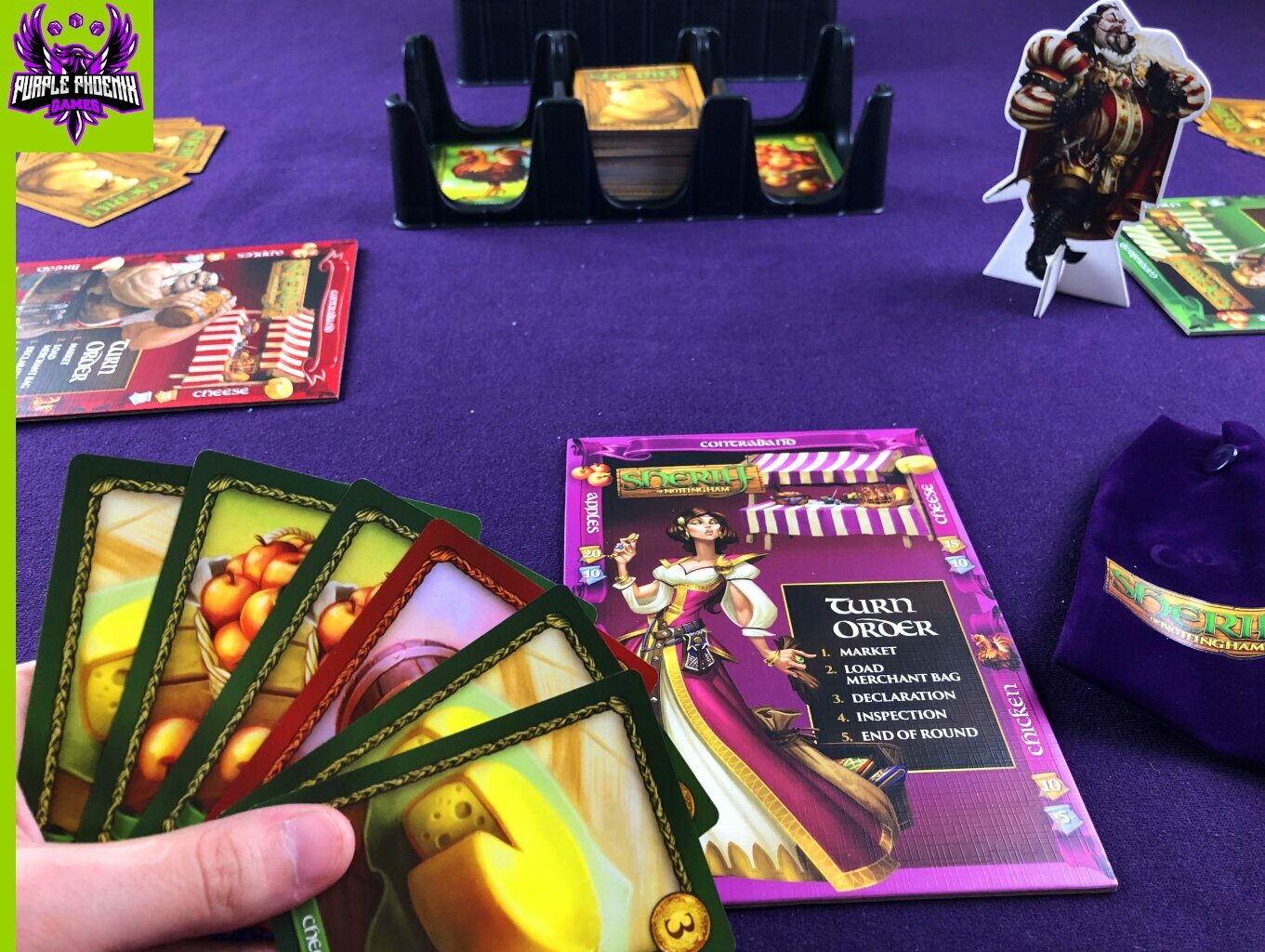
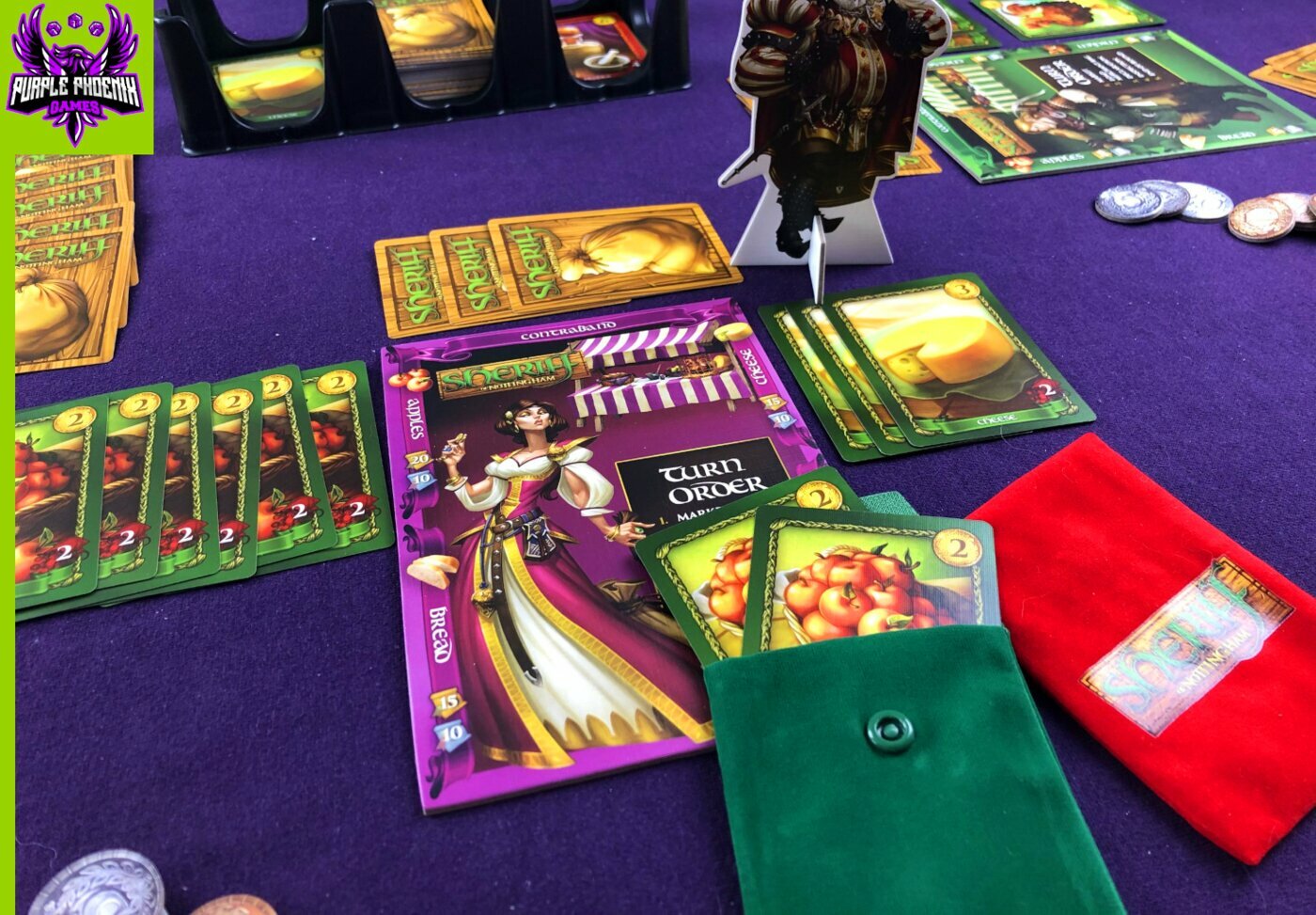
Let’s talk components for a minute. Again, I have the first edition of the game, so I cannot speak as to any component changes in the second edition. But overall, the quality of the first edition is pretty nice! The merchant stand boards are nice, thick cardboard, and are colorful and clear. Perhaps my favorite part of the boards is they each have a turn order reference on them. Not that the gameplay is that complicated, but it’s nice to just have that quick guide. The Goods cards are good quality and feel nice in hand. The artwork is mostly pretty simple, but I like that, since the crux of the gameplay is in the player interactions. The cardboard coins are chunky, and the insert doubles as a draw/discard pile organizer – which to me is a lifesaver! Nothing bothers me more than unruly stacks of cards. The merchant bags are nice and mostly functional. My biggest issue with them is that sometimes the snaps are a little hard to open, and it feels like you might tear the bag if you pull on them too hard. To alleviate that, I just don’t have players actually close the snap, instead just folding over the flap, and that works just as well! Great production quality in my opinion.
So if I seem to like this game, why did I only give it a 4 out of 6? The simple answer to that is that I do like the game, but I don’t love it. It’s fun and serves its purpose well, but it’s not a game that I am dying to pull out every game night. It’s one that will stay in my collection for sure, because there are some occasions that are just perfect for it. But it’s not one that will ever make its way to my Top 10. All in all, it holds up well for being an ‘older’ game, but it doesn’t exactly have me jumping up and down to play. That’s why Purple Phoenix Games gives this one an 11 / 18.
Disclaimer: I have the first edition of this game, so the pictures below do not reflect the art/component changes brought in the recently released second edition. -L
Sheriff of Nottingham is a party game of bluffing, negotiation, and set collection in which players are trying to earn the most money by bringing their goods (Legal or Contraband!) to market. However, before those goods can get to your merchant stand, they must be cleared to pass by the Sheriff of Nottingham. Are you honest in your declarations, or are you trying to sneak something past the town authority? Bluff, bribe, or negotiate your way to victory and collect the most gold!
To setup for a game of Sheriff of Nottingham, each player receives a merchant stand board and bag in their chosen color, 20 starting gold, and 6 Goods cards. The remaining Goods cards are placed in a draw pile, with 2 adjacent discard piles. Turn over 5 cards to each discard pile, select a starting Sheriff, and the game is ready to begin! Sheriff of Nottingham is played over a series of rounds, and each round is broken down into 5 phases: Market, Load Merchant Bag, Declaration, Inspection, and End of Round. Important note – the player acting as Sheriff for the round will only act in the Inspection phase of a round. During the Market phase, players have the opportunity to discard unwanted Goods from their hand in order to draw cards from the draw pile or either discard pile. New cards are drawn one at a time, and you will draw as many cards as you have chosen to discard. The cards you discard will be placed in either discard pile, in whatever order you choose.
The next phase, Load Merchant Bag, is pretty self-explanatory. All merchant players will select up to 5 cards from their hand to place in their merchant bag. Snap it closed, and place it in front of you for the next phase, Declaration. In this phase, players will take turns declaring what good they are bringing to market. You must say exactly how many cards you are bringing, and you may only declare 1 type of Legal good! Even if your bag has multiple types of goods, you must declare only 1 type. Here is where your bluffing skills come into play! Once all players have made their declarations, the game moves to the Inspection phase, and it is now time for the Sheriff to act! In this phase, the Sheriff will get to decide if they wish to inspect any of the merchant bags, and merchants will have the opportunity to negotiate or bribe the Sheriff to not inspect their bag, or to inspect an opponent’s bag instead. If you make a deal with the Sheriff, you must hold up your end of the agreement!
Once the Sheriff has made their decision, they will either inspect bags or allow them to pass. If you are allowed to pass, you will take back your bag, open it, and add all goods to your merchant stand in their corresponding locations. Legal goods are known to all players, but Contraband goods are kept face-down. If the Sheriff chose to inspect your bag, they will open it and reveal the cards inside. If you were in fact telling the truth, and the cards inside are exactly what you declared, you add them to your merchant stand and the Sheriff will pay you a penalty for each Good card in your bag. If you were lying, a few things happen. First, any goods that were truthfully declared will go to your merchant stand as normal. Any goods that you lied about are confiscated by the Sheriff, and placed onto either discard pile. You then will pay the Sheriff a penalty fee for each confiscated good! The final phase, End of Round, has all players draw back up to 6 cards in hand, and the Sheriff title passes to the next player. The game continues in this fashion until all players have been the Sheriff twice (or three times in a 3-player game). Points are counted up – from your goods in your merchant stand, any gold coins you possess, and any bonus points for majority of Legal goods compared to opponents. Once all points have been tallied, the player with the highest score wins!
I know that I have said before that I generally don’t like bluffing games, but I think that Sheriff of Nottingham might be an exception. Yes, in some cases you will have to bluff about the contents of your merchant bag, but the ability to bribe/negotiate with the Sheriff takes some focus off the actual bluffing part. Can you convince the Sheriff to inspect another player’s bag just because you are trying to hinder that player? Or do you try to get the Sheriff to inspect your own bag, because then they will have to pay you a penalty fee for your honesty (this round, at least). It feels like there is more strategic gameplay here than simple bluffing, and I like the opportunity to strategize instead of relying solely on my (admittedly horrendous) poker-face.
Another thing that I really like about Sheriff of Nottingham is that it can technically be categorized as a party game, but it doesn’t feel like a typical party game to me. It takes strategy to play, and doesn’t just rely on crude/adult humor for laughs. This game really engages all players at all times, as you’re constantly watching your opponents, keeping track of what goods they seem to be collecting, and trying to catch them in a lie. The gameplay itself is pretty streamlined and straightforward, and that just helps to make it flow naturally and logically. The playing time is listed as 60 minutes, but it doesn’t feel like a long game to me at all. It’s just a light, fun, and entertaining game for really any type of game night.
Let’s talk components for a minute. Again, I have the first edition of the game, so I cannot speak as to any component changes in the second edition. But overall, the quality of the first edition is pretty nice! The merchant stand boards are nice, thick cardboard, and are colorful and clear. Perhaps my favorite part of the boards is they each have a turn order reference on them. Not that the gameplay is that complicated, but it’s nice to just have that quick guide. The Goods cards are good quality and feel nice in hand. The artwork is mostly pretty simple, but I like that, since the crux of the gameplay is in the player interactions. The cardboard coins are chunky, and the insert doubles as a draw/discard pile organizer – which to me is a lifesaver! Nothing bothers me more than unruly stacks of cards. The merchant bags are nice and mostly functional. My biggest issue with them is that sometimes the snaps are a little hard to open, and it feels like you might tear the bag if you pull on them too hard. To alleviate that, I just don’t have players actually close the snap, instead just folding over the flap, and that works just as well! Great production quality in my opinion.
So if I seem to like this game, why did I only give it a 4 out of 6? The simple answer to that is that I do like the game, but I don’t love it. It’s fun and serves its purpose well, but it’s not a game that I am dying to pull out every game night. It’s one that will stay in my collection for sure, because there are some occasions that are just perfect for it. But it’s not one that will ever make its way to my Top 10. All in all, it holds up well for being an ‘older’ game, but it doesn’t exactly have me jumping up and down to play. That’s why Purple Phoenix Games gives this one an 11 / 18.


Movie Metropolis (309 KP) rated Halloween (2018) in Movies
Jun 10, 2019


A True successor to the original
Halloween 1978 and little-known director John Carpenter terrifies thousands of impressionable horror fans with the introduction of ‘The Shape’. Jamie Lee Curtis becomes the new ‘scream queen’ and all is well in the world of the slasher genre.
Fast-forward to 2009 and Rob Zombie directs the sequel to his reasonably successful remake of Halloween, but it was poorly received by critics and audiences alike. Why? Well Zombie’s grungy, rock-anthem vibe didn’t really sit too well with Michael Myers and the result was a distasteful and messy outing that set the franchise back nearly 10 years.
Of course, in between 1978 and 2009, the series was ripped apart, put back together again until it was a shadow of its former self. Anyone remember Busta Rhymes doing a vague impression of a karate master in Halloween: Resurrection? Best forget about that.
Nevertheless, director David Gordon Green, a lifetime fan of Carpenter’s iconic original is in the chair to helm a direct sequel to the 1978 classic. That’s right, it forgoes every single film apart from the first. But is it a worthy sequel to one of the greatest horror films of all time?
It’s been 40 years since Laurie Strode survived a vicious attack from crazed killer Michael Myers on Halloween night. Locked up in an institution, Myers manages to escape when his bus transfer goes horribly wrong. Laurie now faces a terrifying showdown when the masked madman returns to Haddonfield. But this time, she’s ready for him.
Having Jamie Lee Curtis and John Carpenter back for this instalment is already a coup for Gordon Green. Clearly, they thought enough of the material that he and co-writer Danny McBride had produced to give one more shot at crafting a properly deserved sequel. And it works very well, so well in fact that we have, barring the original, the best Halloween movie to date.
Jamie Lee Curtis is absolutely fabulous as a world-weary Laurie Strode. Traumatised by the events of 40 years ago, she holds herself up in a cabin on the outskirts of Haddonfield, flanked by floodlights and CCTV cameras. The script does a very good job at showing how massive events can destroy an individual’s life and Curtis’ understated performance is a highlight here.
Judy Greer gets a nicely fleshed out role as Karen, Laurie’s daughter. She’s an incredibly talented actress and it’s a world away from the one-dimensional characters she’s been given to play in blockbusters like Jurassic World. The great thing about this film is that each of the main characters feels real. There’s no cheap sex scenes, the kills are well-placed and the dialogue is superbly written – you actually believe these are real people, rather than characters in a movie.
While the body count is high, Halloween doesn’t rely on the murders to progress the story forward. This is very much Laurie’s film as opposed to Michael’s and it works very well. There’s some nice juxtaposition as shots that would have involved Michael in the original, choose to put Laurie front and centre here. Halloween features some tasteful references to the original as well as its less-well received sequels. They’re not immediately obvious for those not too familiar with the series, but die-hards will enjoy seeing those homages pop up every now and then.
Halloween is a resounding success. It takes what audiences loved about the original and updates them in a sequel that, while not being wholly original, respects what came before it
The film starts relatively slowly with a not quite successful side-plot involving two investigative journalists, but once Michael Myers gets his mask back, the film rarely lets up until the end. Populated by enough kills and scares to keep the audience happy, this is a Halloween movie that doesn’t rely too much on jump scares. There’s a few, but they’re nicely filmed which helps lift them above the mundane.
To look at, this is a film that is head and shoulders above anything else in the genre. Gordon Green uses incredibly fluid camera techniques that almost mimic those of the original. In one extended sequence, Myers moves in and out of shot as the camera follows him from house to house, selecting his next victim. With no cuts in between, it’s a stunning scene to watch and very effective.
Thankfully, the writing duo has decided to pass on giving Michael anything resembling a back story. The embodiment of ‘pure evil’ as Samuel Loomis once put it, Myers needn’t have any motives – and that’s what makes him so terrifying. In fact, his first kill here reaffirms his evil characteristics and it’s clear that David Gordon Green and Danny McBride were aiming for this take on the character.
Then there’s the score. John Carpenter has returned to craft new music for this instalment and it is by far the best score in the series, possibly even better than the original. That haunting Halloween theme tune is back, but upgraded with guitar riffs and electronic percussion. It’s a fabulous update that works perfectly with the modern characters and an older Michael.
While it’s true that the film isn’t out-and-out scary, the finale is exquisite as Laurie and Michael come face-to-face once again. Only the abrupt ending and forgetting of some key characters lets it down. After all, what’s the point in caring about a character and never learning of their fate?
Overall, Halloween is a resounding success. It takes what audiences loved about the original and updates them in a sequel that, while not being wholly original, respects what came before it. While this is sure to make bucket loads at the box-office, it feels like it was crafted with care by a writing team and director that absolutely adores the series. It’s a must watch.
https://moviemetropolis.net/2018/10/20/halloween-2018-review-a-true-successor-to-the-original/
Fast-forward to 2009 and Rob Zombie directs the sequel to his reasonably successful remake of Halloween, but it was poorly received by critics and audiences alike. Why? Well Zombie’s grungy, rock-anthem vibe didn’t really sit too well with Michael Myers and the result was a distasteful and messy outing that set the franchise back nearly 10 years.
Of course, in between 1978 and 2009, the series was ripped apart, put back together again until it was a shadow of its former self. Anyone remember Busta Rhymes doing a vague impression of a karate master in Halloween: Resurrection? Best forget about that.
Nevertheless, director David Gordon Green, a lifetime fan of Carpenter’s iconic original is in the chair to helm a direct sequel to the 1978 classic. That’s right, it forgoes every single film apart from the first. But is it a worthy sequel to one of the greatest horror films of all time?
It’s been 40 years since Laurie Strode survived a vicious attack from crazed killer Michael Myers on Halloween night. Locked up in an institution, Myers manages to escape when his bus transfer goes horribly wrong. Laurie now faces a terrifying showdown when the masked madman returns to Haddonfield. But this time, she’s ready for him.
Having Jamie Lee Curtis and John Carpenter back for this instalment is already a coup for Gordon Green. Clearly, they thought enough of the material that he and co-writer Danny McBride had produced to give one more shot at crafting a properly deserved sequel. And it works very well, so well in fact that we have, barring the original, the best Halloween movie to date.
Jamie Lee Curtis is absolutely fabulous as a world-weary Laurie Strode. Traumatised by the events of 40 years ago, she holds herself up in a cabin on the outskirts of Haddonfield, flanked by floodlights and CCTV cameras. The script does a very good job at showing how massive events can destroy an individual’s life and Curtis’ understated performance is a highlight here.
Judy Greer gets a nicely fleshed out role as Karen, Laurie’s daughter. She’s an incredibly talented actress and it’s a world away from the one-dimensional characters she’s been given to play in blockbusters like Jurassic World. The great thing about this film is that each of the main characters feels real. There’s no cheap sex scenes, the kills are well-placed and the dialogue is superbly written – you actually believe these are real people, rather than characters in a movie.
While the body count is high, Halloween doesn’t rely on the murders to progress the story forward. This is very much Laurie’s film as opposed to Michael’s and it works very well. There’s some nice juxtaposition as shots that would have involved Michael in the original, choose to put Laurie front and centre here. Halloween features some tasteful references to the original as well as its less-well received sequels. They’re not immediately obvious for those not too familiar with the series, but die-hards will enjoy seeing those homages pop up every now and then.
Halloween is a resounding success. It takes what audiences loved about the original and updates them in a sequel that, while not being wholly original, respects what came before it
The film starts relatively slowly with a not quite successful side-plot involving two investigative journalists, but once Michael Myers gets his mask back, the film rarely lets up until the end. Populated by enough kills and scares to keep the audience happy, this is a Halloween movie that doesn’t rely too much on jump scares. There’s a few, but they’re nicely filmed which helps lift them above the mundane.
To look at, this is a film that is head and shoulders above anything else in the genre. Gordon Green uses incredibly fluid camera techniques that almost mimic those of the original. In one extended sequence, Myers moves in and out of shot as the camera follows him from house to house, selecting his next victim. With no cuts in between, it’s a stunning scene to watch and very effective.
Thankfully, the writing duo has decided to pass on giving Michael anything resembling a back story. The embodiment of ‘pure evil’ as Samuel Loomis once put it, Myers needn’t have any motives – and that’s what makes him so terrifying. In fact, his first kill here reaffirms his evil characteristics and it’s clear that David Gordon Green and Danny McBride were aiming for this take on the character.
Then there’s the score. John Carpenter has returned to craft new music for this instalment and it is by far the best score in the series, possibly even better than the original. That haunting Halloween theme tune is back, but upgraded with guitar riffs and electronic percussion. It’s a fabulous update that works perfectly with the modern characters and an older Michael.
While it’s true that the film isn’t out-and-out scary, the finale is exquisite as Laurie and Michael come face-to-face once again. Only the abrupt ending and forgetting of some key characters lets it down. After all, what’s the point in caring about a character and never learning of their fate?
Overall, Halloween is a resounding success. It takes what audiences loved about the original and updates them in a sequel that, while not being wholly original, respects what came before it. While this is sure to make bucket loads at the box-office, it feels like it was crafted with care by a writing team and director that absolutely adores the series. It’s a must watch.
https://moviemetropolis.net/2018/10/20/halloween-2018-review-a-true-successor-to-the-original/

Emma @ The Movies (1786 KP) rated X-Men: Dark Phoenix (2019) in Movies
Jun 22, 2019 (Updated Sep 25, 2019)

This was another screening that needed a second viewing because of challenging people, so now I've seen it in 2D and 3D. I'm seeing more films in 3D recently that actually work, I'm still not quite convinced by it but I'm certainly not annoyed by it.
The pre-"hype" for this was very mixed. I had been looking forward to the film for a long time but when the first trailer dropped I was disappointed and underwhelmed, it was however nice to see that others were having the opposite reaction to me. Perhaps I had just built it up too much in my head beforehand.
As we eeked closer the vibe became decidedly negative around it, and for the most part I avoided articles and rants as I just don't see the point in speculating so wildly about something that hasn't been seen. That climaxed again when the preview screening was interrupted by a fire alarm, and then when the internet seemed to go nuts over the fact the review embargo was so late. (It's not like embargos are unusual, I don't see how you can draw conclusions from release and embargo being on the same day... this seems entirely logical. *deep breath*)
Something I would like to query is the fact that someone decided it was sensible to put a reaction video of three of the stars seeing the Dark Phoenix trailer in 4DX. It's a little bit of fun, but frustrating if you've been trying to avoid trailers and spoilers before seeing the film.
Wow... waffle... to the film!
The team take on a mission to space when a shuttle loses control and is in the path of what appears to be solar flares. The mission seems successful until they realise there's still a crew member trapped. With the shuttle disintegrating the only ones who can safely make it are Jean and Nightcrawler. As Jean holds the shuttle in place Nightcrawler rescues the last man from the wreckage but when he returns for her she's already encountered the strange space energy.
Somehow despite the destruction of the shuttle Jean survives floating in space, Nightcrawler brings her back to the X-Jet and the whole team return to Earth as heroes. Jean wasn't left unchanged by her encounter though, she's changing, and as her mind begins to open the danger starts to grow.
Almost all of the characters in Dark Phoenix go through some sort of change. Jean comes face to face with her past and a power that is even more difficult to control than her own. Professor Xavier is less of a friend in his current persona than he's ever been before, and in this moment may not be the leader the X-Men need. Certainly by the end of the film each character has grown in some way. I'm not sure I was a fan of the changes in Professor Xavier, they were necessary in some respects but in the context of the rest of the series are a bit of a shock and out of the blue.
Thankfully some things don't change, and Quicksilver is still very funny, the occasional laugh was needed in what was quite a serious film.
Very briefly I want to talk about the effects. There's obviously a lot of them but I didn't spot anything that was outright terrible. (There's one moment in Cerebro, but that's more to do with how they choose to depict Cerebral's general imagery than anything.) My real standout moment is Jean's hair when she is embracing Dark Phoenix. We are given the floating underwater swirling effect that we should have seen in Aquaman.
It's been a while since I've seen all of the other films, although I did rewatch Last Stand and Apocalypse in the run up to this. There were a few moments where I saw flashes of Last Stand in Dark Phoenix which I thought was a nice touch.
I'm not sure there's a lot of point dwelling much on the acting for the main cast, it's consistent and what you'd expect for the franchise. Nicholas Hoult was able to bring a slightly bigger performance and he's probably one of the only regulars that had the ability to do that with his story.
Our villains were led by Jessica Chastain as Vuk. Vuk as a character and most of her group in general are actually quite bland. As emotionless aliens there's little to either love or hate. Had they been slightly more human than drone-like then they might have had a bigger impact. The only moment where I saw some good acting was when Vuk is with Jean near the very end and a look comes across her face and I thought, "oooh, acting!"
I wasn't entirely sure what was happening with Raven. She seemed to be a bundle of contradictions and got a terrible hand when it came to the script. I did want to slap her at one point, there was no need for what she did! NO NEED!
[Random thought: If Raven's scales/skin ripples when she transforms then how does she manage to do that when she's wearing an X-Suit? And also, why does she bother changing to her human look when she's in the mansion?]
The actions sequences were very good, the train scene felt like it had been crafted perfectly. Possibly a little too organised, but overall the entire scene came together. I particularly liked the choice of music when it coincided with Storm's piece, wonderfully atmospheric. (A pun? Perhaps.)
If there's anything I've taken from this it's that Dark Phoenix annoyed me less than Endgame did. It's not epic, but then I've never felt like the franchise has ever been that high on the scale. I'm reasonably happy with where it's left the sequence and what the future of the franchise might hold. I honestly don't think it deserves the hate that it's been getting.
What you should do
I think that you should go and see it, the action is good and a nice diversion for a couple of hours.
Movie thing you wish you could take home
I'd always want a superpower, but my choice changes more than Raven does.
The pre-"hype" for this was very mixed. I had been looking forward to the film for a long time but when the first trailer dropped I was disappointed and underwhelmed, it was however nice to see that others were having the opposite reaction to me. Perhaps I had just built it up too much in my head beforehand.
As we eeked closer the vibe became decidedly negative around it, and for the most part I avoided articles and rants as I just don't see the point in speculating so wildly about something that hasn't been seen. That climaxed again when the preview screening was interrupted by a fire alarm, and then when the internet seemed to go nuts over the fact the review embargo was so late. (It's not like embargos are unusual, I don't see how you can draw conclusions from release and embargo being on the same day... this seems entirely logical. *deep breath*)
Something I would like to query is the fact that someone decided it was sensible to put a reaction video of three of the stars seeing the Dark Phoenix trailer in 4DX. It's a little bit of fun, but frustrating if you've been trying to avoid trailers and spoilers before seeing the film.
Wow... waffle... to the film!
The team take on a mission to space when a shuttle loses control and is in the path of what appears to be solar flares. The mission seems successful until they realise there's still a crew member trapped. With the shuttle disintegrating the only ones who can safely make it are Jean and Nightcrawler. As Jean holds the shuttle in place Nightcrawler rescues the last man from the wreckage but when he returns for her she's already encountered the strange space energy.
Somehow despite the destruction of the shuttle Jean survives floating in space, Nightcrawler brings her back to the X-Jet and the whole team return to Earth as heroes. Jean wasn't left unchanged by her encounter though, she's changing, and as her mind begins to open the danger starts to grow.
Almost all of the characters in Dark Phoenix go through some sort of change. Jean comes face to face with her past and a power that is even more difficult to control than her own. Professor Xavier is less of a friend in his current persona than he's ever been before, and in this moment may not be the leader the X-Men need. Certainly by the end of the film each character has grown in some way. I'm not sure I was a fan of the changes in Professor Xavier, they were necessary in some respects but in the context of the rest of the series are a bit of a shock and out of the blue.
Thankfully some things don't change, and Quicksilver is still very funny, the occasional laugh was needed in what was quite a serious film.
Very briefly I want to talk about the effects. There's obviously a lot of them but I didn't spot anything that was outright terrible. (There's one moment in Cerebro, but that's more to do with how they choose to depict Cerebral's general imagery than anything.) My real standout moment is Jean's hair when she is embracing Dark Phoenix. We are given the floating underwater swirling effect that we should have seen in Aquaman.
It's been a while since I've seen all of the other films, although I did rewatch Last Stand and Apocalypse in the run up to this. There were a few moments where I saw flashes of Last Stand in Dark Phoenix which I thought was a nice touch.
I'm not sure there's a lot of point dwelling much on the acting for the main cast, it's consistent and what you'd expect for the franchise. Nicholas Hoult was able to bring a slightly bigger performance and he's probably one of the only regulars that had the ability to do that with his story.
Our villains were led by Jessica Chastain as Vuk. Vuk as a character and most of her group in general are actually quite bland. As emotionless aliens there's little to either love or hate. Had they been slightly more human than drone-like then they might have had a bigger impact. The only moment where I saw some good acting was when Vuk is with Jean near the very end and a look comes across her face and I thought, "oooh, acting!"
I wasn't entirely sure what was happening with Raven. She seemed to be a bundle of contradictions and got a terrible hand when it came to the script. I did want to slap her at one point, there was no need for what she did! NO NEED!
[Random thought: If Raven's scales/skin ripples when she transforms then how does she manage to do that when she's wearing an X-Suit? And also, why does she bother changing to her human look when she's in the mansion?]
The actions sequences were very good, the train scene felt like it had been crafted perfectly. Possibly a little too organised, but overall the entire scene came together. I particularly liked the choice of music when it coincided with Storm's piece, wonderfully atmospheric. (A pun? Perhaps.)
If there's anything I've taken from this it's that Dark Phoenix annoyed me less than Endgame did. It's not epic, but then I've never felt like the franchise has ever been that high on the scale. I'm reasonably happy with where it's left the sequence and what the future of the franchise might hold. I honestly don't think it deserves the hate that it's been getting.
What you should do
I think that you should go and see it, the action is good and a nice diversion for a couple of hours.
Movie thing you wish you could take home
I'd always want a superpower, but my choice changes more than Raven does.
Purple Phoenix Games (2266 KP) rated Vamp on the Batwalk in Tabletop Games
Feb 12, 2021
I think I could be a vampire. Not that I THINK I’m a vampire, but I think I could live(?) with being a vamp. Not the sparkly kind. Just the normal kind. Or maybe the “What We Do in the Shadows” kind. Yeah. At least initially I don’t think I would care much about being the most fashionable vampire in the group, but I could see why some of the elder vampires would need SOMETHING over which to compete and obsess. Maybe I could be one of the judges.
Vamp on the Batwalk has players take on the personalities of one of these fashionable elder vampires competing in the latest fashion show. The only problem is that vampires are unable to see themselves in mirrors, so they cannot really assure themselves that they look marvelous; the other vampires will have that privilege. Which vampire can win the most fashion shows this year with limited knowledge of how they look? Who would… stake… their reputation on mere fashion shows anyway?
DISCLAIMER: We were provided a copy of this game for the purposes of this review. This is a retail copy of the game, so what you see in these photos is exactly what would be received in your box. I do not intend to cover every single rule included in the rulebook, but will describe the overall game flow and major rule set so that our readers may get a sense of how the game plays. For more in depth rules, you may purchase a copy online or from your FLGS. -T
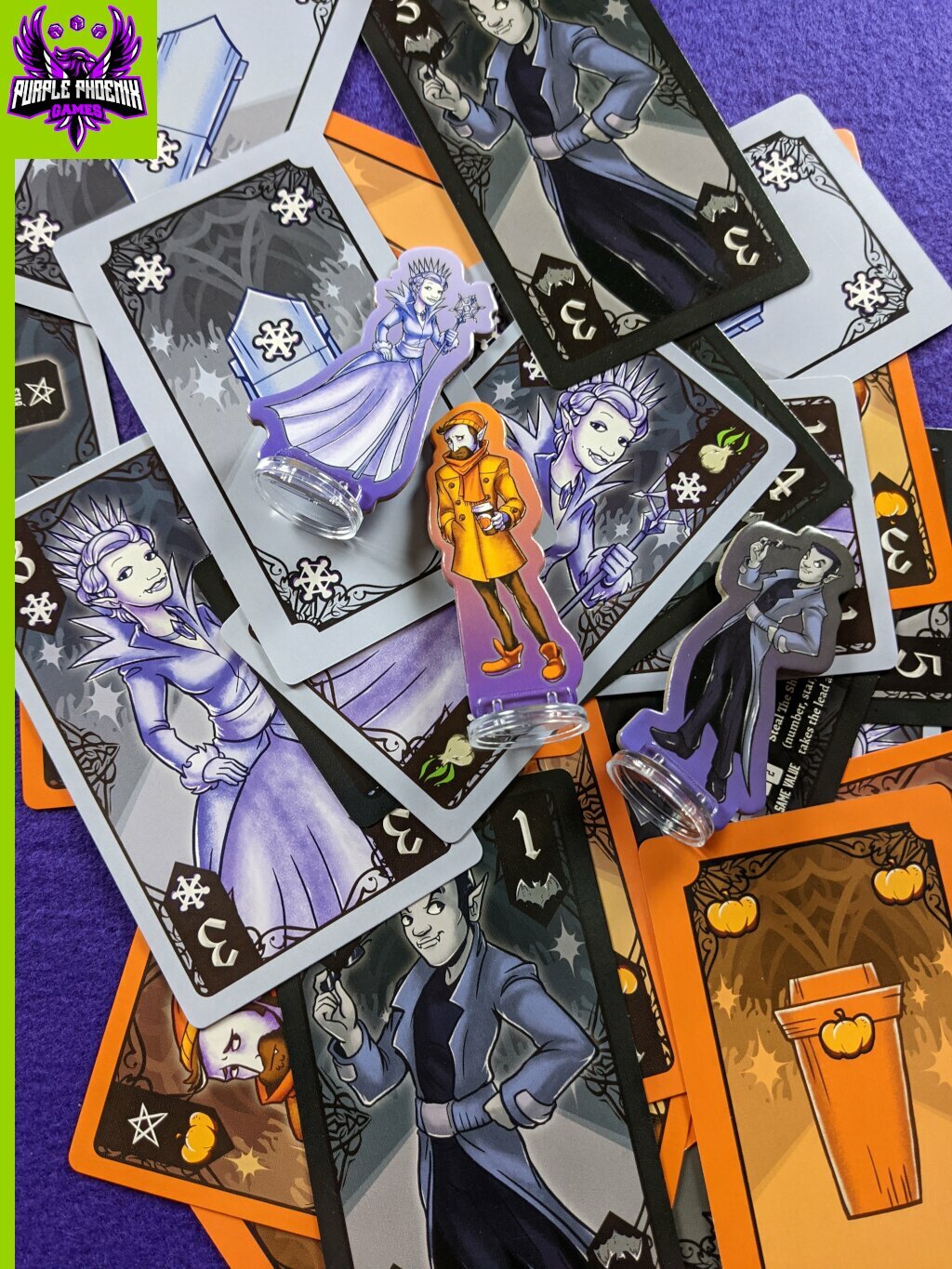
To setup invert the bottom of the box and insert it into the back of the box top lid to create a runway. A “batwalk,” if you will. Each player will choose a vampire and place their standee on the batwalk Start space. They will also take the matching Reference Card. All Vamp Cards matching the vamps in play are collected, shuffled together, and five are dealt to each player. Whichever player is most fashionable goes first and the game may begin!
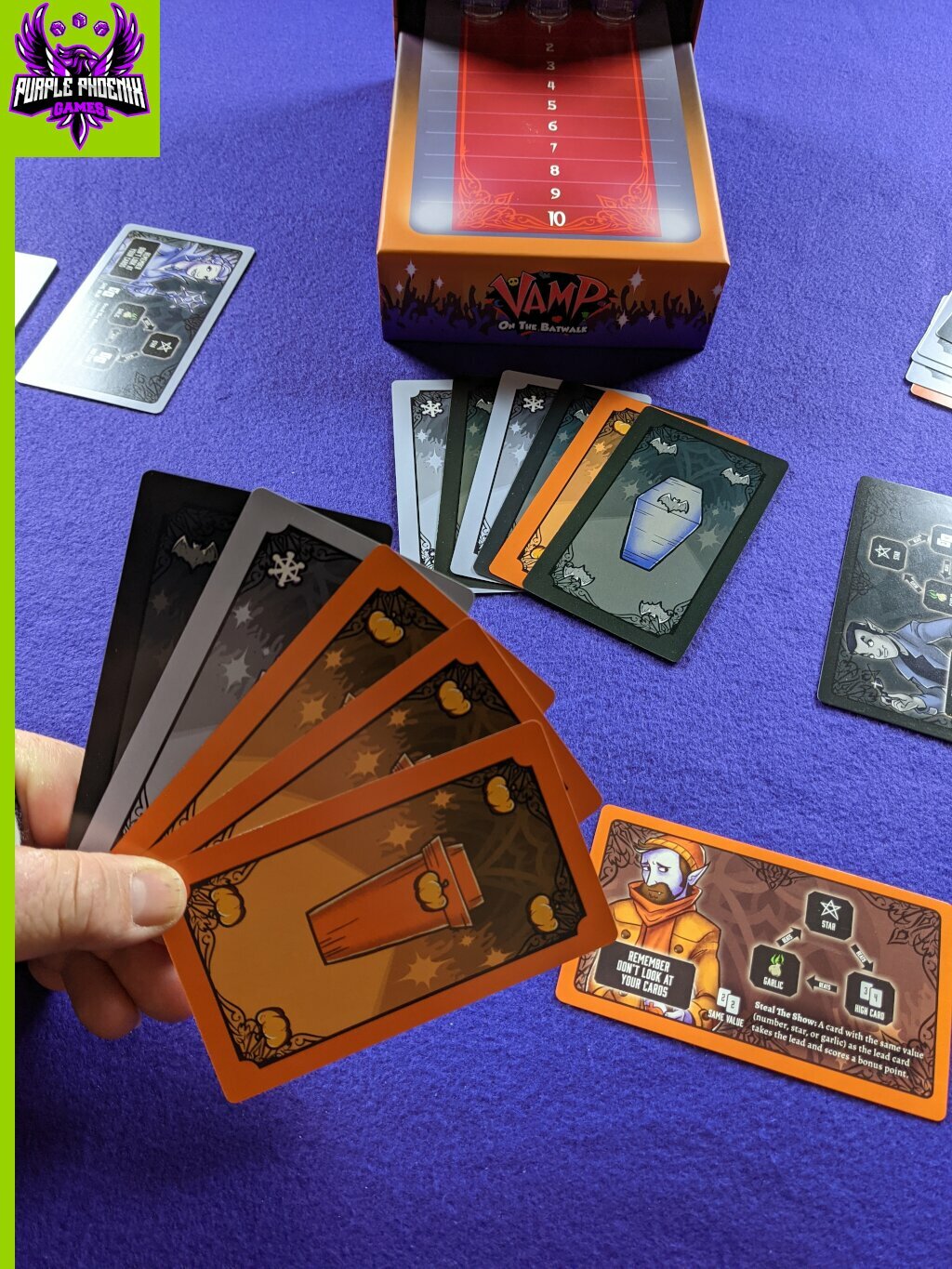
Vamp on the Batwalk is a trick-taking game where players know not which cards they hold. Instead, their hands are facing all other players in order to suss out which cards they may be holding. The first player will open the game by playing any card from their hand. The next player also will play any card they wish, and so on until all players have played a card.
Once each card is played the “lead” card may be switched depending on the rules of the game. Should all cards played be of the same suit the highest card played is the lead card and wins the trick. Similarly, if the first card played remains the highest card in that suit and no other cards played earn the lead card status, that highest card wins the trick.
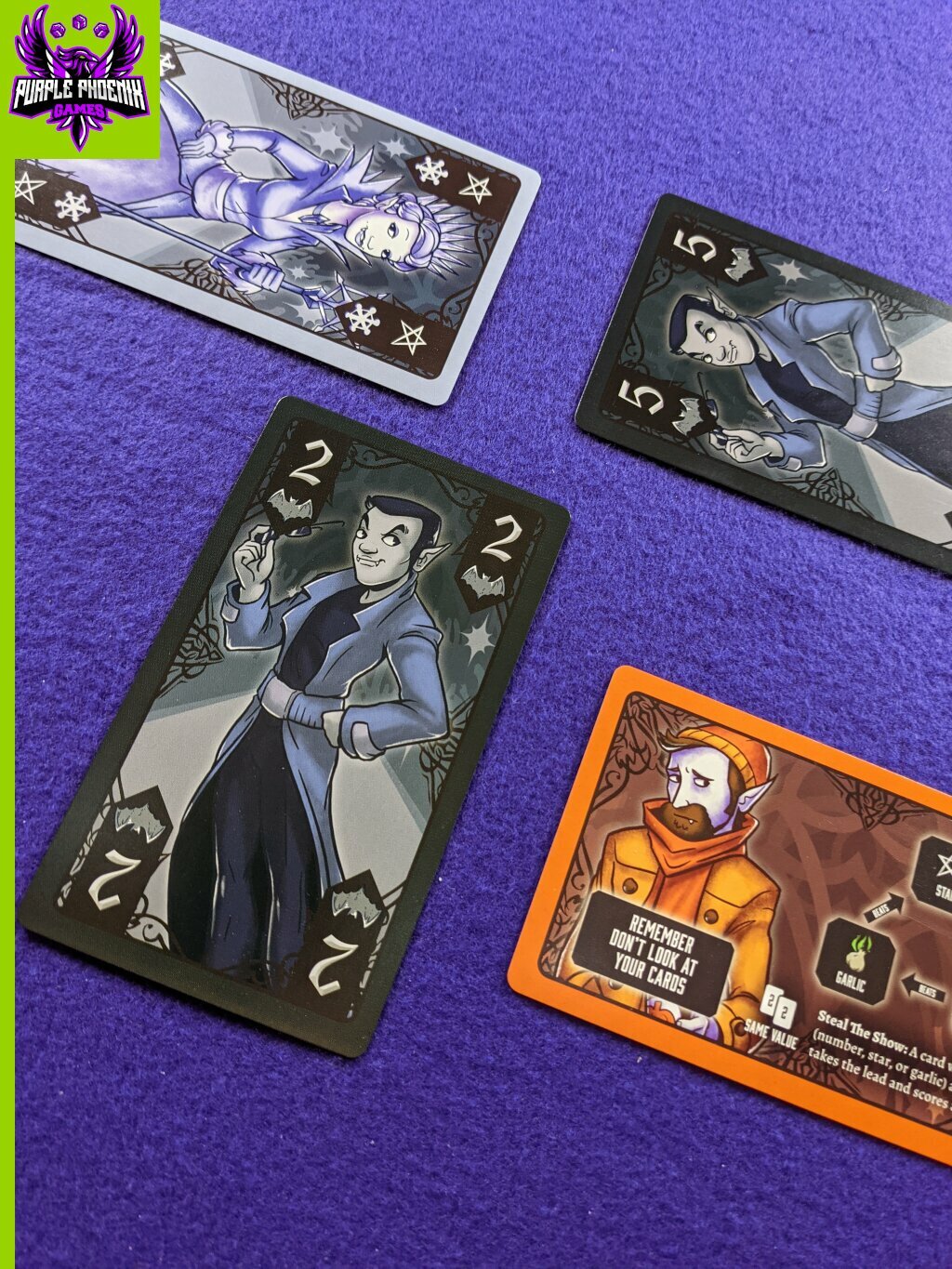
However, when a card is played that is the same value (a three played on a three of a different suit) the newest card with the matching value “Steals the Show” and becomes the new lead card. Some cards feature a star for the value. These star cards will always take the lead unless a garlic card has been played to trump the star. Garlic cards typically are the lowest-ranking suit, but when played in the same hand as a star become the trump suit.
Luckily, the reference cards have handy reminders for these special rules. After all cards from the hand have been played, players check who is winning the fashion show based on points earned during the round. If this is the end of the third round the vamp with the most points wins! If not, the player to the left of the most recent first player then becomes the first player for the next round.
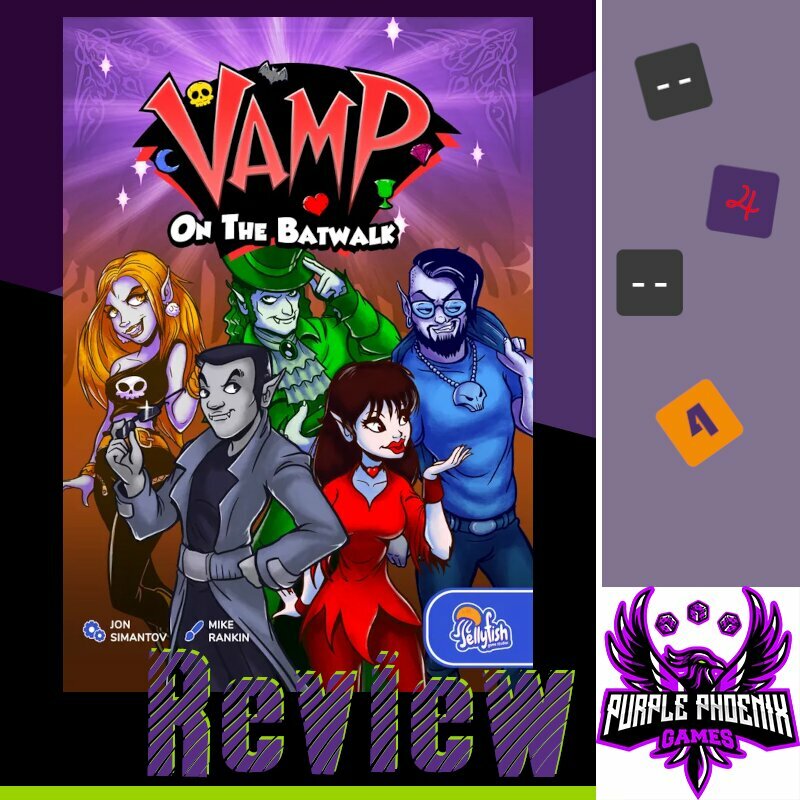
Components. This game features an ingenious scoreboard that is just so fun to use. Having the box double as the scoreboard runway was such a great decision and it works flawlessly. The cards are all large tarot-sized (I think, I’m no tarot-master) and feature some really great art. The player standees are fine, but only four or so can actually fit on a space on the runway without creating a mess. All in all I adore the components and art style here.
Now, several games also employ this mechanic of holding your hand of cards outward for opponents to see, but here the players never really are told which cards they hold. In Vamp on the Batwalk the card play is silly and mostly a guessing game, at least in my head. One can never truly know all the cards they hold because each round not all cards are used. This adds another layer of difficulty in trying to guess what you are holding. This may turn off certain gamers, but it’s a silly way to play the game and I love it.
At the end of the day, this is a game about vampires putting on a fashion show. I feel like once I decided not to take it so seriously I began enjoying it so much more. Sometimes it’s a surprise to win a trick with a 2 of garlic. A throwaway card usually can win if a star is played. Or thinking you have THE card to win the trick only to have someone else Steal the Show and beat you out. It’s just chaotic silliness and I’m smitten.
If you are at all anything like me and can put aside the need to win at all times and at all costs, you will enjoy this one. It is wacky, has an amazing theme and excellent components, and is just a fun game to relax with or to help recharge after a brain burning sesh. Purple Phoenix Games gives this one a blood-slurping 8 / 12. Even though I think the blue vamp is eerily similar to Travis McElroy, the almost-coolest-Travis, this one is a hit for me. Go grab it if you like fun games that don’t tax the brain a whole lot.
Vamp on the Batwalk has players take on the personalities of one of these fashionable elder vampires competing in the latest fashion show. The only problem is that vampires are unable to see themselves in mirrors, so they cannot really assure themselves that they look marvelous; the other vampires will have that privilege. Which vampire can win the most fashion shows this year with limited knowledge of how they look? Who would… stake… their reputation on mere fashion shows anyway?
DISCLAIMER: We were provided a copy of this game for the purposes of this review. This is a retail copy of the game, so what you see in these photos is exactly what would be received in your box. I do not intend to cover every single rule included in the rulebook, but will describe the overall game flow and major rule set so that our readers may get a sense of how the game plays. For more in depth rules, you may purchase a copy online or from your FLGS. -T
To setup invert the bottom of the box and insert it into the back of the box top lid to create a runway. A “batwalk,” if you will. Each player will choose a vampire and place their standee on the batwalk Start space. They will also take the matching Reference Card. All Vamp Cards matching the vamps in play are collected, shuffled together, and five are dealt to each player. Whichever player is most fashionable goes first and the game may begin!
Vamp on the Batwalk is a trick-taking game where players know not which cards they hold. Instead, their hands are facing all other players in order to suss out which cards they may be holding. The first player will open the game by playing any card from their hand. The next player also will play any card they wish, and so on until all players have played a card.
Once each card is played the “lead” card may be switched depending on the rules of the game. Should all cards played be of the same suit the highest card played is the lead card and wins the trick. Similarly, if the first card played remains the highest card in that suit and no other cards played earn the lead card status, that highest card wins the trick.
However, when a card is played that is the same value (a three played on a three of a different suit) the newest card with the matching value “Steals the Show” and becomes the new lead card. Some cards feature a star for the value. These star cards will always take the lead unless a garlic card has been played to trump the star. Garlic cards typically are the lowest-ranking suit, but when played in the same hand as a star become the trump suit.
Luckily, the reference cards have handy reminders for these special rules. After all cards from the hand have been played, players check who is winning the fashion show based on points earned during the round. If this is the end of the third round the vamp with the most points wins! If not, the player to the left of the most recent first player then becomes the first player for the next round.
Components. This game features an ingenious scoreboard that is just so fun to use. Having the box double as the scoreboard runway was such a great decision and it works flawlessly. The cards are all large tarot-sized (I think, I’m no tarot-master) and feature some really great art. The player standees are fine, but only four or so can actually fit on a space on the runway without creating a mess. All in all I adore the components and art style here.
Now, several games also employ this mechanic of holding your hand of cards outward for opponents to see, but here the players never really are told which cards they hold. In Vamp on the Batwalk the card play is silly and mostly a guessing game, at least in my head. One can never truly know all the cards they hold because each round not all cards are used. This adds another layer of difficulty in trying to guess what you are holding. This may turn off certain gamers, but it’s a silly way to play the game and I love it.
At the end of the day, this is a game about vampires putting on a fashion show. I feel like once I decided not to take it so seriously I began enjoying it so much more. Sometimes it’s a surprise to win a trick with a 2 of garlic. A throwaway card usually can win if a star is played. Or thinking you have THE card to win the trick only to have someone else Steal the Show and beat you out. It’s just chaotic silliness and I’m smitten.
If you are at all anything like me and can put aside the need to win at all times and at all costs, you will enjoy this one. It is wacky, has an amazing theme and excellent components, and is just a fun game to relax with or to help recharge after a brain burning sesh. Purple Phoenix Games gives this one a blood-slurping 8 / 12. Even though I think the blue vamp is eerily similar to Travis McElroy, the almost-coolest-Travis, this one is a hit for me. Go grab it if you like fun games that don’t tax the brain a whole lot.

Gareth von Kallenbach (980 KP) rated The Words (2012) in Movies
Aug 7, 2019
On paper, The Words is a film that is better suited as a literary novella. In print, we, as readers, are often granted insight to our characters thoughts and motivation that is frequently lost on film or delivered in a lackluster voiceover that most critics deem as lazy film making. Furthermore, the story within a story, within a story approach in film often leaves the audience with uninteresting shells of characters and can make a story forgettable at best.
Given these reasons, it is easy to see why many would choose to undertake a less ambitious story for their directorial debut. That group does not include co-writer-directors Brian Klugman and Lee Sternthal. This duo is actually successful at tackling this dangerous story-within-a-story film device by keeping it simple. Focusing on the main characters of each story and their motivation, while tying each together with some common themes like love, what it means to write something great, and how far the need for success will drive the characters.
The movie begins with highly successful author Clay Hammond (Dennis Quaid) conducting a reading of his latest novel The Words. Among his audience is literary grad student and adoring fan, Daniella (Olivia Wilde), who has aspirations of picking the brain of the man that authored her favorite stories and perhaps getting involved romantically. As Hammond begins to read his story we are introduced to the tale of starving writer Rory Jensen (Bradley Cooper) and his wife Dora (Zoe Saldana). The two are a young couple in love, trying to get on their feet while Rory struggles with multiple rejections of his novels, until he is finally forced to come to grips with his own limitations as an artist and a writer.
As he settles into life and a job as a mail clerk at a publishing firm, he finds a lost manuscript in a vintage leather briefcase that Dora had purchased for him during their honeymoon in Paris. That story turns out to be something that moves him to tears. It is the final thing in his realization that he will never be the great writer that he thought he was, the great writer that wrote this anonymous story. In an effort to feel and try to understand what it is like to create something great, Rory decides to retype the novel word for word on his laptop if only to admire the beautiful story that he had instantly fallen in love with. When Dora mistakenly reads the novel, she encourages him to submit it to a publisher. Before he can tell her the truth, his world is transformed into the life he had always imagined he would have for himself and Dora as the novel gains him both great literary and commercial success. And finally, now that his star has risen he can get his own novel published.
Enter Jeremy Irons as the old man who reveals himself to Rory as the true author of his story. The old man feels compelled to explain to Rory the tragic origin of the story that has become the young author’s success. Irons steals every second he is on screen as his delivery of the old man oozes with the intellectual style that has been his trademark over the years. Like Rory, we are helpless to do nothing but listen and get lost in the words of his story as if he was sitting next to us and telling the story in real life.
The old man reveals that the novel is the result of great love and pain that his younger self (Ben Barnes) and the love of his life Celia (Nora Arnezeder) endured. While I am not familiar with Barnes’ and Arnezeder’s work, their performance as the younger couple in Irons’ story had a genuine connection. And while this love story does not seem to be anything new when it comes to film, it served its purpose by strengthening the other stories, showing how a great story can be mused from someplace unexpected, even if only once.
With Rory now confronted with his deceitful success, he struggles to decide how to make things right and live with himself as a fraud. It’s at this point the film subtly suggest that Hammond’s story of Rory may actually be a disguised autobiography.
As Rory, Bradley Cooper gives perhaps his best performance to date. I feel that despite his poor and deceitful decision, at no point does he lose the audience. With the help of a strong and emotionally charged performance by Zoe Saldana, we experience Cooper’s honest plight and can understand the events that unfold around him. He is effective as a man who genuinely believes he does not deserve the success that he stole. Without a doubt, this will be a surprising role for those fans who only know Cooper from the humorous characters he plays in The Hangover and most recently Hit and Run. I hope this is the beginning of growth in his craft beyond the charming, confident character we have seen in Limitless and perhaps into a deeper emotional actor.
The weakest part of this film is the story of Clay Hammond and Daniella. Dennis Quaid is quite unlikable as Hammond. He is monotone in his readings and the prose of his story is mediocre at best. While the film drops hints that Hammond’s story of Rory is autobiographical it makes sense that Quaid’s character is played this way. He succeeds in helping create the notion that Hammond is unworthy of the success his character has enjoyed. But something about his performance is so unlikable that even when his character has a redeeming moment, it is lost on an audience that may not care enough about him for it to work.
To add to this dislike of Quaid, Olivia Wilde seems out of place as the character Daniella. It is not that her performance is bad, it is just that every time they showed her as the starry-eyed fan who is love struck for Hammond, she just seemed out of place. Additionally there did not seem to be any connection between Daniella and Hammond in the way the other characters’ connections helped strengthen their performances.
In the end, I enjoyed this movie more than I expected. Visually the Montreal backdrop does an excellent job as both New York and Paris. And the continual piano score helps blend the stories. The simple focus on the main characters helped maintain the three different stories and keep the overall pacing of the movie in order. In addition, the solid to exceptional performances also helped to keep the film focused and avoided the empty shell of characters that most movies of this nature create. That being said, this movie is not for everyone, but those looking for a change of pace from the summer blockbusters season should consider this film.
Given these reasons, it is easy to see why many would choose to undertake a less ambitious story for their directorial debut. That group does not include co-writer-directors Brian Klugman and Lee Sternthal. This duo is actually successful at tackling this dangerous story-within-a-story film device by keeping it simple. Focusing on the main characters of each story and their motivation, while tying each together with some common themes like love, what it means to write something great, and how far the need for success will drive the characters.
The movie begins with highly successful author Clay Hammond (Dennis Quaid) conducting a reading of his latest novel The Words. Among his audience is literary grad student and adoring fan, Daniella (Olivia Wilde), who has aspirations of picking the brain of the man that authored her favorite stories and perhaps getting involved romantically. As Hammond begins to read his story we are introduced to the tale of starving writer Rory Jensen (Bradley Cooper) and his wife Dora (Zoe Saldana). The two are a young couple in love, trying to get on their feet while Rory struggles with multiple rejections of his novels, until he is finally forced to come to grips with his own limitations as an artist and a writer.
As he settles into life and a job as a mail clerk at a publishing firm, he finds a lost manuscript in a vintage leather briefcase that Dora had purchased for him during their honeymoon in Paris. That story turns out to be something that moves him to tears. It is the final thing in his realization that he will never be the great writer that he thought he was, the great writer that wrote this anonymous story. In an effort to feel and try to understand what it is like to create something great, Rory decides to retype the novel word for word on his laptop if only to admire the beautiful story that he had instantly fallen in love with. When Dora mistakenly reads the novel, she encourages him to submit it to a publisher. Before he can tell her the truth, his world is transformed into the life he had always imagined he would have for himself and Dora as the novel gains him both great literary and commercial success. And finally, now that his star has risen he can get his own novel published.
Enter Jeremy Irons as the old man who reveals himself to Rory as the true author of his story. The old man feels compelled to explain to Rory the tragic origin of the story that has become the young author’s success. Irons steals every second he is on screen as his delivery of the old man oozes with the intellectual style that has been his trademark over the years. Like Rory, we are helpless to do nothing but listen and get lost in the words of his story as if he was sitting next to us and telling the story in real life.
The old man reveals that the novel is the result of great love and pain that his younger self (Ben Barnes) and the love of his life Celia (Nora Arnezeder) endured. While I am not familiar with Barnes’ and Arnezeder’s work, their performance as the younger couple in Irons’ story had a genuine connection. And while this love story does not seem to be anything new when it comes to film, it served its purpose by strengthening the other stories, showing how a great story can be mused from someplace unexpected, even if only once.
With Rory now confronted with his deceitful success, he struggles to decide how to make things right and live with himself as a fraud. It’s at this point the film subtly suggest that Hammond’s story of Rory may actually be a disguised autobiography.
As Rory, Bradley Cooper gives perhaps his best performance to date. I feel that despite his poor and deceitful decision, at no point does he lose the audience. With the help of a strong and emotionally charged performance by Zoe Saldana, we experience Cooper’s honest plight and can understand the events that unfold around him. He is effective as a man who genuinely believes he does not deserve the success that he stole. Without a doubt, this will be a surprising role for those fans who only know Cooper from the humorous characters he plays in The Hangover and most recently Hit and Run. I hope this is the beginning of growth in his craft beyond the charming, confident character we have seen in Limitless and perhaps into a deeper emotional actor.
The weakest part of this film is the story of Clay Hammond and Daniella. Dennis Quaid is quite unlikable as Hammond. He is monotone in his readings and the prose of his story is mediocre at best. While the film drops hints that Hammond’s story of Rory is autobiographical it makes sense that Quaid’s character is played this way. He succeeds in helping create the notion that Hammond is unworthy of the success his character has enjoyed. But something about his performance is so unlikable that even when his character has a redeeming moment, it is lost on an audience that may not care enough about him for it to work.
To add to this dislike of Quaid, Olivia Wilde seems out of place as the character Daniella. It is not that her performance is bad, it is just that every time they showed her as the starry-eyed fan who is love struck for Hammond, she just seemed out of place. Additionally there did not seem to be any connection between Daniella and Hammond in the way the other characters’ connections helped strengthen their performances.
In the end, I enjoyed this movie more than I expected. Visually the Montreal backdrop does an excellent job as both New York and Paris. And the continual piano score helps blend the stories. The simple focus on the main characters helped maintain the three different stories and keep the overall pacing of the movie in order. In addition, the solid to exceptional performances also helped to keep the film focused and avoided the empty shell of characters that most movies of this nature create. That being said, this movie is not for everyone, but those looking for a change of pace from the summer blockbusters season should consider this film.
Purple Phoenix Games (2266 KP) rated Dodekka in Tabletop Games
Mar 3, 2021
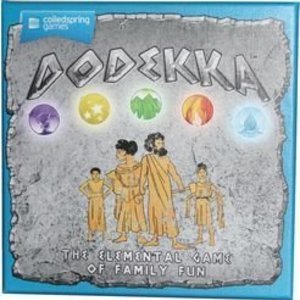
I am eagerly growing into a big Andy Hopwood fan. He has designed family favorites like Daring Dustbunnies, Mijnlieff, and Niche. Playing one of his games is like playing an old classic with a new coat of paint and some killer new rims. Dodekka may seem familiar when playing, and I will disclose my comp at the end of this review, but again has a special twist. Obviously my family loves the game, but why?
Dodekka is loosely named after the Greek prefix for 12, Dodeca. Twelve is a big aspect of this game. In it players are attempting to score a large value of cards from one suit while keeping other suits to a minimum, as they are negative points at the end of the game. The player with the most points at the end of the game will be crowned the winner.
DISCLAIMER: We were provided a copy of this game for the purposes of this review. This is a retail copy of the game, so what you see in these photos is exactly what would be received in your box. I do not intend to cover every single rule included in the rulebook, but will describe the overall game flow and major rule set so that our readers may get a sense of how the game plays. For more in depth rules, you may purchase a copy online or from your FLGS. -T
To setup shuffle the main deck of cards and reveal three near the deck. The game may now begin! Note: this may be the easiest setup of any game I have played.
Dodekka is played in turns where each player will take one of a choice of two actions: take a card or add a card. When a player decides to take a card they simply take the card closest to the deck into their hand. Should they wish to add a card the player will simply reveal a card from the deck and add it to the end of the line. Easy, right? Well that’s not much of a game, admittedly. Where’s the catch?
When players add cards to the end of the line they must take care not to increase the total value of the cards within the line past 12. Each suit contains cards numbered zero through four, so adding a card to the line can be quite a gamble if the total value of the cards in the line is already in double digits. Many times players will be forced to take the card closest to the deck out of fear of busting the line total. When a players busts they must take ALL the cards in the line and a new set of three will be revealed to form a new line.
However, there is a catch to this catch. A catch-ception! Should the line bust when adding a card, but the newly added card is of the matching value of the card already at the end of the line (for example adding a three when the last card is already a three) then the bust is delayed until another player brings the total value down by taking a card or busts on a failed gamble.
Play continues in this fashion of players collecting cards of certain suits to earn points or pressing their luck by adding cards to the line until the deck runs out of cards. At that point players will add up the values of the suit with the most points in their hand and subtract the NUMBER of non-scoring cards. Using the photo below for example, should the player choose to score blue they would have five points. However, they would need to subtract the number of cards from the non-scoring suit, which also equals five (two purple cards and three green cards). This will be a net zero score. The player with the most points wins!
Components. This game is a bunch of cards. The cards are all great quality and feature minimal art. The numbering text on the cards are ancient Greek-themed and work for me. I actually like that the art gets out of the way of the cards and allows the numbers and suit colors to shine. Although, I try to be conscious of our colorblind friends and Dodekka is also considerate here by the addition of different art for each suit to help these players be successful. I have no qualms with any of the components here.
All in all, this game is quite similar to another favorite of ours: No Thanks! In each, players are trying to keep away from gaining a bunch of cards that will negatively impact their final scores. Also in each is the element of press your luck that I find simply delicious. You try to wait as long as possible sometimes so as not to get stuck with the bad card(s) but sometimes that gamble blows up in your face. I just love it!
What I like better in Dodekka than I do in No Thanks! is that there is so little to setup that this can be taken almost anywhere and played without any real concern for losing or damaging components. Being solely cards and setup just being a deck with three exposed cards is so simple that players I have introduced to Dodekka are floored that they don’t receive any cards or have anything at setup. It is just refreshing to start a game that can be setup in 10 seconds or less, depending on shuffling skills.
I really don’t want to say this because I love No Thanks! but I may have found its replacement. Dodekka is light, fast, and gives the same level of heart-racing excitement when you need to add a card to the line when it is at 11 already and showing a three at the end. Can you risk pulling a 0, 1, or 3 to remain cool, or will a 2 or 4 be your downfall and cause you to take the lot? It’s wonderful! If you are looking for a small card game that is an excellent little filler and has interesting twists on familiar mechanics, I recommend you grab a copy of Dodekka. Purple Phoenix Games gives this one an under-the-radar 10 / 12. Go grab your trusty dodecahedrons (or borrow mine – my Monk doesn’t use it for anything) and get Dodekka to the table!
Dodekka is loosely named after the Greek prefix for 12, Dodeca. Twelve is a big aspect of this game. In it players are attempting to score a large value of cards from one suit while keeping other suits to a minimum, as they are negative points at the end of the game. The player with the most points at the end of the game will be crowned the winner.
DISCLAIMER: We were provided a copy of this game for the purposes of this review. This is a retail copy of the game, so what you see in these photos is exactly what would be received in your box. I do not intend to cover every single rule included in the rulebook, but will describe the overall game flow and major rule set so that our readers may get a sense of how the game plays. For more in depth rules, you may purchase a copy online or from your FLGS. -T
To setup shuffle the main deck of cards and reveal three near the deck. The game may now begin! Note: this may be the easiest setup of any game I have played.
Dodekka is played in turns where each player will take one of a choice of two actions: take a card or add a card. When a player decides to take a card they simply take the card closest to the deck into their hand. Should they wish to add a card the player will simply reveal a card from the deck and add it to the end of the line. Easy, right? Well that’s not much of a game, admittedly. Where’s the catch?
When players add cards to the end of the line they must take care not to increase the total value of the cards within the line past 12. Each suit contains cards numbered zero through four, so adding a card to the line can be quite a gamble if the total value of the cards in the line is already in double digits. Many times players will be forced to take the card closest to the deck out of fear of busting the line total. When a players busts they must take ALL the cards in the line and a new set of three will be revealed to form a new line.
However, there is a catch to this catch. A catch-ception! Should the line bust when adding a card, but the newly added card is of the matching value of the card already at the end of the line (for example adding a three when the last card is already a three) then the bust is delayed until another player brings the total value down by taking a card or busts on a failed gamble.
Play continues in this fashion of players collecting cards of certain suits to earn points or pressing their luck by adding cards to the line until the deck runs out of cards. At that point players will add up the values of the suit with the most points in their hand and subtract the NUMBER of non-scoring cards. Using the photo below for example, should the player choose to score blue they would have five points. However, they would need to subtract the number of cards from the non-scoring suit, which also equals five (two purple cards and three green cards). This will be a net zero score. The player with the most points wins!
Components. This game is a bunch of cards. The cards are all great quality and feature minimal art. The numbering text on the cards are ancient Greek-themed and work for me. I actually like that the art gets out of the way of the cards and allows the numbers and suit colors to shine. Although, I try to be conscious of our colorblind friends and Dodekka is also considerate here by the addition of different art for each suit to help these players be successful. I have no qualms with any of the components here.
All in all, this game is quite similar to another favorite of ours: No Thanks! In each, players are trying to keep away from gaining a bunch of cards that will negatively impact their final scores. Also in each is the element of press your luck that I find simply delicious. You try to wait as long as possible sometimes so as not to get stuck with the bad card(s) but sometimes that gamble blows up in your face. I just love it!
What I like better in Dodekka than I do in No Thanks! is that there is so little to setup that this can be taken almost anywhere and played without any real concern for losing or damaging components. Being solely cards and setup just being a deck with three exposed cards is so simple that players I have introduced to Dodekka are floored that they don’t receive any cards or have anything at setup. It is just refreshing to start a game that can be setup in 10 seconds or less, depending on shuffling skills.
I really don’t want to say this because I love No Thanks! but I may have found its replacement. Dodekka is light, fast, and gives the same level of heart-racing excitement when you need to add a card to the line when it is at 11 already and showing a three at the end. Can you risk pulling a 0, 1, or 3 to remain cool, or will a 2 or 4 be your downfall and cause you to take the lot? It’s wonderful! If you are looking for a small card game that is an excellent little filler and has interesting twists on familiar mechanics, I recommend you grab a copy of Dodekka. Purple Phoenix Games gives this one an under-the-radar 10 / 12. Go grab your trusty dodecahedrons (or borrow mine – my Monk doesn’t use it for anything) and get Dodekka to the table!

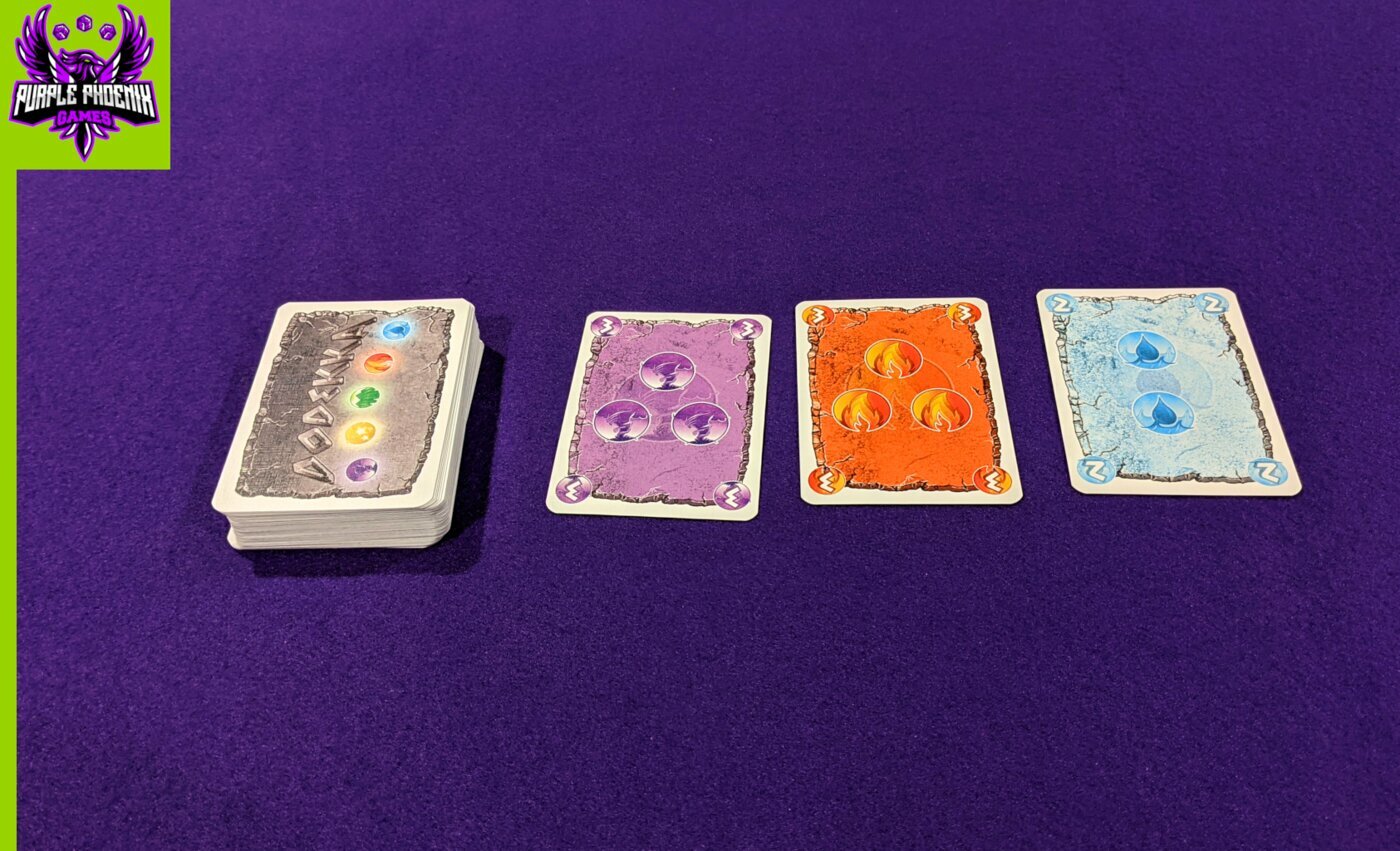
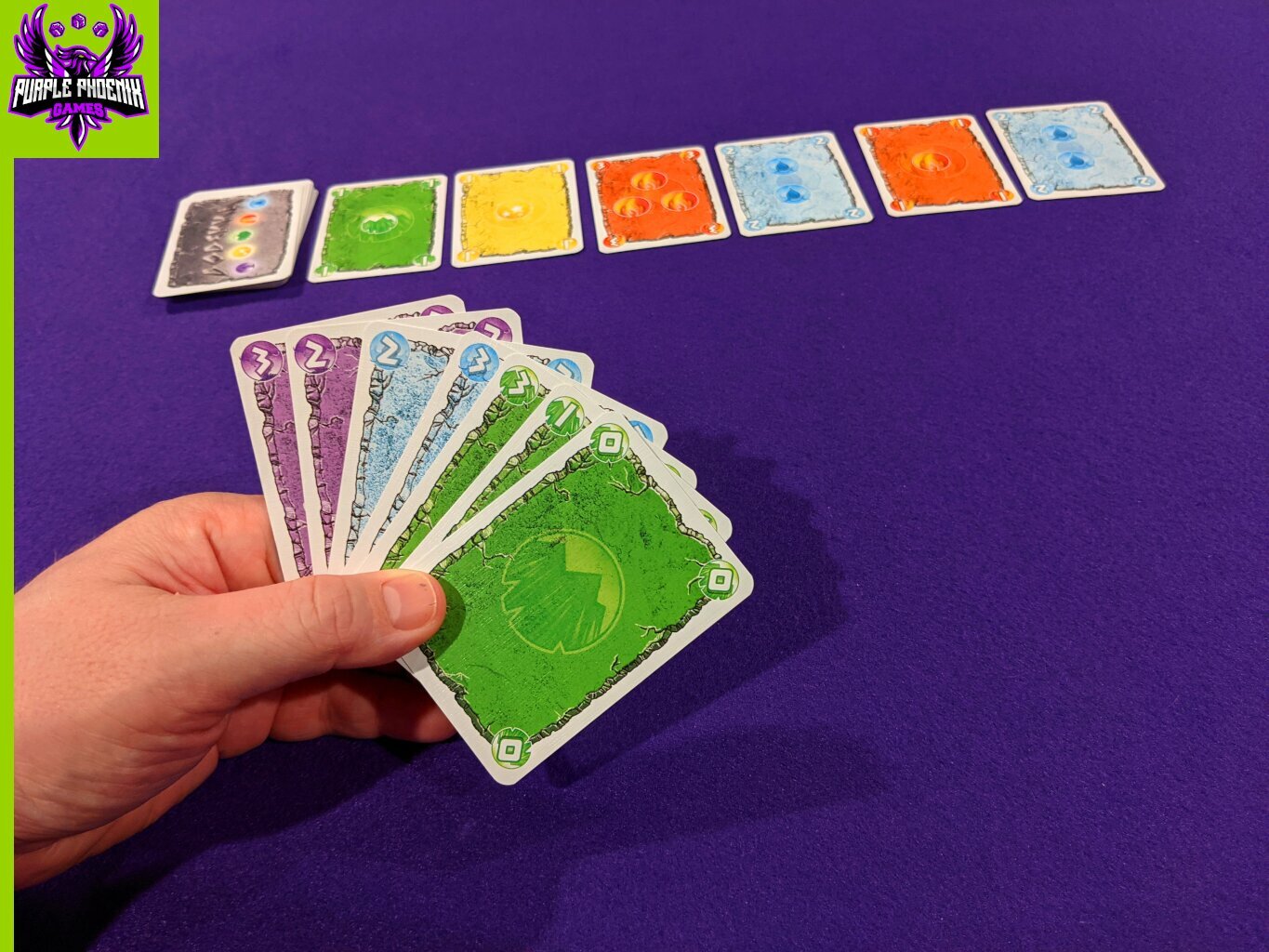
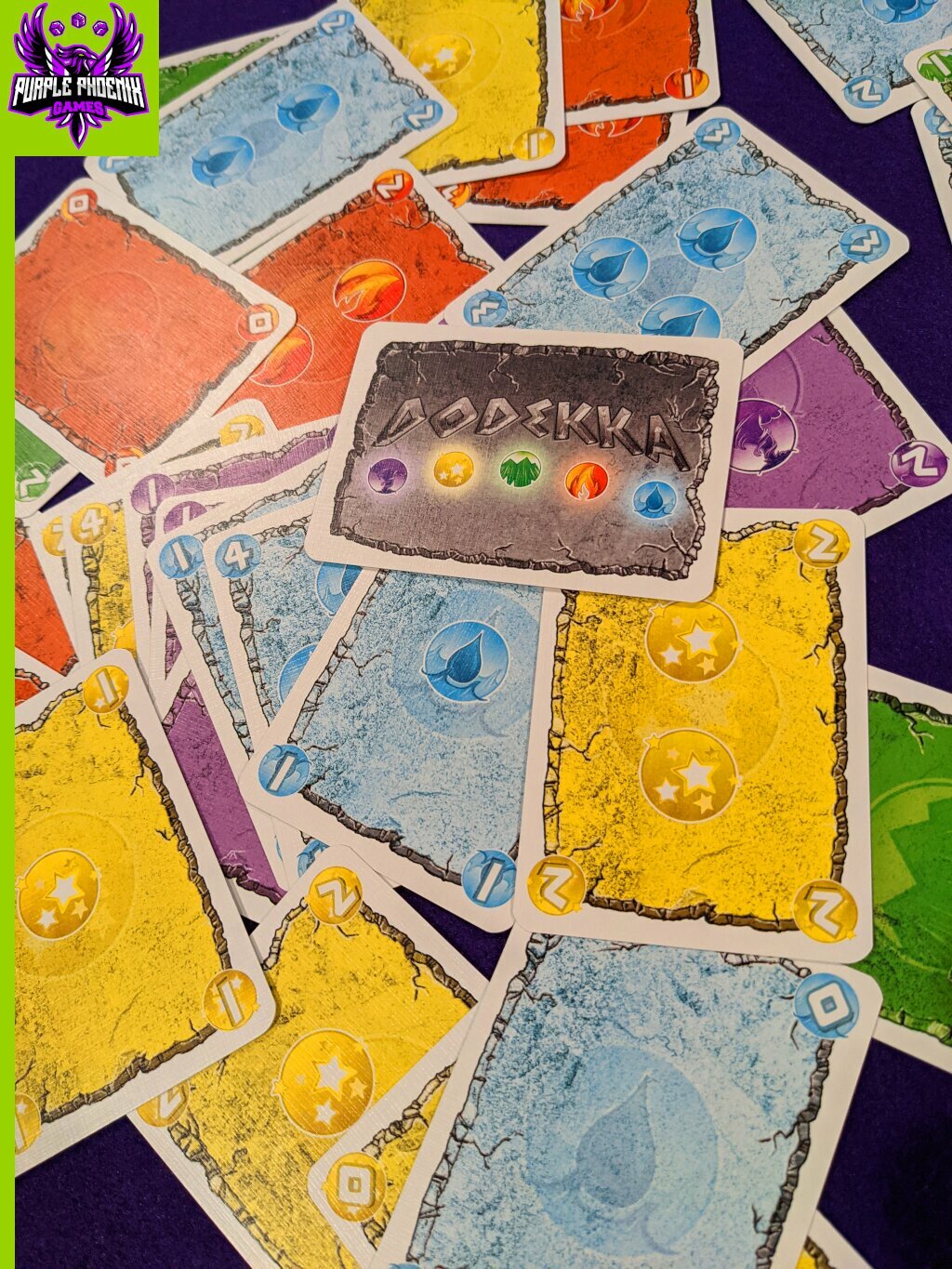
Purple Phoenix Games (2266 KP) rated Niche in Tabletop Games
Mar 3, 2021
I have a gamer confession to make and I am not sure how it will be received. Perhaps it isn’t a gamer confession at all. I will let you be the judge. I am not a fan of Sudoku. There! I said it, and I stand by it. I find it tedious and far too intelligent a game for me. However, if someone would just dumb it down enough for me to get it, I may actually enjoy it. Oh wait, Andy Hopwood did that for me already? Hot dog!
Niche is a puzzly abstracty Sudoku-y card sheddy game for two to seven players that can be played in as few as 10 minutes. In it players attempt to shed their hand and score the most points by adding cards to established lines of cards. As with most of Andy Hopwood’s games, though, there is a twist.
DISCLAIMER: We were provided a copy of this game for the purposes of this review. This is a retail copy of the game, so what you see in these photos is exactly what would be received in your box. I do not intend to cover every single rule included in the rulebook, but will describe the overall game flow and major rule set so that our readers may get a sense of how the game plays. For more in depth rules, you may purchase a copy online or from your FLGS. -T
To setup the dealer will shuffle the deck and, well, deal out seven cards to each player. The cards not dealt form a deck and from this deck a starter card is flipped to the table. Setup is complete and the game may now begin!
On a turn each player will need to perform three steps: Select, Place, Score. When Selecting a card from their hand the player will need to observe the last played card. This card will essentially inform the player of what CANNOT be played. For example (per the photo above), if a yellow triangle was just played, then the next card played can be NEITHER yellow nor a triangle. So from their hand the active player will select a group of cards that can be played this turn and choose one to add adjacently to the most recently played card.
The player then must Place their card such that they do not add the same card to the line that already exists within the line. For an example here (per the photo below), the most recently played card is a blue circle. In hand are two blue squares, a yellow square, and a red square. As the previous card is blue the only choices left are the yellow and red square. However, the card played previous to the blue circle was a yellow square, so that leaves our player with only one choice: the red square connected to the blue circle. Now, the player could actually use the yellow square, but would need to place it below the blue circle forming the beginning of a new line. I will explain why that is a less strategic play.
When players perform the third step in a turn, Scoring, they will count up all cards in the lines extended by their card, both vertically and horizontally. In our previous example the red square continues a line of two cards so their score for that placement is three. Should they place the yellow square below they will only score two as they have added onto only one card. Fans of Azul will be familiar with this scoring system. Players are expected to keep track of their own scores each turn.
Should a player not have any legal plays using cards in their hand they must pass, and await their next turn. Play continues in this manner of players performing these three steps in a turn until a player sheds their entire hand of cards. All other players will have one more chance to play one card to score points. Players add up all the points they have scored throughout the game and the player with the most points is the winner!
Components. This is a deck of cards in a tuckbox. The cards are all fine quality, and the iconography could not be much clearer. I have zero qualms with the components here.
Gameplay is super quick and puzzly, with a great weight for its type of game. This will not be a centerpiece title of the game night, but will offer filler style gameplay for gamers mulling about or waiting for the next game to begin. I enjoy the simplicity of the rules coupled with the puzzly and thinky nature of each turn. Obviously the name of the game is scoring points, so you want to add to an already-long line instead of having to begin a new off-shoot somewhere, but it is near impossible to anticipate what other players will place on their turns. Therefore, more strategic players will find either solace or frustration from the more tactical style of play here.
I do want to mention that this game was originally designed for an event benefiting The Foundation for Conductive Education in the UK. Quote taken from the BGG profile for Niche: “The game aims to promote and support The Foundation for Conductive Education. This method works with children and adults who have conditions such as Cerebral Palsy, Stroke, M.S. or Parkinsons, helping them to lead more independent lives.” I know this organization holds a special place in the designer’s heart and I just wanted to take a moment to give a shout-out to this amazing organization and this amazing person who created a game for the benefit of others. I applaud both entities, and hope for much success.
That said, Niche is a game that can be played with any type of gamer in almost any situation. It takes up little table space (at most nine cards in a line) and is rules-light. Purple Phoenix Games gives this one an extended 8 / 12. If you are a fan of Sudoku and would like to explore a little card game that gives this reviewer the same vibe (but infinitely more fun) then I urge you to grab a copy of Niche. Not only will you be purchasing a good little game, but your purchase also goes toward furthering an organization that is doing very important work in the UK. And if you would like to feel very smart, play Niche with me sometime and watch me struggle to play the right card.
Niche is a puzzly abstracty Sudoku-y card sheddy game for two to seven players that can be played in as few as 10 minutes. In it players attempt to shed their hand and score the most points by adding cards to established lines of cards. As with most of Andy Hopwood’s games, though, there is a twist.
DISCLAIMER: We were provided a copy of this game for the purposes of this review. This is a retail copy of the game, so what you see in these photos is exactly what would be received in your box. I do not intend to cover every single rule included in the rulebook, but will describe the overall game flow and major rule set so that our readers may get a sense of how the game plays. For more in depth rules, you may purchase a copy online or from your FLGS. -T
To setup the dealer will shuffle the deck and, well, deal out seven cards to each player. The cards not dealt form a deck and from this deck a starter card is flipped to the table. Setup is complete and the game may now begin!
On a turn each player will need to perform three steps: Select, Place, Score. When Selecting a card from their hand the player will need to observe the last played card. This card will essentially inform the player of what CANNOT be played. For example (per the photo above), if a yellow triangle was just played, then the next card played can be NEITHER yellow nor a triangle. So from their hand the active player will select a group of cards that can be played this turn and choose one to add adjacently to the most recently played card.
The player then must Place their card such that they do not add the same card to the line that already exists within the line. For an example here (per the photo below), the most recently played card is a blue circle. In hand are two blue squares, a yellow square, and a red square. As the previous card is blue the only choices left are the yellow and red square. However, the card played previous to the blue circle was a yellow square, so that leaves our player with only one choice: the red square connected to the blue circle. Now, the player could actually use the yellow square, but would need to place it below the blue circle forming the beginning of a new line. I will explain why that is a less strategic play.
When players perform the third step in a turn, Scoring, they will count up all cards in the lines extended by their card, both vertically and horizontally. In our previous example the red square continues a line of two cards so their score for that placement is three. Should they place the yellow square below they will only score two as they have added onto only one card. Fans of Azul will be familiar with this scoring system. Players are expected to keep track of their own scores each turn.
Should a player not have any legal plays using cards in their hand they must pass, and await their next turn. Play continues in this manner of players performing these three steps in a turn until a player sheds their entire hand of cards. All other players will have one more chance to play one card to score points. Players add up all the points they have scored throughout the game and the player with the most points is the winner!
Components. This is a deck of cards in a tuckbox. The cards are all fine quality, and the iconography could not be much clearer. I have zero qualms with the components here.
Gameplay is super quick and puzzly, with a great weight for its type of game. This will not be a centerpiece title of the game night, but will offer filler style gameplay for gamers mulling about or waiting for the next game to begin. I enjoy the simplicity of the rules coupled with the puzzly and thinky nature of each turn. Obviously the name of the game is scoring points, so you want to add to an already-long line instead of having to begin a new off-shoot somewhere, but it is near impossible to anticipate what other players will place on their turns. Therefore, more strategic players will find either solace or frustration from the more tactical style of play here.
I do want to mention that this game was originally designed for an event benefiting The Foundation for Conductive Education in the UK. Quote taken from the BGG profile for Niche: “The game aims to promote and support The Foundation for Conductive Education. This method works with children and adults who have conditions such as Cerebral Palsy, Stroke, M.S. or Parkinsons, helping them to lead more independent lives.” I know this organization holds a special place in the designer’s heart and I just wanted to take a moment to give a shout-out to this amazing organization and this amazing person who created a game for the benefit of others. I applaud both entities, and hope for much success.
That said, Niche is a game that can be played with any type of gamer in almost any situation. It takes up little table space (at most nine cards in a line) and is rules-light. Purple Phoenix Games gives this one an extended 8 / 12. If you are a fan of Sudoku and would like to explore a little card game that gives this reviewer the same vibe (but infinitely more fun) then I urge you to grab a copy of Niche. Not only will you be purchasing a good little game, but your purchase also goes toward furthering an organization that is doing very important work in the UK. And if you would like to feel very smart, play Niche with me sometime and watch me struggle to play the right card.
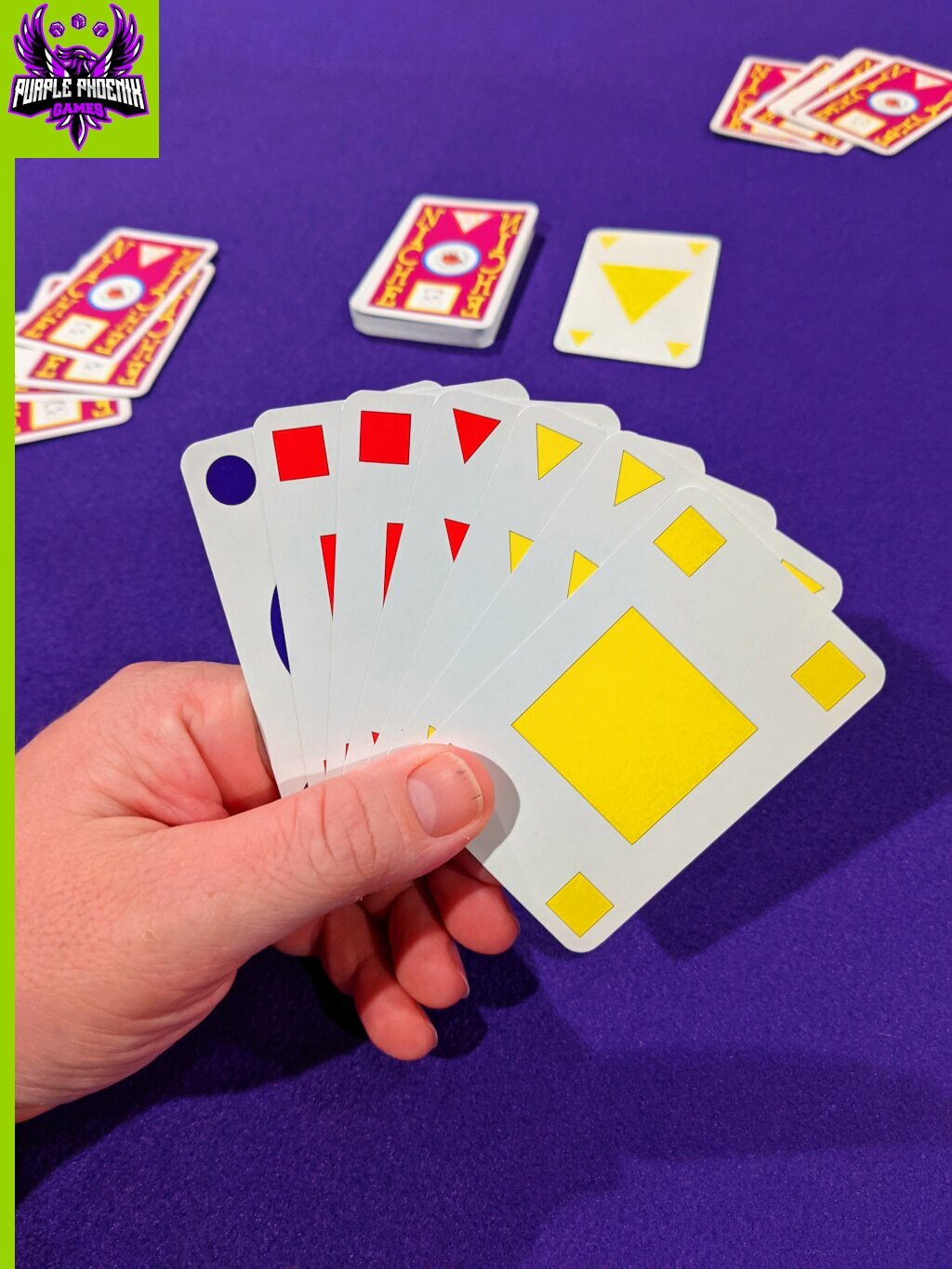
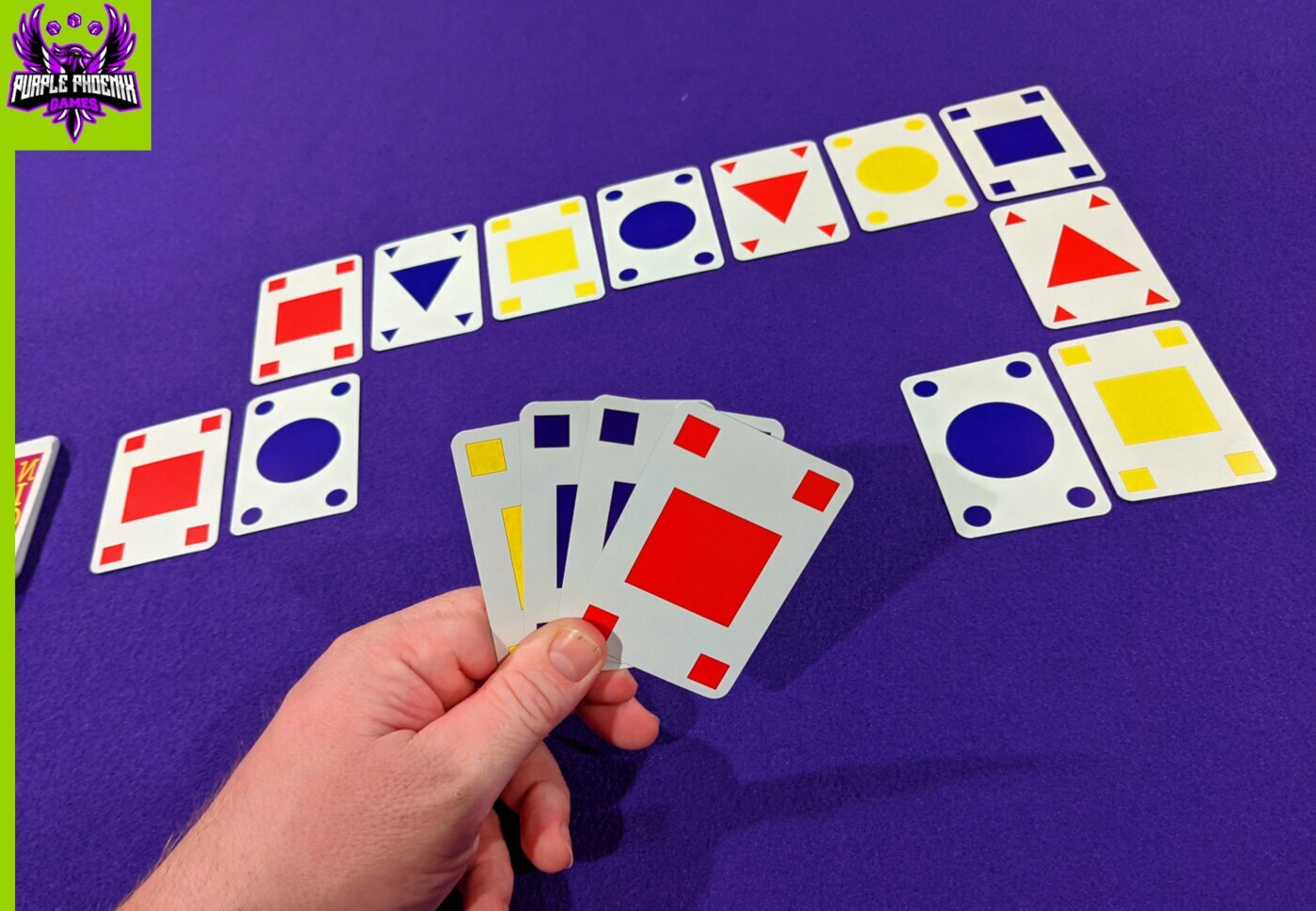
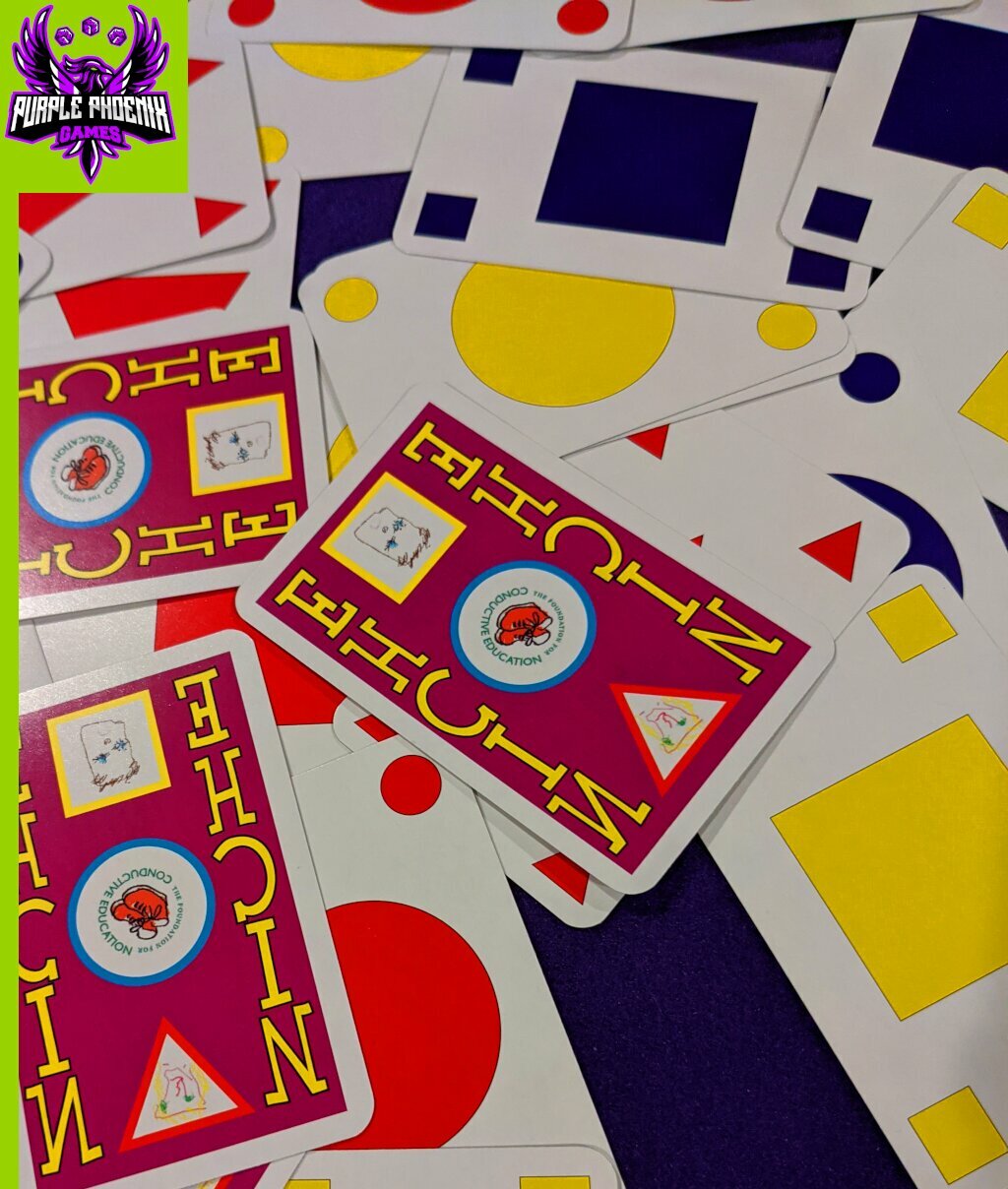
Purple Phoenix Games (2266 KP) rated Chronicles of Crime: 1900 in Tabletop Games
Apr 23, 2021

WARNING: Extremely minor spoilers ahead (in the photos)! Don’t say I didn’t warn you (they aren’t big spoilers).
If you have been following us for a while now you have probably noticed we have published another title from the Millennium Series – Chronicles of Crime: 1400. While that title takes place in the year, well, 1400, this new title is set 500 years later in Paris. How do these games compare? What about the link to the original Chronicles of Crime (review to be posted later)? Should one purchase copies of all Chronicles of Crime games?
Chronicles of Crime: 1900 (which I shall refer to as CoC1900 from here) is a cooperative campaign, deduction, storytelling, puzzle solving adventure game, but I prefer to play it, and its relatives, solo. In it, the player(s) take control of the journalist Victor Lavel, a descendent of the main character from CoC1400. Victor has a limited amount of time to complete his investigation and return the scoop to the local newspaper by which he is employed. Players will be tackling the investigations of our noble hero in attempts to solve the case that is presented.
DISCLAIMER: We were provided a copy of this game for the purposes of this review. This is a retail copy of the game, so what you see in these photos is exactly what would be received in your box. I do not intend to cover every single rule included in the rulebook, but will describe the overall game flow and major rule set so that our readers may get a sense of how the game plays. For more in depth rules, you may purchase a copy online or from your FLGS. -T
To setup, place the main card holder board on the table. Anywhere. I called it. Next, keep the card decks in order (or don’t) and place them near the board. Similarly, place the location boards on the table and ready the main newspaper board for play. Launch the Chronicles of Crime app on a device, choose 1900, and select the scenario you wish to play. The app will drive the remainder of the game, so hold onto your butts!
How do I explain this game succinctly? Well, each of the cases will involve players traveling to different Location Boards and meeting Characters at these locations. Many cases will be involving several Special Items and, new for the 1900 version, Puzzle Cards that players will need to solve or use in special ways in order to progress with certain leads. These Puzzle Cards do not really give the story away or anything, but are merely tools to be used to help solve the cases.
By using the app and scanning the QR codes on the boards and cards players will be learning about the case, viewing the scene of the crime(s), inspecting items, and chatting up locals for information. Play will continue not so much in “rounds” but until the players have enough evidence and a good handle on the situation enough to return to the paper’s office to report to their coworkers all the details of the crime(s) by scanning answers to their questions about the case. The app then assesses the accuracy of the answers and outputs a score. Based on the score achieved players can play again to pick up clues they missed along the way or try another scenario entirely.
Components. As with all CoC games I have played, the components are simply wonderful. Most of what is in the box is cardstock of varying thickness, but the art is what really stands out. This is a gorgeous game and when it is displayed on the table, people become fascinated by its presence. Then when the onlookers see an app driving the gameplay they are hooked. I have heard complaints from other reviewers that the Character cards in the game are lacking in variation, and I would have to agree. Yes, it is set in 1900 Paris, but all the Character cards feature white people, most of whom seem to be upper crust, and with most of the males sporting an awful mustache. So I get that complaint and agree. With inclusivity and diversity being major hot issues currently, you would expect to see more of it in our industry. I would have liked to have come across more diverse characters, and maybe a mini expansion can add many alternate art characters to the game.
All in all I loved this theme of Chronicles of Crime. Being set in Paris and following a young investigative journalist is a nice twist on the protagonists commonly featured in these games. The gameplay is the same as previous versions of CoC, save for the new Puzzle cards. I do enjoy their addition, and look to find more of these in future versions. I love the Chronicles of Crime system so I was bound to love this one as well.
Now, should you buy this version if you already have base Chronicles of Crime? Sure! Why? I like this one because it adds a different mechanic to the game with all-new scenarios, and I enjoy having more of a good thing. I think I personally prefer the theme in 1400 more, but 1900 is a great addition to the family. If you are someone who has and enjoys the base CoC, or any of its iterations, and are looking for more content to devour, then definitely grab a copy of 1900. If you are new to the system, I say go ahead and start with 1900. The Puzzle cards do not add enough complexity to take it out of reach for beginner gamers or those who enjoy lighter games, but certainly add a new and welcome layer to the series. Purple Phoenix Games certainly recommends this one to all our fans. Can’t get enough Chronicles of Crime? Grab 1900. Want to start in the series but London or Medieval times don’t do it for you? Grab 1900. Like tons of portraits of mustachioed white dudes and floofy ladies? Grab 1900. Whatever your motivation, play the game and let me know how you score. I am not advertising my first score here because I am mortified by my performance. (I did get better on subsequent plays.)
If you have been following us for a while now you have probably noticed we have published another title from the Millennium Series – Chronicles of Crime: 1400. While that title takes place in the year, well, 1400, this new title is set 500 years later in Paris. How do these games compare? What about the link to the original Chronicles of Crime (review to be posted later)? Should one purchase copies of all Chronicles of Crime games?
Chronicles of Crime: 1900 (which I shall refer to as CoC1900 from here) is a cooperative campaign, deduction, storytelling, puzzle solving adventure game, but I prefer to play it, and its relatives, solo. In it, the player(s) take control of the journalist Victor Lavel, a descendent of the main character from CoC1400. Victor has a limited amount of time to complete his investigation and return the scoop to the local newspaper by which he is employed. Players will be tackling the investigations of our noble hero in attempts to solve the case that is presented.
DISCLAIMER: We were provided a copy of this game for the purposes of this review. This is a retail copy of the game, so what you see in these photos is exactly what would be received in your box. I do not intend to cover every single rule included in the rulebook, but will describe the overall game flow and major rule set so that our readers may get a sense of how the game plays. For more in depth rules, you may purchase a copy online or from your FLGS. -T
To setup, place the main card holder board on the table. Anywhere. I called it. Next, keep the card decks in order (or don’t) and place them near the board. Similarly, place the location boards on the table and ready the main newspaper board for play. Launch the Chronicles of Crime app on a device, choose 1900, and select the scenario you wish to play. The app will drive the remainder of the game, so hold onto your butts!
How do I explain this game succinctly? Well, each of the cases will involve players traveling to different Location Boards and meeting Characters at these locations. Many cases will be involving several Special Items and, new for the 1900 version, Puzzle Cards that players will need to solve or use in special ways in order to progress with certain leads. These Puzzle Cards do not really give the story away or anything, but are merely tools to be used to help solve the cases.
By using the app and scanning the QR codes on the boards and cards players will be learning about the case, viewing the scene of the crime(s), inspecting items, and chatting up locals for information. Play will continue not so much in “rounds” but until the players have enough evidence and a good handle on the situation enough to return to the paper’s office to report to their coworkers all the details of the crime(s) by scanning answers to their questions about the case. The app then assesses the accuracy of the answers and outputs a score. Based on the score achieved players can play again to pick up clues they missed along the way or try another scenario entirely.
Components. As with all CoC games I have played, the components are simply wonderful. Most of what is in the box is cardstock of varying thickness, but the art is what really stands out. This is a gorgeous game and when it is displayed on the table, people become fascinated by its presence. Then when the onlookers see an app driving the gameplay they are hooked. I have heard complaints from other reviewers that the Character cards in the game are lacking in variation, and I would have to agree. Yes, it is set in 1900 Paris, but all the Character cards feature white people, most of whom seem to be upper crust, and with most of the males sporting an awful mustache. So I get that complaint and agree. With inclusivity and diversity being major hot issues currently, you would expect to see more of it in our industry. I would have liked to have come across more diverse characters, and maybe a mini expansion can add many alternate art characters to the game.
All in all I loved this theme of Chronicles of Crime. Being set in Paris and following a young investigative journalist is a nice twist on the protagonists commonly featured in these games. The gameplay is the same as previous versions of CoC, save for the new Puzzle cards. I do enjoy their addition, and look to find more of these in future versions. I love the Chronicles of Crime system so I was bound to love this one as well.
Now, should you buy this version if you already have base Chronicles of Crime? Sure! Why? I like this one because it adds a different mechanic to the game with all-new scenarios, and I enjoy having more of a good thing. I think I personally prefer the theme in 1400 more, but 1900 is a great addition to the family. If you are someone who has and enjoys the base CoC, or any of its iterations, and are looking for more content to devour, then definitely grab a copy of 1900. If you are new to the system, I say go ahead and start with 1900. The Puzzle cards do not add enough complexity to take it out of reach for beginner gamers or those who enjoy lighter games, but certainly add a new and welcome layer to the series. Purple Phoenix Games certainly recommends this one to all our fans. Can’t get enough Chronicles of Crime? Grab 1900. Want to start in the series but London or Medieval times don’t do it for you? Grab 1900. Like tons of portraits of mustachioed white dudes and floofy ladies? Grab 1900. Whatever your motivation, play the game and let me know how you score. I am not advertising my first score here because I am mortified by my performance. (I did get better on subsequent plays.)
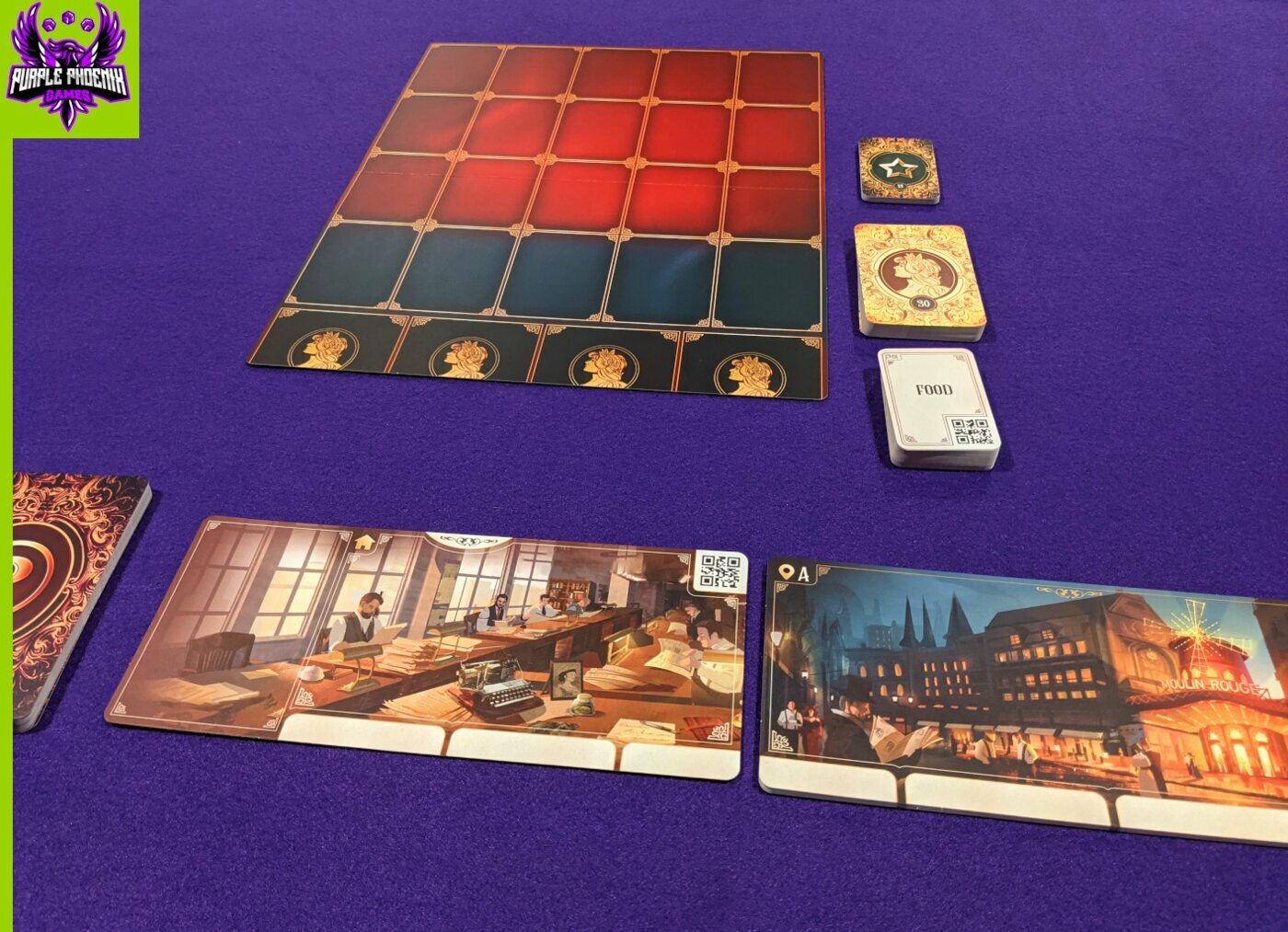
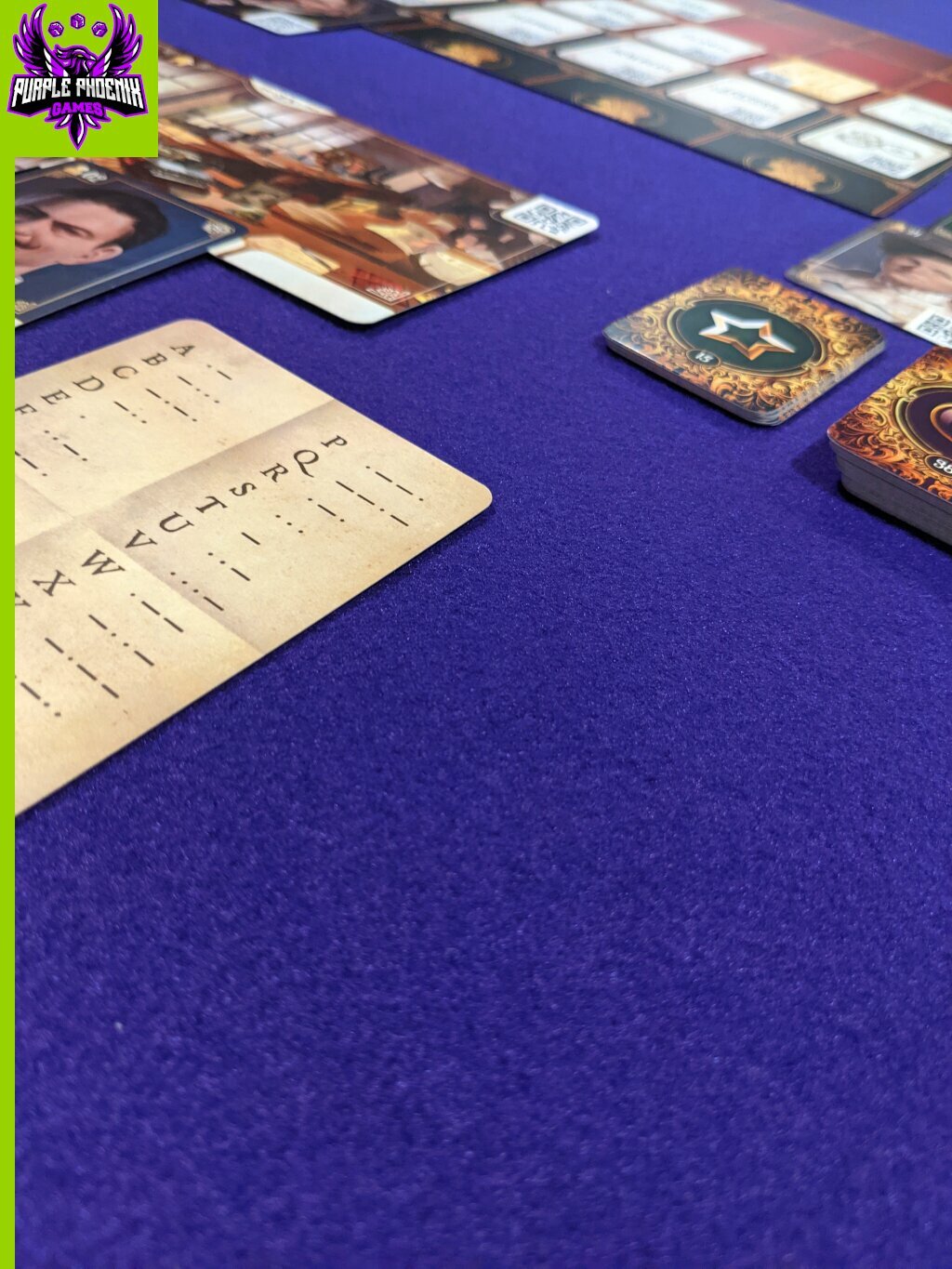

Purple Phoenix Games (2266 KP) rated Horrified: Universal Monsters Strategy Board Game in Tabletop Games
Aug 6, 2021
I was a child a long time ago. Okay, not THAT long ago, but I remember being frightened of a great many thing on TV: Michael Jackson’s “Thriller” music video, the TV show “V,” and so many others. I still to this day have not watched an entire old school Universal Studios Monster movie. However, I used to live in California for part of my childhood and my family had season passes to Universal Studios and we would go quite a lot, so I have always been familiar with the monsters. So when I saw a game was being crafted featuring these lovable, but in a nostalgic way, creatures I knew I just had to have it.
Horrified is a pickup and deliver, action points, cooperative game with dice and miniatures utilizing a variable setup. In it players take on the role of a hero in a monster movie – but not just A monster movie, but SEVERAL monsters will be haunting the town! It is the heroes’ goal to defeat the monsters before the Terror Marker reaches maximum or the heroes run out of time and the monsters take over the town.
To setup, place the board on the table and draw 12 Item tokens from the bag. Place these Items on the board in the specified location printed on the Item. Depending on how many players (for this review I will be using the Solo rules in the rule book) place the Terror Marker appropriately on the board – the photo above was taken before I realized that it starts on three in the Solo game. Choose the monsters to be faced and place their mats near the board. The rulebook states where the monster minis will start the game. Place the Frenzy token on the lowest Frenzy-numbered monster. Shuffle the Monster and Perk decks of cards separately and deal each player one Perk card. Each player chooses or is randomly dealt a character badge and places the standee in the appropriate location on the board. The game may now begin!
Players will be taking turns traveling the town, picking up Items, attempting to defeat the monsters per their defeat instructions on their mats, delivering villagers that randomly appear to their safe locations, and keeping the Terror Marker in the acceptable range. Each character has a certain number of actions that can be taken on their turns, but any Perk cards used are spent as a bonus action on the hero’s turn. The hero actions are: Move (one space along the lit pathways, even with a villager in tow), Guide (a villager one space away from the hero), Pick Up (Items from locations), Share (Items from player to player – not needed in a Solo game), Special Action (if the character being played has one on their badge), Advance (complete a task on the Monster mat to move one step closer to defeat), and Defeat (once all the tasks are complete and the player has enough Items to defeat the Monster at the same location). Once a hero has used up all their Action Points per their badge, it will be the Monster phase.
Monster phases begin with a draw from the Monster deck. Upon the card will be a number printed on the top which instructs players as to how many Items to draw and place from the bag. Next, players will read the text on the card and complete any instructions. Finally, the Monsters will strike. At the bottom of the card will be printed several icons pertaining to Monsters individually and also the Monster who happens to currently be Frenzied. These icons instruct players to move certain Monsters and if they share a space with a hero or villager, to roll the attack dice. One hit from a Monster defeats either a villager or hero (unless the hero discards any Item to block the attack). If a hero or villager is defeated, the Terror Marker moves up a space toward ultimate doom. Play then is passed to the players again. The game continues in this fashion until one of the game end conditions is met and the heroe(s) win or the Monsters succeed in their hostile haunted takeover.
Components. I’d like to start with the art. I love it. The art has a very 1930s Hollywood style and is simply beautiful. The colors are vibrant, where color is used, and the board is stunning. All of the cardboard components are top notch quality, and the Monster minis are fab. Obviously it would be great for all the heroes and villagers to have minis as well, but there is text printed on those standees that just can’t translate to a miniature. All in all, the components here are wonderful and high quality.
The gameplay is also wonderful and high quality. The solo game from which these photos are taken I randomly drew the Mayor character and decided to hit the town with Dracula, The Creature from the Black Lagoon, and The Invisible Man. That’s a Standard game in the rules. The Mayor is great because she is able to take five actions on her turn (plus Perks), but she has no special abilities. That is both a blessing and a curse and wonderfully balanced. I would say I finished the game needing just one or two more Monster cards to draw before all three baddies were defeated. But, that’s the difficulty of having three Monsters showing. With just two Monsters I would have won handily, but maybe would not have enjoyed it as much and written it off as too easy. Luckily I always learn games on normal standard difficulty first.
Traipsing around town picking up Items and ushering villagers to their safe spaces sounds relaxing, but when the Monsters are on your trail and ready to Strike it adds a layer of anxiety that is just delicious. I admit I probably spent too much time trying to save every villager and that’s partly why I failed at this one game. Also I miscalculated how many extra Items to have on hand when attempting to Advance the Monster tasks. Couple those with my strategy to concentrate on defeating one Monster at a time and, well, that’s a losing strategy it seems.
The gameplay is so much fun, and the components are so wonderful to play with, it’s really no surprise I enjoy this game as much as I do. I have purposely left out some rules for readers to enjoy discovering themselves, but this is a tight game with pressure from different fronts to complete objectives. It’s the kind of game where even with a loss you find yourself wanting to try again right away. And that’s a sing of an excellent game. Purple Phoenix Games gives this very high ratings, even as a solo experience. If you need more horror-style adventure games in your collection, please check out Horrified. It’s not really that scary to play, but you will certainly be haunted by your choices you make throughout the game.
Horrified is a pickup and deliver, action points, cooperative game with dice and miniatures utilizing a variable setup. In it players take on the role of a hero in a monster movie – but not just A monster movie, but SEVERAL monsters will be haunting the town! It is the heroes’ goal to defeat the monsters before the Terror Marker reaches maximum or the heroes run out of time and the monsters take over the town.
To setup, place the board on the table and draw 12 Item tokens from the bag. Place these Items on the board in the specified location printed on the Item. Depending on how many players (for this review I will be using the Solo rules in the rule book) place the Terror Marker appropriately on the board – the photo above was taken before I realized that it starts on three in the Solo game. Choose the monsters to be faced and place their mats near the board. The rulebook states where the monster minis will start the game. Place the Frenzy token on the lowest Frenzy-numbered monster. Shuffle the Monster and Perk decks of cards separately and deal each player one Perk card. Each player chooses or is randomly dealt a character badge and places the standee in the appropriate location on the board. The game may now begin!
Players will be taking turns traveling the town, picking up Items, attempting to defeat the monsters per their defeat instructions on their mats, delivering villagers that randomly appear to their safe locations, and keeping the Terror Marker in the acceptable range. Each character has a certain number of actions that can be taken on their turns, but any Perk cards used are spent as a bonus action on the hero’s turn. The hero actions are: Move (one space along the lit pathways, even with a villager in tow), Guide (a villager one space away from the hero), Pick Up (Items from locations), Share (Items from player to player – not needed in a Solo game), Special Action (if the character being played has one on their badge), Advance (complete a task on the Monster mat to move one step closer to defeat), and Defeat (once all the tasks are complete and the player has enough Items to defeat the Monster at the same location). Once a hero has used up all their Action Points per their badge, it will be the Monster phase.
Monster phases begin with a draw from the Monster deck. Upon the card will be a number printed on the top which instructs players as to how many Items to draw and place from the bag. Next, players will read the text on the card and complete any instructions. Finally, the Monsters will strike. At the bottom of the card will be printed several icons pertaining to Monsters individually and also the Monster who happens to currently be Frenzied. These icons instruct players to move certain Monsters and if they share a space with a hero or villager, to roll the attack dice. One hit from a Monster defeats either a villager or hero (unless the hero discards any Item to block the attack). If a hero or villager is defeated, the Terror Marker moves up a space toward ultimate doom. Play then is passed to the players again. The game continues in this fashion until one of the game end conditions is met and the heroe(s) win or the Monsters succeed in their hostile haunted takeover.
Components. I’d like to start with the art. I love it. The art has a very 1930s Hollywood style and is simply beautiful. The colors are vibrant, where color is used, and the board is stunning. All of the cardboard components are top notch quality, and the Monster minis are fab. Obviously it would be great for all the heroes and villagers to have minis as well, but there is text printed on those standees that just can’t translate to a miniature. All in all, the components here are wonderful and high quality.
The gameplay is also wonderful and high quality. The solo game from which these photos are taken I randomly drew the Mayor character and decided to hit the town with Dracula, The Creature from the Black Lagoon, and The Invisible Man. That’s a Standard game in the rules. The Mayor is great because she is able to take five actions on her turn (plus Perks), but she has no special abilities. That is both a blessing and a curse and wonderfully balanced. I would say I finished the game needing just one or two more Monster cards to draw before all three baddies were defeated. But, that’s the difficulty of having three Monsters showing. With just two Monsters I would have won handily, but maybe would not have enjoyed it as much and written it off as too easy. Luckily I always learn games on normal standard difficulty first.
Traipsing around town picking up Items and ushering villagers to their safe spaces sounds relaxing, but when the Monsters are on your trail and ready to Strike it adds a layer of anxiety that is just delicious. I admit I probably spent too much time trying to save every villager and that’s partly why I failed at this one game. Also I miscalculated how many extra Items to have on hand when attempting to Advance the Monster tasks. Couple those with my strategy to concentrate on defeating one Monster at a time and, well, that’s a losing strategy it seems.
The gameplay is so much fun, and the components are so wonderful to play with, it’s really no surprise I enjoy this game as much as I do. I have purposely left out some rules for readers to enjoy discovering themselves, but this is a tight game with pressure from different fronts to complete objectives. It’s the kind of game where even with a loss you find yourself wanting to try again right away. And that’s a sing of an excellent game. Purple Phoenix Games gives this very high ratings, even as a solo experience. If you need more horror-style adventure games in your collection, please check out Horrified. It’s not really that scary to play, but you will certainly be haunted by your choices you make throughout the game.