
The Nutcracker Musical Storybook
Book and Entertainment
App
Join Clara and The Nutcracker Prince in a fully animated, cinematic storybook adventure of the...

Purple Phoenix Games (2266 KP) rated Orchard: A 9 Card Solitaire Game in Tabletop Games
Mar 1, 2022

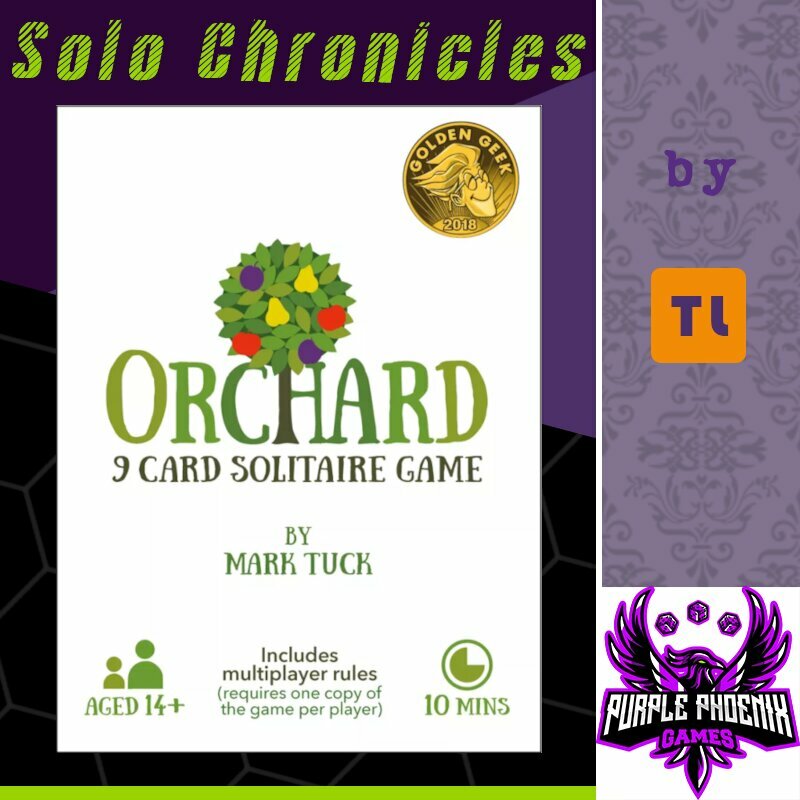
Orchard: A 9 Card Solitaire Game (simply Orchard from here on out) is a solo game where the player is attempting to harvest the most fruit from trees that are bred for high yield. As there are no players to play against, the player will instead compare their ending score with a table in the rulebook. Will the player’s game result in a “Pal-tree” score or will they score enough to be considered “Almost imposs-apple!”?
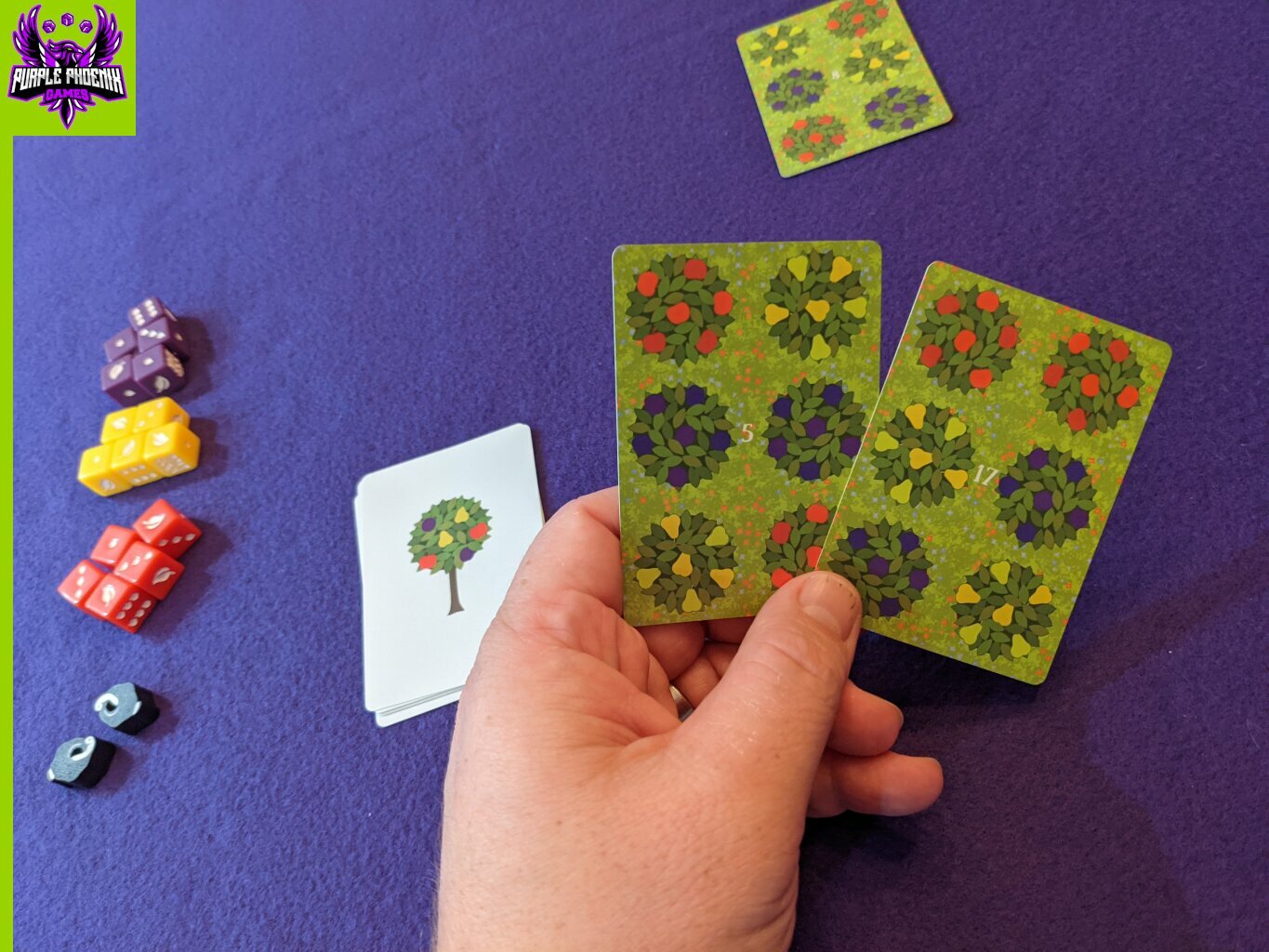
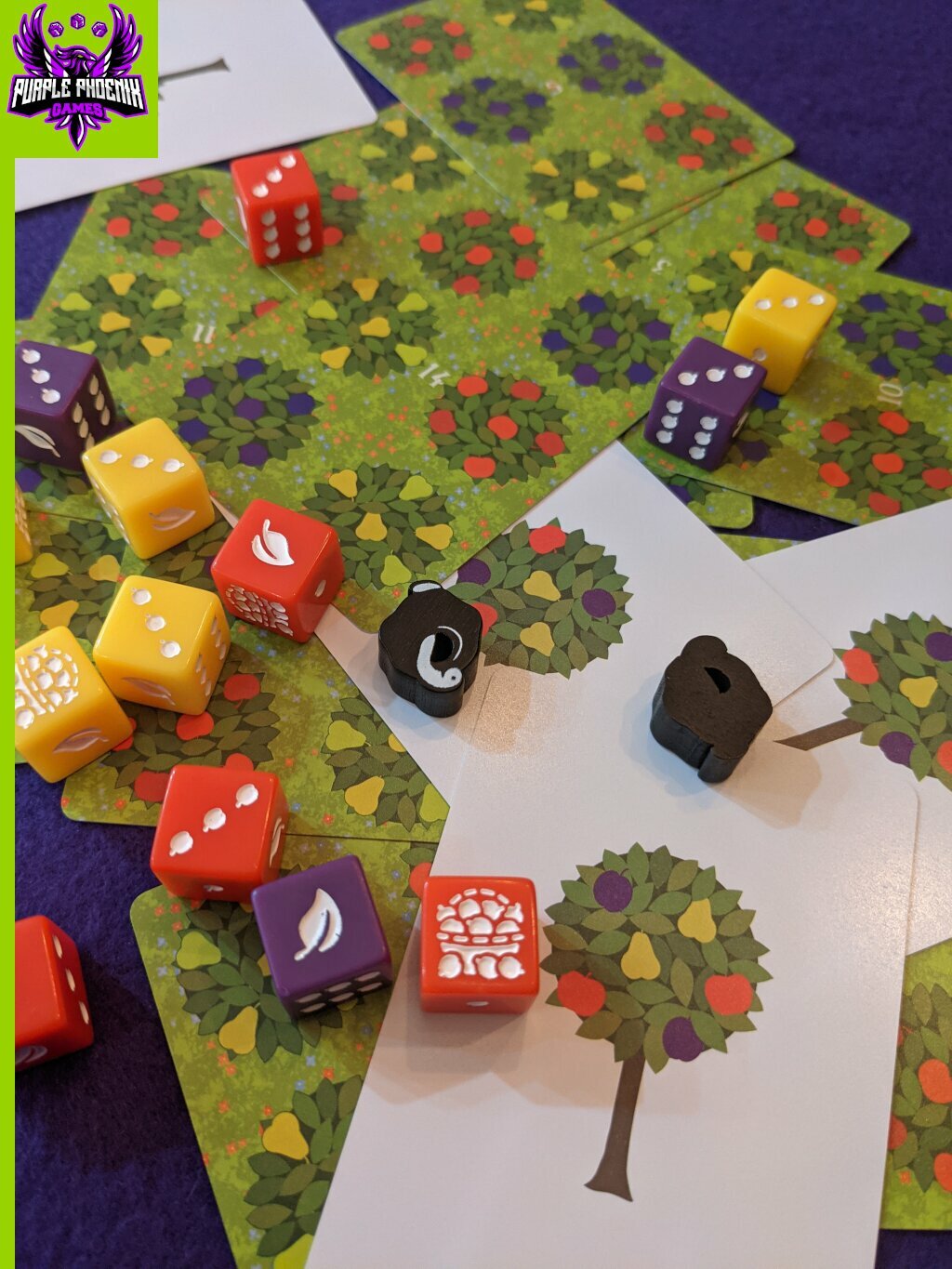
To setup, place the dice and Rotten Fruiteeple on the table. Shuffle the 18 cards, deal two decks of nine cards (two games worth), and choose a deck to play. Flip the first card over to start the orchard, shuffle the remaining cards and draw two into hand. The game is now setup and ready to begin!
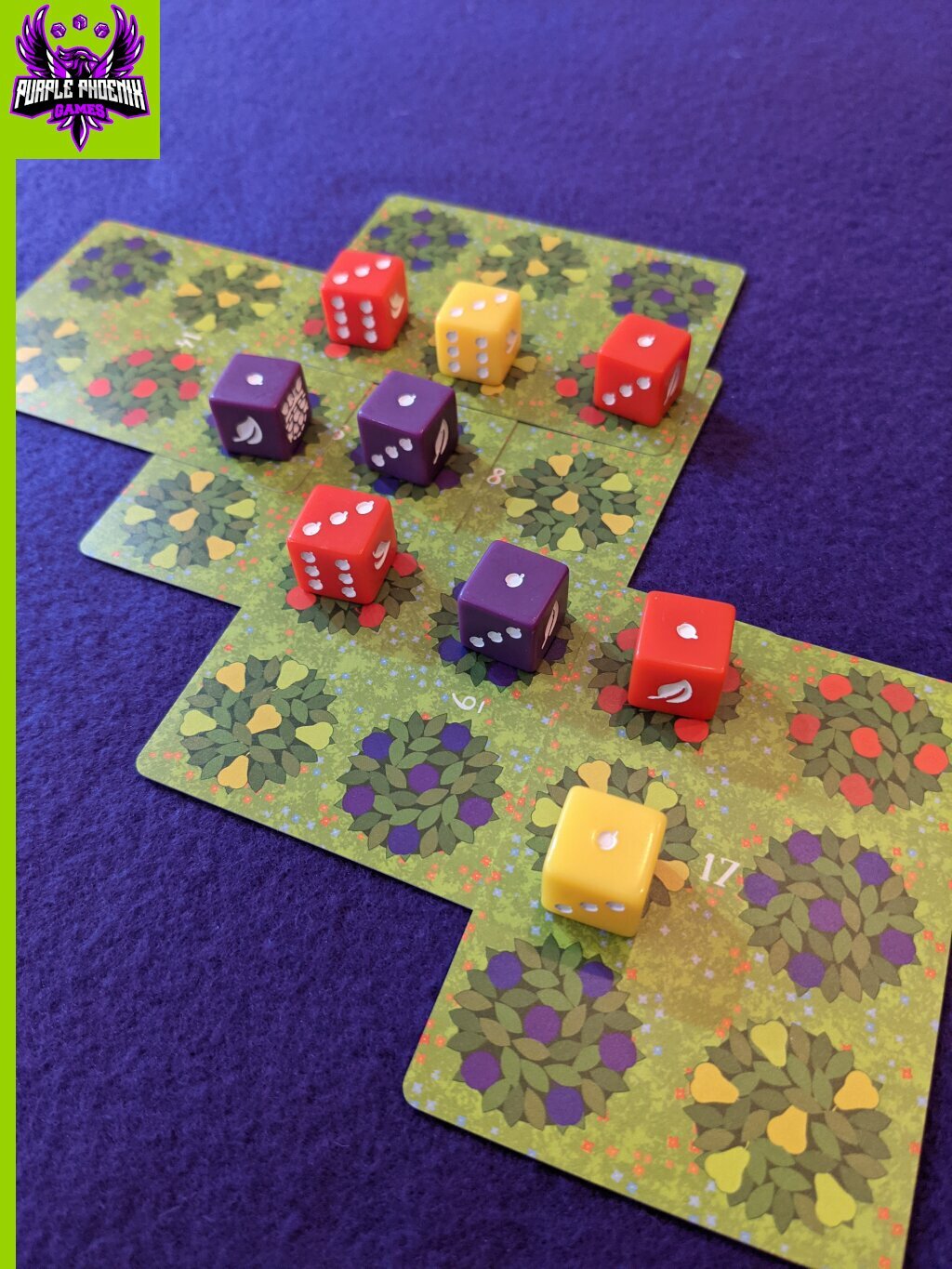
Turns in Orchard could not be simpler: Play a Card, Place Dice, Draw a Card. From the two-card hand, choose one to be placed in the orchard with one very important rule: the newly-placed card must overlap another card in the orchard by overlapping matching tree types. So, a card can only be placed if the apple tree overlaps an apple tree, etc. More than one icon may overlap the existing card, but each icon must match types below it.
Once the new card has been placed, for each icon overlapped, a die matching the fruit type is placed on the icon. If this is the first time the tree has been overlapped, the die face is placed with value 1 showing. However, the die will increase in value each subsequent time it is overlapped (total die values of 1, 3, 6, 10). Therefore, when a card has been overlapped four times on the same icon, the maximum number of points has been reached for that icon. Should a player wish instead to forego any die placement and be unable (or unwilling) to place a card correctly, they may place any card, overlap an icon, and then add a Rotten Fruiteeple atop the mismatched icon. This spoils the fruit for the remainder of the game, so no further dice may be placed upon it, and also reduces the final score by three VP at game end for each token placed.
Finally, when the card and die have been placed, the player draws another card into their hand. When the final card has been played, or no further legal placements can be made, the game ends and the player totals up the dice values to arrive at their final score.
Components. This game is 18 cards of good quality, a bunch of custom dice, and two Rotten Fruit meeples. Everything is good quality and size, and it fits into a really cool sliding deck-box. The art, for me, is fine. The colors match fruits from the real world, and the dice match those color well enough too. I feel like different fruit choices could have been made to increase accessibility for our color-blind gamer friends. The plums and apples are both small and round (with an ever-so-slight different shape on the apple). I don’t know what other fruits would have been more appropriate – I’m not a botanist. Similarly, the dice are custom made with the pips looking like a plum or apple, and two sides of the dice showing a leaf icon. Perhaps in the interest of differentiation, instead of the leaves, the different dice colors could instead show the matching fruit style (if only the plum and apple looked differently enough). So instead of leaves, the red dice could show apples, the yellow dice could show pears, and the purple dice could show, I don’t know, eggplants? I am not color-blind, so these do not affect me, but it is something I have taken to commenting on as I review more and more games.
All in all, Orchard is a really good little game of overlapping and puzzling out next moves. The games are super-quick and engaging, and I always want to improve my score each time I play. When a game forces me to play again and again I feel it is a sign of a good game. I have plans to keep this one in its own special place where I can just grab it and go, instead of being dwarfed by my collection of much larger game boxes. If you are like me and pine for good solo play, then perhaps you should check out Orchard: A 9 Card Solitaire Game. The rules are light, game play is simple and fast, and it keeps drawing me in every time I look at the box.
Also let me know your highest score because I apparently am trash at this game, even though I really enjoy playing it. Have you scored in the top tier? Those must be some delicious fruits.
Purple Phoenix Games (2266 KP) rated Hues and Cues in Tabletop Games
Jul 7, 2020 (Updated Jul 7, 2020)
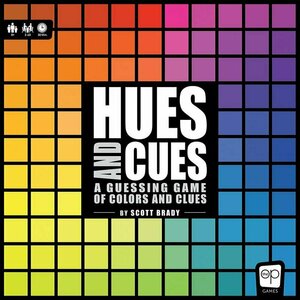

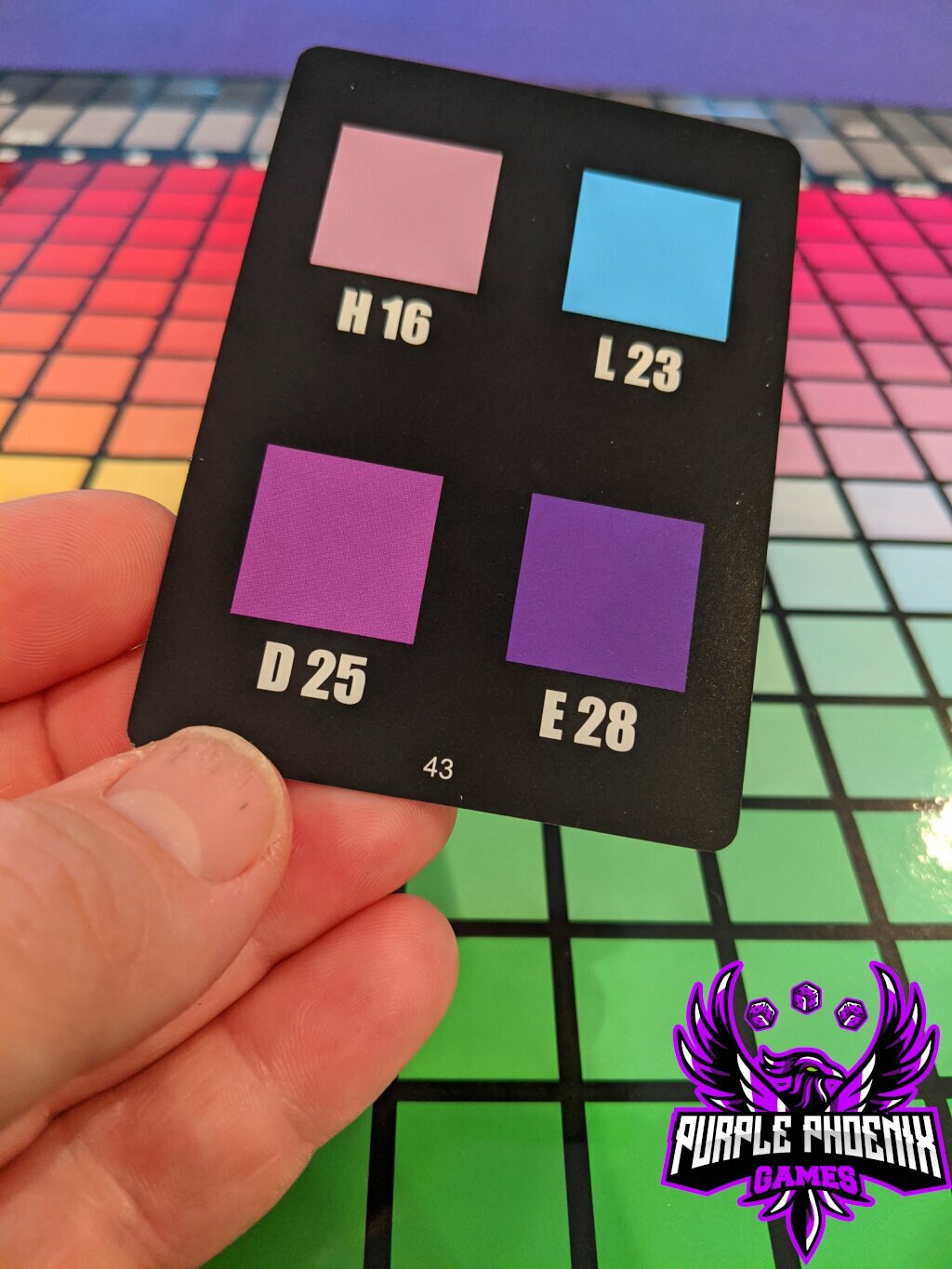
Hues and Cues is a party game of describing colors using one- and two-word cues (a la the hit game show Password from back in the day). As each player is attempting to guess the correct color, and populate the areas immediately adjacent to it, chances for big-time points are plentiful, but I’ll tell you what – coming up with cues proves to be a bit more challenging than one might assume.
DISCLAIMER: We were provided a retail copy of this game for the purposes of this review. Though I know the designer personally, I will be reviewing this game as an impartial judge. -T
To setup a game of Hues and Cues, shuffle the large deck of cue cards to be drawn from, lay out the giant board, set aside the scoring frame for now, and give each player the three cones of their selected color. Place one of these cones on the board to be used as a scoring token, and the game is ready to be played!
A game of Hues and Cues will be played over several rounds where each player will act as the cue giver for at least one round, depending on number of players (unless you play with my wife, in which case games can last many many more rounds than suggested). The cue giver will draw a card from the deck, choose a color hue from it, and think of a one-word cue to offer the group. Once the cue is given, in clockwise fashion, each other player will place one of their cones on a color box on the main board. Once complete, the cue giver will then offer a two-word cue to the group, if they so choose… Again the players will place their other cone in a box (either near their original choice or somewhere completely different). When all players have placed their second cone, the cue giver will place upon the board the scoring frame with the chosen hue’s coordinates directly in the center of the frame.
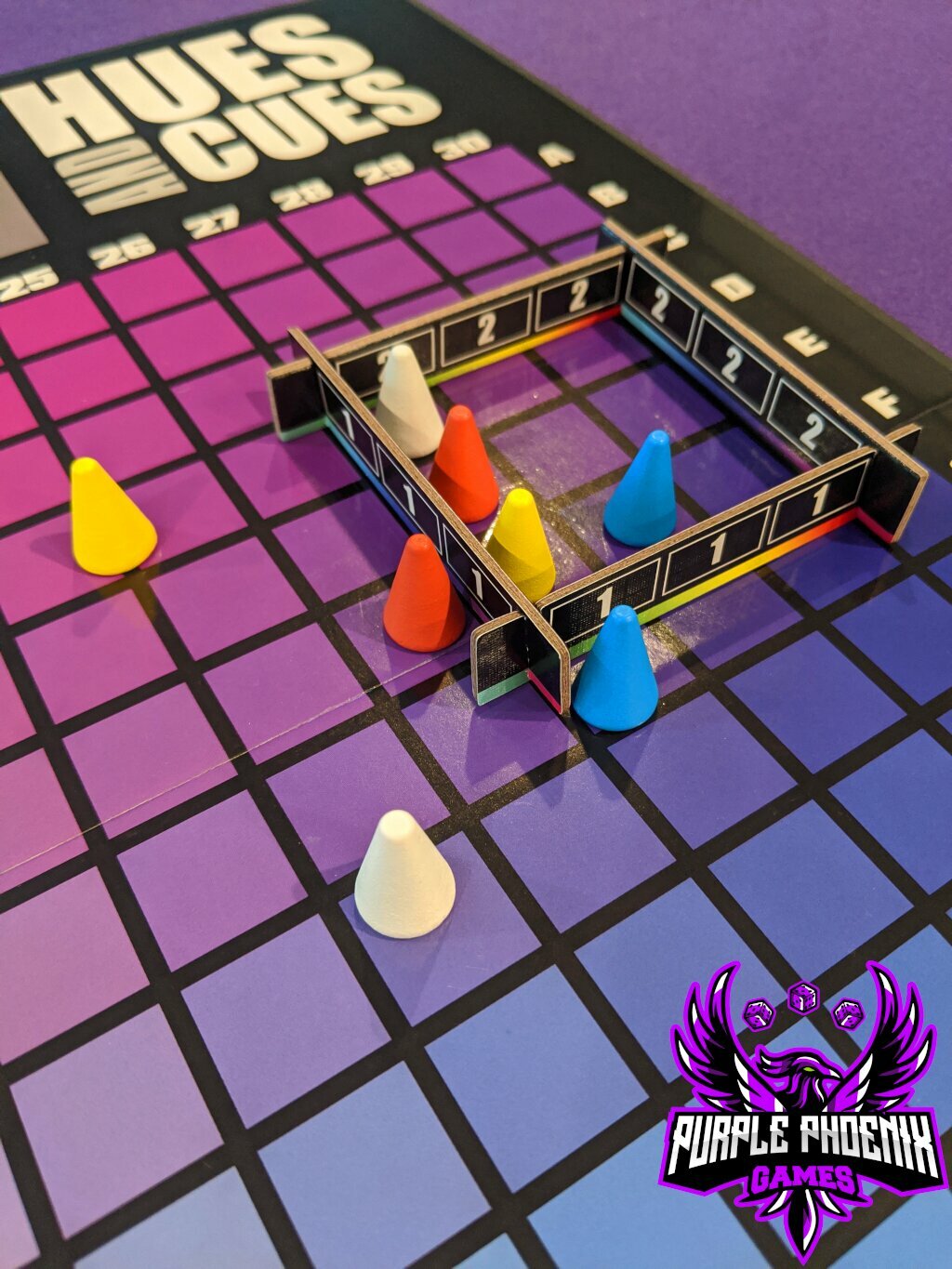
If a player has placed a cone directly on the correct coordinate box, they score 3 points. If a cone resides within the scoring frame (the other 8 boxes surrounding the correct box), they receive 2 points. For every cone just outside the scoring frame surrounding it, the player will receive 1 point. For each cone within the scoring frame the cue giver will score 1 point.
The game ends after each player has had one or two turns to be cue giver, depending on player count and house rules for game end rounds. The player with the most points will be deemed the winner and will have quality bragging rights for the night.
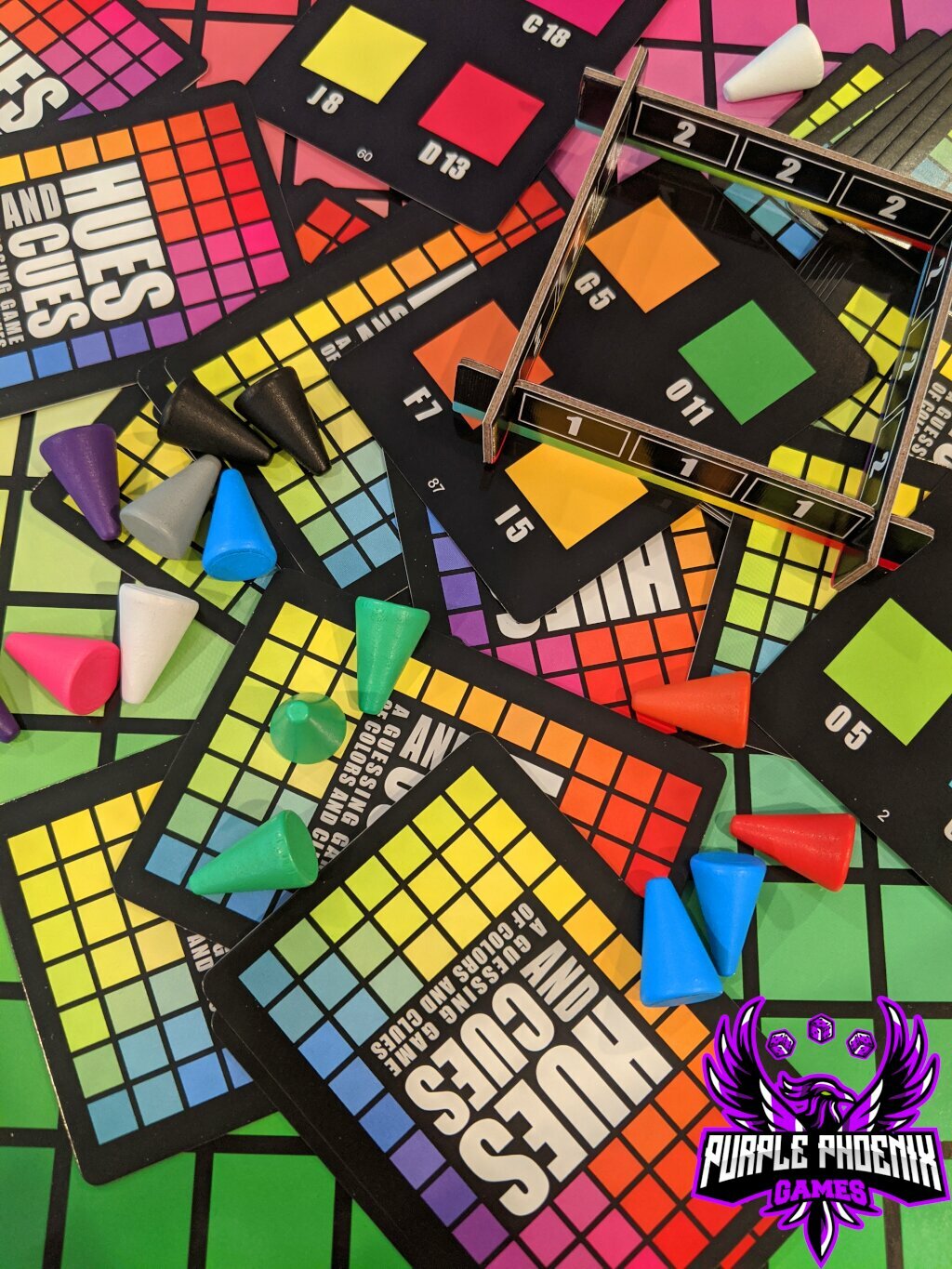
Components. Guys and gals, these components are great. The board is HUGE, but also necessary because there are tons of color hues printed on it. The cards are nice, and the game comes with a giant stack of them. The cones are colored cones. There’s orange and purple and some others colors I think too (I really only care about orange and purple usually). The scoring frame takes a bit to get used to, but is necessary to visualize which cones receive the correct amount of points. The Op comes through again with some choice components here.
So again, I personally know the designer and want to offer that disclaimer. That said, whether I know him or not, this is another great game. I reviewed Gekitai some months ago and was enamored with it as a wonderful abstract, and Hues and Cues gets me again. I love the components, the game play is simple and fast, and I haven’t really played a game too similar. I guess the closest games I can compare it to would be Concept and Codenames. You have to be very exact when giving cues to others (Concept) using one-word and two-word cues (Codenames). It seems super easy to be able to describe a color, but when you look at your chosen hue and can’t even think of a one-word cue and you’re just sitting there while the other players are anxiously awaiting your utterance, you can feel the confidence sweating out of your body.
For one example of actual gameplay, a cue was given, “Western.” My wife and I, alums of Western Illinois University, immediately started finding the correct purple hue because WIU’s colors are purple and gold. However, another player started searching the browns because they thought the cue was guiding the players to Western movies or the Wild West. So there may be conflicts, or different ideas and interpretations of the cues given that can make the whole group giggle incessantly, or times where the game is near the end and you know you need at least 3 points to be in the running and you reallllllly want to hit on the exact hue. So this one can make you feel like you are Bob Ross colormaster, or like you can’t even remember what red even is anymore.
That said, this is NOT a game for our colorblind friends, as it revolved heavily on being able to distinguish color differences, but for everyone else this is a hit. I love that I have to think of things and items and concepts in terms of color to describe instead of any other values, and that is very challenging for me. I love being able to look at the board and have 20 options when the cue given is, “Penny.” I love laughing at some of the amusing cues given or trying to figure out what the hey someone even means with their cues. It’s a wonderful stressful game (for me and the way my mind works) but it has gone over smashingly with everyone to whom I have introduced it. If you are looking for a uniquely-themed party (!) game that isn’t an Apples to Apples or Mafia clone, then you certainly owe it to yourself to check out Hues and Cues. Purple Phoenix Games gives this one a rainbowy 11 / 12. Hugh Jackman would certainly approve, and would probably like to come to your house to play your copy.
Cookie Calls
Games and Education
App
This is an app full of fun phone calls from Cookie Monster, which will help teach your child about...

RəX Regent (349 KP) rated The Wicker Man (1973) in Movies
Feb 18, 2019
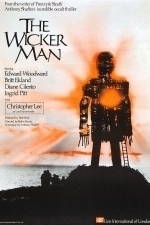

But if you are expecting some dimly lit, slow burn slasher movie, then you will be sorely disappointed. The Wicker Man spends most of its runtime, which varies from its various versions, Theatrical, Director’s and Final Cuts, providing us with a pretty decent, if not disturbing insight into paganism.
Or more over, Paganism verses Christianity. Both spiritual, both magical, yet one is fun and the other is boring. The virgin sacrifice by the sexually liberated heathens is played out brilliantly.
The beauty here is that the final twist is so well conceived and executed throughout the entire film that even though most of us know the ending whether we have seen the film or not, it is not spoiled by that foreknowledge.
It is a kin to the previously released Planet Of The Apes (1968) or the much later Sixth Sense (1999). Both spin out complex genre tales which culminate in “that ending”. But in this case, Edward Woodward delivers a chilling performance in the finale, as he is taken to his death, locked inside the burning Wicker Man to be sacrificed in order to restore the poor harvest of the previous year.
“Don’t you see that killing me is not going to bring back your apples?”
But Woodward’s character is a devout Christian and he has only his faith and a dogged view of the world to aide him. Unable to accept the seemingly free spirited community in which his finds himself, one where sex is commonplace as he himself is still a virgin.
On the other hand there is Lord Summerisle, Christopher Lee, who steals the show as per usual as the charismatic leader of the this pagan community and the descendant of a lord who routed Christianity from the Highland Island a century before.
But whilst on the surface it may seem like a rather academic subject, the film is a trippy 1970’s sexploitation movie in many ways. Some of the sex and violence fits in well with plot but other moments, such as the nude dance by Britt Ekland, though actually doubled by Lorraine Peters is a prime example of a needless, if not memorable sequence.
Overall, The Wicker Man is low budget British movie of the 1970’s and one which has endured to earn it’s classic status, by meeting the main criteria of being smart, engaging and visually compelling, along with several standout performances throughout.


Stepz - Step Counter
Health & Fitness and Lifestyle
App
Stepz is a convenient step counter app that leverages the clever Apple Motion Coprocessor which...

The Math Tree
Education and Games
App
Come learn arithmetic with The Math Tree! Add and subtract bluebirds, doves, plums, peaches and more...

Gareth von Kallenbach (980 KP) rated Pete's Dragon (2016) in Movies
Aug 6, 2019

39 years after the original, David Lowery brings us the re-invention of Pete’s Dragon. His aim was not to remake the original film, but to reinvent it. And that he did. PD opens up with a family traveling through a forest on a road trip. The young boy, Pete (Levi Alexander) is reading from a book about a lost puppy name Elliot. A tragic accident occurs, which leaves Pete by himself in the forest. As he starts to wander, a pack of wolves begins to close in on him, only to be thwarted by… you guessed it. A dragon.
Flash forward 6 years, and we now see an older Pete (Oakes Fegley) running around through the forest with Elliot, the dragon who he bonded with over the years. Pete happens upon a forest ranger, Grace (Bryce Dallas Howard) as she is scouting the forest, unmarking trees that were marked for cut down. She’s not a rebel, just protecting the habitat of an owl. Turns out her fiancé, Jack (Wes Bentley), and his brother, Gavin (Karl Urban), run the company that is tearing down the forest. One day, they happen upon Pete and bring him home, but Pete misses Elliot, and Elliot misses Pete. In an effort to get back to him, Elliot is discovered by Gavin who wants to hunt down Pete and bring him in. Grace seeks assistance from her father, Meachum (Robert Redford), who was always thought of as a crazy old man with his wild story of a dragon he met so many years ago. Can they help save Elliot from Gavin and his men?
While a little darker than the original, I found that I enjoyed this movie quite a lot. There are some plot holes to consider, and a little unbelievable on how fast the story develops in time passed in the universe set up here, but you have to understand that this movie is geared toward children. And I think they did well in creating an entertaining film for children and nostalgic adults alike. In fact, this screening was the quietest family screening I have ever attended. There were plenty of kids in the audience, but they were captivated.
Keeping in mind that this is truly a children’s movie, my biggest gripe was the absence of my favorite scene from the original (scorched apples, anyone?). But all in all, it is definitely something to get out to theaters to see. Lowery had indicated that he chose the appearance for Elliot as he did because he wanted to portray a dragon you could hug. Success, Mr. Lowery. Success. Pete’s Dragon is good fun for the whole family, so what are you waiting for? Go see it, already.

Fair Food Maker Game
Games and Entertainment
App
Play the BIGGEST and BEST Fair Food Maker chef game! Make 18 delicious fair foods and 8 fair games...