

The Emergence of Routines: Entrepreneurship, Organization, and Business History
Daniel M. G. Raff and Philip Scranton
Book
This book is a collection of essays about the emergence of routines and, more generally, about...
Public Policies for Food Sovereignty: Social Movements and the State
Annette Aurelie Desmarais, Priscilla Claeys and Amy Trauger
Book
An increasing number of rural and urban-based movements are realizing some political traction in...
The Mixer: The Story of Premier League Tactics, from Route One to False Nines
Book
An absolutely essential book for every modern football fan, about the development of Premier League...
sports

Kristy H (1252 KP) rated The Grace Year in Books
Sep 26, 2019


"No one speaks of the grace year. It's forbidden."
I really liked the premise of this book. I'm sure you've heard all the comparisons by now. This is "The Handmaid's Tale" plus "Lord of the Flies." Throw a little "Hunger Games" in. Sold, right? The idea that society sends girls away at sixteen to rid themselves of their "magic"--it sounds really cool. A society that fears women and takes away their status, yet relies on their parts (literally) as medicine. Yes. So much of this book is really amazing. I highlighted so many powerful lines.
But, I don't know, guys... I am still wrapping my brain around this one. I just couldn't get into it. I never wanted to pick it up--I should have cared deeply for Trinity, and I did. Sometimes. Part of the reason I had problems going back to the book was because it stressed me out. These girls were mean. Sometimes I was confused. We were thrown into the story without any backstory--what time period, why they think women have magic, why medicine consists of body parts, who are the poachers, what are the outskirts, why is the original language flowers, etc. I guess that adds to the mystique, but I don't like reading when I can't figure anything out.
"But not all of us will make it home... not in one piece."
It seemed like this was going to be a power anthem. The girls rise against society. Or maybe just Trinity escapes and the outskirts rise against society. Someone should be revolting, right? And yes, Trinity definitely had her awesome moments. But it also seemed like there were lots of moments that involved rescue--by men. There's also a really convenient insta-romance in here. Everything just seemed a little jumbled and crazy for my taste. There's some amazing, underlining worthy lines and then some that just make you cringe a bit.
So, overall, I'm not totally sold, though there's potential here. I rate based on my enjoyment, so this is a 3-star read for me. But it's getting lots of rave reviews from others, so don't let my review necessarily hold you back.
Data Mining for Business Analytics: Concepts, Techniques, and Applications with JMP Pro
Galit Shmueli, Nitin R. Patel, Peter C. Bruce and Mia L. Stephens
Book
Data Mining for Business Analytics: Concepts, Techniques, and Applications with JMP Pro(R) presents...

Die große Wörterfabrik
Book and Games
App
NEW: Now for iPad AND iPhone - You can now install this app on both your iPad and on your iPhone. ...

Emma @ The Movies (1786 KP) rated A Simple Favor (2018) in Movies
Sep 25, 2019
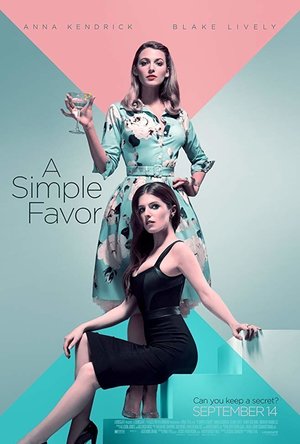

There's no denying that this is an entertaining film. There's also no denying that it's predictable. Even without knowing the plot you can basically guess the way it's going to progress.
Blake Lively is amazing though. I honestly thought I'd never seen her in anything, but of course she's been in Green Lantern and Accepted. The latter being a favourite and the former... well, I thought Deadpool had taken care of that one for us... oh well. She does a great job of her role in this one. You can see her devious nature in the way she interacts with everyone and she really does improve the scenes she's in.
I love Anna Kendrick, she's funny and very talented but I wasn't overly keen on her character in this. While I understand that Stephanie takes a major character shift when she realises what has happened, I didn't enjoy the way they did that on the screen. There were some baby steps followed by some huge leaps. At one point I was convinced that they'd gone... "Anna Kendrick always sings... we should get some of that in there." I don't feel like it added anything to the film at all. I'd be interested to see how her character unfolds in the book.
The humour in it is entertaining but the side story of the other "mums" and particularly their inclusion in the summing up of the story feels out of place and more comedy than was right for this film.
Rating this one is tricky. Apart from those odd bits I didn't hate the film and none of it was badly dont... but I don't think I enjoyed it either. I took the evening to think it over and honestly I'm still not sure so therefore it's sitting at the three and a half mark. There's an outside possibility that I'll watch it again to see if I can figure it out, but I don't think it'll be any time soon unless I'm really at a loose end.
Based on the book A Simple Favour by Darcey Bell.
What should you do?
I personally wouldn't recommend watching this until it's streaming. But plenty of other people would disagree with me on that.
Movie thing you wish you could take home
Emily and Sean's house. Although I'm baffled as to why the kitchen is so small so I'd probably expand into the living room space.

Connor Sheffield (293 KP) rated Assassin's Creed: The Official Movie Novelization in Books
May 21, 2017
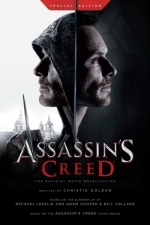

With that said, I turned my attention to the novel, and pre-ordered the special edition because I knew it would make a great addition to my collection of Assassin's Creed novels, and I wanted everything I could possibly get from the novel. I love all the behind the scenes features on a DVD/Blu Ray and when I heard that this book contained some BHS content I wanted it so badly that I made sure I got the special edition despite the addition to the price.
The adaptation of the Film to the novel, is incredible. When Movies are adapted from Books, there will always be the person with you that says "The Book is always better". Sometimes, in the vice versa of this situation, when books are adapted from films, it doesn't always add anything more to make the film's plot better, or give you anything else to think about. This book is something else entirely.
In the movie we are introduced to so many characters, and so many sub plots that just can't be explored in the film itself, because it would be what I and others like to call, a cluster fuck. There would far too much going on, and people already seemed confused by the simple plot of the film, that the addition of these subplots would have given them a headache and everything they needed to see to enjoy the movie would be lost even further, as people would walk out of the cinemas saying "What the heck did I just watch?". Books allow the writer and the reader the freedom to explore these subplots and open up our experience to these other characters such as Moussa, Emir, Nathan, and Lin. If you don't even know these names, that's because the film didn't get the opportunity to express to you the importance of these names, whilst introducing them in a way that you only really remember them as, 'The other assassins in the facility who organize the breakout of Abstergo finale'.
However these characters each have their own Assassin ancestors, at least two of which are heavily connected to the video games. Lin's ancestor, is Shao Jun, the protagonist who you play as in Assassin's Creed Chronicles: China. Emir's ancestor, is a Turkish Assassin named Yusuf, the same Yusuf who you befriend in Assassin's Creed: Revelations, whilst playing as an older Ezio Auditore in his final video game to end the Ezio Trilogy. In the movie's special features, there is a deleted scene in which Cal is able to see these ancestors, during the common room scene as he is trying to eat his steak. However it was taken out due to it not making much sense for him to be able to see other people ancestors via the bleeding effect. The novel on the other hand, doesn't need this scene, and instead the reader is treated to the thoughts and a little backstory to each of these modern day assassins, and how they had felt after being introduced to their ancestors, and how they connected to them through their own lives.
We learn even more about the films central characters as well, mainly Aguilar, Sofia and Callum Lynch, and the novel adaptation gives us a new view on their relationship as a whole. Sofia feels emotions she has never felt with other patients. Callum has a lot running through his mind that just can't be spoken or portrayed in the film. Aguilar's relationship to his fellow Assassin Maria is opened up to us, with us learning that they had been very intimate, and that despite never truly portraying their love for one another, the two assassins knew what the other was thinking and they moved and thought in unison with one another, which makes the final memory sequence, that much more heart breaking, and powerful.
The book grants us access to everything, and this is what makes it such a thrilling read. From start to finish I just wanted to read on and on, despite how heavy my eyes felt at night, tucked up in bed. It grips you and pulls you into the exciting journey of the beautifully written emotional rollercoster. Christie Golden, known for her own literary work and for her work on other franchise based novels, including Star Wars, World of Warcraft and Star Trek, has done a fantastic job at expanded the movie into a new experience, which even I wasn't expecting, and I've watched the film twice in the cinema and about 7 times since the day of it's digital release, March 10, 2017. I really do love this book and everything it has to offer.
My only bad point, which is personal to me, as I have theories about certain points of this movie, and I was hoping it would help answer some of my theories. However, whilst it expanded on them a little, giving more evidence to support one of my theories, it simply left more questions than answers. That is no fault of the writer or her work, but simply to my own inquisitive mind. The book overall has no faults in my opinion.
If you enjoyed the movie, you'll love the book more. If you didn't enjoy the movie, give the book a try. It might surprise you.

Bob Mann (459 KP) rated Denial (2016) in Movies
Sep 29, 2021
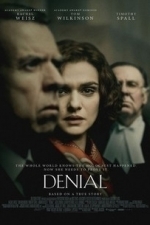

Help is required and Lipstadt is assigned a hot-shot solicitor (if that’s not an oxymoron) in the form of Anthony Julius (Andrew Scott, “Sherlock”) and top barrister Richard Rampton (Tom Wilkinson, “Selma“). The stage is set for an epic legal battle that will establish not just legal precedent but also historical precedent affecting the entire Jewish people.
This film’s trailer really appealed to me, and I was looking forward to this film. And that view clearly also got through to people of my age bracket (and older) since the cinema was pretty full. But ultimately I was disappointed by the film.
But first the good points.
The cinematography by Haris Zambarloukos (“Thor”, “Mamma Mia”) is memorable, particularly for the Auschwitz tour which is done in an impressively bleak way on an astoundingly bleak winter’s day.
Andrew Scott, so woefully miscast as “C” in “Spectre“, here is a nice shoo-in for the cocksure but aloof expert. And Tom Wilkinson, who can seldom put a movie foot wrong, is also perfectly cast as the claret-swigging defence-lead: passionless and analytical even when facing the horrors of a trip to Auschwitz.
Timothy Spall’s Irving is well portrayed as the intelligent and articulate – albeit deluded – eccentric he no doubt is.
There are also some nice cameo performances, including John Sessions (“Florence Foster Jenkins“) as an Oxbridge history boffin and Mark Gatiss (“Sherlock”) as an Auschwitz expert.
However, these positives don’t outweigh the big negative that the broader ensemble cast never really gels together well. The first time this is evident is in an office meeting of the defence team where the interactions have a sheen of falseness about them that is barely hidden behind some weak script and forced nervous laughter. Tea can’t help.
In particular, attractive Kiwi actress Caren Pistorius (“The Light Between Oceans“) seems to have been given a poor hand to play with as the junior member of the team. A late night interaction with her boyfriend, who whinges at her for having to work late, seems to be taken from a more sexist age: “the 70’s called and they want their script back”.
None of this is helped by Rachel Weisz, who I’m normally a fan of, but here she is hindered by some rather dodgy lines by David Hare (“The Reader”) and an unconvincing (well, to me at least) New York accent. For me I’m afraid she just doesn’t seem to adequately convey her passion for the cause.
While the execution of the court scenes are well done, the film is hampered by its opening five words: “Based on a True Story”. This is something of a disease at the moment in the movies, and whilst in many films (the recent “Lion” for example) the story is in the journey rather than the result, with “Denial” the story is designed to build to a tense result that unfortunately lacks any sort of tension – since the result is pre-ordained.
This is all a great shame, since director Mick Jackson (“LA Story”, in his first feature for nearly 15 years) has the potential here for a great movie. Perhaps a more fictionalised version (“vaguely based on a true story”) might have provided more of a foundation for a better film?
The Gourmands’ Way: Six Americans in Paris and the Birth of a New Gastronomy
Book
“In The Gourmands’ Way, Justin Spring brilliantly recounts the French odyssey of six remarkable...
Biography food