Search
Search results

Purple Phoenix Games (2266 KP) rated Peak Oil Profiteer in Tabletop Games
Jun 11, 2021


One of the most important energy resources in the world is oil. We have a finite amount, it is used in our everyday lives, and it is always in demand. So imagine if a country found a new supply of oil – everyone would be fighting for a piece! Enter Peak Oil Profiteer, a game that puts you in charge of an oil corporation vying for money and oil in this new-found oil vein. Sound like something you might be interested in? Keep reading and see what it’s all about!
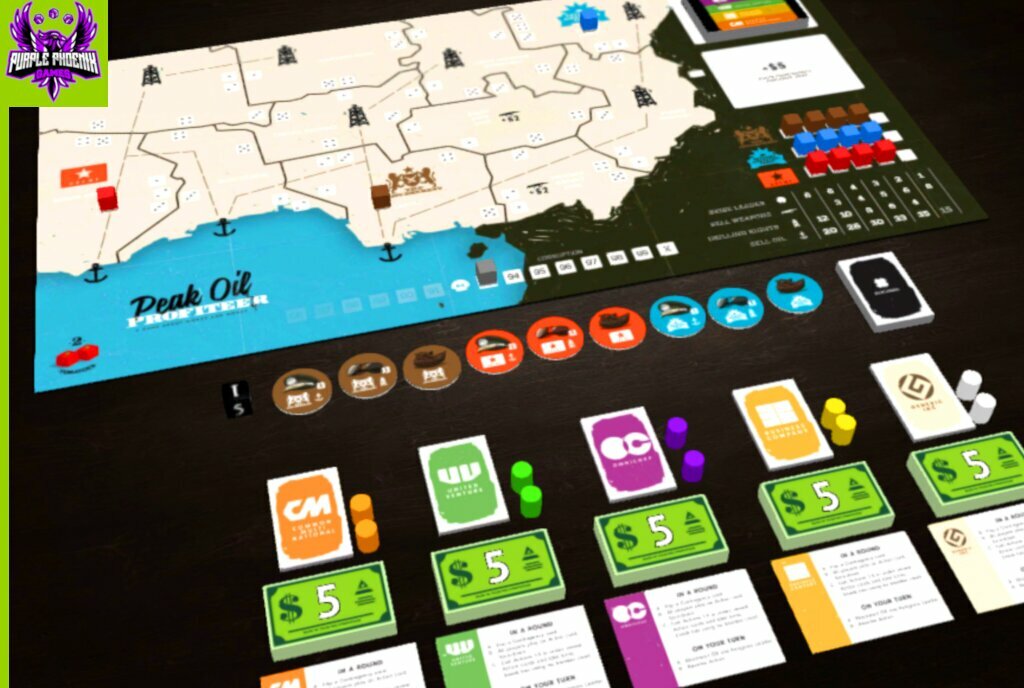
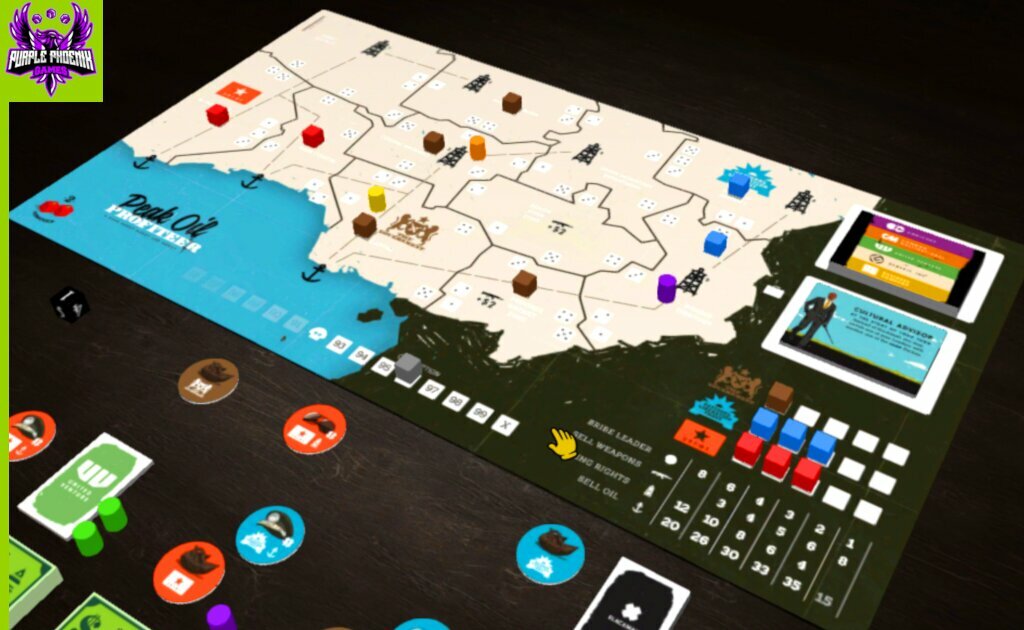
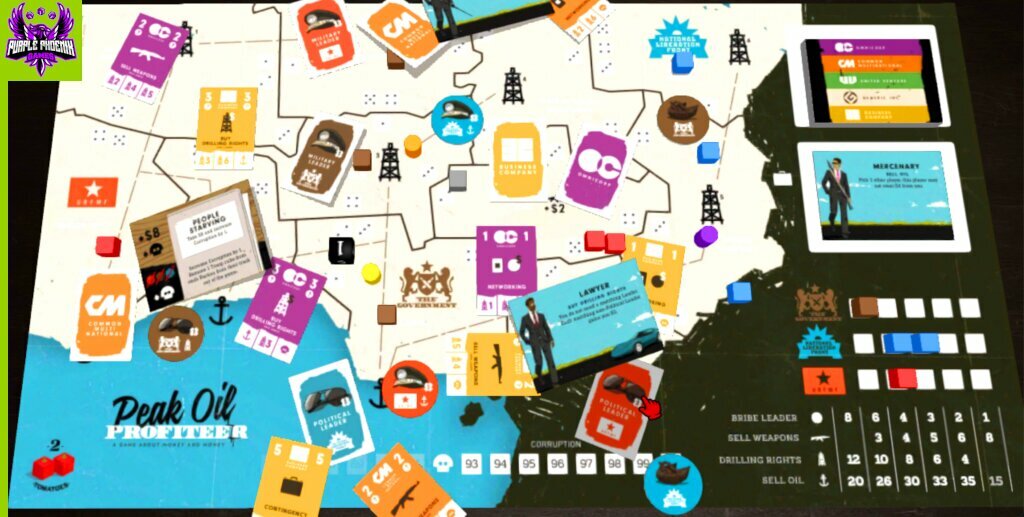
Disclaimer: For this preview, we played the Tabletopia version of the game. The pictures you will see below are screenshots from my plays online. Also, I do not intend to rehash the entire rulebook, but rather provide a general overview of the rules and gameplay. For a more in-depth look, check it out when it hits Kickstarter! -L
Peak Oil Profiteer is an economic game of area majority/movement, network building, and simultaneous action selection in which players take on the roles of oil corporations competing to make the most money in an oil-rich country before corruption overtakes the land. There is a power struggle between 3 Factions, so play your cards right (literally) to come out ahead. To setup for a game, set the board in the middle of the table, populate the 3 Faction Tracks with their corresponding cubes, place the Corruption cube on 93%, create the Contingency deck (as described in the rules), shuffle the Blackmail deck, and give each player their 5 Action cards, starting Money, and 3 Pawns in their color. Flip all 9 Leader tokens face-down, shuffle them, and randomly give one to each player, placing the remaining Leader tokens face-up near the board.
The game is played over a series of rounds. At the start of every round, one card from the Contingency deck will be revealed/resolved. Contingency cards will either be Events (that will most likely alter the rules for the current round), or Consultants (to be ‘hired’ by an individual player for special abilities). Once the Contingency card has been dealt with, the round moves to the next phase: Action Selection. All players have the same 5 Action cards, numbered 1-5, available to them every round. Players will select one of their 5 Action cards and place it face-down in front of them. Then, in numerical order, all Action cards will be resolved. When your Action number has been called, you will reveal your Action card, perform the corresponding action, and take the card back into your hand. Once all players have performed their Action for the round, check the Corruption track – if it has reached 100% then the game ends, and if not then the game moves to a new round.
The 5 Actions available to all player are: 1. Networking, 2. Sell Weapons, 3. Buy Drilling Rights, 4. Sell Oil, and 5. Contingency. Networking allows you to collect Blackmail in order to win control of Faction Leaders. You may only Sell Weapons to a Faction if you control at least one of its Leaders. You will earn a set amount of Money, and a new Troop cube will be added to the game board. To Buy Drilling Rights from a Faction, you again need to control at least one of its Leaders. Pay for the rights, and then add one of your Pawns to that region of the board. Once you’ve got Drilling Rights, you can Sell Oil. Remove your Pawn from the corresponding region, and collect the appropriate amount of Money. And lastly, Contingency allows you to either ‘hire’ a Consultant, or perform an extra action as a result of an Event.
The amount of Money that you pay/earn for each of the actions is dictated by the Faction Tracks. For example, the price of Weapons decreases as Factions get more Troops on the board, which means you won’t earn as much selling to a Faction with lots of Troops in play. You have to time your Actions wisely in order to maximize your profit! If, at the end of a round, the Corruption track has reached 100%, the game ends. Players count up their Money, and the player with the highest earnings is declared the winner.
Although the theme isn’t something that would normally appeal to me, I have to say that Peak Oil
Profiteer is a solid game. The gameplay is straightforward, the player interaction is competitive but not combative, and the strategy keeps you engaged all game. The ultimate goal is to earn the most Money, and the Faction Track creates sort of a “commodity speculation” type mechanic to the gameplay. The costs vary depending on the Faction Track, and it can be manipulated by all players. That in and of itself creates some fun player interaction because the Faction Track affects all players. Doing something to block an opponent now may come back to bite you next round. Another neat element about Peak Oil Profiteer is that players select their Actions simultaneously, and they are then resolved in numerical order. Depending on where your turn falls in the round, you might be able to do just what you had planned, unless an opponent went before you and changed the game layout. There is an amount of uncertainty that forces players to adjust their strategy on the fly and adapt to the current situation.
I will say that resolving Actions in numerical order does kind of add an element of Action Programming, if you will. Once you have selected your Action this round, you are locked in. No matter what happens before your turn, you must perform your selected Action if at all possible. It creates some neat strategic opportunities, but at the same time, can feel like you’ve been blocked out. Just something to consider! Normally, I would touch on components, but as this was a Tabletopia version of the game, I can’t really do so. I will say that the art style and card/board layouts online are thematic and immersive. If the physical version of the game looks anything like this digital version, it’ll be a good looking game! One component that I especially appreciated was that each player gets a Player Reference/Round Reference card. It gives you the information you need without being too wordy, and it stops you from having to refer back to the rule book every turn. So big thanks from me for that!
Having never played the original Peak Oil game, I have to say that Peak Oil Profiteer made a good impression on me. It’s fast to teach and learn, engaging, and strategic enough to keep you thinking. The fluctuation of the Faction Track, and the order of Action resolution add elements of uncertainty and ‘luck’ (if you will) that keep the game from having a clear run-away winner. Everyone is in it until the very end, and the race for the most Money is a nail-biter for sure. If you’re looking for something interactive but not too confrontational, while also putting your strategic chops to the test, consider backing Peak Oil Profiteer on Kickstarter!
Disclaimer: For this preview, we played the Tabletopia version of the game. The pictures you will see below are screenshots from my plays online. Also, I do not intend to rehash the entire rulebook, but rather provide a general overview of the rules and gameplay. For a more in-depth look, check it out when it hits Kickstarter! -L
Peak Oil Profiteer is an economic game of area majority/movement, network building, and simultaneous action selection in which players take on the roles of oil corporations competing to make the most money in an oil-rich country before corruption overtakes the land. There is a power struggle between 3 Factions, so play your cards right (literally) to come out ahead. To setup for a game, set the board in the middle of the table, populate the 3 Faction Tracks with their corresponding cubes, place the Corruption cube on 93%, create the Contingency deck (as described in the rules), shuffle the Blackmail deck, and give each player their 5 Action cards, starting Money, and 3 Pawns in their color. Flip all 9 Leader tokens face-down, shuffle them, and randomly give one to each player, placing the remaining Leader tokens face-up near the board.
The game is played over a series of rounds. At the start of every round, one card from the Contingency deck will be revealed/resolved. Contingency cards will either be Events (that will most likely alter the rules for the current round), or Consultants (to be ‘hired’ by an individual player for special abilities). Once the Contingency card has been dealt with, the round moves to the next phase: Action Selection. All players have the same 5 Action cards, numbered 1-5, available to them every round. Players will select one of their 5 Action cards and place it face-down in front of them. Then, in numerical order, all Action cards will be resolved. When your Action number has been called, you will reveal your Action card, perform the corresponding action, and take the card back into your hand. Once all players have performed their Action for the round, check the Corruption track – if it has reached 100% then the game ends, and if not then the game moves to a new round.
The 5 Actions available to all player are: 1. Networking, 2. Sell Weapons, 3. Buy Drilling Rights, 4. Sell Oil, and 5. Contingency. Networking allows you to collect Blackmail in order to win control of Faction Leaders. You may only Sell Weapons to a Faction if you control at least one of its Leaders. You will earn a set amount of Money, and a new Troop cube will be added to the game board. To Buy Drilling Rights from a Faction, you again need to control at least one of its Leaders. Pay for the rights, and then add one of your Pawns to that region of the board. Once you’ve got Drilling Rights, you can Sell Oil. Remove your Pawn from the corresponding region, and collect the appropriate amount of Money. And lastly, Contingency allows you to either ‘hire’ a Consultant, or perform an extra action as a result of an Event.
The amount of Money that you pay/earn for each of the actions is dictated by the Faction Tracks. For example, the price of Weapons decreases as Factions get more Troops on the board, which means you won’t earn as much selling to a Faction with lots of Troops in play. You have to time your Actions wisely in order to maximize your profit! If, at the end of a round, the Corruption track has reached 100%, the game ends. Players count up their Money, and the player with the highest earnings is declared the winner.
Although the theme isn’t something that would normally appeal to me, I have to say that Peak Oil
Profiteer is a solid game. The gameplay is straightforward, the player interaction is competitive but not combative, and the strategy keeps you engaged all game. The ultimate goal is to earn the most Money, and the Faction Track creates sort of a “commodity speculation” type mechanic to the gameplay. The costs vary depending on the Faction Track, and it can be manipulated by all players. That in and of itself creates some fun player interaction because the Faction Track affects all players. Doing something to block an opponent now may come back to bite you next round. Another neat element about Peak Oil Profiteer is that players select their Actions simultaneously, and they are then resolved in numerical order. Depending on where your turn falls in the round, you might be able to do just what you had planned, unless an opponent went before you and changed the game layout. There is an amount of uncertainty that forces players to adjust their strategy on the fly and adapt to the current situation.
I will say that resolving Actions in numerical order does kind of add an element of Action Programming, if you will. Once you have selected your Action this round, you are locked in. No matter what happens before your turn, you must perform your selected Action if at all possible. It creates some neat strategic opportunities, but at the same time, can feel like you’ve been blocked out. Just something to consider! Normally, I would touch on components, but as this was a Tabletopia version of the game, I can’t really do so. I will say that the art style and card/board layouts online are thematic and immersive. If the physical version of the game looks anything like this digital version, it’ll be a good looking game! One component that I especially appreciated was that each player gets a Player Reference/Round Reference card. It gives you the information you need without being too wordy, and it stops you from having to refer back to the rule book every turn. So big thanks from me for that!
Having never played the original Peak Oil game, I have to say that Peak Oil Profiteer made a good impression on me. It’s fast to teach and learn, engaging, and strategic enough to keep you thinking. The fluctuation of the Faction Track, and the order of Action resolution add elements of uncertainty and ‘luck’ (if you will) that keep the game from having a clear run-away winner. Everyone is in it until the very end, and the race for the most Money is a nail-biter for sure. If you’re looking for something interactive but not too confrontational, while also putting your strategic chops to the test, consider backing Peak Oil Profiteer on Kickstarter!

Purple Phoenix Games (2266 KP) rated Spy Club in Tabletop Games
Aug 12, 2021

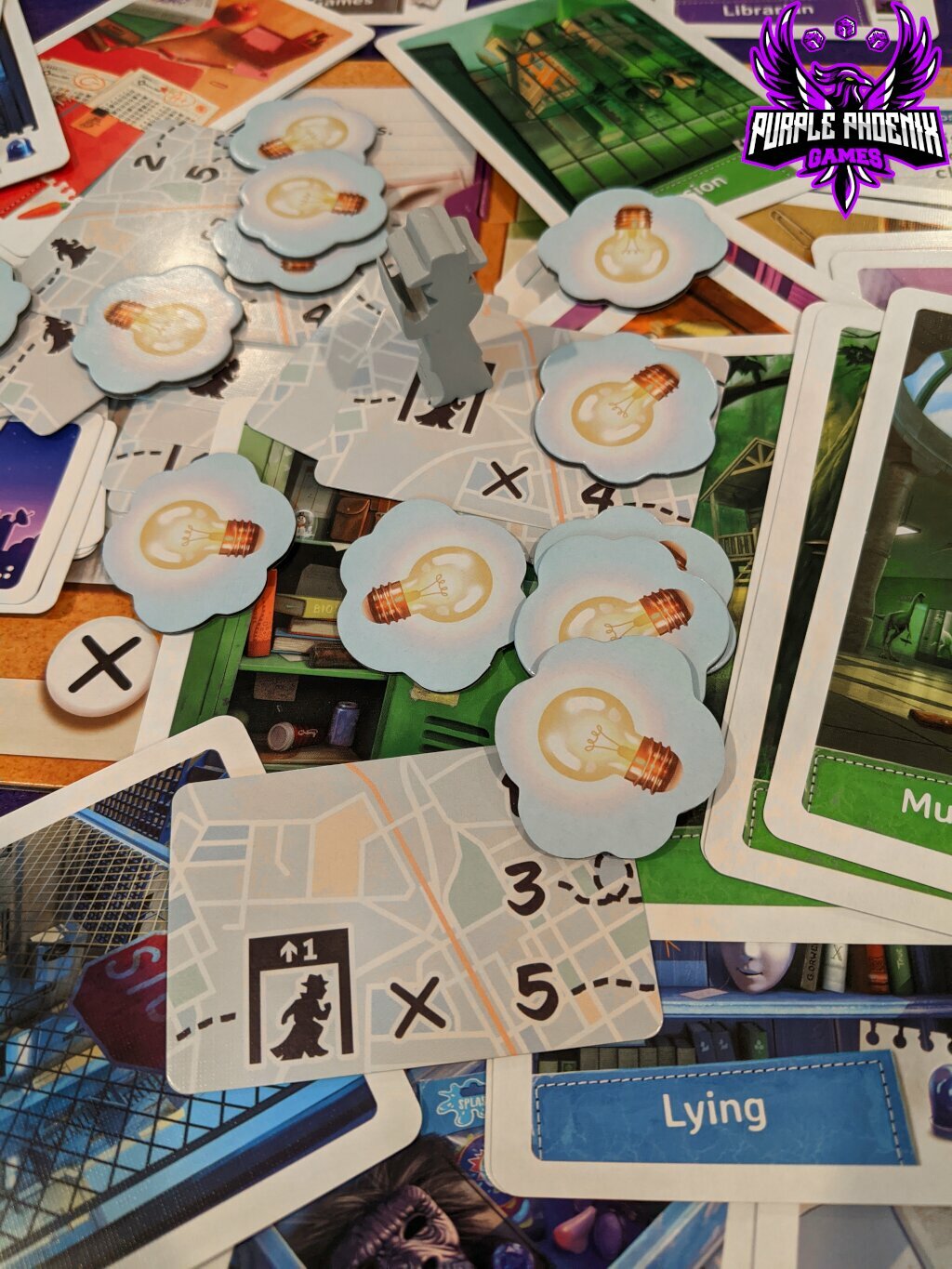
You guys have heard of “Where in the World is Carmen Sandiego?” The globetrotting super-spy who is hard to pin down? Well imagine what she may have been like as a young person. I bet she had her own spy club. And now we have a game to play to emulate what it may have been like in such a club. **This game has nothing to do with Carmen Sandiego.
Spy Club is a cooperative memory and deduction card game utilizing an action point system and sharing of resources. It is set in any neighborhood where kids can gather in groups and snuff out a mystery. The goal is to whittle the clues down to the correct Motive, Suspect, Location, Crime, and Object of the Crime. Are you intrepid youths up to the task?
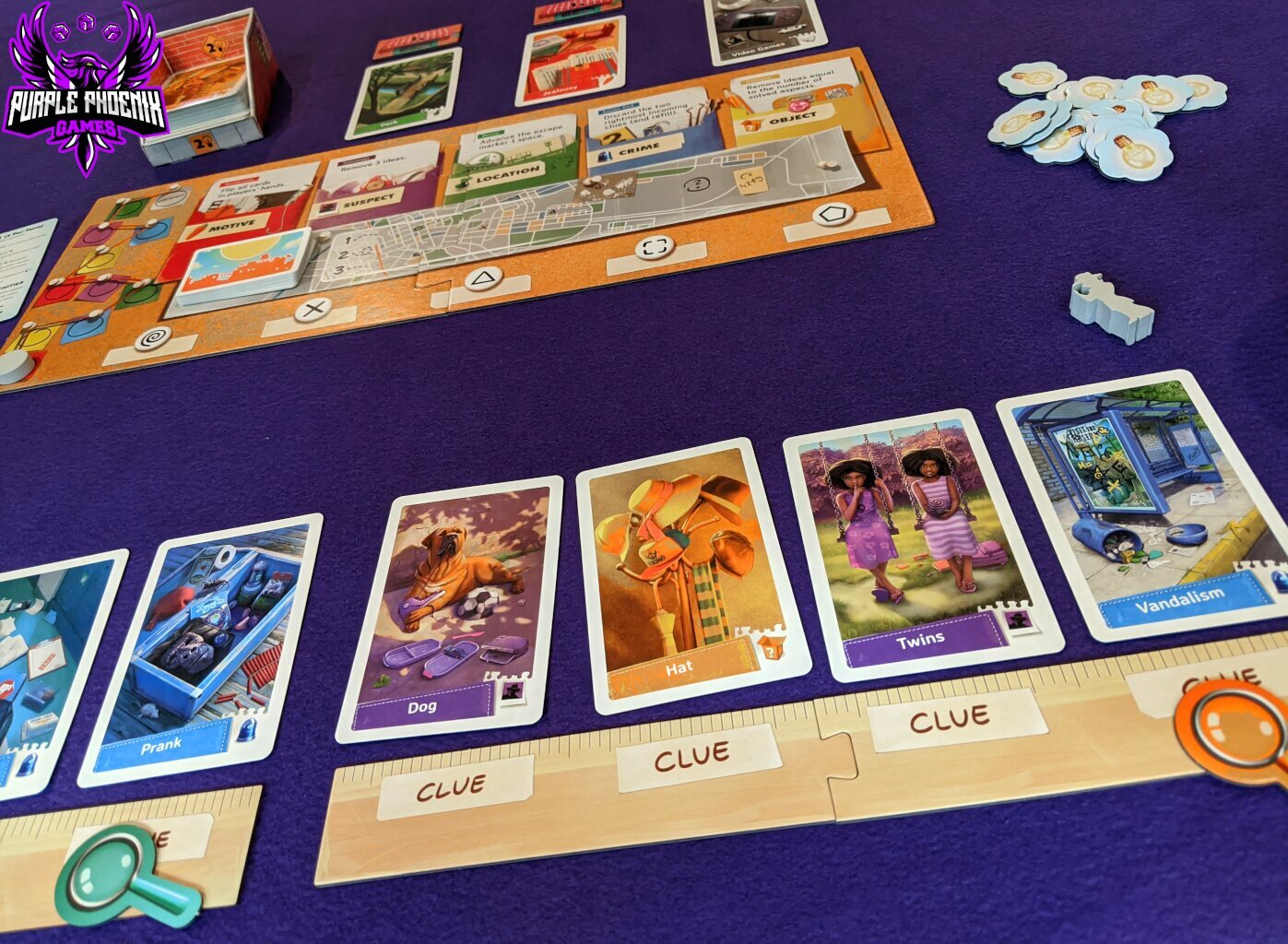
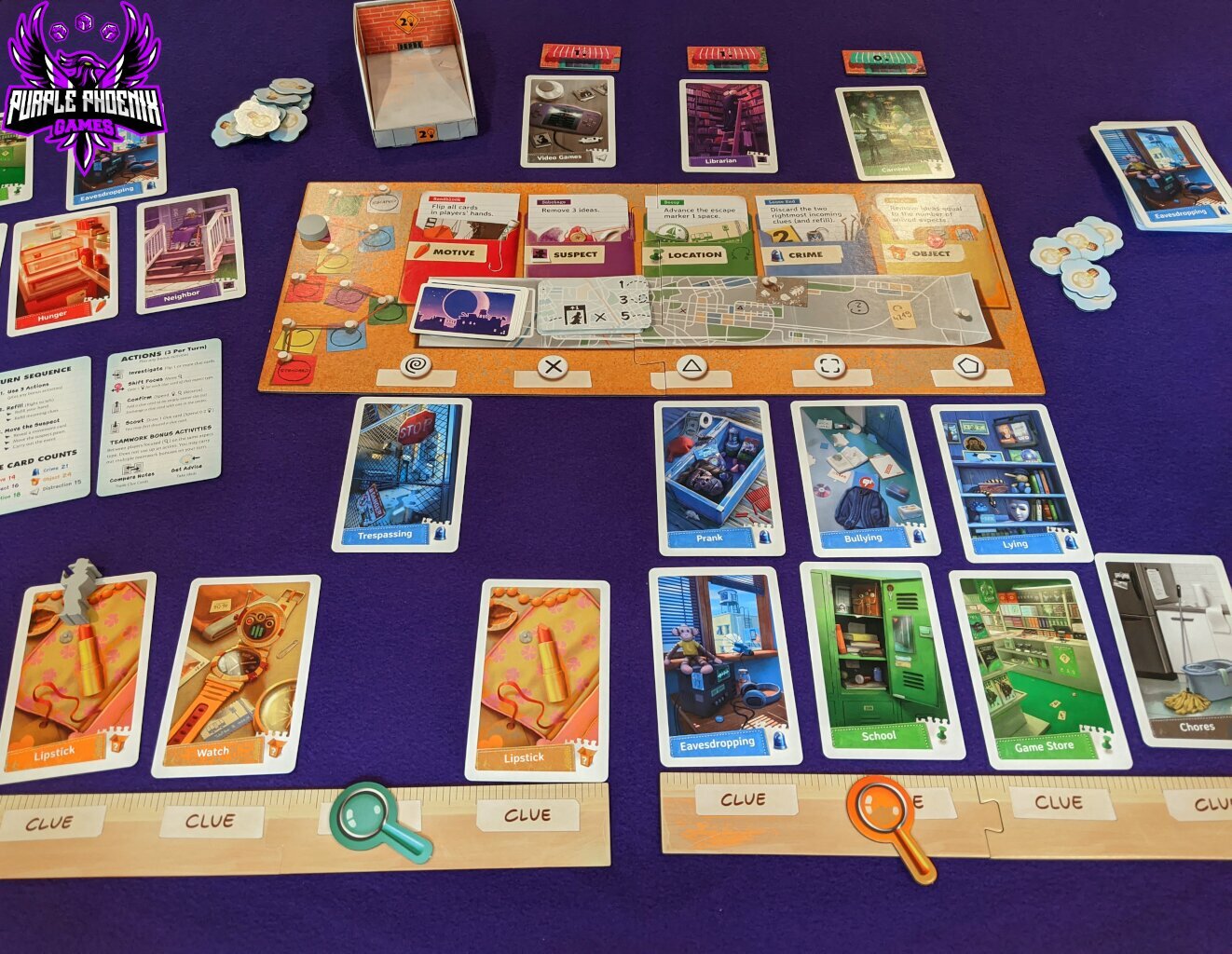
To setup, place the main board on the table, and the Escape Marker upon it at the bottom of the track. Shuffle the Movement Deck cards separately by backs, remove one from each differently-backed set, and place them in day – sunset – night order in its space. Each player receives a play board according to the number of players and a spyglass in their favorite color to go upon their play board. The Idea markers can be in a rough pile near everything else. The Clue Deck is to be shuffled and placed face-down (or face-up, whichever you prefer; they are double-sided) and each player is dealt a number of Clues equal to the number of spaces on their play boards. Clues will also be dealt to an “Incoming Clues” area (an offer row or “market”). DO NOT LOOK AT THE BACKS OF THE CARDS. Like, EVER. Unless you use an action to do so. The Suspecteeple will be placed on the right-most Clue Card of the starting player’s board. The game of sleuthing may now begin!
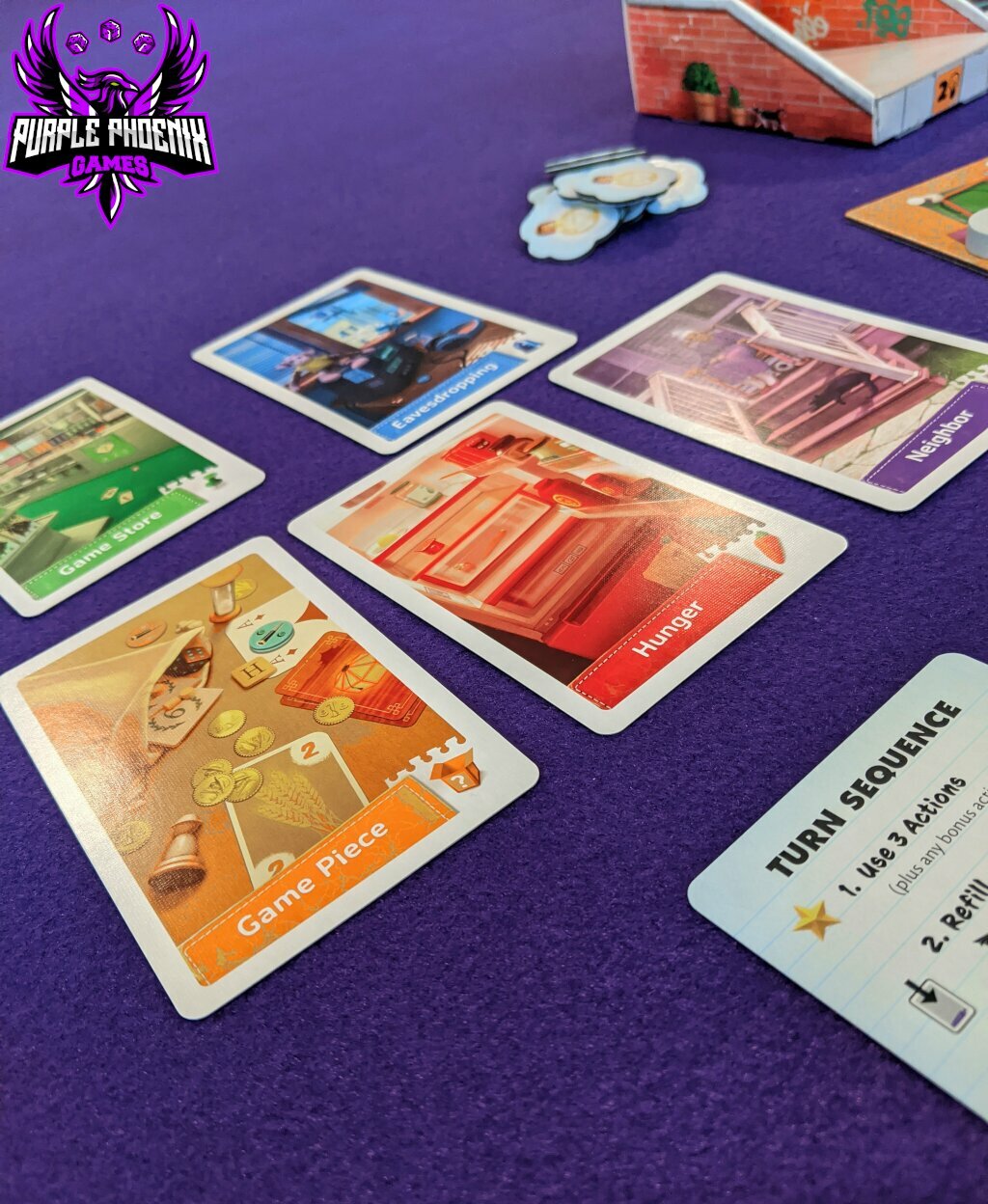
A player’s turn will consist of three main steps with different phases in those steps. Step 1 is Use Actions. Players will be able to use three Actions on their turn. These Actions are: Investigate, Shift Focus, Confirm, and Scout. To Investigate the active player will flip a Clue Card from their collection to its back. They may then continue flipping their cards or stop at any time. To Shift Focus a player will simply move their spyglass to a different Clue and collect Ideas equal to the number of Clues whose aspects match the newly-focused one (two Ideas if moving to a Location and a player has two Location Clues). Skipping Confirm, to Scout simply means purchasing a card from the Incoming Clues area to a player’s board, with a discard of an existing card already there.
Confirming is where the main action in Spy Club lies. Players will be attempting to Confirm five Clues of matching aspect (Location, Motive, etc) in order to hone in on the correct aspect. To Confirm, a player can submit a Clue from their collection (hand) to the main board. The cost, in Ideas, depends on where the spyglass lies. If the spyglass is directly under the Clue to be submitted the cost is nothing. However, if a player wishes to complete three Confirm actions and they have matching Clues on either side of their spyglass, they would need to spend two Ideas for each Clue resting one space away from the spyglass.
There are also rules for taking “Teamwork Bonus Actions,” but I will let you discover those on your own.
After these Actions are carried out, Step 2 is Refill. Firstly the active player’s hand will need to be refilled from the Incoming Clues row, and more Incoming Clues come out to fill that row.
Step 3 is Move the Suspect. Drawing from the Movement Deck the active player will match up the Movement cards from the previous round and the current round to find out how many spaces the Suspecteeple will be moving through players’ cards. Depending upon which aspect Clue the Suspecteeple lands a negative action will be levied against the players. In some ways the Suspect could land on cards that trigger no negative action, but I will leave that for you to discover as well. I am a bit… distracted.
Play continues in this fashion of players Using Actions, Refilling the Clue cards, and Moving the Suspect until players win by solving all five aspects of the crime, the Suspect escapes, the players run out of Idea markers, the Suspect escapes due to running out of Movement cards, or there are insufficient Incoming Clues to refill a player’s hand. So there are four ways to lose and one way to win.
Components. I find the components in Spy Club to be good overall. Nothing really stands out as amazing, either in design or quality. The art is very good, though. One thing I will say about the components as a whole is that once the game is setup and in play it looks fascinating on the table. I love the way it looks and certainly assists with full immersion. Always a plus in my book.
There are so many things I love about this game. And there are so many things I didn’t even explain here! Ok I’ll tell you one. Spy Club can be played as a one-shot game night medium-length (60 minutes) game, or can be converted into a campaign game where players will play five connected scenarios using a giant stack of cards that are not in use for the one-shots. That is simply fabulous! I can play one game of this to get people hooked, then reel them in by offering to continue this as a campaign to see what the main story arc is really trying to tell us. Oh man, that’s just special and I love it!
I feel like I have been playing a lot of really great games lately, and Spy Club is certainly a GREAT game. In fact, I told the rest of the team that this one is a contender for my Top 10 Games of All Time list. It has everything I love in a game: it is difficult (my first game I would have lost had it lasted one more turn) without being too heavy, it is inviting me to play more games (especially with the campaign mode active), I just like looking at it on the table, and creates a stunning amount of tension as we race against the game clock to figure out the crime aspects.
I have had this in my collection for too long without it being played, and I am so sorry that it took me so long to get into it. I will certainly be playing this a LOT more, and introducing as many people to it as I can. I think in the gaming world it is flying under the radar, but I will be one of its champions and suggest it as much as possible. If you like certain aspects (hehe) of Clue, 13 Dead End Drive, Carmen Sandiego, and even Jaipur, then take a look at Spy Club. Purple Phoenix Games gives this a super-sleuth 11 / 12. I actually might go play it right now. Yes, at 11:07pm.
Spy Club is a cooperative memory and deduction card game utilizing an action point system and sharing of resources. It is set in any neighborhood where kids can gather in groups and snuff out a mystery. The goal is to whittle the clues down to the correct Motive, Suspect, Location, Crime, and Object of the Crime. Are you intrepid youths up to the task?
To setup, place the main board on the table, and the Escape Marker upon it at the bottom of the track. Shuffle the Movement Deck cards separately by backs, remove one from each differently-backed set, and place them in day – sunset – night order in its space. Each player receives a play board according to the number of players and a spyglass in their favorite color to go upon their play board. The Idea markers can be in a rough pile near everything else. The Clue Deck is to be shuffled and placed face-down (or face-up, whichever you prefer; they are double-sided) and each player is dealt a number of Clues equal to the number of spaces on their play boards. Clues will also be dealt to an “Incoming Clues” area (an offer row or “market”). DO NOT LOOK AT THE BACKS OF THE CARDS. Like, EVER. Unless you use an action to do so. The Suspecteeple will be placed on the right-most Clue Card of the starting player’s board. The game of sleuthing may now begin!
A player’s turn will consist of three main steps with different phases in those steps. Step 1 is Use Actions. Players will be able to use three Actions on their turn. These Actions are: Investigate, Shift Focus, Confirm, and Scout. To Investigate the active player will flip a Clue Card from their collection to its back. They may then continue flipping their cards or stop at any time. To Shift Focus a player will simply move their spyglass to a different Clue and collect Ideas equal to the number of Clues whose aspects match the newly-focused one (two Ideas if moving to a Location and a player has two Location Clues). Skipping Confirm, to Scout simply means purchasing a card from the Incoming Clues area to a player’s board, with a discard of an existing card already there.
Confirming is where the main action in Spy Club lies. Players will be attempting to Confirm five Clues of matching aspect (Location, Motive, etc) in order to hone in on the correct aspect. To Confirm, a player can submit a Clue from their collection (hand) to the main board. The cost, in Ideas, depends on where the spyglass lies. If the spyglass is directly under the Clue to be submitted the cost is nothing. However, if a player wishes to complete three Confirm actions and they have matching Clues on either side of their spyglass, they would need to spend two Ideas for each Clue resting one space away from the spyglass.
There are also rules for taking “Teamwork Bonus Actions,” but I will let you discover those on your own.
After these Actions are carried out, Step 2 is Refill. Firstly the active player’s hand will need to be refilled from the Incoming Clues row, and more Incoming Clues come out to fill that row.
Step 3 is Move the Suspect. Drawing from the Movement Deck the active player will match up the Movement cards from the previous round and the current round to find out how many spaces the Suspecteeple will be moving through players’ cards. Depending upon which aspect Clue the Suspecteeple lands a negative action will be levied against the players. In some ways the Suspect could land on cards that trigger no negative action, but I will leave that for you to discover as well. I am a bit… distracted.
Play continues in this fashion of players Using Actions, Refilling the Clue cards, and Moving the Suspect until players win by solving all five aspects of the crime, the Suspect escapes, the players run out of Idea markers, the Suspect escapes due to running out of Movement cards, or there are insufficient Incoming Clues to refill a player’s hand. So there are four ways to lose and one way to win.
Components. I find the components in Spy Club to be good overall. Nothing really stands out as amazing, either in design or quality. The art is very good, though. One thing I will say about the components as a whole is that once the game is setup and in play it looks fascinating on the table. I love the way it looks and certainly assists with full immersion. Always a plus in my book.
There are so many things I love about this game. And there are so many things I didn’t even explain here! Ok I’ll tell you one. Spy Club can be played as a one-shot game night medium-length (60 minutes) game, or can be converted into a campaign game where players will play five connected scenarios using a giant stack of cards that are not in use for the one-shots. That is simply fabulous! I can play one game of this to get people hooked, then reel them in by offering to continue this as a campaign to see what the main story arc is really trying to tell us. Oh man, that’s just special and I love it!
I feel like I have been playing a lot of really great games lately, and Spy Club is certainly a GREAT game. In fact, I told the rest of the team that this one is a contender for my Top 10 Games of All Time list. It has everything I love in a game: it is difficult (my first game I would have lost had it lasted one more turn) without being too heavy, it is inviting me to play more games (especially with the campaign mode active), I just like looking at it on the table, and creates a stunning amount of tension as we race against the game clock to figure out the crime aspects.
I have had this in my collection for too long without it being played, and I am so sorry that it took me so long to get into it. I will certainly be playing this a LOT more, and introducing as many people to it as I can. I think in the gaming world it is flying under the radar, but I will be one of its champions and suggest it as much as possible. If you like certain aspects (hehe) of Clue, 13 Dead End Drive, Carmen Sandiego, and even Jaipur, then take a look at Spy Club. Purple Phoenix Games gives this a super-sleuth 11 / 12. I actually might go play it right now. Yes, at 11:07pm.

Purple Phoenix Games (2266 KP) rated Chronicles of Crime: 1400 in Tabletop Games
Oct 21, 2020

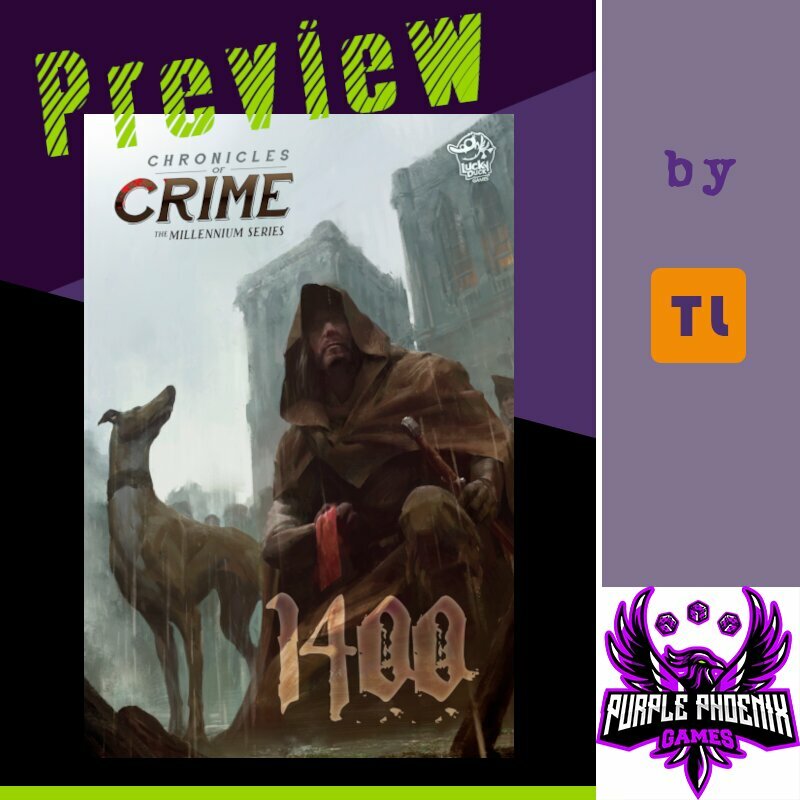
Isn’t that box cover just awesome? I never open a preview with a comment about components, but this one warranted it because the box art is so good. Anyway, it’s Paris in the year, well, 1400 AD, and now some strange things are afoot at le Cercle K.
Chronicles of Crime: 1400 (which I shall shorten to 1400 for the duration of this preview) is an app-assisted campaign, murder-infested, cooperative storytelling game for one to four players. If you are familiar with the original Chronicles of Crime, you already know how to play 1400. However, should ye be of the uninitiated, allow me to set the stage for this incredible gaming experience.
DISCLAIMER: We were provided a copy of this game for the purposes of this review. This is a retail copy of the game, so what you see in these photos is exactly what would be received in your box. I do not intend to cover every single rule included in the rulebook, but will describe the overall game flow and major rule set so that our readers may get a sense of how the game plays. For more in depth rules, you may purchase a copy online or from your FLGS. -T
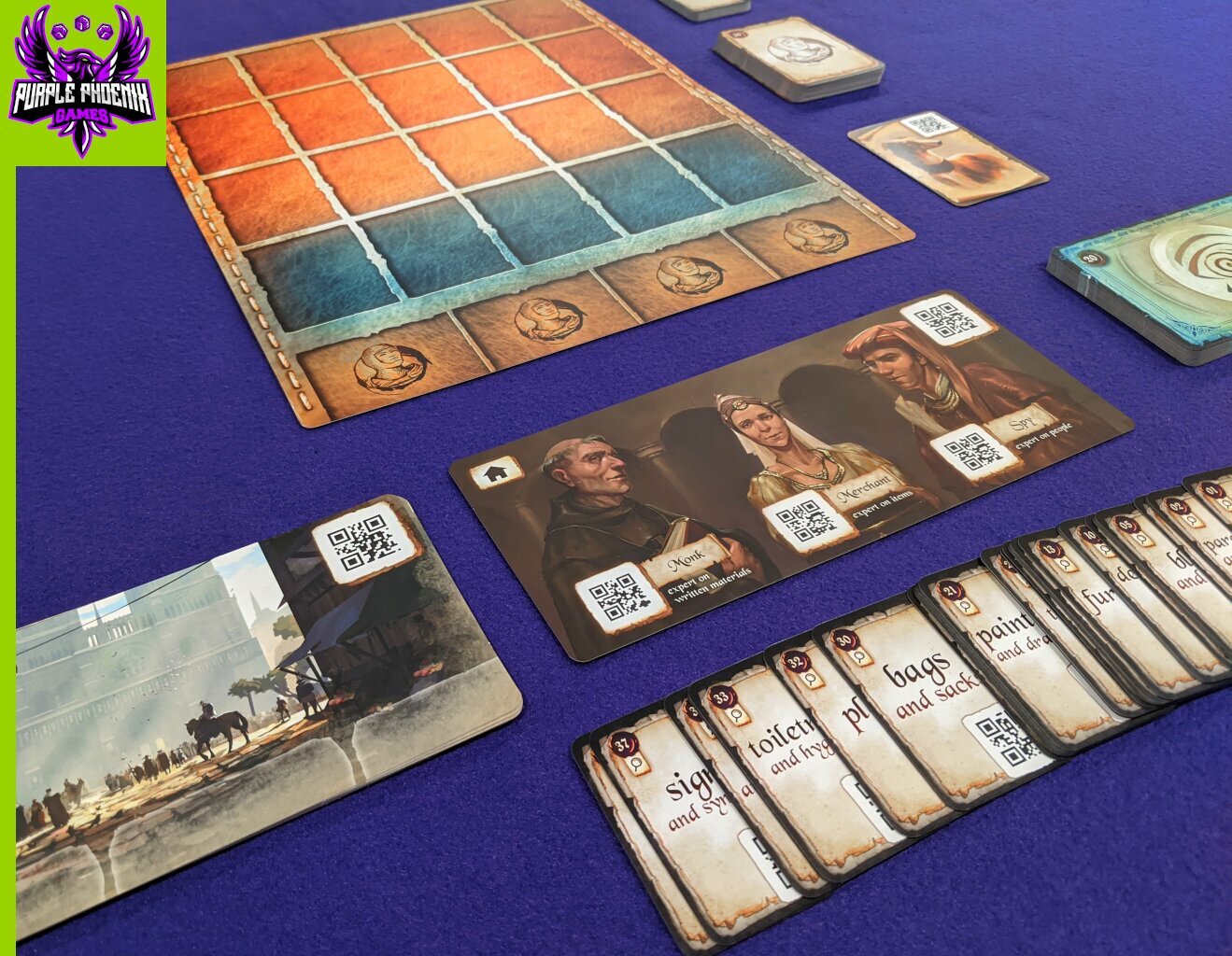
To setup, place the Evidence Board in the middle of the table and the Home Location Board near. Keep all the decks of cards nearby (shuffled or unshuffled, whatever is your liking) as well as the alphabetically-labeled Location Boards. Fire up the Chronicles of Crime app, choose “1400,” and then choose the case you would like to play. The app will walk players through the additional setup steps for the case being played. For this solo preview I played through The Missing Pages case. Also, to be completely upfront I got a 95/110 for a final score, but no big deal.
How do I explain this game succinctly? Well, each of the cases will involve players traveling to different Location Boards and meeting Characters at these locations. Many cases will be involving several Special Items and, new for the 1400 version, Vision Cards that may assist players in putting the case into focus. These Vision Cards do not really give the story away or anything, but are merely a vague framework of possible factors.
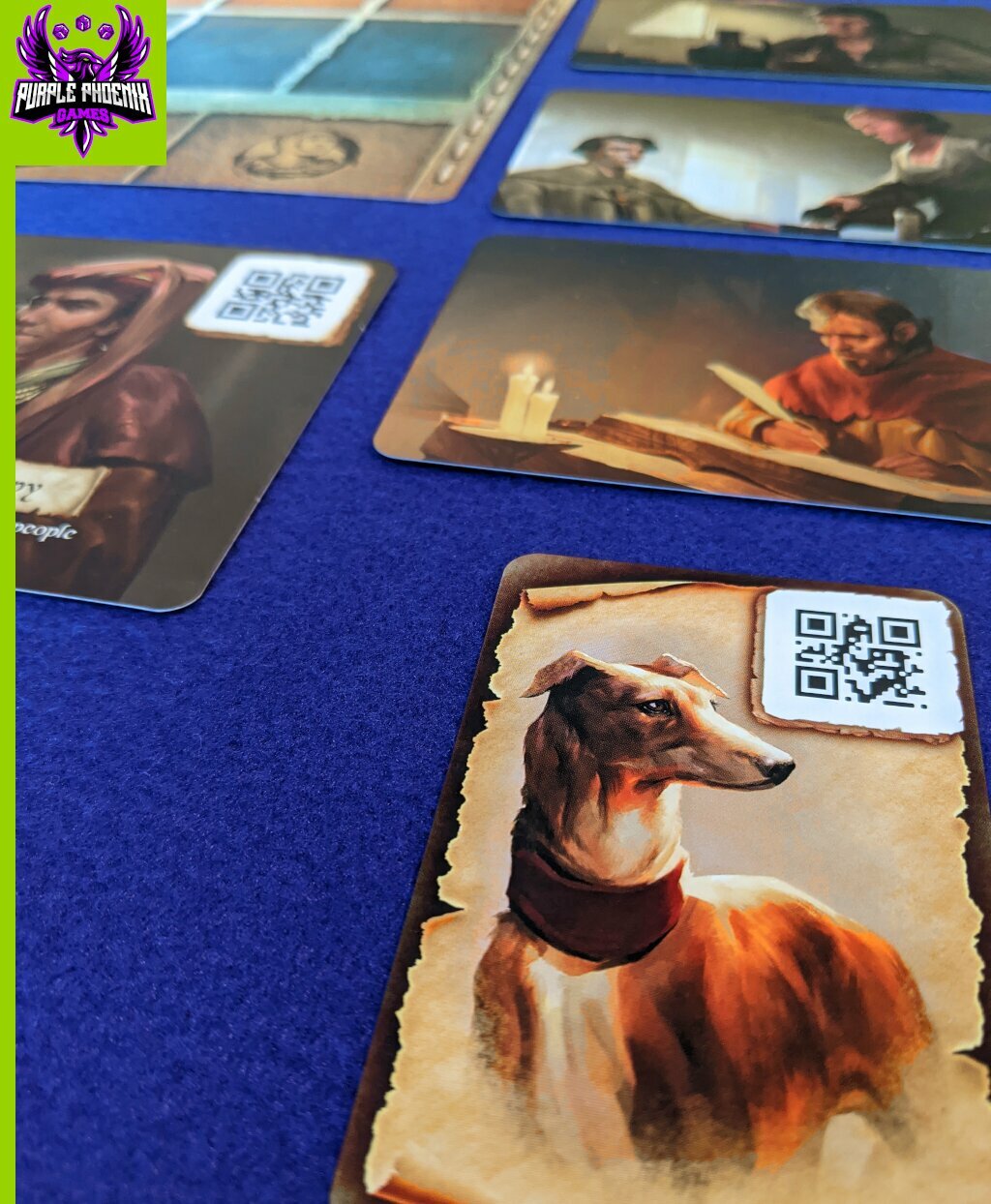
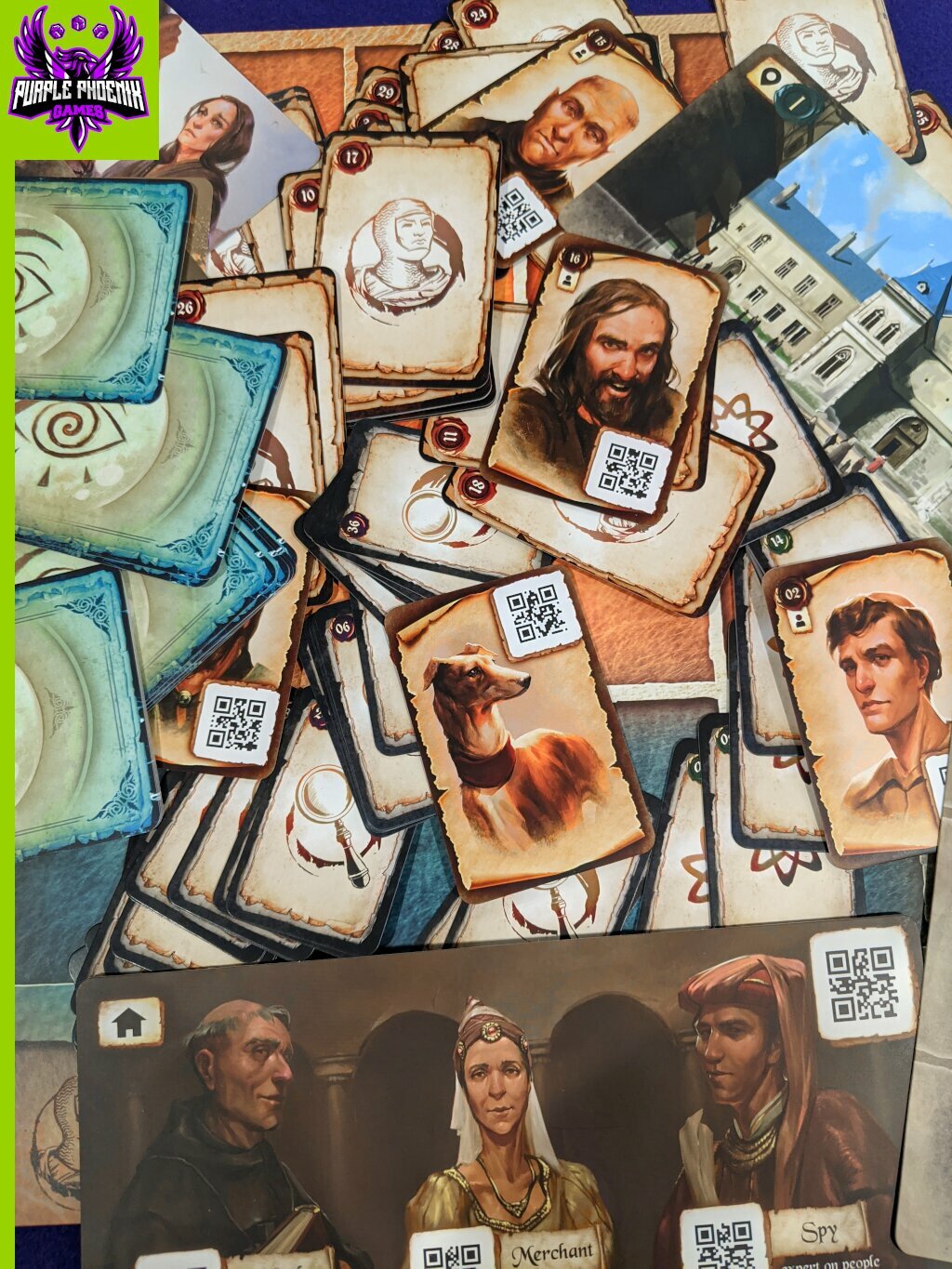
By using the app and scanning the QR codes on the boards and cards players will be learning about the case, viewing the scene of the crime(s), inspecting items, chatting up locals for information, and also new for 1400: consulting with the goodest boi dog companion! The dog, Perceval, assists the knight (the players) in cases by sniffing items. A word of caution, though, when you play this game do NOT have Perceval sniff any items until you are completely done with a location because he may drag you to another completely different location right away before you were ready. Not that it happened to me, mind you… okay, it did.
Play will continue not so much in “rounds” but until the players have enough evidence and a good handle on the situation enough to return Home to report to their family members all the details of the crime(s) by scanning answers to their questions about the case. The app then assesses the accuracy of the answers and outputs a score. For reference, though I did receive 95/110 on my first play of 1400 I did only receive a 70/100 on my first runthrough of the original Chronicles of Crime, so playing this style of game several times seems to improve how one plays.
Components. As most items in the box of the game are card or cardboard-based, and all really great quality, I will speak on other component items. Firstly, the art and art style throughout the game is simply stunning. I mean look at that Perceval card! And I already raved about the box cover in my opening statement. This art really speaks to me and it says, “I’m gorgeous.”
The app. I have only great things to say about the app. It’s the same app that you would use for original Chronicles of Crime, and operates the exact same way. For me it has been flawless to use and just a joy to bring technology into the gaming world, even for a game set in the year 1400. I am obviously no purist game enthusiast, as I enjoy these hybrid model games. Once you play with the app you will see how ingenious a system it really is. The app coupled with the nondescript cards and other components in the game make for infinite storytelling possibilities that can only be limited by creativity and time constraints. I love the components in the box AND the marvelous app.
Gameplay for me is also just glorious. I love being able to sit down, setup the game, and let the app tell me what’s going on. So what should I do first? Oh, let’s mosey on down here to this Location Board and drum up some information. Ooh I found an Item! I should bring it back to my Family Location Board and ask my merchant sister about it. Hmm, it’s religious in nature? Okay then, my Monkle (monk uncle) will know something about it. Okay, time to go back to that location and speak with the other person who was in there. OH CRAP, I wasted too much (in game) time and now that other person is gone?! Uh oh, I better stop messing around here…
It’s just amazing, and I love this family of games. I am so stoked to delve more into 1400 and discover more shenanigans happening in Paris. Perceval and I are out to solve all the cases and beg for more. If you are looking for a game that uses a hybrid board game/app model, are a fan of this era in history, or just want to have a really great experience playing a game, I urge you to consider Chronicles of Crime: 1400. It has everything I love in a unique game and I just can’t get enough!
Chronicles of Crime: 1400 (which I shall shorten to 1400 for the duration of this preview) is an app-assisted campaign, murder-infested, cooperative storytelling game for one to four players. If you are familiar with the original Chronicles of Crime, you already know how to play 1400. However, should ye be of the uninitiated, allow me to set the stage for this incredible gaming experience.
DISCLAIMER: We were provided a copy of this game for the purposes of this review. This is a retail copy of the game, so what you see in these photos is exactly what would be received in your box. I do not intend to cover every single rule included in the rulebook, but will describe the overall game flow and major rule set so that our readers may get a sense of how the game plays. For more in depth rules, you may purchase a copy online or from your FLGS. -T
To setup, place the Evidence Board in the middle of the table and the Home Location Board near. Keep all the decks of cards nearby (shuffled or unshuffled, whatever is your liking) as well as the alphabetically-labeled Location Boards. Fire up the Chronicles of Crime app, choose “1400,” and then choose the case you would like to play. The app will walk players through the additional setup steps for the case being played. For this solo preview I played through The Missing Pages case. Also, to be completely upfront I got a 95/110 for a final score, but no big deal.
How do I explain this game succinctly? Well, each of the cases will involve players traveling to different Location Boards and meeting Characters at these locations. Many cases will be involving several Special Items and, new for the 1400 version, Vision Cards that may assist players in putting the case into focus. These Vision Cards do not really give the story away or anything, but are merely a vague framework of possible factors.
By using the app and scanning the QR codes on the boards and cards players will be learning about the case, viewing the scene of the crime(s), inspecting items, chatting up locals for information, and also new for 1400: consulting with the goodest boi dog companion! The dog, Perceval, assists the knight (the players) in cases by sniffing items. A word of caution, though, when you play this game do NOT have Perceval sniff any items until you are completely done with a location because he may drag you to another completely different location right away before you were ready. Not that it happened to me, mind you… okay, it did.
Play will continue not so much in “rounds” but until the players have enough evidence and a good handle on the situation enough to return Home to report to their family members all the details of the crime(s) by scanning answers to their questions about the case. The app then assesses the accuracy of the answers and outputs a score. For reference, though I did receive 95/110 on my first play of 1400 I did only receive a 70/100 on my first runthrough of the original Chronicles of Crime, so playing this style of game several times seems to improve how one plays.
Components. As most items in the box of the game are card or cardboard-based, and all really great quality, I will speak on other component items. Firstly, the art and art style throughout the game is simply stunning. I mean look at that Perceval card! And I already raved about the box cover in my opening statement. This art really speaks to me and it says, “I’m gorgeous.”
The app. I have only great things to say about the app. It’s the same app that you would use for original Chronicles of Crime, and operates the exact same way. For me it has been flawless to use and just a joy to bring technology into the gaming world, even for a game set in the year 1400. I am obviously no purist game enthusiast, as I enjoy these hybrid model games. Once you play with the app you will see how ingenious a system it really is. The app coupled with the nondescript cards and other components in the game make for infinite storytelling possibilities that can only be limited by creativity and time constraints. I love the components in the box AND the marvelous app.
Gameplay for me is also just glorious. I love being able to sit down, setup the game, and let the app tell me what’s going on. So what should I do first? Oh, let’s mosey on down here to this Location Board and drum up some information. Ooh I found an Item! I should bring it back to my Family Location Board and ask my merchant sister about it. Hmm, it’s religious in nature? Okay then, my Monkle (monk uncle) will know something about it. Okay, time to go back to that location and speak with the other person who was in there. OH CRAP, I wasted too much (in game) time and now that other person is gone?! Uh oh, I better stop messing around here…
It’s just amazing, and I love this family of games. I am so stoked to delve more into 1400 and discover more shenanigans happening in Paris. Perceval and I are out to solve all the cases and beg for more. If you are looking for a game that uses a hybrid board game/app model, are a fan of this era in history, or just want to have a really great experience playing a game, I urge you to consider Chronicles of Crime: 1400. It has everything I love in a unique game and I just can’t get enough!
Purple Phoenix Games (2266 KP) rated Survive: Escape from Atlantis! in Tabletop Games
Sep 4, 2019 (Updated Jul 2, 2020)
I have never been on a sinking anything. Sure, I have flipped over kayaks, and paddle-boards, and anything else that requires me to balance on top of water. But I cannot imagine the terror of being on an island that just… sinks into the deep. Oh also running out of room and having to swim to safe land. Oh also while sharks, whales, and sea monsters are chasing me. You know what? Maybe I’m cool with being located in the Midwest. I’ll just play this game and live vicariously through the esceeples (escaping meeples? I need a handbook for these -eeple terms).
Survive: Escape from Atlantis! (which I now will call Survive) is an competitive adventure game featuring action points, grid movement, secret unit deployment, dice rolls, and lots of take-that. And little boats. It also can destroy friendships and ruin evenings. Play at your own risk.
DISCLAIMER: There are several expansions to this game, but we are not reviewing them at this time. We ARE including the 5-6 player mini expansion, however. Should we review the others in the future we will either update this review or post a link to the new material here. Also, I do not intend to detail every rule in the book, but give our readers an idea of how the game plays and our thoughts on it. -T
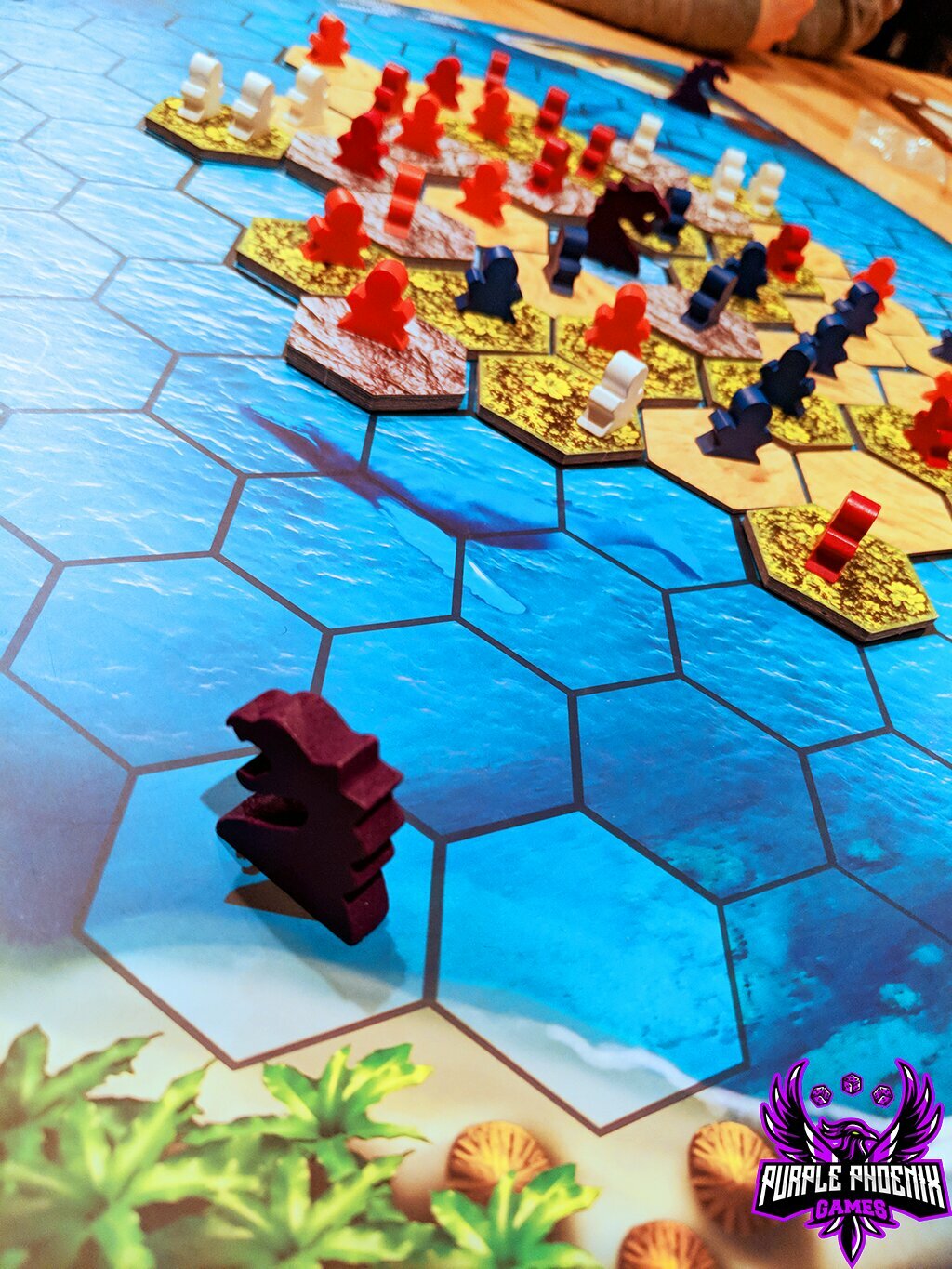
To setup a game of Survive, each player will choose a color and take into their supply all the meeples of that color and two boats. Place all the terrain tiles randomly (and face down) within the bolded line on the board to create the central island. Place out the sea serpents on the sea serpent spots as menacingly as possible. Players then take turns placing their numbered meeples on terrain tiles until all meeples have been placed, and their boateeples on any water space near the island they wish. Keep aside the shark, whale, and dolphin meeples for later. Give the die to the first player and you are ready to play.
On a player’s turn they will 1. Play any tiles from their hand, 2. Move meeples, 3. Remove terrain a tile, 4. Roll the die and move creatures. At the beginning of the game nobody will have any tiles in hand to play, so skip this step if there are no tiles in hand. On subsequent turns players may have collected tiles as a result of the #3 action, and now is the time to play those. Typically they are beneficial for the active player or detrimental to the opponents. Next, the active player will move their meeples in any combination three total board hexes. This can be done with one or more meeples on land or in the water. There are movement restrictions that I will not cover here. After movement, the active player will remove one of the terrain tiles with the lowest elevation (sand, forest, then mountain tiles). The player flips over the tile and will play it immediately if it shows an arrow, or keeps it in hand if it shows a hand icon. Finally, the active player will roll the red die and move creatures per the movement table printed on the board.
Creature movement creates the tension in the game (as if fighting over the boats wasn’t enough). You see, when sharks enter the board and are moved, they are hungry for swimmer meeples (obv). Whales are hungry(?) for boats and will destroy them but fling the meeples aboard into the water to become swimmers. Sea serpents don’t care. They will eat swimmers and manned boats… but they’re the slowest movers. So consider that.
Play continues in this fashion until the either all meeples have been removed from the play grid, or a player flips over the volcano mountain tile and ends the game. Any meeples who have made it to the safety of the outer islands are worth the VP printed on their bottoms. Wait, not the butts. The bottom of the meeples. Which I guess are the feet.
Components. To reiterate, in case it was missed, we are reviewing the 2010 Stronghold edition. There is a newer version, and it seems to look a little better but plays the same. However, I love the components of this version too. The meeples are fine, the creatures are cool, the varying thicknesses of the terrain tiles makes for an interesting mini-3D look, and the board is great without being too busy and distracting. I have absolutely no issues with these components and think they are super.
Now, you may have read in my intro that this game may ruin friendships and the evening, and I really am not joking about this. I have played this so many times where at least one person becomes completely angered by the chomping of the shark or the horrible movement of the sea serpent adjacent to their boat. It’s just a game, and it’s inevitable in this one – your meeples will get eaten. It’s gonna happen! When I teach this now I try to make that apparent right away because it is then not viewed as absolutely treachery when it happens to newer players. Should you be playing with sensitive gamers, please instruct them early that it WILL happen or you’re gonna have a bad time.
However, this game is great! I love it now as much as I ever have. It’s an older horse for me, but one of which I will never tire. I can and love to play it with new gamers, especially the ones that are hoping to join the inner circle. If you can hang through a game of Survive without being angered and taking it all in stride, you are welcome at my table ANY time. That said, as you can see by our ratings, Purple Phoenix Games gives this one a mighty and well-deserved 21 / 24. If you enjoy games that upset your players and want a cool theme on it, check out Survive: Escape from Atlantis!
Survive: Escape from Atlantis! (which I now will call Survive) is an competitive adventure game featuring action points, grid movement, secret unit deployment, dice rolls, and lots of take-that. And little boats. It also can destroy friendships and ruin evenings. Play at your own risk.
DISCLAIMER: There are several expansions to this game, but we are not reviewing them at this time. We ARE including the 5-6 player mini expansion, however. Should we review the others in the future we will either update this review or post a link to the new material here. Also, I do not intend to detail every rule in the book, but give our readers an idea of how the game plays and our thoughts on it. -T
To setup a game of Survive, each player will choose a color and take into their supply all the meeples of that color and two boats. Place all the terrain tiles randomly (and face down) within the bolded line on the board to create the central island. Place out the sea serpents on the sea serpent spots as menacingly as possible. Players then take turns placing their numbered meeples on terrain tiles until all meeples have been placed, and their boateeples on any water space near the island they wish. Keep aside the shark, whale, and dolphin meeples for later. Give the die to the first player and you are ready to play.
On a player’s turn they will 1. Play any tiles from their hand, 2. Move meeples, 3. Remove terrain a tile, 4. Roll the die and move creatures. At the beginning of the game nobody will have any tiles in hand to play, so skip this step if there are no tiles in hand. On subsequent turns players may have collected tiles as a result of the #3 action, and now is the time to play those. Typically they are beneficial for the active player or detrimental to the opponents. Next, the active player will move their meeples in any combination three total board hexes. This can be done with one or more meeples on land or in the water. There are movement restrictions that I will not cover here. After movement, the active player will remove one of the terrain tiles with the lowest elevation (sand, forest, then mountain tiles). The player flips over the tile and will play it immediately if it shows an arrow, or keeps it in hand if it shows a hand icon. Finally, the active player will roll the red die and move creatures per the movement table printed on the board.
Creature movement creates the tension in the game (as if fighting over the boats wasn’t enough). You see, when sharks enter the board and are moved, they are hungry for swimmer meeples (obv). Whales are hungry(?) for boats and will destroy them but fling the meeples aboard into the water to become swimmers. Sea serpents don’t care. They will eat swimmers and manned boats… but they’re the slowest movers. So consider that.
Play continues in this fashion until the either all meeples have been removed from the play grid, or a player flips over the volcano mountain tile and ends the game. Any meeples who have made it to the safety of the outer islands are worth the VP printed on their bottoms. Wait, not the butts. The bottom of the meeples. Which I guess are the feet.
Components. To reiterate, in case it was missed, we are reviewing the 2010 Stronghold edition. There is a newer version, and it seems to look a little better but plays the same. However, I love the components of this version too. The meeples are fine, the creatures are cool, the varying thicknesses of the terrain tiles makes for an interesting mini-3D look, and the board is great without being too busy and distracting. I have absolutely no issues with these components and think they are super.
Now, you may have read in my intro that this game may ruin friendships and the evening, and I really am not joking about this. I have played this so many times where at least one person becomes completely angered by the chomping of the shark or the horrible movement of the sea serpent adjacent to their boat. It’s just a game, and it’s inevitable in this one – your meeples will get eaten. It’s gonna happen! When I teach this now I try to make that apparent right away because it is then not viewed as absolutely treachery when it happens to newer players. Should you be playing with sensitive gamers, please instruct them early that it WILL happen or you’re gonna have a bad time.
However, this game is great! I love it now as much as I ever have. It’s an older horse for me, but one of which I will never tire. I can and love to play it with new gamers, especially the ones that are hoping to join the inner circle. If you can hang through a game of Survive without being angered and taking it all in stride, you are welcome at my table ANY time. That said, as you can see by our ratings, Purple Phoenix Games gives this one a mighty and well-deserved 21 / 24. If you enjoy games that upset your players and want a cool theme on it, check out Survive: Escape from Atlantis!

Purple Phoenix Games (2266 KP) rated 7 Wonders Duel in Tabletop Games
Oct 26, 2021
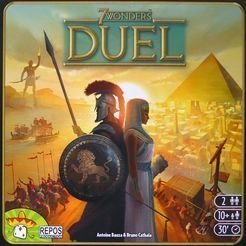

The original 7 Wonders was my #1 game of all time for a long while. While it has since dropped off my Top 10, I still have so many fond memories of it. Now, I know I am not breaking any stories here by finally reviewing its 2-player successor, but this game is really streamlined and fabulous. Obviously it is wonderful as it has earned the Purple Phoenix Games Golden Feather Award! But why do we love it so much?
7 Wonders: Duel is a 2-player tableau and engine-building card game set in the 7 Wonders game universe where players collect cards to create an engine to gain VP using any number of winning strategies. The game takes place over three ages and the player with the most VP at the end of the game, becomes victorious via military supremacy, or wins via scientific supremacy.
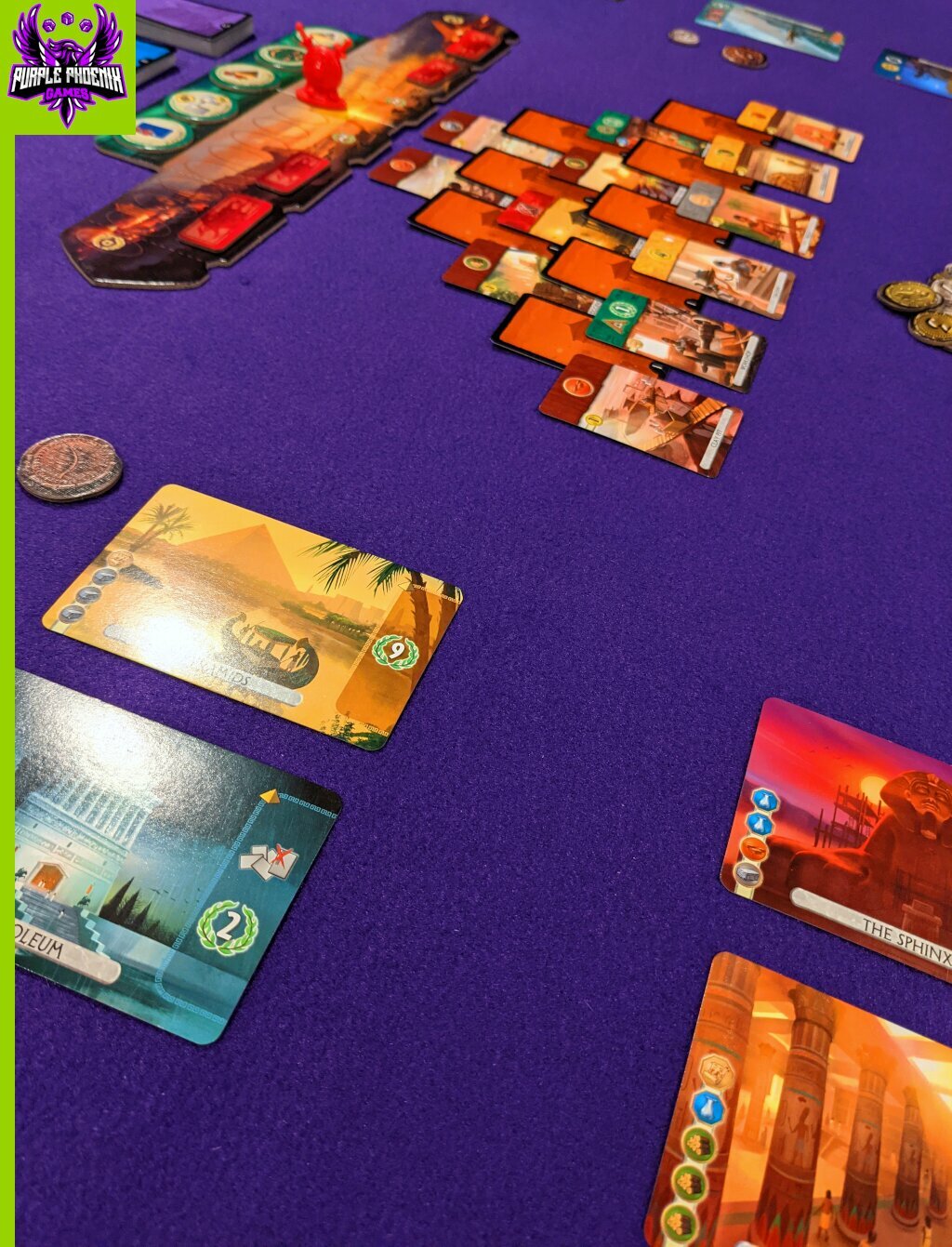
To setup, place the game board between the players with the green Progress tokens, Military tokens, and red Conflict pawn upon it. Shuffle the Age I cards and lay them according to the rule book (this formation changes for each age. Age I is setup in the photo below). Each player receives seven gold and they draft their Wonders according to the process in the rules.
On a turn the active player will choose one uncovered face-up card to be used one of three different ways. The card can be added to the player’s tableau and “built” by spending resources required, if any. The card may be discarded in exchange for coins totaling 2 + the number of yellow cards built in the player’s city. Lastly, the card may be used to build a player’s Wonder card by inserting it below the Wonder and paying the cost, as in 7 Wonders proper. The next player will then take their turn.
If on a turn a player builds certain card types into their city, special actions are taken. This happens as a result of building Military or Science cards. When a player builds a Military (red shield icon) card they immediately move the Conflict token on the board one space toward their opponent’s Capital (the end of the board closest to the opponent). Should a player force the Conflict token to reach their opponent’s Capital, the attacking player immediately wins! The other special action that can be taken is with a pair of Science cards being built. For every pair of like-symbol Science cards built, the active player may choose to take one of the Progress tokens from the game board and add it to their collection. These tokens can be very powerful, and just as in 7 Wonders proper, Science is a viable yet difficult strategy. Should a player build any six unique Science icons on cards they will immediately win!
If a Military or Science supremacy victory is not achieved, the game continues to Age II, where setup of the cards is different, but play remains the same. Similarly, Age III is setup differently still and has the added bonus of three random Guild cards, which may add significant strategic icons or abilities. At the end of Age III the players count their VP from the various sources listed in the rule book and the ultimate champion is then crowned!
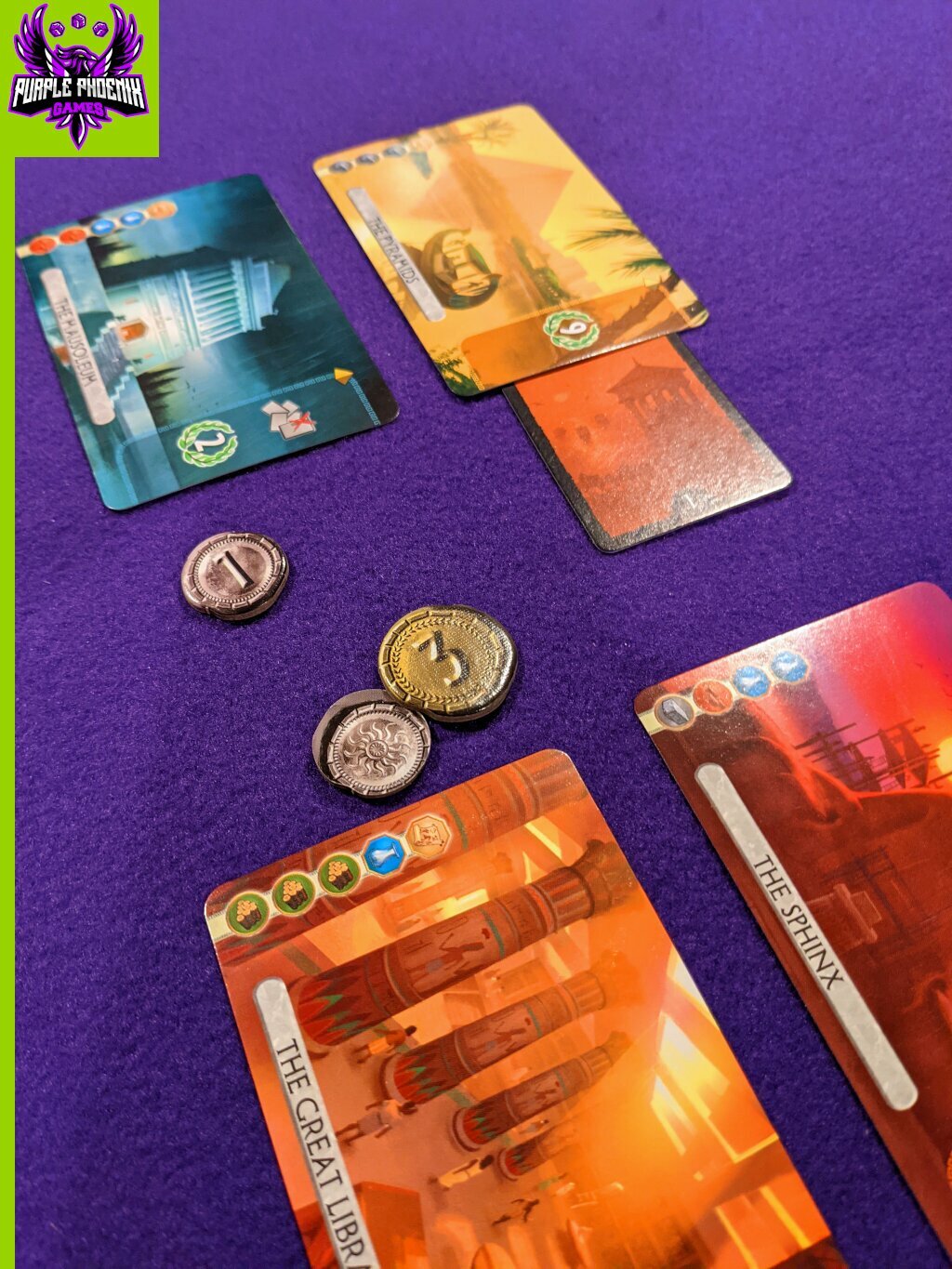
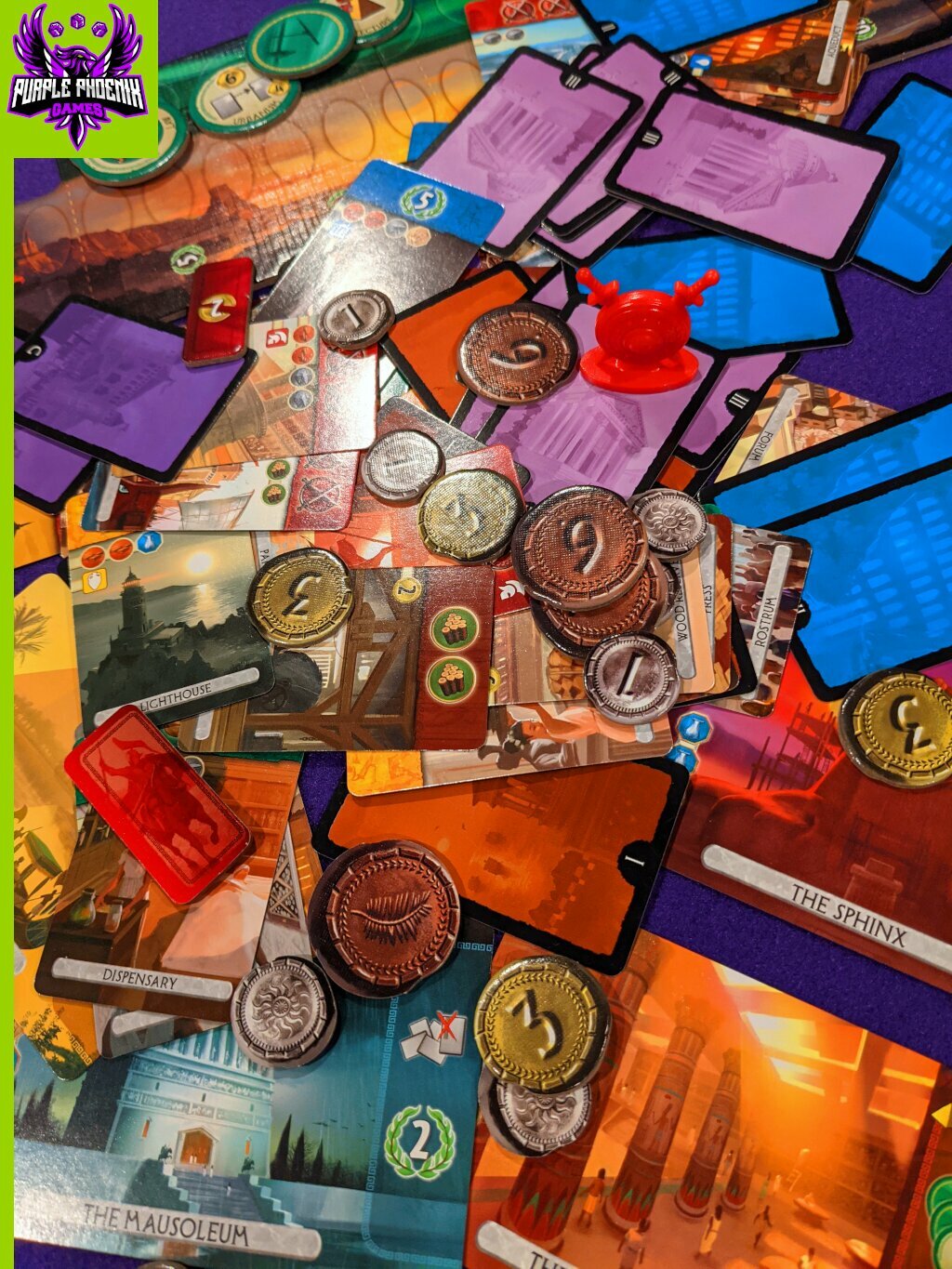
Components. This game comes in a very small box, so the components are also quite small. I believe myself to have medium-sized man-paws and I have not had any issues with size of components. They are all very high quality, as is to be expected from Repos Production, and are fantastically illustrated. The Conflict token is enticingly menacing, and it lures me into concentrating on a Military victory every time I play. I need to just ignore it, but it’s so beautiful! All in all, the components are great, and even though the cardstock is relatively thin, my copy has withstood many plays and has seen very little wear and tear.
So 7 Wonders: Duel exists for all those players who love 7 Wonders but do not wish to play it with the 2-player variant rules. While Duel is certainly a little sibling, it is also its own beast of a game and should be treated as such. There are several key changes in rules for Duel, such as the trading with the BANK for missing resources upon building versus paying a neighbor to borrow their resource production. Also, the obvious change of adding a board with an ever-dancing Conflict token is unique to this title. Wonders are treated differently and instead of receiving one Wonder with three layers, Duels gives each player four Wonders with just one layer.
Aside from the differences between the two games, I do believe that if you are a fan of one you will also like the other. I can see, though, gamers who dislike 7 Wonders enjoying the smaller 7 Wonders: Duel. There is just something about being able to focus on one other player and agonizing over every turn so that your opponent receives a useless card from the offer, or taking every Military or Science card possible so as to end the game as quickly as possible. My brother, Bryan, greatly dislikes 7 Wonders, but he does not mind playing Duel, or at least that is what he led me to believe…
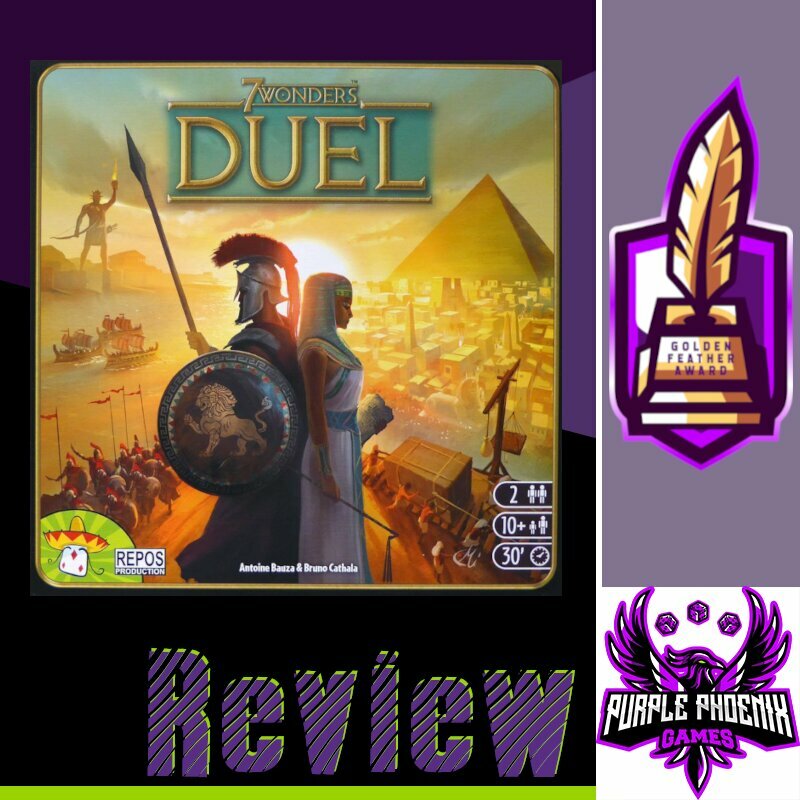
Myself, though, I think I still prefer original 7 Wonders, and I believe it is because I can soar through a game of it in under 15 minutes while holding a conversation with the other players (as long as they have played before and are very comfortable with the rules). Duels creates a more intimate feeling and eats up more of my brainpower. Purple Phoenix Games has awarded 7 Wonders Duel the coveted Golden Feather Award, so we agree that this is a fabulous game. If you have been waffling over grabbing a copy of Duels, please do yourself a favor and just purchase it! I promise you will have a great time with it, and if you end up disagreeing with me, let me know. We can play whatever you like next time we meet.
7 Wonders: Duel is a 2-player tableau and engine-building card game set in the 7 Wonders game universe where players collect cards to create an engine to gain VP using any number of winning strategies. The game takes place over three ages and the player with the most VP at the end of the game, becomes victorious via military supremacy, or wins via scientific supremacy.
To setup, place the game board between the players with the green Progress tokens, Military tokens, and red Conflict pawn upon it. Shuffle the Age I cards and lay them according to the rule book (this formation changes for each age. Age I is setup in the photo below). Each player receives seven gold and they draft their Wonders according to the process in the rules.
On a turn the active player will choose one uncovered face-up card to be used one of three different ways. The card can be added to the player’s tableau and “built” by spending resources required, if any. The card may be discarded in exchange for coins totaling 2 + the number of yellow cards built in the player’s city. Lastly, the card may be used to build a player’s Wonder card by inserting it below the Wonder and paying the cost, as in 7 Wonders proper. The next player will then take their turn.
If on a turn a player builds certain card types into their city, special actions are taken. This happens as a result of building Military or Science cards. When a player builds a Military (red shield icon) card they immediately move the Conflict token on the board one space toward their opponent’s Capital (the end of the board closest to the opponent). Should a player force the Conflict token to reach their opponent’s Capital, the attacking player immediately wins! The other special action that can be taken is with a pair of Science cards being built. For every pair of like-symbol Science cards built, the active player may choose to take one of the Progress tokens from the game board and add it to their collection. These tokens can be very powerful, and just as in 7 Wonders proper, Science is a viable yet difficult strategy. Should a player build any six unique Science icons on cards they will immediately win!
If a Military or Science supremacy victory is not achieved, the game continues to Age II, where setup of the cards is different, but play remains the same. Similarly, Age III is setup differently still and has the added bonus of three random Guild cards, which may add significant strategic icons or abilities. At the end of Age III the players count their VP from the various sources listed in the rule book and the ultimate champion is then crowned!
Components. This game comes in a very small box, so the components are also quite small. I believe myself to have medium-sized man-paws and I have not had any issues with size of components. They are all very high quality, as is to be expected from Repos Production, and are fantastically illustrated. The Conflict token is enticingly menacing, and it lures me into concentrating on a Military victory every time I play. I need to just ignore it, but it’s so beautiful! All in all, the components are great, and even though the cardstock is relatively thin, my copy has withstood many plays and has seen very little wear and tear.
So 7 Wonders: Duel exists for all those players who love 7 Wonders but do not wish to play it with the 2-player variant rules. While Duel is certainly a little sibling, it is also its own beast of a game and should be treated as such. There are several key changes in rules for Duel, such as the trading with the BANK for missing resources upon building versus paying a neighbor to borrow their resource production. Also, the obvious change of adding a board with an ever-dancing Conflict token is unique to this title. Wonders are treated differently and instead of receiving one Wonder with three layers, Duels gives each player four Wonders with just one layer.
Aside from the differences between the two games, I do believe that if you are a fan of one you will also like the other. I can see, though, gamers who dislike 7 Wonders enjoying the smaller 7 Wonders: Duel. There is just something about being able to focus on one other player and agonizing over every turn so that your opponent receives a useless card from the offer, or taking every Military or Science card possible so as to end the game as quickly as possible. My brother, Bryan, greatly dislikes 7 Wonders, but he does not mind playing Duel, or at least that is what he led me to believe…
Myself, though, I think I still prefer original 7 Wonders, and I believe it is because I can soar through a game of it in under 15 minutes while holding a conversation with the other players (as long as they have played before and are very comfortable with the rules). Duels creates a more intimate feeling and eats up more of my brainpower. Purple Phoenix Games has awarded 7 Wonders Duel the coveted Golden Feather Award, so we agree that this is a fabulous game. If you have been waffling over grabbing a copy of Duels, please do yourself a favor and just purchase it! I promise you will have a great time with it, and if you end up disagreeing with me, let me know. We can play whatever you like next time we meet.

Nick doonan (0 KP) rated Dunkirk (2017) in Movies
Apr 4, 2018



A movie you only watch once.
Contains spoilers, click to show
Okay so i was sceptical about watching this movie and have put off watching it for quite some time but, as it is Christopher Nolan and the IMDb ratings seem to show above average on it, i thought i'd give it a chance seen as i loved all his previous movies.
Boy was i disappointed. .
I don't quite know where Nolan was planning to go with this movie or what it was even for but it is completely out of sync with all his other creations. I wanted to actually turn off the movie half way through it but my liking for Nolan kept me watching until it's pitiful and yet quite anticipated ending.
So the movie starts off with soldiers walking through the streets. Looking at the mess left behind from the still engaging warfare of the french. Then we cut to a young lad, separated from his group, avoiding gunfire, running away to stay alive. It's fast paced and it looks like a great start. THEN...
The young lad ends up at the beach where all the soldiers are waiting to be picked up and taken back home to England. A lot of long staring goes on and a very dramatic run by two soldiers taking an injured soldier to one of the boats prevails, but what was the dramatic music for? We then cut to our only 2 fighter pilots, protecting the skies. They seem to have a good friendship but we don't see any of it materialise until the end where one goes ''come on Farrier''. It is hard at this point to actually get on board with any of the characters, whether to like them or dislike them. The majority of the movie is spent watching a young lad trying to get on a board to get back home but keeps meeting obstacles on his way. Eventually, in particular fashion at the end, boats arrive and everyone safely returns home after what felt like eternity.
Conclusion?
I watched this movie purely because it was by Christopher Nolan. If it hadn't been, i wouldn't recommend this to anyone or even watched it myself. It's a movie you would only watch once and this suprises me. I expected so much better from such a great director. It was sloppy, messy and rushed and more importantly... it was just absolutely dull all the way through.
Cillian Murphy had a great part but felt watered down. I really struggled to get on board with anything that was going on.
I wanted to really enjoy this movie, i really did. but i struggled to actually get into anything that was going on. There was no character depth or explanation behind anything that was going on.
*SPOILER HERE....but it's not major so don't worry.* What was the deal with the young lad that died? Why did he mean so much to the old man and his son? Why was the dramatic music used so much for when ziltch was happening? I mean, literally, dramatic music getting faster and faster and then cuts to silence and nothing?
This movie started off quite promising. Walking the streets in the aftermath of battle, avoiding gunfire and then 3 minutes later, nothing. I feel like it was going to go back and explain why certain things was happening but it never did. I honestly don't understand this movie at all. The majority of the movie felt like a filler. The spitfire scenes were tedious and boring, despite the fact they were probably the only best scenes from the movie. This movie is a ''watch once, never again'' type movie. It had absolutely nothing make you want to come back. You can't like any of the characters because of the character depth being missing and it just felt messy.
I'm genuinely dissapointed that this movie wasn't as good or enjoyable.
Boy was i disappointed. .
I don't quite know where Nolan was planning to go with this movie or what it was even for but it is completely out of sync with all his other creations. I wanted to actually turn off the movie half way through it but my liking for Nolan kept me watching until it's pitiful and yet quite anticipated ending.
So the movie starts off with soldiers walking through the streets. Looking at the mess left behind from the still engaging warfare of the french. Then we cut to a young lad, separated from his group, avoiding gunfire, running away to stay alive. It's fast paced and it looks like a great start. THEN...
The young lad ends up at the beach where all the soldiers are waiting to be picked up and taken back home to England. A lot of long staring goes on and a very dramatic run by two soldiers taking an injured soldier to one of the boats prevails, but what was the dramatic music for? We then cut to our only 2 fighter pilots, protecting the skies. They seem to have a good friendship but we don't see any of it materialise until the end where one goes ''come on Farrier''. It is hard at this point to actually get on board with any of the characters, whether to like them or dislike them. The majority of the movie is spent watching a young lad trying to get on a board to get back home but keeps meeting obstacles on his way. Eventually, in particular fashion at the end, boats arrive and everyone safely returns home after what felt like eternity.
Conclusion?
I watched this movie purely because it was by Christopher Nolan. If it hadn't been, i wouldn't recommend this to anyone or even watched it myself. It's a movie you would only watch once and this suprises me. I expected so much better from such a great director. It was sloppy, messy and rushed and more importantly... it was just absolutely dull all the way through.
Cillian Murphy had a great part but felt watered down. I really struggled to get on board with anything that was going on.
I wanted to really enjoy this movie, i really did. but i struggled to actually get into anything that was going on. There was no character depth or explanation behind anything that was going on.
*SPOILER HERE....but it's not major so don't worry.* What was the deal with the young lad that died? Why did he mean so much to the old man and his son? Why was the dramatic music used so much for when ziltch was happening? I mean, literally, dramatic music getting faster and faster and then cuts to silence and nothing?
This movie started off quite promising. Walking the streets in the aftermath of battle, avoiding gunfire and then 3 minutes later, nothing. I feel like it was going to go back and explain why certain things was happening but it never did. I honestly don't understand this movie at all. The majority of the movie felt like a filler. The spitfire scenes were tedious and boring, despite the fact they were probably the only best scenes from the movie. This movie is a ''watch once, never again'' type movie. It had absolutely nothing make you want to come back. You can't like any of the characters because of the character depth being missing and it just felt messy.
I'm genuinely dissapointed that this movie wasn't as good or enjoyable.

Wedding Planner PRO
Lifestyle and Productivity
App
Our deepest congratulations to you and your fiancé on your happy engagement! The planning process...

Bajaj Finserv Wallet
Finance and Shopping
App
Bajaj Finserv Wallet powered by Mobikwik. Fastest Online Recharges, No Cost EMI, offers on LED,...

Snowboard Party Pro
Games and Sports
App
Snowboard Party brings the thrill of snowboarding to your mobile device! Get ready to ride the...
Purple Phoenix Games (2266 KP) rated Buru in Tabletop Games
Feb 22, 2021
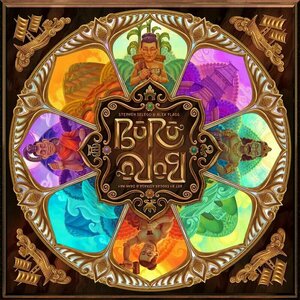
I would consider myself somewhat of a world traveler. I haven’t quite visited as many places as I would like, and certain worldwide pandemics have prevented me from scheduling any international travel plans. My family and I enjoy cruises and visiting all sorts of different countries. Now, Buru has never been specifically on our list of places to visit, but should we ever get the chance to head to Indonesia, now after playing this game I think I will want to visit this little island.
Buru (http://burugame.com/)is a mid-weight economic worker placement game with a large dose of bidding thrown in for fun. In it players are visitors to the island sent to compete to become the governor of Buru by hiring indigenous peoples to assist with tasks, by providing fish for the peoples, pleasing the island’s elders, and by paying homages to the spirits of the land. The emissary who can utilize all their resources efficiently and impactfully will be deemed governor of Buru and winner of the game.
DISCLAIMER: We were provided a prototype copy of this game for the purposes of this review. These are preview copy components, and I do not know for sure if the final components will be any different from these shown. Also, it is not my intention to detail every rule in the game, as there are just too many. You are invited to download the rulebook, back the game through the Kickstarter campaign, or through any retailers stocking it after fulfillment. -T
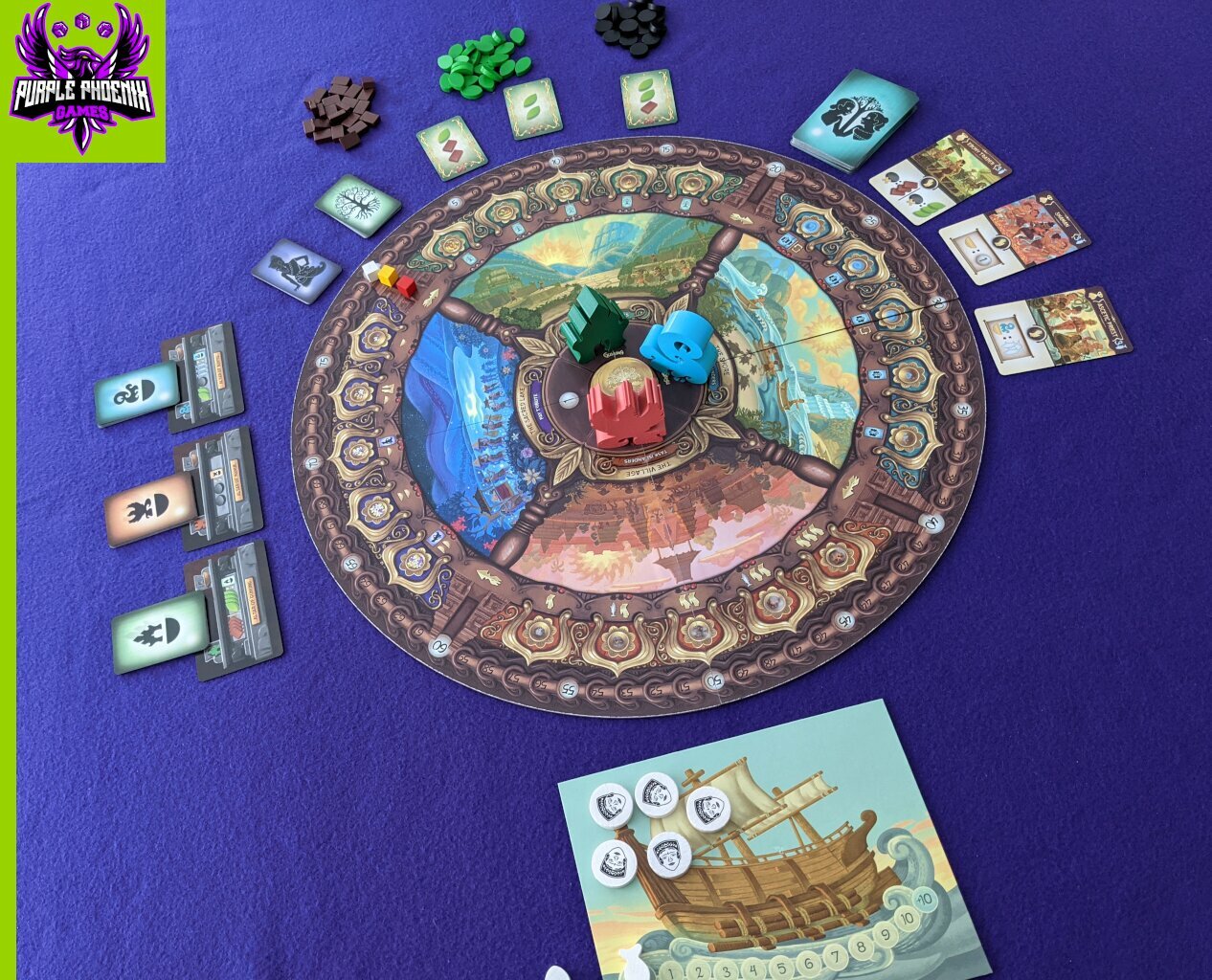
To setup, follow the instructions in the rulebook. There are just too many steps to detail here and the rulebook is fantastic. Once setup, the play area should look similar to the photo below.
The game of Buru lasts five rounds, and each round consists of five phases of the day: Dawn, Morning, Noon, Afternoon, and Dusk. At the end of the fifth round the game is over and players will tally points to arrive at the winner.
During the Dawn phase players will flip over the top two Decrees tokens from the middle of the main circular board. These Decrees will be placed in certain areas and are worth bonus points or other advantages for the round. Also during this phase the Forest cards will be reset from the previous round. Once complete play moves to the Morning phase.
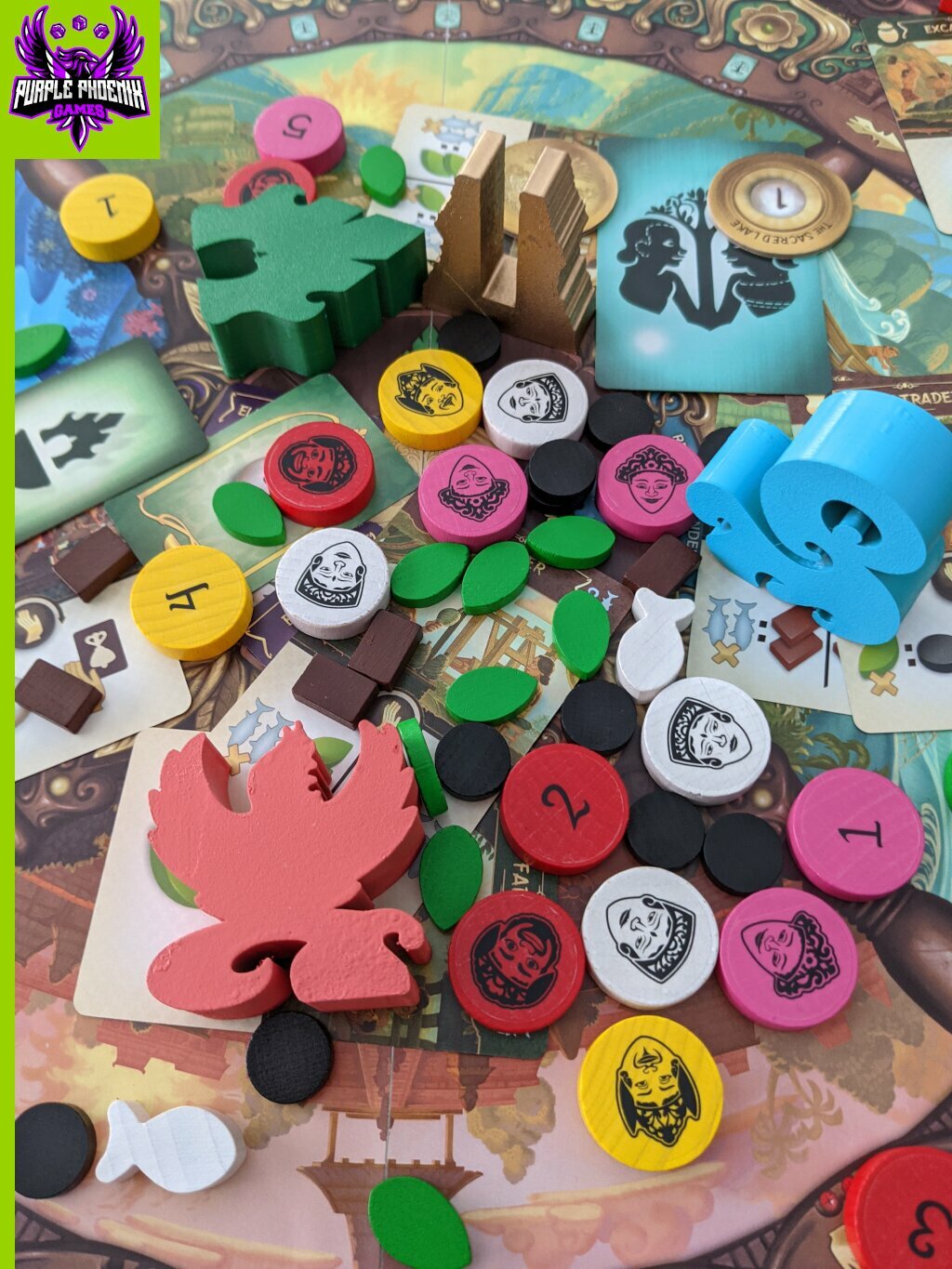
In the Morning players will be sending out their numbered Explorer tokens (from 1-5) onto the various board areas in turn starting with the current Emissary (first player). Each player will place one of their Explorer tokens at a time until each player has only one Explorer token left. Players may place multiple Explorers in a location to increase their bid for majority, but these Explorer tokens are placed face-up (literally with the face showing and the number on the board not showing) so that their values are hidden. Once Explorers are placed, play moves to the Noon phase.
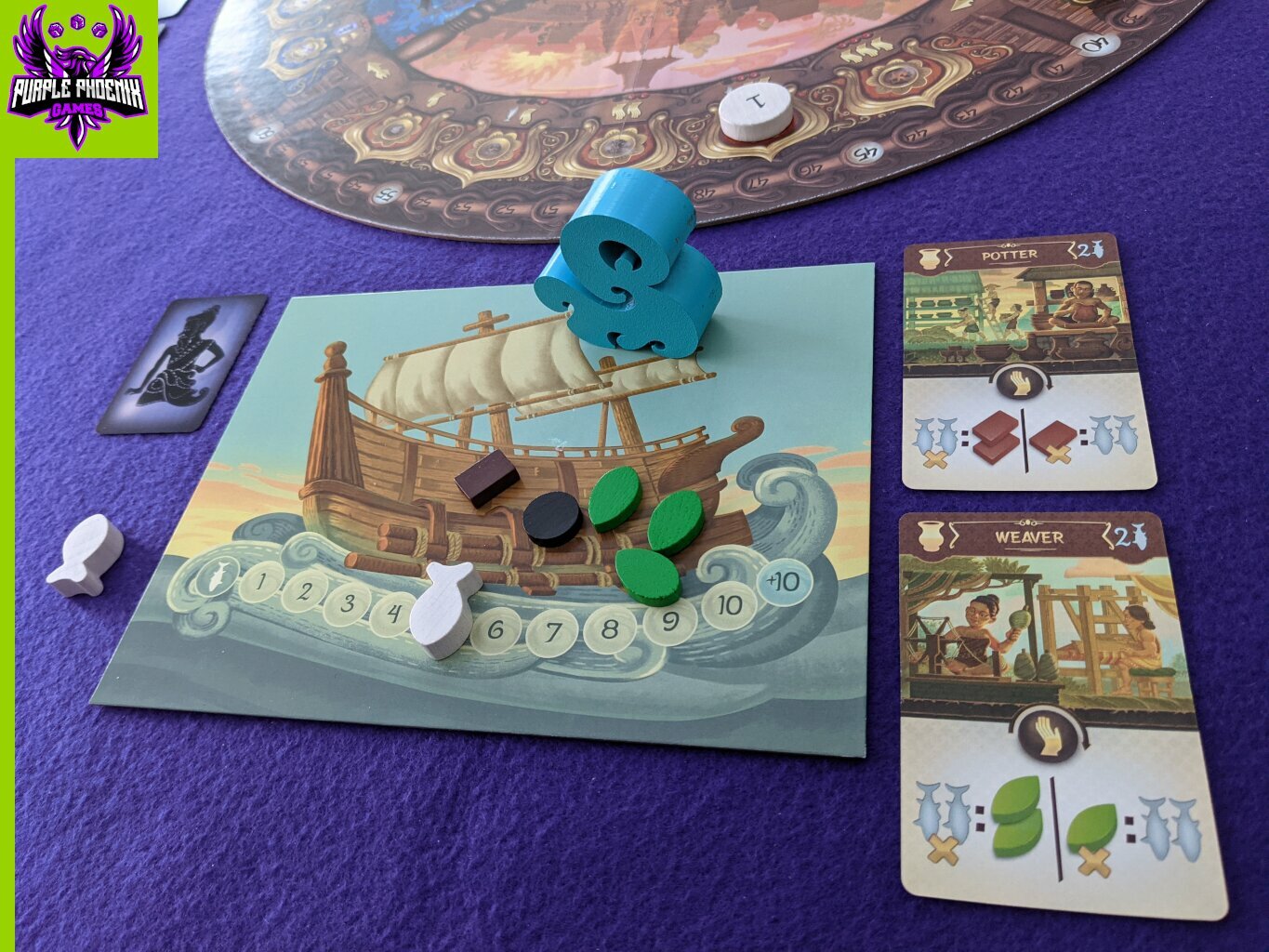
At Noon the people must fish for food and have lunch. The leftover Explorer token that was not used in the Morning is then revealed and its value is converted to fish. Fish are needed to recruit islanders and are converted into other resources. Fish are tracked on the individual player boards. After a hearty lunch play continues into the Afternoon.
The Afternoon is where much of the action in Buru takes place. During this phase the Explorer tokens that were placed in the Morning are revealed and players take actions in each area by order of majority in each area. First the highest-bidding player will claim their chosen action space, then the next highest bidder, and so on. The Forest is resolved first. Players reveal the Explorer tokens in the Forest and whichever player has majority in this area is able to place their tokens a claim space on the board and will receive a Forest card of their choice. Forest cards are typically resources immediately earned by the player. Resources include Clay, Palm Leaves, and Ebony. The player with majority also earns the favor of Gunung (green spirit) and takes its giant statueeple.
Next, the Shore is resolved in the same manner. The Shore is where players may use their supplies of fish to recruit islanders to their taskforces and carry out tasks. The majority leader in this area chooses a space to place their Explorer tokens and resolves the action. This could include purchasing islander cards and refreshing the offer of islander cards in whichever order the player chooses. The player with the majority also earns the favor of Banyu (blue spirit) and takes its giant statueeple.
The Village is the area where islanders are able to complete tasks. The majority leader in this area chooses a space and takes the actions. These actions include activating islanders for the actions printed on the bottom of their cards and possibly even earning more fish. The player with the majority also earns the favor of Manuk (orange spirit) and takes its giant statueeple.
Finally, The Sacred Lake is resolved in the same manner. Here players are able to pay tributes to the spirits in order to earn bonuses from them. The majority leader in this area chooses a space to place their Explorer tokens, earns an immediate Esteem (VP tracked along the outer edge of the board), and takes the action of the space claimed. These spaces offer opportunities to pay tribute to one or more of the spirits as well as earning an Elder card, which provides conditions for earning bonus points at the end of the game. When a spirit is tributed they offer bonus Esteem cards and other benefits to be used. Once this area is completely resolved and players have all taken their turns play moves onto Dusk.
In Dusk players will reset the board for the next round of play. Players retrieve all their Explorer tokens from the board and untask their islanders that have completed tasks this day. After the fifth round the game is over and players tally their scores from their position on the Esteem track, any spirit Tribute cards earned, and Elder card point conditions met. The player with the most points will be crowned the winner!
Components. Okay, I have to give a giant shout-out to the team at Crafty Games. This is one of the highest-quality prototypes I have ever played in terms of component quality. When I opened the game box all components were separated into baggies and card cases and LABELED with the number of components, the titles, and even a picture of the components to be placed within. I don’t even organize my games to this level and I feel I am a tad OCD about my game organization. Kudos here. But also the components are all fine quality and the finished product promises to be just spectacular if this is what is received as a prototype.
I love the art and art style throughout this game. It is difficult to have theme shine through in a very Euro-style game, but I did feel the theme here. The art is very suggestive of island life, and Crafty Games even hired Cultural Consultants to assure all avenues are culturally appropriate. What a great call. I wish all publishers would be so thorough.
The gameplay is also quite stunning. The game just flows so naturally and everything makes complete sense. Of course you need to collect natural resources before recruiting islanders before asking said islanders to complete tasks before you pay respects to their spirits. I like the flow, and after a couple rounds I no longer needed the rulebook as a crutch.
I have very much enjoyed my plays of Buru for many reasons. The game is absolutely gorgeous. The art sings and truly adds to the gameplay. The rules are not light, but not over my head, and I appreciate that. The choices given to each player are crunchy without being too burdensome, and players of many skill levels will be able to find joy contemplating when and where to send their Explorers in each area. The game builds up to a big ending where many points are scored from places unknown to opponents and bulleting ahead from last place to first from exploiting bonus cards is so satisfying.
It is easy to understand why I love this game and would certainly recommend it to all gamers. If you have been looking for something a little heavier in your collection but don’t want to go TOO heavy, please do yourself a favor and consider backing Buru. Crafty Games has been working on some truly great games here the past couple years and I am excited to see where Buru ends up after another undoubtedly successful Kickstarter campaign. I will always be up for a game of Buru, and I hope to play it often as the years continue.
Buru (http://burugame.com/)is a mid-weight economic worker placement game with a large dose of bidding thrown in for fun. In it players are visitors to the island sent to compete to become the governor of Buru by hiring indigenous peoples to assist with tasks, by providing fish for the peoples, pleasing the island’s elders, and by paying homages to the spirits of the land. The emissary who can utilize all their resources efficiently and impactfully will be deemed governor of Buru and winner of the game.
DISCLAIMER: We were provided a prototype copy of this game for the purposes of this review. These are preview copy components, and I do not know for sure if the final components will be any different from these shown. Also, it is not my intention to detail every rule in the game, as there are just too many. You are invited to download the rulebook, back the game through the Kickstarter campaign, or through any retailers stocking it after fulfillment. -T
To setup, follow the instructions in the rulebook. There are just too many steps to detail here and the rulebook is fantastic. Once setup, the play area should look similar to the photo below.
The game of Buru lasts five rounds, and each round consists of five phases of the day: Dawn, Morning, Noon, Afternoon, and Dusk. At the end of the fifth round the game is over and players will tally points to arrive at the winner.
During the Dawn phase players will flip over the top two Decrees tokens from the middle of the main circular board. These Decrees will be placed in certain areas and are worth bonus points or other advantages for the round. Also during this phase the Forest cards will be reset from the previous round. Once complete play moves to the Morning phase.
In the Morning players will be sending out their numbered Explorer tokens (from 1-5) onto the various board areas in turn starting with the current Emissary (first player). Each player will place one of their Explorer tokens at a time until each player has only one Explorer token left. Players may place multiple Explorers in a location to increase their bid for majority, but these Explorer tokens are placed face-up (literally with the face showing and the number on the board not showing) so that their values are hidden. Once Explorers are placed, play moves to the Noon phase.
At Noon the people must fish for food and have lunch. The leftover Explorer token that was not used in the Morning is then revealed and its value is converted to fish. Fish are needed to recruit islanders and are converted into other resources. Fish are tracked on the individual player boards. After a hearty lunch play continues into the Afternoon.
The Afternoon is where much of the action in Buru takes place. During this phase the Explorer tokens that were placed in the Morning are revealed and players take actions in each area by order of majority in each area. First the highest-bidding player will claim their chosen action space, then the next highest bidder, and so on. The Forest is resolved first. Players reveal the Explorer tokens in the Forest and whichever player has majority in this area is able to place their tokens a claim space on the board and will receive a Forest card of their choice. Forest cards are typically resources immediately earned by the player. Resources include Clay, Palm Leaves, and Ebony. The player with majority also earns the favor of Gunung (green spirit) and takes its giant statueeple.
Next, the Shore is resolved in the same manner. The Shore is where players may use their supplies of fish to recruit islanders to their taskforces and carry out tasks. The majority leader in this area chooses a space to place their Explorer tokens and resolves the action. This could include purchasing islander cards and refreshing the offer of islander cards in whichever order the player chooses. The player with the majority also earns the favor of Banyu (blue spirit) and takes its giant statueeple.
The Village is the area where islanders are able to complete tasks. The majority leader in this area chooses a space and takes the actions. These actions include activating islanders for the actions printed on the bottom of their cards and possibly even earning more fish. The player with the majority also earns the favor of Manuk (orange spirit) and takes its giant statueeple.
Finally, The Sacred Lake is resolved in the same manner. Here players are able to pay tributes to the spirits in order to earn bonuses from them. The majority leader in this area chooses a space to place their Explorer tokens, earns an immediate Esteem (VP tracked along the outer edge of the board), and takes the action of the space claimed. These spaces offer opportunities to pay tribute to one or more of the spirits as well as earning an Elder card, which provides conditions for earning bonus points at the end of the game. When a spirit is tributed they offer bonus Esteem cards and other benefits to be used. Once this area is completely resolved and players have all taken their turns play moves onto Dusk.
In Dusk players will reset the board for the next round of play. Players retrieve all their Explorer tokens from the board and untask their islanders that have completed tasks this day. After the fifth round the game is over and players tally their scores from their position on the Esteem track, any spirit Tribute cards earned, and Elder card point conditions met. The player with the most points will be crowned the winner!
Components. Okay, I have to give a giant shout-out to the team at Crafty Games. This is one of the highest-quality prototypes I have ever played in terms of component quality. When I opened the game box all components were separated into baggies and card cases and LABELED with the number of components, the titles, and even a picture of the components to be placed within. I don’t even organize my games to this level and I feel I am a tad OCD about my game organization. Kudos here. But also the components are all fine quality and the finished product promises to be just spectacular if this is what is received as a prototype.
I love the art and art style throughout this game. It is difficult to have theme shine through in a very Euro-style game, but I did feel the theme here. The art is very suggestive of island life, and Crafty Games even hired Cultural Consultants to assure all avenues are culturally appropriate. What a great call. I wish all publishers would be so thorough.
The gameplay is also quite stunning. The game just flows so naturally and everything makes complete sense. Of course you need to collect natural resources before recruiting islanders before asking said islanders to complete tasks before you pay respects to their spirits. I like the flow, and after a couple rounds I no longer needed the rulebook as a crutch.
I have very much enjoyed my plays of Buru for many reasons. The game is absolutely gorgeous. The art sings and truly adds to the gameplay. The rules are not light, but not over my head, and I appreciate that. The choices given to each player are crunchy without being too burdensome, and players of many skill levels will be able to find joy contemplating when and where to send their Explorers in each area. The game builds up to a big ending where many points are scored from places unknown to opponents and bulleting ahead from last place to first from exploiting bonus cards is so satisfying.
It is easy to understand why I love this game and would certainly recommend it to all gamers. If you have been looking for something a little heavier in your collection but don’t want to go TOO heavy, please do yourself a favor and consider backing Buru. Crafty Games has been working on some truly great games here the past couple years and I am excited to see where Buru ends up after another undoubtedly successful Kickstarter campaign. I will always be up for a game of Buru, and I hope to play it often as the years continue.