
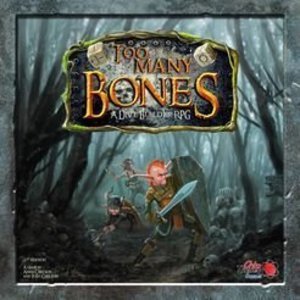
Too Many Bones
5.3 Rate It
Tabletop Game
Too Many Bones comes loaded for bear by breaking into a new genre: the dice-builder RPG. This game...
Boardgames DiceRPGgame
HeroQuest Advanced Quest
7.5 Rate It
Tabletop Game
Advanced Heroquest was a 1989 sequel to HeroQuest, published by Games Workshop. Changes from...

Rent: The Complete Book and Lyrics of the Broadway Musical
7.3
Rate It
Book
Set on the Lower East Side of New York City, Rent is the story of young bohemians Mark, Roger,...

The Relic Keeper
Book
Italy, 1620. Angelo is an orphan, lonely and forgotten. Having been passed on from one family to...
Historical Fiction

Calvin (Almstead Island: Newcomer's Club #2)
10.0 Rate It
Book
What could go right with a Daddy who doesn’t know how to be one, and a boy who’s scared to let...
Contemporary MM Romance Daddy kink Content Warnings: Daddy/boy parental death

The Patient
7.0
Rate It
Book
The Silent Patient by way of Stephen King: Parker, a young, overconfident psychiatrist new to his...

Merissa (14173 KP) rated The Stone God (Indulgence #1) in Books
May 26, 2021 (Updated Jul 26, 2023)
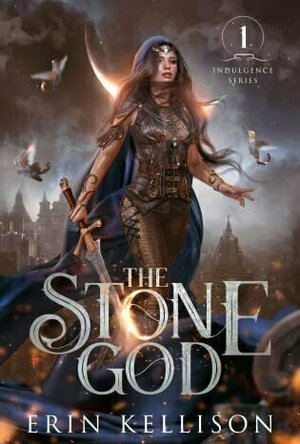
Terah has moved to the house she inherited so she can get her life back together again. Some peace sounds very good to her. Instead, a shrine is washed up (literally) and she is charged with taking care of it. Her life changes, in ways too many to mention. Although this is in the Romance genre, at this stage I honestly don't know who is the main male (although I have my own idea) - and I love that!
The pacing is fast and there is a lot that happens. Terah grows immeasurably in this story and still remains true to herself. She is prepared to help the Gods as long as they help her and had better not get in her way. If there were any editing or grammatical errors, I have to say I missed them, being engrossed in the story as I was.
There are pieces scattered all over the board by the end, and I honestly can't wait for book two to see where they will end up. A fantastic story that had me gripped from beginning to end. Absolutely recommended by me.
** same worded review will appear elsewhere **
* A copy of this book was provided to me with no requirements for a review. I voluntarily read this book, and the comments here are my honest opinion. *
Merissa
Archaeolibrarian - I Dig Good Books!
May 26, 2021

Paul Kellett (118 KP) rated Snowdonia in Tabletop Games
May 4, 2019

Well, there are trains (many, many wonderful (and stupid) trains), and there are tracks, but Snowdonia is not your typical stuffy old train game.
Snowdonia is a worker placement Euro game (one of the best in My opinion) which has players working to complete the railway up to the top of Mount Snowdon.
While you are all working on the same track, this is a competitive game in which you score points for laying tracks, building stations and completing contracts.
The Dai is Cast
The game is set up by choosing which scenario you wish to play, and there are a good number, and laying out the track & station cards around the edge of the board. This is one of the great things about Snowdonia - each expansion is just a deck of cards which replace the original station & track cards, add a few additional rules and make a completely different experience.
The main board has a number of actions you can take like gathering resources, digging out rubble to clear the way for laying tracks (another action) or building stations to name a few. Each action location is further split into worker slots and in true worker placement fashion, these are limited so not everyone can do what they might want to.
There is a deck of contract cards, 3 of which are drawn at the start and replenished each round. If no-one has taken a contract, then the leftmost one is discarded and the other cards shift across with a new contract appearing on the right.
These contract cards are in two sections - the main part is a one time action that can give you a bonus to specific actions and is then spent. You keep the card though as the top part shows a game end bonus. If you satisfy the contract (by having laid a certain number of rails, built a number of stations, or dug enough rubble (and usually a combination of these things)) then you can get a decent bunch of points at the end of the game. Going after these can be rewarding but also quite tricky.
The backs of the contract cards also have a weather icon on them and this can be sunny, raining, foggy or, depending on the scenario, snowy. There is a weather track on the board which indicated the current weather as well as the forecast for the next 2 days so you can try to plan what you are going to do. The weather affects what actions you can take and how efficient you will be at doing them. Sunny days increase the amount of rubble you can dig and the number of tracks you can lay while rainy days decrease this and foggy days restrict the number of action spaces available. These work rates are marked on a track so if you get a run of 2 or 3 sunny days, you can get a good amount of work done.
The way this weather mechanic works really changes how each game feels. You can have games where it's very sunny and you can fair fly up the mountain or you could trudge through the fog gloomily laying the odd track and wishing you were in the pub.
It's warm in here, boyo, leave me to my pint will you
Ah, the pub. You have three workers, but only two are always available. The third one is found in the pub and will only come out if you get a train to take him up the mountain. Firstly, this involves buying a train when it becomes available and then paying a coal cube (not a cola cube, he's not that easily bought) to fuel the train. You only get him for that round after which he goes straight back to the pub.
This brings me on to resources. There are three types - Iron, Stone and Coal. Iron is needed to make tracks and build some station spots while Stone is used to build stations. Coal, as said, get's your man out of the pub.
Resources are restocked at the end of every turn and drawn blindly from a bag. The bag has finite resources determined by the player count but also contains 5 white cubes. These white cubes are the game's timer and represent "the company" coming in and doing work while you are messing about so keeping an eye on what resources are out is vital if you want to get a decent score.
When white cubes are drawn, they get placed on the AI track and will make the company dig, build or lay tracks so if you are not careful, the company will bring the game to a swift end.
Very Chuffed
The base game comes with 6 trains and each expansion adds more. Each train has it's own different special ability like granting you a bonus to your dig rate, letting you convert more Iron into Rail tracks or giving you a free build action.
All these really change how you can play and combined with the weather and the variety of contracts available really give a ton of replayability to Snowdonia.
Not only do the expansions come with trains, but the designer, Mr. Boydell has been creating additional trains for many a year, both as physical promo cards given away at conventions and with other games in his stable and as print and play cards posted up on his blog on BGG. Many of these trains are funny, silly or rude, often being inspired by events on the news and in the gaming world and there are A LOT of them. Check out www.snowdoniacentral.com to see the full list.
The Solo Game
Technically, the solo game is played exactly as the multiplayer game and is a "beat your best score" but that is really doing it a disservice. Like in the multiplayer game, the vastly different ways the weather, contracts and trains can interact makes each game feel totally different and the AI is unforgiving if you linger too long hoarding resources. This makes for a very challenging puzzle of resource optimisation and action efficiency that is very satisfying when you nail it.
There is a campaign of sorts where you play through a number of games using each train in order and there have been various challenges posted on Boardgame Geek.
Ooh, It's Big and Shiny
The Deluxe Edition (currently on Kickstarter) has collected all the expansions, many of them incredibly hard to find, (almost) all of the trains (even the print & play ones) and every other promo over released for Snowdonia and put them together in a lovely big box with a myriad up upgraded wooden pieces, all screen printed, as well as a larger board (with spaces to lay the track cards), more trains and some exclusive new scenarios. There is also the hint of a dedicated solo Automa to be added, but we will have to see, I wouldn't be bothered if it doesn't as the game is a superb solo experience as it is. Oh yeah, they have also added a set of cards that have each space on the board printed on each one so that you can use those to play the game if you are tight on space or want to take the game travelling. These were originally uploaded to BGG by a fan and I have used these many times when I have been working away as you can take them plus just enough pieces and cards to play solo and fit them all in a tiny box.
Snowdonia is My top Euro game and has been for a number of years, and I highly recommend going and checking it out.

Purple Phoenix Games (2266 KP) rated Jetpack Joyride in Tabletop Games
Jan 8, 2020 (Updated Jan 8, 2020)
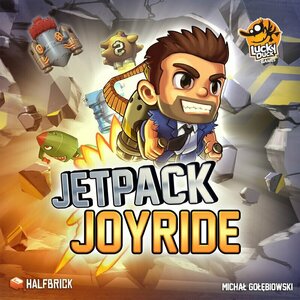

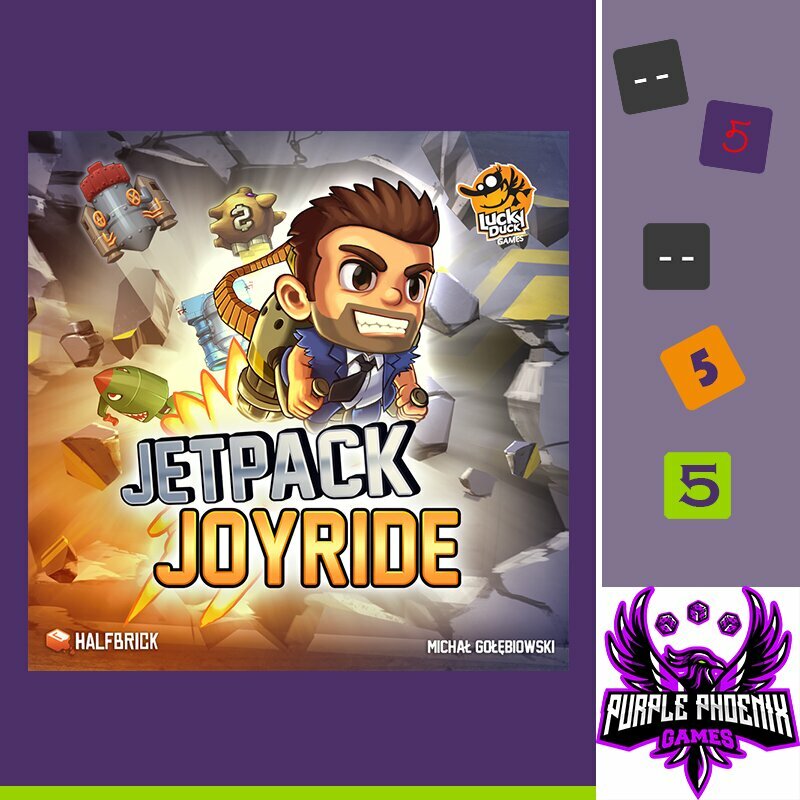
Originally a mobile game, Jetpack Joyride follows our main character, Barry, as he attempts to escape a top-secret lab with a stolen jetpack! He must avoid being hit by zappers, annihilated by lasers, and blown away by missiles in the process. If Barry succeeds, he escapes with not only the high-tech jetpack, but also with as many gold coins and other top-secret gadgets as he can get his hands on! So the risk is definitely worth the reward. But if Barry is unable to escape, he will face the consequences for his unauthorized joyride… In all honesty, I had never heard of Jetpack Joyride before I Kickstarted the board game version, so I downloaded it on my phone to see how it plays. Do you remember Flappy Bird? The mobile version of Jetpack Joyride is kiiiinda like that, but more exciting and way less infuriating. It’s free to download in the App Store and Google Play Store, so check it out if you’re interested! Anyway, back to the board game version. The premise is the same as the app – you have to create a path for Barry to use for his escape from the lab, utilizing the gadgets available to you and collecting gold coins on your way.
DISCLAIMER: We are using the Kickstarter Deluxe version of the game. We do have the expansions from the KS campaign, but will not be using those for this review. Also, we do not intend to cover every single rule included in the rule book, but will describe the overall game flow and major rule set so that our readers may get a sense of how the game plays. For more in depth rules, you may purchase a copy from the publisher directly or from your FLGS. -T
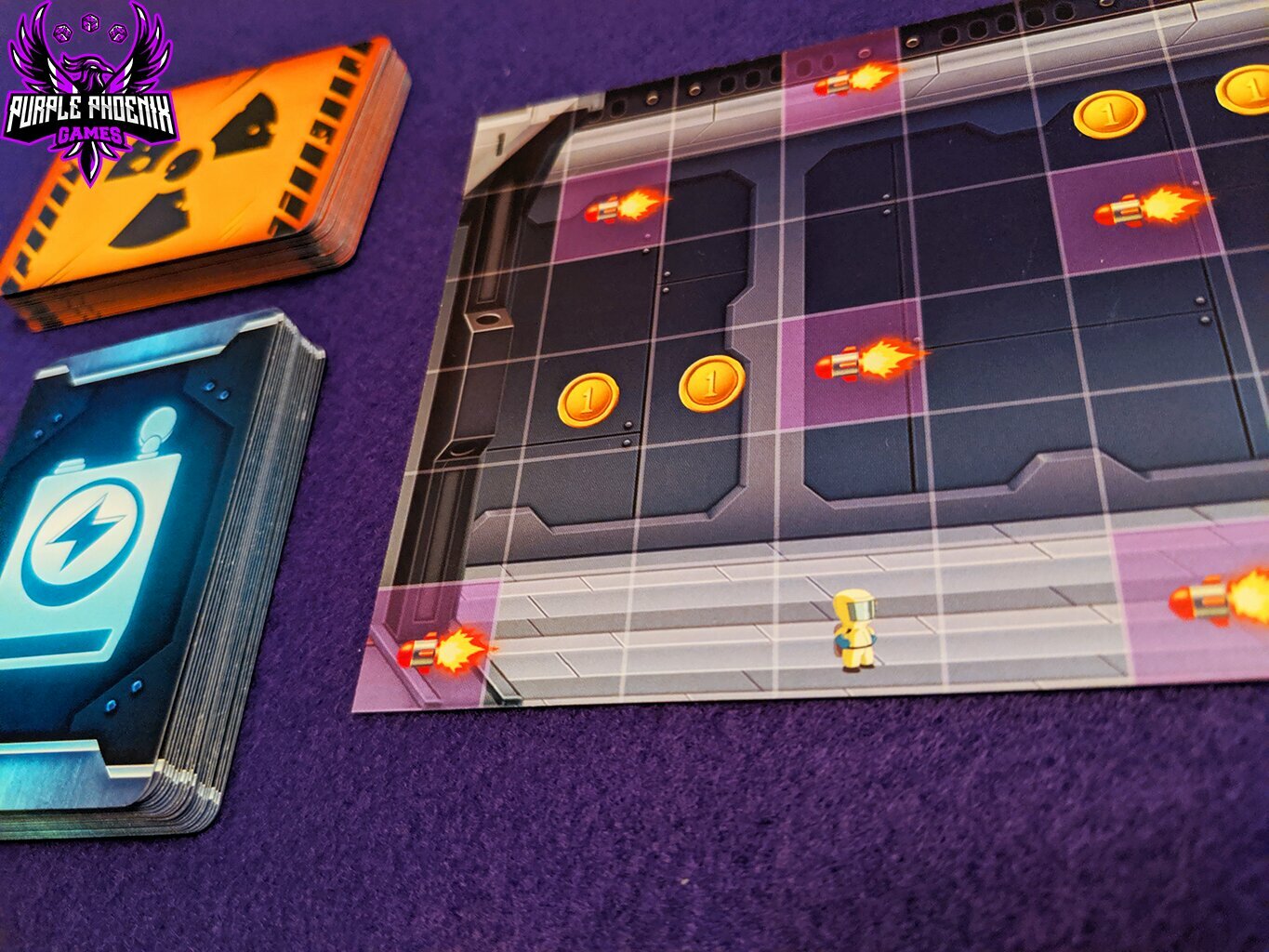
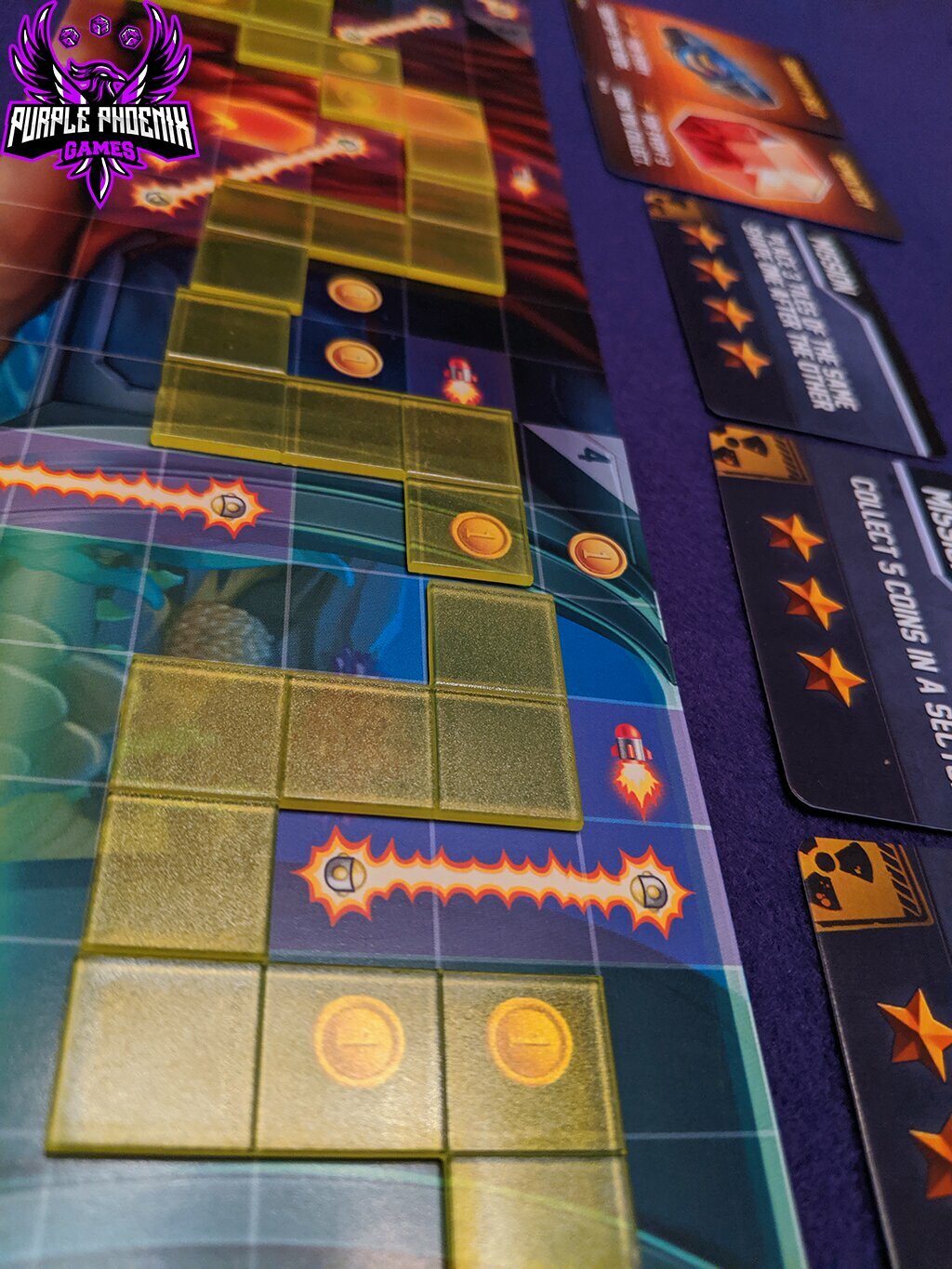
Jetpack Joyride is a real-time game of tile placement in which players are racing to see who can complete their run (path through the lab) the fastest. The game lasts for 3 runs, and points are earned throughout all runs. To setup, each player receives a set of 4 lab sector cards and sets them on the table in front of them in numerical order, 1-4. Three mission cards (cards that score points at the end of the run) are revealed and available for all players. Players may also have gadgets, available only to them, to help score extra points. When a run begins, all players grab translucent polyominoes (like matte versions of bits from Blokus) from the common pool and place them on their lab cards to create an unbroken path through the lab. There are specific placement restrictions that I will leave for you to discover in the rulebook. The game has no set time limit for each run, but it is a race to complete a path before your opponents. At the end of the run, points are tallied for completed missions and gadget cards. Easy, right? Here’s a small twist – before starting the next run, all players pick up their lab cards and pass them to the player on their left. So each run, players are looking at new cards and must find new paths through the lab! New mission cards and gadgets are revealed before subsequent runs as well. The player with the most points at the end of all 3 runs is the winner!
Jetpack Joyride is a fast-paced, exciting, and surprisingly strategic game that keeps all players engaged and entertained. And that’s what I love about it. First of all, real-time games are always high-energy, at least in my opinion. It’s nearly impossible to stay calm and collected when you’re literally racing against your opponents! Jetpack Joyride is definitely not a passive game, and there’s so much action and excitement that you sometimes forget you’re literally just laying tiles on cards. The next thing I love about this game is how deceptively strategic it is. Laying tiles to form a legal path across cards is not complicated, but doing so while also trying to earn extra points by completing missions (like placing 3 tiles of the same shape in a row, for example) adds a strategic element that you don’t expect. You’re not only trying to finish your run the fastest, but you’ve also got to fulfill the requirements for multiple mission and gadget cards too. One misplaced tile could decimate a run for you, so you’ve always got to be thinking several tiles in advance.
Going along with that, another neat thing about Jetpack Joyride is that all players are drawing tiles from a common pool. There is a finite number of tiles, and a specific number of the different shapes, so if the shape of tile you need is gone from the pool, you’re outta luck! You have to think and move quickly, otherwise you might get knocked out of a run, and that costs you valuable end-game points. For such a simple game, Jetpack Joyride also has a lot of variability. All lab cards are double-sided, and can be mixed and matched in any combination, as long as they are in a numerical set of 1-4. There are so many possibilities, chances are you won’t ever play with the same card combo twice….and if you do, chances are you won’t remember it 😛 All of these aspects elevate this game from a simple party game to a strategically fun game that can be played with any player count.
Overall, I think Jetpack Joyride is great. After my first play, I rated it a 4+, but after a few more I’ve changed my rating to a 5. As you can see from our scores above, Travis and our guest judge Luke enjoyed it as well. It’s a nice, light game that can be used as a filler between heavier games, or as a main-event game all on its own. Definitely a game I will use with newer gamers, and the strategic side will keep me coming back for more. I think Jetpack Joyride will get a lot of playtime from me, and it was worth my investment on Kickstarter. Purple Phoenix Games gives it a jet-powered 15 / 18.

Purple Phoenix Games (2266 KP) rated Cryptocurrency in Tabletop Games
Apr 2, 2020

You are the CEO of a fin-tech startup company. Leading a team of specialized experts, you will evaluate, trade, and mine different cryptocurrencies. Strategy is key, as you must stay ahead of the trend to maximize your earnings from the market. Can you solve the right algorithms and manipulate the network to help create the most wealth for your company? Or will you be scammed into buying worthless cryptocurrency? Play to find out!
Disclaimer: We were provided a copy of this game for the purposes of this review. This game is available to purchase, so the components seen in the pictures are what come with the game. I do not intend to rehash the entire rulebook in this review, but rather provide the basic ruleset and general gameplay overview of the game. Feel free to pick up a copy of the game directly from the publisher or your FLGS! -L
Cryptocurrency is a game of commodity speculation, action points, trading, and a little push your luck in which players are trying to amass the most amount of money over 5 rounds. To setup the game, place the Cryptocurrency Info Boards in the center of the play area, and place the Market Board next to them. Prepare and distribute the Rumor cards, and create the Ongoing Transactions deck. Each player receives a player reference card, 3 Intern Expert cards, and a total of 6 Wonga (the currency of the game). The game is now ready to begin! Each round is broken up into 4 phases: Prep, Action, Upkeep, and Rumor. During the Prep phase, each player (in turn order) must draw a Rumor card, and may hire a new Expert or take a loan. Experts are hired (purchased) from the Job Seekers pile, and often provide special abilities or increased Action Points. Hired Experts must replace one Expert from their existing team. Your team can only have 3 Experts, so choose wisely who to hire and fire! A loan can be taken to immediately gain 8 Wonga, but interest must be paid for the loan later in the round. After each player has performed these actions, play moves to the second phase.
During the Action phase, players take turns performing one of two actions: Mining or Trading. These actions are performed by spending Action points – each Expert offers a certain number of points to spend. Once you use an Action Point, that Expert is exhausted and can no longer work in this phase. To Mine, players choose one of the 4 available cryptocurrencies to mine (research), and will either Succeed or Fail in this endeavor. If you succeed, you create and earn coins from that specific cryptocurrency, as well as any extra money earned from completing ongoing transactions. If you fail, your turn immediately ends. To take the Trade action, players will either Buy or Sell coins to/from the Market. You are only allowed to buy/sell the same cryptocurrency each turn, and you may buy/sell up to 4 coins each turn. For every 4 coins bought, the Market Board shifts to increase that currency’s price by 1 Wonga. For every 4 coins sold, the Market decreases by 1 Wonga. Once every player is out of Action Points, this phase is over.
In the Upkeep phase, players refresh all Experts, pay interest on any Loans, or completely pay off a Loan. The final phase, Rumor, moves in counter-clockwise order. Players take turns adding their secret Rumor card to the Rumor Track of one of the 4 cryptocurrencies. The market values are adjusted based on the Rumors played, and any face-down Rumor cards will affect the end-game value of the currencies. Play then returns to the Prep phase, and continues until 5 rounds have been completed. Players determine which cryptocurrency was a scam, sell any remaining coins, and then count up their money. The player with the most Wonga is the winner!
I have to admit that Cryptocurrency surprised me. After reading the rules and getting the game setup, I was feeling a little overwhelmed. I was prepping myself for a complicated, quasi-educational game in which I would be relatively unengaged and going through the motions each turn. What I got, however, was the complete opposite. Yes, there is a lot going on in this game, but it offers so many different mechanics and strategies for success that you’re always thinking one step ahead. There’s the aspect of bluffing when it comes to Rumor cards and manipulating the market through those means, there’s drafting of new Experts and shedding your hand of lesser-powered cards, there’s push your luck in the Mining action as the more Action Points you spend, the more opportunity you have for success. There’s not one sure strategy to win, and you are changing and adapting on every turn. You also have to be paying attention to your opponents! Although there’s not really any direct player interaction, everything you do on your turn could throw a wrench in the plans of your neighbor. Can you figure out how they’re trying to play the Market? Or will you try to fly beneath the radar and throw them off your trail?
My biggest issue with this game has to do with components. The cryptocurrency boards and the market board all work together, but they are all their own separate components. So it just makes set-up/tear-down a little more involved because instead of laying out 1 big board and adding components to it, you have to lay out and populate 5 individual boards. It just makes it a little more tedious than I would like, but honestly it has no bearing on the gameplay at all. The quality of the components is pretty good overall, the artwork is tech-influenced and fun, and the cardboard coins are nice and sturdy. So all in all, a pretty good production quality.
So what are my thoughts on Cryptocurrency? I actually liked it more than I thought I would. It’s engaging and strategic, yet relatively simple enough that it doesn’t feel like too much of a brain burner. I am no cryptocurrency expert by any means, but I feel like after playing this game, I have a better understanding of it and how it works. So mission accomplished, Captial Gains Studio – you have a fun AND educational game here. Is it one I will pull out at every game night? No. But it’s one that I am looking forward to playing again in the future. Purple Phoenix Games gives Cryptocurrency an economic 8 / 12.