
Search
Search results
Arboretum
Tabletop Game
Arboretum is a strategy card game for 2-4 players, aged 10 and up, that combines set collection,...
Boardgames CardGames BeautifulGames
VivaJava: The Coffee Game: The Dice Game
Tabletop Game
VivaJava: The Coffee Game: The Dice Game – or, more simply, VivaJava Dice – is the successor to...
BoardGames Dicegame RollnWriteGames CoffeeGames
Steam Park: Play Dirty
Tabletop Game
You probably remember the merry town of Roboburg, don’t you? You know: that place full of...
Merissa (14224 KP) rated Strength Check (Dungeons and Dating #1) in Books
Sep 17, 2021 (Updated Jul 14, 2023)
STRENGTH CHECK is the first book in the Dungeons and Dating series, and we start off with Roxie. She has just opened a board game café with her two best friends and has no room in her life for romance. Her self-esteem has been severely battered and she has hidden herself from the world. Melody (Mel) has moved to San Francisco from Philly and rents out a room in Roxie's home. Both of them feel attraction but, due to baggage, neither makes a move.
Miscommunication is a theme where romance is concerned. After all, if everyone just said what they thought, there wouldn't be any books! BUT there seemed to be just a tad too much here for me. I really wanted to slap both Roxie and Mel upside the head. I was cheering when they finally got together!
Found families is a wonderful theme for me. I adore it, and this was no exception. Roxie's found family are divine and I really can't wait for future stories so I can get to meet each of them in closer detail.
This is a slow-burn, steamy romance with fun, frolics, and family. It is also sad in places, leaving me wanting their book now. Sorry, not saying who as I don't want to spoil it.
First in a series and absolutely recommended by me. Just be prepared to be frustrated at the two of them! 😉
** same worded review will appear elsewhere **
* A copy of this book was provided to me with no requirements for a review. I voluntarily read this book, and the comments here are my honest opinion. *
Merissa
Archaeolibrarian - I Dig Good Books!
Sep 17, 2021

Miscommunication is a theme where romance is concerned. After all, if everyone just said what they thought, there wouldn't be any books! BUT there seemed to be just a tad too much here for me. I really wanted to slap both Roxie and Mel upside the head. I was cheering when they finally got together!
Found families is a wonderful theme for me. I adore it, and this was no exception. Roxie's found family are divine and I really can't wait for future stories so I can get to meet each of them in closer detail.
This is a slow-burn, steamy romance with fun, frolics, and family. It is also sad in places, leaving me wanting their book now. Sorry, not saying who as I don't want to spoil it.
First in a series and absolutely recommended by me. Just be prepared to be frustrated at the two of them! 😉
** same worded review will appear elsewhere **
* A copy of this book was provided to me with no requirements for a review. I voluntarily read this book, and the comments here are my honest opinion. *
Merissa
Archaeolibrarian - I Dig Good Books!
Sep 17, 2021
Heather Cranmer (2721 KP) created a post
Aug 14, 2022
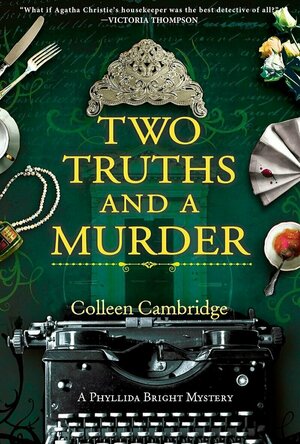
Two Truths and a Murder
Book
Agatha Christie’s trusted housekeeper, Phyllida Bright, has become an amateur sleuth in her own...

Purple Phoenix Games (2266 KP) rated The Grimm Masquerade in Tabletop Games
Apr 8, 2021
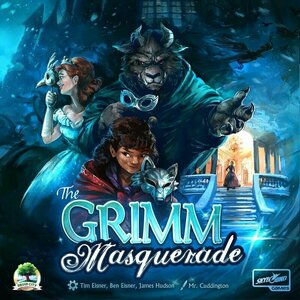
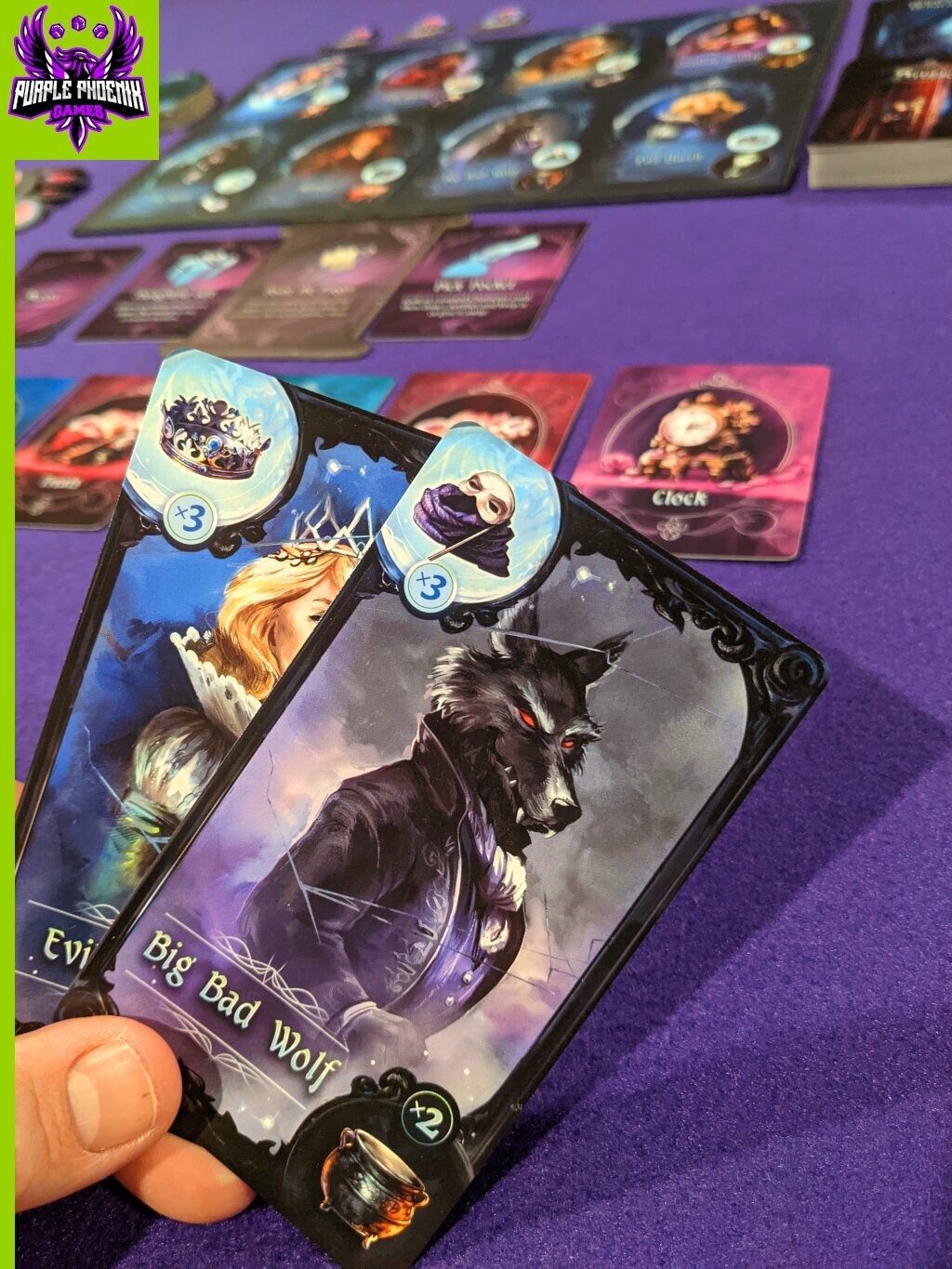
Have you ever been to a proper masquerade? I have not, though I would enjoy it, I think. I would enjoy it even more if I were competing against the other attendees to figure out who is who (and avoid having to do those Victorian square dances). But what if I were actually fairytale folk cavorting around with others trying to gain artifacts that speak to me while refusing any artifacts that may hurt me. Well now you understand my plight and the premise of this game.
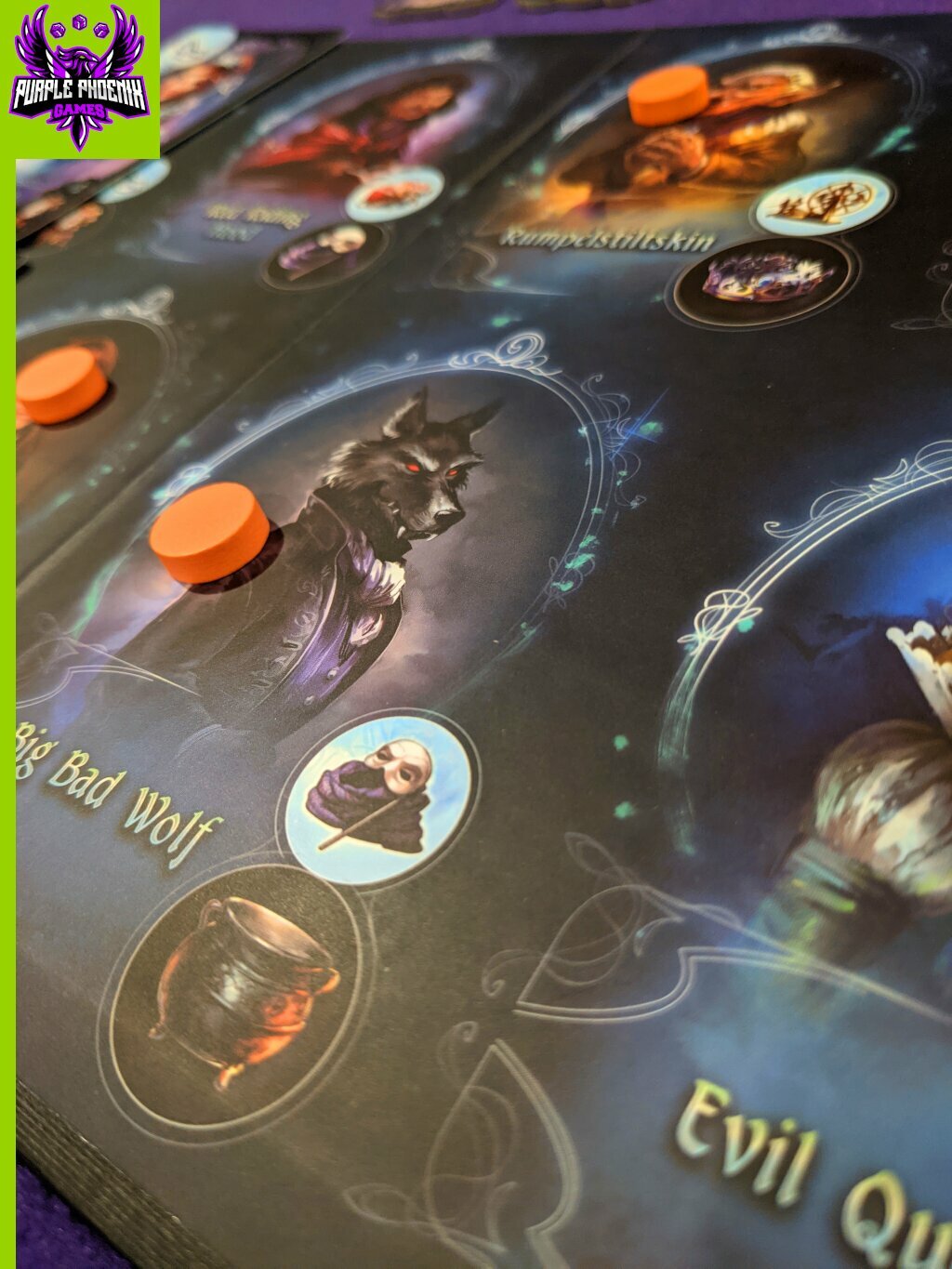
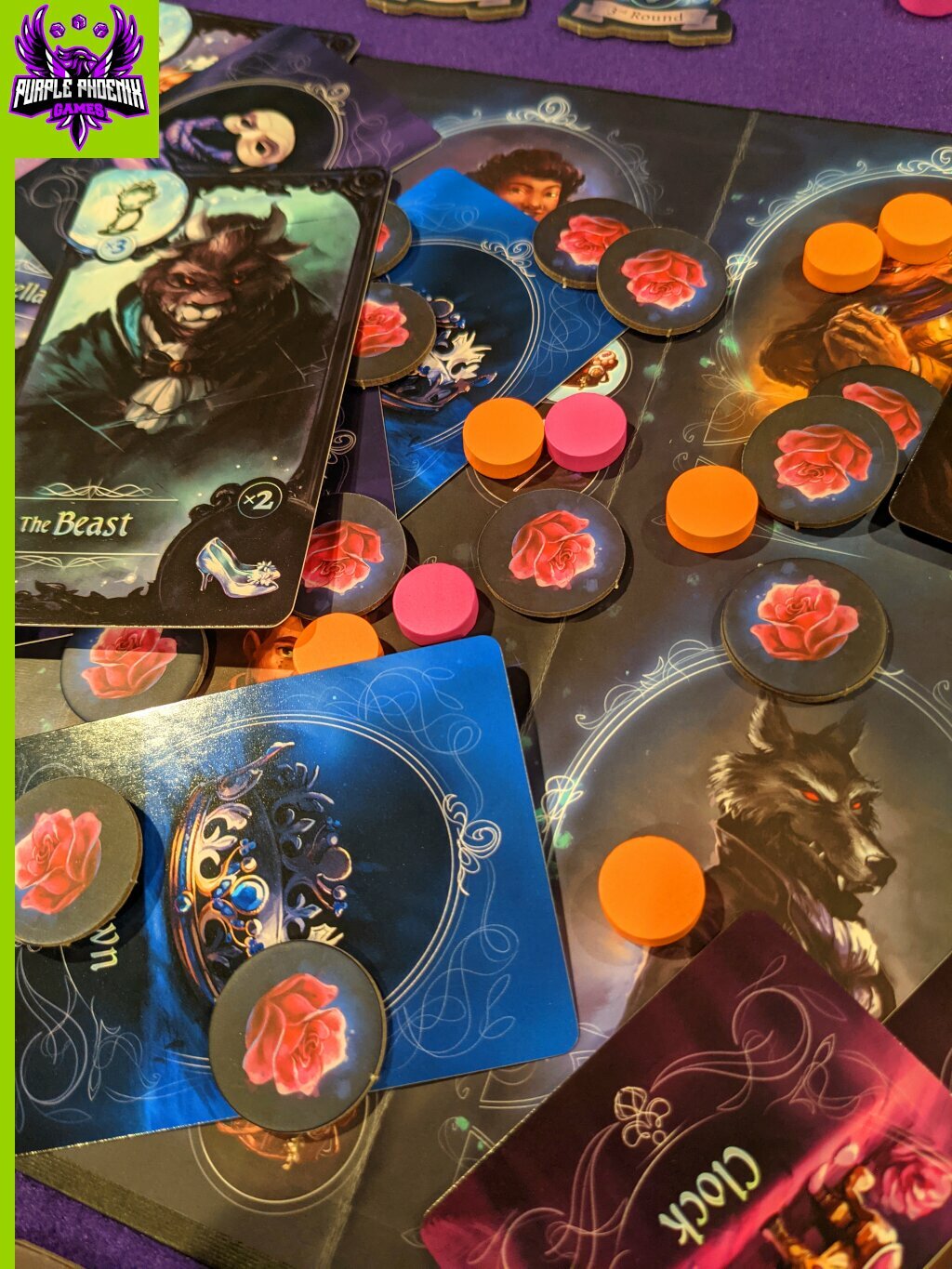
The Grimm Masquerade is a hidden role competitive bluffing game for two to five players. In it player take on the roles of well-known fairytale folk attending a magical masquerade thrown by The Beast (I mean, he has a name, right? Not just “The Beast…”). Attendees are tasked with trying to unmask other attendees while earning magical roses in the process. The winner is the player who can earn the most roses at the end of three rounds of bluffing and guessing, unless one player is able to earn 10 roses before the end.
DISCLAIMER: We were provided a copy of this game for the purposes of this review. This is a retail copy of the game, so what you see in these photos is exactly what would be received in your box. I do not intend to cover every single rule included in the rulebook, but will describe the overall game flow and major rule set so that our readers may get a sense of how the game plays. For more in depth rules, you may purchase a copy online or from your FLGS. Also, this review concentrates on the two-player variant for the game as I played it mostly with my wife. -T
To setup, place the main board showing all the fairytale folk in the middle of the table. Each player will receive two (one if playing multi-player rules) Character cards, all Evidence Markers of their chosen color, and Reference cards. Around the board is placed the remaining Character cards, the Artifact deck, the stack of Broken Mirror tokens, the pile of roses, and the Action Board with two random Action cards revealed on either side. For the two-player game six Artifact cards are revealed in a line and each player will choose one Artifact for each of their two characters they are playing. The unchosen Artifacts will form the discard pile near the Artifact draw pile. Whomever most recently wore a costume will be the lead player and the game may begin!
The game is played in rounds, with each turn of a round consisting of two steps. First, the active player draws an Artifact card and decides to keep it in their face-up tableau of Artifacts for all to see or give the Artifact to another player. Then the active player will draw a second card and either keep or give, whichever is opposite of their first choice. For example, should the first card drawn be kept, the next card would need to be given away. Each character has one Boon suit (which they love), and one Bane suit (which they despise). If at any time a character receives a card to create a matching pair in their tableau they must indicate whether that Artifact is in fact their Bane suit or not. They do this by placing one of their Evidence Markers on the character who owns that suit’s Bane value. However, if the player is actually the character who has that suit as their Bane, they have been unmasked and will play their other character in hopes of winning with them.
Should a player receive a card that would cause a set of three matching suit cards, they must indicate that they have either won the round or that they are not the character that matches that suit’s Boon value. For example, should a player receive their third Treats card they must declare they have won the round (if they happen to be Red Riding Hood), or that they are not indeed Red Riding Hood by placing an Evidence Marker on Red Riding Hood.
After this card play at the beginning of their turn the active player may choose to discard a matching pair of Artifact cards in order to activate an Action available (optional step). The Actions available are on the revealed Action cards on either side of the Action Board (which also shows an always-available Action of Point the Finger). So by discarding a pair of Crowns, for example, a player could utilize the Action card Eavesdrop in order to force the other player(s) to place Evidence Markers on characters they are NOT. This gives the active player more insight into who the other player(s) may actually BE.
Once cards have been drawn and the optional Actions taken, play passes to the next player. Players win the round by collecting three matching Boon Artifact cards or by unmasking all other characters in play. Whichever player wins the round also takes the Rose Trophy depending on which of the three rounds was just completed (value 1 for the first round, 3 for the second, and 5 for the third). At the end of the third round players count up their total roses (unless one player has earned 10 or more at the end of a previous round) and whomever has collected the most is the winner of The Grimm Masquerade!
Components. I have to say, every game I have played by Druid City Games has had amazing components, and this one is certainly no different. All the cardboard pieces, the cards, and the wooden discs are all excellent quality. But what I want to concentrate on here is the perfect choice to employ Mr. Cuddington for the art. Every time I see Mr. Cuddington on the credits for a game I know I am going to love looking at it on the table. They just have amazing style and everything is so detailed and perfectly matched for the setting. This FEELS like a Grimm’s Fairy Tales game for sure, and I love it.
It is definitely no secret that I love this one. I enjoy hidden role games to begin with (The Resistance: Avalon also being one of my favorites), and this setting feels excellently matched to the genre and the execution is wonderful. I really have a great time sussing out who is who and giving those final Artifacts in order to unmask players that are perceived to be leading is so fulfilling. Being able to spend matching cards in order to use Actions is also great design, especially when you can bluff by discarding your Boon cards to throw opponents off your trail. So much deceit in a fun package.
If you have few hidden role games and you want something with a light theme and relatively quick playtime, please do yourself a favor and check out The Grimm Masquerade. Purple Phoenix Games gives this one a playful 15 / 18. If you are like us and enjoy games where you control some information and can guess other players’ identities, but also like games where you can still play on even when you have been found out, this one is for you. If only this could support even more players, I could see it unseating Avalon for me. As it is, I may still end up using this one more often than Avalon unless I have a larger group of people at the table. That is a big statement from me as Avalon is a proven winner and has been a staple of my collection for years. But The Grimm Masquerade is that good. Play it and let me know if you agree.
The Grimm Masquerade is a hidden role competitive bluffing game for two to five players. In it player take on the roles of well-known fairytale folk attending a magical masquerade thrown by The Beast (I mean, he has a name, right? Not just “The Beast…”). Attendees are tasked with trying to unmask other attendees while earning magical roses in the process. The winner is the player who can earn the most roses at the end of three rounds of bluffing and guessing, unless one player is able to earn 10 roses before the end.
DISCLAIMER: We were provided a copy of this game for the purposes of this review. This is a retail copy of the game, so what you see in these photos is exactly what would be received in your box. I do not intend to cover every single rule included in the rulebook, but will describe the overall game flow and major rule set so that our readers may get a sense of how the game plays. For more in depth rules, you may purchase a copy online or from your FLGS. Also, this review concentrates on the two-player variant for the game as I played it mostly with my wife. -T
To setup, place the main board showing all the fairytale folk in the middle of the table. Each player will receive two (one if playing multi-player rules) Character cards, all Evidence Markers of their chosen color, and Reference cards. Around the board is placed the remaining Character cards, the Artifact deck, the stack of Broken Mirror tokens, the pile of roses, and the Action Board with two random Action cards revealed on either side. For the two-player game six Artifact cards are revealed in a line and each player will choose one Artifact for each of their two characters they are playing. The unchosen Artifacts will form the discard pile near the Artifact draw pile. Whomever most recently wore a costume will be the lead player and the game may begin!
The game is played in rounds, with each turn of a round consisting of two steps. First, the active player draws an Artifact card and decides to keep it in their face-up tableau of Artifacts for all to see or give the Artifact to another player. Then the active player will draw a second card and either keep or give, whichever is opposite of their first choice. For example, should the first card drawn be kept, the next card would need to be given away. Each character has one Boon suit (which they love), and one Bane suit (which they despise). If at any time a character receives a card to create a matching pair in their tableau they must indicate whether that Artifact is in fact their Bane suit or not. They do this by placing one of their Evidence Markers on the character who owns that suit’s Bane value. However, if the player is actually the character who has that suit as their Bane, they have been unmasked and will play their other character in hopes of winning with them.
Should a player receive a card that would cause a set of three matching suit cards, they must indicate that they have either won the round or that they are not the character that matches that suit’s Boon value. For example, should a player receive their third Treats card they must declare they have won the round (if they happen to be Red Riding Hood), or that they are not indeed Red Riding Hood by placing an Evidence Marker on Red Riding Hood.
After this card play at the beginning of their turn the active player may choose to discard a matching pair of Artifact cards in order to activate an Action available (optional step). The Actions available are on the revealed Action cards on either side of the Action Board (which also shows an always-available Action of Point the Finger). So by discarding a pair of Crowns, for example, a player could utilize the Action card Eavesdrop in order to force the other player(s) to place Evidence Markers on characters they are NOT. This gives the active player more insight into who the other player(s) may actually BE.
Once cards have been drawn and the optional Actions taken, play passes to the next player. Players win the round by collecting three matching Boon Artifact cards or by unmasking all other characters in play. Whichever player wins the round also takes the Rose Trophy depending on which of the three rounds was just completed (value 1 for the first round, 3 for the second, and 5 for the third). At the end of the third round players count up their total roses (unless one player has earned 10 or more at the end of a previous round) and whomever has collected the most is the winner of The Grimm Masquerade!
Components. I have to say, every game I have played by Druid City Games has had amazing components, and this one is certainly no different. All the cardboard pieces, the cards, and the wooden discs are all excellent quality. But what I want to concentrate on here is the perfect choice to employ Mr. Cuddington for the art. Every time I see Mr. Cuddington on the credits for a game I know I am going to love looking at it on the table. They just have amazing style and everything is so detailed and perfectly matched for the setting. This FEELS like a Grimm’s Fairy Tales game for sure, and I love it.
It is definitely no secret that I love this one. I enjoy hidden role games to begin with (The Resistance: Avalon also being one of my favorites), and this setting feels excellently matched to the genre and the execution is wonderful. I really have a great time sussing out who is who and giving those final Artifacts in order to unmask players that are perceived to be leading is so fulfilling. Being able to spend matching cards in order to use Actions is also great design, especially when you can bluff by discarding your Boon cards to throw opponents off your trail. So much deceit in a fun package.
If you have few hidden role games and you want something with a light theme and relatively quick playtime, please do yourself a favor and check out The Grimm Masquerade. Purple Phoenix Games gives this one a playful 15 / 18. If you are like us and enjoy games where you control some information and can guess other players’ identities, but also like games where you can still play on even when you have been found out, this one is for you. If only this could support even more players, I could see it unseating Avalon for me. As it is, I may still end up using this one more often than Avalon unless I have a larger group of people at the table. That is a big statement from me as Avalon is a proven winner and has been a staple of my collection for years. But The Grimm Masquerade is that good. Play it and let me know if you agree.
Purple Phoenix Games (2266 KP) rated Neon Knights: 2086 in Tabletop Games
Sep 10, 2020
Some of us actually lived through the 1980s. Just barely, but I certainly remember the neon stylizations, the hair, the tight-rolled pants. It’s not a look I ever hope to reincarnate. However, what if the style of the 1980s reappeared in the future? Like in the 2080s? That would be kind of awesome, actually. Or maybe it would be more bodacious or tubular. In any case, some things never go out of style. Things like attacking your fellow racers as they try to pass on the left with their NOS and dangling repair arms. Just me?
Neon Knights 2086 (here forth known as NK) is a car racing game of customization and street battle. The game essentially takes place over three race weeks (rounds) with each week being divided into a preparation period and then the race day itself. The winner of NK is not necessarily the driver who crosses the finish line more often, but rather the driver who wisely invests in upgrades and tempts Lady Luck to be on their side during crucial dice rolls.
DISCLAIMER: We were provided a copy of this game for the purposes of this review. This is a retail copy of the game, so what you see in these photos is exactly what would be received in your box. I do not intend to cover every single rule included in the rulebook, but will describe the overall game flow and major rule set so that our readers may get a sense of how the game plays. For more in depth rules, you may purchase a copy online or from your FLGS. -T
To setup, separate and shuffle each different-backed deck of cards, set them on the board in their places, and display the number of cards equal to the card spaces on the board. Give each player components in their character color, the matching play mat, and starting car parts to be tucked under their mat. Determine the starting player who will construct the first race course out of the provided map chunks and the game may begin!
Again, I will not be explaining every rule in the game as there are just too many to cover, but the game is played over three weeks. During the preparation days leading up to the race on day 7 (Sunday I guess), players will be taking actions to draft upgrades to their cars, or implants into their driver’s BRAIN, getting themselves sponsored so they can make bank come pay day, and also accepting bets on how each driver can earn a little extra on the side come race day.
Each day leading up to the race will allow players to complete one action, and pay day is on Day 5. This is when players will be paid out by their sponsors thus allowing players more spending power at the various upgrade shops. However, Race Day looms ahead and drivers will be making sure they have the best car they can afford because racing is a matter of life or death.
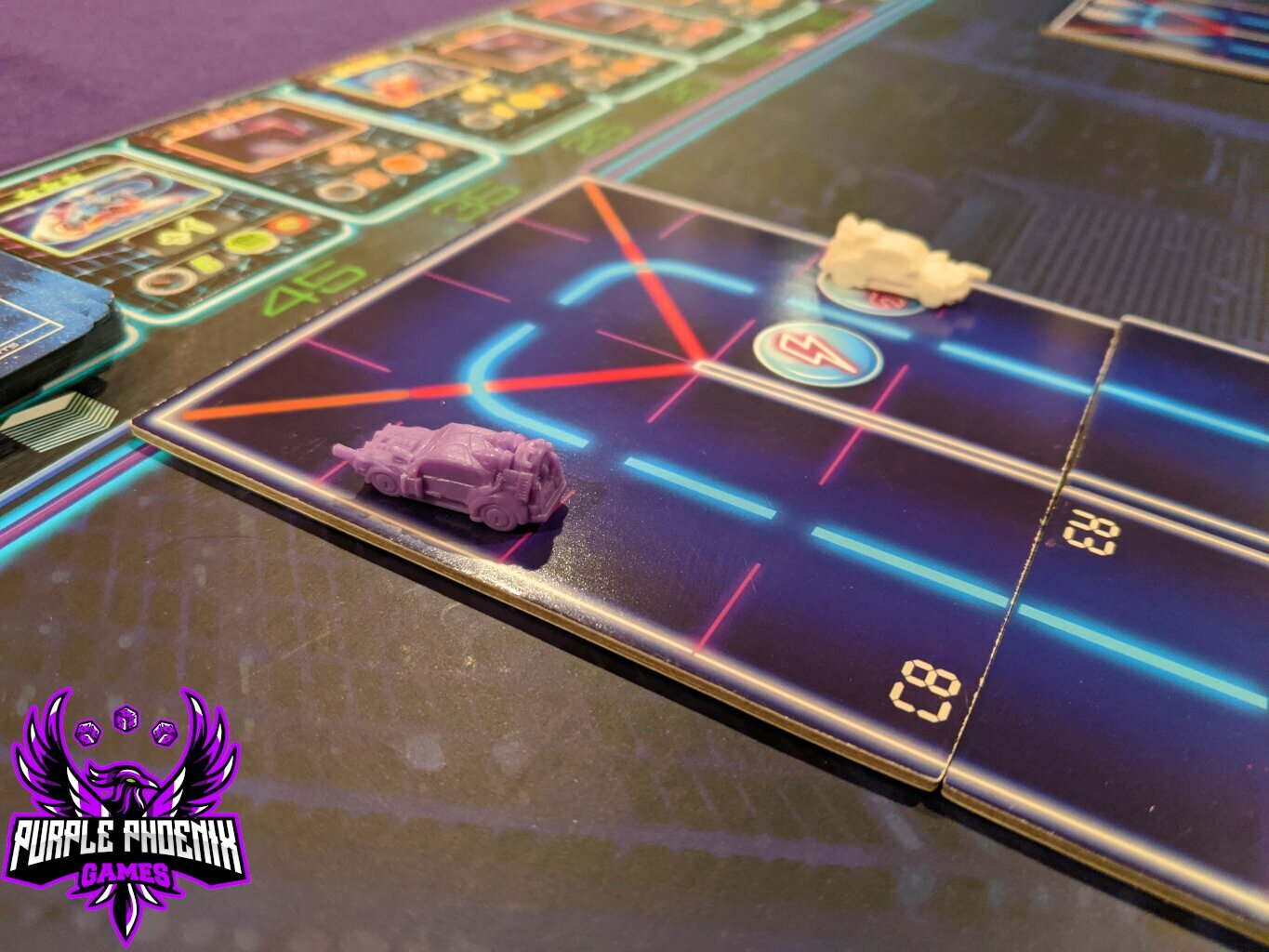
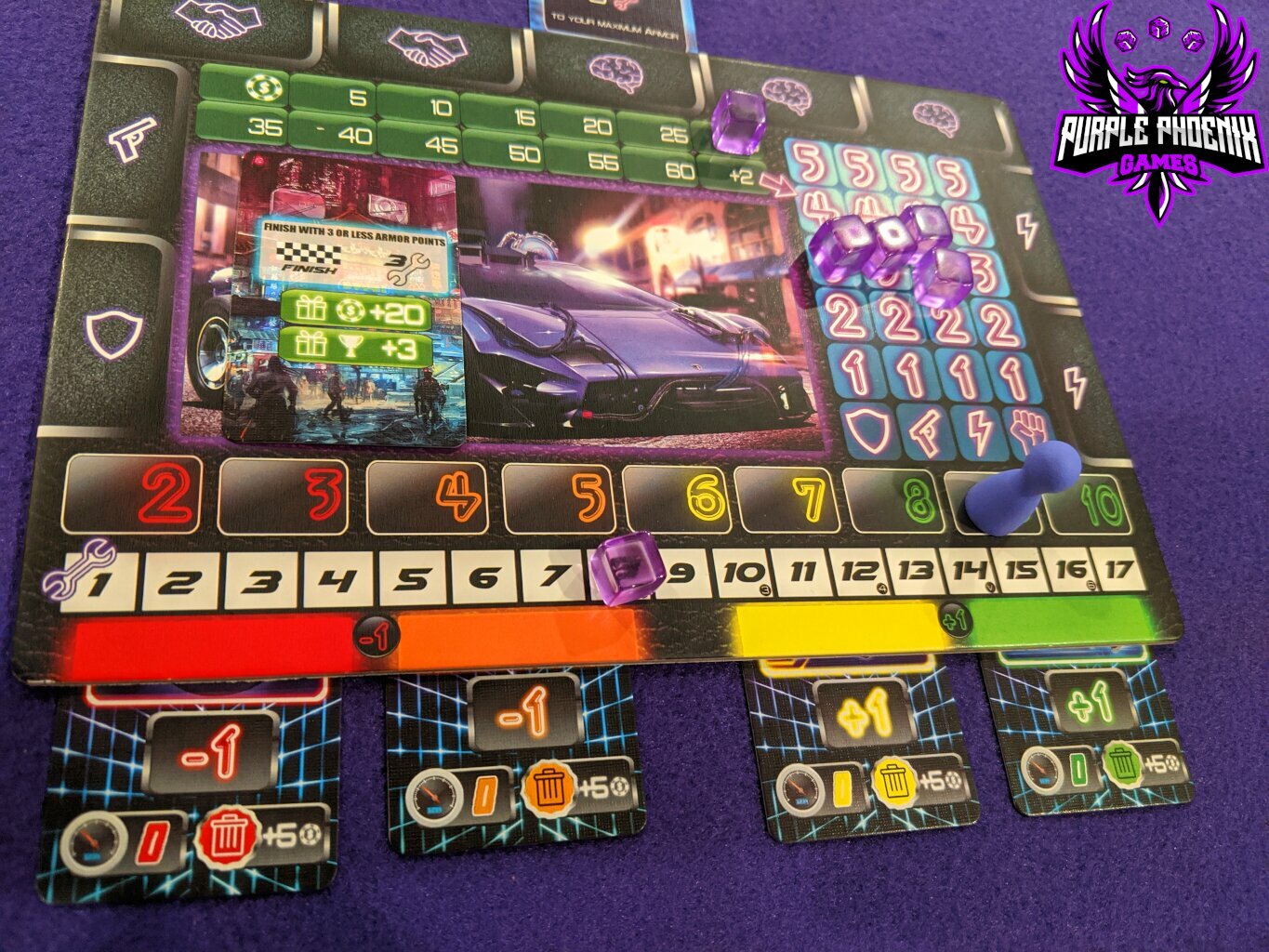
During a race, players will be choosing their initial speed and traveling the course attempting to finish first to gain points, but also to inflict damage on opposing cars and trying to complete their bets they’ve made. Cars will typically travel the number of spaces that the driver has chosen as the speed for the turn, but along the way the cars will be passing over neon lights in the street that are colored according to the suggested speed to overcome them. Go too fast and players will need to roll damage dice to simulate clipping a curb or smashing into a building corner. Go the correct suggested speed or less and pass over the lights no problem and with no damage dice to roll. Of course, car upgrades can assist with this.
When cars end their turn on a space with another car, a battle ensues and damage is calculated. Also, either before or after movement a car can decide to use a weapon on a rival car in range of their weapon to inflict extra damage. After all, a well-damaged car must screech to a halt and possibly use precious resources to repair the damage. Races are flat out bonkers but are the crux of NK. The winner of NK is the player who can amass the most VP at the end of the game and will be able to run a victory lap in the streets.
Components. This game is one of those hefty 12×12 boxes that is packed with goodies. The board is huge. The player components are beautiful and amazing. The player mats are great and laid out really well. The big chunky street map tiles are big and chunky. The colors are perfectly ’80s and perfect for a board game. I have no issues at all with the components. Oh wait, just one little eensy weensy complaint. I wish the font in the rule book was something of the serif variety instead of block all-caps. I felt as if I were being scolded for reading the rules.
All that said, I find Neon Knights 2086 to be a beautiful and relatively quick-playing racing game with the added bonus of car customization akin to that of creating an RPG character (and everyone knows that’s the best part of RPGs). The prep days are super fast to play through because you are basically just taking cards from the offers or drawing cards from the face-down decks to improve your ride, or repairing your car from previous races, and negotiating with sponsors to get those sweet gigs.
The racing, however, is where the game play takes off. It’s here that all the planning and optimizing is put to the test. It’s here where you discover that some of your “upgrades” just ain’t cuttin’ it, and need to be upgraded further. Hopefully a new sweet (and affordable) weapon will come out during the week. Maybe a new sponsor will enter and entice you with tons of money. And then it’s Race Day and you can take your rig out to demolish the competition. Ahh sweet demolition.
This game was a big surprise for me for several reasons. First, I didn’t realize how much I actually enjoyed some of the things from the ’80s. Those colors are just so dang beautiful. That design. So good. But also I just don’t play a lot of car racing games so I was skeptical at first. I’m not a fan of NASCAR so obviously I won’t like any car racing game, right? At least that was my initial thought. Neon Knights 2086 may just have piqued my interest in trying out some other racing titles in the future. For these reasons, Purple Phoenix Games gives this one a bruised 8 / 12. If you are aching for a racing game with battles in the streets and customization in the sheets, check out Neon Knights 2086. I am now a believer, and can’t wait to play this one many more times.
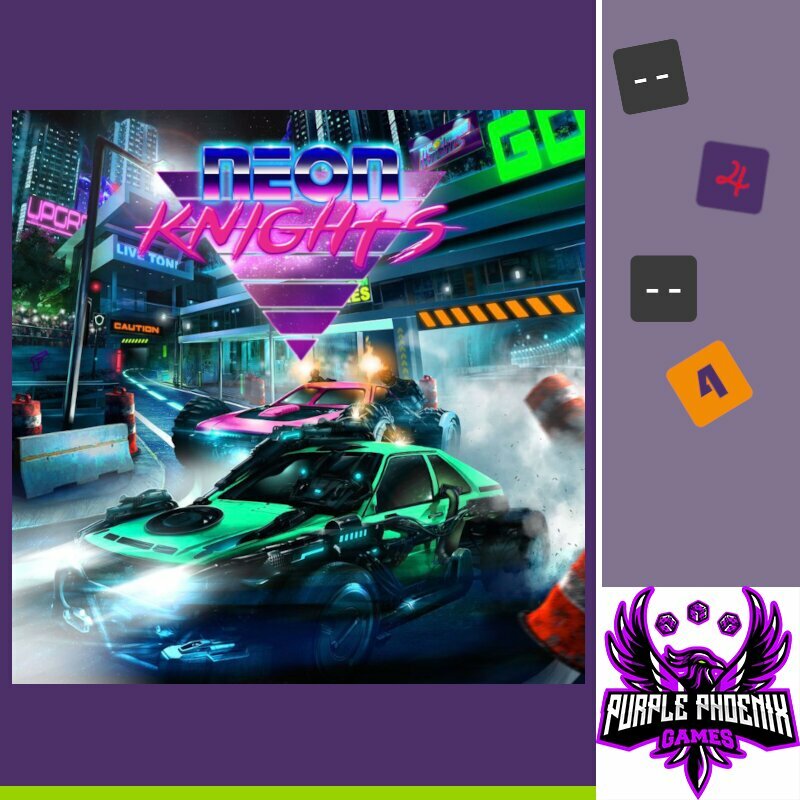
Neon Knights 2086 (here forth known as NK) is a car racing game of customization and street battle. The game essentially takes place over three race weeks (rounds) with each week being divided into a preparation period and then the race day itself. The winner of NK is not necessarily the driver who crosses the finish line more often, but rather the driver who wisely invests in upgrades and tempts Lady Luck to be on their side during crucial dice rolls.
DISCLAIMER: We were provided a copy of this game for the purposes of this review. This is a retail copy of the game, so what you see in these photos is exactly what would be received in your box. I do not intend to cover every single rule included in the rulebook, but will describe the overall game flow and major rule set so that our readers may get a sense of how the game plays. For more in depth rules, you may purchase a copy online or from your FLGS. -T
To setup, separate and shuffle each different-backed deck of cards, set them on the board in their places, and display the number of cards equal to the card spaces on the board. Give each player components in their character color, the matching play mat, and starting car parts to be tucked under their mat. Determine the starting player who will construct the first race course out of the provided map chunks and the game may begin!
Again, I will not be explaining every rule in the game as there are just too many to cover, but the game is played over three weeks. During the preparation days leading up to the race on day 7 (Sunday I guess), players will be taking actions to draft upgrades to their cars, or implants into their driver’s BRAIN, getting themselves sponsored so they can make bank come pay day, and also accepting bets on how each driver can earn a little extra on the side come race day.
Each day leading up to the race will allow players to complete one action, and pay day is on Day 5. This is when players will be paid out by their sponsors thus allowing players more spending power at the various upgrade shops. However, Race Day looms ahead and drivers will be making sure they have the best car they can afford because racing is a matter of life or death.
During a race, players will be choosing their initial speed and traveling the course attempting to finish first to gain points, but also to inflict damage on opposing cars and trying to complete their bets they’ve made. Cars will typically travel the number of spaces that the driver has chosen as the speed for the turn, but along the way the cars will be passing over neon lights in the street that are colored according to the suggested speed to overcome them. Go too fast and players will need to roll damage dice to simulate clipping a curb or smashing into a building corner. Go the correct suggested speed or less and pass over the lights no problem and with no damage dice to roll. Of course, car upgrades can assist with this.
When cars end their turn on a space with another car, a battle ensues and damage is calculated. Also, either before or after movement a car can decide to use a weapon on a rival car in range of their weapon to inflict extra damage. After all, a well-damaged car must screech to a halt and possibly use precious resources to repair the damage. Races are flat out bonkers but are the crux of NK. The winner of NK is the player who can amass the most VP at the end of the game and will be able to run a victory lap in the streets.
Components. This game is one of those hefty 12×12 boxes that is packed with goodies. The board is huge. The player components are beautiful and amazing. The player mats are great and laid out really well. The big chunky street map tiles are big and chunky. The colors are perfectly ’80s and perfect for a board game. I have no issues at all with the components. Oh wait, just one little eensy weensy complaint. I wish the font in the rule book was something of the serif variety instead of block all-caps. I felt as if I were being scolded for reading the rules.
All that said, I find Neon Knights 2086 to be a beautiful and relatively quick-playing racing game with the added bonus of car customization akin to that of creating an RPG character (and everyone knows that’s the best part of RPGs). The prep days are super fast to play through because you are basically just taking cards from the offers or drawing cards from the face-down decks to improve your ride, or repairing your car from previous races, and negotiating with sponsors to get those sweet gigs.
The racing, however, is where the game play takes off. It’s here that all the planning and optimizing is put to the test. It’s here where you discover that some of your “upgrades” just ain’t cuttin’ it, and need to be upgraded further. Hopefully a new sweet (and affordable) weapon will come out during the week. Maybe a new sponsor will enter and entice you with tons of money. And then it’s Race Day and you can take your rig out to demolish the competition. Ahh sweet demolition.
This game was a big surprise for me for several reasons. First, I didn’t realize how much I actually enjoyed some of the things from the ’80s. Those colors are just so dang beautiful. That design. So good. But also I just don’t play a lot of car racing games so I was skeptical at first. I’m not a fan of NASCAR so obviously I won’t like any car racing game, right? At least that was my initial thought. Neon Knights 2086 may just have piqued my interest in trying out some other racing titles in the future. For these reasons, Purple Phoenix Games gives this one a bruised 8 / 12. If you are aching for a racing game with battles in the streets and customization in the sheets, check out Neon Knights 2086. I am now a believer, and can’t wait to play this one many more times.
Purple Phoenix Games (2266 KP) rated Faza in Tabletop Games
Oct 28, 2020
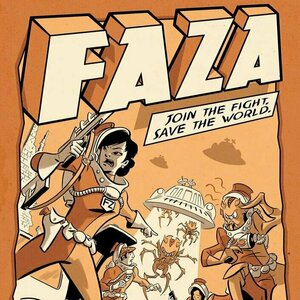
You know those fantasy dreams you have where an alien race comes to Earth and tries to take over the world and terraform it to match their homeland? Just me? Well, this is awkward. Okay, how about the ones where you are a freedom fighter trying to save the world from those aliens and you only have three friends to help you in your impossible mission? That one is better? Okay! Then you are in for a treat with Faza, no matter which dream is yours.
Faza is a sci-fi, grid movement, modular board, purely cooperative board game for one to four players. In this review I will be addressing it from a solo player’s viewpoint. In my plays I have used the full complement of four characters and controlled them all simultaneously.
In Faza, players take on the roles of four Faction Zeta members tasked with saving Earth from the Faza alien race. They will accomplish this by using each character’s skills effectively and efficiently, killing alien drones invading the town tiles, and attacking motherships using the help of turncoat rebel Faza. Only one path to victory lies ahead with several ways to lose. Do you got the GUTS? DO YA??
DISCLAIMER: We were provided a copy of this game for the purposes of this review. This is a retail copy of the game, so what you see in these photos is exactly what would be received in your box. I do not intend to cover every single rule included in the rulebook, but will describe the overall game flow and major rule set so that our readers may get a sense of how the game plays. For more in depth rules, you may purchase a copy online or from your FLGS. -T
To setup a game of Faza, each player will choose a character to control throughout the game. These characters are medical, political, tactical, or technological in nature, and there are two of each from which players may choose. The map of the town is comprised of 16 tiles, and once randomly setup in a 4×4 grid players will place their color-matched meeples on the appropriate Outpost tiles along with two rebels (purple fazeeples). Each of the three mothership standees will be placed on tiles corresponding to rulebook placement along with three drones and two drones per orthogonally adjacent tiles. The Faza deck is to be shuffled and placed aside, along with the remaining drones and rebels. Each player places out their character action cards in numerical order and the game may now begin in earnest!
On a player’s turn… well, there aren’t any turns in this game. In fact, the game is played over several phases: the Team Phase and the Faza Phase. During the Team Phase players may use several free actions and one action pertaining to each of their four player action cards. Each of these cards offer the player a choice of two actions. Perhaps one side is movement and the other a bazooka. Or one is an airplane while the other is a raygun, for example. As actions are spent cards are twisted 90 degrees to keep track.
During the Team Phase players may play their actions in any order that would benefit the team best. This also includes fighting drones and sending rebels to damage the motherships. However, with every damage to the mothership taken a Faza card is drawn and put into play. These could be real bad news for the heroes, or even reward cards. They can be devastating or not so bad at all. Once players have finished the Team Phase, the action now turns to the Faza.
During the Faza Phase the Mothership Activation Tracker will move to the next mothership in sequence and activate their abilities. The motherships will typically move, do something bad to the terrain or drop more drones or destroy something, and then pass play onto the players again.
Each mothership starts the game with 4 HP and once players send enough rebels and encounter the same number of Faza cards the mothership is downed and less powerful when their ability card is activated. However, players will win once all three motherships have been defeated! On the other hand, players will lose when any one player dies of injuries from unsuccessful battles, the players run out of drones to be placed on the board when needed, all of the Outpost tiles have been terraformed by the Faza motherships, or all rebels have been removed from the board in Hard Mode.
Components. When contacted about reviewing the game I first turned to the website and watched a how to play video by Jon Gets Games. He did a great job explaining the rules clearly and succinctly. Then I happened to get a notification on BGG that Marco Arnaudo posted a video on Faza, so I watched it as well. In his video he complains that though the components are all very nice (which they are for sure) the color palette is not great. I can certainly see why he would say such a thing, but orange is my favorite color, so to see so much of it on a game is a big plus for me. Yes, having the orange drones sitting atop an orange town tile can maybe make for unpleasant color contrast, I happen to find it tolerable and enjoyable. The quality of the components is wonderful and the box has a nice heft to it. No complaints from ME about the components. Did I mention the rebels are an amazing purple color as well? No secret here that we love the color purple! Maybe even more than Oprah!
The gameplay is where it’s at for me. Marco too. We both love this little gem! The ability to sandbox your entire turn and just have one character do one action, then switch over to another character to do one or more actions, then back to the original is just so much fun. Each character has a special ability and four action cards. Even when an injury must be sustained, actions are still available, but at a much lesser potency. That’s a great way to negatively affect the players without having to completely debilitate them. To sustain an injury the player will flip their lowest-numbered action card to the back side, and once all four of their action cards are injured they are dead. D-E-D dead.
As a solo game Faza really delivers the goods. Being able to control two to four characters by oneself and determine the best order to activate abilities and move meeples around is delicious. Having certain tiles offer combat bonuses to matching characters is excellent and a great way to thin the herd of pesky drones. I really cannot say enough great things about the game. If you have never heard of this one, please don’t worry. I really hadn’t either until the designer contacted me about reviewing it. And I am certainly glad he did because this is a marvel of a game. I am looking forward to my next play against the Faza and increasing the difficulty to really bash my confidence on this one.
If you are looking for a game that is relatively quick to play and offers so many great choices, while using a wonderful art style and color palette, I urge you to check out Faza by visiting the website and ordering your copy right away. The Earth needs you to ward off the invaders and you need to play this game of mostly orange with a dash of purple.