
Search
Search results

Griffin (480 KP) rated Super Fight in Tabletop Games
Dec 14, 2018
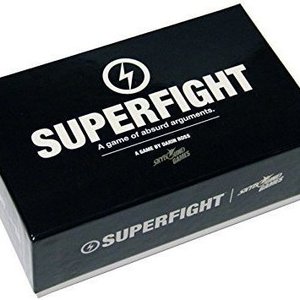

An excessive amount of cards in the base game which allows for a great amount of replayability. (2 more)
Allowing players to debate about how their character would win the fight is a fun and unique mechanic that works out verl well.
Adding a random attribute card onto each character makes for some hilarious and surprisingly interesting combinations.
While there are a lot of cards in the base set after you begin to loop through the cards they do get old as they lose that initial shock factor. Buying the expansions will prolong this. (1 more)
Players tend to talk over each other while "debating" and end up shouting at each other for 5 minutes. (can be fun at times, but when it keeps happening it gets irritating)
A great way to settle arguments.

Minos Strategos
Games
App Watch
You are the legendary Minos Strategos (general of the ancient city of Minos)! Command the defenders...
games

Orange TopUp
Utilities
App
Orange TopUp app enables you to manage your Orange prepaid account. With Orange TopUp app you can: ...




Purple Phoenix Games (2266 KP) rated TEN in Tabletop Games
Nov 28, 2021

When it comes to game mechanics, set collection is my JAM. Auction/bidding and push your luck, not so much….. So when Alderac Entertainment Group brought TEN into my life, I was a bit wary at first. A game of collecting sequences/sets of numbers? Awesome!! Add in bidding for Wildcards or pushing your luck to not Bust each turn? A bit too risky, at least for my gaming tastes. After having had the opportunity to play TEN, were my initial feelings misplaced? Spoiler: Yes. For me, TEN was a prime example of “Don’t judge a game by its mechanics.” Keep reading to find out why.
Disclaimer: We were provided with a copy of TEN for the purposes of this review. This is a final production copy, so what you see pictured is what you would receive in a retail copy of the game. -L
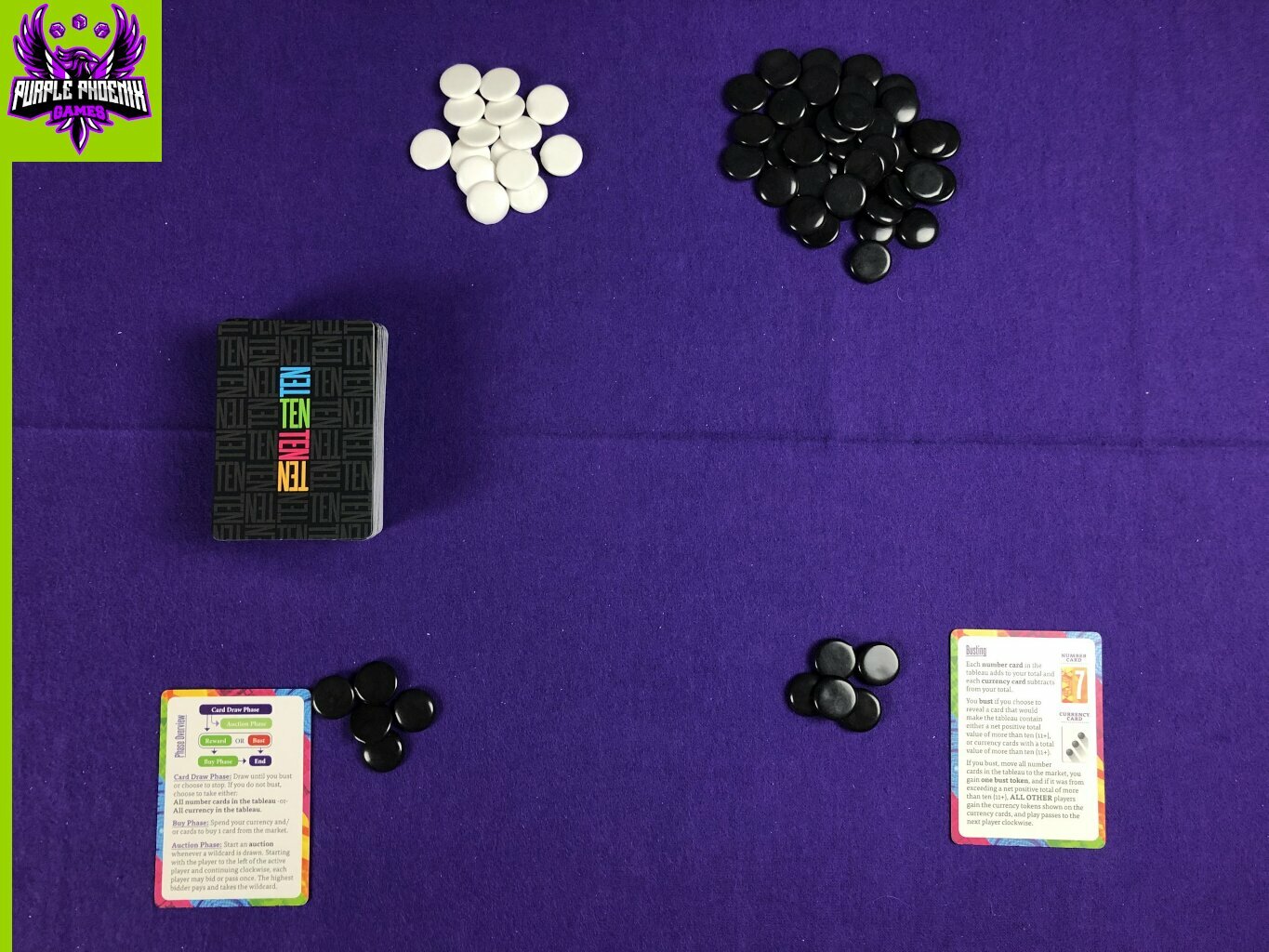
TEN is a push-your-luck game of set collection and auction/bidding in which players are trying to amass the most points by the end of the game. Points are earned by collecting sets of numeric sequences in the 4 colors of the game: Blue, Green, Pink, and Orange. Played over a series of turns, players will be drawing/collecting cards from the tableau, buying cards from the Market, or Busting if they push their luck a bit too far. To setup for a game, assemble the deck of cards as dictated by the player count and set it in the play area. Each player gets 5 Currency tokens with which to start the game, and are all dealt a random reference card. The player who was dealt the reference card with the Starting Player symbol will begin the game. Before getting into the actual gameplay, I want to mention the different card types, as to provide a better understanding when reading this review. In each of the 4 colors, there are card values numbered 1-9, with more copies of the lower numbers and fewer of the higher numbers. There are also Wildcards that can be used to represent any #/color, depending on the card. Some cards in the deck are Currency cards and show a value of 1-5 Currency. Should you choose to take these from the tableau, you collect that amount of Currency to be used for auctions or buying cards in later turns.
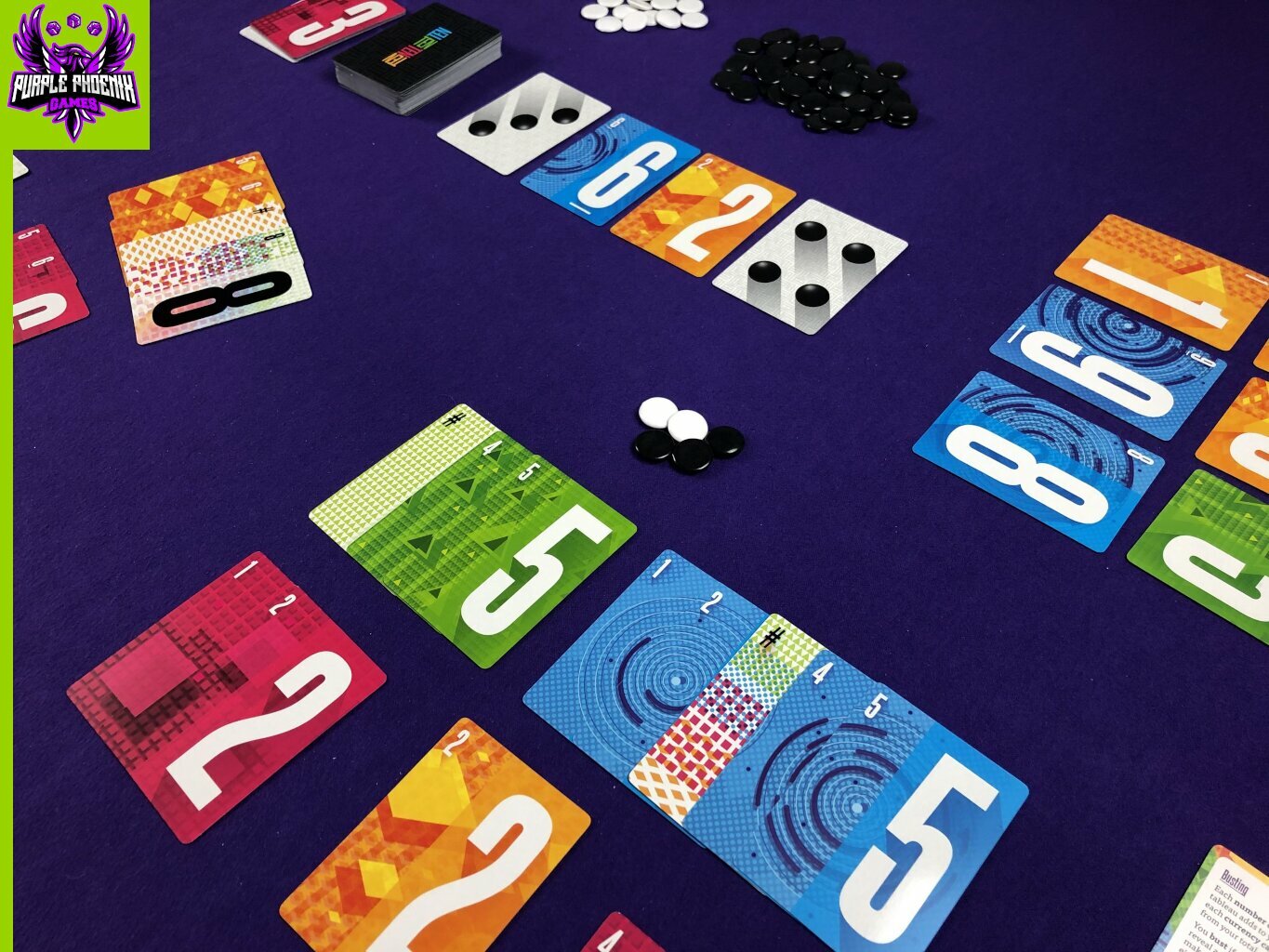
On your turn, you will perform a series of actions, the first of which is Draw a Card. You will draw a card from the top of the deck and place it in the tableau. If the card is a # card or a Currency card, you will then decide if you wish to continue drawing cards. If you do, draw the next card, and so on, until either you decide to stop or you Bust (more on this in a bit). As long as you do not Bust, you can decide when to stop drawing cards to the tableau. You may then take one of the following rewards: take all the # cards to your play area, or take Currency tokens (equal to the amount shown on the Currency cards in the tableau). When you take the # cards, they go into your play area and all other players will collect Currency tokens. You then have the opportunity to Buy a card from the Market (by paying the numeric value of the card) and add it to your play area. If you instead choose to collect Currency, you will take Currency equal to the total value of Currency in the tableau, and all other players receive nothing from your turn. All # cards are moved to the Market, and your turn ends. In the picture below, if I choose to take the # cards, I would take the Orange 2 and Blue 6 to my play area, and all other players would collect 7 Currency. Conversely, I could choose to take 7 Currency, and the # cards are added to the Market (on the right-hand side of the picture).
So how does Busting work? The tableau may never have a value of more than 10. Every # card you draw adds to your total value, and any Currency card drawn subtracts from the total. If you were to draw a # card that would give you a total value of more than 10, you Bust! OR if you ever have Currency cards that total more than 10, you Bust as well. So there’s a bit of math involved, with addition and subtraction, but you have to make sure you never get more than 10! For example, in the picture below, the net total value of the tableau is 1. (8 from # cards, -7 from Currency cards) If I were to draw a Currency card of 4-5, I would Bust, because that totals more than 10. In this pictured instance, any # card I draw would not make me Bust, as the highest total would only be a 10, given the current cards in play. If you ever push your luck too far and end up Busting, all # cards in the tableau are moved to the Market, and you gain a Bust token (worth 3 Currency). If you Busted with # cards, then all other players will collect Currency tokens, but if you Bust with Currency cards, nobody receives anything. After resolving a Bust, your turn ends and the game continues to the next player.
If, on your turn, you ever draw a Wildcard, your turn pauses and the Wildcard is auctioned. Each player will have one chance to either bid (increasing the bid from the previous) or pass. Whomever wins the auction must pay their bid, and they collect the Wildcard to their play area. Once the auction has been resolved, your turn continues as normal. It is possible to have multiple auctions on your turn – it all depends on the cards. The game continues in this fashion, players taking turns drawing cards, collecting cards/Currency, buying from the Market, bidding in auctions, etc., until the draw deck has been depleted. The active player finishes their turn as normal, but may not draw any more cards. Points are then tallied. All players will arrange their cards to create consecutive sequences of numbers in the 4 different colors. You receive 1 point per card in your longest sequence of each color. If you have a complete set of numbers 1-9 in a color, you get a bonus point. Players count up all their points, and the player with the highest value is the winner!
That kind of seems like a lot, but I promise it’s actually pretty intuitive when you get playing. Also, huge shoutout to AEG for providing such a well-done reference card – it includes a little flowchart to help you with how the turns flow. The gameplay itself is essentially pretty straightforward. You draw a card, and then react based on what it is. Bust? Collect a Bust token and your turn ends. No Bust? Decide if you want to keep drawing. Done pushing your luck? Collect either the # cards or Currency. Try to make sequential runs of numbers in the different colors – the more cards you get in sequence, the more points you’ll get at the end of the game. The thing that elevates TEN beyond a simple push-your-luck game to me is that it requires more strategy than just luck. You can see what cards are available in the Market – is there something you need to buy? You can see everyone else’s playing area – do they need any of the numbers you just revealed? You know how much Currency every player has – do you bid high on this Wildcard because your neighbor can’t outbid you? There is so much more than just luck in this game, and that is what takes it to the next level for me. I know that Travis has reviewed No, Thanks! in the past, and I would say that this gives me similar vibes, but way better in my opinion.
When it comes to playing games, I am generally not a huge risk-taker. I like making logical choices based on known information and end-game strategy. But something about this game just gets me. I think one element that makes me love this game is the different types of cards – # cards and Currency cards. When you’re pushing your luck and drawing cards, there’s an added element of excitement, because the two different types of cards affect the net total differently. It doesn’t all positively add to the net total, which makes me more likely to keep drawing in hopes that things will cancel out and I can maximize the turn. If everything all added together, and you just couldn’t get more than 10, I would probably only ever draw 2 cards per turn, max., just to make sure I didn’t Bust. But the fact that Currency cards subtract from the net total encourages players to keep pushing their luck, and either earning a big payoff or a big Bust. This game is exciting, engaging, and entertaining to play, and that makes it fun!
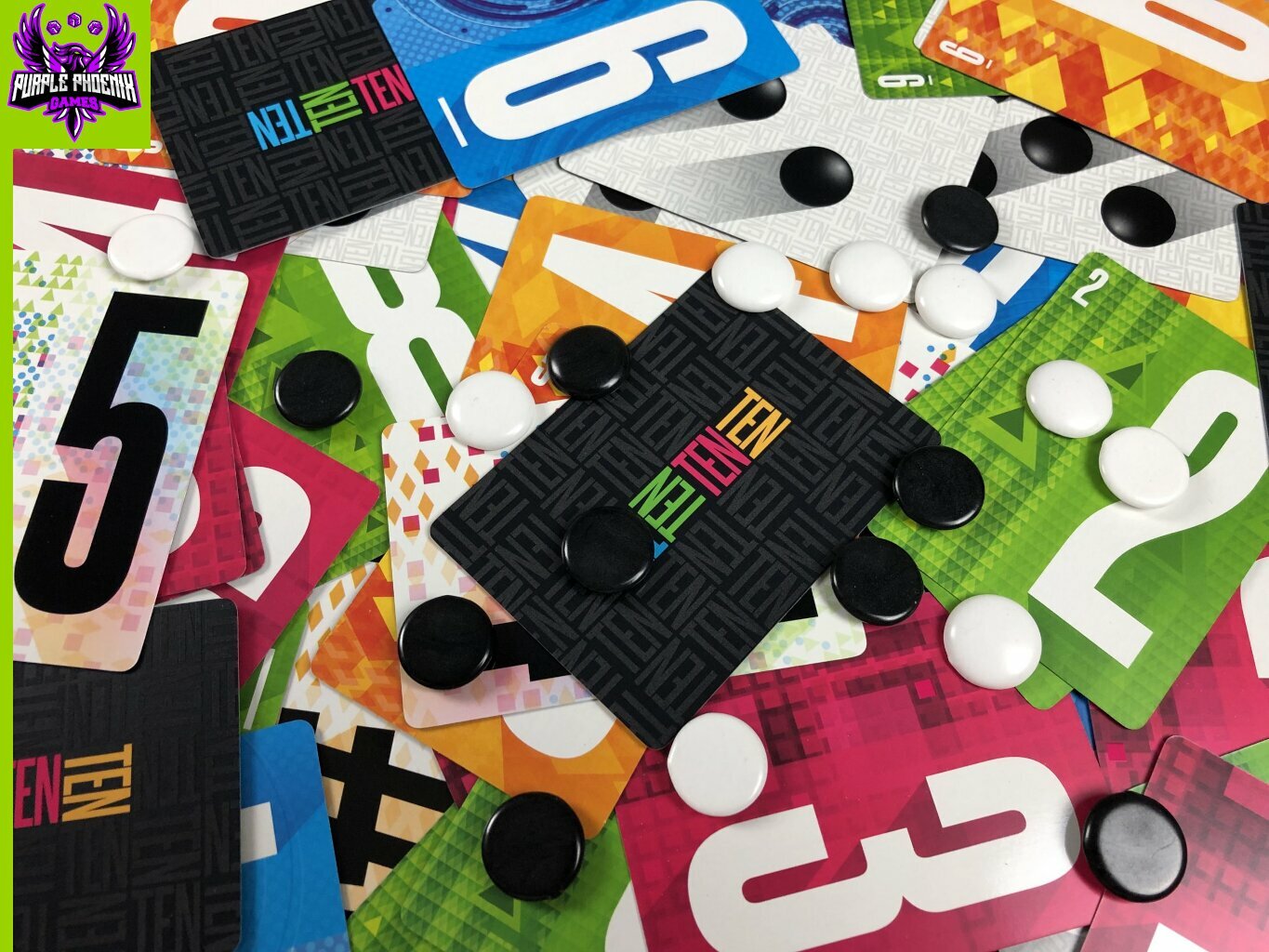
To touch on components, AEG always hits it out of the park – and TEN is no exception. The game is mostly just a bunch of cards, and some white/black Currency tokens. The tokens themselves are nice plastic, and are smooth and chunky in hand. The cards are thick and sturdy, and hold up to shuffling pretty well. The colors of the game are bright and vibrant, and they are very clear to differentiate between. It’s a nice pop of color on the table, and that adds to the overall enjoyment of the game. Each of the 4 colors, and the Wildcards for that matter, have a unique background design – which can help our colorblind friends who may not necessarily be able to differentiate between the colors. Just an added plus to help the gamers tell what cards belong to what colors! The game box is equally as colorful, and is eye-catching on the shelf. All in all, I’d say AEG gets a 10 for their production quality here. (Get it?)
I spoke earlier about judging a game by its mechanics, and how TEN really challenged me on that. I was expecting a game that I would like, but would be kind of just ok overall for me. What I got is a game that is highly strategic, yet also unpredictable at times. I am definitely a planner when it comes to strategy, but the unpredictability of this game is light, fun, and engaging for all players at all times. It just is fun to play. This is a game that I see staying in my collection for a long time, and hopefully getting to the table quite often when I need a quick filler that isn’t so light that it’s mindless, but not heavy enough that it’s a brain-burner. If you’re in the market for a fun little game that challenges all players, I would definitely recommend checking out TEN. Purple Phoenix Games rates our games on a scale of 1-6 (not 10 unfortunately in this case), and we give this one a solid 5 / 6.
Disclaimer: We were provided with a copy of TEN for the purposes of this review. This is a final production copy, so what you see pictured is what you would receive in a retail copy of the game. -L
TEN is a push-your-luck game of set collection and auction/bidding in which players are trying to amass the most points by the end of the game. Points are earned by collecting sets of numeric sequences in the 4 colors of the game: Blue, Green, Pink, and Orange. Played over a series of turns, players will be drawing/collecting cards from the tableau, buying cards from the Market, or Busting if they push their luck a bit too far. To setup for a game, assemble the deck of cards as dictated by the player count and set it in the play area. Each player gets 5 Currency tokens with which to start the game, and are all dealt a random reference card. The player who was dealt the reference card with the Starting Player symbol will begin the game. Before getting into the actual gameplay, I want to mention the different card types, as to provide a better understanding when reading this review. In each of the 4 colors, there are card values numbered 1-9, with more copies of the lower numbers and fewer of the higher numbers. There are also Wildcards that can be used to represent any #/color, depending on the card. Some cards in the deck are Currency cards and show a value of 1-5 Currency. Should you choose to take these from the tableau, you collect that amount of Currency to be used for auctions or buying cards in later turns.
On your turn, you will perform a series of actions, the first of which is Draw a Card. You will draw a card from the top of the deck and place it in the tableau. If the card is a # card or a Currency card, you will then decide if you wish to continue drawing cards. If you do, draw the next card, and so on, until either you decide to stop or you Bust (more on this in a bit). As long as you do not Bust, you can decide when to stop drawing cards to the tableau. You may then take one of the following rewards: take all the # cards to your play area, or take Currency tokens (equal to the amount shown on the Currency cards in the tableau). When you take the # cards, they go into your play area and all other players will collect Currency tokens. You then have the opportunity to Buy a card from the Market (by paying the numeric value of the card) and add it to your play area. If you instead choose to collect Currency, you will take Currency equal to the total value of Currency in the tableau, and all other players receive nothing from your turn. All # cards are moved to the Market, and your turn ends. In the picture below, if I choose to take the # cards, I would take the Orange 2 and Blue 6 to my play area, and all other players would collect 7 Currency. Conversely, I could choose to take 7 Currency, and the # cards are added to the Market (on the right-hand side of the picture).
So how does Busting work? The tableau may never have a value of more than 10. Every # card you draw adds to your total value, and any Currency card drawn subtracts from the total. If you were to draw a # card that would give you a total value of more than 10, you Bust! OR if you ever have Currency cards that total more than 10, you Bust as well. So there’s a bit of math involved, with addition and subtraction, but you have to make sure you never get more than 10! For example, in the picture below, the net total value of the tableau is 1. (8 from # cards, -7 from Currency cards) If I were to draw a Currency card of 4-5, I would Bust, because that totals more than 10. In this pictured instance, any # card I draw would not make me Bust, as the highest total would only be a 10, given the current cards in play. If you ever push your luck too far and end up Busting, all # cards in the tableau are moved to the Market, and you gain a Bust token (worth 3 Currency). If you Busted with # cards, then all other players will collect Currency tokens, but if you Bust with Currency cards, nobody receives anything. After resolving a Bust, your turn ends and the game continues to the next player.
If, on your turn, you ever draw a Wildcard, your turn pauses and the Wildcard is auctioned. Each player will have one chance to either bid (increasing the bid from the previous) or pass. Whomever wins the auction must pay their bid, and they collect the Wildcard to their play area. Once the auction has been resolved, your turn continues as normal. It is possible to have multiple auctions on your turn – it all depends on the cards. The game continues in this fashion, players taking turns drawing cards, collecting cards/Currency, buying from the Market, bidding in auctions, etc., until the draw deck has been depleted. The active player finishes their turn as normal, but may not draw any more cards. Points are then tallied. All players will arrange their cards to create consecutive sequences of numbers in the 4 different colors. You receive 1 point per card in your longest sequence of each color. If you have a complete set of numbers 1-9 in a color, you get a bonus point. Players count up all their points, and the player with the highest value is the winner!
That kind of seems like a lot, but I promise it’s actually pretty intuitive when you get playing. Also, huge shoutout to AEG for providing such a well-done reference card – it includes a little flowchart to help you with how the turns flow. The gameplay itself is essentially pretty straightforward. You draw a card, and then react based on what it is. Bust? Collect a Bust token and your turn ends. No Bust? Decide if you want to keep drawing. Done pushing your luck? Collect either the # cards or Currency. Try to make sequential runs of numbers in the different colors – the more cards you get in sequence, the more points you’ll get at the end of the game. The thing that elevates TEN beyond a simple push-your-luck game to me is that it requires more strategy than just luck. You can see what cards are available in the Market – is there something you need to buy? You can see everyone else’s playing area – do they need any of the numbers you just revealed? You know how much Currency every player has – do you bid high on this Wildcard because your neighbor can’t outbid you? There is so much more than just luck in this game, and that is what takes it to the next level for me. I know that Travis has reviewed No, Thanks! in the past, and I would say that this gives me similar vibes, but way better in my opinion.
When it comes to playing games, I am generally not a huge risk-taker. I like making logical choices based on known information and end-game strategy. But something about this game just gets me. I think one element that makes me love this game is the different types of cards – # cards and Currency cards. When you’re pushing your luck and drawing cards, there’s an added element of excitement, because the two different types of cards affect the net total differently. It doesn’t all positively add to the net total, which makes me more likely to keep drawing in hopes that things will cancel out and I can maximize the turn. If everything all added together, and you just couldn’t get more than 10, I would probably only ever draw 2 cards per turn, max., just to make sure I didn’t Bust. But the fact that Currency cards subtract from the net total encourages players to keep pushing their luck, and either earning a big payoff or a big Bust. This game is exciting, engaging, and entertaining to play, and that makes it fun!
To touch on components, AEG always hits it out of the park – and TEN is no exception. The game is mostly just a bunch of cards, and some white/black Currency tokens. The tokens themselves are nice plastic, and are smooth and chunky in hand. The cards are thick and sturdy, and hold up to shuffling pretty well. The colors of the game are bright and vibrant, and they are very clear to differentiate between. It’s a nice pop of color on the table, and that adds to the overall enjoyment of the game. Each of the 4 colors, and the Wildcards for that matter, have a unique background design – which can help our colorblind friends who may not necessarily be able to differentiate between the colors. Just an added plus to help the gamers tell what cards belong to what colors! The game box is equally as colorful, and is eye-catching on the shelf. All in all, I’d say AEG gets a 10 for their production quality here. (Get it?)
I spoke earlier about judging a game by its mechanics, and how TEN really challenged me on that. I was expecting a game that I would like, but would be kind of just ok overall for me. What I got is a game that is highly strategic, yet also unpredictable at times. I am definitely a planner when it comes to strategy, but the unpredictability of this game is light, fun, and engaging for all players at all times. It just is fun to play. This is a game that I see staying in my collection for a long time, and hopefully getting to the table quite often when I need a quick filler that isn’t so light that it’s mindless, but not heavy enough that it’s a brain-burner. If you’re in the market for a fun little game that challenges all players, I would definitely recommend checking out TEN. Purple Phoenix Games rates our games on a scale of 1-6 (not 10 unfortunately in this case), and we give this one a solid 5 / 6.

Purple Phoenix Games (2266 KP) rated Journey of the Emperor in Tabletop Games
Jun 13, 2019

Do you think you know how to party? I thought I did, too. Then I played Journey of the Emperor, where you are planning an exciting party of journeys for the Emperor and their friends. They are all relying on YOU to provide them with the best journeys seeing exciting animals, beautiful flowers, and colorful lanterns along the way. But will you be able to plan wisely in the limited time you have been given? Let’s find out.
We were very excited to receive this game from Laboratory H for preview before they began their Kickstarter campaign. We love games with an Asian influence, and it seemed to have touches and inspirations from Tokaido, another favorite of ours. What we received is its own beast with great art and components.
So like I alluded to in my intro, you play a party planner drafting the best path cards to build the most killer journeys for your Emperor. You are dealt a hand of path cards – big, beautiful cards – that can feature different combinations of Journey Start, Journey End, animals, and lanterns icons. To assist you in focusing your strategy, you are also dealt four Emperor’s Favorites cards, from which you will keep two and discard the others. From the large stack of remaining path cards you reveal six as an offer and the game can begin.
On your turn you will be drafting cards from the offer, playing cards from your hand, and trying to complete objectives for points on your Emperor’s Favorites and Journey Start and End cards. These cards have scoring conditions printed on them to help tailor your play. So a Journey End card could have a picture of a flower on it (as all Start and End cards do) with a scoring condition of 3 points for every tiger icon on this completed Journey (I want to call this a “scoring panel” for this review to make it easier). So then you want to concentrate on getting as many tiger icons into this Journey to score tons of points. Or perhaps a Journey Start card will have a different flower, and state that you get 21 points for every set of tiger, dragon, and turtle icons. Either way, you now have a goal to achieve and you spend the game trying to amass the most points from these scoring opportunities and those found on your Emperor’s Favorites cards, which have similar scoring iconography. Most points at game end wins!
While this seems easy and that there is no inherent strategy, let me introduce the wrinkle. You can only score points from completed journeys. Each completed journey has at least a Journey Start and Journey End card. These cards will be adjacent to each other to form a pathway through the cards. You may never add a path card to your journey between two existing cards, but they can be added to the edges of a journey – either at the beginning or the end. If you add to the beginning, you will completely cover up the Journey Start card’s scoring panel so that you can create an uninterrupted path. Herein lies the strategy. At what point do you take the plunge and cover up a scoring panel to add to your journey? Yes, you can get way more points by doing this, but in a 4-player game you only have EIGHT turns. So do you feel like you will be able to draft just the right cards to maximize your scoring or will you falter and not be able to complete a journey in time, thus forfeiting any points you could have scored? Oh, you clever game…
Components. This is a smaller card game. The Emperor’s Favorites cards are about the mini size you would find in OG Ticket to Ride. The path cards are much larger and similar to the tarot sized cards, if not even taller. Both are of great quality with the wonderful linen finish (that I’m learning is more polarizing than I originally thought, but I love it!). Our review copy came with a few scoring sheets to tally the final scores – which we didn’t use correctly but still arrived at the correct final scores. The art in this game is truly breathtaking. The details in the murals in just the backgrounds of the path cards are amazing, and the flowers and animals are really really incredible. If we had one small gripe about the art, it was mentioned that someone could not tell much of a difference between the tiger and the dragon icons on the path cards. I didn’t have much of a problem deciphering the difference, but they are very similar in color and style, so I can see how others may view this as an issue for them.
DISCLAIMER: These are preview copy components, and I do not know if the final components will be similar or different, or if the Kickstarter campaign will alter or add anything through stretch goals. That said, I am very satisfied with the components provided in this game.
This is a really good game. A lot more thinky than Tokaido (using a similar theme), and ultimately more enjoyable because you really feel you have control over your turns and aren’t just going for the best available at the time. You actually have to employ strategy here in order to be competitive. And although this is not a spiteful take-that game, you most certainly can foil your opponents’ plans indirectly by drafting their much-needed path cards. The art is amazing, the game is a great length, and you really want to keep playing. To me, that is the mark of a really good game. All that said, I would recommend this one if you are looking for a quick game that gives you all the good feelings of Tokaido but also scratches more of a gamer’s itch for actual strategy. Oh, and it’s absolutely beautiful.
We were very excited to receive this game from Laboratory H for preview before they began their Kickstarter campaign. We love games with an Asian influence, and it seemed to have touches and inspirations from Tokaido, another favorite of ours. What we received is its own beast with great art and components.
So like I alluded to in my intro, you play a party planner drafting the best path cards to build the most killer journeys for your Emperor. You are dealt a hand of path cards – big, beautiful cards – that can feature different combinations of Journey Start, Journey End, animals, and lanterns icons. To assist you in focusing your strategy, you are also dealt four Emperor’s Favorites cards, from which you will keep two and discard the others. From the large stack of remaining path cards you reveal six as an offer and the game can begin.
On your turn you will be drafting cards from the offer, playing cards from your hand, and trying to complete objectives for points on your Emperor’s Favorites and Journey Start and End cards. These cards have scoring conditions printed on them to help tailor your play. So a Journey End card could have a picture of a flower on it (as all Start and End cards do) with a scoring condition of 3 points for every tiger icon on this completed Journey (I want to call this a “scoring panel” for this review to make it easier). So then you want to concentrate on getting as many tiger icons into this Journey to score tons of points. Or perhaps a Journey Start card will have a different flower, and state that you get 21 points for every set of tiger, dragon, and turtle icons. Either way, you now have a goal to achieve and you spend the game trying to amass the most points from these scoring opportunities and those found on your Emperor’s Favorites cards, which have similar scoring iconography. Most points at game end wins!
While this seems easy and that there is no inherent strategy, let me introduce the wrinkle. You can only score points from completed journeys. Each completed journey has at least a Journey Start and Journey End card. These cards will be adjacent to each other to form a pathway through the cards. You may never add a path card to your journey between two existing cards, but they can be added to the edges of a journey – either at the beginning or the end. If you add to the beginning, you will completely cover up the Journey Start card’s scoring panel so that you can create an uninterrupted path. Herein lies the strategy. At what point do you take the plunge and cover up a scoring panel to add to your journey? Yes, you can get way more points by doing this, but in a 4-player game you only have EIGHT turns. So do you feel like you will be able to draft just the right cards to maximize your scoring or will you falter and not be able to complete a journey in time, thus forfeiting any points you could have scored? Oh, you clever game…
Components. This is a smaller card game. The Emperor’s Favorites cards are about the mini size you would find in OG Ticket to Ride. The path cards are much larger and similar to the tarot sized cards, if not even taller. Both are of great quality with the wonderful linen finish (that I’m learning is more polarizing than I originally thought, but I love it!). Our review copy came with a few scoring sheets to tally the final scores – which we didn’t use correctly but still arrived at the correct final scores. The art in this game is truly breathtaking. The details in the murals in just the backgrounds of the path cards are amazing, and the flowers and animals are really really incredible. If we had one small gripe about the art, it was mentioned that someone could not tell much of a difference between the tiger and the dragon icons on the path cards. I didn’t have much of a problem deciphering the difference, but they are very similar in color and style, so I can see how others may view this as an issue for them.
DISCLAIMER: These are preview copy components, and I do not know if the final components will be similar or different, or if the Kickstarter campaign will alter or add anything through stretch goals. That said, I am very satisfied with the components provided in this game.
This is a really good game. A lot more thinky than Tokaido (using a similar theme), and ultimately more enjoyable because you really feel you have control over your turns and aren’t just going for the best available at the time. You actually have to employ strategy here in order to be competitive. And although this is not a spiteful take-that game, you most certainly can foil your opponents’ plans indirectly by drafting their much-needed path cards. The art is amazing, the game is a great length, and you really want to keep playing. To me, that is the mark of a really good game. All that said, I would recommend this one if you are looking for a quick game that gives you all the good feelings of Tokaido but also scratches more of a gamer’s itch for actual strategy. Oh, and it’s absolutely beautiful.



BusinessCardDesigner - Business Card Maker with AirPrint
Business and Photo & Video
App
Now you can create your own original business card on your iPhone or iPod touch! Business Card...