partypoker - Play Real Money Poker & Casino Games
Games
App
Play poker whenever and wherever you want with the partypoker app. Get a seat at the best tables in...

Purple Phoenix Games (2266 KP) rated Yes! Broccoli! in Tabletop Games
Mar 25, 2020

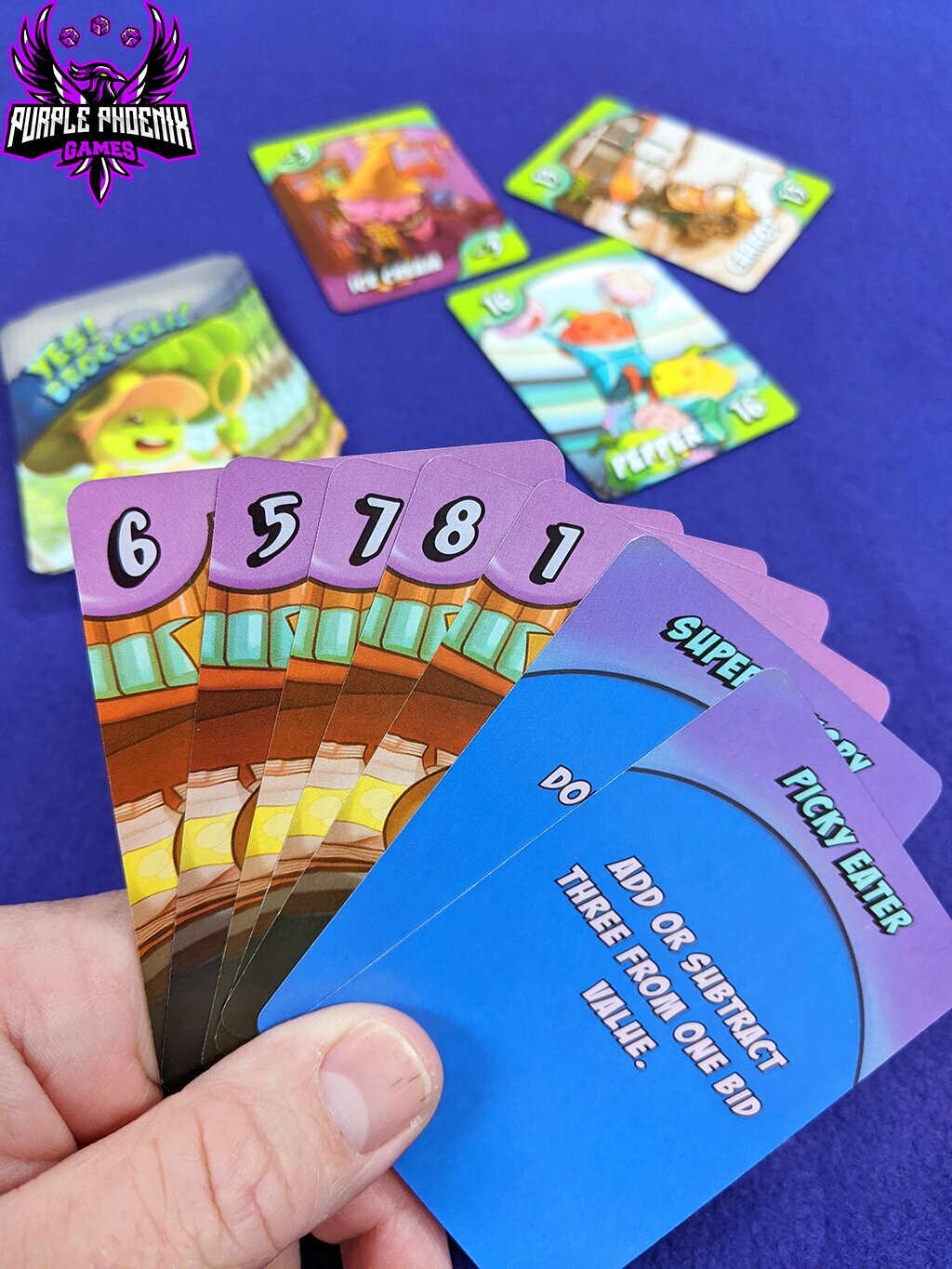
Yes! Broccoli! is a card game for 2-5 players that incorporates blind bidding, special player powers (in advanced games), and drafting elements. The hidden benefit from this game is that healthy food cards are worth more points while the junk food cards are worth negative points (boo and hiss).
DISCLAIMER: We were provided a copy of this game for the purposes of this review. This is a retail copy of the game, so what you see in these photos is exactly what would be received in your box. I do not intend to cover every single rule included in the rulebook, but will describe the overall game flow and major rule set so that our readers may get a sense of how the game plays. For more in depth rules, you may purchase a copy online from the publisher directly, or from your FLGS if stocked. -T
To setup a basic game, each player will take a personal deck of cards numbered 1-8 of the same color border (I choose orange or purple). These are the cards that will be used during the game. Shuffle the large stack of food cards as a draw deck. Draw a number of cards equal to the number of players, determine the starting player and the game is ready to be consumed!
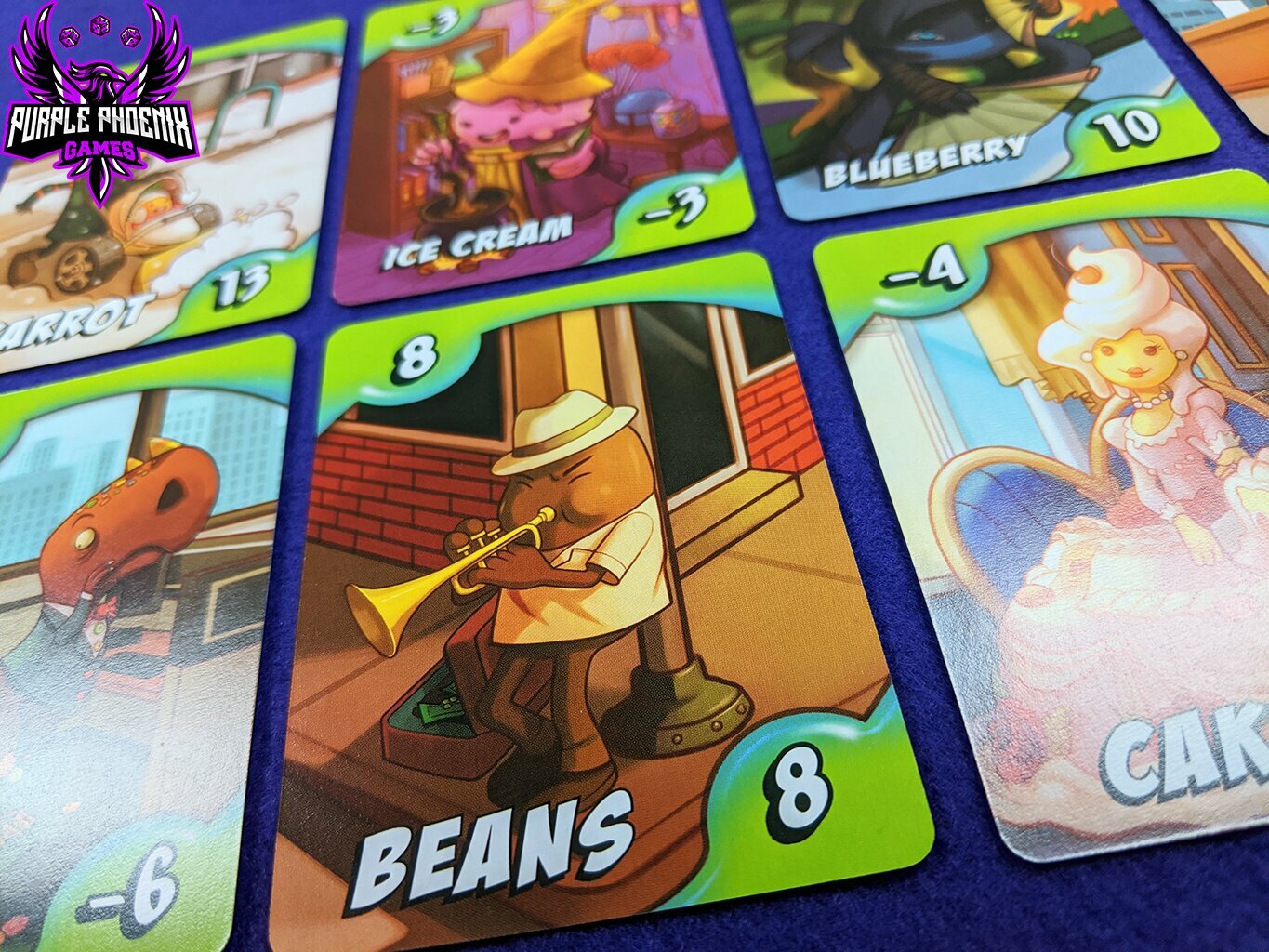
The players will all choose one of their bid cards from their hand and place them face-down in front of them. Once all have chosen, all bid cards will be revealed simultaneously. The highest-bid card’s player will then choose one of the drawn food cards to take into their score pile. That winning player now acts as the dealer and will draw and reveal the next set of cards upon which the players will bid. As the players play all their numbered cards, they may win food cards worth many points, or they may be saddled with negative values as well. These are the junk food cards that nobody wants. Except my son, who wanted all the Candy T-Rex cards, even knowing that it will affect his score. Some people play to win. Others play to have a good time. I admire that about him. Play continues in this fashion until all bid cards have been played. Count up the points won/gathered and determine a winner! This is the basic game to be played with new players or young children.
To play a more advanced game, setup will be the same, except each player will also be dealt two special ability cards to be used during the game. These cards are very powerful, and can only be used once during the game. As this adds a new and thinky layer to the basic game, it is only recommended for older children or adult play. Examples of these special abilities are having the lowest-bid card win instead of highest card, or doubling a bid amount, or adding/subtracting three to/from a current bid.
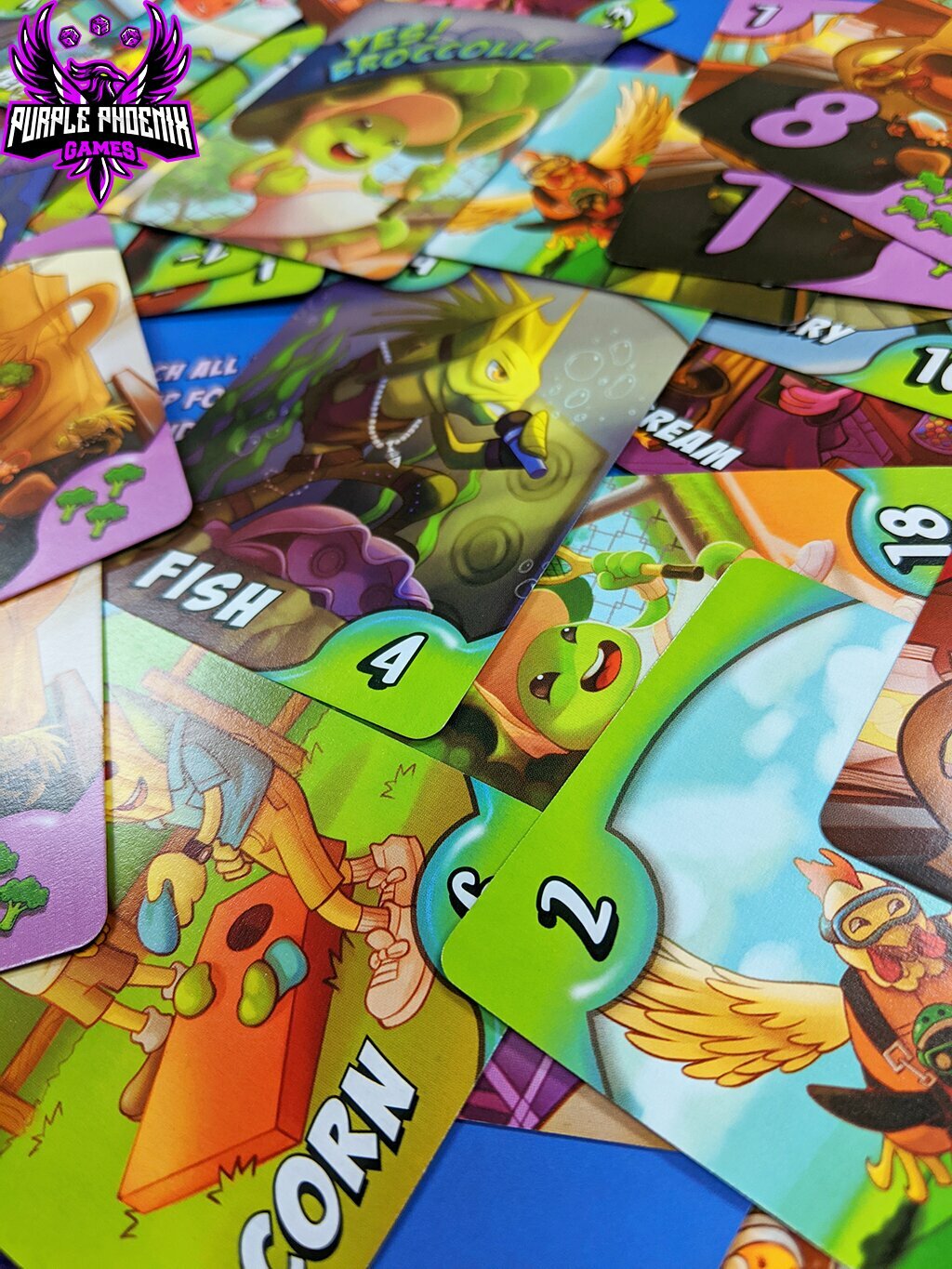
Components. This game is a big stack of cards in a small (but appropriately-sized) box. The cards are great, and while I would prefer plastic cards for my young kids, children who can respect game components will be just fine. The art on these cards is super cute and I found myself just smiling while I was playing because not only is this game educational for youngsters, but it’s fun to look at while playing too. I made a parenthetical comment about the box being appropriately-sized, and I mean it. I appreciate when a game doesn’t try to be bigger on the shelf for that extra “presence” at the game store. When I open a box and more than 50% is air, it is very irksome to me. How wasteful. Well, not here. We have nothing bad to say about these components at all.
So while most kids may not appreciate the backstabbiness of the special abilities, adults certainly will. That said, when playing with the intended audience of children, we found that Yes! Broccoli! was a huge hit! We are still working on the younger kids and breaking them of the, “yes, the cake princess is very pretty, but you really don’t want to take her into your score pile.” Winning and losing really doesn’t matter much in the Lopez household, but gaming experiences do, and though my son doesn’t win this one ever, he loves it, and I love playing it with him. So I consider this a win, and though our official Purple Phoenix Games rating has a caloric value of 8 / 12, I do believe you will enjoy this little card game – ESPECIALLY if there are little ones in your life. Purchase it directly from the publisher at Gangway Games. You can use it as a precursor to Munchkin and Cutthroat Cavern, or as a stepstone to bidding games like Biblios and No Thanks!

Bunny Party at Maple Valley
7.0 Rate It
Tabletop Game
You’ve come to visit Maple Valley at a very special time - the Night Sky Party is approaching!...

The Gallerist
8.0 Rate It
Tabletop Game
This age of art and capitalism has created a need for a new occupation - The Gallerist. Combining...
Boardgames ArtGames VidalGames workerplacementGames


Number Quiz by Tantrum Apps
Games and Education
App
Number Quiz is the best way to learn the your numbers. Four different games for every stage of...
Alien: Fate of the Nostromo
Tabletop Game
In ALIEN: Fate of the Nostromo, players take the role of Nostromo crew members Ripley, Lambert,...
Purple Phoenix Games (2266 KP) rated King of the Castle in Tabletop Games
Jul 2, 2020
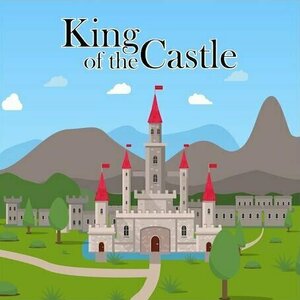

Disclaimer: We were provided a prototype copy of this game for the purposes of this preview. The components pictured are not final. Also, I do not plan to detail the entire rulebook in this review, but rather discuss the main rules and overall flow of the game. Keep an eye out for the Kickstarter launching later this fall! -L
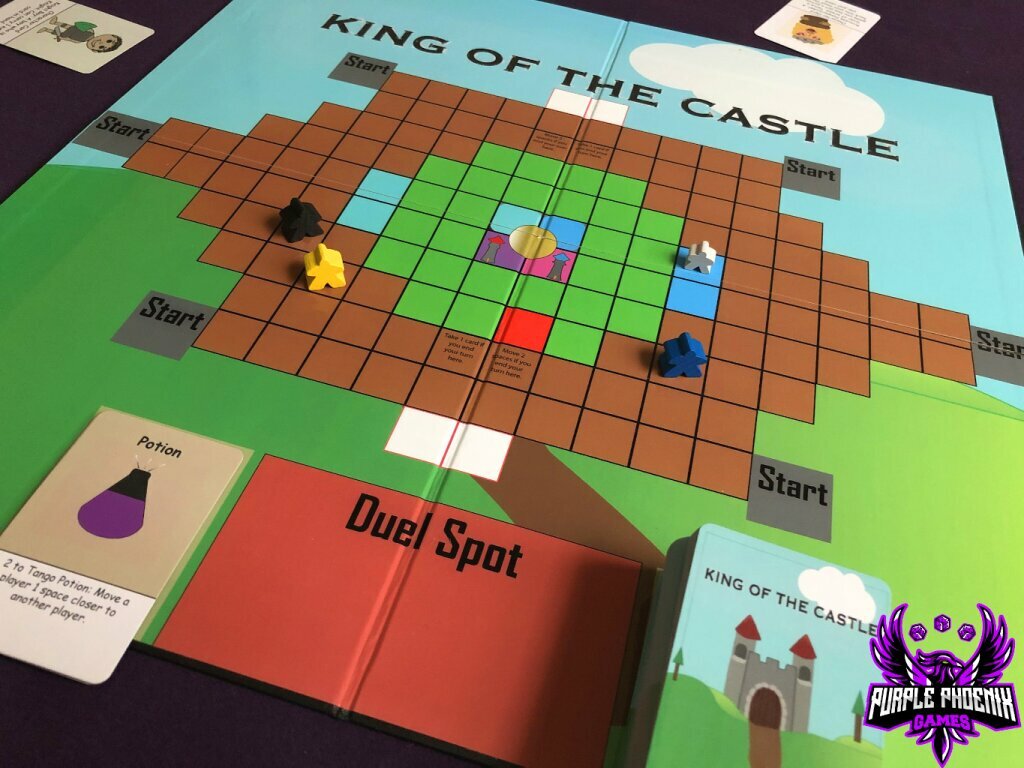
King of the Castle is a game of hand management, grid movement, and take that in which players are battling to be the first to capture and hold the throne. Played over a series of turns, players will move around the board, draw cards, and battle opponents to hinder their progress. To setup, each player is given a Character card at random, selects a Meeple in their chosen color, and places it on one of the various Start spaces on the game board. Shuffle all other cards and place them in a draw deck. Select a player to be the first player, and you are ready to begin!
On your turn, you will take a combination of 2 actions. Those combos are: Move 1 space and draw 1 card, Move 2 spaces, or Draw 2 cards. It is important to note that diagonal movement is not allowed! There are 2 types of cards that can be drawn: Potion cards (special powers/abilities) and Army cards (strength points for duels). Once you have performed your 2 actions, and played any Potion cards from your hand that you want, your turn ends. The game moves on to the next player. If you land on the same space as an opponent, you must duel each other. The dueling players will select as many Army cards from their hand as they wish to play, and will lay them down simultaneously. They may then play up to 3 Potion cards from their hand to influence the strength points of either player, as stated on the Potion cards. Whomever has the most strength points wins the duel, and gets to remain on that space. The loser must discard a card, and is knocked back to the nearest Exit space (depending on their current placement on the board).
In the center of the board are 2 Tower spaces. You must ‘capture’ a Tower in order to fulfill the win conditions. To capture a Tower, you must land on that space and occupy it for one full turn. Once you have captured a Tower, you may move to capture the Throne. The centermost space of the board is the Throne. To capture the Throne, you must first have captured a Tower, and you must enter the Throne space and occupy it for 3 complete and consecutive turns. When you are capturing a Tower or the Throne, you can still be attacked by opponents – so it is important to have a strong hand of cards to ward off enemies and continue your occupation of these valuable spaces. Once a player has occupied the Throne space for 3 consecutive turns, the game ends and that player is named King!
So with all of that said, how does King of the Castle play? Overall, I would say it’s a nice and simple little game. The concept itself is easy to comprehend – draw cards, duel opponents, capture a Tower, and ultimately, the Throne. There is a decent amount of strategy required for success. Not only are you racing to the center of the board, but you also need to amass a strong hand of cards with which you can hinder your opponents. Choosing when to use your Potion cards can affect not only your strategy, but those of your enemies as well. Is your strategy to skirt around your opponents and try to sneak by unnoticed? Or will you duel enemies at every opportunity, building up your Army and continually kicking the other players to the Exit spaces on the board? The idea of having to ‘capture’ certain spaces by occupying them for consecutive turns is an interesting one, and adds a unique twist to this game. You must be able to defend yourself in those spaces, or risk being kicked back to an Exit, requiring you to start that journey over again. It is a simple game to play, but not necessarily one that is easy to win, and I really like that.
Components. As I stated earlier, this is only a prototype version of the game, and I anticipate that there will be some changes for final production. That being said, the board in this prototype is nice and sturdy, the cards are easy to manipulate, and the Meeples are your standard wooden bits. So overall, these prototype components are off to a great start. The artwork and overall style of the game are a different story. The current artwork is pretty childish and unrefined. Again, this being only a prototype, I anticipate that the artwork will be overhauled and revised for final production. The artwork on the board is pretty basic as well, which is not necessarily a bad thing, it just doesn’t feel immersive or engaging for players. The spaces of the board are different colors to denote different areas of play, but nothing is labeled on the board, which can create some confusion at first as to the flow of movement around the board. The rules themselves need to be revised and edited for clarity. There is just a bit of ambiguity that leaves questions unanswered, but nothing that cannot be fixed.
All in all, the concept of King of the Castle is a solid one. It combines hand management, grid movement, and take that in a way that all 3 mechanics complement and work well with each other. The gameplay is lighthearted and relatively simple, which results in a fun and fast game. With some refining of the style and editing of the rules, I am sure that this game will truly shine. I look forward to following its progress, and am eager to see the Kickstarter campaign later this year. Keep your eyes on King of the Castle, because it’s shaping up to be a solid game.

Tiny Epic Zombies
7.3
Rate It
Tabletop Game
In Tiny Epic Zombies, survivors are always on the run, collecting weapons, killing Zombies and...
Purple Phoenix Games (2266 KP) rated Disney Shadowed Kingdom in Tabletop Games
Sep 15, 2021
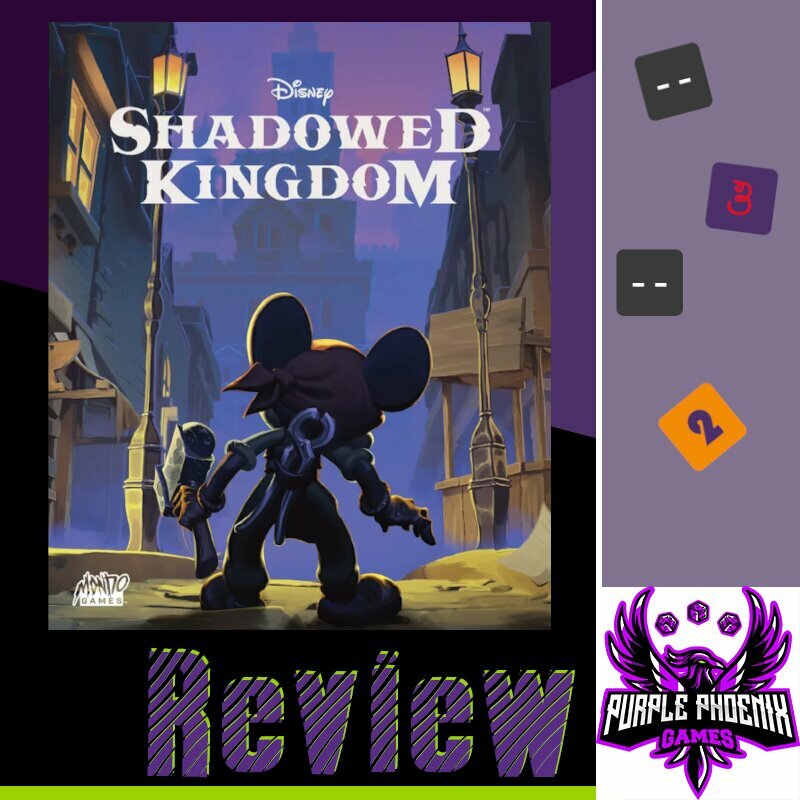
In Disney Shadowed Kingdom players are attempting to drive away the darkness of Doubt with the help of Wish (which are both characters, I guess). In order to do this the players will be splitting up within the Magic Kingdom to cleanse the different locations and, with the help of Wish, gain enough Magic to fend off Doubt and the darkness forever!
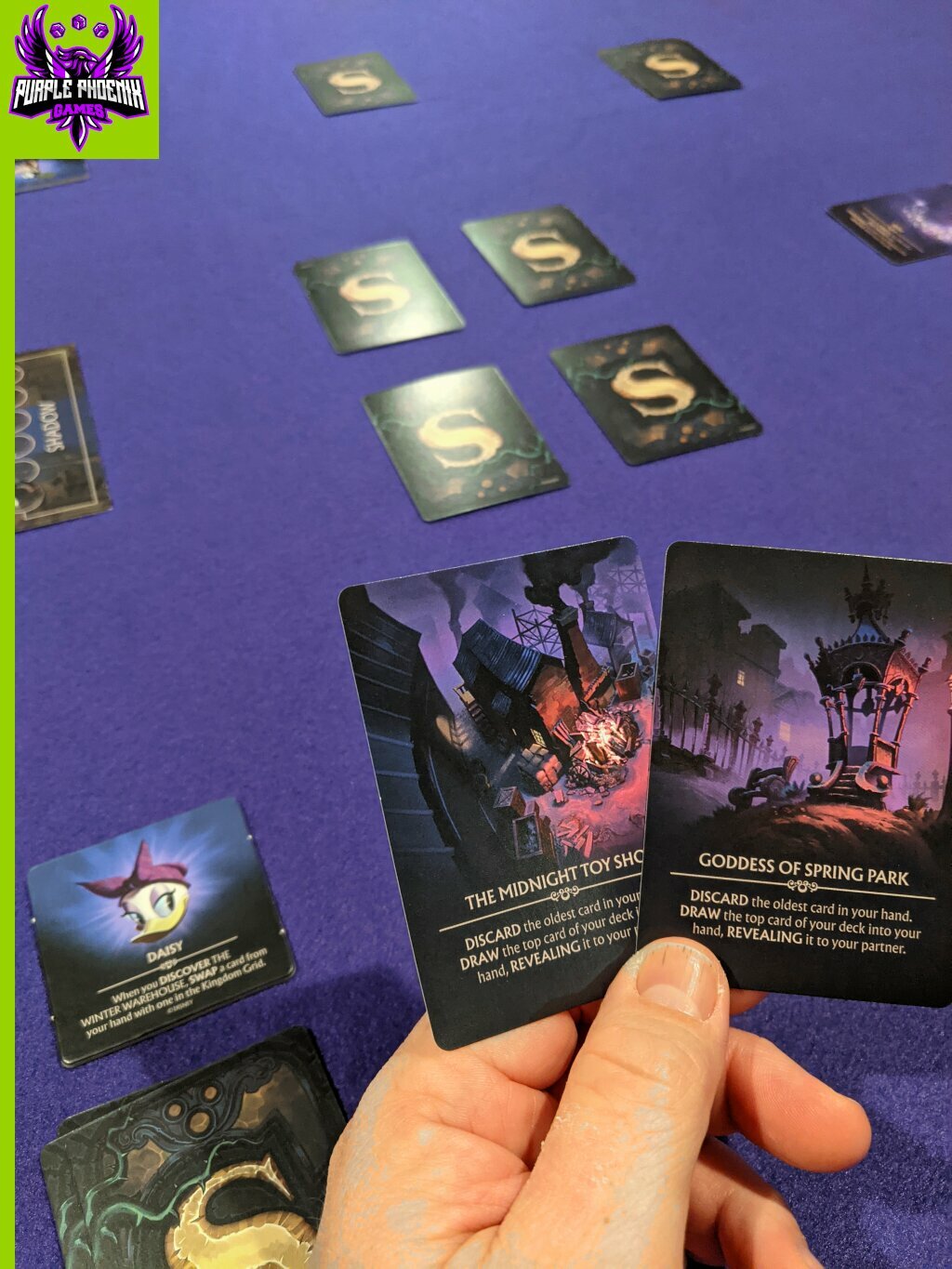
To setup, each player receives a random (or chosen) Hero Card (in the photo above I was Daisy). The Magic/Shadow Tracker is placed on the table with the tokens on the 0 spaces of each tracker. Place the Wish card on the table. Shuffle the cards and deal each player 10 cards. Each player will then draw the top two cards from their deck, look at them, and then place them face-down in front of themselves on the table. Once done, the play area will be a 2×2 grid of each player’s first draw. The first player will draw two cards from their deck and the second player will draw one. The game may now begin!
On a player’s turn they will take their “oldest” card in their current hand and play it to the table. They may play it to push a card toward their partner to be Discovered, or play it to a side of the grid to push a card outside grid to be Dispelled (discarded). When a card is pushed to a player to be Discovered the discovering player will read the card aloud and follow its directions. Once complete the discovering player takes the card in hand to be used on a future turn. When a card is Dispelled the partner of the active player will NOT play the card for its face abilities, but will rather place it directly in their own discard pile.
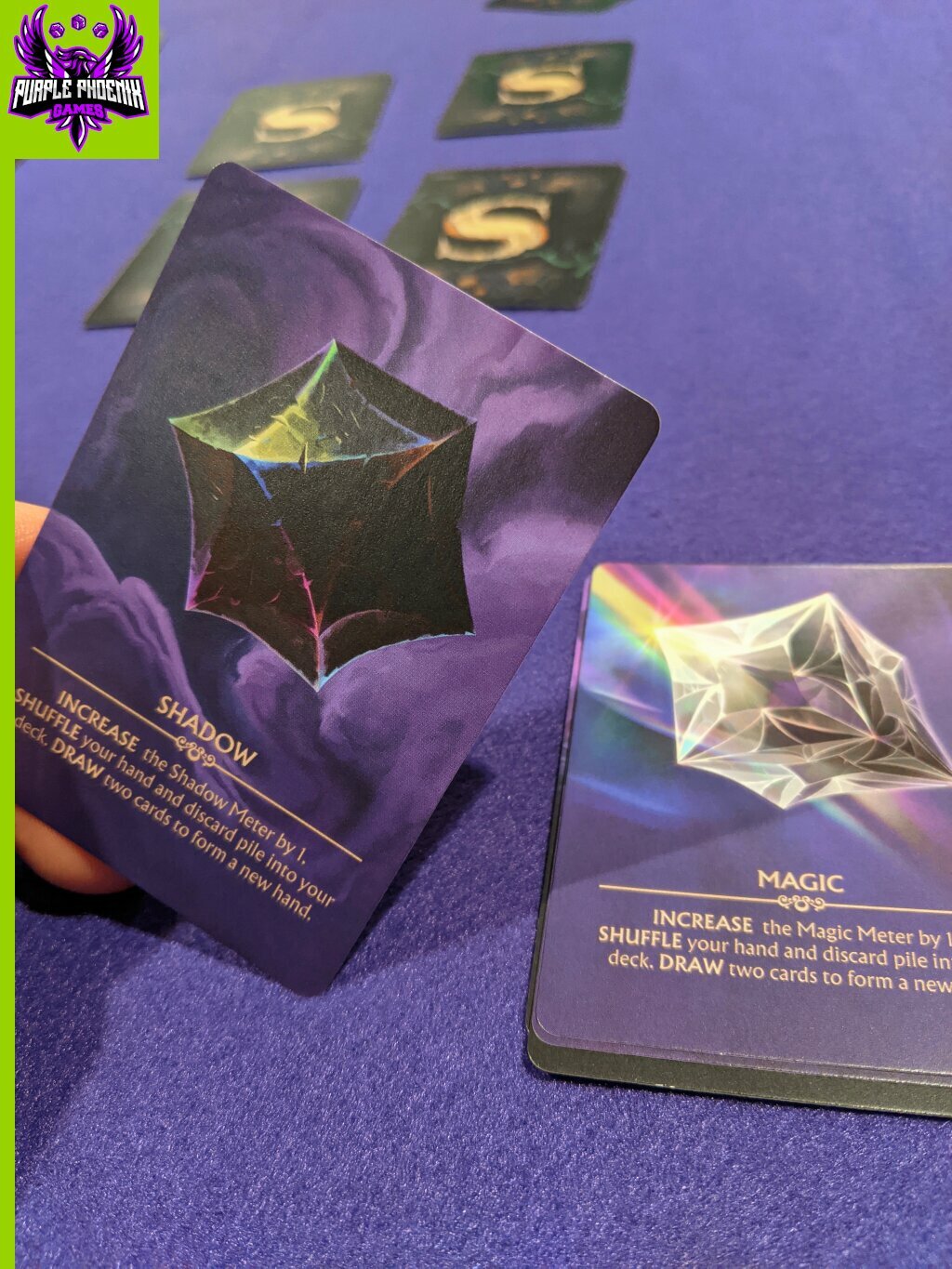
When certain location cards are Discovered they may cause the hero’s (the card that was chosen at the beginning) special ability to trigger. These abilities could be peeking at cards in the grid or partner’s hand, or swapping two cards, or other abilities. Play continues in this way until players have pushed enough Magic cards to their partners to win or enough Shadow cards to allow the darkness to invade and lose the game.
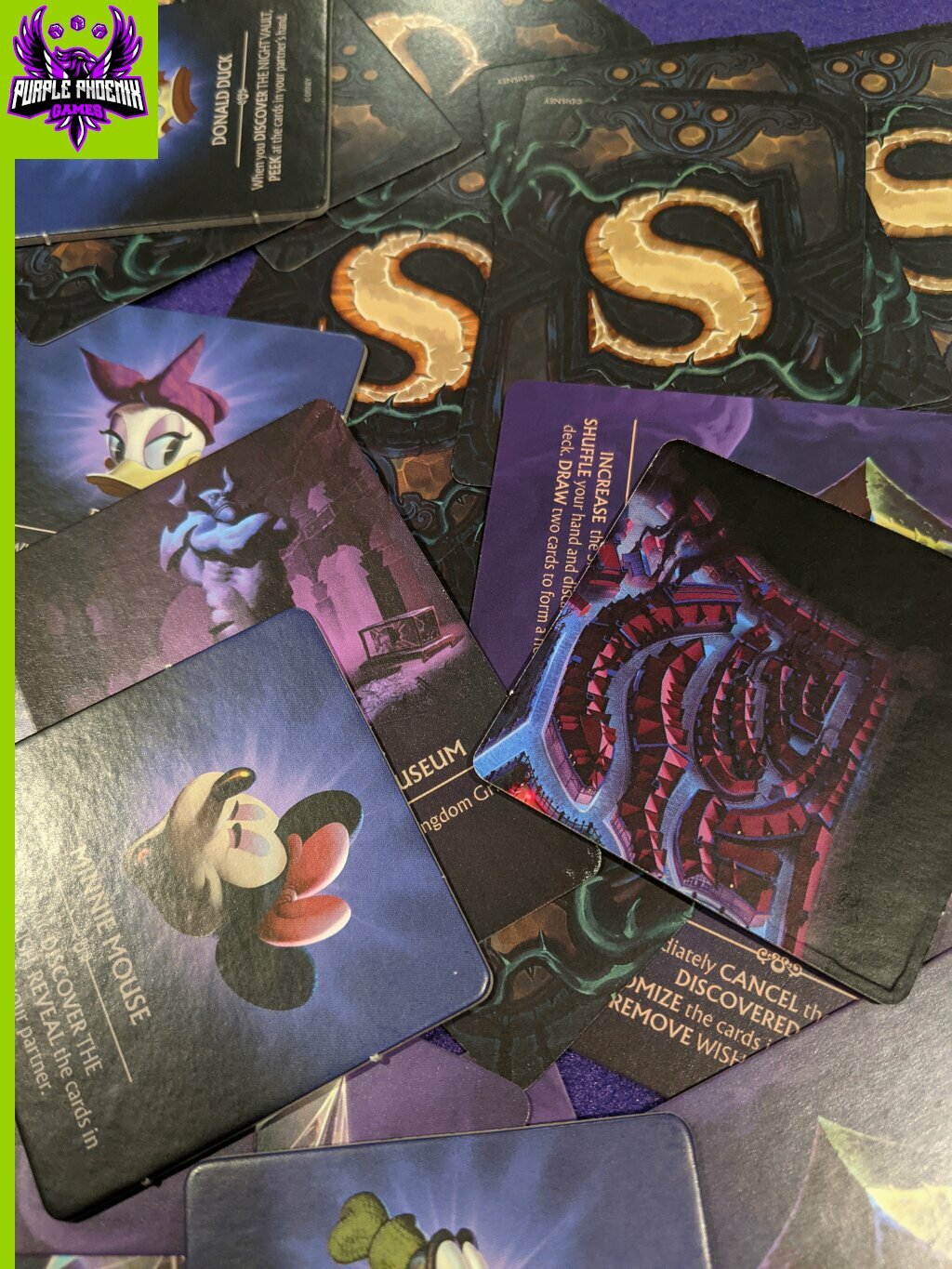
Components. This game is a small stack of cards, some Hero cards, and the Magic/Shadow tracker with tokens. The cards are fine quality, the Hero cards are thick cardboard, and the other components are also fine. The art on the cards is amazing, and the saving grace.
Overall I would not recommend this game at all. I only rated it as highly as I did because I love the art and the theme. The gameplay just doesn’t work. There were times, when playing, we would get stuck in a loop of a card telling us to randomize the grid over and over. So while there IS an amount of memory used in the game, it can quickly be thrown out the window with just one card. This is merely one instance of the strategy and tactics needed to win or even play this one: almost none. As you HAVE to play the oldest card in your hand, it becomes a chore to try to remember exactly where it has been placed, and the hope that your partner will not push it toward you to be Discovered. And as bad as that may sound, the other cog in this wonky wheel is that players may not communicate with each other AT ALL. No talking, gestures, reactions, etc. So players are placing cards into the grid to be pushed about without knowing what may be in the grid. Sure, the Heroes all have special abilities, but they are limited to triggering only when one specific location card is Discovered. In a deck of 20 cards, having just one trigger your ability can be frustrating, as that card may never be Discovered in the first place.
When all is said and done, this is a Disney game in name only, and not a great one. The inability to really enact any strategy is severely limiting and thus just presents a game that you play without really making many decisions at all. It’s a guess as to what your partner has played, and “knowing” when to Discover or Dispel is also a crap shoot. Yes, cards on your side of the grid may be known to you, but once your partner pushes cards to you to Discover you no longer know 3/4 of the grid contents. It is just frustrating.
I will probably not be playing this again, and I really don’t see it staying in my collection. It’s sad, really, because this game feels like it should be grander but there are so many missing pieces that is really flops. Purple Phoenix Games gives Disney Shadowed Kingdom a woeful 5 / 12. With so many Disney-themed games out there, and many of them decent to good, pass on this one and grab a different one. I know a few off the top of my head I could suggest. Just message me or email me and I would be happy to recommend some Disney games that are excellent.