Search
Search results
Bob Mann (459 KP) rated The Death Of Stalin (2017) in Movies
Sep 29, 2021
Death…. Torture…. Child Abuse…. LOL??
Armando Iannucci is most familiar to TV audiences on both sides of the pond for his cutting political satire of the likes of “Veep” and “The Thick of It”, with his only previous foray into directing movies being “In the Loop”: a spin-off of the latter series. Lovers of his work will know that he sails very close to the wind on many occasions, such that watching can be more of a squirm-fest than enjoyment.
Rupert Friend (centre) tries to deliver a eulogy to his father against winged opposition. With (from left to right) Michael Palin, Jeffrey Tambor, Steve Buscemi and Simon Russell Beale.
It should come as no surprise then that his new film – “The Death of Stalin” – follows that same pattern, but transposed into the anarchic and violent world of 1950’s Russia. Based on a French comic strip, the film tells the farcical goings on surrounding the last days of the great dictator in 1953. Stalin keeps distributing his “lists” of undesirables, most of who will meet unpleasant ends before the end of the night. But as Stalin suddenly shuffles off his mortal coil, the race is on among his fellow commissariat members as to who will ultimately succeed him.
Stalin…. Going… but not forgotten.
The constitution dictates that Georgy Malenkov (an excellently vacillating Jeffrey Tambor) secedes but, as a weak man, the job is clearly soon going to become vacant again and spy-chief Lavrentiy Beria (Simon Russell Beale) and Nikita Khrushchev (Steve Buscemi) are jostling for position. (No spoilers, but you’ll never guess who wins!). Colleagues including Molotov (Michael Palin) and Mikoyan (Paul Whitehouse) need to decide who to side with as the machinations around Stalin’s funeral become more and more desperate.
The film starts extremely strongly with the ever-excellent Paddy Considine (“Pride”) playing a Radio Russia producer tasked with recording a classical concert, featuring piano virtuoso Maria Yudina (Olga Kurylenko, “Quantum of Solace”). A definition of paranoia in action!
Great fingering. Olga Kurylenko as Yudina, with more than a hand in the way the evening’s events will unfold.
We then descend into the chaos of Stalin’s Russia, with mass torture and execution colouring the comedy from dark-grey to charcoal-black in turns. There is definitely comedy gold in there: Khrushchev’s translation of his drunken scribblings from the night before (of things that Stalin found funny and – more importantly – things he didn’t) being a high point for me. Stalin’s children Svetlana (Andrea Riseborough, “Nocturnal Animals”) and Vasily (Rupert Friend, “Homeland”) add knockabout humour to offset the darker elements, and army chief Georgy Zhukov (Jason Isaacs, “Harry Potter”) is a riot with a no-nonsense North-of-England accent.
Brass Eye: Jason Isaacs as the army chief from somewhere just north of Wigan.
Production values are universally excellent, with great locations, great sets and a screen populated with enough extras to make the crowd scenes all appear realistic.
Another broad Yorkshire accent: (the almost unknown) Adrian McLoughlin delivers an hysterical speaking voice as Stalin.
The film absolutely held my interest and was thorougly entertaining, but the comedy is just so dark in places it leaves you on edge throughout. The writing is also patchy at times, with some of the lines falling to the ground as heavily as the dispatched Gulag residents.
It’s not going to be for everyone, with significant violence and gruesome scenes, but go along with the black comic theme and this is a film that delivers rewards.

Rupert Friend (centre) tries to deliver a eulogy to his father against winged opposition. With (from left to right) Michael Palin, Jeffrey Tambor, Steve Buscemi and Simon Russell Beale.
It should come as no surprise then that his new film – “The Death of Stalin” – follows that same pattern, but transposed into the anarchic and violent world of 1950’s Russia. Based on a French comic strip, the film tells the farcical goings on surrounding the last days of the great dictator in 1953. Stalin keeps distributing his “lists” of undesirables, most of who will meet unpleasant ends before the end of the night. But as Stalin suddenly shuffles off his mortal coil, the race is on among his fellow commissariat members as to who will ultimately succeed him.
Stalin…. Going… but not forgotten.
The constitution dictates that Georgy Malenkov (an excellently vacillating Jeffrey Tambor) secedes but, as a weak man, the job is clearly soon going to become vacant again and spy-chief Lavrentiy Beria (Simon Russell Beale) and Nikita Khrushchev (Steve Buscemi) are jostling for position. (No spoilers, but you’ll never guess who wins!). Colleagues including Molotov (Michael Palin) and Mikoyan (Paul Whitehouse) need to decide who to side with as the machinations around Stalin’s funeral become more and more desperate.
The film starts extremely strongly with the ever-excellent Paddy Considine (“Pride”) playing a Radio Russia producer tasked with recording a classical concert, featuring piano virtuoso Maria Yudina (Olga Kurylenko, “Quantum of Solace”). A definition of paranoia in action!
Great fingering. Olga Kurylenko as Yudina, with more than a hand in the way the evening’s events will unfold.
We then descend into the chaos of Stalin’s Russia, with mass torture and execution colouring the comedy from dark-grey to charcoal-black in turns. There is definitely comedy gold in there: Khrushchev’s translation of his drunken scribblings from the night before (of things that Stalin found funny and – more importantly – things he didn’t) being a high point for me. Stalin’s children Svetlana (Andrea Riseborough, “Nocturnal Animals”) and Vasily (Rupert Friend, “Homeland”) add knockabout humour to offset the darker elements, and army chief Georgy Zhukov (Jason Isaacs, “Harry Potter”) is a riot with a no-nonsense North-of-England accent.
Brass Eye: Jason Isaacs as the army chief from somewhere just north of Wigan.
Production values are universally excellent, with great locations, great sets and a screen populated with enough extras to make the crowd scenes all appear realistic.
Another broad Yorkshire accent: (the almost unknown) Adrian McLoughlin delivers an hysterical speaking voice as Stalin.
The film absolutely held my interest and was thorougly entertaining, but the comedy is just so dark in places it leaves you on edge throughout. The writing is also patchy at times, with some of the lines falling to the ground as heavily as the dispatched Gulag residents.
It’s not going to be for everyone, with significant violence and gruesome scenes, but go along with the black comic theme and this is a film that delivers rewards.
Movie Metropolis (309 KP) rated Gerald's Game (2017) in Movies
Jun 10, 2019
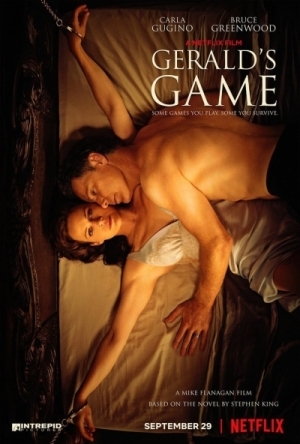
Not a very fun game
The horror film market is huge. Hundreds, if not thousands, of horror films are made every year, with only few standing out of the blood-drenched crowd. Netflix, with a penchant for outstanding horrors and thrillers, decided to hop on the horror flick train, bringing about an adaptation of Stephen King’s terrifying novel ‘Gerald’s Game’.
The film follows Jessie (Carla Gugino) and her husband, Gerald (Bruce Greenwood), as they head to a remote lake house in order to spice up their marriage. One thing leads to another, and then Gerald has a heart attack and dies, leaving Jessie handcuffed to the bed with the keys out of reach. She must then fight to survive, whilst having a few disturbing flashbacks and encounters along the way.
This movie is really disturbing. Like, really, really disturbing. It’s not particularly scary, there’s the odd jump-scare or three, but its the imagery and the situation that really get your heart going.
Carla Gugino as the shackled wife is a stand-out in this film. She basically carries it, only with a few interruptions from inside her head, and this makes for very entertaining viewing. She’s amusing, in a way that you didn’t think anyone could be whilst fighting dehydration, a hungry dog at the end of her bed and death himself. In all honesty, it’s not a very fun game.
Her husband, however, is brilliant at being horrible. Greenwood really amps up the bad husband vibes in the 20 minutes he is alive, which then are exacerbated in Jessie’s head after he has died. He’s manipulative, seedy and slimy: something that Jessie realises at the end of the film.
It could be argued that this film isn’t really a horror film in the typical sense. It’s more a horror film about what has happened to Jessie, the main character, and how she comes to terms with her past and survives. She calls on past experiences to escape her confines on the bed, and her horrible history.
That’s not to say that it doesn’t have stereotypical horror movie attributes. The Moonlight Man is their contribution to the supernatural – or more the ‘is he actually there or am I insane?’ kind of gimmick that sometimes comes with this genre. The Moonlight Man is a shadowy figure, lurking in the shadows with his box of trinkets and bones. He’s absolutely terrifying.
He’s also real. In the film and book, he’s a necrophiliac who’s waiting for Jessie to die so he can add her wedding ring and one of her bones to his box. The Moonlight Man is the kind of horror movie villain that you have nightmares about. Which is why he is one of the highlights of Gerald’s Game.
The film isn’t exactly the most complex plot in the world. It plays a bit too much on the stereotypes in some cases and the ending, in true horror film fashion, is too happy, is too well put together after such a traumatic experience. It all ends a bit too neatly after such a messy first three-quarters.
Even though this isn’t the best horror film ever, it certainly is not the worst. It has it’s flaws, but the acting and the scriptwriting make up for the few it has. In an era of horror trying too hard, this film is simple and refreshing, bringing a new feeling to the horror industry as a whole.
So, the moral of the story is: don’t handcuff yourself to the bed because your husband will die on top of you and then a stray dog will eat him and a necrophiliac will come into your house at night. Quite an easy thing to remember, right?
https://moviemetropolis.net/2017/12/06/geralds-game-review-not-a-very-fun-game/

The film follows Jessie (Carla Gugino) and her husband, Gerald (Bruce Greenwood), as they head to a remote lake house in order to spice up their marriage. One thing leads to another, and then Gerald has a heart attack and dies, leaving Jessie handcuffed to the bed with the keys out of reach. She must then fight to survive, whilst having a few disturbing flashbacks and encounters along the way.
This movie is really disturbing. Like, really, really disturbing. It’s not particularly scary, there’s the odd jump-scare or three, but its the imagery and the situation that really get your heart going.
Carla Gugino as the shackled wife is a stand-out in this film. She basically carries it, only with a few interruptions from inside her head, and this makes for very entertaining viewing. She’s amusing, in a way that you didn’t think anyone could be whilst fighting dehydration, a hungry dog at the end of her bed and death himself. In all honesty, it’s not a very fun game.
Her husband, however, is brilliant at being horrible. Greenwood really amps up the bad husband vibes in the 20 minutes he is alive, which then are exacerbated in Jessie’s head after he has died. He’s manipulative, seedy and slimy: something that Jessie realises at the end of the film.
It could be argued that this film isn’t really a horror film in the typical sense. It’s more a horror film about what has happened to Jessie, the main character, and how she comes to terms with her past and survives. She calls on past experiences to escape her confines on the bed, and her horrible history.
That’s not to say that it doesn’t have stereotypical horror movie attributes. The Moonlight Man is their contribution to the supernatural – or more the ‘is he actually there or am I insane?’ kind of gimmick that sometimes comes with this genre. The Moonlight Man is a shadowy figure, lurking in the shadows with his box of trinkets and bones. He’s absolutely terrifying.
He’s also real. In the film and book, he’s a necrophiliac who’s waiting for Jessie to die so he can add her wedding ring and one of her bones to his box. The Moonlight Man is the kind of horror movie villain that you have nightmares about. Which is why he is one of the highlights of Gerald’s Game.
The film isn’t exactly the most complex plot in the world. It plays a bit too much on the stereotypes in some cases and the ending, in true horror film fashion, is too happy, is too well put together after such a traumatic experience. It all ends a bit too neatly after such a messy first three-quarters.
Even though this isn’t the best horror film ever, it certainly is not the worst. It has it’s flaws, but the acting and the scriptwriting make up for the few it has. In an era of horror trying too hard, this film is simple and refreshing, bringing a new feeling to the horror industry as a whole.
So, the moral of the story is: don’t handcuff yourself to the bed because your husband will die on top of you and then a stray dog will eat him and a necrophiliac will come into your house at night. Quite an easy thing to remember, right?
https://moviemetropolis.net/2017/12/06/geralds-game-review-not-a-very-fun-game/
BankofMarquis (1832 KP) rated The Lighthouse (2019) in Movies
Jan 25, 2021
Weird - and I couldn't look away
I have viewed some really strange films in my day. When asked, I often mention MIRRORMASK (based on a Neil Gaiman story) and mother! (the Darren Aronofsky oddity) as the strangest films I have ever seen.
Add Robert Eggers’ THE LIGHTHOUSE to this list.
Based on a real life tragedy from 1801, THE LIGHTHOUSE follows 2 isolated Lighthouse keepers as they interact with each other, slowly going mad in the process…or did they? Is one of them mad and the other sane? Are they both mad? Or…is it the viewer who is going mad? Eggers let’s you, the viewer, decide.
And…good for him. I have now encountered 2 films directed by former Production Designer Eggers - THE WITCH and now this film. In both cases, the movies are interestingly shot and intriguing to view but almost incomprehensible. The more so with THE LIGHTHOUSE, it is almost as if Eggers heard the criticism of THE WITCH of being incomprehensible and said “hold my beer”.
Besides the production values - which really are quite good (especially Eggers use of Black and White) - what holds this movie in high regards is the acting of the 2 people in film. These 2 characters are the only speaking parts in this movie.
Willem Dafoe portrays the older, veteran Lighthouseman who tells the tales of Mermaids and Curses and has a generally air of foreboding from the start. It is a masterwork by Dafoe - his best work of his career (and that’s saying something). He is unnerving to view from the start. The only thing the viewer needs to figure out is whether he is insane or very, very, very sane.
The surprise for me in this movie is the work of Robert Pattinson, the younger Lighthouseman who is in his first assignment. He is the audience’s eyes into this weird world and he is very much sane at the beginning. At the end…well…you decide. He was able to go toe-to-toe with DaFoe and held his own very well. This young actor has made a conscious choice following the Twilight films and with this movie and with Christopher Nolan's TENANT he is establishing himself as a darn good performer.
As for the film itself, my one recommendation for you is to not be too concerned of making sense of what is going on in the scene you are watching…you’ll drive yourself mad doing this (at least it was driving me mad). After awhile I just sat back and drank in the weirdness - and the quality acting and production values - that was enfolding in front of me and the ending was satisfying (enough).
All in all one of the stranger times I’ve had at the movies.
Letter Grade: B
7 stars (out of 10) and you can take that to the Bank (ofMarquis)
Add Robert Eggers’ THE LIGHTHOUSE to this list.
Based on a real life tragedy from 1801, THE LIGHTHOUSE follows 2 isolated Lighthouse keepers as they interact with each other, slowly going mad in the process…or did they? Is one of them mad and the other sane? Are they both mad? Or…is it the viewer who is going mad? Eggers let’s you, the viewer, decide.
And…good for him. I have now encountered 2 films directed by former Production Designer Eggers - THE WITCH and now this film. In both cases, the movies are interestingly shot and intriguing to view but almost incomprehensible. The more so with THE LIGHTHOUSE, it is almost as if Eggers heard the criticism of THE WITCH of being incomprehensible and said “hold my beer”.
Besides the production values - which really are quite good (especially Eggers use of Black and White) - what holds this movie in high regards is the acting of the 2 people in film. These 2 characters are the only speaking parts in this movie.
Willem Dafoe portrays the older, veteran Lighthouseman who tells the tales of Mermaids and Curses and has a generally air of foreboding from the start. It is a masterwork by Dafoe - his best work of his career (and that’s saying something). He is unnerving to view from the start. The only thing the viewer needs to figure out is whether he is insane or very, very, very sane.
The surprise for me in this movie is the work of Robert Pattinson, the younger Lighthouseman who is in his first assignment. He is the audience’s eyes into this weird world and he is very much sane at the beginning. At the end…well…you decide. He was able to go toe-to-toe with DaFoe and held his own very well. This young actor has made a conscious choice following the Twilight films and with this movie and with Christopher Nolan's TENANT he is establishing himself as a darn good performer.
As for the film itself, my one recommendation for you is to not be too concerned of making sense of what is going on in the scene you are watching…you’ll drive yourself mad doing this (at least it was driving me mad). After awhile I just sat back and drank in the weirdness - and the quality acting and production values - that was enfolding in front of me and the ending was satisfying (enough).
All in all one of the stranger times I’ve had at the movies.
Letter Grade: B
7 stars (out of 10) and you can take that to the Bank (ofMarquis)
Ryan Hill (152 KP) rated Wonder Woman (2017) in Movies
May 18, 2019
"I can save today, you can save the world"
Remember when some trickster claiming to be a former worker from Warner Bros. wrote an open letter saying that Wonder Woman was just another mess of a DC movie, et cetera? I remember how Patty Jenkins responded to that. She tweeted: "Just wait and you'll see".
Honestly, I don't know how anyone could even consider that there was the slightest chance of this movie not being good, and I'm gonna tell you why: this is the very first big female-led superhero movie, in which the title character also happens to be the greatest female superhero in history. If you really think that Patty Jenkins, also the first woman to ever direct a superhero movie of this caliber in a industry where women barely stand any chances to get to direct major blockbusters, would let this movie be anything less than great... You've got another thing coming, mate.
Wonder Woman is a traditional, oldschool superhero movie, but the first essentially feminist one at it, and they couldn't have chosen a better setting to tell this story, or a better character to star in it. The movie's social comments are strong and constantly present, but never forced, because it is only natural: by placing Diana, a princess raised in an island of warrior women, in the middle of the reality of World War I, the absurdities of the feminine role in the world - and so many other human corruptions - automatically come to light. The way Diana reacts to this world raises a great sense of awareness, with a touch of poignant humor to it. There is a very funny subtle arc of her wanting to take out her cloak, but not being able to because her armor is "barely any clothes", hinting not only at society's sexist feminine dressing code - which is still a thing today -, but also gradually adding power to the iconography of Wonder Woman in full costume; this is Wonder Woman's much awaited debut on the big screen in a solo movie, and like Superman and Batman before her, her first appearance needed to be something incredibly striking. Patty knew that, Gal knew that, and they made it happen. Even if we already saw her in BVS, the very first time Wonder Woman walks up in full costume here is undoubtedly one of the most iconic moments in superhero cinema.
Jenkins is extremely devoted to giving Wonder Woman the iconic debut film she deserves, and she nails it - there's quite a bit of remarkable shots and set pieces that let out the same imagetic power as in Donner's Superman, Burton's Batman or even Raimi's Spider-Man, and I must highlight the No Man's Land sequence. It's my favorite part of the movie; Jenkins and Heinberg carefully work on Diana's mindset as she first witness the horrors of human war, not being able to help everyone, horses being hurt so they can move faster, a mother and a child begging for help, and it all leads up to the powerful moment of a woman crossing the land no man could cross - and Heinberg's dialogue doesn't rely on obvious statements such as "fortunately I'm a woman" (I'm looking at you, Batwoman trailer), it simply lets the image strike us, because it is powerful enough by itself, and boy did that cause some serious goosebumps.
Speaking of dialogue... It's so terrific, so well written. The exchanges between Diana and Steve Trevor are very clever and funny, but most of all natural. All the characters are also extremely likable; Allan Heinberg's writing knows that not all of them can be given deep development, but nonetheless he gives them stories, personalities and purposes, and that - plus the charismatic performances - makes them very empathetic. The villains are not as remarkable as in some of the other DCEU films, but they didn't need to be; the movie doesn't require in-depth arcs from its villains. They have a strong presence when they're in scene and a well elaborated lore, and that's everything they need.
Contrary to the Nordic mythology depicted in the MCU, here we are talking about real gods, true deities, not superpowerful aliens that only strike a similar image - and that also brings a few narrative dangers along with it, after all, it was in greek mythological stories that the concept of Deus Ex Machina first appeared. Heinberg's screenplay, though, makes a few clever twists in that mythology to avoid easy solutions, which adds to the storytelling, the world building and the developing of the themes as well. The lore surrounding the God of War Ares, for example, is not a simple Diabolus Ex Machina as "he influences men to war and if you kill him every man goes back to being good and everything's alright", no, it's more narratively complicated and socially engaging than that.
And Gal Gadot... I'm at a loss for words. I'll confess right here that when she was first announced as Wonder Woman, I was one of the few who were very opposed to that casting. I've never been so wrong in my life, and I've never been so happy about it. She really is Wonder Woman. She's so graceful and adorable, but a major badass when she needs to be. The way she moves, the way she curiously looks at things, the way she speaks, and the way she incarnates Diana's evolving from her naive beginnings to the wise warrior... She's not only an icon, she's a true hero. Comparisons to Christopher Reeve's Superman were made for good reasons.
Chris Pine is also great, he walks perfectly in the line between funny and serious, Steve Trevor is a darling character and his chemistry with Gal is on point. Their relationship is very well constructed and becomes highly emotional by the end - there are scenes that filled my heart with joy, and others that made it ache.
The action is exciting and full of originality, and I like how Jenkins uses slow-motion differently than Zack Snyder. I know that Snyder helped her direct some of the action sequences, which is understandable since Jenkins had no experience with this type of movie, but you can tell it's not the same. In the fights themselves, there's this feel of sensibility to how these people react to Diana, and it's slightly different from the typical "regular people react to superhumans among them" trope. The cinematography is very keen on portraying the difference between Themyscira - an island of colors and natural beauty - and "jolly ol' London" - desaturated and smoggy, a scenario in which Diana's colorful armor shines in a most beautiful contrast.
And the soundtrack. Rupert Gregson-Williams made a beautiful score that brings out the best in every scene. It's heroic, very heartfelt, and loyal to the foundations of what makes superhero music so memorable. Gregson-Williams adds new themes to compose Wonder Woman's musical identity, but Hans Zimmer's main theme from BVS still lives, and it plays in some heart-pounding scenes. I love that they're dedicating that much attention to the musical continuity, because amongst Marvel's many qualities, they're doing a lousy job in that area. Wonder Woman's theme is the most catchy superhero theme in a long time, it quickly gained a lot of appreciation and by continuing on using it, Gregson-Williams collaborates to making Wonder Woman the strong cinematic icon she's setting out to be.
The irregular reception of previous DCEU movies also extols the impact of Wonder Woman, as do the distinct styles between the films. One of the DCEU's biggest virtues is that singularity of each film; be it a near disaster movie epic such as Man Of Steel, a complex deconstruction of heroic values such as Batman v Superman, an stylish chaos such as Suicide Squad or a traditional, graceful superhero film such as Wonder Woman, these movies are all in the same universe, and that very fact is an example of its richness. A lot of people will think Wonder Woman is the best DCEU movie of the lot, some will stick to BVS, others to MOS, maybe for some it's Shazam, but that's the fun of it: we can discuss this forever. Each of these movies mean different things to different people, we're way past simply labelling one as "better" and the other as "worse".
Wonder Woman, however, is not simply a movie about a very strong woman. It's an achievement for every woman. There were tons of girls dressed up as Wonder Woman in the theater, and just seeing how ecstatic they were after the movie brought me joy. There were tons of applause. It's a mark. Be that as it may, Wonder Woman will be remembered as the most impactful superhero film of its time. In 1978, Superman showed to the world how a man could fly; in 2017, Wonder Woman showed to the world how a woman can fight.
Honestly, I don't know how anyone could even consider that there was the slightest chance of this movie not being good, and I'm gonna tell you why: this is the very first big female-led superhero movie, in which the title character also happens to be the greatest female superhero in history. If you really think that Patty Jenkins, also the first woman to ever direct a superhero movie of this caliber in a industry where women barely stand any chances to get to direct major blockbusters, would let this movie be anything less than great... You've got another thing coming, mate.
Wonder Woman is a traditional, oldschool superhero movie, but the first essentially feminist one at it, and they couldn't have chosen a better setting to tell this story, or a better character to star in it. The movie's social comments are strong and constantly present, but never forced, because it is only natural: by placing Diana, a princess raised in an island of warrior women, in the middle of the reality of World War I, the absurdities of the feminine role in the world - and so many other human corruptions - automatically come to light. The way Diana reacts to this world raises a great sense of awareness, with a touch of poignant humor to it. There is a very funny subtle arc of her wanting to take out her cloak, but not being able to because her armor is "barely any clothes", hinting not only at society's sexist feminine dressing code - which is still a thing today -, but also gradually adding power to the iconography of Wonder Woman in full costume; this is Wonder Woman's much awaited debut on the big screen in a solo movie, and like Superman and Batman before her, her first appearance needed to be something incredibly striking. Patty knew that, Gal knew that, and they made it happen. Even if we already saw her in BVS, the very first time Wonder Woman walks up in full costume here is undoubtedly one of the most iconic moments in superhero cinema.
Jenkins is extremely devoted to giving Wonder Woman the iconic debut film she deserves, and she nails it - there's quite a bit of remarkable shots and set pieces that let out the same imagetic power as in Donner's Superman, Burton's Batman or even Raimi's Spider-Man, and I must highlight the No Man's Land sequence. It's my favorite part of the movie; Jenkins and Heinberg carefully work on Diana's mindset as she first witness the horrors of human war, not being able to help everyone, horses being hurt so they can move faster, a mother and a child begging for help, and it all leads up to the powerful moment of a woman crossing the land no man could cross - and Heinberg's dialogue doesn't rely on obvious statements such as "fortunately I'm a woman" (I'm looking at you, Batwoman trailer), it simply lets the image strike us, because it is powerful enough by itself, and boy did that cause some serious goosebumps.
Speaking of dialogue... It's so terrific, so well written. The exchanges between Diana and Steve Trevor are very clever and funny, but most of all natural. All the characters are also extremely likable; Allan Heinberg's writing knows that not all of them can be given deep development, but nonetheless he gives them stories, personalities and purposes, and that - plus the charismatic performances - makes them very empathetic. The villains are not as remarkable as in some of the other DCEU films, but they didn't need to be; the movie doesn't require in-depth arcs from its villains. They have a strong presence when they're in scene and a well elaborated lore, and that's everything they need.
Contrary to the Nordic mythology depicted in the MCU, here we are talking about real gods, true deities, not superpowerful aliens that only strike a similar image - and that also brings a few narrative dangers along with it, after all, it was in greek mythological stories that the concept of Deus Ex Machina first appeared. Heinberg's screenplay, though, makes a few clever twists in that mythology to avoid easy solutions, which adds to the storytelling, the world building and the developing of the themes as well. The lore surrounding the God of War Ares, for example, is not a simple Diabolus Ex Machina as "he influences men to war and if you kill him every man goes back to being good and everything's alright", no, it's more narratively complicated and socially engaging than that.
And Gal Gadot... I'm at a loss for words. I'll confess right here that when she was first announced as Wonder Woman, I was one of the few who were very opposed to that casting. I've never been so wrong in my life, and I've never been so happy about it. She really is Wonder Woman. She's so graceful and adorable, but a major badass when she needs to be. The way she moves, the way she curiously looks at things, the way she speaks, and the way she incarnates Diana's evolving from her naive beginnings to the wise warrior... She's not only an icon, she's a true hero. Comparisons to Christopher Reeve's Superman were made for good reasons.
Chris Pine is also great, he walks perfectly in the line between funny and serious, Steve Trevor is a darling character and his chemistry with Gal is on point. Their relationship is very well constructed and becomes highly emotional by the end - there are scenes that filled my heart with joy, and others that made it ache.
The action is exciting and full of originality, and I like how Jenkins uses slow-motion differently than Zack Snyder. I know that Snyder helped her direct some of the action sequences, which is understandable since Jenkins had no experience with this type of movie, but you can tell it's not the same. In the fights themselves, there's this feel of sensibility to how these people react to Diana, and it's slightly different from the typical "regular people react to superhumans among them" trope. The cinematography is very keen on portraying the difference between Themyscira - an island of colors and natural beauty - and "jolly ol' London" - desaturated and smoggy, a scenario in which Diana's colorful armor shines in a most beautiful contrast.
And the soundtrack. Rupert Gregson-Williams made a beautiful score that brings out the best in every scene. It's heroic, very heartfelt, and loyal to the foundations of what makes superhero music so memorable. Gregson-Williams adds new themes to compose Wonder Woman's musical identity, but Hans Zimmer's main theme from BVS still lives, and it plays in some heart-pounding scenes. I love that they're dedicating that much attention to the musical continuity, because amongst Marvel's many qualities, they're doing a lousy job in that area. Wonder Woman's theme is the most catchy superhero theme in a long time, it quickly gained a lot of appreciation and by continuing on using it, Gregson-Williams collaborates to making Wonder Woman the strong cinematic icon she's setting out to be.
The irregular reception of previous DCEU movies also extols the impact of Wonder Woman, as do the distinct styles between the films. One of the DCEU's biggest virtues is that singularity of each film; be it a near disaster movie epic such as Man Of Steel, a complex deconstruction of heroic values such as Batman v Superman, an stylish chaos such as Suicide Squad or a traditional, graceful superhero film such as Wonder Woman, these movies are all in the same universe, and that very fact is an example of its richness. A lot of people will think Wonder Woman is the best DCEU movie of the lot, some will stick to BVS, others to MOS, maybe for some it's Shazam, but that's the fun of it: we can discuss this forever. Each of these movies mean different things to different people, we're way past simply labelling one as "better" and the other as "worse".
Wonder Woman, however, is not simply a movie about a very strong woman. It's an achievement for every woman. There were tons of girls dressed up as Wonder Woman in the theater, and just seeing how ecstatic they were after the movie brought me joy. There were tons of applause. It's a mark. Be that as it may, Wonder Woman will be remembered as the most impactful superhero film of its time. In 1978, Superman showed to the world how a man could fly; in 2017, Wonder Woman showed to the world how a woman can fight.
Darren (1599 KP) rated A Star Is Born (2018) in Movies
Jun 20, 2019
Story: A Star is Born starts when rock star Jackson (Cooper) looking for another drink stumbles into a drag bar, he sees working class woman Ally (Gaga) perform on stage, instantly he knows she has talent and learns more about her, bring her on stage for his latest show.
When Ally becomes an overnight success story the two-start performing together which only attractions more record labels who come calling to make Ally the next biggest star in the music world which soon sees her become more famous than Jack whose own problems could bring an end to his fame.
Thoughts on A Star is Born
Characters – Ally is a hotel worker that performers in a local drag bar after being rejected by record labels before. She meets rock star Jack who encourages to perform, first with him and soon the world wants to see her become the biggest star in the music industry. Ally must learn about the world around her, one she has never stepped foot in before or become consumed by it. Jack is the rock star who sees Ally believing she could become a star, he offers her a chance to perform which sets her on her way, Jack however has his own problems with drinks and drugs would could finish his own career just as Ally’s is about to take off. These two characters do take centre stage for the most part, we do see family that support as well as friends who see their friend get to levels of fame they never thought they could.
Performances – Bradley Cooper gives one of his best performances of his career here, not just on front of the camera, but behind it too. He manages to make us feel like his problems are real, which are problem many musicians could be facing. Lady Gaga was always going to be a wonderful choice for the singing side of the film, it was the acting side people wanted to see if she could handle, she does a good job through the film managing to show the bond the two have throughout the film. the supporting cast are good without needing to be challenged to reach the levels of the lead two actors.
Story – The story follows the rise of a musician after being discovered by an alcoholic rock star. We know this is a remake, so we know this had been modernised to tell an old story which deals with the modern problems of fame for musicians. We see how one side is taking every opportunity thrown her way and the other than has been watching his career fade away because of alcoholism and drug abuse. This is a great story of how important taking chances are and how success can ruin lives. The story does however become slightly slow paced because we just jump into a song to cover up anything that needs to be talked about more.
Music/Romance – The music in the film is good with songs that Gaga performs with ease. The romance between the two shows how they can support each other through the lives they didn’t know they would be going through.
Settings – The film uses the settings to show the journey that Ally takes from the small venue to awards ceremony showing here rise to fame.
Scene of the Movie – First song.
That Moment That Annoyed Me – The rise feels too fast.
Final Thoughts – This is a great look at how the fame can affect lives in the music industry, we get strong performances from Cooper and Gaga who both shine through the film.
Overall: Great Music based movie.
https://moviesreview101.com/2019/01/01/abc-film-challenge-best-of-2018-a-a-star-is-born-2018/
When Ally becomes an overnight success story the two-start performing together which only attractions more record labels who come calling to make Ally the next biggest star in the music world which soon sees her become more famous than Jack whose own problems could bring an end to his fame.
Thoughts on A Star is Born
Characters – Ally is a hotel worker that performers in a local drag bar after being rejected by record labels before. She meets rock star Jack who encourages to perform, first with him and soon the world wants to see her become the biggest star in the music industry. Ally must learn about the world around her, one she has never stepped foot in before or become consumed by it. Jack is the rock star who sees Ally believing she could become a star, he offers her a chance to perform which sets her on her way, Jack however has his own problems with drinks and drugs would could finish his own career just as Ally’s is about to take off. These two characters do take centre stage for the most part, we do see family that support as well as friends who see their friend get to levels of fame they never thought they could.
Performances – Bradley Cooper gives one of his best performances of his career here, not just on front of the camera, but behind it too. He manages to make us feel like his problems are real, which are problem many musicians could be facing. Lady Gaga was always going to be a wonderful choice for the singing side of the film, it was the acting side people wanted to see if she could handle, she does a good job through the film managing to show the bond the two have throughout the film. the supporting cast are good without needing to be challenged to reach the levels of the lead two actors.
Story – The story follows the rise of a musician after being discovered by an alcoholic rock star. We know this is a remake, so we know this had been modernised to tell an old story which deals with the modern problems of fame for musicians. We see how one side is taking every opportunity thrown her way and the other than has been watching his career fade away because of alcoholism and drug abuse. This is a great story of how important taking chances are and how success can ruin lives. The story does however become slightly slow paced because we just jump into a song to cover up anything that needs to be talked about more.
Music/Romance – The music in the film is good with songs that Gaga performs with ease. The romance between the two shows how they can support each other through the lives they didn’t know they would be going through.
Settings – The film uses the settings to show the journey that Ally takes from the small venue to awards ceremony showing here rise to fame.
Scene of the Movie – First song.
That Moment That Annoyed Me – The rise feels too fast.
Final Thoughts – This is a great look at how the fame can affect lives in the music industry, we get strong performances from Cooper and Gaga who both shine through the film.
Overall: Great Music based movie.
https://moviesreview101.com/2019/01/01/abc-film-challenge-best-of-2018-a-a-star-is-born-2018/
AAA+ Investor Magazine - An Entrepreneurs Guide to Trading and Investing in Silicon Valley Tech Startups, the Stock Market, Shares and Forex
Business and Magazines & Newspapers
App
FREE to Download & FREE to Trial for a Full 30 Days! Who’s taking Silicon Valley and the World...
Heather Cranmer (2721 KP) rated Altered (Crewel World, #2) in Books
Jun 7, 2018
(This review can be found on my blog <a href="http://themisadventuresofatwentysomething.blogspot.com/">The (Mis)Adventures of a Twenty-Something Year Old Girl</a>).
First off, I don't think Altered would work as a stand alone novel, so therefore, I'd suggest reading Crewel first so as not to be too confused. Oh, and if you haven't read Crewel, this review may contain some spoilers for it.
I really enjoyed Crewel, the first book in this series. I'd been wanting to read Altered since I finished Crewel. While this book takes a different direction from Crewel, I still really enjoyed it.
I like the title. It suits the book rather well. Even the Earth in this book has been altered from the Earth we know.
I really love the cover! I love the photo off Adelice within the whole sand timer thing. Adelice is running on borrowed time, and the cover depicts this perfectly.
The world building was done fantastically! It is quite a different world then that of Arras. Yes, I know it takes place on Earth, but this is a post apocalyptic type Earth with a sort of alternate history. In fact, there is one famous figure from history who makes an appearance in Altered which I didn't expect.
The pacing was done really well, and I was instantly drawn back into Adelice's world. I never wanted to put the book down!
Again, the plot is very original. I was confused a little bit through out the book, but I think that was because it had been awhile since I had read Crewel (well over a year ago). I had to try to remember how Adelice can weave and her abilities. Saying that though, I did enjoy the whole plot throughout especially the whole alternate history take. The cliff hanger at the end of this book leave it open for another book in the seires (which I will be reading). There's also the whole love triangle with Jost and Eric again. With the last book, I was team Jost, but this book, I was team Eric!
Again, Albin does a fantastic job in writing well developed characters. Adelice feels like she's grown a lot emotionally in this book. She's more of a stronger female lead and less sarcastic in this book. Jost, to me, shows his true colors in Altered. We also get to learn more about Eric and his background. We are also introduced to another baddie in this book named Kincaid. Kincaid is more of a snake in the grass compared to Cormac who was an up front, in your face, sleazeball.
The dialogue is fantastic and never once feels awkward. I don't remember any swear words, and there is minor violence.
Overall, Altered is a much different book from its predecessor, but that's not a bad thing. There's more gritty, fast paced action as well as a whole new cast of characters.
I'd recommend this book to those aged 14+ who are into science fiction and post apocalyptic worlds.
<center><b>I'd give Altered (Crewel World #2) by Gennifer Albin a 4.75 out of 5.</b></center>
(I won this hardback book in a competition. I was not required to write a review).
First off, I don't think Altered would work as a stand alone novel, so therefore, I'd suggest reading Crewel first so as not to be too confused. Oh, and if you haven't read Crewel, this review may contain some spoilers for it.
I really enjoyed Crewel, the first book in this series. I'd been wanting to read Altered since I finished Crewel. While this book takes a different direction from Crewel, I still really enjoyed it.
I like the title. It suits the book rather well. Even the Earth in this book has been altered from the Earth we know.
I really love the cover! I love the photo off Adelice within the whole sand timer thing. Adelice is running on borrowed time, and the cover depicts this perfectly.
The world building was done fantastically! It is quite a different world then that of Arras. Yes, I know it takes place on Earth, but this is a post apocalyptic type Earth with a sort of alternate history. In fact, there is one famous figure from history who makes an appearance in Altered which I didn't expect.
The pacing was done really well, and I was instantly drawn back into Adelice's world. I never wanted to put the book down!
Again, the plot is very original. I was confused a little bit through out the book, but I think that was because it had been awhile since I had read Crewel (well over a year ago). I had to try to remember how Adelice can weave and her abilities. Saying that though, I did enjoy the whole plot throughout especially the whole alternate history take. The cliff hanger at the end of this book leave it open for another book in the seires (which I will be reading). There's also the whole love triangle with Jost and Eric again. With the last book, I was team Jost, but this book, I was team Eric!
Again, Albin does a fantastic job in writing well developed characters. Adelice feels like she's grown a lot emotionally in this book. She's more of a stronger female lead and less sarcastic in this book. Jost, to me, shows his true colors in Altered. We also get to learn more about Eric and his background. We are also introduced to another baddie in this book named Kincaid. Kincaid is more of a snake in the grass compared to Cormac who was an up front, in your face, sleazeball.
The dialogue is fantastic and never once feels awkward. I don't remember any swear words, and there is minor violence.
Overall, Altered is a much different book from its predecessor, but that's not a bad thing. There's more gritty, fast paced action as well as a whole new cast of characters.
I'd recommend this book to those aged 14+ who are into science fiction and post apocalyptic worlds.
<center><b>I'd give Altered (Crewel World #2) by Gennifer Albin a 4.75 out of 5.</b></center>
(I won this hardback book in a competition. I was not required to write a review).
Lyndsey Gollogly (2893 KP) rated Deadly Truths (Kiss Her Goodbye #3) in Books
Mar 23, 2021
Contains spoilers, click to show
42 of 250
Kindle
Deadly Truths ( Kiss her Goodbye book 3)
By Rebecca Royce
Once read a review will be written via Smashbomb and link posted in comments
I'm Everly Marrs.
Eighteen months ago the Letters took me to force my father's hand and turned my world upside down. A few months after that, a man named Ben took me from them and I went through hell before I saw them again and they turned my heart inside out. In fast moments I'll never get over, I killed my father and walked away from everything--the Alliance, the Letters, my heart.
Before D, W, T, K and J, I had plans. I was going to help people. After, I barely recognize myself, but I went through the motions, and I finished school. I had a job that paid under the table. I avoided electronic monitoring and I knew how to take care of myself. I was going off the grid. I was going to be safe and disappear.
Then one of my Letters walked into a bar...it sounds like a joke yet its anything but funny. Once again, I'm plunged back into their world, only they aren't taking me this time. No one is.
No, this time I know what it means to be Everly Marrs and what happens next is going to happen my way.
Yes!! Everly gets her happy ever after!! She worked hard for it and finally took control of her life. Love Rebeccas books and although sad to see this end it’s great to have a complete story that is compact and holds a punch! Brilliant RH series
Kindle
Deadly Truths ( Kiss her Goodbye book 3)
By Rebecca Royce
Once read a review will be written via Smashbomb and link posted in comments
I'm Everly Marrs.
Eighteen months ago the Letters took me to force my father's hand and turned my world upside down. A few months after that, a man named Ben took me from them and I went through hell before I saw them again and they turned my heart inside out. In fast moments I'll never get over, I killed my father and walked away from everything--the Alliance, the Letters, my heart.
Before D, W, T, K and J, I had plans. I was going to help people. After, I barely recognize myself, but I went through the motions, and I finished school. I had a job that paid under the table. I avoided electronic monitoring and I knew how to take care of myself. I was going off the grid. I was going to be safe and disappear.
Then one of my Letters walked into a bar...it sounds like a joke yet its anything but funny. Once again, I'm plunged back into their world, only they aren't taking me this time. No one is.
No, this time I know what it means to be Everly Marrs and what happens next is going to happen my way.
Yes!! Everly gets her happy ever after!! She worked hard for it and finally took control of her life. Love Rebeccas books and although sad to see this end it’s great to have a complete story that is compact and holds a punch! Brilliant RH series
Chris Sawin (602 KP) rated Free Guy (2021) in Movies
Dec 14, 2021 (Updated Dec 14, 2021)
Taika Waititi. (2 more)
The cameos.
Impressive special effects.
Not as funny as it could have been. (2 more)
Love being the "hokey" solution.
Mouser.
Artificial Excellence
Filmed in 2019 and finally seeing release after five separate delays from its original July 2020 premiere date, Free Guy is a sci-fi action comedy directed by Shawn Levy (Real Steal, the Night at the Museum trilogy) and written by Matt Lieberman (Scoob!) and Zak Penn (Ready Player One), which follows the life of Guy (Ryan Reynolds), an NPC that and lives and works as a bank teller in Free City.
Completely content with every day being exactly the same as the day before, Guy’s life is changed forever following a chance encounter with a ‘Sunglasses Person’ (the film’s term for player characters) named Molotov Girl (Jodie Comer).
An homage to Grand Theft Auto’s Vice City, with some elements from Fortnite sprinkled in for good measure, Free City is located within a video game of the same name, and boasts a population of various NPCs (non-player characters) as they go through their daily routines completely unaware that they’re stuck within the confines of a video game.
These NPCs cater to the whim of the Sunglasses People, who are seen as unapproachable heroes, but in actuality are just players from the real world who want to loot, steal, and cause chaos in order to achieve virtual richness in free city.
Ryan Reynolds’ real-life demeanor and sense of humor are so similar to his portrayal of Deadpool that almost anything Reynolds has done since 2016 has undoubtedly reminded you of The Merc With A Mouth.
To that end, in Free Guy, Reynolds’ narration of his own story, combined with the film’s explosive action, will definitely have filmgoers reminiscing about Marvel’s pair of R-rated X-men spin-offs – an inevitable circumstance of being a successful actor and allowing oneself to be typecast into roles similar to their most popular one.
While there are some laugh out loud moments in Free Guy, the “Oh, he found the button,” scene being the most notable, the film simply isn’t as funny as you think it’s going to be.
There’s no arguing that Free Guy is amusing to a certain extent, but its repeated gags and attempts at humor, more often than not, fall flat. Taika Waititi’s Antwan character, the man calling the shots when it comes to Free City’s game development, is a highlight of the film.
However, the promotional clip of Waititi’s outtakes released to hype the film, whose content supposedly made it into the film (spoiler alert: they didn’t), is better than any of Antwan’s actual lines of dialogue in the theatrical cut.
The cameos in Free Guy are some of the best surprises to stumble onto while seeing the film. They won’t be spoiled here, though some of them have been spoiled on the internet already, but there are a couple of really fun ones that are so much more entertaining if you go in not expecting them.
In fact, one of the lengthier such cameos, which extends across multiple scenes and features in several minutes of screen time, is a major source for hilarity in Free Guy.
The premise of Free Guy a A background character in a video game becomes sentient – is its most promising aspect. Guy, motivated by a desire to get more out of life than the daily routine he’s accustomed to, essentially betters himself simply because he wants to. In a way, it’s an I, Robot kind of concept burrito’d within a world that would fit within the walls of Ready Player One.
Surprisingly, given its filming before the outbreak of the pandemic, the film is also extremely relatable to how our reality is still under the thumb of an unpredictable coronavirus. Guy being trapped within the walls of Free City and wanting more out of life is an awfully similar sentiment to wanting everything back to normal after being stuck in months-long lockdowns.
Yet, Free Guy’s solid special effects, absurd humor, and surprisingly effective cameos are nearly derailed by how much time it devotes to the its love story.
Guy’s big awakening all comes down to finding the girl of his dreams, which then branches off into a different sort of relationship in the real world that was right under two character’s noses from the start. It feels like it was meant to be this sort of revelation in the film, but comes off as this, “Duh,” moment anyone besides the writers could have predicted.
Speaking of the film’s writing, the character of Mouser (Utkarsh Ambudkar) is so poorly written that it’s unbearable and exhausting.
A developer working alongside Antwan and Keys (Joe Kerry), Mouser comes off a rival to the later, acting like he can do Keys’ job better than Keys can and constantly breaking his balls from the moment he is introduced. Throughout the film, Mouser wants to do nothing more than whatever Antwan says, even if it’s morally reprehensible.
But, predictably, in the film’s final moments, Mouser is suddenly Keys’ best friend, wanting to do what’s right all for the sake of a happy ending.
Ultimately, while Free Guy has an amazing concept, it’s trapped within a massively underwhelming execution.
Admittedly, the film looks like it was an absolute blast to make, but also incredibly expensive. This tall budget, combined with public hesitancy to return to theaters and the Delta variant of COVID seemingly on the verge of backtracking all the progress we’ve made since the vaccine became readily available to the public, it makes you wonder if Free Guy has any sort of chance of making a respectable amount of money at the box office or even just breaking even.
Note: This was originally written when the film opened in theaters. Free Guy would go on to make $331.5 million on a $100-$125 million budget. A sequel is currently in the works.
Completely content with every day being exactly the same as the day before, Guy’s life is changed forever following a chance encounter with a ‘Sunglasses Person’ (the film’s term for player characters) named Molotov Girl (Jodie Comer).
An homage to Grand Theft Auto’s Vice City, with some elements from Fortnite sprinkled in for good measure, Free City is located within a video game of the same name, and boasts a population of various NPCs (non-player characters) as they go through their daily routines completely unaware that they’re stuck within the confines of a video game.
These NPCs cater to the whim of the Sunglasses People, who are seen as unapproachable heroes, but in actuality are just players from the real world who want to loot, steal, and cause chaos in order to achieve virtual richness in free city.
Ryan Reynolds’ real-life demeanor and sense of humor are so similar to his portrayal of Deadpool that almost anything Reynolds has done since 2016 has undoubtedly reminded you of The Merc With A Mouth.
To that end, in Free Guy, Reynolds’ narration of his own story, combined with the film’s explosive action, will definitely have filmgoers reminiscing about Marvel’s pair of R-rated X-men spin-offs – an inevitable circumstance of being a successful actor and allowing oneself to be typecast into roles similar to their most popular one.
While there are some laugh out loud moments in Free Guy, the “Oh, he found the button,” scene being the most notable, the film simply isn’t as funny as you think it’s going to be.
There’s no arguing that Free Guy is amusing to a certain extent, but its repeated gags and attempts at humor, more often than not, fall flat. Taika Waititi’s Antwan character, the man calling the shots when it comes to Free City’s game development, is a highlight of the film.
However, the promotional clip of Waititi’s outtakes released to hype the film, whose content supposedly made it into the film (spoiler alert: they didn’t), is better than any of Antwan’s actual lines of dialogue in the theatrical cut.
The cameos in Free Guy are some of the best surprises to stumble onto while seeing the film. They won’t be spoiled here, though some of them have been spoiled on the internet already, but there are a couple of really fun ones that are so much more entertaining if you go in not expecting them.
In fact, one of the lengthier such cameos, which extends across multiple scenes and features in several minutes of screen time, is a major source for hilarity in Free Guy.
The premise of Free Guy a A background character in a video game becomes sentient – is its most promising aspect. Guy, motivated by a desire to get more out of life than the daily routine he’s accustomed to, essentially betters himself simply because he wants to. In a way, it’s an I, Robot kind of concept burrito’d within a world that would fit within the walls of Ready Player One.
Surprisingly, given its filming before the outbreak of the pandemic, the film is also extremely relatable to how our reality is still under the thumb of an unpredictable coronavirus. Guy being trapped within the walls of Free City and wanting more out of life is an awfully similar sentiment to wanting everything back to normal after being stuck in months-long lockdowns.
Yet, Free Guy’s solid special effects, absurd humor, and surprisingly effective cameos are nearly derailed by how much time it devotes to the its love story.
Guy’s big awakening all comes down to finding the girl of his dreams, which then branches off into a different sort of relationship in the real world that was right under two character’s noses from the start. It feels like it was meant to be this sort of revelation in the film, but comes off as this, “Duh,” moment anyone besides the writers could have predicted.
Speaking of the film’s writing, the character of Mouser (Utkarsh Ambudkar) is so poorly written that it’s unbearable and exhausting.
A developer working alongside Antwan and Keys (Joe Kerry), Mouser comes off a rival to the later, acting like he can do Keys’ job better than Keys can and constantly breaking his balls from the moment he is introduced. Throughout the film, Mouser wants to do nothing more than whatever Antwan says, even if it’s morally reprehensible.
But, predictably, in the film’s final moments, Mouser is suddenly Keys’ best friend, wanting to do what’s right all for the sake of a happy ending.
Ultimately, while Free Guy has an amazing concept, it’s trapped within a massively underwhelming execution.
Admittedly, the film looks like it was an absolute blast to make, but also incredibly expensive. This tall budget, combined with public hesitancy to return to theaters and the Delta variant of COVID seemingly on the verge of backtracking all the progress we’ve made since the vaccine became readily available to the public, it makes you wonder if Free Guy has any sort of chance of making a respectable amount of money at the box office or even just breaking even.
Note: This was originally written when the film opened in theaters. Free Guy would go on to make $331.5 million on a $100-$125 million budget. A sequel is currently in the works.