
Search
Search results

Bob Mann (459 KP) rated Viceroy's House (2017) in Movies
Sep 29, 2021


The 80:20 Rule.
India, 1947. Churchill’s government has sent Lord Grantham – – sorry — Lord Louis Mountbatten of Burma (Hugh Bonneville, “The Monuments Men“) as the new Viceroy. His mission is to make sure he is the last ever Viceroy, for India is to be returned to independence. But racial tensions between the Hindu and minority Muslim populations are brittle and deteriorating fast. Can India survive as a single country, or will Mountbatten be forced to partition the country along religious lines to avoid civil-war and countless deaths?
Of course, there is little tension in this plot line since we know Pakistan was indeed founded by Muhammad Ali Jinnah (played by Denzil Smith) on August 14th 1947. (In reality, Jinnah’s victory was short lived as he died of TB the following year). The rest of India went on to be ruled by Jawaharlal Nehru (played by Tanveer Ghani). What the film does remind this generation of is the extreme cost of that partition, with riots, mass abductions and rapes, over a million estimated deaths and one of the biggest migrations of populations ever seen. (All of this is largely shown through original newsreel footage, which is effectively inter-weaved with the film).
So as an educational documentary it is useful. However, as an entertaining movie night out? Not so much. After coming out of the film we needed to buy some milk at Tesco and I was put on the spot by the checkout lady to sum-up the film: “Worthy but dull” was what I came up with, which with further time to reflect still seems a good summary.
This shouldn’t have been the case, since the film is directed by the well-respected Gurinder Chadha (“Bend it like Beckham) and boasts a stellar cast, with Bonneville supported by Gillian Anderson (“The X Files”) as Lady Mountbatten; Michael Gambon (“Harry Potter”) as General Ismay (Mountbatten’s chief of staff); Simon Callow (“Four Weddings and a Funeral”) as Radcliffe (the drawer of ‘the new map’); and Om Puri (“The Hundred Foot Journey“) as former political prisoner Ali Rahim Noor. Playing Mountbatten’s daughter is Lily Travers (“Kingsman: The Secret Service“): Virginia McKenna’s granddaughter.
But unfortunately, for me at least, the film lumbers from scene to scene, seldom engaging with me. Bonneville’s Mountbatten, whilst perfectly sound, was just a re-tread of Downton with added humidity and curry; Anderson’s (probably extremely accurate) crystal-glass English accent quickly becomes tiresome; and elsewhere a lot of the acting of the broader Indian cast is, I’m sorry to comment, rather sub-par. For me, only Om Puri, who sadly died in January, delivers an effective and moving performance as the blind father (literally) unable to see that the arranged marriage for his daughter Aalia (Huma Qureshi) is heading for trouble thanks to Mountbatten’s man-servant. And no, that isn’t a euphemism…. I’m talking about his real manservant, Jeet Kumar (Manish Dayal)!!
As an aside, the late Puri (probably most famous in western cinema for “East is East”) has made over 270 feature films in his prolific career, over and above his many appearances on Indian TV. And he still has another 6 films to be released! May he rest in peace.
Probably realising that the historical plot is not enough to sustain the film, the screenwriters Paul Mayeda Berges (“Bend it like Beckham”), Moira Buffini (“Tamara Drewe”) and Gurinder Chadha try to add more substance with the illicit romance between the Hindu Jeet and the Muslim Aalia. Unfortunately this is clunky at best, with an incessant 30 minutes-worth of longing looks before anything of substance happens. Even the “Lion“-style denouement (also with a railway train connection) is unconvincing.
After that, the film just tends to peter out, with a ‘real-life photograph’ segue delivering a rather tenuous connection between a character not even featured in the film and the director!
Mrs. Chadha has clearly corralled an army of extras to deliver some of the scenes in the film, in the hope of delivering a historical epic of the scale of Attenborough’s “Gandhi”. For me, she misses by a considerable margin. But that’s just my view….. if you like historical dramas, its a film you might enjoy: as the great man himself said “Honest disagreement is often a good sign of progress”.
Of course, there is little tension in this plot line since we know Pakistan was indeed founded by Muhammad Ali Jinnah (played by Denzil Smith) on August 14th 1947. (In reality, Jinnah’s victory was short lived as he died of TB the following year). The rest of India went on to be ruled by Jawaharlal Nehru (played by Tanveer Ghani). What the film does remind this generation of is the extreme cost of that partition, with riots, mass abductions and rapes, over a million estimated deaths and one of the biggest migrations of populations ever seen. (All of this is largely shown through original newsreel footage, which is effectively inter-weaved with the film).
So as an educational documentary it is useful. However, as an entertaining movie night out? Not so much. After coming out of the film we needed to buy some milk at Tesco and I was put on the spot by the checkout lady to sum-up the film: “Worthy but dull” was what I came up with, which with further time to reflect still seems a good summary.
This shouldn’t have been the case, since the film is directed by the well-respected Gurinder Chadha (“Bend it like Beckham) and boasts a stellar cast, with Bonneville supported by Gillian Anderson (“The X Files”) as Lady Mountbatten; Michael Gambon (“Harry Potter”) as General Ismay (Mountbatten’s chief of staff); Simon Callow (“Four Weddings and a Funeral”) as Radcliffe (the drawer of ‘the new map’); and Om Puri (“The Hundred Foot Journey“) as former political prisoner Ali Rahim Noor. Playing Mountbatten’s daughter is Lily Travers (“Kingsman: The Secret Service“): Virginia McKenna’s granddaughter.
But unfortunately, for me at least, the film lumbers from scene to scene, seldom engaging with me. Bonneville’s Mountbatten, whilst perfectly sound, was just a re-tread of Downton with added humidity and curry; Anderson’s (probably extremely accurate) crystal-glass English accent quickly becomes tiresome; and elsewhere a lot of the acting of the broader Indian cast is, I’m sorry to comment, rather sub-par. For me, only Om Puri, who sadly died in January, delivers an effective and moving performance as the blind father (literally) unable to see that the arranged marriage for his daughter Aalia (Huma Qureshi) is heading for trouble thanks to Mountbatten’s man-servant. And no, that isn’t a euphemism…. I’m talking about his real manservant, Jeet Kumar (Manish Dayal)!!
As an aside, the late Puri (probably most famous in western cinema for “East is East”) has made over 270 feature films in his prolific career, over and above his many appearances on Indian TV. And he still has another 6 films to be released! May he rest in peace.
Probably realising that the historical plot is not enough to sustain the film, the screenwriters Paul Mayeda Berges (“Bend it like Beckham”), Moira Buffini (“Tamara Drewe”) and Gurinder Chadha try to add more substance with the illicit romance between the Hindu Jeet and the Muslim Aalia. Unfortunately this is clunky at best, with an incessant 30 minutes-worth of longing looks before anything of substance happens. Even the “Lion“-style denouement (also with a railway train connection) is unconvincing.
After that, the film just tends to peter out, with a ‘real-life photograph’ segue delivering a rather tenuous connection between a character not even featured in the film and the director!
Mrs. Chadha has clearly corralled an army of extras to deliver some of the scenes in the film, in the hope of delivering a historical epic of the scale of Attenborough’s “Gandhi”. For me, she misses by a considerable margin. But that’s just my view….. if you like historical dramas, its a film you might enjoy: as the great man himself said “Honest disagreement is often a good sign of progress”.

Purple Phoenix Games (2266 KP) rated The Artemis Project in Tabletop Games
Apr 6, 2021
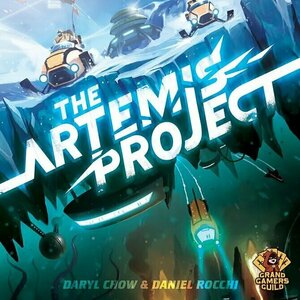

I don’t know about you, but I spend more time than I should probably admit perusing Kickstarter and checking out new projects. Although, that is how I came across The Artemis Project. A game about exploration and colonization of one of Jupiter’s moons? Yes please! The campaign looked promising, the gameplay looked engaging, and the hype was real. Once I finally got the game, did it live up to my expectations? Keep reading to find out!
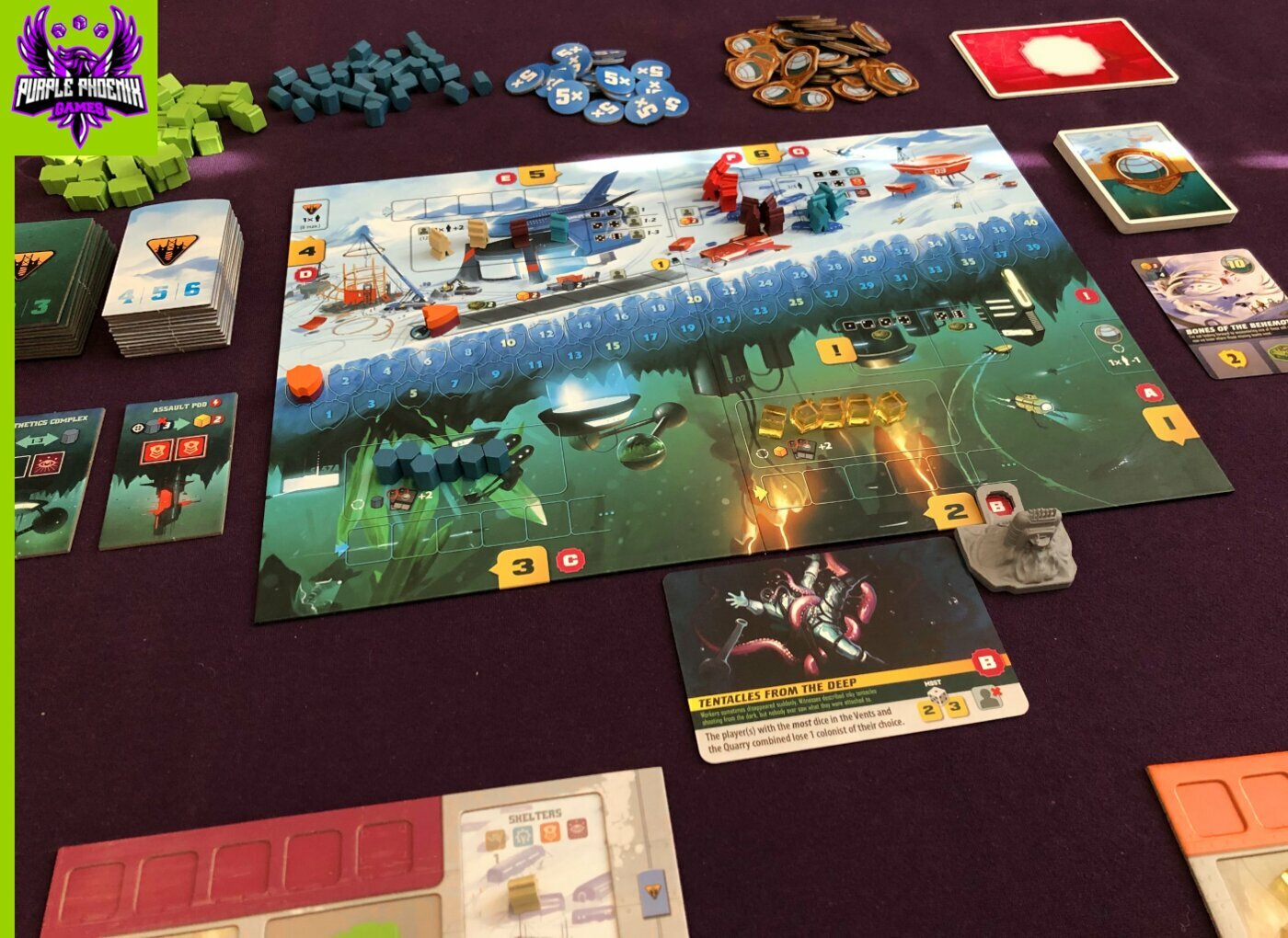
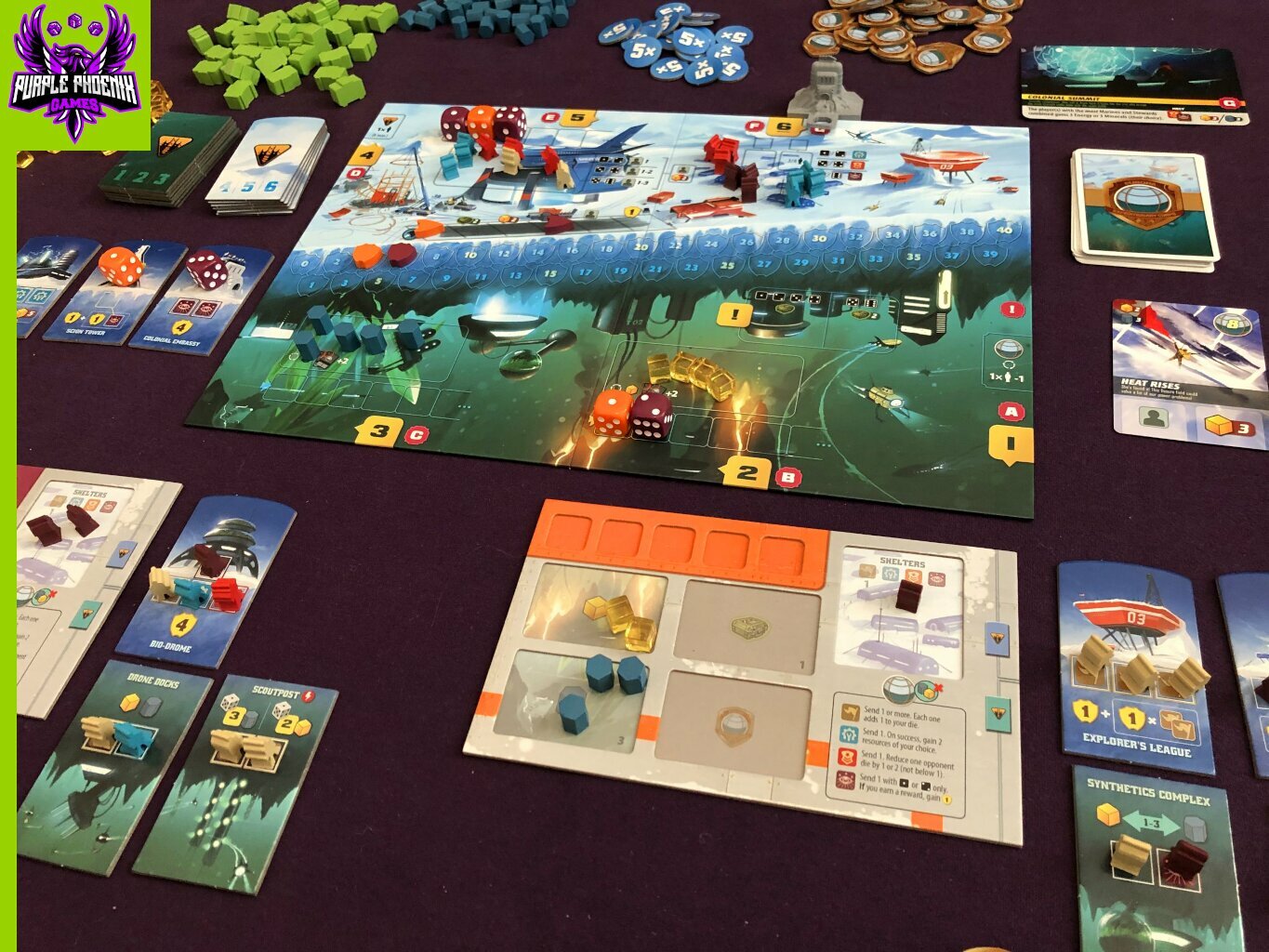
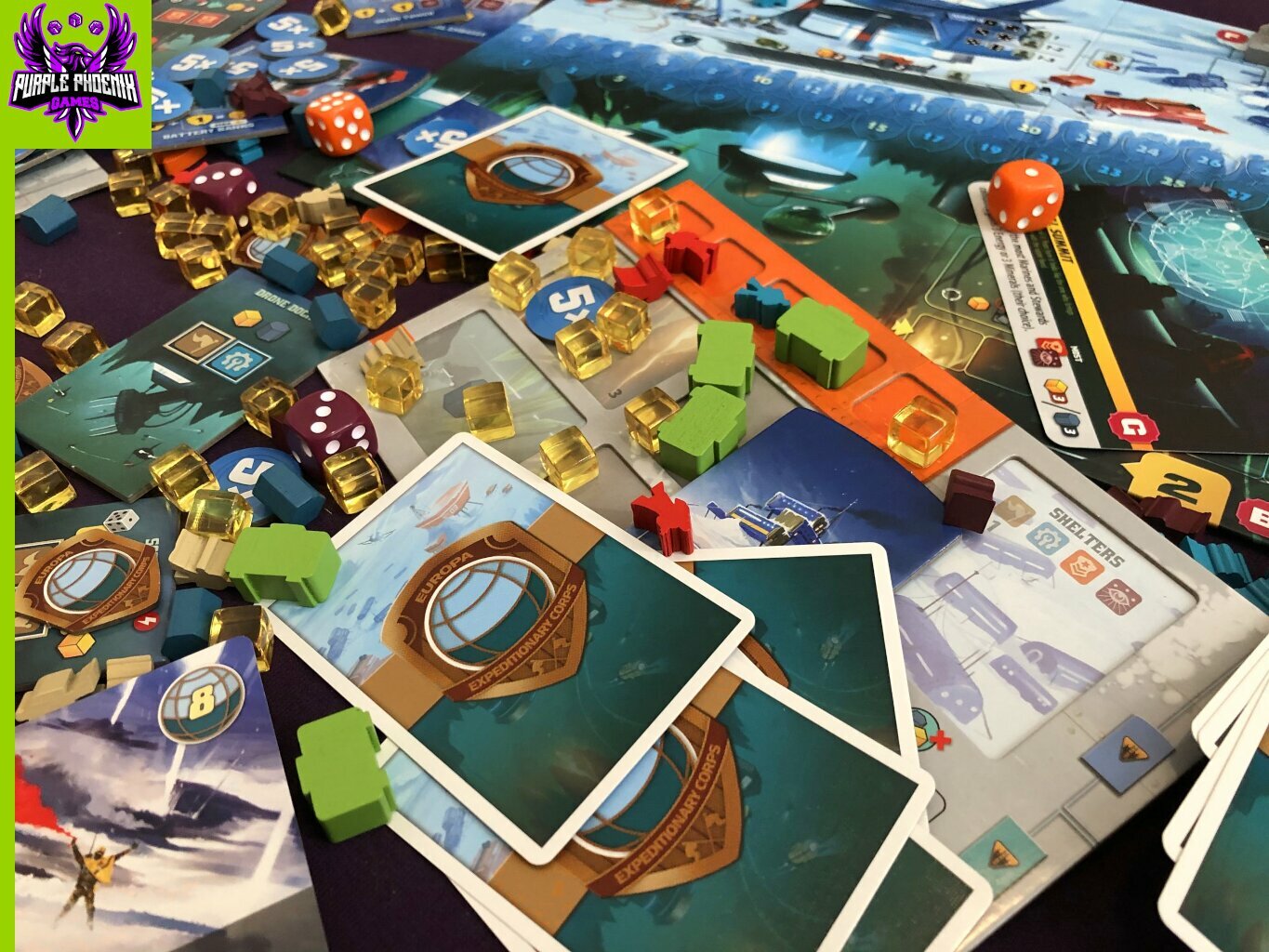
The Artemis Project is a game of dice/worker placement in which players are trying to build and sustain a prosperous colony on Jupiter’s moon Europa. Played over 6 rounds, players will take turns rolling and placing dice across the regions of the board to collect resources, construct buildings, recruit and train colonists, and partake in expeditions to explore this vast ice-land. To begin, follow the setup instructions in the rulebook for the appropriate player count. Each player receives a player board, dice, and markers in their chosen color. Populate the board for the first round, select a starting player, and the game is ready to begin!
Disclaimer: I do not intend to rehash the entire rulebook in this review, as there are just too many details. For a more in-depth look at The Artemis Project, pick up a copy from your FLGS or directly from the publisher! -L
To start each round, all players will simultaneously roll all 5 of their dice. Once players are happy with their results, the round is ready to properly begin. Each round is broken into three phases: Placement, Resolution, and Upkeep. To begin the Placement phase, starting with the first player, players will take turns assigning one die at a time to the 7 regions of the board. These regions are: Basecamp, Vents, Quarry, Gantry, Doorstep, Academy, and Outfitters. (I will explain each region in more detail in the next section!) The value of the dice placed in any region is important, because it will dictate what you are allowed to do, or when you are allowed to resolve the action for that region – so choose your placements wisely.
Once every player has placed all 5 of their dice, the Resolution phase begins. During the Resolution phase, each of the regions of the board will be resolved in order, allowing players to perform their region-specific actions. Resolution starts with Basecamp. Placing dice at Basecamp allows players to partake in Expeditions in an effort to earn Expedition Badges (which translate to end-game VP), as well as extra rewards. Each Expedition has a difficulty level which must be equaled or surpassed by the total of all dice placed on that card. If the difficulty is surpassed, the Expedition is a success and rewards are doled out accordingly, but if the Expedition fails, no rewards are earned by anyone.
The next 2 regions, Vents and Quarry, allow players to collect Energy and Minerals, respectively, and are resolved in the same way. Players will collect a number of resources equal to their played die value. Pretty straight-forward! Moving on to the Gantry region, the value of dice placed on any building tiles are considered bids for buying/constructing that building. You can bid against opponents for building tiles, but each bid must increase the previous amount. When resolving the Gantry, the highest value die on a tile is the winner, and that player must pay their die-amount in Minerals to collect that tile. Buildings are added to your colony, and allow you to perform special actions once they are fully-staffed (all colonist slots on the tile are filled).
Next is the Doorstep – depending on the value of dice you placed there, you will be able to recruit 1-3 new colonists. Recruiting a colonist costs you 2 Energy per new addition, and any new colonists you recruit can be placed immediately into any of your buildings (if space is available), or into your Shelter where they will wait to be used. The Academy region allows you to exchange a colonist of your choice for one of a different type/occupation, again, depending on the value of the die used. And finally, the Outfitters region does not resolved during this phase, because it’s action is performed immediately upon dice placement. Any dice placed to the Outfitters gives Tool Kits (used to manipulate die values at the start of each round) to the player, based upon the die value.
The remaining element of the Resolution phase is the Even card. At the start of each round, an Event card is drawn, and will pertain to a certain region of the board. During the Resolution phase, when that region is reached, the Event card will be resolved – either penalizing players or benefitting them in some way. I have purposefully left out a few elements of the Resolution phase for you to discover on your own!
Once all regions have been resolved, the round moves to the Upkeep phase. During this phase, all players can choose to move 1 colonist to a building tile, or swap any 2 colonists between buildings. This is not required, but can only be performed once during this phase. Next, if any players have fully-staffed buildings (all colonist slots are filled), they may activate the listed ability. And finally, for any colonists left in your shelter and not in a building, you must pay 1 Energy for each to keep them warm! The game board is now refreshed for the next round, a new starting player is selected, and the new round is ready to begin. After the 6th and final round, VPs are tallied – earned through number of building tiles, Expedition Badges, sets of resources, and sets of colonists – and the player with the most VP is the winner!
I know that seems like a lot, but I promise that once you start the first round, everything is pretty intuitive and the game flows well. The turn sequence and phases are logical and easy to understand. The game board itself has lots of helpful icons that work as reminders throughout gameplay, and the rulebook has a nice and concise round overview on the last page as well, which is easy to refer back to at a moment’s notice. I’ll go ahead and touch on components here, since I kind of already started to do so. The components in this game are great! The game board and cards are all sturdy and have colorful and immersive artwork. The dual-layered player boards are high quality, the colonist meeples are cute and effective, the building tiles and cardboard chits are strong and can definitely hold up to many plays, and the dice are easy to roll and read. Definitely an A+ on components from me.
I have to admit that The Artemis Project surprised me. At its core, it is a worker placement game, and that in and of itself lends itself to a certain gameplay. You’re trying to complete your own agenda, being the first to snag those important placements that you need to accomplish those goals, while also blocking opponents from doing the same. The thing that makes The Artemis Project unique is that the ‘workers’ in this game are dice. And their value is what dictates the resolution of each region. Just because you place a die in a region first, does not necessarily mean that you will get to resolve first – depending on how your opponents play, they could block you entirely! The use of dice adds an extra layer of strategy to the gameplay that really elevates it beyond a simple worker placement mechanic. Another great thing about this game is that there is no one way to win – there are several strategies that you could play by in an effort to earn VPs. Maybe you are trying to complete as many Expeditions as possible, or want to construct as many buildings as possible. Either strategy can work, and all strategies can easily be adapted and altered during gameplay.
I am so happy that I came across this game on Kickstarter. The game is strategic, engaging, and just fun to play. I’m not necessarily a huge fan of worker placement games, but the approach to the mechanic taken by The Artemis Project really puts a unique twist on it that adds to the gameplay. This is one KickStarter that was definitely worth the investment. Check it out if you haven’t heard of it, or if you’re looking to elevate your worker placement games. Purple Phoenix Games gives it an enterprising 10 / 12.
The Artemis Project is a game of dice/worker placement in which players are trying to build and sustain a prosperous colony on Jupiter’s moon Europa. Played over 6 rounds, players will take turns rolling and placing dice across the regions of the board to collect resources, construct buildings, recruit and train colonists, and partake in expeditions to explore this vast ice-land. To begin, follow the setup instructions in the rulebook for the appropriate player count. Each player receives a player board, dice, and markers in their chosen color. Populate the board for the first round, select a starting player, and the game is ready to begin!
Disclaimer: I do not intend to rehash the entire rulebook in this review, as there are just too many details. For a more in-depth look at The Artemis Project, pick up a copy from your FLGS or directly from the publisher! -L
To start each round, all players will simultaneously roll all 5 of their dice. Once players are happy with their results, the round is ready to properly begin. Each round is broken into three phases: Placement, Resolution, and Upkeep. To begin the Placement phase, starting with the first player, players will take turns assigning one die at a time to the 7 regions of the board. These regions are: Basecamp, Vents, Quarry, Gantry, Doorstep, Academy, and Outfitters. (I will explain each region in more detail in the next section!) The value of the dice placed in any region is important, because it will dictate what you are allowed to do, or when you are allowed to resolve the action for that region – so choose your placements wisely.
Once every player has placed all 5 of their dice, the Resolution phase begins. During the Resolution phase, each of the regions of the board will be resolved in order, allowing players to perform their region-specific actions. Resolution starts with Basecamp. Placing dice at Basecamp allows players to partake in Expeditions in an effort to earn Expedition Badges (which translate to end-game VP), as well as extra rewards. Each Expedition has a difficulty level which must be equaled or surpassed by the total of all dice placed on that card. If the difficulty is surpassed, the Expedition is a success and rewards are doled out accordingly, but if the Expedition fails, no rewards are earned by anyone.
The next 2 regions, Vents and Quarry, allow players to collect Energy and Minerals, respectively, and are resolved in the same way. Players will collect a number of resources equal to their played die value. Pretty straight-forward! Moving on to the Gantry region, the value of dice placed on any building tiles are considered bids for buying/constructing that building. You can bid against opponents for building tiles, but each bid must increase the previous amount. When resolving the Gantry, the highest value die on a tile is the winner, and that player must pay their die-amount in Minerals to collect that tile. Buildings are added to your colony, and allow you to perform special actions once they are fully-staffed (all colonist slots on the tile are filled).
Next is the Doorstep – depending on the value of dice you placed there, you will be able to recruit 1-3 new colonists. Recruiting a colonist costs you 2 Energy per new addition, and any new colonists you recruit can be placed immediately into any of your buildings (if space is available), or into your Shelter where they will wait to be used. The Academy region allows you to exchange a colonist of your choice for one of a different type/occupation, again, depending on the value of the die used. And finally, the Outfitters region does not resolved during this phase, because it’s action is performed immediately upon dice placement. Any dice placed to the Outfitters gives Tool Kits (used to manipulate die values at the start of each round) to the player, based upon the die value.
The remaining element of the Resolution phase is the Even card. At the start of each round, an Event card is drawn, and will pertain to a certain region of the board. During the Resolution phase, when that region is reached, the Event card will be resolved – either penalizing players or benefitting them in some way. I have purposefully left out a few elements of the Resolution phase for you to discover on your own!
Once all regions have been resolved, the round moves to the Upkeep phase. During this phase, all players can choose to move 1 colonist to a building tile, or swap any 2 colonists between buildings. This is not required, but can only be performed once during this phase. Next, if any players have fully-staffed buildings (all colonist slots are filled), they may activate the listed ability. And finally, for any colonists left in your shelter and not in a building, you must pay 1 Energy for each to keep them warm! The game board is now refreshed for the next round, a new starting player is selected, and the new round is ready to begin. After the 6th and final round, VPs are tallied – earned through number of building tiles, Expedition Badges, sets of resources, and sets of colonists – and the player with the most VP is the winner!
I know that seems like a lot, but I promise that once you start the first round, everything is pretty intuitive and the game flows well. The turn sequence and phases are logical and easy to understand. The game board itself has lots of helpful icons that work as reminders throughout gameplay, and the rulebook has a nice and concise round overview on the last page as well, which is easy to refer back to at a moment’s notice. I’ll go ahead and touch on components here, since I kind of already started to do so. The components in this game are great! The game board and cards are all sturdy and have colorful and immersive artwork. The dual-layered player boards are high quality, the colonist meeples are cute and effective, the building tiles and cardboard chits are strong and can definitely hold up to many plays, and the dice are easy to roll and read. Definitely an A+ on components from me.
I have to admit that The Artemis Project surprised me. At its core, it is a worker placement game, and that in and of itself lends itself to a certain gameplay. You’re trying to complete your own agenda, being the first to snag those important placements that you need to accomplish those goals, while also blocking opponents from doing the same. The thing that makes The Artemis Project unique is that the ‘workers’ in this game are dice. And their value is what dictates the resolution of each region. Just because you place a die in a region first, does not necessarily mean that you will get to resolve first – depending on how your opponents play, they could block you entirely! The use of dice adds an extra layer of strategy to the gameplay that really elevates it beyond a simple worker placement mechanic. Another great thing about this game is that there is no one way to win – there are several strategies that you could play by in an effort to earn VPs. Maybe you are trying to complete as many Expeditions as possible, or want to construct as many buildings as possible. Either strategy can work, and all strategies can easily be adapted and altered during gameplay.
I am so happy that I came across this game on Kickstarter. The game is strategic, engaging, and just fun to play. I’m not necessarily a huge fan of worker placement games, but the approach to the mechanic taken by The Artemis Project really puts a unique twist on it that adds to the gameplay. This is one KickStarter that was definitely worth the investment. Check it out if you haven’t heard of it, or if you’re looking to elevate your worker placement games. Purple Phoenix Games gives it an enterprising 10 / 12.
Purple Phoenix Games (2266 KP) rated Magical Friends and How to Summon Them in Tabletop Games
Sep 29, 2021
If there is one game theme that will never get old for me, it’s fantasy. Something about a world of magic and magical creatures is fascinating to me, and I will never turn down the chance to play any sort of fantasy-themed game. So when I came across Magical Friends and How to Summon Them, I was immediately hooked. Does the gameplay live up to my expectations of what a great fantasy game should be, or does it miss the magical mark?
Disclaimer: We were provided with a prototype copy of this game for the purposes of this preview. The components pictured are not finalized, and could change after a successful Kickstarter campaign. I do not intend to rehash the entire rulebook, but rather provide a general overview of the rules and gameplay. For more information, head to the Magical Friends website. -L
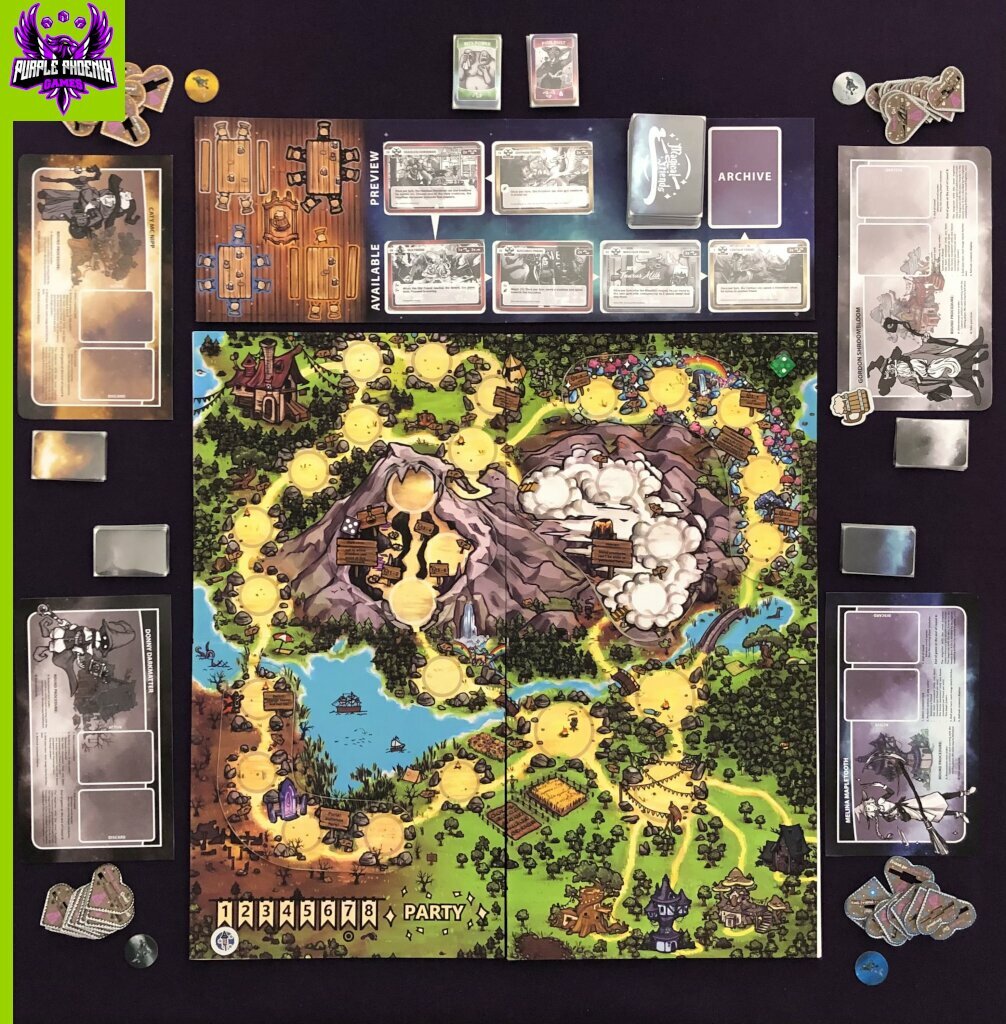
Magical Friends and How to Summon Them (referred to as just Magical Friends from hereon out) is a strategic game of card drafting and variable turn order in which players take on the roles of mages attempting to summon the most magical creatures to the local tavern in order to win the Midsummer festival competition. Played over 8 rounds, players will take turns summoning creatures, moving them towards the tavern, using special creature abilities, and occasionally fighting off your opponents’ creatures. The player who gets the most creatures to the tavern by the end of the 8th round is the winner! To setup for the game, lay out the main board and summoning board in the center of the table. Take the 4 double-sided map tiles, randomly choose a side, and place them in their corresponding places on the main board. Shuffle the Summoning cards and reveal a number of cards, determined by player count, to create a market row and preview row. Each player receives a player mat, heart tokens, and Artifact Cards in their chosen color. Place the round marker on Round 1 of the main board, select a player to get the starting player token, and the game is ready to begin!
To start a round, first you will need to determine turn order. Each player has an identical deck of 11 Artifact Cards, numbered 1-11. The player who offers the most powerful (highest number) Artifact gets to act first in the round. The player with the starting player token chooses their card first, and places it face-up on their player mat. The next player, in clockwise order, will do the same. Here’s the catch though – once a number has been played, it cannot be played by anyone else for this round! So say I put choose my value 8 card – no other player may choose that card for this round. Once all players have chosen their Artifacts, determine the turn order for the round. The player with the highest valued Artifact goes first, then the next highest, and so on.
Once the turn order has been determined, it is time for players to take their turns! On your turn, the first thing you will do is to select a Summoning card from the Summoning board and take it into their tableau. The selected card tells you which friend (creature) you have summoned, and tells you how many moves/what types of movement you may take this round. After choosing your Summoning card, you will take any/all of the following actions: Summon a friend (bring its standee into play), use basic movement (as determined by your new friend), use bonus movement (from other cards), or use the abilities of any friends in your tableau. You may perform as many of these actions as you want and are able to perform. It is important to note that each friend may only use one basic movement and one bonus movement per round. So you can’t just move a single friend with every movement available in one turn.
Once you are finished performing actions, you will end your turn. Refresh the Summoning board by shifting cards down and refilling any empty creature slots. Play then moves to the player with the next highest valued Artifact card. When all players have taken their turn, the round ends. Move the Round marker up one spot, and pass the starting player token to the next clockwise player. A new round will then start with the turn order determination, beginning with the new starting player. After 8 rounds of play, the winner is crowned. Players score points for the number of their friends who reached the tavern, and the player with the highest score wins!
I’ll come right out and say that I really have enjoyed Magical Friends. There are lots of elements that I like and that work well together to create a fun, strategic, and engaging game. First, turn order determination. I love that the turn order isn’t set for the entire game, because that could really be a detriment to whomever would be last every round. Being able to ‘bid’ for turn order, in a sense, allows players to be proactive (or conversely, reactive) with their strategy. And after you’ve used an Artifact card in a round, it is discarded and cannot be used for the rest of the game. So you need to decide when it’s worth it to play your high value cards to hopefully act first, or if you’re willing to risk playing a mid-value card that might be out-bid by an opponent.
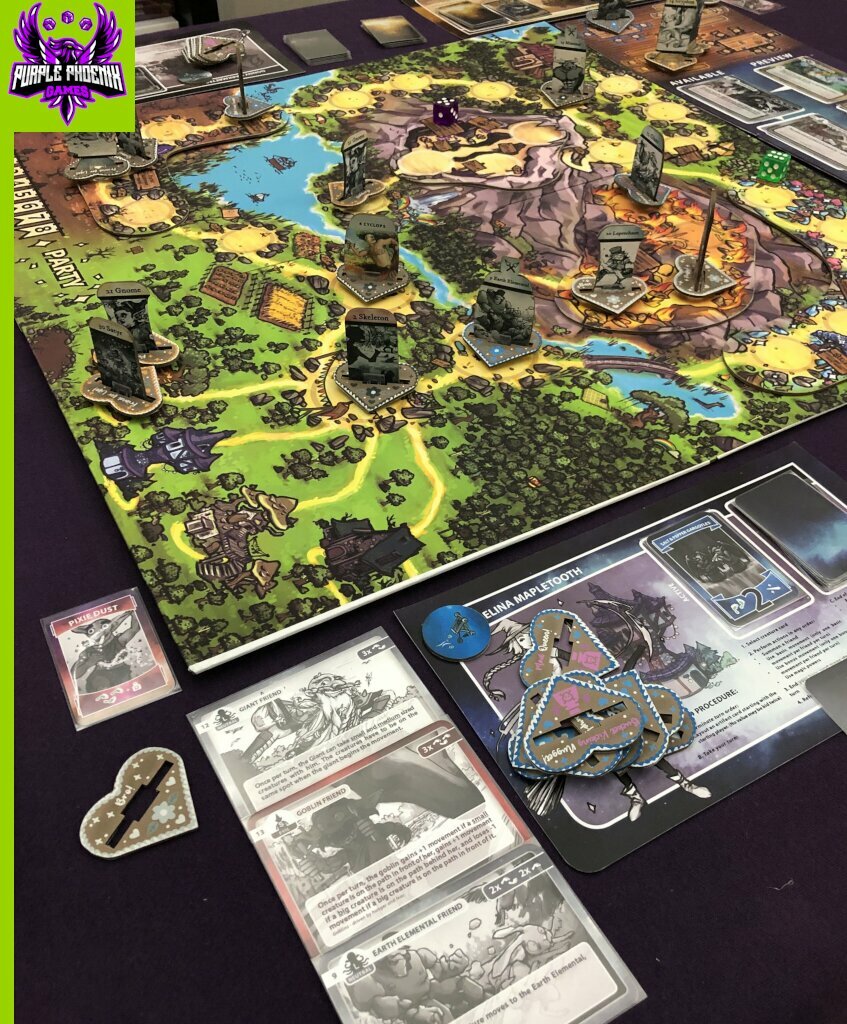
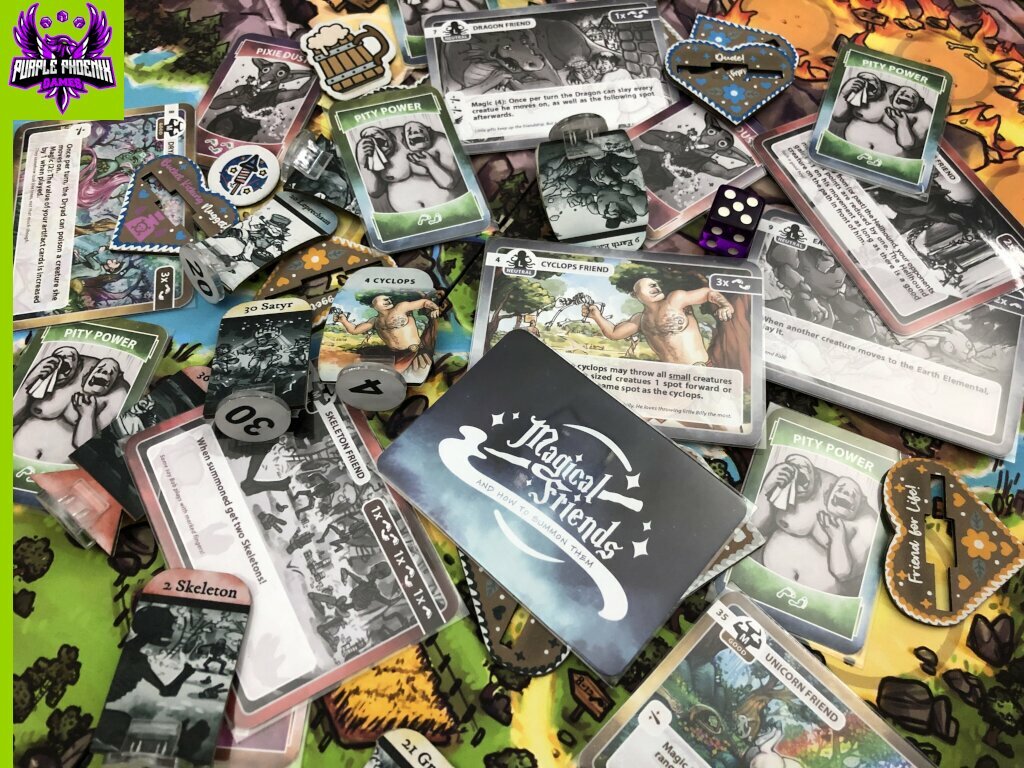
The other awesome strategic element are the friends in the game. Each friend is a different creature with different movement options and special abilities during gameplay. An important thing to note is that although every friend has a printed movement value on its card, you may only ever use that value on the round in which you summon that friend. So a Griffin, for example, lets you move 3 friends 2 spaces, which you may do when you first summon the Griffin. But in future rounds, the Griffin will only move based on the movements provided by the most newly acquired friend. Maybe you don’t necessarily want to summon a Mermaid, but the movement she offers is exactly what you need to get some friends to the tavern for scoring. It’s all a neat mix of strategy that you are changing with every turn. Along with the movements, each friend has a special ability that can be used on your turns. Some abilities allow you to move extra spaces, move opponents, or even slay creatures. When you slay a creature, you collect its heart token for endgame scoring, and the player who controlled that creature gets a Pity Power card (which provide bonus movement). You need to decide when to move which friends, and in what order to trigger your abilities. You must always be paying attention to the board layout and your opponents’ turns as they will help you determine your strategy for future turns.
Components. As I mentioned earlier, this is a prototype version of the game, but with that said, the components are pretty nice! The cards are sturdy, the text is clear, and the artwork is fun to look at. The main game board and summoning boards are colorful, and the creature standees are nicely sized for the board. I do have to say that I really like the heart tokens used to identify to whom each creature belongs on the board. The hearts slide over top of the standee and create a base of sorts to color-code every creature on the board. Just a neat little use of components that make the gameplay smooth. And how about the insert? It’s awesome! The standees are all stored, assembled, in a slotted inlay that allows for quick selection of creatures. I hope that’s something that makes it to final production because it really helps streamline the gameplay. Some of the wording in the rulebook could use some clarification, but I know that it is still a work in progress and continues to undergo edits. The only negative I would have to say is that 2 of the player colors are black and gray – and they are sometimes difficult to differentiate between. But changing one color should be an easy fix!
All in all, I was pleasantly surprised by Magical Friends. At first glance, I thought it would be a pretty simple ‘roll-and-move’ type game, but it proved to be much more strategic and engaging than I initially thought. The variable turn order, the movement rules/restrictions, and the unique friend abilities all work together to create a cohesive, thematic, and strategic game. I very much am looking forward to following the progress of Magical Friends and How to Summon Them on Kickstarter, and I encourage you to check it out as well!
Disclaimer: We were provided with a prototype copy of this game for the purposes of this preview. The components pictured are not finalized, and could change after a successful Kickstarter campaign. I do not intend to rehash the entire rulebook, but rather provide a general overview of the rules and gameplay. For more information, head to the Magical Friends website. -L
Magical Friends and How to Summon Them (referred to as just Magical Friends from hereon out) is a strategic game of card drafting and variable turn order in which players take on the roles of mages attempting to summon the most magical creatures to the local tavern in order to win the Midsummer festival competition. Played over 8 rounds, players will take turns summoning creatures, moving them towards the tavern, using special creature abilities, and occasionally fighting off your opponents’ creatures. The player who gets the most creatures to the tavern by the end of the 8th round is the winner! To setup for the game, lay out the main board and summoning board in the center of the table. Take the 4 double-sided map tiles, randomly choose a side, and place them in their corresponding places on the main board. Shuffle the Summoning cards and reveal a number of cards, determined by player count, to create a market row and preview row. Each player receives a player mat, heart tokens, and Artifact Cards in their chosen color. Place the round marker on Round 1 of the main board, select a player to get the starting player token, and the game is ready to begin!
To start a round, first you will need to determine turn order. Each player has an identical deck of 11 Artifact Cards, numbered 1-11. The player who offers the most powerful (highest number) Artifact gets to act first in the round. The player with the starting player token chooses their card first, and places it face-up on their player mat. The next player, in clockwise order, will do the same. Here’s the catch though – once a number has been played, it cannot be played by anyone else for this round! So say I put choose my value 8 card – no other player may choose that card for this round. Once all players have chosen their Artifacts, determine the turn order for the round. The player with the highest valued Artifact goes first, then the next highest, and so on.
Once the turn order has been determined, it is time for players to take their turns! On your turn, the first thing you will do is to select a Summoning card from the Summoning board and take it into their tableau. The selected card tells you which friend (creature) you have summoned, and tells you how many moves/what types of movement you may take this round. After choosing your Summoning card, you will take any/all of the following actions: Summon a friend (bring its standee into play), use basic movement (as determined by your new friend), use bonus movement (from other cards), or use the abilities of any friends in your tableau. You may perform as many of these actions as you want and are able to perform. It is important to note that each friend may only use one basic movement and one bonus movement per round. So you can’t just move a single friend with every movement available in one turn.
Once you are finished performing actions, you will end your turn. Refresh the Summoning board by shifting cards down and refilling any empty creature slots. Play then moves to the player with the next highest valued Artifact card. When all players have taken their turn, the round ends. Move the Round marker up one spot, and pass the starting player token to the next clockwise player. A new round will then start with the turn order determination, beginning with the new starting player. After 8 rounds of play, the winner is crowned. Players score points for the number of their friends who reached the tavern, and the player with the highest score wins!
I’ll come right out and say that I really have enjoyed Magical Friends. There are lots of elements that I like and that work well together to create a fun, strategic, and engaging game. First, turn order determination. I love that the turn order isn’t set for the entire game, because that could really be a detriment to whomever would be last every round. Being able to ‘bid’ for turn order, in a sense, allows players to be proactive (or conversely, reactive) with their strategy. And after you’ve used an Artifact card in a round, it is discarded and cannot be used for the rest of the game. So you need to decide when it’s worth it to play your high value cards to hopefully act first, or if you’re willing to risk playing a mid-value card that might be out-bid by an opponent.
The other awesome strategic element are the friends in the game. Each friend is a different creature with different movement options and special abilities during gameplay. An important thing to note is that although every friend has a printed movement value on its card, you may only ever use that value on the round in which you summon that friend. So a Griffin, for example, lets you move 3 friends 2 spaces, which you may do when you first summon the Griffin. But in future rounds, the Griffin will only move based on the movements provided by the most newly acquired friend. Maybe you don’t necessarily want to summon a Mermaid, but the movement she offers is exactly what you need to get some friends to the tavern for scoring. It’s all a neat mix of strategy that you are changing with every turn. Along with the movements, each friend has a special ability that can be used on your turns. Some abilities allow you to move extra spaces, move opponents, or even slay creatures. When you slay a creature, you collect its heart token for endgame scoring, and the player who controlled that creature gets a Pity Power card (which provide bonus movement). You need to decide when to move which friends, and in what order to trigger your abilities. You must always be paying attention to the board layout and your opponents’ turns as they will help you determine your strategy for future turns.
Components. As I mentioned earlier, this is a prototype version of the game, but with that said, the components are pretty nice! The cards are sturdy, the text is clear, and the artwork is fun to look at. The main game board and summoning boards are colorful, and the creature standees are nicely sized for the board. I do have to say that I really like the heart tokens used to identify to whom each creature belongs on the board. The hearts slide over top of the standee and create a base of sorts to color-code every creature on the board. Just a neat little use of components that make the gameplay smooth. And how about the insert? It’s awesome! The standees are all stored, assembled, in a slotted inlay that allows for quick selection of creatures. I hope that’s something that makes it to final production because it really helps streamline the gameplay. Some of the wording in the rulebook could use some clarification, but I know that it is still a work in progress and continues to undergo edits. The only negative I would have to say is that 2 of the player colors are black and gray – and they are sometimes difficult to differentiate between. But changing one color should be an easy fix!
All in all, I was pleasantly surprised by Magical Friends. At first glance, I thought it would be a pretty simple ‘roll-and-move’ type game, but it proved to be much more strategic and engaging than I initially thought. The variable turn order, the movement rules/restrictions, and the unique friend abilities all work together to create a cohesive, thematic, and strategic game. I very much am looking forward to following the progress of Magical Friends and How to Summon Them on Kickstarter, and I encourage you to check it out as well!


Movie Metropolis (309 KP) rated The Incredibles 2 (2018) in Movies
Jun 10, 2019


Was it worth the wait?
It’s been fourteen years since Pixar introduced the likes of Violet, Dash, Robert and Helen Parr onto unsuspecting audiences across the globe. The quartet of superheroes swiftly became one of the studio’s best and most profitable films, with a loyal legion of fans begging for a sequel soon after.
Nevertheless, Pixar went on to create some of the greatest animated films of all time. Then the slump came. After Cars and its dreadful sequel came and went and The Good Dinosaur reminded us that not even Pixar was immune from the movie critic curse, they swiftly regrouped and brought us the thrilling Coco and new classic, Inside Out. Now, 14 years later, Mr Incredible and the team are back. But are we looking at a classic Pixar, or a sequel that is too little too late?
Everyone’s favourite family of superheroes is back, but this time Helen (Holly Hunter) is in the spotlight, leaving Bob (Craig T. Nelson) at home with Violet (Sarah Vowell) and Dash (Huck Milner) to navigate the day-to-day heroics of normal life. It’s a tough transition for everyone, made tougher by the fact that the family is unaware of Jack-Jack’s superpowers. When a new villain hatches a dangerous plot, the family and Frozone (Samuel L. Jackson) must find a way to work together again.
Picking up immediately after the events of its predecessor, Incredibles 2 is a thrilling and entertaining sequel that reeks of quality. Everything from the voice acting to the animation is leaps and bounds ahead of the first film and this is testament to the incredible technological gains Pixar has made over the last decade.
Brad Bird is once again in the director’s chair and that familiarity lends it the same heart and emotional engagement of its predecessor. We, as the audience, feel truly invested in the characters again, as we did all that time ago. This time however, the action is dialled up to 11 with some truly exceptional set-pieces.
Thankfully, this is not at the cost of what made The Incredibles such a hit, family drama. The central family unit remains as prevalent as it did before, but this time we have Jack-Jack’s powers thrown into the mix with Elastigirl taking centre stage over Mr. Incredible. This new dynamic is a welcome change from the very male-centric blockbusters we’ve had over the last few years; Wonder Woman being the obvious exception.
The animation is, well incredible. While the quirky character designs never let you forget you’re watching an animated feature, the over-the-top set design means it sits perfectly together. Where The Good Dinosaur went wrong was in its presentation of photo-realistic visuals paired with cartoon-like characters; it simply didn’t work.
Incredibles 2 is a sequel that was absolutely worth the wait
We also have a very interesting villain to contend with. The Screenslaver is pure popcorn wickedness at its very best. It’s amazing that The Incredibles series has scored 2/2 when it comes to their antagonists, yet Marvel still manages to struggle with its bad guys. The Screenslaver may not quite match up the brilliance of Syndrome from its predecessor, but it comes pretty close.
There’s also the welcome return of Edna Mode (voiced by director Brad Bird). Her part is perhaps a little too short, but maintaining her cameo status means she doesn’t feel as overcooked as the minions did after their first solo outing. In the end, we want more Edna, rather than having too much and this is a good thing.
Plot wise, it’s fantastic. With a central storyline about a changing family dynamic, it’s sure to resonate with both children and adults. There are plot twists that wouldn’t look out of place in a live-action feature and some great voice acting by all of the cast.
Negatives? Well it’s hard to think of any whatsoever. This is a much more engaging film than its predecessor but at 118 minutes, it’s long by animation standards. The pacing is a little off just before the finale kicks off, but this is my main and only complaint.
Overall, Incredibles 2 is a sequel that was absolutely worth the wait. It’s filled with sparkling dialogue and great voice acting as well as superb animation and a thrilling plot that all combines to make it one of the year’s best films.
https://moviemetropolis.net/2018/07/15/incredibles-2-review-was-it-worth-the-wait/
Nevertheless, Pixar went on to create some of the greatest animated films of all time. Then the slump came. After Cars and its dreadful sequel came and went and The Good Dinosaur reminded us that not even Pixar was immune from the movie critic curse, they swiftly regrouped and brought us the thrilling Coco and new classic, Inside Out. Now, 14 years later, Mr Incredible and the team are back. But are we looking at a classic Pixar, or a sequel that is too little too late?
Everyone’s favourite family of superheroes is back, but this time Helen (Holly Hunter) is in the spotlight, leaving Bob (Craig T. Nelson) at home with Violet (Sarah Vowell) and Dash (Huck Milner) to navigate the day-to-day heroics of normal life. It’s a tough transition for everyone, made tougher by the fact that the family is unaware of Jack-Jack’s superpowers. When a new villain hatches a dangerous plot, the family and Frozone (Samuel L. Jackson) must find a way to work together again.
Picking up immediately after the events of its predecessor, Incredibles 2 is a thrilling and entertaining sequel that reeks of quality. Everything from the voice acting to the animation is leaps and bounds ahead of the first film and this is testament to the incredible technological gains Pixar has made over the last decade.
Brad Bird is once again in the director’s chair and that familiarity lends it the same heart and emotional engagement of its predecessor. We, as the audience, feel truly invested in the characters again, as we did all that time ago. This time however, the action is dialled up to 11 with some truly exceptional set-pieces.
Thankfully, this is not at the cost of what made The Incredibles such a hit, family drama. The central family unit remains as prevalent as it did before, but this time we have Jack-Jack’s powers thrown into the mix with Elastigirl taking centre stage over Mr. Incredible. This new dynamic is a welcome change from the very male-centric blockbusters we’ve had over the last few years; Wonder Woman being the obvious exception.
The animation is, well incredible. While the quirky character designs never let you forget you’re watching an animated feature, the over-the-top set design means it sits perfectly together. Where The Good Dinosaur went wrong was in its presentation of photo-realistic visuals paired with cartoon-like characters; it simply didn’t work.
Incredibles 2 is a sequel that was absolutely worth the wait
We also have a very interesting villain to contend with. The Screenslaver is pure popcorn wickedness at its very best. It’s amazing that The Incredibles series has scored 2/2 when it comes to their antagonists, yet Marvel still manages to struggle with its bad guys. The Screenslaver may not quite match up the brilliance of Syndrome from its predecessor, but it comes pretty close.
There’s also the welcome return of Edna Mode (voiced by director Brad Bird). Her part is perhaps a little too short, but maintaining her cameo status means she doesn’t feel as overcooked as the minions did after their first solo outing. In the end, we want more Edna, rather than having too much and this is a good thing.
Plot wise, it’s fantastic. With a central storyline about a changing family dynamic, it’s sure to resonate with both children and adults. There are plot twists that wouldn’t look out of place in a live-action feature and some great voice acting by all of the cast.
Negatives? Well it’s hard to think of any whatsoever. This is a much more engaging film than its predecessor but at 118 minutes, it’s long by animation standards. The pacing is a little off just before the finale kicks off, but this is my main and only complaint.
Overall, Incredibles 2 is a sequel that was absolutely worth the wait. It’s filled with sparkling dialogue and great voice acting as well as superb animation and a thrilling plot that all combines to make it one of the year’s best films.
https://moviemetropolis.net/2018/07/15/incredibles-2-review-was-it-worth-the-wait/
Movie Metropolis (309 KP) rated The Commuter (2018) in Movies
Jun 10, 2019

Liam Neeson's special set of skills return
The Movie Metropolis Alternative Oscars have received over 650 votes so far and it’s proving to be the closest run awards ever. Make sure you cast your vote for the best films and performances from 2017 before March 6th.
Liam Neeson is this generation’s formidable action hero. From protecting his family in Taken and protecting his family in Run All Night, to protecting his family in Taken 2, and you know, protecting his family in Taken 3, Neeson is a family man if ever I’ve seen one.
Teaming up with director Jaume Collet-Serra for the fourth time, the rather excellent Non-Stop being their best work together, Neeson takes the action and moves it on-board, you guessed it, a commuter train. But does The Commuter work? Or are we starting to get derailed by these constant action roles?
Insurance salesman Michael (Neeson) is on his daily commute home, which quickly becomes anything but routine. After being contacted by a mysterious stranger (Vera Farmiga), Michael is forced to uncover the identity of a hidden passenger on the train before the last stop. As he works against the clock to solve the puzzle, he realizes a deadly plan is unfolding, and he is unwittingly caught up in a criminal conspiracy that carries life and death stakes for everyone on the train.
The premise is a borderline carbon copy of what we saw in Non-Stop, but with Neeson battling a series of bad guys on a train instead of in the air, and while it is at times, ridiculous, it’s directed with the usual Collet-Serra sense of style that would make even a dog food commercial look intriguing.
Where last year’s Murder on the Orient Express opted for opulence and fairly static camerawork, here The Commuter utilises every part of the train to its advantage. From underneath the carriages, to through the windows and even cleverly framed through a ticket stub, Collet-Serra’s direction is unique, if a little over-stylised at times.
Casting wise, Neeson is the perfect choice to play the world-weary protagonist with a very special set of skills, after all, it’s a role he has been playing for many years now. Some might say typecast, I prefer to think of it as knowing what he wants. Elsewhere, Vera Farmiga is a disappointingly underused presence and it would have been nice to see her a little more throughout the fairly taut 105-minute running time. It’s also nice to see Sam Neill back on the big screen and he remains dependable company.
It’s a shame that Collet-Serra wasn’t given slightly more to work with as his ingenious camera trickery is at odds with the poor CG
The action is choreographed well considering the limitations of the set and while it’s clear that the carriages have been manipulated during some of the fight scenes, it’s still impressive to think of all the camera equipment being squeezed into a fairly small space. There’s always been something oddly satisfying at seeing 65-year-old Neeson taking down a group of ruffians half his age and that shows no sign of dissipating any time soon.
Unfortunately, it appears that the limitations of the set also manifested themselves in limits to the script. There are numerous scenes of Neeson pacing up and down the carriages with very little dialogue and while this worked reasonably well in Non-Stop, the result is less successful here, probably due to a less engaging supporting cast.
And while the cinematography is very clever indeed, the low budget, less than $20million in fact, means some of the CGI and special effects leave a lot to be desired, especially towards the film’s climax. It’s a shame that Collet-Serra wasn’t given slightly more to work with as his ingenious camera trickery is at odds with the poor CG.
Overall, The Commuter is another thrilling slice of popcorn entertainment from Jaume Collet-Serra and Liam Neeson. At 65-years-old, you’d think everyone’s favourite Irish actor would want to be settling down into cosier rom-com territory and who could blame him? I’m just thankful he’s not. The Commuter may be utterly preposterous and completely unoriginal, but you’ll have a blast watching it.
https://moviemetropolis.net/2018/01/20/the-commuter-review-liam-neesons-special-set-of-skills-return/
Liam Neeson is this generation’s formidable action hero. From protecting his family in Taken and protecting his family in Run All Night, to protecting his family in Taken 2, and you know, protecting his family in Taken 3, Neeson is a family man if ever I’ve seen one.
Teaming up with director Jaume Collet-Serra for the fourth time, the rather excellent Non-Stop being their best work together, Neeson takes the action and moves it on-board, you guessed it, a commuter train. But does The Commuter work? Or are we starting to get derailed by these constant action roles?
Insurance salesman Michael (Neeson) is on his daily commute home, which quickly becomes anything but routine. After being contacted by a mysterious stranger (Vera Farmiga), Michael is forced to uncover the identity of a hidden passenger on the train before the last stop. As he works against the clock to solve the puzzle, he realizes a deadly plan is unfolding, and he is unwittingly caught up in a criminal conspiracy that carries life and death stakes for everyone on the train.
The premise is a borderline carbon copy of what we saw in Non-Stop, but with Neeson battling a series of bad guys on a train instead of in the air, and while it is at times, ridiculous, it’s directed with the usual Collet-Serra sense of style that would make even a dog food commercial look intriguing.
Where last year’s Murder on the Orient Express opted for opulence and fairly static camerawork, here The Commuter utilises every part of the train to its advantage. From underneath the carriages, to through the windows and even cleverly framed through a ticket stub, Collet-Serra’s direction is unique, if a little over-stylised at times.
Casting wise, Neeson is the perfect choice to play the world-weary protagonist with a very special set of skills, after all, it’s a role he has been playing for many years now. Some might say typecast, I prefer to think of it as knowing what he wants. Elsewhere, Vera Farmiga is a disappointingly underused presence and it would have been nice to see her a little more throughout the fairly taut 105-minute running time. It’s also nice to see Sam Neill back on the big screen and he remains dependable company.
It’s a shame that Collet-Serra wasn’t given slightly more to work with as his ingenious camera trickery is at odds with the poor CG
The action is choreographed well considering the limitations of the set and while it’s clear that the carriages have been manipulated during some of the fight scenes, it’s still impressive to think of all the camera equipment being squeezed into a fairly small space. There’s always been something oddly satisfying at seeing 65-year-old Neeson taking down a group of ruffians half his age and that shows no sign of dissipating any time soon.
Unfortunately, it appears that the limitations of the set also manifested themselves in limits to the script. There are numerous scenes of Neeson pacing up and down the carriages with very little dialogue and while this worked reasonably well in Non-Stop, the result is less successful here, probably due to a less engaging supporting cast.
And while the cinematography is very clever indeed, the low budget, less than $20million in fact, means some of the CGI and special effects leave a lot to be desired, especially towards the film’s climax. It’s a shame that Collet-Serra wasn’t given slightly more to work with as his ingenious camera trickery is at odds with the poor CG.
Overall, The Commuter is another thrilling slice of popcorn entertainment from Jaume Collet-Serra and Liam Neeson. At 65-years-old, you’d think everyone’s favourite Irish actor would want to be settling down into cosier rom-com territory and who could blame him? I’m just thankful he’s not. The Commuter may be utterly preposterous and completely unoriginal, but you’ll have a blast watching it.
https://moviemetropolis.net/2018/01/20/the-commuter-review-liam-neesons-special-set-of-skills-return/
Movie Metropolis (309 KP) rated Rogue One: A Star Wars Story (2016) in Movies
Jun 10, 2019


The 2nd best star wars film
The Star Wars universe just got a whole lot bigger. When Rogue One: A Star Wars Story was announced by Disney a couple of years ago, diehard fans of the sci-fi saga met the news with a huge dose of scepticism.
After all, the prequel trilogy was an unmitigated disaster, doing all it could to destroy not only the greatest villain in the history of film, but the series itself. Then Gareth Edwards was announced as director, whose film credits include the brilliant Monsters and Godzilla, which was critically praised but received a lukewarm reception publically.
THEN Disney announced the film was undergoing “heavy” reshoots to its first cut, reportedly due to executives being unhappy with the finished product’s tone.
So it’s clear that it’s not been plain sailing for Rogue One, but that headline isn’t a misprint – the finished article is just that damn good. But why?
In a time of conflict, a group of unlikely heroes band together on a mission to steal the plans to the Death Star, the Empire’s ultimate weapon of destruction. This key event in the Star Wars timeline brings together ordinary people who choose to do extraordinary things, and in doing so, become part of something greater than themselves.
If you cast your minds back to 1977 and the release of A New Hope, Rogue One takes place just before those events, acting as a stop-gap between the ending of Revenge of the Sith and the film that started it all.
A cast that includes Felicity Jones, Forest Whitaker, Diego Luna, Ben Mendelsohn and Mads Mikkelsen all gel together incredibly well to form one of the most coherent ensemble groups the galaxy has ever seen. Not since the introduction of Han, Chewie, Luke and Leia has the Star Wars franchise been so superbly kept afloat. Jones in particular is excellent and adds yet another leading lady to a franchise that loves putting women at the forefront, and rightly so.
Elsewhere, the cinematography is sublime. Director Gareth Edwards is renowned for his stunning shot choices and Rogue One is no exception. The intense variety of planets created from photo-realistic CGI and real landscapes adds an immersive quality that it has to be said, was lacking somewhat in The Force Awakens.
Then there is the much publicised return of Lord Vader. The aforementioned villain has been playing heavy on the minds of Star Wars fans for years after he was ridiculously robbed of any street cred at the climax of Revenge of the Sith. Mercifully, Edwards keeps his appearances to but a few, though he does loom heavy throughout the course of the film’s 133 minute running time, and returns to the dark presence he once was – it’s also nice to see James Earl Jones returning to the series.
There are Star Wars easter eggs abound, some only noticeable to diehards, whilst others smack you in the face with their lack of subtlety – though each and every one is placed at a point where the film feels better because of it. I’m not going to mention any by name, but a couple of old faces received cheers from the audience.
Any negatives? Well, Forest Whitaker’s Saw Gerrera fails to make a lasting impact and feels a little too much like executives wanted to shoehorn the Clone Wars television series into the film, and as much as it pains me to say, Michael Giacchino’s bombastic score, whilst brimming with nostalgia, doesn’t hit the right notes 100% of the time – with some musical elements feeling a little out of place with what is occurring on the screen.
Then there’s the dreaded reshoots. Well, they’re not noticeable… unless you’ve been watching the trailers, from which there are numerous scenes that aren’t included in the final cut. That’s a shame, though they’ll feature on the extended edition that will no doubt follow when the film is released on DVD and Blu-Ray.
Overall, Rogue One is better than anyone could have hoped. 2016 has been one of the worst years in decades for disappointing blockbusters and as it nears its end, we have one of the best yet. Smartly written with a heartfelt and engaging story, it adds a new and exciting layer to the Star Wars saga, and what’s even more impressive is its ability to make A New Hope a better film because of its existence.
https://moviemetropolis.net/2016/12/16/the-2nd-best-star-wars-film-rogue-one-review/
After all, the prequel trilogy was an unmitigated disaster, doing all it could to destroy not only the greatest villain in the history of film, but the series itself. Then Gareth Edwards was announced as director, whose film credits include the brilliant Monsters and Godzilla, which was critically praised but received a lukewarm reception publically.
THEN Disney announced the film was undergoing “heavy” reshoots to its first cut, reportedly due to executives being unhappy with the finished product’s tone.
So it’s clear that it’s not been plain sailing for Rogue One, but that headline isn’t a misprint – the finished article is just that damn good. But why?
In a time of conflict, a group of unlikely heroes band together on a mission to steal the plans to the Death Star, the Empire’s ultimate weapon of destruction. This key event in the Star Wars timeline brings together ordinary people who choose to do extraordinary things, and in doing so, become part of something greater than themselves.
If you cast your minds back to 1977 and the release of A New Hope, Rogue One takes place just before those events, acting as a stop-gap between the ending of Revenge of the Sith and the film that started it all.
A cast that includes Felicity Jones, Forest Whitaker, Diego Luna, Ben Mendelsohn and Mads Mikkelsen all gel together incredibly well to form one of the most coherent ensemble groups the galaxy has ever seen. Not since the introduction of Han, Chewie, Luke and Leia has the Star Wars franchise been so superbly kept afloat. Jones in particular is excellent and adds yet another leading lady to a franchise that loves putting women at the forefront, and rightly so.
Elsewhere, the cinematography is sublime. Director Gareth Edwards is renowned for his stunning shot choices and Rogue One is no exception. The intense variety of planets created from photo-realistic CGI and real landscapes adds an immersive quality that it has to be said, was lacking somewhat in The Force Awakens.
Then there is the much publicised return of Lord Vader. The aforementioned villain has been playing heavy on the minds of Star Wars fans for years after he was ridiculously robbed of any street cred at the climax of Revenge of the Sith. Mercifully, Edwards keeps his appearances to but a few, though he does loom heavy throughout the course of the film’s 133 minute running time, and returns to the dark presence he once was – it’s also nice to see James Earl Jones returning to the series.
There are Star Wars easter eggs abound, some only noticeable to diehards, whilst others smack you in the face with their lack of subtlety – though each and every one is placed at a point where the film feels better because of it. I’m not going to mention any by name, but a couple of old faces received cheers from the audience.
Any negatives? Well, Forest Whitaker’s Saw Gerrera fails to make a lasting impact and feels a little too much like executives wanted to shoehorn the Clone Wars television series into the film, and as much as it pains me to say, Michael Giacchino’s bombastic score, whilst brimming with nostalgia, doesn’t hit the right notes 100% of the time – with some musical elements feeling a little out of place with what is occurring on the screen.
Then there’s the dreaded reshoots. Well, they’re not noticeable… unless you’ve been watching the trailers, from which there are numerous scenes that aren’t included in the final cut. That’s a shame, though they’ll feature on the extended edition that will no doubt follow when the film is released on DVD and Blu-Ray.
Overall, Rogue One is better than anyone could have hoped. 2016 has been one of the worst years in decades for disappointing blockbusters and as it nears its end, we have one of the best yet. Smartly written with a heartfelt and engaging story, it adds a new and exciting layer to the Star Wars saga, and what’s even more impressive is its ability to make A New Hope a better film because of its existence.
https://moviemetropolis.net/2016/12/16/the-2nd-best-star-wars-film-rogue-one-review/

Cynthia Armistead (17 KP) rated American Gods in Books
Mar 1, 2018

I'm trying to remember whether or not I've read any of Gaiman's other novels before, and I'm fairly certain that I haven't. I read [b:Good Omens|12067|Good Omens|Terry Pratchett|http://photo.goodreads.com/books/1266659394s/12067.jpg|4110990], but that was co-written with [a:Terry Pratchett|1654|Terry Pratchett|http://photo.goodreads.com/authors/1235562205p2/1654.jpg], and the collaboration was genius. I know that the entire world seems to love Sandman, of course, but I'm just not a fan of graphic novels. In fact, it took me a while to realize that the Good Omens co-author and the Sandman author were one and the same.
I've certainly read some short stories, too. The most memorable, <a href="http://en.wikipedia.org/wiki/Snow,_Glass,_Apples">"Snow, Glass, Apples"</a> was reprinted in an anthology I read recently. I find it disturbing, so I won't re-read it. Well-written, of course—it wouldn't be so very memorably distressing if it weren't so masterfully done! (I found the <a href="http://www.holycow.com/dreaming/stories/snow-glass-apples">text online</a> if you care to read it, but please understand that the story deals with pedophilia, necrophilia, and incest here. It is the polar opposite of all things Disney.) Snow White was never one of of my favorite fairy tales, and Gaiman definitely pushed it much farther down the list.
In any case, I don't know what I was expecting from Gaiman, but <i>American Gods</i> wasn't it. I like stories with happy endings, and within the first few chapters I was fairly sure that there wouldn't be one. Is Gaiman fundamentally opposed to joy, or is it just happiness that he doesn't allow?
The novel is epic. It is masterful. All that stuff from the big critics is dead on. The book could be used as the backbone of a mythological scavenger hunt if a teacher were willing to run a very unstructured but engaging course that way. I certainly enjoyed that aspect of it, and it made me glad that I was reading it on my iTouch so that I could look up anything I liked online at any time, no matter where I happened to be (which was almost always at home or somewhere else that had wifi access, happily).
I seldom want to see illustrations in any book, but yes, I think I would like to see good pictures of some of the characters Gaiman described in this one. On the other hand, without artwork I spent time imagining what the characters looked like based on the descriptions. I don't normally stop to do that, as such matters as seldom relevant to a plot, but these beings caught my fancy. Not enough that I would sit through an entire graphic novel, I'm afraid, but if I saw one now I might flip through it to see how the artist's renderings compare with my versions.
I'm seldom able to identify an overall Theme to the books I read. Most of them, honestly, are fluff. I'm fine with that. I read them because they entertain me. <i>American Gods</i> is different. It is entertaining, but it isn't light or fluffy in the least. It definitely has an easily identifiably Theme and Tropes and all those elements that I recall from long-ago classes, the sorts of things that put me off from my original English major because I hated tearing other author's works apart instead of writing anything original. (Now, I begin to understand that we were being taught to recognize what makes for good writing so we might have some hope of possibly creating some of it one day.)
I somewhat timidly conclude that <i>American Gods</i> is the first piece of Literature I've read in a very long time, and well worth the time spent reading it. (I find it rather amusing that it would be British Literature, despite its title, due to the author's nationality.) I'm not going to state the theme, because that would be a spoiler, and I hate putting those in reviews—but it's something that I see as a Truth, and one that needs to be stated far more often, especiallly today. It's even more interesting that it took a Brit to say it.
The book is dark, although it does have some very bright spots in it. I will acknowledge that I was going through a particularly bad time with regards to my health when I was reading it, but I still think it might be best for some people to read this one when in a fairly positive state of mind.
I've certainly read some short stories, too. The most memorable, <a href="http://en.wikipedia.org/wiki/Snow,_Glass,_Apples">"Snow, Glass, Apples"</a> was reprinted in an anthology I read recently. I find it disturbing, so I won't re-read it. Well-written, of course—it wouldn't be so very memorably distressing if it weren't so masterfully done! (I found the <a href="http://www.holycow.com/dreaming/stories/snow-glass-apples">text online</a> if you care to read it, but please understand that the story deals with pedophilia, necrophilia, and incest here. It is the polar opposite of all things Disney.) Snow White was never one of of my favorite fairy tales, and Gaiman definitely pushed it much farther down the list.
In any case, I don't know what I was expecting from Gaiman, but <i>American Gods</i> wasn't it. I like stories with happy endings, and within the first few chapters I was fairly sure that there wouldn't be one. Is Gaiman fundamentally opposed to joy, or is it just happiness that he doesn't allow?
The novel is epic. It is masterful. All that stuff from the big critics is dead on. The book could be used as the backbone of a mythological scavenger hunt if a teacher were willing to run a very unstructured but engaging course that way. I certainly enjoyed that aspect of it, and it made me glad that I was reading it on my iTouch so that I could look up anything I liked online at any time, no matter where I happened to be (which was almost always at home or somewhere else that had wifi access, happily).
I seldom want to see illustrations in any book, but yes, I think I would like to see good pictures of some of the characters Gaiman described in this one. On the other hand, without artwork I spent time imagining what the characters looked like based on the descriptions. I don't normally stop to do that, as such matters as seldom relevant to a plot, but these beings caught my fancy. Not enough that I would sit through an entire graphic novel, I'm afraid, but if I saw one now I might flip through it to see how the artist's renderings compare with my versions.
I'm seldom able to identify an overall Theme to the books I read. Most of them, honestly, are fluff. I'm fine with that. I read them because they entertain me. <i>American Gods</i> is different. It is entertaining, but it isn't light or fluffy in the least. It definitely has an easily identifiably Theme and Tropes and all those elements that I recall from long-ago classes, the sorts of things that put me off from my original English major because I hated tearing other author's works apart instead of writing anything original. (Now, I begin to understand that we were being taught to recognize what makes for good writing so we might have some hope of possibly creating some of it one day.)
I somewhat timidly conclude that <i>American Gods</i> is the first piece of Literature I've read in a very long time, and well worth the time spent reading it. (I find it rather amusing that it would be British Literature, despite its title, due to the author's nationality.) I'm not going to state the theme, because that would be a spoiler, and I hate putting those in reviews—but it's something that I see as a Truth, and one that needs to be stated far more often, especiallly today. It's even more interesting that it took a Brit to say it.
The book is dark, although it does have some very bright spots in it. I will acknowledge that I was going through a particularly bad time with regards to my health when I was reading it, but I still think it might be best for some people to read this one when in a fairly positive state of mind.

Gareth von Kallenbach (980 KP) rated the PlayStation 4 version of Crash Bandicoot N. Sane Trilogy in Video Games
Jun 19, 2019


When news first arrived that the crash empire would be releasing a new game. The whole world went nuts. It was a childhood favourite for so many households across the world. It was rolled out onto the PS4 platform on the 30th of June 2017. It smashed pre sale records, with tons of people choosing to put a deposit down in order of not missing the game. It consists of three of the crash games; Crash Bandicoot, Cortex Strikes Back, and Warped. The three most iconic of the crash series. All three had a major face lift, which was going to be obvious due to sheer jump in technology and graphics we’ve had. Yet nothing about the actual game has really changed. The levels, characters, and sounds have all stayed the same. Here’s a review of what the game was like to play.
Game Play
The first thing that a lot of people pointed out is, the game is hard to play. Well, harder than when most of us were kids and attempting it. But this shouldn’t be classed as a negative. It added excitement to the game, and if anything, made game play last longer. The graphics were incredible. Everything was so sharp and defined, it really made the characters and scenery pop to life. It also sort of made the game easier to play. Although the levels were hard, moving through them was easy. There were no annoying glitches, the characters were extra responsive to movements, and it really just had a smoother feeling compared to its very older brother. This game was review on a standard PS4, the graphics would have been 10x better on a custom gaming pc, it would have been interesting to compare the difference.
The attention to detail that Vicarious Visions (the developer) has gone to is outstanding. One huge improvement is the enemies. In the first lot of the three games, the enemies were always so hard to kill. It is very noticeable that in the new series, enemies move more fluidly, and are easier to kill or dodge. There’s no lag what so ever during the game which is perfect. The sounds are also crisper, with additional noises such as feet crunching on the floor, or the wind blowing have been added. It doesn’t affect gameplay, but it’s a nice additional touch. The best of the three games is definitely Cortex Strikes Back, it’s much more fun, crash is able to move around better, and it’s just generally more engaging.
Characters
All of the original characters still appear in the new games. There’s Aku Aku, the mask that appears making the funny noise. Crush, Crunch, Coco, Doctor Neo Cortex to name but a few. As with the scenery of the game, they’ve all had a little face lift too. It’s so much easier to see the features of the character’s. They look so crisp and clear in the HD platform. They all play exactly the same role as they did in the beginning, and seeing them all together in a high definition view really offers something nostalgic. Crash still remains the main character throughout the game.
Price
The price of the game when first released was around $35-$55 depending on which store you got it from. It has now rapidly reduced to around $20-$30. There’s also cool collectable extras to take a look at. You can get model figures of most of the main crash characters from the internet. If you can collect all of them, they might be worth something a little more in the future!
Negatives
There’s only two negatives of this game. One being the fact it is only available on the PS4 platform. Many xbox lovers weren’t too happy about this, but at the same time, crash has always been on playstation. It wouldn’t be right to release it on all platforms. If they had done however, there profit could have been exponential compared to what it was. Although this didn’t have PS4 lover’s complaining. The second issue is just how damn hard the levels were. Yes it’s good to have a little bit of a challenge, but not three whole games worth of rock solid challenges. It did anger a lot of people, especially parents. The game was simply just too hard to play for some children. I think if they had the chance to do it again, they should have options that let you choose game play difficulty. That way it’ll be suitable for all ages. But even so, the game did need to be toned down a bit.
http://sknr.net/2017/10/11/crash-bandicoot-n-sane-trilogy-review/
Game Play
The first thing that a lot of people pointed out is, the game is hard to play. Well, harder than when most of us were kids and attempting it. But this shouldn’t be classed as a negative. It added excitement to the game, and if anything, made game play last longer. The graphics were incredible. Everything was so sharp and defined, it really made the characters and scenery pop to life. It also sort of made the game easier to play. Although the levels were hard, moving through them was easy. There were no annoying glitches, the characters were extra responsive to movements, and it really just had a smoother feeling compared to its very older brother. This game was review on a standard PS4, the graphics would have been 10x better on a custom gaming pc, it would have been interesting to compare the difference.
The attention to detail that Vicarious Visions (the developer) has gone to is outstanding. One huge improvement is the enemies. In the first lot of the three games, the enemies were always so hard to kill. It is very noticeable that in the new series, enemies move more fluidly, and are easier to kill or dodge. There’s no lag what so ever during the game which is perfect. The sounds are also crisper, with additional noises such as feet crunching on the floor, or the wind blowing have been added. It doesn’t affect gameplay, but it’s a nice additional touch. The best of the three games is definitely Cortex Strikes Back, it’s much more fun, crash is able to move around better, and it’s just generally more engaging.
Characters
All of the original characters still appear in the new games. There’s Aku Aku, the mask that appears making the funny noise. Crush, Crunch, Coco, Doctor Neo Cortex to name but a few. As with the scenery of the game, they’ve all had a little face lift too. It’s so much easier to see the features of the character’s. They look so crisp and clear in the HD platform. They all play exactly the same role as they did in the beginning, and seeing them all together in a high definition view really offers something nostalgic. Crash still remains the main character throughout the game.
Price
The price of the game when first released was around $35-$55 depending on which store you got it from. It has now rapidly reduced to around $20-$30. There’s also cool collectable extras to take a look at. You can get model figures of most of the main crash characters from the internet. If you can collect all of them, they might be worth something a little more in the future!
Negatives
There’s only two negatives of this game. One being the fact it is only available on the PS4 platform. Many xbox lovers weren’t too happy about this, but at the same time, crash has always been on playstation. It wouldn’t be right to release it on all platforms. If they had done however, there profit could have been exponential compared to what it was. Although this didn’t have PS4 lover’s complaining. The second issue is just how damn hard the levels were. Yes it’s good to have a little bit of a challenge, but not three whole games worth of rock solid challenges. It did anger a lot of people, especially parents. The game was simply just too hard to play for some children. I think if they had the chance to do it again, they should have options that let you choose game play difficulty. That way it’ll be suitable for all ages. But even so, the game did need to be toned down a bit.
http://sknr.net/2017/10/11/crash-bandicoot-n-sane-trilogy-review/

Chris Sawin (602 KP) rated Black Swan (2010) in Movies
Jun 21, 2019 (Updated Jun 23, 2019)

Darren Aronofsky has been circling movie news sites pretty frequently as of late. He recently signed on to direct the stand-alone sequel to Wolverine (appropriately titled The Wolverine). He also developed a rather large and devoted fanbase over the course of directing fantastically surreal films such as Pi, Requiem for a Dream, and The Wrestler, but his psychological thriller Black Swan has also been gaining quite a bit of steam leading up to its December 3rd release. Despite Aronofsky's already well-established reputation and the rather high anticipation for the film, Black Swan still delivers a product that is even better than expected.
Like most ballerinas, Nina (Portman) lives, breathes, and is completely devoted to dance. Artistic director Thomas Leroy (Cassel) is preparing a new spring production of his interpretation of Swan Lake. Nina is next in line to become prima ballerina after the former dancer to hold that spot, Beth Macintyre (Ryder), reluctantly retires. Everything seems to be shifting in that direction until a rather unorthodox, provocative, and unstable (in a dangerous kind of way) dancer named Lily (Kunis) arrives. Lily seems to have an eye for Nina's spot as soon as she walks through the door. Thomas begins to see Nina as the White Swan, which signifies innocence and perfection and Lily as the Black Swan, which is more sensual and deceptive. The problem is that one dancer is required to play both parts. Other than the stiff competition she has to deal with, The Swan Queen role begins to take its toll on Nina who begins to think Lily wants even more than her spot in the production. Nina's obsessive behavior leads to her releasing her dark side that she must now struggle to control.
Aronofsky has always had an exceptional eye for cinematography in his films. His use of micro-photography in The Fountain made the entire film a visually stunning spectacle that will stand the test of time while something like a someone's pupil dilating or a drug deal gone bad in Requiem for a Dream is memorable because of the way and angle Aronofsky shot it rather than relying on its disturbing content to make the scene a classic. Black Swan is no different. Being placed behind Nina whenever she heads to the dance venue gives the viewer a rather unique third person perspective that also gives the impression that you're walking right behind the main character of the film. The intense dream sequences are also shot in a way that flawlessly blur the line between reality and hallucination. Is this really happening or is it all a figment of Nina's deteriorating imagination? Figuring that out is half the film's charm.
The extraordinary main cast is the main ingredient to the film being as great as it is though. The key players all seem to have this twisted side to them that is nearly the exact opposite of the way they first appear to be, which coincides with the Swan Lake theme. Winona Ryder steals most of the screen time she's given whether she's trashing her dressing room, yelling obscenities in Portman's face, or sitting in a hospital room. Even though Mila Kunis seems to play nothing more than her role in Forgetting Sarah Marshall to the most extreme degree on the surface, it's the edge she's given that results in unpredictablity for her character. While Vincent Cassel's performance is strong thanks to his sensual reputation with his dancers and Barbara Hersey is both charming and disturbing as Nina's mother who seems to secretly be trying to live in her daughter's dance shoes after a missed opportunity in her past, it's no surprise to hear that Natalie Portman is the heart of the film. Nina is so consumed with dance that she keeps pushing herself even when her mind and body begin to show her that she's had enough. Her breakdowns are heartbreaking and engaging to watch while her transformation by the end of the film can best be described as a monstrous beauty. It's all thanks to Portman's powerful, phenomenal, tour de force performance.
While some might not be surprised that Aronofsky has created another masterpiece, this may be his most solid and well-rounded film to date. Black Swan is a beautiful, disturbing, and captivating work of art that features gorgeous camera work, an excellent and mindbending story, and one of Natalie Portman's best performances.
Like most ballerinas, Nina (Portman) lives, breathes, and is completely devoted to dance. Artistic director Thomas Leroy (Cassel) is preparing a new spring production of his interpretation of Swan Lake. Nina is next in line to become prima ballerina after the former dancer to hold that spot, Beth Macintyre (Ryder), reluctantly retires. Everything seems to be shifting in that direction until a rather unorthodox, provocative, and unstable (in a dangerous kind of way) dancer named Lily (Kunis) arrives. Lily seems to have an eye for Nina's spot as soon as she walks through the door. Thomas begins to see Nina as the White Swan, which signifies innocence and perfection and Lily as the Black Swan, which is more sensual and deceptive. The problem is that one dancer is required to play both parts. Other than the stiff competition she has to deal with, The Swan Queen role begins to take its toll on Nina who begins to think Lily wants even more than her spot in the production. Nina's obsessive behavior leads to her releasing her dark side that she must now struggle to control.
Aronofsky has always had an exceptional eye for cinematography in his films. His use of micro-photography in The Fountain made the entire film a visually stunning spectacle that will stand the test of time while something like a someone's pupil dilating or a drug deal gone bad in Requiem for a Dream is memorable because of the way and angle Aronofsky shot it rather than relying on its disturbing content to make the scene a classic. Black Swan is no different. Being placed behind Nina whenever she heads to the dance venue gives the viewer a rather unique third person perspective that also gives the impression that you're walking right behind the main character of the film. The intense dream sequences are also shot in a way that flawlessly blur the line between reality and hallucination. Is this really happening or is it all a figment of Nina's deteriorating imagination? Figuring that out is half the film's charm.
The extraordinary main cast is the main ingredient to the film being as great as it is though. The key players all seem to have this twisted side to them that is nearly the exact opposite of the way they first appear to be, which coincides with the Swan Lake theme. Winona Ryder steals most of the screen time she's given whether she's trashing her dressing room, yelling obscenities in Portman's face, or sitting in a hospital room. Even though Mila Kunis seems to play nothing more than her role in Forgetting Sarah Marshall to the most extreme degree on the surface, it's the edge she's given that results in unpredictablity for her character. While Vincent Cassel's performance is strong thanks to his sensual reputation with his dancers and Barbara Hersey is both charming and disturbing as Nina's mother who seems to secretly be trying to live in her daughter's dance shoes after a missed opportunity in her past, it's no surprise to hear that Natalie Portman is the heart of the film. Nina is so consumed with dance that she keeps pushing herself even when her mind and body begin to show her that she's had enough. Her breakdowns are heartbreaking and engaging to watch while her transformation by the end of the film can best be described as a monstrous beauty. It's all thanks to Portman's powerful, phenomenal, tour de force performance.
While some might not be surprised that Aronofsky has created another masterpiece, this may be his most solid and well-rounded film to date. Black Swan is a beautiful, disturbing, and captivating work of art that features gorgeous camera work, an excellent and mindbending story, and one of Natalie Portman's best performances.
Purple Phoenix Games (2266 KP) rated Tiny Epic Galaxies in Tabletop Games
Jul 16, 2019

When it comes to game themes, I’ve got them all – modern mystery, fantasy, superhero, abstract puzzle, pirates, zombies, and more. But the one theme I never had was space. Which, thinking back on it now, is kind of weird because there are so many space-themed games out there. In my exploration of the Tiny Epic series, I eventually came to the third installment, Tiny Epic Galaxies. And thus, the space-game void I didn’t even know I had was filled. Since then, I’ve played a handful of other space-themed games, but Tiny Epic Galaxies is by far my favorite.
In Tiny Epic Galaxies, you are the leader of a galactic empire looking to expand its borders and influence across space. Unfortunately, you are not the only one vying for power – competing galactic leaders are also gathering resources and sending out scouts to planets in hopes of bringing them into the folds of their own empires. Can you outwit your opponents and stake your claim on these new planets before your rivals do? Or are you doomed to live under someone else’s rule forever?
DISCLAIMER: There are several expansions to this game, but we are not reviewing them at this time. Should we review them in the future we will either update this review or post a link to the new material here. -T
Tiny Epic Galaxies is a game of dice rolling and area control/influence in which players take turns rolling dice and activating powers in order to gather resources and increase their influence on newly-discovered planets. On your turn, you will roll a specified number of dice, and activate them in any order you choose to perform any of the available actions: move a ship, advance your colonization of a planet, acquire resources, or utilize the special power of a planet you control. Gaining control of a planet earns victory points, and the game ends once a player has reached 21 VPs. Sounds simple enough, right? But here’s a twist – when you activate a die on your turn, any other player can spend a resource to follow your action and perform the same action you just did. Make sure you keep an eye on your opponents’ ships and resources – a beneficial action for you could also earn your opponents a planet!
My absolute favorite part of all the Tiny Epic games is that they have so much more to offer than meets the eye, and Tiny Epic Galaxies is no exception. The premise of the game is simple and easy to learn, yet mastering the strategy is what keeps me coming back for more. There is no single strategy for guaranteed success, and the necessity to adapt strategy based upon your dice rolls keeps the game engaging and exciting. You may have a plan in mind, but unless the dice cooperate, you’ll have to adjust that plan on the fly. And you’ve also got to pay attention to your resources and your opponents’ turns, because you might be able to capitalize on their dice if you can afford the cost. It could potentially always be your turn, even if it’s not your official turn, since you have the ability to follow an opponent’s action. You’re coming up with your own strategy, while also trying to decipher your opponents’ strategies so you can outwit them and earn the most VPs the fastest.
Another great part of this game is that there is a good amount of player interaction, but not in a way that feels confrontational. In some situations it may feel like a bit of ‘take that,’ but remember – you’re the one who gave them the opportunity to take that action! Without you taking the action in the first place, your opponent would not have had the chance to follow you! Your strategy must transcend your individual galaxy and also take into account every other galaxy in play. In Tiny Epic Galaxies, you’re constantly interacting – some interactions are just more subtle than others.
Tiny Epic Galaxies is perhaps my favorite Tiny Epic game to date. It’s quick, simple, and yet deceptively strategic. Plus the little spaceships are so cute! If I had to pick one Tiny Epic game to use to introduce someone to the series, I would pick this one. Purple Phoenix Games gives Tiny Epic Galaxies an out-of-this-world 17 / 18.
In Tiny Epic Galaxies, you are the leader of a galactic empire looking to expand its borders and influence across space. Unfortunately, you are not the only one vying for power – competing galactic leaders are also gathering resources and sending out scouts to planets in hopes of bringing them into the folds of their own empires. Can you outwit your opponents and stake your claim on these new planets before your rivals do? Or are you doomed to live under someone else’s rule forever?
DISCLAIMER: There are several expansions to this game, but we are not reviewing them at this time. Should we review them in the future we will either update this review or post a link to the new material here. -T
Tiny Epic Galaxies is a game of dice rolling and area control/influence in which players take turns rolling dice and activating powers in order to gather resources and increase their influence on newly-discovered planets. On your turn, you will roll a specified number of dice, and activate them in any order you choose to perform any of the available actions: move a ship, advance your colonization of a planet, acquire resources, or utilize the special power of a planet you control. Gaining control of a planet earns victory points, and the game ends once a player has reached 21 VPs. Sounds simple enough, right? But here’s a twist – when you activate a die on your turn, any other player can spend a resource to follow your action and perform the same action you just did. Make sure you keep an eye on your opponents’ ships and resources – a beneficial action for you could also earn your opponents a planet!
My absolute favorite part of all the Tiny Epic games is that they have so much more to offer than meets the eye, and Tiny Epic Galaxies is no exception. The premise of the game is simple and easy to learn, yet mastering the strategy is what keeps me coming back for more. There is no single strategy for guaranteed success, and the necessity to adapt strategy based upon your dice rolls keeps the game engaging and exciting. You may have a plan in mind, but unless the dice cooperate, you’ll have to adjust that plan on the fly. And you’ve also got to pay attention to your resources and your opponents’ turns, because you might be able to capitalize on their dice if you can afford the cost. It could potentially always be your turn, even if it’s not your official turn, since you have the ability to follow an opponent’s action. You’re coming up with your own strategy, while also trying to decipher your opponents’ strategies so you can outwit them and earn the most VPs the fastest.
Another great part of this game is that there is a good amount of player interaction, but not in a way that feels confrontational. In some situations it may feel like a bit of ‘take that,’ but remember – you’re the one who gave them the opportunity to take that action! Without you taking the action in the first place, your opponent would not have had the chance to follow you! Your strategy must transcend your individual galaxy and also take into account every other galaxy in play. In Tiny Epic Galaxies, you’re constantly interacting – some interactions are just more subtle than others.
Tiny Epic Galaxies is perhaps my favorite Tiny Epic game to date. It’s quick, simple, and yet deceptively strategic. Plus the little spaceships are so cute! If I had to pick one Tiny Epic game to use to introduce someone to the series, I would pick this one. Purple Phoenix Games gives Tiny Epic Galaxies an out-of-this-world 17 / 18.