
Search
Search results

Purple Phoenix Games (2266 KP) rated Matryoshka in Tabletop Games
Apr 8, 2022


I don’t know about you, but I have always been fascinated by Russian nesting dolls, known as Matryoshka dolls. Something about opening the outer-most doll and finding an exact replica, but smaller, just brings me so much joy and satisfaction. I could play with them all day. So whilst perusing Miniature Market, I came across this little card game. Does Matryoshka give me the same sense of satisfaction as playing with physical nesting dolls? Or does it leave me feeling empty, like a Matryoshka that is missing its inner dolls? (This analogy is a stretch, but I’m sticking with it)
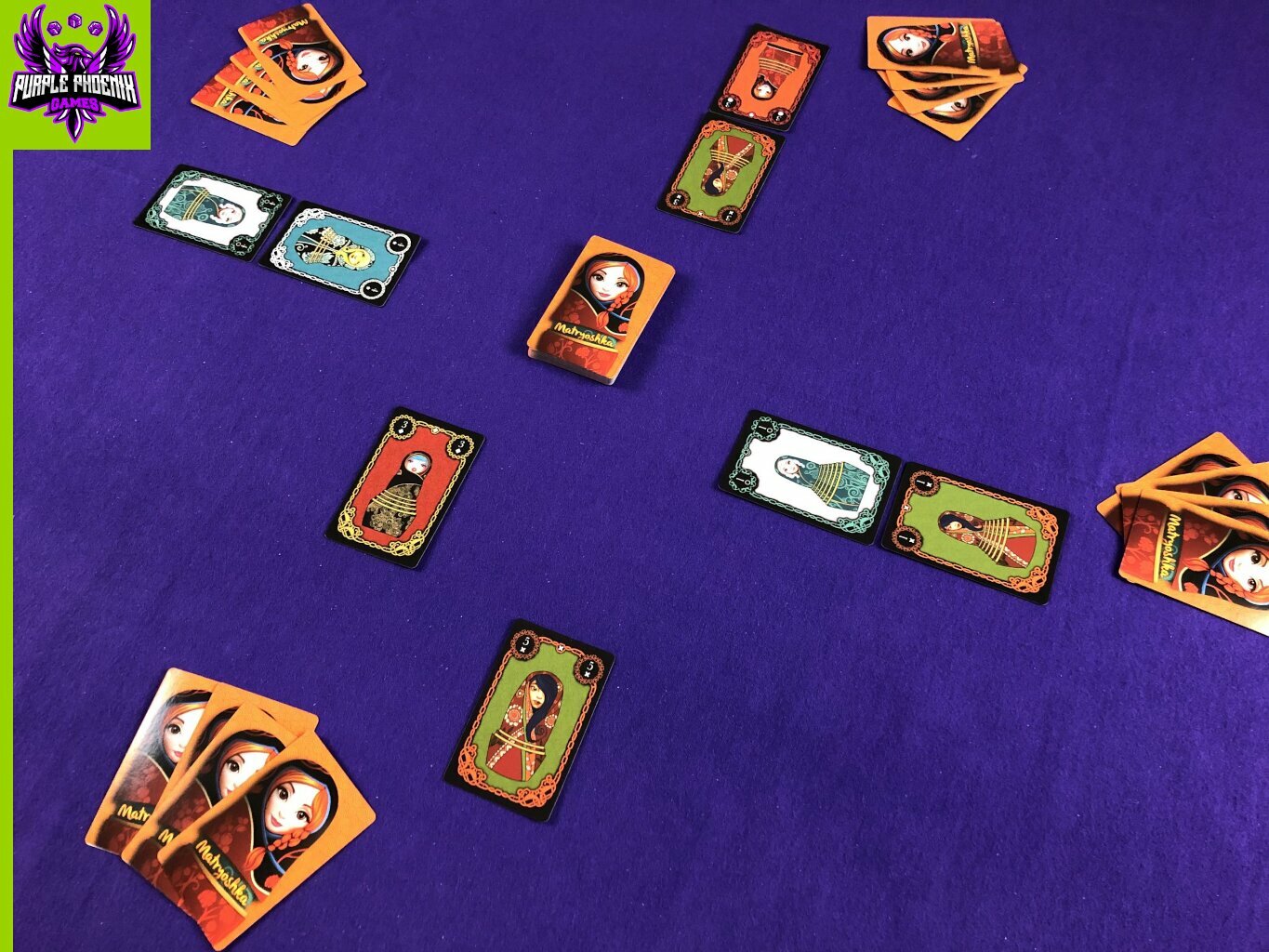
Matryoshka is a card game of hand management and set collection in which players are antique collectors attempting to gather complete sets of valuable Matryoshka dolls. Over the course of 4 rounds, players will be trading (in a sort of auction/bidding way) cards in their attempts to collect different sets of numerically ascending Matryoshka dolls. To setup for a game, you will first create the game deck. Depending on the player count, you will use a specific number of Matryoshka sets for the game – each set ranging from values 1-7. Shuffle the deck and deal 6 cards to each player, placing the remaining cards in the middle of the play area in a face-down draw deck. Players will then select 2 cards from their hand to place in their Display (tableau), organized as described in the rules. Cards in your display are visible to all players, and provide information as to what cards you have, and what cards you may be looking for. So deciding which cards to Display is part of your strategy. Select a starting player, and the game is ready to begin! Pictured below is the setup for a four-player game.
Each round is consists of 3 phases: Draw, Exchange, and Display. To begin the round, all players will draw 2 new cards from the deck. The Exchange phase is played in turns, beginning with the starting player as the active player. The active player will select one card from their hand to be placed face-up in the middle of the table. This is the card that is up for trade. All other players must then choose one card from their hands to be offered in exchange. Players keep their offer cards hidden, and the active player will secretly look at all offer cards. The active player then chooses one of the offer cards to take into their hand, and the player whose card was chosen takes the active player’s face-up card. All other players take their offer cards back into their own hand. Play then moves clock-wise, beginning another Exchange with a new active player.
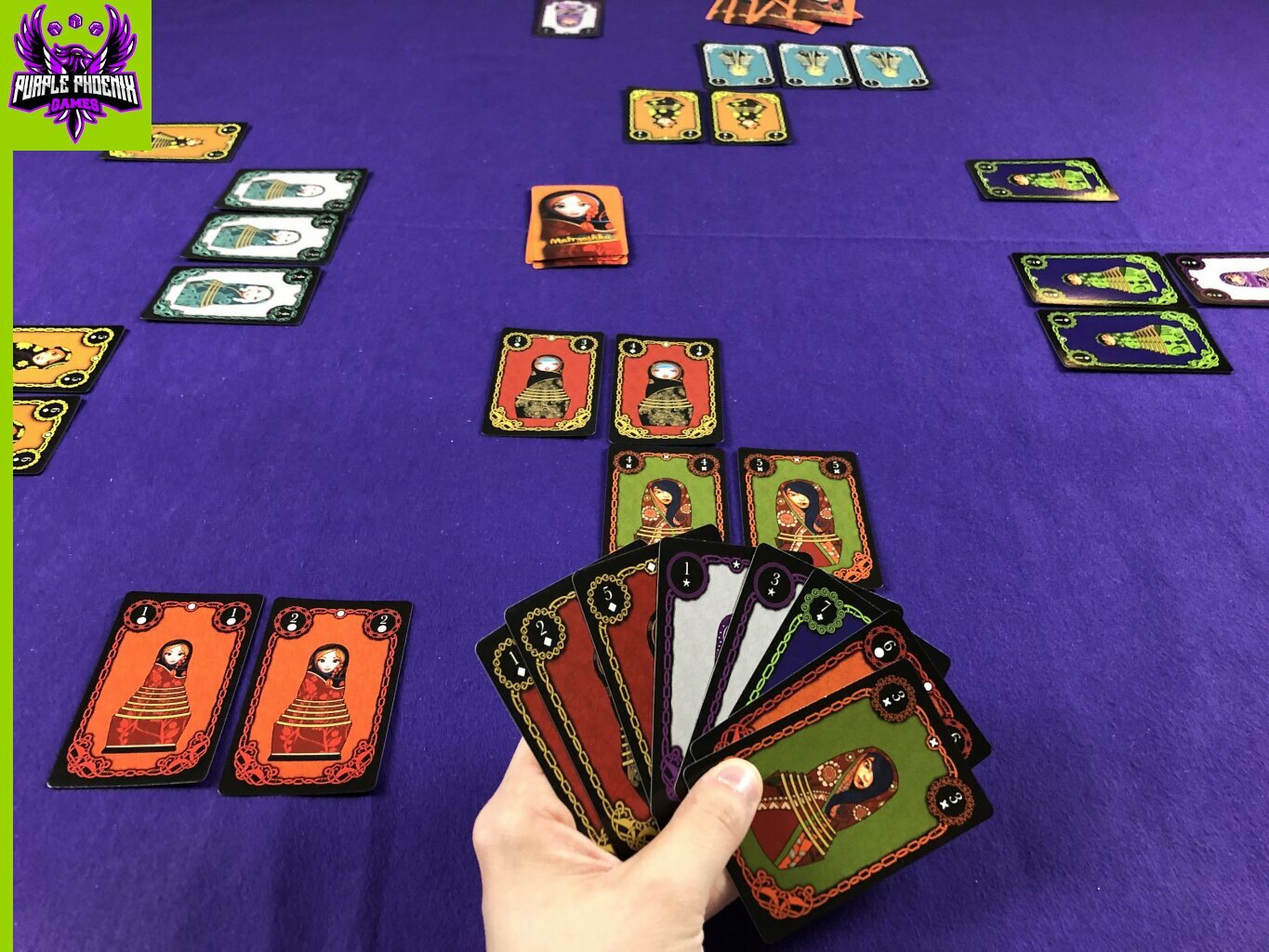
When all players have had the opportunity to be the active player, the game moves to the Display phase. Players take all cards from their Display into their hand, and will then create a new Display. As the game rounds progress, the number of cards in each Display increases. To start the game, all players Display 2 cards. After the first round, the Display will have 4 cards, then 6, 8, and finally 13 to end the game. Again, cards in your Display are visible to all players, and that information could be used strategically when Exchanging cards in the second game phase. After the fourth and final round, players will have a total of 13 cards in their Display. Each Display is now scored, earning points for consecutive cards per row as well as sets of the same size of doll. The player with the highest total score is the winner of the game!
I should probably start by saying that I’m a sucker for set collection. So when I stumbled across Matryoshka, the theme drew me in and the set collection mechanic prompted me to hit ‘Add to Cart.’ And I have to say that I am loving this game. One major element that I like about Matryoshka is the simplicity of the gameplay. Draw 2 cards each round, offer cards from your hand in Exchange for others, create Displays of your sets. Easy as pie.
What really takes this game above and beyond for me are the strategic elements. Deciding which cards to Display at the end of each round is a major strategy point of the game. You have to be careful with which cards you choose to Display, because they are visible to all players. So maybe you’ve got a set of 5 consecutive cards, but do you really want your opponents to know that? Is it better to only Display a couple and use other sets to finish your Display? Or maybe you do want people to know you’re gunning for that set, as it may prompt them to offer any of those cards from their hand, for which you would pay a pretty price. You scratch my back, I’ll scratch yours, right? Along with that comes the negotiation tactic. During every Exchange, players are allowed to try to influence the active player for certain trades. Take my card now and I’ll owe you a favor later sort of thing. It’s neat to see what strategies players will try with each passing round.
ALSO it pays to pay careful attention to all opponents each round. When creating your Display at the end of every round, you do not have to use the same cards as in your last Display. So you can strategize to bait opponents to giving you cards you want, or to try and keep your chosen sets secret. That being said, paying attention to opposing Displays can be a good tactic. Maybe your neighbor just had a consecutive run of 3 cards in their Display, but now are choosing to only Display 1 of those cards – just because you can’t see the others, doesn’t mean they’re not necessarily there. So changing up Displays can be a way to maybe trick your opponents into thinking you do or do not have specific cards. If you keep a careful eye out, you may be able to deduce what everyone is hiding…
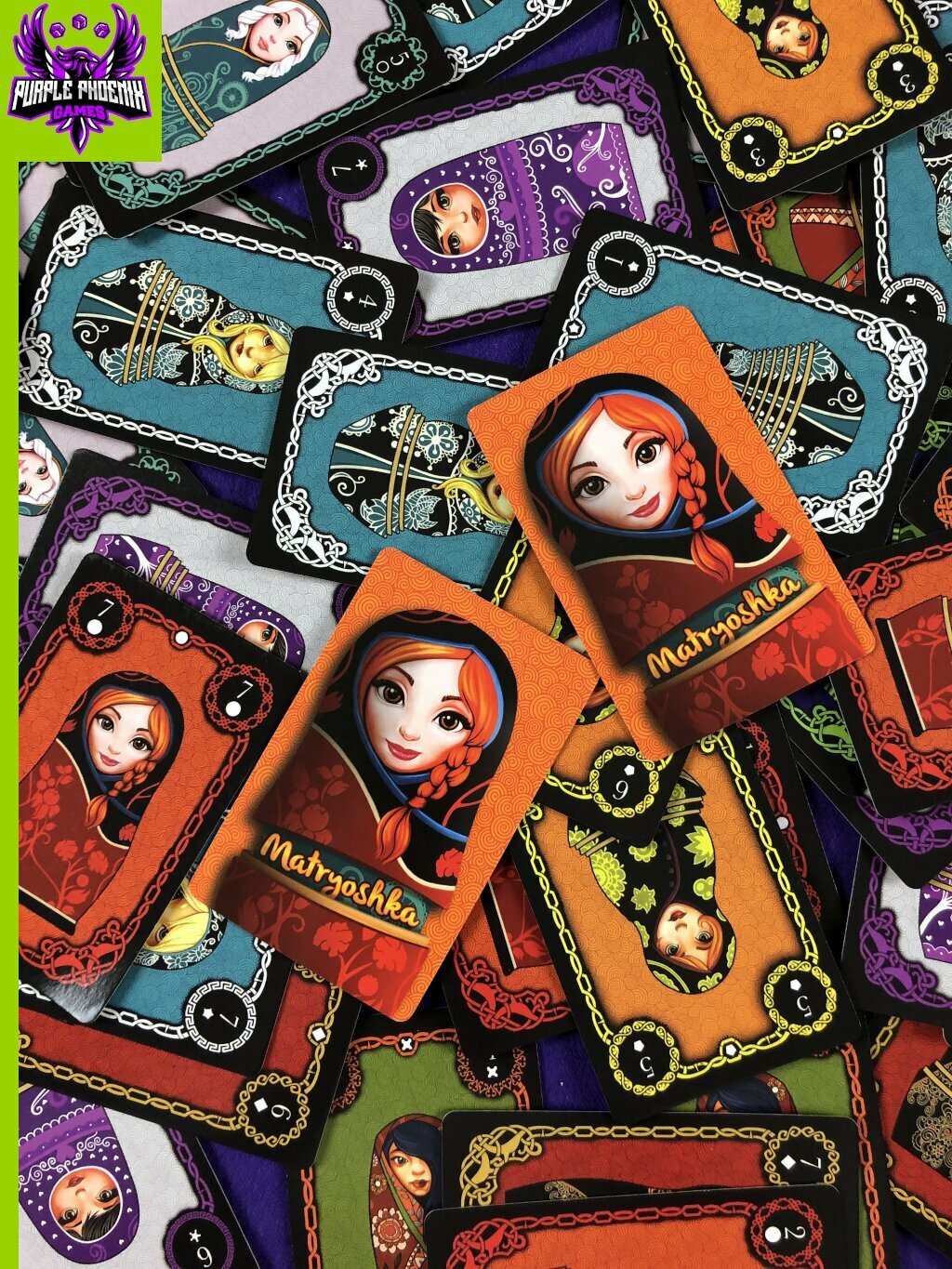
A quick note on components – this game is a stack of cards in a small magnetically-closing box. The artwork is thematic and unique, the rules and scoring aids are understandable, and the box itself is nice and sturdy. The cards are not the most high-quality I’ve seen in games, but as long as my players are gentle, that shouldn’t be a problem in the long run.
So all in all, I think you can tell that I love Matryoshka. The gameplay is simple and fast, yet the strategic options really get you thinking and perhaps second-guessing every Exchange that is made. I really like the element of changing Displays at the end of every round, as it allows players to adapt their strategy for the coming round. I wasn’t really sure what to expect when I picked up this game, but I was pleasantly surprised. It’s one that I’m definitely happy to have, and can see myself pulling it out often for a quick, yet strategic game between some of the bigger games out there. To bring back my analogy from my intro (yep, I’m committed to this joke), I would say that Matryoshka is nearly as satisfying as playing with a physical set of nesting dolls. If you’re looking for something light yet engaging, I would definitely recommend picking this one up. Purple Phoenix Games gives Matryoshka a nestled 5 / 6.
Matryoshka is a card game of hand management and set collection in which players are antique collectors attempting to gather complete sets of valuable Matryoshka dolls. Over the course of 4 rounds, players will be trading (in a sort of auction/bidding way) cards in their attempts to collect different sets of numerically ascending Matryoshka dolls. To setup for a game, you will first create the game deck. Depending on the player count, you will use a specific number of Matryoshka sets for the game – each set ranging from values 1-7. Shuffle the deck and deal 6 cards to each player, placing the remaining cards in the middle of the play area in a face-down draw deck. Players will then select 2 cards from their hand to place in their Display (tableau), organized as described in the rules. Cards in your display are visible to all players, and provide information as to what cards you have, and what cards you may be looking for. So deciding which cards to Display is part of your strategy. Select a starting player, and the game is ready to begin! Pictured below is the setup for a four-player game.
Each round is consists of 3 phases: Draw, Exchange, and Display. To begin the round, all players will draw 2 new cards from the deck. The Exchange phase is played in turns, beginning with the starting player as the active player. The active player will select one card from their hand to be placed face-up in the middle of the table. This is the card that is up for trade. All other players must then choose one card from their hands to be offered in exchange. Players keep their offer cards hidden, and the active player will secretly look at all offer cards. The active player then chooses one of the offer cards to take into their hand, and the player whose card was chosen takes the active player’s face-up card. All other players take their offer cards back into their own hand. Play then moves clock-wise, beginning another Exchange with a new active player.
When all players have had the opportunity to be the active player, the game moves to the Display phase. Players take all cards from their Display into their hand, and will then create a new Display. As the game rounds progress, the number of cards in each Display increases. To start the game, all players Display 2 cards. After the first round, the Display will have 4 cards, then 6, 8, and finally 13 to end the game. Again, cards in your Display are visible to all players, and that information could be used strategically when Exchanging cards in the second game phase. After the fourth and final round, players will have a total of 13 cards in their Display. Each Display is now scored, earning points for consecutive cards per row as well as sets of the same size of doll. The player with the highest total score is the winner of the game!
I should probably start by saying that I’m a sucker for set collection. So when I stumbled across Matryoshka, the theme drew me in and the set collection mechanic prompted me to hit ‘Add to Cart.’ And I have to say that I am loving this game. One major element that I like about Matryoshka is the simplicity of the gameplay. Draw 2 cards each round, offer cards from your hand in Exchange for others, create Displays of your sets. Easy as pie.
What really takes this game above and beyond for me are the strategic elements. Deciding which cards to Display at the end of each round is a major strategy point of the game. You have to be careful with which cards you choose to Display, because they are visible to all players. So maybe you’ve got a set of 5 consecutive cards, but do you really want your opponents to know that? Is it better to only Display a couple and use other sets to finish your Display? Or maybe you do want people to know you’re gunning for that set, as it may prompt them to offer any of those cards from their hand, for which you would pay a pretty price. You scratch my back, I’ll scratch yours, right? Along with that comes the negotiation tactic. During every Exchange, players are allowed to try to influence the active player for certain trades. Take my card now and I’ll owe you a favor later sort of thing. It’s neat to see what strategies players will try with each passing round.
ALSO it pays to pay careful attention to all opponents each round. When creating your Display at the end of every round, you do not have to use the same cards as in your last Display. So you can strategize to bait opponents to giving you cards you want, or to try and keep your chosen sets secret. That being said, paying attention to opposing Displays can be a good tactic. Maybe your neighbor just had a consecutive run of 3 cards in their Display, but now are choosing to only Display 1 of those cards – just because you can’t see the others, doesn’t mean they’re not necessarily there. So changing up Displays can be a way to maybe trick your opponents into thinking you do or do not have specific cards. If you keep a careful eye out, you may be able to deduce what everyone is hiding…
A quick note on components – this game is a stack of cards in a small magnetically-closing box. The artwork is thematic and unique, the rules and scoring aids are understandable, and the box itself is nice and sturdy. The cards are not the most high-quality I’ve seen in games, but as long as my players are gentle, that shouldn’t be a problem in the long run.
So all in all, I think you can tell that I love Matryoshka. The gameplay is simple and fast, yet the strategic options really get you thinking and perhaps second-guessing every Exchange that is made. I really like the element of changing Displays at the end of every round, as it allows players to adapt their strategy for the coming round. I wasn’t really sure what to expect when I picked up this game, but I was pleasantly surprised. It’s one that I’m definitely happy to have, and can see myself pulling it out often for a quick, yet strategic game between some of the bigger games out there. To bring back my analogy from my intro (yep, I’m committed to this joke), I would say that Matryoshka is nearly as satisfying as playing with a physical set of nesting dolls. If you’re looking for something light yet engaging, I would definitely recommend picking this one up. Purple Phoenix Games gives Matryoshka a nestled 5 / 6.

Purple Phoenix Games (2266 KP) rated Skulls of Sedlec in Tabletop Games
Feb 27, 2020
When it comes to board gaming, bigger does not always necessarily mean better. And that is something that Button Shy Games has really embraced. With all of their wallet games comprising of only 18 cards, they always manage to pack a lot of game into one small space. I think they’ve got the right idea – engaging gameplay, multitude of themes and mechanics, and easy storage and transport! So how does their newest game hold up to their other successful wallet games? Keep reading to find out!
Let us travel back to the 16th Century AD. You are a monk working in the Sedlec Ossuary, a chapel in the Czech Republic. The coincidental timing of the Black Plague and the Hussite Wars has led to some serious overcrowding in the Sedlec graveyard. Working under a half-blind monk, you and your fellow underlings have been tasked with exhuming graves and artfully arranging the skulls in the crypt. Who can create the most unique and tasteful display of skulls? There’s only one way to find out.
Disclaimer: We were provided a prototype review copy of this game for the purposes of this preview. The final components may vary once the Kickstarter campaign has concluded, so the published game may look differently than the one presented in these pictures. -L
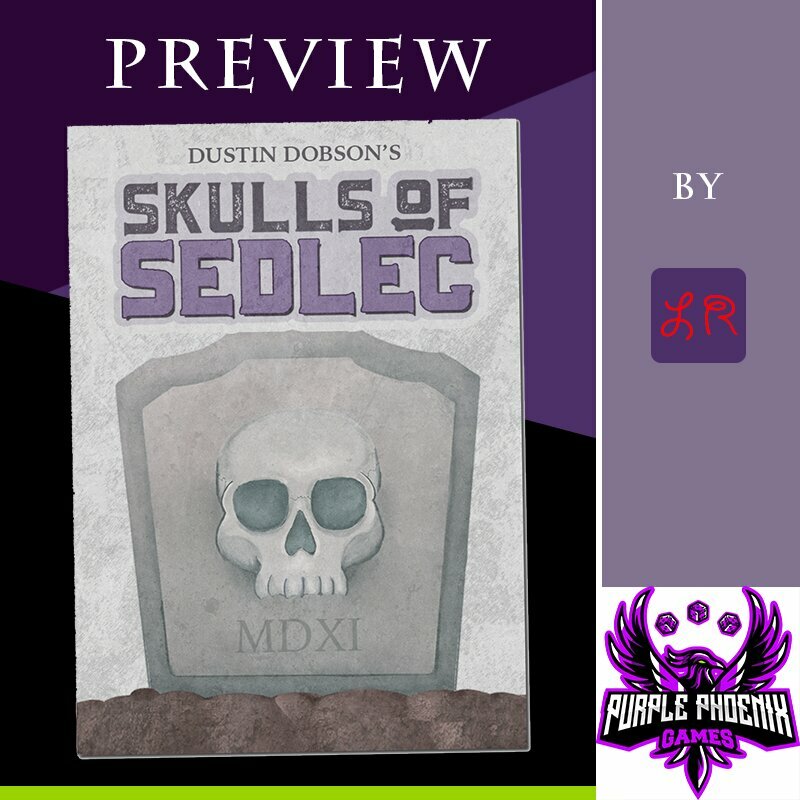
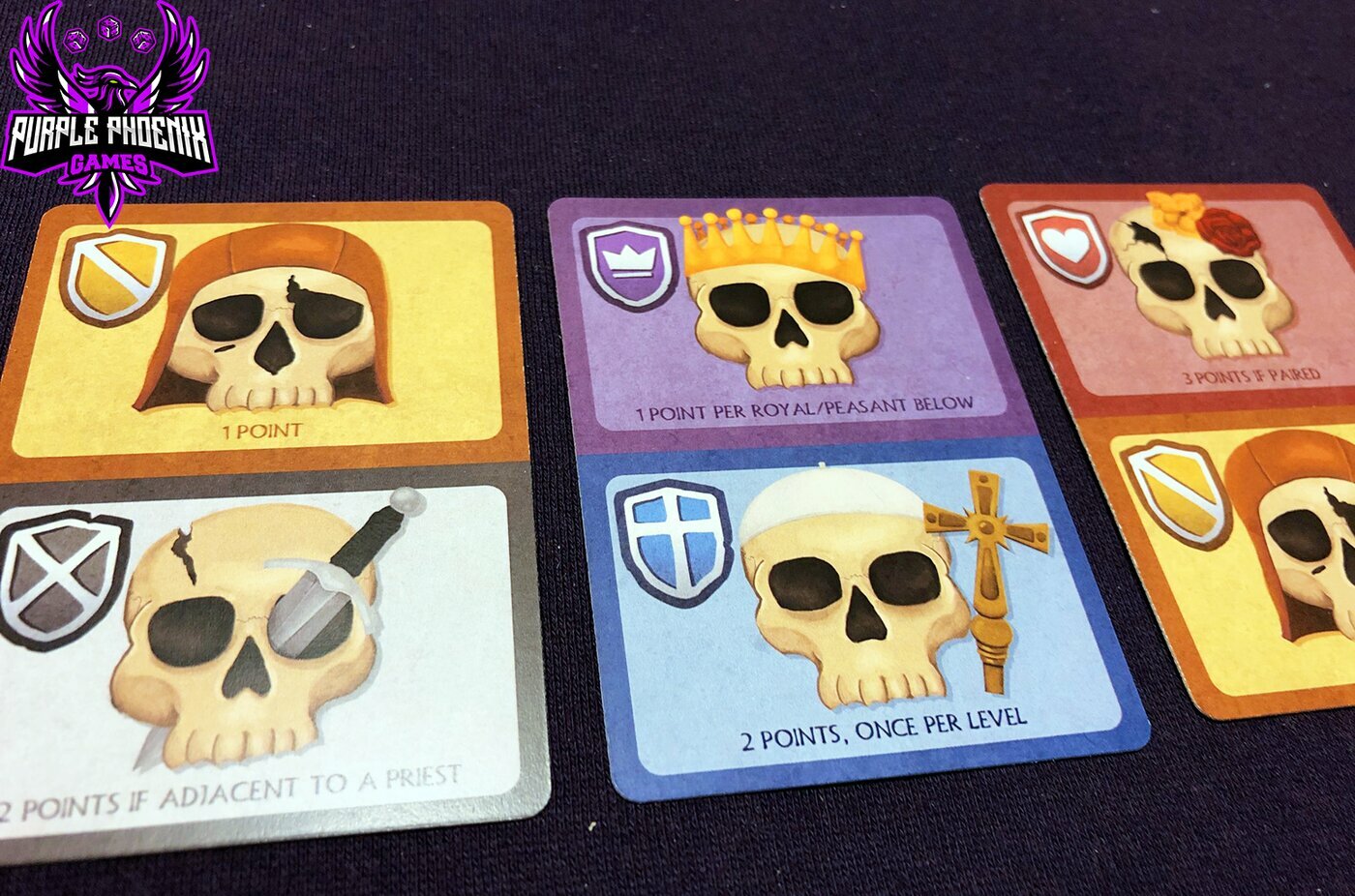
Skulls of Sedlec is a game of card drafting and hand management in which players are trying to amass the most points by the end of the game. Here’s how it works. To set up, shuffle all 18 cards. Create a 2×3 grid of 6 facedown piles consisting of 3 cards each. Pick any pile and flip one card face-up from the top. You are now ready to begin! The game is played over a series of turns in which players will draft and play cards into their personal Stack, an arrangement of cards in a pyramid shape. Each card has 2 skulls on it, and each skull earns a certain number of points based on its placement in your Stack. For example, Criminal skulls are vying for redemption in the afterlife, so they score 2 points if they are adjacent to any Priest skulls. At the end of the game, the player with the highest scoring Stack is the winner!
During the game, on your turn, you will take one of these three possible actions: Dig, Collect, or Stack. When you choose to Dig, you choose 2 facedown piles in the graveyard and flip their top cards face-up. Once you have done that, choose one of the two cards you flipped to take into your hand. If you choose to Collect, you simply choose any face-up card from the graveyard and take it into your hand. There is a hand limit of 2 cards per player, though, so if you already have 2 cards in your hand you may not take the Collect action. If you choose to Stack, you select one card from your hand and add it to your Stack, following the placement rules – Stacks are built from the bottom up. Your first card will be placed into the bottom row of your Stack. Depending on how many players are in the game, your Stack will require a different number of cards in each row. A card may only be played into a higher row if it is directly centered over two cards on the row beneath it. Logical enough! The game ends when each player has completed their Stack. Points are then added, and the highest score wins.
As I mentioned earlier, the size of the game does not always dictate the quality of the game, and Skulls of Sedlec is the perfect example of that. For only consisting of 18 cards, it takes a good deal of strategy to claim victory. There are 5 different types of skulls, and they earn points in different ways depending on their placement. You really have to be thinking in advance as to how you want to play the cards in your hand, and what other skulls you need to pick up to maximize your score. You can also see the Stacks of your opponents, so you know what you’re up against. You need an adaptive strategy for success based on the current cards available in the graveyard, as well as potentially anticipating your opponents’ moves. Be careful, though, because once a card has been played to your Stack, it cannot be moved.
Components. Again, this is just a preview copy of the game, but the card quality is already great. It might be something upgraded during the Kickstarter campaign, but if it’s not, you’re still getting a high quality game. Of course, the trademark wallet is on par with the rest of the wallet series, and it protects the cards well. The artwork of Skulls of Sedlec might not be awe-inspiring, but it is still colorful, thematic, and well-done. I appreciate the simplicity of the cards because it makes it easier to see the card types throughout the game and final scoring. You can clearly tell which skulls are which, so the game does not grind to a halt while trying to figure out what the scoring requirements are for a particular skull. And each skull type has a corresponding symbol, which can help our color-blind friends play the game – instead of relying solely on color, the symbols help differentiate the cards. So big kudos there!
As someone who does a fair amount of solo playing, I would like to mention the solo expansion of Skulls of Sedlec, Monstrance. Again, this is a preview of the solo expansion, so final rules and components may vary from those described here. When playing Skulls of Sedlec as a solo game, you will be creating a Stack like in a multiplayer game, as well as a Feature. The Feature you build will have a shape different to that of your normal Stack, and is determined by the Feature card you select at game setup. You will also select a second Feature card, which will be flipped over to reveal a new condition or effect for the game (for example, Romantics in the Stack do not score). Create a graveyard of 4 facedown piles of cards, evenly spread throughout the piles. You are then ready to play.
Gameplay is similar to that of a multiplayer game, but the solo player does not have a hand of cards. Instead, every card that you select will be immediately played into your Stack or your Feature. Placement rules are the same for the Stack, and cards in your Feature must be supported from below or adjacently. When both your Stack and Feature are complete, the game is over and you tally up your score. The solo expansion offers scoring milestones to compare with your score. See if you can best yourself and become a Legendary Artisan instead of remaining a Humble Monk.
Personally, I am not a huge fan of beat-your-own-score solo expansions. That being said, the gameplay of the Monstrance solo expansion still requires decent strategy and thought to maximize your final score. The addition of Features to solo play add another level of strategy because placement is just as important there as it is in your general Stack. Another neat twist is the addition of effects/conditions in solo play. They affect your strategy and make for a unique game every play.
Overall, I would say that Skulls of Sedlec is one of my favorite ButtonShy Games that I have played. It’s fast to play, simple to teach and learn, yet strategic enough that it keeps you engaged the entire time. Another thing I love about it is that it is only a 2-3 player game. We all know that getting together for game nights can be tricky, so I can see myself bringing Skulls of Sedlec to many game nights in which maybe only a few of us could attend. I’m glad I got the opportunity to preview this game, and I will be following the progress of the campaign for sure. If you’re looking for a small filler that still keeps your brain working, definitely consider backing the Skulls of Sedlec campaign!
Let us travel back to the 16th Century AD. You are a monk working in the Sedlec Ossuary, a chapel in the Czech Republic. The coincidental timing of the Black Plague and the Hussite Wars has led to some serious overcrowding in the Sedlec graveyard. Working under a half-blind monk, you and your fellow underlings have been tasked with exhuming graves and artfully arranging the skulls in the crypt. Who can create the most unique and tasteful display of skulls? There’s only one way to find out.
Disclaimer: We were provided a prototype review copy of this game for the purposes of this preview. The final components may vary once the Kickstarter campaign has concluded, so the published game may look differently than the one presented in these pictures. -L
Skulls of Sedlec is a game of card drafting and hand management in which players are trying to amass the most points by the end of the game. Here’s how it works. To set up, shuffle all 18 cards. Create a 2×3 grid of 6 facedown piles consisting of 3 cards each. Pick any pile and flip one card face-up from the top. You are now ready to begin! The game is played over a series of turns in which players will draft and play cards into their personal Stack, an arrangement of cards in a pyramid shape. Each card has 2 skulls on it, and each skull earns a certain number of points based on its placement in your Stack. For example, Criminal skulls are vying for redemption in the afterlife, so they score 2 points if they are adjacent to any Priest skulls. At the end of the game, the player with the highest scoring Stack is the winner!
During the game, on your turn, you will take one of these three possible actions: Dig, Collect, or Stack. When you choose to Dig, you choose 2 facedown piles in the graveyard and flip their top cards face-up. Once you have done that, choose one of the two cards you flipped to take into your hand. If you choose to Collect, you simply choose any face-up card from the graveyard and take it into your hand. There is a hand limit of 2 cards per player, though, so if you already have 2 cards in your hand you may not take the Collect action. If you choose to Stack, you select one card from your hand and add it to your Stack, following the placement rules – Stacks are built from the bottom up. Your first card will be placed into the bottom row of your Stack. Depending on how many players are in the game, your Stack will require a different number of cards in each row. A card may only be played into a higher row if it is directly centered over two cards on the row beneath it. Logical enough! The game ends when each player has completed their Stack. Points are then added, and the highest score wins.
As I mentioned earlier, the size of the game does not always dictate the quality of the game, and Skulls of Sedlec is the perfect example of that. For only consisting of 18 cards, it takes a good deal of strategy to claim victory. There are 5 different types of skulls, and they earn points in different ways depending on their placement. You really have to be thinking in advance as to how you want to play the cards in your hand, and what other skulls you need to pick up to maximize your score. You can also see the Stacks of your opponents, so you know what you’re up against. You need an adaptive strategy for success based on the current cards available in the graveyard, as well as potentially anticipating your opponents’ moves. Be careful, though, because once a card has been played to your Stack, it cannot be moved.
Components. Again, this is just a preview copy of the game, but the card quality is already great. It might be something upgraded during the Kickstarter campaign, but if it’s not, you’re still getting a high quality game. Of course, the trademark wallet is on par with the rest of the wallet series, and it protects the cards well. The artwork of Skulls of Sedlec might not be awe-inspiring, but it is still colorful, thematic, and well-done. I appreciate the simplicity of the cards because it makes it easier to see the card types throughout the game and final scoring. You can clearly tell which skulls are which, so the game does not grind to a halt while trying to figure out what the scoring requirements are for a particular skull. And each skull type has a corresponding symbol, which can help our color-blind friends play the game – instead of relying solely on color, the symbols help differentiate the cards. So big kudos there!
As someone who does a fair amount of solo playing, I would like to mention the solo expansion of Skulls of Sedlec, Monstrance. Again, this is a preview of the solo expansion, so final rules and components may vary from those described here. When playing Skulls of Sedlec as a solo game, you will be creating a Stack like in a multiplayer game, as well as a Feature. The Feature you build will have a shape different to that of your normal Stack, and is determined by the Feature card you select at game setup. You will also select a second Feature card, which will be flipped over to reveal a new condition or effect for the game (for example, Romantics in the Stack do not score). Create a graveyard of 4 facedown piles of cards, evenly spread throughout the piles. You are then ready to play.
Gameplay is similar to that of a multiplayer game, but the solo player does not have a hand of cards. Instead, every card that you select will be immediately played into your Stack or your Feature. Placement rules are the same for the Stack, and cards in your Feature must be supported from below or adjacently. When both your Stack and Feature are complete, the game is over and you tally up your score. The solo expansion offers scoring milestones to compare with your score. See if you can best yourself and become a Legendary Artisan instead of remaining a Humble Monk.
Personally, I am not a huge fan of beat-your-own-score solo expansions. That being said, the gameplay of the Monstrance solo expansion still requires decent strategy and thought to maximize your final score. The addition of Features to solo play add another level of strategy because placement is just as important there as it is in your general Stack. Another neat twist is the addition of effects/conditions in solo play. They affect your strategy and make for a unique game every play.
Overall, I would say that Skulls of Sedlec is one of my favorite ButtonShy Games that I have played. It’s fast to play, simple to teach and learn, yet strategic enough that it keeps you engaged the entire time. Another thing I love about it is that it is only a 2-3 player game. We all know that getting together for game nights can be tricky, so I can see myself bringing Skulls of Sedlec to many game nights in which maybe only a few of us could attend. I’m glad I got the opportunity to preview this game, and I will be following the progress of the campaign for sure. If you’re looking for a small filler that still keeps your brain working, definitely consider backing the Skulls of Sedlec campaign!



Gareth von Kallenbach (980 KP) rated Prometheus (2012) in Movies
Aug 7, 2019
After nearly 2 years of waiting and rampant speculation, director Ridley Scott’s science-fiction epic Prometheus has finally arrived. The project initially started as a prequel to Alien, and in doing so got the attention of the Alien fan community. After the last two sequels and two disastrous Alien Versus Predator spinoffs, this fan community was eager for the director who started the series to bring the series back to prominence. However, hopes were dashed when it was announced that Prometheus would not be a prequel but instead a standalone film that “shared” DNA with Alien. As production of the film developed under very tight conditions, fans could only speculate as to the nature of the film even when leaked photos and eventually trailers seem to indicate more than a passing connection to the Alien franchise.
The film follows the story of Dr. Elizabeth Shaw (Noomi Rapace), who in the late 21st century makes a startling discovery with her boyfriend Charlie Halloway (Logan Marshall-Green). Their discovery leads to an extremely expensive expedition to an unknown area of space aboard the state-of-the-art research vessel Prometheus. The eclectic but talented crew of experts along for the ride are under the stern watch of Meredith Vickers (Charlize Theron), who has been appointed by the Weyland Corporation to oversee the expedition even though she is highly skeptical about the expected goals that set the crew on the journey.
Holloway and Shaw believe that a series of paintings they discovered at several archaeological sites throughout the world indicated that ancient man had been visited and guided by beings from beyond the stars and that said beings may very well be responsible for engineering humanity as well.
After a journey of nearly 2.5 years the crew arrives at the star system depicted in the paintings and soon find themselves exploring a temple-like structure on an otherwise desolate and apparently lifeless moon. Despite the misgivings of the crew, when the true nature of their expedition is revealed upon their arrival, Shaw and Holloway are vindicated when remains of alien life forms and other technology are discovered by the crew.
Their initial exploration cut short due to a violent storm, the crew returns the safety of the ship to wait out the storm, save for two members of the team who remained at the temple after becoming lost. A series of events follow which soon indicate that not only are there hidden agendas at play but that the crew has stumbled upon a discovery that they are ill-prepared for.
Bizarre and horrific revelations and events follow which cause the crew members to question their motivations and the expedition’s purpose as well as examine their place in a much more complex and dangerous universe, where their petty human concerns and conflicts now seem much more insignificant.
It would be very difficult to go into further detail with spoiling key elements to the film. Suffice it to say that there are some real twist and turns along the way as well as some thrills and action that keep things moving along nicely as the film makes its way towards the conclusion. But, yes, Prometheus does have a very clear connection to the Alien films.
Scott had said that he wanted to do something epic in scale and in that he has, for the most part, succeeded. Shot using the latest 3-D technology, the film is amazing to watch. The opening sequence, as well as some footage of the ship in-flight, are truly gorgeous to look at and the amazing attention to detail not only on the alien world but on the ship itself is truly spectacular.
Early in the film, the android David (Michael Fassbender) is seen going through his various routines on the ship as the crew sleeps in suspended animation. His various activities range from monitoring the crew and their dreams, to watching old movies and studying ancient languages and keeping an eye on the ship systems. All that seems fairly routine, but it is his skill with a basketball that was fascinating and establishes the complex and dynamic character that he portrays.
This introduction underscores the diversity of the crew. We are given bits and pieces about all of them to help them stand out from the usual stock characters in this type of film. While we are not given as complete a background set up as I would’ve liked, little touches such as Capt. Janik (Idris Elba), insisting upon celebrating Christmas as well as the crew running side bets, help to underscore that these are people we can easily relate to, just doing their job in extraordinary situations. This was something that Scott mastered in the original Alien, giving you average Joe’s who had to deal with extraterrestrial horror.
I mention this because Prometheus is not an action film, nor is it a horror film. I wonder if perhaps this film had not had the production costs that it does, if it would be better suited for fall release. I say this not as a criticism of the movie, simply to emphasize the fact this is a movie that requires thought, something your typical summer blockbuster doesn’t. Scott does not lay it out on a plate for the audience and say “Here it is, take it.” He presents a story filled with questions, and instead of giving you answers, gives you even more questions as the film goes along.
At first, this was more than a bit frustrating as I wanted answers to questions I’ve had since seeing the original Alien back in 1979. I wanted to know more about some of the plot lines and characters as well as certain situations that were in the film. At one point the captain shares some very important information. I asked myself how this piece of news was arrived at, as certainly a discovery of this magnitude would have been a very interesting scene. However much like the film’s premise, faith is an underlying and key component. Just as the characters discuss and act based on faith, or lack thereof, audience members asked to have faith in the storyline and the sequence of events that lead up to the finale. There will be those who will be unwilling to do so and will be quick to find fault with the film, cast, and plot. But I hope there will be more who accept that they are seeing the first part of a larger journey and understand that there are things that they are meant to know, as well as things hey are not meant to know and in time more may be revealed.
Scott has indicated that he would like to do another film in the series and scuttlebutt indicates the studio would very much like to entertain thoughts of a trilogy. I would certainly like to see this, as would a few of my fellow critics. Following our screening, three of us stood around discussing aspects of the film, trying to figure out what it really meant and how it connected to the Alien series as well as potential future films in the series. If nothing else, this movie will spark interesting conversation.
As the days have passed since seeing the film I’ve appreciated it more and more with each passing day. Scott could have taken the easy way out and given a straight up prequel to Alien complete with all manner of monsters and CGI creatures on the loose wrecking havoc upon a crew of unfortunate victims. Instead he opted to take a much larger look at life, the universe, and our place in it and wove a complex and open-ended framework that not only provided fantastic entertainment but also provided an opportunity for intelligent conversation and introspection.
From the incredible visuals to the engaging and enjoyable cast, Prometheus is a refreshing and enjoyable film and an extremely welcome and much-needed addition to the alien franchise.
The film follows the story of Dr. Elizabeth Shaw (Noomi Rapace), who in the late 21st century makes a startling discovery with her boyfriend Charlie Halloway (Logan Marshall-Green). Their discovery leads to an extremely expensive expedition to an unknown area of space aboard the state-of-the-art research vessel Prometheus. The eclectic but talented crew of experts along for the ride are under the stern watch of Meredith Vickers (Charlize Theron), who has been appointed by the Weyland Corporation to oversee the expedition even though she is highly skeptical about the expected goals that set the crew on the journey.
Holloway and Shaw believe that a series of paintings they discovered at several archaeological sites throughout the world indicated that ancient man had been visited and guided by beings from beyond the stars and that said beings may very well be responsible for engineering humanity as well.
After a journey of nearly 2.5 years the crew arrives at the star system depicted in the paintings and soon find themselves exploring a temple-like structure on an otherwise desolate and apparently lifeless moon. Despite the misgivings of the crew, when the true nature of their expedition is revealed upon their arrival, Shaw and Holloway are vindicated when remains of alien life forms and other technology are discovered by the crew.
Their initial exploration cut short due to a violent storm, the crew returns the safety of the ship to wait out the storm, save for two members of the team who remained at the temple after becoming lost. A series of events follow which soon indicate that not only are there hidden agendas at play but that the crew has stumbled upon a discovery that they are ill-prepared for.
Bizarre and horrific revelations and events follow which cause the crew members to question their motivations and the expedition’s purpose as well as examine their place in a much more complex and dangerous universe, where their petty human concerns and conflicts now seem much more insignificant.
It would be very difficult to go into further detail with spoiling key elements to the film. Suffice it to say that there are some real twist and turns along the way as well as some thrills and action that keep things moving along nicely as the film makes its way towards the conclusion. But, yes, Prometheus does have a very clear connection to the Alien films.
Scott had said that he wanted to do something epic in scale and in that he has, for the most part, succeeded. Shot using the latest 3-D technology, the film is amazing to watch. The opening sequence, as well as some footage of the ship in-flight, are truly gorgeous to look at and the amazing attention to detail not only on the alien world but on the ship itself is truly spectacular.
Early in the film, the android David (Michael Fassbender) is seen going through his various routines on the ship as the crew sleeps in suspended animation. His various activities range from monitoring the crew and their dreams, to watching old movies and studying ancient languages and keeping an eye on the ship systems. All that seems fairly routine, but it is his skill with a basketball that was fascinating and establishes the complex and dynamic character that he portrays.
This introduction underscores the diversity of the crew. We are given bits and pieces about all of them to help them stand out from the usual stock characters in this type of film. While we are not given as complete a background set up as I would’ve liked, little touches such as Capt. Janik (Idris Elba), insisting upon celebrating Christmas as well as the crew running side bets, help to underscore that these are people we can easily relate to, just doing their job in extraordinary situations. This was something that Scott mastered in the original Alien, giving you average Joe’s who had to deal with extraterrestrial horror.
I mention this because Prometheus is not an action film, nor is it a horror film. I wonder if perhaps this film had not had the production costs that it does, if it would be better suited for fall release. I say this not as a criticism of the movie, simply to emphasize the fact this is a movie that requires thought, something your typical summer blockbuster doesn’t. Scott does not lay it out on a plate for the audience and say “Here it is, take it.” He presents a story filled with questions, and instead of giving you answers, gives you even more questions as the film goes along.
At first, this was more than a bit frustrating as I wanted answers to questions I’ve had since seeing the original Alien back in 1979. I wanted to know more about some of the plot lines and characters as well as certain situations that were in the film. At one point the captain shares some very important information. I asked myself how this piece of news was arrived at, as certainly a discovery of this magnitude would have been a very interesting scene. However much like the film’s premise, faith is an underlying and key component. Just as the characters discuss and act based on faith, or lack thereof, audience members asked to have faith in the storyline and the sequence of events that lead up to the finale. There will be those who will be unwilling to do so and will be quick to find fault with the film, cast, and plot. But I hope there will be more who accept that they are seeing the first part of a larger journey and understand that there are things that they are meant to know, as well as things hey are not meant to know and in time more may be revealed.
Scott has indicated that he would like to do another film in the series and scuttlebutt indicates the studio would very much like to entertain thoughts of a trilogy. I would certainly like to see this, as would a few of my fellow critics. Following our screening, three of us stood around discussing aspects of the film, trying to figure out what it really meant and how it connected to the Alien series as well as potential future films in the series. If nothing else, this movie will spark interesting conversation.
As the days have passed since seeing the film I’ve appreciated it more and more with each passing day. Scott could have taken the easy way out and given a straight up prequel to Alien complete with all manner of monsters and CGI creatures on the loose wrecking havoc upon a crew of unfortunate victims. Instead he opted to take a much larger look at life, the universe, and our place in it and wove a complex and open-ended framework that not only provided fantastic entertainment but also provided an opportunity for intelligent conversation and introspection.
From the incredible visuals to the engaging and enjoyable cast, Prometheus is a refreshing and enjoyable film and an extremely welcome and much-needed addition to the alien franchise.

Nymphomaniac Volume II (2014)
6.3 Rate It
Movie Watch
Joe becomes annoyed with Seligman, accusing him of overlooking the severity of her lost sexuality to...
Purple Phoenix Games (2266 KP) rated The GemShine Pylons in Tabletop Games
Mar 17, 2021
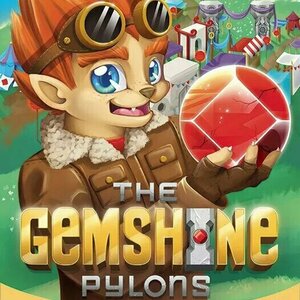

The empire needs power, and you’ve landed a job constructing gem-powered Pylons to harness and distribute that power. Different colored gems will provide power of varying levels, and the more power you can deliver will earn you rewards within the empire. Oh, also, we don’t want those Pylons to be eyesores, so if you can add some decorations to them to make them more attractive, that would be rewarded as well! Can you build the best, most powerful, and most attractive Pylons? Put yourself to the challenge!
Disclaimer: We were provided with a prototype copy of this game for the purposes of this preview. This is not a production copy of the game. The game also came with rules for solo play and cooperative play, but this preview will be covering the base rules of competitive play. I will be providing a general overview of the gameplay, and will not be rehashing the entire rulebook in this preview! -L
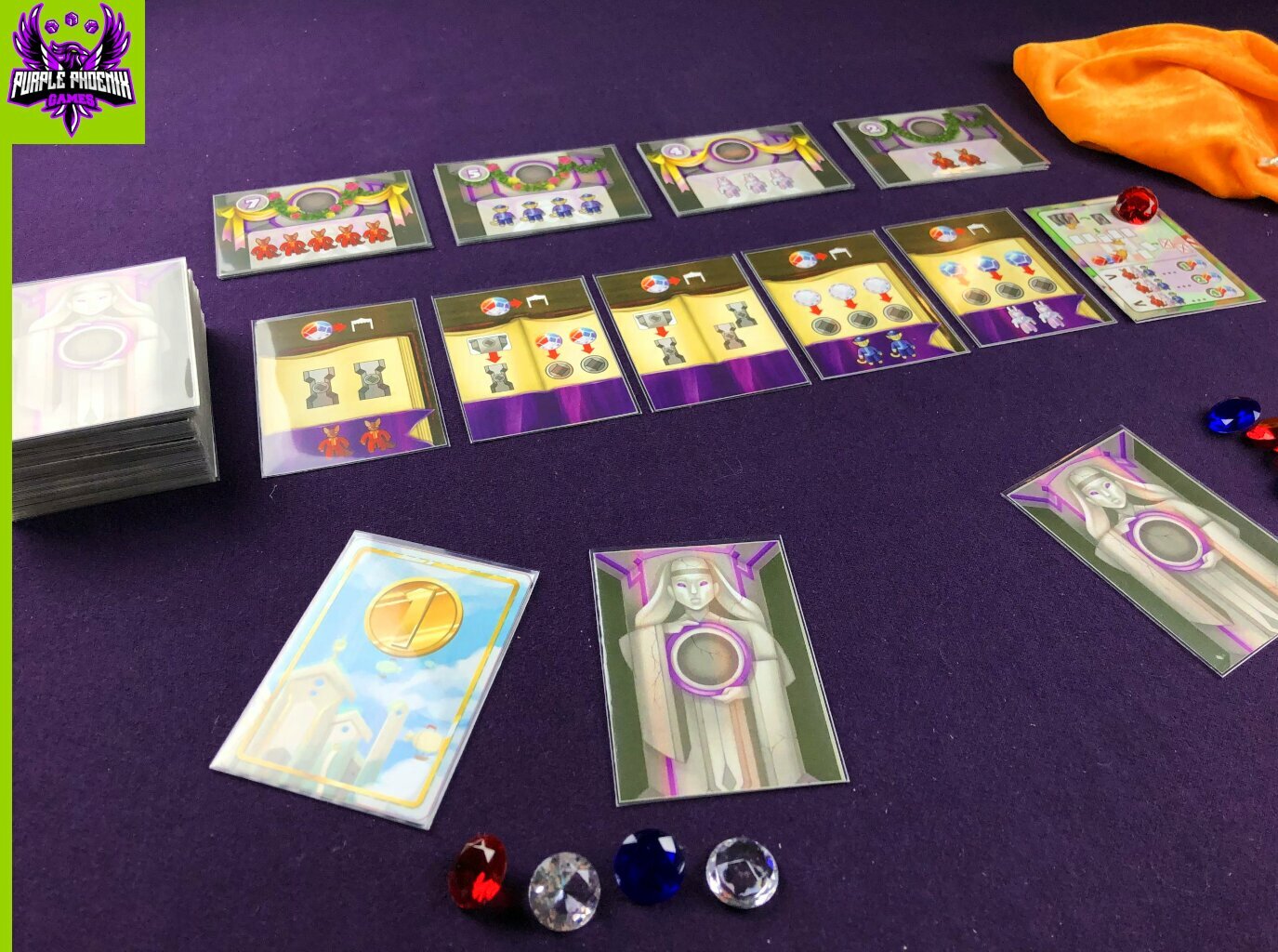
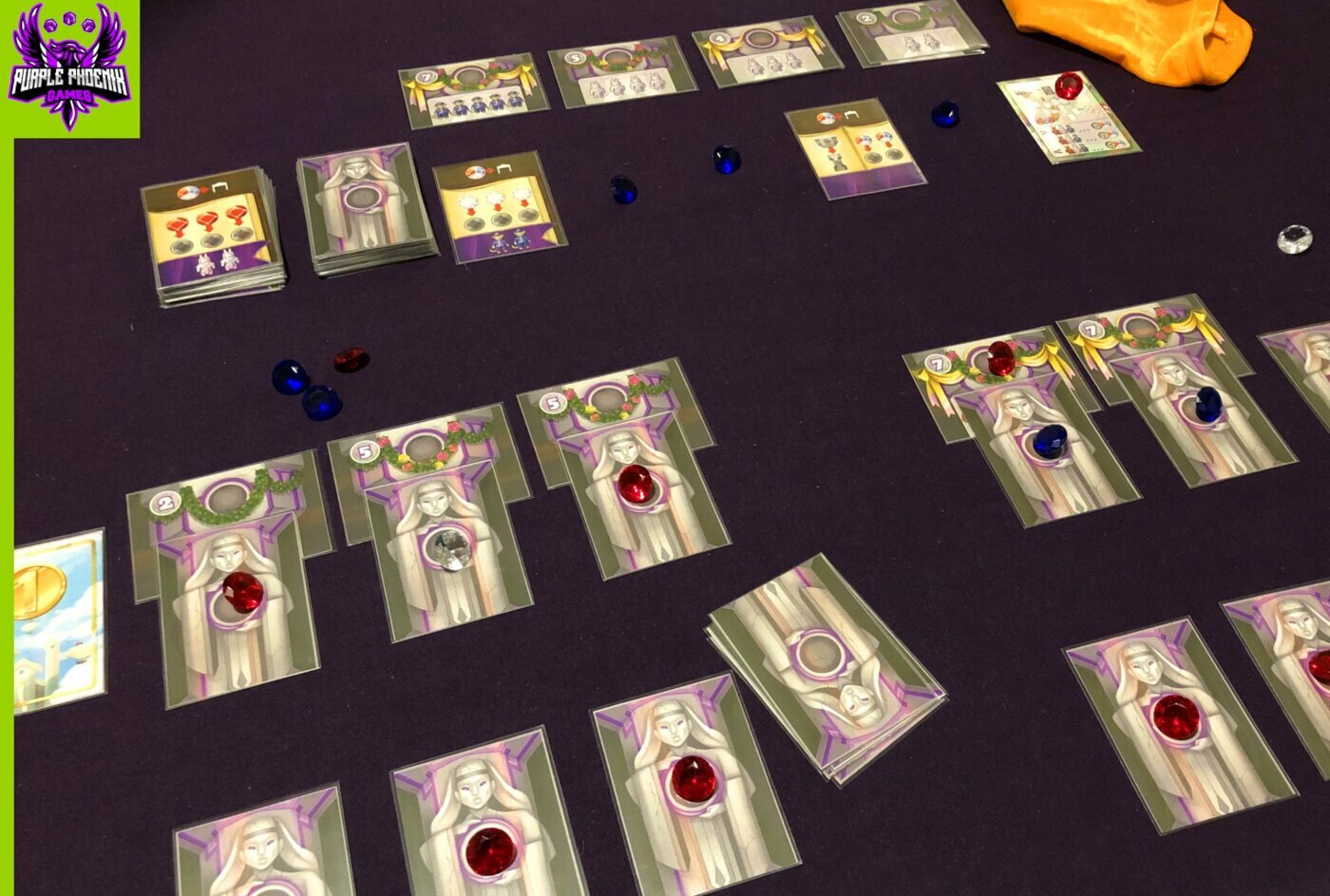
The GemShine Pylons is an economic game of hand management in which players are trying to build, power, and decorate Pylons in an effort to earn the most end-game points. To setup the game, shuffle the deck of Pylon cards, deal 1 face-down to each player as their starting Pylon, and deal 5 face-up next to the deck to serve as the market. Place the Timing Card at the bottom of the Pylon deck, with the appropriate player-count side face-up. Place the Setup card at the end of the market line, and place a random gem from the bag onto the empty gem slot. Above the market line, create 4 piles of Decoration cards, based on the number of Representatives on each card. Each player receives 4 random gems to their personal supply, a starting player is selected, and the game is ready to begin! The setup should look similar to the picture below.
The GemShine Pylons is played over a series of rounds in which players take turns performing actions. On your turn, you will perform one of three actions: Purchase a Card, Gather Gems, or Build a Pylon. To Purchase a Card, you will select a card from the market and pay its cost. There are 3 different costs for purchasing cards – leave 1 gem, leave 2 gems, or discard 1 Pylon. To leave 1 or 2 gems, you will select a gem (or 2) from your personal supply and place it in the spot emptied by the card you have purchased. When you discard a Pylon, you will take a Pylon from your tableau and discard it in order to purchase said card. Once a card has been purchased, you resolve the effect shown. These effects could be: gaining gems, placing gems onto Pylons/Decorations, gaining Pylons, or ‘purchasing’ Decorations. You may choose to not perform any/all effects on a card. Certain market cards have a number/color of Representatives on the bottom, and those are used to purchase Decorations. Every Decoration has a Representative cost, and you must discard cards from your hand with the matching color Representatives equal to the Representative cost. After performing the action on the card, it now goes into your hand.
To Gather Gems, you will take all the gems that are present in the market line, including the gem on the Setup card. These gems go directly into your personal supply. Any cards that were left in the market line are discarded, and the market is filled with 5 new cards from the Pylon deck. Select a random gem to be placed on the Setup card. To Build a Pylon, you will select a card from your hand and place it face-down in your tableau – it is now a Pylon. Play continues in this fashion, alternating turns, until the Pylon deck is depleted and the Timing Card is revealed. The game ends at the end of the current round. Points are now tallied – from Decorations and gems in slots. Players count up their points from any Decoration cards in their tableau. All players then reveal the cards in their hands, and the total number of Representatives for each color – blue, red, and white – are counted. The color that has the highest number of Representatives across all players combined is worth 4 points, the next highest is worth 2 points, and the lowest is worth 1 point. Players will then go through their gems in slots, counting up points based on the color majorities. Only gems in slots earn end-game points – any gems in your personal supply are not counted. Add up gem points and Decoration points, and the player with the highest score wins!
I know that may seem like a lot, but I do have to say that once you get going, the gameplay is pretty streamlined and straightforward. You only have 3 main action options each turn. If you purchase a card from the market, there are essentially 4 different effect options on each card. That being said, the small number of actions/effects do not stop the gameplay from being strategic. Most cards in the market require you to pay 1 or 2 gems, leaving them in the market line and available for your opponents to collect. How badly do you need that effect, and which color gem do you give up? Maybe the available cards only have blue Representatives but you only need 1 more red Representative to claim a Decoration – should you snag that blue in hopes of using it later in the game? Or do you go for a card that allows you to place gems, thus powering your Pylons and earning you points at the end of the game. But if you wait too long, your opponent may just buy the Decoration you were saving towards – seems to happen to me every time! It is also important to note that when you buy a Decoration, it can only be attached to a gem-powered Pylon. So you’ve got to balance having enough gems to power your Pylons, as well as having enough gems to purchase cards from the market. AND the different colored gems will earn varying amounts of points at the end of the game – do you want to risk going all in on red gems in hopes of scoring big, or should you try to collect gem colors evenly and spread those points around. There’s no single right way to play, and your strategy must be evolving constantly as the market line and available Decorations change throughout play.
Let me touch on components for a moment. Although we received a prototype copy of the game, the artwork is finalized and ready for production. The art style is relatively simple, yet nice to look at and thematically appropriate. I want to applaud the iconography on the cards as well, as it is very straight-forward and easy to understand. The cards have no text on them at all, but the consistency of the icons and simplicity of their explanations make them very easy to comprehend. The gems themselves are chunky and fun to play with, and make the game feel a little more immersive!
Overall, I really like The GemShine Pylons. The gameplay is straightforward, relatively simple, yet requires a decent amount of strategy. Every game feels exciting and unique, as everyone really is at the mercy of the deck shuffle. The artwork is thematic, the iconography is simple and clear, and the gameplay feels fresh. Even though this is only a prototype copy of the game, I am excited to have it in my collection, and am already thinking about my strategy for my next play. I am eager to try out the solo and cooperative modes as well, but the competitive rules themselves are engaging and entertaining. If you’re looking forward to a strategic, yet quick game, give The GemShine Pylons a try. I look forward to following this Kickstarter campaign and seeing what other goodies Game Elemental has in store!
Disclaimer: We were provided with a prototype copy of this game for the purposes of this preview. This is not a production copy of the game. The game also came with rules for solo play and cooperative play, but this preview will be covering the base rules of competitive play. I will be providing a general overview of the gameplay, and will not be rehashing the entire rulebook in this preview! -L
The GemShine Pylons is an economic game of hand management in which players are trying to build, power, and decorate Pylons in an effort to earn the most end-game points. To setup the game, shuffle the deck of Pylon cards, deal 1 face-down to each player as their starting Pylon, and deal 5 face-up next to the deck to serve as the market. Place the Timing Card at the bottom of the Pylon deck, with the appropriate player-count side face-up. Place the Setup card at the end of the market line, and place a random gem from the bag onto the empty gem slot. Above the market line, create 4 piles of Decoration cards, based on the number of Representatives on each card. Each player receives 4 random gems to their personal supply, a starting player is selected, and the game is ready to begin! The setup should look similar to the picture below.
The GemShine Pylons is played over a series of rounds in which players take turns performing actions. On your turn, you will perform one of three actions: Purchase a Card, Gather Gems, or Build a Pylon. To Purchase a Card, you will select a card from the market and pay its cost. There are 3 different costs for purchasing cards – leave 1 gem, leave 2 gems, or discard 1 Pylon. To leave 1 or 2 gems, you will select a gem (or 2) from your personal supply and place it in the spot emptied by the card you have purchased. When you discard a Pylon, you will take a Pylon from your tableau and discard it in order to purchase said card. Once a card has been purchased, you resolve the effect shown. These effects could be: gaining gems, placing gems onto Pylons/Decorations, gaining Pylons, or ‘purchasing’ Decorations. You may choose to not perform any/all effects on a card. Certain market cards have a number/color of Representatives on the bottom, and those are used to purchase Decorations. Every Decoration has a Representative cost, and you must discard cards from your hand with the matching color Representatives equal to the Representative cost. After performing the action on the card, it now goes into your hand.
To Gather Gems, you will take all the gems that are present in the market line, including the gem on the Setup card. These gems go directly into your personal supply. Any cards that were left in the market line are discarded, and the market is filled with 5 new cards from the Pylon deck. Select a random gem to be placed on the Setup card. To Build a Pylon, you will select a card from your hand and place it face-down in your tableau – it is now a Pylon. Play continues in this fashion, alternating turns, until the Pylon deck is depleted and the Timing Card is revealed. The game ends at the end of the current round. Points are now tallied – from Decorations and gems in slots. Players count up their points from any Decoration cards in their tableau. All players then reveal the cards in their hands, and the total number of Representatives for each color – blue, red, and white – are counted. The color that has the highest number of Representatives across all players combined is worth 4 points, the next highest is worth 2 points, and the lowest is worth 1 point. Players will then go through their gems in slots, counting up points based on the color majorities. Only gems in slots earn end-game points – any gems in your personal supply are not counted. Add up gem points and Decoration points, and the player with the highest score wins!
I know that may seem like a lot, but I do have to say that once you get going, the gameplay is pretty streamlined and straightforward. You only have 3 main action options each turn. If you purchase a card from the market, there are essentially 4 different effect options on each card. That being said, the small number of actions/effects do not stop the gameplay from being strategic. Most cards in the market require you to pay 1 or 2 gems, leaving them in the market line and available for your opponents to collect. How badly do you need that effect, and which color gem do you give up? Maybe the available cards only have blue Representatives but you only need 1 more red Representative to claim a Decoration – should you snag that blue in hopes of using it later in the game? Or do you go for a card that allows you to place gems, thus powering your Pylons and earning you points at the end of the game. But if you wait too long, your opponent may just buy the Decoration you were saving towards – seems to happen to me every time! It is also important to note that when you buy a Decoration, it can only be attached to a gem-powered Pylon. So you’ve got to balance having enough gems to power your Pylons, as well as having enough gems to purchase cards from the market. AND the different colored gems will earn varying amounts of points at the end of the game – do you want to risk going all in on red gems in hopes of scoring big, or should you try to collect gem colors evenly and spread those points around. There’s no single right way to play, and your strategy must be evolving constantly as the market line and available Decorations change throughout play.
Let me touch on components for a moment. Although we received a prototype copy of the game, the artwork is finalized and ready for production. The art style is relatively simple, yet nice to look at and thematically appropriate. I want to applaud the iconography on the cards as well, as it is very straight-forward and easy to understand. The cards have no text on them at all, but the consistency of the icons and simplicity of their explanations make them very easy to comprehend. The gems themselves are chunky and fun to play with, and make the game feel a little more immersive!
Overall, I really like The GemShine Pylons. The gameplay is straightforward, relatively simple, yet requires a decent amount of strategy. Every game feels exciting and unique, as everyone really is at the mercy of the deck shuffle. The artwork is thematic, the iconography is simple and clear, and the gameplay feels fresh. Even though this is only a prototype copy of the game, I am excited to have it in my collection, and am already thinking about my strategy for my next play. I am eager to try out the solo and cooperative modes as well, but the competitive rules themselves are engaging and entertaining. If you’re looking forward to a strategic, yet quick game, give The GemShine Pylons a try. I look forward to following this Kickstarter campaign and seeing what other goodies Game Elemental has in store!

Purple Phoenix Games (2266 KP) rated Shelfie Stacker in Tabletop Games
Jul 29, 2021
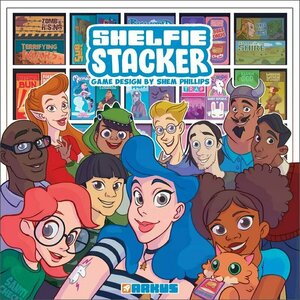

I don’t know about you, but I love getting a new game. Unboxing it, punching tokens, reading the rules – it’s so satisfying! Now after that fun is done comes my dilemma: where to put it on my shelves… I know I’m not the only one that runs into this problem. I often see on Board Gamer Facebook groups queries about how to store/organize games. Do you place them vertically or horizontally? Organize by publisher? Size of box? Box color? Player counts? The list is nearly endless. So Arkus Games had the brilliant idea to make a meta-game in which you must sort and organize your game shelf! After having a good laugh at this theme and game, I decided to back it on Kickstarter. And as you can see above, it is one that has earned The Golden Feather Award for us!
Disclaimer: I do not intend to rehash the entire rulebook in this review, but rather provide an overview of the rules and gameplay. For a more in-depth look, check out the game at your FLGS or directly from the publisher. -L
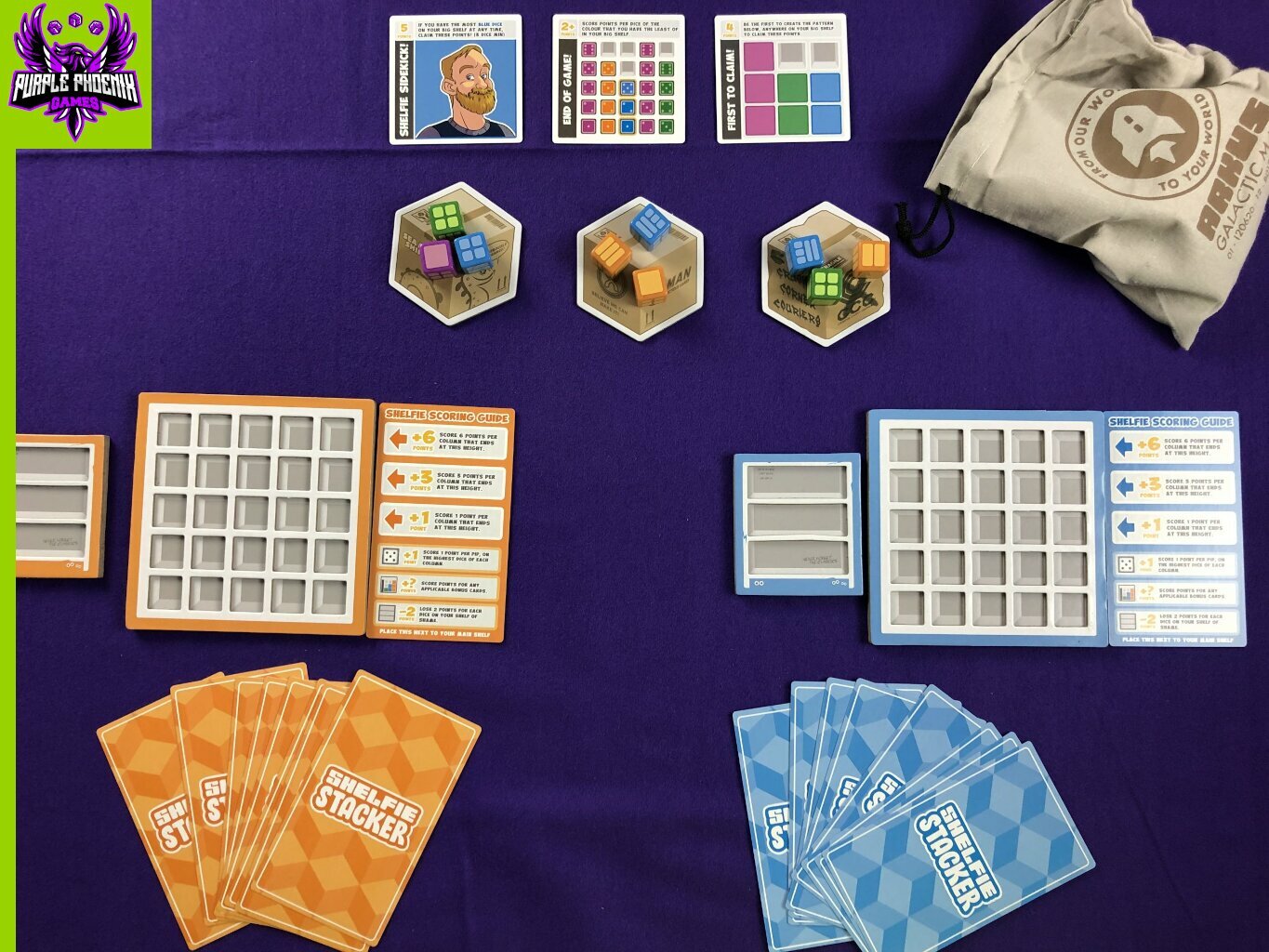
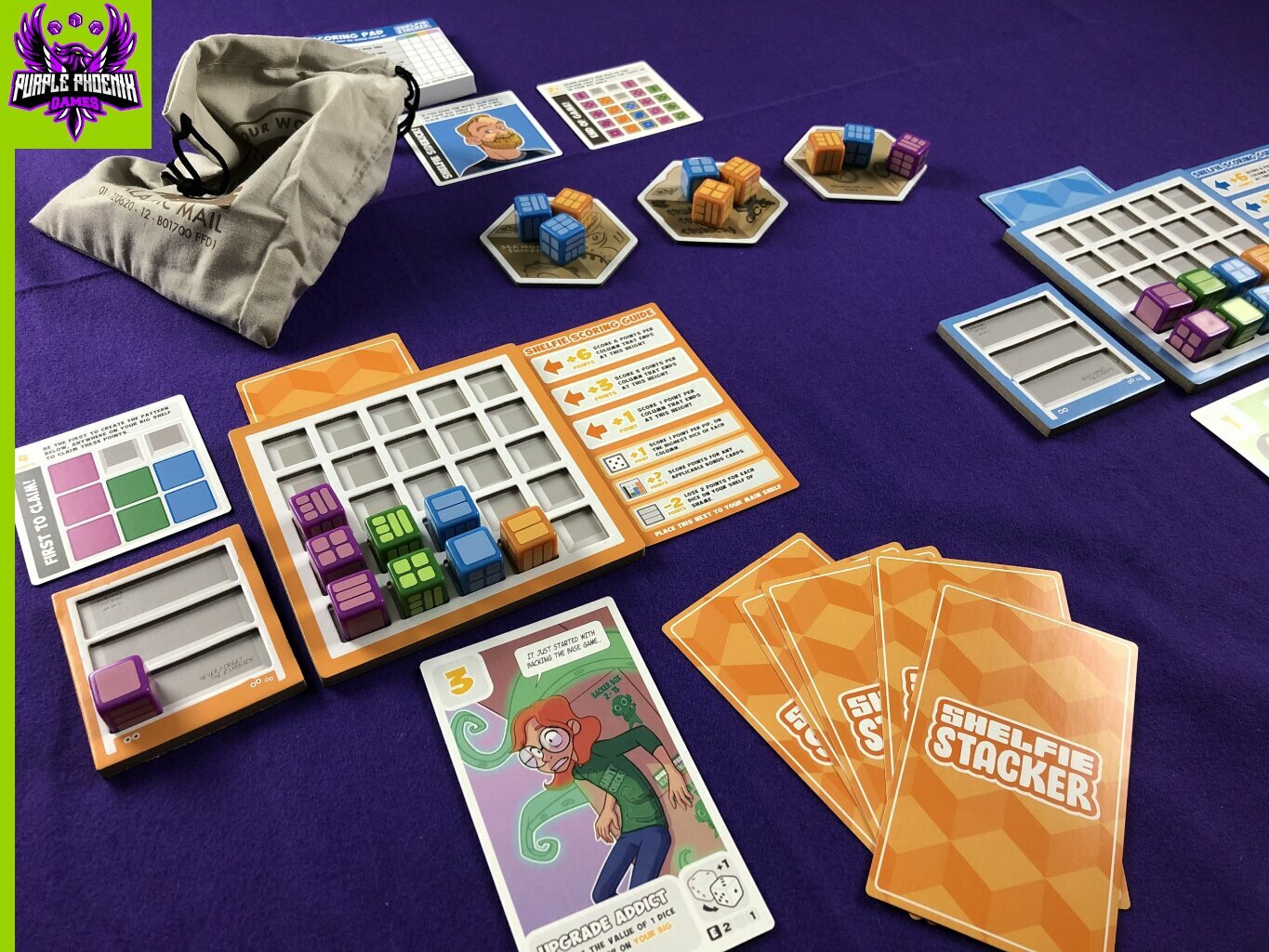
Shelfie Stacker is a game of dice drafting and hand management in which players are trying to create the most prestigious board game shelf in the group. Players will be drafting dice, manipulating them with special abilities, and placing them on their Big Shelf in an effort to amass the most points by the end of 7 rounds. To setup for the game, each player receives a Big Shelf, Shelf of Shame, and Character Cards in their chosen color. Of the 16 Character Cards, you will select 8 with which to play this game, and return the others to the box. Place the Delivery Boxes in the center of the table (1 per player, plus 1 more), and place the dice into the dice bag. Randomly select 1 Sidekick, First to Claim, and End of Game cards and place them face-up in view of all players. The game is now ready to begin!
The game is played over a series of 7 rounds, each broken down into 5 phases. The first phase is to fill the Delivery Boxes. To do so, one player will draw and place 3 dice from the dice bag onto each Delivery Box. The dice don’t need to be rolled, but the drawing player shouldn’t change the faces in any way when placing. In the next phase, all players will select a Character Card to play. This will determine the turn order for the round. The Character Cards are numbered 1-16 (you only use 8 total cards in a game though), and each provide a special one-time ability for use in the game. Players select their Character Card in secret, and then will simultaneously reveal them. Starting with the player who played the lowest-value Character Card, each player will select one of the available Delivery Boxes as their own.
Once you have a Delivery Box, you will then start placing the dice in your Big Shelf! You must place all of your dice, following the placement rules (detailed in the rulebook). During this phase of the round is when most Character Card abilities will be used. These are one-time abilities to be used throughout the game, and allow you to manipulate your dice in various ways. One super important note is that the Character abilities do not need to be used on the same round in which they are played! So I could play a card for its number value (securing my spot in the turn order), but not use its ability until a later round. This really gives you the opportunity to strategize and potentially chain abilities together for maximum results! Once an ability has been used, it is discarded from the game and cannot be used again.
At any point during a round, a player may be able to claim the First to Claim or Sidekick cards, which provide end-game points. The first player to create the depicted pattern on the First to Claim card takes and keeps it for the end of the game. The Sidekick, however, won’t necessarily remain with one player. For example, I may have the most blue dice now and claim the Sidekick, but if in a later round you have more blue dice than me, you can steal it from me! If you are unable to place any/all of your dice on your Big Shelf. they will be placed on your Shelf of Shame *womp womp* and any dice there earn negative points in final scoring. When everyone has finished placing their dice, you prepare for the next round. The Delivery Boxes are returned to the center, and the game is ready to move to the next round.
After the 7th round, the game ends and final scoring takes place. Players can earn points in several ways: if columns get to a certain height, points per pip on the highest die of each column, bonus cards (First to Claim, Sidekick, and End of Game), and you lose 2 points for every die in your Shelf of Shame. Points are totaled and the player with the highest score is the winner!
Putting aside the humor and the theme, Shelfie Stacker is actually a very solid game. The premise is simple (manipulate and place dice) but the actual execution is more strategic than I first thought. The placement rules alone create quite a challenge. The first couple of rounds really determine your success in later rounds. If you don’t set yourself up early in the game with a good strategy, it could all come crashing down as the game progresses. Couple that with the Character Card abilities, and the strategy is elevated once more. You have to decide when to use which abilities, knowing that they are a one-time use. One of my favorite parts of this game is the fact that abilities do not have to be used immediately when played. So maybe I want to go early in the round so I play a low-value card. I can hang onto that special ability until I am ready to play it – I am not forced to use it until I decide to. This adds to the strategy because it allows you to choose when to use cards for maximum benefit, potentially even using multiple abilities in a row to get the desired result. Be warned though, this game could be a little AP-inducing as it gets into later rounds and you have to be more focused with your strategy. Not that the game necessarily halts altogether, but be ready for a little downtime as all players consider their options at the top of a round.
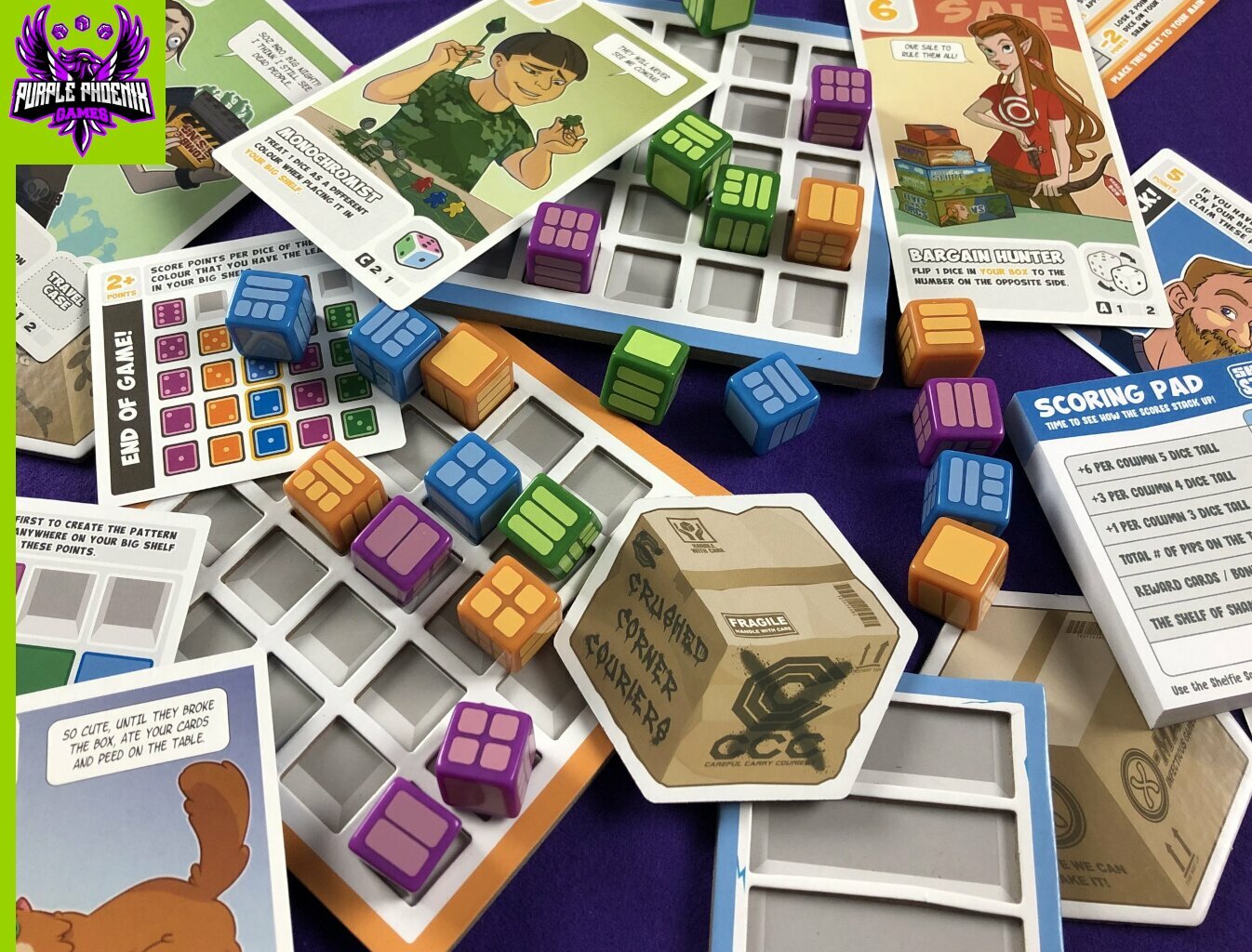
The components of Shelfie Stacker are excellent. The Big Shelf and Shelf of Shame boards are nice and thick dual-layered cardboard that really keep the dice in place. The dice themselves are fun colors, clear to read, and easy to manipulate. The artwork on all the cards is unique and fun, and the rulebook is clear and concise. So all in all, Shelfie Stacker gets an A+ from me with regards to production quality.
Obviously, as you saw in my graphic at the top of this review, Shelfie Stacker gets nothing but praise from me. The theme might not be one that appeals to everyone (especially non-gamers), but the gameplay is super solid and engaging. Every game is unique and strategically challenging, and it really puts you to the test mentally. If you’re in the market for something with a light and fun theme, but that really packs a punch with serious gameplay, I would highly recommend Shelfie Stacker. Then, of course, when you get it you have to decide where to put it on your shelf. The eternal struggle of gamers! Purple Phoenix Games awards this one the coveted Golden Feather Award! That’s right – I think this is a contender for my Top 10! Ooh, what if I put my Top 10 all together on my shelf……
Disclaimer: I do not intend to rehash the entire rulebook in this review, but rather provide an overview of the rules and gameplay. For a more in-depth look, check out the game at your FLGS or directly from the publisher. -L
Shelfie Stacker is a game of dice drafting and hand management in which players are trying to create the most prestigious board game shelf in the group. Players will be drafting dice, manipulating them with special abilities, and placing them on their Big Shelf in an effort to amass the most points by the end of 7 rounds. To setup for the game, each player receives a Big Shelf, Shelf of Shame, and Character Cards in their chosen color. Of the 16 Character Cards, you will select 8 with which to play this game, and return the others to the box. Place the Delivery Boxes in the center of the table (1 per player, plus 1 more), and place the dice into the dice bag. Randomly select 1 Sidekick, First to Claim, and End of Game cards and place them face-up in view of all players. The game is now ready to begin!
The game is played over a series of 7 rounds, each broken down into 5 phases. The first phase is to fill the Delivery Boxes. To do so, one player will draw and place 3 dice from the dice bag onto each Delivery Box. The dice don’t need to be rolled, but the drawing player shouldn’t change the faces in any way when placing. In the next phase, all players will select a Character Card to play. This will determine the turn order for the round. The Character Cards are numbered 1-16 (you only use 8 total cards in a game though), and each provide a special one-time ability for use in the game. Players select their Character Card in secret, and then will simultaneously reveal them. Starting with the player who played the lowest-value Character Card, each player will select one of the available Delivery Boxes as their own.
Once you have a Delivery Box, you will then start placing the dice in your Big Shelf! You must place all of your dice, following the placement rules (detailed in the rulebook). During this phase of the round is when most Character Card abilities will be used. These are one-time abilities to be used throughout the game, and allow you to manipulate your dice in various ways. One super important note is that the Character abilities do not need to be used on the same round in which they are played! So I could play a card for its number value (securing my spot in the turn order), but not use its ability until a later round. This really gives you the opportunity to strategize and potentially chain abilities together for maximum results! Once an ability has been used, it is discarded from the game and cannot be used again.
At any point during a round, a player may be able to claim the First to Claim or Sidekick cards, which provide end-game points. The first player to create the depicted pattern on the First to Claim card takes and keeps it for the end of the game. The Sidekick, however, won’t necessarily remain with one player. For example, I may have the most blue dice now and claim the Sidekick, but if in a later round you have more blue dice than me, you can steal it from me! If you are unable to place any/all of your dice on your Big Shelf. they will be placed on your Shelf of Shame *womp womp* and any dice there earn negative points in final scoring. When everyone has finished placing their dice, you prepare for the next round. The Delivery Boxes are returned to the center, and the game is ready to move to the next round.
After the 7th round, the game ends and final scoring takes place. Players can earn points in several ways: if columns get to a certain height, points per pip on the highest die of each column, bonus cards (First to Claim, Sidekick, and End of Game), and you lose 2 points for every die in your Shelf of Shame. Points are totaled and the player with the highest score is the winner!
Putting aside the humor and the theme, Shelfie Stacker is actually a very solid game. The premise is simple (manipulate and place dice) but the actual execution is more strategic than I first thought. The placement rules alone create quite a challenge. The first couple of rounds really determine your success in later rounds. If you don’t set yourself up early in the game with a good strategy, it could all come crashing down as the game progresses. Couple that with the Character Card abilities, and the strategy is elevated once more. You have to decide when to use which abilities, knowing that they are a one-time use. One of my favorite parts of this game is the fact that abilities do not have to be used immediately when played. So maybe I want to go early in the round so I play a low-value card. I can hang onto that special ability until I am ready to play it – I am not forced to use it until I decide to. This adds to the strategy because it allows you to choose when to use cards for maximum benefit, potentially even using multiple abilities in a row to get the desired result. Be warned though, this game could be a little AP-inducing as it gets into later rounds and you have to be more focused with your strategy. Not that the game necessarily halts altogether, but be ready for a little downtime as all players consider their options at the top of a round.
The components of Shelfie Stacker are excellent. The Big Shelf and Shelf of Shame boards are nice and thick dual-layered cardboard that really keep the dice in place. The dice themselves are fun colors, clear to read, and easy to manipulate. The artwork on all the cards is unique and fun, and the rulebook is clear and concise. So all in all, Shelfie Stacker gets an A+ from me with regards to production quality.
Obviously, as you saw in my graphic at the top of this review, Shelfie Stacker gets nothing but praise from me. The theme might not be one that appeals to everyone (especially non-gamers), but the gameplay is super solid and engaging. Every game is unique and strategically challenging, and it really puts you to the test mentally. If you’re in the market for something with a light and fun theme, but that really packs a punch with serious gameplay, I would highly recommend Shelfie Stacker. Then, of course, when you get it you have to decide where to put it on your shelf. The eternal struggle of gamers! Purple Phoenix Games awards this one the coveted Golden Feather Award! That’s right – I think this is a contender for my Top 10! Ooh, what if I put my Top 10 all together on my shelf……

Purple Phoenix Games (2266 KP) rated Marvel United in Tabletop Games
Sep 1, 2021
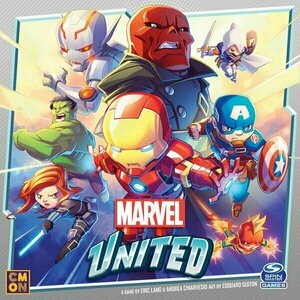

This has probably been mentioned before, but I love Marvel superheroes. My favorite has got to be Spider-Man, hands down. Feel free to send me an email if you’d like to hear my thoughts on who is the best Spider-Man – Tobey Maguire, Andrew Garfield, or Tom Holland. I’m getting off topic here… Anyway – when I saw the massive Kickstarter campaign for Marvel United, I knew it was going to be big. Admittedly, I didn’t join in on the campaign (teacher salaries, amiright?), but I did snag a copy of the base game post-campaign. Does the game live up to my expectations? Or does it fall flat, like a DC movie? (OOOOOOH BURN)
Disclaimer: This review encompasses only the base game of Marvel United. There are a number of expansions, but they will not be addressed in this review. -L
Marvel United is a cooperative game in which players take on the roles of various Marvel superheroes tasked with stopping the main Villain from completing their Villainous Plot. Follow the setup instructions detailed in the rulebook, selecting a Villain with whom to battle, 6 random Locations, and whichever Heroes you decide to use to fight the big bad. Place Threat cards, Civilians, and Thugs on the various Locations as indicated, and place the Villain and Heroes as described in the rules. Shuffle the Master Plan deck and respective Hero decks, and each player draws a hand of 3 cards. Choose a Hero as the ‘starting’ Hero, and the game is now ready to begin!
Over a series of turns, players will be resolving Villain effects and playing Hero cards to perform actions. The game always begins with a Villain turn, and the first step is to reveal a Master Plan card, adding it to the Storyline (table). Master Plan cards have different effects to be resolved – move the Villain to a new Location, BAM! effects (usually attacking Heroes or advancing their Villainous Plot towards victory), and adding Civilians/Thugs to surrounding Locations. Once all effects on the Master Plan card are dealt with, the game moves to a Hero turn. During a Hero turn, the player will perform 4 steps: Draw a card, Play a Card, Resolve Actions, and Location Effects. To start, the player will draw a card from their Hero deck and add it to their hand. They then select a card from their hand to play, adding it to the end of the Storyline.
Looking at the symbols at the bottom of their played card, the Hero will now resolve their actions. Actions could be Movement (to an adjacent Location), Attack (Thugs/Henchmen or the Villain in their current Location), Heroic Actions (rescuing Civilians or working to clear the Threat on their current Location), or Wild (any of the previous actions). During this step, a cool twist comes into play – after all, the game is called Marvel United, right? When a Hero plays a card, they resolve the symbols on the bottom of their card AND the symbols on the bottom of the previously played Hero card! This simulates the various Heroes uniting their efforts to take down the Villain! So when selecting your card, be sure to check out the last card to see if you can create a sweet chain of actions for maximum benefit. The final step is to use Location effects, if applicable. Location effects are only available after the Threat to the Location has been cleared, and allows the player to perform special actions (draw extra cards, move to other Locations, etc.). If you end your turn on a Location that has been cleared, you may use its ability if you so choose.
In order to defeat the Villain, the Heroes must complete Missions. The 3 Missions in each game are to Rescue Civilians, Defeat Thugs, and Clear Threats. So with their actions on their turns, Heroes will be working to complete these Missions, moving them closer to victory. The turn sequence of the game is unique as well – the Villain will take a turn after every 3rd Hero turn, not opposite every single Hero. Keep that in mind as you decide which card to play when! The game essentially continues in this fashion (with a few extra effects) until either the Heroes win or they lose. Heroes win if they defeat the Villain! The Villain is defeated when at least 2 Missions are completed, and the Villain has been sufficiently damaged by Attacks. Heroes lose if the Villain completes their Villainous Plot, the deck of Master Plan cards has run out, or if any Hero starts their turn with no cards left to play. The Heroes either win together or lose together.
So I know that kind of sounds like a lot, but I promise that once you get playing, the game flows really well and is pretty intuitive. Marvel United can basically be broken down into 2 steps: Villain turn and Hero turn. All you are doing is playing cards and resolving actions to complete your goals. One of the coolest things about this gameplay is the fact that on your turn you resolve not only your played card, but also the previously played Hero card as well. It does a good job emulating the Heroes working together, and adds a strategic element to the overall gameplay. Maybe you wanted to play a certain card, but based on the last Hero card, you should play this one to benefit the group the most. Players really are all working together to defeat the Villain, instead of each playing their own Hero and going in for the fight one-on-one.
Another neat aspect of the game is the inclusion of the Missions. Heroes are not allowed to directly attack the Villain until at least 2 Missions have been completed. This ups the gameplay because it stops players from just going straight for the Villain from the start, not taking anything else into account. In ‘real life,’ Heroes are also concerned with saving Civilians and neutralizing threats, so the Mission requirement makes the gameplay feel more authentic. Well, as authentic as a superhero game can feel…. The variability of Locations and the random setup of Threats each game means that you likely won’t play the same game twice. Add in expansions too and you’ve got even more scenarios. With different Hero choices, you get to try out different combinations and find out which Heroes really work well together. The gameplay itself may be simple (draw cards, play cards, resolve cards) but the variety of Heroes, Villains, Locations, Threats, etc. keeps it engaging and entertaining.
As for components, I only have positive things to say. The Villain/Hero minis are chunky and cute, the artwork is all colorful and fun to look at, and the cardboard tokens are thick and crisp. All the symbolism in the game is clear, and the text is legible and easy to comprehend. One thing to consider is that this game can be a bit of a table hog if you let it. So just be prepared for a bit of a bigger footprint with this one. Overall, great production quality of the base game, and from what I’ve seen of the expansions, those are top notch as well.
Don’t let the cutesy artwork fool you – Marvel United isn’t an easy game by any means. It takes a decent amount of strategy to be successful, and it does really take a team effort. You stay engaged in the gameplay right up until the very end, and it’s more involved than you would think for being a lighter game. I am also a big fan of Marvel Legendary, and I have to say that this gives me those vibes, but in a more simplified and streamlined way. I’m not sure I would go as far as to call Marvel United “Marvel Legendary Jr.,” but it’s also not entirely a bad idea….. Overall though, I really liked Marvel United way more than I first anticipated. It’s light, yet strategic, and has some unique elements that keep you on your toes. I can’t wait to get my hands on some of the expansions to see how I can mix and match and create even more awesome scenarios! Purple Phoenix Games gives this one a heroic 16 / 18.
Disclaimer: This review encompasses only the base game of Marvel United. There are a number of expansions, but they will not be addressed in this review. -L
Marvel United is a cooperative game in which players take on the roles of various Marvel superheroes tasked with stopping the main Villain from completing their Villainous Plot. Follow the setup instructions detailed in the rulebook, selecting a Villain with whom to battle, 6 random Locations, and whichever Heroes you decide to use to fight the big bad. Place Threat cards, Civilians, and Thugs on the various Locations as indicated, and place the Villain and Heroes as described in the rules. Shuffle the Master Plan deck and respective Hero decks, and each player draws a hand of 3 cards. Choose a Hero as the ‘starting’ Hero, and the game is now ready to begin!
Over a series of turns, players will be resolving Villain effects and playing Hero cards to perform actions. The game always begins with a Villain turn, and the first step is to reveal a Master Plan card, adding it to the Storyline (table). Master Plan cards have different effects to be resolved – move the Villain to a new Location, BAM! effects (usually attacking Heroes or advancing their Villainous Plot towards victory), and adding Civilians/Thugs to surrounding Locations. Once all effects on the Master Plan card are dealt with, the game moves to a Hero turn. During a Hero turn, the player will perform 4 steps: Draw a card, Play a Card, Resolve Actions, and Location Effects. To start, the player will draw a card from their Hero deck and add it to their hand. They then select a card from their hand to play, adding it to the end of the Storyline.
Looking at the symbols at the bottom of their played card, the Hero will now resolve their actions. Actions could be Movement (to an adjacent Location), Attack (Thugs/Henchmen or the Villain in their current Location), Heroic Actions (rescuing Civilians or working to clear the Threat on their current Location), or Wild (any of the previous actions). During this step, a cool twist comes into play – after all, the game is called Marvel United, right? When a Hero plays a card, they resolve the symbols on the bottom of their card AND the symbols on the bottom of the previously played Hero card! This simulates the various Heroes uniting their efforts to take down the Villain! So when selecting your card, be sure to check out the last card to see if you can create a sweet chain of actions for maximum benefit. The final step is to use Location effects, if applicable. Location effects are only available after the Threat to the Location has been cleared, and allows the player to perform special actions (draw extra cards, move to other Locations, etc.). If you end your turn on a Location that has been cleared, you may use its ability if you so choose.
In order to defeat the Villain, the Heroes must complete Missions. The 3 Missions in each game are to Rescue Civilians, Defeat Thugs, and Clear Threats. So with their actions on their turns, Heroes will be working to complete these Missions, moving them closer to victory. The turn sequence of the game is unique as well – the Villain will take a turn after every 3rd Hero turn, not opposite every single Hero. Keep that in mind as you decide which card to play when! The game essentially continues in this fashion (with a few extra effects) until either the Heroes win or they lose. Heroes win if they defeat the Villain! The Villain is defeated when at least 2 Missions are completed, and the Villain has been sufficiently damaged by Attacks. Heroes lose if the Villain completes their Villainous Plot, the deck of Master Plan cards has run out, or if any Hero starts their turn with no cards left to play. The Heroes either win together or lose together.
So I know that kind of sounds like a lot, but I promise that once you get playing, the game flows really well and is pretty intuitive. Marvel United can basically be broken down into 2 steps: Villain turn and Hero turn. All you are doing is playing cards and resolving actions to complete your goals. One of the coolest things about this gameplay is the fact that on your turn you resolve not only your played card, but also the previously played Hero card as well. It does a good job emulating the Heroes working together, and adds a strategic element to the overall gameplay. Maybe you wanted to play a certain card, but based on the last Hero card, you should play this one to benefit the group the most. Players really are all working together to defeat the Villain, instead of each playing their own Hero and going in for the fight one-on-one.
Another neat aspect of the game is the inclusion of the Missions. Heroes are not allowed to directly attack the Villain until at least 2 Missions have been completed. This ups the gameplay because it stops players from just going straight for the Villain from the start, not taking anything else into account. In ‘real life,’ Heroes are also concerned with saving Civilians and neutralizing threats, so the Mission requirement makes the gameplay feel more authentic. Well, as authentic as a superhero game can feel…. The variability of Locations and the random setup of Threats each game means that you likely won’t play the same game twice. Add in expansions too and you’ve got even more scenarios. With different Hero choices, you get to try out different combinations and find out which Heroes really work well together. The gameplay itself may be simple (draw cards, play cards, resolve cards) but the variety of Heroes, Villains, Locations, Threats, etc. keeps it engaging and entertaining.
As for components, I only have positive things to say. The Villain/Hero minis are chunky and cute, the artwork is all colorful and fun to look at, and the cardboard tokens are thick and crisp. All the symbolism in the game is clear, and the text is legible and easy to comprehend. One thing to consider is that this game can be a bit of a table hog if you let it. So just be prepared for a bit of a bigger footprint with this one. Overall, great production quality of the base game, and from what I’ve seen of the expansions, those are top notch as well.
Don’t let the cutesy artwork fool you – Marvel United isn’t an easy game by any means. It takes a decent amount of strategy to be successful, and it does really take a team effort. You stay engaged in the gameplay right up until the very end, and it’s more involved than you would think for being a lighter game. I am also a big fan of Marvel Legendary, and I have to say that this gives me those vibes, but in a more simplified and streamlined way. I’m not sure I would go as far as to call Marvel United “Marvel Legendary Jr.,” but it’s also not entirely a bad idea….. Overall though, I really liked Marvel United way more than I first anticipated. It’s light, yet strategic, and has some unique elements that keep you on your toes. I can’t wait to get my hands on some of the expansions to see how I can mix and match and create even more awesome scenarios! Purple Phoenix Games gives this one a heroic 16 / 18.

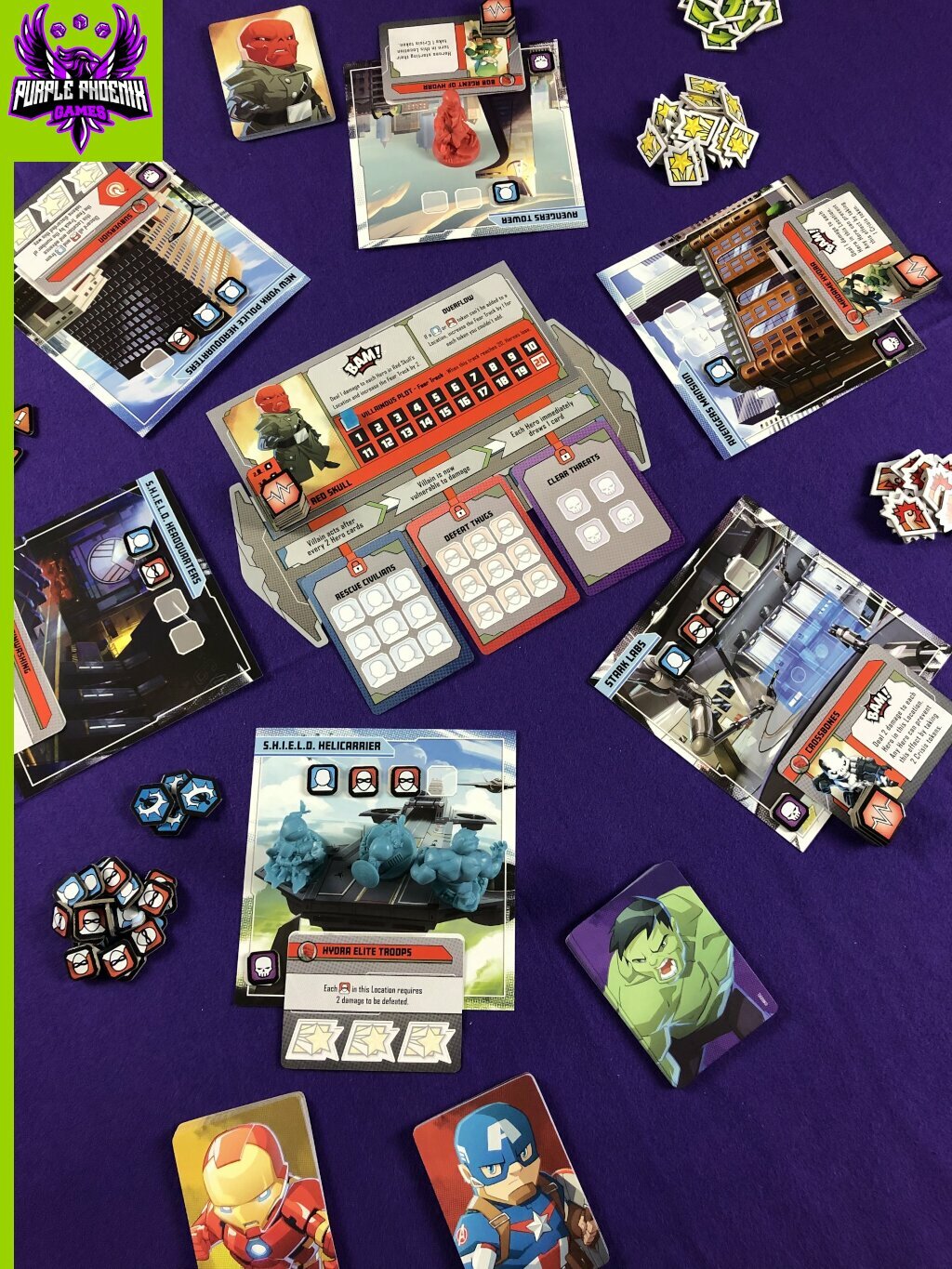
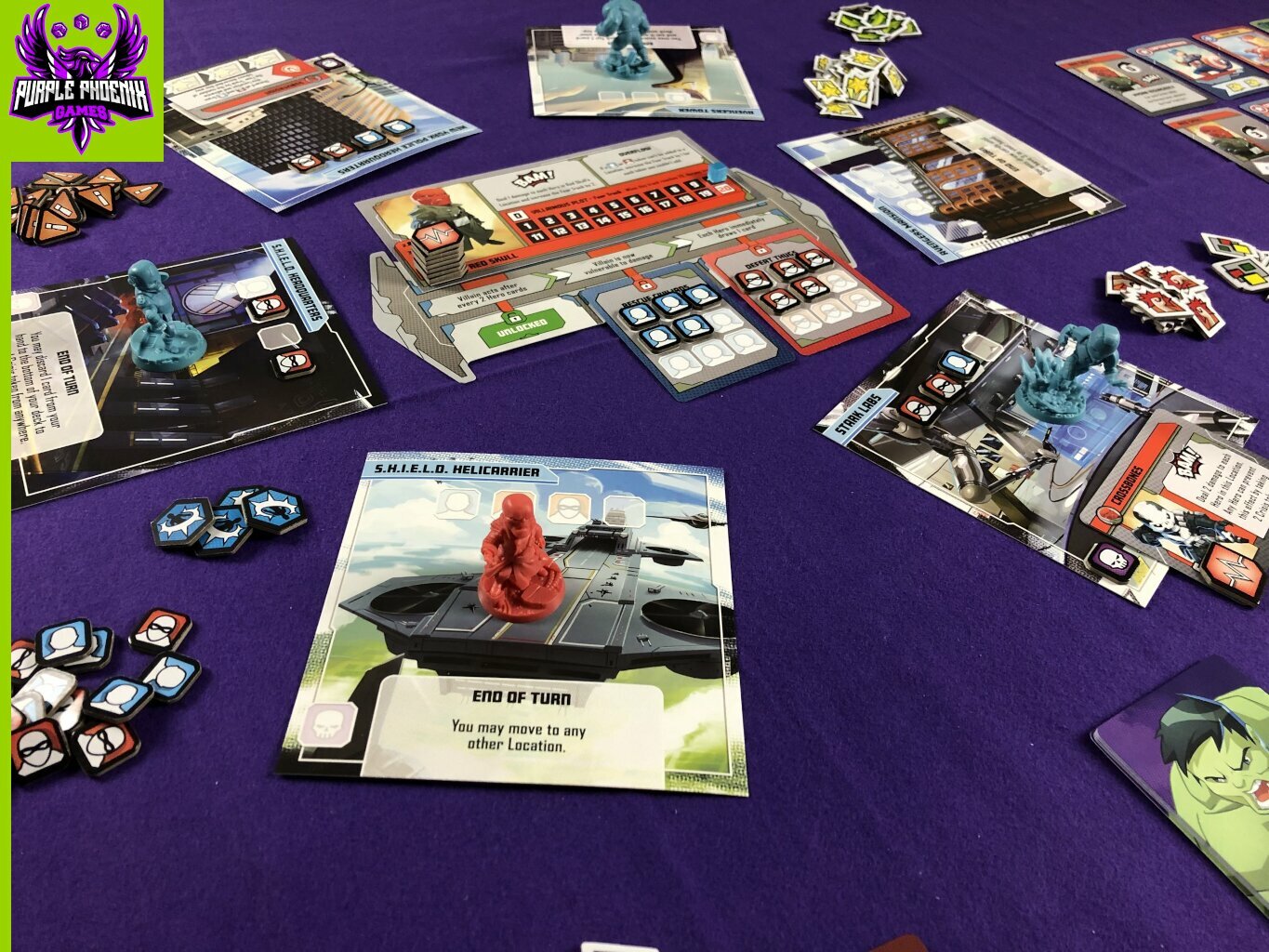
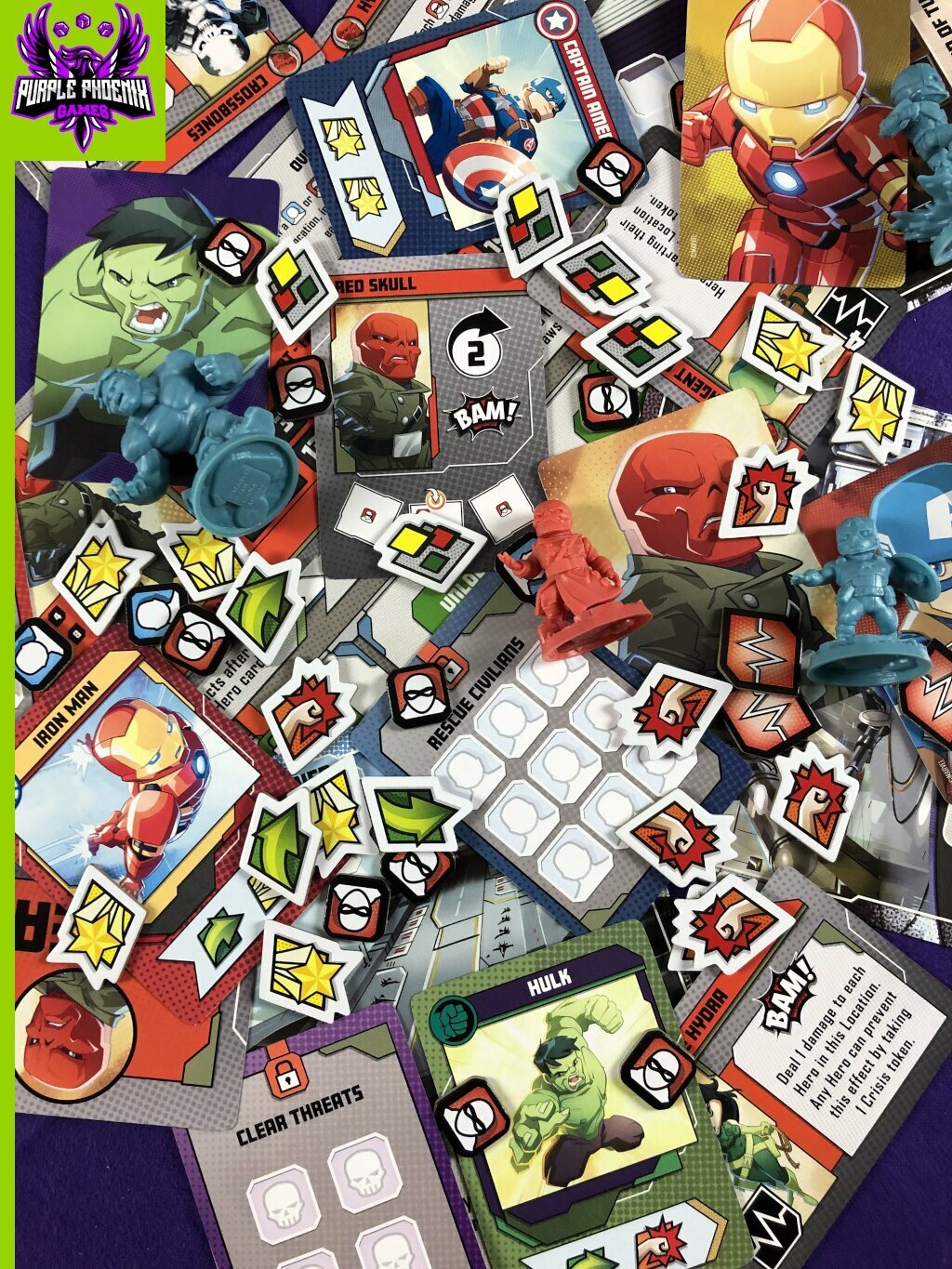

Charlie Cobra Reviews (1840 KP) rated the Xbox One version of Xuan Yuan Sword 7 in Video Games
Oct 4, 2021

Beautiful looking world and nice graphics (2 more)
Pretty enjoyable story and gameplay
Interesting mix of fantasy and history
Lacks the polish that could have made it great (2 more)
Too linear and doesn’t open up enough
Combat could have been further refined
Interesting and Ambitious but Ultimately Average
So to start this review I got to say that I'm pretty mixed on how I feel about this game. For one it definitely has a lot of potential and enough going for it that it could have been a really good. But on the other hand it had a lot of things that I feel could have been done better and falls far from being a great game to just around average for me. The story itself isn't terrible but it suffers from bad writing and performance of the voice actors. The world itself seems like it could have been a lot more interesting but it just wasn't engaging enough half the time.
It seemed like it was going to be an open world game but wound up being very linear in nature although it had aspects of an open world game like side quests, fast travel, and even treasure chests scattered throughout the game world as well. There's a climbing mechanic that seemed kind of pointless because it was pretty much just a cut scene of in game graphics of you climbing a little cliff or sometimes it would turn into an interactive part where you had to move the analog stick to move the character. Still it was better than these weird times that the game gave you control of the character for a scene in which your only movement was preset like a ride on a rail that couldn't veer off a road.
I liked that it was an action-RPG meaning instead of turn based combat like most RPG's it had an active combat system where you could move at your own leisure and consisted of hack and slash combat with some martial art skills, blocking, dodging, and some riposte (parrying). There are four basic martial art skills which can be learned as you progress through the game, Bull, Wolf, Bear, and Tiger. They become stronger and increase the length or hits of their combo the more you use them. A big draw back is that you could only equip or use two at one time although they can be changed at anytime through the talent menu. Then there are three special martial art skills which are Taowu, Tundou and ?
The combat was one of the things that had me really conflicted. A cool thing I liked about the combat was that there was a meter that would go up when you would attack an enemy and if it filled all the way you could perform an execution on them. Otherwise it was very unresponsive most of the time making dodging and parrying really hard and kind of useless. I found the blocking especially useless because of how much damage you still incurred. There is a skill tree for new martial arts and you can create and upgrade structures in Elysium that can enhance various things, such as weapon, armor, accessories and more. You can also use the fusion to capture the souls of enemies in combat and fuse them together in Elysium to equip them for bonus stats and effects.
Your able to carry items in your inventory which are mainly objects like items that don't do anything except advance the story or quest and some like healing weapons. There is an equipment screen for weapons and accessories but you only stay with one weapon the whole game. It does change and become stronger and its appearance changes too. You can even change outfits. I'm not sure if you get any in the game as the version I played came with a couple of additional weapons/costumes. You do wind up getting some party members which is customary of some RPG's and they help out by attacking enemies on their own. You can control them by activating some abilities or special attacks that have cooldown times for when you can use them again. There's a minigame called Zhuolu chess and it can be pretty fun and a nice change of pace but not what you were looking for when you bought the game.
You can save your game and recover health at random campfires throughout the game world as well as listen to some party dialogue when you choose to rest. The dialogue tends to repeat often and doesn't really advance the story much or fit where you are at in the story that often. These game mechanics are similar to Dark Souls as resting respawns enemies when you save at a bonfire and get healed too. As I mentioned earlier the game employs a fast travel system consisting of waypoints called guard stones that you can activate when found. There is an element of puzzle solving in the game but they don't seem to be that hard to figure out and some can even be skipped if you don't want to bother with it.
The graphics were pretty solid and the game surely looks good for the most part. The textures are sometimes rough in the environment and sometimes there's very noticeable instances of "pop-ins" but overall aesthetic and style is beautiful. You really never get to play games where you get to see ancient Chinese castles, cities, or kingdoms so that was nice. The leaves in the trees are even ruffled by the wind, which is a nice touch. The main characters like Zhao and his sister Xiang look great and so do most of the secondary characters like Chu-Hong and Mo Huang. It just makes it that more disappointing when you see sub-par detail in the NPC's and stiff cutscenes because you know they could have done better on those too. Maybe they didn't have enough time, man power or budget.
The music was probably one of the best additions to the game as a whole. Containing traditional Chinese sounds and instruments befitting the setting the music was great. There are some instances where there is no music and the void is filled with nothing but awkward silence or the sound of footsteps. Only the subpar voice acting fills the dead air and background music would have added more depth to certain parts and scenes of the game. There's no English dubbing for the voice acting in the game it's only in Mandarin/Chinese which isn't bad in itself except the performances are kind of hit and miss and not very balanced.
Verdict: [5/10]
The game seemed very rough around the edges, it lacked that "polished" feel that it would have gotten if it had been a "AAA" game instead of a "AA" game. It's linear aspects left little to no deviation for exploring the world other than the main quest making it feel like going through a tunnel from location to the next. The distances between the towns and villages also made the world feel really small which it probably was. The story and gameplay were enjoyable enough but writing and especially acting/voice acting in key cutscenes needed work. The combat was was so uninspired I felt like I was doing the same sword attacks the whole game and they never really changed. And last thing, even if it doesn't help or is in any way useful, I like to be able to make my character jump and this game didn't let you do that either. So in conclusion I have to give Xuan Yuan Sword 7 a 5/10. It's an average or ok game, which has it's moments but nothing to write home about. However if they make a Xuan Yuan Sword 8, I'd be looking forward to see what kind of improvements they would make in the next installment.
It seemed like it was going to be an open world game but wound up being very linear in nature although it had aspects of an open world game like side quests, fast travel, and even treasure chests scattered throughout the game world as well. There's a climbing mechanic that seemed kind of pointless because it was pretty much just a cut scene of in game graphics of you climbing a little cliff or sometimes it would turn into an interactive part where you had to move the analog stick to move the character. Still it was better than these weird times that the game gave you control of the character for a scene in which your only movement was preset like a ride on a rail that couldn't veer off a road.
I liked that it was an action-RPG meaning instead of turn based combat like most RPG's it had an active combat system where you could move at your own leisure and consisted of hack and slash combat with some martial art skills, blocking, dodging, and some riposte (parrying). There are four basic martial art skills which can be learned as you progress through the game, Bull, Wolf, Bear, and Tiger. They become stronger and increase the length or hits of their combo the more you use them. A big draw back is that you could only equip or use two at one time although they can be changed at anytime through the talent menu. Then there are three special martial art skills which are Taowu, Tundou and ?
The combat was one of the things that had me really conflicted. A cool thing I liked about the combat was that there was a meter that would go up when you would attack an enemy and if it filled all the way you could perform an execution on them. Otherwise it was very unresponsive most of the time making dodging and parrying really hard and kind of useless. I found the blocking especially useless because of how much damage you still incurred. There is a skill tree for new martial arts and you can create and upgrade structures in Elysium that can enhance various things, such as weapon, armor, accessories and more. You can also use the fusion to capture the souls of enemies in combat and fuse them together in Elysium to equip them for bonus stats and effects.
Your able to carry items in your inventory which are mainly objects like items that don't do anything except advance the story or quest and some like healing weapons. There is an equipment screen for weapons and accessories but you only stay with one weapon the whole game. It does change and become stronger and its appearance changes too. You can even change outfits. I'm not sure if you get any in the game as the version I played came with a couple of additional weapons/costumes. You do wind up getting some party members which is customary of some RPG's and they help out by attacking enemies on their own. You can control them by activating some abilities or special attacks that have cooldown times for when you can use them again. There's a minigame called Zhuolu chess and it can be pretty fun and a nice change of pace but not what you were looking for when you bought the game.
You can save your game and recover health at random campfires throughout the game world as well as listen to some party dialogue when you choose to rest. The dialogue tends to repeat often and doesn't really advance the story much or fit where you are at in the story that often. These game mechanics are similar to Dark Souls as resting respawns enemies when you save at a bonfire and get healed too. As I mentioned earlier the game employs a fast travel system consisting of waypoints called guard stones that you can activate when found. There is an element of puzzle solving in the game but they don't seem to be that hard to figure out and some can even be skipped if you don't want to bother with it.
The graphics were pretty solid and the game surely looks good for the most part. The textures are sometimes rough in the environment and sometimes there's very noticeable instances of "pop-ins" but overall aesthetic and style is beautiful. You really never get to play games where you get to see ancient Chinese castles, cities, or kingdoms so that was nice. The leaves in the trees are even ruffled by the wind, which is a nice touch. The main characters like Zhao and his sister Xiang look great and so do most of the secondary characters like Chu-Hong and Mo Huang. It just makes it that more disappointing when you see sub-par detail in the NPC's and stiff cutscenes because you know they could have done better on those too. Maybe they didn't have enough time, man power or budget.
The music was probably one of the best additions to the game as a whole. Containing traditional Chinese sounds and instruments befitting the setting the music was great. There are some instances where there is no music and the void is filled with nothing but awkward silence or the sound of footsteps. Only the subpar voice acting fills the dead air and background music would have added more depth to certain parts and scenes of the game. There's no English dubbing for the voice acting in the game it's only in Mandarin/Chinese which isn't bad in itself except the performances are kind of hit and miss and not very balanced.
Verdict: [5/10]
The game seemed very rough around the edges, it lacked that "polished" feel that it would have gotten if it had been a "AAA" game instead of a "AA" game. It's linear aspects left little to no deviation for exploring the world other than the main quest making it feel like going through a tunnel from location to the next. The distances between the towns and villages also made the world feel really small which it probably was. The story and gameplay were enjoyable enough but writing and especially acting/voice acting in key cutscenes needed work. The combat was was so uninspired I felt like I was doing the same sword attacks the whole game and they never really changed. And last thing, even if it doesn't help or is in any way useful, I like to be able to make my character jump and this game didn't let you do that either. So in conclusion I have to give Xuan Yuan Sword 7 a 5/10. It's an average or ok game, which has it's moments but nothing to write home about. However if they make a Xuan Yuan Sword 8, I'd be looking forward to see what kind of improvements they would make in the next installment.

Ryan Hill (152 KP) rated Wonder Woman (2017) in Movies
May 18, 2019

"I can save today, you can save the world"
Remember when some trickster claiming to be a former worker from Warner Bros. wrote an open letter saying that Wonder Woman was just another mess of a DC movie, et cetera? I remember how Patty Jenkins responded to that. She tweeted: "Just wait and you'll see".
Honestly, I don't know how anyone could even consider that there was the slightest chance of this movie not being good, and I'm gonna tell you why: this is the very first big female-led superhero movie, in which the title character also happens to be the greatest female superhero in history. If you really think that Patty Jenkins, also the first woman to ever direct a superhero movie of this caliber in a industry where women barely stand any chances to get to direct major blockbusters, would let this movie be anything less than great... You've got another thing coming, mate.
Wonder Woman is a traditional, oldschool superhero movie, but the first essentially feminist one at it, and they couldn't have chosen a better setting to tell this story, or a better character to star in it. The movie's social comments are strong and constantly present, but never forced, because it is only natural: by placing Diana, a princess raised in an island of warrior women, in the middle of the reality of World War I, the absurdities of the feminine role in the world - and so many other human corruptions - automatically come to light. The way Diana reacts to this world raises a great sense of awareness, with a touch of poignant humor to it. There is a very funny subtle arc of her wanting to take out her cloak, but not being able to because her armor is "barely any clothes", hinting not only at society's sexist feminine dressing code - which is still a thing today -, but also gradually adding power to the iconography of Wonder Woman in full costume; this is Wonder Woman's much awaited debut on the big screen in a solo movie, and like Superman and Batman before her, her first appearance needed to be something incredibly striking. Patty knew that, Gal knew that, and they made it happen. Even if we already saw her in BVS, the very first time Wonder Woman walks up in full costume here is undoubtedly one of the most iconic moments in superhero cinema.
Jenkins is extremely devoted to giving Wonder Woman the iconic debut film she deserves, and she nails it - there's quite a bit of remarkable shots and set pieces that let out the same imagetic power as in Donner's Superman, Burton's Batman or even Raimi's Spider-Man, and I must highlight the No Man's Land sequence. It's my favorite part of the movie; Jenkins and Heinberg carefully work on Diana's mindset as she first witness the horrors of human war, not being able to help everyone, horses being hurt so they can move faster, a mother and a child begging for help, and it all leads up to the powerful moment of a woman crossing the land no man could cross - and Heinberg's dialogue doesn't rely on obvious statements such as "fortunately I'm a woman" (I'm looking at you, Batwoman trailer), it simply lets the image strike us, because it is powerful enough by itself, and boy did that cause some serious goosebumps.
Speaking of dialogue... It's so terrific, so well written. The exchanges between Diana and Steve Trevor are very clever and funny, but most of all natural. All the characters are also extremely likable; Allan Heinberg's writing knows that not all of them can be given deep development, but nonetheless he gives them stories, personalities and purposes, and that - plus the charismatic performances - makes them very empathetic. The villains are not as remarkable as in some of the other DCEU films, but they didn't need to be; the movie doesn't require in-depth arcs from its villains. They have a strong presence when they're in scene and a well elaborated lore, and that's everything they need.
Contrary to the Nordic mythology depicted in the MCU, here we are talking about real gods, true deities, not superpowerful aliens that only strike a similar image - and that also brings a few narrative dangers along with it, after all, it was in greek mythological stories that the concept of Deus Ex Machina first appeared. Heinberg's screenplay, though, makes a few clever twists in that mythology to avoid easy solutions, which adds to the storytelling, the world building and the developing of the themes as well. The lore surrounding the God of War Ares, for example, is not a simple Diabolus Ex Machina as "he influences men to war and if you kill him every man goes back to being good and everything's alright", no, it's more narratively complicated and socially engaging than that.
And Gal Gadot... I'm at a loss for words. I'll confess right here that when she was first announced as Wonder Woman, I was one of the few who were very opposed to that casting. I've never been so wrong in my life, and I've never been so happy about it. She really is Wonder Woman. She's so graceful and adorable, but a major badass when she needs to be. The way she moves, the way she curiously looks at things, the way she speaks, and the way she incarnates Diana's evolving from her naive beginnings to the wise warrior... She's not only an icon, she's a true hero. Comparisons to Christopher Reeve's Superman were made for good reasons.
Chris Pine is also great, he walks perfectly in the line between funny and serious, Steve Trevor is a darling character and his chemistry with Gal is on point. Their relationship is very well constructed and becomes highly emotional by the end - there are scenes that filled my heart with joy, and others that made it ache.
The action is exciting and full of originality, and I like how Jenkins uses slow-motion differently than Zack Snyder. I know that Snyder helped her direct some of the action sequences, which is understandable since Jenkins had no experience with this type of movie, but you can tell it's not the same. In the fights themselves, there's this feel of sensibility to how these people react to Diana, and it's slightly different from the typical "regular people react to superhumans among them" trope. The cinematography is very keen on portraying the difference between Themyscira - an island of colors and natural beauty - and "jolly ol' London" - desaturated and smoggy, a scenario in which Diana's colorful armor shines in a most beautiful contrast.
And the soundtrack. Rupert Gregson-Williams made a beautiful score that brings out the best in every scene. It's heroic, very heartfelt, and loyal to the foundations of what makes superhero music so memorable. Gregson-Williams adds new themes to compose Wonder Woman's musical identity, but Hans Zimmer's main theme from BVS still lives, and it plays in some heart-pounding scenes. I love that they're dedicating that much attention to the musical continuity, because amongst Marvel's many qualities, they're doing a lousy job in that area. Wonder Woman's theme is the most catchy superhero theme in a long time, it quickly gained a lot of appreciation and by continuing on using it, Gregson-Williams collaborates to making Wonder Woman the strong cinematic icon she's setting out to be.
The irregular reception of previous DCEU movies also extols the impact of Wonder Woman, as do the distinct styles between the films. One of the DCEU's biggest virtues is that singularity of each film; be it a near disaster movie epic such as Man Of Steel, a complex deconstruction of heroic values such as Batman v Superman, an stylish chaos such as Suicide Squad or a traditional, graceful superhero film such as Wonder Woman, these movies are all in the same universe, and that very fact is an example of its richness. A lot of people will think Wonder Woman is the best DCEU movie of the lot, some will stick to BVS, others to MOS, maybe for some it's Shazam, but that's the fun of it: we can discuss this forever. Each of these movies mean different things to different people, we're way past simply labelling one as "better" and the other as "worse".
Wonder Woman, however, is not simply a movie about a very strong woman. It's an achievement for every woman. There were tons of girls dressed up as Wonder Woman in the theater, and just seeing how ecstatic they were after the movie brought me joy. There were tons of applause. It's a mark. Be that as it may, Wonder Woman will be remembered as the most impactful superhero film of its time. In 1978, Superman showed to the world how a man could fly; in 2017, Wonder Woman showed to the world how a woman can fight.
Honestly, I don't know how anyone could even consider that there was the slightest chance of this movie not being good, and I'm gonna tell you why: this is the very first big female-led superhero movie, in which the title character also happens to be the greatest female superhero in history. If you really think that Patty Jenkins, also the first woman to ever direct a superhero movie of this caliber in a industry where women barely stand any chances to get to direct major blockbusters, would let this movie be anything less than great... You've got another thing coming, mate.
Wonder Woman is a traditional, oldschool superhero movie, but the first essentially feminist one at it, and they couldn't have chosen a better setting to tell this story, or a better character to star in it. The movie's social comments are strong and constantly present, but never forced, because it is only natural: by placing Diana, a princess raised in an island of warrior women, in the middle of the reality of World War I, the absurdities of the feminine role in the world - and so many other human corruptions - automatically come to light. The way Diana reacts to this world raises a great sense of awareness, with a touch of poignant humor to it. There is a very funny subtle arc of her wanting to take out her cloak, but not being able to because her armor is "barely any clothes", hinting not only at society's sexist feminine dressing code - which is still a thing today -, but also gradually adding power to the iconography of Wonder Woman in full costume; this is Wonder Woman's much awaited debut on the big screen in a solo movie, and like Superman and Batman before her, her first appearance needed to be something incredibly striking. Patty knew that, Gal knew that, and they made it happen. Even if we already saw her in BVS, the very first time Wonder Woman walks up in full costume here is undoubtedly one of the most iconic moments in superhero cinema.
Jenkins is extremely devoted to giving Wonder Woman the iconic debut film she deserves, and she nails it - there's quite a bit of remarkable shots and set pieces that let out the same imagetic power as in Donner's Superman, Burton's Batman or even Raimi's Spider-Man, and I must highlight the No Man's Land sequence. It's my favorite part of the movie; Jenkins and Heinberg carefully work on Diana's mindset as she first witness the horrors of human war, not being able to help everyone, horses being hurt so they can move faster, a mother and a child begging for help, and it all leads up to the powerful moment of a woman crossing the land no man could cross - and Heinberg's dialogue doesn't rely on obvious statements such as "fortunately I'm a woman" (I'm looking at you, Batwoman trailer), it simply lets the image strike us, because it is powerful enough by itself, and boy did that cause some serious goosebumps.
Speaking of dialogue... It's so terrific, so well written. The exchanges between Diana and Steve Trevor are very clever and funny, but most of all natural. All the characters are also extremely likable; Allan Heinberg's writing knows that not all of them can be given deep development, but nonetheless he gives them stories, personalities and purposes, and that - plus the charismatic performances - makes them very empathetic. The villains are not as remarkable as in some of the other DCEU films, but they didn't need to be; the movie doesn't require in-depth arcs from its villains. They have a strong presence when they're in scene and a well elaborated lore, and that's everything they need.
Contrary to the Nordic mythology depicted in the MCU, here we are talking about real gods, true deities, not superpowerful aliens that only strike a similar image - and that also brings a few narrative dangers along with it, after all, it was in greek mythological stories that the concept of Deus Ex Machina first appeared. Heinberg's screenplay, though, makes a few clever twists in that mythology to avoid easy solutions, which adds to the storytelling, the world building and the developing of the themes as well. The lore surrounding the God of War Ares, for example, is not a simple Diabolus Ex Machina as "he influences men to war and if you kill him every man goes back to being good and everything's alright", no, it's more narratively complicated and socially engaging than that.
And Gal Gadot... I'm at a loss for words. I'll confess right here that when she was first announced as Wonder Woman, I was one of the few who were very opposed to that casting. I've never been so wrong in my life, and I've never been so happy about it. She really is Wonder Woman. She's so graceful and adorable, but a major badass when she needs to be. The way she moves, the way she curiously looks at things, the way she speaks, and the way she incarnates Diana's evolving from her naive beginnings to the wise warrior... She's not only an icon, she's a true hero. Comparisons to Christopher Reeve's Superman were made for good reasons.
Chris Pine is also great, he walks perfectly in the line between funny and serious, Steve Trevor is a darling character and his chemistry with Gal is on point. Their relationship is very well constructed and becomes highly emotional by the end - there are scenes that filled my heart with joy, and others that made it ache.
The action is exciting and full of originality, and I like how Jenkins uses slow-motion differently than Zack Snyder. I know that Snyder helped her direct some of the action sequences, which is understandable since Jenkins had no experience with this type of movie, but you can tell it's not the same. In the fights themselves, there's this feel of sensibility to how these people react to Diana, and it's slightly different from the typical "regular people react to superhumans among them" trope. The cinematography is very keen on portraying the difference between Themyscira - an island of colors and natural beauty - and "jolly ol' London" - desaturated and smoggy, a scenario in which Diana's colorful armor shines in a most beautiful contrast.
And the soundtrack. Rupert Gregson-Williams made a beautiful score that brings out the best in every scene. It's heroic, very heartfelt, and loyal to the foundations of what makes superhero music so memorable. Gregson-Williams adds new themes to compose Wonder Woman's musical identity, but Hans Zimmer's main theme from BVS still lives, and it plays in some heart-pounding scenes. I love that they're dedicating that much attention to the musical continuity, because amongst Marvel's many qualities, they're doing a lousy job in that area. Wonder Woman's theme is the most catchy superhero theme in a long time, it quickly gained a lot of appreciation and by continuing on using it, Gregson-Williams collaborates to making Wonder Woman the strong cinematic icon she's setting out to be.
The irregular reception of previous DCEU movies also extols the impact of Wonder Woman, as do the distinct styles between the films. One of the DCEU's biggest virtues is that singularity of each film; be it a near disaster movie epic such as Man Of Steel, a complex deconstruction of heroic values such as Batman v Superman, an stylish chaos such as Suicide Squad or a traditional, graceful superhero film such as Wonder Woman, these movies are all in the same universe, and that very fact is an example of its richness. A lot of people will think Wonder Woman is the best DCEU movie of the lot, some will stick to BVS, others to MOS, maybe for some it's Shazam, but that's the fun of it: we can discuss this forever. Each of these movies mean different things to different people, we're way past simply labelling one as "better" and the other as "worse".
Wonder Woman, however, is not simply a movie about a very strong woman. It's an achievement for every woman. There were tons of girls dressed up as Wonder Woman in the theater, and just seeing how ecstatic they were after the movie brought me joy. There were tons of applause. It's a mark. Be that as it may, Wonder Woman will be remembered as the most impactful superhero film of its time. In 1978, Superman showed to the world how a man could fly; in 2017, Wonder Woman showed to the world how a woman can fight.

Hadley (567 KP) rated Those Bones Are Not My Child in Books
Nov 12, 2019


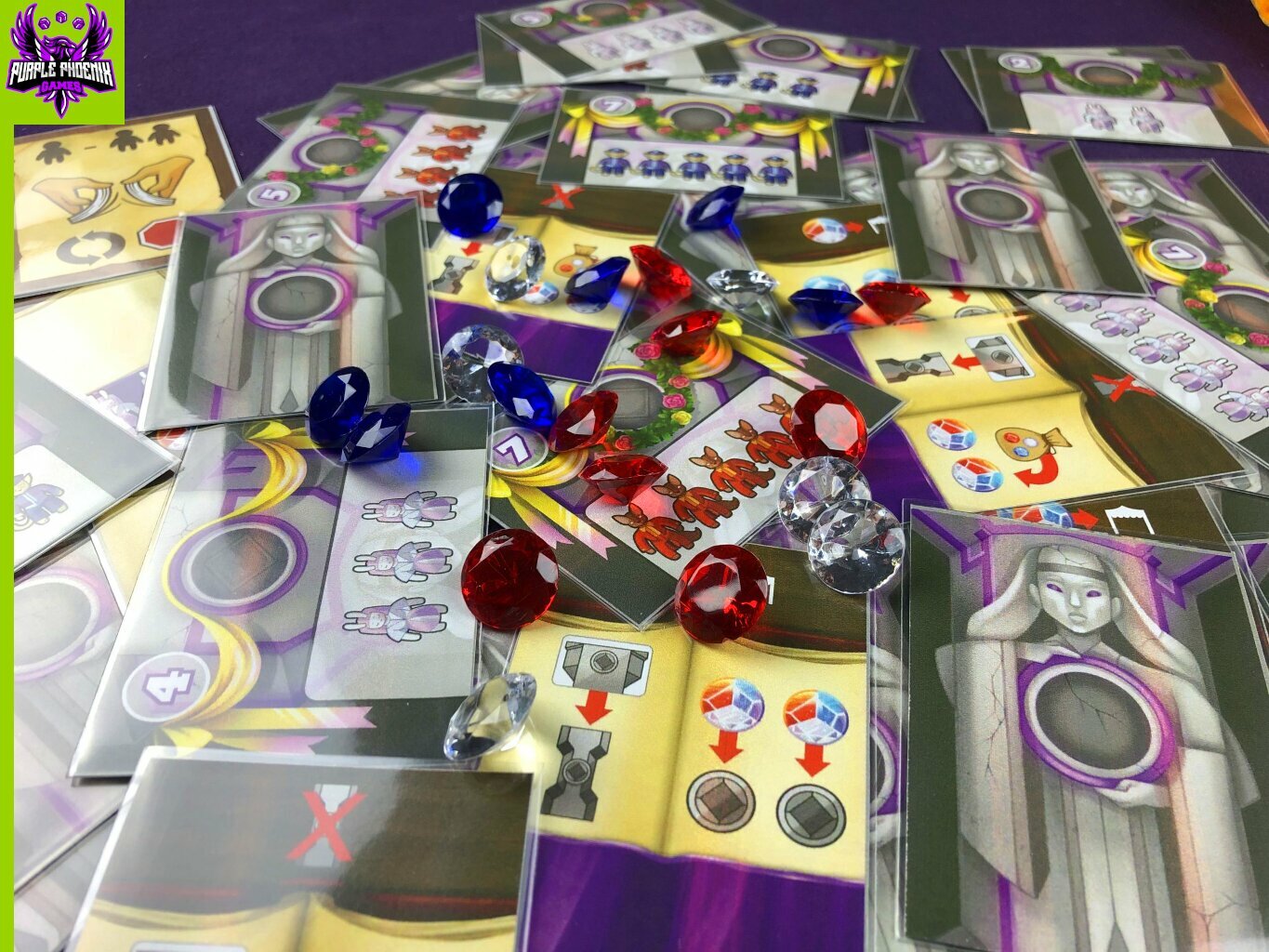
A different type of True Crime book (1 more)
Things you probably didn't know about the case
Writing transitions are confusing (1 more)
Smash poetry breaks up the flow
Toni Cade Bambara, a writer, documentary filmmaker and screenwriter, gives True Crime readers a unique viewpoint of the real Atlanta Child Murders. Bambara mostly writes from the eyes of Marzala, a mother of three whose oldest son goes missing during one of the worst murder sprees in Atlanta's history. Marzala and her family were not actual people during this time- - - all of them are based off of parents and siblings of the real victims. Not soon after Marzala does everything she can with the police to find her son, she joins a group of African-Americans that are outraged by the lack of progress to catch who is killing Atlanta's black children. This group forms what is called STOP (a citizen-run task force). For the majority of the book, Marzala with most of the black community in the area typed out letters to prominent government officials asking for help to stop the murders, also using Vietnam vets in the area to use their tracking skills to keep an eye on suspects, and investigating buildings that police refused to believe had anything to do with the childrens' disappearances and/or murders, which Bambara did an amazing job putting all the real facts together of the actual community members that were involved with this at the time. This story is upsetting, but enlightening on how politics may have caused so many children to be murdered. This is a story no reader will ever forget.
Bambara writes not in a normal narrative - - - just telling a story from specific viewpoints, but she often breaks off into smash poetry to depict a character's state-of-mind, which, sometimes can be off putting for the reader, breaking the flow of the story. Yet, the use of smash poetry combined with the era and the heart breaking subject at hand, separates Those Bones Are Not My Child from every True Crime book I have ever read. But a note for fans of True Crime, this story is from the view point of the victims' families and the search they went through to try and catch the murderer(s), unlike most TC books, which follow the police through the investigation leading to, usually, the capture of the perpetrator. From living in Atlanta during the time of the murders, Bambara was able to reconstruct the life of a black family in 1980's Georgia, while focusing on the effect these terrible crimes had on the surrounding community. Bambara did an amazing job on what most writers cannot.
The amount of characters, specifically the fictional ones, are very well created. She describes just enough to give readers the ability to tell them apart, showing every now and then from their own viewpoints. Out of all the characters, I came to really like Zala's two other children: Kenti and Kofi. One particular scene shows the strain of Sonny's disappearance on their family: " Zala parked the comb again and sat back. 'Listen, you two.' Kofi dropped down onto his knees. 'The police and the newspapers don't know what the hell is going on, so they feel stupid, because they're supposed to know, they're trained to know, they're paid to know. It's their job. Understand? But it's hard for grown-ups to admit they're stupid, especially if they're professionals like police and reporters. So they blame the children. Or they ignore them and fill up the papers with the hostages in Iran. Understand? And now... Jesus... they've got people calling those kids juvenile delinquents.'
'Don't cry.' Kenti tried to lean into her lap and got pushed away.
'They don't know a damn thing and they act like they don't want to know. So they blame the kids 'cause they can't speak up for themselves. They say the kids had no business being outdoors, getting themselves in trouble.'
'You let us go outdoors.'
'Of course I do, baby. We go lots of places, 'cause a lot of people fought hard for our right to go any damn where we please. But when the children go out like they've a right to and some maniac grabs them, then it's the children's fault or the parents who should've been watching every minute, like we don't have to work like dogs just to put food on the table.'
Kofi walked on his knees towards the bed, but he didn't lean on her like he wanted 'cause she might push him away. So he just put his hand on the mattress next to hers."
During the Atlanta Child Murders, victims were random, except for that they were children from the same neighborhood, and they were African-American. At first, police didn't believe a serial murderer was going around abducting children, but rather that 'poor, broken' families were killing their own. In the Prologue, Bambara shows that the victims' families and private detectives came up with more ideas of the motive than the police did:
" White cops taking license in Black neighborhoods.
The Klan and other Nazi thugs on the rampage.
Diabolical scientists experimenting on Third World people.
Demonic cults engaging in human sacrifices.
A 'Nam vet unable to make the transition.
UFO aliens conducting exploratory surgery.
Whites avenging Dewey Baugus, a white youth beaten to death in spring '79, allegedly by Black youths.
Parents of a raped child running amok with 'justice.'
Porno filmmakers doing snuff flicks for entertainment.
A band of child molesters covering their tracks.
New drug forces killing the young (unwitting?) couriers of the old in a bid for turf.
Unreconstructed peckerwoods trying to topple the Black administration.
Plantation kidnappers of slave labor issuing the pink slip.
White mercenaries using Black targets to train death squadrons for overseas jobs and for domestic wars to come. "
All of these theories are explored with evidence in Those Bones Are Not My Child. One scene in Part III, Zala's cop friend, B.J. shows up to her house to tell her to stop bringing attention to the investigation, " 'That Eubanks woman - - - your husband's friend? - - - she said you were bringing in the TV networks to blow the case open. I thought we had an agreement to keep each other informed. This morning I find out through the grapevine that you parents got a medium stashed in a hotel here in town, some woman who's been making headlines up north with cases that supposedly have the authorities stumped. If you knew how much work has been done on this case - - - no, listen, don't interrupt me. Then I find out - - - and not from you - - - that some of you parents are planning to tour the country cracking on the investigation. That's not too smart. And you should have told me.' " These two may have been fictional characters, but in Bambara's Acknowledgments, she states that all scenarios were true, and that she made B.J. to tell about the actual police officers who were involved with the investigation.
The tension between the police and the public is felt throughout the entire story. Despite all of the work the citizen task force put in, police arrested a man named Wayne Williams for the murder of two adult victims (who, due to their mental age, which was stated to be that of children, were placed on the victims' list of the Atlanta Child Murders): " Wayne Williams, charged with the murder of twenty-seven-year-old Nathaniel Cater and implicated in the murder of the other adults and children on the official list..." Zala, having worked for almost a year at the STOP offices, she, along with most of the community, doubt that Williams was a lone killer or even the killer at all. Williams never stood trial for the childrens' murders, but the police informed the public that he did it, case closed - - - although, after Williams' arrest, children were still being abducted and their bodies were still being found. Even after Williams' trial and the guilty verdict for two adult victims, some people stuck around to continue to investigate and claim Williams a 'scapegoat' of politics: " There were still pockets of interest and people who wouldn't let the case go. James Baldwin had been coming to town off and on; a book was rumored. Sondra O'Neale, the Emory University professor, hadn't abandoned her research, either. From time to time, TV and movie types were in the city poking around for an angle. Camille Bell was moving to Tallahassee to write up the case from the point of view of the STOP committee. The vets had taken over The Call now that Speaker was working full-time with the Central American Committee. The Revolutionary Communist Party kept running pieces on the case in the Revolutionary Worker. Whenever Abby Mann sent down a point man for his proposed TV docudrama, the Atlanta officials and civil rights leaders would go off the deep end. " At the end of it all, the questions still remain: did Williams kill all of those children by himself? Was he part of a pornographic cult that killed the children? Or is Williams completely innocent, and the murderer(s) are still out there? In Those Bones Are Not My Child, I guarantee you will be left questioning if the police were right.
All in all, the writing transitions can become confusing sometimes, especially the interludes of smash poetry, but I highly recommend this book to people who like the True Crime genre, especially of any interest in this specific case.
Bambara writes not in a normal narrative - - - just telling a story from specific viewpoints, but she often breaks off into smash poetry to depict a character's state-of-mind, which, sometimes can be off putting for the reader, breaking the flow of the story. Yet, the use of smash poetry combined with the era and the heart breaking subject at hand, separates Those Bones Are Not My Child from every True Crime book I have ever read. But a note for fans of True Crime, this story is from the view point of the victims' families and the search they went through to try and catch the murderer(s), unlike most TC books, which follow the police through the investigation leading to, usually, the capture of the perpetrator. From living in Atlanta during the time of the murders, Bambara was able to reconstruct the life of a black family in 1980's Georgia, while focusing on the effect these terrible crimes had on the surrounding community. Bambara did an amazing job on what most writers cannot.
The amount of characters, specifically the fictional ones, are very well created. She describes just enough to give readers the ability to tell them apart, showing every now and then from their own viewpoints. Out of all the characters, I came to really like Zala's two other children: Kenti and Kofi. One particular scene shows the strain of Sonny's disappearance on their family: " Zala parked the comb again and sat back. 'Listen, you two.' Kofi dropped down onto his knees. 'The police and the newspapers don't know what the hell is going on, so they feel stupid, because they're supposed to know, they're trained to know, they're paid to know. It's their job. Understand? But it's hard for grown-ups to admit they're stupid, especially if they're professionals like police and reporters. So they blame the children. Or they ignore them and fill up the papers with the hostages in Iran. Understand? And now... Jesus... they've got people calling those kids juvenile delinquents.'
'Don't cry.' Kenti tried to lean into her lap and got pushed away.
'They don't know a damn thing and they act like they don't want to know. So they blame the kids 'cause they can't speak up for themselves. They say the kids had no business being outdoors, getting themselves in trouble.'
'You let us go outdoors.'
'Of course I do, baby. We go lots of places, 'cause a lot of people fought hard for our right to go any damn where we please. But when the children go out like they've a right to and some maniac grabs them, then it's the children's fault or the parents who should've been watching every minute, like we don't have to work like dogs just to put food on the table.'
Kofi walked on his knees towards the bed, but he didn't lean on her like he wanted 'cause she might push him away. So he just put his hand on the mattress next to hers."
During the Atlanta Child Murders, victims were random, except for that they were children from the same neighborhood, and they were African-American. At first, police didn't believe a serial murderer was going around abducting children, but rather that 'poor, broken' families were killing their own. In the Prologue, Bambara shows that the victims' families and private detectives came up with more ideas of the motive than the police did:
" White cops taking license in Black neighborhoods.
The Klan and other Nazi thugs on the rampage.
Diabolical scientists experimenting on Third World people.
Demonic cults engaging in human sacrifices.
A 'Nam vet unable to make the transition.
UFO aliens conducting exploratory surgery.
Whites avenging Dewey Baugus, a white youth beaten to death in spring '79, allegedly by Black youths.
Parents of a raped child running amok with 'justice.'
Porno filmmakers doing snuff flicks for entertainment.
A band of child molesters covering their tracks.
New drug forces killing the young (unwitting?) couriers of the old in a bid for turf.
Unreconstructed peckerwoods trying to topple the Black administration.
Plantation kidnappers of slave labor issuing the pink slip.
White mercenaries using Black targets to train death squadrons for overseas jobs and for domestic wars to come. "
All of these theories are explored with evidence in Those Bones Are Not My Child. One scene in Part III, Zala's cop friend, B.J. shows up to her house to tell her to stop bringing attention to the investigation, " 'That Eubanks woman - - - your husband's friend? - - - she said you were bringing in the TV networks to blow the case open. I thought we had an agreement to keep each other informed. This morning I find out through the grapevine that you parents got a medium stashed in a hotel here in town, some woman who's been making headlines up north with cases that supposedly have the authorities stumped. If you knew how much work has been done on this case - - - no, listen, don't interrupt me. Then I find out - - - and not from you - - - that some of you parents are planning to tour the country cracking on the investigation. That's not too smart. And you should have told me.' " These two may have been fictional characters, but in Bambara's Acknowledgments, she states that all scenarios were true, and that she made B.J. to tell about the actual police officers who were involved with the investigation.
The tension between the police and the public is felt throughout the entire story. Despite all of the work the citizen task force put in, police arrested a man named Wayne Williams for the murder of two adult victims (who, due to their mental age, which was stated to be that of children, were placed on the victims' list of the Atlanta Child Murders): " Wayne Williams, charged with the murder of twenty-seven-year-old Nathaniel Cater and implicated in the murder of the other adults and children on the official list..." Zala, having worked for almost a year at the STOP offices, she, along with most of the community, doubt that Williams was a lone killer or even the killer at all. Williams never stood trial for the childrens' murders, but the police informed the public that he did it, case closed - - - although, after Williams' arrest, children were still being abducted and their bodies were still being found. Even after Williams' trial and the guilty verdict for two adult victims, some people stuck around to continue to investigate and claim Williams a 'scapegoat' of politics: " There were still pockets of interest and people who wouldn't let the case go. James Baldwin had been coming to town off and on; a book was rumored. Sondra O'Neale, the Emory University professor, hadn't abandoned her research, either. From time to time, TV and movie types were in the city poking around for an angle. Camille Bell was moving to Tallahassee to write up the case from the point of view of the STOP committee. The vets had taken over The Call now that Speaker was working full-time with the Central American Committee. The Revolutionary Communist Party kept running pieces on the case in the Revolutionary Worker. Whenever Abby Mann sent down a point man for his proposed TV docudrama, the Atlanta officials and civil rights leaders would go off the deep end. " At the end of it all, the questions still remain: did Williams kill all of those children by himself? Was he part of a pornographic cult that killed the children? Or is Williams completely innocent, and the murderer(s) are still out there? In Those Bones Are Not My Child, I guarantee you will be left questioning if the police were right.
All in all, the writing transitions can become confusing sometimes, especially the interludes of smash poetry, but I highly recommend this book to people who like the True Crime genre, especially of any interest in this specific case.